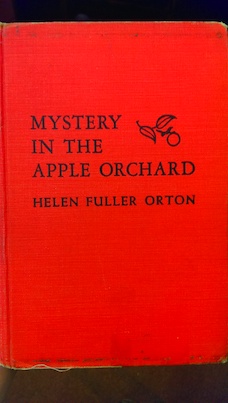
Mystery in the Apple Orchard by Helen Fuller Orton, 1954.
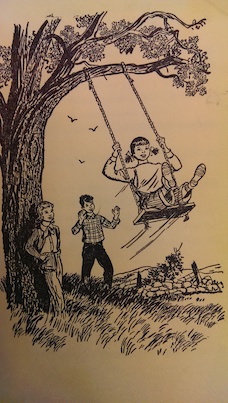
Dee Waters (age nine), her brother Ronnie (age eleven), and the other neighborhood children enjoy playing in the nearby apple orchard. The orchard was planted by Dee and Ronnie’s grandfather, and the trees are all different types of apple. Sometimes, the children take a lunch with them and spend hours climbing trees and playing. They like to watch the animals there, like the squirrels and crows, running around and hiding things in the trees. There is also a swing hung in one of the trees.
The Waters’ housekeeper, Mrs. Brown, lives in the city and commutes to her job in the country. She also has a son, Timmy, and she’s been concerned about him. Timmy is recovering from a broken leg. The bullies in his neighborhood dared him to climb a tall pole, and he fell. Although Timmy’s been out of the hospital, he hasn’t been getting enough fresh air and time outdoors in the city because they don’t live near a park. Dee and Ronnie don’t know Timmy, but hearing that he’s been unwell, they suggest that Mrs. Brown bring him along the next time she comes so that they can show Timmy the apple orchard. The children’s mother thinks that’s a good idea and also urges Mrs. Brown to bring Timmy for a visit.
Timmy is a little younger than Dee and Ronnie, and he can’t play many games with the children yet because he still walks with a crutch and can’t run. Still, he is fascinated by the animals in the orchard and enjoys watching them. He doesn’t see many wild animals in the city.
Most of the other children in the area are nice to Timmy, but Gloria is a little bit of a snob. Ronnie finds Gloria annoying because she is so prissy and extra careful about her clothes, and on Timmy’s first day in the orchard, Gloria shows up with a ring that she says has a real diamond and a family. The other children don’t believe her at first because it would be silly to wear an old, valuable ring to an apple orchard, especially when it looks so loose on her finger. Ronnie warns her that it could get lost, but Gloria tells him to mind his own business. She also tries to cheat when they play hide-and-seek, asking Timmy to tell her where everyone is because he can’t play the game anyway. Timmy refuses to help her cheat, and Gloria leaves in a huff. Because this is a mystery story, you can see where this is probably leading.

When Timmy comes the next time, the children decide to pretend that they’re going on trips by airplanes, with the trees in the orchard representing the planes. Timmy is sad that he can’t climb with the others, so they make him the ticket agent in the airport. Gloria shows up again, still with her diamond ring, and the other children again warn her that she could lose it in the orchard. Gloria says that’s impossible because she tied it to her finger, and she shows the the string. (What was it they said about the Titanic being unsinkable?)
Naturally, the ring gets in the way while Gloria is playing with the others, catching on a twig in a tree. They have to untie the string to get her loose. The other children tell Gloria to put the ring somewhere safe while she plays, suggesting that Timmy the ticket agent could watch it. However, Gloria decides to put the ring on a stone near the old well that has been filled in. (Considering that there are small animals in the orchard that happen to like shiny things, this was not the best decision.)

Sure enough, by the time Gloria comes down from her tree and her imaginary flight to Paris, her ring is gone. Naturally, Gloria is upset and admits that she was wearing the ring without her mother’s permission. (Gloria likes to show off.) She accuses one of the other children of taking the ring. Timmy seems like the most logical suspect, since he was on the ground while the others were in the trees, but he denies it, saying that he closed his eyes so he could imagine a flight, like the others were doing. Dee suggests that an animal could have taken the ring. Earlier, a chipmunk carried off the piece of string. On the other hand, crows also like shiny things. Could the crow have swooped down and carried it away?
Gloria still insists that Timmy took the ring, and she threatens to tell her mother that he stole it. Can the others find the ring before Timmy is labeled as a thief?
It take awhile for the other children to find Gloria’s ring, and because they failed to find it with the animals right away, some readers might wonder whether a human was responsible for taking. However, the mystery itself is very simple and wouldn’t really surprise anyone but young children. In the end, though, the important point is that Timmy is so motivated to find the ring and clear his name that he finds the courage to climb a tree again. He has healed from his broken leg more than even he thought he had. Before coming to the country, the doctor had told him that he could stop using his crutch, but he hesitated to do that because he was so afraid of re-injuring himself. Once he gets the courage to try not using his crutch, he discovers that he can also do many other things, although he does freeze up when trying to come back down the tree and needs the help of a couple of telephone linesmen to get back down. The linesmen tell him that it’s okay and that God has smiled on him for helping him to improve and do what he needed to do. Timmy is reassured by the discovery that he can do more than he thought he could, and his mother and Mrs. Waters decide that the Browns should move to the country permanently so that Mrs. Brown won’t have to commute to work and Timmy can have more fresh air, playing with the other children in the apple orchard.
This book is available to borrow for free online through Internet Archive.


 Jestress's Forgotten Books and Stories