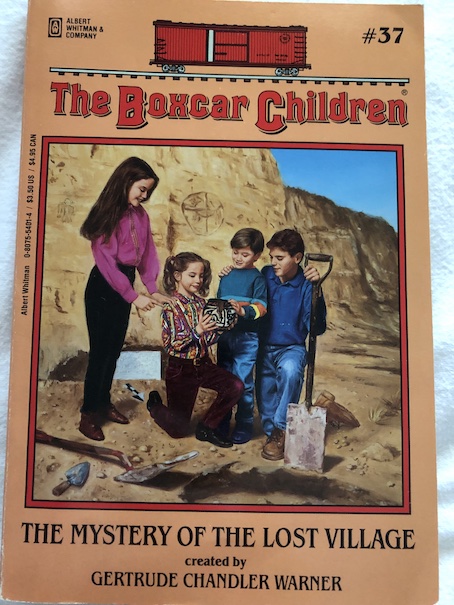
#37 The Mystery of the Lost Village by Gertrude Chandler Warner, 1993.
Grandfather Alden is going on a fishing trip with a friend, and he arranges for his grandchildren to stay with a family on a Navajo reservation. They’ve never been to a reservation before, and there will be hiking and a powwow. The kids are all eager to go!
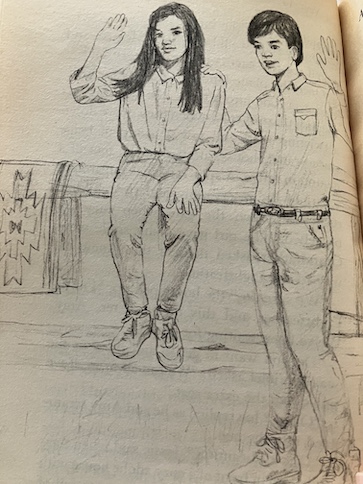
The family the Aldens are staying with is the Lightfeathers, and they have two children about the same age as the Aldens, Joe and Amy. The Lightfeathers tell the Aldens interesting things about Navajo history, culture, and crafts. What grabs their attention the most is a story about an ancient village nearby that was abandoned due to drought. The stories that have been passed down through the generations tell them roughly where the village was supposed to be, but the remains of the lost village have never been found.
Joe, Amy, and the Aldens ask if they could try digging for the lost village. Mrs. Lightfeather once studied archaeology, and they ask her if she can help them. Mrs. Lightfeather says that, although the village may be gone, traces of it should be left. The children begin laying out an orderly dig and start their search. They find some arrowheads and pottery, but when they show Mrs. Lightfeather what they’ve found, she says that they can’t continue their dig for much longer. The adults have just heard that a developer is taking over the land to build vacation homes. The children are dismayed when they find out that the developer is going to clear all of the trees. Of course, if the children can find signs of the lost village, the site would become an archaeological site, and the developer would have to stop. They only have two weeks to find some evidence of the lost village before the development starts!
There are some suspicious people hanging around. Michael Runningdeer, who works for the real estate developer, has been checking the boundaries of the reservation to check where they can develop. While they’re working on their dig, the kids meet a woman called Rita Neville, who says that she’s working on a documentary. Ted Clark is a genealogist who says that he has come to the reservation to trace his family’s roots, but Amy thinks it’s strange that he doesn’t seem to know things that someone with Navajo roots would usually know.
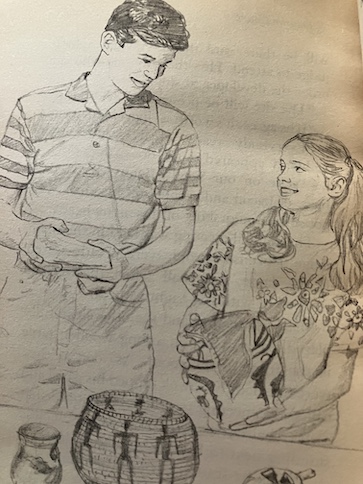
As the children work on their dig, they start finding more things, but someone also starts filling in places where they’ve been digging. In other places, someone has been digging where they haven’t dug yet. Then, someone steals an impressive bowl that Violet found. Is someone trying to prevent them from making a discovery that would stop the development, or is this a case of greed for Native American artifacts?
My Reaction
I liked this mystery as a kid, but I have a bone to pick with this story now. Perhaps the rules have changed since the book was written, but I know from living in Arizona that it’s routine to call in professional archaeologists to survey sites before digging and development take place. Because this area was inhabited by different groups over the centuries, archaeological finds can be just about anywhere.
I was attending ASU when they build the bio-sciences building, and people were allowed to watch the archaeologists survey the site. They did find an old Native American burial ground on the site. It didn’t stop the development completely, but they did record and catalog all of their finds before reburying them in the same locations where they were found. The logic of that is that Arizona is a very dry climate, and it preserves things buried in the ground very well. Putting a building over the site will prevent the site from being disturbed again for a long time. In the future, there may be better archaeological tools and scientific techniques that can be used to reevaluate the site and the things in it, and by then, the building may no longer be there.
What I’m saying is that there are rules and practices regarding archaeology and development in this region. Because this book was written about 30 years ago, when I was a kid, I’m not sure how different the rules were then, but I’m sure that archaeological surveys of this type were conducted back then, too. One of my old college teachers was an archaeologist, and he told us about digs he participated in around one of the reservations years before. I’d be surprised that development so close to a reservation, as in this story, would be allowed to go ahead without an archaeological survey from one of the universities or other archaeological organizations in the state. I just think that there should have been professionals working in the area before the kids started their dig.
I liked the pieces of information that the Lightfeathers explain to the Aldens about Navajo history and culture. My favorite piece of trivia was the explanation about how, rather than putting clay cooking pots directly over the fire, historical Navajos would heat a stone in a fire and then put the stone into a pot of water to heat the water for cooking. I think it’s a creative solution to cooking in a vessel that can’t be used directly over fire.
Jessie is allowed to participate in a dance at the powwow as a guest of a Navajo family, and Amy helps her put together regalia for the dance. (See Jingle Dancer for an example of this in a different tribe.) I sometimes find it a little cringey now when characters in stories too easily participate in Native American events and are quickly called honorary members of the tribe, but in this case, the Aldens do help make an important discovery.
Mystery of the Inca Cave by Lilla M. Waltch, 1968.
Thirteen-year-old Richard Granville has been living in Peru for the last two years. His family moved from California to a mining town in the Andes because his father is a manager for a mining company. Richard enjoys living in Peru because he’s developed an interest in archaeology and the history of the Incan civilization. Richard feels like the mountains are a connection to the distant past, and he loves the historical feel of the place. His parents don’t understand how he feels and would rather see him work harder at his schoolwork instead of spending all of his time exploring the mountains. Richard’s father tells him that he won’t become an archaeologist if he doesn’t apply himself to his studies, and his mother worries that something could happen to him in the mountains. They think he should finish school first and then decide if he wants to go into archaeology or not, but Richard’s mind is already made up, and he doesn’t want to waste this golden opportunity to do what he loves most right now. Richard feels hurt that his parents don’t really listen to him, don’t share his interests, and don’t appreciate the finds he’s already made.
Richard loves to explore the area with his friend, Todd Reilly, and see if they can find pieces of Incan relics. They’ve found some interesting bits of pottery and broken tools, but one day, they make a particularly exciting discovery – an ancient stone road mostly covered with grass. Although Richard knows that there are many other remains of Incan roads, this one is particularly tantalizing because it seems more hidden than most. Richard is fascinated with how neatly the stones of the road fit together so precisely without mortar, and he wonders where the road leads.
The boys explore the old road further, but they discover that at least part of the road was buried in a landslide. Todd doubts that they’ll ever be able to find where the road leads, but Richard wants to keep trying. When they return to the spot to try again, Richard spots the remains of an ancient building! Richard is sure that the building was once a chasqui station (also called tambos), which was a place where Incan messengers could stop, rest, and trade off with other messengers, who would continue to carry messages along the route, like the members of the Pony Express used to trade off with each other. Richard knows that stations like that were placed about 2.5 miles apart along roads, so there might be other stations located along this route.
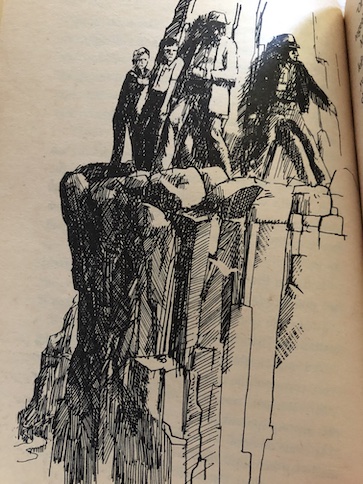
The boys go a little further and find a stairway leading up the side of a cliff to a cave. On the stairs, Richard finds a small doll. The doll is puzzling because Richard isn’t sure if it’s an Incan relic that somehow managed to survive or if it’s a more modern doll made by the South American Indians in the area. He has trouble believing that any more modern person could have been at this spot recently because it’s pretty isolated and rough territory. It looks like other landslides could happen. He can’t tell his parents about his discovery because they probably wouldn’t let him return to the area to explore it further if they knew how dangerous it was, and he can’t bring himself to abandon the most exciting discovery he’s ever made.
On a trip to the marketplace, Richard and Todd spot a mine foreman, Jeb Harbison, yelling at a boy in Quechua. He stops as soon as he sees the other boys watching, and they wonder what that was about. Then, the boys spot a merchant selling dolls that are similar to the one they found at the ruins. They ask the merchant where the dolls came from and who made them, and he gives them the name of the doll maker, a woman named Deza. Todd thinks that the most likely explanation for the doll they found is that some young girl living in the area got a doll from the same doll maker, and she lost it while playing around the cave. However, Richard doesn’t think that’s likely because the cave is such an out-of-the-way place, not somewhere a young child could easily reach alone.
On another visit to the area of their discovery, the boys find a mine shaft that doesn’t belong to the company their fathers work for, even though it’s on land that they know the company owns. There are signs that someone is actively mining there, but who?
The boys also discover that the activity at the cave is connected to the mine when they see some men there, breaking up rocks and stuffing them inside of little dolls, like the one they found earlier. It seems like the miners are smuggling gold or other minerals in the dolls, but when the boys talk to Richard’s dad about what they’ve seen, the situation points to a possibly larger conspiracy.
The book is available to borrow and read for free online through Internet Archive. The book was originally titled Cave of the Incas.
My Reaction
The first thing that I liked about this book was the pieces of information about the ancient Incas. Our knowledge of ancient civilizations has increased since the 1960s, but the information in this book is still good. I liked the book’s descriptions of Inca building techniques, how they used closely-fitted stones instead of mortar, and how their system of messengers was organized. There are also points where the characters notice parallels between the way the ancient Incas lived and the way their descendants live, such as their system of cooperative farming.
However, this story is also about human relationships as well as adventure, mystery, and ancient civilizations. Through most of the book, Richard is troubled about his relationship with his parents, especially his father. His parents are frustrated with him because he is absorbed by his interest in archaeology and exploring the countryside and isn’t applying himself to his schoolwork. At the same time, Richard hates it that his parents don’t understand what interests him and only seem to want him to focus on what they want. They’re having a clash of priorities.
When I was a kid, I hated homework with a vengeance. That might be a surprising revelation about an adult who willingly does what are essentially book reports on a regular basis as a hobby. Reading is fun. Research produces interesting information. I like knowing things and writing to other people about them. Basically, I was always good at the skills necessary for homework, so that wasn’t the problem. The problem is that there were many other things I wanted to do, and homework got in the way. I didn’t always get to read about what I wanted to read about in school because someone else was always choosing the school material for me, and I frequently hated their choices. Even the arts and crafts weren’t always the ones I wanted to learn, and I was usually told what to make instead of getting to make what I wanted. Because I was a good student, I ended up in the honors classes, so I always had more homework to do than everyone else. I was proud that I was a good student, but at the same time, I also hated it because I found it stifling. I’ve always been interested in many different subjects and handicrafts, but all through my childhood, I felt like I could never just take up all the different projects I wanted to do because I had to do my never-ending supply of homework first. Everything I wanted to do always had to wait. Even after I graduated, it was difficult for me to shake off the feeling that I had to wait on things I wanted to do , which was also kind of irritating.
I could sympathize with Richard’s attitude toward his own studies. He knows what he really wants to do, and he finds it infuriating that his parents want him to put it off and finish his homework and his education first. There is something to be said for making the most of finding himself in the very place he wants to be with direct access to what he knows he wants to study seriously. The move to Peru was an enriching experience for Richard that gave him a direction and life ambition, and I think he would regret it forever if he didn’t use this opportunity to explore it as much as possible. At the same time, though, my adult self knows that there is truth to what Richard’s parents say about his explorations in the mountains. The mountains are dangerous, like Richard’s mother says, and even Richard knows it. Also, Richard’s father is correct that if Richard seriously wants to be a professional archaeologist, he’s going to have to finish his education.
Nobody in modern times becomes a serious, professional archaeologist without a college degree, and even archaeologists need to study things beyond their specialist field. Archaeology isn’t just wandering around, digging, and seeing what you find. You have to recognize what you find, study its context, understand its significance, and know how to treat it to preserve it. You can’t study past lives and interpret artifacts without having real life and world knowledge. Archaeology is also where science and history intersect. Archaeologists need to know mathematics, geology, and how humans are affected by climate (which can and does change over time, for various reasons) and access to resources. There are legal and ethical principles to archaeology that Richard will also have to understand. Archaeologists can also benefit from learning drawing and photography to record and interpret finds and perfecting their writing skills to present their findings to the world. Richard has made a good start in his field of interest, but to get serious about it, he will need more education and greater depth and breadth of knowledge.
As annoying and stifling as homework feels, the skills it imparts are necessary for doing many more interesting things. Getting through the studying phase can be a pain, but sometimes, you really have to lay a solid foundation before you can build something solid on it. I still think that my past school assignments could have been more interesting and less stressful if I’d had more flexibility about them and more time for personal projects in between. However, I have realized over the years that, once you’ve really learned something, you will use it, even if you only use it indirectly as part of something else. I don’t regret learning the things I learned because, as hard as it was along the way, I have used things I learned in more interesting ways later in life. I’ve also realized that, if I had spent less time and emotions complaining about how stifling my homework situations were, I also could have used the time I spent lamenting about homework and procrastinating about it to accomplish some of the other things that I complained that I never had enough time to do. Not all of them, but more than I did when I was too busy being upset and resentful about homework. That’s also a lesson that Richard learns in the story.
At one point, Richard talks to Todd about his relationship with his own father, and Todd says that they get along pretty well. Richard realizes that Todd and his father don’t fight over his studies because Todd is an easy-going type who doesn’t mind doing his homework much and takes care of things without making anybody nag him to do it. Todd just accepts that there are some things that just need to be done, so he doesn’t waste time complaining or procrastinating about them. That’s harder for Richard because he feels the strong pull of what he really wants to do.
Todd admits that he and his parents don’t always get along perfectly because he doesn’t always do what he’s supposed to do. There are times when he leaves messes or physically fights with his brother or talks back to his mother, and his parents get angry or irritated about it. When Richard asks Todd what he does in those instances, Todd says that, eventually, after the initial argument, he typically apologizes or cleans up his mess or does whatever he needs to do to fix the situation. Todd’s reasoning is that, while people aren’t perfect and don’t always do what they should, “when you’re wrong, you’re wrong.” He accepts that, sometimes, he screws up and needs to do something to fix it without getting too overwrought about having been in the wrong. He sees it as just a normal part of life. When it happens, he can correct himself and move past it.
In the case of Richard and his father, each of them has to admit to being a little wrong and accept that the other is partly right. Both of them have to do some work to fix their relationship. Richard has to admit to his father that he does need to continue his education and apply himself to getting his work done. In return, his father needs to try harder to understand Richard’s interest in archaeology and allow him some time and opportunities to make the most of his time in Peru, getting the firsthand knowledge and experience he needs for the future he really wants and that won’t come from the standard classes he’s taking.
Through their adventures in the course of the story, Richard and his father come to a better understanding of each other and have an honest conversation about how to manage the conflicts in their relationship. Richard’s father admits that he needs to stop looking at his son as being just a younger version of himself and to see Richard for the independent person he is, with his own interests and goals in life. Meanwhile, Richard connects somewhat to his father’s interests through their investigation of the illegal mining operation he and Todd discovered.
This mystery story is a little unusual for children’s books, where kids often investigate mysteries on their own, having adventures without the adults, because Richard’s father joins the boys in their investigations and he stands up for them and what they’ve discovered when their discovery is challenged. The shared adventure becomes a bonding experience for Richard and his dad. At the end of the story, Richard’s father helps Richard connect with a museum curator, who helps the whole family to see the true value and significance of Richard’s archaeological finds. The curator also emphasizes to Richard that, while he has the potential to excel in his chosen field, he’s going to have to study and move on to higher education to get where he wants to go. Richard agrees, now having a greater understanding of its importance and satisfied that his parents understand the direction he’s chosen for his life.
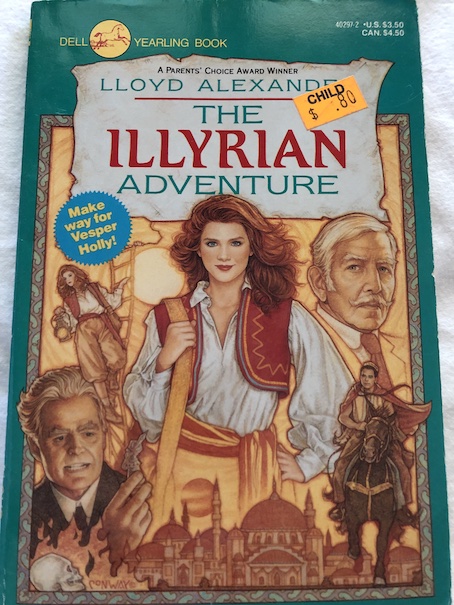
This is the first book in the Vesper Holly series. Vesper Holly is like a female Young Indiana Jones.
The story begins in 1872, when Professor Brinton Garrett and his wife, Mary, receive a letter saying that Professor Garrett’s colleague, Dr. Holly, has died overseas. Dr. Holly named Professor Garrett as executor of his will, gave him the rights to organize his person papers for publication, and made him the guardian of his 16-year-old daughter, Vesper. When Professor Garrett and his wife arrive at Dr. Holly’s country estate in Pennsylvania to meet Vesper and take charge, they at first expect that they will have to comfort a timid and grieving orphan. However, Vesper is anything but timid and seems to have gotten over whatever grief she was feeling and has quickly taken charge of the situation. She welcomes the professor and his wife, calling them Uncle Brinnie and Aunt Mary, and she quickly persuades them that, rather than her coming to live with them, it would be better for them to take up residence at the Holly estate, where there is plenty of room and Uncle Brinnie would have full access to her late father’s library and papers. At first, they’re reluctant to leave their own home, but Vesper Holly is practically a force of nature and very difficult to resist.
Vesper is intelligent and multi-talented, with interests in everything from science to women’s rights. (In some ways, she seems kind of like Mary Sue – impossibly talented and skilled at everything, with her main flaws seeming to be that she is difficult for everyone else to keep up with.) Uncle Brinnie quickly realizes that she is a daunting girl to have as his ward, and rather than he and his wife taking charge of her, Vesper has efficiently taken charge of them.
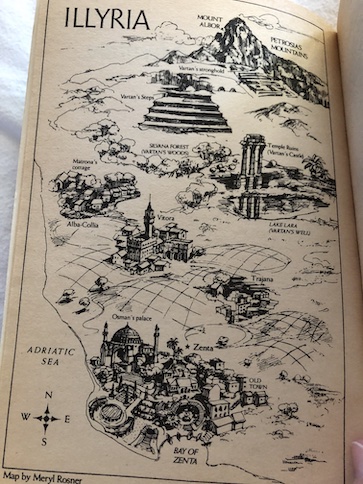
Soon after Professor Garrett and Mary settle in at the Holly estate, Vesper asks Uncle Brinnie if he’s read a piece of classic literature called the Illyriad and if he knows anything about Illyria. Professor Garrett has read this less-known classic piece, and while he’s never been to Illyria, he knows that it’s an incredibly unstable place. While the Illyriad is thought to be mostly legend, Vesper says that her father believed that there was more truth to it than most people know. He believed that the magical army described in the story may actually have been an army of clockwork automatons. Professor Garrett remembers Dr. Holly saying something like that before, but no one in the academic community took the theory seriously, and Professor Garrett says that he thought Dr. Holly had abandoned the idea. Vesper reveals that her father was still working on the theory and that, shortly before his death, he wrote to her, saying that he found something that seemed to support his ideas. Unfortunately, he died before revealing what he found. Vesper says that she wants Uncle Brinnie to take her on an expedition to Illyria so that she can finish her father’s work. Once again, Professor Garrett balks at the idea because of the dangerous political situation in the region, but also once again, Vesper’s powers of persuasion win.
Professor Garrett is sure that they won’t be granted permission to enter the country much less move around Illyria because of the unrest there, but to his astonishment, Vesper gets them permission to do both by writing to the king of Illyria himself. Although the king never met Vesper’s father, he has read Dr. Holly’s research and is fascinated by his theories, which is why he also grants Vesper a personal audience. Before their meeting with the king, Vesper and Professor Garrett are caught up in a riot while touring the city, and someone tries to stab Vesper! Although it could have been an accident during the riot, Vesper is sure that someone deliberately tried to kill her, and she tells the king about it at their meeting. The king is troubled by the news and admits that he had assigned someone to follow Vesper and Professor Garrett to protect them. It’s a failure on the part of his guard that they were attacked anyway.
The king’s vizier immediately says that they have to crack down harder on the native Illyrians, bringing up the cultural and political struggle that has made this country so dangerous. (Don’t worry too much about understanding it. This isn’t a real life historical situation with real groups of people.) Vesper boldly says that it doesn’t make sense to her that one half of the country crack down on the other half of the country, and she advocates for more respect for the native Illyrians and their wishes. The vizier is scandalized at a girl speaking up to the king like that, and the king tells Vesper that the situation isn’t that simple. The king has been trying to modernize and improve the infrastructure of the country with projects like building schools and railroads lines, but each of these projects has been ruthlessly sabotaged, apparently by the native Illyrians. The vizier has suggested hiring outside sources from other countries to complete the projects, but the king still thinks it’s important to keep the projects within the country. Hiring outsiders would be costly and would make Illyria dependent on outsiders. (Right about at this point, I was sure that I fully understood who the real villain of this story was and who was really responsible for the sabotage, and it wasn’t the native Illyrians. However, there is one more important character yet to be introduced.)
The king grants Vesper and Professor Garrett the ability to travel to the village Vesper wants to visit to pick up the trail of her father’s studies, but before they leave the palace, the king introduces them to anther visiting scholar, Dr. Desmond Helvitius. Dr. Helvitius is there to catalog the palace archives and conduct research for a book about the early history of Illyria. Dr. Helvitius says that, based on his studies, he believes that the army from the Illyriad Dr. Holly was researching never existed and was purely imaginary and says that the palace archives, which are thorough and complete, prove it. However, Vesper insists on seeing the archives herself, and she quickly notices that there is a gap in the records. Our heroes ponder what is missing and why Dr. Helvitius doesn’t want anyone to know that anything is missing.
As Vesper and Uncle Brinnie continue in pursuit of Dr. Holly’s theory, there are further attempts on their lives.
The book is available to borrow and read for free online through Internet Archive (multiple copies).
My Reaction and Spoilers
Although there are themes of history and archaeology in the Vesper Holly stories, I think it’s important to point out that all of the history and archaeology in the stories is fake. The locations they visit are fictional. The series takes place in the Victorian era, but this is not really a historical fiction series because they mostly focus on the history of places that don’t exist. The Indiana Jones and Young Indiana Jones franchise based their adventures on real places, people, artifacts, and legends that exist outside of the franchise, but that’s not the case with Vesper Holly. Really, the Vesper Holly series is just an adventure series. The locations and circumstances only exist to create the opportunities for adventure. That’s fine and fun, as long as readers understand that’s the case.
The name of Illyria comes from an ancient name for a region in the Balkans where people spoke a language that was called Illyrian, but Illyria didn’t exist as a country in the 1870s. People stopped referring to Illyria in the sense of a nation after the Ottomans invaded the region in the 15th century, and that was after it had already been under both Roman and Byzantine control. The term “Illyria” sometimes emerged after that in a cultural sense. The Illyriad doesn’t exist and seems to be based on the real piece of classical literature, the Iliad. I couldn’t find any references to a King Vartan, but there is a St. Vartan or Vardan, who was an Armenian military leader and martyr, who died in 451 AD. The political and social tensions in the story are between the ethnic Illyrians and the Zentans. The captial city of this fictional Illyria is Zenta, and I think it is based on the city now called Senta in modern day Serbia, which was the site of a battle in 1697, where the Ottomans were defeated and lost control of the region. So, my overall impression of the time period and location of the story is that it seems to take place in a sort of alternate reality of the Victorian world, semi-based on real places and historical concepts from Eastern Europe and the Mediterranean, especially the Balkans, but not adhering strictly to real history so the author could set up the adventure creatively.
The Illyrian characters in the book use words like “dragoman” (a term for a guide and interpreter, usually used in the Near East, particularly in areas with Arabic, Turkish, or Persian influence) and “effendi“, which is an honorific for a man of high status in eastern Mediterranean countries. It’s plausible that these terms would be used in the Balkans in the 19th century, but this isn’t really my area of expertise, so I can’t say how common that would have been.
The adventure in the story is good, and it has an element of mystery that adds an interesting twist to the ending. At the beginning of the story, Vesper and Professor Garrett explain that Dr. Holly had a theory about the historical events behind a legend described in a piece of classical literature. His theory was that this special army described in literature was actually some kind of mechanical or clockwork army, an army composed of something man-made rather than real humans. Professor Garrett and his colleagues never took Dr. Holly’s theory seriously because it does sound rather unbelievable, too technologically advanced for the time when the historical events took place. However, Vesper believes in her father and his theories, and now that he is dead, she wants to investigate and find the proof that her father wanted for the sake of his memory. If they had really found an amazing clockwork army, it would have been an incredible adventure, but I was pleased that what they actually found is a more plausible explanation that would have fit the time period. It turns out that Dr. Holly was half right; the legendary army was not composed of real people, but there is another kind of army that nobody considers until Vesper actually finds it. Legends tend to magnify things out of their original proportions. This particular legend not only exaggerated the army’s capabilities but also its size.
I liked the twists to the story, but Vesper herself got on my nerves a bit. Vesper only really makes sense if you look at her as being the kind of heroine of tall tales. She is overly perfect with no noticeable flaws. She rarely gets frightened or upset at anything, from the death of her own father to being threatened with death herself. She cheerfully pulls her new guardian into dangerous situations, and her guardian can’t even really get angry with her for doing it. Vesper is incredibly persuasive, whether it’s dealing with her guardian or a foreign king, and her guardian is adoring of her and constantly admires her intelligence and abilities. Like Sherlock Holmes with Watson, Uncle Brinnie is always one step behind both Vesper and the readers in figuring things out. Characters who are overly perfect can be a little grating, partly because there are times when they drag their friends into dangerous situations but, somehow, it’s never their fault because they’re perfect. In fiction, this kind of confidence and seeming perfection are strengths, but in real life, over-confidence is a sign of incompetence and lack of awareness. People who charge directly into dangerous situations in real life are just kind of clueless about the dangers they’re plunging into. The books in this series are just meant as fun adventure stories, not serious or true-to-life in either characterization or historical background, so Vesper’s amazing qualities, whether it’s her ability to eat all kinds of strange foods or learn new languages in barely any time at all or to compete intellectually with professional academics who are decades older than she is, fits with the story type. Vesper isn’t mean to be a real person so much as the ultimate teenage adventurer.
Kids can enjoy this teenage heroine who is on top of every situation, can rush into danger without any sense of fear, and gets her way with little argument from anyone. However, I think I would enjoy Vesper more if she did have a few more flaws and limitations. I would have liked it if Vesper had a definite fear of something, like Indiana Jones’s fear of snakes. It could be played for comedy, like in the Indiana Jones movies. I also would have liked it if Professor Garrett could have appeared more sharp than he did and provide more useful knowledge so that Vesper had to depend a little more on him professionally during their expedition. I felt like the story dumbed down the professor a bit so Vesper could appear more brilliant, and I don’t like it when characters are made to look stupid so another character can look more intelligent by comparison.
Vesper’s relationship with her deceased father is never really explained or developed, either. When we first meet her, she is well over being sad about his death and ready to embark on an adventure in his name. I would have liked it if she and her Uncle Brinnie had a heart-to-heart talk about her feelings during their travels. Dr. Holly seems to have spent a significant amount of time away from home or involved in his research work. Vesper is a motherless only child who does not seem to attend a regular school or have friends her own age. I would expect that this unconventional life would have an effect on her development and that she would have feelings about it. I would have liked her to explain more to Brinnie that her eclectic range of knowledge and expertise with languages comes from having been dragged around the world with her father from a young age, from spending time around her father’s professional colleagues and witnessing their discussions with each other, and from becoming an active research assistant to her father because their family consisted of only the two of them, and sharing his interests was a way for them to bond. I picture Dr. Holly reading pieces of classical literature to Vesper as bedtime stories because he would have little or no interest in the typical nursery rhymes or picture books.
If Vesper had more knowledge of ancient history and literature than things typical children know and like, that could also show character quirks and development. It might even be a flaw in the sense that Vesper knows more about how to speak to and relate to professional academics than girls her own age at a time when female academics were often not taken seriously. Vesper occupies an odd position in life but without the obvious awkwardness that would cause in real life. Her confidence and ability to stride forward in situations that would cause anyone else hesitation might actually come from the knowledge that, if she allowed anyone else time to think about what she’s barging into, she would never be able to accomplish what she wants to accomplish because other people wouldn’t accept it. She could be feeling more of the awkwardness of her position more than she lets on, and some discussion of her need to hide her own feelings, act more confident than she feels, or compensate for other people’s feelings about her would add depth to her character. It’s possible that later books in the series develop other sides of her personality and history more, but I would have liked more of that in this book.
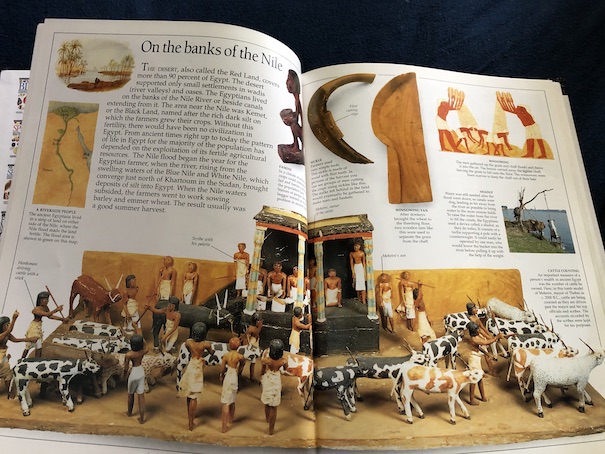
I love the way this book, like others in the Eyewitness series, shows photographs of artifacts so readers can not only read about how people lived but see the objects that they used. Each photograph in the book has a caption to explain what it is.
The book begins with an explanation about the origins of Ancient Egyptian civilization thousands of years ago, before there were pharaohs. Then, it explains about the geography of Egypt and the Nile and how the Nile floods and fertile lands along the river made Egyptian civilization possible.
The book then explains the concept of the Egyptian king as a “pharaoh.” The title of “pharaoh” comes from an Ancient Egyptian word meaning “great house”, referring to the palace where the king lived, so the king was the one who lived in the “great house.” However, the pharaoh was more than just the an important man living in a palace; he was also regarded as being a god. Most Egyptian rulers were male, although queens also sometimes ruled and were also regarded as divine. The book shows pictures of statues depicting pharaohs and explains a little more about some of the most famous pharaohs and queens. Then, it goes on to discuss life in the royal court.
Of course, no book about Ancient Egypt is complete without a discussion of mummies and tombs. Much of what we know about Ancient Egypt comes from what the Ancient Egyptians left in their tombs because Ancient Egyptians believed in life after death. They developed methods of preserving their bodies after death, and they stocked their tombs with things that they wanted to have with them in the next life. The book explains the embalming process, what pyramids and royal tombs were like, who the Egyptian gods and goddesses were, and what Egyptians believed about the journey to the afterlife.
I liked how the book not only explains different types of gods and goddesses in Ancient Egypt but also the roles of priests and temples in Egyptian society, types of religious rituals, and the role of religion and magical rituals in Ancient Egyptian medicine.
As the book covers a wide variety of different topics in Egyptian society, including scribes and writing, weaponry, and trading. I particularly like the parts focusing on daily life, like what Egyptian homes were like and some of the tools and details of different trades, like carpentry. The book has details about foods Ancient Egyptians ate, what music and dancing were like, and types of clothing and jewelry they had.
One of my favorite sections in the book is about toys and games in Ancient Egypt. We don’t know all of the details of games that were played in Ancient Egypt, but we do know that they had board games because they were found in tombs. Children’s toys were whimsical and included moving parts. Some of the games children played are similar to ones that children play today, like versions of leapfrog and tug-of-war and spinning tops.
The book is available to borrow and read for free online through Internet Archive (multiple copies, including some in different languages)
The
Sleepover Friends have volunteered to take part in an archaeological dig on the
site of an old mansion, which is also on land where a Native American tribe once
lived. Other students from their school
and a school in a nearby town will also be taking part. Stephanie isn’t sure that she’s going to like
being part of the dig because she doesn’t really like getting her hands dirty
and she thinks it would be gross if they uncovered the bones of dead people
during the dig. The others are more excited
about the dig, but at first, it doesn’t turn out as well as expected for
Lauren.
First, Lauren’s hair is weird on the day of the dig because the other girls tried to give her a perm at a sleepover and it didn’t go well. Then, she attracts some unexpected attention from Walter, a new neighbor of Stephanie’s. Walter is in the fourth grade, but only because he skipped a couple of grades to get there. He’s only eight years old, but he’s something of a child genius. He’s not really a bad kid, but when he starts following Lauren around and acts like he’s got a crush on her, Lauren is embarrassed because he’s so much younger than she is.
Then Lauren
makes an exciting discovery on the dig: a carved rabbit charm. The archaeologist in charge of the dig is
excited because its presence, along with some yellow paint, means that they’ve
found a Native American burial spot. She
takes the younger children off the dig and has her grad students continue
searching for the grave itself. Lauren
is pleased at being the one to make an exciting find, but the charm
mysteriously disappears at the dig.
The
archaeologist thinks that, most likely, the charm fell out of the tray Lauren was
using to collect things on the dig when everyone started pushing to get a look
at the spot where it was found. She says
that she and the grad students will keep an eye out for it as they continue the
dig. For Lauren, it just seems like
another piece of bad luck in her bad luck streak.
Walter
continues paying too much attention to Lauren at school, and later, writes an
anonymous note, asking her to meet him at a local pizza place. At first, Lauren thinks that the note was writing
by Jenny Carlin, a rival at school, because of a series of pranks they were playing
on each other earlier. When Jenny denies
being responsible for the note, Lauren goes to the pizza place and sees
Walter. Unfortunately, Jenny and her friend
Angela show up there, too, curious to see who was meeting Lauren, and they tease
her and Walter. Lauren is embarrassed at
having a kid so much younger than she is (genius or not) chasing after her, and
she hates the teasing that she gets at school about it, but she’s not quite sure
what to do about it, other than ignoring Walter as best she can. However, Walter is actually the key to
solving the mystery of what happened to the rabbit charm.
You
might guess at this point that Walter was the one who took the charm in the first
place. I thought it was pretty obvious
myself. Walter wasn’t trying to cause
trouble. He explains to Lauren that he
was trying to get her attention, and his first plan was to pretend that he
found the missing charm after a search so that he could look like a hero to
her. He just never got the chance to
give it back because he got interrupted, and then Lauren started avoiding him
because of the teasing. It all works out
for the best because Lauren gives the charm back to the archaeologist, who
doesn’t press her too closely about where she found it, and Walter gets a crush
on a different girl who is a little closer to his age.
Getting
a crush on someone who either doesn’t feel the same way or just isn’t available
is a normal part of life (if it wasn’t, it wouldn’t appear so often in tv
shows, movies, and books – people find this type of situation relatable), and
so is being the subject of a crush from someone you don’t love or find
unsuitable (again, that’s why this situation comes up often in fiction – it happens
often enough in real life that people understand the feeling). When it comes to getting boyfriends or girlfriends,
one of the people involved has to be the first to stick their neck out and say
that they’re interested, and there’s no guarantee that the feelings will be
returned. It’s not easy, but this is a
part of how relationships start. When
the feelings aren’t returned, which is bound to happen from time to time, there’s
always some awkwardness. The first
person is usually disappointed, and there might be a struggle for the other
person as they try to find a way to turn the other person down without hurting
their feelings. The situation in this
book is especially awkward because precocious young Walter is so young, and it’s
likely a first crush for him. Lauren has
also never had to deal with a situation like this before and isn’t quite sure
how do handle it.
In a way, having Walter simply lose interest in Lauren feels a little like a cop-out for the situation so neither of them really has to confront the situation directly, but there are a couple of things that Walter has come to realize by the end of the story that may be useful. One good point is that there are limits on the things people should be allowed to do to get someone’s attention and start a relationship with him. When Walter was just trying to strike up a conversation with Lauren or be helpful to her at the dig, it wasn’t bad. It didn’t get Lauren’s approval for him, but it wasn’t because his behavior was bad (more about this later because it’s important). The bad part came when he stole the charm to get her attention. When Walter’s mother later finds out about his theft of the charm, she grounds him and makes him give the charm back and confess to Lauren what he did. Learning that life has limits and that some behaviors don’t get you the kind of attention you’re really looking for is a good life lesson. Some people do come on too strongly when they’re seeking attention, and I’m not just talking about kids who aren’t experienced enough to know how to behave; even adults don’t always know the best way to approach romantic relationships or understand others’ limits and boundaries regarding them. I’m no relationship expert, but I think that the solution is partly developing a kind of situational awareness and an ability to empathize with other people and read their reactions.
Before the story is over, Walter learns more about reading other people’s reactions and understanding how his actions fit into the larger situation from someone else’s viewpoint. At first, Walter doesn’t seem to sense Lauren’s discomfort, and her friends criticize him for not taking a hint. Lauren felt a little awkward about his helpfulness at the dig not because it was a bad thing (he was really trying to be nice and there was nothing objectionable about what he said or did until he took the charm – I want you to understand that she wasn’t rejecting him for being a nice guy or anything like that) but because she had reservations about getting too involved with someone so much younger than herself, and she felt like his attention put her in an awkward position. Walter is a genius, but he is still physically and socially about three years behind the other kids in the story, and at first, he can’t see why that would create awkwardness in a romantic relationship, especially for kids who are only just starting to get old enough to be interested in romance. The difficulty for Lauren and the reason why she was so irritable with the situation was that she found it difficult to tell a younger kid who was being so nice to her that she didn’t welcome his attentions when he wasn’t doing anything really wrong and didn’t want to hurt his feelings. As I said, an awkward situation. Sometimes, even a person who is trying to be nice can unintentionally create awkwardness if they don’t understand the other person’s circumstances, and that’s something that adults do as well as children. This is basically what’s at the heart of a situation where “nice guys” get rejected or “friend-zoned.” It’s not about the “nice guy” doing anything wrong so much as a case of the wrong relationship at the wrong time with someone who isn’t quite as compatible with them as they thought.
In a romantic relationship, both of the people involved have to agree to it equally, one isn’t enough. When Jenny and her friend start teasing Lauren and Walter after the incident at the pizza place, Walter comes to see why a relationship with him would make things awkward for Lauren because of their age difference and the reactions of the other kids. If they were in their 20s or 30s, an age difference of two or three years wouldn’t mean anything, but for where they are in their lives now, as kids in elementary school, it means a lot. At the end of the story, Walter’s new love interest is a little closer to his age, making less of a problem, and he has developed enough social awareness to use his age difference to get a little revenge on Jenny for her teasing by publicly asking her about meeting him at the pizza place later, as if she were interested in dating him. Walter could have been hurt and insulted about being rejected and teased because of his age (and it would have been understandable), but he has realized that, under the circumstances, it would be better to move on and find someone who is more suitable for him and who might be more open to a relationship with him. In the end, he feels good enough about the situation to use his age for the joke on Jenny, and his other classmates approve of his humor and the well-deserved jab at Jenny’s teasing.
The one thing that I really wish they had added to the story would be for Lauren to learn how to gracefully turn down an offer of a relationship when she isn’t interested because I think that would be an important life lesson for her and for young readers. Socially awkward situations occur in life, but there are ways of handling them to minimize the embarrassment for everyone involved. In the story, Lauren’s main tactic is trying to ignore Walter and hope that he’ll take it as a hint until he finds someone else, and in real life, that’s not good enough. I’m not sure what she would have said if Jenny and her friend hadn’t interrupted her and Walter at the pizza place, but I would hope that it would have been something like, “I appreciate the help you gave me at the dig, Walter, and you seem pretty nice, but I just don’t think that we have enough in common. I think that there is too much of an age difference between us, and I’m not interested in that kind of relationship.” The rejection still might sting, but some simple honesty would at least be more respectful than ignoring him and hoping that he’ll take that as a hint.
I read this book years ago when I was a kid, although there was only one part that really stayed with me, and for a long time, I thought that I was remembering the incident from one of the Baby-Sitters’ Club books. The scene that stuck in my memory was from the sleepover at the beginning of the book. The girls were angry at Jenny for some mean comments that she made, so they requested a song on the radio called “You’re a Jerk” by the Lurkers and dedicated it to her. When they made the request, they told the radio station that they were “well-meaning friends” instead of giving their names, and the radio DJ made a joke about it when he played the song. It was this incident that started off the series of pranks that Jenny and the girls play on each other throughout the book. I think part of the reason this scene stuck with me was the “well-meaning friends” phrase and part of it was because I had always wondered if the song they requested was a real song. I don’t think it is because I can’t find it on the Internet. The Lurkers are a real band, but I can’t find anything about that song. If that song actually exists and someone can find a video of it, let me know, and I’ll link to it!
The book is currently available online through Internet Archive.
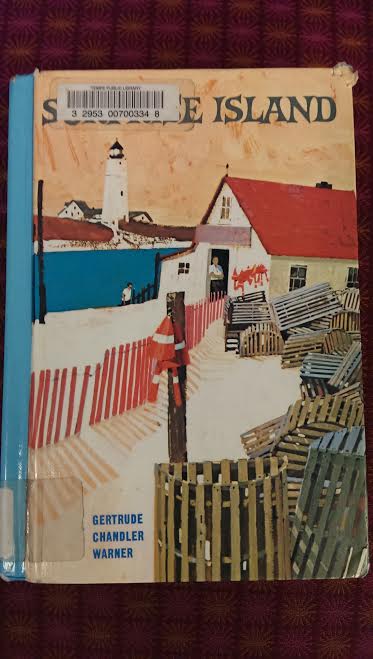
Surprise Island by Gertrude Chandler Warner, 1949.
Mr. Alden
has promised his grandchildren a special surprise for their summer vacation. He
tells them that, years ago, his father bought a small island because he kept horses
and wanted a quiet place for them. The
island has only one little yellow house, a barn, and a fisherman’s hut where
Captain Daniel lives. Captain Daniel
operates the motorboat that can take people to the island. Mr. Alden plans to take his grandchildren to
the island to look over the house, and if they like, they can spend the summer
there. The children think that it sounds
like fun.
When
they get to the island, the children decide that they want to stay in the barn
instead of the house. Captain Daniel
also tells them that he has a young man staying with him, a friend who hasn’t
been feeling well. The Aldens’ old
friend, Dr. Moore, has come to see the island with them, so he looks in on the
young man. It turns out that the young
man was in an accident and had lost his memory for a time, although he has been
gaining it back. He says that he used to
live with an uncle but that he didn’t want to go home again until he was sure
that he was completely well. He is going
by the name of “Joe”, which is short for his middle name, Joseph. Captain Daniel says that he’s known the young
man all his life, and Dr. Moore also seems to know him, but Joe doesn’t seem to
want to talk about himself to Mr. Alden.
The kids
enjoy setting up housekeeping in the barn.
It reminds them of when they used to live in an old boxcar. They use old boxes for furniture, dig for
clams, and eat vegetables from the garden that Joe and Captain Daniel have
tended for them. Their grandfather
allows the children to stay on the island in Captain Daniel’s charge, but they are
mostly allowed to take care of themselves.
Joe sometimes brings them supplies that they ask for from the mainland. (One of the themes of the Boxcar Children Series
is self-sufficiency. At one point,
Jessie comments about how much better things seem “when we have to work to get
it.”) For fun, they go swimming, and Joe
spends time with them, telling them about different types of seaweed. They are surprised at how knowledgeable Joe
is.
Henry gets the idea that they can set up a kind of museum of interesting things that they find on the island, like samples of different types of seaweed, shells, flowers, pictures of birds that they’ve seen, etc. The other children think that it sounds like fun, and they begin thinking about the different types of things that they can collect.While they’re searching for things to collect and add to their museum, the children find a cave and an old arrowhead and ax-head. They are authentic Indian (Native American) relics! When they show Joe what they’ve found, he gets very excited, especially when they tell him that they saw a pile of clam shells, too. Joe explains to the children how Native Americans used to use shells as money called wampum. He thinks that what they saw was wampum, which the people who used to live there might have made after drying the clams to eat later. Joe explains to the kids some of the process they would have used to turn the shells into wampum. He’s eager to go to the cave and look for more Native American artifacts with them, but he urges them not to say anything to anyone else about it because other treasure hunters will probably show up if they do. The children agree to keep their find a secret until their grandfather returns.
When
they return to the cave with Joe, they make an even more incredible find: a
human skeleton with an arrowhead inside.
It looks like they’ve found the bones of someone killed by an arrow!
The book is available to borrow and read for free online through Internet Archive.
My Reaction
As with
some other vintage children’s mystery series, the early books in the series
were more adventure than mystery. The
most mysterious part of this book concerns the real identity of the young man
they call “Joe.” The truth begins to
come out when a strange man who calls himself Browning comes to the island in
search of a young man who disappeared the year before while doing some
exploring for him. The young man he’s
looking for worked for a museum.
This is the book where Violet first learns to play the violin. This is a character trait that stays with her for the rest of the series.
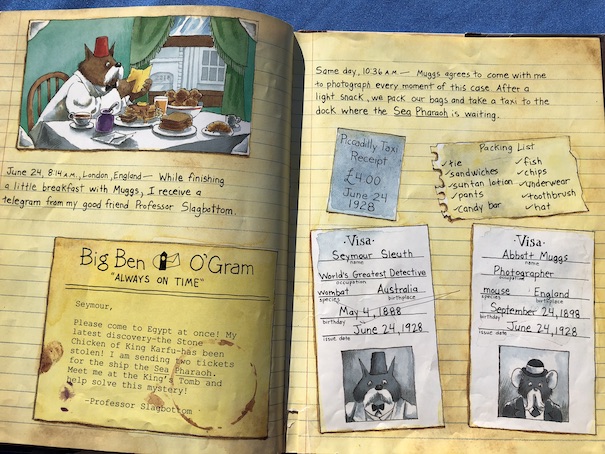
Seymour Sleuth, an Australian wombat living in London, introduces himself as “the greatest detective in the world.” His friend, Abbott Muggs, a mouse, is a photographer who assists him in his cases and documents them. When the story begins, Seymour receives a telegram from his friend Professor Slagbottom, who is working on an archaeological site in Egypt. Someone has stolen one of their finds, the Stone Chicken of King Karfu, and he needs Seymour’s help to find it! Seymour and Muggs head for Egypt!
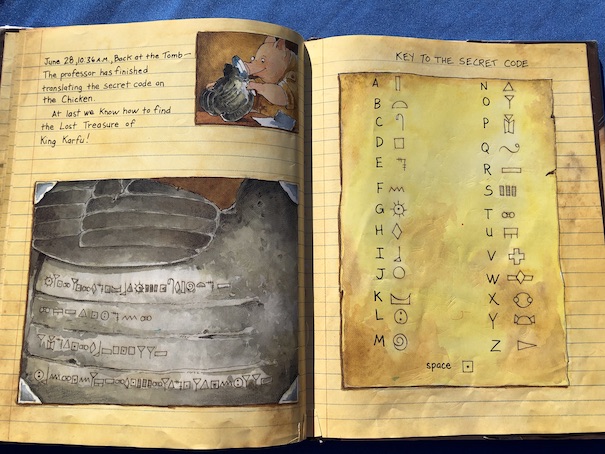
King Karfu was a wealthy pharaoh and a wonderful cook, and the Stone Chicken may provide clues about the Lost Treasure of King Karfu, the nature of which is unknown. When they reach the dig in Egypt, Professor Slagbottom explains that he was researching a message in code on the outside of the Chicken when it was stolen. The suspects are the other people on the dig, who may be trying to steal King Karfu’s Treasure.
Seymour interviews the suspects one at a time and considers their connection to clues found at the scene of the crime. As an adult, I figured out who the culprit was pretty quickly, but for the benefit of child readers, Seymour provides notes about the clues and suspects to help them understand the connections. The pictures in the story also provide important clues. After Professor Slagbottom’s decoder is stolen, Seymour realizes who the thief is.
After they get the Stone Chicken back, readers can use the decoder provided to solve the code and learn where the Treasure is. It turns out that the Treasure is actually a recipe, written in the same substitution code – for peanut butter and jelly sandwiches!
I always like mysteries that involve codes and puzzles, and this cute animal mystery would be fun and challenging for young kids. With the key provided, it would be a good introduction to substitution codes for kids who have never seen them. There is one other book with Seymour Sleuth, The Mystery of the Monkey’s Maze. The author, Doug Cushman, is also the author of the Aunt Eater Mysteries.
The book is currently available online through Internet Archive.
Mouse detective Basil’s arch enemy, Professor Ratigan, has taken over the Asian country of Bengistan, near India. Basil discovers that he is holding the real ruler of the country captive so that he and his gang can loot the country for everything they can get, keeping the populace in subjugation. Basil is determined to go there and free the rightful ruler so they can vanquish Professor Ratigan!
When Dr. Edward Hagerup of the British Mousmopolitan Museum hears that Basil is heading to Asia, he asks him to investigate an historical mystery for him. There have been tales of a race of pygmy cats, no bigger than mice, but new evidence has been found that suggests there is more truth behind the stories than anyone has realized. Basil has an interest in archaeology and eagerly accepts this extra task as part of their mission. Along the way, other mice who have heard of the expedition join up to help Basil.
At first, Basil’s original mission, stopping Ratigan, seems easy. Basil and his friend Dawson allow themselves to be captured so that they can get into the palace and find the real Maharaja of Bengistan. After solving a secret code in the dungeon, they find the Maharaja, who tells them that another acquaintance of theirs, the opera singer, Relda, is also a prisoner in the palace. She was giving a performance there when Ratigan and his thugs took over, and Ratigan has forced her to stay, giving private performances for him. During one of these performances, Basil and his friends manage to take Ratigan by surprise and capture him.
Now, Basil thinks that he and his associates are free to continue their other mission, finding the lost civilization of pygmy cats. However, that mission is fraught with danger and surprises, and they haven’t quite heard the last of Ratigan.
The story isn’t really much of a mystery. It’s really more an adventure story.
Basil and his friends manage to locate the island of pygmy cats with the help of Jeannie (a sea serpent related to the Loch Ness Monster who lost her way back to Scotland after a family trip — I kid you not) and the Sacred Catfish (which they bribe with catnip — I also kid you not, and his nip trip is a little disturbing).
This is my least favorite of the Basil series, partly because of the lack of mystery and also because of “primitive” nature of the pygmy cats when they find them. Basil makes it clear that the pygmy cats are inherently less intelligent than mice and that their greatest achievements were because of the influence of royal mice who washed up on the shores of their island years ago, only to be wiped out by a volcano. (Really? Really. Basil, if these mice were so superior and the pygmy cats so inferior, why were the cats able to get away from the volcano when the mice didn’t, hmm? Why didn’t the mice just go to the part of the island where the cats were until the volcano stopped erupting? Just what kind of bill of goods are you trying to sell us, Basil?) Basil comes off sounding like a 19th century imperialist, and the fawning adoration he gets for his discovery is really annoying.
In general, I don’t like the Basil stories that turn out to be more adventure than mystery, and Basil’s smug superiority at various points in the story are off-putting. It’s true that that Sherlock Holmes (which this series parodies) had an ego as well, but these sort of imperialist attitudes in a children’s story are distasteful. Although I like recommending nostalgic books for future generations, this is one that I really can’t recommend. The brightest spot in this book was the secret code in the dungeon, which is more in keeping with the mystery theme. If the book had made the plot to capture Ratigan and end his reign of terror in another country without all this stuff about an “inferior” species of small cats, it would have been a much better story.
Like other books in this series, this book contains a number of jokes on the original Sherlock Holmes stories. Read a number of the names backwards, and you’ll see some familiar names from Sherlock Holmes as well as a reference to another series by Eve Titus.
This book is available to borrow and read for free online through Internet Archive.











 Basil and the Pygmy Cats by Eve Titus, 1971.
 Now, Basil thinks that he and his associates are free to continue their other mission, finding the lost civilization of pygmy cats. However, that mission is fraught with danger and surprises, and they haven’t quite heard the last of Ratigan.
 Jestress's Forgotten Books and Stories