The Son of the Slime Who Ate Cleveland

The Son of the Slime Who Ate Cleveland by Marjorie Weinman Sharmat, 1985.

Frank is the first to admit that he’s a bit eccentric and that his mind doesn’t quite work like other kids’. He’s a bit more imaginative, more daring. When he thinks of something, he can’t resist doing it, even pulling pranks on his best friends, Jack and Lee. He sees it as a way of expressing himself, and he wants to go into show business someday.

One day, the boys spot a jelly bean counting contest at the mall. The prize is two tickets to a move called Monster Mayhem and all the jelly beans they can eat in two hours. Frank isn’t really interested in counting contests. Jack and Lee, who have ambitions to go into law and banking, are more interested in counting things and competing with each other. Jack and Lee both come up with the exact same number of jelly beans that they think are in the jar, and they start arguing about which of them came up with the estimate first. Frank can’t decide which of them was first, so he just tells them that they’re both wrong and guesses his own random number without even trying to count the jelly beans. All three of them enter the contest.

That could have been the end of it, but Frank can’t resist telling other people about the contest. Not only does he tell them that he and his friends have entered the contest, but he tells them the exact number that Jack and Lee both guessed.

A classmate, Bianca, invites everyone to a party at her house where everyone has to come dressed as their favorite monster. Her parents are also there, dressed as Mr. and Mrs. Slime Who Ate Cleveland. Bianca’s parents are both psychologists, and they think it’s emotionally healthy for kids to expend their energies and go wild at parties, so they’re very permissive with Bianca and her friends. At the party, Bianca’s father takes an interest in Frank, calling him “son” (hence the name of the book) and telling him that he should mingle more with the other kids and be less of a loner. He offers to help Frank with vocational counseling for his future, which Frank is not eager to accept from a guy who is currently dressed as a Slime Who Ate Cleveland and who actively encourages the kids to have a potato sack race in the living room. Frank thinks an indoor potato sack race sounds crazy, Jack thinks it sounds dumb, but Lee is all for it. When Jack and Lee argue about the potato sack race, Bianca brings up the story that Frank told her earlier about the jelly bean counting contest and the boys’ argument over which of them guessed the answer first, putting it to a vote among the party guests. Lee wins the vote (which doesn’t mean much since the other party guests weren’t even there when they made their guesses), and Bianca switches her attentions from her current crush, Jack, to Lee (who doesn’t want Bianca’s attentions and becomes afraid to answer the phone when she keeps calling him).

Jack and Lee both get irritated with Frank for turning the jelly bean counting contest into a big deal and ask him to stop telling people about it because neither of them really even expects to win. However, the incident doesn’t even stop there, because it turns out that both Jack and Lee are declared the winners of the contest because their identical guesses are the closest to the real answer. The contest judges decide to award the prize jointly to the two of them – a movie ticket each and all the jelly beans that each of them could eat in an hour.

Sharing the prize could have resolved the incident, but Jack and Lee still have a competitive streak. Even though Frank congratulates them both as winners, Jack and Lee still argue about which of them is the “real” winner for coming up with the answer first. Frank tries to point out that each of them really only needs one movie ticket anyway, so what difference does it make if the other friend gets the other one? That doesn’t do any good, though. Jack and Lee both want to be acknowledged as the “real” winner, and thanks to the vote at Bianca’s party, other kids at school are taking sides to support their votes.

The entire jelly bean counting situation has gotten completely out of control! Jack and Lee won’t stop arguing with each other about who really won the contest, and both of them are mad at Frank for spreading the word about it and turning it into a bigger deal than it had to be. Frank needs to find a way to solve the argument and reconcile with his two best friends. Meanwhile, Bianca’s father, Mr. Wasserman, keeps calling Frank “son” and trying to talk to him about his vocational future, which makes Frank feel as green as the Son of the Slime Who Ate Cleveland.

Just when Frank thinks he’s got everything solved, a new contest threatens to set Jack and Lee against each other again. Frank tries one more outlandish scheme that exposes Jack and Lee’s arguments to an even wider audience than before. It takes some sincere friendship from Bianca, some words that actually make sense from her mother, and some “perfectly frank” talk from Jack and Lee to help Frank to recognize how his own behavior has contributed to the problems and how his friends really feel about some of the things he’s said and done.

The book is humorous, but Frank does develop some empathy through the course of the story, coming to a better understanding of how the people in his life really think and feel and the effects that his various pranks and stunts have had on people around him. Frank learns not just what it means to be “Perfectly Frank”, as he puts it, but what it really takes to be a sincere and honest friend. One of the best parts of the book is the banter between the various eccentric characters, from Frank’s straight-forward responses to the strange offers of advice from Bianca’s well-meaning slime monster father to the school principal’s attempts to convince Frank to take up paper clip collecting as a hobby to keep him out of trouble to the frank discussion of friendship Frank and Bianca have when Bianca asks Frank to kiss her.

The book is available to borrow and read online through Internet Archive.

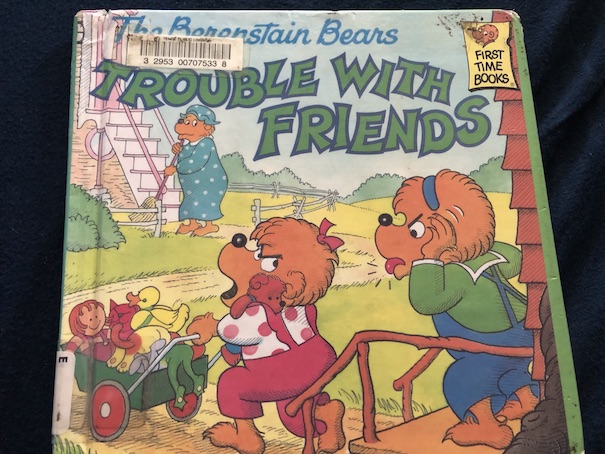
The Berenstain Bears and the Trouble with Friends

The Berenstain Bears

The Berenstain Bears and the Trouble with Friends by Stan and Jan Berenstain, 1986.

“When making friends,
the cub who’s wise
is the cub who learns
to compromise.”

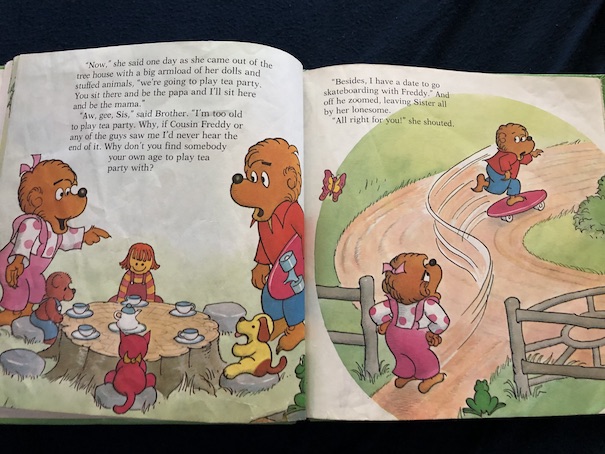
Brother and Sister usually play pretty well together, but Brother is two years older than Sister, and he doesn’t always want to play girls’ games like tea party and house. Brother likes to hang out with Cousin Freddy, but Sister doesn’t have a friend who lives close enough to play with her after school.

Then, one day, a new family moves in down the road, and they have a girl who’s Sister’s age. The new girl’s name is Lizzy, and she likes to do many of the things that Sister likes to do. The girls start playing together right away. Sister thinks that Lizzy is fun, but a little bossy … kind of like Sister herself.

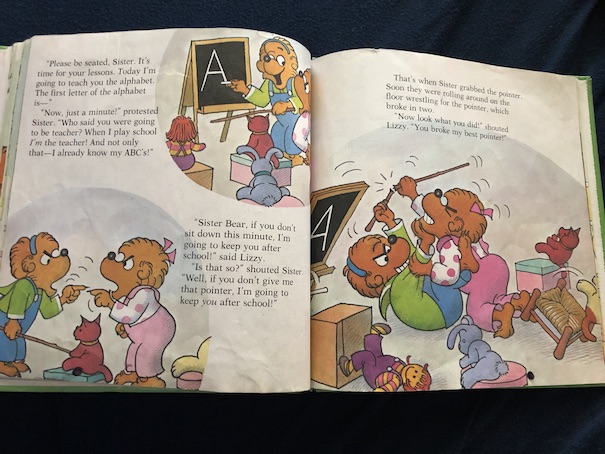
Later, Sister takes some of her stuffed animals to Lizzy’s house so they can play school. However, the girls argue over who is going to play the part of the teacher. Both of them want to play the teacher, and during their argument, they break Lizzy’s pointer stick.

Sister goes home angry, but Mama Bear reminds her of the reasons why she might want to make up with her new friend. Getting along with people can be difficult, but there are many things that are difficult to do alone. Having friends can be a lot of fun, certainly much more fun than sitting home and being lonely. If Sister wants to make up with Lizzy, she needs to accept her for the person she is and recognize that she can be a bit bossy herself sometimes. Both of the cubs need to give a little, let each other have their way sometimes, and care about each other’s feelings.

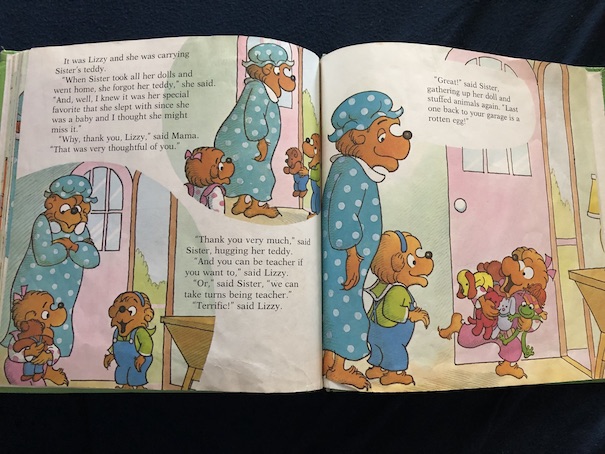
Lizzy drops by to return Sister’s teddy bear, which she left behind. She remembers what Sister told her about her teddy bear and why it’s important to her, showing that she does care about Sister’s feelings. The girls make up and agree to compromise and take turns being the teacher when they play school. Both the girls realize that getting along with friends means considering each other’s feelings and being willing to compromise.

The book is available to borrow and read for free online through Internet Archive (multiple copies).

Elves Don’t Wear Hard Hats

The Adventures of the Bailey School Kids

#17 Elves Don’t Wear Hard Hats by Debbie Dadey and Marcia Thornton Jones, 1995.

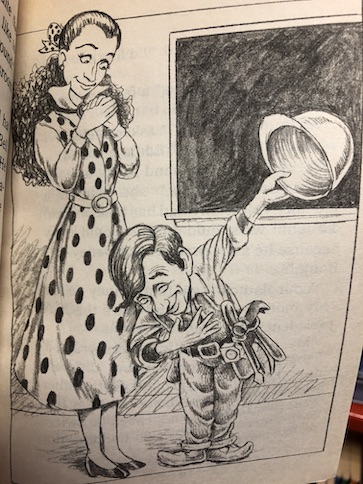
The playground equipment at Bailey School is old and breaking, so the PTA has decided to fund a new playground for the children. The playground is going to be built by the Bell Construction Company, and when the children meet the owner, Hollis Bell, he is an odd little man with curly-toed work boots. In fact, all of his men are unusually short. However, Mr. Bell promises to build the children the best playground they can imagine.

However, the parents at the school are arguing about the playground, how much it’s going to cost, and whether it really needed to be replaced at all. There’s not a lot of Christmas cheer going around, but Mr. Bell puts up Christmas trees and tells the children that they have their own kind of magic that can help fix their parents’ arguing.

One day, Mr. Bell comes to the third grade class to interview them about what they would like to have on their playground. All of the kids have different ideas, and they end up arguing about the things they’ve heard their parents say about what the playground should be like. However, Mr. Bell urges them to calm down and work together. He tells the children that they should make a list of what they all want and “check it twice.” One of the kids in the class says that it’s impossible to give everyone what they want, but Mr. Bell says that he’s in the business of making wishes come true. Liza asks what happens if someone puts down a really bad idea, and Mr. Bell says that he’ll know if an idea is a bad idea. Because Mr. Bell is short, his tools jingle like jingle bells, and he acts like he can grant their Christmas wishes, the kids start thinking that he might be an elf.

The kids are allowed to watch the workmen work, but Mr. Bell makes it clear that they’re not allowed in the trailer that’s attached to his truck. Naturally, the kids get curious about the trailer. They can’t help but sneak a look inside, and when they do, they find out that it’s a workshop full of toys!

As the children try to figure out if the construction crew might really be elves, they decide to ask the department store Santa more about elves. The kids debate about the department store Santa really being Santa, and the Santa makes a comment about how he’s been meaning to pay a visit to their school, seemingly ignoring a previous book in the series, when Santa apparently became their school’s janitor. However, later in the book, Howie refers to the “new janitor who keeps turning down the heat,” referring to what happened in the previous book, which is confusing. The department store Santa explains that his elves like to fix things, and they are particularly concerned with fixing people who can’t get along, hinting that the arguments over the school’s playground are what brought the elves to the school. Santa’s advice is for the children not to worry because the elves will disappear on their own “when the time is right.”

The deadline for submitting the plan for the new playground is approaching, and the kids realize that if the adults can’t agree on something, they might end up with no playground at all! When the “elves” leave to take care of a job “up north,” and the playground issue still isn’t resolved, the kids think that they probably weren’t magical elves and that they didn’t fix anything, but the kids aren’t ready to give up yet.

When Eddie suggests that they all just build their own playground out of wood and begins drawing his vision of it, it attracts the attention of the adults. At first, the kids think that they’ll have to do all the work on their playground themselves, but the more the adults hear them talk and study the picture Eddie drew, the more involved they become. When the adults were in charge, they each wanted to be considered the leader and authority on the project, with their ideas overshadowing everyone else’s, but with Eddie in charge, the project moves forward. Even though Eddie is a child, he’s the one with the vision to carry the project through, and he neutralizes the adults’ competing egos. The project ends up being finished unexpectedly fast, and in the end, no one knows who actually completed it, hinting that the Mr. Bell might really have been an elf and that he and the other elves secretly returned once everyone came to an agreement about what they really wanted. As always with this series of books, readers are left to draw their own conclusions.

The book is available to borrow for free online through Internet Archive.

Annie’s Promise

AnniesPromise

Annie’s Promise by Sonia Levitin, 1993.

This is the final book in the Journey to America Saga.  Annie, the youngest of the Platt girls, is more of a tomboy than her older sisters.  Her father thinks that she’s been growing up too wild in America, running around and climbing like a boy.  This summer, in 1945, while her best friend goes to visit their family’s farm in Wisconsin, Annie’s father wants her to stay home and help him with sewing for his coat business, and Annie’s mother has a list of chores for her to do.  It all sounds so boring and dreary.  Twelve-year-old Annie longs for excitement, but because of her recent appendix operation and her migraine headaches, her parents worry about her health.

Then, Annie gets the opportunity to attend summer camp.  She wants to go and do all the fun summer camp activities that other girls do, but her parents worry at first.  They worry about Annie’s health, and they don’t know who is running the camp or what they do there.  Annie’s older sisters, Ruth and Lisa, tell their parents that it’s normal for girls in America to go to summer camp and that the experience might do Annie some good.  When the family doctor says that Annie is healthy enough to go, her parents finally agree.

At first, camp is hard.  Annie faints soon after her arrival, and she worries that maybe her parents were right about her being delicate.  However, one of the counselors tells her that these things happen and that she was probably just overtired, overheated, and still suffering from the rough bus ride to the camp and that she will be fine after she rests.  Annie is physically fine, although one of the other campers, Nancy Rae, makes a big deal about the incident, calling Annie a “sickie” and other names.  Nancy Rae is a terrible bully, and Annie nearly drowns in the lake after accepting a dare from Nancy Rae to swim across it, in spite of not being a good swimmer.  Annie overhears the counselors saying that Nancy Rae should probably be sent home for goading Annie into a dangerous stunt, but they know that Nancy Rae comes from a bad home and that her father abuses her.  For her own sake, they decide to give her another chance.

However, even knowing Nancy Rae’s troubled history doesn’t help Annie when Nancy Rae keeps picking on her and a black girl named Tallahassee (Tally, for short).  Nancy Rae calls Tally and her younger brother (who is also at the camp) “nigger” and says that Annie is a “nigger-lover” when she tries to protect the younger brother from one of Nancy Rae’s tricks that could have really hurt him.  (Note: I’m not using the n-word here because I like it. I’m just quoting because I want you to see exactly how bad this gets.  Nancy Rae uses this word multiple times, and so do others when quoting her. This book is not for young children.  Readers should be old enough to understand this word and beyond the “monkey see, monkey do” kind of imitation some kids do when they learn about bad words.  The management assumes no responsibility if they aren’t.)  Nancy Rae is a thrill-seeker, who frequently does wild stunts to get attention and tries to make other girls hate Annie as much as she does.  At one point, she snoops through Annie’s things and tries to take her diary.  Eventually, she figures out that Annie is Jewish and makes fun of her for that, painfully reminding Annie of what it was like living in Nazi Germany and of her relatives, who died in the concentration camps.

Finally, Annie reaches the breaking point with Nancy Rae.  At a camp talent show, she arranges with other kids to dump horse manure on Nancy Rae’s head after she finishes singing a song.  Nancy Rae is so humiliated by the experience that she ends up leaving camp.  Annie is relieved that she is gone, but one of the camp counselors, Mary, makes her feel guilty about her revenge because she sees Annie as being stronger and more talented than Nancy Rae and wishes that she could have made Nancy Rae her friend instead, giving the bully a chance to improve herself.  (I disagree with what the counselor says, but I’ll explain more later why.)  Annie feels badly about how things turned out, but the incident blows over, and the rest of camp is a great adventure for her.

At camp, Annie mixes with different kinds of children from the ones she usually sees in her neighborhood and at school, and everything is a learning experience.  She becomes friends with Tally and gets a crush on a boy named John.  There is an ugly incident in which an assistant in the camp kitchen tries to molest Annie when he finds her alone (this really isn’t a book for kids), but the camp counselors dismiss him for what he did.  Annie and Tally talk about many things together, and Tally is very understanding.  The incidents with Nancy Rae and the kitchen assistant bring up the subjects of people who try to victimize others and how to deal with them.  Annie resents that people like that force others to be on their guard, limiting them in ways that they can behave in order to avoid being victimized, but Tally says that there’s no help for that.  As long as people like that exist, she says, protecting yourself is a necessity.  They also compare the way Annie feels when John gives her a little kiss to the repulsed and frightened way that she felt when the kitchen assistant tried to force himself on her.  Both incidents involved a kiss, but the way it was delivered and the person delivering it made each experience feel very different.  In the end, Annie’s crush on John turns into friendship rather than love as she realizes that the kiss was just a friendly gesture.  It is a little disappointing to her at first, but it is still a learning experience for her.

Annie learns that everyone at this camp has been through something bad in their lives.  Annie’s family are war refugees, but Tally’s father has been married three times, and she’s often the one to take care of the house and her younger brother, while her current stepmother cleans other people’s houses for money.  Other kids are poor or orphans or have fathers in jail.  The camp gives them a chance to get away from their problems for awhile, to make new friends, and to develop talents that they can be proud of.  Annie really blossoms at camp, learning to ride horses and work on the camp newspaper.  As Annie’s session at camp comes to an end, Mary offers Annie a position as a junior counselor for the final session of camp, helping the young children.  Annie is enthusiastic about the prospect, but family dramas at home threaten to derail her plans.  Ruth’s fiancé is shell-shocked from the war and has broken off their engagement.  Lisa is tired of arguing with their parents about every small piece of independence in her own life and has decided to move to a place of her own.  With all of this going on, and their parents upset about everything, what chance is there that they will sign the permission slip that Annie needs to become a junior counselor?

This book shows how much the lives of the girls in the Platt family have changed since they first left Germany for America.  It’s partly because they are living in a different country, partly because times and habits are changing everywhere, and partly because all of the girls are growing up and making decisions about what they really want to do with their lives.  The older girls in the family, Ruth and Lisa, are women now and thinking about careers and marriage.  As the girls suffer disappointments and changes of heart, their parents suffer along with them, and Annie realizes that she has to make up her own mind about what she really wants.  As Annie tries to decide what she really does want, her parents struggle to cope with all of the changes in their daughters’ lives and in the changing world around them.  They fight against it in a number of ways, and when things go wrong, whether it’s Annie’s illnesses or the older girls’ romantic problems, they tend to get angry or panic.  As the book goes on, it becomes more clear that what the parents really feel is helplessness.  More than anything, they’ve wanted life to be better for their daughters in their new country, and it upsets them when things don’t work out.  They want to help guide their daughters and make their futures work out for the best, but in the process, they often come across as too controlling or making the wrong decisions because they don’t fully understand the girls’ feelings or situations.

Ruth and Lisa each suffer romantic disappointment before they settle down.  Ruth had a fiancé, Peter, who went away to fight in World War II, but having seen the prisoners in the concentration camps, he has returned disillusioned and dispirited.  He was Jewish, but now comes to associate his religion and heritage with pain and suffering and wants to give it up, breaking off his engagement to Ruth in the process.  At first, Ruth is angry with him, saving that it’s like he wants to give up on his whole life, on the whole world.  The girls’ father says that he wants to kill Peter for leading his daughter on, but part of his feelings turn out to be his own feelings for somehow failing his daughter, that he is somehow to blame for allowing this disappointment.  When Lisa is upset because the young man that she’s been seeing says that he doesn’t want to get married, she argues with her parents about the course of her life and leaves home to live on her own.  Her parents see that as turning her back on their love and protection, but Lisa says that she just wants the independence that other girls have.  Even Annie feels abandoned by Lisa because Lisa was always there to comfort her as a sister and help her persuade their parents to listen to her, but Lisa says that she has to deal with problems on her own and that Annie will understand someday, when she’s in the same position.  Annie realizes that, in a way, she already is in the same position.

The one time that Tally comes to visit Annie at her house and the girls go to the beach together, Annie’s parents make a scene when she gets home because she’s left sewing all over the house and eaten more food than she should have.  Tally was going to apply for a sewing job with Annie’s father, which would have helped both of them, but Annie’s parents send her away, thinking that she’s a bad influence who encouraged Annie to goof off.  Then, Annie hears her own parents use the n-word.  It’s the final straw for Annie, and she runs away to camp.

The people at camp are glad to have her because they need her help, but being there, helping them, and thinking about her own life and future help Annie to realize what’s really important to her.  She’s been feeling bad about the hate she got from Nancy Rae and the hate that she felt from her parents with their insults to her friend.  However, her parents don’t really hate her, and in spite of what they’ve done, she doesn’t really hate them.  She realizes that, before she does anything more with the camp, she needs to go back and see them.

Annie rethinks what Nancy Rae was really about, how she was filled with hate for everyone, dealing out hatred because of all that she’d received from everyone else.  The counselors realized that she needed love more than anything, but Nancy Rae’s own hateful behavior pushed away the people who would have given her more positive attention and Annie’s revenge (although provoked) ended her camp experience.  Annie realizes that she doesn’t want to go down the same path and that she must mend her relationship with her family.

I said before that I disagreed with the counselor’s approach to the problem of Nancy Rae and what she said to Annie about her revenge.  I see what they were trying to do with giving Nancy Rae another chance, but what bothers me about it is that they act like Annie was in a much less vulnerable position to Nancy Rae and that she should have been strong enough to take what Nancy Rae dished out without hitting back, and I don’t think that’s true.  All of the kids at the camp were there because they had something troubling in their lives, some vulnerability, including Annie.  To say that Annie was more fortunate and more talented and that it should have been enough was to discount the harm that Nancy Rae was doing.  I know that the counselors were trying to make the camp experience positive for Nancy Rae, but she was making the camp experience more negative for everyone else around her and needed to be stopped.  Everyone suffers from something in life (as this book also demonstrates), but not everyone chooses to become a bully because of it.  Nancy Rae made that decision herself, within herself, and for herself alone.

Part of the problem, I think, was that there were no obvious consequences for Nancy Rae’s bad behavior, and therefore, she had no reason to stop doing what she was doing.  The lack of punishment and the inequity of the situation was what finally sent Annie over the edge with her.  Since the counselors didn’t make it obvious that Nancy Rae was in the wrong, Annie felt that she had to, and that says to me that there was a lack of responsibility and accountability.  I think that life is a balance and that both positive reinforcement (giving rewards to people who do good) and negative reinforcement (punishment for bad behavior) are necessary.  I believe in plain speaking, and if I were in the counselors’ position, I would make it plainly and specifically clear that no campers were to use the n-word, to mess with others’ belongings, or to do the other things that Nancy Rae was doing and that there would be consequences for doing so, telling them exactly what those consequences were so that no one could say that they were surprised.  I would also make it clear to Nancy Rae that I knew exactly what she was doing and why she was doing it and that it was unacceptable.  When we choose what we do and say in life, we all consider (or should consider) what we want to happen in life, and I would put it plainly to Nancy Rae how she really expects others to react to her and how their reactions would change if she did things differently.  Clearly, no one has ever told her that in her life before, and it was about time that she heard it from someone.  I suppose we could guess that the counselors may have said something of the sort to her out of hearing of the others, but I would also say the same thing to Nancy Rae’s victims.  Letting them know that I’d dealt with her adequately might head off their attempts to deal with her themselves and talking about what our behavior might lead others to do might also discourage revenge.

Also, the counselors were counting too much on the idea of friendship with Annie to get Nancy Rae to stop treating her badly, but that’s not at all the way that bullies work.  One of the primary reasons why people bully is that they know that there are a lot of people who like mean humor, and they use their bullying to bond with those people, not their victims.  Their friendships are formed on mutual contempt for the victim and the fun of humiliating that person.  They’re getting everything they want through their bullying, so there’s no reason for them to stop until someone else gives them consequences and puts an end to their bully support network.  I think that the counselors should have also talked to the people Nancy Rae was trying to bond with, explaining that they know what Nancy Rae is attempting to do and telling them that they would also be punished if they tried to help her, further cutting off one of Nancy Rae’s incentives to keep doing what she’s doing.

I’m not saying that it’s a perfect solution or that it would be guaranteed to work, just that I believe in being direct rather than letting things slide and just hoping that people will someday see the light.  Sometimes, people just need to have things spelled out for them in no uncertain terms.  If they chose to ignore what you say, then it’s on their own head, and they can’t say otherwise because you were clear and backed up your words exactly how you said you would.  I do think that the counselors were right that, in the long term, revenge never turns out well.  It often turns into a vicious cycle, as Annie later considers.  However, in this case, some proper handling in the first place, with consequences as well as words, might have headed off the situation before it got that far.

We don’t know what eventually happened to Nancy Rae by the end of the story, but I’m not sure that Annie is right to think that she wronged her.  In fact, she might have actually done her some good.  Sometimes, seeing others react badly to bad treatment can make a difference to someone’s future.  In my experience, people sometimes don’t realize that they’ve pushed another person too far until that other person finally reacts and says or does something.  Realizing that they’ve pushed someone too far can give them a reason to change because they realize that people won’t put up with their behavior forever.  Part of me thinks that maybe, at some point in the future, Nancy Rae might look back on this experience and quietly admit to herself that she had provoked it, being more careful the next time not to pick fights because she can be humiliated or excluded when people get fed up.  It might even help Nancy Rae to realize that she doesn’t have to put up with her father’s ill treatment forever because she also has the right to lose patience with bad treatment, too.  At least, I hope that this was a learning experience for her.

Annie realizes that both her parents and Nancy Rae are angry and hateful because of what they’ve suffered in their lives, but the problem is that both of them are taking it out on the wrong people.  Annie’s parents, at least, seem to realize that what they did was going too far and taking out their feelings on someone who didn’t deserve it.  By the time that Annie arrives home, they are also ready to make their peace with her and even support her return to the camp as a junior counselor, if that’s what she really wants to do.

The final days of World War II frame this story, beginning with the reports of Hitler’s death in the late spring of 1945 and ending with the bombings of Hiroshima and Nagasaki and the Japanese surrender in August.  With the end of the war comes a new chapter in the lives of the Platt family.  They’ve been through a lot together, but in spite of the girls growing up, moving out, and arguing with their parents, they still are a family.  There are no more books in the series, but Annie explains that Lisa gives up the dream she once had of being a dancer because she doesn’t think that she’s star material and because she decides that what she really wants is to get married and have children of her own.  In the end, she and her boyfriend get married, and she is happy with her life.  Similarly, Ruth, who is now a nurse, meets a new love when she visits Annie at camp and later marries him.  Annie realizes that she has found what she loves most in teaching young children, taking care of animals, and writing, and these things will form the basis of what she does with her future life.

Who’s Afraid of Haggerty House?

HaggertyHouse

Who’s Afraid of Haggerty House? By Linda Gondosch, 1987.

Kelly McCoy is eager to begin selling greeting cards for the Bismarck Greeting Card company because she wants to earn extra money for Christmas shopping.  Her best friends, Jennifer and Adelaide are selling cards, too, and Kelly is looking forward to teaming up with them.  However, she soon finds out that Jennifer and Adelaide have already finished their selling.  While Kelly was visiting her grandparents for a couple of days, the other girls hurried right out and started selling their cards.  They were worried about other kids beating them to the neighborhood houses.  By the time Kelly is ready to begin, the others are done and tired of going door-to-door, and many of the houses in the area have already bought all the Christmas cards they want.

Angry and hurt, Kelly has a fight with the other girls, and they mention that one house they didn’t visit was Haggerty House, which is supposed to be haunted.  Although the house spooks Kelly, she decides to go there and try to sell her cards.  When her brother, Ben, followers her and hits her with snowballs, further angering her, she dares him to come to Haggerty House, too.  Ben might be annoying company, but he’s still company.

Usually, the only time that kids in the neighborhood go to Haggerty House is on Halloween, and old Mr. and Mrs. Haggerty give good treats for the kids who are daring enough to visit, usually candied apples and nickels.  When Kelly and Ben approach the house to sell Christmas cards, Mrs. Haggerty invites them in for hot chocolate.  Mrs. Haggerty buys one of Kelly’s cards, and Kelly and Ben learn that Mrs. Haggerty is very lonely.  Her husband is ill and in the hospital.  She invites the garbage men in for hot chocolate, too, but is disappointed that they can’t stay very long because they have to finish their rounds.

Kelly and Ben can’t stay very long, either, much to Mrs. Haggerty’s disappointment.  However, Kelly later accepts an invitation from Mrs. Haggerty to visit again.  Mrs. Haggerty shows her some Christmas cards that people have given her previous years and tells her about her son, Tyler, who is a filmmaker in Los Angeles.  Tyler doesn’t visit very often because his work keeps him busy.  Mrs. Haggerty plays the piano, and she’s writing a song for Tyler for Christmas.  Mrs. Haggerty enjoys Kelly’s visit and wishes she could stay even longer.

Mrs. Haggerty becomes closer to Kelly’s family.  Ben helps Kelly to take Mrs. Haggerty’s picture and record the song she’s writing for Tyler so she can send it to him for Christmas.  Mrs. Haggerty also comes with the McCoys when they go shopping for a Christmas tree, and she comes to see Kelly as the Ghost of Christmas Past in her school’s A Christmas Carol play.

Then, while the kids are helping Mrs. Haggerty decorate at her house, an eccentric woman from the neighborhood, Malvina Krebs, comes to the house to ask if Mrs. Haggerty would like to participate in one of the seances that she holds regularly with friends.  Actually, they are hoping that she will let them hold a séance at her house because her house has such wonderful atmosphere and “vibrations.”  Mrs. Haggerty agrees because she’s never seen a séance before, and the séance group will be additional company.  Kelly asks if she could come because she’s curious to see what a séance looks like as well, and the ladies agree.

The séance is a very strange experience, although Kelly later discovers that some of what happened was a prank by her brother and his friend.  It occurs to Kelly that what she likes about visiting Mrs. Haggerty is that, unlike her friends right now, Mrs. Haggerty is always glad to see her and the interesting things that they do take her mind off of her fight with her friends.  However, she has come to miss talking to people who really understand her.  She can imagine what Jennifer would say about the séance and how she would find it interesting and how she would understand how Kelly felt about it.  Kelly’s earlier anger at her friends wasn’t really about how they made money with their cards and left no customers for her so much as they were having a good time without her and how they no longer seem interested in spending time with her.  She confides a little in Mrs. Haggerty how she feels about her friends, and she says that friends don’t always act like friends should.  Mrs. Haggerty herself doesn’t have as many friends as she used to because many of them have passed away.

Kelly does make up with Jennifer and Adelaide, inviting them to a Christmas party at Mrs. Haggerty’s.  There, she learns that some of their stand-offishness and secretiveness was because they’ve been planning a special Christmas present for Kelly.  The Christmas party is fun with a lot of old-fashioned games, but the best part is when Tyler finally comes home for Christmas!

The book is available to borrow and read for free online through Internet Archive.

My Reaction

Friendship is a large part of the theme of this story.  Kelly comes to understand Mrs. Haggerty’s loneliness partly through her quarrels with her friends.  At this point in their lives, each of them needs the other because they don’t really have anyone else.  Kelly’s time with Mrs. Haggerty gives her a new perspective on her relationship with her friends, and she also comes to understand some of the difficulties that Mrs. Haggerty faces because she is elderly.  Mrs. Haggerty’s song for her son is what makes him realize that he needs to spend more time with his aging parents, and Kelly and her friends decide that they will continue to visit with Mrs. Haggerty regularly.

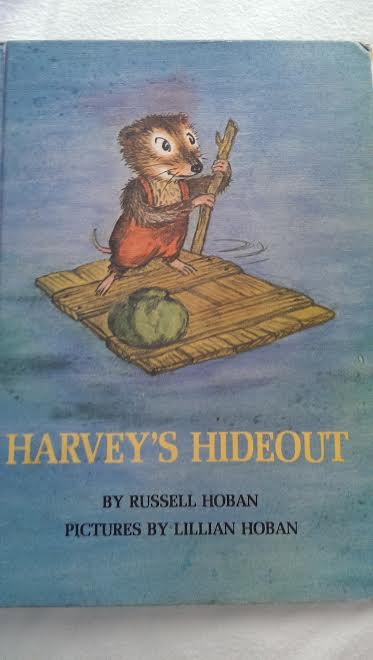
Harvey’s Hideout

HarveysHideout

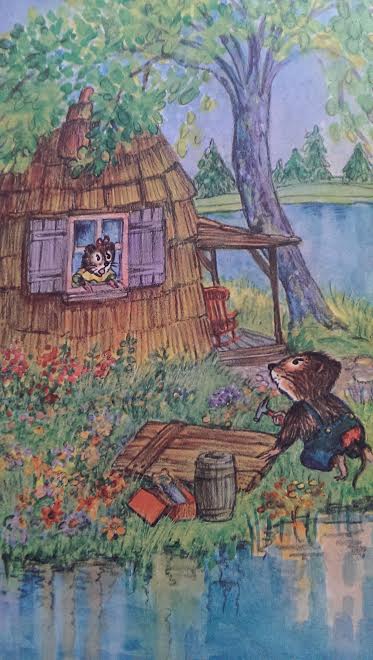
Harvey’s Hideout by Russell Hoban, illustrated by Lillian Hoban, 1969.

HarveysHideoutHouseSummer is difficult for the Muskrat kids this year.  Their friends are away for the summer, and Harvey and his older sister Mildred are getting on each other’s nerves.  But, there’s nothing that says they have to spend the whole summer with each other.

Harvey builds himself a raft and tells Mildred that he’s going off to meet with members of his secret club for a cookout where annoying big sisters aren’t welcome.  Mildred says that’s fine with her because she’s been invited to a party where there will be no annoying little brothers.  Harvey says that’s fine with him . . . except that it really isn’t.

The secret hideout where Harvey has been spending his time is empty except for him and the comic books he brought with him, and his cookout is for only one person.  He just made up the story about the secret club to make Mildred jealous and to have an excuse to spend time away from the house and her.  Harvey appreciates the freedom, but he’s also bored and lonely and envies Mildred, wondering who she knows who is still in town, inviting her to parties every day.

Then, when Harvey tries to make some improvements to his secret hideout, he discovers that he’s not the only one to dig a secret hideout for himself in the area.  Harvey’s unexpected discovery leads to a change in his relationship with his sister.

HarveyHideoutSecret


The book is available to borrow and read for free online through Internet Archive, and new copies are also available to buy through Plough.  If you try it and like it, consider buying a copy to own!

HarveysHideoutFriends

My Reaction

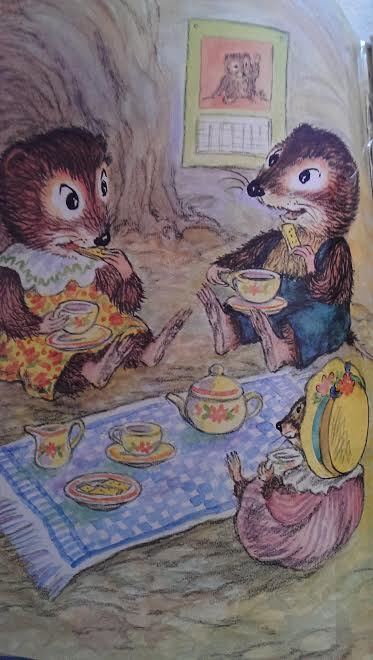
This is a nice story about sibling rivalry and cooperation.  One of the parts I like best is early on in the story when Harvey and Mildred’s father lectures them for fighting and insulting each other. I hated that part when I was a kid, but I kind of like it now because I realize what the father is actually trying to say.  He points out that there is some truth in their insults, but they’re wrong about each other at the same time.  Part of the reason they fight is because they each have their faults (Harvey can be selfish and Mildred can be bossy), but they each unfairly assume that the other is a lost cause and that they can never be friends.  It’s only when they come to realize that they’re equally lonely (Mildred has been having tea parties with just her doll) and Harvey makes the first move in offering to share what he has with Mildred that they realize that they can each be the friends they both need this summer.

When I was a kid, I wished I had a hideout like theirs!  I also love the colorful illustrations in the story.

The Valentine Star

The Kids of the Polk Street School

valentinestar#6 The Valentine Star by Patricia Reilly Giff, 1985.

Emily Arrow and Sherri Dent have been fighting ever since Emily refused to play a game with Sherri at recess.  It wasn’t because Emily didn’t like Sherri.  She was just having too much fun running around with her toy unicorn, Uni.  But, Emily made the mistake of running up on top of that huge snow pile near the school fence, the one that the kids aren’t supposed to play on.  Then, Sherri told on her to Ms. Rooney.  After that, it becomes a game of tit-for-tat, each of the girls telling on the other for little things.  While Emily is acting as room monitor while Ms. Rooney is out of the room, Sherri gets out of her seat to get a book instead of doing her work, so Emily writes her name down and tells Ms. Rooney.  Sherri promises that she’ll get even.

Around the same time, Ms. Rooney’s room gets a new student teacher, Ms. Vincent.  Ms. Vincent is very pretty and nice, and Emily likes her immediately.  The kids are making rhyming Valentine’s Day cards for each other because Valentine’s Day is just a few days away, and Emily wants to give a special one to Ms. Vincent.

valentinestarpic1But then, Emily and “Beast” (Richard Best) make a serious mistake.  It was hot inside at lunch, and they couldn’t resist the urge to run outside in the snow for just a couple of minutes without their coats.  Then, they got locked out and had to get Beast’s sister to let them in a different door.  They thought no one saw them, but a neighbor did and contacted the school.  Now, Emily is afraid of what will happen if their teacher finds out that it was her and Beast.  Will the school be angry enough to hold them both back a grade or maybe worse?  Maybe Emily will be spending Valentine’s Day in the school office instead of at the party, watching Ms. Vincent enjoy her special valentine . . . especially if Sherri happens to know what they did.

Many of the The Kids of the Polk Street School books are about the little problems that kids get into but that seem big because they’re young and inexperienced.  Ms. Vincent’s kindness and understanding help Emily and Sherri to work out their differences, and a President’s Day lesson about the honesty of both Lincoln and Washington help Emily and Beast to realize that tattling on yourself makes you a better person than tattling on others.

The book is available to borrow and read for free online through Internet Archive (multiple copies).