The Mystery in Arizona

Trixie Belden

TBMysteryArizona

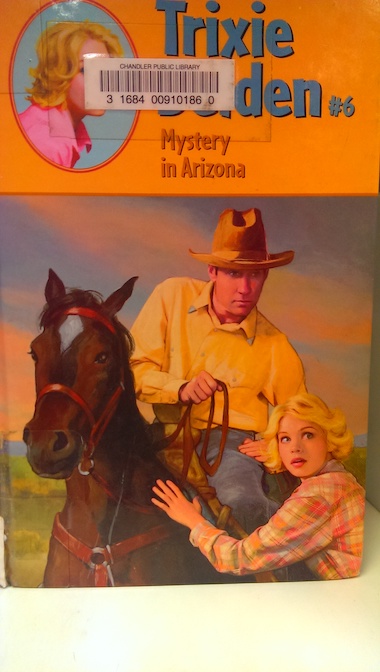
#6 The Mystery in Arizona by Julie Campbell, 1958.
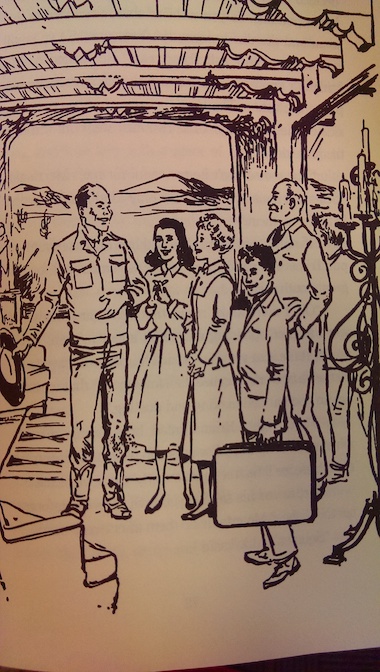
TBMysteryArizonaRanchDi’s Uncle Monty (the real one, not the fake from previously in the series) has invited her and the other Bob-Whites to spend Christmas at his dude ranch near Tucson, Arizona. At first, Trixie is worried that she won’t be allowed to go with the others because her grades in school are bad and she needs to study. However, her parents finally agree to allow her to go when the boys offer to tutor her over the holidays, and Trixie can get information that she needs on Navajo Indians for her theme. It won’t be easy, though.

From the very start of their visit, problems plague the ranch, and it seems as though everyone has a secret. Most of the members of the Orlando family, who usually take care of cooking, cleaning, and other tasks on the ranch, have mysteriously disappeared, except for Maria and her young son. Maria refuses to say where the others are, but the little boy is unhappy that he couldn’t go with the rest of his family and makes strange comments about skeletons and other frightening things. Also, Rosita, a Navajo girl working as a maid at the ranch, is deeply unhappy and in need of money for reasons that she doesn’t want to explain.

Meanwhile, there is a trio of lonely and unhappy guests in need of cheering up. In an effort to help, the Bob-Whites volunteer to take over the Orlandos’ chores to keep the ranch running during the holidays. As Trixie gets drawn further into the mysteries plaguing the ranch, she finds it difficult to balance her work and her studies. Trixie worries that this might turn out to be a terrible way to spend Christmas, but with some help from the Bob-Whites, things might work out even better than anyone hoped.

One of the things that they discover is that the Orlando family is celebrating a family tradition similar to Dia de Los Muertos (Day of the Dead, similar to All Souls Day and Halloween) but their family celebrates it at a different time of year than is customary because they want their celebration to coincide with the birthday of one of their ancestors.  They left without explaining because they were worried that no one would understand their traditions or approve of them.  Maria Orlando did not go right away because she was worried about leaving her job, but when her son tries to run away and join the rest of the family, she decides that it isn’t fair to keep him away from the family celebration.  After making sure that the Bob-Whites can handle the chores on the ranch, she takes her son to join the others in Mexico.

The three unhappy guests, Jane Brown, Mr. Wellington, and Mrs. Sherman, also have their problems solved.  Jane learns to get over her shyness and enjoy herself.  Mr. Wellington’s children, who had decided at the last minute to spend the holidays with friends, change their minds and come to spend Christmas with their father instead, cheering him up.  After Maria leaves, Mrs. Sherman cooks Christmas dinner for everyone, allowing her to once again do the work she loved when she and her late husband ran a restaurant.  Rosita’s secret is that she feels responsible for an accident that her father suffered when he was working with some  more modern tools that she gave him for his silversmithing work.  She took a job at the ranch to get some money for his medical treatment, but she is worried that she cannot earn all the money she needs during the holidays so that she can return to school.  She sold some of her silver jewelry to Mrs. Sherman, but she refused to take more than $100 dollars for it, although Mrs. Sherman would gladly have given her all the money that she needed.  Rosita is too proud to ask for or accept help from others.  The Bob-Whites solve her problem by giving her the money that they earned working at the ranch as a Christmas present.  In spite of all these distractions, Trixie manages to improve her math and get enough information for her theme on Navajos from Rosita.

This is the last Trixie Belden book written by Julie Campbell, the original author of the series.  From this point on, the series continues with other authors.

The book is currently available online through Internet Archive.

Roxaboxen

Roxaboxen

Roxaboxen by Alice McLerran, illustrated by Barbara Cooney, 1991.

This story is based on reminiscences from the author’s family about the games they and their friends played when they were children in Yuma, Arizona. The section in the back about the author and illustrator explains a little about it. The author was born in 1933. Her Aunt Frances (one of the children named in the story) was 80 years old when the creators of the book were writing the story and drawing the pictures, so she was born around 1910. That means that the children in the story probably made up their imaginary town and played in it in during the late 1910s and into the early 1920s. The clothes that the children wear in the pictures appear to be from around that time as well (some of the girls have dresses with dropped waists, and some of the children wear sailor-style outfits).

One of the great things about this book is the power of imagination. Readers are not only taken back in time to someone’s remembered childhood, but to the place that the children invented: a town that both isn’t there but yet always is because of the imaginations of the children who once played there.  The pictures in this book are beautiful!

RoxaboxenDesertBeginning

A group of neighborhood friends living in a small town in Arizona play games on the edge of the desert. They make a town of their own from stones and old boxes and other things they find, naming it Roxaboxen. Marian, one of the oldest children, names the town and becomes its mayor.

RoxaboxenMayor

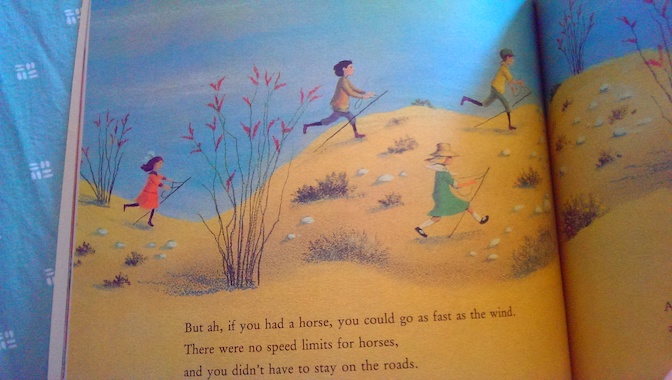
Using stones, the children outline the streets, houses, and shops of their town. They sell things to each other, using little black stones for money, and decorate their “houses” with old bottles and bits of broken glass in different colors. Using other things they find, the kids pretend that they have cars and horses. There are rules against speeding in their “cars”, so they also appoint a policeman and create a “jail.” Sometimes, they have “wars”, boys against girls.

RoxaboxenHorses

Time passes, but the children continue to play in Roxaboxen year after year, adding to the town and its lore. Even years later, when they’ve grown up and have moved to other places, Roxaboxen still lives in their minds. In a way, they said that their imaginary town always existed, just waiting for those with the imagination to see it, and through the story and illustrations in the book, it now draws in those who read about it but have never seen it themselves.

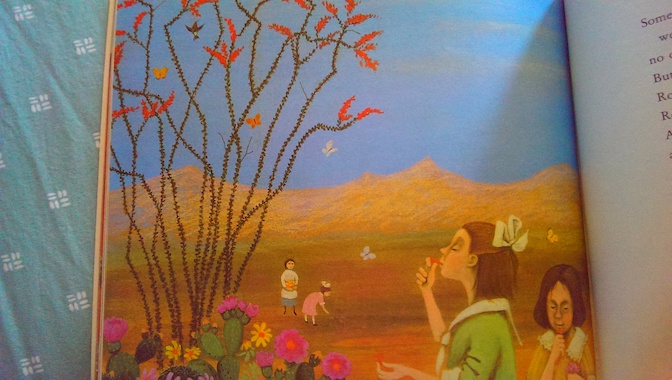
RoxaboxenOcotillo

Another great thing about the book is the sense of freedom that the children have. Many modern children wouldn’t be able to go out on the edges of their town and build something for themselves in the same way that the children in the story did. Although, in the freedom of their own minds and their own backyards, maybe some kids are building their own Roxaboxens as we speak.

The book is available to borrow and read for free online through Internet Archive (multiple copies, including one in Spanish and a video reading).

RoxaboxenFrances

The Little Indian Basket Maker

BasketMaker

The Little Indian Basket Maker by Ann Nolan Clark and illustrated by Harrison Begay, 1957.

By “Indian,” the author means Native American.  This book specifically focuses on the  Papago (Tohono O’odam) who live in the Southwestern United States, specifically Arizona.  The story is about a young girl who is starting to learn the traditional art of basket-making, and the book goes into the process involved in making baskets, step by step.   Although the use of “Indian” instead of Native American is somewhat antiquated, and Tohono O’odam is really the proper name for the Papago people, the book has something of an interesting history and the picture it provides of the practice of traditional crafts is fascinating. There is a section at the beginning of the book which explains a little about the history of the Papago (Tohono O’odam) people and where they live.

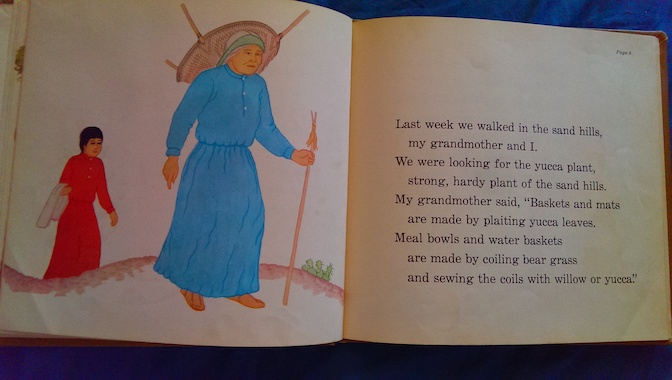
BasketMakerGrandmother

A young girl explains how her grandmother teaches her the traditional craft of making baskets.  They start by gathering the types of plants that they are going to use.

BasketMakerPlants.jpg

They also need special plants for the dye they will need in order to decorate the baskets.  The girl’s grandmother explains about the different types of decorations they traditionally use.

BasketMakerDesigns

Making baskets is a long process that includes cleaning the plants and tearing them into long strips, bleaching them, soaking them to soften them, dyeing strips used in the design, and weaving them together.

BasketMakerSoftening

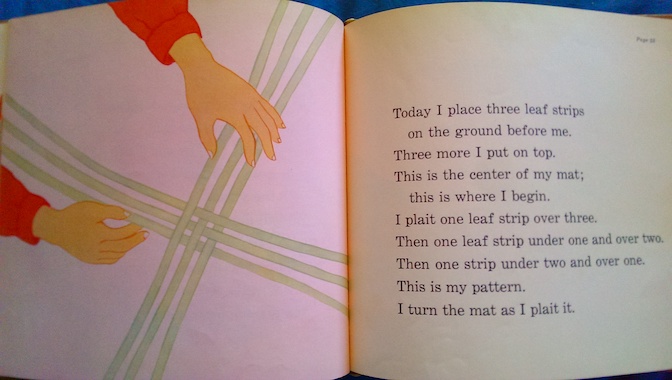
The girl weaves a mat that takes days to finish.  It is the first one that she’s made herself.

BasketMakerWeaving

She is very proud of herself when the mat is finished, and she is pleased with the quality of her work.

BasketMakerFinishing

I’ve owned this book since I was a young child, and it was my introduction to traditional crafts.  Later, I found a related book at a thrift store, The Little Indian Pottery Maker.  Until then, I hadn’t realized then just how old the books were and that there were more of them by the same author.

The book, which was written in the 1950s, was one of a group of stories (not exactly a series because they didn’t have a specific set of characters in common and the themes varied somewhat) written by a woman who was a teacher with the United States Indian Service.  The other books that she wrote, including The Little Indian Pottery Maker, focus on members of different Native American tribes.  She was not Native American herself, and the modern view of Indian schools is not favorable (for good reasons), so one might be a little suspicious of a book written about Native Americans by an Indian school teacher. However, these books interest me because of their explanation of traditional crafts. There are no white people in the stories at all, and they have a timeless quality to them.  Reading them, it’s hard to get a sense of exactly when the stories take place because it’s never mentioned, and there aren’t many clues (no mentions of modern technology, it’s all about the crafts).  I haven’t found any of the other books that the author wrote, but these two are very respectful in their tone, and they begin with explanations of the history of the tribes involved in the stories.  According to Andie Peterson in A Second Look: Native Americans in Children’s Books, the author was deliberately trying to write books that her Native American students could relate to.

The art style of the books vary because they had different illustrators.  The illustrator for this particular book was a Navajo painter.

The book is available to read for free online through Internet Archive.

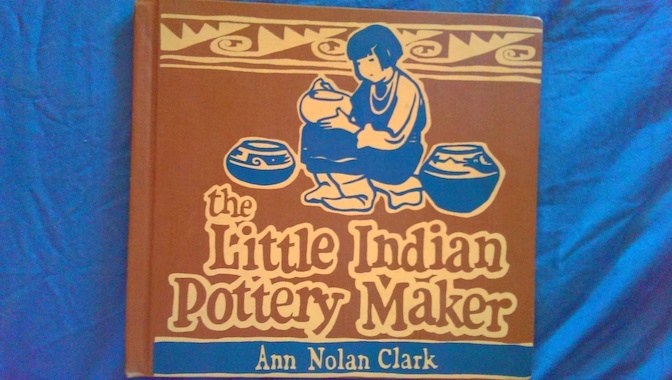
The Little Indian Pottery Maker

PotteryMaker

The Little Indian Pottery Maker by Ann Nolan Clark and illustrated by Don Perceval, 1955.

By “Indian,” the author means Native American.  This book specifically focuses on the Pueblo Indians who live in the Southwestern United States, specifically New Mexico and Arizona.  The story is about a young girl who is starting to learn the traditional art of pottery-making, and the book goes into the process involved in making pottery, step by step.   Although the use of “Indian” instead of Native American is somewhat anitquated, the book has something of an interesting history and the picture it provides of the practice of traditional crafts is fascinating. The beginning of the book explains a little about Pueblo Indians, their history, and where they live.

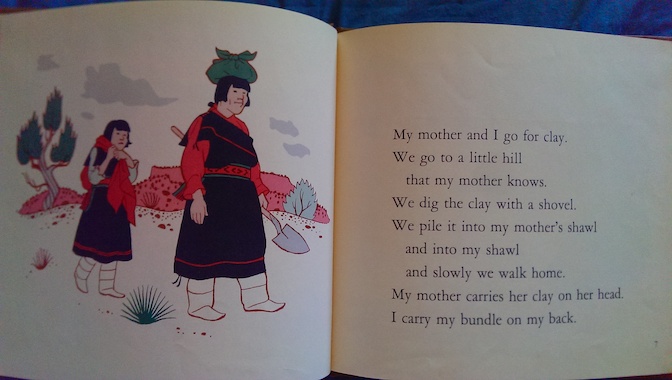
PotteryMakerGettingClay

The young girl tells the story of how her mother introduces her to the traditional craft of making pottery and teaches her how to make her first pot.  She describes every step in the process, from when they collect the clay themselves from a hillside until the pot is finally complete.

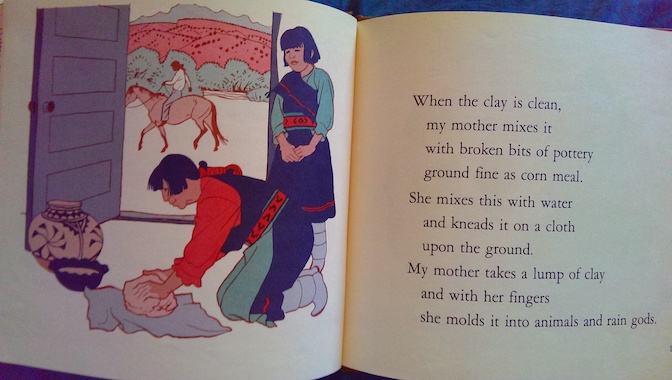
PotteryMakerMixingClay

The girl’s mother explains about the different methods used to make pots, and pictures show how pots are shaped.

PotteryMakerRollingClay
PotteryMakerMakingPots

Making pottery is a long process that takes days to complete, including shaping, scraping and smoothing the sides, drying, decorating, and finally firing the pottery.  The girl is proud of the first pot she has ever made.

PotteryMakerFiringPots

I found this book at a thrift store a number of years ago and recognized it because I already owned a related book, The Little Indian Basket Maker, that I liked when I was a young child.  I hadn’t realized then just how old the books were and that there were more of them by the same author.

The book, which was written in the mid-1950s, was one of a group of stories (not exactly a series because they didn’t have a specific set of characters in common and the themes varied somewhat) written by a woman who was a teacher with the United States Indian Service.  The other books that she wrote, including The Little Indian Basket Maker, focus on members of different Native American tribes.  She was not Native American herself, and the modern view of Indian schools is not favorable (for good reasons), so one might be a little suspicious of a book written about Native Americans by an Indian school teacher. However, these books interest me because of their explanation of traditional crafts. There are no white people in the stories at all, and they have a timeless quality to them.  Reading them, it’s hard to get a sense of exactly when the stories take place because it’s never mentioned, and there aren’t many clues (no mentions of modern technology, it’s all about the crafts).  I haven’t found any of the other books that the author wrote, but these two are very respectful in their tone, and they begin with explanations of the history of the tribes involved in the stories.  According to Andie Peterson in A Second Look: Native Americans in Children’s Books, the author was deliberately trying to write books that her Native American students could relate to.

The art style of the books vary because they had different illustrators.  The illustrator for this particular book was not Native American (unlike some of the illustrators of other books), but he was adopted into a Hopi tribe, apparently as an adult because of his accomplishments in representing Hopi culture in art.