The Boxcar Children
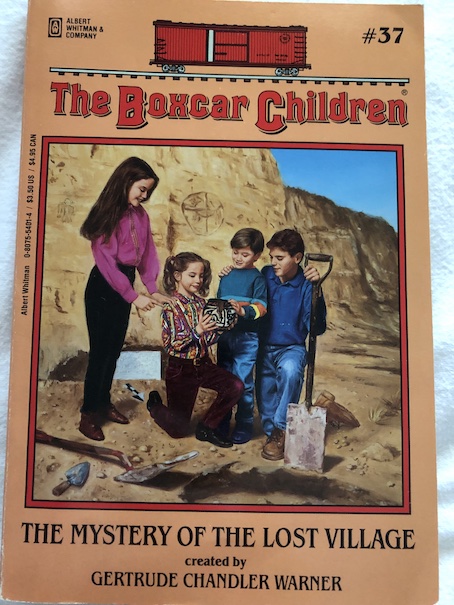
#37 The Mystery of the Lost Village by Gertrude Chandler Warner, 1993.
Grandfather Alden is going on a fishing trip with a friend, and he arranges for his grandchildren to stay with a family on a Navajo reservation. They’ve never been to a reservation before, and there will be hiking and a powwow. The kids are all eager to go!
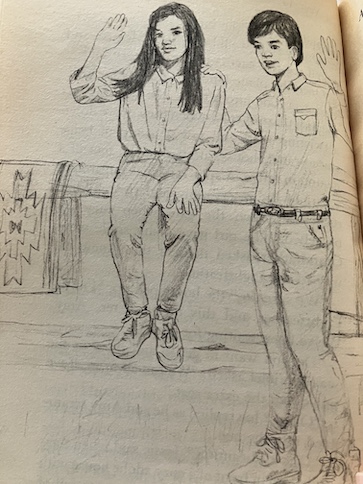
The family the Aldens are staying with is the Lightfeathers, and they have two children about the same age as the Aldens, Joe and Amy. The Lightfeathers tell the Aldens interesting things about Navajo history, culture, and crafts. What grabs their attention the most is a story about an ancient village nearby that was abandoned due to drought. The stories that have been passed down through the generations tell them roughly where the village was supposed to be, but the remains of the lost village have never been found.
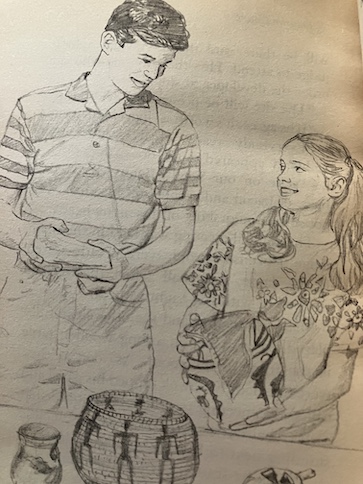
Joe, Amy, and the Aldens ask if they could try digging for the lost village. Mrs. Lightfeather once studied archaeology, and they ask her if she can help them. Mrs. Lightfeather says that, although the village may be gone, traces of it should be left. The children begin laying out an orderly dig and start their search. They find some arrowheads and pottery, but when they show Mrs. Lightfeather what they’ve found, she says that they can’t continue their dig for much longer. The adults have just heard that a developer is taking over the land to build vacation homes. The children are dismayed when they find out that the developer is going to clear all of the trees. Of course, if the children can find signs of the lost village, the site would become an archaeological site, and the developer would have to stop. They only have two weeks to find some evidence of the lost village before the development starts!

There are some suspicious people hanging around. Michael Runningdeer, who works for the real estate developer, has been checking the boundaries of the reservation to check where they can develop. While they’re working on their dig, the kids meet a woman called Rita Neville, who says that she’s working on a documentary. Ted Clark is a genealogist who says that he has come to the reservation to trace his family’s roots, but Amy thinks it’s strange that he doesn’t seem to know things that someone with Navajo roots would usually know.
As the children work on their dig, they start finding more things, but someone also starts filling in places where they’ve been digging. In other places, someone has been digging where they haven’t dug yet. Then, someone steals an impressive bowl that Violet found. Is someone trying to prevent them from making a discovery that would stop the development, or is this a case of greed for Native American artifacts?
My Reaction
I liked this mystery as a kid, but I have a bone to pick with this story now. Perhaps the rules have changed since the book was written, but I know from living in Arizona that it’s routine to call in professional archaeologists to survey sites before digging and development take place. Because this area was inhabited by different groups over the centuries, archaeological finds can be just about anywhere.
I was attending ASU when they build the bio-sciences building, and people were allowed to watch the archaeologists survey the site. They did find an old Native American burial ground on the site. It didn’t stop the development completely, but they did record and catalog all of their finds before reburying them in the same locations where they were found. The logic of that is that Arizona is a very dry climate, and it preserves things buried in the ground very well. Putting a building over the site will prevent the site from being disturbed again for a long time. In the future, there may be better archaeological tools and scientific techniques that can be used to reevaluate the site and the things in it, and by then, the building may no longer be there.
What I’m saying is that there are rules and practices regarding archaeology and development in this region. Because this book was written about 30 years ago, when I was a kid, I’m not sure how different the rules were then, but I’m sure that archaeological surveys of this type were conducted back then, too. One of my old college teachers was an archaeologist, and he told us about digs he participated in around one of the reservations years before. I’d be surprised that development so close to a reservation, as in this story, would be allowed to go ahead without an archaeological survey from one of the universities or other archaeological organizations in the state. I just think that there should have been professionals working in the area before the kids started their dig.
I liked the pieces of information that the Lightfeathers explain to the Aldens about Navajo history and culture. My favorite piece of trivia was the explanation about how, rather than putting clay cooking pots directly over the fire, historical Navajos would heat a stone in a fire and then put the stone into a pot of water to heat the water for cooking. I think it’s a creative solution to cooking in a vessel that can’t be used directly over fire.
Jessie is allowed to participate in a dance at the powwow as a guest of a Navajo family, and Amy helps her put together regalia for the dance. (See Jingle Dancer for an example of this in a different tribe.) I sometimes find it a little cringey now when characters in stories too easily participate in Native American events and are quickly called honorary members of the tribe, but in this case, the Aldens do help make an important discovery.











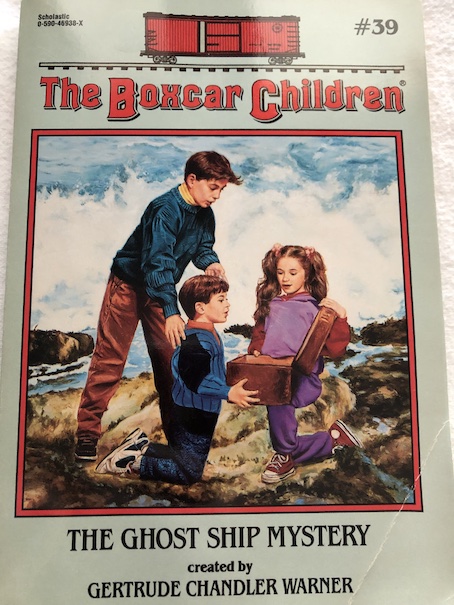





 The Haunting of Cabin 13 by Kristi D. Holl, 1987.
 Scared Silly by Eth Clifford, 1988.
 While the Onetree family is visiting the museum, a pair of shoes that once belonged to a Chinese emperor disappears. Like the two Onetree sisters, Gus considers himself the sensible brother and doesn’t take Razendale, the dreamier sibling, very seriously. He thinks Razendale ran off with the shoes as a prank. But, Erik, who seems more sensible than either of his uncles, says that they can’t just accuse him without proof. Gus provides them with an invention that could settle the whole matter, but that depends on whether or not they can trust Gus.
 Jestress's Forgotten Books and Stories