Games People Play: China

Games People Play: China by Kim Dramer, 1997.

This book is part of a series about games played around the world. The series also covers sports and other, related activities. This book is specifically about the traditional games and sports of China.

China’s history goes back thousands of years, and so does the history of games and toys enjoyed there by generations of children. The book begins with a brief history of China. This book was written in the 1990s, and it contains a brief description of China’s one-child policy, which controlled the sizes of Chinese families and impacted the way in which children were raised. It also explains some important Chinese festivals, such as the Lunar New Year, Lantern Festival, and Dragon Boat Festival. It explains the origins of these festivals and how people celebrate, including the roles of children in the celebrations.
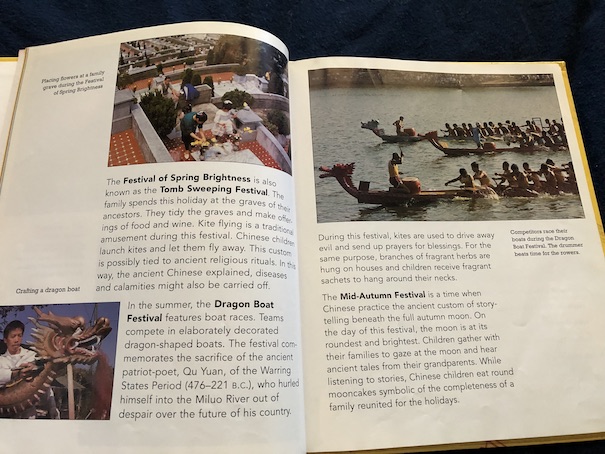
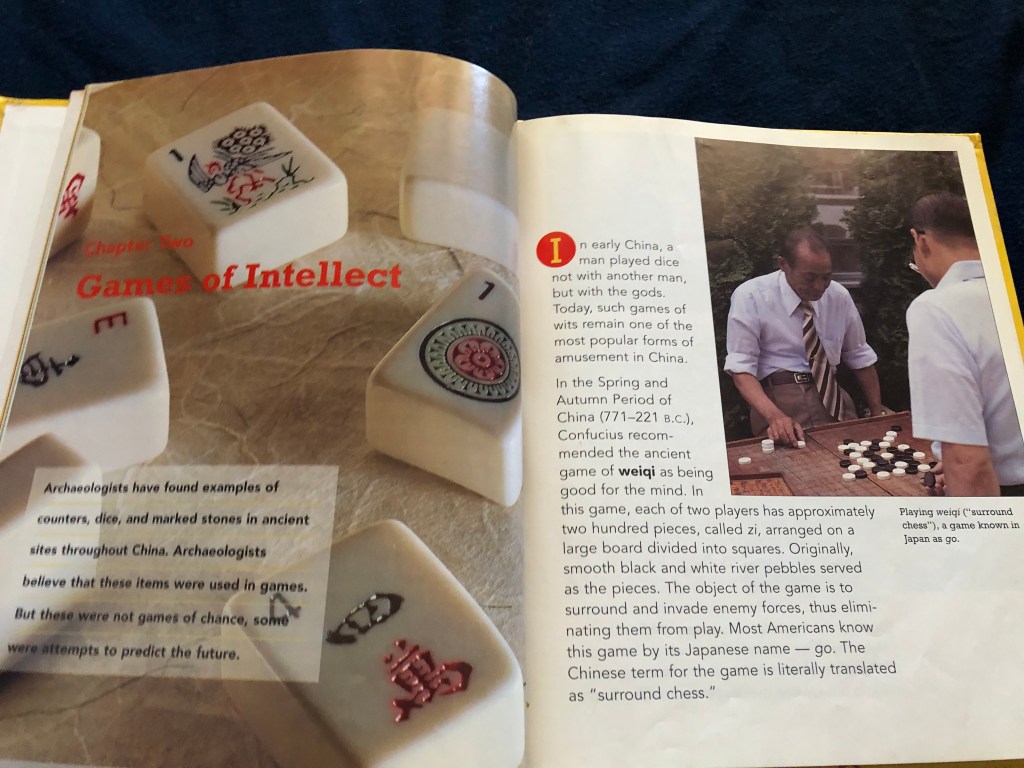
I most enjoyed the sections about board games. Some of the oldest board games in the world come from China. Some of these games are also played in Japan under different names. For example, the game Weiqi is known as Go in Japan, and this is the name that is also most familiar to Americans. Chinese Chess uses different pieces from the international form of chess. The book mentions Chinese Checkers also, but it doesn’t explain that it was not actually invented in China, even though it is played there today. (The “Chinese” in the title was a marketing gimmick in the United States, to make the game seem more exotic. It’s actually a German variation of the American game Halma, which was based on an older English game called Hoppers.) Majiang (called Mah-Jongg in the United States) is another well-known Chinese game. Sometimes, in the United States, people play it as a solitaire game on their computes, but the real-life board game is a multiplayer game with several variations.
When I was in school, I had a teacher who was fond of tangrams, which is a kind of puzzle game that involves using a set of basic shapes to produce different forms or pictures of objects. The book demonstrates how to make a tangram set and how to use it.

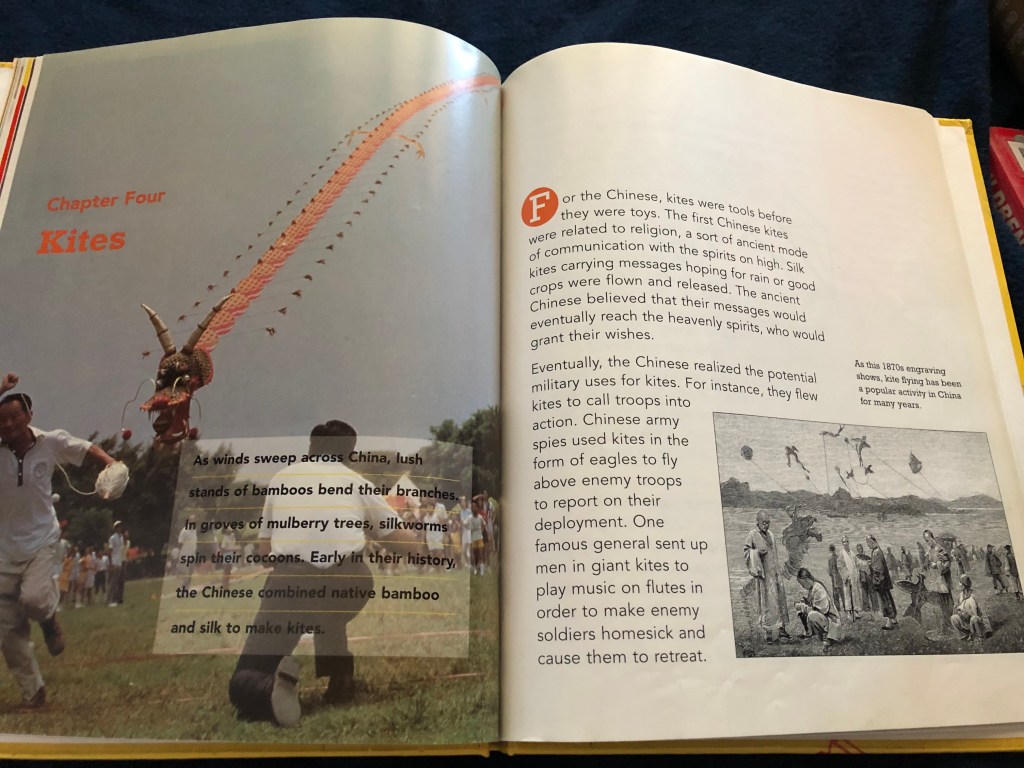
The earliest kites made in China were made for serious, religious purposes, sending prayers, signs, or messages to the heavens. Later, the Chinese also used them to give military signals. Later, paper kites became a popular form of amusement and folk art. They can be made in many different forms. Some of them even make musical sounds, caused by the wind passing over holes placed in the bamboo frame of the kite.
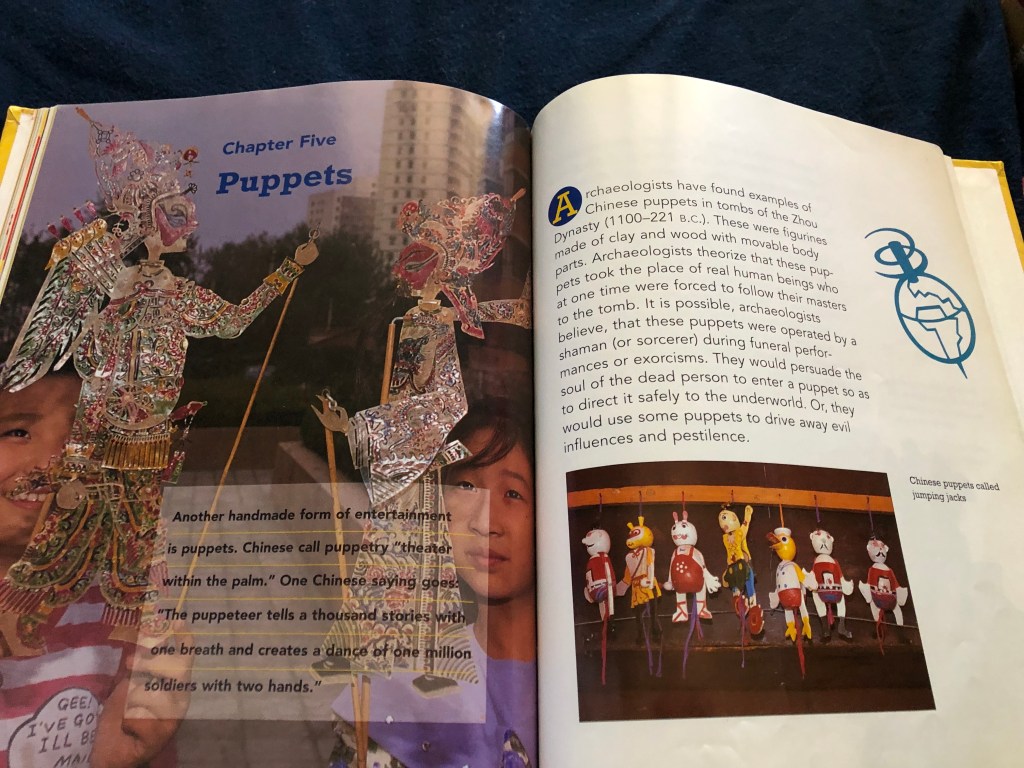
The Chinese also use puppets in different styles. The history of puppet theater also goes back thousands of years, and puppets made for puppet theaters can be very elaborate. Sometimes, plays are performed with shadow puppets controlled by sticks and sometimes with marionettes or hand puppets. The appearance of a puppet and provide clues to the puppet’s character. For example, puppets with red faces represent brave characters while ones with white faces may be cunning and treacherous and ones with black faces are loyal.
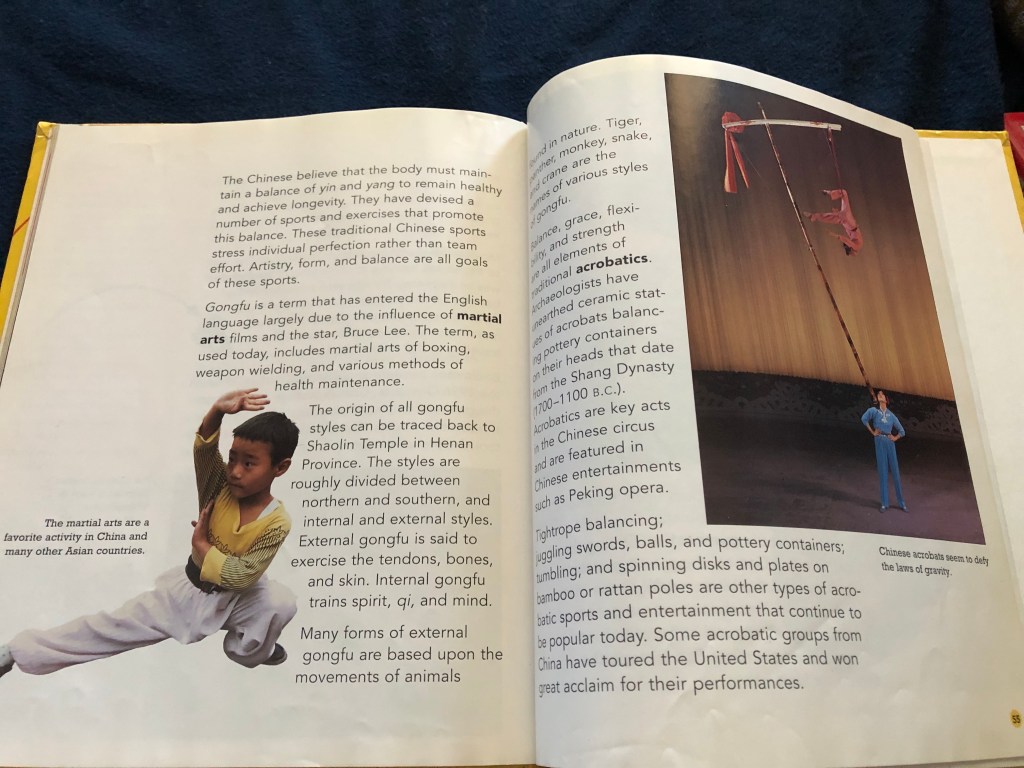
Popular sports in China include soccer (called “football” everywhere but in North America) and badminton. China is also famous for its martial arts and some spectacular forms of acrobatics.
Mystery of the Secret Message

secretmessageMystery of the Secret Message by Elizabeth Honness, 1961.

Penny lives with her aunt and uncle because her mother is dead and her father travels on business much of the time, dealing in Asian art.  Thanks to his travels, Penny and her aunt and uncle have quite a collection of Asian art themselves.  However, Penny has just been told that her father’s airplane crashed in the Pacific Ocean.  No survivors have been found, although Penny still has hope that perhaps her father survived and might yet be found.

At the same time, Penny and her aunt and uncle are moving into a house from the apartment where they used to live. Penny is happy about the move because she knows that she won’t have to worry as much about being quiet and not disturbing the neighbors, like she had to do in their apartment. This means that Penny can bring her friends over to the house to play and have parties. Also, their new house has a very special feature: its own private elevator.

Penny loves the new house and soon begins building a tree house with the help of Pete, a boy who lives nearby.  She tells Pete about her father and her hopes that he might still be alive.

However, events take a disturbing turn when Penny receives a package from Japan containing a beautiful wall scroll. The package appears to have been sent by her father, who meant it as a present for her new room in her new house. Was the package sent before his death, or did he somehow survive the crash?

There is also something odd about Penny’s new neighbors.  Penny’s new house is actually half of a duplex, and the new neighbors, the Carruthers, have also recently moved in after renting the other half. When Penny accidentally gets stuck in the elevator and hears voices coming through the wall, she starts to suspect that her neighbors might not be what they seem to be.  They show an unusual interest in her family’s collection of Asian art, asking to see pieces and borrow pieces for an exhibition that Mr. Carruthers is holding at his gallery.  One of Penny’s friends even catches Mrs. Carruthers sneaking around, looking at things uninvited.

When Penny and her friends have a sleepover on an evening when her aunt and uncle are out, someone sneaks into the house, leaving muddy footprints on the floor.  Penny isn’t sure that her aunt and uncle will believe her because they seem to like the Carruthers, so at Pete’s suggestion, she continues to spy on them, using the elevator to listen in on their conversations through the walls.

When her uncle catches her one day, using the elevator without permission (something she is not supposed to do), she finally explains her suspicions and what’s she’s heard the Carruthers say.  Together, Penny and her uncle discover a hidden secret about the wall scroll Penny recently received, which points to a number of secrets that Penny’s father kept from her and the rest of his family for years.  A stranger from the government helps Penny to fill in some of the blanks, but he has a favor to ask in return that requires Penny to take a big risk.

My Reaction and Spoilers

Although this book is much older than I am, it was a favorite of mine when I was a kid, yet another of my used book sale treasures! I actually got rid of my first copy years ago, when I was cleaning some things out, but I missed it, so I got another one. It’s actually a collector’s item these days.

I always liked the feature of the elevator in the story and how Penny uses it to find the right spot to hear what her neighbors are saying through the wall. I love intrigue, and as a kid, I liked the idea both having a house with an elevator and of overhearing clandestine conversations that reveal sinister secrets. There are points in the story where the two-faced Carruthers think that they have the upper hand, and Penny has to be careful not to let on just how much she knows.

As I explained, the neighbors are not what they seem to be, and Penny’s father was involved in things that his family knew nothing about. Since it’s not easy to get hold of this book right now, I’ll include a couple of spoilers. Penny’s father was acting as a spy for the US government, using his profession as an art dealer to travel to locations he needed to go and to smuggle information back to the US. He is apparently dead, killed in the plane crash, although there are hints that the crash wasn’t an accident, that it may have been intended to kill him. However, before his death, he managed to smuggle his last important information to Penny in the wall scroll that he sent her. When Penny manages to convince her uncle that something isn’t right about the Carruthers, he begins making inquiries and learns the truth about Penny’s father. A government agent speaks to the family and arranges a plan to fool the Carruthers into thinking that they’ve found what they were looking for, but the plan requires Penny to spend an evening in the house alone with them.