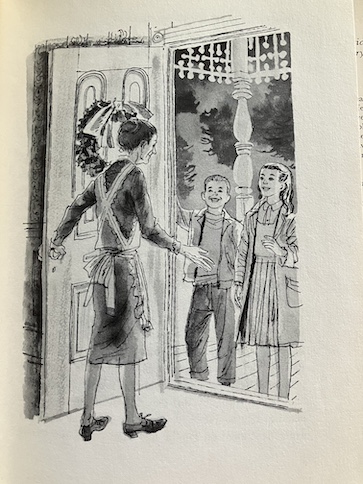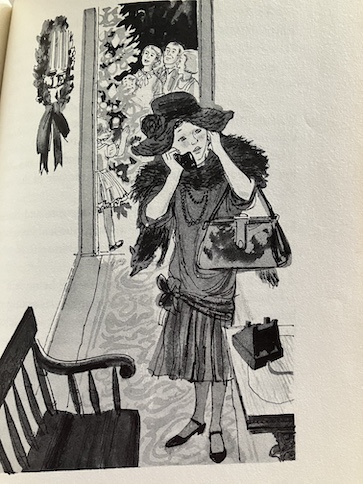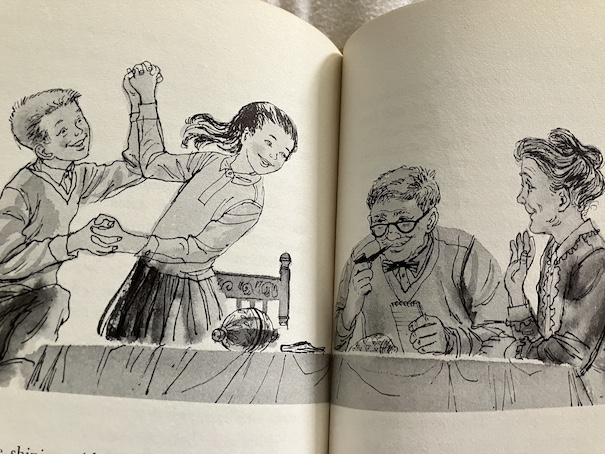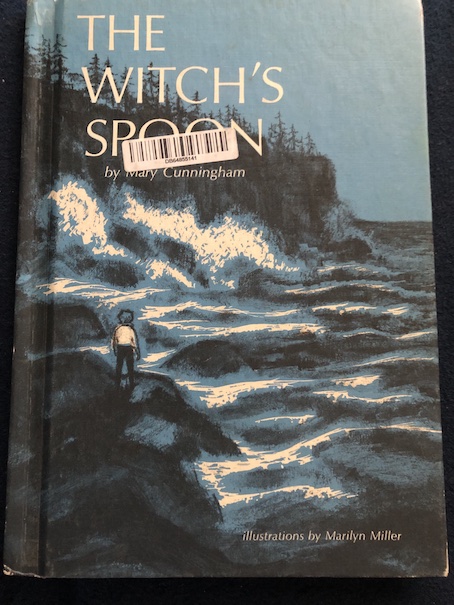
The Witch’s Spoon

The Witch’s Spoon by Mary Cunningham, illustrated by Marilyn Miller, 1975.

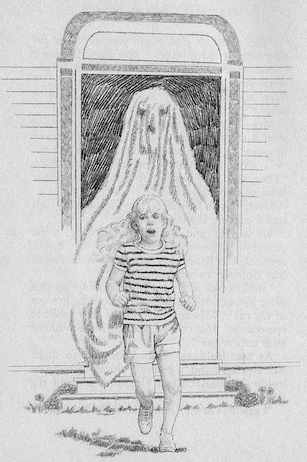
Tom and Lauren are spending a week with their grandmother at her beach cottage during the summer. They have visited the cottage many times before, and they love revisiting all their favorite places, the bunk beds on the cottage’s sleeping porch, like the tree where they always see baby owls (which they call the owl tree), and the place where they once found some lost coins (which they call the money spot). They know the cottage well, inside and out. This summer, though, there are a few things that are different.

The first thing that the kids notice that is different is that their Grandma has added a new item to her curio cabinet: a big silver spoon with a long handle. They ask their grandmother about the spoon, and she explains that it’s a witch’s spoon. She recently inherited it from the children’s Great-Aunt Hannah (that would be their grandmother’s sister), who used to live in Massachusetts. The spoon is a family heirloom from the time of the witchcraft trials in Salem (“when witches were thought to be as much of a problem to people as air pollution is now” – this is from the mid-1970s). Their grandmother says that there are good witches and bad witches, and good witches would use spoons like this one to stir love potions. Tom doesn’t believe in witches, but Lauren is fascinated by the spoon and the idea of love potions. She is sure that she senses magic from the spoon.

The next thing that will make the children’s visit here different from previous years is that their grandmother has decided that they’re old enough to have a June Day. June Days are a family tradition, and it’s not just because it’s June. During a June Day, the usual household rules are suspended for one day, and the children are allowed to go wherever they want and do anything they want, all on their own. Grandma says that she will prepare meals at the usual times, but for that day, it’s up to the children whether or not they show up for them, so they don’t need to interrupt their adventures. If the children aren’t there to eat their meals, Grandma will share the food with their nextdoor neighbor, Mr. Bunby. There are only a few safety rules that the children have to follow: they are expected to by careful when attempting any activity that might have an element of danger, and they have to leave their grandmother a note about the general area where they are going, like the beach or the nearby woods, so if they’re not back by dark, she’ll know where to look for them. The June Day ends when it gets dark, and the children must be home by then.
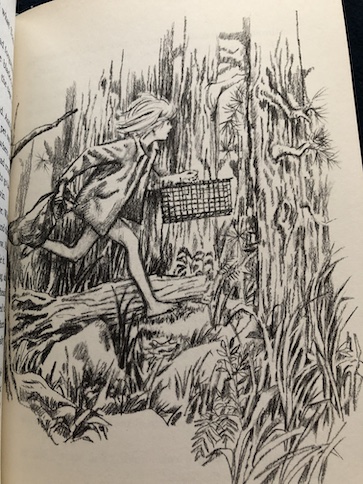
The grandmother understands that there is a certain element of risk in letting the children go off by themselves, and she reminds them that “every box has its pill.” That means that, while their children can choose what they’re going to do, they have to face the consequences of their choices, no matter what they might be, good or bad. “If you open the box and find a bitter pill, you have to swallow it.” Getting to make their own rules and decisions for a day doesn’t get them out of taking the consequences of whatever they do. If they get hurt or get into serious trouble, not only will they suffer the hurt or trouble they cause, but their parents may not let them come back next summer, so they need to keep that in mind when making their choices. Freedom still comes with responsibility, and that’s what the children need to be old enough to understand before they can have a June Day. Tom says that they understand, and that they won’t do anything too wild. Their grandmother tells them that they can have their June Day in two days, so they will have time to look forward to the treat and plan for it.

Tom and Lauren have different interests, so each of them decides to make up their own plans for a private adventure. Tom already knows what he wants to do for his June Day. There is a cave near the beach where the children usually aren’t allowed to go, but there are rumors that there is a giant cavern inside where pirates have hidden their treasure. Getting inside the cave will be difficult and involves an element of risk, but he is determined to spend his June Day hunting for pirate treasure. He doesn’t want to persuade Lauren to join him because he thinks she’ll be too scared to do it.

Meanwhile, Lauren thinks how she’s always wanted to hold a baby owl in her hands. She loves animals, and she decides that she’ll try to hold a baby owl on her June Day. She decides she won’t tell Tom about it, because he would probably think that was a silly thing to do. Lauren thinks that she even might try to make a baby owl a pet, just for the rest of the week.

There is one other thing that is different about this year, though. Their grandmother informs them that their cousin, Elizabeth, will be joining them at the cottage this year. Elizabeth’s father is the brother of Tom and Lauren’s father. Years ago, he moved to Italy and married a woman there, and they had only one daughter, Elizabeth. Unfortunately, Elizabeth’s parents died in a car accident, and Elizabeth has been living with her three aunts in Rome. She has never been the United States before and has never met either her grandmother or cousins, so the children’s grandmother has decided to invite her to visit this year.

Tom and Lauren aren’t thrilled at the idea of meeting their Italian cousin. It’s partly jealousy at sharing their grandmother with a girl they don’t really know. Elizabeth was named after their grandmother, and Lauren worries that Grandma will like her better because of that. Tom complains that she’ll probably be fat and smell like garlic because people in Italy eat a lot of spaghetti. It’s a mean thing to say, and even Lauren thinks it sounds ridiculous, but the children’s negative attitudes are also because they realize that Elizabeth’s presence will complicate their secret plans for their June Day. In order to have their secret adventures by themselves, they will also have to avoid their cousin trying to tag along.

In spite of their negativity and thoughts about playing pranks on Elizabeth so she won’t want to stay, Lauren realizes that she is also curious about this cousin and seeing what she’s like. When Elizabeth arrives the next day, she is a slim girl with dark hair, who doesn’t smell like garlic at all. Elizabeth speaks fluent English as well as Italian because she goes to an international school in Rome, so the children are able to talk to each other easily. Lauren feels jealous about the attention that their grandmother showers on Elizabeth, but Elizabeth is nice to Lauren. Elizabeth likes to knit, and she says that she would like to make a sweater for Lauren. Lauren asks her if she’ll have enough time because she’s only visiting for a week, and Elizabeth says that if it’s not finished by the time she has to leave, she will mail it to her. Lauren begins to feel a little sorry that she thought bad things about Elizabeth, but she also still feels jealous because of all the things Elizabeth knows how to do. Elizabeth can play the flute and wears pretty clothes as well as knitting and speaking multiple languages. Then, their grandmother announces that Elizabeth will be allowed to choose one item from her curio cabinet to take back to Italy with her. Tom and Lauren aren’t even allowed to open the curio cabinet without permission!
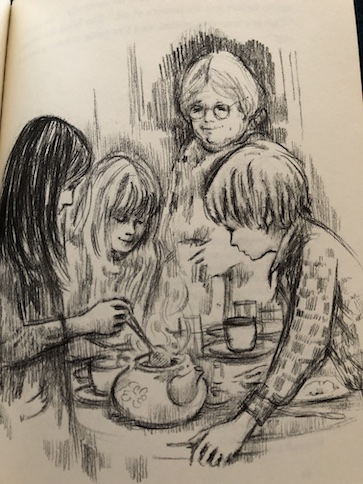
Their grandmother tells Tom and Lauren that they will each have a chance to choose something from the cabinet when they’re older. The only reason why Elizabeth is choosing now is that she lives far away and can’t come very often. Tom and Lauren each have favorite items in it that they tell Elizabeth to definitely not take before they get a chance to choose, and Lauren suggests that Elizabeth take the witch’s spoon. The witch’s spoon hasn’t been in the cabinet long enough for Tom or Lauren to have developed an attachment to it. Elizabeth is intrigued by the story that witches used it for making love potions, and their grandmother says that, in times of trouble, you can look into the bowl of the spoon and see answers. Elizabeth says that it’s an Italian tradition that a good witch gives children presents on January 6th (see The Legend of Old Benfana). She tries to see her deceased father in the spoon and is disappointed when she can’t. Their grandmother says that it might not be magical anymore or maybe people only saw in the spoon what they wanted to see.

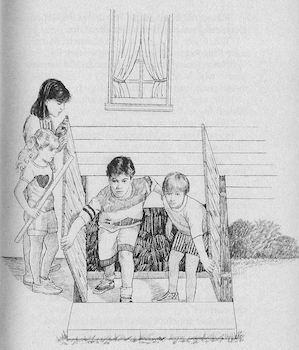
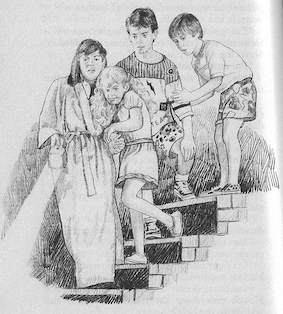
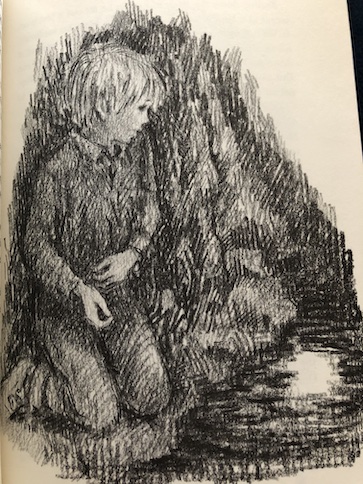
Tom and Lauren continue making their secret plans for their June Day, each kind of wondering what the other is planning to do. When the day arrives, they each get up early and put their plans into action before anybody can ask them what they’re going to do. Of course, their plans don’t turn out the way they thought. Lauren’s attempt to hold a baby owl and maybe make one a pet don’t take into account how the mother owl would feel about that. In the cave, Tom accidentally falls and drops his flashlight, so he’s trapped and unable to find his way out. Neither one of them was specific enough in their notes for anybody to find them quickly when they get into trouble. Fortunately, Elizabeth turns out to be not only a tag-along but a helpful partner in their adventures. Through their various adventures and disasters on this special June Day, the three children come to feel like they really are cousins. At the end of the story, the grandmother makes a special tea blend, and Elizabeth stirs it with the witch’s spoon, turning it into a love potion, but for family love.

I bought my copy of this book through Amazon. I haven’t found a way to read it online.

My Reaction and Spoilers
The book doesn’t say exactly where the story takes place, but I think it’s supposed to be the California coast because that’s where the author lived. The descriptions of the pine forest near the cottage and beach fit the California coast, and the same author wrote another book called The Rescue that takes place at a cabin in California.

The story has some nice cottagecore vibes, with the children having fun and adventures in nature. There are times that they reminisce about past summers at the cottage as well as enjoying the current summer. They once kept a lost, wild baby ferret as a pet temporarily one summer before releasing it back into the woods, and they always have to look for baby owls in the owl tree when they arrive at the cottage. They spend time at the beach, swimming, wading, sunning themselves, and looking for seashells. Lauren has a favorite type of seashell, called angel’s toenails. When Tom explores the cave, he likes seeing the stalactites, and he sees bats and a type of blind fish in the stream of the cave.
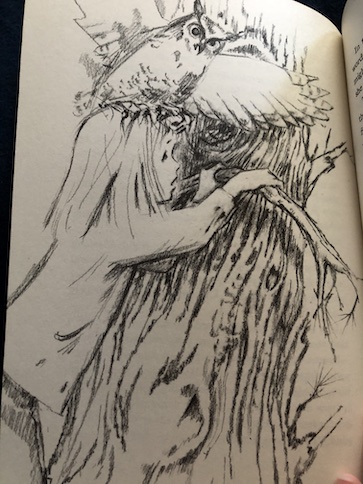
Few children these days have the same level of freedom that these children have at their grandmother’s seaside cottage, although for somewhat obvious reasons. Their grandmother speaks to them honestly and sincerely about the nature of risk-taking and accepting the consequences of their actions, but adults will realize that there are obvious problems with each of their plans for June Day. Even as a kid, I would not have tried to pick up a baby owl or keep one as a pet. Wild animals do not want to be made into pets, and they don’t want their babies to be picked up and held by humans. Owls are cute, but they are also birds prey with sharp beaks and talons and will fight back if they feel like someone is intruding on their personal space. Even my child self would have thought of that long before Lauren tries her June Day experiment. Of course, that’s mostly because my elders impressed on me that nobody should mess with wild animals. The reason why we know that certain things are bad ideas is that people actually tried them and found out from personal experience. Maybe some people have to try things themselves before they understand or believe why they’re bad ideas. I have to admit that I once tried to pick up a dead cactus pad when I was about four years old because I had the idea that dead things couldn’t hurt me, so I figured out that it wouldn’t hurt to touch dead cactus. That’s the Arizona version of this type of experimenting with interacting with the natural world, and I was very, very wrong. One benefit of this kind of hands-on experimenting is that the lessons you learn stay with you forever, but as the grandmother of this story says, you have to accept the results of your experiments, whether it’s a clawed head or a handful of cactus spines.

Tom is the one who takes the greatest risk in this story. When he first considers using the June Day to explore the cave, he knows that they’re not usually allowed to go there. The question that immediately came to my mind was why, and the obvious answer is that the adults know that the cave is too dangerous. Tom considers the difficulties of getting into the cave but not the dangers he can encounter inside. Just because the rules have been suspended for the day doesn’t mean that the dangers have also been suspended for the day, which was what their grandmother was trying to get the children to understand. It’s not unlike learning that cactus spines are just as sharp when the cactus is dead as when it was alive. Fortunately, Lauren and Elizabeth manage to rescue Tom without anyone getting hurt.

The adventures that Tom and Lauren end up sharing with Elizabeth help them bond as cousins. They also learn that, while Lauren has some unique skills and lives a very different kind of life in Rome that is exciting in its own way, she isn’t perfect and neither is her life. Elizabeth is an orphan who still misses her parents. The skills that she has are ones that she’s learned from her aunts, who each have their own standards for what Elizabeth should learn and do. Elizabeth’s aunts love her and care for her, but she isn’t always allowed to do what she wants. This summer represents an unusual amount of freedom for her, too.

I think Tom and Lauren might have taken Elizabeth’s sudden arrival better if their grandmother had prepared them for it instead of springing it on them without warning or discussion of how it would affect their summer plans. The grandmother might have also prevented some hard feelings by talking to all of the children about the gift for Elizabeth from the curio cabinet. I understand why Tom and Lauren wanted to prevent Elizabeth from suddenly taking things that they were attached to. If she had, it would have caused some hard feelings among the cousin. If I were the grandmother in this situation, I think I would have sat all three children down and told them that I wanted to give each of them a special gift from the cabinet. Tom and Lauren would have to leave their gifts in the cabinet for the present, partly because the heirloom Tom values most is a pearl-handled gun, and I think he’s too young to have that unsupervised. However, it would be understood that each of the children would own a special heirloom, and they could discuss their choices among themselves so there wouldn’t be hard feelings or the impression that one child was given more choice than the others.

There aren’t really occult themes in the story. The witch’s spoon only does one thing that appears like magic at one point, and there is a logical explanation for that. The love potion tea really just caps off the children’s day of adventure, when they bond over helping each other. The children know that the spoon probably really isn’t magic. The real magic in their imaginations and the time they spend together as family.
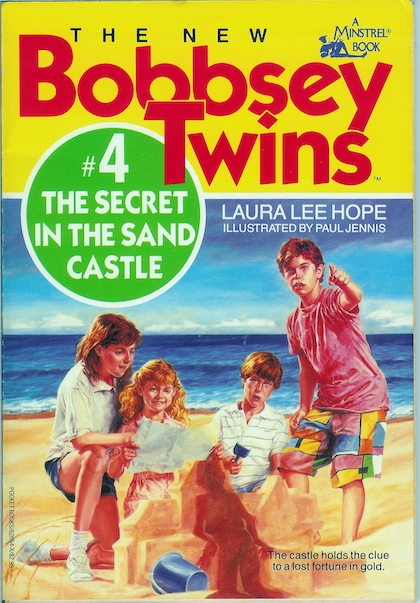
The Secret in the Sand Castle

The Bobbsey Twins

#4 The Secret in the Sand Castle by Laura Lee Hope (Stratemeyer Syndicate), 1988.

Before I begin, I’d like to acknowledge Sean Hagins, for supplying me with photos of this book! Usually, I take pictures of books myself, but I just couldn’t find a physical copy of this one. Sean is a big fan of the Bobbsey Twins, particularly the New Bobbsey Twins mysteries, and you can see some of his video reviews as well as videos about his photography work on his YouTube channel, SJHFoto. Thanks, Sean!

The two sets of Bobbsey Twins and their parents are spending a few weeks in an old house at Beachcliff Bay. It’s sort of a working vacation for their parents. Mr. Bobbsey owns a lumber yard, and he’s helping a local builder, Jim Reade, to either find some antique Victorian wooden gingerbread house trim or make new ones to match a home restoration project. Meanwhile, Mrs. Bobbsey is planning to write a travel article about the area for their local newspaper.

The house where the family will be staying is called the Wilson house, and it’s one of Mr Reade’s recent renovation projects. Flossie is the first in the family to go inside, and she is startled by what she thinks is a ghost. It turns out that it’s only the caretaker, Pete Smedley, taking the old dust sheets off the furniture. It’s not entirely reassuring because Pete says that there are stories about the old Wilson house being haunted by the ghosts of its former owners, who drowned in the nearby bay. He says that he knows when the ghosts have been there because they move things around and leave trails of water, seaweed, and seashells. Mr. Reade thinks that Pete’s stories are nonsense and that the strange things he’s observed are due to windows in the house being left open or something like that.

The inside of the Wilson house is as elaborate as the outside. The Bobbsey twins unpack their things and claim rooms for themselves upstairs. Flossie is quick to claim the biggest room with the best view for herself, and she asks Bert to help her move a mirror she likes into her room. They don’t have anything to hang the mirror, so they set it on Flossie’s bed. Strangely, they later find the mirror still on the bed but broken, and they don’t know how that happened.

Nan is curious about the Wilson family and the history of the house, so she and Freddie take a trip to the local library. There, Nan learns that the last two members of the Wilson family were a brother and sister, called Clay and Jennie. They were both artists, but they never made much money. Badly in need of money, they apparently robbed an armored car and stole gold bars. They tried to escape in a boat, but it was lost in a storm. The Wilsons apparently drowned, although their bodies were never found. The police thought they might have hidden the gold somewhere before getting on the boat, but nobody ever found the gold they stole.

Mr. Reade tells the children that his son, Jimmy, is entering a local sand castle contest, and the Bobbsey twins decide that they would like to enter the contest, too. Nan thinks they should try to build a replica of the Wilson house in sand. Unfortunately, Jimmy turns out to be a troublemaker, and it doesn’t look like he wants to be friends with the Bobbsey twins.

While the girls go to the store, Bert and Freddie decide to check out the old root cellar at the house, and someone traps them inside. The girls let them out when they get back. Then Flossie finds a secret passage and hidden stairs. Mr. Bobbsey says that it was once a servants’ entrance that had been sealed off. Later that night, a ghostly figure tries to enter Nan’s room! Could it have been Jimmy. playing a nasty prank, or is it someone looking for the lost gold? Could it even be a real ghost?

The book is available to borrow and read for free online through Internet Archive.

My Reaction

From the beginning of the book, I had a favorite suspect. However, this is one of those mysteries where there is more than one person involved, and they’re not working together. In the end, I was right about my main suspect, but having a second person doing suspicious things made the mystery more interesting. The title is a little misleading because the story is really about the search for the hidden gold from the robbery, not about the sand castle contest. The sand castle contest is more of a side issue, although studying the design of the house to build the sand castle version leads the kids to the solution of the mystery.

Because this book is from the late 1980s, there are things in the story that were more a part of my childhood than the lives of 21st century children, like renting videotapes. I was about the age of Freddie and Flossie when this book was first published, so it’s a bit of a fun nostalgia trip for me, both because I read books in this series when I was young and because some of the things the kids do in these stories are similar to things I did at their age.

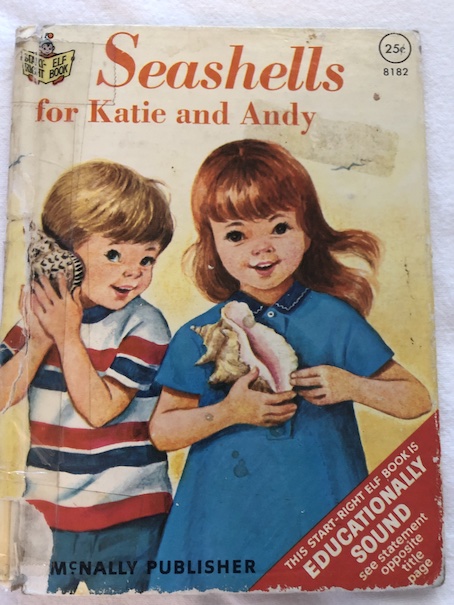
Seashells for Katie and Andy

Seashells for Katie and Andy by Solveig Paulson Russell, illustrated by Marjorie Cooper, 1973.

This is a cute little picture book that presents information about seashells in story form.

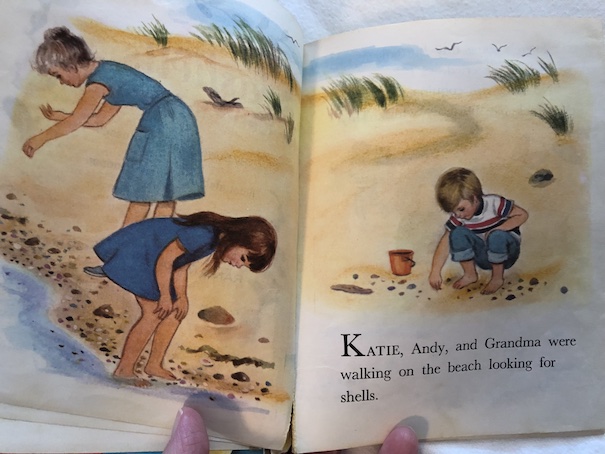
Katie and Andy are at the beach with their grandmother. As the children collect seashells, their grandmother tells them what kind of shells they are and a little about them.

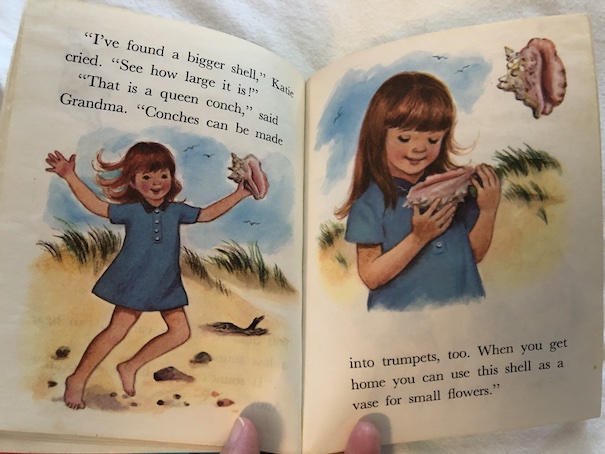
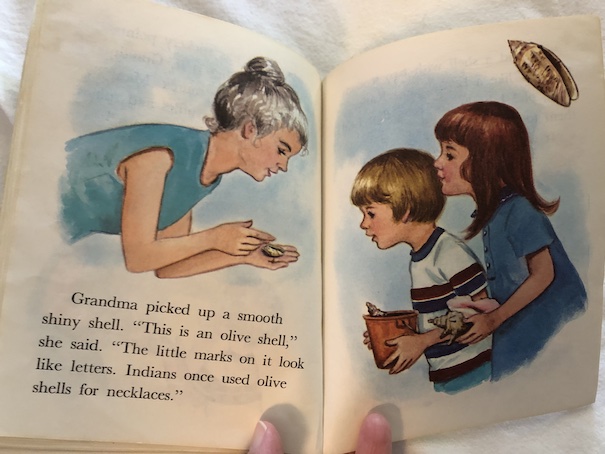
The shells included in the book are: coquina shells, cowrie shells, triton shells, conch shells, lace murex, olive shells, scallop shells, and limpets.

Toward the end of the book, the kids ask their grandmother if they can find shells anywhere else besides the beach, and she tells them about snail shells.

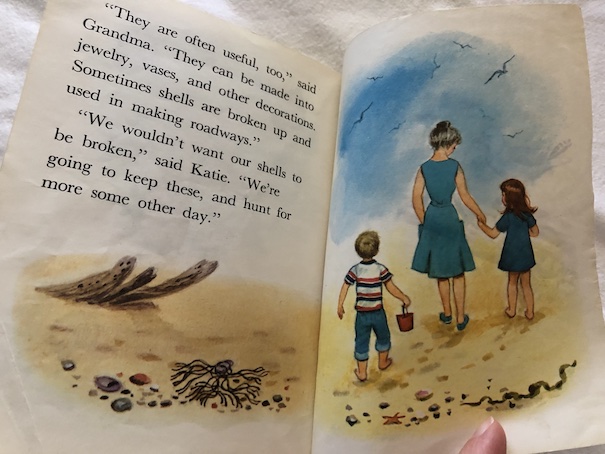
The grandmother also tells the children about different uses people have for seashells. She talks about how they can be used for jewelry, vases, and decorations of different kinds. She also mentions that they can be broken up and used in roads, but the children don’t like the idea of breaking shells.

My Reaction

This book is nostalgic for me because my own grandmother was an amateur naturalist, and she used to give us gifts of seashells that she found in her own travels. Some of the shells in my old collection still have labels with the names of the shells in my grandmother’s handwriting.

In the beginning of the book, there is a note to parents and teachers from the National College of Education in Evanston, Illinois about how the information in the book is educationally sound. I don’t have anything to criticize about the information in the book except one instance where the grandmother talks about “Indians” making necklaces from a certain type of shell. I’m pretty sure from context that they mean American Indians and not people from India, but I think that “American Indians” or “Native Americans” would be better terms to use for the sake of clarity.

They never say exactly where the beach in the story is, which would make a difference in the types of shells that the characters might find. Most of the shells covered in the book have a pretty broad worldwide distribution, but I suspect from the selection of shells given that the characters are probably in the Southeastern United States.

The Mysterious Christmas Shell

Tom and Jennifer are visiting their grandmother and their Aunt Vicky and Aunt Melissa Vining in Monterey for Christmas while their parents are in New York, taking care of Aunt Winny, who is sick. However, the children can tell that something is wrong as soon as they arrive because Mrs. Nipper, their aunts’ housekeeper, seems upset, and the house isn’t decorated for Christmas like it usually is. They have a Christmas tree, but there are no ornaments on it yet, and the Christmas greenery hasn’t been laid out.

The children hear their aunts talking about a letter that their father (the children’s grandfather) had written before he died. They know that he wrote the letter, but they’re upset because they can’t find it. The aunts explain to the children that they had to sell Sea Meadows, the wooded lands that they own, to a man called Theodore Bidwell. It’s a deep disappointment because Sea Meadows is full of ancient sequoias, and the children always liked to go camping and exploring there. Originally, Mr. Bidwell told them that we was only planning to put a few houses on that land that wouldn’t require removing many of the old trees, but now, they’ve learned that he’s actually planning on creating a large summer resort town. The aunts are upset that Mr. Bidwell lied to them to get them to sell the property, but there wasn’t much they could do anyway because they badly needed money to settle debts they had after their father died. The saddest part is that the family business has improved since they made the sale, and the aunts could now afford to buy back the property, but Mr. Bidwell refuses to sell it back to them.

There is one thing that might change the situation. Before the aunts’ father died, he discussed changing his will. He decided that, rather than leave that land to them as he originally planned, he wanted to leave it to the state of California to be turned into a state park. He thought it was the best way of ensuring that the natural beauty of the land would be preserved, and his daughters approved. The aunts already had the family business, and they didn’t need the land for their own sake. However, for some reason, his lawyer never got the letter their father said he was going send about the change in his will. The aunts are sure that he actually wrote the letter, but they think it got lost or mislaid instead of being mailed. If the aunts can find the letter that their father wrote, it would prove that the land actually belongs to the state of California and that it was never really theirs to sell. They’d have to refund Mr. Bidwell’s money, but they’re prepared to do that. It’s more important to them that the land would be preserved from development. Even local people have been angry with the family for selling the land to Mr. Bidwell because they don’t want the development, either.

When Tom and Jennifer begin helping with the Christmas decorations, and they start reminiscing about the Christmas before, the last Christmas when their grandfather was alive and he wrote his letter about the land, they remember that their cousin Elsa was also visiting. Elsa is about Jennifer’s age, and she and her parents are living in France now, so she doesn’t come to visit very often. The mention of Elsa makes the aunts remember that there was something that their father wanted to tell them about Elsa. He mentioned a funny thing she did, but then, they were interrupted, and he didn’t finish telling them what it was before he died. Everyone starts to wonder if Elsa may have done something with the important letter, but they can’t ask her because they know that she and her parents are visiting friends somewhere in France for Christmas, and they don’t know where or how to get in touch with them. (This is the 1960s, pre-Internet and pre-cell phones, so there are no methods of communication they can use that are independent of also knowing their physical location. They have to either know the address or phone number of where they are staying, and they don’t.)

The children’s grandmother recalls that Elsa was still with them even after Tom and Jennifer left with their parents, and they talked about Sea Meadows and showed her the deed to the land. Elsa had been helping to put away Christmas decorations at the time, and while the adults were talking, she suddenly started to cry. She had cut her finger on something, but they were never sure how she did that because none of the decorations were broken. Elsa was also upset because she had done two things earlier in the day that had caused trouble: she’d broken a little figurine and she’d forgotten to tell her grandfather about a phone call from a friend. She seemed worried that she had done yet another thing wrong, but her grandfather told her not to worry because troubles come in threes, and if the cut finger is her third trouble, she has nothing more to worry about. However, their grandmother recalls that Elsa didn’t seem reassured by that. Rather than being the third trouble of last Christmas, Elsa’s cut finger is a clue to a bigger problem that Elsa was afraid to admit, and that’s the clue they need to solve the problems of this Christmas.

The book is available to borrow and read for free online through Internet Archive. There is an earlier book with the same characters, a mystery about a sea monster in the same area of California, called The Terrible Churnadryne, but I haven’t read it and haven’t been able to find a copy.

I read this book years ago, and I remember liking it, but for a long time, I couldn’t remember the details of the story. I only remembered bits and pieces. I didn’t remember that it was a Christmas story, which would have helped. I remembered that a girl did something with an important paper, but until I reread the book, I couldn’t remember why the paper was important. What stayed with me the longest was the solution to the missing letter and the cut on Elsa’s finger. But, because I forgot that this was a Christmas story, I misremembered exactly what Elsa put the letter in.

I also remembered that one of the aunts had a secret hiding place in a cave when she was young, and when they revisit the cave, they find cave drawings done by Native Americans. I also remembered that the cave is dangerous at certain times because the tide comes in. Years ago, Aunt Melissa was almost trapped there because she stayed too long and was caught by the tide. When her father found out, he refused to allow her to go there alone again. Since her mother and sister didn’t like going to the cave at all and she and her sister soon went away to boarding school, she gave up going there entirely for a long time. She was always sad about the loss of her secret hiding place. However, when she returns there as an adult, it contains part of the secret to unraveling what happened to her father’s letter last Christmas.

At one point in the story, Jennifer finds a very distinctive seashell with red and green colors. Everyone is amazed because it’s a court cone, not a shell normally found on the shores of California, and it also doesn’t normally appear in those colors. This is the shell that Jennifer calls the Christmas Shell. This shell doesn’t directly contain the solution to the mystery, but its shape and something Jennifer does with the shell awaken some of Aunt Melissa’s memories. I also remembered that Jennifer was the one who figured out what Elsa did after watching her brother fiddling around with a napkin in a napkin ring.

While I was rereading this book, I was happy to see all the bits and pieces of my memories of this book fall into place alongside the clues to the mystery. Stories with secret hiding places are always fun, and this one has two – Aunt Melissa’s old secret hiding place in the cave and the place where the missing letter is hidden.

There is also a reference in this story to the Elsie Dinsmore books, a children’s series from the late 1800s and early 1900s.

Ruth Fielding at Lighthouse Point

Ruth Fielding

Ruth Fielding at Lighthouse Point or Nita, the Girl Castaway by Alice B. Emerson (the Stratemeyer Syndicate), 1913.

When this story begins, Ruth’s friend Helen is finally being initiated into the society that Ruth and some of their friends founded at their boarding school, Briarwood Hall. In the second book of the Ruth Fielding series, when the girls started attending Briarwood, they found themselves caught between two rival social groups. One of them had the reputation for being led too much by the school faculty instead of the students themselves. Ruth, Helen, and some of the other girls craved more independence from the teachers. However, the other main social group, which was more student-led, was led by a sly bully of a girl named Mary Cox. That group had basically turned into a cult of personality centered around Mary Cox, where everyone else had to do whatever she said. The initiation into Mary Cox’s group was a mean trick, and Mary Cox, known as “the Fox” to many girls at school because of her slyness, used bullying tactics to dominate the other girls.

For awhile, Helen was a member of Mary Cox’s group, finding it exciting, but Mary Cox took exception to Ruth very soon after they first met because Ruth is more independent-minded and not easily led or intimidated by Mary. Although Ruth was one of the new girls at school and one of the youngest, she decided to assert her independence and create a new society without some of the problems that plagued the older ones. She found other interested girls who felt the same way she did, and they soon attracted more members who were similarly tired of the old groups. Ruth’s group is called the Sweetbriars, or S.B.s for short, although Ruth frequently reminds people that the group is not hers exclusively. To avoid the problem with Mary’s group, having everything monopolized by one person, Ruth established in the rules that leadership of the Sweetbriars will rotate, with no member serving as the club president for more than one year. That way, no one will have total control, and there will be opportunities for new people with fresh ideas to get more involved.

Helen, who eventually figured out what kind of person Mary was, stuck with her group for awhile anyway, out of loyalty to the membership, but since then, Mary’s group has fallen apart. Helen was one of the last to leave it, but Mary is still resentful that many of her old members have joined the Sweetbriars, including Helen.

Shortly after Helen’s initiation, Ruth and her friends are talking about taking a summer trip to a friend’s beach house. They started talking about their summer plans over the winter break, and now, they’re making the final arrangements. Mary, still looking for ways to cause trouble for Ruth and the Sweetbriars and regain her social dominance, tells Helen that the only reason she’s being invited to the beach house is because she’s now a Sweetbriar, implying that the other girls wouldn’t have wanted her around if she hadn’t joined their club. Frankly, Helen is a bit of a sucker and falls for Mary’s manipulation. She confronts the other girls about what Mary said.

The other girls all remind her that, first of all, they started planning this trip well before her initiation. Second, they are inviting people who aren’t part of the Sweetbriars. They’ve invited Madge, who is the student leader of the faculty-led social club, and she’s coming. They’ve also invited some boys, brothers of girls at the school and their friends, who attend the nearby boys’ boarding school. Helen says that Madge is also an honorary Sweetbriar, even though she’s in another club, and the other girls correctly realize that Mary’s comments to Helen were a manipulation to secure her own invitation. The girl whose family owns the beach house, Jennie Stone (nicknamed “Heavy” by the other girls because she’s “stout”), is actually one of Mary’s roommates at school, and she reminds Helen that she also invited Mary but that Mary was non-committal about accepting.

The girls debate among themselves whether or not Heavy should renew the invitation and encourage Mary to come with them. It’s pretty obvious to the girls (except maybe Helen) that Mary is being manipulative and probably has a trick up her sleeve. (They don’t call Mary “the Fox” for nothing, and if the reader has any doubts that this is a ploy, Mary is listening to this whole conversation through the keyhole.) Mercy, known for her outspokenness, thinks they should all just forget about Mary because her meanness will spoil the fun. Ruth doesn’t like Mary, either, but she can see that Helen will feel bad if they act exclusionary, and Mary will try to use that against them. Ruth tells Heavy that it’s only right for her to invite her roommate, and not only does Ruth want her to invite Mary, she insists on it.

So, Mary will be going to the beach house with the other girls, but before their trip even gets started, the situation is rocky. When the girls get on the boat that will take them from the school to the train station, Mary goofs off, teasing one of the other girls, and she ends up falling overboard. Since Mary can’t swim, Ruth has to jump in and save her. This is the second time that Ruth has saved Mary’s life since she arrived at the school. The first time, Mary credited the rescue to Helen’s brother, Tom, who also helped, but this time, Ruth gets the credit alone, and everyone witnessed it. One of the other girls says that Mary will have to change her attitude toward Ruth now, but Ruth knows that isn’t likely. Just because Mary might owe her some gratitude for the rescue doesn’t mean that Mary will like her, and Mary is the kind who would resent “owing” a person she doesn’t like.

Worse still, Ruth learns that her Uncle Jabez has lost a considerable amount of money in a bad investment, and he might not be able to afford to sent her back to Briarwood Hall! It’s a heavy blow because she’s finally settled in there and has a good group of friends. He’s become so paranoid about money again that he might also stop the money he was contributing toward Mercy’s education, which would be a double blow.

Ruth is an ambitious girl and determined not to give up on her education so easily. Raising the money for her next year’s tuition would be difficult all on her own, but Ruth knows that she has to find a way to do it over the summer. At first, she isn’t sure that she should go to the seaside with the others as planned, but Uncle Jabez surprises her by giving her some money and telling her to go. As the girls set out on their trip, Heavy also tells Ruth that Mary Cox’s family is having trouble. Mary’s father died a year ago, leaving the family with money problems, and her brother left college to tend to his father’s business affairs. Now, her brother has disappeared on a business trip, and she and her mother are worried about him. With the girls’ problems hanging over their heads, they all set off for Heavy’s family’s seaside bungalow at Lighthouse Point.

When the party arrives at Lighthouse Point in Maine, there’s a storm, and they hear that there’s a shipwreck on a nearby reef. The young people all go down to the seaside to watch the rescue efforts. At first, they think it’s all very exciting, but then, the destructive power of the storm and the real risk to the rescuers makes them realize the seriousness of the situation. They watch, horrified, as a lifeboat overturns in the storm. It seems like there won’t be any survivors of the wreck, but some people are saved.

Among the survivors is a girl who calls herself Nita. Nita, who is about the same age as Ruth and her friends, admits to being a runaway, but she is evasive about where she came from and what her situation is. The ship captain’s wife, Mrs. Kirby, is also rescued, and she says that it’s her impression that Nita was not well cared for when they first met and that Nita was trying to go to New York, possibly to stay with some relatives there. Nita says that she wants to go to New York, but she is still evasive about why, what she plans to do there, or if she knows anyone there.

In spite of her recent traumatic experience, Nita is very self-controlled, mentally sharp, and even a bit sly. The party of young people and Heavy’s Aunt Kate take Nita with them to the bungalow where they give her a bed and question her more about her past. She lets a couple of things slip, referring to a man named Jib Pottoway, who was a “part Injun” (that’s how Nita puts it, she means that part of his family is Native American, saying that “Jib” is short for Jibbeway, which is apparently either an older version or slang corruption of Ojibwe) “cow puncher” who lent her books to read. Nita apparently came east from somewhere in the western United States, having romantic notions from books about how poor girls can make friends with wealthy families in the east who can help them with their education and help them rise up in society. She’s been finding out that the realities of the east are very different from what she’s read in books, but she still has her stubborn pride. Nita says that she can move on if the others don’t want her around or if they’re getting too nosy about her past, but Aunt Kate is reluctant to let her go until she knows whether Nita is going to be able to manage on her own or has somewhere to go.
Since Nita has only the clothes she was rescued in and those are ruined, the part gets her some new clothes to wear. They notice that a somewhat disreputable man named Jack Crab seems strangely interested in Nita, as if he recognizes her from somewhere. There is an explanation later when Tom picks up a newspaper clipping that Jack Crab drops about a girl named Jane Ann Hicks, who has run away from her wealthy uncle who owns a ranch in Montana. Nita certainly first the description of the missing Jane Ann. In her uncle’s and the reporter’s words, “‘Jane Ann got some powerful hifalutin’ notions.’ She is now a well-grown girl, smart as a whip, pretty, afraid of nothing on four legs, and just as ignorant as a girl brought up in such an environment would be. Jane Ann has been reading novels, perhaps. As the Eastern youth used to fill up on cheap stories of the Far West, and start for that wild and woolly section with the intention of wiping from the face of Nature the last remnant of the Red Tribes, so it may be that Jane Ann Hicks has read of the Eastern millionaire and has started for the Atlantic seaboard for the purpose of lassoing one–or more–of those elusive creatures.” They’ve got her pegged, although the “or more” part of lassoing millionaires makes her sound more like a gold-digging adventuress than an overly-romantic teenager who’s read too many novels. However, if Nita really is Jane Ann Hicks with a wealthy, ranch-owning uncle, why would she need to find a wealthy benefactor to buy her the piano she says she wants and fund her education?

Nita runs away from the beach house, but unfortunately, she trusts the wrong person and is soon in need of Ruth and her friends to rescue her again.

The book is now public domain and is available to borrow and read for free online through Internet Archive (multiple copies) and Project Gutenberg.

My Reaction and Spoilers

Racial Language and Other Issues

I think I should start with a warning that there are some issues with racial language in this book, which is pretty common with early Stratemeyer Syndicate books. I already mentioned the word “Injun” and the newspaper article that mentions “Red Tribes” above. I also noticed that in the article that describes Jane Ann’s disappearance, it is mentioned that she was raised by her uncle alone at his ranch “for a woman has never been at Silver Ranch, save Indian squaws and a Mexican cook woman.” I’m sure they’d be thrilled to find that they don’t count. The Stone family’s cook at their beach house is a black lady called “Mammy Laura” who speaks in a stereotypical way with phrases like “lawsy massy.” (Although, to be fair, Mr. Hicks the rancher also speaks like a stereotypical cowboy, so stereotypes are being used in a very general way and not directed at any group in particular. I know, it’s still not great.)

It’s also a little uncomfortable how they keep referring to Mercy as “the lame girl” or “the cripple.” They don’t seem to mean it as an insult, more as a general description, and it’s true that it’s one of Mercy’s characteristics and a major part of her storyline in the first book. Her health has improved since then, although it’s established that she’s never going to be able to walk as well as other people and will always need some assistance, like crutches. It’s just that it feel like we’re being beaten over the head with it when they keep repeating that she’s “lame.” I think they’re trying to do it as a descriptor, trying to make the writing a little more colorful by referring to characters by some part of their appearance and not just by name, like how they keep calling Ruth “the girl from the Red Mill”, but it falls flat because it seems insensitive and shallow. First of all, this isn’t something that readers are likely to forget and need to be constantly reminded about Mercy. Second, it gives the impression that this is Mercy’s main characteristic. Mercy is the most blunt and sarcastic character among the girls, and she has quite a lot of personality, so she does have characteristics beyond her disability. Third, in the first book, they establish how much Mercy hates her disability and how bitter she was about it until she found a way to improve her situation, make friends, and move forward with her life and education. It doesn’t seem like she’d enjoy people constantly calling her “cripple” and “lame”, and it would be completely in character for her to bluntly say so if asked, so it’s a little uncomfortable when the invisible narrator of the book keeps doing it.

Heavy’s nickname is also a little irritating. She doesn’t seem to mind it, but this is a good opportunity to point out that older Stratemeyer Syndicate books do have a tendency to use characters’ weights as one of their defining characteristics. Even up through later series, like Nancy Drew, characters are often specifically described in terms like “slender”, “slim”, “stout”, etc. Typically, in Stratemeyer Syndicate stories, the slimmer characters are either the main characters or the nicer or more talented ones, while the fatter ones are either more comic relief, socially awkward, or villains. Actually, one of the things I like about Heavy is that she doesn’t fall into this pattern. Heavy is pleasant, cheerful, practical, and generous.

The Runaway

As Ruth considers Jane Ann’s position and why she would run away from her uncle, she remembers that she also considered running away from Uncle Jabez when she first came to live with him. Both Ruth and Jane Ann are orphans who depend on their uncles, who control the family finances and their education. Jane Ann’s uncle is far richer than Uncle Jabez, but he also has firm ideas about the kind of life Jane Ann is going to live as the future heiress to his ranch and what kind of education she’s going to need. He rejects the kind of education a girl would have on the east coast of the US as being too “effete” for a young woman who will someday have to manage a ranch with tough “cow punchers.” However, Jane Ann wants some of the refinements of east coast culture, like her own piano, an education, and the company of other girls her own age who share her interests, none of which are available at her uncle’s ranch. It’s true that Jane Ann has a lot of unrealistic notions about life from the books she’s been reading, but that’s largely because cheap romantic novels have been her main source of information about life outside of her uncle’s ranch. Getting an education and more interaction with the outside world would do her some good. Actually, I think Jane Ann’s problem does reflect a problem that exists even in modern education, when parents and instructors are so focused on job training and the roles they think the young are going to fill in life that they neglect the subjects that give students a broader view of life and how the world works, their roles as human beings outside of career roles, and their relationships to other human beings in the world.

When Mr. Hicks comes to the beach house later, looking for his niece, Ruth talks to him about what she knows about Jane Ann/Nita and what Jane Ann really wants. Mercy also adds some criticism because she has “a sharp tongue and a sharper insight into character”, pointing out to Hicks in no uncertain terms what a young girl needs and how she feels about things. Her criticism of the name “Jane Ann”, which seems as dull and plain to the other girls as Jane Ann thought it was herself, seems a little overdone. Jane Ann’s uncle picked that name because it was his grandmother’s name, and it is traditional for certain names to be reused in families. It’s not as romantic and modern as the girls think it should be, but it’s also simple and classic and could really belong to just about any time period, so I don’t think it’s as old-fashioned as they’re implying. I do appreciate Mercy’s straightforward talk and how she speaks her mind without being intimidated by either Hicks’s age or wealth. Mercy really is a character with a personality, which makes her different from some of the other cookie-cutter characters in Stratemeyer Syndicate books with little variation in their personalities, and she’s one of my favorites in this series.

Like other books in the series, there is an element of mystery, but the book tends to lean more toward adventure. However, as the series goes on, the stories are becoming more mystery, and this one is more mystery than previous books. There is first the question of who Nita really is. The newspaper clipping provides a clue, although it’s not a firm answer until Jane Ann’s uncle shows up, looking for her. Then, there is the question of where Jane Ann went after she left the beach house. Ruth is sure that Crab had something to do with her disappearance, but she and her friends have to do some intentional investigating and searching for Jane Ann to rescue her. In spite of some of the problematic language, I like the direction this series is heading.

At the end of the story, there is still something unresolved, and that’s how Ruth is going to pay for her boarding school. Jane Ann’s uncle offers a reward for rescuing her, but Ruth can’t bring herself to accept it because she doesn’t want it to appear that she was only helping Jane Ann for the sake of the money. Instead, she and her friends will be rewarded with a trip to the ranch where Jane Ann and her uncle live.

Odd Piece of Trivia

When Jack Crab tries to pester Nita about what her name is, Mercy bluntly tells him off using a children’s retort:

“Puddin’ Tame!” retorted Mercy, breaking in, in her shrill way. “And she lives in the lane, and her number’s cucumber! There now! do you know all you want to know, Hardshell?”

I not only appreciate that she pokes fun at Crab’s name, calling him “Hardshell“, but she brings up an interesting piece of children’s lore. The “Puddin’ Tame” retort was old-fashioned when I was a kid in the 1980s and 1990s, but it was a popular playground retort for decades, maybe over a hundred years, although I’m not sure of its actual age, and it’s possible that it’s still circulating in schools and playgrounds somewhere. When kids say it, the quick rhyme is more important than the meaning, although there are theories that “Pudding Tame” or “Pudding Tane” (as some people say it) is a reference to a devil character called Pudding of Thame.

Spot Goes to the Beach

Spot

Spot Goes to the Beach by Eric Hill, 1985.

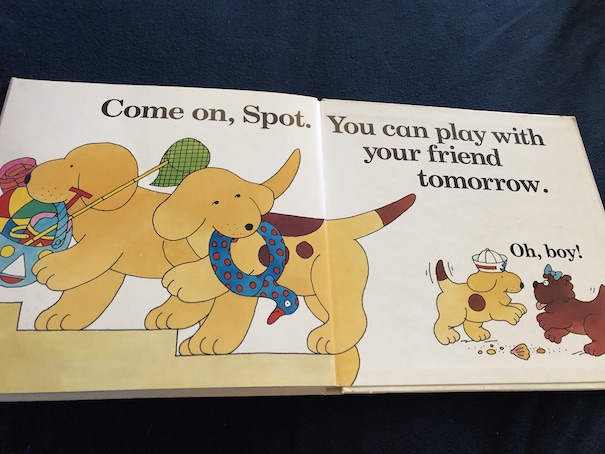
Spot’s parents take him to the beach to spend the day there. When they get to the beach, Spot wants to get a sailor hat from a stand selling beach equipment, and his father also buys him some beach toys.

Spot plays with a beach ball, builds sand castles, and buries his father in the sand.

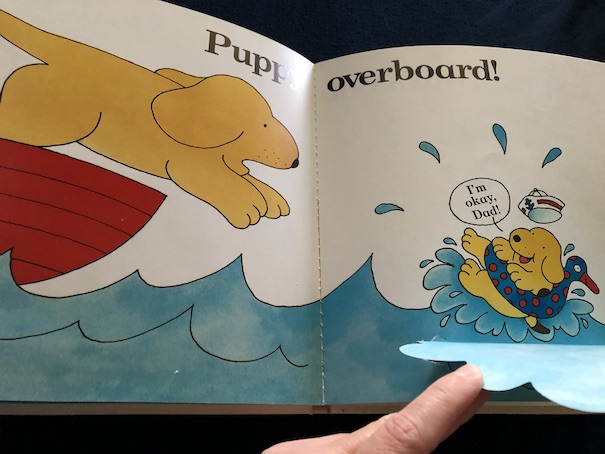
Spot and his father later go fishing, and Spot falls in the water, but Spot is fine because he’s wearing a pool float.

Before they leave the beach, Spot also makes a new friend, another puppy!

This is just a cute book for children about the fun things that they can do at the beach.

Like other Spot books, this book is a lift-the-flap picture book. The British version of the title is Spot Goes on Holiday. It’s available to borrow and read for free online through Internet Archive (multiple copies).

Aria Volume 4

Aria Volume 4 by Kozue Amano, 2004, English Translation 2008.

This is the fourth volume of the second part of a fascinating manga series that combines sci-fi, fantasy, and slice of life. The series takes place about 300 years in the future, when Mars has been terraformed and renamed Aqua (because of all the water on its surface). The human colonies on Aqua are designed to resemble old-fashioned cities on Earth (called Manhome here). The people of Aqua prefer a much slower pace of life than people on Manhome, and aspects of life on Aqua more closely resemble Earth’s past.

The series is divided into two parts. The first two books are the Aqua volumes and introduce Akari Mizunashi, the main character, a young girl who came to Aqua to learn to become a gondolier in the city of Neo Venezia (which resembles Venice). Female gondoliers, called Undines, give tours of the city, giving Akari plenty of time to admire the beauty of her new home and meet interesting people. The two Aqua books are the prequel to the main series, Aria. Aqua covers Akari’s arrival on the planet, her introduction to life on Aqua, and the beginning of her training. The main Aria series show Akari’s continuing training, her progression to becoming a full Undine, her evolving relationships with her friends, and as always, her delight in learning more about her new home and admiring its beauty.

The series has received some criticism for being slow and lacking danger and adventure, but that is not really the point of the series. The main purpose is to show people how to appreciate the small pleasures of life. The sci-fi and fantasy elements (the spaceships, advanced environmental controls, intelligent Martian cats, and even the occasional appearances of the legendary Cait Sith) are mainly background to the stories about the magic of friendship and simple pleasures. Each volume contains a few short stories about Akari and her friends and the little adventures they have on a daily basis and the life lessons they learn. It’s a great series for relaxing when you’re stressed out.

The stories included in this volume are:

Neverland

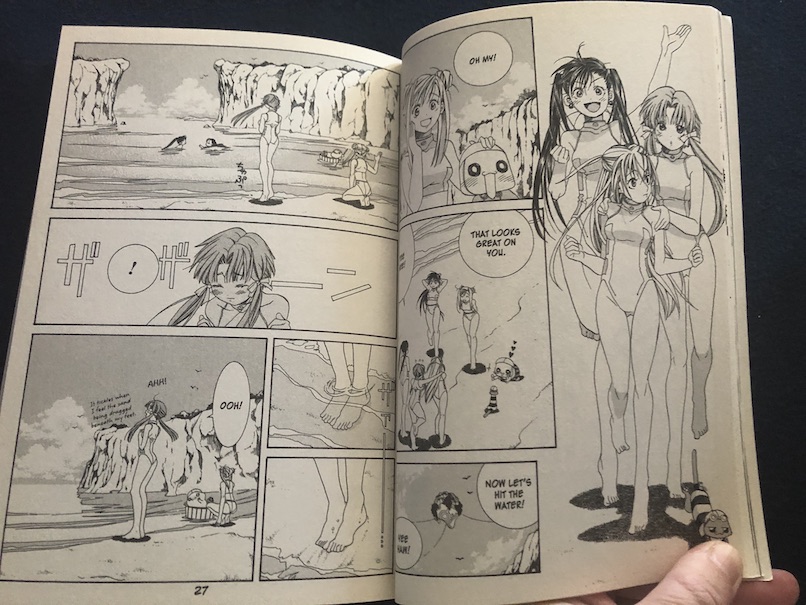
Alicia and Akira arrange a special, surprise trip to the beach for the trainees, a happy day that reminds Akari of Neverland. It starts out with an invitation for each of the trainees that supposedly comes from Peter Pan, inviting them to Neverland, but it turns out to be a fun day at a beach that President Aria found.

Akira wanted the day to be a day of training, but Alicia convinced her that a day of rest and relaxation would benefit the trainees more. The girls put on their swimsuits and enjoy a day of swimming.

Akari thinks that the beach and their day there really is like Neverland, and Alicia realizes that it is because of the way that Akari looks at things. Akari’s strength is the ability to enjoy the simple pleasures in life for what they are, finding the magic in daily life.

This story emphasizes the theme of the series, which is that the most important thing is to choose to be happy.

Traveling Water

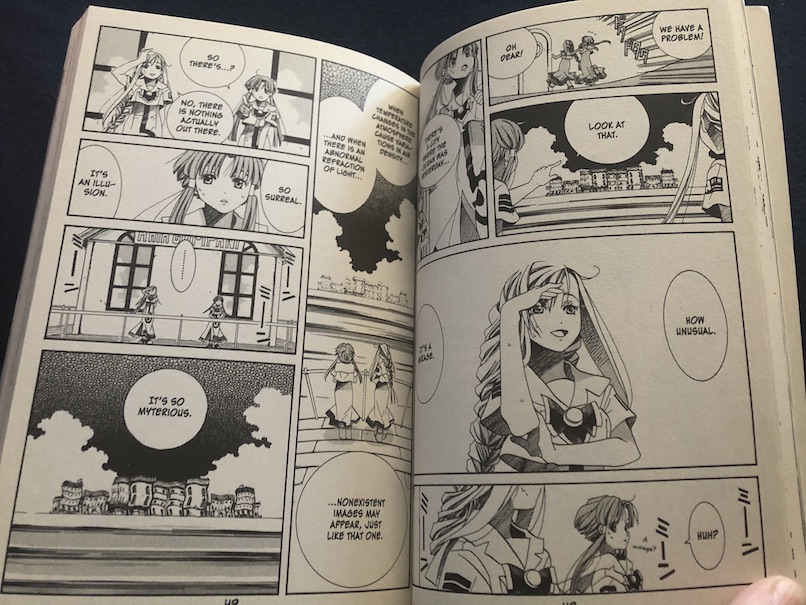
Summer on Aqua is very hot, and Akari experiences her first mirages. People on Aqua sometimes call them “traveling water” because they can look like water that you can never reach. (I grew up in Arizona, and I grew up seeing that. On a straight road, the heat waves will look like distant water, waving and reflecting the scenery, but they appear to dry up or move further away as you go toward them.)

On a very hot day, Akari sets out to buy a night light chime and, oddly, seems to find herself all alone, except for President Aria. She follows President Aria, hoping that he will lead her to a place where she can cool off.

Akari finds herself at a mysterious cafe, which is nice and cool. The server gives her and President Aria ice cold milk, and Akari feels better, but the cafe is no ordinary cafe.

It turns out that the cafe is a secret hangout for cats and their king, Cait Sith. Humans do not ordinarily find their way there. They give Akari a special night light chime and urge her to go on her way …

Unless it was all just another mirage.

I love this story for its “was it all a dream” theme and for the cat-shaped chime that helps confirm that it all really happened. I also like the idea/warning that the server offers to Akari, that maybe it’s a good thing not to completely catch up to a mirage. Akari is sometimes a special guest of the magical characters that inhabit their world, going to places and seeing things that others don’t, but she can’t stay among them because her life is in the human world, and she has to let the fantasy elements slip away to return to her ordinary life that is a little less ordinary for the experiences she’s had.

Flying Fish in the Sky

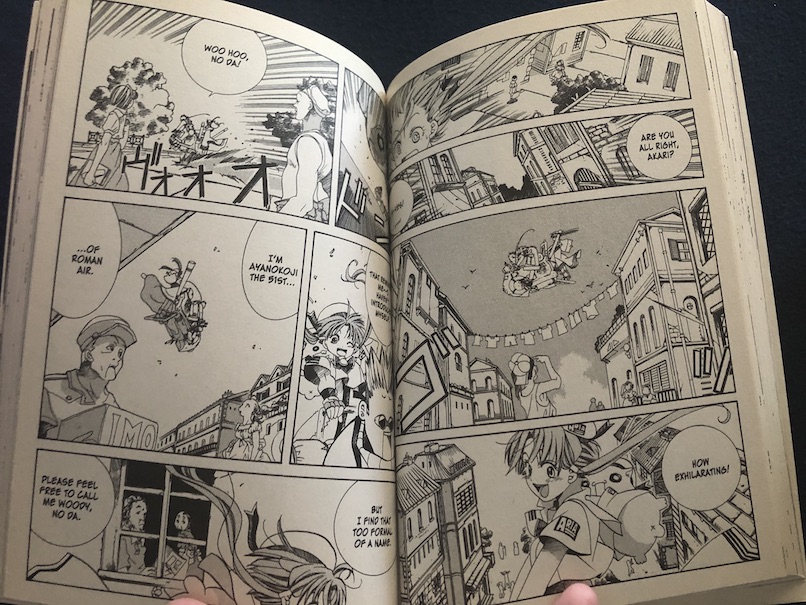
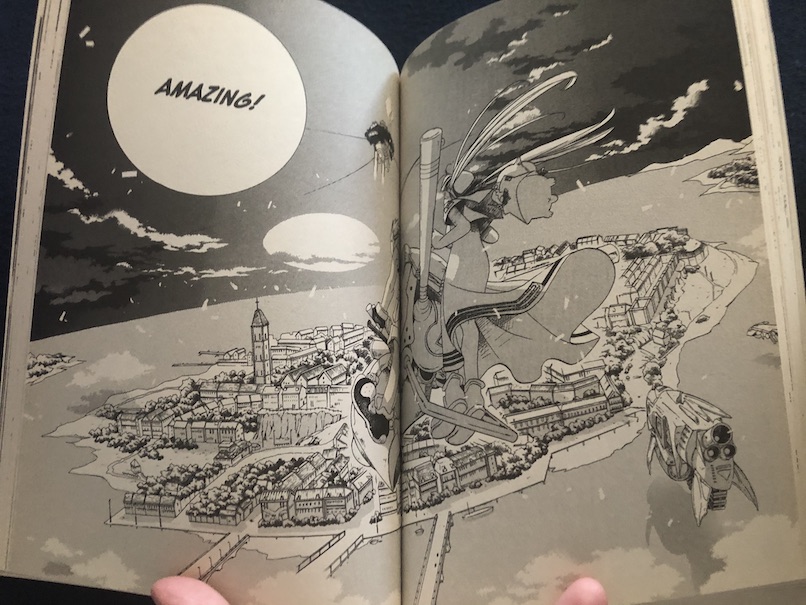
Akari notices that some of the professions on Aqua relate to the four elements: water, fire, earth, and air. The Undines represent water because they spend their time rowing their gondolas, the Salamanders represent fire because they control the heat levels in the atmosphere to control the weather, and the Gnomes represent earth because they work underground to control gravity. The fourth element-based profession is Sylph, which represents air. They are flying deliverymen.

Akari helps a sylph called Woody, a flying deliveryman with a poor sense of direction, after he falls off his flying bike and loses the map he depends on in order to make his deliveries. It’s kind of a scary ride, but it’s also exciting, and Akari gets a bird’s-eye view of her city.

Woody also appears in later stories.

The Legendary Major Fairy

The trainees go to meet the founder of Aria Company, who is considered the Legendary Major Fairy, the grandmother of the younger Undines. She now lives in the countryside, and as the girls help her with some chores and enjoy other activities, Aika keeps looking for hidden tests of their skills or lessons slipped into the activities.

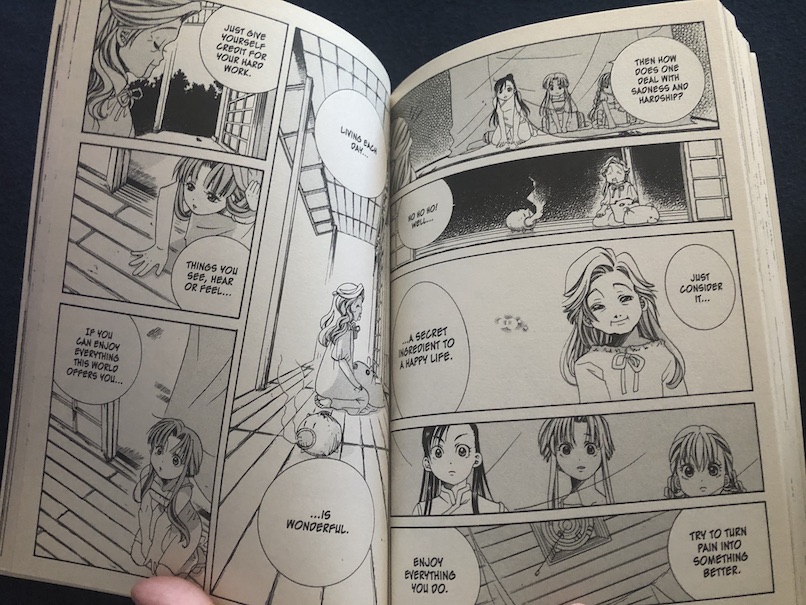
When hidden tests and lessons don’t seem to be in these activities, and the activities just are what they appear to be, Aika gets impatient and worries that maybe the older woman thinks that they’re hopeless and not worth teaching. She asks the Legendary Fairy, who asks them to call her “Grandma”, directly for some advice about being a great Undine, and what she tells them is both simple and yet something that is easy for people to forget.

Grandma’s advice is another repetition of the themes of the entire Aria series, but it’s worth repeating. She tells the girls to enjoy themselves in everything they do (the activities she gave them earlier were for them to enjoy, nothing more), remember that the world and life itself is full of things to enjoy, give yourself credit for your hard work, and when you encounter pain and sadness, try to turn it into something better.

The Redentore

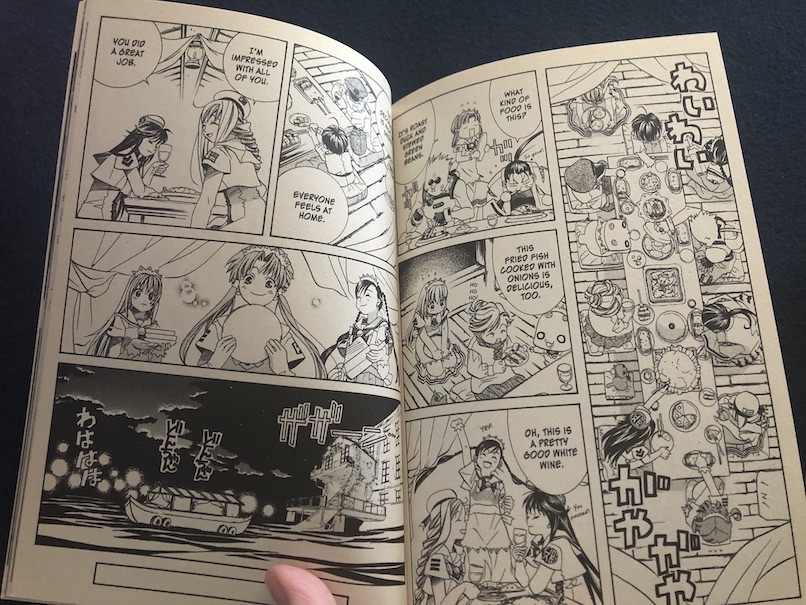
The Undines celebrate Rendentore, a special festival of thanksgiving, with a party on a boat for all of their friends, organized by the trainees. In keeping with the tradition, the trainees invite special guests and use the opportunity to improve their hostess and entertaining skills, designing invitations and planning the meal and entertainment.

The party is a success, and one of the best parts is that the girls have brought together a group of people who otherwise would not have spent time together, except they are tied together by their roles in the lives of the girls.

The Mystery of the Midnight Visitor

MorganMidnightVisitor

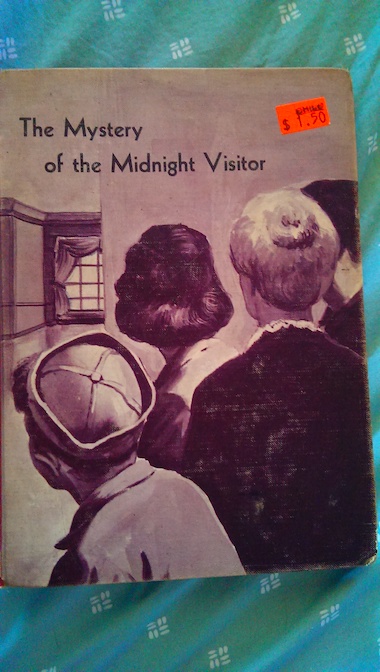
The Mystery of the Midnight Visitor by John and Nancy Rambeau, 1962.

One day, Gabby is going fishing on the beach at Morgan’s Landing. Miss Wellington, a family friend, owns the property along with the old mansion known locally as Morgan Castle. She has given permission to Gabby to fish there, but Gabby is surprised to meet a stranger on the beach as well. This stranger is an old man who says that his name is Admiral Lavendar. When Gabby tells him that he’s on private property, the old man moves on. Then, Gabby spots smoke coming from Morgan Castle!

When Gabby goes to investigate, he finds that someone has shut Miss Wellington in a closet and that there is a fire in the bedroom that had once belonged to Mrs. Morgan, the former lady of the house. He gets Miss Wellington out of the closet, and they call the fire department. The firemen put out the fire and tell Miss Wellington that it was apparently caused by a dropped candle.


Morgan Castle was once owned by the wealthy Morgan family that gave Morgan Bay its name. However, the house has become shabby over the years. Miss Wellington inherited the house after Mrs. Morgan died because there were no other Morgans left. However, she doesn’t actually live in Morgan Castle because she has a house of her own. People have been saying that perhaps the house should be torn down because of its poor condition. Miss Wellington doesn’t have much money and says that she would find it difficult to manage the upkeep of the house.

Gabby and his brother Bill and sister Vinny don’t want to see the old beautiful old mansion destroyed, and there is still the mystery of who dropped the candle and why to consider. A small silver box that Gabby found on the beach turns out to be a jewelry box that once belonged to Mrs. Morgan. Mrs. Morgan wasn’t particularly interested in jewelry, but she did own one particularly fine emerald necklace that was never found after her death. Perhaps the person who dropped the candle was looking for it!

To give Morgan Castle a new purpose and prevent it from being torn down, the kids convince Miss Wellington to let them turn it into a Historical, Boat, and Tennis Club, dedicate to celebrating local history and providing entertainment for local people.

At first, the mysterious Admiral Lavendar looks like a likely suspect for the person sneaking around Morgan Castle, but he turns out to be very helpful to the children and their plans. There is another stranger in town who has the knowledge to seek out Mrs. Morgan’s lost necklace.

MorganMidnightVisitorThief

This book is part of a series that were once used as classroom readers.

Ginnie and the Mystery Doll

GinnieMysteryDoll

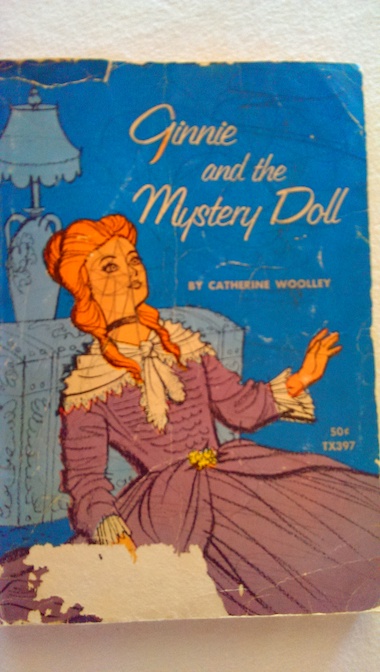
Ginnie and the Mystery Doll by Catherine Woolley, 1960.

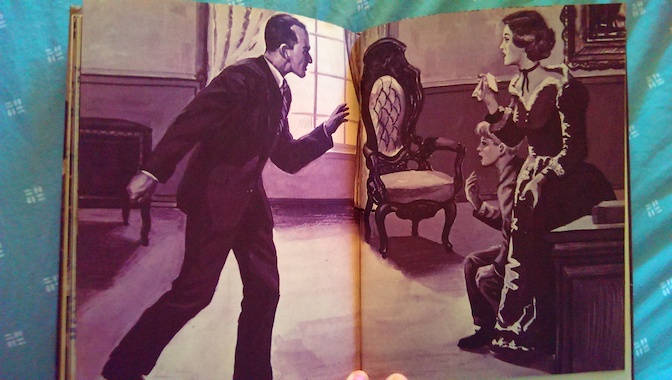
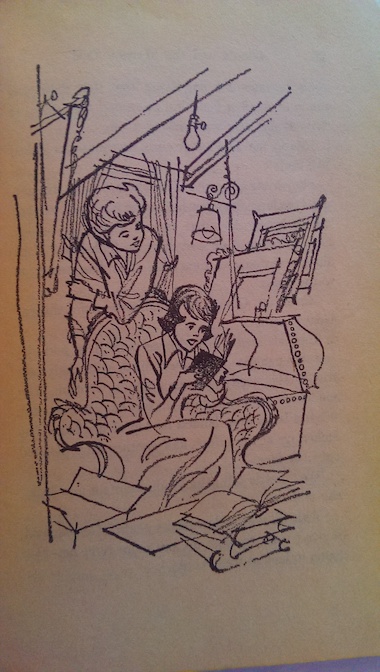
Ginnie and Geneva’s families have rented a house on Cape Cod for the summer, so they’ll be sharing their vacation at the beach. Their next door neighbor at Cape Cod is Miss Wade, a nice older lady. Miss Wade’s house is very old-fashioned, and when the girls make friends with her, she shows it to them, allowing them to see some of the neat old things in her attic on a rainy day. The girls have fun trying on the old clothes in the attic, and then they find an old diary belonging to Miss Wade’s mother when she was a girl. In the diary, the girl talks about the special doll that her uncle gave her, which has a “precious jewel.”

GinnieMysteryDollDiaryAtticThe girls ask Miss Wade about the doll, and she says that she knows the one they mean, but she no longer has it. Her mother’s uncle was the captain of a ship and used to bring her presents from around the world. The doll, called Lady Vanderbilt, was very fancy, and Miss Wade describers her costume to the girls. However, she says that the doll disappeared after she rented her house out to a family one summer while she was traveling. She never found out what happened to the doll, but she assumed that the children of the family probably found her and either took her or broke her. Miss Wade said that she didn’t think that the doll was worth making a fuss about, so she never asked the family about it. The girls note that Miss Wade doesn’t seem to know anything about a precious jewel in the doll, but they decide not to say anything about it since Miss Wade doesn’t have the doll anymore.
The girls decide to concentrate on enjoying their summer vacation, picking beach plums and digging clams with Miss Wade on the beach. Then, when they go to see a local auction, they spot a doll that looks exactly like the Lady Vanderbilt that Miss Wade described! The girls try to bid on the doll at the auction, but someone else buys her instead, and that lady leaves the auction before the girls can talk to her.

GinnieMysteryDollJewelThe girls tell Miss Wade and their mothers about the doll, but when they try to ask the people in charge of the auction where the doll came from and who bought her, they learn that the woman who was in charge of organizing the toys has already left on vacation. The only clue that the girls have is that the woman who bought the doll left the auction in a red Jaguar.
The girls make it their mission to track down the doll and its buyer, asking questions all over town about who might own a red Jaguar. Then, at an art exhibit at the Historical Society, they make a surprising discovery: a painting of the very doll that they’re looking for!

But, just when they figure out who has the doll and where she is, she disappears again when the red Jaguar is stolen with Lady Vanderbilt inside! Was it just an accident that the doll was stolen along with the car, or does someone else know that Lady Vanderbilt might be hiding a valuable secret?

The book is currently available online through Internet Archive.

Mrs. Armitage and the Big Wave

ArmitageWave

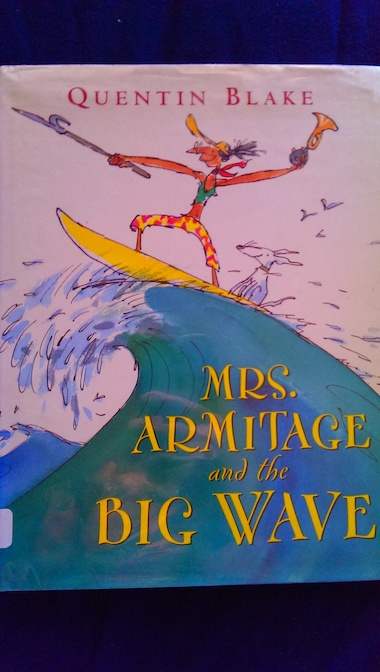
Mrs. Armitage and the Big Wave by Quentin Blake, 1997.

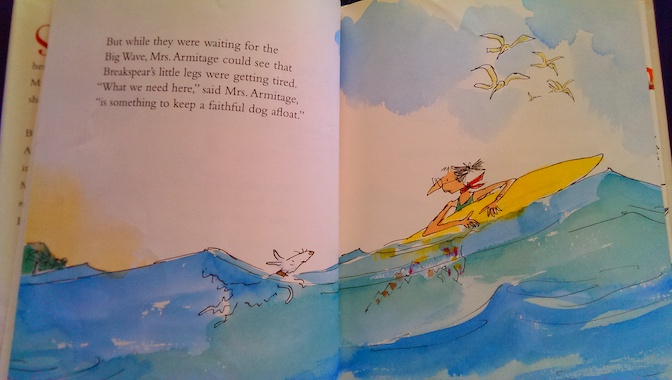
Mrs. Armitage goes the beach with Breakspear in order to go surfing.  She explains to Breakspear that they have to swim out and wait for the “Big Wave.”  But, waiting takes longer that Mrs. Armitage expected, and soon Breakspear is tired, and they’re both hot.

ArmitageWaveDogTired

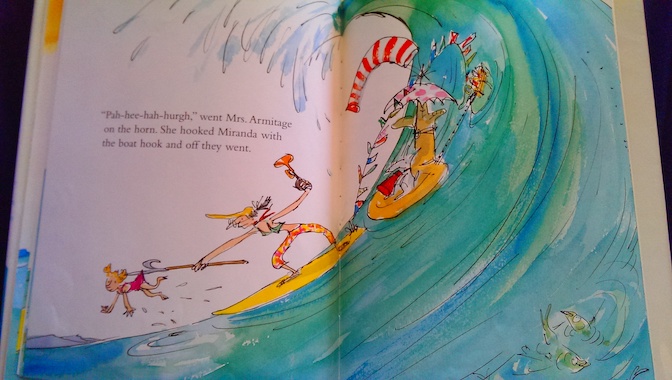
Of course, Mrs. Armitage finds a solution for everything.  With an inflatable toy for Breakspear to ride on and some protective gear, they wait some more.  Needless to say, Mrs. Armitage doesn’t stop there.  As they wait for the perfect wave, there are plenty of other things that they need to keep themselves busy and make themselves more comfortable.

ArmitageWaveFloaties

When the Big Wave finally comes, Mrs. Armitage not only makes an incredible show, but she also has what she needs to save a little girl who swam out too far and needed to be rescued.

The book is available to borrow and read for free online through Internet Archive (multiple copies, including one in Spanish).

ArmitageWaveRescue