Kirsten Saves the Day

Kirsten, An American Girl

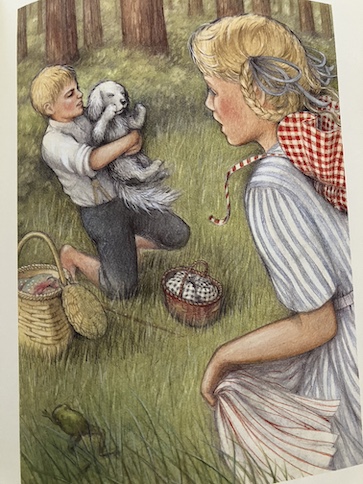
It’s summer, and for a frontier family, the summer chores can be the most fun! Kirsten and her younger brother, Peter, are going fishing. They’re hoping to get enough fish for their family and their Uncle Olav’s family to have for supper. There is plenty of trout in the stream, and they should be able to get enough fish, although sometimes, disasters happen on their fishing trips. Once, Peter chased a skunk, and their mother also warns them to be careful of snakes and bears. Kirsten wears a whistle around her neck that she can blow if they get into trouble. Kirsten thinks her mother worries too much.
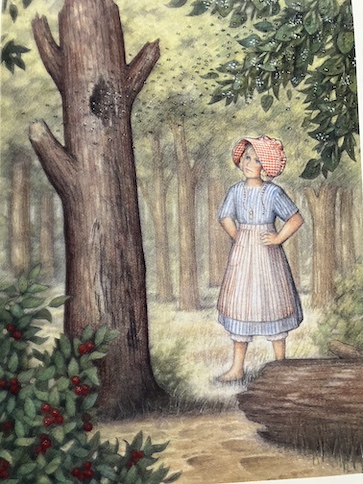
The children take their dog, Caro, fishing with them. Kirsten is a little concerned because Caro likes to chase things, but Peter insists that he can watch the dog and fish at the same time. When they don’t seem to have much luck getting big enough fish in the stream, they decide to go upstream to the pool. The fishing goes well, but Caro is stung by a bee.

Kirsten realizes that Caro must have found a “bee tree”, a tree where bees have built their hive. Kirsten is interested in finding the tree because it’s a source of honey and honeycomb that their mother can make into special treats. If they can collect enough honey, their father might even be able to sell some and buy some of the things the family needs. They need to be careful while looking for the tree, though, or they might get stung themselves. Kirsten is pleased when she finds the tree, but she notices that there are marks on it from a bear’s claws, so it looks like a bear was trying to get the honey, too. Kirsten could ask her father how to get the honey and get him to help, but she wants to figure out how to do it herself and surprise everyone. She asks Peter to keep the bee tree a secret while she tries to figure out how to get the honey, and Peter reluctantly agrees.

Meanwhile, Kirsten’s cousins tell her about the town’s Fourth of July celebration. Kirsten’s family hasn’t lived in America for very long, so her cousins have to explain the significance of the holiday to her. Every year, the nearby town holds a parade and picnic with music and games. A lot of the local farmers also bring things to sell, like pies, butter, or preserves, and they use the money they make to buy things they need. Kirsten thinks again about the honey tree and the things her family could buy. She really wants a straw hat, like her cousins wear.

Later, when Kirsten is picking berries with her cousins, she sees a little black bear cub. She thinks it’s adorable, but Lisbeth says they have to leave the area immediately. If the baby is near the berries, its mother is sure to be somewhere nearby, and mother bears get dangerous if they think someone might hurt their cubs. Kirsten doesn’t really take the warning seriously until she tries to take Peter and Caro back to the bee tree with her to get the honey, and they meet the mother bear face-to-face!

The book ends with a section of historical information about the wilderness on the American frontier in the 1800s. Wild plants and animals were sources of food, but they were also sources of danger, like the bears in the story. The attempts of the pioneers to control the land were about securing sources of food and reducing sources of danger. There is information in the book about how pioneers cooked and how they dealt with changing seasons and weather. It also discusses the Fourth of July and how trips to town were rare treats for pioneer farming families.

The book is available to borrow and read for free online through Internet Archive (multiple copies).

It’s a good story about the difference between bravery and being foolhardy. From the beginning, even young Peter reminds Kirsten that being brave and being foolish are not the same thing. After their hair-raising encounter with the bear, in which the children have a narrow escape and their dog is injured (but fortunately not killed), the children’s father lectures Kirsten about putting both her life and her little brother’s life in danger. When Kirsten explains what she was trying to do with the bee tree, her father also tells her that she doesn’t really know what she’s doing. She took his equipment, but if she had carried out her plan the way she was thinking of doing it, she would have both destroyed the hive and ruined the honey as well as getting badly stung. Kirsten should have just gone to her father as soon as she found the tree and got his help from the beginning. Kirsten is ashamed for getting their dog hurt and putting herself and her brother in danger and almost ruining her special find, and she apologizes.

Because Kirsten’s father now understands the situation, he gets Kirsten’s older brother, Lars, to help him move the colony of bees to their farm. He knows how to set up hives and keep bees long term, so instead of this being just a one-time find and honey harvest, they will be able to get honey from the bees regularly. Kirsten goes with her father and Lars to watch them move the bees. She does it because she’s been having bad dreams about the traumatic escape from the bear, and she thinks it will help her to recover if she goes to the area again and sees it with her father and brother, when it’s safe.

Kirsten still feels bad that she wasn’t able to get the honey all by herself and that her attempt to do it was a disaster, but her mother consoles her. She says that she and Kirsten’s father understand that Kirsten was just trying to help and that her discovery has helped them. She just needs to learn to be careful as well as being brave. I thought that it was also a lesson in learning to share the glory instead of trying to take all the credit by going it alone and risking the success of the project, but the book didn’t quite say that. Kirsten wanted to be the one to say that she did it all herself, but because she couldn’t really do it all herself, everything went wrong. She could have accomplished her goals by talking to her father in the beginning and still been the heroine who found the bee tree, as her mother pointed out. She still gets credit for what she did without needing to take credit for what she couldn’t do alone.

The book ends with the family enjoying the Fourth of July celebration. Thanks to the discovery of the bees, they are able to buy the things they need.
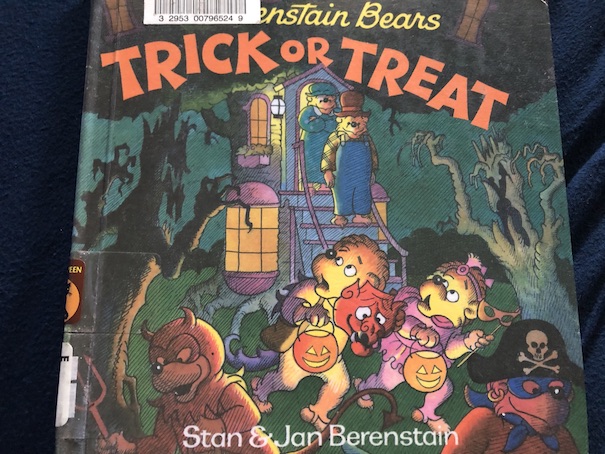
The Berenstain Bears Trick or Treat

The Berenstain Bears

The Berenstain Bears Trick or Treat by Stan and Jan Berenstain, 1989.

“Even little bears
expect a good fright
when they go out for treats
on Halloween night.”

Brother and Sister Bear are looking forward to trick-or-treating on Halloween night with their friends. Sister is going as a ballerina, and Brother is dressed as a monster. When Brother jumps out at Mama in his monster costume, she pretends to be frightened, and when he takes off his mask, Mama comments that “appearances can be deceiving.” Sister asks what that means, and Mama explains that “things aren’t always what they look like.”

This is the first year that Brother and Sister will be allowed to go out trick-or-treating without their parents. They plan to trick-or-treat with friends, and they talk about the houses that they plan to visit. The one house in the neighborhood that they don’t want to visit belongs to Miz McGrizz. Miz McGrizz’s house looks spooky, and the kids think that she might be a witch. Mama tells them that’s nonsense and that Miz McGrizz is a nice person.

As the young bears set out to trick-or-treat with their friends, some of the bigger, tougher cubs in the neighborhood try to talk them into joining them in some pranks. First, they want to decorate Miz McGrizz’s house with toilet paper.

However, before the cubs can do anything, Miz McGrizz comes out of her house, and seeing the cubs, tells them that she’s ready for them. Although the kids are frightened at first, it turns out that Mama really was correct about Miz McGrizz. Miz McGrizz is just a nice old lady who has a special treat for the cubs who are brave enough to visit her house.

In real life, trick-or-treaters shouldn’t go into the houses of people they visit unless they know them very well, but in this case, it’s not so bad because the cubs’ mother approves of Miz McGrizz and would be fine with the children visiting her.

The book is available to borrow and read for free online through Internet Archive (multiple copies).

Trouble at School

The Berenstain Bears

Trouble at School by Stan and Jan Berenstain, 1986.

“When a problem at school
Is kept secret too long,
It can grow ’til a cub
Thinks that everything’s wrong!”

Brother Bear runs into problems at school after he catches a bad cold. While he’s recovering from his cold, he is allowed to watch tv and read comic books. His teacher sends home a packet of schoolwork for him to do, but he ignores it and forgets about it.

He doesn’t remember the packet of work until he’s better and going back to school. However, he soon becomes preoccupied with the news that Cousin Freddie has taken over his position on the soccer team during his absence.

When his teacher gives a quiz on the new lesson in division, Brother fails it. Brother is supposed to show the quiz to his parents and have them sign it, but his parents become preoccupied with Sister, who is now sick, and Brother doesn’t show them the quiz.

The next day, Brother is so upset about his bad grade and what’s happening on the soccer team that he doesn’t go to school. He makes his quiz into a paper airplane and throws it away.

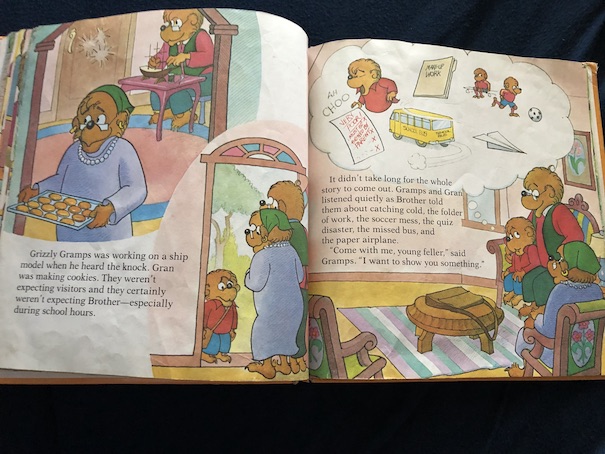
Then, Brother gets the idea of going to see his grandparents for help. He explains the entire situation to them. His grandfather tells him a story that helps put the situation in perspective.

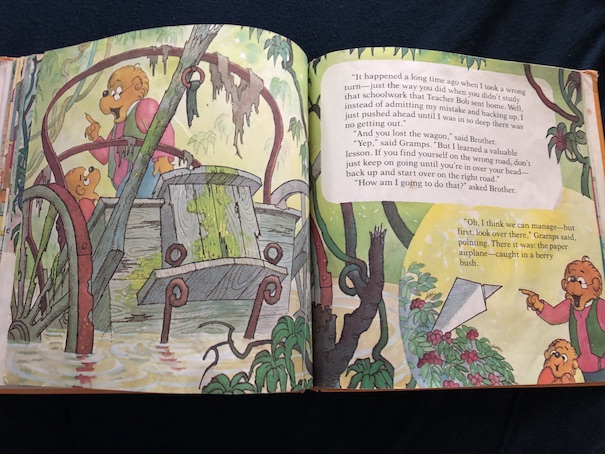
There was a time when Gramps did something wrong, and instead of admitting his mistake, he just kept going and made the problem worse, like Brother did by ignoring his schoolwork and not telling his parents about his problems at school. Gramps says that it’s best to admit when you’ve made a mistake so you can do what you need to do in order to turn the situation around.

They find the quiz that Brother threw away and go home to tell Brother’s parents about his school problems. They’re not happy about the situation, but they tell Brother that “It’s never too late to correct a mistake,” and Gramps proves to Brother that he can do division by having him divide a bag of cookies among the family members.

When Mama takes Brother back to school, he learns that nobody else in class did very well on the quiz, so the teacher is letting them do a retake. Now that Brother realizes what division is really about, he does much better. At the soccer game that afternoon, Brother also gets a chance to retake his old position on the team. If he hadn’t gone to school that day, he would have missed these chances to make things right, but because he did go and took the second chances that he was offered, things were much better by the end of the day.

Adults reading the story will recognize that the reason why Brother’s parents are supposed to sign his failed quiz is because that is how the teacher draws parents’ attention to problem areas that their children have so they can make sure that they can pay extra attention to the child’s homework and help him with his problem areas. It’s not about shaming or punishing the child but getting the child the help he needs to understand the subject. By hiding the bad quiz from his parents, Brother was avoiding the help that his parents were supposed to provide and making the situation worse. Parents can be disappointed when their children bring home bad grades, but this is a situation where parents would rather know than not know if their children are struggling with something because they generally want to help their children when they need it.

The lesson of the story is a good one. Anyone can occasionally make mistakes, have problems, or just plain fail at something, but the people who succeed in the end are the ones who face up to their problems and do what’s necessary to make them right. Some people feel overwhelmed when confronted by problems, but the best thing they can do is admit that there is a problem and that they’re feeling overwhelmed and get help from someone else. Brother could have just told his parents and gotten help with division immediately, as soon as he realized that neglecting his make-up work had left him behind in class. At first, he was too embarrassed and worried to do that, but he did manage to turn things around by talking to his grandfather about his problems and taking the help and advice that he offered. Making mistakes or even failing something doesn’t have to be scary or overwhelming because there are always things you can do to make the situation better and people who are able to help.
The book is available to borrow and read for free online through Internet Archive.

The Berenstain Bears and the Trouble with Friends

The Berenstain Bears

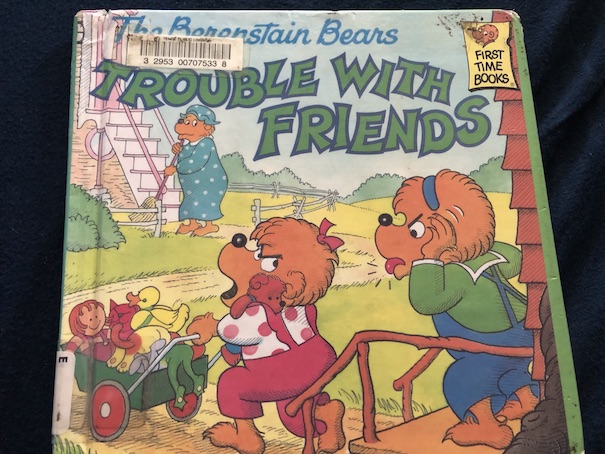
The Berenstain Bears and the Trouble with Friends by Stan and Jan Berenstain, 1986.

“When making friends,
the cub who’s wise
is the cub who learns
to compromise.”

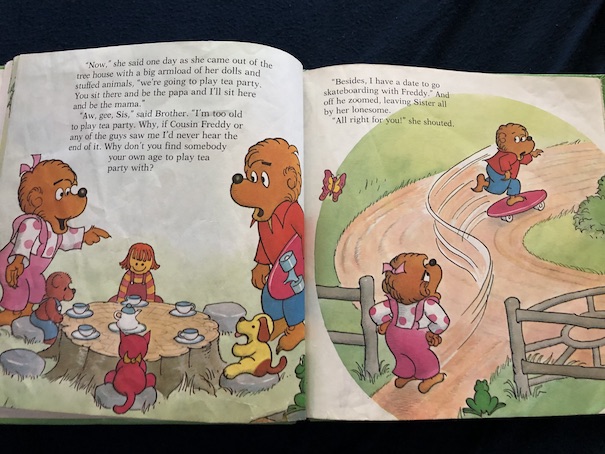
Brother and Sister usually play pretty well together, but Brother is two years older than Sister, and he doesn’t always want to play girls’ games like tea party and house. Brother likes to hang out with Cousin Freddy, but Sister doesn’t have a friend who lives close enough to play with her after school.

Then, one day, a new family moves in down the road, and they have a girl who’s Sister’s age. The new girl’s name is Lizzy, and she likes to do many of the things that Sister likes to do. The girls start playing together right away. Sister thinks that Lizzy is fun, but a little bossy … kind of like Sister herself.

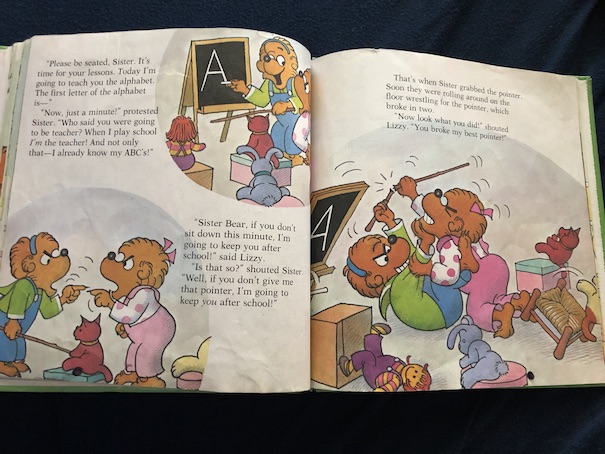
Later, Sister takes some of her stuffed animals to Lizzy’s house so they can play school. However, the girls argue over who is going to play the part of the teacher. Both of them want to play the teacher, and during their argument, they break Lizzy’s pointer stick.

Sister goes home angry, but Mama Bear reminds her of the reasons why she might want to make up with her new friend. Getting along with people can be difficult, but there are many things that are difficult to do alone. Having friends can be a lot of fun, certainly much more fun than sitting home and being lonely. If Sister wants to make up with Lizzy, she needs to accept her for the person she is and recognize that she can be a bit bossy herself sometimes. Both of the cubs need to give a little, let each other have their way sometimes, and care about each other’s feelings.

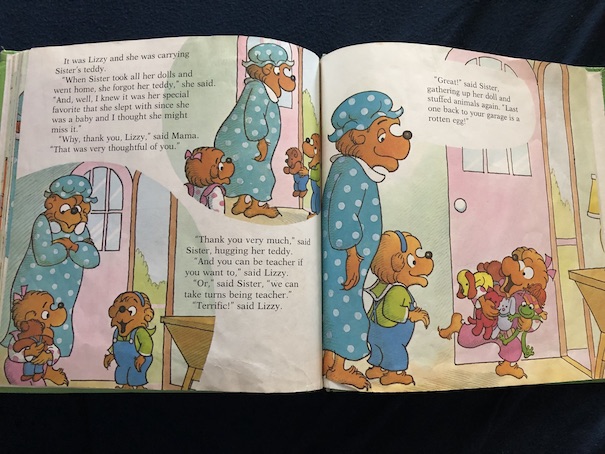
Lizzy drops by to return Sister’s teddy bear, which she left behind. She remembers what Sister told her about her teddy bear and why it’s important to her, showing that she does care about Sister’s feelings. The girls make up and agree to compromise and take turns being the teacher when they play school. Both the girls realize that getting along with friends means considering each other’s feelings and being willing to compromise.

The book is available to borrow and read for free online through Internet Archive (multiple copies).

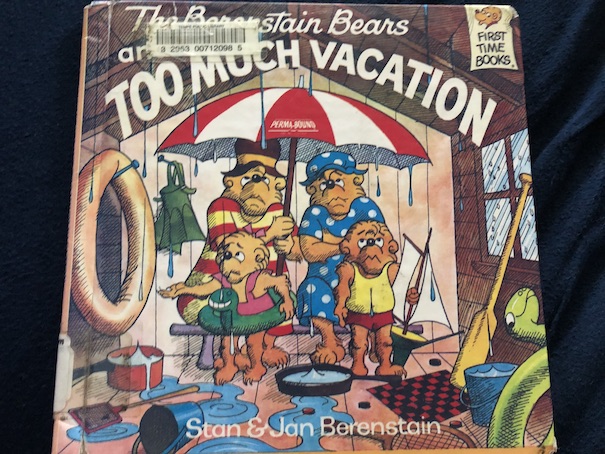
The Berenstain Bears and Too Much Vacation

The Berenstain Bears

The Berenstain Bears and Too Much Vacation by Stan and Jan Berenstain, 1989.

“Can a bear’s vacation
with more rain than sun
end up being
the one that’s most fun?”

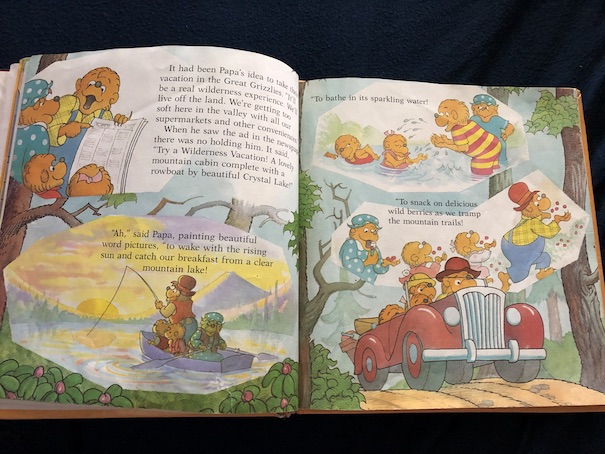
The Bears are looking forward to their family vacation! The vacation was Papa’s idea because he saw an ad in the newspaper for a rental cabin the mountains. Papa likes the idea of a wilderness vacation and living off the land. He describes to his family how much fun it will be to swim and fish in the lake and eat wild berries.

However, when they arrive at the cabin, it soon becomes apparent that their vacation is not going to be as it was advertised. The cabin is run-down and messy. The water from the pump is brownish, and the lake is too.

From the very beginning, nothing on their vacation goes right. Papa’s “wilderness stew,” made from plants that he gathered, is terrible, and the wild berries are sour. Their rowboat sinks, and fishing is a disaster!

When it starts to rain, their cabin leaks, and Papa falls down in the mud. By then, everybody has decided that they’ve had enough and that it’s time to go home.

So, what did they get out of their worst vacation ever? Memories! The experiences were pretty awful, but Mama’s pictures of everything that happened turn out to be hilarious! This is a fun story about how even disappointing situations can have a humorous side.

The book is available to borrow and read for free online through Internet Archive (multiple copies).

Blueberries for Sal

Blueberries for Sal by Robert McCloskey, 1948.

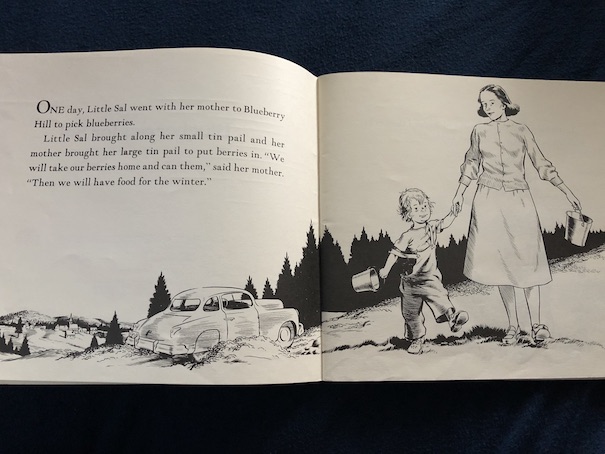
Sal is a little girl whose mother takes her to pick blueberries one day. The mother wants to can the blueberries for winter.

Sal gives in to temptation and eats the blueberries as she picks them.

Meanwhile, a mother bear and her baby come to eat blueberries.

Both Sal and the Little Bear lose sight of their mothers, and when they go looking for them, Sal accidentally finds the mother bear, and the little bear accidentally finds Sal’s mother.

Eventually, the mother bear realizes that Sal is following her when she hears the blueberries plunking into Sal’s pail. Sal’s mother realizes that a small bear is following her when he eats blueberries out of her pail.

Fortunately, nothing bad happens. The mothers just look around for their respective children and figure out where they are by the sounds they make. Then, the mother bear leaves with her baby, and Sal and her mother take their blueberries home.

At first, I was worried about Sal being with the mother bear and how Sal’s mother would react to the mother bear when she saw it, but the two mothers never meet in the story, and the children are fine.

The book is a Caldecott Honor Book. It is available to borrow for free online through Internet Archive (multiple copies).

Can’t You Sleep, Little Bear?

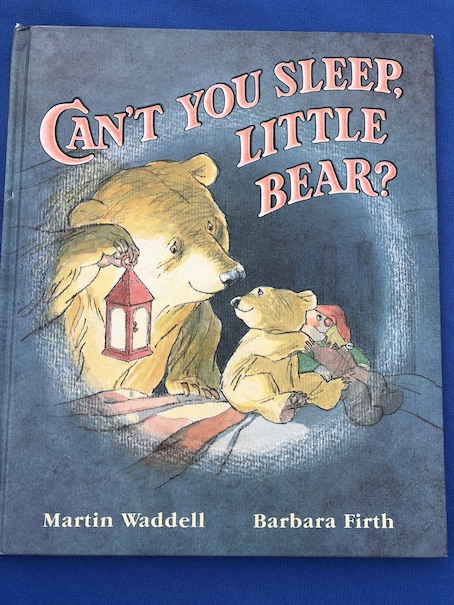
Can’t You Sleep, Little Bear? By Martin Waddell and Barbara Firth, 1988.

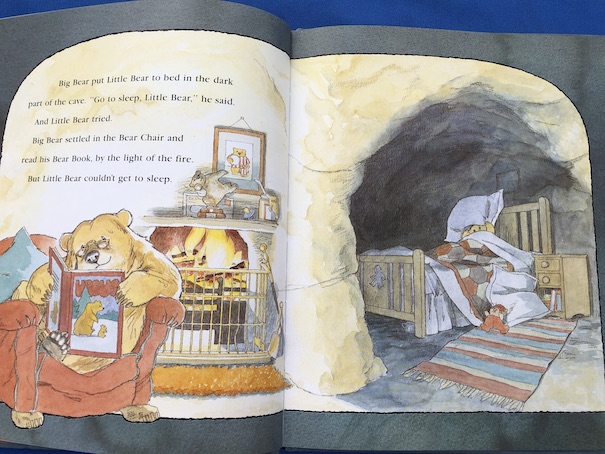
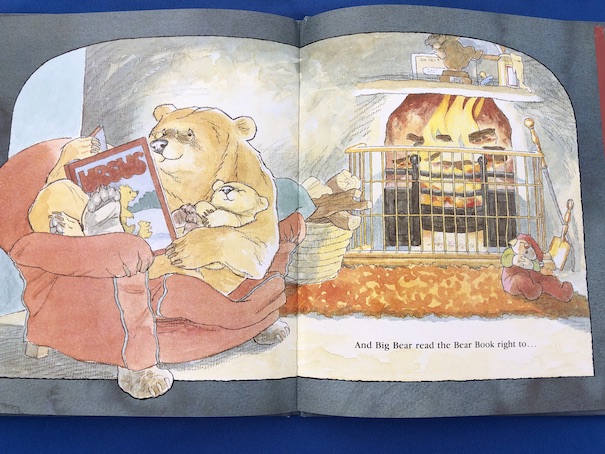
Big Bear and Little Bear live in their Bear Cave.  (Big Bear is apparently the father of Little Bear, but they don’t call him that.)  After Big Bear puts Little Bear to bed at night, Little Bear has trouble sleeping.  Little Bear says that he can’t sleep because he’s afraid of the dark.

Big Bear gives Little Bear a lantern, but that doesn’t work.  Little Bear says that the lantern isn’t big enough.  Big Bear tries to bring two larger lanterns, but neither of those helps, either.

Little Bear says that the dark beyond the cave bothers him.  To prove to Little Bear that the darkness outside isn’t scary, Big Bear takes him outside.

Outside, he shows Little Bear the moon and the stars, so he’ll know that it’s not completely dark.  Little Bear falls asleep in Big Bear’s arms.

This is one of those cute bedtime stories that can help to reassure young children at bedtime. Sometimes, it is a big, scary, dark world out there, but it’s not always as dark as it seems when you take a second look, especially if you’re with someone you can really trust. Because the bears appear to be father and son, it also makes a nice father/son story.

The book is currently available online through Internet Archive. There is also an animated version of this story. I haven’t seen it for sale (if anyone knows where to get it, let me know), but it sometimes appears on YouTube (link repaired July 18, 2024).