This book is part of the Madeline series about a little girl at a small boarding school in Paris. The son of a Spanish Ambassador, Pepito, lives next door to the girls. He’s a menace to them at first, but the girls make friends with him. However, in this book, Pepito moves to London because his father has been relocated for his job.
When Pepito and his parents go to London, Pepito is unhappy there because he’s lonely for Madeline and the other girls from the boarding school. With Pepito growing thin and depressed from his unhappiness, Pepito’s father arranges for the girls from the boarding school to visit for Pepito’s birthday to cheer him up.
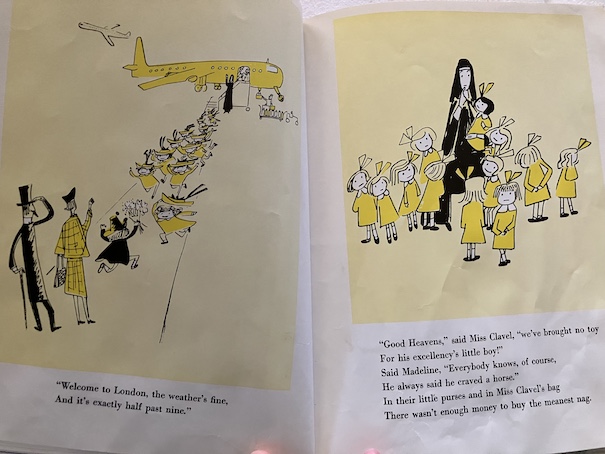
When Miss Clavel and the girls arrive in London, there’s a happy reunion, but then, they remember that they didn’t bring Pepito a present for his birthday. Madeline remembers that Pepito has always wanted a horse, and they find an old, retired army horse who is still healthy and gentle.
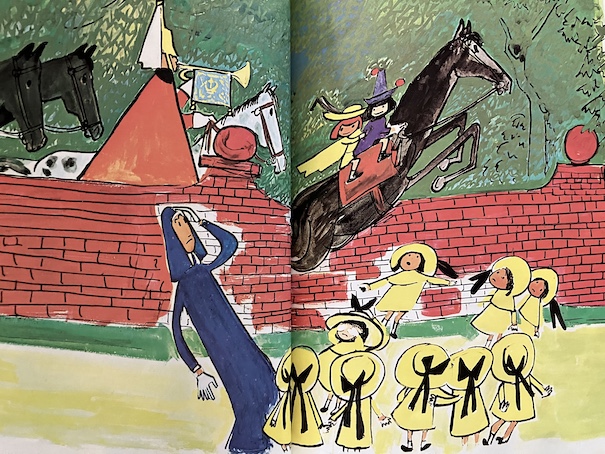
However, when they give the horse to Pepito, they quickly discover that there are complications to owning a horse as a pet. The horse hears a trumpet, and reacting to his army training, he runs off with Pepito and Madeline on his back to join a parade.
Then, they forget to feed him, so he eats everything in the garden, making himself sick. It seems like the embassy in London is no place for a horse, but Madeline and her friends may have room for one at their school!
The book is available to borrow and read for free online through Internet Archive (multiple copies).
My Reaction
Giving someone a horse for a present without checking with their parents or making sure that they have what they need to take care of a horse isn’t something that people realistically do, but the Madeline books rarely worry about the practicalities of a situation. It’s all fun and adventure!
I was seriously worried about the horse after they forget to feed him and he helps himself to random plants in the garden, especially when they find him with his feet up in the air. Fortunately, everything works out okay, which is characteristic of Madeline books, too. How the trustees of Madeline’s school will react when they find out that the girls now have a pet horse, since they raised a fuss earlier about the girls having a dog, is anyone’s guess, but the story doesn’t worry about that, either.
Like other books in this series, the pictures in the book alternate between limited color images, mostly in black and yellow, and full color images.
Happy Birthday, Little Witch by Deborah Hautzig, illustrated by Marc Brown, 1985.
This was one of my favorite Halloween books when I was a child, and so is the first book in the series, Little Witch’s Big Night. The first time I read these books, I read them out of order, but you really have to read the first book in order to understand Happy Birthday, Little Witch because it turns out that Little Witch still doesn’t understand the idea of trick-or-treating or that human children wear costumes on Halloween after meeting some children trick-or-treating on the previous Halloween. She really thinks that she met a small astronaut, pirate, and devil on Halloween, and that makes it difficult for her to find them when she wants to invite them to her birthday party.
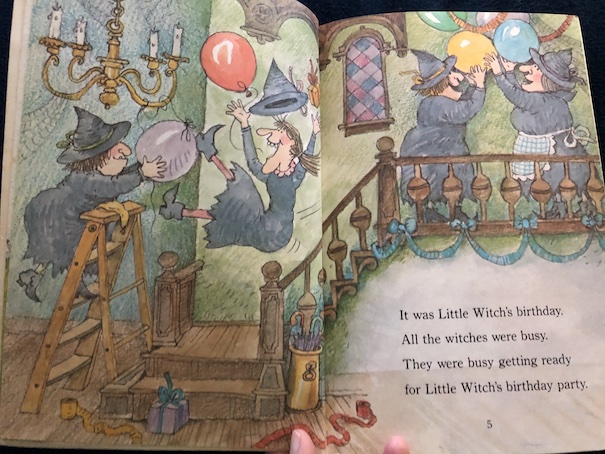
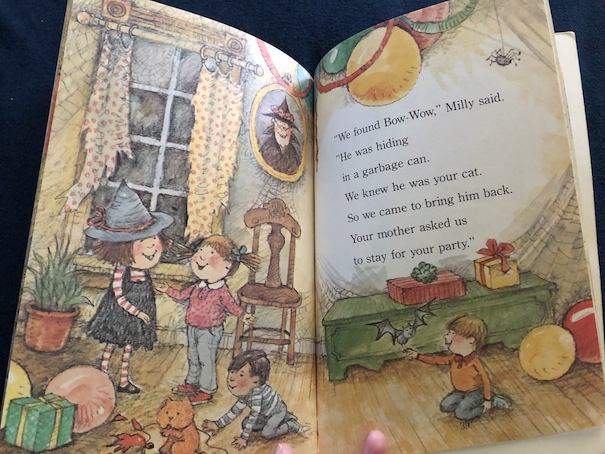
The witches in Little Witch’s family are decorating and preparing for Little Witch’s birthday party, but Little Witch is sad. Witches are generally bad and nasty, and Little Witch knows all the tricks her family will pull at her birthday party. Little Witch is nicer than the other witches, and she wishes that her party could be nicer, too. Then, she gets the idea of inviting the new friends she met on Halloween, who she only knows as Pirate, Astronaut, and Devil.
She doesn’t know her friends’ real names, so she tries to search for them in place where she thinks that a pirate, an astronaut, and a devil might hang out, taking her cat Bow-Wow and her pet bat Scrubby with her. She hitches a ride on a rocket ship, but her astronaut friend isn’t inside.
She checks out a pirate ship, but her pirate friend isn’t there, and the captain makes her walk the plank.
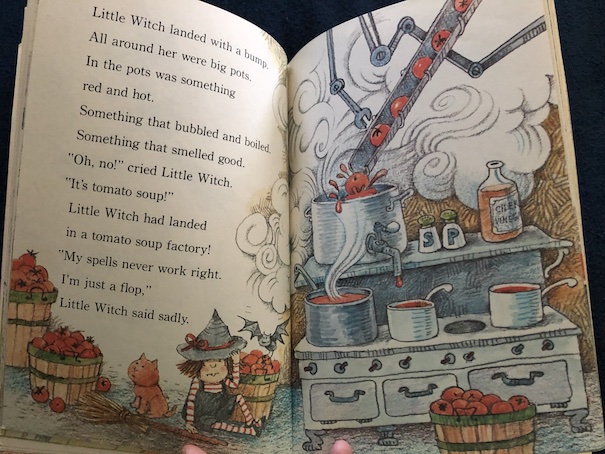
As for the devil, she thinks that she should try someplace that’s red and hot and ends up in a tomato soup factory (which I think is the funniest part if you’re reading this as an adult and you realize what kind of red, hot place she was really thinking of going to look for a devil).
However, the cook in the factory suggests to her that if she’s looking for her friends, they’re probably in school. At the school, Bow-Wow the cat gets frightened and runs away.
When Little Witch gets home, she finds out that her friends are ordinary children. They found her pet cat and brought it to her house, so her mother invited them to join the party. Her friends introduce themselves by name for the first time.
Little Witch’s party is nicer than it usually is, and she gets to play different games with her new friends. Little Witch’s mother says that she loves her, even though she is more good that most little witches.
Something that I didn’t mention in the review of the previous book is that both of these books were illustrated by Marc Brown, who created Arthur. The book is available to borrow for free online through Internet Archive.
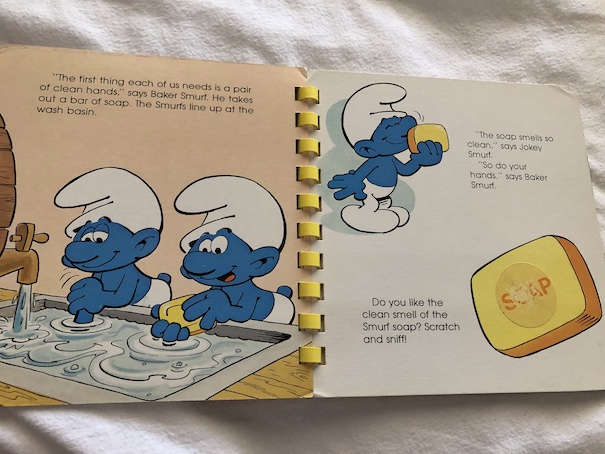
“Sniffy” books with scent patches for readers to scratch and sniff were a recent innovation in the 1980s and were popular with kids. Many books that included this feature used well-known characters from popular children’s cartoons, like this one featuring the Smurfs.
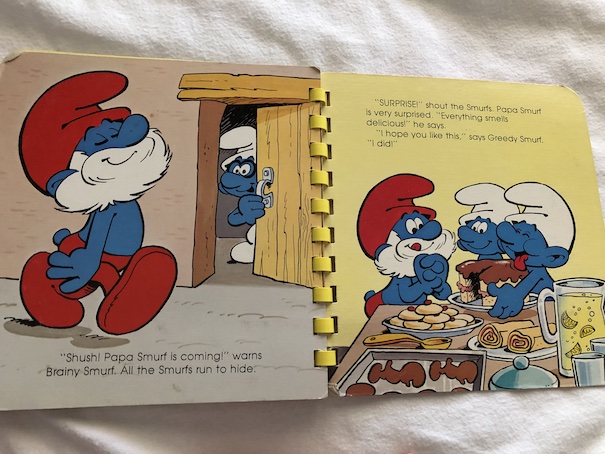
The Smurfs are making special treats as part of a surprise party for Papa Smurf’s birthday! The first scent in the book is the soap the Smurfs use as they wash their hands and prepare to help.
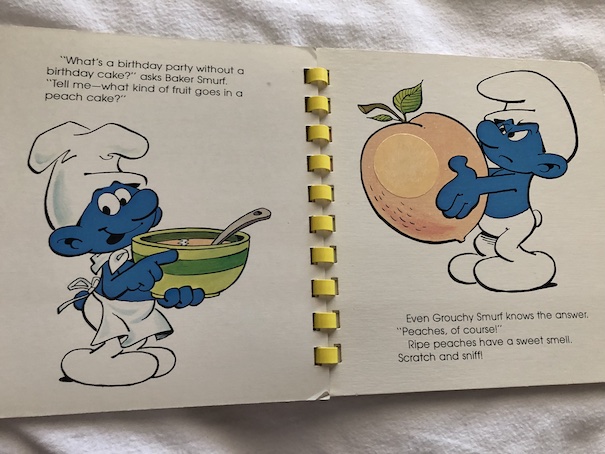
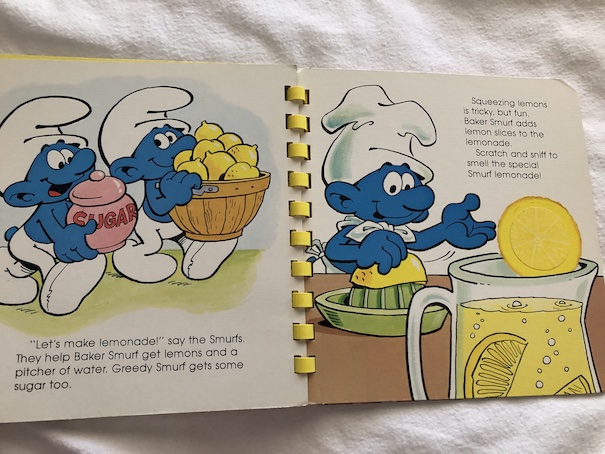
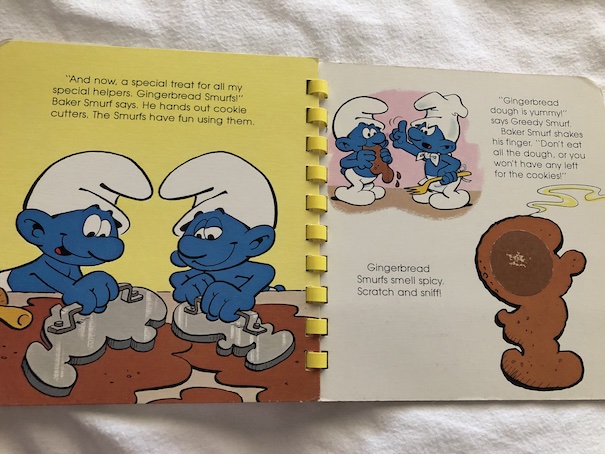
All of the rest of the scents in the book are ingredients they use to make the birthday treats. There is the jam that they put in the jelly rolls, the peach they put into the peach-flavored birthday cake, violets that they make into candied violets (not common in the US, but they can be used as decorations on desserts in real life), gingerbread that they make into gingerbread Smurfs, and lemonade.
When everything is ready, they surprise Papa Smurf with their fun birthday feast!
My Reaction
We’ve had this book since I was a little kid. Sniffy books gradually lose their scents the more the patches are scratched, but we used this one pretty frequently, and the scents have held up surprisingly well. You can see the scratch marks on the scent patches in the pictures, and the scents aren’t as strong as they used to be, but even more than 30 years later, the scents are still there and recognizable as what they’re supposed to be. The one that held up the least well is the lemonade scent, but the others are pretty good for being as old as they are!
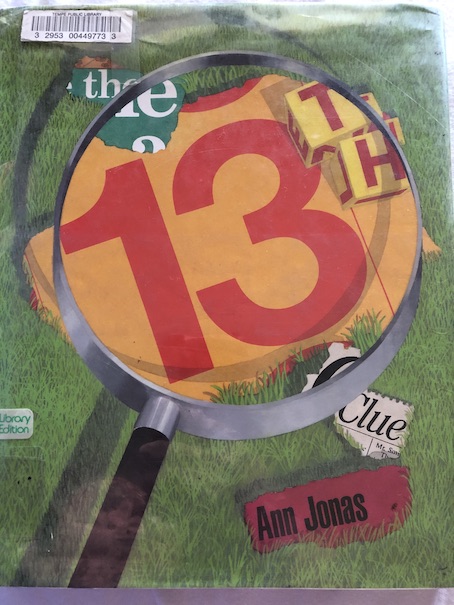
This picture book is almost entirely pictures. The pictures present clues to a treasure hunt and reveal the true story of the book.
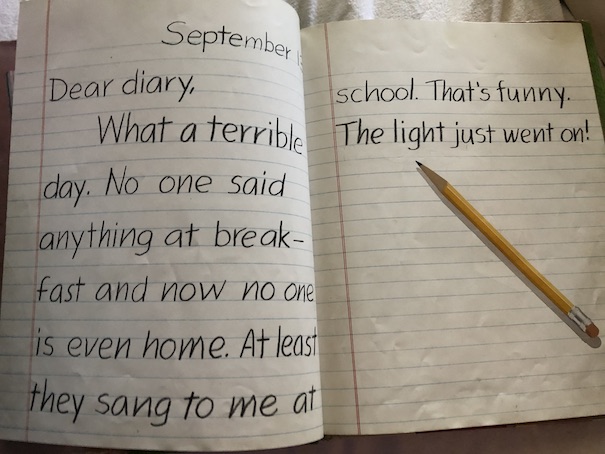
The book begins with a diary entry. At first, we don’t know who is writing it, but this person writes about what a bad day it’s been. We know that the person must be a kid because they mention school, and I guessed that it was the person’s birthday because people sang to them at school. But, she thinks that others have forgotten her birthday. The diary entry breaks off when the person notices a light going on in the house when, supposedly, no one else is home.
From this point on, until the very end of the book, the text is presented in the form of clues for our birthday kid (who turns out to be a girl, as shown in shadows and a reflection in water in later illustrations) to follow that lead to the place where her friends are waiting to give her a surprise party. Readers can figure out the clues along with the girl, some of which are easier and more direct than others.
I love puzzle books, and I thought that it was interesting how we don’t even know who the main character of the book is, only finding that out as the book continues. I liked the challenge of figuring out the clues as the book went along, although none of them were particularly difficult. They aren’t written in any kind of code, just kind of hidden in plain sight, most of them using objects that are part of the rest of the scene. Some of the letters of words are jumbled and have to be unscrambled. I’m sure it would seem harder to children.
This is a pretty easy book, but not one that would be suitable to read to children who can’t read themselves. There are no solutions provided to the puzzles, but that’s okay because, first of all, they aren’t very hard, and second, there are no opportunities for the reader to make choices based on the puzzles, so there is nothing for the reader to get wrong. The end of the story is obvious. Most of the fun is just studying the pictures to see the cute ways her friends decided to hide their “secret” messages. The hardest message to spot is the one written in the hillside.
The book is available to borrow for free online through Internet Archive.
Samantha is turning ten years old! She is having a birthday party with some other girls, and Aunt Cornelia’s younger sisters, the twins Agnes and Agatha, are coming to visit. Samantha’s grandmother is very strict, with very precise ideas about the way that things should be done. The twins are accustomed to being raised more permissively. When Samantha complains that her grandmother makes her wear long underwear for most of the year, even when it’s really too hot to wear it. Her grandmother thinks that it will help ward off illness. The twins encourage Samantha to think for herself. Few people wear long underwear anymore or believe that they will get sick by not wearing it, the twins say, and if Samantha doesn’t want to wear it, she should be allowed to make up her own mind about it. Samantha agrees that ten years old should be old enough to decide about simple things, like what kind of underwear to wear.
The twins have a lot of interesting ideas about how to do things differently, and they encourage Samantha to be a little more daring and try new things. When the cook talks about Samantha’s birthday cake and how it will have ten candles on it, the twins suggest that she could make ten smaller cakes, called petite fours, and put one candle on each of them. Samantha thinks that sounds so elegant that she wants to try it, although the cook thinks that it sounds a little strange for birthday cakes. They’re also going to have ice cream at the party, homemade. Samantha and the twins help to make it, although they are annoyed by Eddie, the nosy and bossy boy from next door, who shows up and tries to tell them what to do, hoping for a taste of ice cream himself.
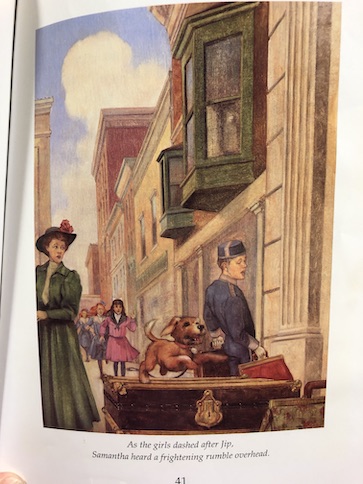
At first, girls the party act a bit self-conscious, trying to be polite and grown-up in their party clothes. After Samantha opens her presents, her Uncle Gard and Aunt Cornelia show up with a special surprise: a puppy named Jip. Jip is a little wild and doesn’t know how to obey commands. He runs off with Samantha’s new teddy bear (a recent invention in Samantha’s time), and the girls have to chase him and get him to drop the toy. Samantha distracts the dog by offering him her shoe, and Eddie, who was watching, picks up the bear. At first, he says that he’ll give it back if they give him some ice cream and let him play with the dog, but Samantha refuses because he was not invited to the party, and she doesn’t like him nosing in. Agatha wrestles the teddy bear away from Eddie before Samantha’s grandmother arrives and tells them that young ladies shouldn’t fight or make spectacles of themselves. Most of the rest of the party is elegant, and the girls are a little more relaxed, now that they look a little less elegant from chasing the dog. However, Eddie gets revenge on the girls by adding salt to the ice cream they made. Even though everything else is fine, including the petite fours, Samantha is still angry at Eddie for ruining the ice cream.
Since Samantha didn’t get to eat the ice cream at her birthday party, the twins and Aunt Cornelia suggest that Samantha return to New York City with them for a visit, and they can all go to a fancy ice cream parlor there. Grandmary agrees and says that she would like to go to New York City herself. On the way to Uncle Gard and Aunt Cornelia’s new house, Grandmary says to Samantha that she hopes that she thinks that the twins get too carried away with some of their ideas. She thinks that they’re too impulsive and don’t think before they act, and while they’ve been raised to be very modern children, she still thinks that some of the old ways are best.
When Grandmary and Samantha see a protest held by women’s suffragists, Grandmary is annoyed at the women, making public spectacles of themselves and inconveniencing passing traffic. She thinks that it’s just another “newfangled notion” that’s a lot of fuss and bother over nothing. She’s never had to vote in her entire life, and she doesn’t see why any other woman would need to. Samantha can tell that this opinion bothers Aunt Cornelia and the twins when Grandmary says it in front of them, but they don’t seem to want to discuss it further.
The twins and Samantha ask to take Jip to the park, and Aunt Cornelia says that’s fine. She has a meeting to attend, but she wants them back home in time to go to the ice cream parlor after her meeting. However, Jip gets away from the girls when they try to put him in Samantha’s doll carriage, and they chase him to the place where the suffragists are meeting. Although Samantha knows that her grandmother doesn’t approve of the suffragists, they have to go after the dog. There, the twins tell Samantha that Cornelia is also a suffragist, and she is speaking at the meeting.
Jip charges right up to the stage where Cornelia is giving her speech, and Cornelia lectures the girls about not thinking about the consequences of their actions and not following her instructions for taking proper care of Jip. Sometimes, they are too impulsive and don’t think ahead. Cornelia explains to the girls about the need to follow agreed-upon rules for safety and how that is different from the changes that her group is advocating. While Grandmary has been saying that the suffragists are also too radical and impulsive and making a fuss about nothing, Cornelia says that much thought, planning, and hard work has gone into their movement to ensure that the changes they’re advocating will be for the better. Grandmary doesn’t appreciate how much thought and preparation the group has done and how long it has taken them to get this far because she hasn’t really thought about the issues at all herself and she has not been to any of previous meetings, where the planning has taken place.
Note:The women’s suffrage movement was already decades old by 1904, when this story takes place, so it’s not really as “newfangled” as Grandmary describes it. It had been building for a long time. However, Grandmary may not have been aware of that because she never needed to be aware. Consider what her life has been like. Remember that Grandmary is a wealthy lady and that marriage and social connections have been the basis of her life. Her husband was wealthy, and she was likely born into a wealthy family. Her life has always been comfortable without her needing to have a job or vote or do anything other than be a wife and mother. Growing up, becoming a well-behaved young lady, and getting married set her for life, and up to this point, she hasn’t had any major problems with money or her lifestyle and hasn’t really needed to think much further than that. She’s used to letting the men in her life handle business and politics and provide her with money, and she now lives on the money that her husband left to her, which is more than ample. Mostly, what Grandmary has needed to manage in her life are the social graces necessary for entertaining her husband’s business associates and their wives and for helping to facilitate her children’s marriages and careers. Grandmary’s daughter was also married to a well-off man before their early deaths. Her son is also a wealthy man, who can provide for his wife, and Cornelia is also from a wealthy family in New York City, a natural extension of their social circle. Grandmary assumes that Samantha, raised in this wealthy social atmosphere, will also naturally meet and marry a wealthy man through the connections of her friends and family, one who will support her and their children in a comfortable fashion. She thinks that, besides caring for her future children, Samantha will likely occupy her time with good works for the less fortunate and that she will give elegant parties for the fashionably-dressed ladies of their social level to solidify their social connections. The elegant affair that her tenth birthday was supposed to be was also practice for her future, as Grandmary envisions it. Grandmary thinks that life will continue to follow this same general course in their family and that there will never be a need for anything different because her own life has been fairly smooth, comfortable, and predictable, largely unshaken, even by the deaths of her husband and Samantha’s parents. But, she’s about to change her mind.
The girls are a little disheveled when they go to meet Grandmary at the ice cream parlor because there is no time to go home and change. As they explain to Grandmary about why the girls look a little disheveled, she tells them that she already knows because she was there, watching the speech. When she saw that Cornelia was the one speaking, she decided to stop and listen, and she was impressed by what she heard. She liked the part where Cornelia talked about the importance of standing up for what is right, and that’s something that Grandmary believes in, too. She is now more open to the suffrage movement than she was before.
The story is partly about growing up and how Samantha realizes that she needs to learn to make her own decisions. She can’t always go by what her grandmother tells her, and sometimes, listening to the twins isn’t always the wisest choice, either. Samantha also begins to see that she has choices to make about the kind of young lady that she will grow up to be. She can be the elegant lady at the party or the public crusader for the causes she believes in or maybe something that combines aspects of both. In the end, Grandmary also begins to see the possibilities of change.
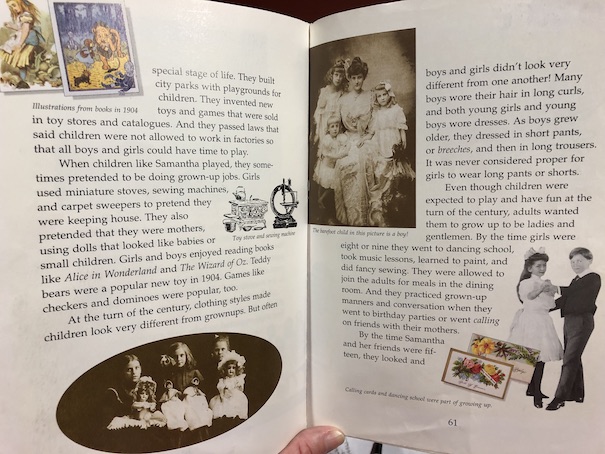
In the back of the book, there is a section about babies and children during the early 1900s. It discusses what children liked to do for fun and how adults would begin training children to be young adults early in life, emphasizing social skills, like dancing, how to behave at the dinner table, and how to engage in polite adult conversation. A girl from a wealthy family, like Samantha, might go to a finishing school instead of college after completing her basic education. At finishing school, she would learn how to manage a household, including how to manage servants (how to hire them, how to tell if they were doing a good job, etc.) and how to throw elegant dinner parties. She might have a coming out or debutante party to introduce her to society as an adult, which meant that she would be ready for introductions and dates with young gentlemen and would probably soon be considering marriage. (This is likely the path that Samantha’s grandmother took in life and the one that she is considering for Samantha.) However, some young ladies did go to college, had careers, or become suffragists, and some did some combination of the above. Samantha’s life is full of possibilities, and her future hasn’t been decided yet. Because Samantha was ten years old in 1904, she would have been eighteen in 1912. For an example of what college life would have been like for an eighteen-year-old girl at a college in the eastern United States in 1912, see the novel Daddy-Long-Legs.
The book is currently available to borrow for free online through Internet Archive.
Bear really loves the moon and decides that he would like to give the moon a birthday present. The problem is that he doesn’t know when the moon’s birthday is. He tries asking it, but it doesn’t answer.
Deciding that he needs to get closer to the moon to talk to it, Bear goes to the mountains to ask the moon when its birthday is. In the mountain, Bear hears his own echo and thinks that it is the moon answering him. When Bear tells the moon that his birthday is tomorrow, the “moon” replies that its birthday is tomorrow. Bear is pleased, especially when the moon echoes his wish for a hat for its birthday.
Bear buys the moon a hat and puts it on top of the moon by putting it in a tree. The following morning, the hat is on Bear’s doorstep, and Bear accepts it as the moon’s present to him.
When the wind blows poor Bear’s hat away, Bear goes to the mountains again to apologize to the moon for losing the hat. It’s okay, though, because Bear and the moon still love each other.
Bear never realizes that what he’s hearing is his own echo. It’s sweet although somewhat silly. If you wonder what happened to the hat in the end, it’s shown on the back cover of the book, holding a bird’s nest.
The book is currently available online through Internet Archive. (When you borrow a book from Internet Archive, you have to set up an account, but it’s free.)
Things
have improved for Molly in Winter Hill since she and Emma became friends. Now, Molly doesn’t feel quite so alone as she
once did. However, Emma is still friends
with the nasty Elizabeth (resident mean girl from the first book). Molly has learned that a major part of
Elizabeth’s resentment toward her is that Elizabeth is used to being the
teacher’s pet and the center of attention at school. In both first and second grade, she always
seemed to be the favorite student. Now,
in the third grade, Elizabeth thinks that their teacher prefers Molly, and she
can’t stand it. So, she tries to make
trouble for Molly whenever she can and make others not like her, too.
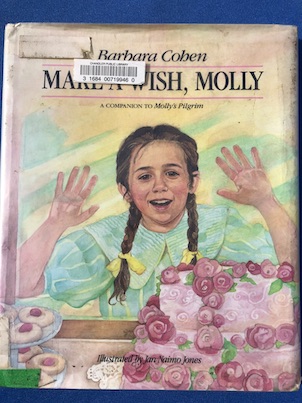
Emma tries to ignore Elizabeth’s nastiness and invites both girls to her birthday party. Molly is excited because she’s never been to a birthday party in America before, and birthdays are celebrated very differently in America from the way they were in Russia. Emma and Elizabeth (in her condescending way) explain how birthday parties are, that the birthday girl receives presents from her friends and gives them small party favors in return, and that there is cake and ice cream for everyone. Molly has never had a cake like the ones that the girls look at in the bakery window and is eager to try it. But, there’s a problem.
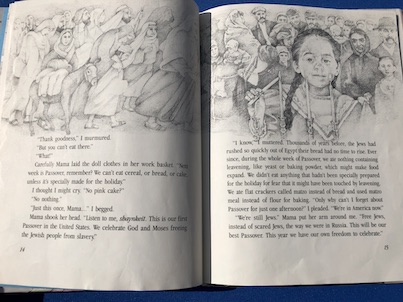
Molly’s mother says that it’s fine for her to go to the party and is willing to make some doll clothes for Emma’s birthday present, but she says that Molly cannot try the cake because the party will take place during Passover, and Jewish families like theirs cannot eat leavened foods during that time. Leavened foods are those that include rising agents, like yeast, baking powder, and baking soda, which includes cakes and breads. For Passover, Molly and her family are limited to things which don’t have these ingredients.
Instead, Molly’s mother packs a snack for Molly to take and eat while the others have the cake. At first, Molly thinks maybe she could disobey her mother just this once and try the cake anyway without her noticing and without feeling different among the other girls, but when a piece of cake is placed in front of her at the party, she can’t bring herself to eat it.
Of course, Elizabeth takes advantage of Molly’s inability to eat the cake to make her feel bad and look bad in front of the others. Elizabeth says that Jewish people don’t like to eat in Christian homes. Molly tries to explain that isn’t the problem and to tell them about Passover, but Elizabeth ignores her explanation and just says that Molly’s reluctance to eat proves that what her mother told her about Jews was true. (Let me just say that when a kid is as awful as Elizabeth is routinely, I always assume that the parents are exactly the same way. I decided that Elizabeth’s mother was probably a bully and a snob back in the first book, so hearing that she’s been spewing anti-Semitic comments is no more than what I would have expected. I view this type of behavior as an off-shoot of a bullying mindset, so I would completely expect that a person who is prone to one type of bullying would also engage in another. The apples never fall far from the tree.) Molly knows that she can’t make the other kids understand the situation, so she just leaves in embarrassment.
When she gets home, Molly tells her mother about what happened. Her mother says that everyone is a little different from other people, and there’s no use in pretending that they don’t live different types of lives from some of their neighbors. However, Molly also has a birthday coming soon, and Molly’s mother thinks that if they invite some of the girls from Emma’s party to their house for a celebration, they will see that Molly’s family isn’t quite as different as they might think.
At first, Molly isn’t sure that it will be such a good idea, but it turns out better than she expects. Her birthday is full of wonderful surprises. There’s no cake, but Molly’s mother bakes other wonderful goodies, like rugelach (pastries with apples, raisins, and nuts). Emma and another girl, Fay, try them and like them, but Elizabeth still refuses. She also just looks defiant when Molly’s mother proves to her that Jews will wash and reuse plates that Christians have eaten from, not throw them away, like Elizabeth’s mother said before. Once again, the issue with Elizabeth isn’t how correct or incorrect she (or her mother) was in whatever she said but whether or not she happens to look better than someone else at the current moment. All Molly’s mother’s demonstration means to her is that she just lost another opportunity to look better than someone, and that annoys her. But, Molly doesn’t care so much about Elizabeth’s lingering nastiness at that point because she knows that Emma is still her friend and Fay has just become a new friend.
There is also a movie version of this book, although the story was altered slightly so that the girl who insults Molly at the party says that it was her aunt who told her all the bad stuff about Jews, not her mother. Also, the movie takes place in a time contemporary with when it was made. The original book takes place in the past, judging by why the reasons why Molly’s family had to leave Russia and the clothes that the girls wear in the pictures.
Molly is excited because she has just learned that an English girl will be coming to stay with her family for a while. The girl, Emily, is one of the child evacuees from London. Really, she’s supposed to be staying with her aunt, who also lives in Molly’s town, but her aunt is in the hospital with pneumonia and won’t be able to take her for another couple of weeks. In the meantime, Molly and her friends are eager to meet her, imagining her to be something like the English princesses, Elizabeth and Margaret Rose.
The girls have a fascination for England after all the things they’ve seen in movies and newsreels. Recently, they saw a newsreel about bomb shelters in England. Inspired by what they’ve seen, the girls make a pretend bomb shelter under an old table and enjoy pretending that they are like the people in the newsreel. Molly’s brother, Ricky, says that it isn’t very realistic, and the girls say that they’ll have to ask Emily when she comes.
However, Emily turns out to be very shy and quiet. She’s pale and skinny and hardly talks at first. When the girls show her their “bomb shelter”, she doesn’t want to play in it. Molly thinks that maybe Emily doesn’t like them, but her mother reminds her that, in World War II England, bomb shelters aren’t places to play. Emily is the same age as Molly, and the war has been going on since she was a little kid. Molly’s mother points out that Emily probably doesn’t remember much about life before the war. Emily is accustomed to bombings and danger all around her, and Molly’s mother compares her to a flower “who’s not sure it’s spring yet. It will take some time for her to realize it’s safe to come out now.”
Emily goes to Molly’s school, and their classmates are fascinated with her. This fascination makes Emily even more shy than she would be otherwise as kids try to imitate her accent and ask her questions about what it’s like to see buildings bombed. To the America kids, the war seems exciting, and they want to know what it’s like to see it up close, but Emily dodges their questions.
Molly finally comes to understand why Emily is so evasive when their town has a blackout drill. When the drill starts, a siren sounds, and everyone has to go down into their basements until they get the signal that it’s all clear. Molly is surprised to see that Emily is actually frightened by the drill, but everyone assures her that it’s just for practice, not because Illinois is actually going to be bombed. In Molly’s family, it’s almost like a game, but Emily has memories of real bombings during the Blitz. As they sit in the basement during the drill, Emily explains it to Molly: the fear, the explosions, destroyed buildings, people getting hurt or killed. Molly and her friends thought it was exciting to hear about the war in newsreels, but living it is an entirely different thing. The drill and everyone’s questions about what bombings are like bring back bad memories for Emily.
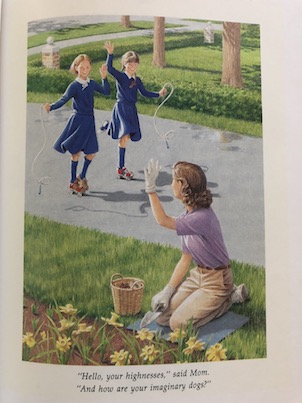
As Molly comes to understand Emily’s feelings more, Emily opens up to her. The girls discover that they share a fascination with Princess Elizabeth and her sister Margaret Rose. They start playing a game where they pretend to be the princesses, dressing alike in blue skirts and sweaters. Because the princesses have pet dogs, the girls also pretend that they have dogs, using jump ropes as leashes for their imaginary pets.
Molly’s birthday is approaching, and she offers to let Emily share in her party and help plan it. She’s curious about what people in England do on their birthdays, and the idea of an English tea party sounds great to her friends. However, Molly doesn’t like the way that Emily describes English birthdays, and the types of sandwiches that the English tea with tea don’t sound very good. Worst of all, Emily says that, at her last birthday before the war rationing started, she had a lemon tart instead of a cake. Molly can’t imagine her birthday without a birthday cake. Mrs. Gilford, the housekeeper, has been saving up rationed goods for her cake this year, and it’s what she’s been looking forward to the most!
Sharing things with Emily becomes more of a trial for Molly, and when the girls argue about their countries’ contributions to the war effort, they get into a fight and Molly starts thinking that she doesn’t even want Emily at her birthday party. However, Molly’s mother points out to the girls that the war effort is a team effort. A couple of special birthday surprises help the girls to make up, including something extra special that helps Emily to heal further from the trauma of the war.
In the Molly, An American Girl movie, Emily plays a larger role than she did in the books. This is the only book in the series where Emily appears. Her story was changed somewhat for the movie, too. In the movie, she says that her mother was killed in a bombing. In the book, her parents are both still alive, and it was her dog who was killed. Molly doesn’t learn that until the end of the book when her family gives the girls a pair of puppies as a present, and Emily tells her about her pet dog who died.
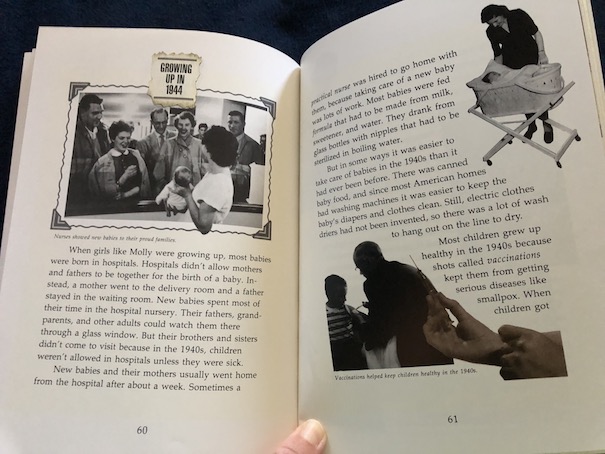
In the back of the book, there’s a section with historical information about what it was like to grow up in the 1940s. It explains how women used to stay in the hospital for about a week after giving birth, and sometimes, they could hire a practical nurse to help them at home as well. Canned baby food was a new invention, and vaccines helped to prevent disease. Back then, people still got smallpox shots because the disease hadn’t been eradicated, but there was still nothing to prevent chicken pox or measles, so children with those diseases had to be kept at home with warning signs out front to tell people to stay away from the quarantined house. (Note: My father was born in 1944, the year that this series takes place, and he said that throughout his early childhood, parents who knew of a child who had chicken pox would deliberately take their children to visit and get the disease. It wasn’t that they really wanted their children to get sick, but since there was no way to prevent the disease at the time, they had to accept that it was inevitable that their child would catch it eventually, and chicken pox is somewhat peculiar in that there is a kind of age window in which the disease isn’t likely to be too bad. If you waited too long, and the child got older or even to adulthood without getting it, it was bound to be much worse when they eventually caught it. So, if your child was about the right age for getting it, in early childhood but no longer a baby, people thought it was best to get it over with so they could benefit from the lifetime immunity afterward. This remained true even up through the 1980s, my early childhood, which is why I have a permanent scar on my face from the disease. Now, there are vaccines to prevent it, although I understand that some people still have chicken pox parties in places where the vaccine isn’t readily available. If you have the option, go for the vaccine. Preventing chicken pox also prevents shingles.)
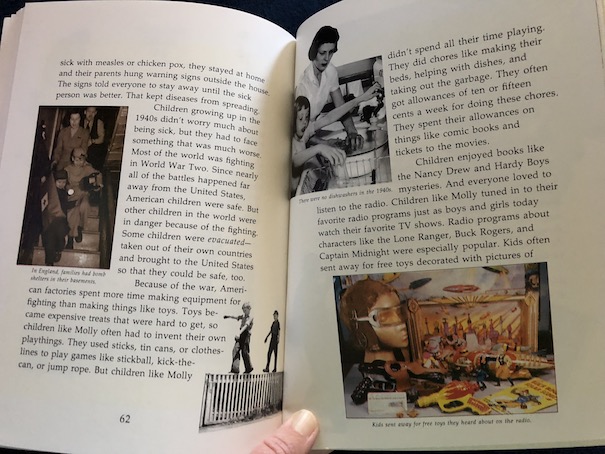
The historical section also talks about child evacuees, like Emily, and what teenagers did during the 1940s. It was around this time that people began looking at the teenage years as being a distinct phase of life, and businesses began specifically catering to teenagers.
The book is currently available online through Internet Archive.
Moira wants to have a birthday party and to invite every kid in her school, from kindergarten to sixth grade. Her parents say that she can have only six party guests total, not six grades’ worth. However, so many kids at school want to come to her party that she ends up inviting the whole school anyway.
When every kid in school shows up on the day of the party, Moira’s parents are bowled over. There are so many kids that they hardly fit in the house. Moira calls up a pizza place, asking for an enormous amount of pizza, and a bakery, asking for an enormous amount of birthday cakes. The kids also help out by supplying their own food from home.
Naturally, Moira’s house is a mess, and her parents are upset, but Moira, seeing the enormous pile of birthday presents that everyone brought, promises a present to everyone who helps to clean up.
But, just when everything seems to have worked out all right, the trucks from the bakery and pizza place show up with the rest of Moira’s order.
The book is currently available online through Internet Archive.
The Sly Spy by Marjorie Weinman Sharmat and Mitchell Sharmat, 1990.
Someone has been trying to steal Olivia’s business by covering up her flyers with ones that say E.J.’s Spy Service. At the same time, Olivia’s friends are trying to keep Desiree’s birthday present a secret even though she has been snooping at their houses to find out what it is.
Olivia’s friends bought her a pet canary because she said that she likes feathers, and they ask Olivia to hide it at her penthouse until the party. However, it looks like Desiree has hired E.J. to spy on her friends and discover what they’re giving her for her birthday. Olivia has to outwit the spy and prove to him that some cases aren’t worth taking.
In a way, this story is kind of like business ethics for kids. First, covering up Olivia’s ads to prevent her from getting business was a form of unfair competition. Then, when Olivia points out to E.J. that he also has a surprise present to give to Desiree, she helps him to understand why the other kids want to keep their present a secret. It wasn’t really ethical for E.J. to take Desiree’s case in the first place since it would be better for her to be surprised on her birthday. Olivia makes sure that E.J. only has a vague notion about what Desiree’s present actually is, and he figures out what to tell Desiree so that he can fulfill his duty to her without giving away the surprise.





















 Jestress's Forgotten Books and Stories