Happy Birthday, Little Witch

Happy Birthday, Little Witch by Deborah Hautzig, illustrated by Marc Brown, 1985.

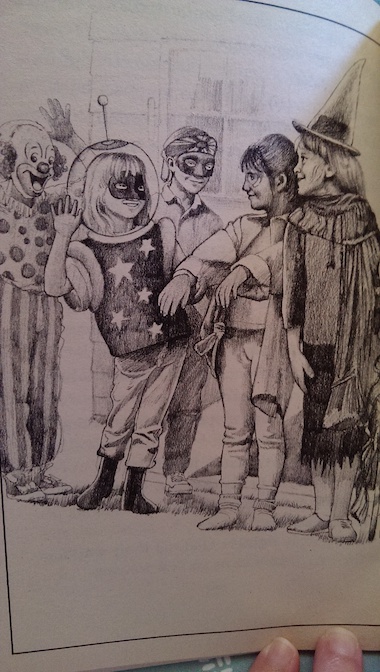
This was one of my favorite Halloween books when I was a child, and so is the first book in the series, Little Witch’s Big Night. The first time I read these books, I read them out of order, but you really have to read the first book in order to understand Happy Birthday, Little Witch because it turns out that Little Witch still doesn’t understand the idea of trick-or-treating or that human children wear costumes on Halloween after meeting some children trick-or-treating on the previous Halloween. She really thinks that she met a small astronaut, pirate, and devil on Halloween, and that makes it difficult for her to find them when she wants to invite them to her birthday party.
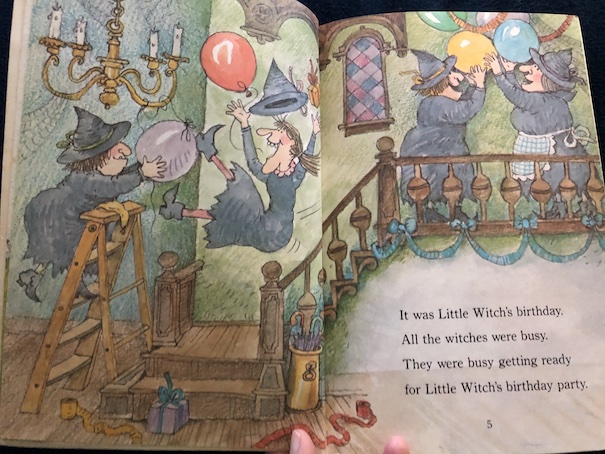
The witches in Little Witch’s family are decorating and preparing for Little Witch’s birthday party, but Little Witch is sad. Witches are generally bad and nasty, and Little Witch knows all the tricks her family will pull at her birthday party. Little Witch is nicer than the other witches, and she wishes that her party could be nicer, too. Then, she gets the idea of inviting the new friends she met on Halloween, who she only knows as Pirate, Astronaut, and Devil.

She doesn’t know her friends’ real names, so she tries to search for them in place where she thinks that a pirate, an astronaut, and a devil might hang out, taking her cat Bow-Wow and her pet bat Scrubby with her. She hitches a ride on a rocket ship, but her astronaut friend isn’t inside.

She checks out a pirate ship, but her pirate friend isn’t there, and the captain makes her walk the plank.

As for the devil, she thinks that she should try someplace that’s red and hot and ends up in a tomato soup factory (which I think is the funniest part if you’re reading this as an adult and you realize what kind of red, hot place she was really thinking of going to look for a devil).
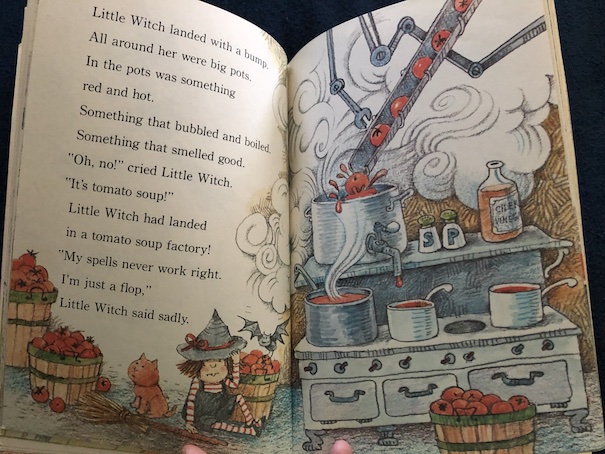
However, the cook in the factory suggests to her that if she’s looking for her friends, they’re probably in school. At the school, Bow-Wow the cat gets frightened and runs away.

When Little Witch gets home, she finds out that her friends are ordinary children. They found her pet cat and brought it to her house, so her mother invited them to join the party. Her friends introduce themselves by name for the first time.

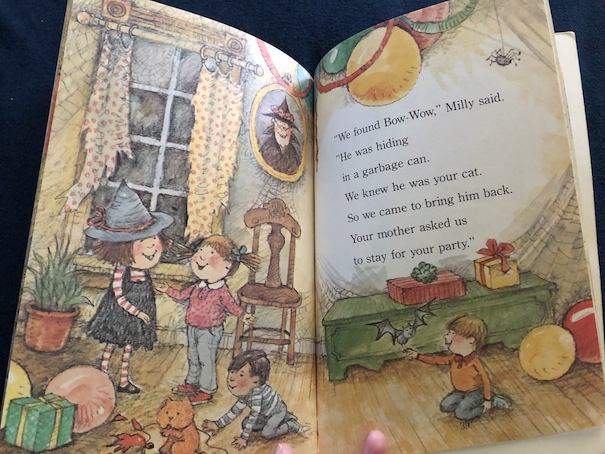
Little Witch’s party is nicer than it usually is, and she gets to play different games with her new friends. Little Witch’s mother says that she loves her, even though she is more good that most little witches.

Something that I didn’t mention in the review of the previous book is that both of these books were illustrated by Marc Brown, who created Arthur. The book is available to borrow for free online through Internet Archive.
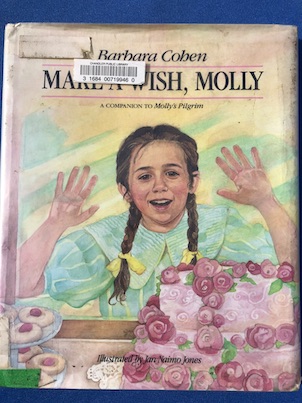
Make a Wish, Molly

Make a Wish, Molly by Barbara Cohen, 1994.

This book is the sequel to Molly’s Pilgrim.

Things have improved for Molly in Winter Hill since she and Emma became friends.  Now, Molly doesn’t feel quite so alone as she once did.  However, Emma is still friends with the nasty Elizabeth (resident mean girl from the first book).  Molly has learned that a major part of Elizabeth’s resentment toward her is that Elizabeth is used to being the teacher’s pet and the center of attention at school.  In both first and second grade, she always seemed to be the favorite student.  Now, in the third grade, Elizabeth thinks that their teacher prefers Molly, and she can’t stand it.  So, she tries to make trouble for Molly whenever she can and make others not like her, too.

Emma tries to ignore Elizabeth’s nastiness and invites both girls to her birthday party.  Molly is excited because she’s never been to a birthday party in America before, and birthdays are celebrated very differently in America from the way they were in Russia.  Emma and Elizabeth (in her condescending way) explain how birthday parties are, that the birthday girl receives presents from her friends and gives them small party favors in return, and that there is cake and ice cream for everyone.  Molly has never had a cake like the ones that the girls look at in the bakery window and is eager to try it.  But, there’s a problem.

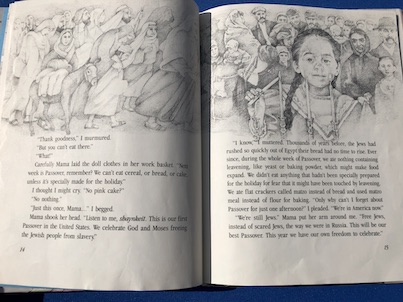
Molly’s mother says that it’s fine for her to go to the party and is willing to make some doll clothes for Emma’s birthday present, but she says that Molly cannot try the cake because the party will take place during Passover, and Jewish families like theirs cannot eat leavened foods during that time. Leavened foods are those that include rising agents, like yeast, baking powder, and baking soda, which includes cakes and breads. For Passover, Molly and her family are limited to things which don’t have these ingredients.

Instead, Molly’s mother packs a snack for Molly to take and eat while the others have the cake.  At first, Molly thinks maybe she could disobey her mother just this once and try the cake anyway without her noticing and without feeling different among the other girls, but when a piece of cake is placed in front of her at the party, she can’t bring herself to eat it.

Of course, Elizabeth takes advantage of Molly’s inability to eat the cake to make her feel bad and look bad in front of the others.  Elizabeth says that Jewish people don’t like to eat in Christian homes.  Molly tries to explain that isn’t the problem and to tell them about Passover, but Elizabeth ignores her explanation and just says that Molly’s reluctance to eat proves that what her mother told her about Jews was true.  (Let me just say that when a kid is as awful as Elizabeth is routinely, I always assume that the parents are exactly the same way.  I decided that Elizabeth’s mother was probably a bully and a snob back in the first book, so hearing that she’s been spewing anti-Semitic comments is no more than what I would have expected.  I view this type of behavior as an off-shoot of a bullying mindset, so I would completely expect that a person who is prone to one type of bullying would also engage in another. The apples never fall far from the tree.)  Molly knows that she can’t make the other kids understand the situation, so she just leaves in embarrassment.

When she gets home, Molly tells her mother about what happened.  Her mother says that everyone is a little different from other people, and there’s no use in pretending that they don’t live different types of lives from some of their neighbors.  However, Molly also has a birthday coming soon, and Molly’s mother thinks that if they invite some of the girls from Emma’s party to their house for a celebration, they will see that Molly’s family isn’t quite as different as they might think.

At first, Molly isn’t sure that it will be such a good idea, but it turns out better than she expects.  Her birthday is full of wonderful surprises.  There’s no cake, but Molly’s mother bakes other wonderful goodies, like rugelach (pastries with apples, raisins, and nuts).  Emma and another girl, Fay, try them and like them, but Elizabeth still refuses.  She also just looks defiant when Molly’s mother proves to her that Jews will wash and reuse plates that Christians have eaten from, not throw them away, like Elizabeth’s mother said before.  Once again, the issue with Elizabeth isn’t how correct or incorrect she (or her mother) was in whatever she said but whether or not she happens to look better than someone else at the current moment.  All Molly’s mother’s demonstration means to her is that she just lost another opportunity to look better than someone, and that annoys her.  But, Molly doesn’t care so much about Elizabeth’s lingering nastiness at that point because she knows that Emma is still her friend and Fay has just become a new friend.

There is also a movie version of this book, although the story was altered slightly so that the girl who insults Molly at the party says that it was her aunt who told her all the bad stuff about Jews, not her mother.  Also, the movie takes place in a time contemporary with when it was made.  The original book takes place in the past, judging by why the reasons why Molly’s family had to leave Russia and the clothes that the girls wear in the pictures.

Moira’s Birthday

MoirasBirthday

Moira’s Birthday by Robert Munsch, 1987.

Moira wants to have a birthday party and to invite every kid in her school, from kindergarten to sixth grade. Her parents say that she can have only six party guests total, not six grades’ worth. However, so many kids at school want to come to her party that she ends up inviting the whole school anyway.

When every kid in school shows up on the day of the party, Moira’s parents are bowled over. There are so many kids that they hardly fit in the house. Moira calls up a pizza place, asking for an enormous amount of pizza, and a bakery, asking for an enormous amount of birthday cakes. The kids also help out by supplying their own food from home.

Naturally, Moira’s house is a mess, and her parents are upset, but Moira, seeing the enormous pile of birthday presents that everyone brought, promises a present to everyone who helps to clean up.

But, just when everything seems to have worked out all right, the trucks from the bakery and pizza place show up with the rest of Moira’s order.

The book is currently available online through Internet Archive.

The Haunted House

Peanut Butter and Jelly

PJHauntedHouse

#3 The Haunted House by Dorothy Haas, 1988.

PJHauntedHouseCostumesJilly was sick on her birthday and couldn’t have a party, so she and Peanut decide to hold an haunted house party, just for fun and invite all the kids in their class. The girls’ nemesis, Jennifer, and her friends are in another class and won’t be invited to the party, but when they hear about it, they make it a point to tell Peanut and Jilly how childish it sounds.  However, no one else seems to think so, and the girls’ classmates are eager to come.

Peanut has fun making Halloween-themed food, and the girls decorate the fruit cellar in Jilly’s basement as their haunted house. They tell everyone to come in costume, and promise a prize to the person in the best costume.  Peanut also tells everyone to bring un-birthday presents to surprise Jilly and make up for missing her actual birthday.

Everyone is excited about the party, but when it starts, some strange things happen. First, it looks like more people show up than they expected.  Then, a mysterious, glowing ghost comes and tells them the tragic story of his death. What is going on?

This is just a fun book about a group of friends and a fun haunted house party they had together.  It doesn’t actually take place on Halloween (the girls get a fake skeleton on sale that was left over from Halloween), but it makes a nice Halloween-type story.  When I was a kid, I liked reading about the creative ways the girls set up the various surprises in the haunted house: making people crawl through a tunnel they’d made, having a skeleton pop out of a trunk by attaching elastic to it, and using a rubber glove filled with water and frozen as a ghostly hand reaching out to touch people, etc.  They also describe how Peanut made “frogs’ noses” out of shell pasta that was dyed green and covered with salad dressing as scary food for the party guests.

The book is currently available online through Internet Archive.

Which Witch is Which

WhichWitch

Which Witch is Which by Pat Hutchins, 1989.

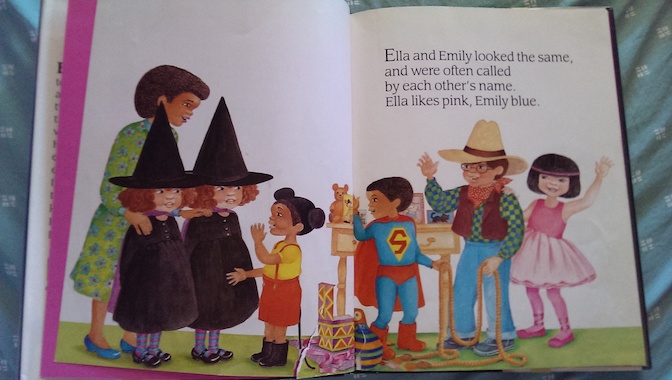
This is a cute picture book/puzzle book.  A pair of twins, Ella and Emily, are invited to a friend’s costume party, but they come dressed as witches in identical (or nearly identical) costumes.  Throughout the party, as the girls play party games, eat the party snacks, and give presents to their host, readers are invited to figure out which twin is which.

WhichWitchIntro

The main clue to the girls’ identities is that Ella’s favorite color is pink while Emily prefers the color blue.  Things that the girls have in those colors or objects that they select give away their identities

WhichWitchPresents

However, there are also other hints, like we are told what each of the girls ate at the party so that we can use the crumbs left on their plates (or the lack of crumbs) to determine which witch is which.

WhichWitchCake

The text of the book rhymes.  The illustrations are cute, and it’s a good book for teaching children how to notice details.

The book is available to borrow and read for free online through Internet Archive.
WhichWitchPlates

Something Queer at the Birthday Party

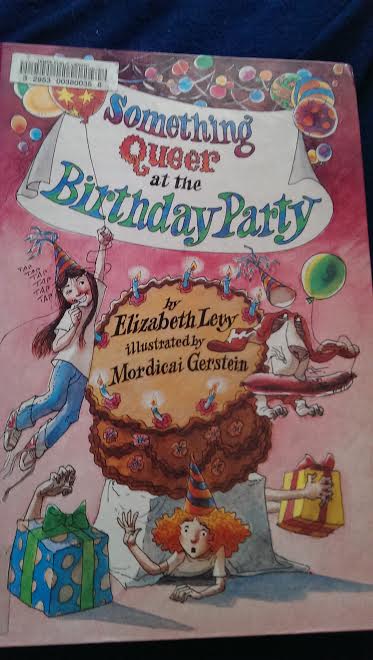
SQBirthdaySomething Queer at the Birthday Party by Elizabeth Levy, illustrated by Mordicai Gerstein, 1989.

Jill and some other friends are throwing a surprise birthday party for Gwen. They send out invitations secretly and create a mystery game for Gwen with a series of clues to lead her to the party.  As part of the game, Jill pretends that someone broke into her house and stole a painting of her and her dog, Fletcher.  The clues to the thief lead Gwen into the room where all of their friends are hiding, waiting to surprise her.

Gwen loves their little mystery and the surprise, and the party seems a success. But when it’s time to bring out the cake and open presents, Jill discovers that they are missing from the closet where they were hidden. At first, Gwen thinks that it’s just another mystery game, but Jill tells her that the presents really are missing. Who took the presents, and where are they now?

SQBirthdayPic1Gwen takes her party and all the guests on a hunt across town for her missing presents, but the big clues turn out to be right back where they started, and Fletcher leads them right to what they’re looking for.

The solution to this mystery touches on a problem that children with a birthday near Christmas understand: When your birthday is near a major holiday, people don’t pay as much attention to it or give as many presents.  My grandmother said it was the same with her when she was young, and she was also the eldest child in a large family, so her birthday was never quite what it should have been.  In the story, one of the girls’ friends had this problem, and it was the motive behind this temporary theft.  The culprit didn’t mean to keep the presents forever, they just wanted to pretend that they were all theirs for a little while.  Gwen forgives the culprit and shares the rest of her birthday with this person.

The book is part of the Something Queer Mysteries.

The Eleventh Hour

The Eleventh Hour by Graeme Base, 1989.

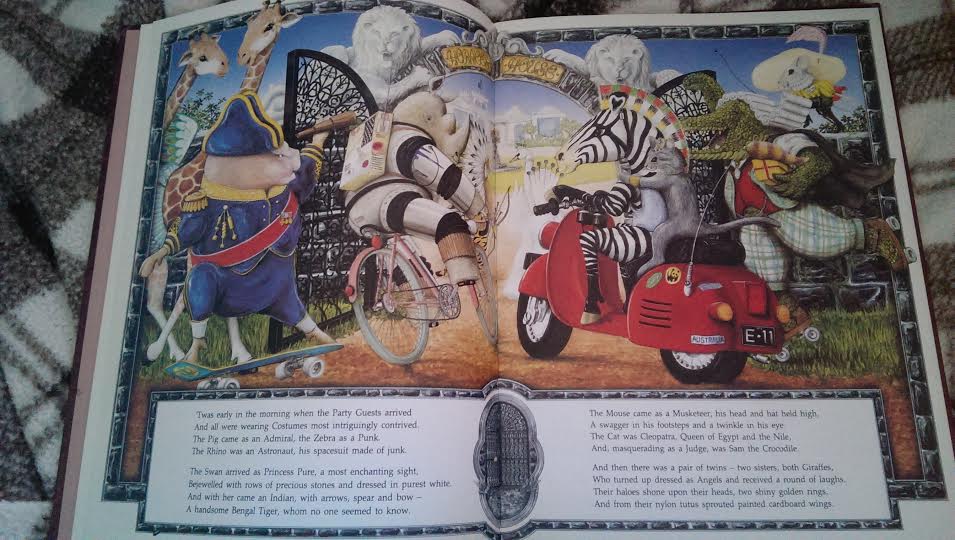
Horace the elephant is turning eleven years old, so he’s invited all of his animal friends to his house for a costume party.  The best part will be the extraordinary feast that Horace has created himself with all kinds of cakes and pastries and other desserts.

eleventhhourguests2

But, Horace refuses to let his friends eat any of the goodies until after they’ve played the party games. The guests have a lot of fun, but through all the games, they’re still thinking about that glorious feast. Only, when they finally go to eat, the food is all gone! Who could have taken it?

The book is available to borrow and read for free online through Internet Archive.

My Reaction

This picture book is actually a puzzle book, with puzzles difficult enough to even challenge adults.  Hidden within each of the large pictures taking up the entire page of each page in the book, are secret messages that hint at the identity of the thief, who is one of the party guests.  Some of the messages are in code.  Although a young child might enjoy the pictures in the book and the rhymes of the story, it would take someone older to be able to solve the puzzles.

There is a way to find the thief without finding the hidden messages or solving any codes, but it still requires attention to detail. There is a section in the back of the book that explains everything, pointing out all the secrets that you can find in the pictures, including the names of one of the giraffes and the swan, whose names are not given in the story itself.

But, don’t skip straight to the answers.  As Base himself says at the beginning to the section of answers, “the getting of wisdom is no match for the thrill of the chase, and those who choose the longer road shall reap their reward!”

Never Hit a Ghost with a Baseball Bat

GhostBaseballBatNever Hit a Ghost with a Baseball Bat by Eth Clifford, 1993.

Mary Rose and Jo-Beth are visiting another museum with their father, but they’re not happy about it.  Mary Rose is annoyed because there’s a boy she likes, and no matter what she does, he just won’t pay attention to her.  Jo-Beth is annoyed because she just turned eight years old, and well, . . . she just turned eight.  Nothing special happened on her birthday.  She doesn’t look different, she doesn’t feel different, and she just had to go to school like normal.  Their father, Harry, hopes that a visit to a strange museum dedicated to antique trolleys will help snap them out of their funks, although neither girl thinks so at first.

But, it seems like the trolley museum might be inhabited by a ghost.  The owner, Sam Thorne, doesn’t think so, but his assistant, Hoot Turner, can’t think of any other explanation.  Strange things are happening.  Food and other objects disappear.  Things are moved around.  Areas are . . . unexpectedly tidy?  What gives?  If it’s a ghost, it’s apparently a ghost that believes in cleanliness and doesn’t mind doing the dishes.  But, if the ghost is so friendly and useful, why do mysterious voices call out to them to beware?

GhostBaseballBatPicThe girls explore the trolleys parked in the museum and admire the manikins dressed in old-fashioned clothing that are part of the displays in each trolley car, but more strange things happen.  A teddy bear seems to speak to them, even though it isn’t the kind with a string and a talk-box.  The manikins start to seem creepier.  Mary-Rose and Jo-Beth are only armed with a baseball bat from one of the displays and the old teddy bear (which terrifies Jo-Beth).  But, Mary Rose is determined to find the ghost, even if it’s the last thing she does!

Telling you about one of the themes of this story would spoil the ending, but both the girls come to realize that there are people in the world with much more serious problems than the ones that they were worried about at the beginning of the story.  There is a happy ending for everyone as Mary Rose turns her mind to something more interesting than a boy who takes no notice of her and Jo-Beth appreciates her birthday more by throwing a special party for someone else.

This is part of the Mary Rose and Jo-Beth Mysteries series. It is available to borrow and read for free online through Internet Archive.