The Christmas Tree Mystery

The Christmas Tree Mystery by Wylly Folk St. John, 1969.

A couple of days before Christmas, twelve-year-old Beth comes running to her 10-year-old sister Maggie, saying that she’s in trouble and needs her help. Beth doesn’t know whether Maggie can help at all, but she thinks she’s done something wrong and needs somebody to listen to her. Someone stole the family’s Christmas tree ornaments the day before, and Beth saw someone running out of their backyard right after the theft. She was sure that the person she saw was Pete Abel, and that’s what she told everyone. However, the girls’ older stepbrother, Trace, says that it couldn’t have been Pete. Beth thinks that it would be awful if she’s leapt to the wrong conclusion and wrongly accused Pete of theft, but then again, she can’t be sure that Trace is right, either. Trace says that Pete was somewhere else at the time, but he doesn’t want to say where because, for some reason, that might also get Pete in trouble. Beth doesn’t know whether to believe him or not.

The kids are part of a blended family that has only been together for less than a year, so the children are still getting used to each other and their new stepparents. Beth likes their new little stepsister, Pip, but teenage Trace is harder to get used to. Trace is frequently angry, and much of his anger comes from his mother’s death. Beth knows sort of how Trace feels because her father died three years ago. She knows what it’s like to miss a parent, and try to keep their memory alive. Even though Beth doesn’t think of her stepfather, Champ, as being her father, she tries to be fair toward him and accept that he’s doing his best to take care of them. Sometimes, she wishes she could talk about it all with Trace, but Trace has made it clear that he doesn’t want to talk. Trace doesn’t like to talk about his mother and gets angry when anyone else even mentions her.

Beth thinks that Pete was the thief because the boy she saw running away was wearing a jacket like the one Pete has and has the same color hair. However, she didn’t actually see his face, and Maggie points out that other kids have similar jackets. Also, they found an old handkerchief of the house with the initial ‘Z’, and that wouldn’t belong to Pete. Beth has to admit that she may have been mistaken about who she saw. However, she can’t think of anybody whose name begins with ‘Z’, either. She worries that if she was wrong to say it was Pete that she saw she may have broken one of the Ten Commandments because she was bearing false witness. All that Beth can think of to make things right is apologize to Pete for being too quick to accuse him and try to find the thief herself, but she needs Maggie’s help to do that.

Why anybody would steal Christmas ornaments right off a tree is also a mystery. Some of the ornaments that belonged to Champ had some value and could possibly be sold for money, but most did not. The thing that Beth misses the most is the little angel that she had made for the top of the tree years ago. Its only value is sentimental, and Beth worries that a thief might just throw it away if he didn’t think it was worth anything. Also, if Trace is so sure that Pete is innocent, why can’t he explain where Pete really was when the theft occurred? Trace is sneaking around and seems to have secrets of his own. Then, after the family gets some new ornaments and decorates the tree again, the ornament thief strikes again! The new set of ornaments disappears, but strangely, the thief brings back Beth’s angel and puts it on top of the tree. If it had just been a poor kid, desperate for some Christmas decorations, they should have been satisfied with the first set. Is anybody so desperate for ornaments that they would take two sets, or is it just someone who doesn’t want this family to have any? And why did the thief return the angel?

The book is available to borrow and read for free online through Internet Archive (multiple copies).

My Reaction and Spoilers

The idea of somebody stealing Christmas ornaments sounds like a whimsical mystery for the holiday, but even though I’ve read books by this author before, I forgot that Wylly Folk St. John can bring in some of the darker sides of life. Much of this story centers around getting ready for Christmas, but there are some truly serious issues in the story. This is a book that would be better for older children. For someone looking for someone for younger children or a lighter mystery for Christmas, something from the Three Cousins Detective Club series would be better. (See my list of Christmas Books for other ideas.) It’s an interesting story, and I enjoyed the book, but I wouldn’t call the mood light.

The ways this new blended family learns to get along with each other and Trace learns to cope with his grief at the loss of his mother are major themes in the book. The parents try to be conscientious of the children’s feelings, making joint decisions and rules for the children as “The Establishment” of the house so none of the children feel like a stepparent is discriminating against them. The reason why the stepfather is called Champ is because he’s a chess champion, and Beth knows that her mother gave him that nickname so the girls wouldn’t feel awkward, wondering whether to call him by his name or refer to him as their dad. Beth is grateful for the nickname because, although she likes and appreciates Champ as a person, she does feel awkward about calling anybody else “dad” while she still remembers her deceased father. Trace calls his stepmother Aunt Mary for similar reasons, and Beth understands that. What she doesn’t understand is why Trace insists on wearing the old clothes that were the last ones his mother bought for him, even though they no longer fit him. Aunt Mary has bought him some nice new clothes that would fit him better, but he won’t wear them, and he even insists on washing his clothes himself, without her help. Beth asks her mother about that, but she says it doesn’t bother her because, if Trace is willing to help with the laundry, that’s less for her to do. Beth says that they ought to just donate all of Trace’s old clothes so someone else who can actually wear them can have them, but her mother doesn’t want to be too quick to do that because she doesn’t want to upset Trace. I can understand that because Trace is still growing, and it won’t be much longer before he won’t be able to wear those old clothes anymore anyway. The day that he can’t pull one of those old shirts over his head or put on old pants without splitting them will be the day he’ll be ready to get rid of them. Time moves on, and eventually, Trace won’t be able to help himself from moving on with it, and I think Aunt Mary understands that.

Part of the secret about Trace and his grief is that his mother isn’t actually dead, although he keeps telling people that she is. The truth is that his parents are divorced and his mother left the state and has gone to live in Oklahoma with her relatives. At first, Beth’s mother doesn’t even know that Trace has been telling the girls that his mother died, but when Beth tells her mother that’s what Trace said, her mother tells her the truth. She doesn’t want to explain the full circumstances behind why Champ divorced Phyllis and why she left, but she says that she can understand why Trace might find it easier to tell himself and others that she’s dead instead of accepting the truth. There is an implication that Phyllis did something that Beth’s mother describes as something Trace would see as “disgraceful” (I had guessed that probably meant that she had an extramarital affair, but that’s not it) that lead to the divorce. So, Trace is actually feeling torn between losing his mother and learning to live without her and his anger at her for what she did. He both loves and hates his mother, and that’s why he finds it easier to think of her as dead and gone and refuse to talk about her any further than deal with these painful, conflicting emotions. Beth’s mother also indicates that Phyllis was emotionally unstable, saying that the atmosphere in the household wasn’t healthy for Trace and his little sister because Phyllis “kept them all stirred up emotionally all the time”, and that’s why she didn’t get custody of the children and isn’t allowed to see them now. It turns out that there was a lot more to it than that, and that figures into the solution to the mystery.

When I was reviewing an earlier book from the 1950s by a different author about children coping with grief and a new blended family, Mystery of the Green Cat, I talked about how books from the 1950s and earlier tended to focus on the deaths of parents when explaining why children lived in households with stepparents and step-siblings and how books from the 1960s and later started to focus more on the issue of divorce. This book kind of combines aspects of both of those types of stories. Beth understands the grief of a parent dying, and Trace has to come to terms with his parents’ divorce, which is a different kind of loss, although it’s still a loss. As I explained in my review of that earlier book, in some ways, divorce can be even more difficult for children to understand than death. Both are traumatic, but divorce involves not just loss but also abandonment (a parents who dies can’t help it that they’re no longer there, but it feels like a parent who is still living somehow could, that it’s their choice to leave their children and live apart from them, which leads to feelings of rejection) and the complicated reasons why people get divorced, including infidelity and emotional abuse. In this case, it also involves drug abuse.

I was partly right about the solution to the mystery. I guessed pretty quickly who the real thief was, but there’s something else I didn’t understand right away because I didn’t know until later in the book that Trace’s mother was still alive. Before the end of the book, Trace and Beth and everyone else has to confront the full reality of Phyllis’s problems. They get some surprising help from Pete, who has been keeping an eye on things and has more knowledge of the dark sides of life than the other children do. (Whether his father ever had a problem similar to Phyllis’s is unknown, but it seems that at least some of the people his father used to work with did, so it might be another explanation for Pete’s family’s situation.) Because Pete has seen people in a similar situation before and knows what to do. I had to agree with what Beth said that much of this trouble could have been avoided if Champ had been more direct with Trace before about his mother’s condition, but Beth’s mother says that sometimes children don’t believe things until they see them themselves. Champ was apparently trying to protect his children from Phyllis before, but because Trace had never seen his mother at her worst, he didn’t understand what was really happening with her. There is frightening part at the end where the children have to deal with a dangerous situation, but it all works out. Trace comes to accept the reality of his mother’s condition and that things will never be the same again, but he comes to appreciate the stepsisters who came to his rescue and brought help when he needed it.

Susannah and the Poison Green Halloween

Susannah and the Poison Green Halloween by Patricia Elmore, 1982.

This is the second book the Susannah Higgins mystery series.

Halloween doesn’t start out well for Susannah’s best friend, Lucy. Her father accidentally threw out her costume, thinking that it was trash because it was mostly made out of tin foil. (She was planning to be the Death Queen character from a comic book.) As she desperately tries to put together a last-minute costume for Susannah’s Halloween party, her father tries to buy her a costume at the discount store. Unfortunately, all the discount store left was a Little Bo Peep costume. Lucy thinks that she’s going to be mortified, showing up in something so childish when she told everyone her costume would be really cool. When another girl from school, Carla, comes by and teases her about her costume, Lucy gets the idea to make it a kind of double costume, painting her face an evil green so she can rip off her sweet Little Bo Peep mask and be the sinister Death Queen underneath.

Carla says that the secret identity costume idea is pretty good, but before she can go to the party, she has to buy a costume of her own. She had to wait for her stepfather’s pay day because her parents bought a new dress for her older sister, Nadine, for a high school dance earlier. As Carla explains about her delay in getting her costume, she mentions her sister’s social worker coming to dinner. Susannah asks why Nadine has a social worker, and Carla says that her sister got into trouble with drugs a couple of years before, but she’s not really supposed to talk about it. Lucy and Susannah want to do some trick-or-treating before the party, and Carla asks if they’ll wait for her to get her costume first. The other girls aren’t willing to wait, but they say that they’ll get some extra candy for her when they start out, and they’ll meet her at her family’s apartment at the Eucalyptus Arms apartment house. In her recounting of that Halloween night, Lucy says right out that it was at the Eucalyptus Arms that someone gave them poisoned candy.

When they reach the Eucalyptus Arms, Carla isn’t home yet, but they meet up with Knieval Jones (Lucy’s nemesis and Susannah’s occasional helper from the previous book), who is dressed like a vampire, and get some stale granola bars from Carla’s sister, Nadine. A nice lady name Mrs. Sweet gives them homemade cupcakes, and Mr. O’Hare, who is a vegetarian and thinks that sugar is poisonous, gives them organic treats from the natural food store. However, the strangest experience they have is in Mr. Mordecai’s apartment. Mr. Mordecai is a strange man with whitish eyes. He insists that they come in and pay their respects to the deceased “Jeremiah.” There is a coffin in the room with a wreath on it. The kids are spooked, but Susannah notices something odd about the wreath, which gives her an idea of who/what “Jeremiah” is. Mr. Mordecai gives them popcorn balls, and they leave.

They meet up with Carla, and Susannah’s grandfather, Judge Higgins, drives all four children to the party. However, Knievel and Lucy get into a fight over their treat bags, spilling both of them into the gutter and ruining their candy. Lucy is mad at Knievel, but then Knievel suddenly gets sick. At first, Lucy thinks that he’s just eaten too much because he’s been sampling his treats and stealing some of hers. Knievel misses the party because he’s sick, but it turns out to be much worse than that. The next day, the police come to the school to tell them that Knievel was poisoned and to interview the children about everything that happened the night before.

Because Lucy and Knievel spilled and ruined their bags of candy, it’s hard to say exactly what Knievel ate before he got sick, and Lucy never ate any of it. Carla had the same treats as the others, and she is also ill and being examined by a doctor, just in case she was also poisoned. Susannah turns her treat bag over the police for analysis. She never touched her candy because she had more than enough to eat at the Halloween party.

By process of elimination, they determine that the poisoned treats had to come from one of the apartments at the Eucalyptus Arms, and that it must have been in something homemade or unwrapped, not wrapped, commercially-made candy. Lucy says that they really know better than to eat unwrapped treats from a stranger, but Susannah points out that Knievel was hungry and ate treats almost as fast as he got them, regardless of whether they were wrapped or not. There are only a handful of suspects who could have handed out the poison in homemade or unwrapped treats, but which of them did it and why?

The title of the book is based on the fact that the apartment house is painted an ugly shade of green and all of the questionable treats the kids received were colored green.

The book is available to borrow and read for free online through Internet Archive (multiple copies).

My Reaction

One of the best things about this book for me is that it was originally published in the year I was born, and it’s a Halloween story, and I happened to be born only a few days before Halloween. Even if I hadn’t already read and liked the first book in this series, that would have endeared me to this book right away. I originally read the first book in the Susannah Higgins series as a child in elementary school, but I think that’s the only book in the series that I read at the time. It might have been that the library didn’t have the full series and the first book was the only one I could find or that book was one of the many that I found at a used book sale and the others weren’t there. It’s been so long that I can’t remember. I just remembered one scene from the first book for years, and it took me a long time to figure out what I was remembering.

Because I was very young during the early 1980s, it was a long time before I understood that this was a period when people were especially worried about the possibility of poison and razor blades in Halloween candy. Like other kids of the 1980s and 1990s, I had to watch those Halloween safety videos that warn you to be careful and to inspect candy for signs of tampering before eating it. (Specifically, I saw this video, which I found one day on YouTube. I watched this 1970s film on reel-to-reel when I was in elementary school because they hadn’t yet installed TVs and VCRs in the classrooms yet and they had a library of old films that I’m pretty sure they bought when they originally built the school in the 1970s. The sound quality wasn’t any better when I saw it for the first time, but it still cracks me up that the ultimate solution to the girl’s unsafe Halloween costume turns out to be gradually changing it to be a different costume.) In 1974, a father murdered his own son for the insurance money, hoping that some random sadist would be blamed for the crime because there were already urban legends about such things. Even though it wasn’t long before the truth of the father’s crime came out, this incident added to the urban legends, seeming to confirm the stories of Halloween poisonings. Because of this, my early Halloweens were very different from the ones my parents had in the 1950s. I was allowed to go trick-or-treating, but I never received any homemade treats, like the popcorn balls and candy apples my parents sometimes got. By the time I was trick-or-treating, only fully-wrapped, commercially made candy was considered safe and acceptable.

At first, I thought that the solution to this mystery would be that Nadine had made marijuana granola bars because we were told right away that she was involved with drugs in the past. There have been real-life cases of children accidentally getting into drugs owned by family members, including cases that have become part of the Halloween urban legends. However, that’s not the case in this story. Susannah’s Aunt Louise, who is a nurse at the children’s hospital, tells Susannah that marijuana was one of the first things they ruled out when they were testing to see what had poisoned the children. The children were vomiting and hallucinating, so Aunt Louise says that it appears to be an overdose of some kind of medicine.

Aunt Louise wasn’t mentioned in the previous book in the series, but she comes to stay with Susannah because her grandparents have to go out of town. Again, Susannah’s parents are simply not mentioned in the story. It’s never clarified whether Susannah is an orphan or living with her grandparents for another reason, although I think it’s implied that she’s an orphan by the parents’ absence and the lack of any mention of why.

Carla is a new character who didn’t appear in the previous book, but again, children in these books do not live in conventional two-parent households. Nadine is actually Carla’s stepsister, and the two of them haven’t known each other very long and are having problems adjusting to their parents’ remarriage and living together. Books with divorced parents or blended families were becoming increasingly common in children’s literature during the 1980s and 1990s, and they were a regular staple of books that I read when I was young. It was pretty common for there to be at least one character with divorced parents in the books I read, but this series stands out to me because it seems like every kid in it so far is either from a divorced family or lives with relatives other than their parents, for some reason. A mixture of different family situations is to be expected, but an overwhelming number of kids in almost the same situation just seems a little odd.

The author does a good job of making everyone at the apartment house look equally suspicious. A number of people at the apartment house have secrets, and some of them are truly dangerous. One of the characters in the story, a man Nadine and Carla call “Uncle Bob” because he’s a friend of Nadine’s father, seems to be showing inappropriate attention to the girls. Carla is afraid to be alone with him, hinting that things that he does when she’s alone with him make her uneasy or even frightened. Uncle Bob isn’t the poisoner, but he does seem to have inappropriate sexual interest in the girls. There isn’t anything explicit described in the story, but the way that the characters refer to Uncle Bob and the dirty magazine that Lucy says she found in his trash can along with a bunch of empty liquor bottles imply what Uncle Bob is like when other adults aren’t watching. Carla says that she’s tried to tell her parents about it before, but nobody believed her because Uncle Bob has been such a good old friend of her stepfather, and he can’t picture him doing anything wrong. When she finally confides the problem to Nadine, Nadine confirms that she’s had the same experience with him and that her father didn’t believe her either, but she’s going to make sure that he listens this time. Susannah also says that they are going to tell the police about it and her Aunt Louise, and while Uncle Bob may not have actually done anything that would cause him to be arrested, he’s going to get some severe warnings and maybe some professional help.

The Hidden Message

Adventures in the Northwoods

The Hidden Message by Lois Walfrid Johnson, 1990.

The story, like the others in its series, is set on a farm in Wisconsin during the early 20th century.

One night, Kate McConnell wakes up to hear her mother and stepfather talking. The family needs money for the new planting season, so Papa Nordstrom has decided to take a job in a lumber camp over the winter. It will keep him away from home for a couple of months. He doesn’t really want to leave his family, but there’s a new baby on the way, and they really need the money. His absence on the farm means that the children will have to take on extra chores to help out. Kate also worries because conditions in lumber camps can be dangerous. Her birth father was killed in an accident in a similar camp, and she doesn’t want the same thing to happen to Papa Nordstrom.

Before Papa Nordstrom leaves for the lumber camp, he butchers a pig so his family will have meat while he’s gone. With winter setting in, it’s important to make sure that food supplies are secure. That’s why Kate knows it’s serious when her friend Josie tells her at school that someone stole her family’s steer, the one they were planning to butcher for meat this winter. Her family has no other source of meat, and they might go hungry if they can’t find the steer. Josie asks Kate for help because she and Anders solved a mystery involving a mysterious stranger who took things before.

One of the possible suspects is an older boy who has recently returned to school, who the others call Stretch. Kate has never met Stretch before because he’s been gone from school, doing farm work, since before she arrived in the community. Anders knows him, though, and he tells Kate that Stretch is trouble. Part of the reason they call him “Stretch” is that he has a habit of stretching the truth. Kate finds Stretch handsome at first, but Anders warns her not to get involved with him. Kate thinks Anders is exaggerating about Stretch because other people at school seem to like him. Anders says that if Kate wants to like someone, she should like Erik instead. Kate has a kind of rivalry going with Erik since he dipped her braid in his inkwell, and it permanently stained her dress. Anders says that Erik didn’t really mean to ruin her dress, but Kate is still unhappy about the incident. So, although Kate can tell that Erik is more responsible in other ways and is a bright and dedicated student, and they go to the same church, she has reservations about liking him.

However, Kate soon comes to realize just how dangerous Stretch is. Their teacher warns them all away from the frozen lake because the springs in the lake make the ice unpredictable. While the others play on the playground, Stretch talks Kate into walking by the lake with him. He says that he knows it’s safe because he was out on the lake earlier that morning, although Kate has her doubts about it. Then, Kate spots Anders’s dog out on the ice. Worried about the dog, Kate tries to call to him, but the dog doesn’t come to her like he usually does. Kate steps onto the ice to get the dog, and the ice breaks. Kate nearly drowns in the icy water, but Erik saves her. Kate realizes that, when she was in danger because of Stretch, Stretch actually abandoned her to drown. Later, he won’t even admit that he was the reason why Kate went down to the lake in the first place. When Kate is warmer and able to think better, she also begins to realize that the reason why Anders’s dog wouldn’t come to her when she called was because she was with Stretch, and the dog is afraid of Stretch, indicating that Stretch has been cruel to the dog in the past.

Kate’s brush with death opens her eyes to what Stretch is really like. It also creates a problem because the teacher writes a letter to Kate’s mother about the incident, letting her know that Kate did something very dangerous. Kate doesn’t want her mother to know what happened because it would upset her, especially with Papa Nordstrom being away and the children supposed to be behaving responsibly to help her on the farm. Kate wants to hide the teacher’s letter and not tell her mother, although Anders and Lars try to persuade her to be honest about what’s happened. They argue about it, and Kate accuses them of wanting to tattle on her, threatening to tell on them if they do something wrong. She feels sorry for upsetting them, especially young Lars, but she’s afraid of how her mother might react when she finds out what happened. Anders warns her that her mother might still find out what happened from someone else and that by being dishonest and fighting with Lars, she’s starting something that she’s going to regret. But, Kate can’t even bring herself to confide in anyone that Stretch was the reason she went down to the lake. Even though he almost got her killed and didn’t even try to help her, she can’t bring herself to tattle on him. (That’s dumb, on several levels. I’ll explain why below.)

After the incident with Kate falling through the ice, Stretch avoids going to school for awhile. Then, one day, Kate sees him stealing candy at the general store. Even though Kate knows what she saw, she still can’t bring herself to tell on him, and she even begins making excuses for him in her mind to make him seem less bad. When he offers her a ride home, she’s a little hesitant, but she decides to accept to avoid the long walk home. On the way, she asks him why he didn’t help her when she fell through the ice, but he never answers her. She also notices that his hand is oddly blue, and when she asks about that, he says that he must have just worked that hand too hard when he was cutting wood. However, he doesn’t have wood in the back of his wagon. He’s hauling boxes of something. This time, she decides to tell Anders about Stretch stealing, but she doesn’t mention the boxes in the back of Stretch’s wagon because she still doesn’t know what to think about them.

The secret about the ice incident comes out when Kate’s step-siblings, feeling uncomfortable about her deception, play a prank on her to get her to tell on herself. Knowing how afraid of mice Kate is, they put a dead one in a box with the label, “Pretty on the outside, like this on the inside,” on top. When Kate opens it, she screams, and her mother comes running. Knowing why they played this prank on her, Kate explains the truth to her mother. Her mother gives her a punishment for lying to her before, and Kate sees how upset she is that Kate didn’t tell her the truth earlier.

However, Kate hasn’t quite learned her lesson about lying. She sneaks out when she’s supposed to be grounded in her room by climbing down the tree outside the window. While she’s outside without permission, she spots a loose cow belonging to Josie’s family and guides it back to them. It’s a good deed, but she was still out without permission, and Tina spots her. Kate is angry and accuses Tina of “spying” on her and tries to persuade her not to tell. Kate can tell that Tina is upset and worries about lying to her mother and making her mad. Kate feels badly, but she can’t seem to stop herself from doing these things. She still continues to sneak out during her period of being grounded. When little Tina tries to imitate her by climbing down the tree herself and gets stuck, Kate has to rescue her. Her mother spots them once they’re down on the ground, and Kate confesses everything.

Kate feels like an awful person because Tina could have been badly hurt or even killed by following her example. Her mother says that everyone is awful in the sense that humans are all imperfect, and that’s why they commit sins. That is why God sent His son to redeem human sins. It’s good to be sorry when you’ve done something wrong and ask for forgiveness because forgiveness will be granted, and if you accept Jesus as your Savior, he will take away your sins. (I’ve heard this before, the part about everyone being “awful”, or words to that effect. This is kind of a Protestant way to phrase this. When I’ve heard it before, it usually seems to be from Protestants with a more Evangelical outlook, although that might vary. I don’t disagree with the principles, but Catholics would say it differently, and I may include a little more about it in my reaction.)

Meanwhile, there are still more thefts occurring in the community. Someone robs Erik’s family of all of the vegetables and fruit they’ve canned for the winter. Having food stores stolen at the onset of winter puts the family in a precarious position, and everyone else in the community worries about their foods stores, too.

One day, when Erik is at Windy Hill, Anders starts teasing Kate about her organ playing. He takes it too far, and both Kate and Erik tell him to stop. To Kate’s surprise, Erik hits Anders when he refuses to stop when asked, and the boys start to fight. Kate’s mother comes in, stops the fight, and makes the boys clean the room as punishment, which leads to several revelations. Kate comes to realize that Anders is a major reason why Erik has been teasing her. Anders has been urging Erik to tease her and also using Erik as an excuse for his own teasing. Now, Erik is getting as tired of it as she is. Erik confides in Kate that he knows that Stretch was the reason she went down to the lake when she fell in, and the only reason he hasn’t told anyone else is that he can’t prove that Stretch was there or that he abandoned Kate when she got into trouble.

As the kids move Kate’s organ back into position from the cleaning, Anders almost drops his end, and he accidentally opens a secret hiding place in the organ, knocking a hidden book onto the floor. The book contains church hymns in Swedish, but there’s also a torn part of a note in English. Unfortunately, they don’t have enough of the note to really understand what it means. (This is the “hidden message” of the title, and it doesn’t enter the story until about the final third of the book. I suspected it was a Biblical quotation, but I couldn’t place it from the fragment.) The note fragment contains the word “fear”, which makes the children worry that someone might be in trouble and asking for help. Erik asks them when and where they got the organ, but Kate explains that they bought it a few months ago at a fair in Grantsburg, and she doesn’t even know the name of the man who sold it. Papa Nordstrom might know, but since he’s away, they can’t ask him.

Stretch still seems like the likely suspect for the food thefts. Kate has seen him do some suspicious things, and he’s been telling some obvious lies, but she and Anders have difficulty finding any positive proof to get the authorities to intervene. Then, the thief takes the pig that Papa Nordstrom left for his family and the lid from their stove, rendering the stove useless until it’s replaced. With the stakes that much higher, Kate knows that they have to catch the thief, fast!

Kate also manages to figure out who originally owned the organ and who left the book and the message in the secret hiding place. The original owner is someone Kate already knows who used to play the organ. As I guessed, the message is actually part of a Biblical quotation (Psalm 118, Verse 6). The message is part of the theme of the story, but it doesn’t have anything to do with the theft directly. However, some strange things that the former owner of the organ has observed help to provide Kate and Anders with the proof they need to get back everything that was stolen. The story ends at Christmas.

The book is available to borrow and read for free online through Internet Archive.

Themes and My Reaction

In some ways, I was disappointed in this book. The identity of the thief isn’t really a surprise. Most of the mystery concerns how to prove it. Also, even though the title of the book refers to the hidden message, the mystery doesn’t center around the hidden message, and the hidden message doesn’t contribute directly to the solving of the mystery. Its main contribution to the story is to provide a theme: “The Lord is on my side; I will not fear. What can man do to me?” This quotation does give Kate the courage she needs to confront the thief.

Honesty in Relationships

I don’t blame Kate for having reservations about liking Erik at first. I know that things end up improving between them as the series goes along and even during this book, but he really did do something dumb and started off on the wrong foot with her. He’s not the first to do it, and frankly, it’s become a rather sad cliche. (It’s not unlike Gilbert in Anne of Green Gables and the way he started off wrong with Anne by making those “carrots” comments about her hair.) I’ve heard people say that boys will do mean things like that because they like girls and just don’t know how to say it, but you can’t just let people keep causing problems without some feedback about it because it doesn’t lead to good relationships. You don’t want to give someone the impression that you’re okay with teasing or rough play when you’re not because, if they don’t know it bothers you, they’ll never stop doing it, and it will drive you crazy. We all teach people how to treat us through the feedback we give. If Erik really cares about Kate, he’ll learn to give her the kind of attention she wants instead of the kind she doesn’t.

I started feeling better about Erik when he started standing up to Anders because Anders was going to far and wouldn’t stop even after both Erik and Kate telling him to stop. I appreciated that, while Erik may have initially felt compelled to join Anders in teasing Kate, Erik seems to have developed a sense of when to stop teasing and is willing to draw a hard line when necessary, even standing up to a friend and telling him “no.” Toward the end of the story, Anders finally has an honest talk with Kate, asking her why she didn’t tell him that Stretch was with her at the lake and abandoned her when she got in trouble. The answer is that Anders teases Kate all the time about everything. His constant teasing prevents her from confiding in him about things that they really should discuss. His teasing shuts down conversations before they even start. Anders finally tells Kate that he is her brother and wants to help her when she needs it, and he says that he wouldn’t tease her about anything really important. That attitude sounds promising. Unfortunately, he still insists that he’ll be the judge of what’s important, so I think that relationship still needs some work.

I’ll never understand people who say that teasing helps build relationships. Never. I’ve never seen it work that way in real life, not for building relationships of any depth, at least not unless the relationship has already been established on another basis first. It usually goes the other way, preventing relationships from developing or getting deeper than being shallow because relentless teasing does tend to shut down conversations and prevent people from opening up to each other. Why should someone tell you anything at all if they know that’s the reaction they’re going to get from you and that you don’t care that they don’t like it? The only times when teasing seems tolerable in real life is when the people involved already have built solid relationships with each other based on other qualities, really know each other well, and trust each other. Relationships are frequently based on trust, and you simply can’t trust someone who’s not really listening to what you say so much as trying to figure out how to use any and every little thing you say as a punchline for a dumb and hurtful joke for their own amusement or so they can score a few points off someone else and feel clever about it. I see it more as using other people than building a relationship with them. I just don’t feel endeared to anyone who only seems to be using me to score points to impress some third party onlookers. You can’t build a relationship based on teasing by itself. At least, I know I can’t. It just doesn’t work. What I’m trying to say is that Anders has not built a relationship with Kate and is both oblivious or resistant to feedback. He does not know when to take a hint and shut up even when people tell him plainly and not even when someone physically tackles him to the ground over it. So far, Kate has been doing all the heavy lifting in her relationship with Anders, trying to win him over, and he’s not really giving her much in return, although he’s slowly starting to show some signs of being helpful.

The characters in the story also alternately worry about being thought of as tattle-tales or criticize others for “tattling.” I’ve always thought all that “tattling” stigma was dumb. I know sometimes “tattling” means complaining about really petty things to one-up someone else, which is truly annoying (as I think all forms of one-upmanship are). However, people also use that word to try to shame people for talking about problems that really do need to be discussed. The way I look at it, if you’re going to be either mean or an idiot in a way that hurts other people, you forfeit your rights to complain about those other people talking about your meanness or idiocy. It’s not like the person talking about you made you do what you did, they didn’t ask to hurt by you, and if you did what you did in public, where other people could see it, it already counts as public knowledge anyway.

In 1906, when the story takes place, the Kate’s biggest worry is that her mother will hear about things she’s done from a neighbor at church because that’s their biggest opportunity for seeing and talking to other people. Every kid at school knows that she almost drowned, and since that was the big event of the day, they all no doubt told all of their parents about it. It’s common knowledge, not tattling. In the early 21st century, news of Kate’s brush with death at the lake would be all over social media before the end of the day because an entire classroom of people is aware of what happened and will be excited to talk about it. Even in cases where something happened that wasn’t serious enough for the school to immediately call the parent and tell them directly, any usual incident at school will get around fast. Usually what irritates people about “tattling” is that it can be pointless, petty nitpicking. However, the lake incident in this book was a matter of life and death, so I think complaining about anybody “tattling” is pretty dang petty itself. I think there needs to be a distinction between petty complaining and serious discussion. I think the anti-tattling attitudes people have teach bad morals, including dishonesty, self-delusion, and excuse-making, all issues that Kate has to confront in herself during the course of the story.

By choosing not to “tattle” on Stretch, which actually wouldn’t be “tattling” so much as just giving an honest answer to questions people were directly and specifically asking Kate about how she happened to be out on the frozen lake, Kate has also left Stretch open to doing similar things in the future to other innocent victims. She isn’t helping herself or the next person who could use some honest warnings. She didn’t initially trust Anders’s warnings about Stretch because he wouldn’t answer her questions about Stretch in specific terms (perhaps for fear of being thought a tattler), but Kate is now in a position to describe Stretch’s behavior in very specific terms herself, from first-hand knowledge. Anders was trying to be honest with Kate in his warnings, but he wasn’t fully honest and is already known for being an annoying teaser, which is why he didn’t seem believable. For all Kate knew, it just might have been another of his dumb jokes to embarrass her. (Another problem with too much teasing – no one knows when you’re actually trying to be honest and sincere about something, and few people are prepared to believe it because those are not a teaser’s default modes. If the teaser has already built a relationship based on qualities other than teasing alone, I suppose those close to him might be able to tell the difference, but no one else will, and Anders hasn’t built that kind of relationship with Kate yet.) If Anders had simply said why he didn’t trust Stretch, maybe Kate would have believed him and been more careful in the first place. Kate had to learn the hard way that Anders was telling her the truth about Stretch, and now, she’s going to have to learn the hard way that she also needs to drop her “tattling” hang-ups and be fully honest with herself and other people. Again, we teach others how to treat us, and Stretch could use some fully honest lessons from various people in his life. Don’t worry; he does get some help at the end of the book.

I was interested in what Anders said at the part of the story where he and Kate are talking about whether it’s better for her to like Stretch or Erik. Anders says that Papa Nordstrom has said that liking people is a choice, and people can make good choices or bad choices about who to like, which leads me to a few comments I have about the religious themes in the stories.

Sin and Forgiveness

I’ve explained before that I came from a family of mixed religions, although I was raised Catholic, and my religious education has also been somewhat mixed from childhood, although mainly Catholic. The only reason why I mention it is because, although Catholics and Protestants have similar ideas about the flawed nature of humanity, the causes of sin, and the role of Jesus in redeeming humanity, they have different ways of phrasing these concepts, which can sometimes give people wrong impressions and make it seem like their views are more different from each other than they actually are. When I see it, the differences are partly on where each puts the emphasis and the words they use.

A friend of mine (Mormon) was taking a college religious studies course and she was irritated by the way the teacher talked about original sin and about human beings as being “awful.” I can’t remember the exact phrasing she said that the teacher used, but it was something similar to what the mother says in this book about everyone being “awful.” My friend told me about it because she knows I’m Catholic and don’t mind discussing these things, and she thought her teacher was Catholic. I said that didn’t sound like a Catholic speaking. I looked it up, and it turns out that the teacher was specifically speaking from an Evangelical viewpoint, which is what I expected would be the case because, as I said, I’ve heard this before. I get the concept, but I don’t like that phrasing. It seems like it implies that all humans are inherently “bad” (which is what got on my friends’ nerves), but that’s not really the concept, not in real life or in this book.

The article that I linked in the first paragraph of this section explains it very well, but as a quick overview, the real issue is not that humans are inherently “bad” or “awful.” Not completely. (That’s what some people call the doctrine of “total depravity“, although even some of its adherents say that’s still a misunderstanding of the concept of “total depravity.”) It’s just that human beings are not perfectly good. Humans are inherently imperfect, which is different from just being flat-out “awful.” We’re not completely good or completely bad, just imperfectly between the two. Since we have elements of each in us, neither side can be ignored to get the full picture, and we can make choices about which of our sides we favor and try to maximize. Because we are imperfect as humans, we all sometimes have impulses, desires, and lapses in judgement that lead us to sin. That’s a part of who we are, but at the same time, we also have other desires for relationships with God and our fellow human beings that lead us to self-improvement and a desire to do good for others.

As Papa Nordstrom observed, we all have the ability to make choices. (This is part of the concept of “free will.” Catholics believe strongly in the concept of free will and reject any concept that original sin renders people unable to use their free will to make good decisions and consciously reject flawed impulses. I think that helps make “original sin” seem less of a tragedy because, while there’s always a struggle, knowing that there are still things you can do about it helps. Nobody’s doomed just for being human.) People can make good choices or bad choices. They can choose to give in to their worst impulses or practice mindfulness and self-discipline to resist them and strive for improvement. Understand that there are times when anyone could potentially do the wrong thing or have the impulse to do it. It happens to everyone from time to time, in varying degrees, throughout their lives. But, having the impulse to do something doesn’t mean you have to give in to it every time. Because human beings are imperfect, we often need some help and support to make the right choices when we’re struggling, and that’s the help that Christians look for when they turn to Jesus, accepting Him as their Savior, the example of what to do when they’re not sure how to control their feelings and impulses. People just need to make the choice to seek out that help when they’re struggling with bad habits or a crisis of conscience because there is help available, both spiritual help and help from other human beings. People can choose to say they’re sorry for bad decisions they’ve made and ask for forgiveness and guidance for making better choices, both from God and their fellow humans. (Kate should have been honest with her mother because she’s there to help and guide her and needs to know when something serious happens.) I prefer that description to saying that “we are all awful.” We’re not “awful.” We’re imperfect, and even if we’ll never be perfect in our human state, we can improve. That doesn’t sound as bad, does it?

The part where Kate rescues Tina from the dangerous situation she was in because of Kate’s bad example sort of reminds me of the end of Disney’s Freaky Friday from 1976, when the mother and daughter are talking about what they’ve done and what they’ve learned from being each other for a day:

“I am so much smarter than I thought. And so much dumber.”
“Oh, my darling, aren’t we all?

Other Interesting Topics

I thought the part of the story where Kate was talking to her organ teacher, Mr. Peters, about the difference between playing by ear and learning the notes was interesting. Mr. Peters points out that Kate is in the habit of playing songs by ear but she hasn’t really learned to read music. He tells her that she’ll learn more if she gets in the habit of reading the music for herself instead of depending on someone else playing a song for her to learn it. She later uses her new knowledge of reading music to learn to play one of the songs in the Swedish book of hymns. Musical notes are the same even if the songs are written in other languages.
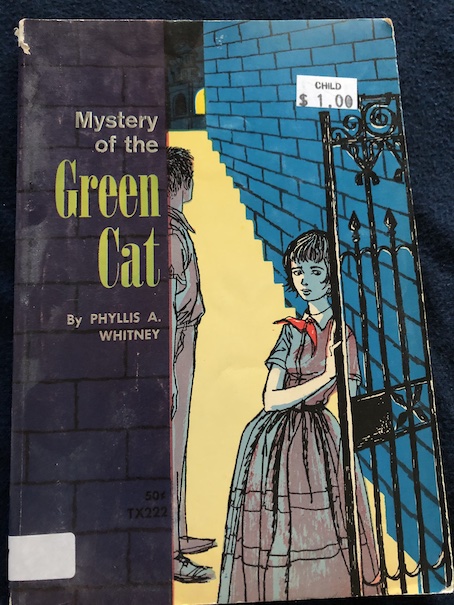
Mystery of the Green Cat

Mystery of the Green Cat by Phyllis Whitney, 1957.

Things just haven’t been the same for twins Andy and Adrian Dallas since their mother died two years ago. Now, their father has remarried to a woman he met through his work, and Adrian has been having an even harder time coping with it than Andy has. The twins have always been different from each other, not identical in appearance or personal interests, but now, Adrian is frequently angry and moody, and he’s getting on Andy’s nerves.

Their new stepmother, Emily, isn’t bad, and Andy can tell that she’s trying hard to be nice to them so that they’ll like her, but it does make the boys uneasy that their father seems to be having an easier time moving on from their mother’s death than they are. Also, Emily has two daughters, Jill and Carol, who have been living with their grandmother. Now that Emily has remarried, Jill and Carol are coming to live with her, her new husband, and the two boys in San Francisco. Emily has been saying that they’ll all be one big family now, but all of the children have misgivings about it. The twin boys have never lived with girls before, and they’re not looking forward to having a bunch of girly stuff around or Carol practicing her dancing in their new house. Meanwhile, the two girls aren’t sure that they’re really looking forward to suddenly having a couple of brothers. Carol is optimistic and thinks it might be fun, but Jill remembers that she hasn’t gotten along with the brothers of some of her friends. This new blended family is a major adjustment for everyone.

Adrian is so angry and upset about the coming of the girls that he refuses to go meet them at the airport with the rest of the family. Andy goes, although he is uneasy about meeting his new stepsisters, and Jill can tell that he’s not really happy to see them. Andy’s father explains Adrian’s absence by saying that he had a summer school art project to work on, although he does warn Jill that Adrian might need some time to get used to being around girls because he doesn’t make friends easily. Jill bluntly asks if that means that Adrian doesn’t want them around, and her stepfather says that it’s more that Adrian is still mourning his mother and having trouble adjusting to his new stepmother. But, he adds that he and his sons have really been lonely since his first wife’s death, and they’ve really needed someone like Emily in their lives, and he’s sure that Adrian will eventually realize that. He asks Jill, as the oldest girl, if she would try to make friends with Adrian. Jill’s not sure how she’s going to do that if Adrian doesn’t want to be friends with her. (This is a recurring theme in other mystery stories by Phyllis Whitney. The solution usually involves shared experiences binding people together, and this is partly the case in this book, too.)

The Dallas family house is situated on Russian Hill, and as they approach it, Jill’s mother points out another house higher on the hill, which she calls a “mystery house,” knowing that Jill loves mystery books. Her stepfather says that there are two women living there, Mrs. Wallenstein and Miss Furness. The two women are somewhat reclusive, and nobody really seems to know much about them. Andy says that Mrs. Wallenstein is a baroness, but his father says he thinks that’s just a rumor. The two elderly ladies also have a Japanese family working for them. The wife is their cook, and the husband is their gardener. Later, Jill spots someone spying on the Dallas house, peeking down from a wall surrounding their property, and Andy says that’s probably the daughter of the cook and gardener. Andy and Adrian have seen her around before, although they haven’t spoken to her much.

While they’re all sitting at the table, eating and talking, someone suddenly throws a rock through one of their windows. The rock came from the baroness’s house, so the father of the family says he’s going to call her and talk to her about it. However, when he calls, Miss Furness answers the phone, denies that anyone at her house would do such a thing, and hangs up. The boys tell Jill that this isn’t the first time someone has thrown rocks, but the last time, the rock just landed on the terrace and didn’t break anything. The boys haven’t wanted to tell the parents about the last time. Jill asks why not, and Andy refers to a “green cat” but doesn’t really explain what that means.

Later, the Japanese girl from the house next door stops by and introduces herself to Jill as Hana Tamura. (Hana’s English is imperfect, and this is one of those books where the author tries to write like the character is speaking to reflect the accent. Hana switches her ‘r’s and ‘l’s when she speaks in that stereotypical way Asians in old movies speak.) Hana admits to breaking the window and says that she did it by accident. She was just climbing the wall to see the new children who moved in next door when she kicked a stone loose from the wall that broke the window. She offers to pay for the damage. Jill’s mother says that won’t be necessary, but Hana insists that she accept some money. Jill’s mother invites her to stay and visit with Jill and Carol, but Hana says she can’t because Miss Furness doesn’t like her visiting with neighbors. Miss Furness doesn’t seem to like people much. Jill is disappointed because she could use a new friend in her new home, and Hana is interesting because she’s the first Japanese person Jill has ever met. (That’s interesting to me because Jill and Carol were originally from New York, and I would think that they’d see all sorts of people there.) Before Hana leaves, Jill asks her if she knows anything about a green cat. Hana refuses to answer, but Jill can tell that she’s a little disturbed at the mention of the cat. Jill’s mother is a little concerned that Hana isn’t being allowed to associate with neighborhood children and says that she’s going to try to talk to Miss Furness about it.

It turns out everyone has completely misunderstood the relationship between Miss Furness and Mrs. Wallenstein (“the baroness”). Rather than Miss Furness being the housekeeper for Mrs. Wallenstein, she’s actually Mrs. Wallenstein’s sister and the head of the household. When Jill spots Mrs. Wallenstein watching her with binoculars, Adrian says that she’s done that before and also finally confides that Mrs. Wallenstein was the one who threw a rock at him and Andy when they were on the terrace, not Hana. The “rock” Mrs. Wallenstein threw was actually just a little pebble, and Andy scooped it up, refusing to even show it to Adrian, although he doesn’t immediately explain why.

After a visit to the house next door to deliver a letter for Mrs. Wallenstein that was accidentally delivered to the Dallas house, Jill comes to realize that Miss Furness doesn’t treat her sister well, reading her mail and keeping people from her, and that Mrs. Wallenstein is in need of help. Andy finally explains to Jill that the rock Mrs. Wallenstein threw had a note tied to it, asking them to help her find her “little green cat.” He didn’t want to tell Adrian before because he didn’t think Adrian would take it seriously. The kids aren’t sure what the “little green cat” is, but both Jill and Andy want to help poor Mrs. Wallenstein.

Miss Furness doesn’t really mean to be mean to her sister, but she is extremely overprotective of her and keeps her isolated from other people because she has been suffering from ill health and memory problems. Mrs. Wallenstein went through hard times in her life after her husband died, and she was badly injured in an earthquake in Japan, which is why she’s now confined to a wheelchair. Sometimes, when Mrs. Wallenstein starts reminiscing about the past, she becomes confused about what’s past and what’s present, and it all begins blending into one. Her sister has been trying to shield her from past traumatic memories, but Mrs. Wallenstein has the feeling that there’s something important that she wants to remember, and she can’t quite figure out what it is. The key to unlocking Mrs. Wallenstein’s memory and learning the truth about the past lies in finding the little green cat.

The book is available to borrow and read for free online through Internet Archive.

Themes and My Reaction

Adjustment to changing family situations is a common theme in Phyllis Whitney’s young adult mystery stories, but this one is a little different from most. Most books by Phyllis Whitney are told only from the point of view of a girl, using third person limited. Even when boys play a major part in stories, the focus is usually on the girl. This book is told mostly from Jill’s perspective, but Andy is the one who begins the story, giving some insight into how he and his brother are feeling before the girls arrive. Although the boys and girls are separate when the book begins, their feelings toward each other are pretty similar. All of the children are trying to adjust to major changes in their lives and having misgivings about suddenly having new siblings of the opposite sex.

I think it’s also important to point out that, although the story focuses on a blended family, there is no divorce in the story. The two parents who are entering into a second marriage were widowed. This book was written in the 1950s, and in the first half of the 20th century, people didn’t talk about parents getting divorced as much. In children’s books of this time period, single parents and remarriages were usually the result of the death of a parent. It’s not that divorce was never mentioned; it’s just that it wasn’t nearly as prevalent in children’s literature, partly due to the social stigma against divorce at the time. I’ve sometimes thought that, in some ways, it was also probably easier for authors to explain the loss that accompanies a parent’s death, which would not have been the parent’s choice and was just a tragedy that couldn’t be helped, than the reasons why parents would willingly choose not to continue living with each other or why one parent would no longer live with the children. This is different from modern children’s books, where it’s usually more common to see divorced parents than dead ones. In fact, quite a lot of modern children’s books include divorced parents. Both death and divorce involve feelings of grief and loss, but if the loss is from a death that just couldn’t be helped, the author can avoid addressing the painful questions of “why” the separation happened. In real life, the reasons for a divorce can involve complex and sensitive issues that many adults would find difficult to discuss with children, including marital infidelity, emotional neglect, financial problems, addiction, and physical or psychological abuse. There’s never a happy reason for a divorce, so saying that the absent parents in the story died allows authors to skip over all of that. Death is sad, but it’s a little more self-explanatory. Andy and Adrian’s mother died from an unspecified long-term illness, and there’s no need for the characters to explain more than that. I could be wrong about some of my theories here, but that’s the impression that I sometimes get from older books. There is less social stigma surrounding divorce in modern times, and the prevalence of divorce in society has made it increasingly important to address children’s feelings about divorce in children’s literature, which is why there are now more books about it. That being said, the loss of a parent because of death is something that children still experience today, and the author of this story makes some important points about the feelings that someone can experience when they lose someone close to them.

As Jill gets to know Adrian, she comes to learn some of the reasons why he’s really unhappy. It’s partly because, when they moved to the new house after his dad remarried, he and Andy had to start sharing a room to make room for the two girls. Adrian and Andy have very different interests, and sharing the space has been particularly hard on Adrian. Adrian is a tidy person, and he’s very serious about art. He needs space to work on his artwork, and Andy is messy and likes to hoard pieces and parts for building things. Jill starts making friends with Adrian when she figures out how to make a better working space for him, but she upsets him again when she accidentally breaks the vase holding his brushes, which reveals the second reason why Adrian is unhappy. When the family moved to the new house, his father got rid of many of the things that used to belong to his first wife. Adrian has been blaming his stepmother for the loss of many of these sentimental reminders. Adrian doesn’t have many reminders of his mother left, and the vase was one of them, so now he blames Jill and her mother for the loss of that. As all the little reminders of his mother seem to be disappearing and Emily and her daughters are moving into the space, Adrian is afraid of losing all of the memories he has of his mother. It’s a situation that’s somewhat similar to Mrs. Wallenstein’s problem, using physical objects as a reminder of the past.

Mrs. Wallenstein has suffered sadness and trauma, which is part of the reason why her memory is so faulty. However she badly wants to remember some of the things she’s forgotten since her injury in the earthquake because they hold the key to the truth about her husband’s death. He died or disappeared under mysterious circumstances, and his business partner was murdered. Some people claimed that her husband might have actually killed his partner, but Mrs. Wallenstein doesn’t believe that. The clues to what really happened are tied up with the mysterious green cat.

However, part of the story also involves selfishness and self-centeredness. Mrs. Wallenstein’s husband’s business partner was a very selfish man, always needing to be the center of attention and taking credit for things that Mrs. Wallenstein’s husband did, and that’s tied in with the story of what happened to the two of them. In his own way, Adrian is selfish, too. It’s true that he’s still grieving for his mother, but the way he shows his grief is selfish, and Jill finally tells him so. Just because his stepmother isn’t his mother is no reason for him to be constantly cold and rude to her. Adrian is also rude and inconsiderate to other people, including Jill, their new friend Hana, and his own brother. Each of them is also dealing with something hard in their lives, but all Adrian cares about are his own feelings. While they all tiptoe around him, trying to make friends with him and be extra careful of his feelings because he’s “sensitive”, he says rude and condescending things to them or suddenly goes into a moody pout if he’s reminded of his mother’s death and/or his father’s remarriage. As Jill says, he’s sensitive, but only about himself; Adrian has no sensitivity for anyone else’s feelings. He’s even careless with Mrs. Wallenstein’s green cat after he learns that it has no monetary value, not considering what it means to her and her past. For someone who’s hyper-aware of belongings that have meaning for him, it’s an incredibly selfish thing to do. He not only doesn’t try to help the others solve the mystery of the cat, but when he finds out some information on his own, he deliberately doesn’t tell them until he can show off how clever he is while taunting the others about how they’re not as clever as they think they are. I honestly thought that he was going to be more help to the others in the story and reconcile his feelings through their shared adventure, but only Andy does that. Adrian resists right up until the very end, when Emily has a very honest talk with him about his feelings and hers.

I was a little annoyed at the way Hana’s speech was shown in the book because it always annoys me a little when authors try to show someone’s accent through spelling. It often seems to detract from what characters are actually saying, and the r/l swapping when Asians speak has a stereotypical feel to it. It’s not that Asians in real life never do the r/l swap, but it’s usually way overdone when it appears in books and movies, so it gets on my nerves. The real life r/l phenomenon is really based on the fact that Asian languages have a tendency to use the same symbol to represent r/l sounds, and the sound those symbols represent is about halfway between the two, depending on the language. In that case, it’s not really so much “swapping” the sounds as making one sound that is more in the middle than English speakers are used to hearing. The speaker may not actually be hearing the difference if they’re not accustomed to thinking of a difference between those two sounds, while listeners who are accustomed to listening for a difference in those sounds are confused about which of the two sounds they’re actually hearing when someone makes a sound that’s kind of in-between.

That being said, the perceptions of Asians, particularly Japanese people, in the book is favorable. This book was published about 12 years after WWII, so I thought it was nice that the characters were looking at the Japanese characters favorably. Jill is genuinely interested in being Hana’s friend, and Jill’s mother wants Jill to be friends with Hana. Later, Hana tells Jill and the boys a little about her own history, how her parents were married before WWII, but because her mother was unsure about coming to the United States, she ended up staying in Japan without her husband for a time. Hana was born shortly before the war started, and her father was unable to come to see her or bring his wife and child to the United States during the war. In fact, Hana and her mother were only reunited with her father a year before the story starts, so she was 13 years old the first time she met her father. Although the other children in the story have had their share of loss and family problems, Hana’s story about her own life helps to highlight that other people have their troubles, too.

The author, Phyllis A. Whitney, spent the first 15 years of her life in Asia because her father worked for an export business. She was actually born in Japan and also lived for a time in China and the Philippines. Because of all of the travel in her early life, Phyllis Whitney’s books often include travel to various countries around the world, people from different cultures, and children getting used to new homes or living among unfamiliar people, for various reasons.

There are some interesting tidbits of information about Asian cultures in the story, particularly about Japanese culture. I thought the part about how Japanese traditionally calculate age was interesting. There are also some interesting pieces of information about San Francisco and its landmarks. I’d heard of Telegraph Hill before, but I didn’t know the origin of the name until the book explained it.

I liked the book, both for the interesting tidbits of information and for the plot itself. This mystery is one of what I think of as the “mysterious circumstances” type of mystery. That’s a name I made up to describe mysteries where no crime (or at least no obvious crime) has been committed but yet there’s evidence of strange happenings and unknown events that must be figured out. I honestly wasn’t sure what direction this story was going to take when it started out, and I changed my mind several times along the way, but it has a very satisfying ending.

Nellie’s Promise

American Girls

Nellie’s Promise by Valerie Tripp, 2004.

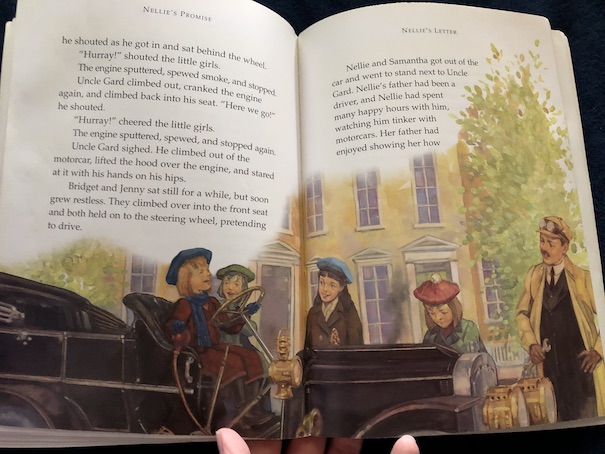
This book is a companion book to the Samantha, An American Girl series, focusing on Samantha’s best friend, Nellie. Personally, I don’t like the companion books to the main American Girls books as well as the original books, but this book does follow up on the events to the main series. At the end of Samantha’s series, Samantha’s aunt and uncle took in Nellie and her sisters, Bridget and Jenny, after their parents died. Nellie and her sisters were from a poor family and had to start working from a young age before their parents died. After their parents died, their disreputable uncle abandoned them, and they were sent to an orphanage before Samantha discovered where they were. Samantha’s aunt and uncle are wealthy, and the girls’ lives have improved considerably.

Nellie’s happiness is threatened by the sudden reappearance of her Uncle Mike. Uncle Mike sees Nellie walking down the street in her nice new clothes and wants to know what rich family the girls are living with. Nellie runs away from him, but he threatens to find out where she’s living and to take her and her sisters back, saying that it’s his right as her uncle. He says that he means to put the girls to work earning money for him. Nellie is afraid that he might be able to reclaim them from Uncle Gard and Aunt Cornelia because he is a blood relative.

At first, Nellie is afraid to tell anyone that she’s seen her uncle and that he threatened to take her and her sisters back. Before her parents died, her mother made her promise to look after her younger sisters, so Nellie makes up her mind that’s what she’s going to do.

Nellie worries about the future for her and her sisters. She feels like she doesn’t fit in with the wealthy girls at Samantha’s school, who have had very different lives from hers, and the lessons they learn are the type of lessons for fine young ladies who will marry rich men and spend most of their time raising families, overseeing a house with servants, and entertaining friends and their husbands’ business associates, not preparing for practical professions outside the home. Nellie thinks that it’s important that she have some kind of job skills because the future can be very uncertain, and she wants to know that she can provide for her sisters, no matter what happens.

Samantha senses that Nellie is unhappy, and she asks her if she likes living with Uncle Gard and Aunt Cornelia. Nellie tells her that she does, but she hesitates to explain what’s really worrying her. Instead, she lets Samantha think that she just wants to feel like she’s doing something useful for the family. Before her parents died, Nellie used to get sewing lessons at a settlement house (a place where immigrant families could go to learn English, new job skills, and other skills they would need in their new lives in the United States) run by Miss Brennan. Aunt Cornelia is involved with many good causes, and she wants to visit a settlement house and get an introduction to Miss Brennan. Because Nellie knows Miss Brennan, she can help arrange that. It’s in a rough part of town, but Nellie is more accustomed to navigating rough neighborhoods than Samantha or her aunt. It also occurs to Nellie that she could ask Miss Brennan what to do about Uncle Mike.

Miss Brennan is glad to see Nellie, and she lets her show Aunt Cornelia and Samantha around the settlement house. They have many different types of classes for children as well as adults. Nellie says that she likes the practical classes that she used to have there, and even the types of dances that they do seem more practical than the more purely artistic ones that they do at the school she now attends with Samantha. Aunt Cornelia is pleased with the classes that they offer for women, and because she is interested in women’s education, decides that she wants to help out at the settlement house. However, the visit to the settlement house leaves Samantha irritated for reasons that Nellie doesn’t fully understand.

As Nellie begins spending more time with Aunt Cornelia at the settlement house, Samantha begins spending more time with Bridget and Jenny, and Nellie becomes jealous of how Samantha seems more like their older sister than she is. However, the others still don’t know about Uncle Mike’s reappearance, and Nellie is still fearful of what he might do and what will happen to her and her sisters if Uncle Mike tries to take them away. She feels like her only option is to try to prepare herself for a better job than that of factory worker.

When Nellie finally gets the courage to tell Miss Brennan about her worries, Miss Brennan tells her that she needs to discuss the situation with Uncle Gard. Uncle Gard is a good man, but he’s also a lawyer, and he will know how to legally stop Uncle Mike from trying to take custody of the girls. However, Miss Brennan adds that, whatever else happens, Nellie will still need to make some decisions about her future and what she wants to do with her life and education. The more Nellie thinks about it, the more certain she is about what she wants to do. She wants to become a teacher, like Miss Brennan.

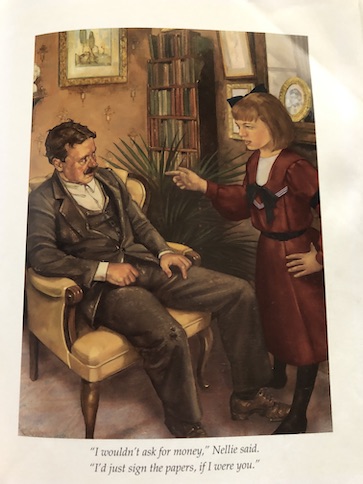
Nellie provokes more drama by applying to the boarding school in Boston where Miss Brennan said that she trained to be a teacher without talking to Aunt Cornelia, Uncle Gard, or Samantha about her decision or about her uncle. However, when the truth comes out about Uncle Mike, everyone understands that she was trying to hide and protect her sisters from him. It turns out that Uncle Gard has actually been looking for Uncle Mike because he already has the documents that he needs to legally adopt Nellie, Bridget, and Jenny, and he just needs Uncle Mike to legally release them into his custody. At first, Uncle Mike tries to extort money from Uncle Gard for the girls, but Nellie gets up the courage to tell him off, promising that if he doesn’t sign the papers and leave, she’ll tell everyone about how he stole all of their money and abandoned them to freeze the last time they were in his custody. The book ends happily, with Aunt Cornelia and Uncle Gard adopting the girls and understanding Nellie’s ambition to be a teacher. They enroll Nellie in a school in New York that teaches the skills she really wants so that she can continue living with them and not go to Boston. It also turns out that Samantha was mostly uncomfortable at the settlement house because she felt so sorry for the young children there and that spending time taking care of Bridget and Jenny was part of her way of trying to help Nellie by leaving her more free to do some of the things that she felt like she had to do. With everything out in the open, Nellie and her sisters are able to more fully become part of the family.

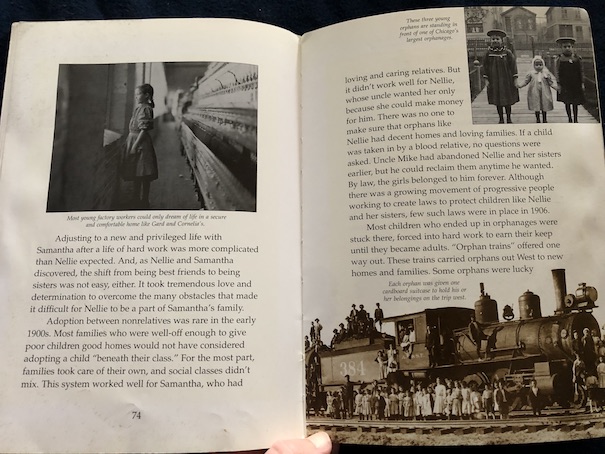
In the back of the book, there is a section with historical information about orphans and adoption in the early 1900s. There were not many laws and regulations governing care of orphans. Usually, orphans would be taken in by relatives, like Samantha was when her parents died. If a child didn’t have any relatives who were willing and able to take them, the child might be sent to an orphanage and possibly sent west on an orphan train as Nellie almost was at the end of the Samantha series. Families didn’t usually adopt children from different levels of society.

Settlement houses were important resources for poor immigrant families, and the education they received allowed immigrants to enter higher professions than servant or factory worker, which had been the primary source of income for many of them. It was common for settlement houses to help train young women to become teachers. There are still similar institutions and organizations in operation in 21st century America.

The book is available to borrow for free online through Internet Archive.

My Reaction and Further Historical Information

Part of the reason why I don’t like the companion books as much as the original American Girls series is that they tend to get more dramatic than the original books, and sometimes, I feel like the attitudes of the characters are less realistic for their time periods than they were in the original books. I think what made the original books more realistic was the restraint of the stories – they had their share of excitement and sometimes drama, but they never went overboard. The return of Nellie’s disreputable uncle struck me as both unlikely and unnecessary to Nellie’s and Samantha’s larger stories.

The historical details in this book are good. What they say about orphans of the time is basically true, although they note in the historical information section in the back of the book that Nellie’s experience of being adopted by a wealthier family was not typical of the time, and I think that’s part of what bothers me. Adoptions in general during the early 1900s were less formal than they are in modern times, and the idea of Uncle Gard hiring a private detective to find Uncle Mike and get him to sign legal documents doesn’t seem entirely realistic. I think it would have been more realistic to me the way that the last Samantha book ended, with Uncle Mike leaving and the assumption that none of the characters would see him again.

The reason why Nellie and her sisters were sent to the orphanage and why the orphanage was considering sending Nellie west on the orphan train was that no one expected that Uncle Mike would ever want to see the girls again. He’d already taken everything he could from them and left with them with no concern for what would happen to them. In the time that has passed since then, I would have expected that Uncle Mike would already have gotten into trouble that would keep him busy and out of their lives, maybe ended up in prison for being drunk and disorderly or hopping from job to job or begging for money as their little money ran out. Even if Uncle Mike had some thought of finding the girls, I don’t think it’s likely that he would have succeeded or even gotten close on his own because he is not that bright and he is not the kind of person who makes friends in places where he’s been before. I doubt that his former neighbor who took his nieces to the orphanage would have told him much if he had shown up again, looking for them. She knew that he was a drunk who abandoned the girls, and she made it clear that she didn’t like him. The people at the orphanage would have probably sent him away with no information because they would probably view the situation as closed since the girls are already placed out and Mike may not even have any proof of his identity and relationship to the girls. There is no such thing as a driver’s license during this period and many people did not even have birth certificates, so it’s possible that the people at the orphanage could simply choose to disbelieve this disreputable character and send him away. When I was watching a documentary about the orphan trains, former orphan train riders said that the orphanages that sent them west deliberately took notes from them that had their living parents’ addresses and otherwise cut off contact with living parents because they wanted the children to sever their ties to their difficult pasts and devote their attention to their new families, not maintain contact with the parents who were unable to care for them financially, so I wouldn’t expect that anyone at the orphanage in these books would go out of their way to reunite the orphaned girls with a rather shady uncle when they knew that the girls were already placed with a wealthy family and no longer their responsibility. Without help, which would be unlikely to be forthcoming, it doesn’t seem likely that Uncle Mike would be able to stumble on the girls by accident. As mentioned in Changes for Samantha, New York is a big city, people can be difficult to find if you don’t have a hint of where to look, and the wealthier part of the city where Nellie and her sisters live now is not a part of town where a guy like Uncle Mike would be likely to hang out. They could all easily live in New York City for years without meeting each other.

I feel like the situations in the story were a little contrived. By now, I would have thought that Nellie would know that Uncle Gard is a lawyer and would be the best person to ask about the laws. I don’t recall the earlier books saying what Uncle Gard did for a living, but Nellie lives with him now, and I would think that someone would have mentioned Uncle Gard’s profession by now. In the book, it oddly seems like as much of a surprise to Nellie as it is to the readers. I could believe that Nellie would go to the settlement house and do volunteer work there with Aunt Cornelia because it was already established in the previous books that Aunt Cornelia supports good causes, and although women of her level of society didn’t usually work for living, supporting good causes and charitable works would have been acceptable. Nellie’s level of knowledge seems a little odd, considering that she needed extra tutoring in basic subjects, like reading, in Samantha Learns a Lesson. In that book, Nellie never mentioned settlement house lessons, which she would have done if it hadn’t been a sudden decision to insert that this in book. Here, Nellie talks about classes that she had at the settlement house, where I would have expected to have more lessons to improve her reading, and it seems like she learned more there than she seemed to know before, even knowing a few words of foreign languages. In Samantha Learns a Lesson, one of Nellie’s skills was her ability to do math quickly handle money because she used to do the shopping for her mother, and in this book, she mentions that she helped to teach immigrants about American money, which she never mentioned before. These things are necessarily contradictory, but it all just seems a little off because they don’t quite fit into Nellie’s established character and history, and it implies that Nellie has had more education and training than she seemed to have before. It’s not necessarily impossible for a girl of Nellie’s time to know some of these things, but it’s the departure from what was already established about Nellie and her situation in life than kind of grates on me.

I think it could be reasonable for Nellie to develop the ambition to be a teacher. Even Samantha has previously some interest in that direction, having helped to tutor Nellie before. Not all women of this time went on to higher education, but those who did might attend a normal school, which is basically a college that focuses on training teachers. By contrast, the daughters of wealthy, high society families would be more likely attend a finishing school that emphasized social skills and entertaining more than academics. Both Samantha and Nellie are about twelve years old during this story and would be a little young for either of these options, but Samantha’s school seems to be more inclined toward preparing the girls for a finishing school. Given Aunt Cornelia’s interest in education and social causes and Uncle Gard’s support of it, I would expect that Samantha would be more likely to attend a women’s liberal arts college when she gets older, preparing her to marry a well-educated and culturally aware man as well as a wealthy one and probably engage in some form of social work and/or the arts in her spare time, but that’s just a guess. (I discussed some of this already in my review of Happy Birthday, Samantha. See also the book Daddy-Long-Legs for a description of what that might have been like for a girl of Samantha’s and Nellie’s time. The book was written a little later in than the time period of this book, but it’s set at about the right time for Samantha and Nellie to be old enough for college and includes characters of approximately their social backgrounds.) This book doesn’t really go into the subject, but if that’s the case, Samantha’s future might not be as different from Nellie’s as it first seems, and there might be a kind of middle path that both of them could choose. The Finch College in Manhattan, which was a fairly new preparatory school in Samantha’s and Nellie’s time, seems like it would have been a good option for both Samantha and Nellie, catering to upper-class girls while focusing on a more practical liberal arts education than the less academic finishing schools. Its founder, Jessica Finch, was a women’s rights activist and may have moved in similar circles to Aunt Cornelia. Her attempts to balance theoretical and practical knowledge sound like they would have appealed to the characters in the story. I’m not an expert on the Finch College, only having heard a little about it, but I think a school like that would present an intriguing possibility for the girls’ futures.

The Headless Cupid

HeadlessCupidThe Headless Cupid by Zilpha Keatley Snyder, 1971.

This is the first book in the Stanley Family Mysteries series.  Some people might be put off by the occult themes in this book, but this is a mystery story, and all is not what it seems.  Read to the end or skip to the spoilers section to find out.

Eleven-year-old David Stanley has had to help take care of his younger siblings since his mother’s death.  In some ways, he feels like his mother knew that she was dying before anyone else did, preparing David to help his father by taking care of his younger sister Janie and the young twins, Esther and Blair.  David thinks that his mother might have been psychic because she tended to believe in some odd things and often knew things before other people did.

Now David’s father, a college professor, has remarried, to a divorced woman with a daughter of her own, Amanda, who is twelve years old.  David likes his new stepmother, Molly, who is an artist, and he appreciates having someone else to help take care of the other kids.  Amanda is a different story.  She was an only child before her mother’s remarriage, and she’s not happy to suddenly have step-siblings, some of whom are rather young.  Amanda has been unhappy in general since her parents’ divorce, and she wishes that she could go to live with her father full time. Her father says that he can’t take care of her because he has to work so much, but he spoils her whenever they spend time together.  David has doubts about the things Amanda says about her father, but he and the others try to make her welcome in their new home.

HeadlessCupidNewsWith their family suddenly much larger, David’s father bought a new house for them to live in.  Actually, it’s a very old house just outside of a small town.  People call it the Westerly house after the former owners.  Not long after the family moves in, they find out that people used to say that the Westerly house was haunted.  Mr. and Mrs. Westerly used to travel around the world with their two daughters because Mr. Westerly worked for the government, but after they settled down to a quieter life in this small town in the late 1800s, strange things started happening in their house.  Rocks would fly around the house, seemingly thrown by invisible hands, and someone (or something) cut the head off the carved cupid on the fancy staircase banister.  The head was never found.  These incidents were reported in the local paper, and people believed that the Westerly family was haunted by a poltergeist.  These hauntings seemed to center around the two Westerly girls, particularly the older one, Harriette, which made some people think that the girls were faking the poltergeist.  However, they were never able to catch either of the girls doing anything.  The strange activities finally ended when the girls were sent away to boarding school, but now that the Stanleys have moved into the house, strange things are starting to happen again.
HeadlessCupidAmandaAmanda is fascinated by stories of the poltergeist.  A friend of hers where she used to live (one her mother didn’t approve of) was teaching her about the occult and how to do magic spells.  When David tells Amanda that he thought that his mother was psychic, Amanda is surprised, and she offers to teach David and the other kids about magic over the summer.  David eagerly accepts the offer because he finds the subject fascinating and because it’s the only thing that Amanda really seems interested in.  The other kids are also fascinated at the idea, even the littlest ones, which takes Amanda by surprise.  She had expected them to be scared.
Still, Amanda begins leading the kids through a series of rituals that will supposedly initiate them into the occult world, all of which have to be done in secrecy, without the parents’ knowledge.  They have to do some bizarre things like spend an entire day not talking (they have to take turns so the adults won’t notice, and it’s harder for some kids than others), spend a day where they can’t touch anything metal (mealtimes are awkward), offer “sacrifices” to the spirits (basically giving Amanda things she likes), and find animals to be their “familiars.”  As some of these rituals and the kids’ strange, secretive behavior cause problems, particularly for David’s stepmother, David begins to suspect that Amanda’s “rituals” have an ulterior motive that has nothing to do with magic at all.  Then, the poltergeist activity begins.

HeadlessCupidKidsJust as with the Westerly family years ago, rocks are thrown around the house or found just laying around.  Things are broken in the middle of the night.  Have Amanda’s rituals somehow awoken the poltergeist once more?  David has his doubts, suspecting that it’s part of Amanda’s playacting, but she is accounted for when some of these strange things happen.  The younger kids are still more fascinated than frightened by these strange happenings, but their stepmother finds them particularly unnerving.

Then, just when David thinks that he understands the situation and Amanda seems to be calming down her occult talk and behaving more normally, something happens which is really inexplicable: the missing head of the cupid suddenly reappears.

This is a Newbery Honor Book.  It is available to borrow and read for free online through Internet Archive.

My Reaction, Themes, and Spoilers

The reason why I want to explain some of this is because I think this book has received some unfair criticism because of the “occult” themes in the book, and I want to clarify the situation for the benefit of parents and teachers who have not yet read the book and may be concerned.  I’m putting “occult” in quotes because, as I said before, that’s not really what’s going on.  The book is a mystery story, and the “supernatural” stuff is largely window dressing for the real themes of the story, which have to do with unresolved feelings and revenge.  The story even contains a kind of warning about getting involved with the occult, which is another reason why I think the criticism of this book is unfair.

That Amanda is faking at least part of the haunting is pretty obvious even early on, so I don’t think it’s much of a spoiler to say that.  Amanda is an unhappy girl whose life abruptly changed with her mother’s remarriage, and her occult talk and fake witchcraft are part of her way of dealing with her feelings.  She admits to David at the end of the story that she was purposely trying to frighten her mother, trying to “get even” with her for turning her life upside down, first by divorcing her father and then by getting married again, forcing Amanda to move to a strange town where she has no friends and live with a bunch of kids she hardly knows.  Getting to know her new siblings better and sharing adventures with them helps, but it takes the frightening moment when the cupid’s head suddenly reappears to get Amanda to admit that real occult stuff scares her, too, and to confess the truth of what she did and her real feelings to her mother.

HeadlessCupidDavidAmandaThere are some elements of the happenings, particularly the reappearance of the cupid’s head, that are never fully explained, although David ends up knowing more than Amanda by the end.  Some aspects of the situation are hinted at.  There may be a real supernatural event at the end of the story.  Blair appears to have inherited psychic abilities from his mother, and there is a distinct possibility that the Westerly sisters who once lived in the house were just as unhappy with their parents for the changes in their lives as Amanda was with her mother.  Although the “poltergeist” as it first appears doesn’t exist, it may be that the “poltergeist” of the past remembers what it was like to be young and unhappy and that she wanted to make amends for past wrongs and to help another troubled young girl to make peace with her life and family.  But, if you don’t like that explanation, there is a more conventional, non-supernatural explanation that David considers, which equally possible.  Personally, I think it’s a combination of the two, but it’s not completely clear.  I think the author left it open-ended like that to make readers wonder and to preserve the air of mystery after the other mysteries have been cleared up.

As a kid, I enjoyed the creepy aspects of the story and the sense of wonder the kids experience as they go through their “rituals,” trying to bring some magic to their regular lives, wondering if things like ghosts and magic can really exist.  Now, I more appreciate how Amanda researched tricks used by fake psychics and mediums and used them creatively to her advantage.  When I was a kid, I liked magic tricks, and psychics and mediums make use of those types of stage illusions and psychological tricks in their acts.  I still have some books on the subject myself.  I also like the way David sensed the truth behind Amanda and the strange happenings even though he didn’t really understand how or why it was done at first.  David has some genuine curiosity about magic, but even after he realized that Amanda was faking things and was disappointed by it, he didn’t immediately tell the others.  He could have unmasked her as a fraud, but he knew that would only earn her resentment.  He wanted to understand her motives and help her feel better, giving her the chance to make peace with her mother herself and become part of their family.

This book has been frequently challenged because of the children’s inquiries into the occult, but I would like to point out that their “occult” experiments were all fake, pretty obviously so, and it is acknowledged that Amanda’s interest in the occult was fueled by her emotional distress (part of her urge to “get even” with her mother by causing problems).  By the end of the story, Amanda and her mother have an honest talk with each other about everything.  Amanda admitts her true feelings and makes peace with her mother, and she also says that her mother explained some things that Amanda didn’t know before.  The book doesn’t say exactly what Amanda’s mother told her, but from the context, it’s probably something about the circumstances behind her parents’ divorce, something that they might not have wanted to explain to her earlier.  I have a theory about it, although there’s nothing explicit that I could point to to prove it.  I suspect that Amanda’s father had an affair and that the affair is continuing, which I think is the real reason why he doesn’t want Amanda to live with him full time.  If Amanda were to live at his house, she would be sure to find out the truth.  Maybe his girlfriend is even the housekeeper Amanda referred to, the one who doesn’t help take care of children because she’s “not that kind of housekeeper.”  That possibility didn’t occur to me when I was a kid, but it seems kind of odd for a single man, living without children or other people in his house or other household staff to manage and who spends a large amount of time working away from home, to even have a housekeeper instead of simply hiring a maid or cleaning service to come in from time to time.  Households with fewer people require less maintenance.  There is less laundry to do, and single people who work tend to eat out or order in pretty often or make very simple meals, so I doubt he even needs much help with cooking.  But, that’s just my theory.  No one ever says why Amanda’s parents divorced in the story.  The reasons are less important to the story than Amanda’s feelings concerning the divorce.  Some of Amanda’s earlier resentment toward her mother was fueled by things that her father told her, making it seem like her mother was the one who caused the divorce.  After talking with her mother, Amanda seems to realize that some of the nasty things that her father said about her mother may not have been true and that her resentment toward her mother for causing the divorce was needless.  Much of the story involves unresolved feelings and the need to communicate them honestly.

The difference between reality and perceptions is also important to the story.  Although Amanda at first tries to convince the other kids that she is an expert on all things magic, David soon realizes that she’s not: she acts like ordinary, easily-identifiable wild flowers are rare herbs, she can’t control her “familiar” because she has no idea how to handle animals, and when things happen that Amanda can’t explain, she’s the first to be terrified.  In the end, Amanda gives up on the idea of the occult completely, realizing that the things she did were wrong and that she had gotten involved in something that she really didn’t want to be involved in.  Many kids wonder about the supernatural when they’re young, and I don’t think it’s bad to point out to them that they if they experiment with such things, they may be getting involved in something they could regret and that they should consider their motives for wanting to do so.  Playacting when you know it’s pretend is one thing, but not knowing if the scary stuff is real is another.

For further discussion of the dynamics of the blended family in this story, I recommend the SSR Podcast about this book.  The podcast also points out that there is an incident in this story which might be racially problematic.

Anti-Plagiarism Check

I’ve been thinking about how my reviews could be used for plagiarism ever since I caught a couple of those essay-writing companies trying to follow my blog.  It’s difficult for me to review certain books without giving spoilers, but I’d like to point out that none of my reviews explain everything there is to know about the stories.  That would be completely impossible without reprinting the entire text of the book, which plagiarists are too lazy to read anyway.  There are certain plot points which only a person who has actually read the book would understand and be able to explain.  Teachers who suspect that a student has plagiarized a book review or only pretended to read the book should ask them to verbally explain the points that I have not covered in my review, giving them no chance to try to look up the answers elsewhere or try to find them by quickly skimming the book.  I’m not going to print suggestions for questions to ask here because I don’t want to give the plagiarists a hint, and I doubt that teachers who have read the book recently themselves would really need a hint, but any teacher who contacts me via their official school e-mail address can discuss it with me.  I know these stories well because I’ve loved them for years, and I’ve started a file with suggested plot points to discuss.  I will not send this information to anyone who does not contact me from an official school e-mail address.  Keep in mind that I can easily look up the name of the person who contacts me to determine whether I’ve been contacted by a teacher or a student.

It’s one thing for a student to want to discuss the book with someone to clarify confusing plot points, but it’s another to ask someone to do their homework for them.  I know the difference, and I know homework when I see it.  Let me explain something.  All WordPress blogs have built-in analytics, and I’ve been studying SEO, so I pay attention to who has been visiting my site and how they get there.  I know whether you came here by using a search engine or whether you were referred by another site, and I can also see search terms that you used.  I added this note to this review specifically because I noticed that someone has been trying to Google what are plainly homework questions, and I just got a site referral from an online plagiarism checker.  Yeah, I see what you did there.  This is the Information Age, and when you go looking for information, sometimes, there’s someone else looking back at you, even if you can’t see them.  Not everyone with a blog pays that kind of attention to their traffic, but some of us do, and while some may not say anything about it, some of us are also a little more vocal.  I saw what you did, and I didn’t like it.  I don’t know you, but I know you’re a fool, and your teacher has just discovered it, too.  Now, we’re all aware.  It’s your own fault, and it’s too late to whine about it now.  I do sometimes help people who ask for it.  You should have asked for help when you needed it instead of cheating and stealing my words.  Maybe next time you’ll ask for what you need instead of just taking what you want.

Fudge-A-Mania

FudgeAManiaFudge-A-Mania by Judy Blume, 1990.

Peter is horrified when he finds out that his family is going to spend their vacation in the same place as bossy know-it-all Sheila Tubman and her family.  Even worse, the two families are going to be staying to be staying right next to each other.  Really right next to each other.  They’re staying in the same house, which has been split into two halves.  As far as Peter is concerned, the only thing that might save his summer is that his friend Jimmy will be coming up to stay with them part of the time.

The arrangement turns out to be a little better than Peter thought it would be at first.  Sheila finds a way to make some extra money by baby-sitting Peter’s five-year-old brother Fudge.  Fudge says at first that he wants to marry Sheila, although it turns out to be mostly because he’s afraid of monsters in his room at night, and he thinks that if he gets married and shares a room with Sheila, it will keep the monsters away.  Then, he decides that marriage may be unnecessary when he makes friends with a little girl named Mitzi, who is staying with her grandparents nearby.  Mitzi’s grandmother makes a special monster spray for her to keep monsters away, so Fudge decides that he might not have to marry Sheila after all.

Peter is happy when he discovers that Mitzi’s grandfather is Big Apfel, his baseball hero, and that he holds baseball games that are open to the public, so he and Jimmy can also play with him.  He also gets a crush on Isobel (“Izzy”), a girl who works at the local library, although Isobel is a few years older than he is.  The baseball game goes well enough, but the crush, not so much.

Then, comes the most shocking news of the summer: Peter’s grandmother and Sheila’s grandfather decide to get married!  If that happens, Peter and Sheila realize that they’ll be related by marriage!

Big Apfel and his granddaughter Mitzi are fictional characters, but the book that Mitzi claims is about her, Tell Me a Mitzi, is a real book.

This book is part of the Fudge Series.  It is available to borrow and read for free online through Internet Archive.

Secret of the Tiger’s Eye

tigerseyeSecret of the Tiger’s Eye by Phyllis A. Whitney, 1961.

Benita Dustin’s father is a writer, just like she hopes to be one day. When her father announces that they will live for a year in South Africa with his Aunt Persis so that he can do research, it sounds like a grand adventure. The trouble is that her father’s editor has given permission for her son, Joel, to accompany them because she thinks the experience would be good for him, too. Benita’s little brother, Lanny, gets along well with Joel, but Benita and Joel fight and tease each other almost constantly. Benita gets annoyed with Joel’s obsession with facts and information, and Joel thinks that Benita’s stories and flights of fancy are silly.

Aunt Persis’s house is wonderful with a beautiful tower room where Benita is allowed to stay. There is even a fantastic story about the ghost of a tiger that Aunt Persis’s husband shot years ago in India haunting the grounds of the house and the little cave in the garden. Although Joel scoffs at the idea of a tiger ghost, Benita is captivated by the story, especially when strange things begin to happen around the house. Benita learns about the tragic death of Aunt Persis’s adopted son, Malcolm, and the strange theft of the emerald diadem that Aunt Persis received from the rajah that her husband saved from the tiger years ago. However, she will need Joel’s help to make sense of the situation, a difficult prospect at the best of times but almost impossible to ask for after Joel plays a cruel joke on Benita and tries to get Lanny to help gang up on her.  Then, Benita’s father tells her something that changes everything, and all the time, someone with sinister intentions is watching and waiting . . .

The book is available to borrow and read for free online through Internet Archive.

My Reaction

Besides the mystery, there is also a subplot about the nature of hate and prejudice. In South Africa, at the time the story was written, apartheid was still in force. Benita makes friends with a girl of mixed race called Charis, and they talk about racial issues in South Africa and the U.S. during the 1960s. Although Benita wouldn’t think of being prejudiced against anyone on the basis of race, she finds it harder to understand people with different personalities, like Joel.  Although the story focuses on Benita and the lessons she learns, I personally found Joel and his mistakes harder to accept.  Both Joel and Benita need to learn to be more understanding of each other, but in a way, I think Joel is worse because of his deliberately cruel pranks and because he already knows a couple of things that Benita doesn’t which should have influenced his behavior. Joel is deliberately trying to pick fights, and the book never really explains what he expected to accomplish by that.  Everyone needs a motivation, and Joel never really explains his, so he comes off seeming like he’s just there to be a mean character for no real reason.

I also wish that the parents in the story had more frank and straight-forward discussions with the kids.  As a professional writer and a professional editor, they should have been able to settle the kids’ arguments about imagination vs. facts or at least put the situation into perspective by explaining what they do in their jobs.  After all, Benita’s father is going to South Africa specifically to do research.  In other words, even fiction writers need to have a nonfiction background and real facts to use as a basis for their fictional stories.  Realistic backgrounds give stories the grounding they need in order to feel real to readers.  (Although that does depend somewhat on the type of story.  Fantasy stories don’t need to be based on real life, although they do have to have a consistent logic within the story so readers feel like they can understand the world in which the stories take place and the rules by which the magic in the story works.  If the story is meant to be surreal, the internal logic can be more loose.)  Editors, like Joel’s mother, fact check stories as well as ensuring that they are compelling for readers, helping to make decisions about where fictional stories need to be factually correct and where the author can depart from the facts for the sake of the story.  I think that Benita and Joel really should have had a better grasp of their parents’ professions and the balance between fact and imagination in fiction.  Of course, if they did, there would be less conflict in the story.

Fortunately, Benita and Joel work out their differences while confronting the mysterious situation and become friends when they learn to allow each other to be themselves and to appreciate each other’s good points.

Valentine Blues

valentinebluesValentine Blues by Jeanne Betancourt, 1990.

This book is part of the Aviva Granger Stories series.  (It’s the only one I have in the series right now.)

In the last book, Aviva’s best friend, Josh, came to live with her, her mother, and her step-father.  Josh was living in an orphanage before that, and since he and Aviva were close, her mother and stepfather thought that it would be natural to invite him to be part of the family.  At the time, Aviva thought that it was a good idea, but being friends with someone doesn’t mean that it will be easy living with them, and Aviva’s family life is already complicated!

Aviva’s parents are divorced, and both her mother and father are already in new relationships.  Her mother has remarried, and Aviva not only has a stepfather but a half-sister (college age) and half-brother (baby) living in the same house.  Aviva’s father has a girlfriend, Miriam, and Aviva doesn’t get along well with her.  Miriam would like it if she and Aviva’s father had a child of their own.

When Josh comes to live with Aviva’s mother and her family, Aviva realizes that sharing a family and house with him makes things even more complicated.  He takes too long in the bathroom and makes her late to school.  He’s one more person for her mother to pay attention to, so Aviva gets less attention.  Even her dog seems to like Josh better now!

Then, shortly after Valentine’s Day, Aviva overhears Josh and his friend Ronnie Cioffi talking about girls and giving them ratings based on their looks.  Out of 10 points, Cioffi rates Aviva as a 2, and Josh agrees.  Josh has a crush on Louise, a girl they know from school, and she has a much better figure.

It isn’t that Aviva is in love with Josh, who she sees more as a friend/brother, but it hurts that he seems to be taking her place in the family and doesn’t even really appreciate her, joining in with his friend in making fun of her body.  With her time divided between two households, two parents who hardly seem to have time for her these days, and Josh moving in and taking over, Aviva worries that maybe she doesn’t really belong anywhere or to anybody.

It takes a night when Aviva sleeps out in the barn without telling anyone where she is to make the people closest to her realize how much she needs them.  A sleepover at Louise’s house (where the girls candidly discuss their own ratings for the boys they know) and Aviva’s anonymous question in sex ed class also help to put the rating system into perspective for all the kids.

The book has some Christian themes because the children go to a Catholic school, although this book mostly focuses on family life and girls’ and boys’ perceptions of each other.  The kids are eighth graders, and there is also some talk about sex ed.