Knots on a Counting Rope

Knots on a Counting Rope by Bill Martin, Jr. and John Archambault, 1966, 1987.

The reason for the two copyright dates is that this book originally had somewhat different text and different illustrations.  I don’t have a copy of the original version, so I’m not sure how it compares to the 1987 version.

The story is told in the form of dialog between a young Navajo boy and his grandfather.  The story doesn’t explicitly say that they are Navajo, but they refer to hogans, which are a traditional type of Navajo house.  There are no words in the story other than what the characters say to each other, not even to indicate who is speaking, but you can tell who is speaking based on what they say.
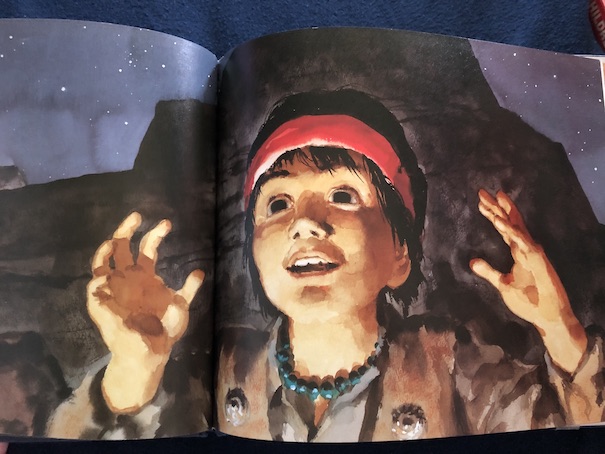
The boy asks his grandfather to tell him the story of when he was born. The grandfather says that he already knows the story, but the boy persuades him to tell the story again.

The grandfather tells him that, on the night he was born, there was a storm, and it sounded like the wind was crying the word “boy.”  The boy’s mother knew that she was going to give birth to a son.  The grandfather quickly brought the boy’s grandmother to be there for the birth, and when the boy gave his first cry, the storm suddenly stopped.

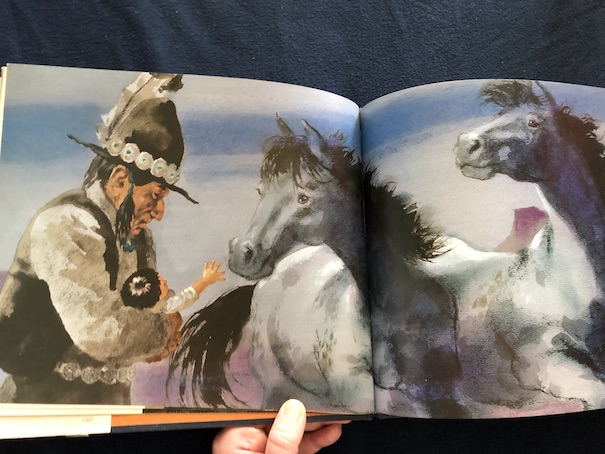
When the boy was born, he was very frail, and everyone was afraid that he would die.  Then, when morning came, the grandfather carried him outside, and although he did not open his eyes to the morning sun, he lived his arms up to two horses that had galloped by and stopped to look at him.  The grandfather took it as a sign that the boy was a brother to the horses and would live because he had the horses’ strength.  The boy did become stronger and was given the name of Boy-Strength-of-Blue-Horses.
However, the boy was born blind. It is a hardship that he will always have to deal with.  Even though the word “blue” in his name, the boy says that he doesn’t really know what “blue” is or what it’s like because he’s never seen it.  The grandfather describes it as being like morning because the sky in the morning is blue, and the boy says that he understands what mornings are like because they feel and sound different from night to him.

The boy has a horse of his own, and the two of them have a special bond.  The two of them perform well at races, and the horse acts as the boy’s eyes when he’s riding.  His grandfather says that it’s like the two of them are one.

As the grandfather tells the boy stories about himself, he ties knots on the counting rope.  He says that when the rope is full of knots, the boy will have heard the stories enough that he will be able to tell them himself.  The grandfather says that he will not always be there to tell the stories, and the boy is frightened, wondering what he will do without his grandfather. The grandfather says that he will be all right because his love will be with him.

The book is partly about the relationship between the boy and his grandfather and the grandfather preparing his grandson for the day when he will be gone, making sure that he knows the family stories about himself and the knowledge that he will need for the future. It’s also about the boy’s own struggles in life, which the grandfather refers to as the “dark mountains” that he must cross. Because of the boy’s blindness, he lives in a world of darkness, and there are things that are challenging to him that would be less challenging to a person with normal vision. Yet, the boy has innate skills which allow him to do things that some people with normal vision can’t do. Not everyone has the affinity for horses that the boy has. He shares a special bond with horses, and when he rides, he and his horse are a team. Because he has skills and a strong spirit, the grandfather knows that his grandson will be all right in his future, in spite of the challenges of his blindness.

The book was featured on Reading Rainbow, and it is currently available online through Internet Archive.

The Blind Men and the Elephant

BlindMenElephant

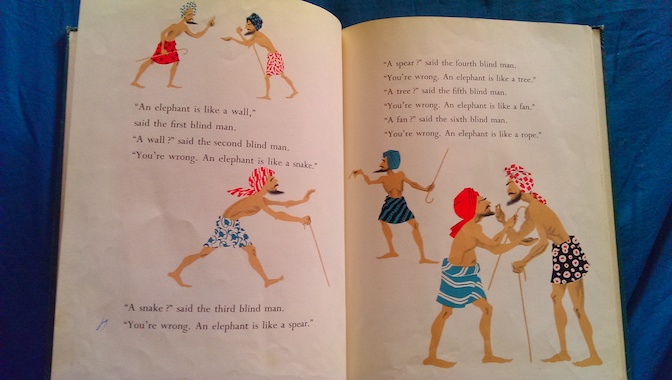
The Blind Men and the Elephant retold by Lillian Quigley, 1959.

This story is based on an old folktale from India.

Six blind men, who all live together, realize that although they have heard a lot of people talk about elephants, none of them has ever seen one and that they don’t really know what elephants are like.  They have heard that the Rajah, whose palace they live near, has many elephants, so they decide to go to the palace to learn more about them.

BlindMenElephantCourtyard

When they reach the palace, where a friend of theirs works, there is an elephant in the courtyard, so the blind men start feeling it with their hands.  Because the elephant is large, each of the men ends up feeling a different part of the elephant and coming to different conclusions about what the elephant is like.

BlindMenElephantImpressions

As they stop to take a rest, they begin arguing about their conclusions because their experiences of the elephant were very different from each other’s.  When the Rajah hears them arguing, he explains to them that the problem is that each of them is only talking about one part of a very large animal and that if they really want to know what elephants are like, they must consider all the pieces together.  Recognizing the wisdom of what the Rajah says, the men sit down and discuss what they’ve learned more calmly.

BlindMenElephantArgument

The book doesn’t explain the background of the story, but the folktale is famous and is often used to describe situations where people each understand only part of a larger truth or where people stubbornly argue about very complicated issues from very limited viewpoints without considering all sides.

BlindMenElephantEnd

Mystery at Camp Triumph

camptriumphMystery at Camp Triumph by Mary Blount Christian, 1986.

A year ago, sixteen-year-old Angie was blinded in a car accident.  It was shocking and devastating for her, especially since she was planning to become an artist.  She loved painting, and she feels like all of her dreams have died since she became blind.  Many of her friends no longer speak to her (partly because she has become angry and bitter and they don’t know how to cope with it), and she refuses to return to her old school, partly because of her fears of not being able to cope and largely because she doesn’t want to be the subject of ridicule or pity because of her new disability.  Her mother has been tutoring her at home, and her parents argue frequently about what’s best for her.

On the advice of a psychologist who has been trying to help Angie during her difficult adjustment, Angie’s parents have decided to send her to a special camp for children with disabilities called Camp Triumph.  Angie makes it plain that doesn’t want to go.  She feels that going to the camp with other disabled kids will just a painful reminder that she’s no longer “normal”, and she can’t imagine that there will be anything fun that she can do at a camp now that she can no longer see.  She knows that she’ll never be able to paint again, so she thinks arts and crafts are out, and how can she possibly ride a horse or go on nature walks?  However, her parents are firm with her, telling her that this is for the best.  There are things Angie needs to learn that they can teach her at camp.

Angie’s first days at the camp are miserable.  The other campers try to make friends with her, although she tries their patience with her bitterness and complaining that she doesn’t want to be there.  Then, someone messes with the guide ropes put up to help the blind children find their way around, sending a frightened Angie plunging into the river on her way back to her cabin.  Although she isn’t hurt, she becomes convinced that the camp is dangerous.  Everyone else thinks it was just a mean-spirited prank by one of the other campers.

Then, while visiting the doctor in town, Angie overhears a conversation between people she whose voices she doesn’t recognize, learning that what happened to her wasn’t just a prank.  Someone is deliberately committing acts of vandalism and sabotage at the camp, trying to get it shut down.  But why?   Angie flees the scene when she realizes that the people who were talking have heard her.  Unfortunately, she drops her cane as she flees.  Her cane has her name and address on it, and Angie later finds it lying on her bed in her cabin at camp.  Whoever these mysterious people are, they know who she is and can find her at any time.  Can Angie convince the other campers of what she heard and find the culprits before something worse happens?

Angie is terrified as she tries to solve the mystery, feeling helpless against her unknown enemies, who can see her while she can’t see them.  But, with the help of her new friends at camp, she comes to realize that she isn’t as helpless as she thinks she is.  Her experiences give her a new perspective on her life.  It’s true that things will never go back to being as they were.  Her life won’t be an easy one, and there are certain things that she can no longer do.  But, she comes to realize that there are still many things she can do, and there are other types of art that are still open to her.  In the end, Angie has friends she can count on, a life that’s worth living, and a better future ahead of her than she thinks.

Along with the story, the book describes some of the techniques that Angie has to learn to cope with her blindness: picturing a “clock” to remember the positions of objects around her (ex. “Your suitcase is at two o’clock.”), following the guide ropes with notches in them to know which path she’s on, listening for clues about her surroundings (she and other blind people recognize the sound of clinking from the flagpole at the center of camp and use that to orient themselves when things get confusing), putting notches in the tags of her clothes so that she knows which pieces of clothing match, using her sense of touch to make clay sculptures, etc.

Besides addressing Angie’s feelings and how she copes with them, the story also touches on how disabilities affect the people who are close to the disabled person.  At first, Angie’s parents don’t know how to help her, struggling themselves with coming to terms with what’s happened.  Her mother feels guilty because she was driving the car when they had their accident, and she wasn’t as badly hurt.  Her guilt leads her to baby Angie more than is good for her.  Angie’s father is a stern businessman with high ambitions, failing at first to understand and accept Angie’s feelings and the way her life has changed, reacting with impatience while Angie struggles.  Angie’s parents also had marital problems before the accident, which only added to the tension between them.  In the end, coming to terms with what has happened to Angie not only helps Angie to improve but helps her parents to improve their relationship with each other.

The book is currently available online through Internet Archive.