
Knots on a Counting Rope by Bill Martin, Jr. and John Archambault, 1966, 1987.
The reason for the two copyright dates is that this book originally had somewhat different text and different illustrations. I don’t have a copy of the original version, so I’m not sure how it compares to the 1987 version.
The story is told in the form of dialog between a young Navajo boy and his grandfather. The story doesn’t explicitly say that they are Navajo, but they refer to hogans, which are a traditional type of Navajo house. There are no words in the story other than what the characters say to each other, not even to indicate who is speaking, but you can tell who is speaking based on what they say.
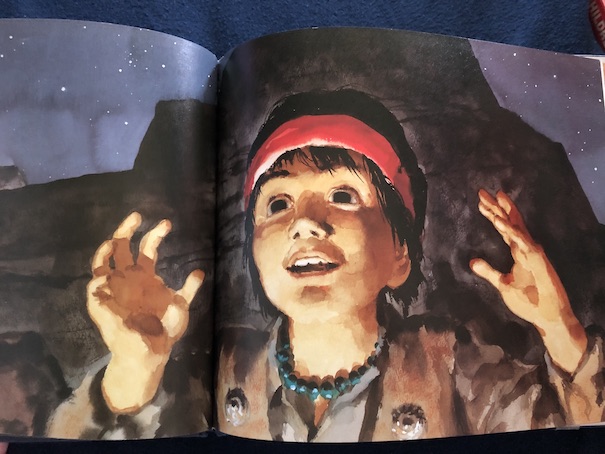
The boy asks his grandfather to tell him the story of when he was born. The grandfather says that he already knows the story, but the boy persuades him to tell the story again.
The grandfather tells him that, on the night he was born, there was a storm, and it sounded like the wind was crying the word “boy.” The boy’s mother knew that she was going to give birth to a son. The grandfather quickly brought the boy’s grandmother to be there for the birth, and when the boy gave his first cry, the storm suddenly stopped.

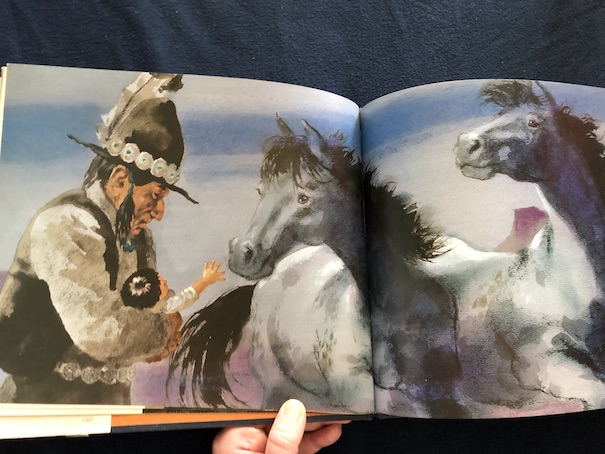
When the boy was born, he was very frail, and everyone was afraid that he would die. Then, when morning came, the grandfather carried him outside, and although he did not open his eyes to the morning sun, he lived his arms up to two horses that had galloped by and stopped to look at him. The grandfather took it as a sign that the boy was a brother to the horses and would live because he had the horses’ strength. The boy did become stronger and was given the name of Boy-Strength-of-Blue-Horses.
However, the boy was born blind. It is a hardship that he will always have to deal with. Even though the word “blue” in his name, the boy says that he doesn’t really know what “blue” is or what it’s like because he’s never seen it. The grandfather describes it as being like morning because the sky in the morning is blue, and the boy says that he understands what mornings are like because they feel and sound different from night to him.
The boy has a horse of his own, and the two of them have a special bond. The two of them perform well at races, and the horse acts as the boy’s eyes when he’s riding. His grandfather says that it’s like the two of them are one.

As the grandfather tells the boy stories about himself, he ties knots on the counting rope. He says that when the rope is full of knots, the boy will have heard the stories enough that he will be able to tell them himself. The grandfather says that he will not always be there to tell the stories, and the boy is frightened, wondering what he will do without his grandfather. The grandfather says that he will be all right because his love will be with him.
The book is partly about the relationship between the boy and his grandfather and the grandfather preparing his grandson for the day when he will be gone, making sure that he knows the family stories about himself and the knowledge that he will need for the future. It’s also about the boy’s own struggles in life, which the grandfather refers to as the “dark mountains” that he must cross. Because of the boy’s blindness, he lives in a world of darkness, and there are things that are challenging to him that would be less challenging to a person with normal vision. Yet, the boy has innate skills which allow him to do things that some people with normal vision can’t do. Not everyone has the affinity for horses that the boy has. He shares a special bond with horses, and when he rides, he and his horse are a team. Because he has skills and a strong spirit, the grandfather knows that his grandson will be all right in his future, in spite of the challenges of his blindness.
The book was featured on Reading Rainbow, and it is currently available online through Internet Archive.



 Mystery at Camp Triumph by Mary Blount Christian, 1986.
 Jestress's Forgotten Books and Stories