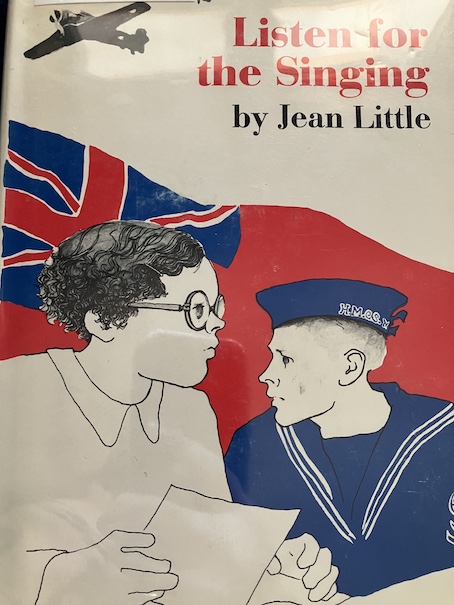
Listen for the Singing by Jean Little, 1977.
This book is the sequel to From Anna. In the previous book, Anna’s family moved from Germany to Canada both to claim an inheritance from a relative and also to escape the Nazis, whose hold has been increasingly tightening on their country. The inheritance isn’t large, mostly just a house and a small grocery store, but it offers the family a chance to start over, away from the Nazis. Anna, the youngest of her siblings was often clumsy and had learning difficulties that her family did not understand. They were often rough, critical, and impatient with her. However, in Canada, Anna has her first thorough physical with a doctor, who reveals to Anna’s startled parents that Anna has an extremely low level of vision, to the point where she is almost blind. For the first time, Anna gets powerful glasses and special classes that help her to cope with her disability and catch up on the learning she’s missed. Anna’s family repents of how hard they were on her when they didn’t understand her problem, and Anna realizes that she is capable of more than she had ever imagined possible.
The sequel begins about 5 years after the previous book, in the fall of 1939. Anna has been wearing glasses for years now, and she’s adjusted to them well. However, changes are coming for her and her family. She is about to leave the special program that she’s been in for students with vision problems and attend a regular high school. She remembers that she used to have problems in regular classes when she lived in Germany, and she worries that she won’t be able to cope with regular classes. Her family, friends, and teacher all remind her, though, that she’s learned things in the last few years that will help her to do much better now. Her teacher says that she’s ready to move on. Anna gets upset when she learns that her friend Isobel from her old school will be going to a different high school, but Anna’s oldest sister, Gretchen, points out that she won’t be alone in high school. Rudi has already graduated from high school, but Gretchen will still be there, and so will the twins. Gretchen says that she will help Anna register on the first day and help her find her way around.
Anna has also begun to worry about her father, who has been distracted by the news they’ve been hearing about the impending war. Her family left Germany partly because they were worried about the direction it was heading under Hitler and the Nazis, and it seems that everything they worried about is now coming true. Then, they hear on the radio that Britain has now declared war on Germany (marking the beginning of the book as September 1939). The onset of war changes things for the family and creates tensions for them among the people in Canada.
When Anna goes to the first day of high school, she learns that her homeroom teacher will be Mr. Lloyd. Her siblings have had Mr. Lloyd as a teacher, and Anna already knows that he’s mean. He plays favorites in class, even though he teaches world history, he doesn’t actually know much about history. Rudi embarrassed him when he was a student, pointing out things he got wrong, and Mr. Lloyd has no love for him or any of the other Solden siblings. Worse still, Mr. Lloyd has a severe prejudice against students with German last names, asking them in class where they were born and if they were proud of their “Fatherland.”
Anna is upset when she is one of the students he singles out, and she’s not sure what to say, but a couple of other students in class speak up to shut him down. Paula voluntarily tells him that, while her mother is Scottish, she was born in Austria … the same place where Hitler comes from. Mr. Lloyd is taken aback, and Anna is surprised both at how bold Paula is and that Mr. Lloyd doesn’t punish her for talking about. Paula later tells her that her mother works for the local school board and has a reputation for standing up for kids who are bullied by teachers, and Mr. Lloyd knows who she is. He has to be careful what he says to Paula or in her presence, or her mother will deal with him. The other student who spoke up is the son of the local alderman, so his father also has influence. Mr. Lloyd could be risking his job if he pushes them too far or says too much in front of them that they might report to their parents.
Anna is grateful to Paula for her intervention, and she also appreciates some help she gets from Paula’s best friend, Maggie. The girls and their other friend, Suzy, make it a point to walk with her to their next classes when Anna explains that she’s been having trouble getting around because she can’t see well. The four girls become friends, and Anna is happy that she already has a friend group at school on the first day.
However, Anna is still troubled about Mr. Lloyd and his targeting of kids with German backgrounds. When she gets home from school and tells her oldest brother, Rudi, what happened, Rudi gets so upset that he goes to his room and refuses to talk anybody. When Anna walks down to the store that her parents manage, she sees Gretchen upset and arguing with their parents about her name. One of her new teachers is also targeting students with German names and gave her a hard time about being called “Gretchen” when the English version of her first name is “Margaret.” At first, Gretchen tries to persuade her parents that she should change her name to Margaret, but after she calms down a little, Gretchen realizes that a name change isn’t really going to solve the problem. There isn’t really anything she could do to make this teacher like her because the teacher is severely paranoid about Germans and talks about how there are German spies everywhere.
Dr. Schumacher, Anna’s family’s doctor and friend, has also experienced some of the same sentiment that the children are experiencing at school. He’s lost at least one of his patients, who no longer trusts him because of his German background, and Anna overhears some of his other patients gossiping about him and speculating on whether or not he’ll serve in the armed forces. Dr. Schumacher tells Anna and his wife that he isn’t overly concerned about these gossipy women, and he doesn’t consider the patient who switched doctors to be a big loss. He, like other young men, feels called to do something about the situation happening around them, but he cannot join the army because he has a heart murmur from having had rheumatic fever when he was younger. His wife (who is also Anna’s former teacher) is relieved that the army has rejected him because they are also expecting a baby.
As Anna and her new friends get to know each other better, Maggie and Paula ask Anna questions about her vision problems. At first, Suzy doesn’t think it’s kind to ask too many questions about it, and the talk of disabilities seems to make her uncomfortable, but the others let her know that she’s misread the room. Rather than finding it uncomfortable to talk about who vision problems, Anna is actually relieved that she can open up about it and that having these problems isn’t regarded as a shameful secret, and Maggie and Paula say that they genuinely want to know what Anna is experiencing so they can help her when she needs it. Anna admits that, sometimes, she’s not even entirely sure when she needs help because, not being able to see certain things, she doesn’t always know what she’s missing. When Anna needs to use alternate materials in class because of her vision problems, she is nervous that Mr. Lloyd will yell at her or bully her, knowing how he feels about students with German backgrounds, but to her surprise, he doesn’t. In fact, he proves very helpful and supportive to her. Mr. Lloyd treats Anna with more consideration than other students because he understands the nature of Anna’s visual problems better than most.
When Anna has trouble in algebra, her father suggests that she talk to her brother, Rudi, who is a math whiz. However, Anna hesitates to ask him for help because Rudi always used to tease her about her awkwardness, worse than her other siblings. She finds it hard to admit to him that she needs help with anything else. When she does ask him, though, Rudi enjoys teaching Anna about his favorite subject, and he even helps her with other things to help her fit in at high school, like teaching her how to dance and encouraging her to get her hair done.
As the story continues, the war increasingly becomes a larger part of everyone’s life. Anna’s father is upset because word reaches him that his sister was arrested in Germany for being a housekeeper for an elderly Jewish man, who was also arrested. At school, the principal makes a speech on Armistice Day where he acknowledges that the war is going to have a profound effect on all of the students and that they will have to grow up faster because of it. As part of the speech, he quotes a preacher who said, “Faith is when you hear the bird singing before the egg is hatched.” This phrase is what gives the book its title because the principal urges the students to “listen for the singing”, to look to the potentials of the future and have faith that they will get through the crisis that is enveloping the world and that the world contains better things.
Anna tries to discuss the idea of imaging how things will be or could be, like hearing the bird sing before the egg hatches, with Rudi, but he doesn’t understand. Rudi seems like he has a promising future ahead of him. He’s already started college and has a talent for mathematics and engineering. He really enjoys college, but at the same time, with so many other young men like himself preparing for war, he feels the pull to join them. When they hear of their aunt’s arrest in Germany, it only makes it worse. Rudi can’t stop thinking about people he knows back in Germany whose lives have already been affected by the Nazis – people who have fled, been arrested, or simply disappeared. He also thinks of the headmaster of their old school back in Germany, who was known to be a Nazi, and how afraid all the children were of him. Rudi decides that he can’t stand back and let people like that win, so he joins the navy against his parents’ wishes.
It turns out to be a disastrous decision. Rudi is still in Canada when he suffers an accident where cleaning fluid is splashed into his eyes, leaving him blind. The doctors don’t believe that Rudi will ever regain his sight. Although Rudi tries to act brave and calm about his new disability, Anna can see that he’s suffering. Having learned to come out of her shell and cope with her own disability, she has a sense of how difficult this is for Rudi, who is usually accustomed to being able to do things pretty easily. Anna realizes how serious Rudi’s mental state is when she hears him crying one night and even praying to die. Anna knows that Rudi needs help, both physically and mentally. He’s suffered a terrible loss, and he feels like his life is over because he can’t see a way forward. Anna has to help him “listen for the singing”, to envision the possibilities.
The book is available to borrow and read for free online through Internet Archive (multiple copies).
My Reaction and Some Spoilers
From Anna told a complete story by itself, but I still enjoyed this new story with Anna and her family. It was nice to see Anna making progress in school and life, finding new friends, and her family treating her better. Because her mother and siblings treated her badly for years before they realized that Anna was slow and clumsy because she couldn’t see, there are some lingering feelings that affect their relationships. Anna’s mother and siblings have repented about their treatment of Anna and have become much more helpful, supportive, and considerate, but Anna still has some lingering fear of Rudi, who was always the one who was the meanest to her. However, even he admits that he regrets his past behavior. Even before he is afflicted with his own disability, he makes it a point to help Anna with her math lessons, learning to dance, and going to her first hair appointment.
Rudi becomes much more thoughtful and mature in this book. He especially comes to appreciate Anna when Anna helps him through the shock and depression after the accident that leaves him blind. When the story ends, it’s still at the beginning of the war, and we don’t know the ultimate fates of many of the characters. The war is just starting to change people’s lives. We know that, like Rudi, many of them will end up marked for life in some way by the things that are about to happen. Some of the other characters in the book see family members going off to war, and we have no idea whether they will come back or not. Mr. Lloyd comes out of his shell a little around Anna because they come to understand one another, thanks to their shared disability. It turns out that Mr. Lloyd’s vision is also very poor, much more than most of his students know, making him sympathetic to Anna. At the end of the story, things are looking brighter for Rudi, as he realizes that his life isn’t over, and there are ways he can cope with his new blindness and continue the studies he initially abandoned to join the navy. We only get to see the beginning of the war, but it’s enough to show us that it’s going to have a profound change on people in many ways before it’s over. Like Anna, readers must also “listen for the singing” to imagine how the characters will continue forward from this point. There will be hard things because of the war, but also hopeful developments in the character’s lives.
I enjoy the literary references in the story. During the story, Anna is reading the book A Girl of the Limberlost, and Anna enjoys studying Emily Dickinson’s poems. Anna also mentions other books she’s reading and bits of poetry or book characters, like Little Lord Fauntleroy. The movie The Wizard of Oz is playing in theaters at the time of the story, and Anna and her friends go to see it.
People With Visual Impairment
As in the first book, there’s information about people coping with forms of visual impairment, based on the author’s own experiences, growing up with low level vision. There’s also a lot about the attitudes the main character witnesses toward people with disabilities and her own feelings about the ways people treat her and how she wants to be treated. Some people, like Suzy, try too hard to shield Anna from public scrutiny by trying to avoid mentioning her disability or shutting down questions about it, but Anna actually prefers to discuss her vision with people who genuinely care and are trying to help her.
Anna is surprised at how much Mr. Lloyd helps her when everyone knows that he has anti-German sentiment. In fact, he goes out of his way to make sure that Anna has what she needs, sometimes even before she asks. Anna realizes why he is so helpful to her when she looks at the notes on his desk, which are printed larger for him, the way that he ensures Anna’s test materials are printed. The truth is that Mr. Lloyd also has low level vision. He covers up for his disability, but he privately admits to Anna that he also struggled when he was young. His parents got him a private tutor because his vision was so bad, and he admits to Anna that he’s impressed at how well she does in a standard school. Mr. Lloyd has strong feelings about some things, but Anna realizes that he’s also a bit shy and socially awkward. The two of them bond over their shared disability and experiences they’ve had in common.
When Rudi becomes blind, he initially feels like his life is over. He can’t continue in the navy, and he doesn’t know how he can return to his studies. Although he tries to cover up how hopeless he feels, Anna realizes that he feels like he can’t do anything anymore. He even lacks the will to use the resources he’s being offered. Anna pushes Rudi to “see” things differently, showing him how he can do things besides sit around and feel sorry for himself. She introduces him to recorded books (on records, not tapes or CDs, because of the time period) and Braille. When Rudi begins to see that he can still think and study, even if he can’t see, he begins to feel more hopeful and see new possibilities for his future. The part of the story about Rudi’s blindness doesn’t come until the end of the book, about the last third or quarter, but it serves to illustrate the point about envisioning hopeful possibilities for the future, even in the midst of misfortune and the chaos of the world around them.
Anti-German Sentiment
Anti-German sentiment was common among the Allied countries during both World Wars. People were paranoid about spies being among them. In most cases, it was just paranoia, but as with many conspiracy theories, it’s the odd case where it actually turned out to be true that kept people in that constant state of paranoia. Realistically, most average schools during this period did not have enemy spies in them, but the possibility that a spy could be anywhere haunts the characters, and that’s behind some of the prejudice that Anna’s family experiences in the story. (See also Charlotte Sometimes for an example at a boarding school for girls during WWI.) In the story, Mr. Lloyd’s prejudice isn’t just about the rise of the Nazis but also about his own brother’s death in the previous war against Germany. To him, the war that’s just starting brings back painful memories of the last one.
Later in the story, after Anna and Mr. Lloyd come to an understanding with each other over their shared vision troubles, Anna speaks to Mr. Lloyd about his prejudice against Germans. She points out to him that a lot of Germans don’t support the Nazis, and they are also at their mercy. She doesn’t know whether or not she’s ever going to hear from her aunt again after she was arrested by the Nazis. Mr. Lloyd admits to Anna that he’s probably not going to be able to let go of all of his feelings about Germans because he’s had years of resentments about them, but he also apologizes to her that his feelings have made things harder on her. This is a small concession, but it may be a turning point in Mr. Lloyd’s attitude. He tells Anna to give his regards to Rudi and is nice to Anna’s father when they meet. Seeds of change have been sewn for Mr. Lloyd, and we see the beginnings in the story. It’s another point where we see the beginning of something and can imagine how it might play out over time.







 Mystery at Camp Triumph by Mary Blount Christian, 1986.
