The Time of the Ghost

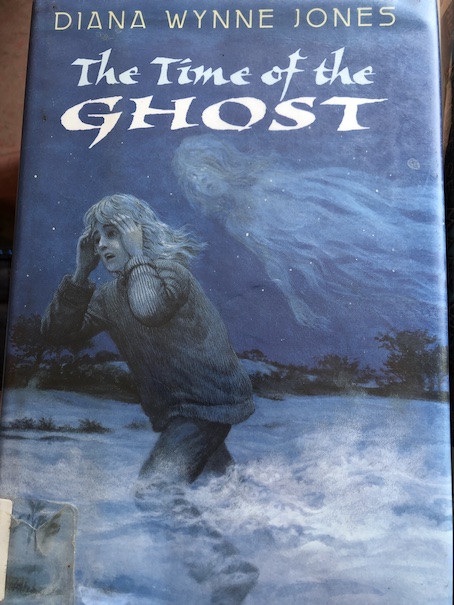
The Time of the Ghost cover

The Time of the Ghost by Diana Wynne Jones, 1981.

This isn’t a very long book, but it packs a lot in! This is both a time travel story and a supernatural ghost story, but with the odd twist that we don’t initially know who the “ghost” is, and she isn’t really dead. She’s trying to save her own life.

In the beginning, although this book is from the first person perspective, we don’t know quite who the narrator is. Even the narrator isn’t quite sure who she is or what has happened. Her last memory is that there was some sort of accident, and her mind doesn’t seem to be working right. Now, she seems to be walking through the countryside, but she can’t remember what happened earlier that day or even what she had for lunch. When she looks down to see what she’s wearing that day, she realizes in a panic that she can’t see herself. She has become a ghost!

It takes her some time to get her panicked thoughts together, but she gradually begins to recognize the countryside. She is surprised that she can look over a hedge, thinking that it was something she had always wanted to do before, and she must have grown. There is a small hut nearby, and she recalls that there is an old rag doll called Monigan inside. Exploring further, she finds herself at a school and locates a classroom she recognizes. To her surprise, she discovers that it’s a Latin class full of boys, and although she has no body, she is sure that she’s a girl, so this can’t be her class. However, she does recognize the teacher as someone familiar but also intimidating.

Leaving the classroom, she continues exploring the school, and she finds people she is sure are her family. She remembers that the woman is called Phyllis, and Phyllis is her mother. There are also girls called Imogen, Fenella, and Charlotte. The ghost thinks that these are her sisters and that her name is Sally because Phyllis seems to call her Sally, although nobody really seems to see her. Sometimes, people just seem to have a sense that someone is there, and the dog, Oliver, seems to know she’s there. Pieces of information click in the ghost’s mind. This family’s last name is Melford. The teacher in the Latin class is her father. Sally is short for Selina. Charlotte is called Cart as a nickname.

The ghost finds herself angry and hating her family. She wonders if she could have died in the accident she vaguely remembers and if she came back to get some sort of revenge on her family, but the idea horrifies her, and she’s sure that she wouldn’t have thought of it in other circumstances.

The ghost watches as Fenella goes to the little hut and pretends to worship the doll Monigan and call her forth, like the doll is some kind of oracle. The ghost remembers that Cart was the one who started this game a year before and that she always thought that it was a boring game. Cart started the game because the four sisters had been fighting over the doll or playing with it too roughly one day, and they had each grabbed an arm or leg and pulled the doll apart. Cart had felt guilty about that, so she sewed the doll back together (badly, because she’s bad at sewing), and she turned the doll into a kind of oracle that the girls would worship to make it up to the doll that she had been ruined. Now, the doll is moldy and mildewy from being left in the little hut for a year. Only little Fenella still plays this game, although the doll has never actually done anything magical when they’ve called on her.

Gradually, the ghost begins putting the pieces of her memories together. Her parents manage a boarding school for boys. The girls help out with chores at the school, but they’re mostly expected to stay out of the way. Although they attend a different school themselves, it feels like they never get a break from school because they live at one. They never even get summers off because there are summer courses for disabled children at the boarding school.

Sally the ghost listens to her sisters complaining about her in her absence. They resent her for being overly sweet and a perfectionist and for defending their parents when the other girls criticize them. Sally is angry with them for the things they say behind her back and for their constant bickering and drama. Imogen gets melodramatic and picks at her sisters because she’s worried about not achieving the music career she really wants. Cart keeps trying to shut Imogen down because she feels overwhelmed by sentiment and emotions, and admittedly, Imogen’s emotions are frequently overwhelming. This dynamic between Imogen trying to express her overwhelming emotions and Cart trying to shut her down is a large part of the quarreling between the girls. Fenella, the youngest of the sisters, is just being a silly little girl, and she is rather fed up with her older sisters. At one point, Sally finds a poem that Fenella wrote that explains her relationship with her sisters:

“I have three ugly sisters
They really should be misters
They shout and scream and play the piano
I can never do anything I want.”

It’s a pretty accurate description of what goes on in their house. All of the girls are loud and argumentative, and a large part of the tension in their house comes from the inability of any of them to do what they want to do. Sally notices some pictures on the walls and remembers their father (whom the girls only refer to as “Himself”, never as “father” or “dad”) yelling at them and calling them “bitches” for stealing art supplies from the school for drawing and painting. Imogen’s drama about her music career is because she’s not allowed to use the music room at the school for practicing, and she thinks that she’ll never get a chance to develop her abilities. The parents pay more attention to the students at the school than they do to their own daughters, even forgetting to leave the girls any supper sometimes. The girls’ home life is not happy, and that’s why they’re not happy with each other. The two oldest girls especially are not happy with their parents because of their neglect.

As Sally listens to her sisters talking about her, Cart and Imogen admit that they’re both jealous of Sally because she gets to be somewhere else that will be important to her future career. Sally wishes that they would say where she’s supposed to be because she can’t remember. She finds a few unfinished rough drafts of letters that she wrote to her parents, trying to tell them that life at the school didn’t have much to offer her and that she was going away, but Sally can’t imagine where she would have gone. One of the letters even says that her life is in danger, but from what?

There is a bright spot in the girls’ lives, and that’s a secret friendship they’ve developed with some of the boys at school. The boys visit them in the kitchen after dinner, and they have coffee together. As ghostly Sally watches one of these visits, the boys ask the girls what happened to Sally, which ghostly Sally is (literally) dying to hear. Sally’s sisters explain that Sally’s disappearance is part of a Plan the girls have.

It’s obvious that the girls’ parents neglect them. While Sally has always been defending their parents to the other girls, the other girls want to prove to her that their parents would never notice if something awful happened to one of them. A lot of the strange things that Sally has witnessed them doing that day are part of this Plan. Fenella has been going around the entire day with big knots tied in her hair, and their parents haven’t noticed. Fenella says that if they continue to not notice, she’ll act like she’s fallen seriously ill. Sally’s sisters say that Sally has gone to stay with a friend named Audrey Chambers, but their parents don’t know and still haven’t noticed that she’s even gone.

The sisters and the boys decide to try holding a seance for fun, and ghostly Sally uses this as an opportunity to communicate with them. Although she has some difficulty and misspells her message, she manages to convince Imogen that she’s the one communicating and that she’s dead. Imogen gets hysterical, but the others calm her down by phoning her friend’s house and confirming that Sally is there and that she’s fine. Ghostly Sally can’t understand it. She’s sure that she’s really Sally, but how can that be if Sally is definitely at her friend’s house?

Ghostly Sally seeks out living Sally, and to her surprise, she finds her, although she feels disconnected from this girl. She also learns that this Sally has been secretly doing things with a boy from the school, Julian, performing nighttime rituals with the doll, Monigan. Although ghostly Sally remembers having been friends with Julian, seeing him from outside herself makes her realize that Julian is actually sinister and disturbed. In her spirit form, she also realizes that their rituals with Monigan have stirred up something genuinely supernatural, apart from herself.

As things become more clear to her, the ghost begins to think that she was wrong about being Sally. She is still sure that she is one of the four sisters, neglected at her parents’ school, but she doesn’t think that she’s Sally after all, and that’s why she had no knowledge of Sally’s secret rituals with Julian and couldn’t remember where Sally was or what she was thinking. She also realizes that everything she has seen happened when she was younger. Somehow, after her accident, her spirit went back into the past, seeing things that she and her sisters used to do.

As the “ghost” wakes up in the hospital in the present day, she also realizes that she is not actually dead. She’s been having an out-of-body experience. Worse, her “accident” wasn’t really an accident. Someone tried to kill her. Julian, also older now in the present day, shoved her out of his car while they were driving somewhere. He was deliberately trying to kill her! Something that happened during that time in the past, during the time with the Monigan rituals and the girls’ Plan to confront their parents over their neglect led up to this attempted murder.

The “ghost” still can’t remember everything that happened in the seven years since then, leading up to the attempted murder, and she’s still confused about who she really is. She only senses that Monigan tried to kill her through Julian. Although the girls once thought that Monigan was just a game, Monigan is actually a real, evil spirit. Seven years ago, Monigan told them that it would claim a life, and now, Monigan is trying to do so. Can the “ghost” regain her memories and figure out what to do in time to save her life before the next attempt?

The book is available to borrow and read for free online through Internet Archive (multiple copies).

My Reaction

Earlier, I covered The Headless Cupid, in which children play at being witches and doing magical rituals that are clearly nonsense, but this book has children who are coerced by some ancient supernatural spirit into doing “real” occult rituals. The children’s rituals involve blood and cruelty to animals, which I didn’t like when I was reading the story. We don’t fully get to know what Monigan actually is, although there are indications that Monigan might be some kind of ancient goddess that craves sacrifices, especially human sacrifices. Monigan seems to remember receiving sacrifices before, in the distant past. Although Cart thinks that she invented Monigan, that Monigan is just a doll they tore, and that all of their rituals are just playacting, the “ghost” realizes that they were all being manipulated by the spirit called Monigan into thinking that. Monigan took advantage of the neglected children and their mentally ill friend for its own purposes. I think Monigan was based on Morrigan from Irish mythology. We are told in the story that this British boarding school is built on a site that has been inhabited from ancient times, and the girls’ father is obsessed with the archaeology of the area, which may also be responsible for stirring up this ancient spirit.

The intriguing part of this story is first that the readers aren’t sure whether or not the “ghost” is actually dead, and then, the readers as well as the ghost have to determine the ghost’s true identity. At first, the “ghost” thinks that she knows who she is, but then, she thinks that she was wrong. (Or was she?) Even when she is awake in the present day, her mind is still confused, and even two of her sisters, while they know that Julian’s attempt to kill her was part of Monigan’s curse, find it difficult to remember everything that happened when all of this started. The “ghost” has to go through the events of the past, with Monigan working against her all the time, to figure out what set off this threat against her before she runs out of time. She knows that Monigan plans to kill her before the day is over, and she doesn’t have much time left to break this curse or prevent it from happening in the first place. The “ghost” isn’t sure at first that she can change the past, but she gradually manages to get through to the other children and figure out a solution with the help of her sisters.

I found the parents in the story not just neglectful but actually cruel and infuriating. The father keeps calling his daughters “bitches” when he gets angry at them. When the girls appeal to their mother about how they’re not being fed and have to keep begging food from the school’s kitchen, the mother shuts her eyes and tells them to stop bothering the cook. The cook is also revealed to be stealing food from the kitchen herself, which may be the reason why both the girls and the students have little to eat, but when the girls tell their mother about it, their mother doesn’t want to hear about it. She just doesn’t want to go to the bother of finding another cook. I’m amazed that the girls haven’t actually died at some point before this or that social services hasn’t gotten involved. The girls do attend a different school from the one their parents manage, so they would have the opportunity to get help and attention from an outside source.

At one point, Fenella openly tells her mother that she’s neglecting them while she only pays attention to the boys at the school, and her mother says that girls can look after themselves while boys can’t. It’s like her mother looks at the girls like some people look at pet cats when they just let them roam and hunt for their own food. I don’t even approve of people neglecting their cats, like they don’t even have pets so much as a nodding acquaintance with feral animals. Even in the present day, when our “ghost” lies in a hospital bed after a murder attempt, their mother doesn’t come to see her because she’s too busy helping the boys at the school to pack their trunks. The father is openly hostile to his daughters, and the mother doesn’t seem to have any feeling or concern for them at all.

The concept of the book was interesting, but it’s not one that I would care to read again because I found it dark and frustrating, although it does end well. Things do improve for the girls in the past after their father discovers their weird rituals and sends them off to their grandmother’s house, angrily declaring that he never wants to see any of them again. The father’s rejection of them is actually a blessing. At their grandmother’s house, they get regular food and the attention that they desperately need. The mother partly redeems herself at the end of the book by coming to see her daughter after all, saying that she felt obligated to get the boys all packed but now that’s done, so she is free to stay with her daughter until she’s fully recovered. The girl does recover, and she begins reconciling herself to her past traumas, both the supernatural ones and the ones resulting from her parents’ neglect and her tumultuous relationship with her sisters.

One thing that the “ghost” accomplishes is that she gets a look at her past and herself as they really are, viewing herself and everything that happened from a neutral position as the “ghost.” Seeing herself from the position of a third person, she discovers that she doesn’t like the things she’s done or the person she’s been during these last several years. That’s why she has felt so disconnected from herself and her memories and why she couldn’t even recognize herself or the things she did in the past. The “ghost” is so upset with herself and ashamed of her life choices that she wonders if she’s really worth saving from Monigan. Fortunately, her sisters truly love her and know that she’s worth saving. Their bad choices and poor behavior to each other have been largely the result of their parents’ neglect, a trauma they all share and understand. Although the ghost doesn’t remember everything at first, the other sisters know that, after they went to live with their grandmother and received the attention and care they really needed, they all improved and their relationships with each other improved. They’ve been trying to move on from their past ever since, and they need to settle the matter about Monigan once and for all to truly be free to go forward in their lives. One of the sisters knows exactly what kind of sacrifice will finally appease Monigan and save her sister’s life.

Monigan wants something perfect as a sacrifice, but our “ghost” isn’t a perfect person. Nobody is perfect, and our “ghost” has become truly aware of her flaws and the nature of her troubled past through her out-of-body experiences. However, things can be perfect in someone’s imagination, and one of the sisters has a more powerful imagination than the others. Someone has a dream that is perfect, at least in her mind. When she gives Monigan that dream, she not only frees her sister from Monigan but herself from something that her future self has realized that she doesn’t really want. Both she and her sister have been clinging to things that were harmful to both of them, making them into the kind of people neither of them really wanted to be. It was their insecurity from their parents’ neglect that made them cling to things that they thought would make them special and distinct. Once they are free from these harmful influences, not only does Monigan stop trying to take their lives, but they are truly free for the first time to become something better. Monigan does claim one life at the end of the story, but in that case, it’s only justice.

Down a Dark Hall

Down a Dark Hall cover

Fourteen-year-old Kathryn Gordy, called Kit, is going to boarding school for the first time. She doesn’t really want to attend the Blackwood School for Girls, but her widowed mother has remarried, and she and Kit’s new stepfather, Dan, will be going on an extended honeymoon in Europe. Kit tried to persuade her mother to take her with them on the trip to Europe, but Dan is firm that she can’t come on their honeymoon trip. The Blackwood School has a good reputation, and graduation from the school would guarantee Kit entrance to a good college. At first, Kit thought it might not be so bad if her best friend, Tracy, could attend the school, too, but although Tracy applied to Blackwood, she wasn’t accepted there. Kit hates the idea of going there alone. Worse still, when her mother and Dan take her to the school, it’s an imposing, castle-like mansion that gives Kit the creeps. Her mother and Dan think it looks impressive, but just the sight of the building gives Kit a terrible sense of evil. Even though she doesn’t want to stay, her mother and Dan insist.

Because her mother and Dan have to leave on their trip, Kit has arrived at the school a day early, before classes will start. Madame Duret, the headmistress of the school, welcomes them and explains a little about the school’s history. The school is fairly new. Before it was a school, the mansion was the private home of a man called Brewer, who died about ten years ago. Because few people would want a house that size outside of town, the building was vacant for some time before the Blackwood School moved in, and there are some ghost stories and urban legends about it in the area. Kit’s mother and Dan laugh it off.

Madame Duret gives them a tour of the school and mentions her art collection. She says that she enjoys collecting lesser-known works by famous artists. The dorm rooms are incredibly luxurious. Each student will have a room to herself with a private bath and a canopied bed with velvet draperies. Art is important to Madame Duret, and she says that she wants the surroundings to inspire her students. When it comes time for Kit’s mother to say goodbye to her, her mother asks her if she thinks she could be happy at the school. If Kit really feels like there’s something wrong with the place, her mother is willing to delay her trip and make other arrangements. Shrugging off her earlier misgivings, Kit tells her mother that she will be fine, and her mother and Dan leave.

The school still bothers Kit, but she feels like she has to try to do well there for her mother’s sake. She knows that things have been hard for her since her father died several years before. Although nobody believes her, Kit remembers seeing her father’s ghost in her room the night he died in a car accident while he was on a business trip. Her mother has managed since then, but she wasn’t really happy until she met Dan, and Kit appreciates that her mother needs adult companionship. Still, Kit senses that this school is very strange, and there are things wrong it it. She can’t figure out why her friend, Tracy, was rejected by the school. The canopied bed is luxurious but kind of creepy because it reminds her of a scary story. Then, she notices that the bedroom doors have locks on the outside of the doors but not the inside.

At dinner that evening, Kit meets Professor Farley, who is a teacher at the school, and Madame Duret’s son, Jules. Professor Farley teaches math and science, and Jules, who has only recently gotten his degree, will teach music, giving the students piano lesssons. Madame Duret herself teaches languages and literature, and apart from these three, there are no other teachers at the school. Professor Farley says that he is the one who convinced Madame Duret to open a school in the United States, having seen her success at her school in England. A young cook named Natalie also works at the school, but strangely, Natalie says that Madame Duret doesn’t want her to speak to the students much.

When the other students begin arriving, Kit realizes that there aren’t going to be many students at this school, either. In fact, there are only three other students besides Kit: Sandy, Lynda, and Ruth. All of the girls also seem to be somewhat removed from their families. Sandy is an orphan who lives with her grandparents, who don’t drive, so they didn’t even drop her off at the school. Lynda and Ruth have both been to boarding schools before, and they were dropped off by a chauffeur. They say that Blackwood isn’t like their old school. Kit still wonders why Tracy wasn’t accepted to the school when there are so few students. Kit realizes that she herself isn’t a top student, and the other three students at this school are quite different from each other. However, Professor Farley says that there are other qualifications besides grades, and all of the girls at this school have the qualities they were looking for. Madame Duret refuses to discuss test results at all.

Kit does her best to settle into the school. Everyone acts nice to each other, and the classes are like having private tutors because there are so few students. However, Kit is still nervous and having strange dreams. She never remembers what she’s been dreaming about, but she dreads these strange dreams, so she has trouble getting to sleep. The only way she can get to sleep is to exhaust herself by reading and writing letters late at night until she is exhausted.

One night, while Kit is writing a letter to Tracy late at night, she hears a scream that is choked off suddenly. Although Kit is afraid, she feels like she has to investigate and find out if there is someone in trouble. She thinks the scream came from Sandy’s room. When Kit tries to check on Sandy, Sandy doesn’t answer, and she has trouble getting into Sandy’s room. Kit feels like there is someone in Sandy’s room, and the room is weirdly cold. When Kit finally gets the light on, Sandy is a little disoriented. She doesn’t remember screaming, but she remembers a strange dream about a young woman in old-fashioned clothing, who was watching her. Sandy tells Kit that she’s had strange dreams like this before, although not about this particular woman. When her parents were killed in a plane accident, Sandy sensed the accident when it happened, and she saw her parents in a dream, not unlike the apparent dream that Kit had about her father when he died. The next day, Kit talks to Lynda and Ruth and learns that they have also been having strange dreams that they have trouble remembering.

These dreams seem to be the one thing that all four of the Blackwood girls have in common, and all of them find them disturbing. When Kit has morning piano lessons, she feels strangely tired and her fingers are sore, as if she’s been playing the piano for hours already. Kit tries to talk to Jules about the strange things that have been happening and her own sense of unease. He tries to give her reasonable explanations, but from the way he speaks, Kit has the uneasy feeling like he knows something that he’s not telling. Jules tells Kit that he’s had some strange dreams himself, but he thinks it’s just the atmosphere of the strange old house. Kit asks him if he’s still having the dreams, and he says he is, but he also likes the house and thinks that it’s just a matter of getting used to the place.

Strange things continue to happen at the school. Lynda wakes up from a nap and suddenly draws an incredibly realistic portrait of Kit when she’s never even taken art classes or done any drawing before. Then, someone steals the portrait out of Kit’s room. Letters and post cards from Kit’s mother and Tracy reveal that they haven’t received any of the letters that she’s been writing to them. Sandy tells Kit that she has a sense that Blackwood School is evil, just like Kit felt when she first arrived.

Ruth is the one who realizes that all of the girls have ESP. Sandy and Kit both experienced ESP when they saw visions of their dead parents. Ruth admits that her excellent grades are only partly due to her naturally high IQ. She can also sense the contents of books without reading them and read the minds of people giving her tests, so she can give them exactly the answers they’re looking for. Lynda isn’t as bright as the other girls, but Ruth has been friends with her for a long time and has discovered that Lynda has memories of herself in a past life, when she lived in Victorian England. Ruth realizes that the girls’ psychic abilities are the reason why the four of them, and only the four of them, were chosen to be students at Blackwood School. The school has a dark purpose beyond providing an education, and these four isolated girls are there to fulfill that purpose.

The book is available to borrow and read for free online through Internet Archive. It was also made into a movie in 2018.

I read this book because it was mentioned as a book a character was reading in another children’s book, The Shimmering Ghost of Riversend, and because it occurred to me that it would fit the Dark Academia genre that’s been popular in the last few years. The reason why this book was mentioned in the other story is that both books involve ghosts who have the ability to act through other people and help them to do things that the living people couldn’t do by themselves. I have a tolerance limit on scary stories, but I felt like I had to read this one because it was mentioned in the other book, and I was curious about it. I’m not sure that I want to see the movie because trailers of the movie make it look even darker than the book, but the book didn’t go beyond my tolerance limits.

In Down a Dark Hall, Madame Duret has psychic abilities of her own and is using girls with psychic abilities to channel the spirits of famous dead people so they can complete works that they were unable to complete in life. Lynda draws and paints pictures that she shouldn’t be able to produce because she has no natural talent for art or training in it. She also begins signing her pictures with the initials TC because she is actually channeling the spirit and abilities of Thomas Cole. Sandy begins writing sonnets without having any prior interest and ability in poetry before because she is channeling Emily Bronte. Ruth finds herself making mathematical notes that are really too advanced for her and barely within her understanding. She’s not sure who she’s been channeling because the scientific and mathematical principles she’s been receiving have little personality attached to them. The reason why Kit’s fingers are always sore and she’s so tired every morning is that she’s been channeling Schubert and other musicians, playing piano music at night. There is one night when multiple musicians fight to control her and get their music out.

The girls are not channeling these spirits through any will or conscious effort of their own. Each of these episodes occurs either while the girls are asleep or just after they wake up from having been asleep. Madame Duret isn’t just facilitating this possession for the sake of art, literature, and scholarship, but also out of greed. She is known for having an impressive collection of works of little-known works of art from famous artists, but what no one else knows is that those works were not produced within the artists’ lifetimes. She has performed this same trick of using the psychic abilities of students to channel the spirits of dead artists to produce new works before, and she artificially ages these works so no one knows that they are new instead of previously-undiscovered works.

Being possessed by the spirits of the dead is disturbing enough, but the girls of Blackwood School also come to realize that the psychic bonds between them and these famous spirits are getting stronger over time. If they don’t find a way to escape Blackwood School soon, they will become permanent. Records in Madame Duret’s office reveal that some of her previous students died from their experiences, and others lost their minds and ended up in mental institutions. No one could stand this type of channeling over the long term and keep their sanity intact, and the spirits themselves don’t seem to have much or any concern for the well-being of the girls channeling them. They seem to have so many ideas that they want to get out that they push the girls harder and harder to produce them. Some of the spirits are gentler and more personable than others, but some regard the girls simply as tools to be used. They can even get violent when the girls resist them or when different spirits interrupt each other’s work. This is a very creepy book, and the girls have some close calls, but fortunately, it has a good ending. I like atmospheric books, but I don’t like books that are overly dark, and I was relieved that all the girls survived. I would have found it hard to take if children died during the course of the story.

Although I knew before reading the book that the story involved ghosts and possession, I initially thought that the isolation each girl has from family and friends was part of the reason why these particular girls were chosen for the school. Before I found out that each girl has psychic abilities, I noticed that none of them are in a position where they are very closely watched by their relatives. Kit’s mother and stepfather are going to be traveling through Europe, so they won’t be trying to visit the school anytime soon, and it would make sense if they didn’t hear from Kit for a while. Sandy is an orphan whose grandparents can’t travel easily, so they won’t be coming to check on her every weekend. Lynda’s mother is an actress who now lives in Italy, so again, there is a separation by great physical distance. Ruth’s parents are busy professionals with doctorates. None of the girls is likely to have any visitors while she’s at school or anybody who would be overly concerned about not hearing from them for a while. At first, I thought that could have been part of the reason why Tracy was rejected as a student, because she has both parents living, and those parents would be in more of a position to check on her and more likely to go to the school themselves if they didn’t hear from her. However, it turns out that her rejection is really because she isn’t psychic, like Kit. The chosen students’ relative isolation from family is just icing on the cake to their psychic abilities and plays into the plot as a reason why nobody outside the school realizes all the weird things that are going on.

I thought that the build-up of the sinister atmosphere at the school was great! Kit has a blatant sense of evil when she first arrives, which feels at first like we’re just being told that the place is evil, but there are also a lot of little details that support it. First, the place is overly luxurious for a boarding school, especially one with so few students to support it. Kit is quick to spot that the girls’ doors can only lock from the outside, which is chilling, although Jules says that’s just to keep people from going into their rooms when they’re not there themselves. However, someone does enter Kit’s locked room to take the portrait of her that Lynda drew, indicating that the girls’ rooms are not safe from anyone and that it’s possible for them to be locked in and unable to get out.

There are also hints from the beginning of the book that Madame Duret and Professor Farley are sinister. Blackwood is actually Madame Duret’s third school that we know about. She had one in France, one in England, and now, one in the US. For some reason, she tends to move countries, which seems odd for someone building a reputation as an elite educator. Boarding schools often have an air of tradition, and their reputations rest on long-term success, which is built over time. Moving around is actually a warning sign, at least to me, that Madame Duret doesn’t want to stay places long enough for people to figure out what she’s really been doing at her schools. Even Jules admits that he doesn’t know things about his mother because he has spent most of his life at other boarding schools himself, not at her schools, so the two of them have mostly been living apart. However, he does know about the possessions of the girls because he has the recordings of the music Kit plays at night. It’s just that he doesn’t fully realize the harm being done to the girls until the end of the book or the harm his mother has already done to previous students.

The old mansion the school is in has a sinister history. The former owner, Mr. Brewer, lost his wife and children, including a baby, in a fire at the house, mostly due to smoke inhalation because the fire didn’t damage the building too badly. After that, he lived as a recluse, and he would act like his family was still alive, buying things for them in town. He could have just lost his mind from grief, but there are indications that his family still haunted the house as ghosts. Locals started telling ghost stories about the place after a plumber heard a baby crying in the house.

Recent reprintings of this book have been updated to include the concepts of laptops, cell phones, and emails, which were not in use when the book was first written. The explanation for why the girls can’t use their laptops to email anybody or get outside help is that there is no Wi-Fi or Internet access at the school. They can write reports on their laptops, but they can’t do much else. Their cell phones don’t get signals, so they can’t call or text anyone.

The version of the book that I used for the cover image is one of the new, revised books with modern technology, and it also has an interview with the author, Lois Duncan, in the back, in which she talks about the inspiration behind the story, her own beliefs about ghosts and psychic abilities, and how she was impacted by the murder of her own daughter, which she earlier documented in a book called Who Killed My Daughter?, in which she consulted psychics for insight into her daughter’s death because the police seemed unable to make progress in the case. Her daughter’s murder happened in 1989, years after Down a Dark Hall was written. Lois Duncan wrote many suspense books for children and young adults, but after her daughter’s death, she gave up writing suspense because it was too upsetting for her to write about girls in danger. She started writing picture books instead. Duncan had already passed away by the time one of the suspects in the case confessed more than 30 years after the murder.

Gone Away

I haven’t found a copy with its dust jacket intact.

Gone Away by Ruth Tomalin, 1979.

Time flies?
Ah no.
Time stays.
We go.

Sundial motto from the beginning of Gone Away

Francie is an only child living on a farm called Goneaway Farm in Sussex in the 1930s. It’s a very old farm, and there’s a story about it that, hundreds of years before, another family once lived there, another couple with only one child. One day, this family went to a fair in another town, Alchester, and for reasons nobody understands, they never returned to this farm. The farm stood empty for a long time before it had a new owner. Because this old family went away with no explanation, the farm came to be called Goneaway. In spite of this strange story and the age of the farm, Francie has never felt that the farm was haunted or that there was anything sinister about it. Then, Francie finds herself staying in a real haunted house.

There are no illustrations in the book. It starts with this quote.

Because the farm where Francie lives with her parents is far away from local schools, Francie studies her lessons at home with her parents’ help, but she often gets distracted by the animals on the farm and doesn’t focus on her lessons. Francie’s great-aunts, Aunt Berta and Aunt Fanny, live in Scotland, but when they come to visit the farm, they see how Francie isn’t getting her schoolwork done. The aunts are also concerned at how isolated Francie’s life is. There are no other children living nearby to be friends with Francie, and they think that her life must be lonely. They talk to Francie’s parents about sending her to boarding school, but they say that they can’t afford it. They can’t even afford a car, which is why they can’t drive Francie to school in town. The aunts remind Francie’s mother that she used to board in a private house with a nice family so she could attend school when she was young. Boarding with a family wouldn’t cost as much as a fancy boarding school, and she could come home on weekends. Still, Francie’s parents are reluctant to send her away because they think she’s too young, and they’re not ready to part with her.

When the aunts leave after their visit and her parents don’t bring up the subject of school again for a while, Francie is relieved. She loves her life on the farm, and she doesn’t want to leave. Yet, she also finds herself oddly disappointed, too. She’s read stories about children at schools, and their adventures do sound exciting. She thinks it would be ideal if she could go to school during the day and come home afterward, like other children do, but that just won’t work with her family’s circumstances. Her parents’ attempts to find friends for her just aren’t working, either. Her parents start inviting other farm families to visit on Sundays, but Francie doesn’t get along with their children. The reasons why she doesn’t get along with them are largely because the other children don’t behave well, but these incidents convince Francie’s parents that maybe the aunts were right and that Francie could benefit from going to school and meeting a wider range of other children.

Her parents write to the high school in Alchester and inquire about registering Francie. They arrange for Francie to take entrance exams, but Francie has mixed feelings about it. On the one hand, the idea of boarding and going to school, with the knowledge that she will come home on the weekends, seems exciting, but on the other hand, she worries that the children at the school won’t be any more friendly than the children of the nearby farm families. Her mixed feelings continue through the day when she and her mother visit the school. At first, Francie thinks that maybe she’ll flunk the entrance exams on purpose so she won’t have to leave her farm. Then, after the initial tour of the school, Francie thinks that going there may be exciting after all, so maybe she’ll try to pass the exams. The exams are difficult, and she expects she’ll fail them after all because she really can’t do the work. Her parents tell her not to worry because, if she fails this year, she can always study more and try again next year. However, it turns out that she did pass. The arithmetic portion of the exam really was too difficult for her because the person giving her the exam accidentally gave her a higher level test instead of the basic entrance exam, but Francie did an excellent job on the writing portion of the test.

Since Francie will be attending the school in Alchester after all, she and her mother begin shopping for her school uniforms and other supplies. Francie is still worried about the prospect of boarding with strangers in town, and her mother isn’t sure how to find a house or family willing to take her. A boarding prospect turns up because Francie is too small and skinny for even the smallest available size of the school uniform, and she and her mother have to visit a professional tailor. The tailor, Mrs. Majendie, also has a few rooms that she rents out to boarders. Francie isn’t sure that she’ll like boarding with Mrs. Majendie at first because she and her house seem a bit grand, her dog seems oddly bored and unresponsive to Francie’s friendliness, and her other boarder is the headmistress of another school in town, the Chantry School. However, the available room is beautiful, with a four-poster bed and tapestries, and the room has a view of the nearby churchyard, where the children from the Chantry School are playing among tombstones in the old graveyard. Mrs. Majendie says that the Chantry School was once a chapel, and her own house was once an old inn. She also says that a new housekeeper will be moving in soon with her daughter, who will attend the Chantry School. It all seems like a fairy tale kind of place to Francie, and she is reassured that there will be another girl living in the house with her, so she tells her mother that she would like to board there.

When she actually starts school, it goes pretty well. The classes aren’t too hard, the subjects are interesting, and she gets along well with the other girls. There is an older girl called Trixie who likes to play pranks on the younger students, and some of the girls tease Francie about her height, but the older girl who is assigned to look after her, Verity, tells Francie not to take any notice of those girls. At first, Francie is able to use her bicycle to get from school to the train station, so she is able to go home every night, but then, as the days grow shorter, and it gets dark sooner, she can’t do that anymore, so she starts to board in town with Mrs. Majendie.

Her boarding experience turns out to be different from what she first thought, though. It turns out that the new housekeeper isn’t very friendly, and her daughter decided to stay with her grandmother instead of coming to town with her mother, so the house is lonelier than Francie had expected. The atmosphere is also different in the winter than in the summer, when Francie first saw her room. The room seems colder, darker, and a little more sinister in the winter, and in the evening, there aren’t any children playing in the churchyard outside. At night, she hears strange sounds, like a tapping and a wailing. When Trixie learns that the place where Francie is boarding is Falcon House, she implies that there’s something really wrong with the place, but Francie assumes it’s just another of Trixie’s tricks. Then, when other students try to get Trixie to shut up and remind her that they all promised not to talk about it in front of Francie, Francie realizes that there really is something weird about the house. She tries to get Verity to explain it to her, but Verity refuses, which just makes Francie angry and more scared. Now, she knows there is a real secret about the house, but she doesn’t know exactly what it is.

A strange man comes to visit Falcon House, and Francie sees that his card says he is Dr. D. Bone Fane from the Circle for Psychical Research. Francie doesn’t know what it means, so she asks some of the other girls at school if they know. One of them, Bryony, says that she’s met this man before. He’s a ghost-hunter from the United States, investigating supposedly haunted places. Bryony’s father teaches in the Abbey choir school, and this man has been pestering him about stories of a haunting there, although Bryony’s father thinks it’s all boring nonsense. From this information, Francie realizes that Dr. D. Bone Fane is interested in Falcon House because he thinks it’s haunted. She confronts Verity about it, and Verity admits that there are stories of hauntings at Falcon house. Nobody’s ever actually seen the ghost that haunts the house, only heard things, and the only people who have heard the ghost are children. According to the stories, Mrs. Majendie’s own children were the last children to be haunted by the ghost, and they were so scared of the house that they begged their mother to send them to boarding school so they could get away from it. Francie is the first child to live in the house since the Majendie children grew up. Francie realizes that this is why the housekeeper didn’t bring her own daughter to the house and why she seems uneasy about Francie’s presence in the house. Mrs. Majendie even gave her nightlights as a gift because she was expecting Francie to be frightened. The headmistress at Francie’s school told everyone not to talk about the ghost stories, not because she believes in them, but because she was afraid that Francie would believe them and get scared. Everyone but Francie has known about the ghost stories from the beginning, and they’ve all been waiting to see what she will experience in the house, if anything.

The more Francie thinks about it, the more she realizes that she sensed the presence of the ghost on her first visit to the house. Besides the noises she’s been hearing at night, the dog in the house reacted to something at the top of the stairs, as if an invisible hand was petting him. When Francie returns to Falcon House after visiting Verity, it’s a stormy night, and she’s terrified about what might be waiting for her at the top of the stairs. However, when she gets there, and she realizes that it’s just her, the dog, and the ghost, she suddenly realizes that the ghost isn’t a menacing presence. The dog likes it, and it seems a little teasing, but it doesn’t mean Francie any harm. Strangely, its presence begins to feel reassuring to Francie because she’s no longer alone in the house, the only child among adults. The ghost is a child, too. In fact, it’s the ghost of the child from Goneaway, the one who disappeared hundreds of years ago, along with its parents.

The more that Francie investigates, the more she comes to realize that the ghost needs her help. Helping the ghost means learning the truth about the family who once lived on the farm that Francie calls home.

This book was originally published in the UK. The book is available to borrow and read for free online through Internet Archive. There is a sequel to this book called Another Day.

My Reaction and Spoilers

This book fits well with the Dark Academia aesthetic, and it could also be considered Dark Cottagecore because of the farm and countryside themes. When Francie is on the farm, she describes the animals and plants in the countryside. Francie’s school isn’t a boarding school, but she does have to board in a spooky place to go there. There are many literary references throughout the story, and there’s a note in the beginning of the book about the poetry references. Francie reads The Story of the Amulet by E. Nesbit for fun, and her class at school reads Treasure Island. She uses stories she’s read to help her understand what is happening around her. When she makes friends with a girl named Geraldine at school, Geraldine also uses story references to explain what she thinks is happening with the ghost.

When Francie first begins to interact with the ghost, she is only able to sense its presence but not really see it. As the ghost begins to interact with her, it gradually begins becoming more visible. At first, Francie can’t even tell whether the ghost is a boy or a girl, only that it’s a child about her size. She wonders why the stories she’s heard about this child and its parents never mention whether the child is a boy or a girl or what its name and age were. She thinks it’s sad that so many little piece of history get lost.

What she eventually realizes is that the child and its parents were probably plague victims because they disappeared around the time that the plague came through this area in the Middle Ages. She thinks that they probably caught the plague when they came to town for the fair and were buried in one of the unmarked mass graves she’s heard about, and that’s why they were never able to return home. When she talks it over with Geraldine, Geraldine realizes that the children who have been able to see the ghost were all suffering from homesickness when they first arrived at Falcon House. The ghost is awakened by feelings of homesickness in other children because that’s what the ghost has been feeling the entire time. What it wants is to go home to the farm, and Francie has to find a way to help bring it home with her. There is a twist in the ghost story later that leaves Francie wondering how much of what she’s perceived about the ghost is her imagination and another girl, the housekeeper’s daughter, sneaking around the house. However, there really is a ghost, and Francie does figure out how how to help it. It comes home for Christmas with Francie.

During the story, Francie struggles with the difficulties of being away from home and going to school for the first time, and she also starts to consider what it’s going to mean for her future. She still thinks of herself as living at Goneaway Farm, but then, the wife of a farm hand refers to her as becoming a “visitor.” Francie feels uneasy about that because she knows that the woman’s son also went away for school and decided that he would rather do something other than farming, so he now lives somewhere else. Francie still thinks of the farm as her home, and it upsets her to think of the farm without her or her life without the farm in her future. But, is that really what she wants? Before her great-aunts raised the issues of school and friends, Francie was content with her life and didn’t realize that either of those things was something she was missing or might want. Now that she’s going to school in town, meeting new friends, and experiencing some independence to explore the town on her own, what else might she discover that she wants and never knew she could experience before? Will the new things she learns and wants to experience mean giving up her old life, which she still loves? These are all questions that people have as they’re growing up and pursuing an education.

Nobody really knows where life will lead them when they’re just starting out, and that can be scary, but at the same time, growing up does mean change. The changes that Francie experiences are ones that she would have experienced anyway, eventually. Her mother understands some of how Francie feels because she also boarded as a child so she could go to school, but at the same time, Francie realizes that her mother doesn’t understand everything that she’s going through because she isn’t there with her every day. Her mother doesn’t fully know what her classes or teachers are like or what the other people she meets and lives with at Falcon House are like. For the first time in Francie’s life, she and her mother are starting to live different lives, and there are some things that Francie must experience and make decisions about on her own.

The practice of children from rural areas boarding at a private house to attend a day school in town is a real part of history, both in the UK and in the US. I covered that earlier when I reviewed Sixteen and Away From Home, a book set in the 19th century Midwestern US, and The Secret School, when a teenage girl named Ida wants to go to high school in the 1920s. Anne Shirley did the same in Anne of Green Gables, which is set in 19th century Canada. This is what children from rural areas in different countries have had to do if they wanted more schooling than they could get in their area.

There is a scene in the story with some gyspies. The book calls them both “gypsies” and “travellers.” One of them tells Francie’s fortune, which gives her hints about what to do. There is also a scene where girls from Francie’s school put on a performance, and there is a dancing dragon and a student who is dressed as a “Chinese boy” for part of it. The “Chinese boy” costume is only mentioned briefly and not described in detail. It’s the sort of thing that is discouraged now in school, people dressing up as people from other races.

Witch Week

This is the third book in the Chrestomanci series.  In this series, there are many different worlds, and in each of those different worlds, there is a copy of every person.  Different versions of our world can differ dramatically in their history, and individual people’s lives can differ dramatically between the worlds. However, there is one person in each generation who has no duplicates in any of the other worlds.  This person is called the Chrestomanci.  All of the talents, abilities, and lives that would have been spread across the other worlds are now centered on that one person, giving that person, literally, nine lives.  The Chrestomanci fills an important role, being better able than anyone else to travel across the dimensions and between worlds, and he acts to keep a balance between them and make sure that the different worlds keep their proper course.

This story takes place in a world where witches are being burned at the stake in the 1980s. At a boarding school for troubled children and orphans, everyone is aware of what an accusation of witchcraft can mean. One day, one of the teachers finds a note in a social studies book saying that one of the students in class 6B is a witch. It’s a serious accusation, but how seriously should anyone take it? This is, after all, a school for troubled children, and children in general play pranks. Mr. Crossly finds the note worrying. Some of the teachers are convinced that this is just a prank or someone playing up for attention. Miss Hodge says that there is a sick mind in class 6B. Mr. Wentworth, whose own son, Brian, is in that class, says that he’s sure that all of the kids in class 6B have sick minds, but that’s just typical. He thinks it’s best if the teachers take no notice of the note. But, the note is correct. There is a witch in class 6B.

Strange things start happening in class 6B and to the students in that class. A flock of assorted birds swarms into their music class. In gym class, Nan Pilgrim can’t manage to climb the rope, no matter how hard she tries. When she and two other students are called to have lunch with the headmistress, Nan finds herself making disgusting comments about the food without her even wanting to say anything, but for some reason, the headmistress can’t hear a thing she says, even though the other students can. Then, it is revealed that Nan’s real name is Dulcinea, which is the name of a famous witch. Could Nan secretly be the witch in class 6B?

Although she can’t openly admit it, Nan is descended from the famous witch Dulcinea, who tried to stop the persecution of witches, and she is also what is called a “witch orphan”, meaning that her parents were witches. However, Nan insists that she’s not a witch herself, and Nan isn’t the only suspicious student in the class. Everyone there is troubled in some way. Brian Wentworth is often picked on for being the son of a teacher. Simon Silverson, Dan Smith, and Theresa Mullet are bullies. They are all eager to point fingers at Nan for being a witch, but could that be to cover up for themselves?

Charles Morgan was sent to the boarding school because his parents think that he is troubled and disobedient and a bad influence on his younger brother. In a way, he is very troubled, but he can’t explain what is really troubling him. When he was younger, he witnessed a witch being burned, something that still traumatizes him. Then, he helped another witch who was being hunted to escape. He can’t admit to his parents that he helped this witch because it was illegal, but the witch promised him good luck for doing so. So far, he hasn’t noticed any good luck, and he feels terrible every time he hears about another witch being burned, thinking that it might be his witch. It all makes him angry and depressed, and he hates the boarding school and everyone there.

Miss Hodge tries to investigate the students by having them act out witchcraft inquisitions. Since most of the children don’t know what happens at an inquisition and aren’t very good actors, most of them are terrible at it. But, she comes to think maybe Charles is the witch because he gets angry at Nan over all the disgusting things she said at lunch and taunts her about them in a way that makes it sound like he’s saying some kind of spell.

When Miss Hodge tries to tell Mr. Wentworth about it, he shrugs it off because he also heard the things Nan said at lunch. Mr. Wentworth interviews Nan about why she said all those things at lunch, but she can’t explain herself. She doesn’t know what made her say those things. Sometimes, she just can’t seem to help herself, and she felt almost possessed. Mr. Wentworth knows about her family’s history and warns her to be careful.

Then, when Charles is trying to escape from some bullies, he somehow manages to turn himself invisible. He doesn’t understand it, but he tries to do something else magical as a test. Since Dan Smith hid his spiked shoes earlier, Charles tries making Dan’s spiked shoes disappear. To Charles’s horror and astonishment, he succeeds! Somehow, he has apparently been a witch the whole time without knowing it. Charles thinks maybe he did some of the other strange things without knowing it, too. He’s always heard that witches are evil, and he thinks maybe he has secretly been evil this whole time and had better confess. An accidental mix-up when he goes looking for the headmistress stops him from confessing immediately, but it leaves him unsure what to do.

Mr. Wentworth has a private conversation with Charles about Miss Hodge’s suspicions about him. He knows what Charles was really talking about when he was arguing with Nan, but he points out to Charles how bad it might sound to someone who didn’t know what he was talking about. Information about witches and the past witch uprisings is drastically censored. There is almost nothing about it in the school library, but Mr. Wentworth understands the situation and explains it to Charles in a no-nonsense way. Nan’s ancestress, Dulcinea Wilkes, had been an advocate for witch’s rights in the 18th century, particularly the right not to be murdered. She said that witches couldn’t help being witches because they were born that way, and it wasn’t fair for them to be murdered for something they just couldn’t help. She said that witches would only use their powers in good ways if people would stop hunting them and burning them, but the murders and burnings continued, and Dulcinea lost her temper. She retaliated with violent spells that frightened people so much that they also murdered Dulcinea by burning her. In remembrance of that, people still continue to burn effigies of her, like they do of Guy Fawkes. Mr. Wentworth says that he thinks what happened to Dulcinea was unfair, but he is worried about his students because there has never been so much stigma against witches at any earlier point in history. Although his students wouldn’t remember it, there was a major witch uprising around the time they were all born. The news of this uprising was largely hushed-up, but the witches attempted to take over the entire government. The revolutionaries were all civil servants, and they were all burned when the uprising was crushed, but the government has been paranoid about anyone with any sign of witchcraft since. When they learned that the leader of the uprisings started showing signs of witchcraft when he was about 11 years old, they even started allowing children to be arrested for witchcraft, even on slight suspicion. The inquisitors have powers that go largely unchecked. Mr. Wentworth knows that any of his students can be hauled away and executed with little recourse.

Even though Mr. Wentworth is concerned with protecting Charles, Charles gets angry with him for giving him a black mark as a reminder to control his behavior, and he glares at Mr. Wentworth. It’s a terrible mistake. It turns out that Charles has the evil eye, and it seems like he accidentally makes Mr. Wentworth disappear. Although Charles tries to pretend like everything is normal, he is desperate on the inside. Soon, someone will realize that Mr. Wentworth is missing and that Charles was the last person to see him. He even tries burning his own finger on a candle to remind himself that burning hurts, and he needs to control himself to avoid being burned to death. When he tries to fix what he’s done with magic, Mr. Wentworth does return, but everyone’s shoes mysteriously disappear.

To Charles’s surprise, the memories of the witch he saw burned and the witch he helped to escape stop bothering him so much after he knows and accepts that he is a witch himself. It’s like he’s always known, inside, that he would be a witch, and once he becomes reconciled to his true nature, he becomes calmer and more self-confident. He knows that he can’t stop being a witch. He can only try to avoid being caught. However, it turns out that he is not the only student who has witchcraft, and when the desperate students seek help or a method of escape from this prison-like school, they accidentally summon Chrestomanci to straighten everything out.

The book is available to borrow and read for free online through Internet Archive (multiple copies, including some in different languages).

Like all of the books in the Chrestomanci series, this book takes place in an alternate world or alternate reality. It explores not only the suspicion and paranoia that go with witch hunts but also the mechanism by which these alternate worlds or realities are created. When the students who have realized that they are witches try to escape, they are given a spell that calls Chrestomanci from his world to theirs. Chrestomanci is accustomed to being summoned to random places on short notice (it’s just one of the hassles that come with the job), but he finds this particular world puzzling. He knows from the similarities between this world and others in the series of worlds that contains his own that he must be in that particular series of worlds, but he recognizes immediately that there is something wrong with it. It has way too many similarities with the world that is “our” world in the series, but yet, there shouldn’t be any witch trials or burnings in the 1980s. He explains that alternate worlds are created when there is some major event that has only two outcomes with an equal chance of happening. Every time that happens, the world splits into two separate worlds where each of the possibilities happen. Because this world is so much like the world that is “ours”, he knows that whatever event caused the split happened fairly recently in history, but for some reason, the split wasn’t complete. There is no real magic in “our” world, but this odd, dysfunctional, split-off world is full of it.

By talking to the students about what they know about the history of their world, Chrestomanci is able to pinpoint the event that caused the problem. As with other Chrestomanci books, Chrestomanci doesn’t just magically solve the problem all by himself, but once he understands the situation, he shows the students at the school where the problem lies and what they need to do to fix it themselves, making use of their own powers, and even some of the mistakes they’ve made, to set their world right and re-integrate their world with “our” world. Once their world is repaired, it’s as if all the witch trials never happened. People who were burned are alive again, and people who were in prison are living perfectly normal lives. The children must sacrifice their magical abilities and all or most of their memories of their old lives to join with our world, which some of them are initially reluctant to do, but once they do it, all of their lives change for the better. Orphans have their parents back, the school is now a day school instead of a boarding school where the children were basically prisoners, and the children are all much friendlier toward each other now that they are no longer part of that toxic atmosphere, where suspicions always surrounded them and everyone is afraid of exposure.

Parts of the story were stressful because of the bullying among the students and the constant threat of imprisonment or death for any child who was proven to be a witch. Most of the adults are not that concerned with the welfare of the students because this entire society is engulfed with paranoia, and everyone is desperate to protect themselves at all cost. The adults are often so preoccupied with saving themselves that they would be willing to throw the children to the wolves rather than face imprisonment or death themselves. The major exception is Mr. Wentworth, who tries to warn children who show signs of witchcraft that they need to be careful. His efforts to protect the children are touching because he has more to lose than some of the other teachers who play along with the politics and paranoia of their society. (Spoiler!) Mr. Wentworth and his son Brian are both witches, and Mr. Wentworth is being blackmailed for most of his salary by the headmistress. Mr. Wentworth advocates self-control to the students as the best way to avoid being caught, but it soon becomes apparent that nobody with witchcraft abilities can fight using them forever. That’s why some of the children’s abilities come out unconsciously, without them even being fully aware of what they’re doing. That’s where the mystery of the story comes in.

Chrestomanci books always contain an element of mystery in some way or other, and from the beginning of the story, there are the questions of who wrote the note about there being a witch in class and who the witch is. We never learn who wrote the note (I don’t remember that being definitely revealed), and in the end, it doesn’t really matter. When Charles realizes that he is a witch, that seems like the answer. However, Charles is not the only witch in class. As one of the other students points out, all of the weird things that have been happening at the school are very different in character, so there is more than one person involved. By the end of the book, it is revealed that (spoiler) the vast majority of the students at the school are witches. Some have been doing magical things unconsciously as their powers have started asserting themselves, and some have done things on purpose because they know they can. Chrestomanci realizes that many more people in their society in general are witches than these paranoid people ever suspected, and witches are only regarded as a minority because of the atmosphere of fear they live in. Everyone has been trying so hard to conceal any sign of abnormality that they all have a warped view of who they all really are and what their society is actually like.

I couldn’t help but notice that, witch or not, absolutely nobody in this society can be called an innocent person. Everybody is doing something illegal, unethical, or simply deceptive. They all have secrets, and they all do things to cover up what they’re doing. Even non-witches are often doing horrible things that they have to cover up. The apparently sweet and proper headmistress is actually a cold-hearted blackmailer. Teachers are manipulative for personal and professional reasons. The so-called “normal” (or “real”, as Nan thinks of it) children are all either secret witches or just horrible bullies and rotten human beings. Like their elders, the “normal” children are sneakily manipulative and practice blackmail and brutality against the other students, knowing that’s the way to get to top of their social heap. As I said, the entire society is toxic, not just the school, and everything the children do is a reflection of their elders (and vice versa, when you think about it). Grown-up witch hunters are like overgrown child bullies, and people like the headmistress probably started their blackmail and manipulation at a young age, just like the students, as tools of survival and self-promotion in this cold, toxic, pitiless world.

The normalization of the toxic parts of this world is both stressful and worrying. People can adjust to many awful things if they are not given any alternative, and that’s what this dysfunctional world represents. There are moments of lightness, though, and some characters are more caring than others. The story is told from the point-of-view of different characters, and much of this book is a psychological study in the different ways people deal with bullying, suspicion, and paranoia. As I said, Mr. Wentworth risks himself sometimes to help students in danger and make them see the seriousness of their situation. Some of the students band together to try to help each other survive their mutual risk, while others are more self-centered, prepared to throw each other under the bus to save themselves. It’s a relief to see all of that end when the world is set right, but it occurs to me that the story has exposed all of the characters’ true characters, what each of them are capable of doing in extreme circumstances. The extreme circumstances brought out the worst in some characters, while others were more creative and caring in spite of everything.

The Secret Language

The Secret Language by Ursula Nordstrom, 1960.

“Sooner or later everyone has to go away from home for the first time. Sometimes it happens when a person is young. Sometimes it happens when a person is old. But sooner or later it does happen to everyone. It happened to Victoria North when she was eight.”

Victoria North is attending boarding school for the first time at the Coburn Home School. Victoria is only eight years old, and this is her first time being away from home at all, so she is very nervous and shy. When she arrives at the school, she is met by an older girl named Ann, who shows her where her room is in the dormitory. Ann shares a room with Victoria and is supposed to show her around and tell her the rules, but she doesn’t really explain much. Victoria still feels lost and has trouble even finding the table where she is supposed to sit at dinner.

At dinner, one of the other girls, Martha Sherman, starts uses funny words, and she tells the other girls that they are part of a secret language that she made up. However, she refuses to tell anybody what they mean. Martha is moody and rude to the other girls at dinner, so the housemother sends her to her room before the meal is over.

Overcome with homesickness, Victoria cries at dinner and during the songs they have to sing afterward. No one has any patience with poor Victoria. Ann tells her that she’s being a crybaby. Other girls laugh at her when they see that she’s been crying. Victoria doesn’t know how she’ll be able to handle boarding school if every day is going to be like this!

The other girls in the dormitory say that Miss Mossman, the housemother, is strict. She blows her whistle at them and makes them line up for inspection every morning. Miss Blanchard, another teacher, is nicer, and she tries to reassure Victoria that things will get better when she gets to know the other students and makes some friends. However, nobody seems to want to be friends with Victoria. Nobody except Martha.

Martha is the only girl who seems interested in talking to Victoria. Martha doesn’t like Coburn Home School, either. More than anything, Martha wants to live at home and just go to an ordinary day school instead of being boarder. Victoria knows just how Martha feels! The other girls are surprised at how well Martha seems to get along with Victoria because Martha doesn’t usually want to be friendly with anyone.

The two of them start to talk about their homes and families. Martha’s father is an importer. She keeps saying that her parents are going to let her come home from boarding school and just go to day school, but it quickly becomes apparent that it isn’t likely. Victoria only has her mother, who works and sometimes needs to travel for work. She doesn’t even remember much about her father. Martha likes math, a subject which Victoria finds hard, but Martha says that she doesn’t reading, which is Victoria’s favorite subject. The two complement each other well.

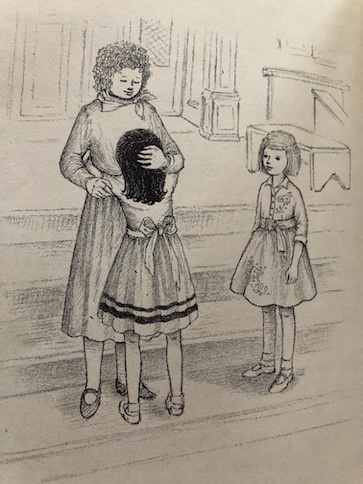
Although Martha misses home, like Victoria does, and doesn’t really want to be a boarder, she is more experienced about boarding school life, and she helps Victoria to adjust to the school. Martha starts teaching Victoria about pieces of boarding school lore, like school rhymes and the traditions made up and passed down by students, and she also begins teaching her the secret language that she made up. There are only three words in Martha’s secret language, but Martha explains to Victoria what they mean, and the girls decide that they’ll make up more together. Martha becomes Victoria’s best friend all through the rest of her first year at boarding school.

Being friends with Martha makes boarding school feel better to Victoria. Martha still constantly talks about hating boarding school and how she definitely won’t come back next year, although Victoria realizes that’s just a wish of hers. Victoria also comes to realize that many other kids at the boarding school feel the same way. Even the ones who like the school admit that they’d really rather be at home with their parents. They daydream about just going to school during the day and coming straight home afterward, where they can just relax at home and eat what they want and not have to answer to whistles or line up for inspections. When Ann’s family decides to bring her home, Martha and Victoria ask Miss Mossman if they can share a room, and she agrees as long as the girls behave themselves.

Victoria is fascinated at the things that Martha knows about life at boarding school. Martha teaches her about “pie beds.” (I always heard it called “short-sheeting” when I was a kid, although I was never good at making beds the normal way in the first place, so I never fully grasped how to pull off the trick, and I didn’t go to summer camp or boarding school, where people typically did this anyway.) The girls argue about what costumes to wear to the school’s Halloween party, but the school’s handy man helps them make ice cream cone costumes that win a prize for the most original costume. The costumes are uncomfortable to wear, but Victoria is pleased and thinks that Martha should get the credit because the costume concept was her idea. Martha says that, next year, they’ll start planning their costumes earlier and come up with an even better idea. That’s the moment when Victoria realizes that Martha is no longer talking about how she’s definitely not coming back next year.

After the girls come back from Christmas vacation, Victoria is homesick again, but it turns out that their old, strict housemother has left to take care of her father, who is ill. Instead, they get a new housemother, Miss Denton, who is much nicer. She doesn’t blow whistles at the girls to wake them up. Victoria likes Miss Denton right away, and even the other girls in the house start calling her “Mother Carrie” as Miss Denton requests, even though the name strikes them all as silly at first. Martha finds Miss Denton to be overly sweet (“ick-en-spick” in the secret language), although she admits that she’s better than Miss Mossman.

Martha also finds herself liking Miss Blanchard, who teaches math. Miss Blanchard was nice to Victoria in the beginning, but Victoria can’t bring herself to like her much because she has so much trouble in math. Victoria has a fanciful imagination and likes to imagine that certain numbers are boys and others are girls, and Martha finds it frustrating because the idea doesn’t make sense to her, and Victoria doesn’t even follow an exact pattern, like odds vs. evens in her designation. Meanwhile, Victoria is confused by the math tricks that Miss Blanchard teaches Martha. Martha thinks they’re fun, but Victoria isn’t as good at math and has trouble following them.

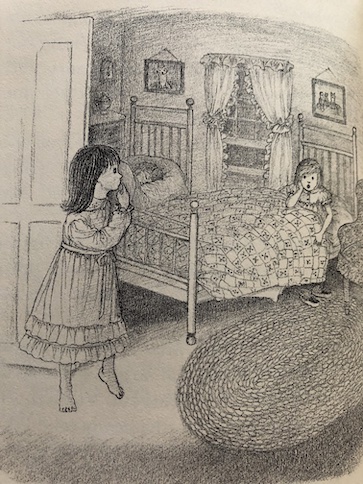
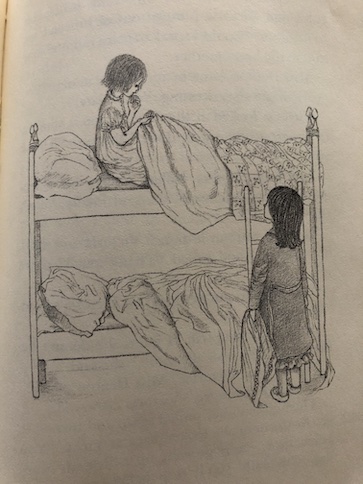
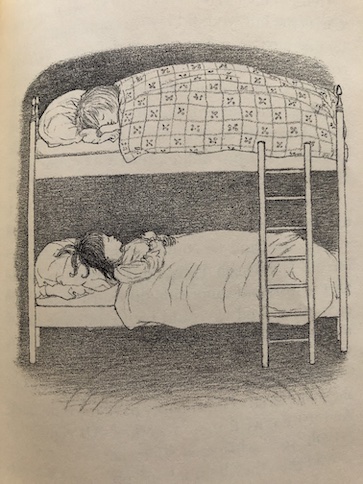
The two girls find themselves arguing sometimes because of their different preferences, but they remain friends. It’s more that, now that they’re getting comfortable with each other and their school, more of their individual personalities are coming out. Victoria is also surprised to realize that, while she still frequently misses her mother, she no longer agrees with her mother about certain things. When her mother comes to visit the school, she worries about Victoria sleeping in the top bunk of their bunk bed, but Victoria herself loves it and has to assure her mother that she likes the top bunk. One thing that boarding school has done for Victoria is to give her a sense of independence and room to develop her own identity and preferences. She no longer has to get her mother’s permission for everything she does, as long as her housemother approves.

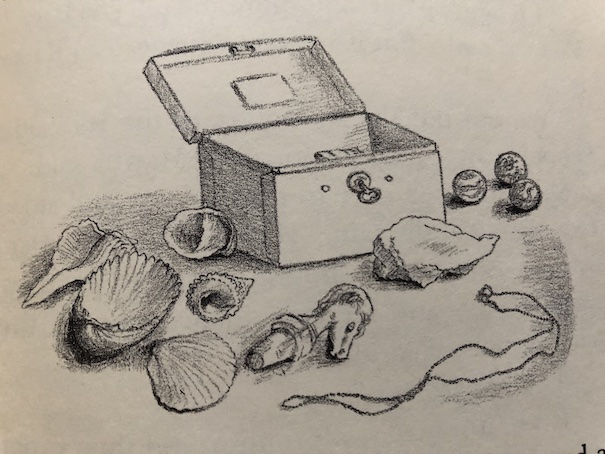
Victoria and Martha are both imaginative, and they begin enjoy their shared adventures at school. They try to hold a midnight feast in their room and search for hidden passages or secret compartments in the dormitory because Martha has heard or read that these things happen in boarding schools. Neither of those adventures goes as planned, but Miss Denton allows the girls to build a little play hut of their own with help from the school’s handy man. Miss Denton also gives the girls a little lockbox to keep some of their treasures in, and they hide it so they can have a buried treasure.

As the year comes to an end, Victoria knows that she’ll be coming back to boarding school next year, and the prospect doesn’t seem so bad as it did before. Martha isn’t sure whether she will or not, talking sometimes about what they’ll do next year but still hoping to live at home with her parents. But, if Martha doesn’t come back to school, it just wouldn’t be the same for Victoria!

The book is available to borrow and read for free online through Internet Archive.

My Reaction and Spoilers

One of the things I found interesting about this book is that it is set in the US. The iconic boarding school stories for children tend to be British stories, but the Coburn Home School is in New York state. The girls’ parents live in New York City.

Most of the story focuses on the girls’ relationship with each other and their growing sense of self-identity and confidence at their boarding school. They talk about classes they take and how they each feel about the other’s favorite subject, but they aren’t shown in classes themselves. The school is also a co-ed school, with both boys and girls, but the boys don’t enter into the story much because most of the action takes place around the girls’ dorm. The boys live in a different dorm. There is only one instance where a boy is shown talking to Victoria, with a hint that he might have a crush on Victoria, another new development in Victoria’s life at school. The little developments in the girls’ lives and attitudes through the school year and each little experience and adventure they have are the main focus of the story. These are the things that are helping the girls understand and develop their identities, self-confidence, and sense of independence.

Toward the end of the book, Miss Denton encourages the girls to think about all of the things they’ve learned this year, and not just the ones they’ve learned in class. The girls don’t fully understand and appreciate that Miss Denton is talking about personal growth and development, but they do consider things they’ve learned, like how to make beds, that midnight feasts aren’t as fun as they sound, and how Victoria learned not to be homesick. These are some of the little things that are part of their school experience and that are slowly making them more grown up and independent than they used to be.

Although Martha is a little older than Victoria and sometimes chides her for being babyish about some things (like putting a lose tooth under her pillow) or still homesick, the truth is that Martha has been just as homesick the entire time. Martha doesn’t appear to be as upset about boarding school as Victoria because she is not a new student in this book, like Victoria. She already went through her first year at boarding school before Victoria got there, so she no longer openly cries about being away from home. Still, the reason why she keeps talking about going home and living with her parents all the time is that she misses them. While the girls’ adventures during the school year and Victoria’s realizations about how boarding school gives her the opportunity to do things and be with people she wouldn’t at home make her feel better about coming back next year, Martha still feels uncertain about it. Martha has also come to love being friends with Victoria and even loves Miss Denton, but her feelings of homesickness leave her feeling torn about what she really wants.

There are hints that Martha will probably return to boarding school anyway, but Miss Denton reassures Victoria that she will be fine at boarding school even if Martha decides not to come next fall, reminding Victoria that she is now one of the “old girls” instead of a scared new one, like she used to be. Victoria also starts to feel that way herself. Martha will probably be back the next year to be with Victoria, Miss Denton, and Miss Blanchard, but readers can be reassured that, even if she doesn’t return, Victoria will be all right with her new sense of identity and independence. This first year at boarding school with Martha may be the beginning of a lifelong friendship or just one step to Victoria finding herself and building other friendships. Maybe it’s both. Victoria’s future life will be fine in general as she continues growing up and finding her way, learning to manage her life one step at a time.

There is a modern 21st century documentary about young children going to boarding school for the first time at 8 years old, What’s Life Like in a Private British Boarding School? | Leaving Home at 8 Years Old, on YouTube. The school in that documentary is British, but I was struck by the common feelings in the documentary and the book, even though they take place decades apart in different countries. There are just some parts of the human experience that last through the generations. The documentary also shows the parents’ side of the boarding school experience, the reasons why they choose to send their children to boarding school, and how they cope with their feelings about sending their children away and being separated from them.

Boarding school isn’t always easy for parents in terms of emotions, and there are hints of that in The Secret Language. We never see Martha’s parents in the book, so we don’t know what’s going on with them, but Victoria’s mother fusses over Victoria when she gets the chance, and she talks about how great it would be if she could arrange things so that Victoria can be home with her all the time again, too. If Victoria’s mother wasn’t a working single mother who has to travel for work, she probably wouldn’t have sent her away to boarding school at all. Miss Denton is very in tune with people’s feelings, and I think that she’s aware of all the complexities in the lives of the girls and their parents. She does her best to look after the girls emotionally, and that’s part of her urging the girls to consider other people’s feelings, to be thoughtful about each other, and to think about the ways they’ve been changing inside as well as outside. I think that the universal nature of the girls’ and adults’ feelings in the book are a sign of the author’s emotional awareness, understanding of how different types of people feel.

Ursula Nordstrom, the author of the book, was actually a famous children’s book editor. She is credited with helping to transform mid-20th century children’s literature to have more of a focus on children’s feelings, experiences, and imagination instead of being morality tales, focused on what adults want children to know or understand. The Secret Language was the only children’s book that she wrote herself. This YouTube video explains about her life and career.

Go Jump in the Pool!

This is the second book in the Bruno and Boots series (also called the MacDonald Hall series), which is about a pair of boys at a Canadian boarding school for boys and their humorous adventures and pranks. 

Once again, Bruno and Boots are faced with a problem when Boots’s parents consider sending him to a different school.  MacDonald Hall, unlike its athletic rival York Academy, doesn’t have its own swimming pool. MacDonald Hall is superior to York Academy in academics, but they often lose to them at swim meets because the MacDonald Hall team can only train at the local YMCA once week.  Boots’s father is an athlete who once competed in the Olympics, and athletics are very important to him.  Because of York’s superior athletic facilities, he’s considering sending Boots there instead. Bruno and Boots ask their headmaster why the school doesn’t have a pool, and he says that they want to build one but haven’t been able to raise the necessary money. Of course, Bruno, the idea man, immediately starts getting ideas.

Boots loves MacDonald Hall and doesn’t want to leave his friends, especially his best friend and roommate, Bruno. Although Bruno’s schemes often cause chaos, they do produce results in the end, so he is able to convince his friends to go along with them.  While Boots writes letters home, talking about how great MacDonald Hall is and how much he loves it there, hoping to sway his parents’ minds, Bruno begins scheming for a way to raise the money so that MacDonald Hall can build a new pool.

First, Bruno gets the other students at the school to hold a rummage sale, selling things of their own and even some furnishings from their dorm rooms. The girls from Miss Scrimmage’s school across the road also join in their efforts, including donating some items that they liberated from their headmistress’s rooms. Mr. Sturgeon, the headmaster of MacDonald Hall is upset when he finds that the boys are holding a large public sale without his permission, and there are some complications because of the items that the girls stole from Miss Scrimmage, including the shotgun that she keeps for protection. While almost everyone would be relieved by someone else buying that gun and removing it from Miss Scrimmage’s dangerous hands, the purchaser turns out to be a robber, who uses the gun in a holdup. Chaos ensues when the police come to arrest Miss Scrimmage because the gun had her name and address engraved on it. However, Mr. Sturgeon manages to get the situation under control by explaining about the sale and giving Miss Scrimmage an alibi for the crime, and he is persuaded not to punish the boys by his wife, who is sympathetic to the boys, and a member of the school’s board of directors, who is impressed by the boys’ initiative and school spirit. However, Mr. Sturgeon tells the boys not to hold any more sales and that he needs to know about any future fundraising efforts.

Their next fundraising project is a talent show with students from both MacDonald Hall and Miss Scrimmage’s. It doesn’t go too badly, although there are complications. Mrs. Sturgeon’s attempts to take pictures of the performers startle the performers with bright flashes that cause a few accidents. Elmer’s bird calls accidentally attract an owl that flies away with Miss Scrimmage’s hat. Then, several of Miss Scrimmage’s girls modify their dancing costumes to make them skimpier, scandalizing Miss Scrimmage. In spite of the incidents of minor chaos, Mr. Sturgeon appreciates that the boys have managed to raise more money, and they’ve also managed to get some of the more shy students, including Elmer, to participate in school activities.

Mr. Sturgeon does put a stop to some of Bruno’s more inappropriate ideas. He refuses to let them hold a casino-themed fundraising event or bet on a race horse because he can’t condone gambling, and he won’t let them enter a fellow student in an eating contest out of concern for the student’s health. However, Bruno convinces his fellow students to enter any contest they can find with a cash prize. Unfortunately, some of the contests also have non-cash prizes, which is how they end up with a massive amount of jelly beans and a refrigerator. When Bruno asks Mr. Sturgeon for permission for them to hold a funny photo contest at the school, he agrees on the condition that the photos be tasteful enough for a school environment. Of course, the students’ attempts to deliberately produce humorous pictures also lead to some antics and bizarre pranks.

After that, the boys hold a kind of carnival that they call “Individual Effort Day” because each student gets to do their own kind of fundraising effort, making and selling things or producing some form of entertainment. While everyone, including the girls at Miss Scrimmage’s school, who are also participating, tries to come up with an original idea, some of the students try spying on each other and stealing ideas. Mr. Sturgeon particularly enjoys the game that Bruno and Boots are holding, where people pay to throw wet sponges at them. He accurately hits both of them and also hits Miss Scrimmage when she passes by. Cathy and Diane’s haunted house scares Miss Scrimmage, and Mr. Sturgeon gets hooked on an elaborate pinball game built by Elmer.

When Mr. Sturgeon points out that the boys have mostly been getting money from the students and parents of MacDonald Hall and Miss Scrimmage’s, Bruno takes his attempts to get money from the public too far by setting up a toll stop on the road that runs by the school. It’s illegal to get money under false pretenses, so Mr. Sturgeon calls a halt to all the fundraising efforts. However, he changes his mind when he finds out that some of the boys’ parents, including Boots’s parents, have been considering sending their boys to York Academy because of the pool issue. Realizing that the boys have been trying to save the school and continue going to school with their friends, Mr. Sturgeon lifts their punishment, although he still gives them a warning that if they do anything illegal again, it will jeopardize the rest of their lives.

The boys still have the problem that they are thousands of dollars short of their goal, even after Cathy wins a large cash prize in a recipe contest. There is still one student at the school who hasn’t contributed to all the fundraising efforts, though: Boots’s old roommate from the previous book in the series, the wealthy but stuffy and fussy hypochondriac, George. George has resisted getting involved in all the weird activities happening on campus because he considers them all “vulgar”, but when they finally explain to him that the point of it all is to raise funds for the school, he approves. If there’s one thing George knows how to do well, it’s manage money. George convinces them that they don’t need to raise more money from other people if they know how to put their money to work for them in the stock market. The other boys are a bit dubious about letting George invest their money, but George knows what he’s doing. Meanwhile, Boots’s parents have been taking all the letters he’s been writing them about how great MacDonald Hall is and how happy he is there to heart. In the end, they just want their son to be happy.

The book is available to borrow and read for free online through Internet Archive (multiple copies). It’s also one of the MacDonald Hall books that was made into a movie. You can sometimes see the trailer for the movie or clips of it on YouTube.

I always liked the Bruno and Boots series when I was a kid. The pranks aren’t quite as funny to me as when I was a kid, but I like it that the boys’ antics always have a purpose. I don’t like stories where people play pranks just to be mean, but the boys’ escapades in this series are always in support of their school and their friends.

There are also aren’t really any villains in the series, and there are no villainous characters in the story. Even when people are in opposition to the boys, they aren’t really evil. There is the rival school, which is snobby and rude to the boys, but other than giving the boys a motive for fundraising for the pool project, they don’t play much of a role in the story. The headmaster of MacDonald Hall is a good man who really cares for the boys, and even when he punishes them, he has their welfare at heart. The boys, especially Bruno, have a tendency to go too far with their schemes, and they do need someone to restrain them at times. George wasn’t a very likeable character in the previous the book, and even here, he’s kind of fussy and not too fond of Bruno and Boots. However, he also cares about the school, and this time, he has just the talents that they need. The other boys at the school also appreciate what George does for them, and they hail him as a hero.

I also appreciated that, in the end, Boots’s parents acknowledge that it’s more important for him to be happy with his school and his friends than for him to seriously train for the Olympics. Boots’s letters are overly enthusiastic about the things he’s been learning in class, and I’m sure his parents know that he’s not really that excited about his math lessons, but they can read between the lines and realize that the purpose of his letters is to indirectly ask them not to make him switch schools. Even if MacDonald Hall wasn’t able to get a swimming pool of their own, I think his parents would have agreed to let him stay there if he insisted that he just wouldn’t be happy anywhere else.

Ruth Fielding in Moving Pictures

Ruth Fielding

One day, while Ruth Fielding is out with her friends, Helen and Tom, they see a film crew working by the river. (Because this is the 1910s, they are making a silent film and using the kind of old-fashioned movie camera that needs to be cranked, like the one shown in the picture to the right.) They talk about whether to not they would like to be in movies themselves. The girls think it sounds exciting, but Tom thinks that they’re too young. The girls say that they are not too young because the actress who is being filmed looks like she’s about their age. As they watch, the young actress accidentally falls into the river, which is freezing cold because it’s winter. Ruth and her friends hurry to help pull her out before she drowns. When they get her out of the river, Ruth is appalled at how unconcerned the director is for the actress’s health while she’s clearly suffering from the cold. Ruth and her friends take the actress, Hazel Gray, back to the Red Mill where Ruth lives, where she can warm up and recover.

While Hazel is resting at the Red Mill, she and Ruth tell each other about themselves. Like Ruth, Hazel is also an orphan. Her parents were actors, and some friends raised Hazel to be an actress after her parents died. Ruth tells Hazel that she has been thinking about writing a movie scenario (script) just for fun, and Hazel offers to show it to the director if she does. Ruth isn’t sure she likes the idea because she didn’t like the director, Mr. Grimes. Hazel explains that, while the director can be callous and abrasive, he is a famous director who really knows his business and can help actors and scenario writers make their careers.

The next day, Mr. Hammond, the manager of the film company, comes to the Red Mill to see how Hazel is and to ask Ruth about how the accident happened. He seems concerned about whether or not Ruth’s description of what happened matches what Mr. Grimes told him. Ruth explains what she saw to Mr. Hammond, and she also tells him what she thinks about Mr. Grimes’s lack of concern about Hazel’s welfare. Mr. Hammond says that it’s impossible to change other people, indicating that he knows how callous and unpleasant Mr. Grimes can be, but he promises to make sure that Hazel gets a fair deal for her acting and the accident she suffered.

While he is there, Mr. Hammond becomes fascinated by the quaintness of the Red Mill. He thinks that it would make an excellent setting for a movie. Ruth says that she would love to write a scenario about the Red Mill herself. Mr. Hammond asks her if she’s ever written a scenario before, and Ruth admits that she hasn’t, but there has to be a first time for everything. Mr. Hammond is amused and says that he would be very interested in any scenario that Ruth might write. However, he suggests to her that, before she writes a scenario about the Red Mill, she write a short story about something else, something exciting, so he can see what her writing is like. Ruth happily agrees, and after she returns to boarding school with her friends, she starts writing.

Ruth and Helen are now seniors at their boarding school, and they are starting to think nervously about their lives after graduation. They know that they want to go on to college, but they find the prospect intimidating, too. Neither of them is quite sure what they want to do with their lives. The idea of growing up in general sounds frightening.

The girls aren’t the only ones showing signs of growing up but feeling awkward about it. Ruth finds herself getting unexpectedly jealous about Tom having a crush on Hazel. Helen says that Ruth simply hasn’t been paying attention to the things the boys are doing. All of Tom’s friends at his school have crushes on actresses, and they’ve been collecting pictures of them from the newspapers and pinning them up in their rooms. At the same time, Tom seems oddly sullen that other people are starting to treat Ruth and his sister as young ladies. It’s one thing for him to have a crush on Hazel, who is a couple of years older than they are, but he doesn’t seem to like the idea of Helen and Ruth seeming too grown up.

These things are in the back of Ruth’s mind as she finishes writing her story. After she sends her story to Mr. Hammond, a fire breaks out in one of the dormitories at the school because of a neglected candle. The dormitory that is destroyed is the one where Ruth lives with her friends. Ruth is tempted to try to save their belongings, but the teachers tell her that it’s just too dangerous. They’re just thankful that all the girls are safe.

After the fire, there is the question of rebuilding the dormitory. At first, they think that the insurance money will pay for a new dorm, but it turns out that the school’s forgetful headmaster accidentally let the insurance policy lapse. Some of the girls at the school are from wealthy families, and they are sure that their parents would be willing to contribute to the building of a new dorm, but Ruth sees a couple of problems with that. First, while the wealthier students’ families would certainly be able to contribute sizable amounts toward the building project, the families of poorer students may hesitate to contribute at all because they may be embarrassed that they cannot possibly match the donations the wealthier families can contribute. Second, the girls are overly relying on their parents. While the parents may be glad to help, Ruth thinks it would be better to find a way that the students themselves can contribute to the building fund. The other students agree that they would all like to find a way for everyone to contribute.

An idea for a group project the entire school can participate in comes to Ruth when Mr. Hammond sends Ruth a check to pay for her first story. He thinks that Ruth has a great talent for writing, and he’s going to make her story into a short, one-reel movie! That makes Ruth realize that, if she can write a short story for a short movie, she can write one for a long, five-reel picture. If she can write a long scenario for a movie, all of the girls in the school can be in the film! She thinks that she can persuade Mr. Hammond to produce the picture and distribute it to the surrounding town, and the royalties from the movie can pay for the dorm reconstruction.

Mr. Hammond agrees to help Ruth and her friends make a movie on behalf of the school, and the school’s headmistress agrees to allow the students to participate in the project. The donations that the school has already received from the parents have paid for the removal of the ruins of the old dormitory and the beginning of the construction of the new one, and the money the girls earn from the movie can pay for the completion of the building project. Ruth already has an idea for the plot of the movie, one about girls at a boarding school, so they can film the movie on their own campus. Mr. Grimes turns out to be the film director, and he is still temperamental, but he shows more patience when dealing with the students than he had before.

There are complications, of course. Hazel Gray is one of the professional actresses helping with the movie, and Ruth is still jealous about how fond she seems of Tom. Then, there is drama when the other girls learn which girl left the candle unattended and vent their wrath on her. The girl, Amy, was already a troubled student with an unhappy home life. Then, Amy gets upset when the boy she likes seems to be getting too friendly with Ruth, and she runs away. Ruth and the other girls have to search for her, and they learn the embarrassing secret behind the dormitory fire and some other secrets that Amy has been hiding from them.

This book is now in the public domain and available to borrow and read for free online through Project Gutenberg.

Not exactly a mystery, but there are some things that Ruth and her friends discover some secrets about their prickly fellow student, Amy, and when she runs away, the other girls have to figure out where she went and rescue her. Although Ruth and the other girls are unhappy with Amy because of the dormitory fire and because Amy frequently has a sour attitude, but they become more sympathetic when they learn more about some secrets that Amy is hiding. The embarrassing secret behind the dormitory fire is that Amy is afraid of the dark. She doesn’t want to admit it to the other girls because she doesn’t want to be teased, but that’s why she left a candle burning in her room; she was afraid of returning to her room after dark. The school has electric lights, but she grew up in a more old-fashioned town and isn’t used to them.

Worse still, Amy is terrified that her father will find out that she caused a fire at school. He is already harsh with her, and it has gotten worse since he remarried. He seems to view the child from his first marriage as a nuisance, and it seems like he sent her to boarding school to get her out of the way as he starts a new life with her stepmother. Actually, Amy’s father’s reasons for sending her to boarding school were not just to get her out of the way. Ruth and the others learn that part of Amy’s difficulties with her stepmother have partly been because Amy behaved badly toward her because her aunts disliked her and were a bad influence on Amy. It wasn’t just that the boy she liked seemed to like Ruth that made her run away; she had gotten an angry letter from her father that not only accused her of doing something bad before she left home but also saying that he has heard rumors about her involvement with the fire. He is coming to the school to find out for himself what she’s been doing there, and Amy is terrified of what he will do when he gets there.

To find Amy, the girls and Curly (the boy Amy likes) have to think of all the things they know about Amy and the places she could have gone. Curly knows more than the girls do because Amy confides in him. I appreciated that Ruth and the other girls are much more active in this story in solving the problem of Amy’s disappearance than they often are in other books. In the earlier books in this series, Ruth and her friends frequently rely on chance and coincidence to reveal hidden information and other people to carrying out the final action, but this time, they use their own reasoning to figure out where to look for Amy and go after her themselves. In some ways, I think that the more active roles that Ruth and the others play in the story are because they are growing up. Amy is younger than Ruth and her friends, and they feel responsible for her. In earlier books, adults and others were looking after them and helping them, but now, they are older than someone else. I’m looking forward to seeing how this develops in other books in the series.

When they find Amy, she has had a bad reaction from poison oak or poison sumac, and everyone feels sorry for her. Amy gets the first sympathy that she’s had for some time. Amy straightens out her relationship with her father when he comes and realizes that she was unfair to her stepmother. The other girls at school forgive Amy for the fire when they find out what she’s been through, and her father makes a generous donation to the building fund.

One of the most unique features of this book is that the characters are growing up, and it’s part of the story. That’s something that doesn’t happen in other, later Stratemeyer Syndicate books. In this book, Ruth and her friends graduate from their boarding school. As the girls think about their graduation and going on to college, they’re a little intimidated because they don’t know what they want to do with their lives, but Ruth discovers her talent for writing movie scripts/scenarios. (These are silent films in her time, so there’s no dialog for the “script.” Any dialog that the audience needs to understand would have been shown in text in the intertitles. I think that’s why they call this form of script a “scenario” in the book.) There is some awkwardness in the way the boys and girls in the story start looking at each other because they realize that they’re becoming young ladies and young men. They’re not used to thinking of themselves and each other in that way, and they’re developing crushes.

You won’t find this sort of thing much in the on-going Stratemeyer Syndicate book series, like Nancy Drew and the Hardy Boys. Those characters are frozen in age on purpose, and the Ruth Fielding series was part of the reason why. In early Stratemeyer Syndicate book series, like Ruth Fielding and the Rover Boys, the characters did age. They grew up, graduated from school, got married, and eventually, had kids of their own. The problem for the Stratemeyer Syndicate was that, when their characters got married and became parents themselves, they were starting to get too old to be teen detectives and young adventurers. Their child audiences wanted to read about kids like themselves or teenagers or young adults, not people who were more like their own parents. So, whenever characters started getting too old for the target audience, they would have to end that series and start a new one. After going through the Rover Boys and Ruth Fielding and some of their other popular series in this way, they realized that they could keep a book series going much longer if they just didn’t let the characters age.

That’s why Nancy Drew and the Hardy Boys are frozen in age somewhere in their late teens or early 20s, and the books typically leave it vague which it is. It’s mostly important that readers know that the characters are young but old enough to travel and have adventures by themselves. Nancy Drew is not going to school, and if she takes any classes in individual books, she isn’t studying for a degree. If she did, her series would eventually end because she would graduate and move on to adult life. Similarly, the Hardy Boys are learning to be private detectives by working with their father, who is a private detective, but they will always be in that apprentice phase, so their series can continue. There are times when the characters date other characters or have crushes, but their romances don’t progress to anything serious because that would also age the characters. Every decade or so, the books in those series get revamped or the characters get a new, updated series that incorporates modern technology and culture, but the characters stay roughly the same age throughout. It’s basically what happens with new Scooby-Doo cartoon series, but with books, and the Stratemeyer Syndicate did it with their characters first.

Part of the reason that I wanted to read the Ruth Fielding books was that I knew the characters would age, and I also knew that she was a kind of prototype for Nancy Drew. The Nancy Drew series started around the time Ruth Fielding’s series ended, as a replacement for Ruth Fielding. Fortunately, we’re not at the end of Ruth Fielding’s series yet. The series doesn’t end with her boarding school graduation. It continues through her time in college and into her career in the movies.

Ruth Fielding on Cliff Island

Ruth Fielding

Ruth Fielding on Cliff Island, or The Old Hunter’s Treasure Box by Alice B. Emerson (the Stratemeyer Syndicate), 1915.

Ruth Fielding and her friend, Helen, are waiting for their friend Jane Ann to arrive by train from her uncle’s ranch so they can all go off to boarding school together. Then, Helen’s brother, Tom, arrives with the news that the train has had an accident. They all get in Tom’s car and rush off to see if they can help Jane Ann.

When they reach the site of the train wreck, they discover that Jane Ann was rescued from the train by a young man named Jerry. Jane Ann is fine, but Jerry was hurt in the rescue. After a harrowing escape from a panther that was released during the train crash (Stratemeyer Syndicate books are like this. There has to be suspense and cliff hangers in every chapter.), they take Jerry to the Red Mill, where Ruth lives with her Uncle Jabez and have the local doctor come to treat him.

Jerry explains to the others that he wasn’t actually riding the train when it crashed. He had just been following the train tracks on foot while on his way to look for a job. Jerry used to live on Cliff Island with his Uncle Pete. Jerry is sure that his uncle actually owns the island because they always lived there, and he always said it was his. His uncle used to keep money and important papers in a lockbox hidden on the island because he didn’t trust banks, but there was a landslide that buried the box in its hiding place. After that, his uncle became distraught because the papers that proved he owned the island were in that box. Then, someone else, a man called Rufus Blent, claimed ownership of the land, and his uncle had trouble proving that the claim was false. Jerry’s uncle got into a physical fight with this man, and because he seemed so violent and unreasonable, the local authorities locked him up in an asylum, which is why Jerry is on his own now. Jerry is sure that Blent is on the island now, trying to find his uncle’s buried treasure box.

Jane Ann is touched by this story of injustice, and she immediately wants to write to her own uncle and get help for Jerry and his uncle, but Uncle Jabez urges caution, telling Jane Ann that they should verify Jerry’s story first before committing themselves to his cause. Uncle Jabez gives Jerry a job at his mill and a place to stay. Ruth and Jane Ann have plans to make for returning to boarding school and for preparing for Jane Ann’s first term there. Jane Ann doesn’t like her name, so they decide that when she starts classes, she’ll go by the name Ann.

Ann has a difficult time at school. She has never had formal education before, and she is behind the other girls her age. Some of the other girls at school tease her mercilessly about it, and after a particularly mean prank, Ann hits some of them until her friends finally restrain her. Ann is so upset that she thinks she can’t handle life at the school and doesn’t belong there. She thinks about running away, but she did that once before in a previous book, and after the last experience, she doesn’t want to do it again.

Ann later has a couple of opportunities to use some of the skills she learned from life on the ranch to save some of the other girls and an injured boy, and some of the girls who were mean to her apologize for the earlier prank. They say that they see her in a different light now and feel guilty about what they did earlier. The mean girls do start treating Ann better (their respect now having been bought), but the damage has already been done. Their belated improvement to the level of minimally-acceptable behavior isn’t enough to make Ann feel better before the school goes on winter break.

Mercy, who has been accustomed to being picked on by people because she uses crutches, understands Ann’s feelings and tells her that she should be mean back to people who are mean to her. Ruth thinks that sounds awful, but Mercy tells her that she doesn’t understand what it’s like. Mercy does use her disability to explain that she should have some allowances for her temperament and behavior, especially when people pick on her, although Ruth doesn’t think that’s quite right.

The conversation leads some of the girls to talk about their life goals. Mercy is glad that she’s able to go to school now because her disability made it difficult when she was younger. She’s determined to be the top of the class to show others that she’s as smart or smarter than they are, even if her legs don’t work as well. Mercy’s self-esteem suffered badly when she wasn’t able to walk, even with crutches, and people looked down on her (or at least, she felt like they did). Now that she can walk with crutches and go to school, she finds a new self-esteem in her ability to excel in her studies. That her ambitions are partly rooted in spite toward people who teased her in the past isn’t healthy, but she is determined to take her education as far as she can go and wants to get a scholarship to college. Other girls also start talking about their own ambitions and what they want from their education.

Rather than feeling better, Ann feels worse because she’s still not doing great at her studies, and she’s not sure about her own ambitions and what she really wants from her education. It makes her wonder what her real purpose is at the school and if she should really be there. The school friends are planning to spend the Christmas holidays together. Ann isn’t sure if she really wants to go with them after all, but they persuade her that she really does belong with them, and they want her.

Ruth hasn’t forgotten about Jerry and his situation. The family of a friend of hers at school, the Tingleys, has purchased some land on Cliff Island, where Jerry used to live, and they’re building a lodge there. The Tingleys have invited some of their children’s school friends, including Ruth, to the island over the Christmas holidays, and Ruth persuades them to hire Jerry to work at their lodge. Jerry is happy to be able to return to the island, and Ruth says that this will give him the opportunity to look for his uncle’s hidden box again. Jerry doesn’t have much hope of finding the box because it’s been buried, but Ruth thinks it could still be possible. Blent also seems to think it’s possible because he does everything he can to get Jerry fired and drive him away from the island.

The book is available to borrow and read for free online through Internet Archive (multiple copies) and Project Gutenberg (multiple formats).

My Reaction

Although books by the Stratemeyer Syndicate, especially the early ones, were criticized for being shallow and formulaic, I will say that they do have a way of making you care about the characters. In fact, I think that I found some of the characters in this book more personable than characters in the Nancy Drew books because there is more reflection on what people are feeling and why.

In particular, I really felt for Ann when she was being bullied, and I don’t blame her for hitting the ones responsible when she lost her temper. The other girls were deliberately mean and picked a fight. Learning that they get a fight when they pick one is a valuable life lesson. Actions have consequences, and these “girls” are too old to be doing this with any degree of innocence. I really wished that someone had made it clear to them that the situation was entirely their fault, not Ann’s, and that they failed in their obligations to behave respectfully to a classmate. A thoughtless prank that hurt someone unintentionally would be forgivable, but in this instance, it’s deliberate, calculated, and repeated cruelty. The book says that the mean girls pick on Ann even harder when they realize that they can hurt her and have hurt her, and deliberately hurting people who are obviously hurting for pleasure is really a very sick thing to do. I don’t like it that the book treats this behavior like it’s a normal thing for them to do. Even though I know this is something people do in real life, this type of behavior shouldn’t be normalized because causing pain for pleasure really is a disturbing thing to do when. The prank that broke Ann’s patience was dumb, but when you look at everything that led up to it and the emotions behind it, it says disturbing things about the nature of the people who did it. I always hate it when people give that sort of thing a pass without pointing out the full reality of their motivations to the people doing it.

I never really felt better about the mean girls during the course of the book, even after they started acting better because I didn’t like their motivations for fixing their behavior. The didn’t repent because they felt badly about hurting someone unfairly. Oh, no, they didn’t care that they had caused someone distress and hurt their feelings. No, they do it because Ann used her ranch skills to rescue people in danger. Not only that, but it took two such rescues, not just one, to get them shut their mean mouths. Yeah, it’s like in Rudolph the Red-Nosed Reindeer, if Rudolph had to do two missions to save Christmas instead of one. I now that the moral of Rudolph is supposed to be that people should be nice to other people because you never know if someone you don’t like might have something good to offer you later, but it leaves a bad taste in my mouth that they think that they’re entitled to be offered something in exchange for their good behavior instead of seeing good behavior and kindness as the minimal level of their own obligations. These mean girls (as all mean girls do) see themselves as being so self-important and such a high level of authority that other people have some obligation to prove themselves to them personally in order to be treated with even basic human respect, even though the reality from an objective observer is that the mean girls are nothing but a bunch of bratty, badly-behaved, immature children who should have their eyes opened to that reality. Their level of morality is that people have to buy their good behavior with some amazing deed or service. Otherwise, they’re fair game as bully prey. I’m not buying this, and I’m not buying their supposed reformation.

If relationships are really as transactional as the mean girls make them, someone should point out to them that they’re the most undeserving people of all because they have not offered Ann any sort of service to merit the payment she gives them. In fact, they are burdens to have around. If behavior is transactional, they’re actually in debt, and they’re not very good debtors. The whole thing about relationships being repaired when a victim becomes a hero to an abuser is a bad cliche. I think it sets terrible examples and warped views of human worth, but it’s admittedly a behavior I’ve seen in real life. When it comes to behavior, I prefer a line from an old Murder She Wrote episode, where a snobby man apologizes to being rude to Jessica Fletcher when they first met because he didn’t realize that she was “somebody” as a famous writer. She tells him that it’s perfectly acceptable to be polite to nobodies. Someone should really tell the mean girls that and make it stick. Fortunately, the mean girls do change their behavior for the long term. After they start treating her better, Ann has an easier time at school and can concentrate on her studies better.

There is a kind of parallel in the book between the way the mean girls at school treat Ann because they don’t think she’s good enough for “their” school (as if they owned it themselves instead of just being clients who have to pay money to go there) and how the local people, who are easily swayed by Blent, treat Jerry and his uncle. Mr. Tingley, who bought his property on the island from Blent, is appalled when Blent tries to not only drive Jerry away from the island but even gets together a posse to try to hunt him down with guns like an animal. The local authorities side with Blent because, first, they seem to be corrupt, and second, Jerry’s uncle was always a little strange, so they’re more than willing to believe that he was really crazy. Blent and his cronies even go so far as to kidnap Jerry and bribe the staff on a train to take him to another town, miles away. Tingley is horrified at the locals and what they’re doing. He recognizes that it’s difficult to fight them because they are presenting a united front in their wrongness and are laughing about his inability to stop them, so he has to call in some outside legal help. It’s not unlike the united school bullies, who think that their ability to get away with what they’re doing makes them superior and gives them the right to continue.

When Jerry’s uncle’s box is finally found, the papers inside establish the reality of the situation. Uncle Pete was in the process of buying the island from Blent, so Blent did originally own it. At the time of the box’s loss, Uncle Pete had paid most of the installments he owed to Blent, so although he hadn’t fully completed the transaction, it wasn’t true that he had no claim to the land, either. Blent covered up that he had already taken Uncle Pete’s money for the land or that they had been involved in a transaction at all, seeing it as his opportunity to not only keep Uncle Pete’s money but to make more by selling that same land to someone else. When his land fraud is uncovered, Mr. Tingley and Uncle Pete drag a humiliated Blent through the law courts. Since Mr. Tingley paid for the land he bought in good faith and with the entire amount, his sale stands, but Blent is forced to pay Uncle Pete back with interest. Mr. Tingley and Uncle Pete work out an arrangement where Uncle Pete will live on the island and work for Mr. Tingley, so Uncle Pete will be able to stay on the land he loves. Mr. Tingley also convinces Uncle Pete that banks are more trustworthy than hiding his money and important papers in a cave.

Ruth Fielding at Briarwood Hall

Ruth Fielding

Ruth Fielding at Briarwood Hall by Alice B. Emerson, 1913.

Since Ruth and her friends have helped her Uncle Jabez to recover his stolen cash box in the previous book, Uncle Jabez has decided to send Ruth to Briarwood Hall, the boarding school that her best friend, Helen Cameron will attend, so the two of them can stay together. Briarwood Hall is an exclusive school, where the primary entrance requirements are academic records and teacher recommendations. Ruth has already graduated from the local school in her uncle’s town although she is a little younger than Helen, and she is ready for the high school level. Helen’s twin brother, Tom, will be attending a military academy close to the girls’ boarding school.

The three of them travel alone to their schools, without adult chaperones. They amuse themselves by seeing if there are other students bound for their schools traveling on the same train and steamboat they take to their boarding schools, but they can’t find any. However, they do see an interesting older lady with a veiled hat who attracts their attention because she looks doll-like and speaks French. For some reason, this lady seems greatly upset by a strange man with a harp who is part of a musical group entertaining passengers on the steamboat.

The mysterious French woman turns out to be the girls’ new French teacher at Briarwood Hall. She seems very nice to the girls when they are introduced to her as they’re riding in a coach to the school after they get off the boat. Mary Cox, a fellow student who is older than Ruth and Helen, rides to the school with the girls and the French teacher. On the way to the school, Ruth notices that Mary seems to oddly ignore the French teacher, speaking only to her and Helen.

Mary is a Junior at the school, and tells the girls about the school clubs. The two main clubs at Briarwood are the “Upedes” and the “Fussy Curls.” I was glad that Ruth and Helen thought that these sounded by strange names for clubs, too. Mary explains that they’re just nicknames for the official club names. The Upedes are members of the Up and Doing Club, a group of girls who like lively activities. There are other groups at school, like the basketball players, but the Upedes and Fussy Curls have a particular rivalry for members. Mary is a member of the Upedes, although, in spite of the groups’ rivalry for gaining new members, Mary strangely doesn’t invite Ruth and Helen to join her group and doesn’t seem to want to explain what the rival group does.

When the girls leave the coach, Mary says that she doesn’t like the French teacher because she’s a poor foreigner, and Mary doesn’t know why she’s at the school. (Mary sounds like she’s rather a snob.) Mary says that she thinks it’s strange that the French teacher never wears any nice clothes and doesn’t seem to have any personal friends or relations. (Yeah, definitely a snob toward someone who just seems a bit unfortunate, like it’s some kind of moral failing, not having nice clothes or personal connections to show off.) Helen says that the French teacher does have personal acquaintances because she seemed to know the harp player on the boat, something that seems to interest Mary. Ruth has the uneasy feeling that they shouldn’t have mentioned it, not knowing exactly what the teacher’s connection to the harp player is. Helen likes Mary, but Ruth has reservations about her friendship.

Mary Cox shows the girls where their dorm room is. Helen and Ruth are sharing a room by themselves. Another girl, a senior named Madge Steel, comes by to talk to the girls and invites them to a meeting of the Forward Club (known as the “Fussy Curls” because of its initials) that evening. Ruth wants to go to that meeting because Madge seems very nice, and the Forward Club includes members of the school faculty. However, Helen says that she’d rather attend the meeting of the Upedes that evening that Mary told her about. Helen thinks that they owe Mary their loyalty because she was the first to meet them and was helpful in finding their room. Besides, the Upedes have no teachers in their club, and Helen thinks that it sounds more exciting and free from supervision than the Forward Club. Ruth thinks that she would prefer to get closer to her new teachers and some well-behaved girls instead, and it’s the first major disagreement that the friends have. Mary talks Ruth into going to the meeting of the Upedes that evening because that was the invitation that they received first, but Ruth says that she won’t join any club officially until she’s had a chance to see the other girls involved and learn what the clubs are really like. Ruth’s stance seems to be the wise one as the school’s headmistress tells the girls that joining clubs on campus are fun but that they should beware of getting involved too much with girls who don’t take their studies seriously and waste their time, and they learn that Mary Cox’s nickname at school is “the Fox”, suggesting that she’s as sly as Ruth has sensed. Although Mary didn’t mention it to the girls before, she’s actually the leader of the Upedes.

That evening, the girls are introduced to other students, and at the meeting of the Upedes, the school’s very own ghost story. Briarwood wasn’t always a school. It used to be a private mansion, and a wealthy man lived there with his beautiful daughter. The wealthy man was the one who commissioned the creation of the fountain with the marble statue that still stands on the school’s grounds. Although people on campus say that nobody really knows what the statue of the woman playing a harp in the fountain is supposed to represent, the ghost story claims that the figure was modeled after the beautiful daughter of the mansion’s former owner. However, according to the story, the girl fell in love with the man who sculpted the statue of her, and the two of them eloped, leaving her father alone and sad. Rumor had it, though, that the girl and her new husband must have died somewhere after they ran away because people started hearing mysterious harp music at night on the grounds of the mansion. Eventually, Briarwood was sold, and the school’s founders, the Tellinghams, bought it, and sometimes, people still hear harp music on the school grounds. Every time something strange or momentous happens at the school, people hear the twang of the harp.

That night, Ruth and Helen become the targets of a frightening hazing stunt by the Upedes that seems to bring the ghost story to life, but when something happens that frightens even the hazers, it brings into question how much of the ghost story is really true.

The book is now public domain and available to read for free online in several formats through Project Gutenberg. There is also an audio book version on Internet Archive.

Spoilers and My Reaction:

I liked this story much better than the first book in the series because it is more directly a mystery story than the first book, and Ruth makes a deliberate effort to untangle some of the puzzling things happening at her new school.

It’s pretty obvious that there is a connection between the ghost story of the girl with the harp and the French teacher’s apparent discomfort at the suspicious harpist. Ruth finds out pretty quickly that the harpist from the boat is lurking around the school. That revelation explains the frightening happenings at the hazing incident, although it still leaves the question of the connection between the harpist and the French teacher. At first, I thought that it was going to turn out that there is some truth to the ghost story the Upedes told, but that actually has nothing to do with the real situation. In some ways, I felt like the real situation was a little to straight-forward and resolved a bit too quickly at the end, considering the build-up they’d had about it. It is interesting that, of the students at the school, only Ruth comes to learn the full truth of the French teacher’s secret. Even Helen doesn’t know what Ruth eventually discovers, partly to save the French teacher’s reputation and partly because Ruth and Helen’s friendship is suffering for part of the book.

Unlike newer series produced by the Stratemeyer Syndicate, characters in the older Stratemeyer series, including the Ruth Fielding series, grow, age, and develop their lives and personalities. In this book, when the girls go away to boarding school, the differences in Helen and Ruth’s backgrounds and personalities become more obvious. It leads them to clash in some ways, and they both worry about endangering their friendship with each other, but by the end of the book, each of the girls develop a greater sense of who they are and what they really stand for.

Helen is more familiar and comfortable than Ruth is with the traditional rituals of boarding school, even taking some glee in the mean hazing ritual of the Upedes, and she badly wants to fit in with the cooler older girls at school, willing to put up with their mean bossing to take part in their schemes for the fun and excitement. However, Ruth, is naturally more serious and shy and less accustomed to having things her way or telling others what to do anywhere she’s lived than the wealthy Helen. Ruth overcomes some of her shyness and learns to be more assertive as she stands up for herself and the other new girls at school, called “Infants” by the older girls. Ruth decides to refuse to join either the Forward Club, which has a reputation of being made up of girls who toady up to the school faculty, or the Upedes (which was initially founded as a protest group to the Forward Club, which is why most of the activities of their club involve breaking various school rules and instigating pranks), after experiencing their mean pranks and bossiness. Instead, she takes a joke of Helen’s seriously and decides to form a secret society of her own. She talks to some of the other new girls at school, and they feel the same way they do, that they don’t want to choose between either the Upedes or the Fussy Curls and would rather have a club of their own, where they won’t be dominated or hazed by the older girls. Helen gets upset at Ruth starting this new group because she thinks that they won’t gain any new friends or have any real fun or really be a part of this school if they don’t join an already-established group. Helen thinks that a group of new girls would look ridiculous because they wouldn’t know what to do with their club and will look like a group of babies. However, Ruth realizes that this is nonsense. There are enough interested girls among the newcomers to give them a good group of friends and they can think of their own things to do where they can be the leaders. Ruth turns out to be more of a leader and Helen more of a follower, and Ruth is also more creative, thinking of new possibilities in life instead of stuck with someone else’s creation. I wish that the book had gone into more details about what Ruth’s club actually does. She and some of the other girls periodically go to meetings of their club, but they don’t say much about what they do at the meetings.

Helen and Ruth temporarily go separate ways at school. Helen joins the Upedes, and Ruth and some of the other new girls carry out the plan to form a new club that they call The Sweetbriars. The other girls who help form The Sweetbriars are as independently-minded and creative as Ruth and like the idea of forming their own school traditions. Helen criticizes Ruth for being a stickler from the rules because she doesn’t want to take part in school stunts that might get her in trouble, but although Helen is more inclined to break rules in the name of fun, she is still less independent in her mind than Ruth because her rule-breaking is done following the dictates of the Upedes and the traditional school stunts of having midnight feasts with other girls in their dorm rooms. They are not stunts of her own creation or particularly imaginative, and while she is brave about school demerits, she is not very brave about what other people think about her. After the Upedes have treated Ruth very badly and spread rumors about her, Ruth finds the courage to tell Helen how hurt she is that she continues to be friends with people who have treated her so badly when she wouldn’t have put up with people mistreating a friend of hers. She doesn’t ask for an apology and says that she’s not sure that one is even warranted, but she wants Helen to know how she feels. Helen has felt like hanging around Mary Cox has made her act like a meaner person, and she feels like she can’t help herself in Mary’s company. Understanding how Ruth really feels reminds Helen that she risks damaging her relationship with her best friend if she doesn’t do something about her behavior, and when Mary is ungrateful and lies to Helen after Ruth and Helen’s brother help save her life during a skating accident, Helen begins to see Mary for what she really is.

In the second half of the book, the Mercy Curtis from the first book in the series reappears. In the first book, she spent most of the time being bitter because she had a physical disability that prevented her from walking, and she was overly sensitive about how people looked her. However, at the end of the first book, Mercy received some treatment from a surgical specialist that has enabled her to regain her ability to walk. She still walks with crutches, but her spirits have improved now that she is able to move more easily on her own, without relying on her wheelchair. Because she had previously spent much of her time alone, studying, she qualifies for admittance to Briarwood and decides that she would like to join her friends, Ruth and Helen. When Mercy comes to the school, she is still sharp-tongued, although less bitter about herself. She rooms with Ruth and Helen and joins the Sweetbriars. She adds a nice balance to Ruth and Helen’s friendship. Ruth gets to spend some time with Mercy and the other Sweetbriars when Helen is with the Upedes, and Mercy is very serious about her studies, so she insists that her friends not neglect theirs, keeping then on task in the middle of their social dramas.

As a historical note, there is a place in the story in, Ch. 22, where the book describes Ruth as wearing a sweater, defining it as if readers might not know exactly what a sweater was, calling it “one of those stretching, clinging coats.” The reason for that is that sweaters were actually a relatively new fashion development for women in 1910s, although men had worn sweaters before. Women often wore shawls in cold weather before sweaters became popular, but sweaters left a woman’s arms more able to move freely than a shawl would allow, as this video about women’s clothing during World War I from CrowsEyeProductions explains.

The Rover Boys at School

The Rover Boys

The Rover Boys at School by Arthur M. Winfield (aka Edward Stratemeyer), 1899.

The three Rover boys, Richard, Thomas, and Samuel (called Dick, Tom, and Sam), live with their aunt and uncle in the country, but they learn that they are going to be sent to boarding school. The boys have been restless on the farm because they used to live in the city.

The boys’ father, Anderson Rover, is a mineral expert and made his fortune in mining. The family had lived in New York, so the boys are accustomed to city life. The boys’ mother died of a fever when they were young. After his wife’s death, the boys’ father traveled restlessly because of his grief, leaving the boys at boarding school in New York. Then, he had the notion to go to Africa and left the boys with their Uncle Randolph. The boys and their uncle haven’t heard from him since, and they worry that something has happened to him.

When the boys first arrived at the farm, they enjoyed the outdoor life of the country, but there isn’t much variety to the activities, and the boys start getting to trouble when they get bored. Their Uncle Randolph spends all of his time in studying scientific farming, and he can’t understand why the boys can’t take an interest in the subject or at least give him some peace and quiet for his work. The boys aren’t too impressed because, so far, their uncle doesn’t seem too successful at it. Richard (Dick) is the oldest of the three boys and is often quiet and studious, so he gets along better with Uncle Randolph than the others. He is 16 at the beginning of the series. Thomas (Tom) is fun-loving, likes to play pranks, and is 15 years old. His pranks are part of the reason why the boys are driving their uncle and aunt and their cook crazy. Samuel (Sam) is 14 years old and athletic.

Uncle Randolph doesn’t know much about kids or young people, so boarding school seems like the ideal solution. The boys’ aunt and uncle think that the boys need some discipline. They do, but the boys are also looking forward to seeing something of the world and having some adventures, so the prospect of going to boarding school sounds exciting to them. They’ve been to boarding school before, but they think it would be exciting to go to a military academy.

Before the boys leave the farm, Dick is attacked by a tramp, who steals his watch and pocketbook (wallet). The boys chase him and get the wallet back, but Tom almost drowns and Sam is almost swept over a waterfall while they try to pursue the tramp, who escapes in a boat with the watch. The boys are sad about the loss of the watch, which belonged to their father.

Tom gets a letter from his friend, Larry Colby, to say that he’s going to be attending the Putnam Hall Military Academy soon, and Larry’s father has recommended the school to the boys’ uncle. Uncle Randolph says that he’s decided to take the suggestion. The boys think it sounds exciting, and they’re glad that they’ll be going to school with someone they know. Uncle Randolph says that the headmaster of the school, Captain Victor Putnam, is a former military man who has a reputation for being kind to his students but strict on discipline, so it sounds like what the boys need.

Later in the story, they explain that Captain Putnam is a graduate of West Point and that he used to serve under Major General Custer, helping to put down Indian uprisings (Native American) until he was injured in a fall from his horse. For this book’s original audience of boys living in the late 19th century, this probably would have sounded exciting and noble, but not to people from the early 21st century. However Captain Putnam would have looked at it, quelling Native American uprisings would be essentially admitting to being part of their oppression because they weren’t uprising for nothing, and that fall from his horse is probably the only reason why he would even still be alive at the time of this story, given what eventually happened to Major General Custer. Because Custer had been a Civil War hero, people were shocked and saddened by his sudden and violent death. As with many people who die young, they romanticized his past and exaggerated his story, turning him into a legend for young people to live up to. Eventually, the romanticism wore off, and the reality stayed (he was the bottom of his class at West Point, not a student parents would really want their kids to emulate, and there were darker sides to his life and personality than most people in the 1800s would have known and which wouldn’t be appropriate talk for children), which is why his modern legacy isn’t as great as people a hundred years or more ago would have thought. Captain Putnam doesn’t look as exciting and heroic as advertised by association, but it’s enough to know that the Rover boys would have thought that it sounded impressive because of what their elders would have told them and so would their earliest readers, for similar reasons.

Before the boys leave for school on the train, Tom plays one last trick on the unpleasant station master by throwing a firecracker into some trash that the station master was burning, setting the mood for the boys’ eventual arrival at school.

After the train ride, the boy have to continue part way by boat. On the boat, they meet three pretty girls (how fortuitous) and a bully who also goes to their new school, Dan Baxter. The bully is harassing the girls by continuing to try to talk to them when they want him to leave them alone. Dan doesn’t say anything shocking to the girls, it’s more that he’s off-putting because he’s rather pushy and full of himself and can’t read a room to see that he’s making the girls uncomfortable because of the way he talks. It’s awkward. The Rover boys step in and try to get Dan to leave the girls alone, making an enemy of Dan. The girls (Dora Stanhope and her two cousins, Grace and Nellie Laning, who belong to prosperous farming families in the area) are grateful for the intervention and think that the Rover boys are better behaved than Dan is. The boys talk to the girls about their new school and learn that they don’t live far from the school, although they don’t mix with the students there much because the students at Putnam Hall don’t leave the campus very often. The boys hope that they’ll have the chance to see the girls again while they’re at Putnam Hall. (You know they will.)

Tom’s Putnam Hall experience starts off with a bang … literally. As the boys arrive at the school, Tom decides to give the other students a “salute” by scaring them with another of his firecrackers. That’s when Tom gets his first taste of military discipline from the Head Assistant Josiah Crabtree, the second in command at the school and the strictest disciplinarian in the place. Most of the school would have given the prank a pass, especially from a new boy, but Josiah Crabtree takes exception to Tom’s attitude and doesn’t accept his excuse that he doesn’t need to answer to Crabtree because he has only just arrived at the school, isn’t an official student yet, and shouldn’t be subject to the school’s rules. (Tom may have thought that military school would be exciting, but it’s pretty clear that he doesn’t have the first clue what military discipline is about.) Crabtree marches Tom off and locks him in the guard room to wait for Captain Putnam to return to the school and administer his discipline. This is actually in Tom’s favor because Captain Putnam understands that his students are still boys, and therefore, he isn’t as strict with them as he would be full adult soldiers.

Josiah Crabtree’s ultra-strictness has caused him to be not well-liked by other students at the school. When he and Tom discuss Tom’s prank while waiting for Captain Putnam, Tom continues to argue the point that he is not yet a student at the school and that Crabtree has no right to lock him up like he has. Tom tells him that he wants to be released to stay at the hotel in town so he can contact his guardian because he may not wish to join this school after all, threatening to tell his uncle of his mistreatment. Crabtree is correct that setting off a fire cracker to scare people isn’t the best way to start off on the right foot with the faculty (I wouldn’t have liked it if someone did it to me, and this is a school where people learn to fire real guns, so you can’t have people who treat firearms and explosives like toys), but Tom’s point that immediate imprisonment before he’s even really joined the school and been notified of the school’s rules is a valid criticism, and he is not so committed to the school at this point that he can’t leave if he wants to. If Tom makes false imprisonment a public issue, it would damage the reputation of the school. That threat is worrying to Crabtree, who knows that he has already rubbed others the wrong way and made a few enemies of his own.

Tom runs away from Crabtree and hides in the forest outside the school. He plans to walk into town, but along the way, he spots a campfire. He listens in on the conversation of the men sitting by the campfire. He discovers that one of them is the tramp who stole their father’s watch before, and he listens to the men discussing some clandestine “mining deal.” When they catch Tom spying on them, Tom confronts the man called Buddy about stealing his father’s watch. Buddy and his friend deny it, and Tom fights with them before running away and getting help at the Laning farm, where he meets Grace and Nellie again and the family gives him a room for the night. When he explains his story to the family, he learns that Josiah Crabtree has been courting Dora Stanhope’s widowed mother because she owns a sizeable farm and has money from her first marriage.

In the morning, Tom returns to the school and makes his case to Captain Putnam, arguing as he did the night before that he had not yet officially joined the school before Josiah Crabtree imprisoned him and confiscated and searched his luggage. Captain Putnam makes it clear to Tom that certain things, like fire crackers, are forbidden at the school, and he will have to accept that if he’s serious about being a student there. Tom asks what the point is of him joining the school if he’s going to have marks against him before he’s even had a chance to properly start, and Captain Putnam says that if Tom still wants to join, he’s willing to let bygones be bygones and let him start school with a clean slate. Captain Putnam sees Tom as intelligent and spirited even though he’s undisciplined, and is willing to give him a chance. Tom accepts and joins the school, although Crabtree is still annoyed at Tom getting away with his prank and running away the previous night. When Tom rejoins his brothers, he tells them about seeing the thief who stole the watch, and they discuss how awful it would be for Dora if the martinet Crabtree became her stepfather.

Because The Rover Boys is an early Stratemeyer Syndicate series, there is more adventure and the general friendships and rivalries of life at a boarding school than there is mystery. The boys and their friends get used to the routines, rules, and drills of military school, getting into fights with the bullies, playing sports, and pulling stunts with their friends. However, there are villains in the story with secrets for the boys to learn. Josiah Crabtree hasn’t been honest with Dora Stanhope’s mother, trying to use pressure to get her to marry him so he can use her money and property for his purposes … including money and property entailed for Dora under her late father’s will. Crabtree claims to have money of his own, bur shows no evidence of it. Although, who has been giving the bully, Dan Baxter, large sums of money and for what purpose? What about the watch thief and his friend? Why do they keep hanging around?

By the end of the book … not too much is resolved, compelling readers to continue on to the next book in the series to find out what happens.

This book and others in the series are now public domain and are easily available online in various formats through Project Gutenberg and Internet Archive (including audiobook).

My Reaction

I never read any of this series of books when I was a kid, but having grown up with other Stratemeyer Syndicate books, like Nancy Drew, Hardy Boys, and the Bobbsey Twins, I was curious about this first series produced by the Syndicate. I picked several of the books to get a feel for the series, and I had several reactions. First, the Rover Boys, like other early Stratemeyer Syndicate series, is almost but not quite a mystery series. It has some elements of suspense, but the little mysteries and secrets of the villains in the story come secondary to physical adventures and the drama of boarding school life for much of the book. In fact, the action kind of breaks for stories about football and baseball games the boys play at school, which don’t really have anything to do with the villains’ plots and are just part of school life. Although, the bully Dan Baxter loses favor with other boys at school when they discover that he actually placed a bet against the school’s own football team before a game, which seems pretty disloyal. I also suspected at first that at least some of the villains’ threads would be connected, but really, they have very little to do with each other, which was disappointing.

Stratemeyer Syndicate books have a pattern of ending chapters on cliffhangers in order to keep kids reading to find out what happens, which begins to show in this book, and often, the mystery/suspense elements in early stories help to set up these cliffhangers while the plot is more about the characters’ lives. Personally, I prefer stories that are more definitely mysteries, where the characters are making active efforts to solve problems and discover the villains’ secrets instead of just randomly stumbling on information. This particular story kind of annoyed me because the entire book ends on a cliffhanger. In fact, the only problem/mystery that gets resolved in the story is that Dick eventually gets his watch back. The other villains are still hanging around. At the end of the book, Crabtree is still hanging around, in spite of multiple interventions, trying to get Dora’ mother to marry him and turn over Dora’s inheritance from her father. The bully, Dan Baxter, left the school, but is apparently hanging around with Crabtree. It also turns out that Baxter’s father is secretly an old enemy of the Rover boys’ father and thinks that Anderson Rover cheated him out a mine years ago and still has the paperwork to prove it, possibly carrying it with him to Africa, for some reason. The Rover boys’ father is also still presumably lost somewhere in Africa, doing who-knows-what there. All of these problems are left hanging, apparently to be resolved in later books with other problems probably being added along the way. The only thing that I felt really certain about at the end of the book is that Dick is probably going to marry Dora in the future because he is already trying to be her protector, and his brothers will probably marry her convenient cousins, Grace and Nellie, in some order.

Second, I was bracing myself throughout the story to watch for its use of racial language. One thing to watch with old Stratemeyer Syndicate books is racist language and attitudes. In the 1950s and 1960s, with the beginning of the Civil Rights Movement, the Syndicate revised and updated its different series. They changed and removed outdated language, including racial terms, and also updated references to culture and technology. The version of this particular book that I used for my review is the old public domain version. I already talked about Captain Putnam’s service with Major General Custer and how people at the time would have felt about that compared to modern people, but there is also a black man called Alexander who works at Putnam Hall. He doesn’t have a very big role in the story, but I wanted to talk about him because of the way the book describes him. The book describes him using the words “colored” and “Negro”, which are outdated now although acceptable for the time period (that’s why they’re part of the names of the National Association for the Advancement of Colored People (NAACP), which was founded in 1909, and the United Negro College Fund, founded in 1944). However, during the Civil Rights Movement, people wanted to distance themselves from terms that were used during periods of high discrimination, so they began shifting to the use of “African American” as the specific term and “black” as the generic. This is the sort of language update that the Stratemeyer Syndicate books received in later reprintings.

Later in the book, one of the boys’ friends jokingly imitates a “Negro minstrel” in an old minstrel show (an entertainment people of this time would have been familiar with which included caricatured characters of black people), saying “That’s the conundrum, Brudder Bones. I’se gib it up, sah!” (“Brudder Bones” was a stock character in one of those shows, although I don’t know much about it because I’ve never seen a real minstrel show. I think there was a similar reference to the name “Bones” as a minstrel show character in the book Cheaper by the Dozen as well.) This is another cultural element that would be removed from later Stratemeyer Syndicate books and that also appeared in other older children’s books that were written prior to the Civil Rights Movement, including at least one of the Little House on the Prairie books. These references get a bad reaction in modern times because this type of caricature is a mean style of humor that probably wouldn’t have lasted very long against anybody who had the authority to complain about it at the height of its popularity. To put it another way, it’s the kind of humor where someone is definitely being laughed “at”, not “with,” and some even included songs with descriptions of horrifically violent things happening to black people masked as comedy. If you’ve never seen this kind of reference to minstrel shows before, you are not missing anything for having grown up without it. There’s nothing inherently funny in the friend’s little joke, and it wouldn’t mean anything to anybody who didn’t know what the reference referred to. It seems to be one of those things that only becomes amusing when someone recognizes the source of the reference, and as I said, I’m not even sure exactly who “Bones” was supposed to be, other than some kind of stock character. I vaguely know what the reference is from, but not enough to connect with it in the way the original audience might have, and anyone younger than I am probably wouldn’t recognize even that much. I don’t want to put undue emphasis on this line in the book because it was only one line, and the Rover boys weren’t really into it either because they were worried about a problem they had at the time that wasn’t really funny, but I thought that I should explain the background of this comment and point it out as another reason why the Stratemeyer Syndicate books needed revising.

When referring to their father, who is still missing in Africa, the boys also worry that maybe he was killed or taken prisoner by “savage” tribes. “Tribes” in many children’s books of this period are described as “savage.” The exact location their father was trying to reach is not specified, just somewhere in Africa where there is a jungle, although a later book in the series has more about it.

Some general old slang in this book really dates it, like the use of the word “fellows” instead of “guys” and the word “peach” for “tattle” or “tell on” someone. Even later Stratemeyer Syndicate series, like the Hardy Boys, use language that would sound dated to modern people, like the word “chums” for “friends.” These old slang terms were also changed and removed from later reprintings.

There were also some features of this story that took me by surprise. Pranks and stunts are regular features of boarding school stories, but I was surprised at some of the roughness of the boys at the school as well as some of the punishments. At one point, the boys realize that Crabtree has pushed Dora’s mother to marry him, and they’re on their way to town to get married immediately. The Rover boys tell their friends and get them to swarm the carriage, pretending that it’s part of a game they’re playing, trying to delay or disrupt their trip to town and their wedding plans. The boys cause an accident with the carriage that causes Mrs. Stanhope to get a broken arm and a cracked rib. They’re lucky nobody broke their neck. It’s a pretty violent way to interfere, even though they’re trying to save Mrs. Stanhope and Dora from Crabtree’s machinations.

One thing I did enjoy was the description of the game of Hare and Hounds (also called Paper Chase) that came right before the carriage scene. I’d never heard of the game before, but apparently, it’s been a popular game in British schools for centuries. Probably, the reason I’ve never seen it played is because the playgrounds and yards of the schools I attended wouldn’t have been large enough to make a really good game. One person plays the role of the “hare” and is given a head start, leaving a trail of bits of paper behind him as he goes. The other players are the “hounds”, and they try to find the hare by following the trail of paper bits, like they were hounds following a scent. The object of the game is for them to catch the hare before he reaches a designated finishing point. At a school where you can see pretty much the entire playground and everyone on it at once, there wouldn’t be any point in following a trail or any real challenge to the game, but it sounds like an interesting game to play if you can find a large enough space for it.