Meg Mackintosh and The Case of the Curious Whale Watch

Meg Mackintosh Mysteries

Meg and her brother, Peter, are going on a whale watch trip with their grandfather. As they board the boat, their grandfather tells them that the captain is well-known as a treasure hunter, looking for pirate treasure.

On board the Albatross, they are greeted by Captain Caleb and meet his mate Jasper, and the other whale watch guests. The guests are Mrs. Clarissa Maxwell and her nephew Anthony, who seems to like gambling; a man named Oliver Morley, who likes stamps; a college student called Carlos de Christopher; and a marine biologist, Dr. Susan Peck.

Meg asks Captain Caleb about his treasure hunting, and he shows everyone an old map that’s been in his family for many years. The sailor who gave it to them also gave them a whale’s tooth with a scrimshaw carving of a whale on it. It’s supposed to help explain where the treasure is hidden. Some of the members of the expedition debate about how much money the treasure of the map would be worth, but Dr. Peck is completely opposed to treasure hunting because it’s disruptive to the environment.

The group enjoys watching the whales, although Meg’s grandfather has to go lie down for a while because he’s seasick, and lazy Jasper spends his time reading comic books in the lifeboat. When they encounter a storm, and everyone goes into the cabin to get out of the rain, they discover that the map is missing!

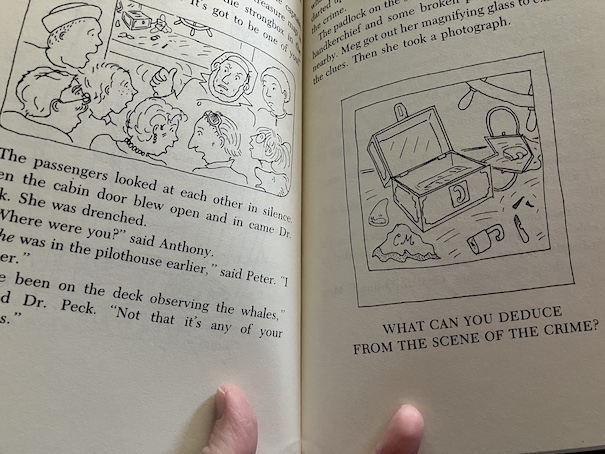
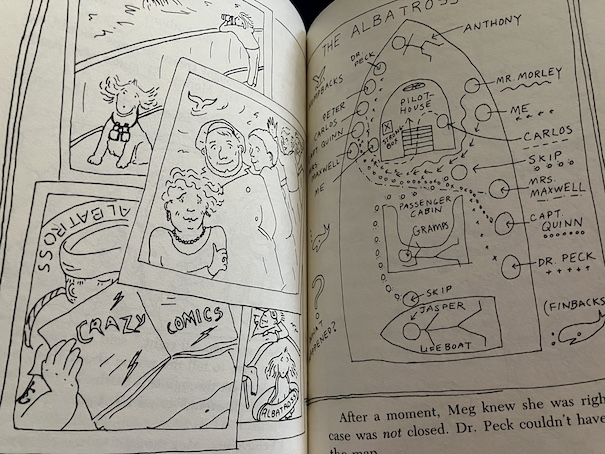
Who could have taken it? Various members of the whale watch have talked about their need for money, and Dr. Peck said that she thought the map should be destroyed to prevent damage to the environment. Meg goes over the pictures she’s take to find the thief!

The book is available to borrow and read for free online through Internet Archive (multiple copies).

I like the Meg Mackintosh books because it’s fun to solve the mystery along with the heroine. Like other books in the series, readers are supposed to use the story and the clues in the pictures to solve the mystery. At various points in the story, the story pauses for readers to figure out something about what’s happening, and these are good points for readers to check that they’re on track and to review the information they know so far. The story isn’t very long, but there are multiple points for readers to figure out something about what’s going on.

I did figure out the answer to this one very quickly. It’s partly because I’m an adult and this is aimed at children, but more importantly, I’ve seen the movie Charade with Audrey Hepburn, which used a similar plot device. The story did a good job of making all the suspects look like they had a motive, but when you figure out what the thief’s real goal was, there’s only one person who qualifies. Kids in early elementary school would probably find the mystery more challenging.

Swallows and Amazons

Roger Walker is staying at a farm near a lake for the summer holidays in 1929 with his mother and siblings. His father is away on a ship, a destroyer, and the family write letters to him. The children are particularly waiting for a reply from their father because they’ve asked him for permission to do something special, and their mother says that they will be allowed to do it if their father agrees. What they want is permission to sail the family’s sailboat, the Swallow, by themselves and to camp out on an island in the middle of the lake. They are all thrilled when their father agrees that they can do it! Roger is especially thrilled because, until their littlest sister, Vicky, was born, he was the baby of the family, and he was often left out of things that the older children were allowed to do.

There are a couple of conditions on the permission for the children to go sailing and camping by themselves. The first is that the two oldest children, John and Susan, are in charge. Roger and their other sister, Titty, will have to follow their orders. Before the children can camp out, their mother also makes them tents to use, shows them how to set up the tents, and takes them on a sailing trip so she can make sure that the children know what they’re doing. The excited children prepare for their sailing and camping expedition, giving themselves sailing roles, working out ship’s articles, and gathering supplies. John will be the captain of their ship, while Susan will be the mate and cook. Roger is a cabin boy, and Titty is an able seaman.

When the children go to the island, they find a nice place to set up their camp and a harbor for their boat. Surprisingly, they also discover signs that someone else has been on the island before them, but they don’t know who that is. They begin to think of the mysterious people who have been there before as “Natives” of the island, and they also start to think of their mother and other adults who help them as “Natives.” Their mother plays along with it, as if she’s part of one of the stories the children have probably been reading. When their mother comes to bring them some supplies, the children also mention seeing a man with a parrot on a house boat. The man helping their mother, Mr. Jackson, says that the man often has his nieces with him, but they don’t seem to be with him this time. The children’s mother tells the children where to go to pick up milk, and she says that she wants the children to talk to her every couple of days so she will know they’re all right and so they can pick up more provisions from her.

The children continue with their camping and fishing, and they continue to notice the man on the houseboat, who they think of as being like a “retired pirate” with his parrot. They also notice that he has a small cannon on his houseboat. One day, the children spot another boat approaching the island, sailed by a pair of girls. The children hide and watch the boat. Then, it sounds like the cannon on the boat goes off, and the “retired pirate” is on the deck, appearing to shake his fist at the girls in the boat. The children from the Swallow think that the man on the houseboat might be firing at the girls! The girls also run a flag with a skull and crossbones on it up their mast. The girls are being pirates! The children try to follow the girls’ boat, the Amazon, to see who the girls are and where the boat docks, but they lose track of the Amazon.

The lady who gives the children their milk talks to them when they come to get their supplies. She tells them not to bother Mr. Turner, the man on the houseboat. The children realize that Mr. Turner thinks of them as a nuisance, although they don’t know why. The crew of the Swallow takes it as the “retired pirate” stirring up the “Natives” against them. Then, someone steals their boat, the Swallow, and the children are set upon by the pirate girls at their camp!

There is a battle at the camp between the Swallows and the Amazons, but one of the Amazons asks for a “parley.” The crew of the Swallow confronts the Amazons about the theft of their boat, and the Amazons confront the Swallows about the campers trespassing on “their” island. The crew of the Amazon says they’ve been coming to this island for years, and they’re the ones who built the little fireplace the Swallows found when they started setting up camp.

During their “parley”, the children sort of continue their imaginary roles as explorers and pirates in their talk, but they also reveal some of their real backgrounds. The two girls from the Amazon explain that Mr. Turner on the houseboat is their Uncle Jim. At least, they say that sometimes he’s their uncle and is nice to them. They’ve been visiting the island for years, and their uncle is the one who gave them their boat. However, this year, their uncle is a hostile “native” and their enemy. The Swallows say that Mr. Turner has apparently been complaining about them to the local adults, “stirring up the natives” against them, so he is their enemy, too. The Amazons, Nancy (real name Ruth) and Peggy (Margaret) Blackett, suggest a truce between the Amazons and the Swallows and an alliance against their shared enemy, the “pirate” Jim Turner, characterized as a Captain Flint type character. If the two crews are allied, it won’t matter who technically “owns” or controls the island because they have a shared mission against their enemies, particularly Uncle Jim, aka “Captain Flint.” The Amazons admit that they really have wanted to be allies all along. The Swallows agree to this plan, and the two crews sign a treaty with each other.

As the two crews celebrate their new alliance, the Amazons explain how their uncle came to be their enemy. Usually, their uncle likes playing with them when they visit during the summer, sailing and exploring with them and teaching them things he knows about sailing. However, this year, he’s writing a book about his travels, and he doesn’t have time for them. He gets upset when they disturb his work, and the girls’ mother has told them to leave him alone when he’s working. The girls feel betrayed that he isn’t paying attention to them and gets annoyed by them. The day when the crew of the Swallow thought the man on the houseboat fired his cannon at them, the girls say that it wasn’t the cannon. They set off a firecracker when Uncle Jim was asleep as a prank, and that’s why he was shaking his fist at them as they fled in their boat.

It sounds like the Blackett girls have been a nuisance to their uncle because they’re hurt that he’s not spending time with them, and they’re trying to get his attention. Still, the Swallows enjoy their new alliance with the Amazons. Each of the crews has some experience sailing, the Amazons having learned what they know from their uncle and the Swallows having been taught by their father. John is impressed by what the Amazons teach them, but there are a few things that they know that the Amazons don’t. The two crews learn from each other, and they begin planning war games with their two ships to practice for a battle with their sworn enemy. In between, they enjoy their camping and exploring activities.

It turns out that Mr. Turner on the houseboat has been blaming the children from the Swallow for his nieces’ pranks with fireworks, which is why he’s been complaining about them to local people. When Mr. Turner leaves a complaining note at the Swallows’ camp, John realizes why he resents them. John knows that he could tell Mr. Turner the truth about who had the fireworks, but he doesn’t want to tattle on the Amazons because of their alliance and because Mr. Turner is angry and offensive and accuses him of being a liar when he insists that he and his siblings didn’t do what he’s accusing them of doing.

The Swallows and the Amazons start a daring war game with each other, a contest for them to try to capture each other’s ship. The winning crew will have their ship declared the flagship of the fleet! The Swallows attempt to capture the Amazon after dark, but their attempt is foiled because the Amazons sneak out of their house and head for the island that night. Titty, left alone on the island to mind their camp, realizes that the Amazons are on the island and decides on a risky plan to take their ship herself!

However, the children aren’t the only marauders abroad that night. When Titty takes the Amazon, she overhears some men in another boat. Some charcoal burners told the children from the Swallow earlier that Mr. Turner should make sure that he locks up his houseboat securely because they’ve heard some talk that someone might try to break in, but they never delivered the message because Mr. Turner accused John and his siblings of setting off the fireworks, and they forgot they were going to tell him what the charcoal burners said. The men that Titty overhears are suspicious, and they seem to be hiding something. After the Swallows win the mock war, the Swallows tell the Amazons what the charcoal burners said, although the Amazons are reluctant to tell their uncle to lock up his boat because they want to stage their own raid on it.

The Walker family will be heading home in only three more days and bad weather may be coming, so the children have to hurry to make the most of their adventures as Swallows and Amazons. Titty tells her siblings about the men who seemed to be hiding something, and she thinks it’s some kind of treasure. Her older siblings think that she probably dreamed about hearing men hiding something because she fell asleep on the Amazon, but Titty persuades Roger to come with her to find the treasure.

The book is available to borrow and read for free online through Internet Archive. This is the first book in a series, and it’s been adapted for film and television multiple times.

The author of the story, Arthur Ransome, named the character of Roger after Roger Altounyan, who he met when the real-life Roger was a child, visiting grandparents in the Lake District of England with his sisters. (Real-life Roger Altounyan later became a doctor and pharmacologist, known for a pioneering treatment for asthma.) The names of the fictional Roger’s siblings are also based on the real-life Roger’s siblings. The name “Titty” is odd, but it’s actually a nickname. The real-life Roger had a sister, Mavis Altounyan, who was called “Titty” as a nickname after a children’s story, Titty Mouse and Tatty Mouse by Joseph Jacobs. The character of Titty is sometimes called “Kitty” in some adaptions of the story.

Although the story explicitly states the year as 1929 when the Swallows and Amazons sign their treaty with each other, most of the book could take place at just about any time during the 20th century and into the 21st century because the children are dedicated to camping and sailing and don’t use any form of technology that would firmly date the book. The book has a timeless quality, and it’s the sort of independent adventure that many children dream of having!

The books in this series have been popular in Britain since they were first published, and they have also inspired other books for children on similar themes, having outdoor adventures with minimal adult help or interference. Enid Blyton wrote several series for children on these themes after Swallows and Amazons was published, such as The Famous Five Series and Enid Blyton’s Adventure Series, and Elinor Lyon started her Ian and Sovra series in the 1950s, explicitly stating that she wanted to write books with similar adventures for children but with child characters who weren’t as competent as the children in Swallows and Amazons. The children in Swallows and Amazons are very knowledgeable about sailing and camping and seem to do almost everything right, and Elinor Lyon thought it would be more realistic if the children in her stories didn’t entirely know what they were doing but somehow managed to muddle their way through anyway. There are also similar books by American authors written after Swallows and Amazons, like The Invisible Island by Dean Marshall.

The children in the story take their inspiration for their imaginary play from books they’ve read, like Robinson Crusoe and Treasure Island. All of the children in the story seem familiar with sea stories and books about exploration and island adventures, and they make references to aspects of them and use those aspects when they’re playing. For example, they refer to adults and anyone who is unfamiliar to them as “Natives” and “savages”, and they call their bottles of ginger beer “grog”, while tea is “hot grog”, lemonade is “Jamaica rum”, toffee candy is “molasses”, and tins of corned beef is “pemmican”, living out their fantasy that they’re sailors exploring unknown territory. Later, they compare Jim Turner, the man on the houseboat, to Captain Flint and call him that for most of the story. Some of the language that the children use, like “natives”, “savages”, and the phrase “Honest Injun” are racially out of date and can have some offensive connotations. The children probably got those phrases from the books they’ve been reading, and they seem to think of them innocently, as part of their imaginary play, living out the stories they’ve read, but modern readers should be aware.

The House in Hiding

The House in Hiding by Elinor Lyon, 1950.

This is the first book in the Ian and Sovra series, which takes place in Scotland.

Ian and Sovra Kennedy are brother and sister, and they live by the sea in western Scotland. Their father is the doctor in their small town. One day, after Ian and Sovra have been asking their dad to rent a boat for them so they can explore some of the islands just off the coast where they live, their father tells them that he has bought a boat for them. It’s just a small boat for rowing, but it’s theirs, and it gives them the freedom to explore that they want. There is one island in particular that they want to explore, the one they call Castle Island. Its real name is Eilean Glas, which means “Gray Island”, but they like to call it Castle Island because there’s a square-shaped rock in the middle of the island that looks somewhat like a castle. However, their visit to this particular island has to wait for the end of the book because other events intervene to distract them.

When the children come back from trying out their boat for the first time, they hear their parents arguing about how to accommodate some house guests. Their father’s fishing friend wants to come for a visit. He was going to rent rooms in town for himself, his wife, and their daughter, but the innkeeper has had a stroke and can’t handle guests right now. So, Dr. Kennedy has offered to host the family, but the Kennedy house isn’t very big. If the guests use the children’s rooms, Ian and Sovra will have to camp out in the bothy, which is an old hut in back of the house. Ian and Sovra sometimes camp there anyway for fun, but it does get damp when it rains. Mrs. Kennedy doesn’t like the idea of the children sleeping there if the weather gets bad, but the children think that it sounds like fun and tell their mother that they’ll be fine and that they want to do it.

Dr. Kennedy’s friend is named Tom Paget. Dr. Kennedy doesn’t like Mrs. Paget, although it isn’t completely clear why. All he says about her is that she likes to wear a cloak and paint with water colors, which doesn’t sound very objectionable by itself. (I was actually a little irritated at Dr. Kennedy because he makes repeated comments about how much he doesn’t like Mrs. Paget without offering any more information than that. If she’s just a little eccentric in her style of dress and likes art, so what? I found the parts in the book where they get nitpicky and really down on her irritating.) Their daughter Ann is about the same age as Ian, and because Dr. Kennedy hasn’t yet met her, he’s not sure what she’s like until the family arrives, although he makes a point of saying, to his children, directly, that he hopes Ann isn’t like her mother. (Nope, no further information about why, and Dr. Kennedy sounds rather rude.) Dr. Kennedy’s comments about Ann and her mother leave Ian and Sovra feeling unenthusiastic about their guests, so they plan to spend most of their visit staying out of their way and possibly avoiding Ann, too, if she turns out to be like whatever her mother is like. (Way to go, Dr. Kennedy. Let’s start this whole experience off on a bad foot with everyone primed to hate your house guests, shall we?) Ian thinks that their whole camping outside the house experience would be even more fun if they were further from the house, so they won’t have to deal with the guests poking their noses into the bothy to see where they’re staying or worrying about whether Ann will want to join them because that would be bad for vague reasons.

Ian and Sovra start camping out in the bothy before the guests actually arrive to get things in order. However, they accidentally set fire to the bothy during an accident with their camp fire. With the bothy burned, where are Ian and Sovra going to camp out while the guests use their rooms? Their parents won’t let them have a tent because it won’t be dry enough if it rains. Fortunately, an important discovery that Ian and Sovra make turn this misfortune into an adventure.

While their parents worry about finding them another place to stay during their guests’ visit, the kids go exploring further in their boat. Their boat gets caught in a whirlpool and is drawn around the back of a waterfall, where they find a hidden cave. More importantly, someone else discovered this cave a long time ago. There are stone steps carved into the rock and a metal ring set into the wall for tying up boats, showing the children that this is an intentional landing spot. When they go up the stone steps, they discover an old, abandoned cottage hidden in a green hollow. (They call it a shieling.) The old cottage is in remarkably good condition for being abandoned for a long time, and Ian thinks that if they clean it up, it would be the perfect place for the two of them to stay during the guests’ visit. Sovra thinks that their parents aren’t likely to agree because the cottage is too far from their own house and rather isolated, and the landing place behind the waterfall is too dangerous. However, Ian is sure that there’s a better landing place somewhere else, if they approach from another side. Upon further exploration, the kids find a collection of cottages that were once a tiny village, older than the shieling they found and abandoned for a long time. The little abandoned village does have a landing place, and they decide that was probably how the people who once lived in the shieling got to where they built their home. They have to be careful, though, because the area is surrounded by a bog that might contain quicksand, and they’re not sure how to get across or around the bog. In the end, they decide that the waterfall entrance is actually the best way to reach the shieling, and they learn to navigate the currents around the waterfall safely.

The children’s father finally gives them permission to camp out in the old shieling, although their mother still has misgivings because the parents aren’t completely clear on exactly where the children will be camping and haven’t seen it yet themselves. The children describe the shieling to their father and tell him that it’s over near Lochhead, another town nearby. Dr. Kennedy is satisfied from their description that the house will be safe to camp in and says that they can communicate with them daily by sending them a message by the postal van from Lochhead, and if they need anything, the parents will send it to them by the same van the next day. Their mother is still uneasy, but since their father is convinced that it will be fine, she finally agrees to let them go. Ian and Sovra are thrilled at having this secret house all to themselves, but Ian says that they will need to keep it a secret and be careful not to leave signs that they’re there, just in case someone still owns the old house and doesn’t want them there, even if they’re not using the house themselves right now.

The children’s discovery and use the shieling is not only the beginning of this story but also the rest of the series. The children’s secret hiding place not only provides them with a secret place of their own but also leads them to some important discoveries about their own family and other people. This book in particular focuses on the missing chieftain of the Gunn clan, who has been presumed dead, but it takes awhile for that mystery to enter the story.

While Ian and Sovra are enjoying their freedom in their secret house, the Pagets arrive with their daughter, Ann. Mrs. Paget turns out to be a somewhat eccentric woman, sometimes overly enthusiastic about little things, raving about them with some cutesy talk. She often elaborates her daughter’s name from Ann (which is what it really is) to the longer Annabel or Annabella (neither of which is her actual name) and referring to the absent Ian and Sovra as the “dear little children.” (Yeah, it’s kind of an annoying cutesiness, but I still think that Dr. Kennedy shouldn’t have been maligning her before she arrived.) Mrs. Paget isn’t just a hobby painter; she has actual shows of her work and has been successful at selling her paintings. When she arrives, she tells the Kennedys that she wants to find the best places in the area to paint, and she’s particularly interested in things like old castles, old bridges, and waterfalls. (I think you can see where this is going.) The Kennedys mention that there are abandoned villages in the area.

Mrs. Paget thinks that sounds exciting and asks about the history of these villages. The Kennedys say that they don’t know the full story behind them, but Donald, the old man they bought the boat from, might know. They think that the people who used to live there probably moved to the bigger cities to find work or something. (This is something that actually did happen to small villages in Scotland in real life. If you’d like to know more about the circumstances and see pictures, I suggest looking at Hirta Island. Although it looks like a pretty spot, living conditions there were harsh, and after a young woman died there who might have been saved if she had lived near a city with a hospital, the people decided that it was too isolated, and they didn’t have the population levels and support they needed to stay there.)

Poor Ann is bored and disappointed by the absence of Ian and Sovra. (Yeah, thanks again, Dr. Kennedy, for all the negative talk that made them not want to even meet poor Ann and be friends with her. In his first message to the children after the guests arrive, Dr. Kennedy makes fun of Mrs. Paget’s sandals, which he says are “made of pink string” and says he doesn’t know why Mrs. Paget wants them to meet Ann. Oh, I don’t know Dr. Kennedy. Let’s all think hard about this. Could it possibly be because Ann is lonely, there are no other kids in the area, and she could use a friend? Why is Dr. Kennedy so mean and weird about this? He’s an adult, for crying out loud! Ian and Sovra think that it would be “frightfulness” if they have to meet Ann and actually “be nice to” her if she’s like her mother. Keep in mind that they still don’t even know what Mrs. Paget is really like because they haven’t met her, and oh, noes, how awful to be nice to somebody who’s a little strange or eccentric during a temporary visit. What a family!) Ann often finds family holidays boring because she’s an only child. When her mother is busy painting and her father is busy fishing, Ann has very little to do and nobody to talk to. Ian and Sovra know that the Pagets have arrived, but they try to avoid meeting them, both because they think that they won’t like the Pagets, not even Ann, and because they want to keep the house where they’re staying a secret.

The very first time Ian sees Ann, he tries to run away from her and ends up falling and getting hurt. Ann tries to help him, although he resists at first, partly because he is afraid that if his mother finds out that he’s hurt, she’ll put an end to the camping trip. Ian messes up Ann’s name, calling her “Animosity,” and I’m not sure if he did it on purpose or because he actually has a head injury from his fall. (Actually, it was probably on purpose because he does it repeatedly from this point on in the story. No, Ian, “animosity” is what your family cultivates for other people and what I’ve been feeling each time your dad criticizes Mrs. Paget behind her back.) Ann messes up Sovra’s name, asking if Ian is saying “Sofa”, but I cut her more slack because Sovra is a more unusual name, and she’s not doing it deliberately. She’s just asking if she heard that right. Ian does explain that although Sovra mostly spells her name “Sovra” for school, her name is really supposed to be the Gaelic word “Sobhrach”, which means “Primrose.” Same name and pronunciation, but different spelling. Ann likes the name for being unusual. Ann goes to get some water for Ian, and while she’s gone, Sovra finds Ian and helps him into their boat. By the time Ann gets back, they’re gone.

Sovra worries about whether Ian has given away their secret to Ann. Ian says he doesn’t think so, but he has been rambling and not thinking straight since he hit his head, so he can’t be sure. He’s dizzy and disoriented and definitely showing signs of having a concussion. He should be checked out by a doctor, who happens to be his dad in this area. However, Sovra takes Ian back to the shieling. Ann worries about where Ian disappeared to, but she realizes that he couldn’t have gone anywhere by himself in his condition, so someone else must have come and helped him. She doesn’t mention what happened when she returns to where her mother is painting by the abandoned village because she doesn’t know where Ian is and can only assume that someone took him somewhere to get help. Both she and her mother spot smoke rising from the hollow where the shieling is, and Ann wonders if that could be Ian and Sovra’s campsite, although she isn’t sure. When Ian and Sovra get another note from their parents, it says nothing about Ian’s injury, so they realize that Ann didn’t tell the adults about it, and they begin to think more highly of her for keeping their secret. (Yeah, as if that was the smartest or most caring thing she could have done. But, these are kid priorities. You’d think with a father who’s a doctor that they’d know better than to be too cavalier about head injuries, though.)

However, soon, there are other things on the kids’ minds. When Ian went to go see Donald about a bung for their boat, he noticed that Donald has a special two-handled cup called a quaich, and his quaich has a symbol on it that’s the same as a symbol that was carved into the hearth of the shieling. Ian and Sovra wonder if that means that Donald actually owns the shieling. When they ask him about it, he tells them that the symbol is a juniper sprig and it’s the badge of the Gunn clan. Donald questions them about why they want to know, and they carefully say that they’ve seen the symbol carved somewhere else. Donald realizes what they’re talking about, and he tells them that he once helped to build the little house where they’re staying. Years ago, his cousins lived in the little abandoned village, and he found that secret cave behind the waterfall himself when he was young. He’s the one who created the secret landing place and stone steps. The Gunns once owned the village and the land around it, but the head of the family, Colonel Gunn, died without children. Since then, Kindrachill House, the bigger house where Colonel Gunn lived, has been empty. Colonel Gunn did have a nephew named Alastair, but everyone believes that he died somewhere in the Far East. Alastair used to live in the shieling where Ian and Sovra have been staying. Donald gives the kids permission to continue staying there, since it seems that the original owner isn’t coming back. He also tells them that there’s a superstition in the Gunn family that, when Kindrachill House is empty, the heir to the estate will not arrive until someone lights a fire in the hearth. Ian wonders if they really have to light a fire only in the hearth at Kindrachill to make the legend come true or if it would count that they’ve been lighting fires in the hearth at the shieling, where Alastair used to live and where he carved his family’s crest in the hearth. Sovra says that it doesn’t really matter since Alastair’s dead and can’t come back … but is that really true?

When things in the shieling are moved around when Ian and Sovra aren’t there, they assume that Ann has found their hideout. They know that she’s been looking for it. Later, she admits to them that she has been there, having figured out a way to get there that Ian and Sovra don’t even know about, but she didn’t move all of the things that have been moved. Someone else who knows about the shieling has been there. They know it’s not Donald because he has trouble walking and can’t make the trip to the shieling by himself. So, who else could it be?

The book is available to borrow and read for free online through Internet Archive (multiple copies).

My Reaction and Spoilers

The location of the story gives it an almost timeless quality. The children spend much of their time in nature, with few references to modern technology, so the story could take place in many time periods. However, the book is set contemporary to the time when it was written, in the mid-20th century, after WWII. That time period is especially important in the third book in the series. This first book in the series could take place during many possible decades, but the third book can only be set during the 1950s because WWII is important to that story.

There is a slight element of mystery to the story, but the kids aren’t actively trying to solve the mystery element. Mostly, it’s a kind of adventure story with elements of slice-of-life about how these kids spend their summer in an exciting location with a somewhat mysterious history. Little pieces of the situation are gradually revealed to the characters during their adventures. Kids like stories about other kids who have adventures without adult supervision, and parts of the story are about the fun things they do, setting up house in the old cottage and enjoying themselves in and around the secret hideaway.

The Kennedys’ Attitude Problems

I have to say that I didn’t like the attitudes of any of the Kennedys. I actually read the third book before this one, and I liked the characters better in that book. In this book, both the parents and the kids seem to be some kind of snobs. They’re negative and mean about Mrs. Paget and her daughter for little reason. Granted, I don’t like cutesiness much, but Mrs. Paget just seems to be a mildly eccentric artist who dresses a little oddly and acts overly enthusiastic about some things. I didn’t think there was any call for a medical man like Dr. Kennedy, who should be at least somewhat understanding about human nature because of his profession, to be so mean about the way Mrs. Paget dresses or try to discourage his children from being nice to Ann. There’s almost a mean girl exclusiveness quality to the Kennedys’ behavior. Most of the men I know have little knowledge about women’s clothes, but Dr. Kennedy sounds like a middle school mean girl, nitpicking the way the poor woman dresses. He even writes about it in the notes that he sends to his kids during their camping trip. The pink rope sandals bother him so much that he wants to put that in writing to his kids who aren’t even there and who should be polite to this guest when they actually meet. Dude, you live a “simple” life in a cottage near a small town on the coast of Scotland. You’re not exactly in a high society fashion district, and there are few people around to see or care what anybody dresses like. So what if she likes to wear cloaks with sandals? It’s an odd clothing choice because it seems to indicate that she’s dressing for two different types of weather at once, but it’s harmless. Calling the landscape “delicious” and the children “dear little children” (“dear” seems overly generous to me, but Mrs. Paget doesn’t know any better) might seems a little sappy, but again, so what if she’s somewhat sappy and romantic in her speech? Calling her daughter Ann by much longer names which she could have just named her in the beginning, like Annabel or Annabella, is also a little odd, but if Ann doesn’t seem to care, why should anybody else? Families do sometimes have odd nicknames for kids, and it’s not the worst I’ve ever heard. Going from a shorter name to a longer one is the opposite of what most nicknames do, but again, it’s just harmless eccentricity. None of the things Mrs. Paget does seem really that bad. Mrs. Paget doesn’t do anything rude or mean, and she seems like a pretty unobtrusive guest. Mostly, she just wants to find pretty spots where she can sit most of the day and work on her paintings while her husband fishes, so if they don’t like her cute, sappy talk, they don’t have to hear it much. She only seems to return to the Kennedy house to eat and sleep, and that’s literally the least a host can provide a house guest.

The Kennedys are fine in the scenes when they’re just by themselves, but when their guests are around, they’re barely holding back inner meanness and rudeness for the guests that seems completely undeserved. That was a constant source of tension for me while reading the book. When Mrs. Paget is asking about beautiful spots in the area with enthusiasm and interest in their history, Dr. Kennedy is thinking about the best way to answer her questions quickly so he can just talk to her husband (about fishing, I guess), like he just wants her to shut up. The men are going to go off fishing together, during which they’ll have hours to talk about anything they want, and Dr. Kennedy thinks it’s such an imposition to talk to Mrs. Paget for a few minutes when they first arrive about the area where he lives and its history, for which Mrs. Paget has only expressed admiration and interest. Mrs. Kennedy also seems oddly defensive to Mrs. Paget about the “simple” life they lead, which she seems to think is too simple for Mrs. Paget, but Mrs. Paget reassures her that isn’t the case, that she thinks the area is charming and the children’s camping trip sounds like fun. Mrs. Paget seems overly enthusiastic about how great it all is. Whether she’s really that enthusiastic on the inside, I couldn’t say, but at least she speaks positively and makes an effort to show interest. She is definitely interested in the artistic possibilities of the area and sincerely curious about its history. She follows up her curiosity by asking Donald about what he knows, which shows effort.

Meanwhile, the Kennedys are trying to hide their negativity, which seems to spring from ideas they have about Mrs. Paget that aren’t born out in real life. There’s little indication of how the Kennedys got these ideas except their own inner negativity and insecurity. When I was a kid, my mother would tell me to be nice to other people and to make visitors feel welcome, and even if I wasn’t having fun with particular visitors, to remember that their visit was only temporary and make the best of it until it’s over. You can feel any way you want, but you still have to behave yourself. Being nice to a temporary guest is not a terrible imposition, and putting up with a less-than-ideal guest is completely bearable and encourages return hospitality. The Kennedys don’t impart these lessons to their children, and the father seems to particularly discourage this thinking. This is the type of family that breeds little bullies, people who think that generally being nice to people is a terrible burden to endure. It really struck me as pretty rotten for Dr. Kennedy, a grown man in a position of trust and responsibility for the welfare of people in their community, to try to discourage his children from meeting and being nice to Ann, a lonely child who never did anything to Dr. Kennedy and doesn’t deserve this bad treatment from him, smearing her reputation and making it difficult for her to make friends. Why is Dr. Kennedy trying to get his kids to be mean to Ann instead of telling them to be kind to a guest and make friends?

Of course, I really know why the Kennedys have to be this way. It’s a plot device. Their reasons for not liking Ann and her mother don’t have to be fair or make complete sense because it’s the results that matter. It’s all to set up part of the conflict of the story. If Dr. Kennedy was nicer about Mrs. Paget and encouraged his kids to be nice to Ann, they wouldn’t be so worried about having Ann around or joining them on their camping trip. Ian wouldn’t have been so worried about Ann seeing him that he tried to run from her, fell, and got that concussion. If the kids were friendlier with each other, Ann wouldn’t have needed to get a ride from a stranger or might have told them about the man she met who gave her a ride and who turns out to be important. Quite a lot of the problems the kids encounter would have been different or simplified if characters were nice with each other and worked together more. It’s a theme that appears often in literature, and actually, quite a lot in real life, too. It doesn’t make it any less annoying for me.

Character Development

The parts where I thought Ian and Sovra were at their best were when they were completely by themselves. They seem to have a good brother-and-sister relationship and know how to function as a team. Even when one of them messes something up and they criticize each other, they still have each other’s back and work together to clean up their messes. However, I never really got to like Ian and Sovra as people during this book because of their meanness and snobbishness, which is ironic because they later say that they don’t like Ann because she thinks that she’s better than they are. This seems to be a retroactive decision by the author because she doesn’t show that trait right away. It seems to surface later in the story, long after Ian and Sovra have decided that they don’t like Ann and need to avoid her and think it would be frightful to be nice to her.

My favorite characters in the story are thoughtful Ann and kind Alastair. Yes, Alastair does appear in the story. He’s not dead. Ann is the first to meet Alastair on his arrival back in the area, and he helps her when Ian and Sovra have been mean to her, stealing her shoes so she can’t follow them back to their secret house from the beach and leaving her to limp back to the Kennedy house over rocks with a hurt foot. Ann vents to Alastair about her troubles with the Kennedys without knowing who he really is, and he tells her that he’s sorry that she’s having such a bad time and that the Kennedys have been unpleasant to her. Finally, a voice of reason and compassion in the story! Ann doesn’t mention this encounter with Alastair to anybody at first because she doesn’t know who he is, that they all think he’s dead, or that his return has any special meaning.

Little by little, Ian and Sovra do start to feel guilty about the way they’ve treated Ann and start looking at her differently, noticing the things she does well and acknowledging some of the skills and knowledge she has. Eventually, Sovra does apologize to Ann for stealing her shoes. When Ann is seasick the first time they take her out in their boat, she admits that she’s not as used to sailing as they are, which makes her seem less superior than Ian and Sovra thought she was. Ann even apologizes for talking like she knows everything when she doesn’t, but I still thought it was weird because that wasn’t the impression that I was getting from her until after Sovra and Ian started saying that’s what she was doing. The apologies they each give each other and their mutual acknowledgement of each other’s faults and strengths help them come to a better understanding of each other and resolve their conflicts.

Ann also proves to Ian and Sovra that she does know things that even they don’t know about the shieling and the area around it because of the questions her mother asked Donald about the history of the area. Donald told Mrs. Paget that there was once a pathway between the abandoned village and the shieling that was lost years ago, apparently swallowed up by the bog, and nobody knows quite where it is now. However, this summer has been drier than normal in the area, and Ann realizes that the path might have been exposed again by the lower water levels in the bog. She carefully observes the area from a high vantage point when they go hiking in the mountains until she spots where the path goes and marks it on her map. Then, the next time her mother goes to the village to paint, she scouts for the beginning of the path from the ground, finding a series of stepping stones through the bog.

When Ian and Sovra ask her later how she got to the shieling when she didn’t know about the waterfall entrance, she explains to them what she did, and they ask her to show them where the path is. I liked this part because Ian and Sovra were smug earlier about Ann’s map, saying that they didn’t need any local maps like that because everyone knows where everything around here is anyway, and their big source of pride with Ann was that they know more about the area than she does. (They thought that her explanations of what’s on her map when they asked her to show it to them earlier was just her trying to be “superior” to them.) They do know a lot from living there for their whole lives, but the problem is that they count too much on that sometimes and don’t think to ask the questions Ann and her mother do because Ann and her mother are aware of what they don’t know and are actively trying to learn.

I also liked it that when Ian and Sovra finally let Ann join them camping at the shieling, they also let her take over the cooking. Earlier, they took exception to her father saying that she’s an excellent cook because they saw it as bragging and acting superior, but Ann really is good at cooking and likes doing it, and Sovra admits that she isn’t terribly good at it and doesn’t really like it herself. I was relieved when the characters stopped worrying about who was superior to who and who was acting superior when they shouldn’t and just let people do what they’re good at and interested in doing, acknowledging when someone does something well without adding a kind of put-down onto it, like Ian and Sovra did earlier.

Alistair

Getting back to Alastair’s return, he eventually shows up at the shieling and talks to the children, explaining what happened to him. He says that he tried to talk to them before, but they weren’t at the shieling the last time he stopped by. His plane was wrecked in the Pacific (They don’t say that it happened during the war, so it might not have been. I thought they might have been implying that he was a pilot in the war, but that would play with the timing of later books in the series.), as they heard, and he spent some time living with a native group on an island. The natives were friendly enough and helped him, but it took him awhile to learn enough of their language to really communicate with them and figure out how to get to a place where he could arrange passage home. That was when he first learned that he’d been declared dead. Since then, he’s been reestablishing his identity and checking on the estate that he’s inherited. By the time that Alastair finally shows up at the shieling and introduces himself to the children, they’ve heard that Kindrachill House is supposed to be sold to pay the mortgage. When they ask Alastair about it, he confirms that he doesn’t have the money he needs to pay the mortgage. He almost didn’t come back to the area at all because he didn’t think there was anything there for him. However, it turns out that he’s an art lover, and when he went to a showing of Mrs. Paget’s paintings in Glasgow, he saw the painting she did of the old village and how she included the smoke rising from the shieling where Ian and Sovra were staying. That made him want to return to his old cottage and see who was there. So, the legend about a fire in the hearth bringing the Gunn heir home comes true.

There is an argument among the four of them whether Ian and Sovra should get the credit for Alastair’s return because they lit the fire in the hearth at the shieling or whether Mrs. Paget should get the credit because her painting is what drew it to Alastair’s attention, but it’s a good-natured debate. There is still the problem of the mortgage that needs to be paid, but Ian, Sovra, and Alastair find the solution to the problem when they finally go take a look at Castle Island, and Ann rescues them when they accidentally maroon themselves there. Since Ian was the first to spot the solution to their problem, Alastair thanks him by giving him the shieling so he and his sister can use it whenever they want. Alastair is able to save Kindrachill House and takes up his role as chieftain of the Gunn clan, which sets up the other stories that follow in this series.

My Favorite Parts

The best parts of the book for me were its timeless quality and the location. A secret house, forgotten by everyone, accessed by going behind a waterfall and climbing a hidden stone stairway is just the sort of place I would have loved as a kid. Even as an adult, I love the idea of a secret hideaway in a picturesque spot. The location and atmosphere are what I recommend to other readers the most. The imagery of the setting is wonderful, and it’s a great place to escape to mentally, if you can’t get to such a spot physically.

I also like books that bring up interesting facts and bits of folklore for discussion. At one point in the book, Ian explains singing sand to Sovra, which is dry sand that makes a sound when people walk on it under the right conditions. (This YouTube video demonstrates what singing sand can sound like on Prince Edward Island.) A less pleasant but still informative part is when Sovra breaks the necks of the fish they catch to kill them quickly. I’m not sure if I’ve heard of other people doing that when they fish or not. It makes sense when they explain it, but I know very little about fishing. I’ve never lived near bodies of water and haven’t gone fishing, and I get squeamish about things, so I’ve never asked.

On a day of heavy mists, Ian and Sovra are also fascinated with how muffled and mysterious the land looks and talk about how it probably inspired stories they’ve heard about ghosts and “second sight” and doppelgangers (although they say it as “doublegangers”). Ian explains how doppelgangers are like “the wraith of someone who’s still alive, so there are two of them.” This piece of folklore is why we refer to people who bear a strong resemblance to each other without being actual twins as doppelgangers. (Some people also call them “twin strangers.”)

Aria Volume 1

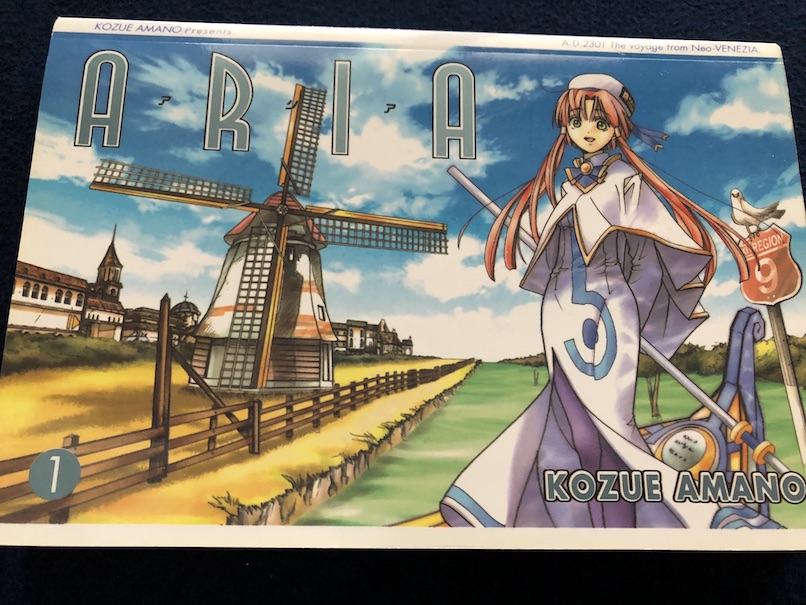
Aria Volume 1 by Kozue Amano, 2002, English Translation 2004.

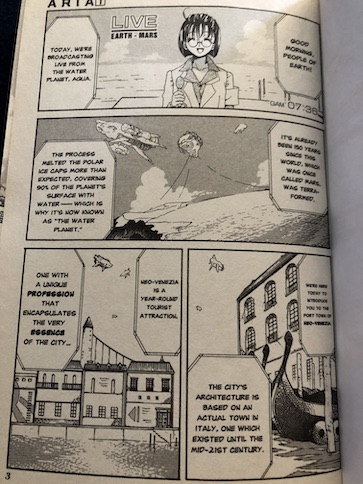
The is the first volume of the second part of a fascinating manga series that combines sci-fi, fantasy, and slice of life. The series takes place about 300 years in the future, when Mars has been terraformed and renamed Aqua (because of all the water on its surface). The human colonies on Aqua are designed to resemble old-fashioned cities on Earth (called Manhome here). The people of Aqua prefer a much slower pace of life than people on Manhome, and aspects of life on Aqua more closely resemble Earth’s past.

The series is divided into two parts. The first two books are the Aqua volumes and introduce Akari Mizunashi, the main character, a young girl who came to Aqua to learn to become a gondolier in the city of Neo Venezia (which resembles Venice). Female gondoliers, called Undines, give tours of the city, giving Akari plenty of time to admire the beauty of her new home and meet interesting people. The two Aqua books are the prequel to the main series, Aria. Aqua covers Akari’s arrival on the planet, her introduction to life on Aqua, and the beginning of her training. The main Aria series show Akari’s continuing training, her progression to becoming a full Undine, her evolving relationships with her friends, and as always, her delight in learning more about her new home and admiring its beauty.

The series has received some criticism for being slow and lacking danger and adventure, but that is not really the point of the series. The main purpose is to show people how to appreciate the small pleasures of life. The sci-fi and fantasy elements (the spaceships, advanced environmental controls, intelligent Martian cats, and even the occasional appearances of the legendary Cait Sith) are mainly background to the stories about the magic of friendship and simple pleasures. Each volume contains a few short stories about Akari and her friends and the little adventures they have on a daily basis and the life lessons they learn. It’s a great series for relaxing when you’re stressed out.

The stories included in this volume are:

Neo-Venezia

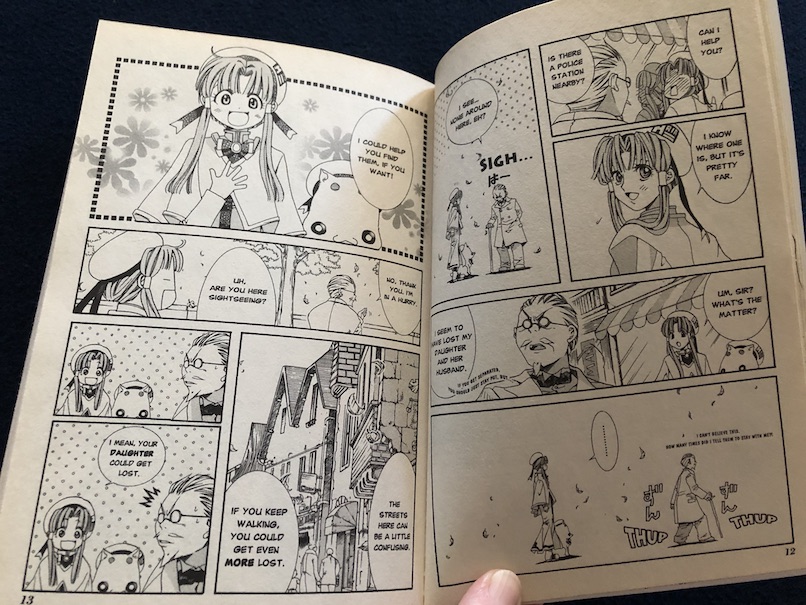
As autumn comes to Neo Venezia, Akari encounters a grumpy old man, a visitor from Earth, who has gotten separated from his daughter and lost in the city. He is frustrated with the confusing and inconvenient nature of Neo Venezia.

Akari says that she can help him find his daughter and gives him a tour of the city, showing him the beauty of the city and changes his mood with the help of some baked potatoes and green tea. A slower pace of life and appreciation for the little pleasures has benefits.

Drydocking

It’s time for the gondolas to be cleaned, so they are moved onto dry land. Akari and her friend, Aika are in charge of the cleaning, but it is Akari who makes it fun.

The Bridge of Sighs

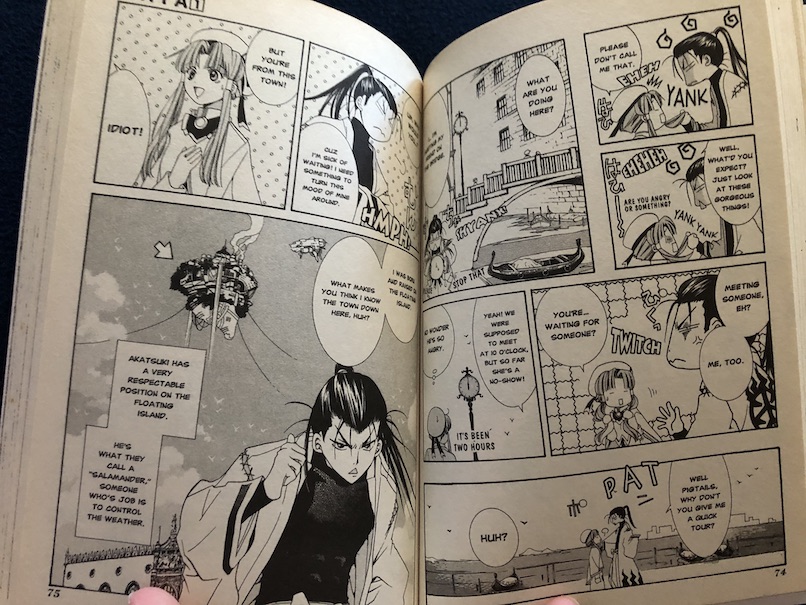
Like the original Venice, Neo-Venezia also has a “Bridge of Sighs.” Akari goes there one day to meet Aika and finds her friend, Akatsuki, waiting for someone. Akatsuki is impatient while he is waiting, so he convinces Akari to give him a short tour to pass the time. Akari tells him about the original Bridge of Sighs and how she thinks the name is still appropriate but for a different reason.

The original Bridge of Sighs, as Akari explains, was between an old courthouse and a prison, and the prisoners were said to sigh as they crossed the bridge because they were being led away to be incarcerated. However, Akari sighs because she likes living in the beautiful city of Neo-Venezia and feels like she’s lucky to be there. Her sigh is a sigh of contentment.

When the person Akatsuki is waiting for shows up, it turns out to be his older brother, who also appears in later stories.

Sun Shower

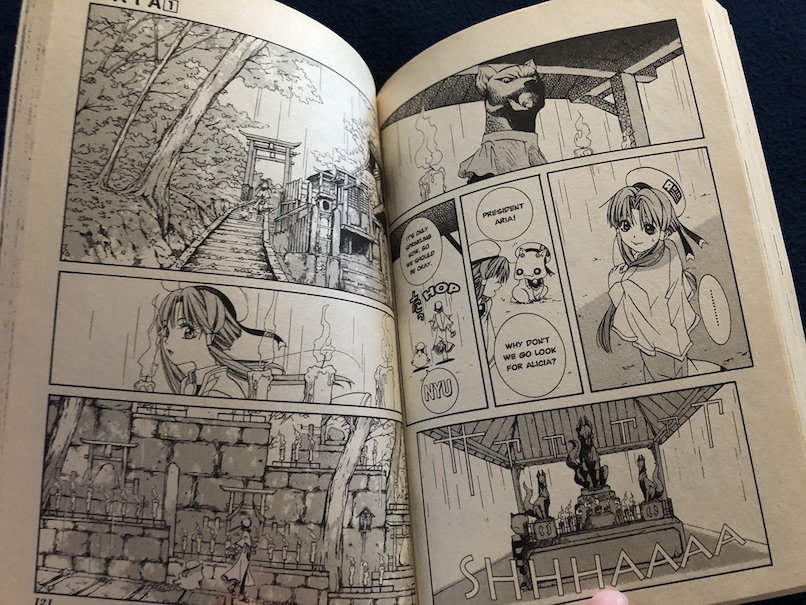
Although Akari lives in Neo-Venezia, which is designed to look like Venice, there are other parts of Aqua designed to look like different parts of Earth. Alicia takes Akari to an area much like Japan to see the changing autumn leaves and get some inarizushi.

They see a shrine on the island, and the woman at the sushi shop tells them a Japanese legend about the fox’s wedding, giving them a warning that the Inari fox might spirit them away to another world.

While admiring the red autumn leaves, Akari finds herself separated from Alicia, and she witnesses a strange wedding procession. When she seems to be invited to join it, she thinks quickly and gives the procession her inarizushi instead.

The story explains that a Japanese term for a sun shower (when it rains while the sun is still shining) is “the fox’s wedding.” Sun showers happen quite often when it rains where I live in Arizona, and I now think of this when I see one. I also know where to get some inarizushi. The Aria stories are good for making me want different types of food, whether it’s inarizushi or baked potatoes and green tea or pudding (from a previous book).

Vogare Longa

This story is based on a real gondola race that takes place in Venice.

Akari and Aika are told about the Vogare Longa gondola race, which all of the gondoliers, including the trainees, will participate in. Aika is determined to make a good showing in the race because there’s a rumor that it is used to judge trainees, but Akari gets caught up in the beauty of the day.

In the end, Akari admits to herself that she never forgot what Aika said about the race being used to judge trainees, but she just didn’t want to hurry because she was enjoying herself, and that’s the way she feels about her training in general. Akari wants to become a full Undine, but she wants to do it at her own pace and enjoy herself along the way.

It turns out to be just as well because the rumor about the race being used to judge trainees was only a rumor.

The Story About Ping

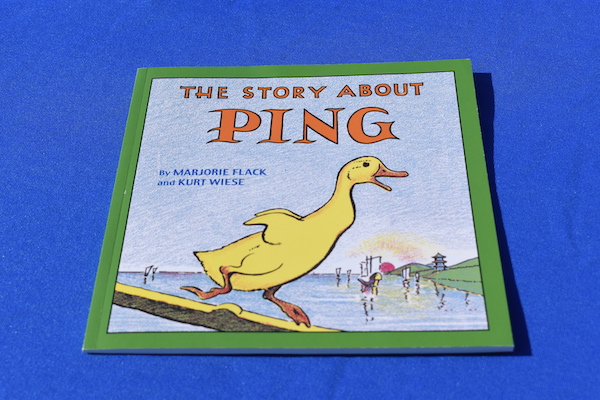
The Story About Ping by Marjorie Flack and Kurt Wiese, 1933.

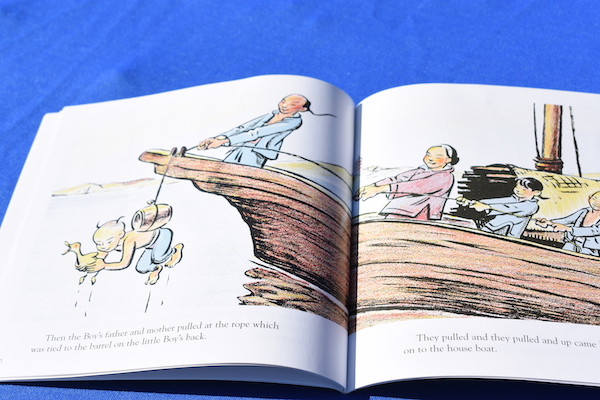
Ping is a small duck who lives with his family on a boat on the Yangtze River in China.  Every morning, the master of the boat lets the ducks out to look for food on the river, and every evening, he calls them back. 

However, Ping hates it that the master gives the last duck to return at the end of the day a spank on the back, so when he realizes that he is late to return one day, he hides and is left behind.

After sleeping on the river bank overnight, Ping sets out to find his family the next day.  However, there are many different boats on the river, and he has trouble finding the one where his family lives.  As he searches, he is captured by a boy who brings him onto his family’s boat.

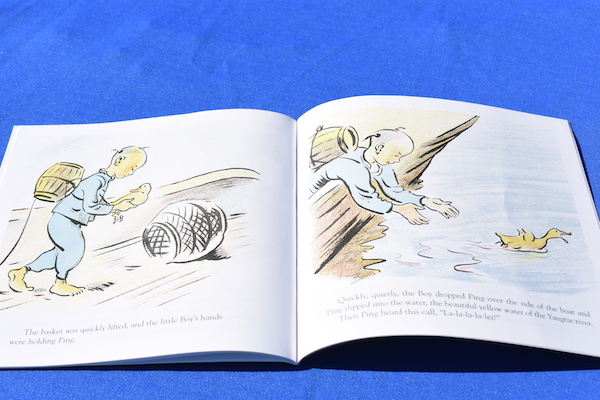
To Ping’s horror, the family who captured him plans to eat him for dinner!  However, the boy who grabbed Ping out of the water thinks that he’s “too beautiful to eat.”  Without letting his family know, the boy frees Ping from the basket where he is being held captive.

As Ping swims away from the boy’s boat, he hears the master of his family’s boat, calling out for the ducks to return.  This time, Ping does return to his family’s boat, even being willing to take a spank for being late, glad just to be safe with his family.

In a way, this little story reminds me of one of the short humor stories in Wayside School is Falling Down.  In that story, a boy at a very strange school gets tired of following the school’s rules.  Some mysterious men explain to the boy that the rules are meant to keep the students safe and choosing whether or not to follow the rules means choosing between freedom and safety.  The story and the boy’s choice are meant to be humorous, but it is a good point about the purpose of rules.  Probably, the reason why the master on Ping’s boat spanks the last duck is to give all of the ducks a reason to hurry back to the safety of the boat.  Ping doesn’t really appreciate that until he sees the dangers that wait for a small duck, alone on the river.  In the end, he is willing to accept some discipline because he wants the safety it promises.  It’s not the usual message in a lot of modern children’s books, especially in the United States, where people and book characters tend to value freedom over safety (the choice made by the boy in the Wayside School book).  However, in this book, Ping and his family have something between total freedom and total captivity – they are allowed to swim pretty freely during the day as long as they return to the boat for safety at night. They get both some freedom and safety in exchange for following the master’s routine. Ping’s danger only comes when he breaks away from that entirely.

But, if you think that analysis is getting too deep, Ping’s adventures and his return to the safety of his family are endearing for lovers of animal stories. Kids who encounter this story will be reassured that Ping is still able to return to home and safety after his adventures!

The story has appeared in film and on television more than once. The book is available to borrow and read for free online through Internet Archive (multiple copies).

The Haunting of Cabin 13

Cabin13The Haunting of Cabin 13 by Kristi D. Holl, 1987.

Thirteen-year-old Laurie is looking forward to her family’s vacation. They’ve rented a cabin for a week, Cabin 13, by the lake at Backbone State Park (It’s a real state park in Iowa. Link repaired 10-19-22.), and her friend Jenny is staying there with them. Laurie’s mother isn’t looking forward to the trip. She hates dirt and bugs and doesn’t like the cabin when they arrive. As everyone starts unpacking, Laurie looks around the cabin and finds a note that warns them to leave because the cabin is haunted. Supposedly, it was written by the ghost herself. The note is signed “Eleanor.” Laurie’s mother thinks that they should leave right away, but Laurie and the rest of the family persuade her that it’s just a joke. At first, Laurie’s sure that’s all it is.

Then, the park ranger tells the family that the other families who have tried to stay in that cabin this summer also found similar notes. It might be just a prank, but it might not. He also tells them that a girl named Eleanor, the same age as Laurie and Jenny, drowned there the summer before, and strange things have been seen there since, like lights around the lake. Laurie’s brother, Ricky, thinks it sounds cool that they’re staying in a haunted cabin by a haunted lake. Like others, Laurie thinks that the notes are the product of a prankster, but what would be the point behind it?

The girls meet a pair of brothers who are staying nearby, Kevin and Matt. When they tell them about the note, Matt is eager to investigate. Jenny enjoys flirting with boys, and she’s mostly interested in flirting with good-looking, athletic Kevin. Matt is in a wheelchair, so Jenny doesn’t pay much attention to him. She just makes an awkward comment about cripples being able to contribute to society that makes everyone feel uncomfortable. Although Laurie knows that Jenny’s comment was inappropriately personal and callous, Laurie also underrates Matt’s ability to help with their note mystery at first, and she’s shy about talking to him because she’s often shy around boys. However, needing someone to confide her thoughts in when Jenny isn’t interested, Laurie talks to Matt about her theories about the mysterious notes. Matt turns out to be easy to talk to, helping Laurie get over her nervousness about talking to boys.

At first, Laurie tells Matt that she thinks that the prankster is trying to drive people away from Cabin 13 because something important is hidden there. However, as she starts asking questions about Eleanor, she learns that the notes haven’t just been directed at Cabin 13. Staff at the park have also received notes from “Eleanor.” Laurie also sees a figure in black sneaking around the park, who she is sure is not a ghost.

It isn’t long before Laurie receives more notes from “Eleanor,” hinting that she might be in danger, and she and Jenny see the mysterious lights that people have been talking about. Then, when the children are out in a canoe together, it develops a leak and sinks. Matt panics because his legs are paralyzed, and he can’t swim, but Laurie saves him with the help of some people in another boat.

Was that accident just an accident, or could it have something to do with Eleanor’s “accident” last year? There are plenty of suspects who might have reasons for playing ghost and stirring up trouble at the lake. Matt’s father blames the park ranger for the accident that paralyzed Matt. At a previous visit to the lake, Matt was crossing a road with his father and brother and was struck by a speeding car. Matt father says it wouldn’t have happened if the roads had been policed properly. Laurie realizes that he might have a motive for revenge. Then again, some people have been coming to the lake, drawn by the ghost stories and hoping to see the mysterious lights. Could the ghost be a publicity stunt to drum up business?

The book is available to borrow and read for free online through Internet Archive.

My Reaction and Spoilers

When Laurie discovers that Eleanor’s half sister has come to the lake to investigate Eleanor’s death herself, she thinks that she has the mystery solved, but she’s only half right. It’s true that Eleanor’s sister has been responsible for some of the things happening at the lake, but not all of them.  She explains to the kids that Eleanor loved mystery stories and was always playing detective games, but she thinks that perhaps the game got too real for Eleanor the summer that she died.  There is something sinister going on at the lake, something that Eleanor also realized before her death, and there is more to Eleanor’s death than most people know.

At the end of the book, Matt gets a chance to be a hero and stop the bad guy from escaping, using his wheelchair to his advantage because a person on wheels can sometimes move faster than a person on foot.  Even before that, Laurie had gained an appreciation for Matt and his sensible thinking, realizing that a person who is impaired in one way can still have great abilities in other areas of life.  She also comes to think of Matt as being brave for coming back to the site of the accident that made him a paraplegic.  Matt says that he had to come in order to prove to himself that there was nothing inherently bad about the  place and to stop the nightmares he was having about his accident.  Matt and Eleanor’s sister both make Laurie realize that everyone has something difficult or frightening that they have to deal with in their lives; it’s just that some people’s problems are more obvious than others.  Everyone can see what Matt’s dealing with at first glance because he’s in a wheelchair, but no one knew about the pain and fear that Eleanor’s sister was carrying around with her until she admitted it.

I consider this story a pseudo-ghost story because the obvious parts of the haunting were caused by living people, for reasons of their own.  However, Laurie seems to feel that Eleanor’s spirit was there with them, waiting to see the mystery of her death solved.  It’s left open to interpretation, but if Eleanor was there, it was only seen in the odd feelings that Laurie had from time to time, not in any more obvious or physical way.

Something that confused me a little in the book is that, at one point, Jenny tells someone that Laurie already has a reputation for being an amateur detective, having discovered that Jenny herself had been kidnapped when the authorities thought that she had run away from home. Jenny gives full details of the time when she was kidnapped, including who kidnapped her and why and how Laurie figured out where she was. When I read that section of the story, I thought at first that the author was talking about a previous book that she had written with these two characters, but I had trouble figuring out which it was, if any.

Interesting fact: some of the children in the story are named after the author’s own children.

The Ship That Never Was

ShipThatNeverWasThe Ship That Never Was by Mickey Spillane, 1982.
Larry Damar and Josh Toomey are sailing in a boat off the coast of Peolle Island in the Caribbean when they rescue an old man from what seems to be a skiff. But, as soon as they get him aboard their own boat, they realize that what they thought was a skiff is actually more of a long boat, and it looks old. Very old.

They take the old man, who is suffering from exhaustion, to their fathers. While the old man rests, they inspect the boat and confirm that it is an antique. Oddly, from the condition of the wood, they believe that it has been resting in water for some years, but not salt water. It’s the kind of longboat that would have been carried aboard larger naval ships from a couple hundred years earlier. The name on the side of the boat, HMS Tiger, is familiar, but they heard that it was lost at sea ages ago. The old man is also carrying what appears to be some very old documents, but they are unable to read them, and when the old man speaks, they’re not quite sure what language he’s speaking.

They send a message to Sir Harry Arnold at the antiquities department of the British Naval Archives about the boat and the old man. When he arrives, he confirms that the longboat came from the HMS Tiger, a three-masted ship built in England in 1791. The Tiger was considered a jinxed ship because of everything that went wrong during its construction and its maiden voyage. Because of that, no one wanted to sail on it again or even work on the ship to dismantle it. So, the builder decided to send the boat on one last voyage by itself. He and his men loaded up the ship with supplies as if it had a crew aboard and then set it adrift, watching it sail off majestically, without a crew. Everyone had assumed that it would have eventually sunk, damaged by the weather, but apparently, it survived for longer than anyone had suspected.

Since no one can understand his language, the old man, who calls himself Vali, draws pictures to explain to them where he came from. Vali indicates which island he came from, and according to his other drawings, he lived there with many other people until many of them were killed in some kind of storm. He also draws a picture of a young girl with a crown on her head. Then, Larry’s dad, Vincent, recognizes the seal on a signet ring that Vali shows them. Vincent has read about the history of the country of Grandau (fictional country), and he recognizes its royal seal.

About 200 years before, Grandau was overrun by a neighboring country. Members of the royal family of Grandau escaped the invasion along with some loyal servants and tried to flee across the Channel to England to seek sanctuary. However, they were only in an old fishing boat, and it was thought that it sunk in a storm before they reached England because such a small craft would be unlikely to have survived. Grandau has not been a happy country since then. Over the years, they have been ruled by a series of dictatorships, and it has been in an almost constant state of unrest.

Now, the presence of the longboat from the HMS Tiger presents a much more intriguing theory of what happened to King Tynere of Grandau and his people. By an unbelievable coincidence (your suspension of disbelief is required for this story), the royal family’s attempted escape to England happened around the same time that the HMS Tiger was sent off alone and fully equipped for its final voyage. It now seems that the desperate people on the fishing boat were saved by encountering this grand, unmanned ship that no one else wanted, that everyone feared was jinxed. Grandau was not a seafaring nation, so the people were probably unable to actually sail the ship, simply letting it drift until they found land. Eventually, they arrived at an island in the Caribbean, and their descendants have been living there ever since in anonymity, until the disaster that prompted Vali to risk venturing out for help.

Unfortunately, their attempts to determine what language Vali was speaking and where he came from have also come to the attention of the wrong people. The government currently in power in Grandau has been working hard to stamp out the history and culture of the country in order to tighten its hold on the people, although their hold has never been more than tenuous, just like all the other dictatorships since Grandau’s royal family fled. Now that word has reached them that members of the royal family that the people of Grandau mourn may actually still be alive, they are determined to eliminate them before they can return to their ancestral home.

The author of this book, Mickey Spillane, is best known for his Mike Hammer series of hard-boiled mysteries for adults, and some of his hard-boiled style shows in this adventure book for children. This book is also part of a short series, although I don’t have the first book, The Day the Sea Rolled Back. In that book, Larry and Josh are helping their fathers hunt for sunken treasure, but their efforts are being sabotaged by a pair of treasure-hunting brothers.

The Case of the Vanishing Villain

The Case of the Vanishing Villain by Carol Farley, 1986

As you can see, my copy of this book has been … well-loved.

This is the first book in a series about two sisters, Flee Jay (short for Felice Jennifer) and Clarice Saylor. Twelve-year-old Flee Jay wants to be a detective, just like in the books she’s read, but her pretty younger sister is a child genius who has more aptitude for it. Clarice is somewhat eccentric for a ten-year-old, but she is also intelligent and logical and has a memory for details and obscure facts. Throughout the series, the two of them kind of compete to solve mysteries. Although Clarice usually comes up with the solution before Flee Jay, it usually takes the two of them together to get to the bottom of things because Flee Jay is an average kid who behaves like an average kid and helps Clarice understand how average people behave.

The story begins with an explanation and a request for help from Flee Jay. She and her genius younger sister, Clarice, were taking an early morning ferry from Michigan to Wisconsin to visit their grandparents when a series of strange events connected with an escaped convict took place. Clarice managed to solve the mystery, but Flee Jay wants readers to go through the events as they happened to see whether any normal person could have solved the mystery like Clarice did.

From that point on, Flee Jay describes what took place from the moment they arrived at the ferry until just before the ferry docked at its destination. She introduces all of the strange passengers on the ferry, including a family of three women who may have unwittingly brought the convict on board, a woman with an annoying barking dog, a bearded man with a guilty secret, and the overly-attentive ship’s steward, Mr. Woolsey, who is keeping an eye on the girls during the trip.

VanishingVillainPic

From the moment that Flee Jay learns about the escaped convict from Clarice, who “accidentally” overhears the police and Mr. Woolsey talking about him through a vent while standing in the sink in the ladies’ room next to Mr. Woolsey’s office, Flee Jay wants to be the one to find him. At first, they don’t really know whether he’s on the boat or not, but when the boat is underway, a woman screams that there was a strange man in her stateroom, and then, they’re pretty sure. Flee Jay and Clarice take it upon themselves to consider all the hiding places and to question the other passengers. Of course, Clarice produces the solution to the puzzle, but she does credit Flee Jay with inspiring her. According to Flee Jay, she just figured things out because she’s nosy, but that’s left to the readers to decide.

Join eccentric 10-year-old genius Clarice and her long-suffering sister as they try to put the pieces together to keep the convict from getting away right under the noses of the authorities!

The book is written with humor and is fun to read. The clues fit together neatly, and the black-and-white pictures, list of characters, and map of the inside of the ferry help readers understand the action.

The book is currently available through Internet Archive.