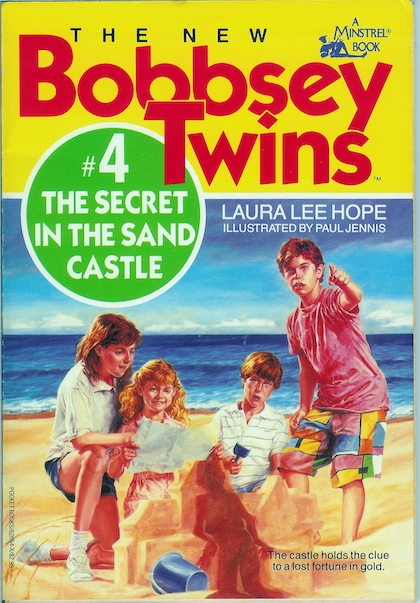
#4 The Secret in the Sand Castle by Laura Lee Hope (Stratemeyer Syndicate), 1988.
Before I begin, I’d like to acknowledge Sean Hagins, for supplying me with photos of this book! Usually, I take pictures of books myself, but I just couldn’t find a physical copy of this one. Sean is a big fan of the Bobbsey Twins, particularly the New Bobbsey Twins mysteries, and you can see some of his video reviews as well as videos about his photography work on his YouTube channel, SJHFoto. Thanks, Sean!
The two sets of Bobbsey Twins and their parents are spending a few weeks in an old house at Beachcliff Bay. It’s sort of a working vacation for their parents. Mr. Bobbsey owns a lumber yard, and he’s helping a local builder, Jim Reade, to either find some antique Victorian wooden gingerbread house trim or make new ones to match a home restoration project. Meanwhile, Mrs. Bobbsey is planning to write a travel article about the area for their local newspaper.
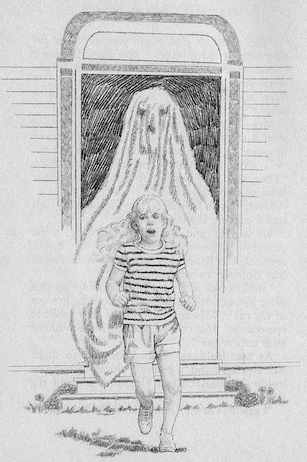
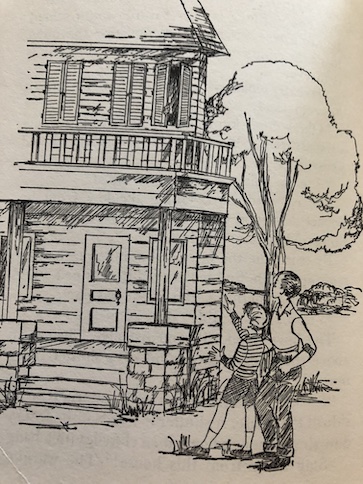
The house where the family will be staying is called the Wilson house, and it’s one of Mr Reade’s recent renovation projects. Flossie is the first in the family to go inside, and she is startled by what she thinks is a ghost. It turns out that it’s only the caretaker, Pete Smedley, taking the old dust sheets off the furniture. It’s not entirely reassuring because Pete says that there are stories about the old Wilson house being haunted by the ghosts of its former owners, who drowned in the nearby bay. He says that he knows when the ghosts have been there because they move things around and leave trails of water, seaweed, and seashells. Mr. Reade thinks that Pete’s stories are nonsense and that the strange things he’s observed are due to windows in the house being left open or something like that.
The inside of the Wilson house is as elaborate as the outside. The Bobbsey twins unpack their things and claim rooms for themselves upstairs. Flossie is quick to claim the biggest room with the best view for herself, and she asks Bert to help her move a mirror she likes into her room. They don’t have anything to hang the mirror, so they set it on Flossie’s bed. Strangely, they later find the mirror still on the bed but broken, and they don’t know how that happened.
Nan is curious about the Wilson family and the history of the house, so she and Freddie take a trip to the local library. There, Nan learns that the last two members of the Wilson family were a brother and sister, called Clay and Jennie. They were both artists, but they never made much money. Badly in need of money, they apparently robbed an armored car and stole gold bars. They tried to escape in a boat, but it was lost in a storm. The Wilsons apparently drowned, although their bodies were never found. The police thought they might have hidden the gold somewhere before getting on the boat, but nobody ever found the gold they stole.
Mr. Reade tells the children that his son, Jimmy, is entering a local sand castle contest, and the Bobbsey twins decide that they would like to enter the contest, too. Nan thinks they should try to build a replica of the Wilson house in sand. Unfortunately, Jimmy turns out to be a troublemaker, and it doesn’t look like he wants to be friends with the Bobbsey twins.
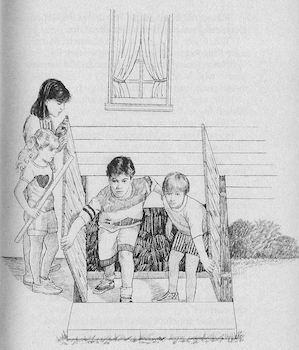
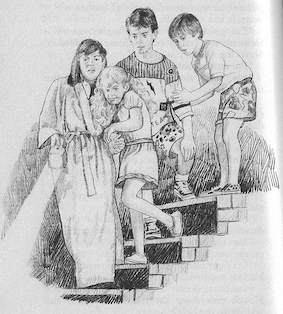
While the girls go to the store, Bert and Freddie decide to check out the old root cellar at the house, and someone traps them inside. The girls let them out when they get back. Then Flossie finds a secret passage and hidden stairs. Mr. Bobbsey says that it was once a servants’ entrance that had been sealed off. Later that night, a ghostly figure tries to enter Nan’s room! Could it have been Jimmy. playing a nasty prank, or is it someone looking for the lost gold? Could it even be a real ghost?
The book is available to borrow and read for free online through Internet Archive.
My Reaction
From the beginning of the book, I had a favorite suspect. However, this is one of those mysteries where there is more than one person involved, and they’re not working together. In the end, I was right about my main suspect, but having a second person doing suspicious things made the mystery more interesting. The title is a little misleading because the story is really about the search for the hidden gold from the robbery, not about the sand castle contest. The sand castle contest is more of a side issue, although studying the design of the house to build the sand castle version leads the kids to the solution of the mystery.
Because this book is from the late 1980s, there are things in the story that were more a part of my childhood than the lives of 21st century children, like renting videotapes. I was about the age of Freddie and Flossie when this book was first published, so it’s a bit of a fun nostalgia trip for me, both because I read books in this series when I was young and because some of the things the kids do in these stories are similar to things I did at their age.
The Bobbsey Twins’ Adventure in the Country by Laura Lee Hope,1907, 1961.
Before I explain the plot of this story, I have to explain that this is one of the early Bobbsey Twins books, originally published in the early 20th century, and like other Stratemeyer Syndicate books that were still in print during the mid-20th century, it was revised from its original form to update the language, culture, and technology in the story and, especially, to remove questionable racial terms and caricatures. The physical copy of the book I read as a kid was the revised version, and I didn’t know about the revisions until I was an adult. When I describe the plot at first, I’m talking about the revised version, but I’m also going to explain some of the differences between the original version and the revised version, so you can see what changed.
The two sets of Bobbsey Twins (Nan and Bert are the elder set of twins and Freddie and Flossie are the younger set) are enjoying their summer vacation at home when their mother receives an invitation for the family to visit the children’s aunt and uncle on their farm and to attend an auction that will be held somewhere nearby. The aunt says that there is something that will be sold at the auction that she thinks will interest the family, but the adults are keeping it as a surprise. The children are excited because they like visiting the farm, and they’ve never been to an auction before.
Mr. Bobbsey has to work at his lumber yard, so the children and their mother take the train to the farm ahead of him, accompanied by their cook/housekeeper, Dinah. (Dinah is black and is a recurring character in the series. The book refers to her as “colored.”) The train trip is a bit chaotic because they nearly forgot to bring their packed lunch, and then, Fred’s cat escapes from its carrier and is nearly left behind when they reach their destination. However, they do get there safely.
At the farm, the children enjoy seeing their cousin, Harry, and visiting all the animals. Freddie loses one of the calves when he tries to take it for a walk, like it’s a dog, and at first, the children fear that it fell in the river and drowned. Fortunately, someone from a nearby farm finds the calf and brings it home. These unrelated misadventures are just the beginning of the children’s summer because there is a mystery that seems to be unfolding at the farm.
On their first night at the farm, Flossie wakes up in the middle of the night because she hears someone playing the piano. She wakes Nan, and the two of them go downstairs, but by the time they get there, whoever was playing the piano is gone. At first, the children’s uncle thinks that it was just a dream, but Nan knows that it wasn’t because a piece of sheet music was knocked off the piano. Later, when they hear the piano at night again, there are smudges on the keys.
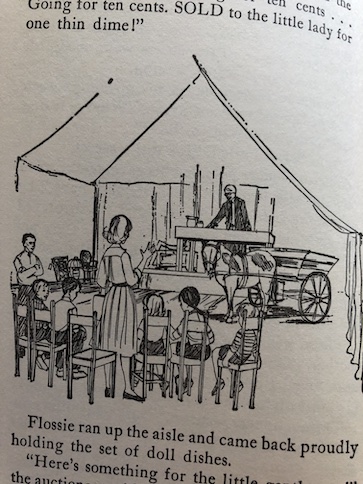
The auction is fun. The children each have a little money to buy something small for themselves, just for the experience of bidding on something at an auction. They all find something to buy, and some of the things they find are funny and eclectic. The mystery object that their mother is there to buy is a pony and cart. A neighbor of the aunt and uncle had a pony and cart that his grandchildren used, but they’ve moved away, and the Bobbseys have decided to buy it for their children. The twins’ aunt and uncle are willing to keep them at their farm because they can’t have a pony in the city, and their cousin can use them when the twins aren’t there. The children love the pony, and they have fun with him and the cart with some other kids. However, when they return to the farm after they auction, they discover that the family’s prize bull has been stolen!
The story is somewhat episodic, but there is a thread of mystery that runs through the whole book as the children try to find the missing bull. There’s a boy from New York City who was lost from a group heading to a nearby Fresh Air Camp (part of a charity that has existed since the 19th century to provide poor city children with enriching summer experiences in the countryside – I referred to it before in another vintage children’s book, Ruth Fielding at Sunrise Farm) who witnessed the theft but didn’t realize that the men he saw didn’t own the bull. There’s a Fourth of July celebration and a picnic with other kids, including a local bully. There is some real danger, where Flossie falls over the edge of a cliff and has to be rescued, and the family has to evacuate the farm temporarily when they fear that a nearby dam might break after a fierce storm. Along the way, the Bobbsey twins gather pieces of information that help them find the missing bull.
The book is available to borrow and read for free online through Internet Archive (multiple copies). The original edition of the book is public domain and available online through Project Gutenberg.
My Reaction
The Mystery
The mysteries in the story are pretty simple. The story is pretty episodic, and the nighttime piano-playing is unrelated to the theft of the bull. The reasons for that are partly related to the way the book was written in the original version. Originally, the book was more of a general collection of stories about how the Bobbsey Twins spend their summer on their aunt and uncle’s farm and have little adventures there, and it wasn’t really a mystery story. One of the features of Stratemeyer Syndicate books is that chapters are always supposed to end on cliffhangers to keep the stories exciting and encourage children to keep reading. That format lends itself well to the mystery genre, which is why some Stratemeyer series that originally started as more general fiction or adventure gradually evolved into mysteries, but some of the early books, like this one, kind of end up being somewhere between mystery and general fiction and read almost like collections of shorter, interrelated stories.
The theft of the bull didn’t occur at all in the original story, but there was a thread through the book about the piano playing at night. In both the new and the old versions, they eventually find out why, but there are different explanations between the versions. In both versions, the nighttime piano player is an animal, not a human.
Original Version vs. Revised
Like other Stratemeyer Syndicate books that were in print in the mid-20th century, the early Bobbsey Twins books were revised and reprinted around the time of the Civil Rights Movement, both to update the technology and slang in the stories and to remove inappropriate racial language. The 1960s edition of the book uses the word “colored” to refer to the housekeeper/cook who works for the Bobbsey family and her husband, which was an acceptable term in the early and mid-20th century (as in The National Association for the Advancement of Colored People, or NAACP), but the word “black” became the common accepted informal, generic term and “African American” became the accepted formal, specific term post-Civil Rights Movement because people were trying to distance themselves from racial words that, while they were not meant to be derogatory, had some emotional baggage attached to them. In the case of this particular book, the changes from the original version to the version I have include making Dinah more intelligent and eliminating the use of stereotypical black people speech. In the original book, even though she’s an adult, Dinah seems childlike in her reactions to things and seems to need the children to explain things to her, like the scale they see at the train station. When she speaks, her speech is spelled out with a strong accent (ex. “dat chile” instead of “that child”), and she throws out phrases like, “Lan’ o’ massy!” In the revised version, she acts and speaks more like the other adults.
Something else that changed from the original version is how much emphasis there was on poor people vs. upper middle class people, like the Bobbseys. The older version of the story emphasizes more how poor the kid from the Fresh Air Camp is and how charitable the Bobbseys are toward him. There are also other instances of charity toward the poor, like when Nan lends another girl a dress because they need to wear white dresses for the Fourth of July celebration, and the other girl doesn’t have a white dress. The book is careful to mention that nobody else knows that the other girl was borrowing a dress from Nan, with the implication that it would have been embarrassing or a mark of shame for people to know that it was a borrowed dress instead of one of her own. Things like this appear in many vintage children’s books from the 19th century and early 20th century, but it’s not something you find much in modern modern books, at least not described like that. Even when I was a middle-class kid in the late 20th century, it wouldn’t be assumed that a kid would necessarily have certain types of clothes for a special occasion or that their family would be able to just quickly buy something new for one-time use. It was also normal for people to borrow things from friends, even just on whims, so borrowing a dress for one-time use for a special occasion wouldn’t have been regarded as either an act of charity or anything to cause embarrassment, if other people just happened to know about it.
Even though there are things in the stories that were changed to make the stories contemporary with the time of the revisions, the 1960s, there are still aspects of the stories that would be out-of-date culturally by 21st century standards. One of those issues relates to how the adults in the story handle the children. One of the adults in the story tries to resolve the bully situation by letting Bert physically fight the boy who was picking on him, telling both the boys to wrestle with each other to settle their differences and get it all out of their systems. This is not advice that most modern adults would give to kids, and one good reason for not giving that advice is that it doesn’t work, not even in this book. First of all, the kid being bullied might not be the winner of the wrestling match in real life, and no kid should be forced to fight physically just because some bully wants to beat them up. In the book, Bert wins the wrestling match because he’s had wrestling classes before, but as the case would probably be in real life as well, it resolves nothing. The bully is resentful about losing the fight and continues to bully him and play mean tricks on the other kids. The bully episodes are basically there just to add conflict and excitement to the story, and they don’t do much more than that.
I was a little surprised that they left in the part from the original story where the kids put on their own circus, and they have an act they call the “Sacred Calf of India.” In the revised version, Nan wears an improvised sari for this act, and they teach the calf to do a trick. Animals doing cute little tricks are just fine, but adding in the exoticism seems in poor taste. I suppose that they left this part in the revised version because it’s not trying to be insulting to people from India, more that the kids are trying to play on the concept of circus acts and snake charmers, but it is another example of something that you find sometimes in vintage books but wouldn’t be likely to find in modern ones.
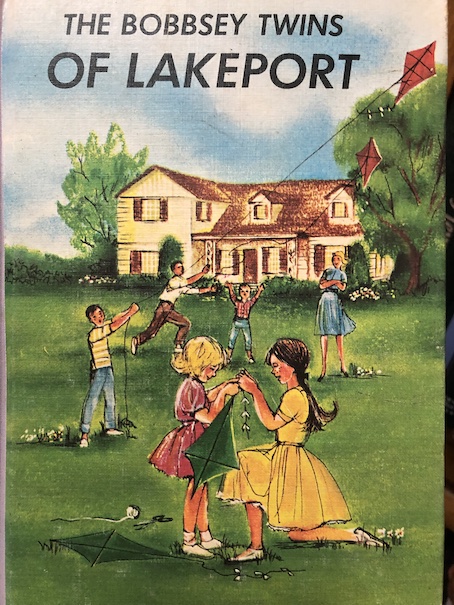
The Bobbsey Twins of Lakeport by Laura Lee Hope (Stratemeyer Syndicate), 1904, 1961.
Before I begin discussing the story, I need to explain that this story, I need to explain that, in the 1950s and 1960s, children’s series books from the Stratemeyer Syndicate that were still in print were rewritten and reprinted to update slang and cultural references and, importantly, to remove inappropriate racial language and stereotypes. This was the time of the Civil Rights Movement, and people were becoming more self-conscious about the language they were using and what they were teaching to children. The Bobbsey Twins was one of the series that was rewritten, and I was surprised by some of the things that appeared in the original printings of the first Bobbsey Twins series. As a kid, I was more familiar with The New Bobbsey Twins series, which was written in the 1980s and 1990s. The Bobbsey Twins was one of those series that has multiple sub-series, sort of like the various incarnations of Scooby-Doo cartoons, each one updated to fit the decades when they were written. The original Bobbsey Twins series was first written in the early 1900s, and the way it originally portrayed the black couple who work for the Bobbsey family was very problematic. I was really surprised. The edition that I’m describing below is the revised 1960s edition, with the problematic elements changed or removed.
The story begins with both sets of Bobbsey Twins – the older set, Nan and Bert, and the younger set, Freddie and Flossie – disassembling their old tree house because they’re planning to build a new one. Six-year-old Flossie mentions that a spooky old house near their school is also going to be torn down, and Freddie says that another kid at school claims that house is haunted. The children’s father says that they must be talking about the old Marden house. It used to a farmhouse, but the town has grown around it. Mr. Marden was a wealthy man who had once been ambassador to Great Britain, and he build the large house when he retired. Since then, the place has become disused and badly run-down, which is why the kids think it’s spooky and why it’s going to be torn down.
The children’s mother explains that she knows Mrs. Marden, who is the widow of the original Mr. Marden’s grandson. Mrs. Marden is now elderly, and she sold the old Marden house to the school when she went to live in a nursing home. Mrs. Bobbsey says that she hasn’t been to visit Mrs. Marden lately, she decides to pay her a visit that afternoon. The kids are still curious about whether the house could be haunted, and they ask their mother to ask Mrs. Marden about it. It doesn’t seem likely that the house is really haunted, even though it is old and spooky-looking. Danny, the kid at school who claims that he’s seen ghosts around the place, is known for playing mean tricks, so he’s not a reliable witness.
Bert suggests to the others that they could go take a look at the house themselves. When they get there, they see men surveying the property. The men say that, after the house is torn down, it will be replaced by an addition to the school. The kids ask the men if they’re worried about the house being haunted. One of the men says that he heard some strange sounds, but he thinks it was just a couple of local boys playing a prank. The men don’t think that there’s a real haunting there. The Bobbsey Twins want to see the inside of the house, but the surveyors tell them that they can’t go inside because the house is locked up to discourage vandals. The kids spend a little more time with the surveyors, helping to hold their equipment and seeing how it works. However, the children are still curious about the house and wish they could investigate it more.
Then, when their mother comes home from visiting Mrs. Marden, she tells them that there really is a mystery about that house. Mrs. Marden’s memory is failing her, but she knows that some valuable souvenirs from old Mr. Marden’s time as an ambassador are missing. One of them is a cameo surrounded by diamonds (the book defines what a cameo is for the benefit of kids who don’t know) and a collection of obsidional coins. (The book also explains what these coins are. The characters had to consult a book because even Mrs. Bobbsey doesn’t know. I hadn’t heard of them before, either, because I don’t know much about coin collecting. They’re basically improvised coins made during times of siege to pay off soldiers. They’re made from whatever materials the makers had at hand and are often irregular in shape. I love stories that explain interesting and unusual historical details!) Mrs. Marden knows that she hid these things somewhere in the old Marden house, but she just can’t remember where. Since the house is going to be torn down, there isn’t much time left to find them!
Mrs. Bobbsey gives the children permission to investigate and tells them that the principal at their school has the keys to the house. She thinks that the principal might let the kids into the house if they explain that they want to retrieve something for Mrs. Marden. The school principal is surprisingly agreeable to the idea of the children poking around the old house and gives them the key, but Danny overhears their conversation and tries to convince them again that the house is haunted.
When the twins and a couple of their friends go inside the house, there isn’t much there. All the furniture has already been cleared out of the house, and it doesn’t seem to leave many possible hiding places to search. The only thing Mrs. Marden seems able to remember about the hiding place is that it has something to do with a hearth, but there are many fireplaces in the old house.
It turns out that the old house is hiding many secrets! There are secret passages and hidden trap doors. The kids also discover that someone is sneaking around the old house, someone who seems to know its secrets. Could it be Danny, playing ghost to scare them, or could it be someone who’s after the same treasure the children are trying to find?
The revised edition of the book is available to borrow and read for free online through Internet Archive (multiple copies).
My Reaction and Spoilers
New vs. Old Editions
I have trouble talking about the original edition of this book because I haven’t been able to find it. I’m not sure if that’s because the racial language was just too objectionable for anyone to want to put a copy online, even though it should be public domain now. Although, it could be that it is online but I just don’t recognize it because it’s called something different. Some of the revised Stratemeyer Syndicate books are so different from their originals that they’re barely recognizable as being the same story. Some original stories were considered so outdated that they were completely rewritten. I know something about the level of racial language and stereotypes in the Bobbsey Twins because I did find an older edition of the next book in the series, and I’ve read articles about some of the other books I haven’t read yet.
Even though this printing doesn’t contain the problematic racial language and stereotypes of the original, there were things some of the characters said that I still didn’t like. Mr. Bobbsey calls Flossie “my little fat fairy” as a term of endearment, but it sounds a little rude to me to call attention to her being “fat.” Flossie doesn’t seem to mind, probably partly because she’s only 6 years old and not at the stage where girls really start worrying about their appearance, but some girls can really be affected by being called “fat”, especially if there’s a lot of teasing at school aimed at “fat” people. The father similarly calls Freddie his “little fat fireman” because Freddie wants to be a fireman. Freddie doesn’t seem to mind it, either, but I still feel like the “fat” part is just unnecessary. If he’s going to give nicknames, why not just say “my fairy princess” or “little fireman”, sticking to words with positive connotations, without adding an extra, unnecessary word that can easily turn negative? I’m not fond of teasing, and I don’t think it’s a good idea to teach kids to tease or set them up for teasing later.
The Mystery
One thing that makes this story a little different from other books in the Stratemeyer Syndicate series is that the children get some adult help with the mystery. Usually, the children in Stratemeyer Syndicate series try to do everything themselves, but when the kids realize that there is a strange adult sneaking around the house and trying to scare them away, they tell their school principal, and he comes to investigate with them. However, even when the adults realize that there’s some strange adult lurking around and trying to scare the kids, nobody stops the kids from continuing to investigate the house.
There are various other little adventures that happen throughout the book, like Freddie getting lost in a department store and adopting a cat he names Snoop and the boys camping out with a friend but ending the trip when it starts to rain too hard. However, these incidents also help the kids to gather some additional clues to the main mystery.
The identity of the adult sneaking around the house would be impossible for readers to guess because we don’t really get to meet him until later. The kids are the ones who find the treasure, although it happens by accident. I would have liked it better if they had reasoned it out, but it’s still a pretty good kids’ mystery story.






 Jestress's Forgotten Books and Stories