The Prince Who Knew His Fate

This picture book is a retelling of an Ancient Egyptian story (sometimes called The Tale of the Doomed Prince) about a prince and a prediction regarding his death with an unknown ending. The only known original version of the story is incomplete. For this book, the author has given the story an ending.

An Egyptian king wishes for a child, but when his son is born, the seven Hathor goddesses offer a prophecy for the prince’s fate. They say that, “He is destined to be killed by a crocodile or a snake or a dog.”

The king is distressed by this prediction for his son’s fate, and he decides to protect him from it as best he can. He has a special house built for the prince, where he grows up, attended by servants and given all sorts of good things to keep him happy. The king wants his son to stay in this house, where he will be safe. 

However, as the prince gets older, he becomes more interested in the outside world. One day, he sees a man passing the house with a dog, and the prince wants a dog of his own. The king relents and allows his son to have a dog, in spite of the prophecy.

The prince further demands that his father allow him to leave the house and travel. After all, he says, if his fate is already determined, it won’t matter if his father tries to protect him from it. He says that, if he must die eventually, he might as well live his life to the fullest while he can. The king allows his son to have a chariot and to hunt and travel the Nile. Everywhere the prince goes, he brings his dog with him.

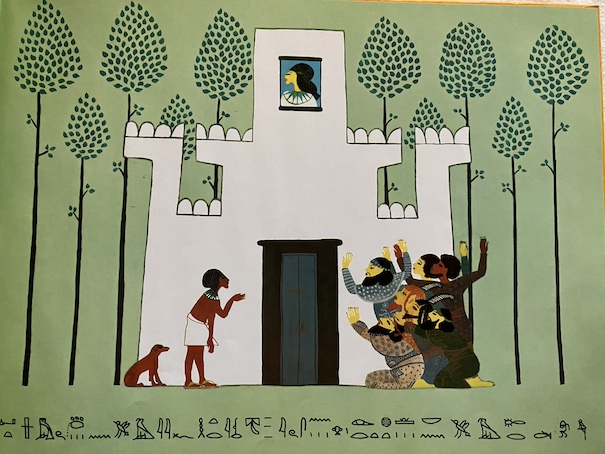
Eventually, he comes to the country of the Chief of Naharin, who only has one daughter. The chief keeps his daughter in a special house with a single window, high off the ground. He says that he will allow his daughter to marry the man who can jump up to that window. The prince manages to make the jump, and he marries the chief’s daughter.

After they are married, the prince explains to his wife the prophecy about his fate. His wife wants to kill the prince’s dog, but he refuses to allow it because he’s had the dog since it was a puppy. His wife begins to watch over him, to try to prevent him from being killed. She manages to kill the snake that comes for the prince, and the prince manages to make a deal with the crocodile, but can he truly escape his fate?

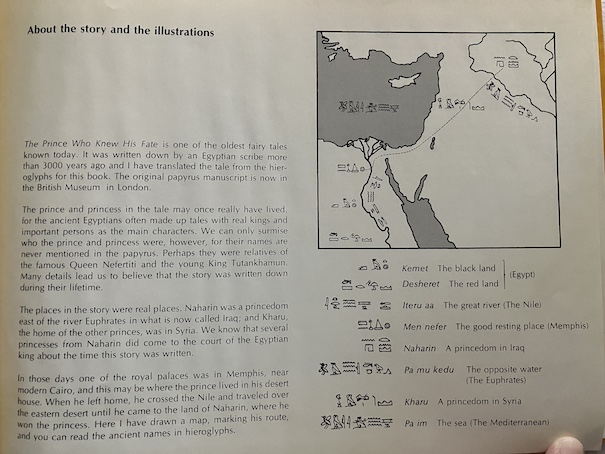
There is a section at the back of the book that explains more about the original story, which was written over 3000 years ago and is “one of the oldest fairy tales known today.” There is also some information about Ancient Egypt and the carvings that were the inspiration for the illustrations in the story.

I always enjoy folklore, and this story is fascinating because the original ending is unknown. The author of this book, Dr. Lise Manniche, who was a Danish Egyptologist, translated the story from the original hieroglyphics and added an ending to the story. I thought that the ending fit well enough, and I was pleased that it was a happy ending, even though it holds to the idea that the fate must be fulfilled. I also enjoyed the illustrations, based on Ancient Egyptian carvings from around the time that the story was created, and the addition of the hieroglyphs of the original story along the bottom of the pages.

I first heard about the folktale in this book in a mystery book for adults called The Snake, the Crocodile, and the Dog by Elizabeth Peters. It is part of the Amelia Peabody mystery series, about a Victorian era woman who is married to an archaeologist. Elizabeth Peters is a pen name for Barbara Mertz, who was an Egyptologist herself. Because this folktale featured prominently in that mystery novel, I was thrilled to find this version of it!

Encyclopedia Brown and the Case of the Dead Eagles

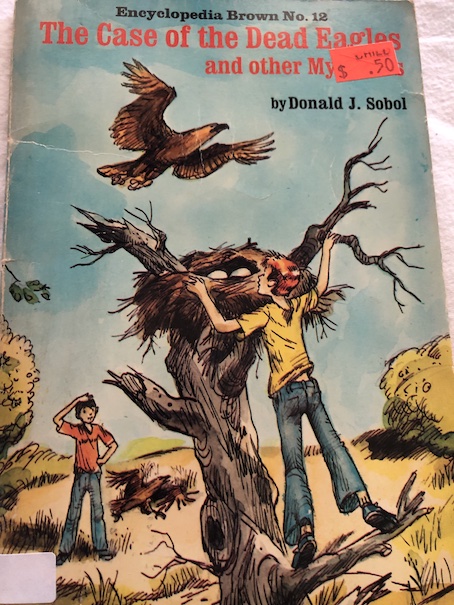
Encyclopedia Brown and the Case of the Dead Eagles and Other Mysteries by Donald J. Sobol, 1975.

The Idaville police department has an excellent record, but that’s because the chief of police’s ten-year-old son is Encyclopedia Brown. People praise Chief Brown, and Chief Brown doesn’t feel like he can admit how much help his son gives him because he doubts anyone would believe him. Encyclopedia himself doesn’t want to admit to other people that he helps his father figure out tough cases because he doesn’t want to seem too different from the others kids at school. However, Encyclopedia also has a detective business, helping the neighborhood kids to solve their problems for only 25 cents a day, plus expenses. Sally, a smart and tough girl, is his partner in the detective business, and Bugs Meany, a bully who’s the leader of a local gang of youths called the Tigers, is their main nemesis, although they also deal with other bullies and criminals.

I always liked Encyclopedia Brown books when I was a kid! There are a couple of instances where modern kids might not understand the solutions to some cases because of certain habits and traditions that modern people don’t follow anymore. There is one case in this book in particular that I didn’t understand when I was a kid, and I wouldn’t expect modern kids to get the answer, either.

The book is available to borrow and read for free online through Internet Archive (multiple copies).

Stories in the Book:

The Case of the Dead Eagles

Encyclopedia is camping with his friend Charlie Stewart when they hear a gunshot. When they go to investigate, they find a dead eagle. They think they know who’s responsible because this person has killed eagles before. Can they prove it in time to save the mother and babies from the same fate?

The Case of the Hypnotism Lesson

A boy named Dave hires Encyclopedia because he thinks Bugs Meany cheated him. (Always a likely possibility in anything Bugs does.) This time, Bugs charged Dave a dollar for a lesson on hypnotizing lobsters. Dave saw Bugs and his friends cooking and eating lobsters they had caught earlier, and Bugs told him that the secret to catching lobsters is to hypnotize them. However, when Dave gave him the money, Bugs just showed that he could pick up a lobster, and the lobster wouldn’t move. He didn’t actually show Dave any hypnotism and refused to teach him anything unless he paid more money. Dave realizes that Bugs was trying to trick him and wants his money back. When Encyclopedia sees a picture that one of Bugs’s friends took, he knows how to prove that Dave was cheated.

The Case of the Parking Meters

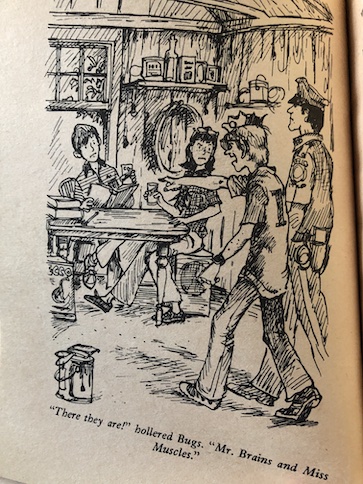
Both Encyclopedia and his detective partner Sally have received phone calls asking them to meet people at different locations, but each time, they waited around, and nobody showed up. They’re starting to suspect that this is another of Bugs Meany’s tricks, trying to get back at Encyclopedia for foiling his schemes. Sure enough, Bugs Meany shows up at Encyclopedia’s house with a police officer, claiming that Encyclopedia is running a racket to get money from people parked at parking meters by putting money in the meters, telling them that they’ve been saved from the fine for an expired meter, and asking them for money for the favor. The police officer isn’t sure that such a thing is actually illegal, although he’d have to inquire with a judge about the matter. Bugs claims that he could prove what happened except that Sally stole the film that he had of Encyclopedia putting money in the meters. When Bugs manages to “find” the film where Sally supposedly ditched it after taking it, Encyclopedia points out why Bugs’s story can’t be true. The solution would make more sense to somebody who understands how reel-to-reel films work.

The Case of the Hidden Will

Encyclopedia’s father, Chief Brown, tells him that a wealthy man named Brandon King has died, but his will is mysteriously missing. Evidently, Mr. King hid the will himself and swore his own lawyer to secrecy about it. The reason for the secrecy is apparently because one of Mr. King’s four sons, who all helped to run the family business, is a thief. Mr. King’s friends knew that was the case, although none of them knew which son it was. Mr. King’s lawyer gave Chief Brown a note written by Mr. King which hints at which son is the thief and saying that his property will go to the other three sons. Chief Brown isn’t sure which of the Kings is considered the “odd King out” until Encyclopedia tells him who it has to be, and Encyclopedia also tells him where the will is.

The Case of the Mysterious Thief

Encyclopedia and Sally go to a restaurant to order a pizza for lunch. While they’re waiting for their pizza, someone attacks the owner’s daughter in the ladies’ room and steals the money she was going to take to the bank. The owner’s daughter is very strong, and it must have taken someone very strong to overpower her and knock her unconscious so quickly and easily. It doesn’t seem likely that it would be a woman, but people would have noticed if a man had gone into the ladies’ room. Sally figures out the answer to this one, but it isn’t likely that modern readers. I didn’t get it when I was a kid, either, because the solution is based on an old piece of etiquette in restaurant seating that I don’t think people observe anymore.

The Case of the Old Calendars

Encyclopedia and Sally hurry over to Butch Mulligan’s house because they hear that Butch is fighting Bugs Meany and the Tigers. Butch is a big, strong 18-year-old, and the Tigers are no match for him. Encyclopedia asks Butch’s younger brother how the fight started, and he explains that Butch’s math teacher recently moved and gave Butch a stack of old calendars with some cool Civil War pictures on them. Then, Bugs claimed that he asked the teacher for those calendars himself, but the teacher forgot. He produced a note supposedly from the teacher that asks Butch to share the calendars with Bugs. Butch was willing to share, but there are an odd number of calendars, and Butch thinks Bugs cheated on the coin flip they had to determine who would get the odd one. He probably did, but Encyclopedia can prove that Bugs faked the note from the teacher, too.

The Case of Lightfoot Louie

Only a few days before the state worm-racing championship, Encyclopedia’s friend Thad accidentally stepped on his prize worm. It’s sad, but as a member of the Worm Racers’ Club of America, Thad can time other people’s worms to be entered in the race. He’s worried because Hoager Dempsey wants him to time a worm, and if he says the worm isn’t fast enough to enter the race, Hoager might beat him up. Thad asks Encyclopedia and Sally to watch the time trial as witnesses to make sure there’s no foul play.

The Case of the Broken Window

John Hall is a wealthy man with an impressive stamp collection. Some of his stamps are worth thousands of dollars. One evening, he calls Chief Brown and asks him to come to his house but to wear a costume because he’s giving a costume party, and he doesn’t want his guests to know that he’s called the police. Chief Brown and Encyclopedia put on their Halloween costumes and go to the Hall estate to investigate the theft of one of Hall’s expensive stamps. Hall thinks one of his guests is the thief, but which one?

The Case of the Gasoline Pill

“Twinkletoes” Willis is a young track star, and he comes to see Encyclopedia about a run-in that he had with Wilford Wiggins, a local high school dropout who’s into get-rich-quick schemes. Wilford has called a meeting of local kids at the city dump to tell them his latest money-making idea, which can only mean trouble. Wilford’s latest money-maker is a pill which he says allows cars to drive thousands of miles if you put it in the gas tank. Fortunately, Encyclopedia knows just how to prove that Wilford is a fraud.

The Case of the Pantry Door

Hilda’s hobby is fly hunting, and she’s a crack shot with rubber bands. She invites Encyclopedia and Sally to a little birthday party that she’s having for her pet frog, who lives in the birdhouse in her backyard. When Encyclopedia and Sally go into the pantry at Hilda’s house for sugar for catching flies, someone locks them in and steals the household money that Hilda’s mother hid in the kitchen. Hilda’s cousin, Lois, says that she saw a boy running away from the house, but Encyclopedia knows who really took the money.

The Midwife’s Apprentice

The Midwife’s Apprentice by Karen Cushman, 1995.

The story focuses on a young girl in Medieval England. She is about twelve or thirteen years old, but she doesn’t know her age or even her real name. Everyone just calls her Brat. For as long as she remembers, she’s always been alone, a homeless orphan traveling and begging from town to town. When a midwife finds her sleeping in a dung heap, she takes the girl on as a servant and apprentice. It isn’t as a kindness. The midwife just realizes that she can get some cheap labor out of the girl as long as she feeds her. Also, because the girl isn’t very bright or experienced, she is no professional competition for the midwife. People begin calling the girl Beetle because she was in the dung heap like dung beetle.

The midwife, Jane, became a midwife because she had six children of her own, although none of them survived. Beetle wonders if she could be a witch because of her strange mixtures, but really, she’s just a midwife. Whenever a woman in the area gives birth, Beetle goes to help carry things for Jane. Beetle is not allowed to watch the births herself, just stand by to fetch and carry. Beetle realizes that part of the reason she is not allowed to watch the births is so Jane can keep her professional secrets, although Beetle soon begins learning about plants and how to make medicines from them and she sometimes spies on births when she can to learn more.

People in town aren’t nice to Beetle. Jane is stingy and never helps anyone who can’t pay her fee. The local people don’t like her, but they tolerate her because they have need of her skills. Beetle often has to deal with the anger that people are afraid to show to Jane. Beetle’s best friend is a cat who was nearly killed by some mean local boys. She talks to the cat. Both of them are abused by locals, especially the mean boys.

Then, Beetle begins to notice that Jane keeps slipping away on mysterious errands, giving excuses for her absence that make no sense. Beetle begins to follow Jane to find out what she is doing. What Beetle learns is that Jane is having a love affair with a married baker.

One day, the miller comes looking for the midwife, but she isn’t home. Desperate for help with his wife’s birth, the miller makes Beetle come with him. Beetle doesn’t know what to do, and the miller’s wife angrily throws things at her until Jane comes to take over. Jane insults and abuses Beetle, too.

It seems like taking abuse is Beetle’s lot in life and that she has to take it or be thrown out into the street again. Her life starts to change when a kind merchant at a fair compliments her curls and gives her a wooden come with a cat carved on it. Then, another man mistakes her for a girl named Alice who can read. Beetle begins to look at herself in a new light. She realizes that at least some people see her as a person who can be pretty and smart, and maybe, she really can be pretty and smart. Liking the name Alice, Beetle decides that she will take the name for herself so she can gave a proper name.

When she returns to the midwife and the midwife abuses and insults her again, Beetle confidently tells her that her name isn’t dung beetle or brat but Alice. The midwife isn’t impressed and even people in town laugh at her for it, but Alice retains her new sense of confidence. She gives the cat a name, too, calling him Purr.

Without Jane realizing just how much Alice has been learning, Alice gradually begins helping people on her own. After saving the life of one of the local bullies, who almost drowned while chasing her, the boy starts treating Alice better. When his cow is having a difficult birth, the boy gets Alice to help him tend to the cow, increasing her knowledge of births.

Then, during one very difficult human birth, Jane leaves Alice to tend to the woman alone while she goes to tend to the lady of the manor, who is also giving birth. Alice protests that she doesn’t know what to do and can’t manage on her own, but Jane tells her she doesn’t have to do anything because this baby is likely to die. Jane just wants Alice to stay to cover for her so she can go earn another, even better fee. However, to everyone’s surprise, Alice saves the baby in Jane’s absence by applying what she has learned so far. The grateful mother names the baby after Alice, and the father refuses to let Jane take credit for Alice’s work. Jane is angry and jealous, especially when another mother insists that she wants Alice and not Jane to tend to her during her birth. Jane throws a fit and accuses Alice of stealing her customers.

Unfortunately, that birth doesn’t go well, and Jane has to step in to help and save the baby. In despair at what she sees as her failure, Alice runs away, convinced that she is just a nobody and too stupid to be anything, even a midwife’s apprentice.

At first, she wants to give up and die, but with the company of Purr the cat, she finds her way to an inn where she finds work. It’s enough to keep her alive, but Alice finds it difficult to shake her feeling that she is nothing and will never be anything. Alice really misses her work with the midwife, although not really the midwife herself, but she has trouble getting over the sense that she is just a failure. It takes a few lessons in reading from a scholar staying at the inn, the realization that she has been a help to someone else in a difficult situation, the encouragement of the boy who was one of her former bullies, and even some surprising comments from Jane the midwife herself to help Alice realize what she needs to do.

The book is available to borrow and read for free online through Internet Archive (multiple copies).

My Reaction

I found this story stressful because there were so many mean people in it. I hated the casual cruelty of the local boys and how they almost killed the cat. I hated Jane, who used and abused a vulnerable orphan girl. I also hated the townspeople in general because this seems to be entirely a town of people who are looking to use and abuse anybody they can and who will also allow other people to abuse the vulnerable, both human and animal, if they can use the abuser for their purposes. For much of the book, I looked for a character other than our heroine with some redeeming quality of some kind and didn’t find one.

The first character I actually liked was the kind merchant who gave Beetle/Alice the comb, but I still felt like the town is the town of the damned because nobody there was really nice. Almost every interaction Alice has with anybody there is unpleasant to some degree until she does something to buy their goodwill or at least civility. The innkeepers are nicer to Alice, although she knows that they’re not entirely honest in the way they run the inn. The scholar was one of my favorite characters because he sees Alice’s potential and gives her lessons in reading by first explaining things to her cat to get her interested. His kindness didn’t need to be bought with anything. The scholar is also the first person who cares about what Alice wants out of life and gets her to consider what she really wants, which builds her confidence and her feeling that she is a real person with wants that matter.

William became nicer after Alice saved his life, which is a kind of cliche in stories about bullies and is still a form of being bought. He’s still not completely nice after that, although he does teach Alice a couple of useful lessons, and he tells Alice that he doesn’t think that she’s a failure as a midwife just because she didn’t know everything and still needed some help. Even better, he points out that Jane doesn’t really know everything, either; she just acts like she does.

I never grew to like Jane. When Alice overhears Jane talking about her, Jane actually says that Alice is bright, which is a surprising compliment, given all of the insults and abuse she constantly heaped on her and her fear and resentment that Alice might steal her customers. Jane doesn’t regard Alice as a failure for not being able to handle a birth on her own, but she says that Alice gives up too easily. She wants an apprentice who is willing to take everything she heaps on her and won’t give up, no matter what. While persistence is an important quality, I was angry with this character for trying to wrap up her own abuse nicely like it was all part of some important, intentional lesson. Jane never had any notion of turning Alice into a fully-trained midwife. She more wanted a cheap drudge than an honest apprentice to learn her craft. In fact, she actively tried to avoid telling Alice much because she was always afraid of training a competitor. Jane wasn’t trying to teach Alice to persevere at any point before she said that. She wasn’t trying to teach her any more of anything than she absolutely had to in order to get the cheap labor she wanted! Her attempt to wrap this whole mess up neatly like a PSA just didn’t work for me because she’s nothing but an abusive employer who screams and throws pots and doesn’t actually want her “apprentice” to progress enough to do as well or better than she does. While Alice does return to be her apprentice because she knows that she really does want to be a midwife and that there are still things she can learn from Jane, including the value of persistence, I still hope that Alice will eventually leave Jane and find a better community to exercise her skills and employers and clients who are better behaved, more appreciative, and generally less toxic and abusive.

Because of the content of this book, it is not for young children. It would be best for tweens and teens.

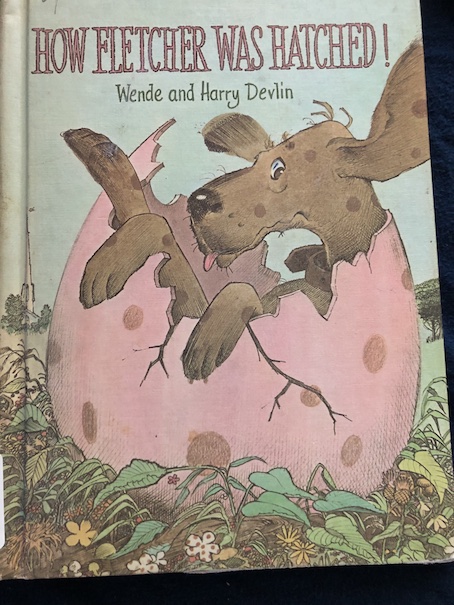
How Fletcher Was Hatched

How Fletcher Was Hatched! by Wende and Harry Devlin, 1969.

Fletcher the dog is sad and upset because it seems like his owner, Alexandra, is forgetting about him. She’s been playing with the new baby chicks, which she thinks are cute, and she’s been forgetting to pet her dog or even fill his water bowl!

Distressed, Fletcher goes to see his friends, Beaver and Otter, at the pond. Beaver and Otter don’t have human owners, so they don’t understand Fletcher’s feelings about Alexandra, but they try to think of ways to get her attention. They think it would help if Fletcher could make himself more like the chicks Alexandra has been obsessed with. Aince he can’t make himself small and yellow, they decide that he should hatch out of an egg, like the chicks do. Fletcher is skeptical about this plan, but Beaver and Otter think that hatching out of an egg will be like having a new beginning in his relationship with Alexandra.

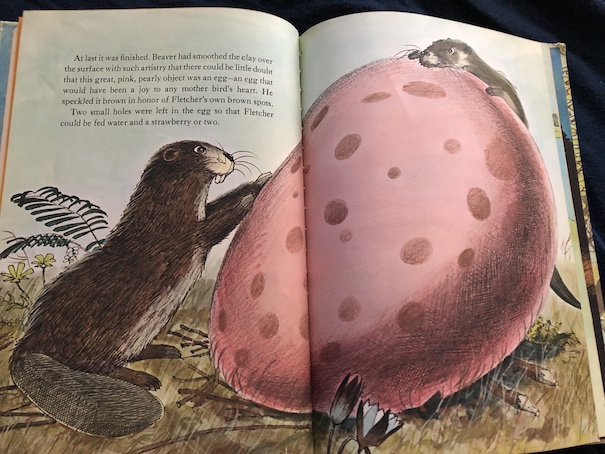
Beaver and Otter build an egg around Fletcher with reeds, grass, and clay from the river, leaving a little hole so they can give Fletcher water and food. When they’re done, it’s a very convincing but giant egg.

By the time they’re finished, it’s night. Fletcher is uncomfortable sleeping in the egg and wonders what Alexandra is doing. Meanwhile, Alexandra is having trouble sleeping because she’s worried about her lost dog.

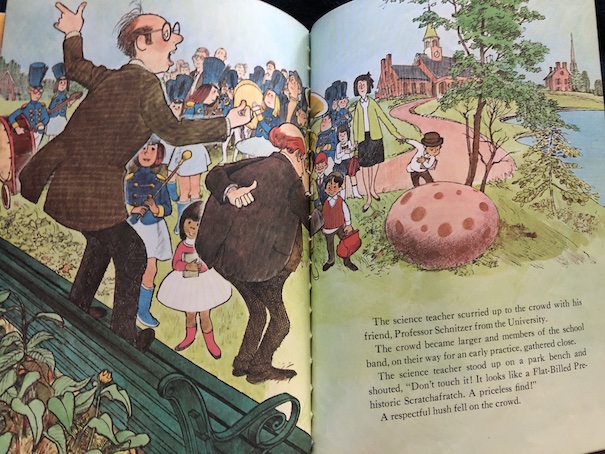
In the morning, Beaver and Otto roll the egg over to Alexandra’s school to make sure that she sees it. The first person who sees the egg, though, is the school’s custodian. He’s shocked at the sight of such a giant egg and starts yelling for the science teacher to come look at it.

Soon, the egg is surrounded by children and adults, marveling over what kind of it could be and where it came from. The science teacher brings a friend who is a university professor, and the two of them are convinced that the egg must belong to a rare creature, although they disagree about the type of creature it is.

Fletcher waits to hatch until he hears Alexandra. Alexandra’s friends are excited about the egg, but she’s just upset and only wants to go looking for her lost dog.

Fletcher decides it’s time to hatch, and he busts his way out of the egg. Alexandra is happy to see him, even though Fletcher’s attempt at peeping is a little weak. Everyone is confused, but Alexandra is just relieved that she has her dog back. Fletcher feels better, realizing that he is important to Alexandra, and she really cares about him, even though he’s not yellow and doesn’t peep.

The book is available to borrow and read for free online through Internet Archive.

My Reaction

I read this book as a kid, but I had forgotten much of the story. I remembered that Fletcher hatched out of an artificial egg and that he did it to get his owner’s attention, but I couldn’t remember why he needed attention. I can understand Alexandra being temporarily distracted by the little chicks on the farm, but forgetting to give her dog water is really bad for a pet owner. I felt like her parents should have noticed and said something. But, mostly, the situation is just set up for the purposes of this humorous hatching of a dog from a giant egg. Because the egg was created by animals, the humans in the story never find out how or why Fletcher got in the egg, which is actually the funniest part for me as an adult.

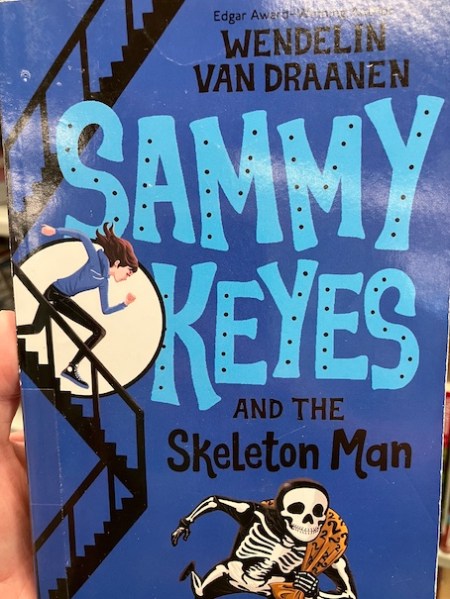
Sammy Keyes and the Skeleton Man

Sammy Keyes

Sammy Keyes decides that she wants to go trick-or-treating even though her grandmother thinks that she’s getting too old to do it. She’s still living secretly in her grandmother’s apartment in an apartment building that’s intended only for seniors, so she jumps at the chance to go out with friends on Halloween night. Dot (real name Margaret/Maggie), a new girl at school, invites her and Marissa to come over to her house to get ready before going out trick-or-treating, which works well for Sammy.

As Dot’s house, Dot is painting herself yellow as part of her bee costume. Sammy is going to color herself green so she can be a marsh monster (something she made up, but it sounds like a swamp monster from old movies). When Marissa comes, she brings Sammy a green sweater that she borrowed from her mother that would be good for a marsh monster costume, and the other girls help Marissa wrap herself in toilet paper for her mummy costume. As the girls set off to trick-or-treat, Sammy gets the idea to go by the old Bush House. The Bush House isn’t haunted, but it is a creepy place and there are stories about the crazy Bush Man who supposedly lives there and will jump out of the tangled bushes that surround the house and kill people. Sammy’s grandmother says that the stories are just stories and the old man who lives in the house is just a lonely old man, but Sammy thinks that it would be thrilling to visit the house and see it up close on Halloween.

As the girls approach the house, they almost collide with someone in a skeleton costume who’s running away. He looks bigger than the girls are, and he’s carrying a pillowcase that looks pretty full. The girls are startled, but Sammy is determined to go up to the Bush House and just knock on the door once for the experience of it. What Sammy sees when she knocks on the door is even more startling.

The door of the house just swings open, and there’s a pile of newspapers on the floor inside that are on fire. Sammy calls out to see if there’s anybody in the house. There’s no answer, so Sammy rushes inside and manages to put out the fire by smothering it with her marsh monster sweater. As the girls are about to leave, Sammy sees someone in a Frankenstein costume in a chair, and they scream and run outside. Then, Sammy realizes that the Frankenstein mask was on sideways, and it’s not easy to breathe in a sideways mask, when the nose and mouth holes don’t line up, so she decides that she has to go back and see if the person wearing the costume is really alright. It’s definitely a human in a costume, and not a dummy. When Sammy removes the mask, she at first fears that the person in the costume is dead because he’s so still, but it turns out that the person under the mask is the Bush Man. He’s tied up, has a head injury, and is barely conscious. He begs the girls for help. The Bush Man is having trouble talking, so after the girls untie him, he writes a message down on paper, asking the girls to go next door and call the police. He also wants to know if the girls saw the skeleton man.

The Bush Man’s real name is Chauncy LeBard, and the reason he can’t talk is that he’s had surgery on his throat because of smoking-related throat cancer. He needs a device held up to his throat to really speak in an electronic voice (an electrolarynx, I’ve seen one used before). While Dot and Marissa run next door and call the police, Sammy stays in the house with him. When the police come, Sammy uncomfortably recognizes the police officer who knows her from the previous book in the series, Officer Borsch. Last time, she and Marissa told him that Sammy is Marissa’s foster sister so they wouldn’t have to reveal where Sammy is actually living. Dot is confused when Marissa refers to Sammy as her “sister”, but she doesn’t give them away.

Mr. LeBard explains that the man in the skeleton costume had forced his way into the house and tied him up, but he doesn’t know who the man is or why he did it. The girls can’t fully describe the man because he was wearing a full-body costume, although they agree that he seemed like a full adult, not just a tall teen. It seems like the skeleton man was a thief because Mr. LeBard’s wallet and a pair of candlesticks are missing.

After the night’s adventures are over, Sammy winds up spending the night at the house of an elderly friend, Hudson Graham, because her grandmother’s nosy neighbor is awake, trying to find proof that Sammy is illegally living with her grandmother in their apartment building. Hudson agrees to let Sammy stay with him, and it turns out that he’s also an old friend of Chauncy LeBard. Mr. LeBard used to be a political science professor at the local college, and Hudson was one of his students. The two of them liked to get together and have political debates. Then, Mr. LeBard’s mother died, leaving him her estate. The local rumors say that’s when Mr. LeBard went crazy and became the Bush Man. The reality is that he developed health problems because of his smoking and didn’t want his old friends to know. Chauncy also has a brother, who was disinherited by their mother because she disapproved of his wife, but nobody knows why the mother didn’t like her.

Sammy can’t forget about what happened with Chauncy LeBard, even if she wants to. She at least has to go back to the Bush House to get Marissa’s mother’s sweater, which turns out to be worth a lot more than either of them thought. Marissa tells her that, even though her mother never wears that old green sweater, she did notice that it was gone and was upset because it turns out that it was a designer sweater that she bought for $500. Sammy is horrified because, having put out a fire with that sweater, she’s pretty sure that it’s done for, and if she has to come up with $500 to replace it, so is she! When Sammy goes to see Chauncy about the sweater, she starts learning more about him and how his inheritance from his mother turned out to be more of a curse than a blessing. Sammy also starts to wonder whether theft was really the motive for what happened on Halloween. If Chauncy didn’t have that hole in his throat from his surgery, the sideways mask might have smothered him. Did the skeleton man want Chauncy dead?

The mystery of the skeleton man and the ruined $500 sweater aren’t Sammy only problems, though. At school, there’s a nasty rumor going around that Sammy has been calling a boy name Jared, trying to get him away from his girlfriend, Amber. Amber is angry with Sammy, and Sammy’s school nemesis, Heather, has been gleefully making sure that everyone in school knows about it in order to embarrass her as much as possible. Sammy knows that she has never called or even spoken to Jared in her life and doesn’t care about him, but it’s not easy to convince everyone else of that. So who really has been calling Jared? Sammy is sure that it’s really Heather, pretending to be her and saying embarrassing things to get her in trouble. It would certainly be in character for Heather to do that. The rumors are get so out of hand even in a day that one of Sammy’s teachers even suggests that maybe she should talk to a school counselor about her issues with Jared so it won’t affect her schoolwork.

Because the characters are middle school kids, Sammy decides that the best way to get evidence that Heather is her phone imposter is to crash her Halloween party. With everyone in costume and the whole class from school invited (except for Sammy, of course), Sammy, Marissa, and Dot are pretty sure that Sammy can sneak in with them, posing as Dot’s cousin “Nikki.” What could possibly go wrong?

The book is available to borrow and read for free online through Internet Archive (multiple copies).

There are characters in the Sammy Keyes series who smoke, which was becoming uncommon in children’s books in general when I was young in the 1980s and 1990s because adults didn’t want to set a bad example for children. In the last book, the fortune teller character smoked, and it kind of surprised me, but it seems that the series follows the unspoken rule for children’s books that include smoking, that the only characters who do it are either villains or oddballs, not cool people to be imitated. This book confronts the issue of smoking more directly, with Chauncy LeBard’s throat cancer. Mean girl Heather also turns out to be a secret smoker who bribes one of her friends to spy on Sammy and her friends by giving her cigarettes. Sammy later finds out that Chauncy’s mother was also a smoker who died of lung cancer. Between Chauncy’s throat cancer and his mother’s death, the story helps illustrate the hard realities of long-term smoking. Chauncy seems to be living in reduced circumstances, without heat or electricity in his house. My first thought was that his mother’s medical expenses and subsequent funeral and Chauncy’s surgery drained his funds. Medical expenses have wiped out people’s savings before in the US, and I remember that one of the stories they told us to discourage smoking when I was in school years ago was about a woman who was forced to sell her family’s heirlooms to cover her cancer treatment. When Sammy meets Chauncy’s brother, Douglas, she finds out that Douglas was trying to get his mother and brother to quit smoking, but neither of them would, and that’s part of the reason for the family rift. Douglas says that if Chauncy has suffered health problems and blown through the family’s money, it’s really his own fault. It’s true that Chauncy should have taken the hint and quit smoking a long time ago, and he might have spared himself a lot of pain and misery if he had, but it turns out that he didn’t sell the family heirlooms to pay for his medical expenses. There was something in his house that was worth a great deal of money, something that Chauncy couldn’t bear to part with even to improve his own living situation because of the sentimental value. The thief is one of the few people who understood what Chauncy had and how to take it without him even noticing that it was gone right away. In a way, what the thief really stole is as much of a mystery for most of the book as who the thief was. The skeleton man turned out to be one of the people I suspected, but not my first suspect, so I was actually in suspense for most of the book.

As for the side plot with Heather calling Jared as Sammy: Oh, criminy! This is one of those ridiculous tween problems that seems so impossibly complicated when you’re in middle school but pretty dumb when you’re not. I appreciate that the math teacher is concerned when Sammy seems distracted in class and her work suffers, but I have trouble believing that an adult teacher would really be interested in rumors about who at school is calling who. I can’t remember any of my teachers ever caring about that stuff because adults usually know that rumors are wrong and that this kind of school drama passes faster if you don’t feed it. I don’t recall any massive rumor campaigns getting the attention of teachers when I was a kid, and I can’t imagine any of my old teachers giving rumors much weight or interest. I think my teachers would have just told us to stop being drama queens, focus on our work, and save the gossip for after school. A few of the more outspoken and direct communicators on the faculty would have flat out told us that gossip isn’t worth anything, that most of it is wrong anyway (that was actually the subject of a play I was in at school once), and that everyone will have gotten bored of whatever it is and moved on in a week or two because nothing we were talking about was really that earth-shaking and we all had the attention spans of chihuahuas on a sugar rush.

If I had to say something to these kids about this situation, I might just tell Sammy not to go calling people who don’t want to speak to her (if I were to assume that she was doing that) because it’s just going to annoy everyone. As for Amber, it’s not really her business to control either her boyfriend or the person calling him, whoever it is. Her decision is whether or not she’s satisfied with how Jared is responding to the situation and if she wants to still be his girlfriend when he acts that way. I’d make it a point to tell Jared, as the center of this drama, that if he doesn’t want to talk to somebody on the phone, he should just hang up without saying anything. You don’t need to stay on the line with someone who’s bothering you. With today’s caller IDs and cell phones that identify everyone who calls, it’s even easier because you don’t have to pick up the phone in the first place if you recognize a number you don’t want to answer. I can’t remember if they had those in the late 1990s, or if that was more an early 2000s development, but I know we definitely had answering machines, and I knew people who would just let the machine answer most of the time, only picking up if they recognized the voice leaving a message. Either way, just because someone calls you doesn’t mean that you have to take the call. On the other hand, if Jared likes being called by a girl other than his girlfriend, it might be time for him to rethink his relationship and decide what he really wants. That seems to be where Jared is. The book describes him as not being too bright and going on an ego trip from whoever keeps calling him. Actually, if I were one of the teachers, the people I’d really want to talk to the most would be Jared’s parents because I think they’d have more power to stop the situation than anybody, no matter who the caller was. Jared’s a kid who still lives at home, so his parents could answer the phone first and find out who wants to talk to him or let the machine record a message that could be used as proof against a prankster who’s bothering him if it gets excessive. Most child pranksters would give up if they called a few times and only got the boy’s parents, especially if the parents sound annoyed or angry when they answer. If Jared’s family got the call on a landline (probable for the 1990s), an annoyed parent could also *69 to last-call return the prankster’s number or look it up on their phone bill if they want to confront the prank caller or talk to the prankster’s parents. It’s annoying to deal with a prank calling kid but not really that hard. I didn’t have access to my parents’ phone bill as a kid, but everyone knew how to *69. Of course, if people in the book handled the situation sensibly, the book would probably be less exciting, and we wouldn’t get the payoff of seeing Sammy get the best of Heather.

There are some laughs when Sammy finds a clever way to record Heather making one of her calls and play the recording for the whole school. It was the sort of victory moment that I would have loved when I was about twelve. However, Sammy’s secret life living in her grandmother’s apartment complicates any problems that Sammy has with the authorities and school administration. After she turns Heather into a public spectacle during a school assembly, the vice principal insists that Sammy’s mother attend a parent-teacher conference. Since Sammy’s mother isn’t available, her grandmother has to attend instead, risking the exposure of their secret.

There is a little more insight into Heather when Sammy sees what Heather’s home and mother are like, but understanding doesn’t equal approval. Heather’s life isn’t perfect, and she lets slip at her party that her mother is a 40-year-old who dresses really inappropriately and flirts with much younger men, possibly including some of her daughter’s teenage classmates. She doesn’t appear to know about Heather’s smoking habit or the truth about any of the other things Heather does. Knowing that her mother is odd and may have really inappropriate taste in men/boys doesn’t make Heather any more likeable, though. At the end of the book, Heather’s outbursts in front of the vice principal may lead to the school insisting on counseling for Heather, which is a hopeful sign, but since Heather remains a bully mean girl for the rest of the series, it’s not that hopeful. You can lead a person to professional help, but you can’t make them internalize it and make use of it.

For me, one of the best parts of this book was the further development of the relationship between Sammy and her grandmother and Hudson Graham. There are hints that Hudson is romantically interested in Sammy’s grandmother, and he treats Sammy like his granddaughter. He seems to be in on the secret of Sammy living with her grandmother and is one of Sammy’s best protections against getting caught. He willingly aids and abets Sammy’s investigations, giving her knowledge and guidance whenever she needs it, and at the end of the book, he gives Sammy and her grandmother a ride to the parent teacher conference.

The ending of the story sets up the beginning of the third book in the series with Sammy being given the assignment of completing some volunteer hours to make up for the disruption that she caused at school.