The Pinhoe Egg

The Pinhoe Egg by Diana Wynne Jones, 2006.

This is the sixth and final book in the Chrestomanci series.  In this series, there are many different dimensions, and in each of those different dimensions, there is a copy of every person.  Different versions of our world can differ dramatically in their history across the dimensions, and individual people’s lives can differ dramatically between the dimensions. There is one person in each generation who has no duplicates in any of the other dimensions.  This person is called the Chrestomanci.  All of the talents, abilities, and lives that would have been spread across the other dimensions are now centered on that one person, giving that person, literally, nine lives.  The Chrestomanci fills an important role, being better able than anyone else to travel across the dimensions, and he acts to keep a balance between them and make sure that the different worlds keep their proper course.

Marianne Pinhoe and her brother, Joseph, are used to Gammer (their grandmother) telling them and everyone else in their family what to do. Gammer is the matriarch of the magical Pinhoe family, and Marianne, as the only girl born into the family in the last two generations, is expected to eventually succeed her. Joseph has magical abilities, too, but he often pretends that he can’t do things so the rest of his family won’t force him into their magical businesses. He really has a fascination for machines and would rather work with them than do magic, so he does his best to convince the rest of his family that he’s a “disappointment” to them (something that other family members appear to have done when they had interests outside the family). However, Gammer still rules the roost and she has plans in mind for both Marianne and Joseph.

One day, she calls Marianne and Joseph to her house and tells Joseph that she’s got him a job as boot boy at Chrestomanci Castle over the school break. Joseph is angry because he had other plans for the school break and doesn’t want to be a boot boy. Gammer tells him that it’s important for him to go to Chrestomanci Castle because she wants him to act as a spy there. The Pinhoe clan doesn’t live too far from the castle, and for generations, they have been careful to conceal their identities as witches from whichever Chrestomanci happens to be in charge at the time. Gammer says that if Chrestomanci (whom they carefully refer to as the “Big Man” because saying his title aloud calls him) ever found out about them, he and his crew of enchanters would (gasp!) force them to obey rules and regulations and not just use their magic any way they like whenever they feel like it. (If you’ve read all the of previous books in the series, you can see that people like the Pinhoes are part of the reason why rules exist in the first place and why just letting them do whatever they want could be a complete disaster that could tear apart the worlds someday, but oh noes, not rules and regulations and being told not to do insane things that would lead to the destruction of the worlds! We’re not talking petty micromanagement here. Basically, this is a huge red flag, right up front, that the Pinhoes are up to seriously shady stuff that may lead to people dying and/or already have involved people dying.) Gammer wants Joseph to be at the castle to find out if the Big Man has caught on to them or looks like he might be going to. (At this point, we don’t know exactly what activities they’re afraid he’s going to catch onto, but that will become more clear later.) Joseph is still angry and tells Gammer that she can’t make him do it, but something happens that changes everything.

While Marianne and Joseph are still at Gammer’s house, the Farley family comes calling, and they’re angry with Gammer, too. They say that she has somehow betrayed them, particularly Dorothea Farley. After an argument with them, suddenly Gammer seems to lose all of her reason! When she speaks, she doesn’t seem to make any sense, as if she’s completely lost her mind. Marianne thinks that the Farleys cast a spell on Gammer, but she can’t prove it. The rest of the family thinks that the strain of the argument with the Farleys just sent Gammer over the edge because she’s so old. They’re unsure whether or not Gammer is going to recover from this incident or not and how long that might take. They temporarily hire nurses to look after her, but Gammer drives them away by using her magical powers to throw things at them like a poltergeist.

The family members all argue about what to do with Gammer, and in the end, they decide that she must go live with Dinah and her husband because gentle Dinah seems like she’s the only one who can handle her. Some of the relatives argue about who will get Gammer’s house since she will no longer be living there, and Marianne’s father reveals that the house actually belongs to him and that he was just letting Gammer live there. He thinks that the house is too large for his family and that the sensible thing to do is to sell the house and use the money for Gammer’s care and other practical uses. Moving Gammer to Dinah’s house is difficult because she uses her magic to resist it, but they eventually accomplish it. In the meantime, Joseph still has to go to Chrestomanci Castle because all of the arrangements are already made and the rest of the family insists that he do it.

While all this is happening, The Chant family is just returning from their holiday in the south of France (which was in Mixed Magics), and they have no knowledge of what’s been happening with the Farleys and the Pinhoes. Julia and Janet have been reading a horse story for girls and have become obsessed with horses and the idea of owning horses of their own. Chrestomanci asks them if they wouldn’t prefer to have bicycles (Roger says he would and Chrestomanci immediately agrees he can have one), but the girls insist that they must have horses. Millie is sympathetic because she wanted a horse of her own when she was young, and they do have stables at Chrestomanci Castle. Chrestomanci reluctantly agrees and purchases a horse for the girls, with the understanding that they will learn to take care of it properly.

However, when the horse arrives, it turns out that Janet is terrified of horses when she actually meets one, and the horse only likes Eric “Cat” Chant. Initially, Cat thought that all of the horse talk was boring, but he feels a strange kinship for Syracuse the horse, and if he doesn’t take care of him, Chrestomanci might follow through on his threat to have Syracuse turned into dog food. (Chrestomanci is also secretly afraid of horses.) Cat finds riding difficult at first, but he enjoys it and becomes fond of Syracuse. Julia and Janet swear off horses in fear and disappointment and get bicycles, like Roger, so Cat becomes Syracuse’s owner.

One day, while riding Syracuse, Cat has a disturbing encounter with Mr. Farley, the gamekeeper. Mr. Farley has placed spells in the territory around his family’s property to keep people away so their magical activities won’t be noticed by anyone, especially the people at Chrestomanci Castle. Since Cat has been riding around the countryside on his horse, Mr. Farley has become paranoid about Cat snooping around. The Pinhoes have some similar worries.

Then, Jason, one of Chrestomanci’s associates, returns to the castle after having been away for years. Jason brings his new wife, Irene Pinhoe, with him. Jason is a plant expert, and he also has some plant samples. Janet and Julia are both heart-broken that Jason is married because they both had enormous crushes on him, and they are sure that Irene is going to be perfectly awful and that they won’t be able to stand her. However, when Cat meets Irene, he thinks that she seems rather nice. She’s an artist and designer, and Cat can tell that she’s using magic in her drawings. Irene admits that her father was some kind of enchanter, and she may have inherited some of his ability, although she seems oddly embarrassed about it and says that she doesn’t know much about her father’s work. Jason and Irene invite Cat to accompany them while they have a look at a house that they’re planning to buy in the area.

Gammer is still not in her right mind, and at Gammer’s request, Marianne has to look after her cat, Nutcase. This is difficult because Nutcase is hard to control, and he somehow manages to get around the spells that Marianne tries to use to control him. After Nutcase kills a bunch of baby chicks belonging to Dinah, Dinah’s husband threatens to kill Nutcase if he comes near their chickens again. Marianne tries, mostly unsuccessfully, to keep track of Nutcase and keep him out of trouble.

One day, while trying to find Nutcase, she shows up at the house that Jason and Irene are trying to buy while they are there with Cat. It happens to be the old Pinhoe house, the one Marianne’s family is selling, and the Pinhoe family would prefer a Pinhoe to buy it. It helps that Irene is a Pinhoe, and Marianne thinks that she is just like the princess that she imagined in a story that she’s writing. Jason is fascinated by the variety of magical herbs in the Pinhoes’ neglected garden, and he’s sure that he really wants the house, too.

Cat is intrigued by Marianne when they first meet because he can tell that she has powerful magical abilities. Marianne asks Cat to help her find Nutcase, and he agrees. While they’re looking for Nutcase, Cat comments to Marianne how powerful her magic is and that she should trust it more. Cat is surprised at himself for being so bold, and Marianne is surprised at how well Cat has read her.

While they look for Nutcase in the attic, Cat senses that there is something important and magical hidden there, protected by spells, and he feels compelled to figure out what it is. As they investigate further, they find a strange, large egg. Marianne says that she doesn’t really know what kind of egg it is but that Gammer told her that it was a silly joke of her grandfather’s because he claimed it was an elephant’s egg. Cat senses that it’s very important, and he asks Marianne if he can have it. Marianne decides it’s okay if Cat keeps it because nobody else ever really seemed to care about it, and the house needs to be cleaned out when they sell it.

During the night, Cat gets a visit from a large, winged creature that says it’s the egg’s mother. The mother says that a spell prevents her from reclaiming her egg, but she sensed that the egg was moved, so she came to see that it was safe. When the egg hatches, it turns out that it’s a griffin. Cat needs Millie, Crestomanci’s wife, to help with the hatching and caring for the griffin. Crestomanci questions Cat about how he got the egg, and Cat explains that it came from the Pinhoes’ old house, which seems to intrigue Crestomanci.

When Marianne’s uncles learn that Marianne gave the egg to Cat and that it’s hatched, they’re furious with her. They had put the egg in the attic themselves and placed spells on it to prevent it from hatching, although they had never told Marianne about it before.

In the mean time, Marianne has been learning that this isn’t the only secret that her family has been hiding and that things in her family are not what she’s always believed they were. Strange things are happening in the nearby village. First, someone places a bad luck spell on all the Pinhoes. Every member of the Pinhoe family falls victim to various accidents until they find the source of the spell buried in the garden of the old Pinhoe house and destroy it. Then, there’s a plague of frogs and a sudden epidemic of whooping cough that affects everyone in the county.

What Marianne comes to realize is that these curses are being cast by Gammer, who still seems to not be in her right mind. What the other relatives have been taking to be harmless, nonsense mutterings and odd little things that she does to entertain herself have actually been magic spells. The curses have been mostly directed at the Farley family, although because Gammer isn’t really in her right mind, some of them have gone astray and affected other people in the area, including the Pinhoes.

However, when Marianne tries to tell her family what Gammer is doing, nobody believes her. Marianne comes to realize that the Pinhoes themselves have also been under one of Gammer’s spells for their whole lives that cause them to view Gammer with reverence and to make excuses for bad things she does. For some reason, this spell no longer seems to be working on Marianne, even though the other members of her family are still affected. Whe’s beginning to see that Gammer has done some pretty awful things and that her own father has been taking more care of the Pinhoe family than Gammer ever has, even though Gammer has been taking the credit as the family’s leader. Because of Gammer’s spells, none of the rest of the family will listen to anything Marianne tries to say about what Gammer has been doing, and they think that it’s just malicious slander. Worse still, Marianne is in disgrace with them because she gave the griffin egg to Cat.

What is the true story behind the griffin egg, and why are the elder Pinhoes so worried about it? Marianne knows that there is a griffin and a unicorn on the family’s coat of arms. What kind of feud does Gammer have with the Farley family, and are the Farleys really responsible for her present condition? With Gammer’s spells on everyone, how can Marianne get anyone to believe her enough to help her get the answers she needs? Her family has tried hard to avoid getting the attention of Chrestomanci or anyone at Chrestomanci Castle, but they may be the very people Marianne needs now.

My Reaction and Spoilers

I love the Chrestomanci series, and I enjoyed reading this book, although the ending seemed a little confusing and fell a little flat to me. I’m starting out with some minor spoilers, including some for previous books in the series. The major spoilers are at the end. The premise of a magical family with secrets is intriguing and fits well with the rest of the series. At first, Marianne believes everything that her family says and accepts that she will probably be the one to eventually take over Gammer’s position as head of the family. However, Marianne comes to realize that members of her family aren’t what she always thought they were, and some of them are hiding dark secrets. This is also a theme in the Chrestomanci series. Other characters in the series have also discovered that members of their families were hiding dark secrets and have been been betrayed by them. In previous books, the current Chrestomanci was used and betrayed by his uncle when he was young, and Cat’s own sister used him and tried to have him killed.

When Marianne allows Cat to take the griffin egg from their family’s old house, and she begins investigating strange things happening to people in the area, she realizes that her grandmother, who seems like she isn’t in her right mind, is the cause of at least some of it. Her family is unable to accept the truth about Gammer and turns against Marianne. It turns out that even her own father has been hiding secrets from her mother and his children and that, years ago, he was involved in a terrible crime against his own father. When the terrible secrets of the Pinhoe family are finally revealed, some of the Pinhoe marriages break up because the Pinhoe wives realize that their husbands have done some terrible things and have lied to them for years about it. Although Marianne’s parents stay together, Marianne’s mother has to come to terms with the truth about her husband’s past and his lies, and she also realizes that she should improve her children’s education and her own education.

In the end, someone else takes over as the leader and adviser of the Pinhoe family, rather than Marianne, but Marianne doesn’t mind because she’s really too young for the role, and she also realizes that her talents lie elsewhere. Like other young characters in the series, she and her brother are invited to continue their magical education at Chrestomanci Castle with the Chant family children. Marianne’s father is against his children studying with the posh people at the castle because he thinks that they’re trying to be too good for their own family, and Chrestomanci tells him that the only way they’ll be too good for their family is if he decides they are and keeps telling them they are. If that’s the message their father feeds them, then someday, they’ll probably believe it and think that their family has rejected them for being better than they are. Marianne’s father grudgingly allows the children to study at the castle because he can’t stop them and also because he and his brothers have lost face in the community because their past wickedness to their own father has been revealed.

Chrestomanci puts a stop to the feud between the Pinhoes and the Farleys by revealing some of their secrets and by having his assistant take away the Farley family’s magic. He does not take away the Pinhoes’ magic, but he wants to study their unique magic style because it has to do with the life force of living things, and Cat also seems to have a talent for it. This unique style of practicing magic is one of the secrets that the Pinhoes have been trying to keep to themselves, but there are also deeper and darker secrets they’ve been hiding, some of which didn’t really make sense to me.

What is eventually revealed is that Marianne’s grandfather, who supposedly died years before, is still alive. He was imprisoned in an area that contains and hides various mythological creatures, and his own sons were the ones who imprisoned him there in an injured state, while they told the whole community and even their own spouses that he was dead. They did it because Gammer, the grandfather’s wife, and Mr. Farley told them to kill their father. They couldn’t bring themselves to actually murder him, so they just crippled and imprisoned him. The reason why they did it was because he was studying the mythological creatures and brought the griffin egg out of the hidden territory. For generations, the family has believed that it was their duty to keep the mythological creatures imprisoned and secret, so they panicked and tried to stop the grandfather when it looked like he was going to expose everything. This is the major secret of the Pinhoes that they were always afraid someone would discover.

Chrestomanci and his people reveal that the family has a hidden history where they were supposed to be the caretakers of the mythological creatures but their mission got corrupted under the influenced of a particularly fanatic religious group, which convinced past generations that the mythological creatures were “abominations” and that they needed to hide their magical abilities. This doesn’t entirely make sense because, in past books, and even in this one, the local clergy knows and accepts magic. Chrestomanci and his family regularly attend church.

The explanation that readers are given is that the past group of religious fanatics was eventually driven out by other groups that came in later, but there’s not much of an explanation of how that works. We don’t know who these fanatics were supposed to be, and the chain of events is only vaguely explained. The Pinhoes aren’t entirely convinced that any of it is true, and because there aren’t a lot of details provided and not much groundwork was laid for this revelation, I wasn’t really impressed with it, either. It also bothered me that the Pinhoes and their mission to hide mythological creatures are very local, just in the village near Chrestomanci Castle, but for reasons that are also never explained, it seems like there aren’t any other mythological creatures, like griffins and unicorns, anywhere else in England or in any other countries. Were all these mythological creatures, their entire populations, only located in this one, particular village or did this one particular village hide all of them from everywhere in the world just in their little, hidden region? Real life animal populations are generally wide-ranging, so if we accept the idea that unicorns and griffins are real and once lived out in the open, I find it hard to believe that these local families were hiding all of them just in their little woods and that nobody, anywhere else, had a clue about it before or any populations of the same creatures elsewhere. Even if all of the other mythological creatures that once existed everywhere else in the world were wiped out by “fanatics” or other causes, it seems like there should still be evidence of it somewhere, like historical accounts or archaeological evidence. If there are plant experts who study magical plants in this series, it would make sense if there were also animal experts who studied magical animals.

There are just too many plot holes here, and all of this is just kind of dumped on the readers at the end without much build-up. It would have made more sense if the children had some kind of historical lessons that included the history of these “fanatics” or the apparent destruction of mythological creatures or something to set this up before the final revelation, but we didn’t really get that. It felt more like a sudden info dump at the end.

The situation with the Pinhoe family in the book seems meant to illustrate how family stories with a very narrow focus and no outside fact checking can lead to serious misconceptions and how militantly clinging to particular ideas simply because it’s “what we’ve always done” is toxic because it can lead to a warped view of history and the places of individuals in it. The Pinhoes have not just been trying to hide their activities from the authorities, but they’ve also been shielding themselves (both intentionally and unintentionally) from anyone or anything that might put a new perspective on their activities. They’ve been worried about the authorities trying to stop them or interfere with their activities, but at no point did they consider that there might be some sound reasons why the things they’ve been doing are pretty strange and out of bounds.

In a way, I think that the message of the story does have some relevance in the real world. Misconceptions about history and historical propaganda can lead people to do some inappropriate and toxic things. I’m pretty sure that I’ve mentioned somewhere before that I resent the United Daughters of the Confederacy for their textbooks, which were largely propaganda for their personal familial pride. When you have an organization based entirely around the concept of being part of certain families involved in a particular event on a particular side, and the nature of that involvement would seem dubious to people not on that particular side because it implies either support for and/or active participation in an unsavory activity (in this case, owning slaves), you have a group of people with a vested interest in telling a version of the story that puts themselves in a positive light and possibly others in a more negative light to make themselves look better by comparison, regardless of the historical accuracy (much of which, in their case, can be easily debunked by primary sources). “Their” traditional version of the story, the one from the textbooks they produced in past decades, puts Northerners into the role of aggressors, frames the concept of slavery as some kind of noble social service project. Ever heard someone ask if the slaves were grateful that they were given jobs or heard slavery described as a kind of unpaid “job training”? People do, and the propaganda of the United Daughters of the Confederacy is a major reason why. One of their tactics was to make slavery sound like a form of indentured servitude that people to pay off a debt and that could work their way out of once they learned job skills, but in real life, slavery never ends and the people in it never had a debt to pay to the people who owned them. Their works have portrayed black people as varying degrees of incompetent and aggressive, needing to be looked after and controlled. As someone with an interest in children’s literature and a degree in history, I seriously resent this organization, its written works, and the “Catechism” based on their historical fan fiction (my term – the more scholarly one is “pseudohistorical narrative“) that they still make children recite in the 21st century (still touted on their website).

The reason why I’m going on this tangent about United Daughters of the Confederacy and their textbooks is that it’s a real life example of a similar situation to the one that the Pinhoes have during the story. For one thing, there is a generational disconnect because, while the older generations in the Pinhoe family cling to their family’s lore about what their mission is and the secrets the family keeps, they haven’t entirely passed on that legacy to the younger generation yet. There is an enchantment over members of the family that makes them obedient to Gammer, makes them look at her in glowing terms, and makes them disregard bad things Gammer does. However, for reasons that are also not fully explained, Marianne has somehow been exempt from this spell. (I think it might be because, initially, it was assumed that she would be taking over the role of Gammer someday, but it just isn’t really explained.) The older members of the family also cannot fully explain certain things to the children in the family because that would mean revealing what they did to Marianne’s grandfather. Because the direct chain of the narrative was broken, Marianne and her brother don’t look at the family and the things they do in the same way as their elders do. Marianne gave away the griffin egg because the adults tried to act like it was unimportant, to deflect interest from it, giving Marianne the impression that the egg really didn’t matter. Because Marianne has been exempt from her family’s stories about what they consider their mission to be and isn’t under the spell that controls how family members feel about Gammer, she is more open to investigating the situation and seeing the flaws in the things that her family has been saying and doing.

It’s a little like how generations who grew up reading the “textbooks” produced by the United Daughters of the Confederacy have a very different view of history from younger generations or even older people who grew up reading anything else. It sometimes leads to generational conflict as older generations cling to old family stories and the “textbooks” they read in school, and younger generations have more exposure to other ideas through a different set of textbooks and other people’s very different family stories through the Internet and other, modern forms of mass media. The issue of what Americans think about the Civil War isn’t the only time we’ve had this sort of disconnect between how professional historians explain things and how amateurs writers explain them. There was also a panic in the 1920s about how the American Revolution was explained in school textbooks and whether they were sufficiently patriotic. I have some training as an historian because I have a bachelor’s degree in history, but I admit that I didn’t go on for a masters or PhD, so I have some respect for people who are more expert in particular branches of history than I am and are responsible in citing their sources. I have no patience for people who do not reference primary sources or are deliberately misleading. I don’t expect perfection, but honesty and the highest degree of accuracy possible are important when other people depend on you for information.

In the book, Marianne’s father views her different understanding of the family and their situation as being malicious and rejecting her family, thinking herself “better” than they are for thinking that they’re wrong in their understanding of the past. Marianne comes to understand that they’ve done wrong things in defense of that historical understanding, including the way they’ve treated any family members who have disagreed with them in the past. They have been downright cruel, even to their own family members, to protect what their family has always believed and what they’ve always done, and they deliberately shut out any outside influences and interference because, on some level, they are aware that other people would stop them if they knew everything they’ve been doing. They try to keep their activities secret to avoid any interference and consequences from the authorities, and they deride younger generations for getting information or perspective from any outside sources that could offer reality checks. There are people in real life who get defensive about their understanding of history, although the Pinhoes are both a magical and extreme version of that phenomenon, and I still think that their story was explained a little clumsily toward the end of the book. I think more could have been done to build up to that ending, with more hints earlier in the story and some better, more detailed explanations toward the end. Still, I think I get the point that the author was trying to make.

I’m not saying that the author meant this book to be about the United Daughters of the Confederacy. That’s just one of my associations of this type of phenomenon of skewed historical perspective and a toxic level of attachment to family lore as a way of justifying otherwise unacceptable behavior. There are other groups of people who have done similar things, and I think it was the general behavior that the author wanted to examine in a magical setting, removed from any particular real-life group. In fact, I think that’s part of the reason why I was left with the impression that the history of the Pinhoes and their area was poorly-explained and lacked details about which group of fanatics set them on this path generations ago. I think the author didn’t want to involve real history or seem too accusing of any real groups, which would provoke emotional reactions from readers, based on their own understanding of history. (Admittedly, I’m pretty accusing of the United Daughters of the Confederacy, and I know that may rub some people the wrong way, but I’m far from the only person who has issues with their “mint julep textbooks“, the issues with the books and their version of history still exist, and I still stand by my criticism.) It occurred to me that the fanatics who dictated that magic and magical creatures were “abominations” might be early Christian missionaries or Catholics before the Protestant Reformation, but the timing of events in the explanation seemed a little vague to me, so I think, as readers, we are not supposed to care about who they were, specifically, but to see the results of what they did, which lasted for generations. From there, we can reflect on what this type of phenomenon might look like in our own societies and the need to accept some outside input for fact-checking purposes.

Conrad’s Fate

Chrestomanci

Conrad’s Fate by Diana Wynne Jones, 2005.

This is the fifth book in the Chrestomanci series.  In this series, there are many different dimensions, and in each of those different dimensions, there is a copy of every person.  Different versions of our world can differ dramatically in their history across the dimensions, and individual people’s lives can differ dramatically between the dimensions. There is one person in each generation who has no duplicates in any of the other dimensions.  This person is called the Chrestomanci.  All of the talents, abilities, and lives that would have been spread across the other dimensions are now centered on that one person, giving that person, literally, nine lives.  The Chrestomanci fills an important role, being better able than anyone else to travel across the dimensions, and he acts to keep a balance between them and make sure that the different worlds keep their proper course.

Conrad lives in the 7 series of worlds in Chrestomanci’s universe. His family owns a bookshop. Well, technically, his Uncle Alfred owns the bookshop. He started it with Conrad’s father, but he says that Conrad’s father needed a large amount of money before his death, so he sold Alfred his half. When he was young, Conrad and his older sister, Anthea, imagined that their father probably lost a large amount of money at the casino. Conrad likes that idea because he’s a bit of a risk-taker himself and likes doing adventurous things, like rock climbing. Uncle Alfred tells them that they’re wrong about their father gambling. He says that he thinks that the aristocrats at the mysterious Stallery Mansion stole a large amount of money from their father. He doesn’t explain any more about how that happened, but he cautions Conrad not to be such a risk-taker because he has bad karma.

Conrad doesn’t understand what karma is, and his sister explains that karma is sort of like fate, but it’s the consequences of good or bad deeds committed in previous lives coming back to affect the present life. She thinks that the only way to clear bad karma is to correct for the misdeeds of the past. Conrad is intrigued and asks if it’s really possible for people to live more than once, but everybody else is busy with things they’re trying to do, and nobody will give him a straight answer. Conrad can’t help but wonder what this could all mean for his karma and his fate.

One day, while Conrad is looking for a book in the shop that is part of a series he’s been reading, he realizes that the books in the series have changed titles, and although he can tell that the basic stories are the same, some of the details are different. When Conrad asks his uncle about it, Uncle Alfred is very angry. He says that it’s the fault of the aristocrats at Stallery Mansion. Uncle Alfred explains that the aristocrats at Stallery Mansion make themselves richer by very literally playing the possibilities. They use powerful magic to evaluate different possible realities and make little shifts in the nature of reality itself to make things go the way they want them to go for their business interests, so they can turn bigger profits. The problem is that any little change in reality can have a ripple effect, changing many other details of life around them, from the titles of books to the color of everyone’s mailboxes. Not everyone notices these magical changes in reality because they use mind games to fool people into thinking that whatever changes they made were always like that. (It’s a weird combination of gaslighting and the Mandela Effect.) They also use powerful enchantments around their area to stop people from sensing what they’re doing, so powerful that they disrupt computers and television sets. Uncle Alfred is a magician himself, so he can tell what they’re doing, and he despises them for their manipulations.

However, Uncle Alfred is greedy and manipulative, too. Conrad discovers how greedy and manipulative he is after his sister leaves home to go to university. Both his mother and uncle are angry at her for leaving because she had been doing much of the work around the house and bookshop, and they had never had to pay her to do it. Anthea knows they’ve been taking advantage of her, and that’s the reason why she knows that she needs to leave and build a life of her own. Conrad misses her after she goes, and his uncle has to actually hire another girl and (gasp!) pay her to work for him. He frets constantly about how much it costs to actually pay someone wages in exchange for work. The other girl, Daisy, tells Conrad that his uncle isn’t hard up for money at all. The bookshop is very successful, and with what it brings in, Uncle Alfred could afford to pay her much better than he does. He just doesn’t want to do it because he’s so stingy. All of the money he brings in, he spends on himself. For the first time, Conrad becomes aware of how much money his uncle spends on fine port and tailored clothes. His mother is also two-faced, spending all of her time writing books about the oppression and subjugation of women while making Conrad do all the cooking in Anthea’s place. Conrad’s not very good at cooking, but his mother won’t cook anymore because she doesn’t want to be subjugated as a woman. She’s not above subjugating her own children for her benefit, though.

Conrad realizes that he has to use the techniques that Daisy uses to get his mother and uncle to stop exploiting him as badly as Anthea. He stops cooking and refuses to make any more food until his uncle agrees to give him things he wants as payment, like a bicycle. He notices that other kids at school get presents from parents without having to work for them or bargain for them, like he does, but he supposes that it’s all part of his bad karma.

Uncle Alfred has been blaming all of the changes that have taken place since Anthea left on Conrad’s bad karma. Conrad isn’t sure whether he lived a past life or not, since Anthea said that she didn’t believe in past lives, but since he keeps getting into trouble in various ways, he suspects that his karma might really be bad. He also starts blaming his bad karma for any accident he has (which all sound like perfectly ordinary accidents that could happen to anybody, really), and he starts feeling like maybe he deserves it all somehow for past sins. He asks his uncle what he could have done that could cause his karma to be bad. His uncle says he doesn’t know and that he’ll try to figure it out with magic.

When Conrad is getting old enough to go to high school, Conrad realizes that he’s going to have to use some kind of persuasion or negotiation to get his uncle to let him go on with his education. He wants to learn magic himself, but he knows that his uncle will probably want him to work in the bookshop for free, like Anthea did. His plan is to offer to work part time for his uncle in exchange for the money to attend high school with his friends when word spreads that Count Rudolph of Stallery Mansion has died. His heir is a 21-year-old man, and he only has a younger sister. People speculate that both of them will have to marry soon to ensure that their family line will continue. Sure enough, there is an announcement that the new count, Robert, will marry soon. People say that the old count’s wife is a controlling person and that she will control her son and his new wife, too. For some reason, the news upsets Uncle Alfred and his group of magicians.

Then, when it’s time for Conrad to leave his school and declare whether or not he’s going on to high school, his mother shocks him by telling him that he can’t go to high school because he already has a job at Stallery Mansion. Conrad demands that his Uncle Alfred explain what this job at Stallery Mansion is and why he signed him up for it. His Uncle Alfred says that he has learned through his magic that, in Conrad’s previous life, he was supposed to kill a wicked person, and he failed to do it, so this person continued their wickedness and has been reborn as an equally wicked person. Uncle Alfred says that this person’s current incarnation is someone at Stallery Mansion and that he got Conrad a job as a servant there so he can take care of the mission he failed to do in his previous life … to kill the person he is supposed to kill. Uncle Alfred says that this is the only way that Conrad can clear his bad karma and go on to live his own life. If he doesn’t, fate will take retribution on him by killing him before the year is out. Conrad isn’t sure whether to believe Uncle Alfred or not, but Uncle Alfred’s magician friends all say the same thing to Conrad, that they can read his bad karma and that it will hang over him and may kill him soon if he doesn’t clear it. As horrible as it is, twelve-year-old Conrad resigns himself to going to Stallery Mansion as a servant with a mission to kill some unknown evil person to save his own life.

When he goes for his interview at Stallery Mansion, Conrad is hired on as a page boy along with another boy, who is taller, handsomer, and very well-dressed. This other boy calls himself Christopher Smith, although Conrad is sure that “Smith” isn’t really his last name. At first, Conrad regards Christopher as a professional rival, but Christopher assures him that he isn’t interested in competing to move up the ranks of the servants. In fact, he admits that he is here for another purpose, and as soon as he’s found what he’s looking for, he will leave. Both Conrad and Christopher have their own intrigues.

Of course, Christopher is really Christopher Chant, who is currently in training to be the next Chrestomanci in his world. He is in Conrad’s world to find Millie, who has run away from boarding school because the other girls there were bullying her, and she didn’t feel like she was learning anything. Christopher had tried to tell their guardian, Gabriel DeWitt, who is the current Chrestomanci, that Millie was miserable, but he wouldn’t listen. After Millie disappeared, DeWitt still wouldn’t listen when Christopher tried to tell him that Millie was no longer in their world, so he went in search of her himself. He knows that she’s somewhere close, somewhere in Stallery Mansion, but he can’t find her, and he’s very worried. It feels like she’s trapped somewhere, but Christopher isn’t sure where.

Conrad is moved by Christopher’s story and offers to help him find Millie. Then, Christopher also witnesses the changes in reality that Conrad has seen and sees how someone at Stallery has been playing with probabilities. When Conrad confides in Christopher about his bad karma from a previous life, Christopher is sure that what his uncle told him isn’t true, no matter what his uncle and his uncle’s friends said. Together, Conrad and Christopher must confront the mysteries of Stallery: who is changing the nature of reality at Stallery and how, where is Millie and why can’t they find her, what is the truth about Conrad’s fate?

The book is available to borrow and read for free online through Internet Archive (multiple copies).

My Reaction and Spoilers

I really liked seeing young Christopher Chant in this adventure, while he’s still learning how to be the Chrestomanci. As an adult, Christopher is always very sure of himself and able to handle just about anything, but here, he’s still young and not always sure of himself. He has high self-confidence from knowing that he’s a powerful, nine-lived enchanter, but in this story, he runs up against things that he doesn’t completely know how to handle. He puts on a show of knowing what he’s doing, but both Conrad and Millie know that there are times when he’s just bluffing or muddling his way through.

I also enjoyed seeing Christopher’s relationship with Millie develop more. They were both children in The Lives of Christopher Chant, but they have known each other for years now. It’s pretty clear that Christopher has strong feelings for Millie from the way he desperately searches for her when she’s lost. Millie knows that he’s powerful, but she also knows his faults from growing up with him. She knows that there are times when he’s lazy and doesn’t want to bother learning something, so he just bluffs his way through. He’s also grown accustomed to getting his way with things. When Millie first told him that she was unhappy at school, he wanted to run away with her so they could live alone on an island together, and Millie realized that was a terrible idea. She likes Christopher, but she doesn’t want to live alone on an island or have him constantly dictating what they’re going to do. That was why she took matters into her own hands and ran away on her own. Since Christopher is a teenage boy, I can guess why he wants to be alone on an island with the girl he likes, and even Conrad realizes that Christopher is trying to be like a knight errant to Millie by single-handedly charging to her rescue. Christopher really does love Millie, and he’s trying to be her hero and help her in romantic ways.

Christopher is a little full of himself and still has some growing up to do, but both Conrad and Millie admit that they like him in spite of his faults. The fact that they know both his good and bad points and still like him makes their relationships with him stronger. Christopher’s faults, like his superior attitude and fussiness about his clothes are minor in the face of bigger issues. He’s on the side of good, where other people in the story definitely aren’t, and although he is powerful, he never abuses those powers. Millie respects Christopher, and he does his best to look after her. At the end of the story, Conrad says that Christopher and Millie are engaged to be married, and Christopher trusts Millie with the ring that contains one of his extra lives.

When Conrad and Christopher start working at Stallery Mansion, they both learn about the divided world of a wealthy mansion with servants, with areas where the family lives and the areas where the servants live, like that shown in Upstairs Downstairs, Gosford Park, and Downtown Abbey. The boys have to learn to make themselves unobtrusive, like they’re pieces of furniture, except when they’re needed to do something for the family. They also learn to be observant and to anticipate the needs of the people they serve. Conrad has some experience with housework and cooking from home, but when Christopher arrives, he has little or no idea how to do certain things because there are staff at Chrestomanci Castle to take care of the chores. Christopher isn’t exactly humbled by his time as a servant, but he does gain the experience of working a regular job and doing menial chores, like polishing shoes. It is a learning experience for him.

I thought it was pretty obvious from the beginning that Uncle Alfred and his friends were villains and that they made up the idea of Conrad’s bad karma to manipulate him into doing their bidding. Fortunately, both Christopher and Anthea help to convince Conrad of the truth before he does anything horrible. Anthea has also discovered that her father was the real owner of the bookshop, not their uncle, even has a half partner. When he died, he left it to their mother and to his children after her. Uncle Alfred has been using memory spells of his own to manipulate everyone into believing that he owns the bookshop. Anthea only realizes it after being away from his influence for a few years and meeting Conrad again at Stallery.

What Christopher realizes about Stallery Mansion is that it’s built on a probability fault, a place where several different probabilities happen to meet. The mansion keeps shifting between different probabilities, and the reason why they have trouble finding Millie is that she has gotten trapped in one particular probability. They can’t reach her until the mansion is in her particular probability. Part of the peculiar shifting of the mansion through probabilities seems to happen naturally because of its location, but both Christopher and Anthea realize that someone is helping it along. Unraveling the mystery of who is responsible reveals some further secrets about Conrad’s family and Conrad himself. Conrad has magical abilities and ends up receiving training from de Witt along with Christopher.

While Christopher and Millie learn a few things from their experiences, Gabriel de Witt also admits at the end of story that he has learned a few things about the way he was treating both of them. As their guardian, he takes his job of educating them and preparing them for the future seriously, something that he berates Conrad’s mother for neglecting for her own children. However, he confesses that he has neglected the emotional well-being of his wards and that he is partly responsible for them running away. When Millie complained about her school and Christopher told him off for ignoring Millie’s unhappiness, Gabriel brushed it off as teenage melodrama, but he later admits that he should have taken their complaints more seriously. After Millie ran away, he did what he should have done in the first place and went to the school to see the conditions there for himself, and he admits that Millie was right that it wasn’t a good school. He promises Millie that he will find her a better school where she can finish her education. He still makes it clear to Christopher that he was behaving like a hothead by running off himself and taking unnecessary risks, but the two of them eventually forgive one another. Later books show that Christopher and Millie still have respect and affection for Gabriel as adults. Gabriel de Witt isn’t always a perfect guardian and he doesn’t always understand young people, but he does care about his young wards and wants the best for them, which contrasts with the way Conrad’s mother and uncle were just using him and his sister with no thought to their well-being or future.

Mr. Pine’s Purple House

Mr. Pine lives in a little white house. All of the houses on Vine Street are white, and they look completely identical. Mr. Pine thinks that he’d like to do something that will make his house different from all the other little white houses.
His first idea is to plant a pine tree in his front yard. Since his name is Pine, everyone seeing it will think of him, and his house will be different from everyone else’s. The problem is that all of his neighbors like his pine tree and decide to plant their own trees. Soon, all of the houses look alike again with pine trees in the yards.
To make his house look different, Mr. Pine tries to plant a bush next to his tree, but everybody likes that idea, too. Soon, everybody has both a bush and a pine tree in their yard, and the houses look identical again.

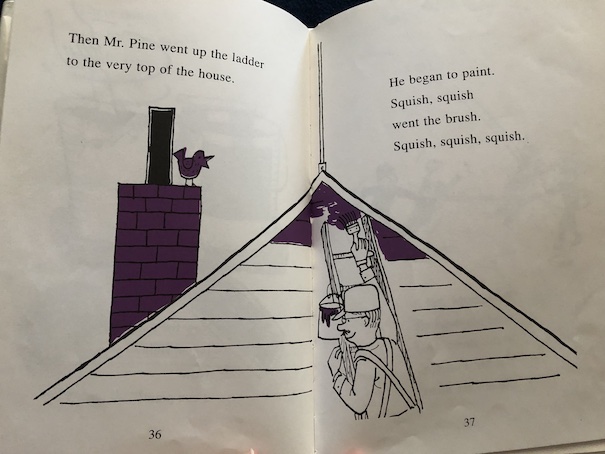
Mr. Pine tries to think of something that he can do with his house that his neighbors won’t imitate. He gets the idea of painting his house, but he can’t pick any obvious color that all of his neighbors will want, too. He decides to paint his house purple. Is this finally the idea that will make Mr. Pine’s house different from the rest?

This book is actually the second book in a series of picture books about Mr. Pine.

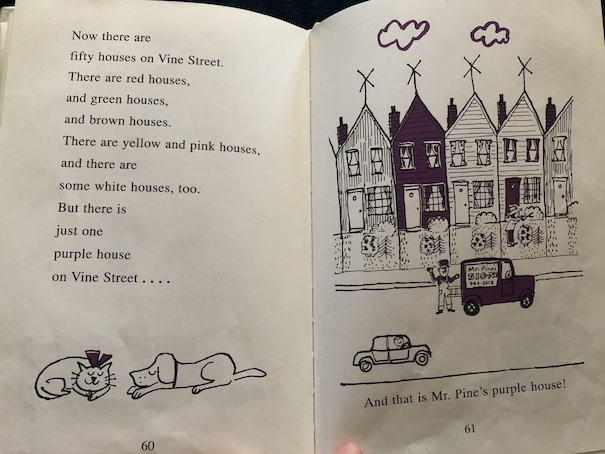
I often think of this book and The Big Orange Splot together because they’re both about people in a neighborhood of identical houses who make changes to distinguish themselves and their houses and end up changing the way their neighbors view their own homes. The difference between the books is that, in The Big Orange Splot, the neighbors were completely opposed to changes that made anyone’s house different until they began to see the opportunities for living out their own dreams through their homes. In this book, the neighbors immediately seize on everything that Mr. Pine does that’s different and start copying him. They think all of his changes are great and frustrate his efforts to be different by doing everything he does until they decide to all paint their houses different colors. Of course, Mr. Pine’s changes are all less outlandish than the ones from The Big Orange Splot, so they would be easier to accept.

I liked it that Mr. Pine’s neighbors all have colors for names: Mrs. Gray, Mr. Gold, Mrs. Green, Mrs. Brown, and Mrs. White, and all the colors they eventually pick for their houses are different from the colors in their names. Even though this book mentions a lot of colors, the only colors shown in the pictures are black, white, and purple. In the end, when the houses are all different, the differences in color are shown with lines providing shading rather than with actual colors. It still works to show that the houses are now different from each other.

A Chair for My Mother

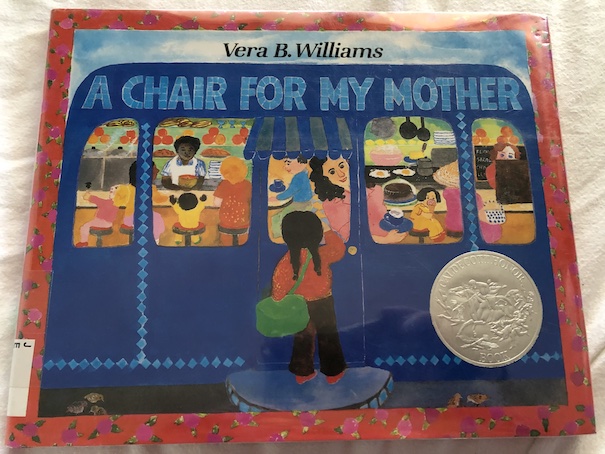
A girl explains how her family is saving up for a new chair after a fire destroyed all the furniture in their old home. The fire happened before the story really begins, but the girl explains how she and her mother returned from a shopping trip and discovered that their home was on fire.

The girl’s grandmother and the family cat escaped from the fire, but everything they had in the house burned.

The girl, her mother, and her grandmother all moved in with the girl’s aunt and uncle until they could move into a new apartment. However, they didn’t have any furniture in the apartment. Their relatives, friends, and neighbors all helped them by giving them food and pieces of furniture they didn’t need anymore.

It was a big help, however, a year later, they still don’t have a sofa or comfortable armchairs. The girl’s mother works in a restaurant, and when she comes home, she’s very tired from being on her feet all day. She wishes that they had a comfortable armchair where she could rest after work.

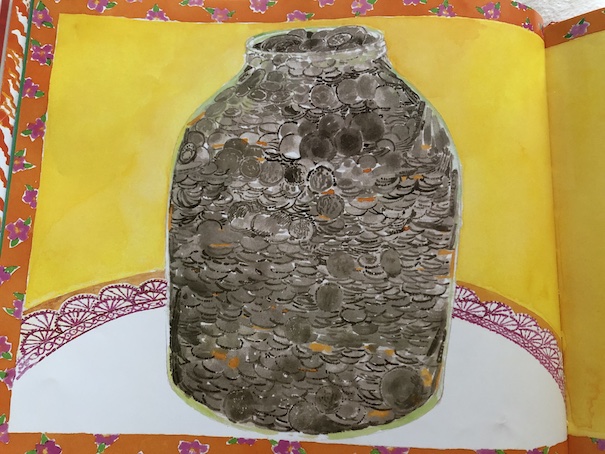
The mother starts saving part of her tips from the restaurant in a coin jar to save up for a new chair. Sometimes, the restaurant owner even pays the girl to do little chores, and she saves part of her money for the chair. Whenever the girl’s grandmother saves money on food she buys, she also puts the savings into the jar. They say that when the jar is full of coins, they will buy the new chair they want.

Eventually, the jar is completely full. They count the coins, roll them in coin wrappers, and take them to the bank to change them for ten-dollar bills. Then, they go shopping for a new chair! There are many chairs to choose from, but they know exactly what kind of chair they want.

The book is a Caldecott Honor Book. It’s available to borrow and read for free online through Internet Archive (multiple copies, including one in Spanish).

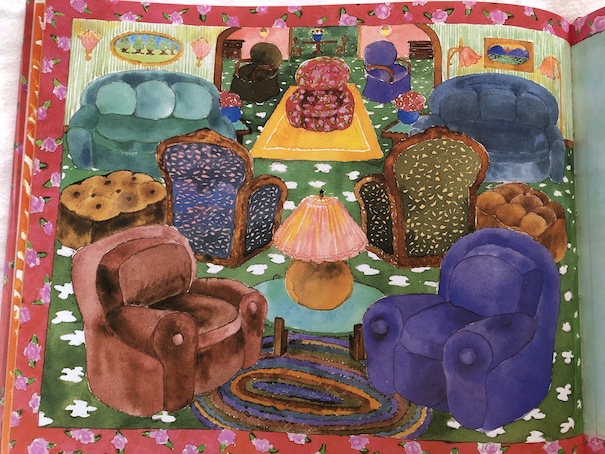
I remember this book from Reading Rainbow when I was a kid! The pictures are bright and colorful, and the story offers comfort and hope.

The people in the story have been through a tragedy where they lost almost everything they had, but the book shows how they recover. Although the fire was sad, the story starts after the fire happened, and the girl talks about the help they’ve received and what they’re doing to make their new home more comfortable. They’re over the initial shock of the fire and concentrating on improving their situation from there. This book felt both comforting and very real. I liked how it showed the family recovering from their ordeal through a combination of help from relatives and friends and their own efforts. Other people help them with some basic household items as they move into a new apartment, and they also save up their money for the chair they want to make their new place feel more like home.

Inside the Secret Garden

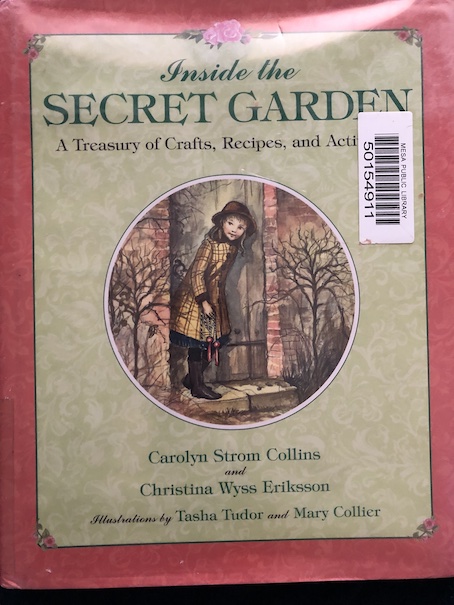
Inside the Secret Garden by Carolyn Strom Collins and Christina Wyss Eriksson with illustrations by Tasha Tudor and Mary Collier, 2001.

This is a how-to book with activities, crafts, and recipes that fit the themes in the classic children’s book The Secret Garden by Frances Hodgson Burnett. The book has some of the classic illustrations from The Secret Garden by Tasha Tudor, and there are also illustrations by Mary Collier.

The book begins with an explanation of the story of The Secret Garden and the life of Frances Hodgson Burnett. In the description of the author’s life, the book discusses some of the places where she lived and people she knew who provided inspiration for aspects of the story of The Secret Garden. There is also a timeline of world events during the author’s lifetime.

The second chapter describes the setting of the story with descriptions of Misselthwaite Manor and its gardens. It explains how a large manor house like Misselthwaite would function and the types of staff and servants it would have. It also explains the types of gardens and plants that would have been grown in the kitchen gardens of English manors and cottages.

The third chapter in the book has recipes and menus based on the foods the characters eat during the story. Food is important in The Secret Garden because Mary and Colin didn’t have appetites when they were unhealthy, but after their time working in the garden and getting fresh air and exercise, their appetites improved. The recipes in the book are based on things the characters eat during the story.

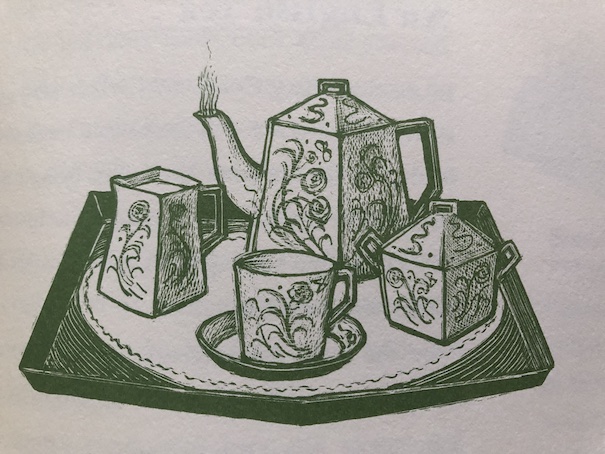
  • A pot of tea
  • Porridge (oatmeal)
  • Treacle (They use molasses with corn syrup and honey to make it.)
  • Orange marmalade
  • Homemade bread
  • Snow-white eggs (soft boiled)
  • Raspberry jam
  • Clotted cream
  • Muffins
  • Ham
  • Oatcakes
  • Doughcakes
  • Apple Crumble
  • Crumpets
  • Robin cake
  • Roasted eggs (The instructions call for cooking them in an outdoor stone oven, like they did in the book, but it also discusses how to make an indoor version.)
  • Roasted potatoes (The instructions call for cooking them in an outdoor stone oven, but it also discusses how to make an indoor version in a standard oven.)
  • Currant buns

A book of activities based on The Secret Garden wouldn’t be complete without gardening activities! The fourth chapter has suggestions for creating your own garden. The gardening tips and suggestions are based on the plants the characters used in The Secret Garden. I’m not sure all of them would grow well in every climate, and planting seasons can vary by region.

  • Planting a spring bulb garden
  • Planting a rose in a flowerpot
  • Making an indoor “secret garden” with potted plants in a tray or pa

The fifth chapter has a selection of crafts and activities related gardening. They include things you can make to use in your garden and things you can make our of plants from the garden, including:

  • A twig tool holder
  • Plant labels (little signs for labeling plants in your garden)
  • Moss-covered flower urns
  • Key wind chimes
  • A planter in a watering can
  • A twig trellis
  • Pressed flowers and a pressed flower scrapbook
  • A bouquet of roses
  • A topiary flower arrangement
  • A miniature arrangement
  • A bird feeder
  • A bird bath
  • Nest-building station

It also explains how to make your own skipping rope, like the one Mary had in the book, and there is a section of traditional jump rope rhymes.

The book is available to borrow and read for free online through Internet Archive.

My Reaction

I liked the chapters about the history of The Secret Garden and the life of Frances Hodgson Burnett. I thought it was interesting to see some of what inspired her to write the story. I particularly like the chapter that describes how a manor like Misselthwaite would be run because I like seeing the historical background to stories.

I don’t think that the gardening tips are really universal. I grew up in Arizona, and I know from personal experience that plants and gardening techniques that would work well in cooler and wetter climates don’t work as well in a hot, dry desert climate. However, some of the garden-related crafts looked intriguing. I particularly like the idea of the wind chime that uses old keys as the chimes. I’ve seen antique stores and places that sell crafting supplies that also sell old keys, so know it’s possible to get them.

I like the selection of recipes the book provides, and I think most of them would be pretty easy to make. The most difficult ones are probably roasted eggs and roasted potatoes because they require an outdoor oven, like the kind the characters in The Secret Garden used. The book briefly describes how to make the kind of outdoor stone oven they mean, but I don’t think that kind of oven can be built just anywhere. It’s more for camping and the countryside, where you can safely have fire pits away from buildings. Fortunately, the book also includes instructions for making those dishes inside, in a standard kitchen.

The Secret Garden Cookbook

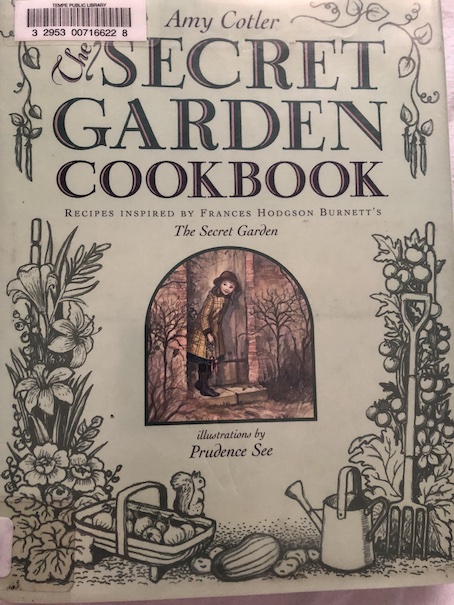
The Secret Garden Cookbook: Recipes Inspired by Frances Hodgson Burnett’s The Secret Garden by Amy Cotler, illustrations by Prudence See, 1999.

This book is a cookbook with recipes based on the types of foods eaten by characters in The Secret Garden by Frances Hodgson Burnett. Food is important in the story because Mary and Collin didn’t have any appetites when they were unhappy and unhealthy, but their appetites improve when they begin working in the garden and getting more fresh air and exercise. Most of the recipes are types of foods that are specifically named during the course of the story, but others are ones that the characters would have been likely to eat for the time and places where they lived. Because the original story focused on gardening, there is also an emphasis on using foods that would be grown in kitchen gardens

Most of the illustrations in the book are simple green and white drawings of different types of foods that accompany the recipes.

The recipes in the book are sorted into different categories, and each section has historical information about different meals and types of food. Individual recipes also have historical information, trivia, and quotes from The Secret Garden related to the dishes. Some traditional English foods need to be explained to Americans. For example, the word “pudding” refers to a specific type of dairy dessert in the US, but in England, it’s a more general word that can refer to any type of dessert.

I liked the selection of recipes, and I really liked the historical information provided with them!

The sections of the cookbook are:

Yorkshire Breakfasts

These are breakfast foods that the characters in the story ate or might have eaten during the Victorian era.

  • Porridge
  • Coddled eggs – Eggs cooked in a cup
  • Cheese muffins
  • Little sausage cakes
  • Cocoa

A Manor Lunch

This section explain the types of things that people of different classes ate as their mid-day meal in the Victorian era.

  • Yorkshire pudding – These are popovers with meat drippings.
  • Roasted fowl with bread sauce
  • Potato snow
  • Welsh rabbit – This is melted cheese on toast.
  • Cabinet pudding – This is a molded custard dessert with fruit.
  • Jam roly poly

An English Tea

This section explains things that Victorian people ate at afternoon tea.

  • A proper pot of tea
  • Cucumber tea sandwiches
  • Scones
  • Fruit tea loaf
  • Lemon curd tartlettes
  • Brandy snap baskets with whipped cream

The Kitchen Garden

This section is about things people would make from fruits and vegetables that they would grow in their kitchen gardens.

  • Fresh spring peas with mint
  • Glazed carrots
  • Summer pudding – This is a molded dessert made with bread and different kinds of berries.
  • Two fools – “Fools” are old-fashioned fruit-based desserts.
  • Raspberry jam
  • Raspberry vinegar
  • Molded spiced pears
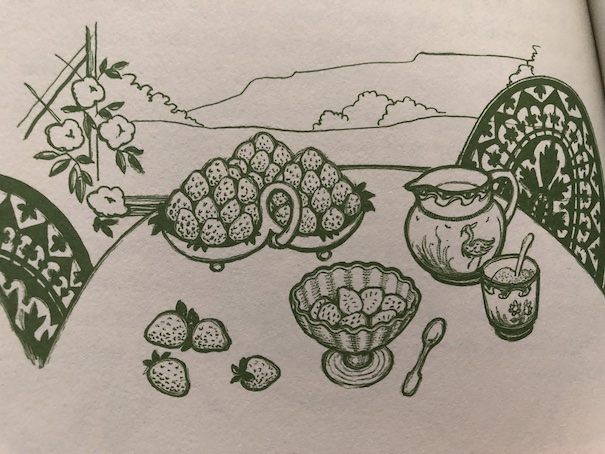
  • Strawberries and cream

Dickon’s Cottage Food

Poor people, like Dickon’s family, would have eaten different things from the wealthier people in Victorian society.

  • Tattie broth – A potato soup.
  • Pease pudding
  • Yorkshire oatcakes
  • Cottage loaf – This is a basic bread recipe.
  • Dough-cakes with brown sugar – A basic dessert made with bread dough.
  • Parkin – A kind of oatmeal gingerbread.

A Taste of India

These are the types of foods that Mary might have eaten during the time she lived in India.

  • Fruit lassi – This is a kind of fruit shake made with yogurt.
  • Sooji – A hot breakfast cereal similar to cream of wheat.
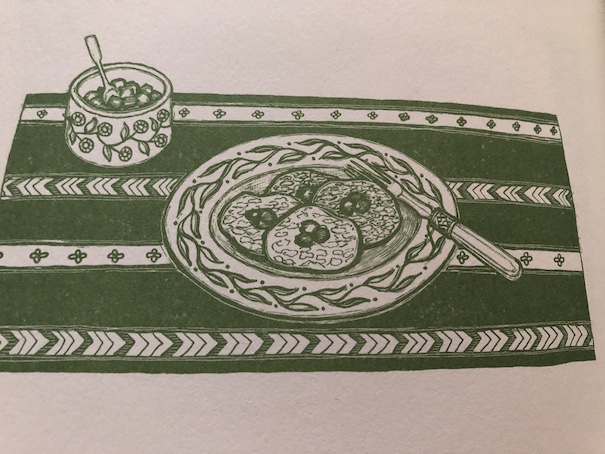
  • Little bacon and coriander pancakes
  • Fresh mango chutney
  • Mulligatawny soup – This soup was invented in India for the British colonists. It’s curry coconut soup whose name means “pepper water.”
  • Florence Nightingale’s kedgeree – Florence Nightingale has nothing to do with the dish, but the Victorians named it after her because she was famous. It’s a rice and fish dish that was often made from leftovers and served for breakfast or lunch.

Garden Picnics

These are foods that can be prepared outside or are easy to pack for a picnic.

  • Roasted potatoes and eggs
  • Currant buns
  • Crumpets
  • Cornish pasties – These are savory pies or turnovers with meat and veggies, meant to be eaten with the hands. They’re sort of like larger, better-tasting Hot Pockets.
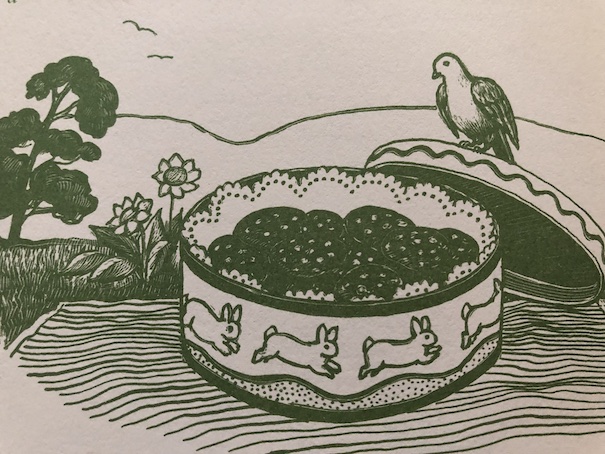
  • Chocolate picnic biscuits

The book is available to borrow and read for free online through Internet Archive.

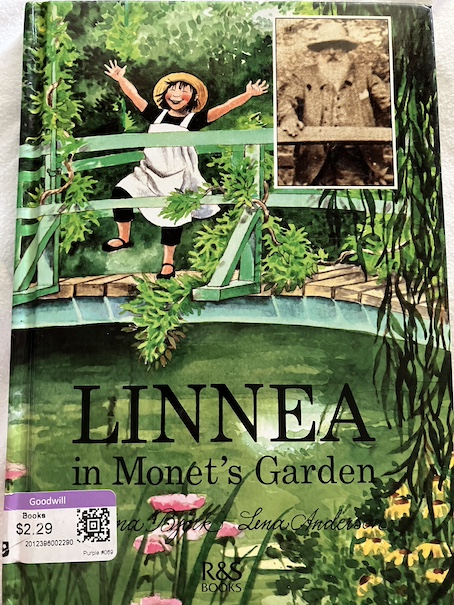
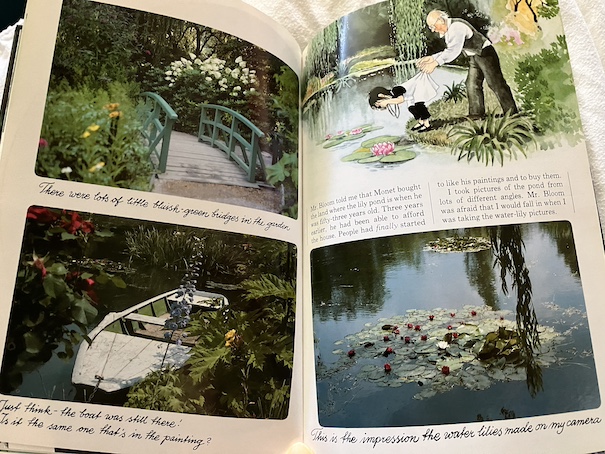
Linnea in Monet’s Garden

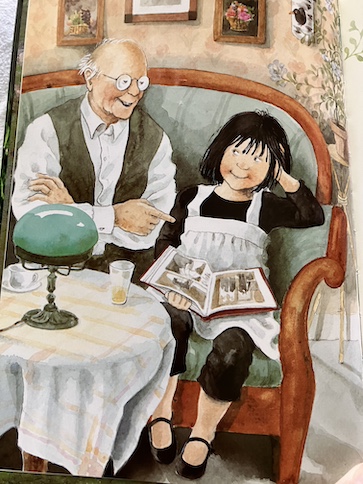
Young Linnea loves plants and flowers. Linnea’s upstairs neighbor, Mr. Bloom, used to be a gardener before he retired. He knows all about plants, and she likes to talk to him about them. Mr. Bloom has a particular book that Linnea likes about the French artist Claude Monet and his garden. Monet was famous for his paintings of the flowers and water lilies in his garden, and the book also has photographs of him, his wife, their children, and their garden. When Linnea looks at that book, she likes to imagine that she really knows the Monet family and that she’s visiting their garden.

One day, Mr. Bloom tells her that it’s possible to really go visit the garden because it still exists. Monet’s house had become run down and the garden was overgrown, but they have since been restored and turned into a museum. They could visit the garden if they go to Paris. They live a long way from Paris, but Mr. Bloom arranges with Linnea’s family for her to go on the trip with him.

Linnea and Mr. Bloom stay at a tiny, old hotel on the River Seine in Paris that was built in 1640. They can see the Notre-Dame Cathedral from the hotel, and it reminds Linnea of The Hunchback of Notre-Dame.

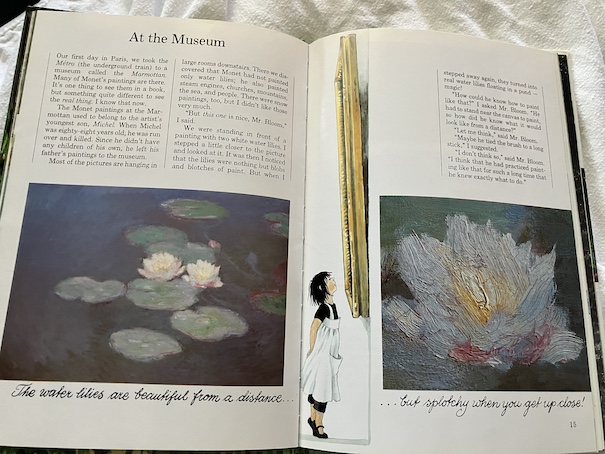
On their first day in Paris, Linnea and Mr. Bloom go to the Marmottan Museum to see Monet’s paintings. Monet’s youngest son left his father’s paintings to the museum when he died because he had no children of his own to inherit them. Mr. Bloom explains to Linnea that Monet painted in the impressionist style, which means that he tried to capture the rough images and impressions of the moment rather than creating detailed, completely realistic paintings. (I’m nearsighted, so impressionist paintings always look to me like what I see when I’m not wearing my glasses. I see colors and rough shapes, but everything is fuzzy with no sharp lines or fine details. I can still tell what objects are without my glasses, but nothing is distinct. I have impressions of things.) Mr. Bloom says that Monet particularly liked to show how light reflects off water and other objects in his paintings.

The next day, they take a train to the town of Vernon, and from there, and from there, they take a taxi to Giverny, where the Monet house and garden are. Along the way, they also buy some food for a picnic. Then, they go to see Monet’s garden.

When Linnea sees the garden in person for the first time, it’s much bigger than she had imagined from the pictures in the book. Mr. Bloom tells Linnea all the names of the different flowers, and they take pictures of them. Then, they go inside Monet’s house. They’re not allowed to take pictures inside the house, but they get some postcards of the house’s interior.

One of the best moments for Linnea is that she is able to stand on the Japanese bridge in the garden, over the lily pond, as she always imagined she could do when she looked at the pictures in Mr. Bloom’s book! Monet painted pictures of that bridge multiple times. Each painting looks different because he painted them at different times and in different weather, so had different impressions of the bridge each time. The book shows Monet’s paintings of the bridge and how different they are from each other, and Linnea tries to capture her own impressions of the bridge.

They aren’t allowed to have their picnic lunch inside Monet’s garden, so they have lunch by the nearby river. Then, they return to Paris.

Back in Paris, they visit the Jeu de Paume museum to see more impressionist paintings. At the Orangerie, they try to see Monet’s giant water lily painting in the Water Lily Rooms. At first, they are told that the exhibit is closed for repairs, but when Mr. Bloom explains that they have come a long way to see them and Linnea starts to cry, the museum staff decide to make an exception.

For the last day of their trip, Linnea and Mr. Bloom decide that they want to return to Giverny. When they make their second visit, a man recognizes them as return visitors, and he turns out to be a member of Monet’s family, his step-great-grandson, Jean-Marie Toulgouat. He lives nearby, and he is also an artist, although his art style is very different from Monet’s. He talks to them about Monet’s life and family, and it also turns out that his wife was the author of the book about Monet that inspired Linnea and Mr. Bloom to take this journey!

When they return home, Linnea and Mr. Bloom go through all the pictures they took in France, and Linnea puts up a bulletin board with postcards and pictures from their trip. She also has a little wooden box with other souvenirs.

In the back of the book, there is a family tree for the Monet family and a timeline of events from Monet’s life. There is also a section of information about museums and sites in Paris and a list of books about Monet.

The book is available to borrow and read for free online through Internet Archive (multiple copies, including one in Chinese). The book was originally written in Swedish and published in Sweden in 1985. The English translation was published in 1987.

This is a lovely book about travel, art, and the beauty of nature and plants. Initially, Linnea becomes interested in Monet because of her love of plants and flowers, and when her neighbor says it’s possible to visit the garden Monet painted, she becomes interested in Monet’s life and work. I grew up learning about art and famous artists because my mother used to teach art lessons through a special program at my school. I don’t remember seeing this book at that time, although it is old enough that I could have. I found it by accident at a thrift store, and it reminded me of the art books that my mother kept around the house when I was a kid.

I enjoyed how the book brought a historical person to life, explaining Monet’s life story as well as his art and showing child readers that it’s possible to see the setting of his paintings in person. The book shows pictures of Monet’s art and photographs of the garden and flowers he painted so children can see the connection between the artwork and the real places and objects. Although not everyone can go to France just on a whim, the book does show what such a trip would be like, and it also shows kids how they can delve deeper into subjects that interest them and even go to places connected with their passions. The journey in the book is a magical trip that even adult armchair travelers can enjoy!

Emma

Emma has had a full life, and she has many grandchildren and great-grandchildren. However, she is often lonely when they aren’t visiting her. Most of the time, it’s just her and her pet cat, Pumpkinseed. It’s not a bad life because Emma loves the many simple things in her quiet life, but she unexpectedly discovers a new interest in life when she turns 72.

Her family comes to visit for her birthday, and one of the presents they give her is a painting of the small village where she was born. Although her family doesn’t entirely understand her attachment to her memories of her home village, they know that she is very fond of remembering it. 

However, the painting bothers Emma because it doesn’t look the way she remembers she remembers her village. The village has probably changed since she was last there, but the way the artist has painted it isn’t the way she remembers it. Emma realizes that she wants to capture those memories. Because no one else can paint her village the way it looks in her memories, Emma decides that she will do it herself. She buys an easel and paints and makes her own painting of her village. 

It makes Emma happy when she hangs her painting up in place of the painting that her family gave her because it looks like her memories. However, she doesn’t want her family to think that she didn’t appreciate their gift, so she is careful to replace her painting with the one they gave her whenever her family comes to visit. Everything changes one day when she forgets to makes the switch before her family visits her.

Everyone notices that the painting on the wall is different from the one they gave her, and they ask her where it came from. Emma is embarrassed and admits that she painted it. At first, she wants to put it away, but her family tells her not to do that because it’s a wonderful painting, and they encourage her to paint more.

Emma admits that she already has painted more, and she brings out her other paintings for everyone to see. From then on, she paints more paintings of her village and all of the little things around her that she loves to notice, and she openly displays them. Aside from her family’s visits, she also starts receiving other visitors who come to see her paintings. There are still times when she is alone, but she is no longer lonely when she is alone because she has her art to keep her busy and her memories of all the places and things she loves hanging on her walls.

The book is available to borrow and read for free online through Internet Archive.

I’ve been trying to figure out what this book is for years! I vaguely remember my mother telling me about this book when I was little. I can’t remember if she read it to me or just told me that she had seen the book somewhere, but the vague concept of the story about a grandmother who started painting because her relatives gave her a painting of her home town that didn’t look the say she remembered it stayed with me.

What I didn’t know or didn’t remember was that the grandmotherly painter in the story is based on a real person. In the back of the book, the American author explains that she met Emma Stern when she was living in Paris. Emma Stern was German, and she was born in 1878 and died in 1970. She is known for painting countryside scenes and village life. I’m not sure exactly where the village or small town where she was born was, although this website, which shows a selection of her paintings, has labeled most of them as being St. Wendel.

The story is inspirational because it’s an example of someone who found a new interest in life and a new talent when they were elderly. There are other examples in life of people who were “late bloomers” and found new careers or achieved something amazing in life at a time when many other people are just retired or taking it easy. It’s never too late to do something you really love!

The Most Beautiful Place in the World

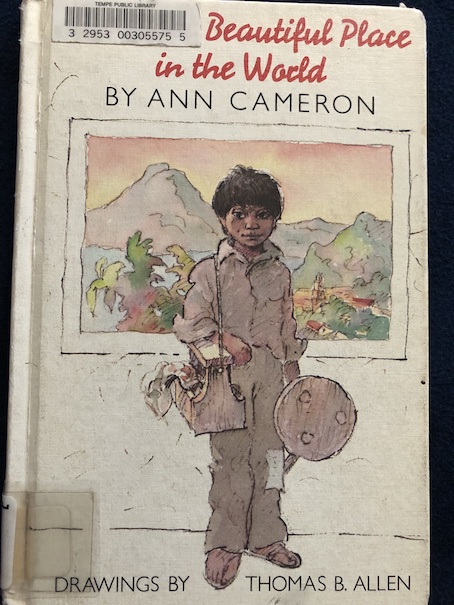
The Most Beautiful Place in the World by Ann Cameron, drawings by Thomas B. Allen, 1988.

Juan is a little boy living in the town of San Pablo in Guatemala. It’s not a very big town, but it is very busy. The town is on a lake with several other towns around it, but Juan has spent his whole life in San Pablo.

Juan is from a poor family, although he doesn’t consider his grandmother poor because she owns her own house and is able to take in other relatives whenever they fall on hard times. He knows that his father was the caretaker of a big house in the town, but he abandoned him and his mother when Juan was still a baby. His mother says that his father wanted to continue partying with his friends like he did when he was a single man, spending more than they could afford. After they argued about it, he left his family and went to a bigger city and never tried to see them again. Juan’s mother moved back in with her mother, so Juan grew up in a crowded little house filled with other relatives who needed help because they had gotten sick, lost their jobs, had marital problems, or various other things going wrong in their lives.

Juan’s grandmother supports herself by making arroz con leche and selling it in the marketplace. When Juan is still a small boy, his mother remarries to a man who doesn’t want anything to do with Juan, so his mother abandons him, leaving him with his grandmother. Juan is distressed by his mother’s abandonment, but his grandmother continues to look after him and begins preparing him to live an independent life from a young age. She has him help her sell arroz con leche in the marketplace, and later, she teaches him how to shine shoes so he can earn his own money. Juan is still very young, but his grandmother knows that life will tough for him without his parents.

Juan knows that his mother has had another child, and he feels jealous of his younger half-brother because he gets to live with his mother, and he doesn’t. (I question whether the younger half-brother is really going to be better off in the long run, but I’ll explain why below.) However, he is really jealous of the other children in town who get to go to school. Not all children in town go to school because many are from poor families, who need them to work and earn money, but Juan wishes that he could go to school, too.

He quietly teaches himself to read the signs in town and a newspaper, but he’s afraid to ask his grandmother about letting him to go school at first. He’s worried that, if he asks for that, his grandmother may tell him that she only cares for him because of the money he earns. If his grandmother abandoned him or withdrew her affection for him because he asked for too much, Juan doesn’t know what he would do. However, when he finally brings up the subject of school with his grandmother, he learns how much she really does care for him, how much she plans for his future, and how proud she is of him.

The book is available to borrow and read for free online through Internet Archive (multiple copies).

My Reaction

Juan’s family is poor, and at first, Juan doesn’t understand fully how poor they are. His grandmother’s life is more secure than others because she owns her own house, while others don’t, but even she has limited resources. The house has running water, but it doesn’t have electricity because she can’t afford it. She takes in other relatives when they are in trouble because she cares about her family, but she also has to make sure that everyone does whatever they can to support themselves because she can’t do it alone.

At first, Juan thinks that maybe she just keeps him because he earns money shining shoes, and she keeps most of his wages. However, when he talks to her about school, he learns that she has not spent any of his wages on herself or on other relatives. Instead, she has secretly saved them up because she knew that he would need money for his education, and she uses it to buy school supplies for him. At first, his teacher doesn’t want to accept him in class because the school year has already started, but when he demonstrates that he has already learned math from working in the marketplace and has taught himself to read, she accepts him. He exceeds everyone’s expectations for him, and his teachers even say that they will contribute to his education, if necessary, to keep him in school.

Juan’s grandmother cannot read, and she reveals that her parents wouldn’t let her go to school when she was young, even though she wanted to go. Her parents were afraid that she wouldn’t learn to do any practical work in school, so they didn’t want her to get an education, but she’s always felt disadvantaged because of it. She’s managed to get by in life, but she realizes that she could have done better with an education. She says that if Juan continues to work after school and does well in school, she’ll support his education, as far as he wants to go, even to the university. She says maybe he’ll even be able to figure out some of the big questions in life, like “why some people were rich, and some were poor, and some countries were rich, and some were poor, because she had thought about it a lot, but she could never figure it out.” Juan worries that he won’t be able to live up to his grandmother’s expectations for him, but she tells him not to worry about that. She just hopes for the best for him and wants to see him do the best he can because she loves him, and that’s what Juan really needs to hear.

The title of the story comes from a tourist poster that Juan reads to his grandmother, calling their town, “The Most Beautiful Place in the World.” Juan’s grandmother thinks that the most beautiful place in the can be anywhere where a person can be proud of who they are, but Juan privately thinks that the most beautiful place in the world is somewhere with someone you love and who loves you back. Juan has been deprived of love because of his parents’ abandonment of him, but he has found the love and support he needs from his grandmother, who wants him to succeed in life because she loves him and not just for what he can do for her.

Parts of the story are sad because Juan’s parents callously abandon him, and even his mother tries to act like it’s nothing because she knows his grandmother is taking care of him. I tried to decide how selfish Juan’s mother is in the story. On the one hand, I can see that she is poor and desperate and may have felt compelled to accept the first marriage proposal she was offered just to get out of her mother’s house, but she is very callous to her little son and his feelings and needs.

At first, he doesn’t even quite understand why his mother has left him, not even leaving him the bed they shared, so he has to sleep on some empty rice bags. He goes to his mother’s new house and tries to spend the night there. His mother lets him stay the night but hides him because she says his stepfather will beat him if he catches him in the house, which is why Juan never goes there again. I don’t know whether the stepfather ever beats Juan’s mother or the child they later have together, but the mother’s comment makes me think that it’s likely. Yes, Juan’s mother succeeded in getting remarried and out of her mother’s house, but I don’t think she’s really headed for a better life, and I have doubts about the future her younger child will have. It looks like the stepfather is selfish and temperamental, probably every bit as immature as Juan’s father was, and the children’s mother will always place her own needs first. As hurtful as it was for Juan to be abandoned by his mother, his mother is not going to nurture him and his future in the way his grandmother does. His grandmother has to be tough sometimes because of the family’s poverty, but she still does her best to look after everyone, even at her own expense, because she does love her family and wants the best for them and their futures, not just to get what she wants from other people and get ahead by herself. I would say that’s the quality that makes her different from Juan’s mother. At one point, she even marches Juan to her daughter’s new house and demands that she and her new husband at least provide a real bed for her son, reminding them of their responsibilities.

The book doesn’t go into the details of Guatemalan society and events in the 1980s, when this book was written, which was something I wanted to see. It’s pretty simple story for elementary school level children, but there is more going on behind the scenes that Juan would be aware of as a young boy living in a small town. The time period when this story was taking place was during the Guatemalan Civil War, which lasted from 1960 to 1996. The war and sharp differences in social class are partly responsible for the economic and societal inequities that Juan’s grandmother describes, although the economic and social disparities in Guatemalan society were part of the reason for the war in the first place. There was also general dissatisfaction with government incompetence and interference in Guatemalan affairs on the part of the United States, which sought to use Guatemala as part of its Cold War strategy, including using it as a training ground for Bay of Pigs Invasion against Cuba. These are complicated and long-term situations that would require more explanation than a children’s book of this level can provide, and because the characters in the story live in a small town, they may not be seeing many of these events directly. As he gets older, Juan will probably become more aware of the wider world and the circumstances that have shaped his family’s lives, as his grandmother hopes and expects, especially if he does end up going to the university in the capital city.

Magdalena

Magdalena is switching classes at school. She’s happy about it because she found her old class too chaotic. She thinks she will be happier in her new class. Her friend in her current class at school, a boy named Saul, tells her that she must be an IGC, an Intellectually Gifted Child, in order to get transferred to that class because that class only takes gifted children. However, she is told that she will also have to wait a little for them to give her a desk in the room. When months go by without her being told that there is a spot ready for her and she can make the switch, Saul thinks that they were probably lying to her about her being able to switch classes.

Finally, in January, she is able to switch to the new class, but right away, she runs into trouble with the class bullies. A boy named Andy and his friend start calling her “Miss Two-Ropes” because of her long braids, and the name sticks. Magdalena wishes that she didn’t have to wear her hair in braids, but her grandmother, Nani, insists on it. She loves Nani, who is from Puerto Rico and has looked after her for last two years, ever since her mother died when she was nine years old, but Nani has some old-fashioned ideas about how girls ought to be raised.

Magdalena’s father is a sailor, and he spends much of his time away at sea, so Magdalena and her grandmother are alone most of the time. Nani speaks Spanish to Magdalena at home because she thinks that’s proper for a Puerto Rican family like theirs, although Magdalena speaks English at school. She thinks that her grandmother probably knows more English than she pretends. Nani also keeps a portrait of Great-Grandfather Mendez, which she brought from Puerto Rico. Although he has been dead for years, the portrait always feels like a living person to Magdalena.

After some further teasing from the boys in her class, Magdalena decides to tell her grandmother that she doesn’t like her braids. Nani says that not unusual, that many children don’t like their braids, but they get over it. Magdalena doesn’t think she’s going to just get over it. Like a lot of kids, she would rather just look like everyone else so she won’t get teased, but Nani doesn’t approve of the short hairstyles that are popular among American girls at Magdalena’s school. She says that Magdalena’s braids are a mark of pride and a caring grandmother who brushes and braids her hair. She thinks the American girls wear their hair short because their mothers can’t be bothered to spend time on caring for long hair, and they don’t have grandmothers to nurture them. When Magdalena tells her that the boys at school are calling her names because of her braids, her grandmother decides that she should talk to the teacher about it. Magdalena thinks that having her grandmother talk to the teacher might be more embarrassing than having the boys call her names, so she persuades her grandmother to forget about it for now and let her handle it.

Then, Magdalena is called to the principal’s office at school. At first, Magdalena is upset because it sounds like she’s in trouble, and she can’t understand what she could have done to cause that. She is calmed a little when a black boy in the office, who is also waiting to talk to the principal, is nice to her. It turns out that Magdalena isn’t really in trouble. Instead, the principal wants to talk to her about one of her classmates, a girl named Daisy Gonzales, who is also transferring into her new class.

Madgalena is surprised because Daisy hasn’t struck her as a gifted child. Most of the other students call her “Spook” because she tends to lurk around the school and suddenly jump out at people to scare them, and she is known to frequently skip classes. The principal says that Daisy might be gifted, but it’s difficult to tell. The teachers think that she’s at least bright, but she’s an “under-achiever.” The principal explains that means that Daisy could do better at school than she does, but for some reason, she doesn’t seem motivated to do better. That’s why they’ve decided to transfer her to the class with the gifted students. They think that she isn’t being challenged enough in the class where she is. The teachers are also concerned that Daisy has no friends at school. They’ve noticed that the other girls at school seem to be afraid of Daisy, although they don’t seem to understand about Daisy’s “Spook” act. They do know that Daisy has behavioral problems and an unhappy home life. The reason why the principal is telling Magdalena about this is that she wants Magdalena to try to be Daisy’s friend when she transfers into her new class. The reason why she selected Magdalena to be Daisy’s new friend is because Daisy’s family is also Puerto Rican, like Magdalena’s family, so she thinks that the girls might understand each other better than their other classmates. The principal thinks that Daisy might settle down at school if she had a friend to help her feel more comfortable there. Magdalena isn’t comfortable with the idea of trying to be Spook’s friend because she also finds Daisy spooky, but the principal persuades her to try but not to let on that the principal asked her to do this.

Magdalena has no idea how to approach Daisy/Spook to be friends, since she’s not the easiest person to approach about anything. Then, Sue Ellen, the most popular girl in class tells Magdalena that she wants to be friends with her. She says that she’s been feeling empathy for her since the first day that she came to class and the boys started teasing her, and she felt it again when she got called to see the principal. She asks her what the principal wanted, and Magdalena explains that she asked her to do something, but it’s something really hard, and she isn’t supposed to talk about it. Sue Ellen offers to help her with whatever the principal’s task is. Magdalena thinks maybe making friends with Spook won’t be so bad if Sue Ellen helps, so she takes Sue Ellen into her confidence. Sue Ellen agrees with Magdalena that making friends with Spook would be hard because she’s so weird and spooky. Both girls admit that they’re a little afraid of her, but Sue Ellen agrees to try to be basically nice to Spook along with Magdalena and see what happens. Sue Ellen says that the principal ought to have more empathy for the students and see just how hard it would be to get along with someone like Spook.

Their first attempts at making friends with Spook are clumsy. Sue Ellen tries offering her advice, pointing out that she wore the wrong thing to the school assembly, but criticism and advice aren’t the best ice-breakers. Then, to Magdalena’s surprise, Spook approaches her in the school library, when she is trying to find a specific book for her grandmother. The school library doesn’t have the book she wants, but Spook says that she knows where to find it. However, she will only help Magdalena if she plays hooky and goes with her right now. Magdalena hesitates because she doesn’t really want to skip class and get in trouble, but Spook says that Magdalena will have to come with her because she’s “emotionally disturbed” and might do crazy things if she doesn’t get her way. Magdalena points out that school will end in only 20 minutes, and she asks Spook to wait for her. Spook makes her promise that she won’t change her mind and let her down in that time.

When Magdalena waits for Spook, she doesn’t show up at first, but Spook jumps out at her just when she’s giving up waiting. Spook says that she just wanted to see if Magdalena was serious about wanting to come with her. The place where Spook knows they can find the book turns out to be the Brooklyn Public Library. Along the way, Magdalena begins to learn more about Spook. The reason why she wasn’t dressed right this morning was that the sweater she was wearing was the only thing she had to wear that was clean. She skipped out during the school assembly to go home and see if her mother was back from the laundromat so she could put on something else. Also, Spook isn’t completely friendless. She is friends with a strange woman named Miss Lilley, who wears an unusual, large hat. When Daisy tells Miss Lilley that she got put into the class at school with the smart kids, Miss Lilley congratulates her and tells her that she knew she was smart. Daisy admits that she’s been trying not to let her teachers know that she’s smart because she knows that they will expect more of her and insist that she do all her homework. People don’t expect so much of kids who aren’t bright. There is method to Daisy’s madness. All of her weird and spooky acts are tools that she uses to get her, get out of things that she doesn’t want to do, cover up for problems that she has, and keep people she doesn’t like or doesn’t think would understand her at a distance.

Daisy introduces Magdalena as one of the smart kids from her class, but Miss Lilley thinks that Magdalena’s manners aren’t very polite because she keeps staring. Magdalena has trouble getting over the large hat, which looks like a large pumpkin. Miss Lilley begins evaluating Magdalena’s appearance, and Magdalena comments about how she hates her braids, but her grandmother makes her wear them. Miss Lilley says that she understands that her grandmother likes the quaintness of the braids, but she knows how to deal with that. She also knows where to find a good barber. The black boy who was nice to Magdalena earlier, Samson Shivers, makes money after school by shining shoes outside the library, and when Miss Lilley asks him if he would be willing to lend them money for the haircut, he joins the others at the barber shop. Miss Lilley takes the kids to the barber shop, and Magdalena gets a haircut. Magdalena feels wonderfully free after he haircut, although she saves the braids as a souvenir and worries about what her grandmother will say when she gets home.

Nani is very upset when she sees Magdalena’s short hair and worries that Magdalena is rejecting her care for her and her Puerto Rican heritage. Magdalena says that’s not the case and explains about going to the library and meeting Miss Lilley. Magdalena’s grandmother thinks that she’s bewitched and says that she knows how to deal with that. She uses herbs on Magdalena to break the bewitchment.

Getting the haircut changes things for Magdalena. The boys stop teasing her, which is a relief. However, Sue Ellen is annoyed that Magdalena didn’t tell her that she was going to get her hair cut. Magdalena explains that it was a sudden decision and a possible bewitchment by Miss Lilley. Sue Ellen thinks that Spook is probably the one who bewitched Magdalena because she’s so spooky and that maybe Magdalena would rather be best friends with her. Magdalena says that’s not the case and that she doesn’t see why she can’t be friends with both girls. Sue Ellen still expects that Spook is going to do something to ruin the class, but Magdalena notices that Spook is becoming less spooky in their class. She stops skipping classes, does more of her homework, and cuts out some of her previous spooky behavior.

Samson, often called Sam, is a practical boy, and when Magdalena tells him how her grandmother thinks Miss Lilley is a witch and bewitched her, he says that she can’t be a witch. Sam sees her often because he shines shoes by the library, and he realizes that Miss Lilley is actually just a poor, old woman. She goes to the library all the time because she can’t afford proper heating for her apartment. She often has little to eat, and she partly survives off of candy that he gives her. Like Spook, she seems spooky because she looks odd and behaves oddly, but there are explanations for what she does that show that she’s actually unfortunate.

Magdalena’s grandmother meets Spook for the first time when Spook hangs out with Magdalena at her apartment after school. Nani isn’t home at the time, but the girls talk to each other about their lives and families. Magdalena gets to know more about Spook, and Spook admires the place where Magdalena lives. Spook’s family lives in a much poorer apartment, and it’s crowded with Spook’s younger siblings. Spook admires the nice bathtub that Magdalena and her grandmother have and says that she wishes they had one at her apartment. Part of the reason why she looks so strange is that she doesn’t get the opportunity to take baths often. Magdalena tells her that if she wants a bath, she can go ahead and take one. Nani arrives home before Spook is finished with her bath, but Nani stops her when she tries to get out and get her clothes. Nani can see how badly Spook needs some care, so she insists that she finish the bath, clean the tub, and let her shampoo her hair. When she’s done, Nani has Magdalena loan her some clean clothes, and the girls are amazed at the transformation.

After the bath incident, Spook avoids Magdalena for a while, and she can’t understand why, but it’s about Spook realizing what’s been lacking in her life and envying what Magdalena has: someone who really cares for her. She was so emotional when she looked at herself in the mirror that she spit at the image and then was embarrassed that she had done that. Nani surprisingly understands Spook’s behavior. She can see that Spook lacks impulse control and the ability to understand and manage her feelings. Nani comments that she’s angry with Spook’s mother because she can tell that the girl has been badly neglected. Having been a mother and grandmother herself, she knows exactly how to deal with this.

Meanwhile, Sam is correct about Miss Lilley. Miss Lilley is poor and not in very good health, but she also knows what Magdalena and Spook/Daisy need. She is eager to help the girls, but she also needs some help and attention herself. When Miss Lilley decides that it’s time to have a word with Nani about the needs of modern girls and her fears about her granddaughter becoming too American, a number of things get better.

The book is available to borrow and read for free online through Internet Archive.

The heart of this story is understanding and empathy. By the time it’s over, many of the characters come to a better understanding of each other and maybe themselves. Although Spook’s transformation is the most dramatic, the other characters are also changed after their experiences in the story.

Magdalena’s changes come with her admission to her grandmother that she really doesn’t like her braids and then with her decision to have her hair cut against her grandmothers wishes. She knew that her grandmother wouldn’t like it when she said that she didn’t want braids because her grandmother is a traditionalist, and she knew that Nani wouldn’t react well to the haircut. At first, it was easier for Magdalena to buy into the idea that Miss Lilley was a witch who bewitched her into doing it, but that’s not really the truth. It wasn’t even that Magdalena was getting her hair cut just because of the teasing. When Magdalena and Spook are talking about whether or not they truly understand the reasons why they do things, Magdalena acknowledges that she has reasons for the things she does, and the truth is that she got the haircut because she herself really hated wearing braids. If she had really loved her braids, she could have kept them in spite of the teasing, and she could have turned down the offer of a haircut, but she really wanted to change her hairstyle, and she just took advantage of the opportunity to do it.

Nani understands from the first time she meets Spook that she has not had nearly the level of care and attention that she has needed in life. Spook doesn’t even really understand all of the motivations she has for the things she does. Her behavior is odd partly because she acts on impulse, not fully thinking about the consequences or the affect her behavior has on others. She initially doesn’t have much self-awareness because she has not had caring adults in her life to teach her how to behave, how to understand her feelings, and how to control herself. Because she hasn’t really had any friends before, she hasn’t really had anyone to talk to about these things and help give her some perspective. When Spook and Magdalena talk about why she spit on the mirror, Spook says at first that she isn’t sure why she did it. As they continue to talk about reasons for doing things, though, Spook admits that she did it because, while she was stunned at how nice she looked, she quickly became upset because she didn’t think that nice look could last.

Nani is the nurturing type of person, and she quickly sees that Spook is in dire need of some nurturing and guidance. She also recognizes that Spook doesn’t have much confidence in herself. She is bright, but she has grown used to hiding it. She also thinks, because she doesn’t really understand her feelings or behavior, that is can never really control herself. She thinks that she will always be a “stinker” who does things that she shouldn’t and acts weird. Nani has a frank talk with her and tells her that she can be herself without being a “stinker”, and the first step is believing that she can. Even if she’s not in the habit of understanding and controlling herself, she can learn. People have different sides to their personalities and different ways of expressing themselves, and Spook can learn how to show the best sides of herself in the best possible ways.

Magdalena appreciates that Nani is understanding and helping Spook, but she also has a frank talk with her grandmother about why she doesn’t understand her own granddaughter as well. When Magdalena tries to tell her what she wants or doesn’t want, Nani contradicts her or ignores her feelings. Nani is understanding with Spook because she can tell that Spook is a disadvantaged child, but she doesn’t see her granddaughter the same way, so she doesn’t try to understand why Magdalena sometimes does things she doesn’t like. Nani admits that she wanted her granddaughter to be “perfect”, but maybe she doesn’t really know what “perfect” actually is. She wants the traditional ways for her granddaughter because she really thinks that’s what’s best, but even grandmother doesn’t always know what’s best.

Miss Lilley is concerned about the girls and offers them attention and support. When she goes to see Nani and open her eyes to her grandmother’s needs and the ways of modern girls, she collapses because of her bad health. Fortunately, Nani is a nurturing person, and she nurtures Miss Lilley, making sure that she gets the treatment she needs and even looking after her when she gets out of the hospital. Miss Lilley’s health improves, and the two of them become friends. Although they are both older ladies, they each admit that they have things to learn in their lives, and they can learn from each other. Nani helps her to make changes to her living arrangements so she will be healthier and more comfortable, and Miss Lilley helps her understand what modern American life has to offer for girls like Magdalena.

Samson is always a very understanding character because he is genuinely interested in people, and he meets many different types of people through his shoe-shining business. Although Sue Ellen is the first person who brings up the topic of empathy, she is really the one who understands it the least. I think her relatively narrow view of empathy is because of her relatively narrow life experiences. She feels some empathy for Magdalena because she sees Magdalena experiencing something she understands, but she doesn’t seem to know what to do when she encounters something she doesn’t understand. Admittedly, Spook’s spooky act is off-putting, partly by design and partly because Spook has issues she herself doesn’t know how to handle. However, because Sue Ellen only wants to stick to the familiar and understandable, she doesn’t notice when Spook begins to change and doesn’t see how some support from her could influence her for the better. Sue Ellen’s attempts at friendliness and helpfulness often involve offering some kind of criticism, like pointing out that Spook isn’t dressed right. Magdalena can tell that Sue Ellen is trying to be helpful, but she’s also kind of snippy and smug in the way she does it, and that gets on Magdalena’s nerves, too. Sue Ellen kind of fades out of the story toward the end, so we don’t know if she continues being friendly with Magdalena or not or if she ever recognizes Spook’s transformation.

There is also a subplot that I haven’t mentioned about the literary magazine that the girls’ class starts. Their teacher has some thought-provoking descriptions about what good writing is and does, and the girls’ choices of what to write about are based on their experiences and the changes in their lives.

The book doesn’t shy away from the harsh realities of life. Magdalena’s mother is dead, and her father is away most of the time, so she is being raised by her grandmother. Her father never even makes an appearance in the story. Miss Lilley is a poor and lonely old woman who needs help and friends. It is acknowledged that Spook is a neglected child, and she even tells Magdalena that her favorite brother died at age three because he was asthmatic, and they were living in bad conditions. We don’t know exactly how her family came to be living in such bad conditions, but Spook says that, if she wrote a story about her family, the teacher would think she had a filthy mind.

Since the story is about understanding other people, one could consider whether we might view Spook’s neglectful mother more sympathetically if we knew her past and what led her to the situation they’re now in, but we do not see Spook’s mother at any point in the story. I think it’s also important to note that understanding does not equal approval. You can know a person’s history and reasons for doing things and still not agree with them. Maybe Spook’s mother is another unfortunate soul who needs some help, but if she is, she doesn’t seem to be looking for that help. Her vulnerable children are suffering for it, and one has died. Empathy doesn’t mean saying that things are okay when they really aren’t, and this mother’s neglect of her children is not okay.