Going to School in 1876

Earlier, I covered Going to School in 1776 by the same author. The earlier book was written around the US Bicentennial, when many authors were revisiting patriotic themes. This follow-up book is set a century later than the first, the time of the US Centennial. The author’s earlier book, Going to School in 1776, explains what Colonial American schools were like, and this book explains what schools were like after the US had existed for 100 years, how they had changed in the 100 years since the Colonial era, and what society needed and wanted education to become.

The book starts off with some information about America in 1876. Ulysses S. Grant was President, there were 37 states in the United States, the country was recovering from the Civil War, and there was a huge exhibition in Philadelphia to celebrate the Centennial. The Centennial Exhibition included exhibits by American industries, showing off new inventions, such as steam engines and sewing machines, and there were exhibits contributed by other countries. Now that railroads and telephones were linking different parts of the country, the general outlook was one of optimism and a fascination with progress.

However, American society was still largely rural. Since newspapers only had limited ranges of circulation, there was no mass media that could reach everyone, the spread of information wasn’t entirely reliable, and news often depended on word of mouth. Education also varied widely throughout the country. The concept of public schools, with taxes paying for anyone who wanted to attend, was controversial. The book says that some people resented the idea of “paying for the schooling of rich and poor alike,” although it doesn’t go into detail about arguments surrounding the issue. Although, in the 21st century, there are public schools across the nation, and the idea of public education for children from elementary school to high school is pretty common, there are still people who quarrel with the concept, with assertions like “Why do I have to pay for people who could be paying for themselves?” and “I paid for myself and my children, so why should I have to pay for anyone else?” I think that studying the types of schools that the US had in the past partially answers these questions.

The beginning chapter of this book references the earlier book and types of Colonial schools, like blab schools and dame schools, which no longer existed by 1876. By 1876, it was more common for children to be educated in formal schools and trained teachers, although the quality of schools varied by region, and not all children attended. There were schoolhouses even in rural areas, but not all schools were well-equipped, and some wouldn’t accept all students. Many states were passing laws about educational requirements, but children were still heavily used in labor in mines and mills. To explain the nature of education in the late 19th century, the book explains that it will examine the daily lives of children in that period to show what their living circumstances and schooling were like.

(Note: After a fashion, something like dame schools reemerged during the Coronavirus Pandemic of the early 2020s, when public schools were closed or converted to online forms. During that time, many people turned to homeschooling in various styles, and there were some homeschooling groups with parents sharing teaching and supervising responsibilities for their children and a small group of other children in their homes, which is sort of what the earlier dame schools were like. However, this book was written written long before that happened, and the 21st century version was more an aberration, a departure from the norm for the time period, by people reacting to unusual circumstances.)

From that point onward, each chapter of the book focuses on a different aspect of children’s lives and education in 1876. To illustrate each of these concepts, rather than just stating the dry facts or statistics about 19th century children, the author tells short stories about individual children as examples. Below, I’ve explained what chapters and sections of the book are like and what information they cover, although I changed some of the heading names of the sections to highlight the educational topics covered rather than the stories about children that were given as examples. The titles of some of these sections in the book, which describe the stories rather than the information, wouldn’t make sense without retelling the story, but this book is available to read online for those who would like to explore this topic further and read the stories for themselves.

The book is available to borrow and read for free online through Internet Archive.

To give readers an idea about the varying circumstances of 19th century children, the author describes the daily lives of six children, who each live in a different part of the US or in a US territory. Each of these descriptions are told in the form of a short story. The author makes the point that the level of education children of this era receive is based not just on geographical location but also social class, and there were major gaps between the education of poor children and wealthy children. The stories he tells about different children around the country illustrate the point. I was pleased that he not only described the lives of children of various social classes and regions, but he also included a Native American girl in this chapter. The Native American girl example is one of the better and more hopeful examples of Native American education for the period, not one of the traumatic ones of the Native American boarding schools of the 1800s.

(Black people are covered in other chapters as the next-largest racial group next to white people at this time and because the Civil War drastically changed their educational prospects, but I have more to say about this later and in my reaction section at the end. Where race/ethnicity is not stated, assume that the people described are white because that’s the majority race/ethnicity and the assumed general default for this time and location. Asian people or Hispanic people are not mentioned at all in this book.)

Farm Child in Massachusetts

Jim Porter is a ten-year-old boy in a village in Massachusetts. His daily routine involves chores on his family’s farm and attending the local schoolhouse. There were laws in Massachusetts mandating that children attend school from the ages of 8 to 14 for at least 12 weeks a year (that’s about 3 months a year), but these laws were rarely enforced. If a child hated school or couldn’t get along with a teacher, the child might simply quit going to school, and very likely, nobody would do anything about it. Children who stayed in school did so either because they wanted to continue going or because their own parents insisted that they continue going because few other people would care if they did or not. Children’s parents would pay tuition fees to the local school committee, just a few cents a day for each day the child attended school (although even a penny went much farther in the 19th century).

Child Coal Miner

Ten-year-old Patrick Doherty lives in Pennsylvania and works in a coal mine. He works every day, except Sunday, and he is only paid a few cents a day for his work. There are some laws about child labor in his time, but not many, and even those that exist have many loopholes. Many parents of this time are poor and need their children to work and earn more money for the family. For them, it’s a necessity, not a preference. Employers liked child labor because they didn’t have to pay kids much. Some people even said they though it was better for children to work and called laws limiting child labor “soft” and “silly.” The book doesn’t shy away from describing Patrick’s harsh and unsafe working conditions, describing children’s “raw and bleeding” little hands and bodies covered in coal dust, the bad and dusty air in the mines, and cave-ins. The only school in Patrick’s town is the local Sunday school, which teaches a little reading and religious education. The town was built by the coal company. The coal company owns all the businesses and buildings in town, and the coal company says that the children don’t need a school because they’ll learn everything they need to know by working in the mines.

Farm Child in Iowa

Jim Wright is a twelve-year old boy in Iowa. His family used to live in Maryland, but his father moved the family west. They live in a cabin near a lake and grow wheat, oats, and barley on their farm. Jim works on his family’s farm, and he and his sister attend the local schoolhouse for a few weeks each winter, between the planting and harvesting seasons. Iowa has had tax-supported public schools since it became a state in 1846, so individual students do not need to pay when they attend. However, there are no laws requiring children to go to school, and families still prioritize the work that children do at home and on the farm. Jim’s father thinks that a few weeks of school a year are all his children need.

Immigrant Child in New York City

Eight-year-old Tony Wasic is from an immigrant family, and his family lives in a crowded tenement building in New York City. Tenements are a cheap form of apartment where many poor people and immigrants live, and they often have many people crowded into very few rooms, with poor conditions and few amenities. An entire building of people might have only one outdoor toilet and only one water tap outside the building, so they would have to haul buckets of water inside for cooking or baths in wooden tubs. Because of the crowded conditions and poor sanitation, they were often breeding grounds for disease, and they were also often fire risks. Tenement slums could be found in major cities, like New York City and Chicago. New York City established a public education system in 1867, so in spite of their poverty, Tony and his brothers can go to school without paying fees to attend. After school, he sells newspapers to help raise money for his family. His ambition in life is to own a grocery store.

Native American Child in Oklahoma

Anna Crowfoot is a 12-year-old Native American girl. She is part of the Cherokee tribe, and she lives in the part of Oklahoma known as Indian Territory. She knows that her people were forcibly moved from their ancestral lands into this territory by government troops during the 1830s. Not many people during this time are concerned about educating Native American children (the book uses the term “Indian” instead of Native American), at least not in any formal way, but the ones who do offer formal schools for Native Americans see education as a way to “civilize” them, Christianize them, and change their lifestyles from the “savage ways” of Native Americans to that of mainstream, predominantly white/European based US culture (the quotes around the words in this sentence also appeared around those words in the book – those ideas are ones expressed by people of the time and do not come from the author, and the author wants readers to know). In short, the people running schools for Native Americans have no interest in Native American culture and would rather see them give up their culture. Whatever the Native American children learn about their tribe’s culture and history comes from their families at home.

Anna attends a girls-only school, where the girls are taught skills that farm wives would find useful, such as how to cook, how to sew, and how to make medicines from herbs. (Herbal medicines are popularly thought to be more Native American than a white person’s thing, but in the days when most people lived on farms or in rural areas and weren’t very near doctors, everybody had to know how to make a few basic remedies for common ailments. White people did have a tradition of herbal medicines from Europe, but one of the issues with that was that white people were more familiar with plants from Europe than plants native to the Americas. The book doesn’t explain this, but European colonists brought some of the plants that they commonly relied on from Europe, and apart from that, they had to learn how Native Americans used the local plants.) The Native American boys learn how to be farmers at their school. (Exactly how this kind of education differed from their traditional Native American lifestyles depends somewhat on the tribe, but basically, one of the goals was to make Native American society into permanent agrarian settlements, specifically on land nobody else really wanted, rather than nomadic or semi-nomadic, which had been the previous way of life for some of them. They also learned to grow different types of plants than the ones that their society would have traditionally cultivated, more in line with the European-based crops favored by white people.)

Anna is described as enjoying her school and lessons in “some of the white man’s ways” (I added those quotes, just quoting from the book), but she also values the ways of her tribe. (This is one of the more benign descriptions I’ve heard of what “Indian schools” could be like. Real life stories could be much worse, and that’s part of the reason why Native Americans would try to avoid sending their children, if they could.) Her ambition in life is to become a teacher herself and to start a school for Cherokee children that will also teach Cherokee traditions.

Middle Class or Upper Class in Indiana

Nancy Feather is the most fortunate of the children described in this chapter. She is an eleven-year-old girl whose father owns a hardware store in Indiana. They are a “middle-class” family. There are other people who are more wealthy than they are, but the Feathers have a very comfortable lifestyle, with money for some luxury items, including some that modern middle class families would be unable to afford. The Feather family employs a cook and a gardener and even has a summer house at a lake. Mr. Feather is a respected businessman in his community, and like others of their social class, the family is concerned with maintaining a good social image. The Feathers make sure that their children are always clean and neatly dressed in public. The children also learn etiquette, so they make a good impression on people they meet. They value education and culture, and they can afford the best education their community can offer and lessons that are not solely focused on employment skills. Nancy attends Miss Dwight’s Academy, which emphasizes that they teach music, art, classical literature, and French.

This chapter has short little stories about a different set of children from the ones described in the previous chapter. This set of stories focuses on what children wore in 1876. Social class and money are factors in the clothes they wore, but the author also brings in other issues, such as health theories and cultural habits. This chapter seems to further elaborate on the range of lifestyles and daily life activities of children and also helps readers to picture the people they’re reading about.

Boys in Wool Suits

Nine-year-old Fred Hart gets a new suit to wear to the Centennial parade on the Fourth of July in his town. Fred doesn’t want to wear the suit because it’s really too heavy for the summer weather, but his mother insists that he wear it because she doesn’t want him to “catch a chill.” The book explains that there were no vaccines to prevent disease at this time, so parents and doctors recommended other precautions, including wearing heavy clothing year-round to avoid “chills.” (This comes from the misconception that colds are caused by literally being cold instead of by viruses.) Dr. Gustav Jaeger, a German doctor, spread a popular theory that wool was the healthiest clothing, telling everyone that plant fibers like linen and cotton wouldn’t adequately block air from touching or moving across the skin. He also believed that clothes should fit tightly to be less breathable. Not everyone agreed with his advice or followed it, but it was a popular theory that governed the way some people dressed.

Poor Children in Flour Sack Clothes

On the other hand, Anna Jenkins is a poor child in a mill town, and her dress is made from an old flour sack because her family can’t afford anything better. They have to improvise clothing from whatever they can find or have available. She dreams of one day owning a pretty silk dress.

Sailor Suits

Ten-year-old William Smith wears a nice sailor suit to church. He wears a wooden whistle around his neck as an accessory, but his mother tells him that he shouldn’t be blowing it on Sunday.

Fancy Dresses and Accessories for Little Girls

Lucy Preston wears a pink dress decorated with rosettes and a blue ribbon sash with a bonnet and white gloves when she visits her grandmother. Her grandmother believes that proper young ladies should wear pretty and fashionable clothes and “behave in a proper manner.” Lucy’s outfit isn’t particularly comfortable, but her grandmother also believes that sacrifice is necessary for the sake of style. This section of the book notes that children’s fashions of the era are based on adult fashions rather than being designed specifically for children.

Different Outfits for Different Purposes of Young Ladies

Twelve-year-old Mary Trent gets her first corset and a dress with a bustle, fashionable touches that mark her as becoming a young lady rather than a mere girl. She writes a letter to a younger cousin about it. She is excited about her new clothes, although she admits that they are difficult to wear. She finds it harder to breathe in the corset, and she admits that her new button boots are difficult to put on, but she thinks that it’s important to wear the right kind of clothes, and she’s looking forward to wearing them when she visits her aunt.

Her father is irritated with her for being too obsessed with clothes, but Mary says that he doesn’t understand because he is a man. Men of their time wear suits for every occasion. A couple of suits for work and church are about all they need. On the other hand, fashionable women are expected to have different outfits for different purposes, including walking dresses, riding dresses, morning dresses (simpler, more informal garments to wear first thing in the morning for breakfast and other activities at home, before dressing to go out for the day – unlike other dresses of the era, they were more loose and could be worn without a corset – sort of like the 19th century version of feminine lounge wear, although the term “morning dress” later came to indicate a more formal type of outfit in the 20th century), and church dresses. Basically, each of these styles of dresses have features that make it easier to do certain activities, rather than the women having a single outfit that was comfortable and easy to wear for a variety of activities. (See the YouTube video Why Did Victorian Women Change Their Clothing 5 times a Day? for more detailed explanations and examples of different types of Victorian era women’s outfits.) With more variety in styles and additional requirements for different types of outfits, women have more decisions to make in the clothes they choose, so there’s more for them to consider.

Unlike the previous two chapters, this chapter focuses on school systems, school districts, and individual schools rather than describing individual students who attend them. It isn’t clear whether the schools the book describes are/were real schools or if, like the children described earlier, they are intended as just general examples of types of schools and school conditions that existed in 1876. I tried looking them up, and I couldn’t find information about them, so they might be fictionalized examples, but they do work as examples to illustrate school types.

One-Room Country Schoolhouse

The Wexbury District School is a one-room schoolhouse one mile outside of town. The book explains that it was common in the 19th century for public schools to be called “district schools” because they served students in a particular area or district. The local school committee (sometimes called school directors or school board, depending on the area) governs the school, pays the teacher, and maintains the school building, using money collected from taxes. However, they don’t pay the teacher much, and the teacher is also responsible for cleaning the school. Public schools of this type could vary in size and the number of teachers, depending on the needs of the local district, but Wexbury District School is just a small, one-room schoolhouse, so it only has one teacher for all the students, regardless of age or grade level. There just aren’t enough students to separate them out into different rooms with different teachers. The Wexbury District School is a kind of dingy gray little building with a couple of outhouses behind it, and truancy is high because the area has weak laws about school attendance. Most days, less than half of the students in this district attend school. Part of that is due to the poor condition of the school. The book quotes an unnamed Connecticut official’s observation that schools are often less comfortable than prisons. One thing the Wexbury District School has that is considered a new innovation is a blackboard. The book says that blackboards were a new development for 19th century schools, and not everyone thought that they would be a lasting trend.

Small Local School Districts/District Schools

The book explains that school districts in southern and western states are named for the town or the area they serve, and some of them have really colorful names. The example of this is Fly Hollow School in West Virginia. Fly Hollow is a very rural area, and most people live on scattered farms, although many of the local families are related to each other. However, the schoolhouse in 1876 is new because West Virginia only established its public school system in 1872. It’s a one-room schoolhouse with one teacher and ten students, most of whom are the teacher’s younger cousins or nephews. The teacher decides when students are ready to pass to the next grade, and the teacher at this school refuses to pass students until they’re really ready, even though they are relatives of hers. Her standards are strict, and she holds to them.

Pioneer Sod Buildings

By contrast, the Logan County public school in Nebraska, is run out of the teacher’s house, which is only a small sod building. Sod houses, made of bricks of sod, are common for pioneers in Nebraska because wood is rare on the prairies. They only have dirt floors, and the conditions are rough and uncomfortable. However, charmingly, plants will grow in the sod bricks, so flowers will grow out of them and bloom in the spring. This particular school and teacher has only six students, and they are supported with state funds.

Small Private Schools

The Millville Academy is a private school for boys. When the schoolmaster opens the school, he advertises the opening in the newspaper, describing what subjects will be taught at the school and what the school fees are. The schoolmaster will be running the school out of his own home, and he will teach science and classical learning. As part of the school’s services, the students will also be provided with a midday meal. Private schools like this were often found in larger towns, and their students were from upper class families. Along with the academic subjects, they would teach etiquette and proper behavior. The midday meal this school provides is also a lesson in how to behave at a dinner table. The schoolmaster uses some harsh punishments on his students, including locking them in a closet. (Abusive by modern standards.) His lessons are rigorous because he wants to prepare the students to go on to college. The schoolmaster’s credentials for teaching are that he is a graduate of Yale.

Upper-Class Academies and Seminaries

While upper class boys’ schools were called “academies”, schools for upper class girls were called “seminaries.” The headmistress of a female seminary was often an educated woman who was either the wife or daughter of a minister. Sometimes, they came from Europe to teach because upper class American families wanted their daughters to learn another language, such as French. Typical subjects at a female seminary might include spelling, writing, music, drawing, sewing, and embroidery.

Segregated Schools in the South

My summary of this part is going to be longer because I think this requires more explanation. Prior to the Civil War, there was no education for black people in the southern states because black people were slaves. (The book doesn’t explain this, but there were actually laws forbidding teaching black people to read. Occasionally, some sympathetic white person would do so anyway in defiance of the laws, or black people themselves would find a way to learn and teach others, but they were rare exceptions.) After the Civil War, the southern states developed a public education system that provided for the education of both black children and white children, but it was a dual system with separate schools for children of different races. Even with separation between the black and white people, the subject of educating black people at all was controversial in the south, with some people calling it a waste of money.

(Think of it this way: If some people generally didn’t like the relatively new idea of public education because it meant paying for other people’s children to attend school through their tax money, imagine how those people might react when they find out that this is going to include paying not just for the children of friends and neighbors they like or might potentially do business with to go to school but also a group of people they specifically hate and resent. I’m not saying that this is well-reasoned, ethically right, or a healthy mindset, just that this is the sort of thing that might be going through people’s minds at the time. The book doesn’t explicitly explain this, although it does indicate that this is how some people of the time feel without going into specifics. Educating people in general might not objectively be a “waste of money”, but what I’d like to point out is that these people are not being objective but very personal about it. They, personally, don’t want to spend their money, and they especially don’t want to spend it on people they personally don’t like or even want to associate with in their daily lives. We’re about to see what they and their children do in response because the book does explain that.)

The example the book describes of a school for black children in the South is Goose Creek School in South Carolina. It’s a small school with only two rooms, and there is only one teacher. The teacher is from the American Missionary Society, an abolitionist organization founded prior to the Civil War which had an interest in providing education for black people after slavery was abolished. The children at Goose Creek School learn basic subjects, such as reading and writing, mathematics, hygiene, and farm skills. A black boy named Jason attends this school, and he gets teasing and physical abuse from white children and even some other black children because of it. They accuse him of being “uppity” and thinking that he’s “somebody special” for going to school. However, he still wants to go to school, and his mother and teacher encourage him to continue his education because this is an opportunity that people like him never had before.

Because this book only focuses on conditions during one year, 1876, it doesn’t explain the futures of any of the children or schools described so far. However, readers with some historical background will know that this segregated system of education continues into the mid-20th century, until the Civil Rights Movement and school desegregation. Having seen footage of people reacting to school desegregation in the mid-20th century, the behavior of opponents to education for black people described in this 19th century is very similar.

A question readers might ask at this point is, was school segregation limited to only the South? Because of the history of slavery in the South and its previous laws against education for slaves, the idea of 19th century southerners being opposed to their children being educated alongside black people or even black people being educated at all makes logical sense just as a progression of events and in keeping with the long-term attitudes of the people involved in the public decision-making. What I’m saying is that educational segregation is not great but not surprising, given the context. People might expect that attitude in former slave states, and their official dual school systems and Jim Crow segregation laws made the South the focus of desegregation, the area of the country always most associated with the idea of segregation. It certainly isn’t an undeserved reputation.

However, others might point out that even northern states had some slavery, and they still had their share of racism, and that’s also a fair observation. So far, in this book, there has been no mention of racism with relation to any schools or school systems outside of the South, so readers might wonder what was happening in Northern schools with relation to race during the 19th century. I have things to say about that in my reaction section below because I think this is a good topic to cover that’s missing from this book.

Public School in a Large City

At this point in history, large cities already have established school systems, and public education is just accepted as a normal part of life. Because there are many schools in a large city, they are often given numbers instead of names, such as “P.S. 84.” The “P.S.” stands for “public school.” Class sizes are large, about 50 to 60 students in a class. One of the challenges they face is helping students from immigrant families, who are still learning English and adjusting to life in a new country. School superintendents are often political appointments, so there are some accusations that the schools are too political.

Church Schools

Some of the very first schools in the United States were church schools, and there have been church schools here ever since. They were very common during the 19th century. Religious groups of all types had schools of their own, and they taught religious classes alongside more basic subjects, such as reading, writing, arithmetic, geography, and history. Although church schools were familiar features of American education, some people criticized them for being too insular, preventing children from mixing with the broader population, keeping them from being exposed to people with different religions, and confining them to their own ethnic groups.

Kindergarten

There weren’t many kindergartens in the US in 1876. The very first public kindergarten in the US was founded in 1873 in St. Louis. Kindergartens were the concept of a German educator named Friedrich Froebel and were meant to help young children become prepared for regular school. At kindergartens, children would learn to play with other children and become adjusted to the concept of leaving their mothers and attending school. Some people at the time criticized the concept of kindergarten because they thought that it was silly and that young children weren’t developed enough to begin learning much.

Teacher Examinations

Job requirements for teachers in the 19th century were far less strict than in the 21st century. Not all teachers even had a high school education, and when they did, high school was often the highest level of education they had. They were typically graduates of whatever local school system they hoped to teach in. To gain teaching status, they had to pass whatever examination was established by the local school superintendent to establish that potential teachers had sufficient knowledge of the subjects they planned to teach.

Normal Schools

In 1834, American Charles Brooks had an interesting conversation about education with a German man while they were traveling together by ship. The German man described how, in Germany, teachers were given specialized training in order to become teachers. Brooks thought the concept was fascinating, and when he returned to the United States, he promoted the idea of specialized teaching colleges called “normal schools,” which would not only give potential teachers mastery of the subjects they would teach but also instruct them on the theories of education and teaching techniques. By 1876, normal schools were becoming common features of American education, and trained teachers became in demand for teaching jobs. (The book doesn’t mention this, but some state universities, including the one I attended, originally started as normal schools before gradually expanding as larger colleges, and eventually, universities.)

Godey’s Lady’s Book

Godey’s Lady’s Book was a popular magazine for American women in the 19th century, and it influenced American life by influencing American women and mothers. (I’ve mentioned it before as one of the magazines that promoted the concept of Halloween as a children’s holiday, around the same time as this book is set, with ideas for mothers to help set up children’s parties, offering suggestions for decorations, costumes, and games. This book doesn’t mention Halloween, but I like to tie into earlier subjects I’ve covered.) Godey’s Lady’s Book promoted the idea that there should be more female teachers in American schools. There were relatively few respectable professions for women during the 19th century, and teaching was one of the more genteel professions, making it an attractive job for unmarried women. The magazine pointed out that, since married women of the time were expected to give up whatever job they had to care for a household and raise children of her own, they wouldn’t need as large a salary as a man would, if he had a family to support. Because women would work for a cheaper salary and had a nurturing, motherly image, teaching gradually came to be thought of as primarily a women’s profession in the United States, although some people questioned whether female teachers had the same academic rigor of male teachers.

Teaching and Marriage

While teaching was becoming a popular profession for women, it was only for unmarried women. Few school systems would hire married teachers because they assumed married women wouldn’t have much time to teach with their own households and families to manage. Unmarried teachers often lived with their parents or other family members or boarded with other families who lived near their schools. There were opportunities for professional teachers to continue studying educational techniques and to form groups with fellow teachers to share information.

A Day in a Country School

This chapter covers what students often studied in American schools, and it starts with a section about a typical day in a country school. All of the students would typically walk to school, no matter what the weather was like, and many of them had to walk long distances. (This aspect of historical education in the US is what started the old joke about elderly people claiming that they had to “walk to school in the snow, uphill … both ways!”) Classrooms might have an American flag, but the students wouldn’t say the Pledge of Allegiance because it hadn’t been established yet, and they didn’t sing the national anthem because no song had been chosen as the national anthem yet in 1876. Instead, students would start the day with a reading lesson from McGuffey’s Ecletic Readers, a popular set of books with reading lessons and selections of stories and poems. McGuffey’s Eclectic Readers also helped to transmit important pieces of American history and culture in their readings.

The students would then study arithmetic, take a recess break, and then have a writing lesson. When it was time for lunch, the students would eat in the classroom. They would bring their own food or sometimes eat soup the teacher would make on the classroom stove. Then, they would study history and geography, and they might have a spelling bee.

Copybooks

Although many schools use slates for writing practice, students would write their best and most important pieces in copybooks.

Lessons in Discipline

As an example of a kind of inspirational lesson a teacher might use to correct a student’s discipline problems, the book tells the story of a student who is caught in a lie by his teacher. The teacher assigns him to read the story about George Washington and the cherry tree from A History of the Life of General George Washington by Mason Weems. The book notes that many of the incidents of George Washington’s life were fictitious, the book was very popular in the 19th century and used in many classrooms. Weems’s book was the origin of many popular myths about George Washington’s life, and although this book doesn’t mention it, even though Weem’s book was popular, it did receive criticism even during the 19th century for its inaccuracies and fantasies.

Arithmetic

In 1876, it was common for schools to teach students to do mental arithmetic instead of having them write everything down. Mathematics lessons covered the basic operations of addition, subtraction, multiplication, and division, plus fractions, decimals, and units of measurement.

Report Cards

Report cards on students’ learning progress and behavior at school were very common and often required of teachers. Teachers might require parents to sign a child’s report card to prove they had seen it, and parents might punish children who misbehaved at school and didn’t do their schoolwork.

School Rules

Large schools might post a list of school rules in the hallway along with the punishments for breaking them. The book presents an example of what might happen to students who misbehave.

Immigrants in School

The book offers an example of what school was like for young immigrants. Schools helped immigrants to learn American history and heritage as well as English, helping them to assimilate to American culture.

School Discipline

The book has an account of how harsh and intimidating school punishments could be. It also describes how some misbehaving children escaped punishment by stirring up other students and watching as they got punished while they put on an innocent act. Sometimes, teachers seemed to take an almost sadistic pleasure in dealing out punishment.

Recess and Games

The book tells an anecdote about some boys who were so busy playing sports at recess that they came back to class very late. Their teacher banned the boys from going to recess for the next five days.

New Teacher

The book describes some boys talking about how they aren’t afraid of their new teacher, but 19th century teachers were tough, strict, and not afraid of administering even physical punishments. The next small section describes the punishment given to a pair of misbehaving boys.

Advice from a Magazine

A girl reads advice on the discipline of children from a magazine. It was becoming more common to allow children some degree of freedom, but obedience to parents was still expected.

Conditions of Poor Children

Life was hard for poor children, and they often faced cruelty and neglect, including harsh physical punishments from employers. Because conditions were getting so bad, citizens in New York formed the Society for the Prevention of Cruelty to Children.

Reform Schools

Children who actually committed crimes or were completely uncontrollable might be sent to reform schools, which were also called industrial schools. There were reform schools for girls as well as boys. The children would live at the school, and parents typically paid for the children to be there. Aside from school subjects, children in reform schools also had to perform long hours of work.

Orphans

“Orphans” not only included children whose parents were dead but also children whose parents were simply unable to care for them, perhaps because they were sick, in jail, had no money, or were divorced but neither parent was able to look after the children. Orphanages would care for children until they were old enough to work, and then, they were often hired out as domestic servants.

Circuses

Traveling circuses were a major source of exciting entertainment, and their arrival in town was often like a holiday.

Children’s Books

Popular books for children in 1876 included the Rollo books by Jacob Abbott and Hans Brinker or the Silver Skates by Mary Mapes Dodge. Children also enjoyed books that we might think of as adult classics now, like The Last of the Mohicans by James Fenimore Cooper. There were also magazines for children, such as St. Nicholas Magazine. Sometimes, children would also read sensationalist adventure stories in “dime novels,” although parents might consider this form of literature “trashy.” Parents and relatives might give children books or magazine subscriptions they approved of as presents for birthdays and Christmas.

Baseball

Baseball evolved from several older games involving balls and bats. By 1876, there were organized, professional teams and a national league.

Football and Lawn Games

Football wasn’t as popular in America as baseball in the 19th century. However, there were a few college teams that played against each other. Popular lawn games in the 19th century were croquet and lawn tennis.

Swimming

It was popular for children to swim in local ponds. Boys would often swim naked in ponds, although swimsuits were required for public beaches.

Playing in the City

Children living in big cities could play in parks, in vacant lots, or just out in the street. Girls often liked to play hopscotch, and boys would play tag. Poor children didn’t have much time to play because they often had to work. However, parks offered green spaces where children could explore among the trees, watch birds and squirrels, or play with toy sail boats on a lake.

I included some of my opinions and some additional historical information within the review itself, but there are a few more points I’d like to make. I looked up this book because I found the first one, Going to School in 1776, fascinating, and I wanted to see what this book would say about changing education in the US from the 18th century to the 19th century. What I appreciated about both books was that they connected the types of schools children attended and the types of education they received to the actual, daily lives of children at the time and the types of lives that they were likely to lead as adults. No matter the era, I think that the type of education a child receives reflects both the realities of their current life and the kind of life that adults caring for them think that they are likely to lead in the future. In the context of 19th century children’s lives, their levels of education and the attitudes of their families toward education make sense.

However, we know that not only did schools not stay the same between the 18th and 19th centuries, the conditions of education in the 20th and 21st centuries are different yet from either of those. Even my own childhood school experiences from the late 20th century aren’t quite like what kids have been experiencing in the early 21st century, and that’s just a difference of about 30 years. Part of that is due to changing technologies since my childhood, but also, it’s about changing expectations about the lives that children will eventually lead. Not only are there almost no jobs in 21st century America that will hire anybody who doesn’t have at least a high school education, there are relatively few jobs that pay a living wage that don’t require either a college education or some form of professional training or certification beyond high school. The schools children attend in the 21st century have that in mind.

One of the controversies about modern education is the way that schools address topics like racial issues. Some schools definitely handle topics like this more effectively than others, but ignoring the issues is not an option for 21st century schools because modern people mix more with people of different cultures and racial backgrounds. Kids have to grow up understanding more about other people’s backgrounds and how to interact with other people than, say, a kid who lived on a 19th century farm and spent most of his time with his own family and occasionally people from nearby farms or the nearest small town. If you rarely see other people in general and almost never interact with anyone whose background is different from yours, then learning to understand other groups of people and how to speak to and about them politely would not be a high priority. (I talked about this when I was reviewing Little House in the Big Woods.) However, that is not even remotely the type of life people in the 21st century have, unless they’re deliberately trying to isolate themselves. Anybody who is reading this review, no matter who they are or where they are, has Internet access and, by extension, the ability to speak to people from all over the world. People of the 19th century were pretty excited by the concept of communicating with people over distances by telephone, but the idea of communicating with large numbers of people around the world would have been incredible to them. The school systems of the 19th century would never be able to prepare students for the kinds of lives people live in the 21st century, which is why we have the school systems we have today instead of the ones we used to have.

In the section about segregated schools in the southern states, I pointed out that the book doesn’t address whether or not schools were segregated in the northern states or anywhere else in the country. I’m going to discuss that here and also point out some of the reasons why segregation and discrimination in the South stood out more than other places.

There was also segregation in northern states, but just as schools and school systems varied, racial laws and conditions also varied by location. In the United States, schools have always been regionally governed, and there can be considerable variation on the way schools are run from region to region, depending on who lives there and what their priorities are. There were both official laws segregating races in various public settings in northern states and unofficial customs and economic factors that effectively created segregated circumstances that weren’t covered by laws. Because I think this is an important and complicated issue that the book doesn’t cover, I want to give a brief run-down of these factors.

As some people have observed, historians tend to focus more on the unofficial factors of racial segregation when it comes to the northern states instead of discussing the formal laws, and I think that’s partly because the southern states had a much more visible system of segregation. Given the South’s history of institutionalized slavery and their official “separate but equal” school systems prior to the Civil Rights Movement, everyone has watched the South’s racial issues much more closely since the Civil War than they have other parts of the country. The South’s stance on segregation was a very visible and deliberately enforced part of public policy during the late 19th and early 20th centuries. Of course, none of that means that the North didn’t have its problems and its own bad behavior and segregation laws. It was more that what it looked like in the northern states was different from what it looked like in the South because of the South’s position in the Civil War and because racial demographics were different in the northern states, compared to the southern states.

Prior to the Civil War, even in northern areas where black people were allowed to attend schools, there was an official policy of segregation. Soon after the end of the Civil War, official legislation “outlawed school segregation in all northern states except Indiana.” However, just as formal school attendance laws were often ignored or rarely enforced when they didn’t suit the people involved, laws forbidding school segregation in the North were also ignored whenever it suited the white people involved. Schools were always managed at the local level, and if the local white people didn’t want black people attending their school, they would find ways to stop them, whether officially or unofficially. Black people had little legal recourse in places where they were outnumbered, wider public opinion was against them, and they couldn’t find or afford lawyers to help them argue their case.

Another factor to consider is that racism tended to be stronger in areas with higher populations of black people, and this applied to both the North and the South. The South had much higher numbers of black people than any area of the North during the 1870s, the focus period of this book, and within the northern states, some areas had higher populations of black people than others. In fact, some areas of the North had few or none. That makes a major difference in the priorities and concerns of the people who were living in these areas.

The 1870 United States Census is telling because it was the first U.S. census to gather detailed information about black people. You can read the full census online, and when you start examining the aggregate population information with race and study the numbers of total population, population of white people, and population of “colored” people, you realize that black people, while still a minority in 1870, were a very large minority in southern states. They were definitely a minority politically and socially, but in some areas of the South, their numbers actually rivaled those of white people. For example, black people made up 46% of the aggregate population in Georgia, and in Mississippi, they were actually the majority at 53% of the aggregate population. In South Carolina, black people were 58% of the aggregate population. By contrast, black people made up only about 1.8% of the aggregate population of Connecticut, 0.26% of the aggregate population of Maine, about 1.2% of the aggregate population of New York, and about 2.5% of the aggregate population of Ohio. The racial demographics were radically different between the different regions of the country, and that changed the ways the racial groups interacted and how the laws in different regions were made. Where there were more black people, there seemed to be more concern about white and black people mixing in public facilities and more rules to prevent it. It also changed how visible the treatment of people of different races could be. One of the lessons I take from this is that making laws that oppress a particular part of the population becomes much more obvious if the part of the population being targeted is about 40% or more of the total population than if it’s only about 2% or less. I think this is a major factor in how visible Southern segregation was and how Northern segregation was easier to overlook.

Because the South had a higher population of black people, they could justify having an official “dual system” of segregated schools. The northern states could not do this in the same way as the South, officially and on a large scale, regardless of whether or not anybody there wanted to, both because most northern states during the 1870s had official laws against segregated schools (whether or not they were being enforced) and also because many areas didn’t have large enough numbers of black people in general to populate a second school system. In rural areas especially, they barely had enough students to justify having even one school, with one room and one teacher. Many of the schools that we’ve seen described for this time period are rural schools and schools in small towns. Many of these small public schools were one-room schoolhouses, serving very small populations of students. Simply because of their overall low populations, not all small towns or rural areas in the northern states would even have black residents, and when that was the case, the issue of where to educate black people didn’t apply to them, and they likely didn’t have to give the matter much thought.

In cases where there were black families in a small town or rural area, there was just no other school or likely not even a second room at the local school to be used to segregate anybody. It was more a question of attending vs. not attending school. Most likely, under those conditions, any segregation would have been more unofficial, established and enforced directly by the attitudes and behavior of local people. Any black people in the area who didn’t feel welcome at the small local school or were actively discouraged from attending simply wouldn’t attend school at all, and because many areas either didn’t have attendance laws or rarely enforced the ones they had, probably no one would say or do anything about it. Their education and training for later life would come largely by engaging in manual labor of some kind and whatever else they could pick up along the way. (This is exactly the situation described for the titular black character in Stories of Rainbow and Lucky in the first installment of the series, written in 1859, on the eve of the Civil War. The white author was aware that things like this were happening in his time period.) The idea of non-attendance sounds bad and like it would set black people far behind white people in their area, and that’s true. However, even white kids during this time often skipped school or only attended sporadically if they were from farming families that needed them to help with farm chores or if they had to work to help support their families. The white kids would still have an advantage from the little schooling they had, but they were still likely to be farmers or doing manual labor, like their parents, rather than prioritizing education or looking to move up much in society or branch out into different types of work.

In larger towns and cities, there was more school choice because the populations there could support both public schools and fee-based private schools for those with the money to pay. Some former slave families went to the bigger cities in the north to find new opportunities and to escape the downsides of the environment they came from. In the larger cities, black people technically could attend public schools by law, although not necessarily without social pressure to not attend public schools with white children, and probably very little or nothing would happen if they didn’t attend because white families didn’t make them welcome or discouraged them from coming because, even in areas with school attendance laws, the laws were only weakly enforced and had loopholes. Where there was a sufficiently large enough population of black people, there was also more opportunity for the local authorities to find ways to segregate them in their neighborhoods. There were even cases where local school systems created some schools specifically for black students, which was illegal under the laws forbidding segregation in education, but could be managed if there was a sufficient number of black people in a particular area to make it seem justified to build a specific school, just for them. As long as they were living in concentrated areas, separate from white people, the segregation could be portrayed as simply providing a school for their particular area but which was meant to make sure that black children wouldn’t join the public schools white children attended. There was also the option for white people who had enough money to send their children to more exclusive private schools that black people would be unlikely to afford. In those instances, neighborhoods segregated by both race and economic status and the unequal ability to pay for a more exclusive form of education could separate well-to-do white families from poorer black counterparts, a form of economic segregation that is still a matter of concern in the 21st century.

There was also the issue that many black people didn’t entirely trust white schools because, having experienced exclusion and abuse, they thought that black children would be better nurtured by black teachers. Why fight too hard to be included in a school system that didn’t want them anyway and where the people there couldn’t be trusted and might just take advantage of them? In those cases, their solution was to form their own private schools or form private schools in conjunction with more sympathetic white organizations who shared common views and goals. If white people could sometimes start private schools out of their own homes or associated with their own churches (as explained in other chapters of this book), black people could do the same. (See Addy Learns a Lesson for a fictional example of a school for black children in Philadelphia during the Civil War.) The downside of this type of solution was that, in the 1870s, so soon after the end of the Civil War, slavery, and the laws that prevented many black people from being formally educated, there were relatively fewer qualified black teachers. Because the families of the students were also poor and struggling, these schools didn’t have much money. There were advantages to forming schools with the help of larger church organizations that also included white people or at least getting support from a larger church to form an all-black school. During the 1870s, state governments also created local colleges to teach people who had been freed from slavery, so the foundations were being laid during this period for more black people to become educational leaders for future generations. Conditions would still be rough and equal for a long time after this, but this period is important for laying the foundations of what was to come.

What I’ve described is just to give you a rough idea of the circumstances of racial segregation in schools and school systems in the 1870s and up to the Civil Right Movement, both in northern and southern states. It’s a complicated issue with a lot of variables. There is quite a lot more to be said about this, and because schools were always governed at the local level, there were considerable variations and options from place to place during every time period. It would be difficult to thoroughly describe every one of them in detail. However, I wanted to explain at least some of the broad strokes and varying conditions and attitudes to the issue to offer a broader view of what this book explains and what it doesn’t about race and education.

Kirsten Saves the Day

Kirsten, An American Girl

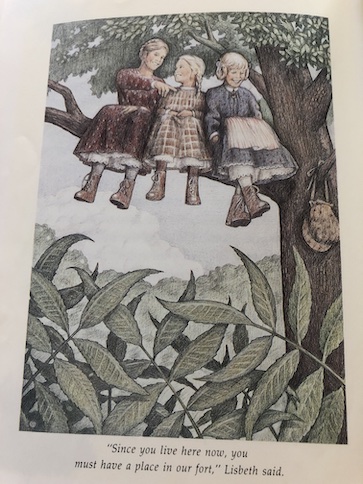
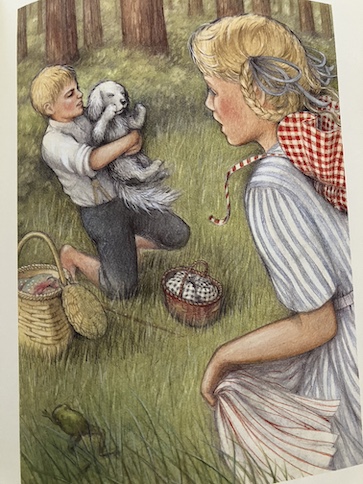
It’s summer, and for a frontier family, the summer chores can be the most fun! Kirsten and her younger brother, Peter, are going fishing. They’re hoping to get enough fish for their family and their Uncle Olav’s family to have for supper. There is plenty of trout in the stream, and they should be able to get enough fish, although sometimes, disasters happen on their fishing trips. Once, Peter chased a skunk, and their mother also warns them to be careful of snakes and bears. Kirsten wears a whistle around her neck that she can blow if they get into trouble. Kirsten thinks her mother worries too much.

The children take their dog, Caro, fishing with them. Kirsten is a little concerned because Caro likes to chase things, but Peter insists that he can watch the dog and fish at the same time. When they don’t seem to have much luck getting big enough fish in the stream, they decide to go upstream to the pool. The fishing goes well, but Caro is stung by a bee.

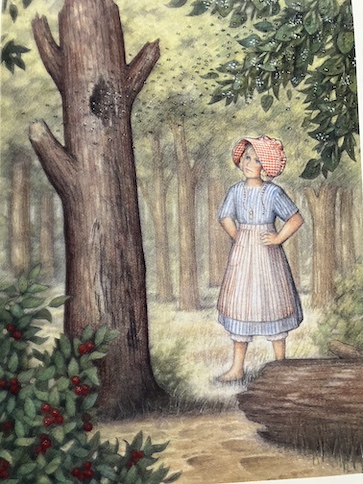
Kirsten realizes that Caro must have found a “bee tree”, a tree where bees have built their hive. Kirsten is interested in finding the tree because it’s a source of honey and honeycomb that their mother can make into special treats. If they can collect enough honey, their father might even be able to sell some and buy some of the things the family needs. They need to be careful while looking for the tree, though, or they might get stung themselves. Kirsten is pleased when she finds the tree, but she notices that there are marks on it from a bear’s claws, so it looks like a bear was trying to get the honey, too. Kirsten could ask her father how to get the honey and get him to help, but she wants to figure out how to do it herself and surprise everyone. She asks Peter to keep the bee tree a secret while she tries to figure out how to get the honey, and Peter reluctantly agrees.

Meanwhile, Kirsten’s cousins tell her about the town’s Fourth of July celebration. Kirsten’s family hasn’t lived in America for very long, so her cousins have to explain the significance of the holiday to her. Every year, the nearby town holds a parade and picnic with music and games. A lot of the local farmers also bring things to sell, like pies, butter, or preserves, and they use the money they make to buy things they need. Kirsten thinks again about the honey tree and the things her family could buy. She really wants a straw hat, like her cousins wear.

Later, when Kirsten is picking berries with her cousins, she sees a little black bear cub. She thinks it’s adorable, but Lisbeth says they have to leave the area immediately. If the baby is near the berries, its mother is sure to be somewhere nearby, and mother bears get dangerous if they think someone might hurt their cubs. Kirsten doesn’t really take the warning seriously until she tries to take Peter and Caro back to the bee tree with her to get the honey, and they meet the mother bear face-to-face!

The book ends with a section of historical information about the wilderness on the American frontier in the 1800s. Wild plants and animals were sources of food, but they were also sources of danger, like the bears in the story. The attempts of the pioneers to control the land were about securing sources of food and reducing sources of danger. There is information in the book about how pioneers cooked and how they dealt with changing seasons and weather. It also discusses the Fourth of July and how trips to town were rare treats for pioneer farming families.

The book is available to borrow and read for free online through Internet Archive (multiple copies).

It’s a good story about the difference between bravery and being foolhardy. From the beginning, even young Peter reminds Kirsten that being brave and being foolish are not the same thing. After their hair-raising encounter with the bear, in which the children have a narrow escape and their dog is injured (but fortunately not killed), the children’s father lectures Kirsten about putting both her life and her little brother’s life in danger. When Kirsten explains what she was trying to do with the bee tree, her father also tells her that she doesn’t really know what she’s doing. She took his equipment, but if she had carried out her plan the way she was thinking of doing it, she would have both destroyed the hive and ruined the honey as well as getting badly stung. Kirsten should have just gone to her father as soon as she found the tree and got his help from the beginning. Kirsten is ashamed for getting their dog hurt and putting herself and her brother in danger and almost ruining her special find, and she apologizes.

Because Kirsten’s father now understands the situation, he gets Kirsten’s older brother, Lars, to help him move the colony of bees to their farm. He knows how to set up hives and keep bees long term, so instead of this being just a one-time find and honey harvest, they will be able to get honey from the bees regularly. Kirsten goes with her father and Lars to watch them move the bees. She does it because she’s been having bad dreams about the traumatic escape from the bear, and she thinks it will help her to recover if she goes to the area again and sees it with her father and brother, when it’s safe.

Kirsten still feels bad that she wasn’t able to get the honey all by herself and that her attempt to do it was a disaster, but her mother consoles her. She says that she and Kirsten’s father understand that Kirsten was just trying to help and that her discovery has helped them. She just needs to learn to be careful as well as being brave. I thought that it was also a lesson in learning to share the glory instead of trying to take all the credit by going it alone and risking the success of the project, but the book didn’t quite say that. Kirsten wanted to be the one to say that she did it all herself, but because she couldn’t really do it all herself, everything went wrong. She could have accomplished her goals by talking to her father in the beginning and still been the heroine who found the bee tree, as her mother pointed out. She still gets credit for what she did without needing to take credit for what she couldn’t do alone.

The book ends with the family enjoying the Fourth of July celebration. Thanks to the discovery of the bees, they are able to buy the things they need.

Happy Birthday, Kirsten

Kirsten, An American Girl

It’s spring, and Kirsten’s family is planning to build a new barn on the farm that they share with Uncle Olav and his family, and her mother is expecting a new baby.

One day, while they are outside, working, dark clouds come, the wind picks up, and Aunt Inger thinks it might be a tornado. She urges everyone to get into the root cellar for safety. Miss Winston, the school teacher who is staying with Uncle Olav and Aunt Inger, joins them in the cellar. She brings her quilt with her for comfort and because it reminds her of home, so she wouldn’t want to lose it to a tornado.

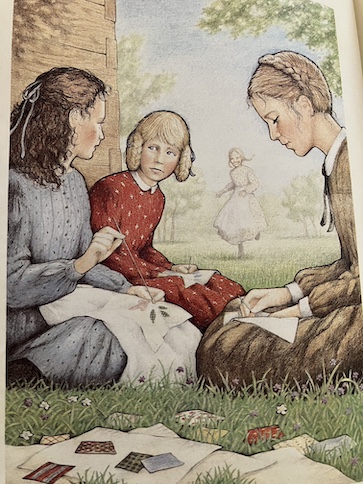
She tells Kirsten and her cousins that her mother and other women and girls in her family made the quilt for her as a present when she left Maine. The scraps of cloth in the quilt came from clothes members of her family used to wear and things she used to wear when she was younger. Everyone who worked on the quilt signed it, making it a “friendship quilt.” Kirsten and her cousins ask Miss Winston if she could teach them to make a quilt like this one, and she agrees. She says that she will give them some muslin for the backing, but they’ll have to supply the scraps of cloth for the designs themselves. Because it takes a lot of work to make a big quilt, she suggests that they each make a square. Quilts are an unusual concept to the Swedish family because people in Sweden during their time usually use woven blankets. Kirsten’s mother also reminds her that she will need her help to sew more clothes for the new baby. Kirsten’s cousins, Anna and Lisbeth, suggest that they do their quilt sewing during recess at school, and Miss Winston agrees.

At school, the girls trade cloth scraps with each other and invite other girls to join them in quilting. One of the other girls, Mary Stewart, has done quilting before, so she helps the others. While the girls sew, they talk, and Kirsten talks about the baby that her mother is expecting. Mary says that the little girl her family calls her little sister is actually her cousin. She was born as one of a set of twins to Mary’s aunt, but the other twin died at birth, and their mother died shortly after, so Mary’s mother took the baby to raise with her family. Stories like that worry Kirsten because she worries that something might happen to her mother or the new baby.

Mary also brings up the topic of whether or not Miss Winston will move on. She’s been going to Powderkeg School for four years, and every year, the previous teacher moves on, and they get a new one. Although Kirsten initially had trouble with Miss Winston, she has become fond of her, and she wouldn’t like to see her go. With all the other changes happening in Kirsten’s life, she doesn’t want any other major changes now. Kirsten suggests to the other girls that they turn their quilting project into another friendship quilt for Miss Winston, signing it like her family members signed their quilt. The other girls debate about whether they could manage to finish a quilt like that by the end of the summer term. Lisbeth thinks they could, but Mary doesn’t want to rush the project because the best part of making a quilt is sewing it with your friends.

The talk then turns to Kirsten’s birthday. She will be turning ten years old soon. She didn’t celebrate her last birthday because that was during their voyage to America. Mary says that ten is a more important birthday anyway, although Kirsten isn’t sure if her family will do anything for her birthday this year, either. Everyone’s attention is taken up with preparations for the new baby.

When Kirsten’s mother tells her that the new baby is about to be born, she also tells her that she remembers the day Kirsten was born, too. She says that she will never forget that day because she had been hoping for a daughter, and she knows that Kirsten’s birthday is coming in two more weeks. Kirsten is happy that her mother remembers, and she hurries to get her aunt to help with the birth of the baby.

Fortunately, Kirsten’s new sister is born safely, although Kirsten has to take some time away from school to help her mother with the new baby and household chores. However, her mother tells her that her friends from school will be coming to the raising of the new barn, which is the day before Kirsten’s birthday, and she will allow Kirsten to have her birthday free to have fun with her friends.

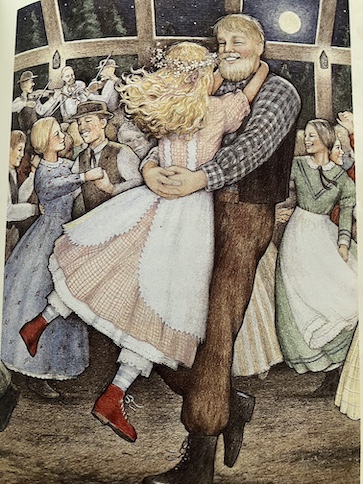
At the barn raising, Kirsten and her friends have a chance to work on their quilt again. Kirsten is behind on making her quilt square, but her friends have arranged a special surprise for Kirsten’s birthday.

There is a section in the back of the book about babies and young children on the frontier during the mid-1800s. Children were born at home then, with the help of family members and midwives because there were few doctors and hospitals on the frontier. With limited access to medicine and without some of the modern medicines we have today, childbirth and early childhood were often risky. It was sadly common for families to lose a child or two before they were five years old. Because accidents as well as illness posed a threat to young children, parents were often strict with discipline so their children would listen to them and follow their instructions to avoid disaster.

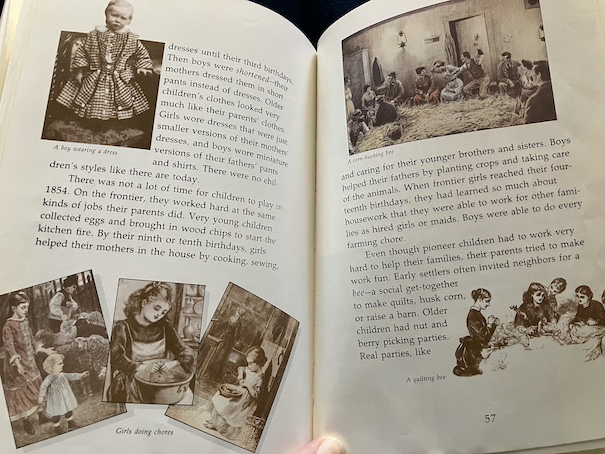
This part of the book also talks about the phases of a child’s life on the frontier. Older children wore clothes that looked like smaller versions of their parents clothes, and they would often do the same kinds of chores that their parents did on their farms. Most children expected to become farmers or farm wives, like their parents. They were raised doing farm work, and they didn’t expect to do anything else when they were older.

Although their lives were filled with chores, there were still some opportunities for fun. Sometimes, neighbors would turn chores into social occasions, called “bees.” These work parties could center around any kind of chore that the community needed to do and could do together, like raising a barn or making quilts, like the characters in the story. Along with accomplishing their task, it was a chance for friends and neighbors to get together and talk and have a little fun.

The book is available to borrow and read for free online through Internet Archive (multiple copies).

I don’t think I read this particular book in the Kirsten series when I was young. I wasn’t as fond of the Kirsten books as I was other series in the American Girls franchise because there are some really sad parts in the series. However, I really enjoyed this particular book. Kirsten is worried at first about the welfare of her mother and her family’s new baby because she knows that life on the frontier can be dangerous, and sometimes mothers die in childbirth, and babies don’t always survive. Fortunately, everything turns out well for Kirsten’s mother and new little sister.

This is a happy spring story with a focus on new life and friendship. Even the smallest kitten in the new litter seems like it’s going to be fine. I liked it because, while life on the frontier could be very hard, it’s nice to see that not everything turned out as a tragedy. The book ends with the barn raising and birthday celebration for Kirsten.

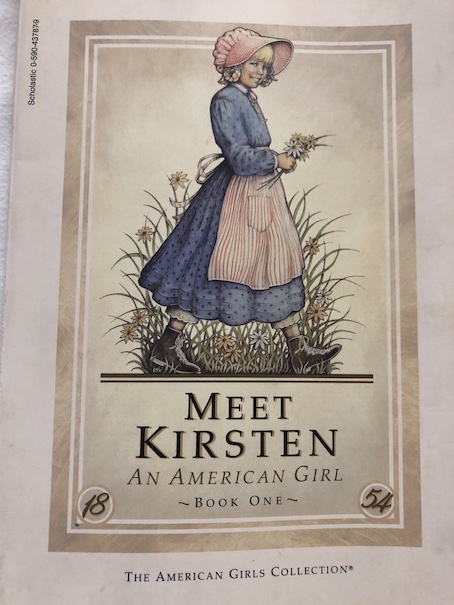
Meet Kirsten

Kirsten, An American Girl

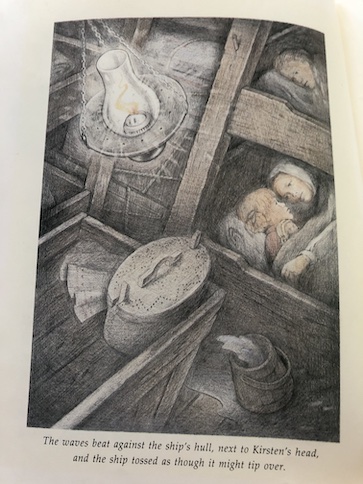
It’s the summer of 1854, and Kirsten Larson is traveling by ship to America from Sweden with her family. There have been storms during the voyage, and the sailing has been rough. It’s crowded on the ship, and people have been seasick. On board the ship, Kirsten makes friends with another girl her age, Marta. The two girls play with their dolls together and talk about the things they’ll do when they finally reach America. The reason why the Larsons are traveling to America is that Kirsten’s Uncle Olav is already there. He has established a farm in Minnesota, and he has married a widow with two daughters. He wrote to the Larsons and asked them to join him and his new family in Minnesota and help on the farm.

When their ship finally reaches America, it docks in New York. No one is allowed to leave the ship until the health inspector declares that they are healthy. Health inspectors will not allow anyone with a serious, contagious disease, like cholera or typhoid, to go ashore. When they are allowed ashore, Kirsten’s father finds an agent to help them change their money at a bank and buy train tickets for their trip west. The agent, who is also from Sweden, will even accompany the family to the Mississippi River as a guide. The family needs help because they can’t speak English yet.

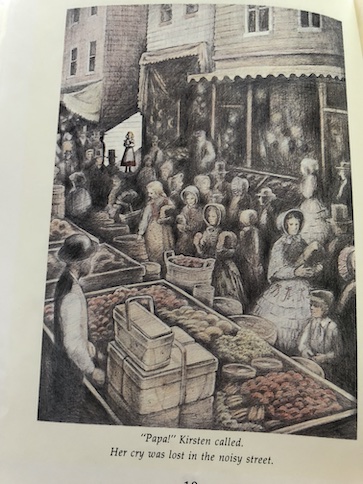
When they go to buy food in New York, Kirsten is accidentally separated from her father and gets lost. Because she can’t speak English, nobody understands what she’s saying, so Kirsten can’t ask for directions. Kirsten is frightened, but a kind lady sees her distress and tries to ask her what’s wrong. Kirsten can’t tell her, but then, she realizes that she can draw a picture, so she draws a picture of a ship. The lady leads Kirsten back to the dock, and she manages to find the rest of her family in the nearby Battery Park.

The next day, Kirsten says goodbye to Marta because the Larsons are leaving the city before Marta’s family. Because Marta’s family is also going to Minnesota, they hope that they will meet again there or somewhere on the way.

Kirsten has never seen a train before, and her first ride on one is frightening at first. The trip lasts for days, but finally, they arrive in Chicago. There, they will meet up with other pioneers heading to the Mississippi River. At the boarding house in Chicago, Kirsten reunites with Marta, whose family will also be traveling with them!

The pioneer families take wagons to the Mississippi River, and then, they board a riverboat. Kirsten’s mother worries because, when they boarded the riverboat, she was sailors burying a passenger who died of cholera. (A disease caused by ingesting contaminated food and water.) Cholera is a serious risk, and her worries are justified. On their third day on the boat, Marta becomes ill with cholera and dies from it.

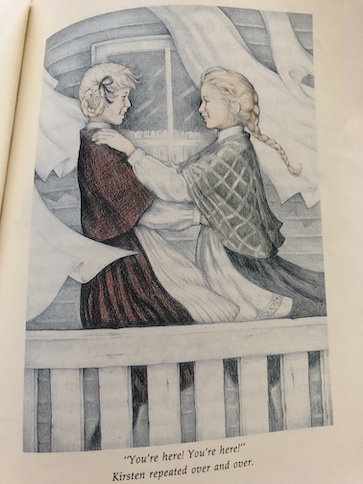
Kirsten is distressed at Marta’s sudden death, but fortunately, the Larsons all make it to Minnesota. All along, Kirsten has been struggling with homesickness and is still grieving the loss of the only friend she had in America, but she is cheered when she is greeted by her new cousins, Anna and Lisbeth. With her cousins as her new friends, Kirsten thinks that Minnesota might come to feel like home after all.

The book ends with a section of historical information about immigrant families, like Kirsten’s.

The book is available to borrow and read for free online through Internet Archive (multiple copies).

Although I liked the American Girl books when I was a kid, I didn’t like the Kirsten books, partly because of Marta’s death. I don’t think any of the other American Girl books has a child death in the first book. In fact, I don’t even remember any other children dying in any of the series, unless it happens in one of the newer books I haven’t read yet. It is realistic for a child to die while traveling west. Diseases like cholera were a real-like risk to pioneers. I’ve visited places along the old Oregon Trail, and I’ve seen the graves of real pioneer children who died of disease. There’s also a doll at one of the local historical museums in my area that once belonged to a little girl who died on the trip west. I know that children died on the journey west in real life, but it’s still depressing to read about, which is what bothered me about the Kirsten books. For this reason, I don’t think I read all of the Kirsten books when I was a kid, or at least, I don’t remember much about most them.

Reading this book again as an adult, I found it easier to deal with Marta’s death. I knew it was coming, so there was no shock to me. Marta’s illness is only a small portion of the book, and Kirsten doesn’t see Marta dead. We do get a picture in the book of the riverboat sailors carrying Marta’s coffin away for burial.

I always appreciate the sections of historical information in the back of American Girl books. This one discusses immigrants, the reasons why they wanted to move to a new country, and the conditions they encountered during their journey.

Earlier, when I covered Rasmus and the Vagabond, I mentioned that the characters hide in an abandoned village, and Oscar tells Rasmus that the reason that the village is abandoned is because, years before, the people in the village all decided to emigrate to America together, specifically Minnesota (a popular destination for Scandinavian immigrants).  The Library of Congress has more information about Swedish immigrants and the major periods of immigration.  Around the time that Kirsten’s family emigrated to the United States, Sweden was suffering problems from overpopulation, lack of adequate tillable farm land, and famine. We don’t hear the Larsons describe any particular problems they had in Sweden or suffering. We are told that they had a farm in Sweden with a house with a maple tree near the door and a barn, but we don’t know if the family was suffering in spite of owning the farm. The important point is more that conditions in general were bad in Sweden, so the promise of rich farm land in Minnesota was attractive to them. The historical information included in the back of Meet Kirsten doesn’t cover this information about conditions in Sweden. Instead it focuses on what immigrant families might pack to bring with them on such a journey and what the traveling conditions would have been like.

Felicity’s Cookbook

Felicity, An American Girl

This cook book is one of the activity books that was written to accompany the Felicity, An American Girl series that is part of the American Girl franchise. The American Girls books were written to help teach American history (as well as sell the accompanying dolls and accessories), so this book has recipes of the type that people would have eaten during the American Revolutionary War, when the character of Felicity lived, and some historical information.

The book starts out with some historical information about cooking in Colonial Virginia, where Felicity lived, and some general cooking tips, like measuring instructions and safety information. It includes information about late 18th century kitchens, cooking utensils, and dishes. Colonial kitchens were frequently located in an outbuilding, separate from the rest of the house. It was best to keep the kitchen a little away from the house because, rather than using stoves, their main method of cooking was a large kitchen fireplace, which made the kitchen very hot. During warm months, the heat would be uncomfortable, so keeping the kitchen separate from the house kept the house cooler. They would vent heat from the kitchen by opening the kitchen windows. On the other hand, during cool or cold months, the warmth of the kitchen fire could be pleasant, so family members might gather there. Families with servants and slaves might have them live in a loft over the kitchen, keeping them separate from the family. The kitchen fire could also be a potential fire hazard, so the kitchen typically had a brick floor or packed dirt because a wood floor might catch fire.

The types of dishes a family might have depended on their social class and what they could afford. Felicity comes from a prosperous merchant family, and a family like hers might have imported dishes from England or China as well as locally-made dishes. Wealthy people might have had silver or pewter serving dishes, while poor people had wooden dishes, often poplar or linden, which wouldn’t contribute much flavor to the food.

Hospitality was very important in Colonial Virginia. Friends, family members, and business associates frequently visited each other’s homes, and because there were no telephones, there often wasn’t much advance notice that guests were coming. People were often prepared to provide food for unexpected guests. Because she is being raised to be a gentlewoman, much of Felicity’s education focuses on how to be a good hostess, how to plan meals and social events, and how to properly prepare and serve different types of foods.

Modern people might not view these topics as being very important from an educational standpoint, but in Felicity’s day, they served a very important purpose. The book doesn’t really go into the reasons why it was important for Felicity to be a good hostess as part of her social status, but it essentially boils down to what 21st century people might call “networking.” As the daughter of a socially-prominent businessman and the potential future wife of someone with a similar social standing, being a good hostess could help her family or future spouse establish and maintain good relations with other members of the community, helping to cement business arrangements or arrange marriages between members her family (siblings or her future children) and other families of good social standing, possibly including her own. Being capable of cooking delicious food and arranging dinner parties could be for fun and family celebrations, but the ability to be a competent and charming hostess for anyone who might have business with her family or anyone her family might want to associate with could help smooth over possible social difficulties or quarrels or promote better relationships with members of their community.

In a way, Felicity’s lessons in manners, tea party etiquette, making pleasant conversation, preparing appropriate meals, and providing food and a pleasant visit for guests on short notice would have been the 18th century equivalent of taking courses in social networking. This type of social role is one that housewives have performed for centuries, both before and after Felicity’s time, and it also appears in some of the other American Girl books, such as Samantha, An American Girl, which is set in the early 1900s and focuses on a girl from a wealthy family. It’s a sort of unofficial role, not unlike that of the First Lady of the United States, who organizes social events, acts as hostess for important visitors, and promotes good causes to better the public image of the President, although the specific methods they use to do this varies based on the social standards of the day, their own tastes and abilities, and the image they want to promote. This is the type of lifestyle that Felicity’s family is preparing her to fulfill. People still do this sort of thing, even if it’s just being prepared to offer someone coffee, tea, or water when they’re visiting on business, seeing to the small social niceties to make the guest a little more comfortable and start important discussions on a positive note. It’s not just about keeping women in the kitchen and out of men’s business; there’s a purpose behind it for promoting the family’s business and social standing. Deep down, Felicity might wish that she could be the one to work in the shop and make business deals directly rather than learning the social niceties and networking skills to promote relationships, but it’s still an important and useful role that her family wants her to fill.

The recipes in the book are organized by meal. Each section and individual recipes come with historical details related to the different types of food.

  • Apple butter
  • Johnnycakes
  • Breakfast puffs
  • Fried ham with gravy
  • Dressed eggs

“Dinner” is usually the biggest meal of the day, but depending on when and where you live, that might be either the midday meal or the evening meal. In modern times, it tends to be the evening meal, after a family or individuals are home from work or school and have more time for a large meal. Modern people sometimes use the terms “dinner” and “supper” (the evening meal) interchangeably for that reason. In Felicity’s time and, sometimes, in rural areas even in modern times, the biggest meal is the midday meal, what most of us would call “lunch.”

  • Chicken pudding
  • Veal balls
  • Sweet potatoes and apples
  • Sally Lunn bread
  • Green beans
  • Whipped Syllabub

This section just has an assortment of recipes for Felicity’s favorite foods.

  • Beefsteak pie
  • Baked pumpkin pudding
  • Raspberry flummery
  • Almond tarts
  • Queen cakes
  • Spiced nuts
  • Liberty tea – an herbal alternative to traditional tea, used after colonists started boycotting imported tea to avoid and protest taxes

The book ends with tips for planning a Colonial party, such as an elegant tea party or Twelfth Night party.

The book is available to borrow and read for free online through Internet Archive.

Lady Margaret’s Ghost

Felicity, An American Girl

This book is one of the mystery stories published to accompany the American Girl series of historical books. The main character of this book, Felicity Merriman, lives in Colonial era Williamsburg, Virginia, around the beginning of the American Revolution.

Felicity’s mother is going on a trip to visit a relative, along with Felicity’s younger siblings. As the oldest girl in the family, Felicity will be in charge of the household while her mother is gone and her father and his apprentice, Ben, are working in the store her father owns. It’s a big responsibility and an honor that Felicity’s mother considers her capable of managing the household, but because Felicity is still young and some household tasks involve heavy work that is difficult for her to do alone, her mother has hired a temporary cook, Mrs. Hewitt, to help her. Because Felicity is known as a daydreamer who doesn’t always pay attention to what she should be doing, her mother reminds her to focus on the task at hand while she’s minding the house, although she has faith in Felicity and is sure that she will do a good job.

Soon after her mother leaves, a crate arrives at the house for Felicity’s father, along with a letter. The letter explains that a cousin of Felicity’s father has died and that the crate contains some family heirlooms that his cousin left to him. These heirlooms once belonged to a common ancestor of theirs, Sir Edward Merriman, a wealthy nobleman and the first member of their family to live in the colonies, more than 100 years earlier. Felicity’s father didn’t know his cousin well because they never lived very close, and his cousin was much older, but he does know the history of the heirlooms. The heirlooms include a lady’s silver vanity set and a silver cup and rattle for baby. The story is that Sir Edward’s wife, Lady Margaret, owned the vanity set, and the rattle and cup were for their infant son. Unfortunately, the baby was stillborn, and Lady Margaret died shortly after the birth. After her death, her husband and the household servants believed that she still haunted the house. The haunting may have been part of the reason why Sir Edward decided to leave his home in England and go to America, but even though he later remarried and had other children, he could never bring himself to part from the things that belonged to his first wife and child. Even before Felicity’s father tells her about the ghost story, Felicity gets a strange feeling from the vanity set, and she wonders if the objects could be haunted.

However, Felicity soon has to turn her attention to household issues. Mrs. Hewitt, the temporary cook arrives, and she is a brusque and unpleasant woman. She is rude and condescending to Felicity when they are working in the kitchen together. Because Mrs. Hewitt is so rude, Felicity is nervous and makes mistakes, making her look like more of a fool to Mrs. Hewitt. They can’t easily replace her because cooks are in demand right now because this is Publick Times in Williamsburg, and there are many visitors to the city. Everyone is busy tending to them. Mrs. Hewitt was the best they could find available. Felicity’s father does speak to her about her rudeness to Felicity. After that, Mrs. Hewitt is sullen and resentful, and she is even more pleased whenever she sees Felicity doing something wrong.

There is also an exciting event taking place. Felicity has entered her horse, Penny, in a horse race at the fair in town! Ben, her father’s apprentice, will ride her. The day of the race, Penny seems to be doing well, but then, she suddenly develops a problem during the race. When Felicity and Ben check her out to see what was wrong, they discover that someone put burrs under Penny’s saddle! Worse still, the wounds caused by the burrs become infected. Felicity is very upset and worried about Penny, and she wonders who would have hurt her horse. There were a couple of men looking at her before the race. There was also a boy named Dawson and a girl called Anne.

Dawson turns out to be a runaway, but he also has some knowledge of horses. Although Felicity is a little suspicious of him at first, Dawson helps to heal Penny’s wounds. He also says that he saw Anne gathering burrs, but it was probably on behalf of someone else.

When Felicity realizes that her treasured coral necklace, which her mother also wore as a girl, has disappeared, Felicity questions whether she carelessly lost it or if someone has stolen it. Felicity has been doubting herself and her ability to manage the household because of all the mistakes she has made since her mother left, and the clasp of the necklace was a little loose. This could just be another disastrous mistake, but it is suspicious that Anne seemed so friendly to her at the race and then ran away from her later. Anne also literally bumped into Felicity at the race. Could she have taken the necklace? Dawson seems to think so, but then again, can Felicity really trust everything he says?

Felicity still gets an odd feeling from Lady Margaret’s heirlooms, and she thinks that she sees something white moving around at night. At first, she thinks that it could be Lady Margaret’s ghost, but then, strange things begin happening around the house. Things disappear, and Felicity worries that maybe she carelessly mislaid them. Then, her necklace unexpectedly turns up, and Lady Margaret’s vanity set vanishes! Are these strange things part of the haunting of Lady Margaret or the work of a thief? If it’s a human thief, is it the work of the runaway Dawson, mysterious Anne, unpleasant Mrs. Hewitt, or the mysterious person who arranged for Penny to be hurt?

The book ends with a section of historical information about Colonial era Williamsburg. The story is set during Publick Times, which was when court was in session in Williamsburg. People would gather in Williamsburg during Publick Times to see the trials in court and attend a public fair in Market Square. The fair offered various kinds of entertainment, games, and races, like the horse race in the story.

The story leaves it a little ambiguous at the end about whether Lady Margaret’s ghost exists, but if she does, she is not harmful and has nothing to do with the thefts in the story or what happened to Penny at the horse race. As the section of historical information explains, there are many new visitors in Williamsburg during Publick Times. This was a good setting for the story because there are many strangers to the city with unknown pasts and motives, and crowds at the fair might harbor thieves.

Part of the story and part of the section of historical information in the back focuses on the subject of orphans. Both Dawson and Anne are orphans, and neither of them is really being cared for. Dawson admits that he used to steal to support himself after his father died, but he is seriously looking for work. Anne technically has a guardian, but her guardian is abusive and uses her as a servant rather than taking care of her.

When the thefts occur and mysterious things start happening around the Merriman house, both Dawson and Anne look like the best suspects, but there are also possible adult suspects. Even after Felicity realizes Anne’s situation, she isn’t entirely sure which of the men at the fair that day is Anne’s guardian. Mrs. Hewitt also looks suspicious because she is so unpleasant and seems to be trying to make trouble for Felicity. I though the book did a good job of supplying an array of suspects to consider. The solution to the mystery was one of the possibilities I thought was most likely, but there were enough other possibilities to make the story interesting.

The Ghost of the Gracie Mansion

Mysteries in Time

The Ghost of the Gracie Mansion by Susan Kohl, illustrated by Ned Butterfield, 1999.

The year is 1803, and the Gracie family has decided to temporarily leave New York City because of the Yellow Fever Epidemic. William Gracie, the eldest son of the family, is disappointed because he has started working for his father’s shipping business, and he was looking forward to being promoted to clerk this spring. He wants to follow in his father’s footsteps, and he’s serious about wanting to learn the business. The trip that they’re taking to their new country home at Horn’s Hook, north of the city, seems to delay his plans because it’s so far away from everything, from his father’s business and from the Tontine Coffee House, where businessmen and other important people meet to discuss the issues of the day. However, William can’t help but admit that the situation in New York is serious. People are dying of Yellow Fever every day, including children, and his parents just want the family to be safe.

William begins to feel a little better when his father tells him that he’s arranged for them to work together from the family’s country mansion. His father says that captains of the ships he owns will stop at Horn’s Hook on their way to New York Harbor to report to him, and William will help him to prepare the cargo lists and timetables for the ships. Their temporary exile from New York hasn’t put a stop to their business or William’s education in that business; they’re just going to be doing things a little differently until the crisis is over.

While the family is traveling to their new country house, Mr. Gracie tells them about the history of the place. There used to be another house on that land, but it was destroyed during the American Revolution (an event still in relatively recent memory at the time this story takes place) as the British and the Patriots struggled to control it because that location is a strategic spot on the Harlem River. Mr. Gracie says that their new house is built over the basement of the old house, and that’s important because he’s aware that the former owners had a secret tunnel that led out of their basement in case they needed to use it as an escape route during the war. He told the builders to look out for it while they were building the new house, but if any of them ever figured out where it is, they never admitted it. The Gracie children are excited about the idea of their new house having a secret tunnel, and they’re eager to find it!

The new Gracie house is beautiful, really more of a mansion than just a house. However, there is something strange going on there. Soon after they arrive, William’s younger sister Sarah sees someone in the house dressed all in white. Sarah thinks that she saw the ghost of the person who owned the house that used to be on their property. The others don’t believe her because Sarah has a vivid imagination and is always making up stories, but Sarah insists that she saw someone.

When things start disappearing from the house, the rest of the family begins to believe that there may be some unknown person in their house. Sarah still thinks it’s a ghost, but William thinks maybe someone has found the secret passageway into the house. Who is this mysterious intruder?

The book is available to borrow and read for free online through Internet Archive.

My Reaction

I always like historical novels, particularly historical mysteries, and I really enjoyed this one. The mystery is meant for children in elementary school, and it isn’t too difficult, but it’s fun to see the Gracie children searching for the secret passage and trying to learn who is sneaking around the family’s country mansion. I also enjoyed that the story offers history lessons on multiple levels. The immediate situation for the characters is the yellow fever epidemic of 1803, but the story also touches on the American Revolution. The solution to the mystery is also related to Revolutionary War history. The Gracies, headed by father Archibald Gracie, were a real family who made their money in shipping, although the events in the story are fictional. There is a section in the back of the book that explains more about the family’s history. They associated with prominent people in New York in the early 19th century, and Alexander Hamilton makes an appearance in the story when he visits the Gracie Mansion. The Gracie Mansion is a real place. When it was first built, it was in the countryside outside the limits of New York City, but since then, the city has grown around it. It is now used as the home of the mayors of New York City.

Although this book was published before the coronavirus pandemic of the early 2020s, I also appreciated the part of the book at the beginning, where William is concerned that the current epidemic has changed his plans and impacted his ability to learn his father’s business. However, his father explains to him that they are still in business, and he has made arrangements for them to continue working in a different way during their time away from the city. People who lived through the quarantines and lockdowns of the covid pandemic will understand how it impacted the way people worked or continued their education and how people had to find ways to work around the problem. I appreciated that this story shows how people have had to deal with public health crises before in history and how they have always had to find creative solutions to deal with problems of this nature.

In this particular situation, the Gracies are a wealthy and privileged family, so their options for escaping from the crisis and working from outside the city are greater than other people of their time. Not everyone had a countryside mansion where they could go to escape the disease, and not everyone had employees who could report to them wherever they were. What Mr. Gracie and his son are doing during the course of the story is the early 19th century equivalent of “working remotely”, pre-Internet, and they accomplish it through people coming to report to them and taking goods and information into the city on their behalf. Even though the Gracie family can stay outside the city, they are still sending their ships into the city’s harbor because the cargo the ships carry is necessary there. There are people in the city who are waiting for the supplies the ships are carrying. The crews of the ships are what people in the 2020s came to call “essential workers” – the people whose type of work was necessary, no matter the circumstances, and who could not perform their duties from a remote location. The same is true for all the other people who must remain in the city because their jobs require them to work with or on behalf of the people who are still there.

The Windy Hill

The original cover is public domain and available through Wikimedia Commons

The Windy Hill by Cornelia Meigs, 1921.

Oliver and Janet are spending the summer with their mother’s cousin, Jasper, who is a wealthier man than the rest of their family. Janet is enjoying the visit and Jasper’s grand house so far, but Oliver is very uneasy there. Oliver doesn’t like the vast, empty house, and he’s noticed that Jasper’s manner seems different from he remembers the last time they saw him. Oliver senses that something is troubling Jasper, something that he doesn’t want to discuss. Jasper is usually a cheerful person who enjoys his cousin’s children, but during this visit, he hardly pays attention to them and never smiles. Janet finds things to do to keep herself occupied, but Oliver is terribly bored and bothered by Jasper’s odd behavior.

Then, one evening, Jasper sees Oliver looking at a nearby house. He says that the people who live in that house are also cousins of theirs, but he’s been too busy lately to see much of them. Jasper apologizes for having neglected Janet and Oliver during their visit so far, and he says that he will invite Eleanor, the daughter of the cousin who lives in that house, to lunch the next day. Eleanor is close in age to Janet and Oliver, and Jasper thinks that they will be friends and that a visit from her will liven up the visit for them. Janet is pleased at the idea of another girl cousin visiting, but Oliver is at that phase where he doesn’t like girls. He can’t imagine that he would have anything in common with this unknown girl cousin, and he thinks he’ll be bored while Janet and Eleanor have fun together. He tries to tell Jasper as much, but Jasper is just amused by his attitude and tells him that, if he is afraid of girls, the sooner he gets over it, the better.

When Jasper orders his car and driver to take Janet and Oliver to see Eleanor, Oliver decides to rebel by going to the train station and trying to get a train home. However, while he is waiting at the train station, he becomes curious about the countryside around him and the nearby river he hasn’t yet investigated. He wanders off to explore a little and encounters a man and a girl at a nearby cottage. The man and the girl ask him to help them with their beehives. Oliver is a little nervous of the bees at first, but he follows the beekeeper’s directions and finds himself enjoying the work. The beekeeper and his daughter, Polly, invite him to join them for lunch afterward. After a lunch of biscuits, honey, and iced cocoa, Oliver feels much better about everything.

Polly thinks that she and her father have somewhere they need to be after lunch, but her father tells her not to worry about that. Instead, he entertains Oliver and Polly with a story about a Native American medicine man, a boy who is curious about what lies beyond the ocean, and their first encounter with white people. By the time the story is over, Oliver realizes that he has missed his train. He decides to return to Jasper’s house, where he is told that Janet didn’t go to see Eleanor because Eleanor was delayed somewhere. (Guess where.)

More and more, Jasper’s odd mood becomes apparent. His servants have also noticed how worried he’s been, and it seems like he’s always more upset after a mysterious and disagreeable man comes to see him. Nobody knows who he is or what his visits are about. Oliver knows how to drive, and Jasper has Oliver drive him out on a mysterious errand one evening to see someone. Oliver doesn’t know who Jasper talks to or what they say to each other, but the visit takes a long time, and it makes Jasper angry.

Oliver’s visit with Jasper gets better because Jasper allows him to use the car by himself from that point on. He takes Janet to visit the Beeman and Polly. Although Oliver is still not enthusiastic about girls, he likes Polly because she is very different from how he imagines that cousin Eleanor must be. The Beeman says that they have to pick up some new beehives that day, and Oliver volunteers to take the girls to get the hives from a man named John Massey. John Massey complains about his landlord, who hasn’t been maintaining the dikes. Massey has had to take it on himself, and the burden is becoming too great for him to bear.

It turns out that Massey’s landlord is Anthony Crawford, the unpleasant man who has been troubling Jasper. Crawford also seems more than happy to let Olive and Janet know that he is also a cousin of theirs. He seems to be under the impression that Jasper has cheated him in some way. Jasper says that he’s already given him what he’s entitled to have, but Crawford says that his share should be more than that. Crawford says that, if Jasper doesn’t give him what he really owes him, he can take everything Jasper has and destroy his reputation in the process. There are secrets in their family’s past that would cause a scandal if the public knew about them, and Crawford says that if people knew that there was one crook in their family, they would all be suspicious that Jasper is much the same way.

Oliver doesn’t know what to think of Crawford’s insinuations or his threats. Not knowing who else to turn to, Oliver explains the situation to the kindly Beeman and asks him what he should do to help Jasper. The Beeman knows far more about everything that’s been happening than Oliver knows, and he say that Crawford has unknowingly been laying a trap for himself. Crawford thinks he’s pretty sharp in his dealings with other people, but he’s been neglecting something very important. Actually, multiple things.

In a series of stories that the Beeman shares with the children, he indirectly tells the children the history of their family and quarrels that go back generations. He tells them about a family with a shipping business that restored their lost fortunes during the War of 1812 by turning to piracy. He tells them about siblings divided by quarrels over money during the Gold Rush. Although the Beeman doesn’t admit to the children that all of his stories are true in the beginning, they soon come to realize that they are and that they are directly connected to the them and the current situation.
Toward the end of the book, the Beeman ties all the pieces of the puzzle together before telling them the final story, the one about three cousins named Jasper, Anthony, and Thomas, who were all raised together and were very close, until they had a falling-out over Anthony’s scheming and his unethical dealings. There are reasons for everyone to resent Anthony for his meanness and greed, but the Beeman is correct that Anthony has set himself up for a fall. He really should have listened when everyone tried to tell him to fix the dike.

The book is available to borrow and read for free online through Internet Archive (multiple copies) and Project Gutenberg. Because it is in the public domain, there is also a LibriVox Audiobook recording.

My Reaction and Spoilers

The Family’s Story

In some ways, the story of the family in the book is also a celebration of American stories. The short stories about different generations in their family are set at turning points in American history. Something that fascinated me about these stories was that they were not all glowing about these points in American history and their associated legends. There are parts of the stories that emphasize the bold American values of adventure and ingenuity, but there are also dark sides and downsides to the stories and flawed characters. The family fortunes were set partly by piracy, but one of the heroes of the family was the man who realized when it was time to stop. Members of their family have been consumed by greed and quarrels, although some have overcome their flaws and misconceptions to come together and be a family again. Again, the Gold Rush story resolves happily when the brothers involved also realize the folly of endlessly pursuing riches at the expense of relationships with the people they love. There is even a slight rebuke against the westward expansion of the United States – portrayed heroically but also as highly costly as people died and killed others over land and gold and promoting an endless, unhappy quest for more and more, with people living their whole lives never feeling satisfied. In short, the family, like the stories and American history itself, is a mixed bag, and they are at their best when they realize their wrongs and make the decision to change. For a book from the early 1920s, a period of heightened patriotism and prejudice after WWI, it seems remarkably insightful and self-aware.

It was Anthony’s decision to forge a relative’s name to get money to cover his unethical dealings that ruined his relationship with his family. It was only by their charity and intervention that he wasn’t charged with his crime and sent to prison. He’s fully aware of that, but he’s been resentful about it rather than grateful. Even from a young age, Anthony had always coveted what other people had. Even if he didn’t really want things for their own sake, he would go through elaborate schemes and bitter fights to get what someone else had, just because someone else had it. Out of greed and spite, he has resurrected old property quarrels in their family. He not only got the old house that was originally willed to Jasper, but he has been scheming to get Jasper’s new house. The Beeman (who is the third cousin in the last story and father of Eleanor, who is called Polly as a nickname) says that Anthony should have headed the lessons learned by their family during the Gold Rush, that always reaching and reaching for greater prizes means never being satisfied with what one has and risking its loss in pursuit of the unattainable.
In the end, when Anthony’s scheming and corner-cutting leave him with no one to turn to but the family members he has harassed and schemed against, he finally experiences a change of heart. I find stories where the villain has a sudden change of heart after long-term villainy to be unrealistic, but the crisis that Anthony realizes he caused is sudden and serious. Because he has neglected the dike and driven away the people who were helping to cover his negligence at their own expense, he suddenly realized that he has endangered many lives, and everyone knows that it’s all his fault. He schemed to get control of that land but didn’t take care of it when he had it. Everyone knows what he did, nobody’s going to cover for him, and while he’s unscrupulous enough to scheme to get others’ property, he doesn’t want to be responsible for killing people. It’s enough to make him swallow his pride and acknowledge the reality of the situation to his cousins. They help him for the sake of the people in danger, and in return, he decides to leave the area.

In the end, Anthony takes a hard look at himself and his life, and he realizes that he and his wife and children were better off when they lived in another community, where he was forced to work for a living instead of by his schemes. He now fully understands his weaknesses and temptations, and rather than continuing to resent the things and people in his life that stop him from furthering his schemes, he has come to welcome them as the guiding forces that keep him from making destructive decisions. The way he phrases it struck me as a little corny, almost like the end of a PSA, but I approved of the sentiment. His family members made him angry because they saw him for who and what he was, but the point is that he now understands who and what he is himself. Although the others are willing to allow him some leniency because of the way he handles the crisis, Anthony realizes that he must give himself the discipline he needs and be the changing force in his own life.

Overall, I thought it was a pretty good story, although there are a few issues with racial language related to Native Americans. I’m not sure if there is a modern revised version of this story or not. The version that I’m reviewing is the original from the 1920s.

Native Americans in the Story

I found the first story the Beeman tells, the one about the Native Americans, fascinating because the story contains the concept that Native Americans arrived in the Americas by crossing the Pacific Ocean and moving eastward across the continent. I know that’s the modern concept of the origins of Native Americans, but I was surprised to find the concept in a book from the early 1920s. I didn’t realize that people in the 1920s had that concept because I thought the older theory was that Native Americans crossed a land bridge.

During the story about the Native American medicine man, the book uses the term “squaw”, which is a controversial term because, although it apparently can mean just “woman” in some Native American languages, it can mean something vulgar in others. Modern books avoid the use of the word, but it appears in some older books, like this one, because white people weren’t always aware of the connotations the word could have. This is the danger of using words you don’t fully understand. It isn’t meant in an insulting way in this book, but be aware that the word appears here and that it isn’t a good word to use yourself. If you’re referring to a Native American woman, just say “Native American woman”, and leave it at that.

The book also uses the word “Indian” instead of Native American, something that also appears in older books. I’ve explained before that this hearkens back to a much earlier misunderstanding about who Native American peoples were, and the nickname has stuck to a certain degree. However, modern convention is just to say “Native Americans” because it’s both a more accurate description and less confusing than explaining American Indians vs. Indians from India. I don’t mind the use of that term too much because it isn’t insulting. However, the book also occasionally uses the term “Red Man” to refer to Native Americans. The characters saying that don’t seem to use it out of malice, but I still think it’s inappropriate. I think that sort of thing went over my head when I was a little kid because I knew people were referred to as “white people” and “black people”, but after I was old enough to understand that there were other connotations to the term it became one of those terms that I think of as “derailing terms.” Even if the characters use it in a non-hostile way or kind of thoughtless way, we (the readers) know that there are hostile or demeaning connotations to the term. It just derails the train of thought of readers like me because we stop to process whether or not the character is trying to be insulting or demeaning, and it just distracts from the rest of the sentence and the thread of the story. I’m generally in favor of reprintings of books like this, with the racial terms updated because, provided that the author and characters are not trying to be demeaning or insulting, a change in the language can clarify attitudes and put the readers’ attention back where it belongs – on the story itself.

Native Americans also appear in the story about the Gold Rush, as risks encountered by westward travelers. Their appearance in the story is minimal, if stereotypical.

Thimble Summer

Thimble Summer by Elizabeth Enright, 1938, 1966.

It’s summer, and Garnet is a 9-year-old girl living on a farm with her parents and brothers in a rural community in Wisconsin. The story is episodic, with each chapter describing things that happen to Garnet over the course of one magical summer when she found a silver thimble down by the river. Garnet thinks that the thimble itself is magic, but maybe the magic is just in the happy summer adventures that follow.
The book is a Newbery Medal winner. It’s available to borrow and read for free online through Internet Archive (multiple copies, including one in Chinese).

The chapters in the book are:

The Silver Thimble

It’s been hot and rainless, and the crops are in danger of being ruined if they don’t get some rain soon. It’s a real worry because, if the crops are bad, Garnet’s family won’t be able to pay their bills. When Garnet and her brother Jay go swimming in the nearby river, Garnet finds a silver thimble. It’s a lucky find, and Garnet becomes convinced that the thimble is magic and that something wonderful is about to happen. Jay thinks that’s silly, but that night, the rain they’ve so badly needed comes! Garnet and Jay are so overjoyed with the rain that they go out running in the rain in the middle of the night, until they are frightened by lightning striking something, and their mother calls them back.

The Coral Bracelet

Garnet’s best friend is a girl name Citronella, who lives nearby. Citronella’s great-grandmother lives with her, and she tells the girls stories about what it was like when she was young. She tells them about Indians (Native Americans) who would sneak into her family’s house in bad weather to get warm and leave them presents as thanks. (I don’t know if any Native Americans ever did this in real life, but she says it like it really happened.) Then, she tells the girls about a special coral bracelet that she wanted at the general store when she was young and some foolish risks she took to get it.

The lucky thing that happens in this chapter is that Garnet’s father gets a government loan to build a new barn.

The Lime Kiln

The family needs to make lime for building their new barn. The kiln needs to burn for three days straight, and they all need to take turns tending it, day and night. Jay and Garnet are allowed to stay up all night there with their father. Friends help them, and neighbors come to visit and talk with them. Garnet brings along a picnic with sandwiches and apple pie that they eat at midnight.

The Stranger

While they’re tending the kiln, a strange boy comes along and asks them for food. His name is Eric, and he’s a parentless boy who travels around and makes his living from odd jobs. He tells them about his life and travels, and Garnet’s father hires him to help the family build the new barn.

Locked In

Garnet likes having Eric at the farm, but she’s also a little jealous that Jay wants to spend more time with Eric now than with her. Garnet starts spending even more time with Citronella, and the two girls build a tree house together. The girls tell stories in their tree house, and because it’s going to rain again, Garnet suggests that they go to the library in town. They get so engrossed in their books that they lose track of time and get locked in the library. Garnet thinks this is a fabulous adventure until Citronella points out that it’s Saturday, and the library is closed on Sunday. If they can’t find a way out, they could be there for the rest of the weekend!

Journey

It’s harvest time, and everyone is occupied in picking crops and canning foods. Garnet helps, and she is temporarily put in charge of the threshing machine. Unfortunately, she falls asleep and lets the straw stack pile up until it falls over and makes a mess. Eric tells her not to worry about it, but Jay yells at her and tells her that she had no business helping out as a girl and that she should be at the house with the women. Garnet is so upset at the way Jay has been critical of her lately that she decides to run away and hitchhike around, like Eric used to do.

“As a Ragpicker’s Pocket”

Garnet is still running away, and she takes a bus to the next town. By the time she has explored the town and looked at all the store windows, she isn’t so upset and can see the funny side of what happened with the thresher, and she’s about ready to go home. She buys a few things for her family at the dime store and a hot dog to eat. Then, she has a horrible realization: she’s out of money. How is she going to get back home?

Fair Day

Garnet goes to the fair with her family and neighbors, and she enters her pig, Timmy, in a contest. Timmy was the runt of his litter, but Garnet has taken special care of him, and she thinks that he has a good chance of winning a prize.

Ice-Cream Cones and Blue Ribbons

Garnet and Citronella enjoy the wonders of the fair while Garnet is waiting for the pig contest. They spot the lady sword-swallower darning her socks, they ride the rides, and they have snacks. The girls get stuck on the Ferris wheel when it stops working, and Garnet worries about getting down in time for the judging of the pig contest.

The Silver Thimble

The silver thimble hasn’t been mentioned since the first chapter, but when Garnet looks back on all the good things that have happened this summer, she’s still sure that it’s magic. All the good things that have happened started right after she found it. She shows the thimble to Eric, and the kids talk about what they want to do with their futures.

My Reaction

This story is more like a collection of stories, some of which continue each other. The book is somewhat episodic, leading up to the fair at the end of the summer. The stories are pretty gentle, slice-of-life adventures. Eric has had a hard life, but he doesn’t want to dwell on it too much, and things improve for him when he decides to stay with Garnet’s family. There are hints that Eric might marry Garnet someday, and the two of them might stay on the family’s farm. Eric has had enough of traveling in his young life, and he wants to be a farmer and thinks that he would like to save up money and buy land near the family’s farm. Jay wants to be a sailor or something else that will let him travel and see the world, although he thinks that he might want to come back to the farm when he’s done traveling and farm it with his father and Eric.

The book fits with the Cottagecore genre, and it would make good bedtime reading. Foodies will enjoy the mentions of old-fashioned treats, like apple pie, griddle cakes, and vinegar candy. Garnet also imagines that each of the kitchen things have their own personalities.

I liked Garnet’s name, which is very unusual in the early 21st century. Citronella is an even more unusual name, but I prefer Garnet. I think it’s charming, and it’s one of the less-common gem names used for girls. In the story, Garnet mentions that the librarian frequently gets her name wrong because gemstone names are popular in her time and area. There are other girls in town named Ruby, Pearl, Opal, and Beryl, and the library usually calls her Ruby, the most popular of the gemstone names.

There are some stereotypical mentions of Native Americans in the story. They’re not derogatory, and they’re minor parts, but there were a couple of things that struck me as being a little stereotypical, like the kids saying that they’re Comanche Indians doing a rain dance when they’re running around in the rain. I also didn’t care for the way the characters kept pointing out which people were “fat” or “fleshy.” They’re not really shaming these characters, just sort of remarking, but I just felt like it was rude and unnecessary. You see this sometimes in older children’s books. Fortunately, none of the fat characters are considered bad characters in this story, as they sometimes are in other books. There aren’t really any bad characters in the story in general. Jay is annoying at times and says things that put down his sister and girls in general in a bratty, macho kind of way, but nobody in the story is a villain.

Return to Gone-Away

Return to Gone-Away by Elizabeth Enright, 1961.

This story picks up the spring after the previous book, Gone-Away Lake, with Portia Blake’s parents purchasing one of the old houses in the abandoned resort community now known as Gone-Away Lake. They’ve bought the large house that’s in the best condition, the one formerly known as the Villa Caprice. The wealthy woman who had once owned it had died many years before in the San Francisco Earthquake of 1906, leaving no heirs. Few other people would be interested in owning it since the lake has become a swamp, so the Blake family got a really good deal on it. The Blake family think the place is wonderful, filled with some amazing old things, and they’re looking forward to fixing it up and restoring the old garden. They plan to use the house as a summer home, and they will still live in their apartment in New York, where the kids go to school, for the rest of the year.

Portia’s aunt and uncle live nearby with her cousin Julian, and the two remaining residents of the old resort community, affectionately known as Aunt Minnehaha and Uncle Pin, still live there. Portia and Julian are part of a club they call the Philosopher’s Club, after Uncle Pin’s old group of friends, which includes Portia’s younger brother Foster and a couple of other kids who live in the area. They have a meeting space in another of the old, abandoned houses.

When the Blakes see the Villa Caprice again, the parents feel less optimistic about their purchase of the house because it looks shabbier than they remembered, and there is so much to fix. The adults know that it will take a lot of money and hard work to restore the house. However, the children are still enthusiastic because they know the old house is full of some fascinating things. One of the first things they run into is a dummy set up by the former owner to frighten and discourage trespassers. They nickname him Baron Bloodshed. When the adults realize that the old chandelier in the house is a Waterford chandelier, they begin to see that there may be some worthwhile treasures in the house after all.

The Blake family takes the children’s spring vacation to start cleaning the house and sorting through the things inside. They find some other valuable, collectible items, like a set of Lowestoft china and antique Chippendale furniture. The adults realize that, if they sell some of these valuable antiques, they can use the money to pay for the renovation of the house. The children have little interest in such things, but they are amazed by some of the old-fashioned features of the house, like the old dumb waiter. Foster climbs inside the old dumb waiter, gets stuck, and has to be rescued. His parents tell him off because it was a dangerous thing to do and the old rope holding it might have been rotten.

The children look forward to spending the whole summer exploring the house and seeing what other treasures it has to offer. Aunt Minnehaha tells them more about the wealthy woman who used to own the house, Mrs. Brace-Gideon, who was a very determined woman who was accustomed to telling everyone what to do and getting her way because of her money. She was self-centered and callous in some ways, but she was also a brave and just woman in others. When Aunt Minnehaha tells them a story about how Mrs. Brace-Gideon dealt with a burglar who was trying to rob her wall safe, Julian begins asking more questions about the safe because they haven’t seen any sign of it. Aunt Minnehaha says that Mrs. Brace-Gideon wasn’t a very trusting woman, so she probably either told everyone the wrong room it was in on purpose to keep its location a secret or maybe had it moved after that incident or removed the safe entirely when she decided that she wanted to move to California. Even if the safe still exists, concealed somewhere in the house, it’s not likely that it would contain anything really valuable because Mrs. Brace-Gideon might have taken her valuables to California with her. All the same, the kids think that it would be exciting to try to hunt for the safe, in case it’s still hidden somewhere.

The kids begin another fun summer, improving their club’s meeting place with discards from their new house, enjoying outdoor fun with their friends, hearing stories about the past escapades of the people of Gone-Away, and spending the night camping out in a spooky old house during a thunder storm. They enjoy finding new treasures among the abandoned belongings of Gone-Away, and before the summer is over, they find the greatest treasure of all!

The book is available to borrow and read for free online through Internet Archive (multiple copies).

My Reaction

This is a fun sequel to the original book! I loved hearing about the things the family discovered in their old house and how the adults let the kids have some neat old things for their club. The small details in the book are magical, like the addition of the dummy they call Baron Bloodshed and the way he keeps scaring them because they keep forgetting that he’s there until they stumble on him again.

It’s the sort of idyllic summer in a unique location that kids dream of having! I liked the treasure hunt for the lost safe, and there are many small adventures and escapades along the way. The stories that the older couple tell the children about wonderful past summers both offer the kids inspiration for their summer and are like little mini-stories within the bigger one.

Even though this old, abandoned community and the house the family is fixing up are charming, there is also some acknowledgement in this book that there are dangers in exploring and playing in the abandoned houses. The incident with the dumb waiter could have been dangerous, and there is also a collapsed stairway in the story. While these houses full of valuable antiques and hidden treasures are wonderful, the inclusion of some of the dangers of abandoned places, no matter how exciting they are to explore, add an element of reality to the story.