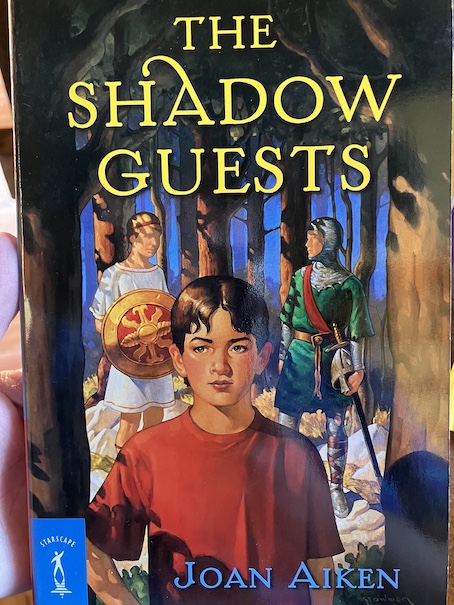
The Shadow Guests by Joan Aiken, 1980.
When Cosmo’s mother and brother mysteriously disappear, Cosmo’s father sends him to live with eccentric cousin Eunice in England, who is a mathematician educated at Cambridge and who now lives in Oxford. Cosmo’s father plans he will join Cosmo in England later, after he’s finished wrapping up the family’s business in Australia.
After Eunice picks up Cosmo at the airport, she tells him that she’s arranged for him to attend a small boarding school. Cosmo has never been to any kind of school before because his family lived too far outside of town. He and his brother always had their lessons together at home. Cosmo isn’t sure he’s going to like living with all these strangers at school, but Eunice says that she arranged for him to be a boarder rather than a day pupil so he would make friends faster. Eunice lives at the old Curtoys mill house, and Cosmo joins her there on weekends.
However, most of the other students at school don’t seem particularly friendly, and one of the teachers seems oddly confrontational about Cosmo’s father. He knows that Cosmo’s father, Richard Curtoys, was once a well-known cancer researcher in London, and he doesn’t know why he gave it all up and moved his family to the middle of nowhere in the Australian Bush. Cosmo doesn’t know what to say because he was very young when his family moved to Australia, and he doesn’t really know why they moved.
On his next weekend with Cousin Eunice, he asks her about it and whether or not the family’s sudden move to England had anything to do with what happened to his mother and brother. Eunice admits that it did. Cosmo’s father hadn’t wanted to explain and had left it up to Eunice to decide how much to tell Cosmo, but Eunice believes that it’s better for people to know everything than not know anything. Eunice reveals to Cosmo that their family has been under a curse for generations.
The Curse
The curse apparently started with the Roman invasion of Britain. Their family seems to have Roman roots, and one of their ancestors was apparently a Roman soldier. When the Romans took over Britain, they wanted to convert the inhabitants to the Roman religion, which was still pagan at that time. According to the legend passed down in their family, their ancestor was one of a group of soldiers who were ordered to destroy a pagan British temple. The son of one of the priestesses at the temple tried to resist them, and Cosmo’s ancestor killed him. The boy’s mother then killed herself out of grief. The boy’s grandmother, who was also a priestess, placed a curse on Cosmo’s family: in every generation, the eldest son of the family would die in battle, and his mother would die of grief.
Since then, Eunice says, the curse seems to have come true. She can list generations of their family where the eldest son has died in battle, including Cosmo’s father’s generation. Cosmo’s father was the youngest son of his family, and his elder brother, Frank, died young in battle. After Frank’s death, when Richard was only 10 years old, his mother died of grief, just like in the curse. Richard claimed that the curse was all nonsense when he was an adult, and he refused to tell his wife about it when they got married. However, Eunice had been friends with his wife before she met Richard, and she didn’t think it was fair to keep the secret from her, now that they had two sons of their own. Eunice admits that she told Cosmo’s mother everything, and that the story seriously upset her. It was Cosmo’s mother who insisted on moving to Australia, hoping to get as far away from the curse and any potential war as possible.
When Eunice explains this, some of the things about Cosmo’s family begin to make sense to him. Eunice admits that it seems like the elder brothers of the family resent the younger ones, who are safe from the curse, and Cosmo realizes that he sensed that his brother seemed to be hard on him or resent him, indicating that he probably had some sense that he had an ordeal or possible early death to face that Cosmo would be spared. Yet, younger brothers in the family are not entirely spared from the curse. It’s true that they live to carry on the family line, but each of them is also destined to lose their first son, and shortly afterward, to lose their wife to grief at their son’s death. Cosmo considers that maybe, when he’s grown up, he’ll just adopt a child to get around the problem.
He somewhat compares the family curse to a form of cancer. Some families are more genetically prone to particular types of cancers than others, and the way that members of those families survive is if, somehow, a genetic mutation is introduced to the family line, something that makes those individuals different from the ones before. It’s an indication that, maybe, this curse might not afflict their family forever. If someone, like Cosmo, can figure out how to be different from earlier generations of his family, and not pass on the cursed element to the next generation, there might be an end to the curse. Figuring out how to do that is going to be difficult, though.
Eunice says that his mother tried to evade the curse by running away, but apparently, it didn’t work. Nobody knows exactly what happened to Cosmo’s mother and brother, only that their car was found abandoned, and that they appeared to go off into the Australian desert on foot. Searchers have found no sign of them since, and because it’s such a harsh environment, people don’t think it’s likely that they’re still alive. Nobody knows why they went off into the desert, except maybe either the curse drew them there or they were trying to escape from it. Eunice’s housekeeper, who also knows about the curse, talks about it with Cosmo, and Cosmo asks her whether she thinks it’s possible to break the curse. Like Cosmo, she thinks it might be a case of gradual changes, members of the family doing things differently from earlier generations. Unlike Eunice, she thinks that maybe what Cosmo’s mother and brother did was one such change, and it’s difficult to tell what effect it has had yet.
Cosmo remembers a strange old man who visited them once in Australia. He thinks the man was probably a sorcerer or something because he told them things about their futures. He’s not sure what the man said to his mother, except that it seemed to upset her, and she was never the same afterward. Eunice suspects that the man may have told her that it’s impossible to run away from heredity and destiny. The man told his brother something about there being many different types of battles, which might indicate that staying away from wars would not be sufficient to save him from his destiny. The old man didn’t clarify that statement, but it’s true that people also fight internal and emotional battles every day, no matter where they are. Was this the battle Cosmo’s brother lost or could lose, and has it actually claimed his life already?
Cosmo had always thought his brother and mother were braver than he was, but now, he comes to question that. They had tried to run from their apparent destinies, and maybe the running caused them to go missing, and maybe even to die. When Cosmo’s father writes to him about the family curse, he explains that he has come to believe that the curse is a self-fulling prophecy, that it only comes true because people expect it to. Perhaps Cosmo’s mother and brother would have been fine if they hadn’t tried so hard to outrun their curse, putting themselves into a dangerous situation.
Of course, Cosmo realizes that it’s easier for Cosmo and his father to put aside their fear than it was for Cosmo’s mother and brother. Being the direct subject of an existential curse is certainly much more terrifying than just being part of a family that has a curse that may kill people around you. These thoughts cause Cosmo to consider the nature of fear and how people can be afraid of many different things and how the nature of a person’s fears make a difference in how they are affected by them. What one person can face with courage may be the undoing of another.
The Ghosts
Meanwhile, the other kids at school have become deliberately hostile to Cosmo. They accuse him of being stuck up and lying to them about Australia, and they start saying that Cosmo has probably never even been to Australia. Cosmo knows that all of the things that they say about him are untrue and unfair, but there isn’t much he can say to refute it. It seems to be a form of hazing at the school. He thinks about how petty and childish the other kids are and how they have no concept about the serious issues that are hanging over Cosmo. In a way, though, Cosmo discovers that he’s actually more comfortable brooding over the curse than he is thinking about the obnoxious kids at school. There is a kind of comfort in knowing your life fits a pattern, even if it’s a disturbing and unpleasant one. He also thinks about what the old man told him, that one day, he would have three friends. Because of the way kids at school act, Cosmo can’t image having any friends there at all, but that prediction comes true as well.
Cosmo gradually discovers that the mill house where his aunt lives is haunted. Eunice tells him about a phantom coach and horses that are supposed to appear at night, and Cosmo begins seeing a boy who calls himself Con. Con first appears to him as a little boy, about 4 years old, but each time Cosmo sees him, he gets a little older. He also eats Cosmo’s candy bars from his room. Eventually, Con speaks to Cosmo as a young man. He admits that he took the candy because eating someone else’s food forms a relationship between the two of them. Con explains to Cosmo that his father was a free Roman soldier, but his mother is a slave woman, so Con himself is a slave. The only way he can win his freedom is to play in the gladiatorial games, and he needs Cosmo’s help to practice. At night, Cosmo practices Roman style fighting with Con, but it is gradually revealed that Con does not expect to survive his upcoming fight. When Con speaks to Cosmo more about his family, it is revealed that Con is a member of Cosmo’s family from the distant past. He is the eldest son in his generation, and he knows about the family curse. Because of the curse, he expects to die fighting. Cosmo tries to explain to Con that he doesn’t need to believe in the curse.
Whether that helps Con or not isn’t apparent because Cosmo has to spend the next weekend at school and doesn’t see Con again. The next ghost he sees is a boy called Sim. Sim has been living at a monastery in the Middle Ages, getting an education, but his father has pledged him to his uncle to go fight in the Crusades. Sim is worried because he doesn’t know anything about fighting and thinks that he’ll be killed. He asks Cosmo if he can help him learn to fight. Again, Cosmo doesn’t know much about fighting, but he tries his best to help Sim. He doesn’t really see why Sim has to be obligated to go to war if he’s no good at it and doesn’t want to go, but he does notice that Sim’s eyesight is poor, and what he really needs are glasses.
Then, some of the hauntings at the mill house turn frightening. Cosmo is almost killed in multiple, inexplicable accidents. It seems like a poltergeist is out to get him. One of the boys who’s been giving Cosmo a hard time at school is also visiting the mill house and witnesses some of these accidents one weekend because his father works with Eunice. Not only do the boys learn to get along better after getting to know each other, but Cosmo starts realizes that the boy, Moley, actually has some problems of his own. He has an unhappy home life because of his stepmother. Moley also has a weak heart that keeps him from participating in certain school activities. Knowing this makes Cosmo feel more sympathetic toward him. Moley also comes to realize that something mysterious and threatening is happening to Cosmo, and he witnesses a ghost that Cosmo doesn’t see: a stern old woman in black. Moley has the sense that this old woman is responsible for the accidents happening to Cosmo, although he doesn’t seem to recognize that she is a ghost at first. It seems like Cosmo has now become the target of his family’s curse, which shouldn’t happen because he isn’t the eldest son. Has Cosmo become the target of the curse or some other supernatural force that now sees him as a threat?
My Reaction and Spoilers
I enjoyed the story, although I feel a little conflicted about the ending. The story is somewhat open-ended. We know that Cosmo survives his ordeals. Part of me wonders if the curse may have actually saved his life, after a fashion. If his bother was fated to die and Cosmo was fated to survive, then the forces trying to kill Cosmo were destined to fail. But, that’s just conjecture. These questions are never really answered. In the end, Cosmo doesn’t know if anything he’s done has changed the nature of the curse or if it actually can be changed. He still doesn’t know what might be in store for his future wife and children or if he will actually have a future wife and children. The only way to know is to live his life as best he can and deal with whatever comes along the way.
There are two things that I can see that he gains from his ordeals: closure about his mother and brother and a glimpse at what various other relatives have done in the past to change their fate (or if they did anything). I think there are some indications, based on Cosmo’s encounters with family ghosts, that what his father believes about the curse is probably true, but the story leaves that up to the imaginations of the readers. If you like speculative books, you might enjoy this one.
Metaphysics
Although Eunice is a mathematician, she’s also interested in metaphysics. She and Cosmo have discussions about the nature of time and reality and the possibility of other dimensions or other realities, which have a bearing on whether or not we interpret the ghosts that Cosmo sees as ghosts or not. In some ways they seem like ghosts, but in others, they might be people who have not yet died but who have crossed over in time.
This isn’t confirmed, though, and during Cosmo’s ghost experiences, someone from the past is attempting to kill him. (Spoilers) At first, I thought that the old woman attempting to kill Cosmo was the old priestess who originally put the curse on his family and who was trying to stop Cosmo from helping the ghosts who came to him to survive and thwart the curse. That isn’t the case, though. What Cosmo discovers is that various ancestors have tried different ways of thwarting the curse themselves. So far, none of them have been successful (and I’ll have more to say about that), but Cosmo discovers that one ancestress and her son actually became evil sorcerers themselves. The old lady is a sorceress, and she believes a prophecy that her son will die in a fight with Cosmo, so both she and her son are traveling through time and actively trying to kill Cosmo to save the son from the family curse.
During his struggles with this unholy duo, Cosmo is very close to being killed, and he has a near-death experience. He sees a beautiful, peaceful place, with Con and Sim and his mother and brother. He wants to join them all there, but they tell him that it’s not his time, and they will wait for him there until it is. This seems to represent a vision of Heaven and to confirm the supernatural nature of the story and that Cosmo’s mother and brother are also both dead.
Destiny and Curses (Lots of Spoilers)
I already said that, in the end, we don’t know if anything that Cosmo has seen, done, or experienced has broken the curse or changed his future or his family’s future. What we do see through Cosmo’s experiences are two things: that different generations of the family have tried to thwart the curse in different ways and that (although the story doesn’t explicitly spell this out) there may have been reasons other than the curse itself for what happened to the sons who died, including what Cosmo’s father said about belief in the curse itself causing it to come true.
Con tried to practice his fighting skills in an effort to win his battle, but unlike Cosmo, he never seemed to seriously consider that maybe he didn’t need to fight that battle at all. We’re not sure exactly how many generations removed he was from the original curse (maybe one or two, possibly more?), but it seems that enough time has gone by to convince him that the curse is real and that he should believe in it. Did his belief that he was going to his destiny and going to die in the upcoming fight cause him to actually seek out that fight and also to lose it?
When Sim comes to Cosmo, Cosmo tries to talk to him about just choosing not to fight, but Sim explains that isn’t an option for him. His father arranged it with his uncle, and Sim has no power to refuse to go. The choice not to fight isn’t open to Sim, but Cosmo also realizes that, beyond simply not being a skilled fighter, Sim is also at a disadvantage because he has bad eyesight. So, was Sim’s death almost arranged by his family because they had already concluded that it was his fate to die in battle, never teaching him to actually fight and overlooking his eyesight? If they had left Sim in the monastery, where he was studying, maybe nothing bad would have happened to him.
After Cosmo recovers from his near death at the hands of the sorceress and her son, who was an 18th century member of the Hellfire Club, he learns their fate from Eunice. Both the evil mother and her son died at the same time in the river where they nearly drowned Cosmo, indicating that they accidentally got themselves killed in their attempt to kill him. The prophecy that said the son would die while fighting Cosmo was actually a self-fulfilling prophecy. If they simply hadn’t believed it and had ignored Cosmo, he would have never met them at all, living in a completely different time and having no way to magically travel through time on his own. It’s only because they sought him out and actually started the fight that both of them died, which lends credence to what Cosmo’s father says about believing in the curse causes it to happen.
Before the end of the story, Cosmo’s father tells him that searchers have finally found his mother’s and brother’s bodies in the desert, confirming his vision of them in Heaven. We still don’t know exactly why they went off into the desert to die. Were they trying to flee the curse in a panic, so they weren’t thinking about how this decision could lead to their deaths? If they had simply chosen not to believe in the curse and had continued living in London instead of trying to wildly flee, losing the battle with their own emotions, perhaps they would have both lived normal lives and not died early … maybe.
There’s no real way to prove exactly what happened to Cosmo’s mother and brother. We never hear what happened to them from their point of view, and what decisions they made because of it. Both Cosmo’s father and Eunice says that they shouldn’t blame them for how they attempted to deal with something beyond themselves because they did the best they knew how at the time, even if no one else understands. This leads me to consider that maybe the real curse of the family is: bad decisions. Whenever the curse seems to arise again, each generation has to decide how they will handle it: run or fight, believe or not believe, etc. Each time, they’ve made the wrong choice for their circumstances.
In a way, Eunice bears some responsibility for what happened to Cosmo’s mother and brother, although no one blames her for her role in the situation. Cosmo’s father, having concluded that belief in the curse causes it to come true, had decided not to tell his wife or kids about the curse, so they would never have to grapple with whether they believed it or not. But, apparently, he never explained that logic to Eunice because she spoiled it by telling Cosmo’s mother and shocking her into taking a course of action that led to her and her elder son dying. Would the situation have been different if she had said nothing or if she had said something but said it at a different time from the one she actually chose? Eunice says that she thought Cosmo’s father should have explained the situation before he got married. Maybe that would have changed things or maybe it wouldn’t, but if she felt that strongly that this was the right thing to do, she could have brought up the subject earlier. Maybe she should have talked to both of Cosmo’s parents before their marriage to either get everything out in the open or at least understand why she should keep the secret. Either Eunice didn’t do that or she weakened in her resolve to keep the secret, and she inadvertently set the curse cycle in motion again.
The supernatural nature of this story and its ghosts suggests that the curse is probably real on some level and not just a series of bad luck incidents and unfortunate mistakes that the family makes. The hopeful outlook, the one that Eunice’s housekeeper believes, is that, little by little, with each passing generation, the family changes. Each generation is a little different from the last. Cosmo’s brother was apparently the first not to die in a conventional battle or a physical fight. He died trying to avoid fighting. With him, it seems to have been some kind of internal battle. This may be true of later generations, or maybe this is the first step in shattering the pattern of the curse. Possibly, all that Cosmo has seen will grant him the ability to make better choices, teach this children how to break old patterns, or do something drastically different that nobody else has done before. It’s hard to say, but realizing that it’s hard to say what might happen or what could have happened is a major part of the story.
Thinking about the curse and all of the ways the family could break it and all of the ways they’ve failed to break it so far shows the unpredictable nature of the choices people make in life. Each generation apparently did something they thought was for the best, whether they were embracing fate, fighting fate, or running from fate. The story leaves open the possibility that fate (or the curse) will always find them in some form, no matter what they do. If they don’t actively go to war, they may face their battles in another way, like internal or emotional battles. Who’s to say whether a different sort of internal battle might have taken Cosmo’s brother in London, even if the family said nothing about the curse to him or his mother? As a teenager, he might have had a battle with drugs or depression and lost. He might have gotten a disease and lost that battle. Life has a lot of maybes, and none of us can foresee every possible struggle or disaster.
Another maybe is that maybe the important point isn’t whether or not the curse exists or whether or not they can save all the potential victims but what each of them chooses to do with the life they have while they have it. Cosmo and his father will keep on living. His father will return to his important cancer research, and Cosmo will have decisions to make about his own life. He may or may not decide to have kids, he may or may not tell his future wife or fiance about the curse, and he may or may not try to adopt a child rather than have a biological one. In fact, unless the curse guarantees that sons will be born in the family, we don’t know for sure whether Cosmo might have all daughters. Really, anything is possible. What his future children’s struggles might be or what the real risks to them could be are a distant unknown right now in Cosmo’s life. In the end, he will have to trust them to a certain extent to make the right choices or at least the best choices that they know how when their battles come to them, in whatever form they take. We all have battles of our own to face and risks we take, no matter who we are, and nothing in life is guaranteed for any of us.
There is one last thing that did surprise me. In all of the ways it seems people in Cosmo’s family tried to end or thwart the curse, did nobody think of maybe some form of apology or atonement? The curse stems from an ancient offense someone in their family committed. Perhaps, if they found a way to say they were sorry, it would do something to end the vengeance against them, but it seems like nobody even suggests it. Heck, the evil sorceress lady and her son acquired the ability to use magic and travel through time, but because they were evil and stupid, they went after Cosmo, who was probably their greatest ally, instead of looking further back in time for the real source of their problems. Couldn’t they have gone and faced the priestess lady and either stopped her from creating her curse or stopped their ancestor from killing her grandson? There are a lot of maybes to this whole situation, but I’m honestly surprised that they didn’t think of that one.
School Troubles
Some of the school experiences in the story may have been based on the author’s own education. Joan Aiken was home schooled until she was 12 years old, and then, she was sent to the Wychwood School in Oxford, a boarding and day school. It’s possible that she also encountered difficulties adjusting to being at school with other children and the hazing and bullying that can occur in that type of environment. In the story, Eunice sees value in learning how to get along with other people, although Cosmo questions the value of learning to get along with people as awful as the kids at his school.
He gradually begins to learn more about the relationships of kids at school by observing them as an outsider. Some of the awful ways of treating him are considered some kind of hazing or initiation, and he’s expected to undergo it with some degree of grace before they will grant him acceptance. It’s all pretty idiotic and immature. Cosmo realizes it, although he knows he can’t show much reaction, or it will make things much worse. It’s the sort of thing I hated when I was a student myself. I admit that I was shy and socially awkward, and I didn’t get along well with many other kids because I just couldn’t stand this sort of thing.
Over 30 years later, I haven’t really changed my mind about that. I get that being around other people can open your eyes to human nature and how to deal with your fellow flawed human beings, but I see the same problem in this story as I do in real life: allowing this system of hazing encourages the personal entitlement of particular students, and it also is detrimental to the mental health of people who struggle to deal with them. I think schools do better at this now than they did when I was a kid, when it seemed like almost 100% of the personal development, learning, and personal responsibility was put on the shoulders of everyone else who has to deal with this type of person. I think I have much, much less patience for this kind of thing now than I used to due to overexposure early in life, which does call into question whether what I learned from that experience was really beneficial or not. On the whole, I actually do think that I benefited from exposure to other people, in spite of all the stresses and mental health issues along the way. Part of the issue is, when you’re part of a group of people, you have to put up with the worst parts of that group to spend time with the better parts of the group. If you avoid society too much, you don’t meet the better parts. Learning social skills and human understanding also requires time and practice, which is what Cosmo learns in the story.
People who bully and cause problems can be considered in the learning phase of developing social skills themselves. It’s just that there do have to be rules about how much of their bad behavior can be allowed while they learn. They can’t be allowed to sabotage other people’s social development for the sake of their own because that only leads to their personal entitlement at someone else’s expense. If they are spared consequences for their actions, they never learn anything, either, never improving or showing signs of development, just putting more needless stress on other people and never seeming to understand or care why. I’ve seen far too many examples of this in real life.
I actually enjoyed the way the school in the book handled some of these conflicts. The headmaster is a psychologist, and although some of the things he does seem a little unfair, he actually discusses his reasons for doing this with Cosmo. He understands how his students think and feel, and he knows how to give consequences for actions that not only enforce the school’s rules and better treatment for bullied children but also which affect their relationships with each other more positively.
At first, Cosmo is angry when he’s punished along with some of the other kids who have been bullying him for a prank he tried to discourage them from committing. However, the headmaster apologizes to him for that, saying that he knows those other kids have been giving him a hard time, treating him like he thinks he’s better than they are. One of the other teachers says that Cosmo has been targeted because he’s one of the bright students, and some of the members of his family have a more prestigious reputation than Cosmo realizes. By giving Cosmo the same punishment as the other boys, while the other boys are made to acknowledge that it’s unjust and that Cosmo doesn’t deserve it as much as they do, the headmaster is showing the other boys that they don’t have reason to think that Cosmo is being treated better than they are, ending some of their resentment against him. He also knows that the boys can now accept Cosmo as being one of them, united in resentment against the headmaster for being harsh and unfair. The headmaster is willing to take their resentment against him because, as an adult faculty member, he doesn’t need to be one of “them”, as in one of the students or their “friend” or “pal.” He’s apart from them anyway in terms of age and status, and part of his role is guiding their actions and relationships with each other. In a way, Cosmo admires the logic and the tactic, even though it means enduring the punishment, and it does improve the way the the other boys treat him.










 Jestress's Forgotten Books and Stories