The Windy Hill

The original cover is public domain and available through Wikimedia Commons

The Windy Hill by Cornelia Meigs, 1921.

Oliver and Janet are spending the summer with their mother’s cousin, Jasper, who is a wealthier man than the rest of their family. Janet is enjoying the visit and Jasper’s grand house so far, but Oliver is very uneasy there. Oliver doesn’t like the vast, empty house, and he’s noticed that Jasper’s manner seems different from he remembers the last time they saw him. Oliver senses that something is troubling Jasper, something that he doesn’t want to discuss. Jasper is usually a cheerful person who enjoys his cousin’s children, but during this visit, he hardly pays attention to them and never smiles. Janet finds things to do to keep herself occupied, but Oliver is terribly bored and bothered by Jasper’s odd behavior.

Then, one evening, Jasper sees Oliver looking at a nearby house. He says that the people who live in that house are also cousins of theirs, but he’s been too busy lately to see much of them. Jasper apologizes for having neglected Janet and Oliver during their visit so far, and he says that he will invite Eleanor, the daughter of the cousin who lives in that house, to lunch the next day. Eleanor is close in age to Janet and Oliver, and Jasper thinks that they will be friends and that a visit from her will liven up the visit for them. Janet is pleased at the idea of another girl cousin visiting, but Oliver is at that phase where he doesn’t like girls. He can’t imagine that he would have anything in common with this unknown girl cousin, and he thinks he’ll be bored while Janet and Eleanor have fun together. He tries to tell Jasper as much, but Jasper is just amused by his attitude and tells him that, if he is afraid of girls, the sooner he gets over it, the better.

When Jasper orders his car and driver to take Janet and Oliver to see Eleanor, Oliver decides to rebel by going to the train station and trying to get a train home. However, while he is waiting at the train station, he becomes curious about the countryside around him and the nearby river he hasn’t yet investigated. He wanders off to explore a little and encounters a man and a girl at a nearby cottage. The man and the girl ask him to help them with their beehives. Oliver is a little nervous of the bees at first, but he follows the beekeeper’s directions and finds himself enjoying the work. The beekeeper and his daughter, Polly, invite him to join them for lunch afterward. After a lunch of biscuits, honey, and iced cocoa, Oliver feels much better about everything.

Polly thinks that she and her father have somewhere they need to be after lunch, but her father tells her not to worry about that. Instead, he entertains Oliver and Polly with a story about a Native American medicine man, a boy who is curious about what lies beyond the ocean, and their first encounter with white people. By the time the story is over, Oliver realizes that he has missed his train. He decides to return to Jasper’s house, where he is told that Janet didn’t go to see Eleanor because Eleanor was delayed somewhere. (Guess where.)

More and more, Jasper’s odd mood becomes apparent. His servants have also noticed how worried he’s been, and it seems like he’s always more upset after a mysterious and disagreeable man comes to see him. Nobody knows who he is or what his visits are about. Oliver knows how to drive, and Jasper has Oliver drive him out on a mysterious errand one evening to see someone. Oliver doesn’t know who Jasper talks to or what they say to each other, but the visit takes a long time, and it makes Jasper angry.

Oliver’s visit with Jasper gets better because Jasper allows him to use the car by himself from that point on. He takes Janet to visit the Beeman and Polly. Although Oliver is still not enthusiastic about girls, he likes Polly because she is very different from how he imagines that cousin Eleanor must be. The Beeman says that they have to pick up some new beehives that day, and Oliver volunteers to take the girls to get the hives from a man named John Massey. John Massey complains about his landlord, who hasn’t been maintaining the dikes. Massey has had to take it on himself, and the burden is becoming too great for him to bear.

It turns out that Massey’s landlord is Anthony Crawford, the unpleasant man who has been troubling Jasper. Crawford also seems more than happy to let Olive and Janet know that he is also a cousin of theirs. He seems to be under the impression that Jasper has cheated him in some way. Jasper says that he’s already given him what he’s entitled to have, but Crawford says that his share should be more than that. Crawford says that, if Jasper doesn’t give him what he really owes him, he can take everything Jasper has and destroy his reputation in the process. There are secrets in their family’s past that would cause a scandal if the public knew about them, and Crawford says that if people knew that there was one crook in their family, they would all be suspicious that Jasper is much the same way.

Oliver doesn’t know what to think of Crawford’s insinuations or his threats. Not knowing who else to turn to, Oliver explains the situation to the kindly Beeman and asks him what he should do to help Jasper. The Beeman knows far more about everything that’s been happening than Oliver knows, and he say that Crawford has unknowingly been laying a trap for himself. Crawford thinks he’s pretty sharp in his dealings with other people, but he’s been neglecting something very important. Actually, multiple things.

In a series of stories that the Beeman shares with the children, he indirectly tells the children the history of their family and quarrels that go back generations. He tells them about a family with a shipping business that restored their lost fortunes during the War of 1812 by turning to piracy. He tells them about siblings divided by quarrels over money during the Gold Rush. Although the Beeman doesn’t admit to the children that all of his stories are true in the beginning, they soon come to realize that they are and that they are directly connected to the them and the current situation.

Toward the end of the book, the Beeman ties all the pieces of the puzzle together before telling them the final story, the one about three cousins named Jasper, Anthony, and Thomas, who were all raised together and were very close, until they had a falling-out over Anthony’s scheming and his unethical dealings. There are reasons for everyone to resent Anthony for his meanness and greed, but the Beeman is correct that Anthony has set himself up for a fall. He really should have listened when everyone tried to tell him to fix the dike.

The book is available to borrow and read for free online through Internet Archive (multiple copies) and Project Gutenberg. Because it is in the public domain, there is also a LibriVox Audiobook recording.

My Reaction and Spoilers

The Family’s Story

In some ways, the story of the family in the book is also a celebration of American stories. The short stories about different generations in their family are set at turning points in American history. Something that fascinated me about these stories was that they were not all glowing about these points in American history and their associated legends. There are parts of the stories that emphasize the bold American values of adventure and ingenuity, but there are also dark sides and downsides to the stories and flawed characters. The family fortunes were set partly by piracy, but one of the heroes of the family was the man who realized when it was time to stop. Members of their family have been consumed by greed and quarrels, although some have overcome their flaws and misconceptions to come together and be a family again. Again, the Gold Rush story resolves happily when the brothers involved also realize the folly of endlessly pursuing riches at the expense of relationships with the people they love. There is even a slight rebuke against the westward expansion of the United States – portrayed heroically but also as highly costly as people died and killed others over land and gold and promoting an endless, unhappy quest for more and more, with people living their whole lives never feeling satisfied. In short, the family, like the stories and American history itself, is a mixed bag, and they are at their best when they realize their wrongs and make the decision to change. For a book from the early 1920s, a period of heightened patriotism and prejudice after WWI, it seems remarkably insightful and self-aware.

It was Anthony’s decision to forge a relative’s name to get money to cover his unethical dealings that ruined his relationship with his family. It was only by their charity and intervention that he wasn’t charged with his crime and sent to prison. He’s fully aware of that, but he’s been resentful about it rather than grateful. Even from a young age, Anthony had always coveted what other people had. Even if he didn’t really want things for their own sake, he would go through elaborate schemes and bitter fights to get what someone else had, just because someone else had it. Out of greed and spite, he has resurrected old property quarrels in their family. He not only got the old house that was originally willed to Jasper, but he has been scheming to get Jasper’s new house. The Beeman (who is the third cousin in the last story and father of Eleanor, who is called Polly as a nickname) says that Anthony should have headed the lessons learned by their family during the Gold Rush, that always reaching and reaching for greater prizes means never being satisfied with what one has and risking its loss in pursuit of the unattainable.

In the end, when Anthony’s scheming and corner-cutting leave him with no one to turn to but the family members he has harassed and schemed against, he finally experiences a change of heart. I find stories where the villain has a sudden change of heart after long-term villainy to be unrealistic, but the crisis that Anthony realizes he caused is sudden and serious. Because he has neglected the dike and driven away the people who were helping to cover his negligence at their own expense, he suddenly realized that he has endangered many lives, and everyone knows that it’s all his fault. He schemed to get control of that land but didn’t take care of it when he had it. Everyone knows what he did, nobody’s going to cover for him, and while he’s unscrupulous enough to scheme to get others’ property, he doesn’t want to be responsible for killing people. It’s enough to make him swallow his pride and acknowledge the reality of the situation to his cousins. They help him for the sake of the people in danger, and in return, he decides to leave the area.

In the end, Anthony takes a hard look at himself and his life, and he realizes that he and his wife and children were better off when they lived in another community, where he was forced to work for a living instead of by his schemes. He now fully understands his weaknesses and temptations, and rather than continuing to resent the things and people in his life that stop him from furthering his schemes, he has come to welcome them as the guiding forces that keep him from making destructive decisions. The way he phrases it struck me as a little corny, almost like the end of a PSA, but I approved of the sentiment. His family members made him angry because they saw him for who and what he was, but the point is that he now understands who and what he is himself. Although the others are willing to allow him some leniency because of the way he handles the crisis, Anthony realizes that he must give himself the discipline he needs and be the changing force in his own life.

Overall, I thought it was a pretty good story, although there are a few issues with racial language related to Native Americans. I’m not sure if there is a modern revised version of this story or not. The version that I’m reviewing is the original from the 1920s.

Native Americans in the Story

I found the first story the Beeman tells, the one about the Native Americans, fascinating because the story contains the concept that Native Americans arrived in the Americas by crossing the Pacific Ocean and moving eastward across the continent. I know that’s the modern concept of the origins of Native Americans, but I was surprised to find the concept in a book from the early 1920s. I didn’t realize that people in the 1920s had that concept because I thought the older theory was that Native Americans crossed a land bridge.

During the story about the Native American medicine man, the book uses the term “squaw”, which is a controversial term because, although it apparently can mean just “woman” in some Native American languages, it can mean something vulgar in others. Modern books avoid the use of the word, but it appears in some older books, like this one, because white people weren’t always aware of the connotations the word could have. This is the danger of using words you don’t fully understand. It isn’t meant in an insulting way in this book, but be aware that the word appears here and that it isn’t a good word to use yourself. If you’re referring to a Native American woman, just say “Native American woman”, and leave it at that.

The book also uses the word “Indian” instead of Native American, something that also appears in older books. I’ve explained before that this hearkens back to a much earlier misunderstanding about who Native American peoples were, and the nickname has stuck to a certain degree. However, modern convention is just to say “Native Americans” because it’s both a more accurate description and less confusing than explaining American Indians vs. Indians from India. I don’t mind the use of that term too much because it isn’t insulting. However, the book also occasionally uses the term “Red Man” to refer to Native Americans. The characters saying that don’t seem to use it out of malice, but I still think it’s inappropriate. I think that sort of thing went over my head when I was a little kid because I knew people were referred to as “white people” and “black people”, but after I was old enough to understand that there were other connotations to the term it became one of those terms that I think of as “derailing terms.” Even if the characters use it in a non-hostile way or kind of thoughtless way, we (the readers) know that there are hostile or demeaning connotations to the term. It just derails the train of thought of readers like me because we stop to process whether or not the character is trying to be insulting or demeaning, and it just distracts from the rest of the sentence and the thread of the story. I’m generally in favor of reprintings of books like this, with the racial terms updated because, provided that the author and characters are not trying to be demeaning or insulting, a change in the language can clarify attitudes and put the readers’ attention back where it belongs – on the story itself.

Native Americans also appear in the story about the Gold Rush, as risks encountered by westward travelers. Their appearance in the story is minimal, if stereotypical.
Thimble Summer

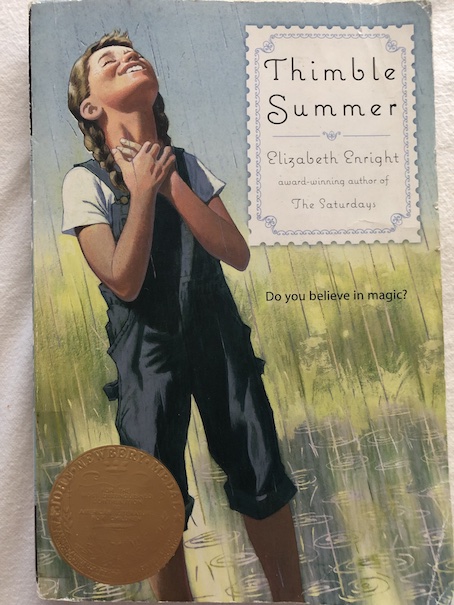
Thimble Summer by Elizabeth Enright, 1938, 1966.

It’s summer, and Garnet is a 9-year-old girl living on a farm with her parents and brothers in a rural community in Wisconsin. The story is episodic, with each chapter describing things that happen to Garnet over the course of one magical summer when she found a silver thimble down by the river. Garnet thinks that the thimble itself is magic, but maybe the magic is just in the happy summer adventures that follow.

The book is a Newbery Medal winner. It’s available to borrow and read for free online through Internet Archive (multiple copies, including one in Chinese).

The chapters in the book are:

The Silver Thimble

It’s been hot and rainless, and the crops are in danger of being ruined if they don’t get some rain soon. It’s a real worry because, if the crops are bad, Garnet’s family won’t be able to pay their bills. When Garnet and her brother Jay go swimming in the nearby river, Garnet finds a silver thimble. It’s a lucky find, and Garnet becomes convinced that the thimble is magic and that something wonderful is about to happen. Jay thinks that’s silly, but that night, the rain they’ve so badly needed comes! Garnet and Jay are so overjoyed with the rain that they go out running in the rain in the middle of the night, until they are frightened by lightning striking something, and their mother calls them back.

The Coral Bracelet

Garnet’s best friend is a girl name Citronella, who lives nearby. Citronella’s great-grandmother lives with her, and she tells the girls stories about what it was like when she was young. She tells them about Indians (Native Americans) who would sneak into her family’s house in bad weather to get warm and leave them presents as thanks. (I don’t know if any Native Americans ever did this in real life, but she says it like it really happened.) Then, she tells the girls about a special coral bracelet that she wanted at the general store when she was young and some foolish risks she took to get it.

The lucky thing that happens in this chapter is that Garnet’s father gets a government loan to build a new barn.

The Lime Kiln

The family needs to make lime for building their new barn. The kiln needs to burn for three days straight, and they all need to take turns tending it, day and night. Jay and Garnet are allowed to stay up all night there with their father. Friends help them, and neighbors come to visit and talk with them. Garnet brings along a picnic with sandwiches and apple pie that they eat at midnight.

The Stranger

While they’re tending the kiln, a strange boy comes along and asks them for food. His name is Eric, and he’s a parentless boy who travels around and makes his living from odd jobs. He tells them about his life and travels, and Garnet’s father hires him to help the family build the new barn.

Locked In

Garnet likes having Eric at the farm, but she’s also a little jealous that Jay wants to spend more time with Eric now than with her. Garnet starts spending even more time with Citronella, and the two girls build a tree house together. The girls tell stories in their tree house, and because it’s going to rain again, Garnet suggests that they go to the library in town. They get so engrossed in their books that they lose track of time and get locked in the library. Garnet thinks this is a fabulous adventure until Citronella points out that it’s Saturday, and the library is closed on Sunday. If they can’t find a way out, they could be there for the rest of the weekend!

Journey

It’s harvest time, and everyone is occupied in picking crops and canning foods. Garnet helps, and she is temporarily put in charge of the threshing machine. Unfortunately, she falls asleep and lets the straw stack pile up until it falls over and makes a mess. Eric tells her not to worry about it, but Jay yells at her and tells her that she had no business helping out as a girl and that she should be at the house with the women. Garnet is so upset at the way Jay has been critical of her lately that she decides to run away and hitchhike around, like Eric used to do.

“As a Ragpicker’s Pocket”

Garnet is still running away, and she takes a bus to the next town. By the time she has explored the town and looked at all the store windows, she isn’t so upset and can see the funny side of what happened with the thresher, and she’s about ready to go home. She buys a few things for her family at the dime store and a hot dog to eat. Then, she has a horrible realization: she’s out of money. How is she going to get back home?

Fair Day

Garnet goes to the fair with her family and neighbors, and she enters her pig, Timmy, in a contest. Timmy was the runt of his litter, but Garnet has taken special care of him, and she thinks that he has a good chance of winning a prize.

Ice-Cream Cones and Blue Ribbons

Garnet and Citronella enjoy the wonders of the fair while Garnet is waiting for the pig contest. They spot the lady sword-swallower darning her socks, they ride the rides, and they have snacks. The girls get stuck on the Ferris wheel when it stops working, and Garnet worries about getting down in time for the judging of the pig contest.

The Silver Thimble

The silver thimble hasn’t been mentioned since the first chapter, but when Garnet looks back on all the good things that have happened this summer, she’s still sure that it’s magic. All the good things that have happened started right after she found it. She shows the thimble to Eric, and the kids talk about what they want to do with their futures.

My Reaction

This story is more like a collection of stories, some of which continue each other. The book is somewhat episodic, leading up to the fair at the end of the summer. The stories are pretty gentle, slice-of-life adventures. Eric has had a hard life, but he doesn’t want to dwell on it too much, and things improve for him when he decides to stay with Garnet’s family. There are hints that Eric might marry Garnet someday, and the two of them might stay on the family’s farm. Eric has had enough of traveling in his young life, and he wants to be a farmer and thinks that he would like to save up money and buy land near the family’s farm. Jay wants to be a sailor or something else that will let him travel and see the world, although he thinks that he might want to come back to the farm when he’s done traveling and farm it with his father and Eric.

The book fits with the Cottagecore genre, and it would make good bedtime reading. Foodies will enjoy the mentions of old-fashioned treats, like apple pie, griddle cakes, and vinegar candy. Garnet also imagines that each of the kitchen things have their own personalities.

I liked Garnet’s name, which is very unusual in the early 21st century. Citronella is an even more unusual name, but I prefer Garnet. I think it’s charming, and it’s one of the less-common gem names used for girls. In the story, Garnet mentions that the librarian frequently gets her name wrong because gemstone names are popular in her time and area. There are other girls in town named Ruby, Pearl, Opal, and Beryl, and the library usually calls her Ruby, the most popular of the gemstone names.

There are some stereotypical mentions of Native Americans in the story. They’re not derogatory, and they’re minor parts, but there were a couple of things that struck me as being a little stereotypical, like the kids saying that they’re Comanche Indians doing a rain dance when they’re running around in the rain. I also didn’t care for the way the characters kept pointing out which people were “fat” or “fleshy.” They’re not really shaming these characters, just sort of remarking, but I just felt like it was rude and unnecessary. You see this sometimes in older children’s books. Fortunately, none of the fat characters are considered bad characters in this story, as they sometimes are in other books. There aren’t really any bad characters in the story in general. Jay is annoying at times and says things that put down his sister and girls in general in a bratty, macho kind of way, but nobody in the story is a villain.

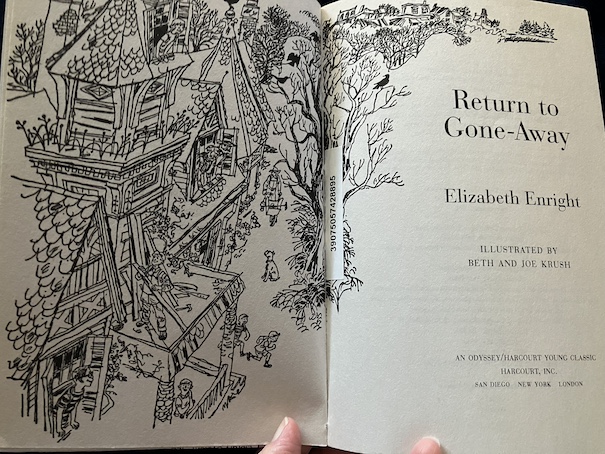
Return to Gone-Away

Return to Gone-Away by Elizabeth Enright, 1961.

This story picks up the spring after the previous book, Gone-Away Lake, with Portia Blake’s parents purchasing one of the old houses in the abandoned resort community now known as Gone-Away Lake. They’ve bought the large house that’s in the best condition, the one formerly known as the Villa Caprice. The wealthy woman who had once owned it had died many years before in the San Francisco Earthquake of 1906, leaving no heirs. Few other people would be interested in owning it since the lake has become a swamp, so the Blake family got a really good deal on it. The Blake family think the place is wonderful, filled with some amazing old things, and they’re looking forward to fixing it up and restoring the old garden. They plan to use the house as a summer home, and they will still live in their apartment in New York, where the kids go to school, for the rest of the year.

Portia’s aunt and uncle live nearby with her cousin Julian, and the two remaining residents of the old resort community, affectionately known as Aunt Minnehaha and Uncle Pin, still live there. Portia and Julian are part of a club they call the Philosopher’s Club, after Uncle Pin’s old group of friends, which includes Portia’s younger brother Foster and a couple of other kids who live in the area. They have a meeting space in another of the old, abandoned houses.

When the Blakes see the Villa Caprice again, the parents feel less optimistic about their purchase of the house because it looks shabbier than they remembered, and there is so much to fix. The adults know that it will take a lot of money and hard work to restore the house. However, the children are still enthusiastic because they know the old house is full of some fascinating things. One of the first things they run into is a dummy set up by the former owner to frighten and discourage trespassers. They nickname him Baron Bloodshed. When the adults realize that the old chandelier in the house is a Waterford chandelier, they begin to see that there may be some worthwhile treasures in the house after all.

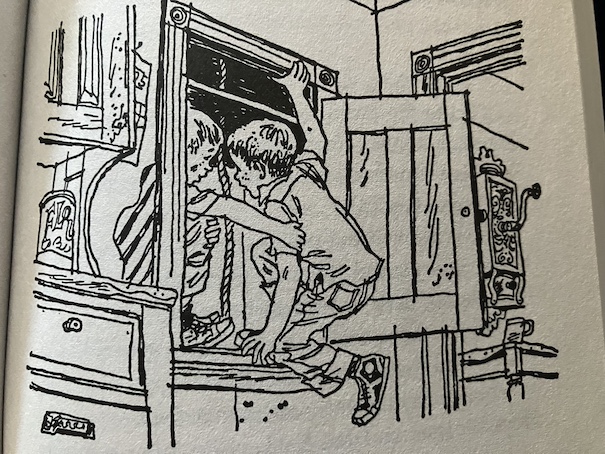
The Blake family takes the children’s spring vacation to start cleaning the house and sorting through the things inside. They find some other valuable, collectible items, like a set of Lowestoft china and antique Chippendale furniture. The adults realize that, if they sell some of these valuable antiques, they can use the money to pay for the renovation of the house. The children have little interest in such things, but they are amazed by some of the old-fashioned features of the house, like the old dumb waiter. Foster climbs inside the old dumb waiter, gets stuck, and has to be rescued. His parents tell him off because it was a dangerous thing to do and the old rope holding it might have been rotten.

The children look forward to spending the whole summer exploring the house and seeing what other treasures it has to offer. Aunt Minnehaha tells them more about the wealthy woman who used to own the house, Mrs. Brace-Gideon, who was a very determined woman who was accustomed to telling everyone what to do and getting her way because of her money. She was self-centered and callous in some ways, but she was also a brave and just woman in others. When Aunt Minnehaha tells them a story about how Mrs. Brace-Gideon dealt with a burglar who was trying to rob her wall safe, Julian begins asking more questions about the safe because they haven’t seen any sign of it. Aunt Minnehaha says that Mrs. Brace-Gideon wasn’t a very trusting woman, so she probably either told everyone the wrong room it was in on purpose to keep its location a secret or maybe had it moved after that incident or removed the safe entirely when she decided that she wanted to move to California. Even if the safe still exists, concealed somewhere in the house, it’s not likely that it would contain anything really valuable because Mrs. Brace-Gideon might have taken her valuables to California with her. All the same, the kids think that it would be exciting to try to hunt for the safe, in case it’s still hidden somewhere.

The kids begin another fun summer, improving their club’s meeting place with discards from their new house, enjoying outdoor fun with their friends, hearing stories about the past escapades of the people of Gone-Away, and spending the night camping out in a spooky old house during a thunder storm. They enjoy finding new treasures among the abandoned belongings of Gone-Away, and before the summer is over, they find the greatest treasure of all!

The book is available to borrow and read for free online through Internet Archive (multiple copies).

My Reaction

This is a fun sequel to the original book! I loved hearing about the things the family discovered in their old house and how the adults let the kids have some neat old things for their club. The small details in the book are magical, like the addition of the dummy they call Baron Bloodshed and the way he keeps scaring them because they keep forgetting that he’s there until they stumble on him again.

It’s the sort of idyllic summer in a unique location that kids dream of having! I liked the treasure hunt for the lost safe, and there are many small adventures and escapades along the way. The stories that the older couple tell the children about wonderful past summers both offer the kids inspiration for their summer and are like little mini-stories within the bigger one.

Even though this old, abandoned community and the house the family is fixing up are charming, there is also some acknowledgement in this book that there are dangers in exploring and playing in the abandoned houses. The incident with the dumb waiter could have been dangerous, and there is also a collapsed stairway in the story. While these houses full of valuable antiques and hidden treasures are wonderful, the inclusion of some of the dangers of abandoned places, no matter how exciting they are to explore, add an element of reality to the story.

The Summer Birds

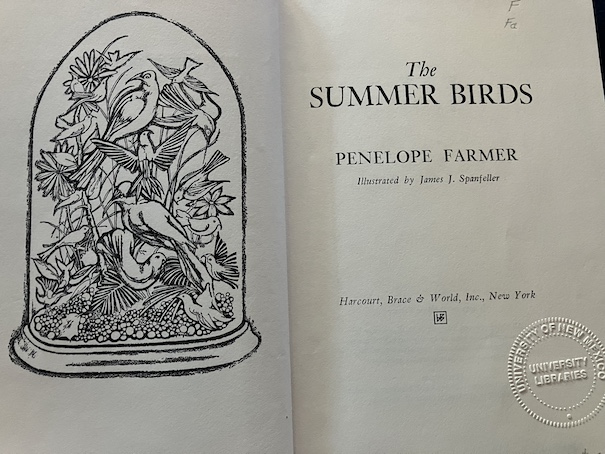
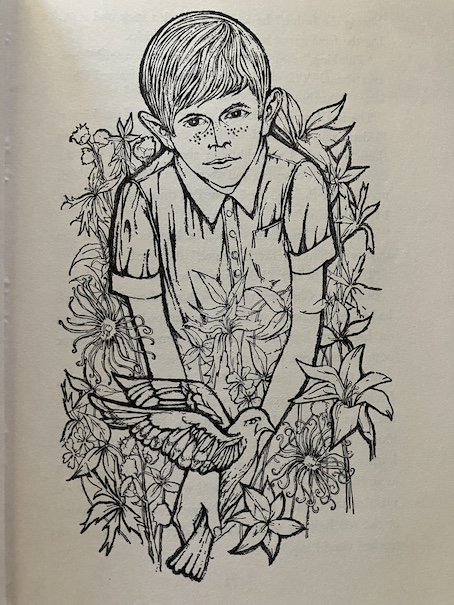
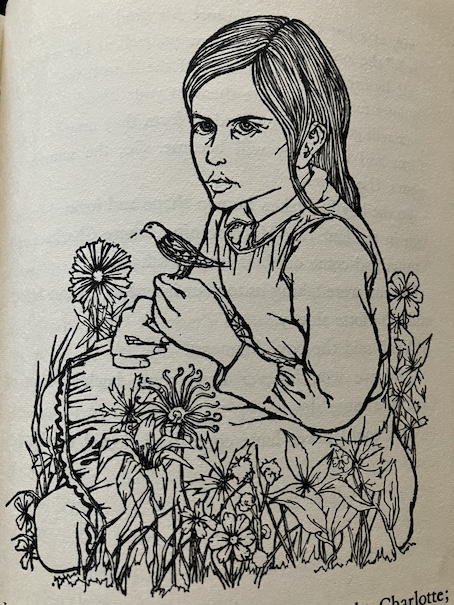
The Summer Birds by Penelope Farmer, 1962.

Aviary Hall is an old, Victorian-era house in a small village in England. It doesn’t really have an aviary, although there are hummingbirds on display in a glass case in the drawing room. Like other houses of its type, it has greenhouses and a walled kitchen garden. Twelve-year-old Charlotte Makepeace and her younger sister, ten-year-old Emma, live there with their grandfather. Every morning, they walk to school, and they admire the birds in the area, wishing that they could fly like that themselves. One morning, they meet a strange boy on their way to school. Charlotte is cautious about meeting strangers, but Emma talks to the boy. Charlotte says that they should hurry, or they’ll be late for school. The boy says that he doesn’t go to school, so Emma invites him to come with them to their school. Charlotte isn’t sure what their teacher would think of the strange boy showing up, but they have to go or they will be late.

However, when they arrive at school, Charlotte gradually begins to realize that nobody seems to notice the new boy except for her and Emma. Other people just look past him, and nobody asks who he is. It’s like they can’t even see him. As the lessons at school continue, Charlotte’s attention wanders, and she finds the heat of the room uncomfortable. Then, the boy invites Charlotte to come away with him, promising that he will teach her more than she will learn in class.

At first, she thinks that people will notice if she leaves, but they don’t. She and the boy run away from the school, and Charlotte feels wonderfully free, like a bird. The boy asks Charlotte if she would like to fly like a bird. Charlotte doesn’t see how that’s possible, but they says that it is and shows her that he can fly. The boy teaches her some exercises to make sure she’s strong enough. Charlotte can’t fly at first, just falling to the ground when she tries, but when the boy urges her to continue trying, she gradually realizes that she is staying in the air longer and longer. They have a wonderful time on this adventure.

The boy is very mysterious about who he is although he asks many questions about Charlotte and her home and family. Charlotte asks the boy if the other kids from school can also learn to fly. The boy says that they have to learn one-by-one, but he will teach them individually, and it has to be a secret.

Then, suddenly, Charlotte finds herself back at school. No one has noticed that she was gone, not even Emma. At first, Charlotte wonders if it was all just a dream, but she discovers that she still has the ability to fly and has to be careful not to let other people see her feet leave the ground when she kicks her feet. Emma can tell that Charlotte has a secret, and she’s irritated when Charlotte refuses to tell her what it is. However, Charlotte knows that Emma will learn soon enough.

Emma learns to fly the next day, and gradually, other children at school also start to be able to see the boy and get their own flying lessons. Charlotte’s best friend, Maggot (a nickname, not her real name), seems particularly accepting of the strange boy and his strange powers of invisibility and flying. She seems to understand things about him, maybe even more than Charlotte does, saying that her uncle has told her about such things.

Their teacher discovers what they’re doing when she catches one of the children flying, and she questions them about it. The children don’t want to admit anything to her because they call swore an oath to keep it a secret, but the mysterious boy says that their teacher is all right and reveals himself to her. He explains that he taught the children to fly, and their teacher is surprisingly accepting of that. She asks if she can also learn, but the boy explains that he can only teach children. The teacher regretfully says that she suspected that might be the case, and the children begin to consider that their ability to fly might also fade with age. The teacher invites the boy to join their class for the rest of the term and seems to quietly support their flying adventures.

When school lets out for the summer, the children continue their flying adventures, still a secret from their parents. The boy, who has still not told anyone his name, is very strange, and not just because he can fly. Charlotte sees him eating insects, which he says he loves, and he doesn’t seem to understand things about school and ordinary houses. During an argument among the boys in the group, who don’t want to be bossed by the mysterious boy without reason, one of the boys, Totty, challenges the mysterious boy about who he really is, where he really comes from, and how he came by his flying magic. The other children are afraid to challenge the mysterious boy because they know that he is strange, they worry that there may be something evil about his magic (although they doubt it), and they fear losing the ability to fly.

The children decide to settle the conflict with a special challenge. If the mysterious boy wins the challenge, he wants to stay with them for the rest of the summer, being their leader and not explaining anything about himself. If Totty wins, the mysterious boy says he will explain who he really is and then leave, although he will let the children keep their ability to fly until the summer is over. The mysterious boy wins the challenge, but at the end of the summer, he makes them all an offer that could change their lives forever.

The book is the first book of the Aviary Hall Trilogy, although it isn’t as well-known as Charlotte Sometimes, which is the third book. It is available to borrow and read for free online through Internet Archive (multiple copies).

My Reaction and Spoilers

Although Charlotte and Emma are sisters, this is the only book in this short series in which they both appear together. Each of the other books focuses on each of the girls separately. Charlotte Sometimes, the best-known book in the series, is set when Charlotte goes away to boarding school, and the second book in the series, Emma in Winter, takes place while Charlotte is away at school, focusing on Emma, who is left at home. All three books focus on growing up and issues of personal identity, although they do it in somewhat metaphysical terms and with fantasy elements.

Charlotte Sometimes focuses on personal identity as Charlotte finds herself traveling back and forth through time, trading places with another girl who attended her school in the past. At times, Charlotte feels like she’s losing her identity as Charlotte and becoming more like the other girl. One of the things I liked about The Summer Birds was getting a glimpse of Charlotte just being in her own identity all the way through the book. The beginning of the book makes it clear that the other children at school think that Charlotte is a prig (someone who is rigidly well-behaved to the point of being obnoxious), but it also clarifies that it’s because she feels compelled to look after Emma and set a good example for her.

The two girls live with their grandfather Elijah, who is obsessed with astrology, and an elderly, lazy housekeeper. The book never really explains what happened to their parents, but it seems that Charlotte and Emma are orphans. It is established in Charlotte Sometimes that their mother is dead, and this book mentions that their father was a sailor. Their grandfather likes girls to be well-behaved, and Emma is anything but, so Charlotte keeps trying to teach Emma how to act to keep their grandfather happy and trying to smooth things over with their grandfather when Emma misbehaves. In Emma in Winter, Emma has to face up to the realities of her personal behavior and other people’s reactions to her behavior without Charlotte running interference or taking responsibility on her behalf. That’s her coming-of-age moment, and it leads her to become more mature, personally responsible, and better-behaved herself and to appreciate what Charlotte was trying to do for her.

Although each of the books in this short series can be read independently of each other, I think reading all of them adds some depth and understanding to the characters. Charlotte was always a very responsible and cautious person in Charlotte Sometimes, showing that there is continuity to her character, but knowing the history of why is that way makes her more understandable. Although the other children sometimes consider Charlotte a drag for pointing out things that they shouldn’t be doing, it’s Charlotte’s serious nature that causes the other children to question the offer that the mysterious boy makes them at the end of the summer.

We also get to meet Charlotte’s best friend in her home town in this book, a girl called Maggot, who never appears and is never even mentioned in Charlotte Sometimes. The reason why she doesn’t appear in later book is that she is the only one who decides to accept the mysterious boy’s offer at the end of the book, leaving with him to be forever young as a bird. Charlotte is tempted by the offer, but she realizes that accepting it would mean giving up everything else and everyone else in their lives. The children would be happy for a while in their freedom as birds, but they would eventually miss their parents, and their parents would grieve for them because they would never be able to return. Although the other children don’t always listen to her, she is able to persuade them that this is really a serious matter that is about their very lives, forever, not just a brief summer lark. In the end, Maggot is the only one who can accept the offer because she is the only one who has no one left in the village to miss. She is an orphan and lives with an uncle who pays little attention to her. It is implied that he would hardly notice if she left, whereas Charlotte and Emma’s grandfather really would miss them, even if he sometimes doesn’t like their behavior. Maggot was also always the most birdlike, and she probably knew that the boy was really a bird before the others did because her uncle is a gamekeeper.

There are still some questions left unanswered at the end of book, but that is typical of this series. Readers might have guessed that the boy was really a bird all along, but we still don’t really understand his magic or see what happens in the village after Maggot leaves with him. We don’t know for sure that Maggot’s uncle doesn’t miss her or try to look for her, what the other villagers decide happened to Maggot, or if the teacher ever tells anyone what she knows about the children flying or if she understands what happened to Maggot herself.

Overall, it’s a pretty slow-paced book. Most of the story feels like pretty low stakes until the part at the very end, where the boy offers to let the other children come with him to be young birds forever. Then, it becomes a serious question of whether they are willing to continue with their normal lives, growing up and losing their flying magic, or if they’re willing to give up everything and everyone they know and love forever to keep it. Even though most of the story is peaceful, I had the feeling from the beginning that there might be a sinister turn somewhere because the boy’s behavior didn’t always seem straight-forward and friendly, and he was definitely keeping secrets. I had the feeling that the mysterious bird boy wanted something from them or was going to try to get them to do something they shouldn’t eventually. It’s an interesting premise, although I still think that Charlotte Sometimes is the best in the series. Events in this book are also mentioned in Emma in Winter, when characters in the story discuss them with each other, showing that all of the local children still remember their flying adventures together and that the events in this book didn’t just happen in their imagination.

Conrad’s Fate

Chrestomanci

Conrad’s Fate by Diana Wynne Jones, 2005.

This is the fifth book in the Chrestomanci series.  In this series, there are many different dimensions, and in each of those different dimensions, there is a copy of every person.  Different versions of our world can differ dramatically in their history across the dimensions, and individual people’s lives can differ dramatically between the dimensions. There is one person in each generation who has no duplicates in any of the other dimensions.  This person is called the Chrestomanci.  All of the talents, abilities, and lives that would have been spread across the other dimensions are now centered on that one person, giving that person, literally, nine lives.  The Chrestomanci fills an important role, being better able than anyone else to travel across the dimensions, and he acts to keep a balance between them and make sure that the different worlds keep their proper course.

Conrad lives in the 7 series of worlds in Chrestomanci’s universe. His family owns a bookshop. Well, technically, his Uncle Alfred owns the bookshop. He started it with Conrad’s father, but he says that Conrad’s father needed a large amount of money before his death, so he sold Alfred his half. When he was young, Conrad and his older sister, Anthea, imagined that their father probably lost a large amount of money at the casino. Conrad likes that idea because he’s a bit of a risk-taker himself and likes doing adventurous things, like rock climbing. Uncle Alfred tells them that they’re wrong about their father gambling. He says that he thinks that the aristocrats at the mysterious Stallery Mansion stole a large amount of money from their father. He doesn’t explain any more about how that happened, but he cautions Conrad not to be such a risk-taker because he has bad karma.

Conrad doesn’t understand what karma is, and his sister explains that karma is sort of like fate, but it’s the consequences of good or bad deeds committed in previous lives coming back to affect the present life. She thinks that the only way to clear bad karma is to correct for the misdeeds of the past. Conrad is intrigued and asks if it’s really possible for people to live more than once, but everybody else is busy with things they’re trying to do, and nobody will give him a straight answer. Conrad can’t help but wonder what this could all mean for his karma and his fate.

One day, while Conrad is looking for a book in the shop that is part of a series he’s been reading, he realizes that the books in the series have changed titles, and although he can tell that the basic stories are the same, some of the details are different. When Conrad asks his uncle about it, Uncle Alfred is very angry. He says that it’s the fault of the aristocrats at Stallery Mansion. Uncle Alfred explains that the aristocrats at Stallery Mansion make themselves richer by very literally playing the possibilities. They use powerful magic to evaluate different possible realities and make little shifts in the nature of reality itself to make things go the way they want them to go for their business interests, so they can turn bigger profits. The problem is that any little change in reality can have a ripple effect, changing many other details of life around them, from the titles of books to the color of everyone’s mailboxes. Not everyone notices these magical changes in reality because they use mind games to fool people into thinking that whatever changes they made were always like that. (It’s a weird combination of gaslighting and the Mandela Effect.) They also use powerful enchantments around their area to stop people from sensing what they’re doing, so powerful that they disrupt computers and television sets. Uncle Alfred is a magician himself, so he can tell what they’re doing, and he despises them for their manipulations.

However, Uncle Alfred is greedy and manipulative, too. Conrad discovers how greedy and manipulative he is after his sister leaves home to go to university. Both his mother and uncle are angry at her for leaving because she had been doing much of the work around the house and bookshop, and they had never had to pay her to do it. Anthea knows they’ve been taking advantage of her, and that’s the reason why she knows that she needs to leave and build a life of her own. Conrad misses her after she goes, and his uncle has to actually hire another girl and (gasp!) pay her to work for him. He frets constantly about how much it costs to actually pay someone wages in exchange for work. The other girl, Daisy, tells Conrad that his uncle isn’t hard up for money at all. The bookshop is very successful, and with what it brings in, Uncle Alfred could afford to pay her much better than he does. He just doesn’t want to do it because he’s so stingy. All of the money he brings in, he spends on himself. For the first time, Conrad becomes aware of how much money his uncle spends on fine port and tailored clothes. His mother is also two-faced, spending all of her time writing books about the oppression and subjugation of women while making Conrad do all the cooking in Anthea’s place. Conrad’s not very good at cooking, but his mother won’t cook anymore because she doesn’t want to be subjugated as a woman. She’s not above subjugating her own children for her benefit, though.

Conrad realizes that he has to use the techniques that Daisy uses to get his mother and uncle to stop exploiting him as badly as Anthea. He stops cooking and refuses to make any more food until his uncle agrees to give him things he wants as payment, like a bicycle. He notices that other kids at school get presents from parents without having to work for them or bargain for them, like he does, but he supposes that it’s all part of his bad karma.

Uncle Alfred has been blaming all of the changes that have taken place since Anthea left on Conrad’s bad karma. Conrad isn’t sure whether he lived a past life or not, since Anthea said that she didn’t believe in past lives, but since he keeps getting into trouble in various ways, he suspects that his karma might really be bad. He also starts blaming his bad karma for any accident he has (which all sound like perfectly ordinary accidents that could happen to anybody, really), and he starts feeling like maybe he deserves it all somehow for past sins. He asks his uncle what he could have done that could cause his karma to be bad. His uncle says he doesn’t know and that he’ll try to figure it out with magic.

When Conrad is getting old enough to go to high school, Conrad realizes that he’s going to have to use some kind of persuasion or negotiation to get his uncle to let him go on with his education. He wants to learn magic himself, but he knows that his uncle will probably want him to work in the bookshop for free, like Anthea did. His plan is to offer to work part time for his uncle in exchange for the money to attend high school with his friends when word spreads that Count Rudolph of Stallery Mansion has died. His heir is a 21-year-old man, and he only has a younger sister. People speculate that both of them will have to marry soon to ensure that their family line will continue. Sure enough, there is an announcement that the new count, Robert, will marry soon. People say that the old count’s wife is a controlling person and that she will control her son and his new wife, too. For some reason, the news upsets Uncle Alfred and his group of magicians.

Then, when it’s time for Conrad to leave his school and declare whether or not he’s going on to high school, his mother shocks him by telling him that he can’t go to high school because he already has a job at Stallery Mansion. Conrad demands that his Uncle Alfred explain what this job at Stallery Mansion is and why he signed him up for it. His Uncle Alfred says that he has learned through his magic that, in Conrad’s previous life, he was supposed to kill a wicked person, and he failed to do it, so this person continued their wickedness and has been reborn as an equally wicked person. Uncle Alfred says that this person’s current incarnation is someone at Stallery Mansion and that he got Conrad a job as a servant there so he can take care of the mission he failed to do in his previous life … to kill the person he is supposed to kill. Uncle Alfred says that this is the only way that Conrad can clear his bad karma and go on to live his own life. If he doesn’t, fate will take retribution on him by killing him before the year is out. Conrad isn’t sure whether to believe Uncle Alfred or not, but Uncle Alfred’s magician friends all say the same thing to Conrad, that they can read his bad karma and that it will hang over him and may kill him soon if he doesn’t clear it. As horrible as it is, twelve-year-old Conrad resigns himself to going to Stallery Mansion as a servant with a mission to kill some unknown evil person to save his own life.

When he goes for his interview at Stallery Mansion, Conrad is hired on as a page boy along with another boy, who is taller, handsomer, and very well-dressed. This other boy calls himself Christopher Smith, although Conrad is sure that “Smith” isn’t really his last name. At first, Conrad regards Christopher as a professional rival, but Christopher assures him that he isn’t interested in competing to move up the ranks of the servants. In fact, he admits that he is here for another purpose, and as soon as he’s found what he’s looking for, he will leave. Both Conrad and Christopher have their own intrigues.

Of course, Christopher is really Christopher Chant, who is currently in training to be the next Chrestomanci in his world. He is in Conrad’s world to find Millie, who has run away from boarding school because the other girls there were bullying her, and she didn’t feel like she was learning anything. Christopher had tried to tell their guardian, Gabriel DeWitt, who is the current Chrestomanci, that Millie was miserable, but he wouldn’t listen. After Millie disappeared, DeWitt still wouldn’t listen when Christopher tried to tell him that Millie was no longer in their world, so he went in search of her himself. He knows that she’s somewhere close, somewhere in Stallery Mansion, but he can’t find her, and he’s very worried. It feels like she’s trapped somewhere, but Christopher isn’t sure where.

Conrad is moved by Christopher’s story and offers to help him find Millie. Then, Christopher also witnesses the changes in reality that Conrad has seen and sees how someone at Stallery has been playing with probabilities. When Conrad confides in Christopher about his bad karma from a previous life, Christopher is sure that what his uncle told him isn’t true, no matter what his uncle and his uncle’s friends said. Together, Conrad and Christopher must confront the mysteries of Stallery: who is changing the nature of reality at Stallery and how, where is Millie and why can’t they find her, what is the truth about Conrad’s fate?

The book is available to borrow and read for free online through Internet Archive (multiple copies).

My Reaction and Spoilers

I really liked seeing young Christopher Chant in this adventure, while he’s still learning how to be the Chrestomanci. As an adult, Christopher is always very sure of himself and able to handle just about anything, but here, he’s still young and not always sure of himself. He has high self-confidence from knowing that he’s a powerful, nine-lived enchanter, but in this story, he runs up against things that he doesn’t completely know how to handle. He puts on a show of knowing what he’s doing, but both Conrad and Millie know that there are times when he’s just bluffing or muddling his way through.

I also enjoyed seeing Christopher’s relationship with Millie develop more. They were both children in The Lives of Christopher Chant, but they have known each other for years now. It’s pretty clear that Christopher has strong feelings for Millie from the way he desperately searches for her when she’s lost. Millie knows that he’s powerful, but she also knows his faults from growing up with him. She knows that there are times when he’s lazy and doesn’t want to bother learning something, so he just bluffs his way through. He’s also grown accustomed to getting his way with things. When Millie first told him that she was unhappy at school, he wanted to run away with her so they could live alone on an island together, and Millie realized that was a terrible idea. She likes Christopher, but she doesn’t want to live alone on an island or have him constantly dictating what they’re going to do. That was why she took matters into her own hands and ran away on her own. Since Christopher is a teenage boy, I can guess why he wants to be alone on an island with the girl he likes, and even Conrad realizes that Christopher is trying to be like a knight errant to Millie by single-handedly charging to her rescue. Christopher really does love Millie, and he’s trying to be her hero and help her in romantic ways.

Christopher is a little full of himself and still has some growing up to do, but both Conrad and Millie admit that they like him in spite of his faults. The fact that they know both his good and bad points and still like him makes their relationships with him stronger. Christopher’s faults, like his superior attitude and fussiness about his clothes are minor in the face of bigger issues. He’s on the side of good, where other people in the story definitely aren’t, and although he is powerful, he never abuses those powers. Millie respects Christopher, and he does his best to look after her. At the end of the story, Conrad says that Christopher and Millie are engaged to be married, and Christopher trusts Millie with the ring that contains one of his extra lives.

When Conrad and Christopher start working at Stallery Mansion, they both learn about the divided world of a wealthy mansion with servants, with areas where the family lives and the areas where the servants live, like that shown in Upstairs Downstairs, Gosford Park, and Downtown Abbey. The boys have to learn to make themselves unobtrusive, like they’re pieces of furniture, except when they’re needed to do something for the family. They also learn to be observant and to anticipate the needs of the people they serve. Conrad has some experience with housework and cooking from home, but when Christopher arrives, he has little or no idea how to do certain things because there are staff at Chrestomanci Castle to take care of the chores. Christopher isn’t exactly humbled by his time as a servant, but he does gain the experience of working a regular job and doing menial chores, like polishing shoes. It is a learning experience for him.

I thought it was pretty obvious from the beginning that Uncle Alfred and his friends were villains and that they made up the idea of Conrad’s bad karma to manipulate him into doing their bidding. Fortunately, both Christopher and Anthea help to convince Conrad of the truth before he does anything horrible. Anthea has also discovered that her father was the real owner of the bookshop, not their uncle, even has a half partner. When he died, he left it to their mother and to his children after her. Uncle Alfred has been using memory spells of his own to manipulate everyone into believing that he owns the bookshop. Anthea only realizes it after being away from his influence for a few years and meeting Conrad again at Stallery.

What Christopher realizes about Stallery Mansion is that it’s built on a probability fault, a place where several different probabilities happen to meet. The mansion keeps shifting between different probabilities, and the reason why they have trouble finding Millie is that she has gotten trapped in one particular probability. They can’t reach her until the mansion is in her particular probability. Part of the peculiar shifting of the mansion through probabilities seems to happen naturally because of its location, but both Christopher and Anthea realize that someone is helping it along. Unraveling the mystery of who is responsible reveals some further secrets about Conrad’s family and Conrad himself. Conrad has magical abilities and ends up receiving training from de Witt along with Christopher.

While Christopher and Millie learn a few things from their experiences, Gabriel de Witt also admits at the end of story that he has learned a few things about the way he was treating both of them. As their guardian, he takes his job of educating them and preparing them for the future seriously, something that he berates Conrad’s mother for neglecting for her own children. However, he confesses that he has neglected the emotional well-being of his wards and that he is partly responsible for them running away. When Millie complained about her school and Christopher told him off for ignoring Millie’s unhappiness, Gabriel brushed it off as teenage melodrama, but he later admits that he should have taken their complaints more seriously. After Millie ran away, he did what he should have done in the first place and went to the school to see the conditions there for himself, and he admits that Millie was right that it wasn’t a good school. He promises Millie that he will find her a better school where she can finish her education. He still makes it clear to Christopher that he was behaving like a hothead by running off himself and taking unnecessary risks, but the two of them eventually forgive one another. Later books show that Christopher and Millie still have respect and affection for Gabriel as adults. Gabriel de Witt isn’t always a perfect guardian and he doesn’t always understand young people, but he does care about his young wards and wants the best for them, which contrasts with the way Conrad’s mother and uncle were just using him and his sister with no thought to their well-being or future.

Mr. Pine’s Purple House

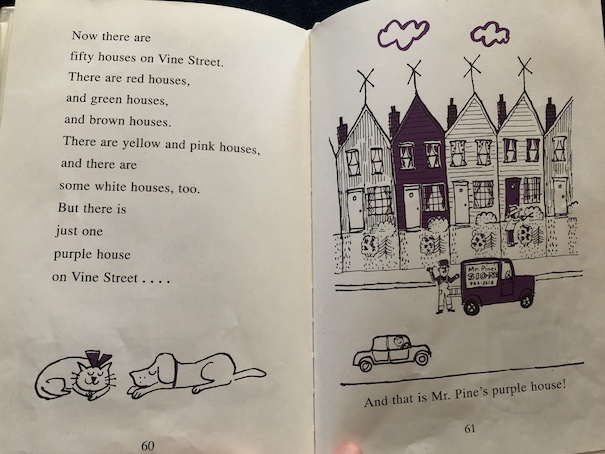
Mr. Pine lives in a little white house. All of the houses on Vine Street are white, and they look completely identical. Mr. Pine thinks that he’d like to do something that will make his house different from all the other little white houses.
His first idea is to plant a pine tree in his front yard. Since his name is Pine, everyone seeing it will think of him, and his house will be different from everyone else’s. The problem is that all of his neighbors like his pine tree and decide to plant their own trees. Soon, all of the houses look alike again with pine trees in the yards.

To make his house look different, Mr. Pine tries to plant a bush next to his tree, but everybody likes that idea, too. Soon, everybody has both a bush and a pine tree in their yard, and the houses look identical again.

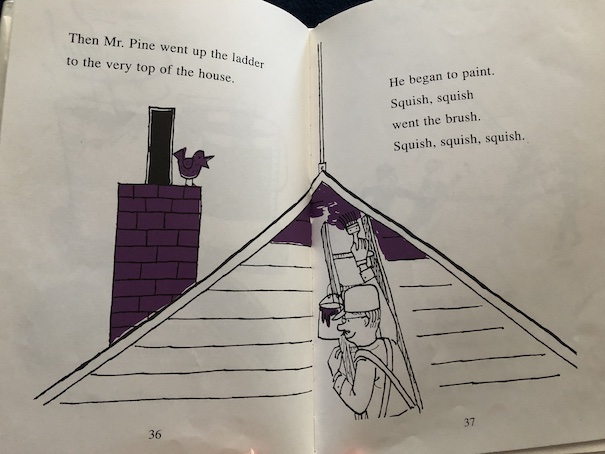
Mr. Pine tries to think of something that he can do with his house that his neighbors won’t imitate. He gets the idea of painting his house, but he can’t pick any obvious color that all of his neighbors will want, too. He decides to paint his house purple. Is this finally the idea that will make Mr. Pine’s house different from the rest?

This book is actually the second book in a series of picture books about Mr. Pine.

I often think of this book and The Big Orange Splot together because they’re both about people in a neighborhood of identical houses who make changes to distinguish themselves and their houses and end up changing the way their neighbors view their own homes. The difference between the books is that, in The Big Orange Splot, the neighbors were completely opposed to changes that made anyone’s house different until they began to see the opportunities for living out their own dreams through their homes. In this book, the neighbors immediately seize on everything that Mr. Pine does that’s different and start copying him. They think all of his changes are great and frustrate his efforts to be different by doing everything he does until they decide to all paint their houses different colors. Of course, Mr. Pine’s changes are all less outlandish than the ones from The Big Orange Splot, so they would be easier to accept.

I liked it that Mr. Pine’s neighbors all have colors for names: Mrs. Gray, Mr. Gold, Mrs. Green, Mrs. Brown, and Mrs. White, and all the colors they eventually pick for their houses are different from the colors in their names. Even though this book mentions a lot of colors, the only colors shown in the pictures are black, white, and purple. In the end, when the houses are all different, the differences in color are shown with lines providing shading rather than with actual colors. It still works to show that the houses are now different from each other.

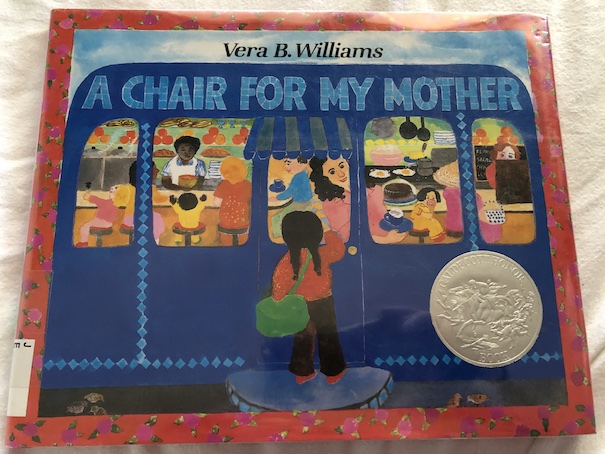
A Chair for My Mother

A girl explains how her family is saving up for a new chair after a fire destroyed all the furniture in their old home. The fire happened before the story really begins, but the girl explains how she and her mother returned from a shopping trip and discovered that their home was on fire.

The girl’s grandmother and the family cat escaped from the fire, but everything they had in the house burned.

The girl, her mother, and her grandmother all moved in with the girl’s aunt and uncle until they could move into a new apartment. However, they didn’t have any furniture in the apartment. Their relatives, friends, and neighbors all helped them by giving them food and pieces of furniture they didn’t need anymore.

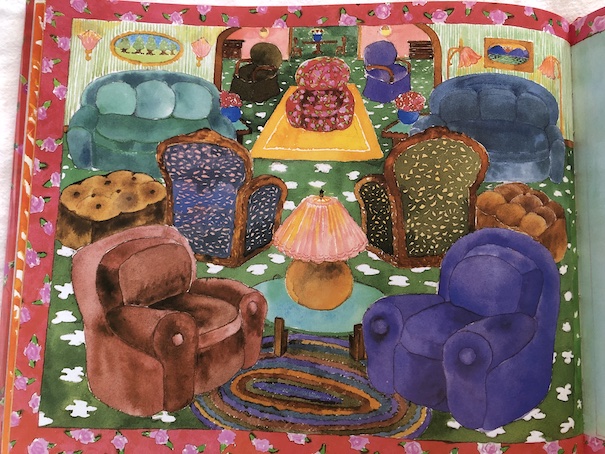
It was a big help, however, a year later, they still don’t have a sofa or comfortable armchairs. The girl’s mother works in a restaurant, and when she comes home, she’s very tired from being on her feet all day. She wishes that they had a comfortable armchair where she could rest after work.

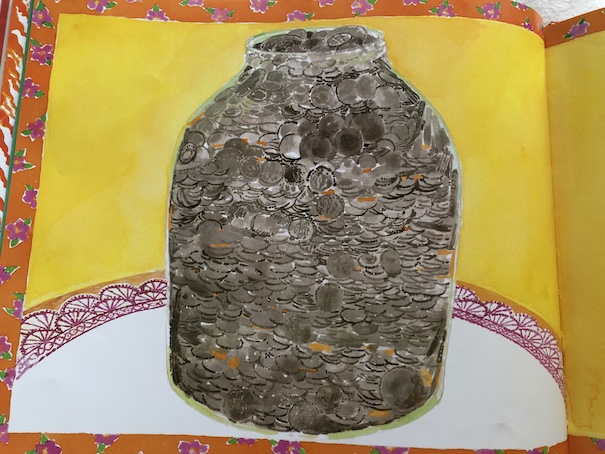
The mother starts saving part of her tips from the restaurant in a coin jar to save up for a new chair. Sometimes, the restaurant owner even pays the girl to do little chores, and she saves part of her money for the chair. Whenever the girl’s grandmother saves money on food she buys, she also puts the savings into the jar. They say that when the jar is full of coins, they will buy the new chair they want.

Eventually, the jar is completely full. They count the coins, roll them in coin wrappers, and take them to the bank to change them for ten-dollar bills. Then, they go shopping for a new chair! There are many chairs to choose from, but they know exactly what kind of chair they want.

The book is a Caldecott Honor Book. It’s available to borrow and read for free online through Internet Archive (multiple copies, including one in Spanish).

I remember this book from Reading Rainbow when I was a kid! The pictures are bright and colorful, and the story offers comfort and hope.

The people in the story have been through a tragedy where they lost almost everything they had, but the book shows how they recover. Although the fire was sad, the story starts after the fire happened, and the girl talks about the help they’ve received and what they’re doing to make their new home more comfortable. They’re over the initial shock of the fire and concentrating on improving their situation from there. This book felt both comforting and very real. I liked how it showed the family recovering from their ordeal through a combination of help from relatives and friends and their own efforts. Other people help them with some basic household items as they move into a new apartment, and they also save up their money for the chair they want to make their new place feel more like home.
Magdalena

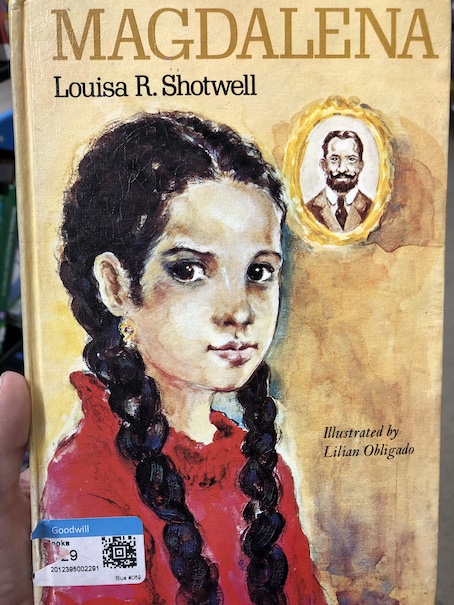
Magdalena is switching classes at school. She’s happy about it because she found her old class too chaotic. She thinks she will be happier in her new class. Her friend in her current class at school, a boy named Saul, tells her that she must be an IGC, an Intellectually Gifted Child, in order to get transferred to that class because that class only takes gifted children. However, she is told that she will also have to wait a little for them to give her a desk in the room. When months go by without her being told that there is a spot ready for her and she can make the switch, Saul thinks that they were probably lying to her about her being able to switch classes.
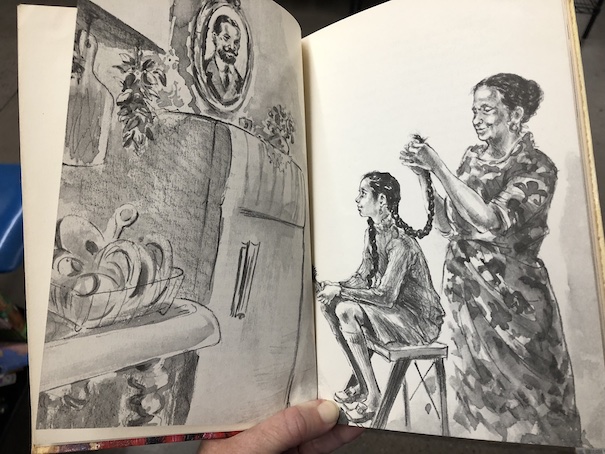
Finally, in January, she is able to switch to the new class, but right away, she runs into trouble with the class bullies. A boy named Andy and his friend start calling her “Miss Two-Ropes” because of her long braids, and the name sticks. Magdalena wishes that she didn’t have to wear her hair in braids, but her grandmother, Nani, insists on it. She loves Nani, who is from Puerto Rico and has looked after her for last two years, ever since her mother died when she was nine years old, but Nani has some old-fashioned ideas about how girls ought to be raised.

Magdalena’s father is a sailor, and he spends much of his time away at sea, so Magdalena and her grandmother are alone most of the time. Nani speaks Spanish to Magdalena at home because she thinks that’s proper for a Puerto Rican family like theirs, although Magdalena speaks English at school. She thinks that her grandmother probably knows more English than she pretends. Nani also keeps a portrait of Great-Grandfather Mendez, which she brought from Puerto Rico. Although he has been dead for years, the portrait always feels like a living person to Magdalena.

After some further teasing from the boys in her class, Magdalena decides to tell her grandmother that she doesn’t like her braids. Nani says that not unusual, that many children don’t like their braids, but they get over it. Magdalena doesn’t think she’s going to just get over it. Like a lot of kids, she would rather just look like everyone else so she won’t get teased, but Nani doesn’t approve of the short hairstyles that are popular among American girls at Magdalena’s school. She says that Magdalena’s braids are a mark of pride and a caring grandmother who brushes and braids her hair. She thinks the American girls wear their hair short because their mothers can’t be bothered to spend time on caring for long hair, and they don’t have grandmothers to nurture them. When Magdalena tells her that the boys at school are calling her names because of her braids, her grandmother decides that she should talk to the teacher about it. Magdalena thinks that having her grandmother talk to the teacher might be more embarrassing than having the boys call her names, so she persuades her grandmother to forget about it for now and let her handle it.

Then, Magdalena is called to the principal’s office at school. At first, Magdalena is upset because it sounds like she’s in trouble, and she can’t understand what she could have done to cause that. She is calmed a little when a black boy in the office, who is also waiting to talk to the principal, is nice to her. It turns out that Magdalena isn’t really in trouble. Instead, the principal wants to talk to her about one of her classmates, a girl named Daisy Gonzales, who is also transferring into her new class.

Madgalena is surprised because Daisy hasn’t struck her as a gifted child. Most of the other students call her “Spook” because she tends to lurk around the school and suddenly jump out at people to scare them, and she is known to frequently skip classes. The principal says that Daisy might be gifted, but it’s difficult to tell. The teachers think that she’s at least bright, but she’s an “under-achiever.” The principal explains that means that Daisy could do better at school than she does, but for some reason, she doesn’t seem motivated to do better. That’s why they’ve decided to transfer her to the class with the gifted students. They think that she isn’t being challenged enough in the class where she is. The teachers are also concerned that Daisy has no friends at school. They’ve noticed that the other girls at school seem to be afraid of Daisy, although they don’t seem to understand about Daisy’s “Spook” act. They do know that Daisy has behavioral problems and an unhappy home life. The reason why the principal is telling Magdalena about this is that she wants Magdalena to try to be Daisy’s friend when she transfers into her new class. The reason why she selected Magdalena to be Daisy’s new friend is because Daisy’s family is also Puerto Rican, like Magdalena’s family, so she thinks that the girls might understand each other better than their other classmates. The principal thinks that Daisy might settle down at school if she had a friend to help her feel more comfortable there. Magdalena isn’t comfortable with the idea of trying to be Spook’s friend because she also finds Daisy spooky, but the principal persuades her to try but not to let on that the principal asked her to do this.

Magdalena has no idea how to approach Daisy/Spook to be friends, since she’s not the easiest person to approach about anything. Then, Sue Ellen, the most popular girl in class tells Magdalena that she wants to be friends with her. She says that she’s been feeling empathy for her since the first day that she came to class and the boys started teasing her, and she felt it again when she got called to see the principal. She asks her what the principal wanted, and Magdalena explains that she asked her to do something, but it’s something really hard, and she isn’t supposed to talk about it. Sue Ellen offers to help her with whatever the principal’s task is. Magdalena thinks maybe making friends with Spook won’t be so bad if Sue Ellen helps, so she takes Sue Ellen into her confidence. Sue Ellen agrees with Magdalena that making friends with Spook would be hard because she’s so weird and spooky. Both girls admit that they’re a little afraid of her, but Sue Ellen agrees to try to be basically nice to Spook along with Magdalena and see what happens. Sue Ellen says that the principal ought to have more empathy for the students and see just how hard it would be to get along with someone like Spook.

Their first attempts at making friends with Spook are clumsy. Sue Ellen tries offering her advice, pointing out that she wore the wrong thing to the school assembly, but criticism and advice aren’t the best ice-breakers. Then, to Magdalena’s surprise, Spook approaches her in the school library, when she is trying to find a specific book for her grandmother. The school library doesn’t have the book she wants, but Spook says that she knows where to find it. However, she will only help Magdalena if she plays hooky and goes with her right now. Magdalena hesitates because she doesn’t really want to skip class and get in trouble, but Spook says that Magdalena will have to come with her because she’s “emotionally disturbed” and might do crazy things if she doesn’t get her way. Magdalena points out that school will end in only 20 minutes, and she asks Spook to wait for her. Spook makes her promise that she won’t change her mind and let her down in that time.

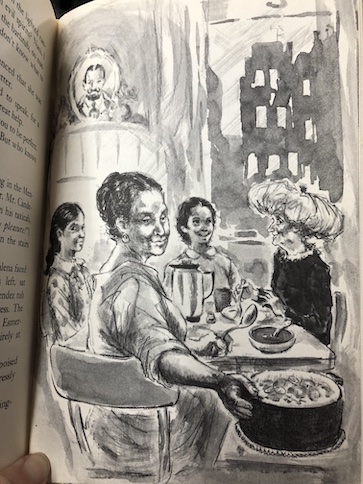
When Magdalena waits for Spook, she doesn’t show up at first, but Spook jumps out at her just when she’s giving up waiting. Spook says that she just wanted to see if Magdalena was serious about wanting to come with her. The place where Spook knows they can find the book turns out to be the Brooklyn Public Library. Along the way, Magdalena begins to learn more about Spook. The reason why she wasn’t dressed right this morning was that the sweater she was wearing was the only thing she had to wear that was clean. She skipped out during the school assembly to go home and see if her mother was back from the laundromat so she could put on something else. Also, Spook isn’t completely friendless. She is friends with a strange woman named Miss Lilley, who wears an unusual, large hat. When Daisy tells Miss Lilley that she got put into the class at school with the smart kids, Miss Lilley congratulates her and tells her that she knew she was smart. Daisy admits that she’s been trying not to let her teachers know that she’s smart because she knows that they will expect more of her and insist that she do all her homework. People don’t expect so much of kids who aren’t bright. There is method to Daisy’s madness. All of her weird and spooky acts are tools that she uses to get her, get out of things that she doesn’t want to do, cover up for problems that she has, and keep people she doesn’t like or doesn’t think would understand her at a distance.

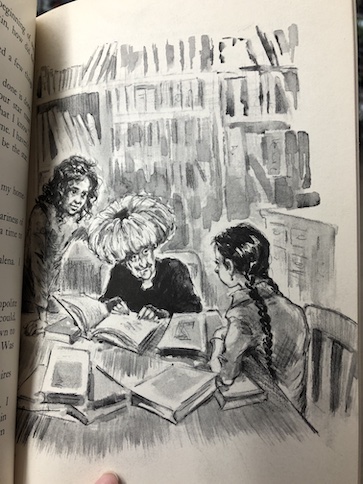
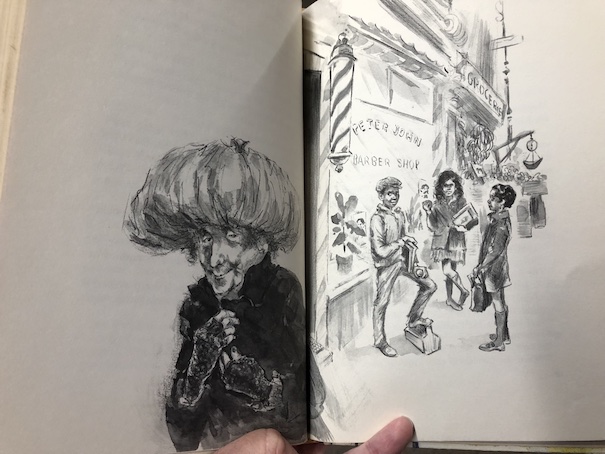
Daisy introduces Magdalena as one of the smart kids from her class, but Miss Lilley thinks that Magdalena’s manners aren’t very polite because she keeps staring. Magdalena has trouble getting over the large hat, which looks like a large pumpkin. Miss Lilley begins evaluating Magdalena’s appearance, and Magdalena comments about how she hates her braids, but her grandmother makes her wear them. Miss Lilley says that she understands that her grandmother likes the quaintness of the braids, but she knows how to deal with that. She also knows where to find a good barber. The black boy who was nice to Magdalena earlier, Samson Shivers, makes money after school by shining shoes outside the library, and when Miss Lilley asks him if he would be willing to lend them money for the haircut, he joins the others at the barber shop. Miss Lilley takes the kids to the barber shop, and Magdalena gets a haircut. Magdalena feels wonderfully free after he haircut, although she saves the braids as a souvenir and worries about what her grandmother will say when she gets home.

Nani is very upset when she sees Magdalena’s short hair and worries that Magdalena is rejecting her care for her and her Puerto Rican heritage. Magdalena says that’s not the case and explains about going to the library and meeting Miss Lilley. Magdalena’s grandmother thinks that she’s bewitched and says that she knows how to deal with that. She uses herbs on Magdalena to break the bewitchment.

Getting the haircut changes things for Magdalena. The boys stop teasing her, which is a relief. However, Sue Ellen is annoyed that Magdalena didn’t tell her that she was going to get her hair cut. Magdalena explains that it was a sudden decision and a possible bewitchment by Miss Lilley. Sue Ellen thinks that Spook is probably the one who bewitched Magdalena because she’s so spooky and that maybe Magdalena would rather be best friends with her. Magdalena says that’s not the case and that she doesn’t see why she can’t be friends with both girls. Sue Ellen still expects that Spook is going to do something to ruin the class, but Magdalena notices that Spook is becoming less spooky in their class. She stops skipping classes, does more of her homework, and cuts out some of her previous spooky behavior.

Samson, often called Sam, is a practical boy, and when Magdalena tells him how her grandmother thinks Miss Lilley is a witch and bewitched her, he says that she can’t be a witch. Sam sees her often because he shines shoes by the library, and he realizes that Miss Lilley is actually just a poor, old woman. She goes to the library all the time because she can’t afford proper heating for her apartment. She often has little to eat, and she partly survives off of candy that he gives her. Like Spook, she seems spooky because she looks odd and behaves oddly, but there are explanations for what she does that show that she’s actually unfortunate.

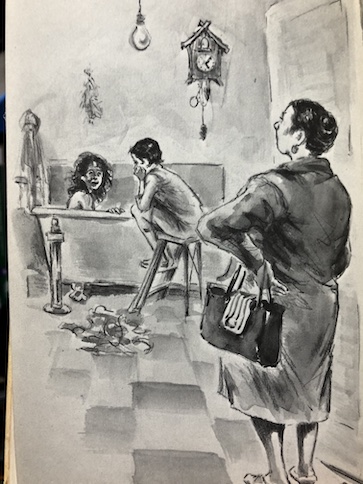
Magdalena’s grandmother meets Spook for the first time when Spook hangs out with Magdalena at her apartment after school. Nani isn’t home at the time, but the girls talk to each other about their lives and families. Magdalena gets to know more about Spook, and Spook admires the place where Magdalena lives. Spook’s family lives in a much poorer apartment, and it’s crowded with Spook’s younger siblings. Spook admires the nice bathtub that Magdalena and her grandmother have and says that she wishes they had one at her apartment. Part of the reason why she looks so strange is that she doesn’t get the opportunity to take baths often. Magdalena tells her that if she wants a bath, she can go ahead and take one. Nani arrives home before Spook is finished with her bath, but Nani stops her when she tries to get out and get her clothes. Nani can see how badly Spook needs some care, so she insists that she finish the bath, clean the tub, and let her shampoo her hair. When she’s done, Nani has Magdalena loan her some clean clothes, and the girls are amazed at the transformation.

After the bath incident, Spook avoids Magdalena for a while, and she can’t understand why, but it’s about Spook realizing what’s been lacking in her life and envying what Magdalena has: someone who really cares for her. She was so emotional when she looked at herself in the mirror that she spit at the image and then was embarrassed that she had done that. Nani surprisingly understands Spook’s behavior. She can see that Spook lacks impulse control and the ability to understand and manage her feelings. Nani comments that she’s angry with Spook’s mother because she can tell that the girl has been badly neglected. Having been a mother and grandmother herself, she knows exactly how to deal with this.

Meanwhile, Sam is correct about Miss Lilley. Miss Lilley is poor and not in very good health, but she also knows what Magdalena and Spook/Daisy need. She is eager to help the girls, but she also needs some help and attention herself. When Miss Lilley decides that it’s time to have a word with Nani about the needs of modern girls and her fears about her granddaughter becoming too American, a number of things get better.

The book is available to borrow and read for free online through Internet Archive.

The heart of this story is understanding and empathy. By the time it’s over, many of the characters come to a better understanding of each other and maybe themselves. Although Spook’s transformation is the most dramatic, the other characters are also changed after their experiences in the story.

Magdalena’s changes come with her admission to her grandmother that she really doesn’t like her braids and then with her decision to have her hair cut against her grandmothers wishes. She knew that her grandmother wouldn’t like it when she said that she didn’t want braids because her grandmother is a traditionalist, and she knew that Nani wouldn’t react well to the haircut. At first, it was easier for Magdalena to buy into the idea that Miss Lilley was a witch who bewitched her into doing it, but that’s not really the truth. It wasn’t even that Magdalena was getting her hair cut just because of the teasing. When Magdalena and Spook are talking about whether or not they truly understand the reasons why they do things, Magdalena acknowledges that she has reasons for the things she does, and the truth is that she got the haircut because she herself really hated wearing braids. If she had really loved her braids, she could have kept them in spite of the teasing, and she could have turned down the offer of a haircut, but she really wanted to change her hairstyle, and she just took advantage of the opportunity to do it.

Nani understands from the first time she meets Spook that she has not had nearly the level of care and attention that she has needed in life. Spook doesn’t even really understand all of the motivations she has for the things she does. Her behavior is odd partly because she acts on impulse, not fully thinking about the consequences or the affect her behavior has on others. She initially doesn’t have much self-awareness because she has not had caring adults in her life to teach her how to behave, how to understand her feelings, and how to control herself. Because she hasn’t really had any friends before, she hasn’t really had anyone to talk to about these things and help give her some perspective. When Spook and Magdalena talk about why she spit on the mirror, Spook says at first that she isn’t sure why she did it. As they continue to talk about reasons for doing things, though, Spook admits that she did it because, while she was stunned at how nice she looked, she quickly became upset because she didn’t think that nice look could last.

Nani is the nurturing type of person, and she quickly sees that Spook is in dire need of some nurturing and guidance. She also recognizes that Spook doesn’t have much confidence in herself. She is bright, but she has grown used to hiding it. She also thinks, because she doesn’t really understand her feelings or behavior, that is can never really control herself. She thinks that she will always be a “stinker” who does things that she shouldn’t and acts weird. Nani has a frank talk with her and tells her that she can be herself without being a “stinker”, and the first step is believing that she can. Even if she’s not in the habit of understanding and controlling herself, she can learn. People have different sides to their personalities and different ways of expressing themselves, and Spook can learn how to show the best sides of herself in the best possible ways.

Magdalena appreciates that Nani is understanding and helping Spook, but she also has a frank talk with her grandmother about why she doesn’t understand her own granddaughter as well. When Magdalena tries to tell her what she wants or doesn’t want, Nani contradicts her or ignores her feelings. Nani is understanding with Spook because she can tell that Spook is a disadvantaged child, but she doesn’t see her granddaughter the same way, so she doesn’t try to understand why Magdalena sometimes does things she doesn’t like. Nani admits that she wanted her granddaughter to be “perfect”, but maybe she doesn’t really know what “perfect” actually is. She wants the traditional ways for her granddaughter because she really thinks that’s what’s best, but even grandmother doesn’t always know what’s best.

Miss Lilley is concerned about the girls and offers them attention and support. When she goes to see Nani and open her eyes to her grandmother’s needs and the ways of modern girls, she collapses because of her bad health. Fortunately, Nani is a nurturing person, and she nurtures Miss Lilley, making sure that she gets the treatment she needs and even looking after her when she gets out of the hospital. Miss Lilley’s health improves, and the two of them become friends. Although they are both older ladies, they each admit that they have things to learn in their lives, and they can learn from each other. Nani helps her to make changes to her living arrangements so she will be healthier and more comfortable, and Miss Lilley helps her understand what modern American life has to offer for girls like Magdalena.

Samson is always a very understanding character because he is genuinely interested in people, and he meets many different types of people through his shoe-shining business. Although Sue Ellen is the first person who brings up the topic of empathy, she is really the one who understands it the least. I think her relatively narrow view of empathy is because of her relatively narrow life experiences. She feels some empathy for Magdalena because she sees Magdalena experiencing something she understands, but she doesn’t seem to know what to do when she encounters something she doesn’t understand. Admittedly, Spook’s spooky act is off-putting, partly by design and partly because Spook has issues she herself doesn’t know how to handle. However, because Sue Ellen only wants to stick to the familiar and understandable, she doesn’t notice when Spook begins to change and doesn’t see how some support from her could influence her for the better. Sue Ellen’s attempts at friendliness and helpfulness often involve offering some kind of criticism, like pointing out that Spook isn’t dressed right. Magdalena can tell that Sue Ellen is trying to be helpful, but she’s also kind of snippy and smug in the way she does it, and that gets on Magdalena’s nerves, too. Sue Ellen kind of fades out of the story toward the end, so we don’t know if she continues being friendly with Magdalena or not or if she ever recognizes Spook’s transformation.

There is also a subplot that I haven’t mentioned about the literary magazine that the girls’ class starts. Their teacher has some thought-provoking descriptions about what good writing is and does, and the girls’ choices of what to write about are based on their experiences and the changes in their lives.

The book doesn’t shy away from the harsh realities of life. Magdalena’s mother is dead, and her father is away most of the time, so she is being raised by her grandmother. Her father never even makes an appearance in the story. Miss Lilley is a poor and lonely old woman who needs help and friends. It is acknowledged that Spook is a neglected child, and she even tells Magdalena that her favorite brother died at age three because he was asthmatic, and they were living in bad conditions. We don’t know exactly how her family came to be living in such bad conditions, but Spook says that, if she wrote a story about her family, the teacher would think she had a filthy mind.

Since the story is about understanding other people, one could consider whether we might view Spook’s neglectful mother more sympathetically if we knew her past and what led her to the situation they’re now in, but we do not see Spook’s mother at any point in the story. I think it’s also important to note that understanding does not equal approval. You can know a person’s history and reasons for doing things and still not agree with them. Maybe Spook’s mother is another unfortunate soul who needs some help, but if she is, she doesn’t seem to be looking for that help. Her vulnerable children are suffering for it, and one has died. Empathy doesn’t mean saying that things are okay when they really aren’t, and this mother’s neglect of her children is not okay.

When Aunt Lena Did the Rhumba

Sophie’s Aunt Lena loves music, dancing, movies, and theater, and she especially loves Broadway musicals. She goes to a musical matinee every Wednesday. After seeing a musical, she comes home, singing and dancing and acting out parts from the play she’s just seen.

One particular Wednesday, when she’s acting out a particularly dramatic dance in the kitchen, she accidentally slips and sprains her ankle. She has to stay home and rest until her ankle gets better, which means that she won’t be able to go to next Wednesday’s matinee.

Aunt Lena is so sad about missing the musicals she loves that Sophie gets an idea to cheer her up. Sophie recruits other members of her family to put on their own musical to entertain Aunt Lena.

Not everyone is enthusiastic about the idea at first, but when Sophie gets her grandmother to help her put together a costume fit for a Broadway musical and choose some music, they begin drawing other family members in.

Aunt Lena loves their performance, and when she’s better, she takes Sophie to a matinee so she can see a real Broadway performance, too!

This book is available to borrow and read for free online through Internet Archive (multiple copies). It was also a Reading Rainbow book, and the episode of Reading Rainbow is also available to watch online through Internet Archive.

I didn’t see the original episode of Reading Rainbow that included this book when I was a kid because this book was published after I was too old for that. However, I always liked Reading Rainbow when I was a kid, and later, after I started this blog, I decided to go back and check out some of the books covered by Reading Rainbow after I stopped watching it. If you’re not familiar with Reading Rainbow, it was a children’s television program on public television in the US that encouraged children to read by discussing books and showing children things that were related to the books they were reading. For example, if they were reading books related to animals in an episode, the host, Levar Burton, might take a trip to a zoo and talk to zookeepers about animals in the zoo.

The themes of this particular story and the Reading Rainbow episode are music, dancing, and theater. In the episode, they show a boys’ choir and dancing class and talk about how performing helps the boys and young men develop confidence and maturity. There’s also a comedian who specializes in physical comedy, who talks about how he does his stunts, and an actress who plays one of the cats in the famous Broadway musical Cats.

I love how the aunt in the book shares her love of dancing and theater with her niece. The two of them have similar personalities and interests, so when her aunt is injured, her niece knows how to cheer her up. The ending of the story implies that the niece will now be going to performances with her aunt, or at least, will sometimes go with her. I also liked how the rest of the family participated in the girl’s plans when they saw what she wanted to do, even if they weren’t as enthusiastic about the idea themselves at first. Enthusiasm can be contagious, and I do think that adults sharing their interests with kids can spark lifelong interests in the next generation.

I also noticed that this seems to be an unconventional family, although the family’s living arrangements aren’t the focus of the story. The girl’s parents are never mentioned. She seems to live with just her grandmother, her aunt, and a couple of uncles, and there is no explanation why because it’s not directly important to the story. In any case, it seems to be a happy, close-knit family, with family members caring for each other and supporting each other’s interests.

The pictures in the book are bright and colorful, fitting with the energy, enthusiasm, and theatricality of the story.

Lowly Worm Sniffy Book

Sniffy books or scratch-and-sniff books were a new development during the 1970s, and they remained popular through the mid-1980s, along with scratch-and-sniff stickers. This particular book features characters from Richard Scarry‘s Busytown series, especially Lowly Worm. The first part of the book has Lowly and his friend Huckle Cat looking at a sniffy book and teaching readers how to use the scratch-and-sniff parts of the picture.

The rest of the book takes readers through the four seasons: spring, summer, fall, and winter. In each season, there are different objects and foods associated with the season for readers to scratch and sniff. In the spring, the characters smell violets and bananas that they eat at the circus.

During the summer, there are lemons for making lemonade and chocolate ice cream sticks that they eat at the beach.

During the fall, there are apples and pumpkin pie at Thanksgiving.

The winter parts focus on Christmas, with pine-scented Christmas trees and gingerbread pigs.

Sniffy books and stickers were common features of my early childhood in the 1980s. I think they still exist, although I don’t know if they’re as popular in the 21st century as they were back when they were relatively new developments. This particular sniffy book was a favorite of mine and my brother when we were little kids.

One of the interesting things about finding some of these older sniffy books decades later is seeing which of the scratch-and-sniff patches have held up over the years. They do wear out over the time, especially the ones that have been scratched more than others, meaning that favorite scent patches will wear out faster. Milder scents are also harder to detect years later than the ones that were always strong. In our old copy of this book, I can’t smell the lemon, chocolate ice cream, pumpkin pie, or gingerbread any more, but the violet, banana, apple, and pine are still fine. I think those scents were always the strongest.