 Mystery of the Secret Message by Elizabeth Honness, 1961.
Penny lives with her aunt and uncle because her mother is dead and her father travels on business much of the time, dealing in Asian art. Thanks to his travels, Penny and her aunt and uncle have quite a collection of Asian art themselves. However, Penny has just been told that her father’s airplane crashed in the Pacific Ocean. No survivors have been found, although Penny still has hope that perhaps her father survived and might yet be found.
At the same time, Penny and her aunt and uncle are moving into a house from the apartment where they used to live. Penny is happy about the move because she knows that she won’t have to worry as much about being quiet and not disturbing the neighbors, like she had to do in their apartment. This means that Penny can bring her friends over to the house to play and have parties. Also, their new house has a very special feature: its own private elevator.
Penny loves the new house and soon begins building a tree house with the help of Pete, a boy who lives nearby. She tells Pete about her father and her hopes that he might still be alive.
However, events take a disturbing turn when Penny receives a package from Japan containing a beautiful wall scroll. The package appears to have been sent by her father, who meant it as a present for her new room in her new house. Was the package sent before his death, or did he somehow survive the crash?
There is also something odd about Penny’s new neighbors. Penny’s new house is actually half of a duplex, and the new neighbors, the Carruthers, have also recently moved in after renting the other half. When Penny accidentally gets stuck in the elevator and hears voices coming through the wall, she starts to suspect that her neighbors might not be what they seem to be. They show an unusual interest in her family’s collection of Asian art, asking to see pieces and borrow pieces for an exhibition that Mr. Carruthers is holding at his gallery. One of Penny’s friends even catches Mrs. Carruthers sneaking around, looking at things uninvited.
When Penny and her friends have a sleepover on an evening when her aunt and uncle are out, someone sneaks into the house, leaving muddy footprints on the floor. Penny isn’t sure that her aunt and uncle will believe her because they seem to like the Carruthers, so at Pete’s suggestion, she continues to spy on them, using the elevator to listen in on their conversations through the walls.
When her uncle catches her one day, using the elevator without permission (something she is not supposed to do), she finally explains her suspicions and what’s she’s heard the Carruthers say. Together, Penny and her uncle discover a hidden secret about the wall scroll Penny recently received, which points to a number of secrets that Penny’s father kept from her and the rest of his family for years. A stranger from the government helps Penny to fill in some of the blanks, but he has a favor to ask in return that requires Penny to take a big risk.


My Reaction and Spoilers
Although this book is much older than I am, it was a favorite of mine when I was a kid, yet another of my used book sale treasures! I actually got rid of my first copy years ago, when I was cleaning some things out, but I missed it, so I got another one. It’s actually a collector’s item these days.
I always liked the feature of the elevator in the story and how Penny uses it to find the right spot to hear what her neighbors are saying through the wall. I love intrigue, and as a kid, I liked the idea both having a house with an elevator and of overhearing clandestine conversations that reveal sinister secrets. There are points in the story where the two-faced Carruthers think that they have the upper hand, and Penny has to be careful not to let on just how much she knows.
As I explained, the neighbors are not what they seem to be, and Penny’s father was involved in things that his family knew nothing about. Since it’s not easy to get hold of this book right now, I’ll include a couple of spoilers. Penny’s father was acting as a spy for the US government, using his profession as an art dealer to travel to locations he needed to go and to smuggle information back to the US. He is apparently dead, killed in the plane crash, although there are hints that the crash wasn’t an accident, that it may have been intended to kill him. However, before his death, he managed to smuggle his last important information to Penny in the wall scroll that he sent her. When Penny manages to convince her uncle that something isn’t right about the Carruthers, he begins making inquiries and learns the truth about Penny’s father. A government agent speaks to the family and arranges a plan to fool the Carruthers into thinking that they’ve found what they were looking for, but the plan requires Penny to spend an evening in the house alone with them.
 Fudge-A-Mania by Judy Blume, 1990.
 Mystery on Taboga Island by Patricia Maloney Markun, 1995.
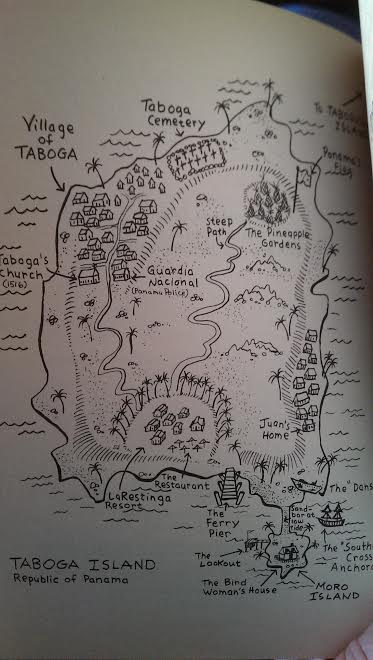 They also introduce Amy to Madame Odelle, who people call The Bird Woman because of all the birds she keeps around her house. She is a widow who lives alone and hardly ever sees people, but she invites the children in and when she learns that Amy is interested in art, she shows them a special painting that her family has had for generations. Madame says that her grandfather bought the painting years ago from a traveling Frenchman who was in need of money. Amy thinks that it looks like one of Paul Gauguin’s paintings, and she knows that some of his work is unaccounted for. However, the initials on the painting are PGO. What could the ‘O’ stand for?
 In the Kaiser’s Clutch by Kathleen Karr, 1995.
 The General Store by Bobbie Kalman, 1997.
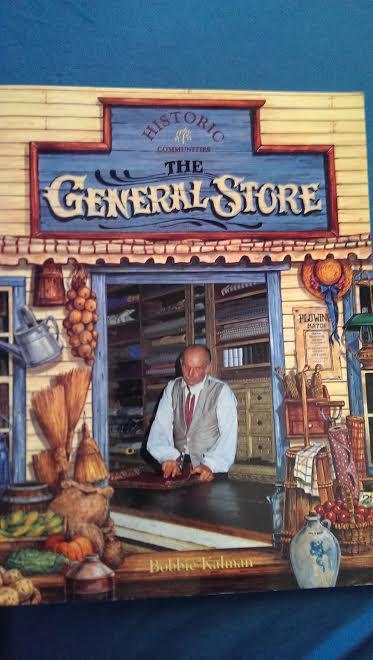
 Store owners also had to decide how much they should charge for each item or how much they would be willing to take in trade. Farmers often bartered for goods with the produce from their farms, and it was common for store owners to use a form of credit to keep track of what their customers owed and what they owed to their customers. Farmers would typically sell their goods at harvest time, and the store owners would give them a certain amount of credit at their store, based on what they thought the farmers’ produce was worth. Then, the farmers could use the credit on their account at the store until the next harvest and selling time. If a farmer ran out of credit before the next harvest, the store owner would usually extend credit at the store to the farmer to allow him and his family to buy some necessities, knowing that the farmer could make up for it when he came to sell his next batch of produce.
 Another odd kind of code that the book mentions was the kind that people would use on mailed letters. Instead of the sender paying the postage, as they do now, people receiving letters were supposed to pay for them when they picked them up from the general store. If a receiver returned a letter unopened, they wouldn’t need to pay anything, so some people would try to cheat the system by writing a message in code on the outside of the envelope so the receiver would know the most important part of what the writer wanted to tell them for free.
 Colonial Crafts by Bobbie Kalman, 1992.


 Going to School in 1776 by John J. Loeper, 1973.
 These explanations are told in story form, rather than simply explaining listing the ways children could live, learn, and go to school, trying to help readers see their lives through the eyes of the children themselves. The children’s lives are affected by the war around them. As the book says, many town schools in New England were closed during the war, so the students would attend “dame schools” instead. A dame school was a series of lessons taught in private homes by older women in the community. In other places, such as cities like Philadelphia, official schools were still open. Discipline was often strict, and school hours could be much longer than those in modern schools. Sometimes, children would argue with each other over their parents’ positions on the war.
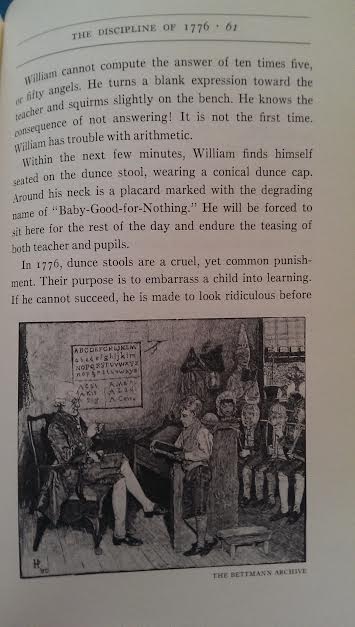 There were different standards for what girls and boys were expected to learn because their learning was guided by what they were each expected to do with their adult lives. A typical school might teach boys subjects like, “writing, arithmetick [sic], accounting, navigation, algebra, and Latine.” Generally, “reading, writing, arithmetic, and religion” were common elementary school subjects. Latin lessons and other advanced subjects were typically for boys who planned to become lawyers or clergymen. Girls were likely to receive little formal education beyond reading and writing, and black people were less likely to receive even that.
 Trapped in Time by Ruth Chew, 1986.
 Franz had only joined the army in the first place because his parents were dead, and he didn’t know what else to do. Now, he has to find a new place to live, somewhere where there won’t be other Hessians who would recognize him as a deserter. Andy and Nathan also have problems because they’ve now realized what time they’re in, and they don’t know how to get home. The watch no longer seems to work.
 The Keeping Room by Anna Myers, 1997.
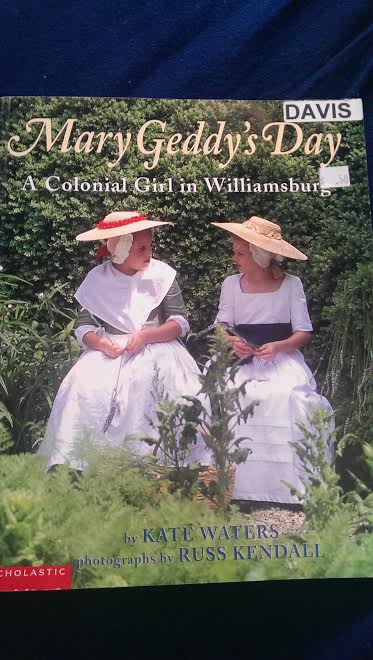 Mary Geddy’s Day: A Colonial Girl in Williamsburg by Kate Waters, 1999.


 Jestress's Forgotten Books and Stories