Felicity Learns a Lesson by Valerie Tripp, 1991.
 This is the second book in the Felicity, An American Girl series.
So far, Felicity has mainly been taught at home, learning to read and write and take care of basic household tasks, like cooking and sewing, from her mother. However, Felicity’s parents have decided that it’s time for her to begin furthering her education. Felicity fantasizes about studying Greek, Latin, and geography, like boys do in college, but girls of her time do not receive that kind of education. Some girls take on apprenticeships, learning professions such as seamstress, which Felicity thinks might be exciting, but her father is a wealthy merchant, which means that Felicity will be educated as a gentlewoman, not as a girl preparing herself for a trade. A gentlewoman’s education involves lessons in penmanship, fine stitchery, dancing, manners, and hostess skills. Felicity doesn’t find that prospect as exciting.
Felicity starts taking lessons from Miss Manderly, a respected gentlewoman, in manners and the practical arts that girls from well-off families of her era were expected to know. Two other girls, a pair of sisters who have recently arrived from England, are also taking lessons from Miss Manderly, and at first, Felicity worries that they will know more than she does. However, they are also young and have lessons of their own to learn. The younger of the sisters, Elizabeth, becomes Felicity’s best friend. However, Annabelle, the older girl, is disapproving. She misses her old life in England and doesn’t think that anything in the colonies is good.
 Then, Felicity’s father declares that because of the tax on tea, he will no longer carry it in his shop. It leaves Felicity feeling conflicted about Miss Manderly’s lessons, which include the proper way to serve tea. She has started enjoying the lessons and doesn’t want to lose Elizabeth’s friendship, but she wants to support her father, too. Then, Annabelle criticizes Felicity for what her father said at one of the lessons, prompting Felicity to storm out angrily. She is doubly angry and hurt that Elizabeth didn’t try to defend her, making her doubt Elizabeth’s friendship.
At first, Felicity thinks that there is no way she can return to the lessons, but her mother convinces her that if there’s something that she really cares about (the lessons, Elizabeth’s friendship, supporting her father, etc.) she will find a way to work through the conflict rather than give up on it. She also points out that some people aren’t as brave as others and find it more difficult to speak their minds and that Felicity should give Elizabeth another chance at friendship. In the end, Felicity works out a compromise for her lessons using what Miss Manderly has already taught her, and Elizabeth finally finds the courage to tell Annabelle how she really feels about her behavior and the way she treats both herself and Felicity.
Each of the girls in the American Girls stories has her own personality, including strengths and weaknesses. Felicity is a spirited girl, but at first, she has a tendency to be too impatient and impulsive. Part of what she learns is the need take responsibility for her choices and to think things through before she acts. Elizabeth, who is shy and easily intimidated by her older sister, learns that nothing will improve until she makes her true feelings known and that she has as much right as anyone else to be treated with respect. Annabelle is a rather self-centered individual and is genuinely surprised when Elizabeth finally stands up to her. In some ways, Annabelle is unfortunate because she does not find a friend at Miss Manderly’s like her sister does, but readers will recognize that Annabelle’s lack of friends is partly her own fault because she is deliberately antagonistic and does not try to earn Felicity’s friendship.
In the back of the book, there is a section that explains more about how children were educated in the American colonies around the time of the Revolutionary War. Other good books on this topic are Going to School in 1776 and Colonial Crafts.
This book is currently available online through Internet Archive.



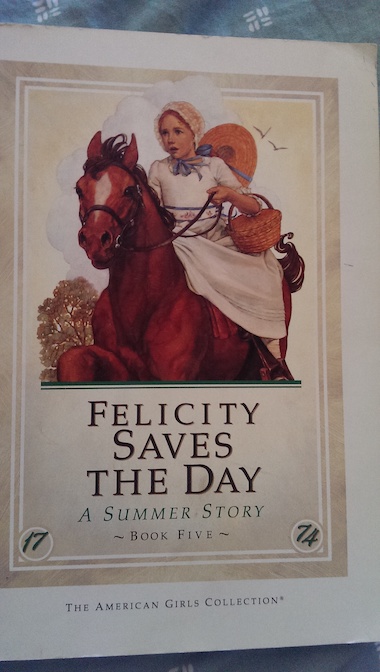
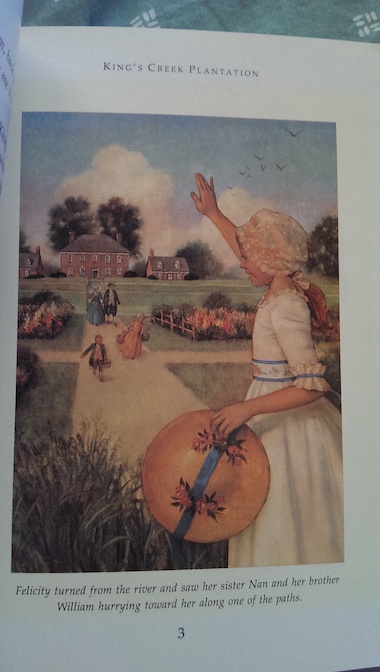 Felicity’s grandfather is a wealthy man who owns the Kings Cross Plantation. Every summer, Felicity and her family go to visit him there, and Felicity loves it. Her grandfather teaches her a lot of things, like which plants can be used for food and medicine, and takes her for horse rides around his estate.
 Ben tells Felicity that he ran away from his apprenticeship to join the revolutionary army. He wants badly to fight for the colonies’ freedom from England, but he had a bad fall while traveling and hurt his leg. Felicity tries to convince Ben to let her get help for him and to return to her father to finish his apprenticeship, but Ben doesn’t want Felicity’s grandfather to find out that he’s there or why he ran away because he knows that he disapproves of the revolutionaries. Because Ben kept her secret when she used to sneak out to see Penny, Felicity reluctantly agrees to keep Ben’s presence a secret for awhile, sneaking him some food and supplies. She tells Ben that, while she thinks that standing up for what he believes is good, he’s going about it in the wrong way because breaking his apprenticeship was dishonest.


 This is the first book in the
  Every morning for about a month, Felicity sneaks out of the house early, dressed in a pair of breeches that she borrowed from Ben without his permission. She goes to visit Penny and gradually gains her trust. When Penny finally allows her to ride her, Felicity thinks that she has won ownership of her, but Jiggy Nye accuses her of theft and takes back the horse. He denies that he ever promised to give her to anyone who could ride her, although Felicity’s younger siblings agree that they heard him say so.





 Cranberry Autumn by Wende and Harry Devlin, 1993.
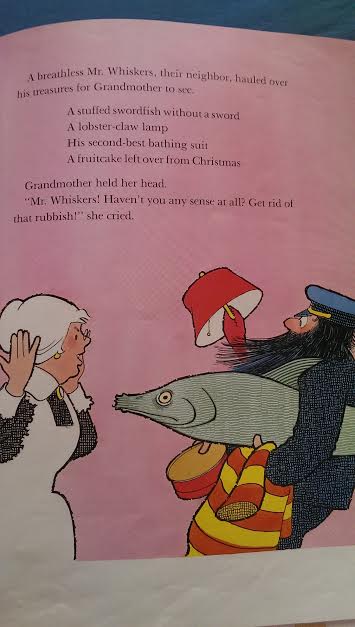 School is about to start, and Maggie and her grandmother realize that they’re short of money. Maggie needs new school clothes, and her grandmother needs a new coat. They know that some of their neighbors could also use some more money, so Grandmother suggests that they hold a sale. Some of them have some antiques and other interesting old items that they could sell.

 The Secret Life of the Underwear Champ by Betty Miles, 1981.
 Now, Larry is wondering what he’s gotten himself into. He worries about his filming schedule conflicting with baseball practice and makes up excuses about needing to visit the dentist when he has to film a commercial. Money or no money, Larry just wishes that his life would return to normal!
 The Best School Year Every by Barbara Robinson, 1994.
