Kiki’s Delivery Service

More Americans would probably recognize the title as the title of a Studio Ghibli animated film for children than as a book title, but the book came before the movie, and it is actually the first in a series, which continues the story about Kiki’s life and adventures, although I don’t think the later books in the series have been translated into English (at least, I haven’t found them in English). The original Japanese version of this book was written in 1985, and I read the English translation from 2003.

Kiki is a young witch, and in keeping with the traditions of young witches, she is expected to leave home at age 13 and live for a year in a city with no other witches.  It will be a test of her developing skills and a coming-of-age experience, helping her to recognize her talents and find her place in the world.

When Kiki sets out for her journey with her cat, Jiji, she doesn’t know exactly where she is going to go or what she will find when she gets there. Some young witches know early on what their talents are and how they plan to support themselves during their year away from home, but Kiki is less sure (like so many of us who “don’t know what we want to be when we grow up”).  The term “witch” just refers to a person’s ability to do magic.  It’s not a job title by itself, and witches are expected to develop a specialization, such as brewing potions or telling the future. Kiki’s mother has tried to teach Kiki her trade, growing herbs and making medicines from them, but Kiki hasn’t had much patience with it.  The only major ability Kiki has is flying, which is something that witches are expected to do anyway.  Still, she has an adventurous spirit and is eager to set out and see what life has to offer.
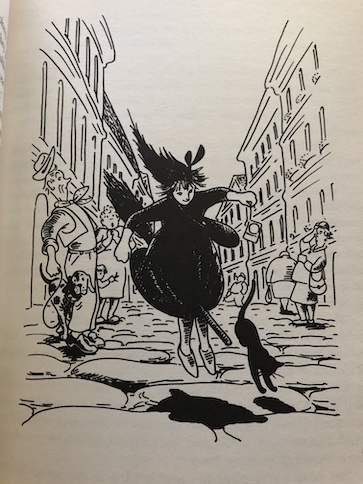
Once Kiki locates a city with no other witches, she has to find a place to stay and a job to earn money. She finds a city by the sea, which seems exciting to her.  As she explores the city, she meets Osono, a woman who owns a bakery with her husband. When she helps deliver a baby’s pacifier to a bakery customer who left it behind, flying to the customer’s house on her on her broom, Osono offers to let her stay in a small apartment attached to the bakery. Kiki feels a little overwhelmed by the big city at first, but she realizes that, in a large city like this, there are probably a lot of people who have small delivery errands that wouldn’t be covered by ordinary parcel delivery services.

Kiki opens a delivery service, delivering small packages and running errands for people around the city.  At first, business is slow, and some people are afraid of her as a witch. During a trip to the beach, a curious boy borrows her broom and breaks it. Kiki is distressed, and the boy apologizes. The boy’s name is Tombo, and he is part of a club of other kids who are interested in flying. He has made a study of flight and had hoped to learn more about how witches fly by trying Kiki’s broom, but Kiki expains that only witches can fly with brooms and that the ability is inherited. Kiki has to make a new broom, and it takes her a while to break it in, but it actually works to her benefit. People who were initially afraid of her for being a witch become less afraid of her and more concerned about her when they see that she is just a young girl, clumsily trying to master a new broom. Kiki gets some additional support and business from people who feel moved to help a struggling young witch. Tombo also makes it up to her and becomes a friend when he helps Kiki to figure out a way to carry a difficult object on her broom.
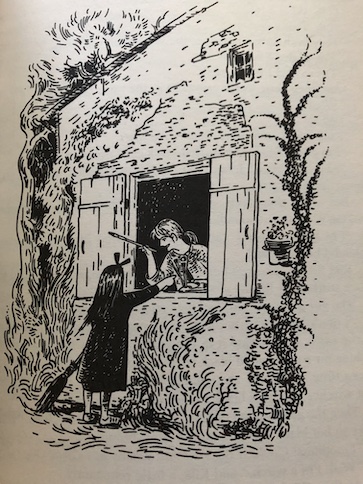
During her very first delivery assignment, Kiki was supposed to carry a toy cat to a boy who was having a birthday, but she accidentally dropped it. When she searched for it, she met a young artist, who was enchanted by Kiki as a young witch and painted a portrait of Kiki with Jiji. When the artist asks Kiki to take the painting to the place where it will be on exhibit, Kiki isn’t sure how to carry it at first. It’s kind of a bulky object to carry on her broom. Remembering that Tombo has made a study of flying, she asks him for help. Tombo ties balloons onto the painting to make it float and tells Kiki that she can now pull the painting along on a leash, as if it were a dog. The idea works, and when people see Kiki pulling a painting of herself along through the sky with balloons tied to it, it acts as advertising, bringing her more business.

Some of Kiki’s new jobs are difficult or awkward, and some customers are more difficult to deal with than others. There are times when Kiki finds herself missing home or trying to remember how her mother did certain things, wishing that she had been better at watching and remembering what her mother did. Still, Kiki learns many new things from her experiences and acquires new skills.

Kiki’s experiences also help her to realize a few things about herself and life in general. Like other girls, Kiki worries about how boys see her. When Tombo makes a comment that he can talk to her when he can’t talk to other girls, Kiki worries that he doesn’t see her as a girl at all. A job delivering a surprise present to a boy from another girl her age helps Kiki to realize that everyone is a little shy and uncertain about romance and even people who act confident feel a little awkward about first relationships.

As her first year away from home comes to an end, Kiki wonders how much she’s really changed over the year. Although she has successfully started a new business and done well living away from her parents, she still experiences a sense of imposter syndrome, where she doesn’t quite feel like she’s really done all of the things she’s done. Her first visit home to her parents reminds her that her new town has really become her new home. She has become a part of the place, and she feels her new business and friends calling her to return.

In 2018, the author, Eiko Kadono, was awarded the Hans Christian Anderson for her contributions to children’s literature.

My Reaction

I think of this story as one of those stories that takes on more meaning the older you get.  Young adults can recognize Kiki’s struggles to make her own way in the world and establish herself in life as ones that we all go through when we start our working lives and gain our first independence.  It can be a scary, uncertain time, when we often wonder if we really know what we’re doing. (Life Spoiler: No, we don’t, but no one else completely does, either, so it’s normal and manageable. Some things just have to be lived to be really understood, and that’s kind of the point of Kiki spending a year on her own, to see something of life and how she can fit into it.) However, it’s also a time of fun and adventure as we try new things, build new confidence, make new friends, and learn new things about ourselves. Like so many of us, Kiki doesn’t always do everything right, but she learns a lot and endears herself to the people of her new town.

The Miyazaki movie captures the feel of the story well, although the plot isn’t completely the same. There are incidents and characters that are different between the book and the movie. Tombo appears in both the book and the movie, but there are other characters who appear in the book who weren’t in the movie. In the book, Kiki makes friends with a girl named Mimi, who is her age, and the two of them discuss crushes on boys and how each of them was a little envious of the other because, while each of them is struggling with their own uncertainties in life, they each thought that the other acted more confident. The movie version developed the character of the young artist more. Kiki also didn’t lose her powers during the book, although that might be a part of one of the other books in the series, since I haven’t had the chance to read the others yet.

The Secret Language

The Secret Language by Ursula Nordstrom, 1960.

“Sooner or later everyone has to go away from home for the first time. Sometimes it happens when a person is young. Sometimes it happens when a person is old. But sooner or later it does happen to everyone. It happened to Victoria North when she was eight.”

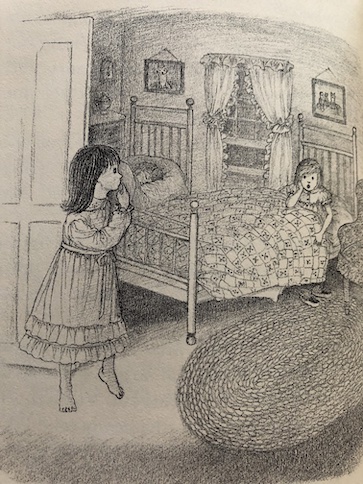
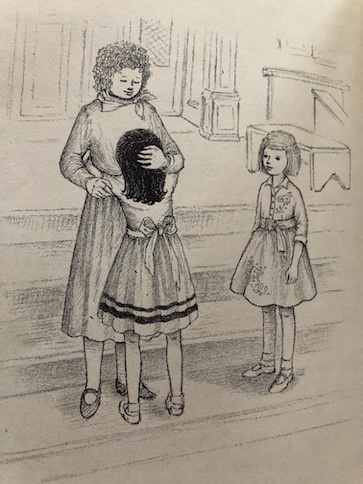
Victoria North is attending boarding school for the first time at the Coburn Home School. Victoria is only eight years old, and this is her first time being away from home at all, so she is very nervous and shy. When she arrives at the school, she is met by an older girl named Ann, who shows her where her room is in the dormitory. Ann shares a room with Victoria and is supposed to show her around and tell her the rules, but she doesn’t really explain much. Victoria still feels lost and has trouble even finding the table where she is supposed to sit at dinner.

At dinner, one of the other girls, Martha Sherman, starts uses funny words, and she tells the other girls that they are part of a secret language that she made up. However, she refuses to tell anybody what they mean. Martha is moody and rude to the other girls at dinner, so the housemother sends her to her room before the meal is over.

Overcome with homesickness, Victoria cries at dinner and during the songs they have to sing afterward. No one has any patience with poor Victoria. Ann tells her that she’s being a crybaby. Other girls laugh at her when they see that she’s been crying. Victoria doesn’t know how she’ll be able to handle boarding school if every day is going to be like this!

The other girls in the dormitory say that Miss Mossman, the housemother, is strict. She blows her whistle at them and makes them line up for inspection every morning. Miss Blanchard, another teacher, is nicer, and she tries to reassure Victoria that things will get better when she gets to know the other students and makes some friends. However, nobody seems to want to be friends with Victoria. Nobody except Martha.

Martha is the only girl who seems interested in talking to Victoria. Martha doesn’t like Coburn Home School, either. More than anything, Martha wants to live at home and just go to an ordinary day school instead of being boarder. Victoria knows just how Martha feels! The other girls are surprised at how well Martha seems to get along with Victoria because Martha doesn’t usually want to be friendly with anyone.

The two of them start to talk about their homes and families. Martha’s father is an importer. She keeps saying that her parents are going to let her come home from boarding school and just go to day school, but it quickly becomes apparent that it isn’t likely. Victoria only has her mother, who works and sometimes needs to travel for work. She doesn’t even remember much about her father. Martha likes math, a subject which Victoria finds hard, but Martha says that she doesn’t reading, which is Victoria’s favorite subject. The two complement each other well.

Although Martha misses home, like Victoria does, and doesn’t really want to be a boarder, she is more experienced about boarding school life, and she helps Victoria to adjust to the school. Martha starts teaching Victoria about pieces of boarding school lore, like school rhymes and the traditions made up and passed down by students, and she also begins teaching her the secret language that she made up. There are only three words in Martha’s secret language, but Martha explains to Victoria what they mean, and the girls decide that they’ll make up more together. Martha becomes Victoria’s best friend all through the rest of her first year at boarding school.

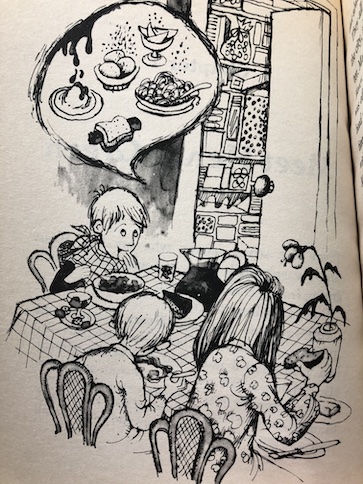
Being friends with Martha makes boarding school feel better to Victoria. Martha still constantly talks about hating boarding school and how she definitely won’t come back next year, although Victoria realizes that’s just a wish of hers. Victoria also comes to realize that many other kids at the boarding school feel the same way. Even the ones who like the school admit that they’d really rather be at home with their parents. They daydream about just going to school during the day and coming straight home afterward, where they can just relax at home and eat what they want and not have to answer to whistles or line up for inspections. When Ann’s family decides to bring her home, Martha and Victoria ask Miss Mossman if they can share a room, and she agrees as long as the girls behave themselves.

Victoria is fascinated at the things that Martha knows about life at boarding school. Martha teaches her about “pie beds.” (I always heard it called “short-sheeting” when I was a kid, although I was never good at making beds the normal way in the first place, so I never fully grasped how to pull off the trick, and I didn’t go to summer camp or boarding school, where people typically did this anyway.) The girls argue about what costumes to wear to the school’s Halloween party, but the school’s handy man helps them make ice cream cone costumes that win a prize for the most original costume. The costumes are uncomfortable to wear, but Victoria is pleased and thinks that Martha should get the credit because the costume concept was her idea. Martha says that, next year, they’ll start planning their costumes earlier and come up with an even better idea. That’s the moment when Victoria realizes that Martha is no longer talking about how she’s definitely not coming back next year.

After the girls come back from Christmas vacation, Victoria is homesick again, but it turns out that their old, strict housemother has left to take care of her father, who is ill. Instead, they get a new housemother, Miss Denton, who is much nicer. She doesn’t blow whistles at the girls to wake them up. Victoria likes Miss Denton right away, and even the other girls in the house start calling her “Mother Carrie” as Miss Denton requests, even though the name strikes them all as silly at first. Martha finds Miss Denton to be overly sweet (“ick-en-spick” in the secret language), although she admits that she’s better than Miss Mossman.

Martha also finds herself liking Miss Blanchard, who teaches math. Miss Blanchard was nice to Victoria in the beginning, but Victoria can’t bring herself to like her much because she has so much trouble in math. Victoria has a fanciful imagination and likes to imagine that certain numbers are boys and others are girls, and Martha finds it frustrating because the idea doesn’t make sense to her, and Victoria doesn’t even follow an exact pattern, like odds vs. evens in her designation. Meanwhile, Victoria is confused by the math tricks that Miss Blanchard teaches Martha. Martha thinks they’re fun, but Victoria isn’t as good at math and has trouble following them.

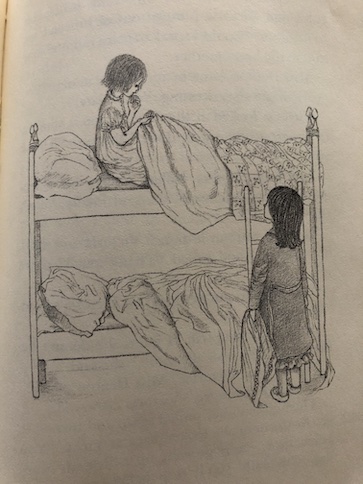
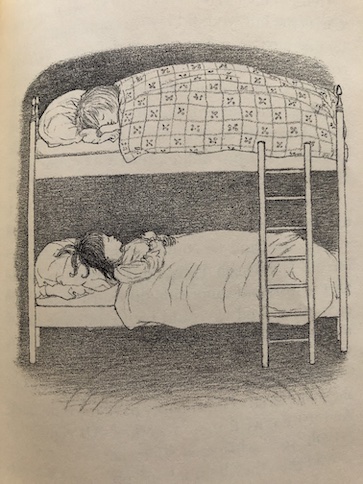
The two girls find themselves arguing sometimes because of their different preferences, but they remain friends. It’s more that, now that they’re getting comfortable with each other and their school, more of their individual personalities are coming out. Victoria is also surprised to realize that, while she still frequently misses her mother, she no longer agrees with her mother about certain things. When her mother comes to visit the school, she worries about Victoria sleeping in the top bunk of their bunk bed, but Victoria herself loves it and has to assure her mother that she likes the top bunk. One thing that boarding school has done for Victoria is to give her a sense of independence and room to develop her own identity and preferences. She no longer has to get her mother’s permission for everything she does, as long as her housemother approves.

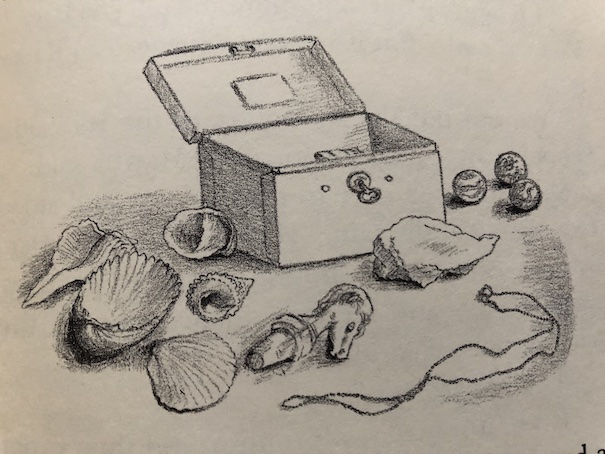
Victoria and Martha are both imaginative, and they begin enjoy their shared adventures at school. They try to hold a midnight feast in their room and search for hidden passages or secret compartments in the dormitory because Martha has heard or read that these things happen in boarding schools. Neither of those adventures goes as planned, but Miss Denton allows the girls to build a little play hut of their own with help from the school’s handy man. Miss Denton also gives the girls a little lockbox to keep some of their treasures in, and they hide it so they can have a buried treasure.

As the year comes to an end, Victoria knows that she’ll be coming back to boarding school next year, and the prospect doesn’t seem so bad as it did before. Martha isn’t sure whether she will or not, talking sometimes about what they’ll do next year but still hoping to live at home with her parents. But, if Martha doesn’t come back to school, it just wouldn’t be the same for Victoria!

The book is available to borrow and read for free online through Internet Archive.

My Reaction and Spoilers

One of the things I found interesting about this book is that it is set in the US. The iconic boarding school stories for children tend to be British stories, but the Coburn Home School is in New York state. The girls’ parents live in New York City.

Most of the story focuses on the girls’ relationship with each other and their growing sense of self-identity and confidence at their boarding school. They talk about classes they take and how they each feel about the other’s favorite subject, but they aren’t shown in classes themselves. The school is also a co-ed school, with both boys and girls, but the boys don’t enter into the story much because most of the action takes place around the girls’ dorm. The boys live in a different dorm. There is only one instance where a boy is shown talking to Victoria, with a hint that he might have a crush on Victoria, another new development in Victoria’s life at school. The little developments in the girls’ lives and attitudes through the school year and each little experience and adventure they have are the main focus of the story. These are the things that are helping the girls understand and develop their identities, self-confidence, and sense of independence.

Toward the end of the book, Miss Denton encourages the girls to think about all of the things they’ve learned this year, and not just the ones they’ve learned in class. The girls don’t fully understand and appreciate that Miss Denton is talking about personal growth and development, but they do consider things they’ve learned, like how to make beds, that midnight feasts aren’t as fun as they sound, and how Victoria learned not to be homesick. These are some of the little things that are part of their school experience and that are slowly making them more grown up and independent than they used to be.

Although Martha is a little older than Victoria and sometimes chides her for being babyish about some things (like putting a lose tooth under her pillow) or still homesick, the truth is that Martha has been just as homesick the entire time. Martha doesn’t appear to be as upset about boarding school as Victoria because she is not a new student in this book, like Victoria. She already went through her first year at boarding school before Victoria got there, so she no longer openly cries about being away from home. Still, the reason why she keeps talking about going home and living with her parents all the time is that she misses them. While the girls’ adventures during the school year and Victoria’s realizations about how boarding school gives her the opportunity to do things and be with people she wouldn’t at home make her feel better about coming back next year, Martha still feels uncertain about it. Martha has also come to love being friends with Victoria and even loves Miss Denton, but her feelings of homesickness leave her feeling torn about what she really wants.

There are hints that Martha will probably return to boarding school anyway, but Miss Denton reassures Victoria that she will be fine at boarding school even if Martha decides not to come next fall, reminding Victoria that she is now one of the “old girls” instead of a scared new one, like she used to be. Victoria also starts to feel that way herself. Martha will probably be back the next year to be with Victoria, Miss Denton, and Miss Blanchard, but readers can be reassured that, even if she doesn’t return, Victoria will be all right with her new sense of identity and independence. This first year at boarding school with Martha may be the beginning of a lifelong friendship or just one step to Victoria finding herself and building other friendships. Maybe it’s both. Victoria’s future life will be fine in general as she continues growing up and finding her way, learning to manage her life one step at a time.

There is a modern 21st century documentary about young children going to boarding school for the first time at 8 years old, What’s Life Like in a Private British Boarding School? | Leaving Home at 8 Years Old, on YouTube. The school in that documentary is British, but I was struck by the common feelings in the documentary and the book, even though they take place decades apart in different countries. There are just some parts of the human experience that last through the generations. The documentary also shows the parents’ side of the boarding school experience, the reasons why they choose to send their children to boarding school, and how they cope with their feelings about sending their children away and being separated from them.

Boarding school isn’t always easy for parents in terms of emotions, and there are hints of that in The Secret Language. We never see Martha’s parents in the book, so we don’t know what’s going on with them, but Victoria’s mother fusses over Victoria when she gets the chance, and she talks about how great it would be if she could arrange things so that Victoria can be home with her all the time again, too. If Victoria’s mother wasn’t a working single mother who has to travel for work, she probably wouldn’t have sent her away to boarding school at all. Miss Denton is very in tune with people’s feelings, and I think that she’s aware of all the complexities in the lives of the girls and their parents. She does her best to look after the girls emotionally, and that’s part of her urging the girls to consider other people’s feelings, to be thoughtful about each other, and to think about the ways they’ve been changing inside as well as outside. I think that the universal nature of the girls’ and adults’ feelings in the book are a sign of the author’s emotional awareness, understanding of how different types of people feel.

Ursula Nordstrom, the author of the book, was actually a famous children’s book editor. She is credited with helping to transform mid-20th century children’s literature to have more of a focus on children’s feelings, experiences, and imagination instead of being morality tales, focused on what adults want children to know or understand. The Secret Language was the only children’s book that she wrote herself. This YouTube video explains about her life and career.

Mandy

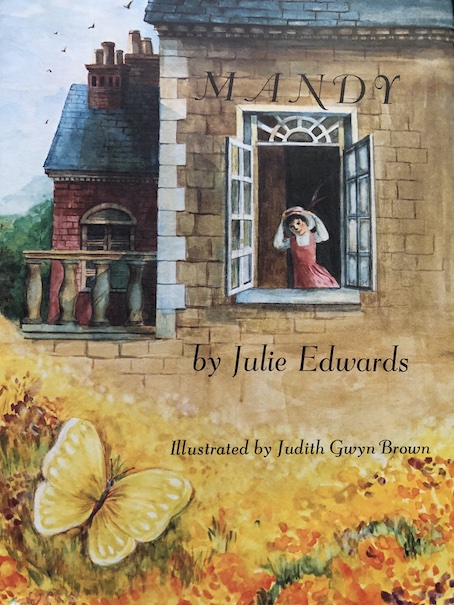
Mandy by Julie Andrews Edwards, 1971.

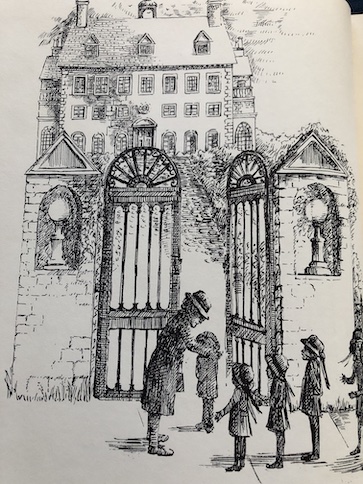
At St. Martin’s Orphanage, there are usually about 30 children at a time, and the matron does her best to nurture her parentless charges. Mandy is a ten-year-old girl who has lived in the orphanage her entire life. She is intelligent, and she loves reading and daydreaming. She is allowed to work part time at a grocery store, and she spends most of her money buying books. She also loves nature and taking walks by herself. She enjoys spending time alone because she likes to daydream and admire flowers and other beauties of the natural world.

However, Mandy isn’t really happy, either. Even though the orphanage is kind to her, she gets along well with the other orphans, and she has her books and other things to keep herself busy, she is lonely and still misses having parents and the family life she’s never known. Because she has no memory of these things, it’s difficult to say whether she truly understands what she’s missing, but she definitely feels the lack of them in her life. As she gets older, she begins to feel more and more melancholy about it. She knows only that something is missing from her life, and she becomes more desperate about it. She craves a place that she can call her own, a place where she really belongs.

There is a wall behind the orphanage, and Mandy, with her vivid imagination, becomes increasingly curious about what’s on the other side of the wall. She asks Ellie, the maid at the orphanage about it, but as far as Ellie knows, it’s just more of the countryside. She’s never actually explored it herself. Mandy likes to imagine that there might be a castle and a unicorn beyond the wall.

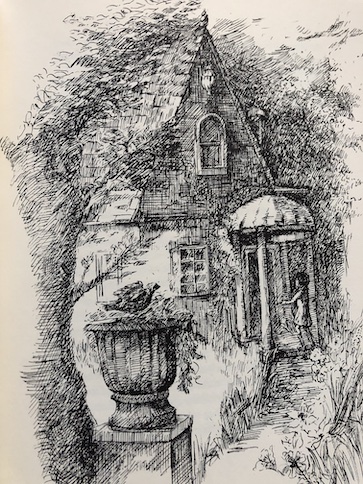
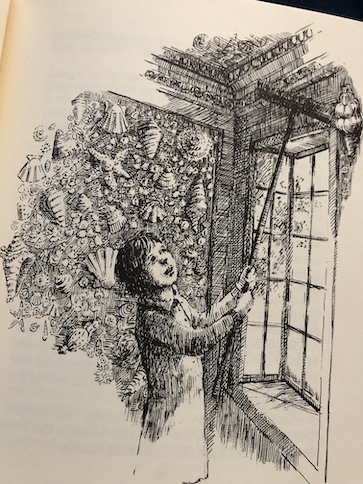
One day, Mandy decides to try climbing over the wall to see for herself. What she sees is an apple orchard and a path through it. When she climbs down from the wall and follows the path, she finds an old, disused cottage with the remains of a garden. The cottage is empty of furniture. Mandy lets herself into the cottage and finds it dusty and in need of repair, and there’s no sign than anyone has been there for years. However, there is a marvelous room in the small house that is decorated with real seashells! Mandy is fascinated, and she wonders who used to live there.

The idea comes to Mandy that she could “adopt” the house and care for it as if it was her own. Obviously, nobody has been there for a long time, and nobody would know or care if she cleaned it up, but she would feel good, having a place of her own and something to care for. When she returns to the orphanage, Ellie tells her that she asked the matron what was on the other side of the wall, and she says that it’s a large, old estate, where nobody lives anymore. Mandy is pleased with that because, if no one lives on the estate where the cottage is, there will be no one to notice when she goes to visit the cottage.

She asks for gardening advice from the gardener at the orphanage without telling him exactly why she wants to know, and he even lets her borrow some tools. Mandy loves tending to her very own garden, and she uses some of her pocket money from the grocery store to buy seeds for the garden and some things for the house. Mandy loves seeing how the cottage and garden improve under her care, but her roommate, Sue, begins to wonder where she keeps disappearing to, and the adults begin to wonder what she is doing with the things she buys and borrows.

The matron tells Mandy that she’s worried about what Mandy is doing because it could be dangerous for her to go off alone where nobody knows where she’s going. Mandy lies to her, saying that she had a project of making a garden for herself but that she gave it up because it was too much work. The matron says that she understands why she would want to have a place to call her own and offers her a spot in the orphanage garden to tend as her own. Mandy feels terrible about lying to the matron, but the thought that the matron might make her give up the special place she’s found because it doesn’t really belong to her or because it’s too dangerous for her to go there alone is just too much.

As the seasons change, Mandy enjoys slipping away to her cottage whenever she can, working in her garden and watching the animals that live nearby. However, the matron has become increasingly suspicious of Mandy’s odd behavior, Sue is angry with her for keeping secrets from her, and there are signs that someone has been at the cottage while she wasn’t there. There are footprints outside the cottage and the hoofprints of a horse, and there are signs that someone has been fixing things. Fortunately, this mysterious person doesn’t seem to mind her being at the cottage. Her mysterious friend leaves little presents and notes for her. More and more, Mandy fears that her secrets will be discovered, but when she becomes ill and needs help at the cottage, she becomes grateful for the help of a friend who knows where she is. Having a place to call your own is good, but having friends and a family who care make a place a real home.

The book is available to borrow and read for free online through Internet Archive (multiple copies).

Update: A site reader pointed out that I should have explained that Julie Andrews Edwards is the same Julie Andrews who played Maria Von Trapp in The Sound of Music, Mary Poppins in the Disney musical, and the queen in The Princess Diaries movies. When I was younger, I didn’t realize that she also wrote children’s books. She is also known for writing The Last of the Really Great Whangdoodles, which I haven’t covered yet. Julie Andrews’s early life was difficult because her parents divorced and each married other people during WWII. At various times, Julie Andrews lived with each of her parents and stepparents and traveled around as she began performing with her family as a child. Her family was poor, and she later described her stepfather as being a violent alcoholic. Her chaotic early life may have been a factor in this story about a lonely girl looking for a place to belong and a real sense of family.
My Reaction and Spoilers

This is a sweet story about having a place to call home and a real family. Mandy craves for these things, even before she truly understands what it means to experience them. Parts of the story are sad and sentimental, but others are just enchanting. This book fits well with the Cottagecore aesthetic. The cottage in the orchard is charming, and Mandy’s care for it reminds me of other children’s books, like Dandelion Cottage, where children have their own secret places to fix up and care for.

Mandy gets wrapped up in her special secret place, tending the garden and watching the animals there, but it gets her into trouble with her friend and roommate, Sue, and with the matron of the orphanage because of the secrets she’s keeping and the way she keeps helping herself to things she really shouldn’t take and slipping away to spend time at the cottage without telling anyone where she’s going. Mandy loves the cottage because she can imagine it as her own home, a place that belongs to her and where she belongs, but Mandy needs people, too. Sue’s friendship for her helps her when she gets into trouble, the matron turns out to be more understanding than Mandy feared, and Mandy’s adventures with her cottage bring her into contact with people who become the family Mandy really needs. Once Mandy has the family she needs, she no longer feels compelled to keep the cottage all to herself, and she decides to share it with the other girls at the orphanage. Mandy’s new home with her new family is every bit as charming and magical as her cottage. It’s a big, old house with secret passages that she explores with her new brother.

However, I think that it’s important to note that not everything in the story is easy and happy for Mandy. All through the story, she struggles with her emotions, experiencing sadness and loneliness and trying to understand what they mean. Her new family doesn’t fully accept her immediately, either. They are never mean or rejecting of her. They are friendly and helpful people from the first time they meet Mandy, but it takes some time of them getting to know her before they decide that they want her to be a permanent part of their family. There isn’t a lot of high drama, and her new brother is never jealous of her or mean to her. However, the family does take some time to make their decision after Mandy spends Christmas with them, and that adds to Mandy’s inner distress.

There are points in the story when Mandy’s fate seems uncertain, and she considers running away from the orphanage. The headmistress becomes concerned about Mandy because of her melancholy and tells the family considering her that Mandy has begun asking her questions again about her parents and how they died, something that she hasn’t done for years, showing that she has become preoccupied with the concept of family life and her lack of it. The family is concerned for Mandy and understanding of her feelings, but I thought that having the family take time to get to know Mandy and to consider what having her join their family would mean was realistic. I think the drama was softened a little to keep the gentle feel of the story, but there’s enough emotion and inner turmoil that it doesn’t feel like Mandy’s problems resolve too easily.

Sue and Mandy bring up the question about whether Mandy’s discovery of the cottage and her new family was a matter of luck. Sue is envious because it seems like everything happens to Mandy. Mandy asks her new father if that’s a matter of luck, but he says that Mandy is special and that things happen to her because she is brave and goes looking for them. She is a quiet person, but she takes her life into her own hands and pursues what she wants, where other people might be too timid to do it. Technically, Mandy broke rules and took some risks to care for her secret cottage, but she did it because it was important to her, and it worked out in the end. Her new father seems to appreciate Mandy’s spirit and determination.

Go Jump in the Pool!

This is the second book in the Bruno and Boots series (also called the MacDonald Hall series), which is about a pair of boys at a Canadian boarding school for boys and their humorous adventures and pranks. 

Once again, Bruno and Boots are faced with a problem when Boots’s parents consider sending him to a different school.  MacDonald Hall, unlike its athletic rival York Academy, doesn’t have its own swimming pool. MacDonald Hall is superior to York Academy in academics, but they often lose to them at swim meets because the MacDonald Hall team can only train at the local YMCA once week.  Boots’s father is an athlete who once competed in the Olympics, and athletics are very important to him.  Because of York’s superior athletic facilities, he’s considering sending Boots there instead. Bruno and Boots ask their headmaster why the school doesn’t have a pool, and he says that they want to build one but haven’t been able to raise the necessary money. Of course, Bruno, the idea man, immediately starts getting ideas.

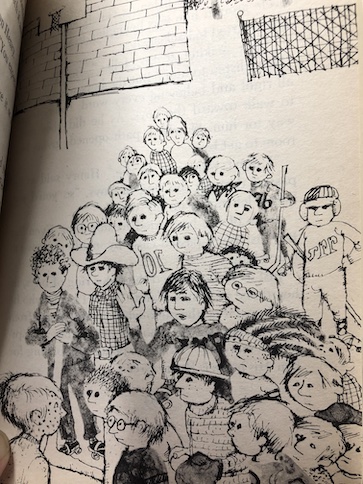
Boots loves MacDonald Hall and doesn’t want to leave his friends, especially his best friend and roommate, Bruno. Although Bruno’s schemes often cause chaos, they do produce results in the end, so he is able to convince his friends to go along with them.  While Boots writes letters home, talking about how great MacDonald Hall is and how much he loves it there, hoping to sway his parents’ minds, Bruno begins scheming for a way to raise the money so that MacDonald Hall can build a new pool.

First, Bruno gets the other students at the school to hold a rummage sale, selling things of their own and even some furnishings from their dorm rooms. The girls from Miss Scrimmage’s school across the road also join in their efforts, including donating some items that they liberated from their headmistress’s rooms. Mr. Sturgeon, the headmaster of MacDonald Hall is upset when he finds that the boys are holding a large public sale without his permission, and there are some complications because of the items that the girls stole from Miss Scrimmage, including the shotgun that she keeps for protection. While almost everyone would be relieved by someone else buying that gun and removing it from Miss Scrimmage’s dangerous hands, the purchaser turns out to be a robber, who uses the gun in a holdup. Chaos ensues when the police come to arrest Miss Scrimmage because the gun had her name and address engraved on it. However, Mr. Sturgeon manages to get the situation under control by explaining about the sale and giving Miss Scrimmage an alibi for the crime, and he is persuaded not to punish the boys by his wife, who is sympathetic to the boys, and a member of the school’s board of directors, who is impressed by the boys’ initiative and school spirit. However, Mr. Sturgeon tells the boys not to hold any more sales and that he needs to know about any future fundraising efforts.

Their next fundraising project is a talent show with students from both MacDonald Hall and Miss Scrimmage’s. It doesn’t go too badly, although there are complications. Mrs. Sturgeon’s attempts to take pictures of the performers startle the performers with bright flashes that cause a few accidents. Elmer’s bird calls accidentally attract an owl that flies away with Miss Scrimmage’s hat. Then, several of Miss Scrimmage’s girls modify their dancing costumes to make them skimpier, scandalizing Miss Scrimmage. In spite of the incidents of minor chaos, Mr. Sturgeon appreciates that the boys have managed to raise more money, and they’ve also managed to get some of the more shy students, including Elmer, to participate in school activities.

Mr. Sturgeon does put a stop to some of Bruno’s more inappropriate ideas. He refuses to let them hold a casino-themed fundraising event or bet on a race horse because he can’t condone gambling, and he won’t let them enter a fellow student in an eating contest out of concern for the student’s health. However, Bruno convinces his fellow students to enter any contest they can find with a cash prize. Unfortunately, some of the contests also have non-cash prizes, which is how they end up with a massive amount of jelly beans and a refrigerator. When Bruno asks Mr. Sturgeon for permission for them to hold a funny photo contest at the school, he agrees on the condition that the photos be tasteful enough for a school environment. Of course, the students’ attempts to deliberately produce humorous pictures also lead to some antics and bizarre pranks.

After that, the boys hold a kind of carnival that they call “Individual Effort Day” because each student gets to do their own kind of fundraising effort, making and selling things or producing some form of entertainment. While everyone, including the girls at Miss Scrimmage’s school, who are also participating, tries to come up with an original idea, some of the students try spying on each other and stealing ideas. Mr. Sturgeon particularly enjoys the game that Bruno and Boots are holding, where people pay to throw wet sponges at them. He accurately hits both of them and also hits Miss Scrimmage when she passes by. Cathy and Diane’s haunted house scares Miss Scrimmage, and Mr. Sturgeon gets hooked on an elaborate pinball game built by Elmer.

When Mr. Sturgeon points out that the boys have mostly been getting money from the students and parents of MacDonald Hall and Miss Scrimmage’s, Bruno takes his attempts to get money from the public too far by setting up a toll stop on the road that runs by the school. It’s illegal to get money under false pretenses, so Mr. Sturgeon calls a halt to all the fundraising efforts. However, he changes his mind when he finds out that some of the boys’ parents, including Boots’s parents, have been considering sending their boys to York Academy because of the pool issue. Realizing that the boys have been trying to save the school and continue going to school with their friends, Mr. Sturgeon lifts their punishment, although he still gives them a warning that if they do anything illegal again, it will jeopardize the rest of their lives.

The boys still have the problem that they are thousands of dollars short of their goal, even after Cathy wins a large cash prize in a recipe contest. There is still one student at the school who hasn’t contributed to all the fundraising efforts, though: Boots’s old roommate from the previous book in the series, the wealthy but stuffy and fussy hypochondriac, George. George has resisted getting involved in all the weird activities happening on campus because he considers them all “vulgar”, but when they finally explain to him that the point of it all is to raise funds for the school, he approves. If there’s one thing George knows how to do well, it’s manage money. George convinces them that they don’t need to raise more money from other people if they know how to put their money to work for them in the stock market. The other boys are a bit dubious about letting George invest their money, but George knows what he’s doing. Meanwhile, Boots’s parents have been taking all the letters he’s been writing them about how great MacDonald Hall is and how happy he is there to heart. In the end, they just want their son to be happy.

The book is available to borrow and read for free online through Internet Archive (multiple copies). It’s also one of the MacDonald Hall books that was made into a movie. You can sometimes see the trailer for the movie or clips of it on YouTube.

I always liked the Bruno and Boots series when I was a kid. The pranks aren’t quite as funny to me as when I was a kid, but I like it that the boys’ antics always have a purpose. I don’t like stories where people play pranks just to be mean, but the boys’ escapades in this series are always in support of their school and their friends.

There are also aren’t really any villains in the series, and there are no villainous characters in the story. Even when people are in opposition to the boys, they aren’t really evil. There is the rival school, which is snobby and rude to the boys, but other than giving the boys a motive for fundraising for the pool project, they don’t play much of a role in the story. The headmaster of MacDonald Hall is a good man who really cares for the boys, and even when he punishes them, he has their welfare at heart. The boys, especially Bruno, have a tendency to go too far with their schemes, and they do need someone to restrain them at times. George wasn’t a very likeable character in the previous the book, and even here, he’s kind of fussy and not too fond of Bruno and Boots. However, he also cares about the school, and this time, he has just the talents that they need. The other boys at the school also appreciate what George does for them, and they hail him as a hero.

I also appreciated that, in the end, Boots’s parents acknowledge that it’s more important for him to be happy with his school and his friends than for him to seriously train for the Olympics. Boots’s letters are overly enthusiastic about the things he’s been learning in class, and I’m sure his parents know that he’s not really that excited about his math lessons, but they can read between the lines and realize that the purpose of his letters is to indirectly ask them not to make him switch schools. Even if MacDonald Hall wasn’t able to get a swimming pool of their own, I think his parents would have agreed to let him stay there if he insisted that he just wouldn’t be happy anywhere else.

Chocolate Fever

Chocolate Fever by Robert Kimmel Smith, 1972.

Henry Green absolutely loves chocolate, and he eats it all the time, at every meal! Although this doesn’t sound healthy, Henry’s parents let him eat as much chocolate as he wants because it never seems to affect his health. Henry doesn’t gain weight, have stomach aches, get cavities in his teeth, or suffer skin problems from eating all that chocolate, so his parents assume that it must be okay and let him eat whatever he wants. However, Henry is about to suffer some consequences from his chocolate obsession.

One morning, Henry starts feeling a little funny, and then, he notices that he’s breaking out in brown spots. His teacher takes him to the school nurse, and they notice that Henry’s rash smells oddly like chocolate. More little brown spots start popping out as they look at Henry.

They take Henry to the hospital, where the doctor who sees him is mystified. He says it’s like Henry is turning into a candy bar, and he starts talking about making medical history. In a panic, Henry runs away from the hospital. However, he ends up lost, and everywhere he goes, people notice his spots and the smell of chocolate.

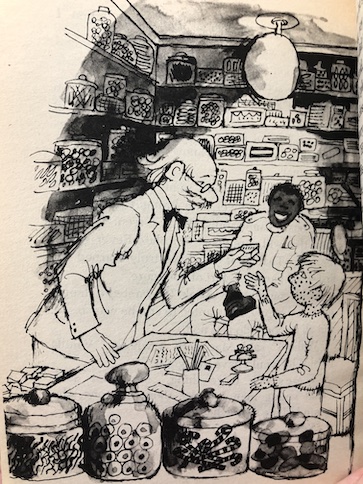
Henry is afraid that he’s going to spend the rest of his life as some kind of chocolate freak, but a kind truck driver helps him and a candy shop owner who’s experienced this problem before provides a solution to his Chocolate Fever.

The book is available to borrow and read for free online through Internet Archive (multiple copies).

My Reaction and Spoilers

I remember hearing about this book when I was a kid, but I didn’t read it until I was an adult. I liked it, and I enjoyed the character of Mac, the truck driver who helps Henry. At first, Henry is reluctant to explain his situation to Mac, but Mac can clearly see (and smell) Henry’s condition, and he just waits for Henry to explain himself without pressing him for answers. When Henry explains that he’s afraid of being a freak for the rest of his life, Mac tells him that he’s “unique” and “sort of special”, not really a “freak.” Henry is afraid of everyone staring at him at all the time, but Mac says that he’s already had experience with that. Mac is a black man in a mostly white society, and he says that being different from other people is bound to attract some attention, but he’s proud of what makes him different because “black is beautiful.” Henry says that’s not the same as his situation because being covered with spots is ugly. It’s true that people with different colors of skin look the way they do because it’s natural for them to look that way, like people with different hair colors and eye colors. That’s not quite the same as someone suddenly breaking out in a weird rash.

Henry just wants to run away from him problems, but Mac convinces him that he has to deal with the situation instead of just running away. He has parents who care about him, and he at least needs to let them know where he is and what’s happening, and they can work out another way to deal with the problem that doesn’t involve returning to the hospital with the doctor he doesn’t like. Mac points out that it’s also possible that this problem of his is a temporary one that will clear up on its own.

Mac’s plan to call Henry’s parents is interrupted by a couple of robbers who hijack the truck, but when Mac finally delivers the cargo he’s carrying – a shipment of chocolate bars – to a local candy shop, the owner of the candy shop provides the solution that Henry’s been looking for. The candy shop owner once had a problem like Henry’s, and he teaches him that it’s possible to have too much of a good thing and that he needs to learn moderation. Cutting back on chocolate also means that Henry gets to experience and appreciate other flavors that he’s been ignoring. The story ends with the potential for Henry to get hooked on some of these flavors as well, and we’re left with the question of whether or not Henry has completely learned his lesson yet.
It’s a fun story about learning not to overdo things. One thing that surprised me was that Mac smoked a cigar because children’s books cut back on portrayals of smoking during the late 20th century to discourage children from taking up the habit. There were still some books that had people smoking, but it just struck me as interesting in this particular story because the story is about out-of-control habits.

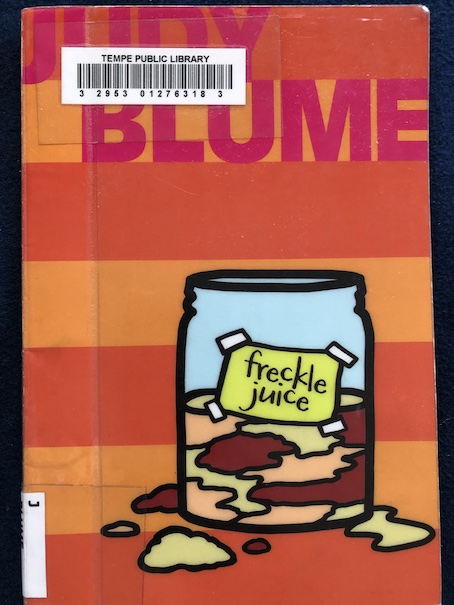
Freckle Juice

Freckle Juice by Judy Blume, 1971, 2014.

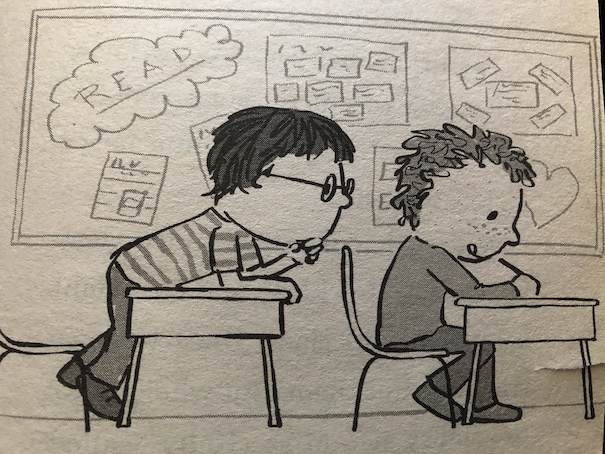
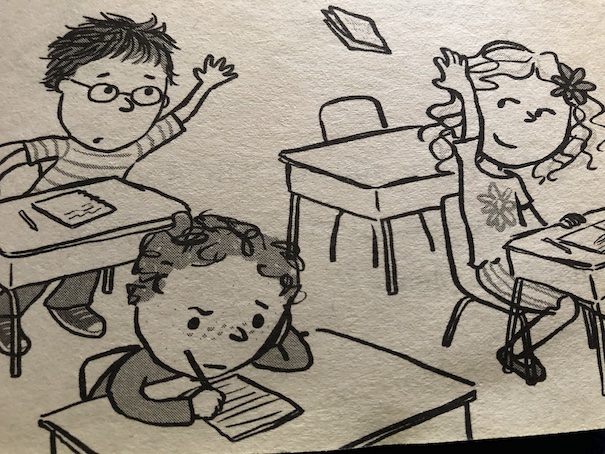
Andrew admires his friend, Nicky, for all his freckles. Andrew thinks freckles are interesting, and if he had a bunch of freckles, maybe his mother wouldn’t notice when his neck was dirty and make him wash it every morning.

When Andrew asks Nicky how he got so many freckles, Nicky says that he was just born with them. However, a classmate, Sharon, overhears the boys talking and claims that she has a secret family recipe that can give a person freckles. She offers to sell her secret recipe to Andrew for 50 cents.

Andrew isn’t sure that he really believes that Sharon has a recipe that can give him freckles, but he figures that he has nothing to lose by trying it. After all, if it doesn’t work, he can always ask for his money back.

Sharon’s recipe is a disgusting conglomeration of weird ingredients. Does it actually stand a chance of working, or will the only thing it gives Andrew be a stomach ache?

I couldn’t find an online copy of this book, but I did find an online literature guide for using this book in the classroom on Internet Archive.

My Reaction and Spoilers

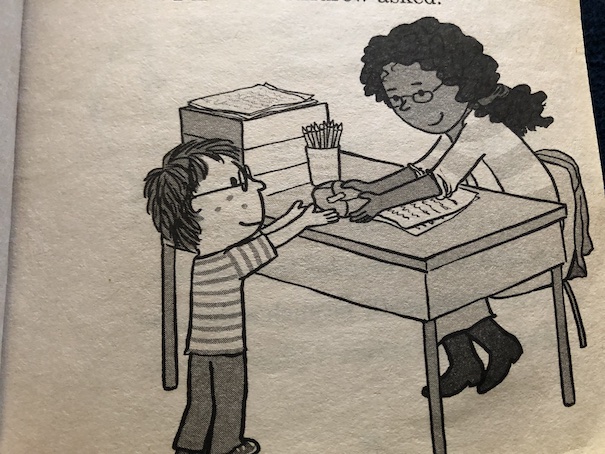
This is a short, easy book for kids in early elementary school, but it’s also a fun story about self-acceptance. Through this experience and the help of the kids’ understanding teacher, he comes to realize that there’s no point in envying other people, but there are benefits to learning to appreciate yourself. It turns out that, while Andrew was envying Nicky for his freckles, Nicky never liked them himself. The kids’ teacher helps them both to appreciate themselves for the qualities they have, pointing out that Nicky’s freckles suit him while they just wouldn’t look the same on Andrew. Hopefully, the kids also learn to beware of miracle cures and anything people like Sharon have to sell!

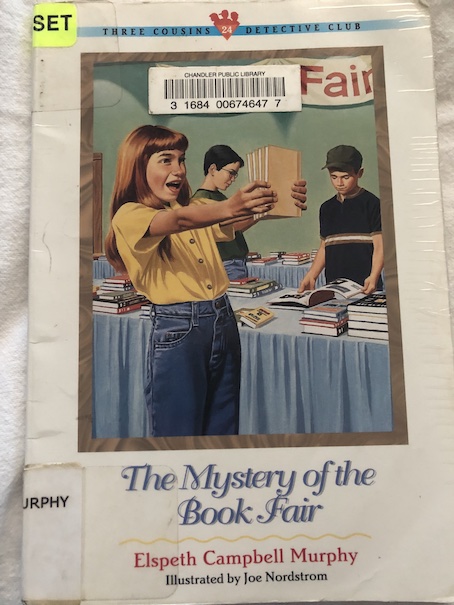
The Mystery of the Book Fair

Three Cousins Detective Club

#24 The Mystery of the Book Fair by Elspeth Campbell Murphy, 1999.

Sarah-Jane is excited about the book fair being held in the public library. She helped to collect donations of books for the sale, and she wants to be first in line so that she can buy a set of old Winnie-the-Pooh books that she’s had her eye on.

But from the moment that she claims the books, people keep coming up to her and trying to get her to let them have them or buy them from her. Another volunteer at the sale, who is also a book dealer, looks over the books and tells Sarah-Jane that they are rare first editions that are worth a lot of money.

Even though Sarah-Jane bought the books in good faith from the library, she and her cousins feel that they ought to try to find the original owner to make sure that he really meant to donate them. The trouble is that Sarah-Jane remembers that the donor of the books behaved rather strangely and seemed very nervous. When he gave them the books, he even called them by the wrong name, “Winkie-the-Pooh.” What kind of book collector wouldn’t know the value of his own collection or even the correct name of the books? Did the books even really belong to him at all? Then, more than one person shows up at the library, claiming to own the books. Who is the original owner?

The theme of the story is Proverbs 3:3, “Don’t ever stop being kind and truthful. Let kindness and truth show in all you do. Write them down in your mind as if on a tablet.”

The book is available to borrow and read for free online through Internet Archive.

My Reaction and Spoilers

Sarah-Jane wanted the books not only because she likes Winnie-the-Pooh but because she likes old things, and she found the old copies of the books charming. Although she did not originally collect old books, these particular books inspire her to start an old book collection. Many people have discovered their love of collecting old books thanks to the popularity of recent aesethics, like Cottagecore and Dark Academia.

However, as the book dealer in the story explains, most old books are not the rare collectors’ items that these first edition copies are. The dealer explains that the value of an old book depends on many factors, like the condition of the book, its rarity, and the number of people who would be interested in acquiring it. I’ve encountered this myself in collecting old children’s books. Many of the books that I cover on this site would be worth very little to other collectors because they are not rare, first edition classics, but they’re worth something to me because there are elements of the stories that I find interesting. I don’t have the funds to buy most of the really rare books, although I’ve occasionally managed to buy books that would ordinarily be out of my price range at used book sales or as library discards or as damaged books. I think the most expensive books I have are ones that would be worth perhaps $100 or $200 if they were in pristine condition, which none of my books are. I’ve never encountered anything that would be worth thousands of dollar, like the Winnie-the-Pooh books in the story. The Winnie-the-Pooh books are worth that much because they are not only first editions but they are in near mint condition and they are extremely popular classic books.

One of the adults who tries to pressure Sarah-Jane into selling the books to her is a woman who tries to make Sarah-Jane feel bad for buying books that are for younger kids. The woman says that she wants to buy them for a young child, but the nice dealer recognizes her as a fellow book dealer and knows that she’s trying to cheat Sarah-Jane because she has recognized the books for what they are and knows their value. The woman wasn’t being honest in anything she said. She wasn’t really interested in the books just for their own sake, as a book lover or as a present for a real child, but only for their monetary value. That makes her different from Sarah-Jane, who fell in love with the books for their own sake. I’m not the only one who collects old books, even old children’s books, just because I appreciate them for what they are. It’s a feeling that doesn’t know any particular age. The real owner of the bookss turns out to be an elderly man who was born the year that the first Winnie-the-Pooh book was published and who has had the books since they were new. He loves them not just because they’re collectors’ items but because of their sentimental value.

The books were stolen from the house of the book collector along with some other things. One of the thieves donated the books to the library because he thought they were worthless. His partner in crime knew that they were worth a lot of money and came to the sale to try to get them back. He runs away when the real owner of the books shows up looking for them. Sarah-Jane calls the police and tells them what happened. The books are returned to their rightful owner, and as a reward, he buys another rare book of fairy tales that was donated to the sale (on purpose, by the owner) and gives it to Sarah-Jane.

The Mystery of the Blue Ring

Polka Dot Private Eye

The Mystery of the Blue Ring by Patricia Reilly Giff, 1987.

When Dawn Bosco first joined Ms. Rooney’s class at Polk Street School, she stole Emily Arrow’s toy unicorn. Now, that incident has come back to haunt her. When the book begins, her theft of Emily’s unicorn was just weeks ago. Now, she and Emily are starting to be friends, although their friendship is a bit shaky.

At school, the teachers are talking about vegetables because it’s Good Vegetable Day. Everything is geared around vegetables all day, and the art teacher has the children make sculptures of vegetables out of clay. Dawn is bored because she’s been reading a mystery book, and she’d rather be finding mysteries and learning to be a detective than making silly vegetables out of clay.

Dawn gets irritated with Emily when she says that she’ll make a cucumber, which is what Dawn was going to make because it’s easy. The teacher won’t let Dawn make a cucumber because Emily already claimed that idea, so Dawn has to make a carrot instead. (Not that much different in shape, really, except one end is more narrow.) However, she still resents Emily for using the cucumber idea first.

As the girls push against each other by the sink, cleaning up from using the clay, Dawn spots a ring next to the sink. Later, Emily says that her ring is missing. It’s a special ring with a blue stone that she got for her birthday. Dawn is pleased that she’s found a mystery to solve. Remembering that she saw a ring next to the sink in the art room, Dawn proudly goes back to the art room to see if she can find the ring and return victorious. However, the ring isn’t there when she checks.

Then, suspicion turns to Dawn herself. After all, everyone knows that Dawn stole Emily’s unicorn before. Instead of being the hero detective, Dawn is turning into the main suspect in this crime. Now, she really needs to find the ring to clear her name!

Dawn’s grandmother, Noni, gave her a special detective kit for her birthday. Dawn uses it to turn into The Polka Dot Private Eye to hunt down Emily’s ring.

The book is available to borrow online through Internet Archive.

My Reaction

I liked the way the series returned to the subject of Dawn’s theft and used it to spark a spin-off mystery series. This is the first of the Polka Dot Private Eye books. In this series, Dawn becomes a more likeable character than she was when she first appeared in Fish Face, and she gets a little comeuppance for her earlier, unpunished theft of Emily’s toy unicorn in the form of her classmates’ suspicion of her. When I read this book for the first time when I was a kid, I hadn’t read the book where Dawn was first introduced, Fish Face, so I didn’t really understand the relationship between Dawn and Emily and how Dawn took Emily’s toy unicorn. We never really find out in either book exactly why Dawn took the unicorn, although in this book, she thinks of herself as having “borrowed” it instead of having stolen it.

Reading Fish Face isn’t necessary to understand the basic story in this book, but after having read it, I appreciate Dawn’s position in this book a little better. By now, everyone knows what Dawn did, and although Dawn thinks of “weeks ago” as a long time ago, it’s not really that long, and it’s still fresh in everyone’s mind. Dawn is still a relatively new kid in class, and one of the few things everyone knows about her is that she has a history of taking things that don’t belong to her. It is a logical conclusion that Dawn might have helped herself to another of Emily’s belongings when everyone knows that she’s done it before. As my grandfather used to say, it’s easier to keep a good reputation than to redeem a bad one, but Dawn works at it and learns that she likes being a detective and that she has a talent for figuring things out. After Dawn figures out where Emily’s ring is, the two of them become better friends. Solving the mystery also makes Dawn a class hero and begins to establish Dawn’s reputation as a person who likes to solve mysteries and crimes rather than commit them.

This book gets bonus points from me for mentioning jelly sandals. Jelly shoes were a regular part of my childhood in the 1980s and early 1990s, and I’ve seen some of them return again in the early 2000s, probably partly because people my age now have children, and they’re nostalgic for some of the things from their childhoods. Jelly shoes (or “jellies,” as we called them) are sandals and sandal-like shoes made from flexible plastic in different colors, some clear or with sparkles inside. They were cheap when I was a kid, and I used to get a new pair or two when the weather turned warm. Eventually, they wear out, and the plastic bits snap. I’d wear them around my backyard with my toes sticking out the front as they started breaking, and I started growing out of them. By the time they were too broken to use anymore, my toes were usually beyond the bottom of the shoes, and I was always kind of proud of that because it was a sign that I’d grown over the summer. It wasn’t much of a loss when the shoes wore out because they’d be too small for me at that point anyway, so we’d throw them away, and I’d wear more solid shoes when the weather turned cold. Jellies, flip-flops, and cheap canvas shoes were a major part of what I wore when I was young and growing out of shoes fairly quickly. They were all inexpensive, and while they didn’t last very long, they lasted about as long as they needed to before I needed the next size and weren’t much to lose when I was rough on them.

The Weird Science Mystery

The Bobbsey Twins

#20 The Weird Science Mystery by Laura Lee Hope (Stratemeyer Syndicate), 1990.

Before I begin, I’d like to acknowledge Sean Hagins, for supplying me with photos of this book! Usually, I take pictures of books myself, but I just couldn’t find a physical copy of this one. Sean is a big fan of the Bobbsey Twins, particularly the New Bobbsey Twins mysteries, and you can see some of his video reviews as well as videos about his photography work on his YouTube channel, SJHFoto. Thanks, Sean!

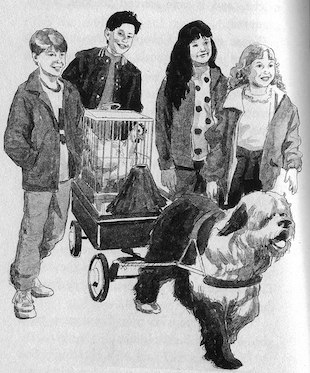
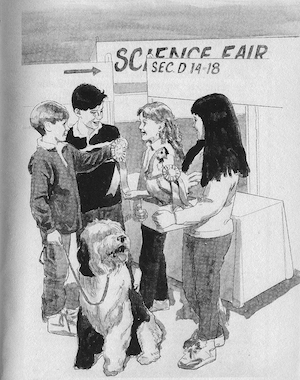
The Bobbsey Twins are all getting ready for their school’s science fair. Bert’s project is about dog behavior with the family’s dog as his subject. His twin, Nan, is also studying animal behavior, but with a chicken named Zelda. Because the science fair is open to both middle school and elementary school kids, the younger twins, Freddie and Flossie, can also enter. Freddie is entering with a large baking soda volcano.

When the kids arrive to drop off their projects, Nan and Bert notice another boy from their class, Martin Crane. Martin is a science whiz, but he isn’t very nice. He’s not really a bully, like Danny Rugg, but he makes fun of the Bobbseys’ science projects. They don’t know what Martin’s project is because he’s bringing it in boxes labeled “Top Secret”, but he swears that it’s going to win first prize.

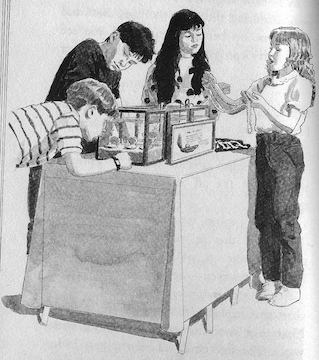
When Freddie sees the other students’ projects, he starts to doubt that he has any chance of winning a prize himself. There’s a boy who has an impressive star chart display, and Danny Rugg has a display of spiders. There’s a girl named Ellen with an exhibit showing how pearls are made, including real pearls! Ellen says that her uncle is in the jewelry business and loaned her the pearls. Ellen’s younger sister, Melissa, says that Ellen’s project is unfair, although she doesn’t say why she thinks so. Melissa says that she didn’t do a project herself because she thinks the science fair is dumb.

Mr. Newman, Nan and Bert’s science teacher from an earlier book in the series, is one of the judges of the science fair. He’s going around the fair, taking pictures of the projects, but Martin refuses to unpack his project, saying that he will reveal it tomorrow. Then, Melissa screams that Danny’s poisonous spiders have escaped, and people start panicking and running! Mr. Newman says that Danny’s spiders are definitely not the poisonous kind, and he makes Danny apologize for telling people they were. The Bobbseys wonder if Danny could have let the spiders loose on purpose as one of his pranks. Then, suddenly, Ellen screams that her pearls are gone!

While the teachers are looking for the pearls and trying to encourage the thief to come forward, other accidents happen to other science fair projects. Freddie’s volcano suddenly erupts even though he didn’t set it up to do that yet. Someone cuts the leash on their dog, so he gets loose, and release’s Nan’s chicken from her cage. Ellen said that the pearls in her collection were valuable, so the teachers call the police. But, were the pearls stolen because they were valuable or because someone wants to sabotage the science fair? Was the theft of the pearls related to the sabotage of the other projects, or are these two separate acts? Also, what does Martin have in those boxes labeled “Top Secret”?

The book is available to borrow and read for free online through Internet Archive.

My Reaction

Sean and I were talking earlier about how later books in the New Bobbsey Twins series focused more on the younger set of twins, Freddie and Flossie, and seemed to involve lower stakes in the mysteries. I reviewed this book shortly after The Clue in the Classroom, so I could compare two science-based mysteries that took place at the kids’ school, one earlier in the series and one later.

The other science-based mystery in the series involved an invention and industrial espionage, while this one involves the school science fair. However, I thought the mystery was well-done. When the Bobbseys arrive at the science fair, the story establishes multiples suspects. Danny Rugg is a repeat suspect because he’s the school bully and general nemesis, and he could have set his spiders loose as a distraction while he took the pearls and set up other things to go wrong. Then again, Melissa seemed upset about her sister’s project, so she might have had a reason to sabotage it. Martin is being mysterious about his science fair project, but what if he doesn’t actually have one in those boxes of his? Maybe he couldn’t think of anything or ran out of time to do his project, so he’s sabotaging everyone else’s project to provide a reason for why his project will suddenly disappear or turn out not to work. I even had a theory that each of those people might have done something since multiple disasters happened at the same time or almost at the same time. From the beginning, there are multiple possibilities that seem about equally likely, which is good for making readers wonder, and the kids are active investigators in the story, investigating suspects individually, not just waiting for chance to give them the answers. Those are the ingredients for a good mystery.

Although the story takes place at a kids’ science fair, there are a couple of factors involved that add some excitement and higher stakes to the story. The value of the pearls has the adults worried about getting them back. (Personally, I wondered about just how valuable the pearls were. Since they didn’t seem to have any form of security to protect them, like a locked display case, and since Danny Rugg lied to everyone about his spiders being poisonous, it occurred to me that Ellen might have lied to everyone about the value of the pearls to make her project seem more exciting, although that is never clarified during the story.) I also appreciated the thief’s motive for stealing the pearls because it wasn’t just about the pearls’ value. It was one of the ideas that I can for a possible motive, but I’ll leave it a secret about which of my theories was right.

The Clue in the Classroom

The Bobbsey Twins

#9 The Clue in the Classroom by Laura Lee Hope (Stratemeyer Syndicate), 1988.

Before I begin, I’d like to acknowledge Sean Hagins, for supplying me with photos of this book! Usually, I take pictures of books myself, but I just couldn’t find a physical copy of this one. Sean is a big fan of the Bobbsey Twins, particularly the New Bobbsey Twins mysteries, and you can see some of his video reviews as well as videos about his photography work on his YouTube channel, SJHFoto. Thanks, Sean!

Nan and Bert are walking to school when Bert starts trying to follow Nan, practicing shadowing someone, like his favorite comic book detective, Rex Sleuther. Nan thinks that Bert’s attempts at following her are ridiculous, especially since she already knows he’s there. Then, she spots a tall man who is really being shadowed.

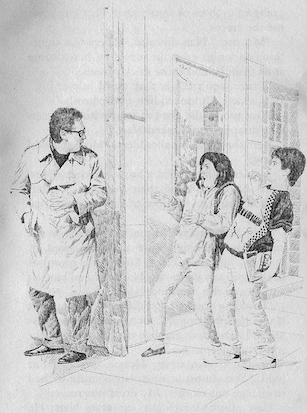
The tall man keeps looking over his shoulder and ducking into doorways, like someone is after them. It doesn’t take the kids long to realize who is following him because a man in a trenchcoat, who is walking behind the tall man, keeps pausing and pretending to tie his shoe or look in store windows every time the tall man glances back. It’s not very subtle. When the man in the trenchcoat sees Nan and Bert watching him, he gives them a menacing look and seems like he’s about to confront them, but then, he leaves. They lose sight of the tall man. It’s a bizarre experience, and it ends when the kids’ mother drives up with their younger siblings and gives them a ride.

At school, Nan meets her new science teacher, and she realizes that he is the tall man who was being followed by the man in the trenchcoat. He introduces himself as Mr. Newman (ha, ha), and he seems much more relaxed than he was before. That is, until they all see the message written on the blackboard in the classroom: “Newman, give up your plans. We’re watching you.” Mr. Newman exclaims, “Oh, no! They’ve found out! They know!” (I seriously wish that at least one of my old teachers had started their first day in class by saying that exact thing.) Mr. Newman doesn’t explain what it’s about. He just quickly erases the message on the board and begins talking about the science project he’s assigning.

When Nan tells her siblings about Mr. Newman and what happened in class, Freddie says that Mr. Newman will also be teaching the afternoon science club that he joined. Mr. Newman will be teaching them about robots, and they’re going to have a meeting at his house, where Mr. Newman will show the club his inventions. Bert says that Freddie can help them figure out what Mr. Newman is doing and what and who he’s afraid of after he’s seen the projects that Mr. Newman is working on.

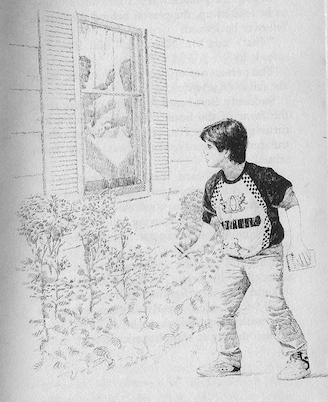
Bert decides to take a walk past Mr. Newman’s house to get a look at it before Freddie goes there. While he’s doing his reconnaissance, Bert sees what looks like people fighting in one of the windows. When he knocks on the door to see if Mr. Newman is all right, Mr. Newman says that he is and insists that there’s no one else there. Then, a strange woman shows up and starts asking Bert questions about Mr. Newman. She says that she’s his former boss at a computer company and wants to know if Bert saw anything in his house. She seems very interested in what he might be working on, but Bert just says that Mr. Newman was too busy for visitors.

Is this woman really Mr. Newman’s former boss, and does she have anything to do with the mysterious man in the trenchcoat? Someone breaks into the school and trashes Mr. Newman’s classroom. What is this secret invention of Mr. Newman’s that everyone seems so interested in, and why would someone threaten him over it or try to put a stop to his work?

The book is available to borrow and read for free online through Internet Archive.

My Reaction

The kids’ first thoughts about the mysterious people who are after Mr. Newman is that they might be spies, and they’re partly right. This is a matter of industrial espionage. People are after Mr. Newman’s invention because they can make a lot of money from it.

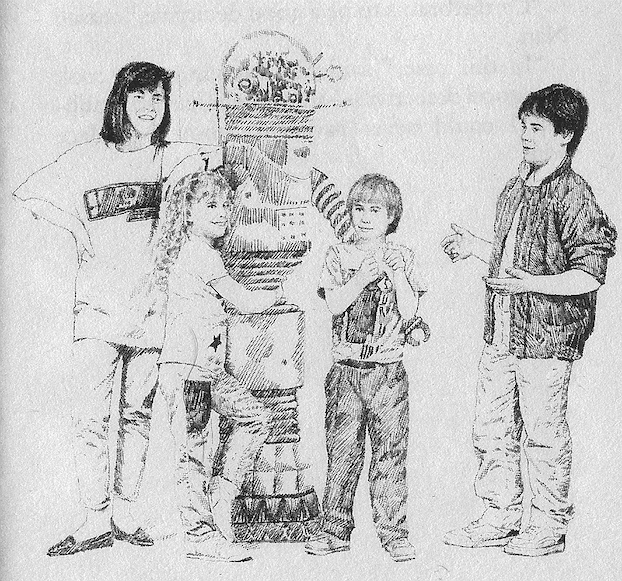
The robot Mr. Newman is building is really impressive, even by modern 21st century standards. Back in the 1980s, when this was written, a robot that large and sophisticated would have seemed almost like science fiction, although increasing developments in robotics technology would have made it seem more possible. Companies were working on developing robots during the 1980s, and Honda was working on a humanoid robot that could walk on two feet. Kids had toy robots. (I wanted one but never got one.) I don’t remember any classes for building robots for kids, but there may have been some that I didn’t know about at the time because I was still pretty young in the 1980s. In the 21st century, there are modern robotics classes for kids, and they sometimes show off their robots at competitions.