The Lighthouse Mystery

The Boxcar Children

The Lighthouse Mystery by Gertrude Chandler Warner, 1962, 1994.

The Boxcar Children and their grandfather have been visiting the children’s Aunt Jane. They are there to see her get married, and now they’re on their way home again. While driving home, they stop to look at a lighthouse and see a For Sale sign. The children are intrigued at the idea of owning a lighthouse, and their wealthy grandfather decides to ask a nearby storekeeper what he knows about the place. It turns out that the storekeeper has recently purchased the lighthouse himself, so it’s no longer for sale, but he’s willing to rent it out to visitors. The children’s grandfather is as fascinated at the idea of living in a lighthouse as the children are, so he decides to rent it for them to stay in.

During their first night at the lighthouse, the children’s dog, Watch, suddenly starts barking and growling. They can’t figure out what is upsetting watch, although Benny thinks that he smells food. They wonder if someone could be cooking something at the little old house near the lighthouse, but after a while, Watch calms down, and they all decide to go back to bed and check out the situation in the morning.

The next day, they go shopping for food, and the children find themselves looking suspiciously at everyone they meet, wondering if someone was near the lighthouse the night before. The first suspicious person they see is a man who almost knocks Violet over because he’s not looking where he’s going. Then, they meet a young man who seems angry about something. The storekeeper says that the young man graduated from high school early because he’s very smart, but his father won’t let him go to college. Grandfather Alden explains to the storekeeper that they had a prowler the night before, and he’s thinking about talking to the police about it. The children persuade their grandfather not to talk to the police because they want to investigate the mystery themselves.

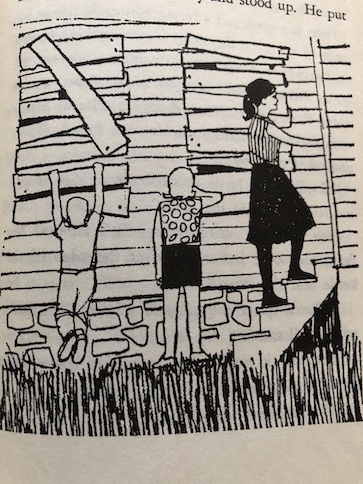
The next night, the children see a woman outside the lighthouse, but when they investigate, they can’t find anyone. They think maybe she went into the little house nearby. Later, they look through the windows of the old house, which are mostly boarded-up. Inside, they see food and cooking equipment, which means that someone might have been cooking there the night that Watch started barking. Strangely, they also see a microscope, seaweed, and something that looks like its glowing. They think maybe someone is doing an experiment of some kind. It could be the woman they saw, or it could be the clever but angry boy who isn’t allowed to go to college, Larry Cook.

When the town holds a special Village Supper, the children learn that Larry loves to cook. They make friends with him while helping him to prepare the food. As the kids become friendlier with Larry and talk with other people in town, they learn more about Larry’s father’s opposition to him attending college and how Larry has been trying to study on his own. They’re pretty sure that Larry is the one who’s been conducting some kind of experiment in the little old house, but what is he trying to do?

The book is available to borrow and read for free online through Internet Archive (multiple copies).

My Reaction and Spoilers

This is one of the early Boxcar Children books, written by the original author. Because it’s one of the early books, the children in the story age. In the books written by other authors after the original author’s death, the children’s ages are frozen, and Henry is always 14, but in this book, he’s in college. That means that he’s not too different in age from Larry, and the kids find out that the college Larry wants to attend is the same one that Henry attends.

At first, I thought that Larry’s father objects to him attending college because they can’t afford tuition, but someone else who knows the family says that Mr. Cook is just a selfish man. I’ve noticed that some people who never went to college take other people’s levels of higher education as some kind of personal insult, like people who go to college are just trying to make them look bad or somehow discredit their personal life choices. It doesn’t seem to occur to them that people might do things for themselves and make decisions for the sake of their own lives that have nothing to do with them in any way. I think that might be the kind of selfishness that the story is trying to describe. Mr. Cook is one of those people who makes everything about himself and feels the need to control other people’s lives to make himself feel good or justify his choices. I’ve also noticed that people who haven’t been to college often don’t understand how changing technology and job requirements cause people to need more education to do jobs that used to require less. They also don’t have the imagination to see how more education can help someone progress further and faster in their field or how it might open the door to new fields they haven’t experienced or even thought about. Because they haven’t sought more education themselves and aren’t accustomed to stretching themselves and looking for new ways to skill up, they don’t think that there might be possibilities beyond their scope. Mr. Cook even admits all of that later, saying, “I just made up my mind that he couldn’t go, and I hated to give in. You see I never had a chance for much schooling. I’ve done all right. I couldn’t see why Larry needed to go to college. A waste of money, I thought. I guess I’m quick to lose my temper and slow to change my mind.”

In spite of his selfishness, this acquaintance says that he thinks Mr. Cook really loves his son. He’s just accustomed to putting his son and his son’s future second to himself. What causes Mr. Cook to change is when Larry is in danger, out on the family’s boat in a storm. Faced with the prospect of losing his son completely, Mr. Cook promises that, if Larry is rescued, Larry can have whatever he want. College turns out to be the right course for Larry. It not only helps him to pursue his field of study but to connect with professors and students who also share his passions and love of learning. It suits him and the life he wants to live.

In some ways, this story is more adventure than mystery. By the time that Larry is rescued from the storm, the Aldens think they have a pretty good idea what Larry is trying to do, but Larry explains it all to them after his rescue rather than the Aldens needing to prove anything themselves. There is also no crime in this story. The mystery part is more about unexplained or mysterious circumstances. Larry hasn’t done anything wrong or illegal. He’s not even trespassing in the little house because his family owns it. Larry’s experiments combine his love of science with his love of cooking. He’s trying to produce new kinds of foods using seaweed and plankton that can help to feed the world.

The Boxcar Children Cookbook

The Boxcar Children

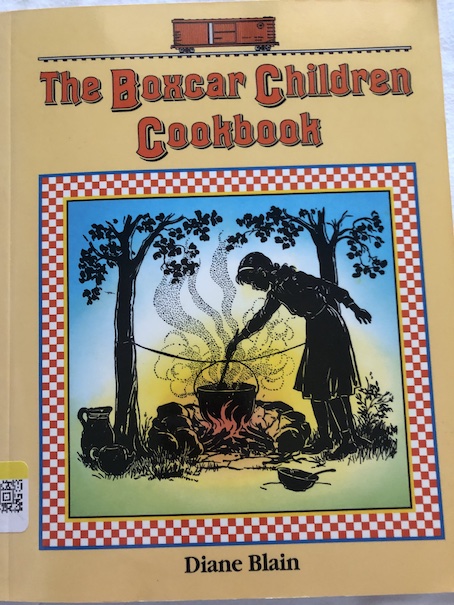
The Boxcar Children Cookbook by Diane Blain, 1991.

This book is a companion to The Boxcar Children series, written years after the original series by a different author. Most of these recipes weren’t included with the original books in the series, but the books often mention food. The children in the stories are often eating foods they like or demonstrating that they can prepare their own food. In particular, the youngest of the children, Benny, likes to eat.

The first part of the book discusses kitchen equipment, measurements, and safety rules. The recipes in the book are organized by types of dishes. There is even a section about cooking over a campfire because the children camp out in multiple books. Each of the recipes explains which story in the series mentioned that type of food. The books that the cookbook references are all part of the original 19 Boxcar Children books written by Gertrude Chandler Warner, not the later ones written by ghost writers under her name.

None of the recipes are very difficult because they’re meant for children, but they’re not overly easy, either.

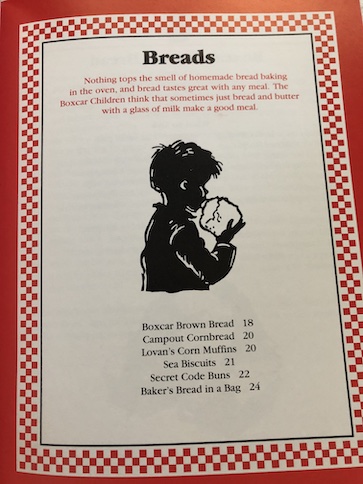
The section about beverages includes recipes for hot chocolate mix, strawberry milkshakes, lemonade, eggnog, and an orange drink. The breads section includes a recipe based on one that appeared in The Snowbound Mystery, which was a secret recipe for buns. However, the recipe in this book includes a shortcut using prepared sweet roll dough from the grocery store.

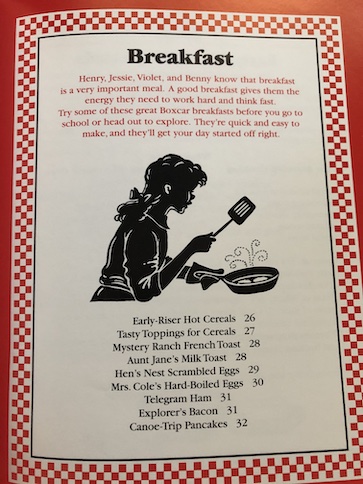
The breakfast section includes recipes for pancakes, French toast, and different types of eggs. I thought it was interesting that the page about hot cereals not only included recipes for oatmeal and cream of wheat, which are common ones but grits, hasty pudding, and cream of rice, which I had never heard of before.

There are sections for sandwiches and main dishes. There is also a section about salads and vegetables for side dishes.

The section about campfire cooking includes instructions for building a campfire and safety rules. There are also grill instructions.

Finally, there are sections for cookies, cakes and desserts. I think the cookbook is a fun way to add activities to accompany the stories. Cooking is a valuable learning experience, and many people like to experience foods similar to the ones that characters in their favorite stories enjoy.

The illustrations in the book are in silhouette form, like the illustrations from the very first Boxcar Children book, but they’re not exactly the same. Some of them have been changed to fit the recipes in the book, with characters holding foods that they weren’t holding in the original illustrations.

The book is available to borrow and read for free online through Internet Archive.

Fannie in the Kitchen

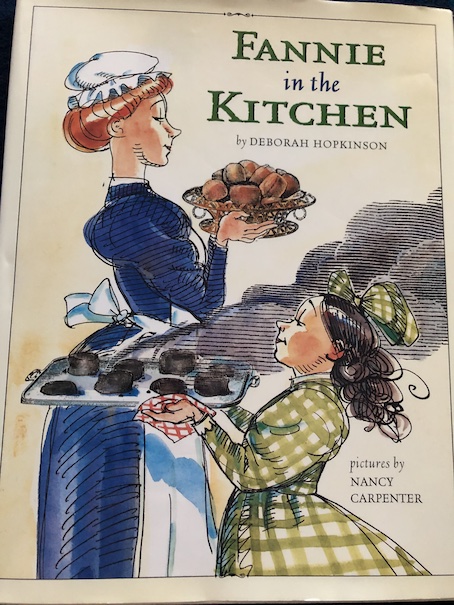
Fannie in the Kitchen by Deborah Hopkinson, 2001.

This is the story of Fannie Farmer and her famous and popular cookbook! When I first heard of the Fannie Farmer Cookbook (originally The Boston Cooking-School Cook Book (1896)), I wasn’t sure whether Fannie Farmer was a real person or if that was just a pseudonym or a marketing name for the cookbook, but Fannie Farmer was a real person in the late 19th century, and that was her real name. The story in this picture book is based on her real life, although details may be fictionalized, and the pictures give the story humorous twists.

In the beginning of the story, a little girl named Marcia Shaw prides herself on how many things she can do around the house and how much help she can give to her mother. However, she’s still a little girl, and there are some things she doesn’t know how to do well. In particular, Marcia doesn’t know how to cook. Now that her mother is expecting another baby, Marcia’s mother decides that she needs to hire some extra household help, especially with the cooking.

Marcia is a little offended that her mother considers her inadequate to help by herself, but when the new help arrives, a young woman named Fannie Farmer, Marcia has to admit that she’s a good cook. Even better for Marcia, Fannie doesn’t consider her cooking techniques trade secrets. She enjoys letting Marcia help in the kitchen and teaching her cooking tips.

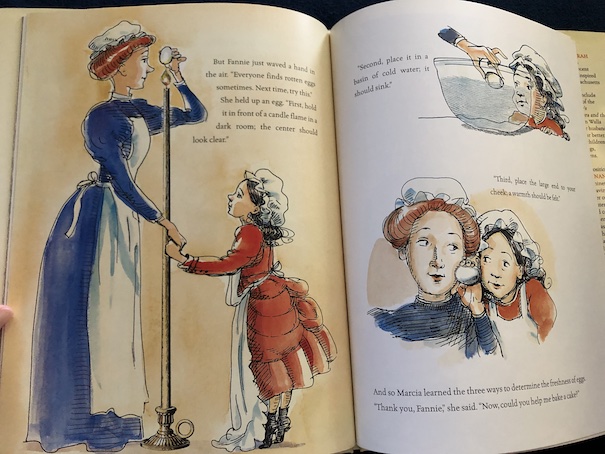
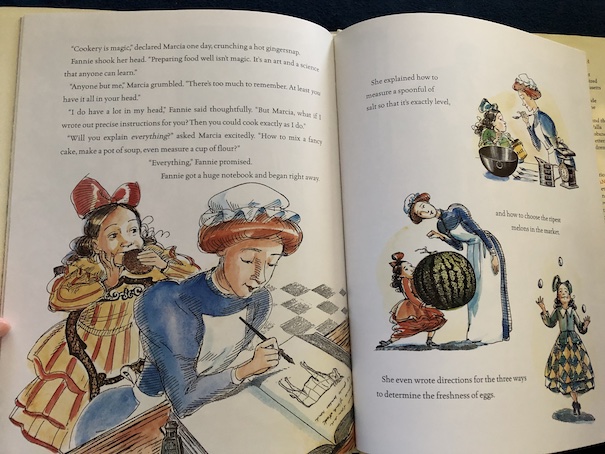
Under Fannie’s tutelage, Marcia’s cooking skills improve. Fannie teaches her many important pieces of information about cooking, like how to measure ingredients and how to tell when ingredients are fresh or if they’ve gone bad.

Marcia enjoys learning to cook with Fannie, but she thinks that she’ll never be as good as Fannie because there’s just too much to remember. She doubts that she’ll ever be able to memorize it all. Marcia is amazed that Fannie can keep all of that cooking information in her head. To help Marcia, Fannie decides to write out a notebook with recipes and cooking instructions, including all of the specific measurements for ingredients and detailed information about cooking techniques to make the recipes come out just right.

This is what makes Fannie Farmer and her cookbook so unique for their time period. If you’ve ever seen a very old recipe book or even just old family recipes written down, they often don’t have all of the amounts of ingredients written down, or the amounts are written in very vague terms. Old recipes also offer little to no cooking techniques, like how to tell when it’s time to turn a griddle cake over or how to tell if a cake is done baking. The assumption was that girls (usually girls for this time period) would learn to cook by watching their mothers and by learning from their examples. However, that assumes that their mothers knew all of these cooking tips themselves, that the mothers remembered to tell their daughters what they knew and explained it well enough for them to understand (some people don’t have much of a talent for teaching, even when it’s a subject they know themselves), and that the daughters understood or remembered everything their mothers said. Otherwise, the vague directions in cookbooks and family recipes were of little help, and new cooks had to learn through experimentation or trial and error. Fannie’s approach to cooking, as explained in the story, is an art and a science that anybody can learn if someone explains it well enough, so she puts her focus on recording all of the necessary details of her recipes.

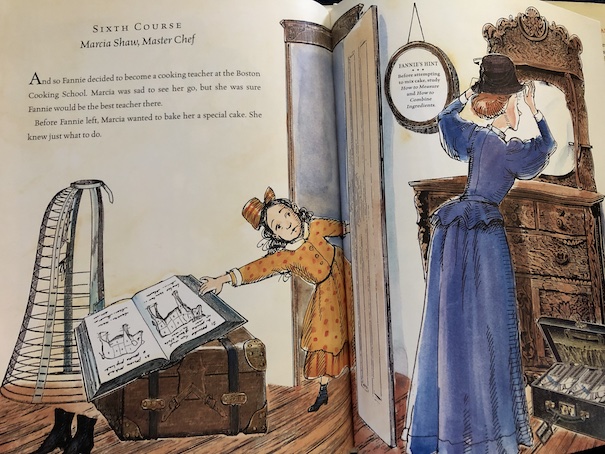
Fannie’s recipe book, started for Marcia, turns out to be very popular with both the Shaw family and their friends and neighbors. As word spreads about it, people start coming by to borrow recipes or get cooking advice. Fannie realizes that there is a lot of demand for better teaching of cooking techniques, and she really enjoys teaching cooking, so she decides to accept a job at the Boston Cooking School.

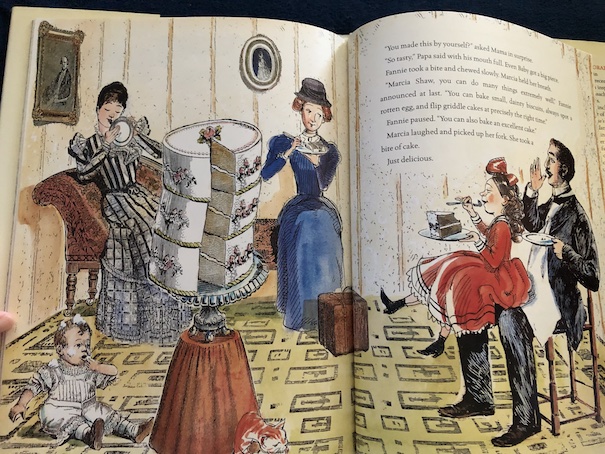
Before Fannie leaves the Shaws, Marcia borrows the cooking notebook and makes a special cake for Fannie to show her what she’s learned. The cake comes out just right because Marcia has followed Fannie’s directions.

There are hints from the Fannie Farmer cookbook throughout the book, and there is a section in the back of the book with historical information about Fannie Farmer. It also includes a sample recipe for Griddle Cakes.

The book is available to borrow and read for free online through Internet Archive (multiple copies). New and used copies are also available on Amazon. You can also buy the original Fannie Farmer Cookbook through Amazon or read it online through Internet Archive (multiple copies).

My Reaction

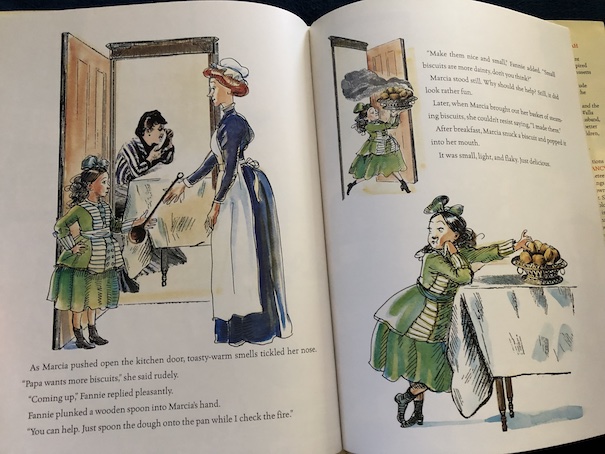
One of the things I liked about this book is the illustrations. There are eccentric details in the pictures that add humor to the story, like how Marcia stacks a bunch of chairs on top of each other while making candles, so she can make them extra long, and one of her extra long candles appears later, when Fannie shows her how to tell if an egg is fresh by holding it up to a light. For some reason, Marcia’s mother also has a weird habit of licking her dishes when she’s eating one of the yummy recipes, and there is one picture where it looks like she’s lost control of the baby carriage, and it’s rolling away with the baby. I’m sure these aren’t historical details and were just thrown in to be funny.

I think it’s also important to point out that the real-life Fannie Farmer lived an unconventional life for someone of her time period. She was plagued with health problems from a fairly young age. At some points in her life, she was unable to walk, possibly because of a stroke, and when she walked, she had a limp. She never married, but she built a fulfilling career around her talent for cooking. and achieved lasting fame because she wanted to share her knowledge with others. She is credited with establishing exact and level measurements in cooking in the United States, and she was also a strong believer in quality food and proper nutrition, especially for people with health problems.

The Super-Duper Cookie Caper

The Bobbsey Twins

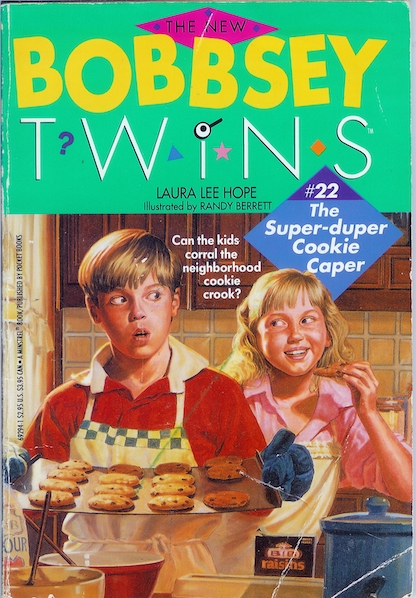
Bobbsey Twins Super-Duper Cookie Caper coverr

#22 The Super-Duper Cookie Caper by Laura Lee Hope (Stratemeyer Syndicate), 1991.

Before I begin, I’d like to acknowledge Sean Hagins, for supplying me with photos of this book! Usually, I take pictures of books myself, but I just couldn’t find a physical copy of this one. Sean is a big fan of the Bobbsey Twins, particularly the New Bobbsey Twins mysteries, and you can see some of his video reviews as well as videos about his photography work on his YouTube channel, SJHFoto. Thanks, Sean!

Freddie decides that he wants to get a new bike, and inspired by the school bake sale, he decides that he’ll make and sell cookies to raise the money. His grandmother makes really delicious oatmeal chocolate chip cookies that everybody loves, so he plans to make and sell them. He persuades his twin, Flossie, to help him by promising her part of the money from the cookie sales. Their parents approve of the plan, and their mother offers to help them because neither of them has much experience with cooking.

When Freddie and Flossie go to sell the cookies in the park, they’re pretty popular. Everyone loves the cookies, and Freddie boasts about his grandmother’s secret recipe. Their last customer is a man who gives them a dollar with some kind of white powder on it, and he doesn’t seem to think much of the cookies. Freddie doesn’t care because everyone else likes them, and they’re making money.

There are some complications to selling cookies. First, Flossie has a sweet tooth, and Freddie has to keep stopping her from eating their stock herself. Then, a boy at school, Brian, announces that he’s going to set up a rival business in the park, selling brownies. Freddie gets the idea of offering broken cookies as free samples and selling orders of cookies door-to-door.

Nan and Bert start helping with the cookie-baking, but things don’t always go well in the kitchen. There are times when they forget ingredients or let the cookies burn. Then, the children realize that the card with the recipe on it is missing! They search the kitchen and realize that there is a chocolate smudge on the kitchen window. It looks like someone reached through the window and stole the recipe!

There are a few logical suspects. It could be Brian, hoping to cash in on the success of the cookie-selling. It could be their old nemesis, local bully Danny Rugg, who stole their free samples earlier and generally likes to mess things up for the Bobbseys. Then again, there is the mysterious man who keeps showing up at the park. The Bobbsey Twins find out that he owns his own bakery. To find out who the recipe thief is, Freddie decides to invent a trap. He tells everyone that his grandmother has given him her other secret recipe for super-duper cookies that’s even better than the first one. Who will take the bait?

The book is available to borrow and read for free online through Internet Archive.

My Reaction

Sean and I were discussing earlier how later books in the New Bobbsey Twins series tended to focus more on the younger set of twins than the older Bobbsey twins and seem to involve lower-stakes mysteries. Earlier books in the series involved definite crimes, police matters, and strange phenomena. A stolen cookie recipe feels like much lower stakes. However, I thought this one was well-done for what it was. There are some definite suspects, enough to sow some doubt about who the recipe thief is. The actual thief is someone I suspected but not necessarily the most obvious suspect, and the thief’s motives do make logical sense, although I’m not sure (spoiler) any real adult would seriously consider that kind of business model. It sounds more like something a kid might do, and that’s partly what allows readers to doubt whether it’s a child or adult who took the recipe.

There is also a punchline to the story. There was one thing that I had guessed early on about the grandmother’s “secret recipe.” It’s not as “secret” as the kids think it is. I guessed that because, when I was a kid, one of my grandmothers always baked chocolate chip cookies. Those cookies were one of the highlights of going to her house. When we were little, my brother and I liked them so much that we guessed that she must have been a baker before she retired. When we were older, we found out that she’d actually been a bookkeeper and that her cookie recipe was just the Toll House recipe from the chocolate chip package. She made two versions, with and without nuts from the pecan tree in her backyard, but it was still the Toll House recipe. It’s a similar situation with the Bobbsey Twins’ grandmother’s secret recipe. The only thing the grandmother changed was the cooking time. Everyone just thought that the cookies were special because her grandchildren thought they were, and they convinced other people. Few things are as special as homemade cookies from your grandmother!

The Chocolate-Covered Clue

The Bobbsey Twins

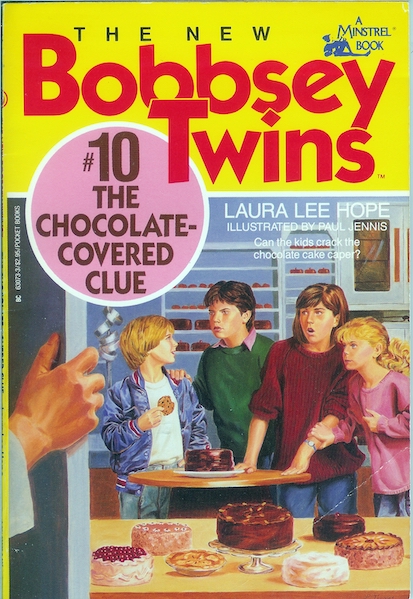
#10 The Chocolate-Covered Clue by Laura Lee Hope (Stratemeyer Syndicate), 1989.

Before I begin, I’d like to acknowledge Sean Hagins, for supplying me with photos of this book! Usually, I take pictures of books myself, but I just couldn’t find a physical copy of this one. Sean is a big fan of the Bobbsey Twins, particularly the New Bobbsey Twins mysteries, and you can see some of his video reviews as well as videos about his photography work on his YouTube channel, SJHFoto. Thanks, Sean!

Flossie has made a new friend, Casey Baker, whose parents own Baker’s Bakery. They invite her to come for a tour of the bakery to see how they make everything. It means getting up very early on a school morning because the baking has to start very early. They need to have everything freshly baked by the time the bakery opens for customers. Although it’s difficult to get up that early, Flossie enjoys the tour, seeing the large electric mixers where they make the cake batter and the enormous oven where they can bake over 100 cookies at once.

While the Bakers are showing her everything, they all realize that they feel cold. Someone has left the door to the alley open. Nobody is around, so they assume that it must have just been left open by a deliveryman making an early delivery.

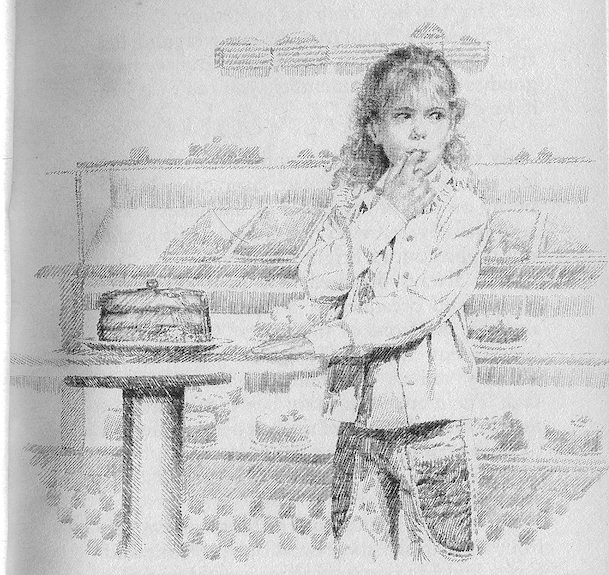
Later, while Flossie and Cassie are admiring a beautiful chocolate cake, something really strange happens. A masked man suddenly runs into the shop, grabs the cake, and runs away with it! Who could be so desperate for chocolate cake that they have to resort to theft? The Bobbsey Twins’ mother is covering a series of recent burglaries for the local newspaper, but this is the weirdest theft the kids have ever heard of.

It gets weirder as the day goes on. While Freddie and his mother are running errands, they stop at a diner, and the same masked man runs in and smashes the chocolate cake on the counter with his bare hands! Freddie tries to chase him, and the man throws cake at him. The cake that was smashed was also from Baker’s Bakery.

The Bobbsey Twins talk to Casey, and she tells them that someone stole their delivery list. From then on, this crazy cakenapper starts tracking down and stealing and smashing every chocolate cake Baker’s Bakery made that day – including the one that the Bobbseys had delivered to their house.

What’s behind all of this cake carnage and chocolate destruction? Does someone have a grudge against the Bakers or against chocolate-based desserts?

The book is available to borrow and read for free online through Internet Archive.

My Reaction and Spoilers

I really liked the premise of this mystery! It’s such a fun, crazy concept of someone going all over town, smashing cakes, apparently for no reason. It’s the sort of mystery that I sometimes call a “Bizarre Happenings” mystery. That’s a mystery where strange things happen that encourage the characters to investigate, but it’s not obvious what’s behind it all or what sort of crime is really being committed. An example from adult literature would be the Sherlock Holmes story, The Red-Headed League, where the characters know that someone has been deceived into joining a special club for red-headed men that doesn’t actually exist and paid to copy entries from the encyclopedia, but they’re not sure why at first. In the case of the Bobbsey Twins mystery, the characters know that someone is stealing and destroying chocolate cakes, which is a very bizarre form of theft, but they’re not sure why. Readers can guess from the beginning that this rash of cake thefts is related to a different crime.

Actually, the solution to the story is very similar to that of another Sherlock Holmes story, The Adventure of the Six Napoleons, where someone is stealing and smashing busts of Napoleon. It has nothing to do with Napoleon or the busts themselves. There is something hidden inside one of the busts that someone is desperate to find, but because the busts all look alike, they have to track down and smash them all to find the one they really want. It’s like that with the cakes. The destruction of the cakes has nothing to do with the Baker family, their business, or the cakes themselves. Someone came into the bakery, looking for a place to hide, and dropped something in the cake batter while it was being mixed. Because the batter in the massive mixer was made into multiple cakes, they can’t be sure which cake now contains what they want. They need to track down the right cake in a hurry, before someone else finds what they hid. What seems to be an oddball crime puts the Bobbsey Twins up against a dangerous criminal!

Encyclopedia Brown Takes the Cake

Encyclopedia Brown

Encyclopedia Brown Takes the Cake by Donald J. Sobol with Glenn Andrews, 1982, 1983.

This book is a little different from other books in the Encyclopedia Brown mystery series. Like other books, it’s a collection of short solve-it-yourself mystery stories with the answers to the mysteries in the back. However, this book also has special sections with recipes and cooking tips after each story. The recipe sections are based on things that happen in each of the stories. It’s best to read the stories first to avoid some of the spoilers in the recipe sections.

The book is available to borrow and read for free online through Internet Archive (multiple copies).

Stories and Recipe Sections:

The Case of the Missing Garlic Bread

Encyclopedia Brown’s neighborhood nemesis, Bugs Meany, and his friends stole some garlic bread and a chocolate cake meant for a birthday party. They deny it, but Encyclopedia Brown knows how to prove that they’re the thieves.

Kitchen Basics

The birthday boy’s mother gives the kids kitchen tips, like how to peel and cut vegetables.

The Case of the Fourth of July Artist

On the Fourth of July, a local boy known for trying to cheat people attempts to sell a picture of the Liberty Bell supposedly painted by one of his ancestors on July 4, 1776. Encyclopedia explains why the painting is a fake. (It was a good enough painting that the guy should have just tried to sell it as an ordinary painting instead.)

The Fourth of July Party

Encyclopedia and his friends make oven-fried chicken, some side dishes, and a red, white, and blue shortcake for their Fourth of July party. All the recipes are provided.

The Case of the Oven Mitt

A friend of theirs has started working in her father’s kitchenware store. On her first day, while she’s helping their friend, Hermes, to decide on a present for his mother, someone sneaks in the back and steals a couple of mixers. She feels badly about it, and at Hermes’s birthday party, Encyclopedia realizes that the thief is one of the party guests.

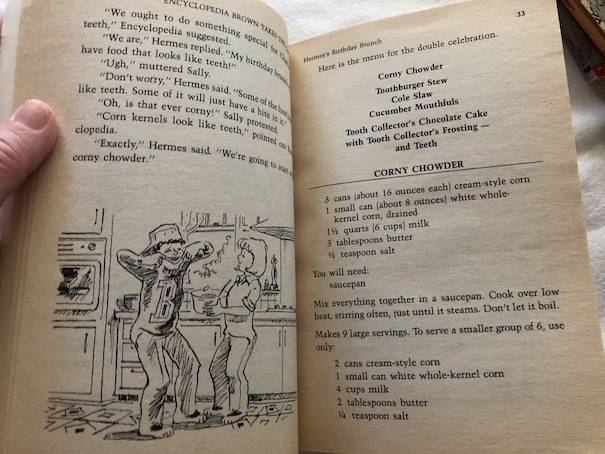
Hermes’s Birthday Brunch

In honor of a friend’s tooth collection, all of the food at the birthday party has something to do with teeth or foods that resemble teeth, like corny chowder and tooth-collector’s chocolate cake with frosting and teeth in the form of bits of marzipan and slivered almonds.

The Case of the Overstuffed Pinata

Bugs Meany steals a pinata from another boy. He insists that it’s his, but Encyclopedia proves it’s not.

A Mexican Fiesta

Encyclopedia and his friends make Mexican food, including cookies called polvorones, which are also known as Mexican Wedding cookies.

The Case of the Missing Watchgoose

A girl’s pet watchgoose goes missing. I didn’t like the solution to this one.

An Italian Dinner

The goose’s name was Christopher Columbus Day, so the kids cook an Italian-themed dinner.

The Case of the Secret Recipe

A friend of Encyclopedia’s, Beauford Twitty, invites his friends to his private potato museum to see his exhibits and sample a new recipe he’s created with a new variety of potato that his grandfather developed on his farm. While they’re there, someone steals a potato autographed by Yankees pitchers.

Dinner at the Twittys’

As a reward for helping to recover the potato, the Twittys give a dinner with no potato dishes at all: cream of chicken soup, meat loaf, corn pudding, baked tomatoes, lemon-buttered green beans, and apple pie.

The Case of the Chinese Restaurant

Oliver, who is a fan of Chinese food and the treasurer of the Service Club, is suspected of stealing from the Letterman’s Club treasury that was entrusted to him. Encyclopedia proves that he’s innocent.

A Chinese Banquet

Encyclopedia and his friends make Chinese food, including egg drop soup, Chinese riblets, egg rolls, and sweet and sour meatballs.

Snacks and Lunches

This section isn’t a story, just a collection of additional recipes for things like pizza made with pita bread, a variety of sandwiches, Twitty’s recipe for French fries from the potato story, French toast, cookies, and brownies.

Pointers from Pablo

Pablo, a young artist, offers advice on how to present and serve food while helping himself to cookies that Encyclopedia and Sally made.

Revolutionary War on Wednesday

Magic Tree House

Revolutionary War on Wednesday by Mary Pope Osborne, 2000.

The story begins with a prologue that explains things that have happened in the series up to this point, saying that Jack and Annie are currently undertaking a series of missions to four special types of writing for the library at Camelot. These missions cover books #21-24 in the series, and in this book, Jack and Annie need to find a piece of writing that represents “something to send.” To find this piece of writing, they’re off to the time of the American Revolutionary War!

When they arrive, it’s winter, and they find a camp of soldiers nearby. At first, they’re not sure which side the soldiers are on, so they sneak up to the camp to get a look at them. The soldiers catch them spying on the camp, but it’s okay because they’re Patriots, not British Redcoats. The soldiers tell the children that they had better go home, thinking that they’re just ordinary children from their time.

After Jack reads a little further in their book about the Revolutionary War, he realizes that this is December 25, 1776, and that they are about to witness the famous crossing of the Delaware River in Pennsylvania. This was a mission carried out in secret by George Washington and his men. The children listen while George Washington delivers an inspirational speech to the soldiers (“These are the times that try men’s souls.”), but a captain tells them that they had better leave because they don’t want children getting in the way of the mission. However, he asks them to do one favor before they leave. He asks them to take a letter to his family back in Frog Creek. He says that it’s a farewell letter, and they should only deliver it if they hear that the mission has failed and many soldiers were lost. Jack accepts the letter, realizing that this letter represents “something to send.”

Since the children know from their book that the mission will be successful, they can safely keep the letter. Jack thinks that their mission is over, but Annie has other thoughts. She climbs into one of the soldiers’ boats because she wants to spend more time with George Washington. George Washington tries to send the children back, but when the snow gets worse and he considers canceling the mission, the children have to persuade him to continue.

At first, the soldiers think that the children might be enemy spies because they seem to know too much about their mission, and one of them saw Jack writing something down earlier. However, Jack convinces them otherwise when he shows that he copied George Washington’s inspirational speech. He reminds George Washington about what he told his men about perseverance. Jack’s words inspire George Washington to take his own advice.

There is a section in the back of the book with more information about the Revolutionary War and places and people mentioned in the story.

The book is available to borrow and read for free online through Internet Archive.

My Reaction

I didn’t often read prologues to books when I was a kid, and I remember skipping over sections that explained the story background and past events in series that I followed regularly, but in this case, I was glad that the prologue explained the children’s mission. I’ve read books in this series out of order, although I don’t really recommend doing that. The books in the Magic Tree House series are very linear, and there are story arcs that extend over multiple books. If you skip around too much, it can spoil some surprises or disrupt the thread of the story.

I liked how this book introduced children both to the historical event of Washington crossing the Delaware and to the famous speech that he made. The lesson about perseverance was good.

The Rescue

The Rescue by Mary Cunningham, 1978.

Bob and Becca are going to stay at their aunt’s cabin in the mountains in California with their mother. Becca has been upset since she found out that her best friend, Elaine, will be moving to another state with her family. This trip is partly to get Becca’s mind off of losing her best friend, but Becca keeps thinking about how much she would have liked having her friend along on the trip. The only bright spot for Becca is that she might be able to write to Elaine about how nice the cabin, called Lantern Lodge, is or about the interesting things they might find to do. It’s not as good as having Elaine there to share the experience, but it’s better than nothing.

Lantern Lodge was originally built to be a guest cabin for friends of the movie star who once owned the mansion at the top of the hill. Now, the mansion is owned by an old man whose grandson is staying there with him. Bob wonders what the grandson is like and if he might want to go fishing sometime. There used to be a staircase leading up the hillside from the cabin, but it’s overgrown with brambles now.
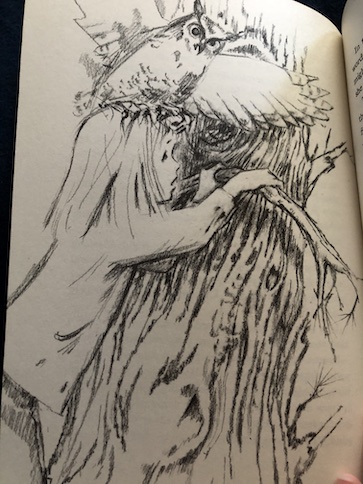
Becca finds her way up the hillside by following a friendly Siamese cat, who shows her how she can use a cherry tree to reach the portion of the old stairs that is still climable. When she gets to the top of the hill, she admires the greenhouse where the old man grows orchids. She also discovers that Bob got to the top of the hill before her and has already met the old man’s grandson, Dan. Without revealing herself to the boys, she listens to what they’re saying. Dan explains that he’s taking care of his grandfather’s house and plants while his grandfather is in the hospital with pneumonia.

There’s a weather report on the radio that there’s a storm coming and that people in vacation cabins should watch for flash floods. Bob asks if that means his family should leave Lantern Lodge, but Dan says that there shouldn’t be a problem because the lodge is well-constructed. However, Dan says that Bob should wait until after the storm to go fishing. Bob agrees and heads back to the cabin. Becca, who still hasn’t shown herself to the boys, decides to stay longer because she’s curious about the old mansion and wants to look around more.

Becca heads back to the cabin when it starts to rain, although it’s difficult to get down from the stairs and tree when they’re wet and slippery. Becca manages to do it unharmed, but her mother slips and hurts her arm when she comes outside to look for her. When her mother’s arm swells up, Becca goes to look at the plants where she fell and realizes that there’s poison oak or poison ivy there. The rain has gotten worse, and the road has flooded, so they can’t leave the cabin, even if their mother was able to drive with her injured arm.

Fortunately, the phone at the cabin still works, and Dan calls them to see how they’re doing. They explain about their mother’s injured arm, and Dan gives them the name and number of a doctor to call. He also gives them other advice for dealing with the situation, recommending that they cook as much food as they can and bring it upstairs in case the lower floor of the cabin floods. They should also fill everything they can with clean water for drinking and prepare candles in case they lose electricity. They follow Dan’s instructions and call the doctor’s office. The nurse on duty gives them some instructions for caring for their mother’s arm and says that they’ll try to send a messenger with some medicine.

Dan calls again later to tell them that cabins in the area are being evacuated, and he thinks they should leave their cabin, too. Bob tries to explain that they can’t leave because the road is flooded and help hasn’t come for them, but the phone line goes dead. He doesn’t know how much Dan understood. They know that there is an emergency crew helping with the evacuations, but without a phone, they can’t call for help. There’s only one way left to communicate with the outside world, and that’s the old flagpole that’s been there since before the telephone was installed. A white flag run up the pole is supposed to signal distress, but the rope is rotten, and they can’t raise the flag. Their mother is now feverish and not very aware of what’s going on. What are Bob and Becca going to do?

The book is available to borrow and read for free online through Internet Archive.

My Reaction and Spoilers

I’ve never been a fan of disaster movies or survival stories, but I did enjoy this one. At one point, Bob says that he used to like seeing disasters movies, but it’s very different from experiencing one in real life. The children are scared, but they try to stay practical and do everything they can to deal with the situation and keep themselves and their mother safe.

It’s not a very long book, but it has some useful information about dealing with disasters. After the phone line goes dead, the kids find a book in the cabin about dealing with disasters. Most of the information in the book doesn’t apply to them, but they make use of the parts they can.

Dan eventually reaches them, but the tree he tied his boat to falls over, trapping him in the house with the kids and their mother. The situation is still dangerous at that point, but the kids realize that there is now one more person to help them. Although Dan was sure that the cabin would be solid, they soon realize that it’s starting to break up, and they have to get out fast. Because he has assisted with other rescues, Dan has the experience they need to help the kids get themselves and their mother to safety. Also, don’t worry about Becca’s pet mouse. I was afraid at first that the mouse wouldn’t make it, but the mouse is okay in the end!

Having survived a real disaster puts the more minor disaster of Elaine moving away into perspective for Becca. It’s sad when a friend moves away, but there are far worse things, and she and her family have come through them together.

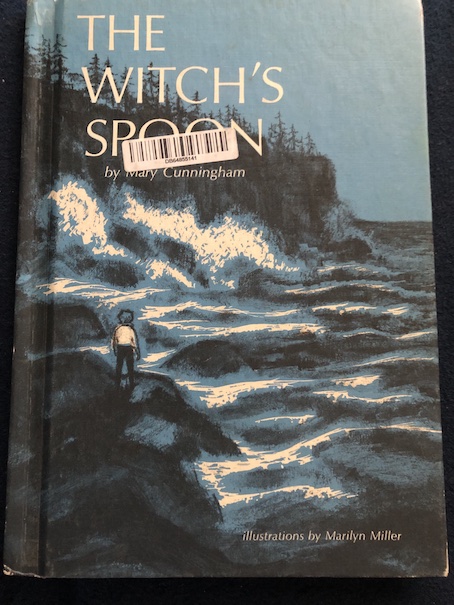
The Witch’s Spoon

The Witch’s Spoon by Mary Cunningham, illustrated by Marilyn Miller, 1975.

Tom and Lauren are spending a week with their grandmother at her beach cottage during the summer. They have visited the cottage many times before, and they love revisiting all their favorite places, the bunk beds on the cottage’s sleeping porch, like the tree where they always see baby owls (which they call the owl tree), and the place where they once found some lost coins (which they call the money spot). They know the cottage well, inside and out. This summer, though, there are a few things that are different.

The first thing that the kids notice that is different is that their Grandma has added a new item to her curio cabinet: a big silver spoon with a long handle. They ask their grandmother about the spoon, and she explains that it’s a witch’s spoon. She recently inherited it from the children’s Great-Aunt Hannah (that would be their grandmother’s sister), who used to live in Massachusetts. The spoon is a family heirloom from the time of the witchcraft trials in Salem (“when witches were thought to be as much of a problem to people as air pollution is now” – this is from the mid-1970s). Their grandmother says that there are good witches and bad witches, and good witches would use spoons like this one to stir love potions. Tom doesn’t believe in witches, but Lauren is fascinated by the spoon and the idea of love potions. She is sure that she senses magic from the spoon.

The next thing that will make the children’s visit here different from previous years is that their grandmother has decided that they’re old enough to have a June Day. June Days are a family tradition, and it’s not just because it’s June. During a June Day, the usual household rules are suspended for one day, and the children are allowed to go wherever they want and do anything they want, all on their own. Grandma says that she will prepare meals at the usual times, but for that day, it’s up to the children whether or not they show up for them, so they don’t need to interrupt their adventures. If the children aren’t there to eat their meals, Grandma will share the food with their nextdoor neighbor, Mr. Bunby. There are only a few safety rules that the children have to follow: they are expected to by careful when attempting any activity that might have an element of danger, and they have to leave their grandmother a note about the general area where they are going, like the beach or the nearby woods, so if they’re not back by dark, she’ll know where to look for them. The June Day ends when it gets dark, and the children must be home by then.

The grandmother understands that there is a certain element of risk in letting the children go off by themselves, and she reminds them that “every box has its pill.” That means that, while their children can choose what they’re going to do, they have to face the consequences of their choices, no matter what they might be, good or bad. “If you open the box and find a bitter pill, you have to swallow it.” Getting to make their own rules and decisions for a day doesn’t get them out of taking the consequences of whatever they do. If they get hurt or get into serious trouble, not only will they suffer the hurt or trouble they cause, but their parents may not let them come back next summer, so they need to keep that in mind when making their choices. Freedom still comes with responsibility, and that’s what the children need to be old enough to understand before they can have a June Day. Tom says that they understand, and that they won’t do anything too wild. Their grandmother tells them that they can have their June Day in two days, so they will have time to look forward to the treat and plan for it.

Tom and Lauren have different interests, so each of them decides to make up their own plans for a private adventure. Tom already knows what he wants to do for his June Day. There is a cave near the beach where the children usually aren’t allowed to go, but there are rumors that there is a giant cavern inside where pirates have hidden their treasure. Getting inside the cave will be difficult and involves an element of risk, but he is determined to spend his June Day hunting for pirate treasure. He doesn’t want to persuade Lauren to join him because he thinks she’ll be too scared to do it.

Meanwhile, Lauren thinks how she’s always wanted to hold a baby owl in her hands. She loves animals, and she decides that she’ll try to hold a baby owl on her June Day. She decides she won’t tell Tom about it, because he would probably think that was a silly thing to do. Lauren thinks that she even might try to make a baby owl a pet, just for the rest of the week.

There is one other thing that is different about this year, though. Their grandmother informs them that their cousin, Elizabeth, will be joining them at the cottage this year. Elizabeth’s father is the brother of Tom and Lauren’s father. Years ago, he moved to Italy and married a woman there, and they had only one daughter, Elizabeth. Unfortunately, Elizabeth’s parents died in a car accident, and Elizabeth has been living with her three aunts in Rome. She has never been the United States before and has never met either her grandmother or cousins, so the children’s grandmother has decided to invite her to visit this year.
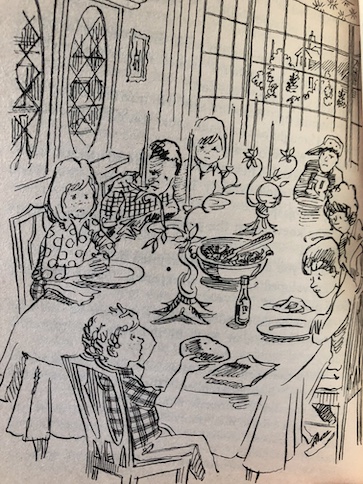
Tom and Lauren aren’t thrilled at the idea of meeting their Italian cousin. It’s partly jealousy at sharing their grandmother with a girl they don’t really know. Elizabeth was named after their grandmother, and Lauren worries that Grandma will like her better because of that. Tom complains that she’ll probably be fat and smell like garlic because people in Italy eat a lot of spaghetti. It’s a mean thing to say, and even Lauren thinks it sounds ridiculous, but the children’s negative attitudes are also because they realize that Elizabeth’s presence will complicate their secret plans for their June Day. In order to have their secret adventures by themselves, they will also have to avoid their cousin trying to tag along.

In spite of their negativity and thoughts about playing pranks on Elizabeth so she won’t want to stay, Lauren realizes that she is also curious about this cousin and seeing what she’s like. When Elizabeth arrives the next day, she is a slim girl with dark hair, who doesn’t smell like garlic at all. Elizabeth speaks fluent English as well as Italian because she goes to an international school in Rome, so the children are able to talk to each other easily. Lauren feels jealous about the attention that their grandmother showers on Elizabeth, but Elizabeth is nice to Lauren. Elizabeth likes to knit, and she says that she would like to make a sweater for Lauren. Lauren asks her if she’ll have enough time because she’s only visiting for a week, and Elizabeth says that if it’s not finished by the time she has to leave, she will mail it to her. Lauren begins to feel a little sorry that she thought bad things about Elizabeth, but she also still feels jealous because of all the things Elizabeth knows how to do. Elizabeth can play the flute and wears pretty clothes as well as knitting and speaking multiple languages. Then, their grandmother announces that Elizabeth will be allowed to choose one item from her curio cabinet to take back to Italy with her. Tom and Lauren aren’t even allowed to open the curio cabinet without permission!

Their grandmother tells Tom and Lauren that they will each have a chance to choose something from the cabinet when they’re older. The only reason why Elizabeth is choosing now is that she lives far away and can’t come very often. Tom and Lauren each have favorite items in it that they tell Elizabeth to definitely not take before they get a chance to choose, and Lauren suggests that Elizabeth take the witch’s spoon. The witch’s spoon hasn’t been in the cabinet long enough for Tom or Lauren to have developed an attachment to it. Elizabeth is intrigued by the story that witches used it for making love potions, and their grandmother says that, in times of trouble, you can look into the bowl of the spoon and see answers. Elizabeth says that it’s an Italian tradition that a good witch gives children presents on January 6th (see The Legend of Old Benfana). She tries to see her deceased father in the spoon and is disappointed when she can’t. Their grandmother says that it might not be magical anymore or maybe people only saw in the spoon what they wanted to see.

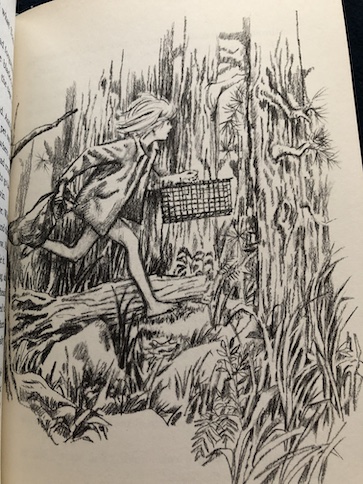
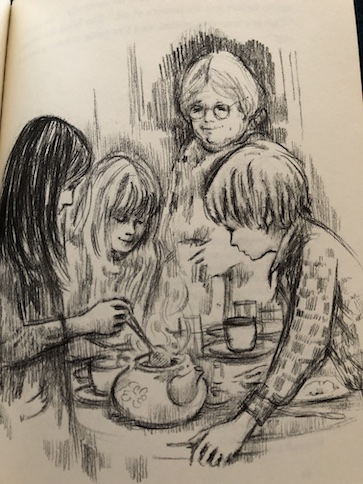
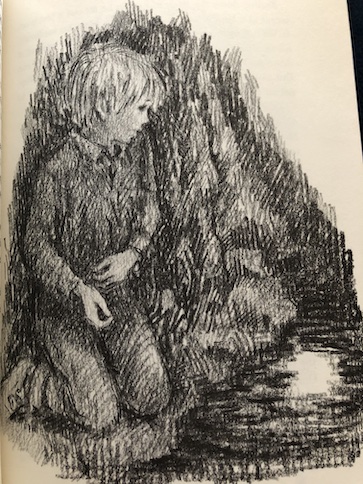
Tom and Lauren continue making their secret plans for their June Day, each kind of wondering what the other is planning to do. When the day arrives, they each get up early and put their plans into action before anybody can ask them what they’re going to do. Of course, their plans don’t turn out the way they thought. Lauren’s attempt to hold a baby owl and maybe make one a pet don’t take into account how the mother owl would feel about that. In the cave, Tom accidentally falls and drops his flashlight, so he’s trapped and unable to find his way out. Neither one of them was specific enough in their notes for anybody to find them quickly when they get into trouble. Fortunately, Elizabeth turns out to be not only a tag-along but a helpful partner in their adventures. Through their various adventures and disasters on this special June Day, the three children come to feel like they really are cousins. At the end of the story, the grandmother makes a special tea blend, and Elizabeth stirs it with the witch’s spoon, turning it into a love potion, but for family love.

I bought my copy of this book through Amazon. I haven’t found a way to read it online.

My Reaction and Spoilers

The book doesn’t say exactly where the story takes place, but I think it’s supposed to be the California coast because that’s where the author lived. The descriptions of the pine forest near the cottage and beach fit the California coast, and the same author wrote another book called The Rescue that takes place at a cabin in California.

The story has some nice cottagecore vibes, with the children having fun and adventures in nature. There are times that they reminisce about past summers at the cottage as well as enjoying the current summer. They once kept a lost, wild baby ferret as a pet temporarily one summer before releasing it back into the woods, and they always have to look for baby owls in the owl tree when they arrive at the cottage. They spend time at the beach, swimming, wading, sunning themselves, and looking for seashells. Lauren has a favorite type of seashell, called angel’s toenails. When Tom explores the cave, he likes seeing the stalactites, and he sees bats and a type of blind fish in the stream of the cave.

Few children these days have the same level of freedom that these children have at their grandmother’s seaside cottage, although for somewhat obvious reasons. Their grandmother speaks to them honestly and sincerely about the nature of risk-taking and accepting the consequences of their actions, but adults will realize that there are obvious problems with each of their plans for June Day. Even as a kid, I would not have tried to pick up a baby owl or keep one as a pet. Wild animals do not want to be made into pets, and they don’t want their babies to be picked up and held by humans. Owls are cute, but they are also birds prey with sharp beaks and talons and will fight back if they feel like someone is intruding on their personal space. Even my child self would have thought of that long before Lauren tries her June Day experiment. Of course, that’s mostly because my elders impressed on me that nobody should mess with wild animals. The reason why we know that certain things are bad ideas is that people actually tried them and found out from personal experience. Maybe some people have to try things themselves before they understand or believe why they’re bad ideas. I have to admit that I once tried to pick up a dead cactus pad when I was about four years old because I had the idea that dead things couldn’t hurt me, so I figured out that it wouldn’t hurt to touch dead cactus. That’s the Arizona version of this type of experimenting with interacting with the natural world, and I was very, very wrong. One benefit of this kind of hands-on experimenting is that the lessons you learn stay with you forever, but as the grandmother of this story says, you have to accept the results of your experiments, whether it’s a clawed head or a handful of cactus spines.

Tom is the one who takes the greatest risk in this story. When he first considers using the June Day to explore the cave, he knows that they’re not usually allowed to go there. The question that immediately came to my mind was why, and the obvious answer is that the adults know that the cave is too dangerous. Tom considers the difficulties of getting into the cave but not the dangers he can encounter inside. Just because the rules have been suspended for the day doesn’t mean that the dangers have also been suspended for the day, which was what their grandmother was trying to get the children to understand. It’s not unlike learning that cactus spines are just as sharp when the cactus is dead as when it was alive. Fortunately, Lauren and Elizabeth manage to rescue Tom without anyone getting hurt.

The adventures that Tom and Lauren end up sharing with Elizabeth help them bond as cousins. They also learn that, while Lauren has some unique skills and lives a very different kind of life in Rome that is exciting in its own way, she isn’t perfect and neither is her life. Elizabeth is an orphan who still misses her parents. The skills that she has are ones that she’s learned from her aunts, who each have their own standards for what Elizabeth should learn and do. Elizabeth’s aunts love her and care for her, but she isn’t always allowed to do what she wants. This summer represents an unusual amount of freedom for her, too.

I think Tom and Lauren might have taken Elizabeth’s sudden arrival better if their grandmother had prepared them for it instead of springing it on them without warning or discussion of how it would affect their summer plans. The grandmother might have also prevented some hard feelings by talking to all of the children about the gift for Elizabeth from the curio cabinet. I understand why Tom and Lauren wanted to prevent Elizabeth from suddenly taking things that they were attached to. If she had, it would have caused some hard feelings among the cousin. If I were the grandmother in this situation, I think I would have sat all three children down and told them that I wanted to give each of them a special gift from the cabinet. Tom and Lauren would have to leave their gifts in the cabinet for the present, partly because the heirloom Tom values most is a pearl-handled gun, and I think he’s too young to have that unsupervised. However, it would be understood that each of the children would own a special heirloom, and they could discuss their choices among themselves so there wouldn’t be hard feelings or the impression that one child was given more choice than the others.

There aren’t really occult themes in the story. The witch’s spoon only does one thing that appears like magic at one point, and there is a logical explanation for that. The love potion tea really just caps off the children’s day of adventure, when they bond over helping each other. The children know that the spoon probably really isn’t magic. The real magic in their imaginations and the time they spend together as family.

Mystery of the Angry Idol

Mystery of the Angry Idol by Phyllis A. Whitney, 1965.

Janice Pendleton is sad and nervous because the rest of her family will be moving overseas for at least a year, and she is staying in the United States to go to school. Her father is a consultant to the government, and his latest assignment is in Saigon in Vietnam. (This book is set contemporary to the time when it was written, in the 1960s. The Vietnam War lasted from 1955 to 1975, which is probably why Jan’s father is going there, although he is going as some kind of government consultant instead of an ordinary soldier. This book was written after the Bay of Pigs Invasion and President Johnson’s continuing escalation of the conflict in Vietnam.) However, things are dangerous in Saigon, so Jan’s mother and younger brothers, a pair of twins, will be living in Okinawa, Japan, so her father will able to visit them sometimes. (There’s a US Air Force base in Okinawa, Japan, and I know it existed and was in operation during the 1960s because, coincidentally, my older cousin was born there while my uncle was stationed in Japan in the 1960s. The book doesn’t mention this, but I thought I’d tell you that there’s an American presence there, including civilian relatives of military personnel, so Jan’s mother and brothers will likely be among other Americans during their stay there.) Twelve-year-old Jan could have gone to Japan with them, but she is much more advanced in school than her young brothers. They are so young than their education won’t be disrupted much by living in another country for a year or two, but Jan is older, and her family was worried about her losing her place in school.

Instead of going to Japan, Jan will be living with her grandmother and great-grandmother in Mystic, Connecticut and attending school there while her family is gone. It’s summer now, so until school starts, she will be spending her time adjusting to her new living situation and getting to know her relatives. Jan doesn’t know her grandmother very well, and she’s never even met her great-grandmother before. At least when she’s with them, she will be with family. However, her grandmother is a little worried about her great-grandmother’s health. Great-grandmother Althea doesn’t really leave her upstairs rooms anymore, and although she was much more lively and interested in people when she was younger, she doesn’t seem to have much stamina for meeting and talking to people these days. Jan is told that she will have to be careful and behave herself because, if she upsets her great-grandmother too much, she won’t be allowed to stay with them in Connecticut anymore. Instead, she would have to attend a boarding school in Boston. If she goes to Boston, she will be there alone, without any friends and family nearby, and she is nervous about that. She already knows that, by going to Connecticut, she will be removed from her parents and siblings and her friends in California, where she grew up.

To help her feel better, her father tells her more about her family’s history and great-grandmother Althea. When she was younger, Althea traveled through Asia because her father, Jan’s great-great-grandfather, was a merchant dealing in Asian art. (This is very similar to what the author’s father did for a living and why she spent most of her youth in Asia. More about that below.) Althea spent years living in China with her parents while her father bought and commissioned pieces of Chinese art and sculpture that he could sell and collect for himself. However, after her mother died, Althea was sent to a boarding school in Boston. Her father was later killed during the Boxer Rebellion. Althea was in China at the time when they realized that trouble was coming. She survived and escaped to the United States because her father sent her to stay with some friends of his. She took some of the smaller pieces from his collection with her.

Now, Great-grandmother Althea has an impressive collection of Asian art herself, including some of the pieces that she managed to smuggle out of China when she had to flee. There is one piece in her collection that seems particularly mysterious, an ugly statue in the style of a Chinese idol that she keeps turned to the wall. (The “idol” was never used as an object of worship, for those worried that Althea’s father may have looted a temple or appropriated a Chinese national treasure of some kind. Althea says that one of his artist friends made the statue specifically for him. It’s important to the story that it is in the style of an idol but that it is also genuinely ugly and of little intrinsic value.) Jan’s father implies that there is some kind of mystery surrounding that statue, but he doesn’t really explain what it is. Jan’s father worries a little about Althea because she always used to be such a lively woman, and he says that, in her old age, she has become a kind of hermit who has shut herself away from the world and lives like a “vegetable.” He hopes that Jan’s youthful presence in the house will help her become more interested in life again, although Jan doesn’t see how that can happen when she risks being sent away to boarding school if she “bothers” Althea too much.

When Jan arrives in Connecticut, everything is awkward because she doesn’t get her own room in the house. Instead, she has to sleep on a cot in the living room. Her great-grandmother doesn’t even want to see her right away. There is a storm that night, and Jan has trouble sleeping. The next day, she sees a neighbor boy outside and decides to try making friends with him because she really needs someone her own age to talk to. The boy, Neil, doesn’t seem entirely friendly, but he does talk to her down by the nearby boat dock. He tells her that, the night before, he noticed a strange, suspicious-looking man hanging around her family’s house, and he wonders if anything from the house was stolen. Jan says that she doesn’t think so and that she didn’t hear anyone come in, but because of the noise from the storm, it’s hard to say for sure if someone tried to get into the house. Neil points out that the mysterious stranger is still hanging around the house, and Jan sees a man with a beard hanging around nearby.

Their conversation is interrupted by the arrival of a boy in a boat. Neil and the boy in the boat don’t seem to like each other, and the boy in the boat seems to immediately resent Jan for talking to Neil. He tells her that she’d better not try to get into his boat because Neil tried to get in uninvited earlier. Jan is insulted by this rude boy and returns to her relatives’ house. There, she learns two surprising things. The first is that the boy with the boat, Patrick, is actually the son of Mrs. Marshall, the housekeeper, so they will be seeing a lot of each other. Jan’s grandmother had hoped that Jan and Patrick would be friends. (So far, they haven’t gotten off to a good start.) The second is that it looks like something may have been stolen from the house last night. The mysterious statue is missing. Jan tells her grandmother and Patrick about the strange man that she saw and what Neil said. Her grandmother has trouble believing that a theft really occurred. She thinks that great-grandmother Althea may have just moved the statue and forgotten, but Patrick is interested in the mysterious man.

When Jan goes upstairs to meet her great-grandmother for the first time, she discovers that Althea is not the “vegetable” that she’s been lead to expect. Althea is physically feeble and stays upstairs because her knees are bad and can’t handle stairs anymore. However, she is mentally sharp and highly observant. She talks to Jan about her family’s past and her own past. She understands that Jan didn’t really want to come to Mystic and be separated from her family, but her father wanted her to come and learn more about her family’s history. Althea explains that she spent a large part of her youth living in Shanghai until her mother’s death, when her father sent her to a school in Boston, and she really hated it. This is reassuring because Althea is less likely to send Jan away, remembering her own youth.

Althea also explains that she isn’t unhappy with her relatively isolated life in the upper rooms of the house, surrounded by the pieces of Asian art in her collection. She says that it’s just another phase of life. Life moves in phases, and a person knows when they’re ready for the next phase. When she was a little girl, she loved paper dolls and couldn’t imagine life without them, but as she got older, playing with paper dolls became dull, and she was ready for new activities. Similarly, when she was young and active, she couldn’t imagine a life without travel and meeting other people. Now that she can’t get around as well as she used to, she has entered a new phase of life where she enjoys quiet time alone and thinking and remembering. She is still somewhat in touch with the world because her rooms have a nice view of the Mystic Seaport, but she no longer has to deal with crowds and traffic and bothersome household chores and schedules. Jan is still young and active, so she has trouble fully understanding Althea’s isolated life of reflection, but Althea says that she will understand someday, when she’s ready for that phase herself.

Jan is interested in the objects in Althea’s collection, and Althea shows her some pieces and explains a little about their history. There are some pieces of scrimshaw that Jan’s great-grandfather carved himself, like a carving of a woman’s hand that Althea says was originally meant as a paperweight but which she had mounted on the head of one of her canes. Her other cane has a carved cat. Althea also owns a chess board with red and white pieces made of ivory and cinnabar, with the figures carved in an Asian style. Jan notices an empty shelf in the room and wonders if that’s where the missing statue is supposed to be.

While Jan and her grandmother are standing on an upper porch, looking at the view, they look down and see the mysterious man talking to Mrs. Marshall, who seems worried and upset. Mrs. Marshall and the man notice that they’re being watched, and the man waves to Althea and greets her. Even though the greeting is friendly, the man seems to upset Althea. When Jan asks about him and tells Althea what Neil said, Althea says that the man’s name is Eddie. She loved Eddie when he was a little boy, but she thinks he’s become a scoundrel. She says that Eddie came to see her the night before, but she didn’t want to see him and sent him away. Althea thinks he probably took the missing Chinese idol, but she also says that she always hated that statue. It had such a reproachful expression on its face that she turned it to the wall so she wouldn’t have to see it. Rather than dealing with Eddie or discussing the situation further, Althea says that she would rather just forget about it all.

Jan spends more time with Althea, until Althea gets tired. Althea shows Jan other pieces from her father’s collection of jade objects, explaining the different colors of jade and their relative values and the connections the pieces in the collection have to Chinese folklore and mythology. She says that her daughter-in-law, Jan’s grandmother, worries about robbers breaking into the house to steal these things, but Althea prefers to keep her collection close rather than locked away somewhere. The pieces in the collection bring back happy memories for her.

Jan’s grandmother owns a book store in a local historical district. When Jan goes to see the book store, her grandmother allows her to explore the area and tells her to be sure to visit Patrick’s grandfather at the rope walk (the place where they make rope). Jan goes there and encounters Eddie again. Eddie seems to want to speak to her, but Jan is afraid of him and avoids him. Grandfather Marshall had just been arguing with Eddie, and he’s in a bad mood when Jan darts inside. At first, he snaps at her when she rushes in. When Jan introduces herself and explains that she was startled by Eddie, Grandfather Marshall calms down and apologizes for snapping at her. Jan tries to ask him more about Eddie, but all he says is that he doesn’t want to talk to him, and he advises her to keep avoiding him. He shows her around the rope walk and explains to her how rope is made, and he also shows her a model ship he’s making for Althea that looks like the sailboat her husband used to own called the Happy Heart.

On her way back to her grandmother’s book store, Jan meets Eddie again. He explains to her that he’s actually Patrick’s older brother and the black sheep of their family. He also used to be friends with Jan’s father when they were both young, although Jan’s father was older than he was. Eddie badly wants to communicate with Patrick. He asks Jan if she’ll take a message to Patrick for him, and he hands her a note, leaving quickly before she can say anything. Jan shows the note to her grandmother and asks her what she should do about it. Without going into specifics, Jan’s grandmother says that Eddie was always a wild child, and years ago, he did something that was very scandalous, and he had to leave town. That’s why most people in town don’t want to see him or talk about him in public, although there’s been plenty of private gossip about what he did. The Marshalls have been friends with the Pendletons for years, and Jan’s grandmother thinks that it’s probably time to forgive and forget what Eddie did, which is why she doesn’t want to pass on gossip about him and make things harder for him and his family. She tells Jan that it’s fine to give Patrick the note from Eddie.

Jan’s delivery of the note thaws her relationship with Patrick a little, and he gives her a ride back across the river to her family’s home in his boat. There, Mrs. Marshall tells Jan that, because her meeting with her great-grandmother went well, Althea has decided that she can be trusted, so she will now have a room upstairs in the house. Jan just needs to be quiet whenever she’s upstairs because Althea likes to nap. Jan begins to feel a little more at home and less like an awkward visitor.

However, strange things are still happening in and around the house. Eddie is still lurking around, and nobody wants to tell Jan what he did to turn himself into such a black sheep. She overhears a late night conversation between Althea and Eddie where the two of them seem to be discussing secrets and playing cat and mouse with each other. Yet, Althea gives Eddie a job doing yard work and seems to be trying to help him redeem himself. He returns the statue that Althea never liked but seems to take other things. Althea tries to send him away when he causes problems, but he insists on hanging around and claims that he’s trying to help Althea. Like others, he believes that there is a secret behind the ugly statue that seems to make Althea nervous, although Althea doesn’t think that the statue contains any real mystery.

As Jan struggles to understand what’s happening around her, she risks getting on the bad side of the reclusive and temperamental Althea just as her great-grandmother seems like she’s becoming fond of her. The Pendleton house isn’t entirely a happy one, and the reasons why are buried in Althea’s past as well as Eddie’s. The clues have been right in front of Althea the entire time, but although Althea is intelligent and thinks she understands everything, there’s something critical that she’s overlooked all along, which changes everything.

My Reaction and Spoilers

Background of the Book

Many of the themes of Phyllis A. Whitney‘s juvenile mysteries come from her own life. When she was young, she lived with her family in Japan and other countries in Asia because her own father was working overseas. She was born in Japan, and her middle initial stands for Ayame (the Japanese form of the name Iris). Whitney’s parents were American, but she didn’t live in the United States until she was a teenager. Both of her parents died while she was a teenager, and she went to live with an aunt in Chicago, so she understood the feelings that kids could have, moving around, living in different countries, being separated from parents, and living with relatives. Because of her upbringing in Asia, many of her books, even those set in the United States, include some mention or aspects of Asian art or culture, especially Japan.

I think both Jan and Althea are reflections of the author and her life. They both share some aspects of their lives with the author, but Jan is probably more like the author in her youth, and Althea is the older version, looking back on her life and remembering what it was like to be young with the knowledge of what it’s like to be old.

The Atmosphere

I really liked the atmosphere of the story! It’s a lovely, old-fashioned house. Althea’s museum-like collection room is fascinating, and the room that she gives to Jan is cozy. Jan’s upstairs room has rosebud wallpaper and a four-poster bed and rocking chair. The room is a little worn and shabby, but Jan loves it. Her grandmother gives her milk and gingerbread on a china plate decorated with violets as a bedtime snack, and she reads old-fashioned children’s books, like A Little Princess by Frances Hodgson Burnett. Jan doesn’t usually read older children’s books, but there’s a collection of them in the house, left by the generations of children in her family who had grown up there.

Relationships

When Jan first meets Neil and Patrick, she realizes that neither of them is really the ideal friend for her. She continues to associate with them partly because she can’t help it. They’re both always around because Patrick’s mother is the housekeeper at Jan’s relatives’ house, and Neil’s family lives next door. Also, Jan doesn’t have anyone else her own age to talk to, although she is realistic and thinks that she should look for other friends in this town because both of the boys are difficult in different ways. Patrick is impulsive and temperamental (a bit like his grandfather the day Jan meets him – snapping at her just because he’s in a bad mood at someone else), and he has a chip on his shoulder because of his brother’s troubles.

However, Neil is even more temperamental. Jan quickly notices how Neil’s mood can abruptly shift from pleasant to irritable and how he doesn’t seem to have much compassion for other people. She later realizes that he’s most charming when he wants something from her or someone else. Neil’s ambition in life is to be a radio interviewer. His uncle is a radio announcer and has encouraged Neil’s ambition. Neil’s hobby is interviewing people and recording his interviews for practice. Some of his teachers have found his interviews fascinating and have played them in class because, while he has never interviewed anyone famous, Neil has interviewed people who have done some really interesting things, like the janitor who was once a prisoner of war during WWII. Neil’s also a little sensitive about his interviews because his father doesn’t think much about his ambitions and would rather that Neil go into his business when he grows up, and sometimes, other kids tease him. Part of the reason why Neil is interested in being friends with Jan is that he would love to interview her great-grandmother because she had a fascinating early life in China. He is also aware that there is some secret about the angry-looking idol in her collection, which she has always felt compelled to keep even though she doesn’t like it. Neil is obsessed with his life’s ambition and is willing to do just about anything to promote it. He also has a chip on his shoulder toward Patrick and Eddie and others who have made fun of what’s important to him and tried to discourage him from doing what he wants to do.

In the end, as Jan comes to know the two boys better and both confronts them over their behavior and helps them through the troubling situations they have, the relationships between the three of them improve. After everything that happens, they all come to realize that each of them has done something wrong or misjudged someone else. This doesn’t completely absolve any of them from things they’ve done because some of them could have had serious consequences for other people as well as themselves. There are things that each of them has to do to make things right, but because each of them has something they need to do to fix things, something to learn, or something they need to apologize for, they realize that they are willing to let each other make amends and to accept each other’s efforts to change. These feelings also extend to others in the story, especially Althea and Eddie. Everyone in the story has misjudged someone or the situation, and everyone has something they need to learn, understand, and change.

Happiness and Redemption

Themes about happiness and redemption run all the way through the story. Eddie’s part of the story focuses on redemption. Part of his troubles are of his own making, but Jan learns that he’s also been falsely accused and badly misjudged. Like others in his family, he has a quick temper and needs more impulse control, and he used to be pretty wild and hung out with a bad crowd. What others know about him and are initially reluctant to tell Jan is that Eddie went to prison for being involved in a robbery and is now out on parole. However, as both Patrick and Eddie explain, Eddie wasn’t actually involved in the robbery. Some of the friends he used to hang out with did it, and they implicated him out of spite when they got caught because he refused to go along with their plan. Althea believed him when he said he didn’t do the robbery and paid for his legal defense, but he was convicted anyway because of his history with the people who committed the crime and because witnesses misidentified him as one of the people who was there.

Althea still doesn’t really believe Eddie was involved in the robbery, but she does know that he causes trouble because he lacks self-control and has lingering resentment about the way people look at him because of the trouble he’s been in. Eddie later says that he’s unfriendly to other people because they’re not friendly with him, although I think it’s fair to point out that people believe badly of him because he’s lived the kind of life where everything he’s been accused of doing are completely credible. That means that, even before he was falsely accused of robbery, the way he lived and the way he treated other people made almost everyone he knows in his home town willing to believe that he was a criminal. There seem to have been significant lifestyle and behavioral choices on Eddie’s part that created his bad boy image and led up to this situation. He may not look at it this way, but he kind of set himself up almost as much as his supposed friends did because of the choices he made with his life, his choice of friends, and his neglect of people who once might have believed in him. Even his own parents believe the worst of him at the beginning of the story, and the way he’s been acting ever since he reappeared in Mystic supports the view that he’s still the kind of person he used to be and people think he is.

As my grandfather used to say, it’s easier to keep a good reputation than to redeem a bad one. It’s not impossible to redeem a bad reputation, but it takes both work and time, and Eddie doesn’t have much patience with the people whose patience he’s already exhausted. He’s only just reappeared in town, but he’s already angry that people are looking at him suspiciously for just showing up. He’s upset that other people aren’t giving him a chance or instant forgiveness and acceptance, but at the same time, he really isn’t giving them much of a chance to see that he’s changed or giving himself enough time to demonstrate that change. Fortunately, some people, like Jan’s grandmother, are willing to drop the matter and give Eddie the chance to prove that he’s changed, and Althea tries to help Eddie by giving him jobs and letting him stay with them in the house for a while.

For a while, Eddie tries to prove that he’s a hard worker and a steady person, but, when Eddie loses his temper with Neil for carelessly wrecking his yard work while trying to catch his runaway dog and turns the garden hose on Neil, Miss Althea starts to think that she’s made a mistake. She craves peace and solitude, and Eddie is one disaster and temper explosion after another. At one point, she tries to send him away, telling him that it would be easier for him to start over somewhere else, where people don’t know his history, and he can cultivate a completely new life and image. Eddie moves out of her house, but he refuses to leave town. He has another job now, thanks to Althea’s recommendation, and he refuses to leave town as if he’s in disgrace when he hasn’t done anything wrong. I didn’t really like Eddie, particularly in the beginning, because he doesn’t really see the way he has made his own reputation and provoked other people, but I think his redeeming characteristics are his determination and perseverance. His attempts to change his reputation are clumsy and impatient. I think he expects too much of other people too soon as he tries to rebuild his relationships with the people he’s offended and pushed away before, but I appreciate that he still cares enough to keep trying until he gets it right.

In facing up to the situation with Eddie and with Jan’s clumsy efforts to figure out what’s going on and make things right, Althea also comes to some realizations about herself and the way she’s been living. Enjoying some solitude and a slower pace of life is fine as a person gets older, but Althea comes to the realization that the way she’s been going about it has been selfish and has cut her off from the people around her. She is out of touch with the lives of people who were once close to her and has failed to understand them and appreciate what they’re going through because of her determination to avoid becoming involved with other people’s problems or deal with anything unpleasant.

The reason why she doesn’t like the ugly statue is because her father carved a message in the back of it, telling her to find a “happy heart.” The theme of happiness used to be one of her father’s favorite topics of discussion when he was alive, and he often lectured her on how to be happy. Althea never liked it when he would lecture that happiness is based on the way a person lives and the choices they make, pointing out times when her own choices or priorities were making her unhappy. She always thought that her father sent her that ugly statue with the “happy heart” message before his death because he wanted to tell her, yet again, to be happy, and she felt like the statue’s ugly snarl was like a rebuke every time she wasn’t happy or made bad decisions. Being lectured and rebuked doesn’t make a person feel good when they’re already feeling bad, as Eddie knows from his experiences. However, Jan and Althea both come to realize that Althea has misunderstood her father’s message and intentions on multiple levels for most of her life.

Althea gets extremely upset one day when Jan says that someone tried to steal one of her most precious jade statues. At first, Jan’s grandmother thinks that Jan’s imagination is running away with her and that her presence in the house is too disturbing for Althea to handle, talking again about sending Jan to boarding school, but Althea later explains that Jan isn’t the reason why she’s upset. She’s upset with herself. She realizes that Jan was wrong about the person taking the statue because she herself had given the statue to Eddie, telling him to sell it to get money to start over somewhere else. However, part of the reason Eddie wants to stay in town is to help Althea, to pay her back for paying his legal bills when he was in trouble. When she sees that either Eddie or Patrick returned the statue because Eddie cares more about struggling to restore his reputation and relationships than about money, she feels terrible that she tried to bribe Eddie to leave out of her own selfish desires.

Happiness and peace of mind can’t be bought, either with money or precious objects, and it doesn’t come from avoiding the parts of life that are unpleasant. Happiness comes from embracing life, all of it, even the parts that are hard, and from maintaining meaningful relationships with people you love, even through their struggles. You have to take the bad with the good to experience life fully. Once Althea comes to these revelations about the life that she’s been living and the life she really wants to live, she feels the peace of mind she’s been seeking and no longer fears the gaze of the statue or the rebukes that she thought that her father was giving her through the statue. Her life doesn’t have to be perfect, every choice she makes doesn’t have to be perfect, other people don’t have to be perfect, and her happiness doesn’t have to be perfect and constant for it to be real happiness. However, there are a couple of other mysteries surrounding the story that Jan manages to clear up, including the fact that Althea’s father had something else in mind with his last message. Althea was so sure she knew what her father was telling her that she didn’t look deeper, but Jan does and discovers the treasure that Althea has been ignoring the whole time.