The Children of Green Knowe

Green Knowe

The Children of Green Knowe by L. M. Boston, 1954, 1955, 1982, 1983.
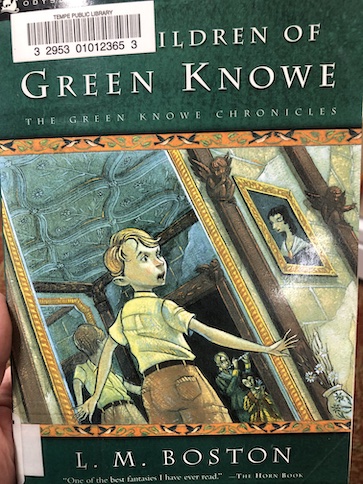
Seven-year-old Toseland is traveling by train to stay with his great-grandmother Oldknow at the old family home, Green Noah, for Christmas. His mother is dead, and his father now lives in Burma with his new wife, who Toseland doesn’t know very well. He has no brothers or sisters, and he spends most of his time at boarding school, so he is often lonely, wishing that he had a family outside of school, like the other boys. His great-grandmother is the only other relative he has, and he has never met her before. He is a little nervous at the idea of meeting her because he knows that she must be very old.

When Toseland arrives at the station, it’s raining, and there has been flooding, but there is a taxi-man waiting to take him to the house. When he arrives, he is immediately fascinated by the large, old house and all of the things in it. It reminds him of a castle, and he marvels at how his great-grandmother could live in such a place. He is surprised at how at home he feels there and how easily he likes and gets along with his great-grandmother. For the first time in his life since his mother died, he really feels at home, and when he asks if the house partly belongs to him, too, his great-grandmother reassures him that it does.

The two of them talk about what to call each other. Toseland’s great-grandmother asks him to call her Granny (although she is still often called Mrs. Oldknow throughout the book), and she asks him if he has any nicknames. Toseland says that the boys at school call him Towser and his stepmother calls him Toto, but he doesn’t like either nickname. Granny Oldknow says that Toseland is a family name and there have been other Toselands before him. The last one was his grandfather, and his nickname was Tolly, so Granny asks him if he would like to be called that also. Toseland says that he likes that nickname better than the others, and his mother used to call him that, so he is called Tolly from that point on.

Granny Oldknow shows Tolly to his room and helps him begin to unpack. It’s a wonderful room with many old toys that used to belong to the other children who have lived in the house in the past. Among the toys is an old dollhouse which Tolly realizes is a miniature version of the house they’re in. When he finds the miniature version of his room, he notices that there are four beds in it instead of one. He asks Granny Oldknow if other children stay at Green Noah, and she cryptically says that they do sometimes, and he might see them, but they come when they want to.

Tolly becomes fascinated by a portrait of three children in old-fashioned clothes with their mother and grandmother. Granny Oldknow tells him that those three children lived in the house long ago. The oldest boy was an earlier Toseland, who was nicknamed Toby. His younger brother was named Alexander, and their little sister was named Linnet. Granny Oldknow had been an orphan when she was a child and was raised at Green Noah by an uncle. Because she was an only child, she often lonely and liked to pretend that the children in the picture were her siblings, so Tolly decides that he’d like to do the same thing.

Tolly asks his great-grandmother questions about Toby, Alexander, and Linnet and learns details of their lives. Toby had a sword because he was going to be a soldier when he grew up, a pet deer, and a horse named Feste who loved him. Alexander had a book in Latin that he loved to read and a special flute. Linnet used to keep birds in a wicker cage that is still in Tolly’s room, along with the toy mouse that used to belong to Toby. Sometimes, Tolly thinks that toys in his room move when he’s not looking, and at night, he hears children moving about and laughing, and he thinks that it’s the three children from the painting.
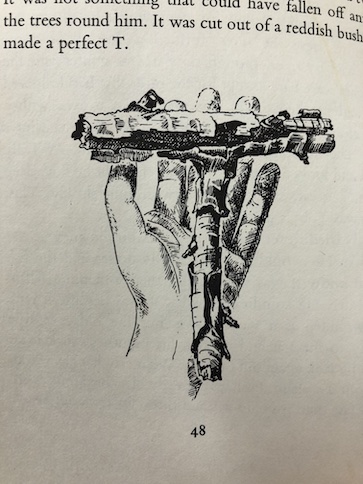
Tolly comes to the conclusion that the three children are still around Green Noah and that they’re playing hide-and-seek with them. He tries to play with them, too, and the children apparently give him a twig in the shape of a ‘T’. Granny Oldknow tells him that she used to play hide-and-seek with the children when she was young, and they would give her an ‘L’ twig because her first name is Linnet, like the little girl in the painting. Later, he hears the children singing Christmas carols. Tolly becomes frustrated that the children tease him and never really show themselves to him, but Mrs. Oldknow tells him that “they’re like shy animals” and that he has to give them a chance to decide that they’re ready to come to him.

He finds the key to the old toy box in his room, and inside the box, he finds more things that belonged to the three children. When he shows them to Mrs. Oldknow, she talks about how things were when the three children were alive at Green Noah. Tolly is shocked when he realizes for the first time that Toby, Alexander, and Linnet are all dead. Mrs. Oldknow gently tells him that they lived at Green Noah centuries ago and could not be alive now. Sadly, the children all died young in the Great Plague during the 17th century. Their illness was sudden and brief, and they all sickened and died in one day along with their mother. Tolly and his great-grandmother are descended from the children’s older brother, who wasn’t at home when this happened. However, the children never left Green Noah, which used to be called Green Knowe years ago. Tolly still loves the children, even though they’re ghostly and elusive. He craves the sense of family he gets from them, having been deprived of family feelings for so much of his young life.
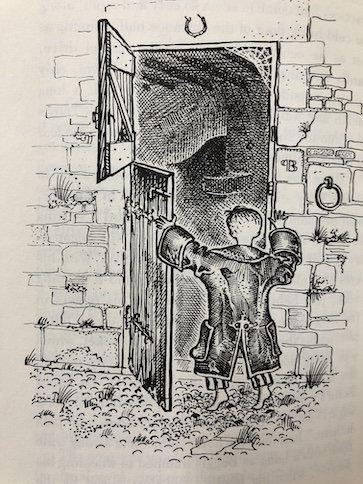
Mrs. Oldknow continues to tell Tolly stories about the three children and other members of his family. As his connection to his ancestors grows, Tolly begins to catch glimpses of the children more and more, and eventually, he’s able to see them and talk to them. He asks the children about their mother, and the children say that she’s in heaven but doesn’t mind them coming back to visit their old home from time to time. The children don’t seem sad at being dead, enjoying the freedom of playing around their old home with the animals and the spirits of their old pets, who keep them company. Their final illnesses had only lasted a few hours before they died, and their deaths happened so long ago that they say that they hardly remember the Great Plague and what it felt like. Tolly is still sad and frustrated that the children appear and disappear so suddenly, but his attachment to them grows and so does his attachment to Green Noah itself. As Christmas comes, Tolly develops a bond with his family, both living and dead, and a realization that the old family home that connects them is also his home, a place they can all return to.

The book is the first in a series and is available to borrow and read for free online through Internet Archive (multiple copies).

My Reaction and Spoilers

This is a ghost story, but it’s not a scary ghost story. There’s nothing frightening about the three ghost children. It’s sad that they died so young, but at the same time, they’re not very sad about it themselves. They seem to enjoy playing together endlessly with the animals around their old home and seeing the new relatives who inhabit the house, their older brother’s descendants. Even their former pets are no longer sad at the children’s passing because they are also spirits who continue to play with them through the centuries. There is one semi-scary part of the story involving a witch’s curse placed on an old tree called Green Noah, which is how the name of the house was changed from Green Knowe, but Tolly is protected by the ghosts of his ancestors.

There is never any desire for the characters to rid Green Noah of its ghosts. They are family and are part of the place, as much a part of it as the living are. The ghosts do not feel trapped there, either. They are just revisiting the home they loved and the family members who now live there. They can come and go as they please, and the ghost children often do.

This also is not the kind of story where a child knows that a place is haunted but can’t convince the adults or tries to hide the ghosts’ presence from the adults. Mrs. Oldknow is fully aware that the ghosts are there and has known about them since her own childhood. Generations of children in the family have probably known about them and played with them, and they are also not the only family ghosts who inhabit the old house. At one point, Tolly and Mrs. Oldknow hear a woman singing and the rocking of a cradle, and Mrs. Oldknow says that she’s heard it before around Christmas, a grandmother singing to a baby. Tolly is confused because even little Linnet wasn’t a baby when she died, and Mrs. Oldknow says that this isn’t the children’s grandmother but somebody from generations earlier than the three children. This grandmother ghost has been around so long that Mrs. Oldknow doesn’t know who she or the baby are supposed to be, although we are told that they are about 400 years old, where the three children died about 300 years earlier. Generations of the same family have lived in the house and have all left their mark on it, and part of them is still there. Now, Tolly has also become part of this family home, and it’s also a part of him. The ghosts are hesitant to fully show themselves to Tolly at first and seem more attached to Granny Oldknow, probably because she’s lived there longer, since she was an infant. The ghosts know her, and she knows all of their stories. However, they are all family, and Tolly develops a new connection to his family as his great-grandmother tells him the stories about them, and he can hear and see the ghosts more often.

Really, that feeling of connection and connectedness is the primary focus of the story. In the beginning, Tolly is lonely, feeling like he doesn’t have a family and doesn’t belong anywhere or to anyone. His father lives far away in Burma with his new wife, and Tolly doesn’t feel connected to them. His mother is gone, and he spends most of his time at school, even having to remain there during the holidays when other students are going home to their families. His great-grandmother inviting him to Green Noah is the first time that Tolly feels a real connection to anyone in his family since his mother’s death, and through her stories and his encounters with the ghosts, he comes to see that he really is part of a much larger family, going back ages. Just because most of his family is now dead or scattered doesn’t mean that they’re not his family. They still love him, and he loves them, even across the centuries. Green Noah really is a family home, and it’s a place that family can return to, even those who seem to be gone forever. It’s a place that has known both the joys of a happy family and the tragedies of loss that families experience from time to time. Through it all, it’s still home, and importantly, it becomes the home that Tolly has been wishing for.

The story takes place in the days leading up to Christmas, and by Christmas, Tolly has received important presents. First, the ghostly Alexander grants him the give of his special flute, which had been a reward from King Charles II for singing so beautifully for him when he was alive. Tolly also has musical talents, and his great-grandmother decides to switch him to a different school so he can develop his talents and so he can stay at Green Noah during his school holidays. On Christmas, Tolly also receives his own pet dog, very much like the one that the ghostly Linnet owned, and he names his dog after hers, just as he has been named after all the other Toselands who have gone before.

In some ways, the story reminds me a little of When Marnie Was There (some people might know the story from the Miyazaki movie version), which has similar themes of family and belonging and ancestors reaching out across time to remind children that, while life is brief and often complicated, love is eternal and everyone belongs somewhere and to someone. However, The Children of Greene Knowe is a much gentler story, and it also contains some shorter stories about Tolly’s family.

The Christmas Tree Mystery

The Christmas Tree Mystery by Wylly Folk St. John, 1969.

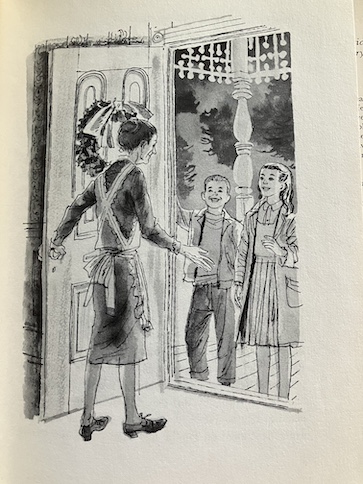
A couple of days before Christmas, twelve-year-old Beth comes running to her 10-year-old sister Maggie, saying that she’s in trouble and needs her help. Beth doesn’t know whether Maggie can help at all, but she thinks she’s done something wrong and needs somebody to listen to her. Someone stole the family’s Christmas tree ornaments the day before, and Beth saw someone running out of their backyard right after the theft. She was sure that the person she saw was Pete Abel, and that’s what she told everyone. However, the girls’ older stepbrother, Trace, says that it couldn’t have been Pete. Beth thinks that it would be awful if she’s leapt to the wrong conclusion and wrongly accused Pete of theft, but then again, she can’t be sure that Trace is right, either. Trace says that Pete was somewhere else at the time, but he doesn’t want to say where because, for some reason, that might also get Pete in trouble. Beth doesn’t know whether to believe him or not.

The kids are part of a blended family that has only been together for less than a year, so the children are still getting used to each other and their new stepparents. Beth likes their new little stepsister, Pip, but teenage Trace is harder to get used to. Trace is frequently angry, and much of his anger comes from his mother’s death. Beth knows sort of how Trace feels because her father died three years ago. She knows what it’s like to miss a parent, and try to keep their memory alive. Even though Beth doesn’t think of her stepfather, Champ, as being her father, she tries to be fair toward him and accept that he’s doing his best to take care of them. Sometimes, she wishes she could talk about it all with Trace, but Trace has made it clear that he doesn’t want to talk. Trace doesn’t like to talk about his mother and gets angry when anyone else even mentions her.

Beth thinks that Pete was the thief because the boy she saw running away was wearing a jacket like the one Pete has and has the same color hair. However, she didn’t actually see his face, and Maggie points out that other kids have similar jackets. Also, they found an old handkerchief of the house with the initial ‘Z’, and that wouldn’t belong to Pete. Beth has to admit that she may have been mistaken about who she saw. However, she can’t think of anybody whose name begins with ‘Z’, either. She worries that if she was wrong to say it was Pete that she saw she may have broken one of the Ten Commandments because she was bearing false witness. All that Beth can think of to make things right is apologize to Pete for being too quick to accuse him and try to find the thief herself, but she needs Maggie’s help to do that.

Why anybody would steal Christmas ornaments right off a tree is also a mystery. Some of the ornaments that belonged to Champ had some value and could possibly be sold for money, but most did not. The thing that Beth misses the most is the little angel that she had made for the top of the tree years ago. Its only value is sentimental, and Beth worries that a thief might just throw it away if he didn’t think it was worth anything. Also, if Trace is so sure that Pete is innocent, why can’t he explain where Pete really was when the theft occurred? Trace is sneaking around and seems to have secrets of his own. Then, after the family gets some new ornaments and decorates the tree again, the ornament thief strikes again! The new set of ornaments disappears, but strangely, the thief brings back Beth’s angel and puts it on top of the tree. If it had just been a poor kid, desperate for some Christmas decorations, they should have been satisfied with the first set. Is anybody so desperate for ornaments that they would take two sets, or is it just someone who doesn’t want this family to have any? And why did the thief return the angel?

The book is available to borrow and read for free online through Internet Archive (multiple copies).

My Reaction and Spoilers

The idea of somebody stealing Christmas ornaments sounds like a whimsical mystery for the holiday, but even though I’ve read books by this author before, I forgot that Wylly Folk St. John can bring in some of the darker sides of life. Much of this story centers around getting ready for Christmas, but there are some truly serious issues in the story. This is a book that would be better for older children. For someone looking for someone for younger children or a lighter mystery for Christmas, something from the Three Cousins Detective Club series would be better. (See my list of Christmas Books for other ideas.) It’s an interesting story, and I enjoyed the book, but I wouldn’t call the mood light.

The ways this new blended family learns to get along with each other and Trace learns to cope with his grief at the loss of his mother are major themes in the book. The parents try to be conscientious of the children’s feelings, making joint decisions and rules for the children as “The Establishment” of the house so none of the children feel like a stepparent is discriminating against them. The reason why the stepfather is called Champ is because he’s a chess champion, and Beth knows that her mother gave him that nickname so the girls wouldn’t feel awkward, wondering whether to call him by his name or refer to him as their dad. Beth is grateful for the nickname because, although she likes and appreciates Champ as a person, she does feel awkward about calling anybody else “dad” while she still remembers her deceased father. Trace calls his stepmother Aunt Mary for similar reasons, and Beth understands that. What she doesn’t understand is why Trace insists on wearing the old clothes that were the last ones his mother bought for him, even though they no longer fit him. Aunt Mary has bought him some nice new clothes that would fit him better, but he won’t wear them, and he even insists on washing his clothes himself, without her help. Beth asks her mother about that, but she says it doesn’t bother her because, if Trace is willing to help with the laundry, that’s less for her to do. Beth says that they ought to just donate all of Trace’s old clothes so someone else who can actually wear them can have them, but her mother doesn’t want to be too quick to do that because she doesn’t want to upset Trace. I can understand that because Trace is still growing, and it won’t be much longer before he won’t be able to wear those old clothes anymore anyway. The day that he can’t pull one of those old shirts over his head or put on old pants without splitting them will be the day he’ll be ready to get rid of them. Time moves on, and eventually, Trace won’t be able to help himself from moving on with it, and I think Aunt Mary understands that.

Part of the secret about Trace and his grief is that his mother isn’t actually dead, although he keeps telling people that she is. The truth is that his parents are divorced and his mother left the state and has gone to live in Oklahoma with her relatives. At first, Beth’s mother doesn’t even know that Trace has been telling the girls that his mother died, but when Beth tells her mother that’s what Trace said, her mother tells her the truth. She doesn’t want to explain the full circumstances behind why Champ divorced Phyllis and why she left, but she says that she can understand why Trace might find it easier to tell himself and others that she’s dead instead of accepting the truth. There is an implication that Phyllis did something that Beth’s mother describes as something Trace would see as “disgraceful” (I had guessed that probably meant that she had an extramarital affair, but that’s not it) that lead to the divorce. So, Trace is actually feeling torn between losing his mother and learning to live without her and his anger at her for what she did. He both loves and hates his mother, and that’s why he finds it easier to think of her as dead and gone and refuse to talk about her any further than deal with these painful, conflicting emotions. Beth’s mother also indicates that Phyllis was emotionally unstable, saying that the atmosphere in the household wasn’t healthy for Trace and his little sister because Phyllis “kept them all stirred up emotionally all the time”, and that’s why she didn’t get custody of the children and isn’t allowed to see them now. It turns out that there was a lot more to it than that, and that figures into the solution to the mystery.

When I was reviewing an earlier book from the 1950s by a different author about children coping with grief and a new blended family, Mystery of the Green Cat, I talked about how books from the 1950s and earlier tended to focus on the deaths of parents when explaining why children lived in households with stepparents and step-siblings and how books from the 1960s and later started to focus more on the issue of divorce. This book kind of combines aspects of both of those types of stories. Beth understands the grief of a parent dying, and Trace has to come to terms with his parents’ divorce, which is a different kind of loss, although it’s still a loss. As I explained in my review of that earlier book, in some ways, divorce can be even more difficult for children to understand than death. Both are traumatic, but divorce involves not just loss but also abandonment (a parents who dies can’t help it that they’re no longer there, but it feels like a parent who is still living somehow could, that it’s their choice to leave their children and live apart from them, which leads to feelings of rejection) and the complicated reasons why people get divorced, including infidelity and emotional abuse. In this case, it also involves drug abuse.

I was partly right about the solution to the mystery. I guessed pretty quickly who the real thief was, but there’s something else I didn’t understand right away because I didn’t know until later in the book that Trace’s mother was still alive. Before the end of the book, Trace and Beth and everyone else has to confront the full reality of Phyllis’s problems. They get some surprising help from Pete, who has been keeping an eye on things and has more knowledge of the dark sides of life than the other children do. (Whether his father ever had a problem similar to Phyllis’s is unknown, but it seems that at least some of the people his father used to work with did, so it might be another explanation for Pete’s family’s situation.) Because Pete has seen people in a similar situation before and knows what to do. I had to agree with what Beth said that much of this trouble could have been avoided if Champ had been more direct with Trace before about his mother’s condition, but Beth’s mother says that sometimes children don’t believe things until they see them themselves. Champ was apparently trying to protect his children from Phyllis before, but because Trace had never seen his mother at her worst, he didn’t understand what was really happening with her. There is frightening part at the end where the children have to deal with a dangerous situation, but it all works out. Trace comes to accept the reality of his mother’s condition and that things will never be the same again, but he comes to appreciate the stepsisters who came to his rescue and brought help when he needed it.

The Mysterious Christmas Shell

Tom and Jennifer are visiting their grandmother and their Aunt Vicky and Aunt Melissa Vining in Monterey for Christmas while their parents are in New York, taking care of Aunt Winny, who is sick. However, the children can tell that something is wrong as soon as they arrive because Mrs. Nipper, their aunts’ housekeeper, seems upset, and the house isn’t decorated for Christmas like it usually is. They have a Christmas tree, but there are no ornaments on it yet, and the Christmas greenery hasn’t been laid out.

The children hear their aunts talking about a letter that their father (the children’s grandfather) had written before he died. They know that he wrote the letter, but they’re upset because they can’t find it. The aunts explain to the children that they had to sell Sea Meadows, the wooded lands that they own, to a man called Theodore Bidwell. It’s a deep disappointment because Sea Meadows is full of ancient sequoias, and the children always liked to go camping and exploring there. Originally, Mr. Bidwell told them that we was only planning to put a few houses on that land that wouldn’t require removing many of the old trees, but now, they’ve learned that he’s actually planning on creating a large summer resort town. The aunts are upset that Mr. Bidwell lied to them to get them to sell the property, but there wasn’t much they could do anyway because they badly needed money to settle debts they had after their father died. The saddest part is that the family business has improved since they made the sale, and the aunts could now afford to buy back the property, but Mr. Bidwell refuses to sell it back to them.

There is one thing that might change the situation. Before the aunts’ father died, he discussed changing his will. He decided that, rather than leave that land to them as he originally planned, he wanted to leave it to the state of California to be turned into a state park. He thought it was the best way of ensuring that the natural beauty of the land would be preserved, and his daughters approved. The aunts already had the family business, and they didn’t need the land for their own sake. However, for some reason, his lawyer never got the letter their father said he was going send about the change in his will. The aunts are sure that he actually wrote the letter, but they think it got lost or mislaid instead of being mailed. If the aunts can find the letter that their father wrote, it would prove that the land actually belongs to the state of California and that it was never really theirs to sell. They’d have to refund Mr. Bidwell’s money, but they’re prepared to do that. It’s more important to them that the land would be preserved from development. Even local people have been angry with the family for selling the land to Mr. Bidwell because they don’t want the development, either.

When Tom and Jennifer begin helping with the Christmas decorations, and they start reminiscing about the Christmas before, the last Christmas when their grandfather was alive and he wrote his letter about the land, they remember that their cousin Elsa was also visiting. Elsa is about Jennifer’s age, and she and her parents are living in France now, so she doesn’t come to visit very often. The mention of Elsa makes the aunts remember that there was something that their father wanted to tell them about Elsa. He mentioned a funny thing she did, but then, they were interrupted, and he didn’t finish telling them what it was before he died. Everyone starts to wonder if Elsa may have done something with the important letter, but they can’t ask her because they know that she and her parents are visiting friends somewhere in France for Christmas, and they don’t know where or how to get in touch with them. (This is the 1960s, pre-Internet and pre-cell phones, so there are no methods of communication they can use that are independent of also knowing their physical location. They have to either know the address or phone number of where they are staying, and they don’t.)

The children’s grandmother recalls that Elsa was still with them even after Tom and Jennifer left with their parents, and they talked about Sea Meadows and showed her the deed to the land. Elsa had been helping to put away Christmas decorations at the time, and while the adults were talking, she suddenly started to cry. She had cut her finger on something, but they were never sure how she did that because none of the decorations were broken. Elsa was also upset because she had done two things earlier in the day that had caused trouble: she’d broken a little figurine and she’d forgotten to tell her grandfather about a phone call from a friend. She seemed worried that she had done yet another thing wrong, but her grandfather told her not to worry because troubles come in threes, and if the cut finger is her third trouble, she has nothing more to worry about. However, their grandmother recalls that Elsa didn’t seem reassured by that. Rather than being the third trouble of last Christmas, Elsa’s cut finger is a clue to a bigger problem that Elsa was afraid to admit, and that’s the clue they need to solve the problems of this Christmas.

The book is available to borrow and read for free online through Internet Archive. There is an earlier book with the same characters, a mystery about a sea monster in the same area of California, called The Terrible Churnadryne, but I haven’t read it and haven’t been able to find a copy.

I read this book years ago, and I remember liking it, but for a long time, I couldn’t remember the details of the story. I only remembered bits and pieces. I didn’t remember that it was a Christmas story, which would have helped. I remembered that a girl did something with an important paper, but until I reread the book, I couldn’t remember why the paper was important. What stayed with me the longest was the solution to the missing letter and the cut on Elsa’s finger. But, because I forgot that this was a Christmas story, I misremembered exactly what Elsa put the letter in.

I also remembered that one of the aunts had a secret hiding place in a cave when she was young, and when they revisit the cave, they find cave drawings done by Native Americans. I also remembered that the cave is dangerous at certain times because the tide comes in. Years ago, Aunt Melissa was almost trapped there because she stayed too long and was caught by the tide. When her father found out, he refused to allow her to go there alone again. Since her mother and sister didn’t like going to the cave at all and she and her sister soon went away to boarding school, she gave up going there entirely for a long time. She was always sad about the loss of her secret hiding place. However, when she returns there as an adult, it contains part of the secret to unraveling what happened to her father’s letter last Christmas.

At one point in the story, Jennifer finds a very distinctive seashell with red and green colors. Everyone is amazed because it’s a court cone, not a shell normally found on the shores of California, and it also doesn’t normally appear in those colors. This is the shell that Jennifer calls the Christmas Shell. This shell doesn’t directly contain the solution to the mystery, but its shape and something Jennifer does with the shell awaken some of Aunt Melissa’s memories. I also remembered that Jennifer was the one who figured out what Elsa did after watching her brother fiddling around with a napkin in a napkin ring.

While I was rereading this book, I was happy to see all the bits and pieces of my memories of this book fall into place alongside the clues to the mystery. Stories with secret hiding places are always fun, and this one has two – Aunt Melissa’s old secret hiding place in the cave and the place where the missing letter is hidden.

There is also a reference in this story to the Elsie Dinsmore books, a children’s series from the late 1800s and early 1900s.

The Box of Delights

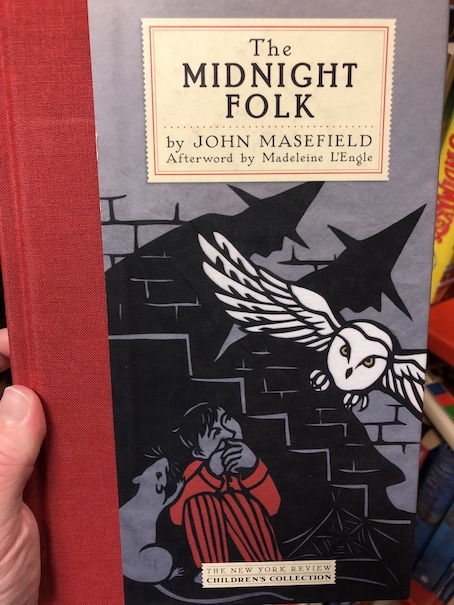
The Box of Delights by John Masefield, 1935, 1957.

This book is a sequel to The Midnight Folk. Since the events of the previous book, Kay Harker has become a student at a boarding school, and he is now returning home for Christmas.

At the train station, Kay panics when he realizes that he can’t find his ticket, but it is returned to him by a nice old man with a dog named Barney. Kay also sees some men who seem to be looking for someone else. He overhears their description of the man they’re looking for, but they seem to conclude that the man isn’t on the train. Kay thinks that they might be police detectives, looking for an escaped criminal. His conclusion is proven correct when a porter tells him later that the detectives caught the man they were looking for, trying to disguise himself as a duchess. Kay asks what the criminal did, and the porter says that he’s murderer who killed his father-in-law in a very brutal way. Now, the detectives are taking him away in a special card with an armed guard, and he will probably hang for the crime. Kay finds the story thrilling, but he wonders if the guard made it up or embellished it. When he buys a newspaper, he doesn’t see anything about a murder like the porter described in it.

Kay enjoys the train ride home because, when he went to school, it was by car, so he’s seeing things on the journey home that he hasn’t seen before. On the train, he meets a couple of men dressed like theology students, but whether they’re really theology students is questionable. They sometimes speak to each other in a foreign language that Kay thinks might be Italian, and they trick Kay into playing a card game for money that’s like the Shell Game. Kay only plays once, and when he realizes that he’s been tricked, he decides the men are sinister. The two men ask Kay about the countryside, and one of them refers to him as “Mr. Harker” when Kay never introduced himself. Kay asks the man how he knew his name, but the man never really explains. When Kay arrives at his train station and meets Caroline Louisa, who looks after him, he realizes that his coin purse and watch are missing. Strangely, when he checks for them, he finds the ticket that he thought that he’d lost, so the ticket the nice man gave him must have been his own.

The nice man with the dog is also at the train station. Caroline Louisa thinks that he looks like a Punch and Judy man, and when Kay asks him, he simply says that he is a showman. He also seems to speak in odd riddles, telling Kay that “the Wolves are Running” and asking him if he will do anything to stop them biting. Kay says that he doesn’t know what he means. Rather than explaining, the man asks him to go to a shop in town to buy some muffins, and while he’s there, to look for a lady wearing a ring like the one he’s wearing and give her the message that “The Wolves are Running.” Kay is surprised that this man also seems to know his name and won’t explain how.

When Kay returns to Caroline Louisa, he mentions the men on the train who knew his name, and she says that they probably read it on his luggage labels. Without telling Caroline Louisa why, Kay asks if they can stop in town to buy some muffins. Caroline Louisa also mentions that the four Jones children, Peter and his three sisters, will be spending Christmas with them because their parents have to go abroad. Kay gets along pretty well with the Jones children, and Peter will be sharing a room with him. Kay says that he will have to get some extra presents for the Jones children in town as well. They stop in town, Kay buys the muffins as he was told, and sees the woman that the old man described with a ring like his. Not knowing why it’s important, Kay passes along his message to her, and she nods to him. Then, Kay notices that there are people in town with Alsatians, and they seem to be on the scent of something. Kay wonders if they could police dogs, and Caroline Louisa says she doesn’t know, but she doesn’t like them herself because they remind her too much of wolves.

When they get home to Seekings, the four Jones children are already there. (We did not met them in the previous book, so these are new characters to readers, although Kay has already met them at this point.) Kay thinks of Peter as “a good honest sort of chap.” Of his three sisters, Kay thinks of Jemima as being the smart one. Maria is untidy and has a toy pistol. She has a fascination with gangsters, like in the movies, and she wishes that they could find a gang of robbers and have a battle with them. Susan looks like a small fairy.

Kay gets the idea of inviting the man they’ve come to think of as the Punch and Judy man to the house to perform for them. When he goes back to town to invite him, another man wearing the same ring as the others stops him and tells him to pass on the message that “Someone is safe.” Kay thinks that the message is intended for the Punch and Judy man and passes the message on to the old man when he sees him. He tries to ask the old man what he’s been talking about when he talks about the “Wolves”, but he’s evasive. Instead, he tells Kay that he will come perform a Punch and Judy show for the children at Seekings at the time he was thinking of. Kay asks him how he knew he was going to make that request, but he ignores the question. The old man produces the image of a Phoenix in the fireplace at the pub where they are talking, and he says that he has other wonders in a little box that he will show him later.

When the old man, whose name is Cole Hawlings, comes to Seekings to perform for the children, he does many magic tricks that appear to be real magic. After his performance, some Christmas carolers come to the house, and Kay spots three men, who seem to be spying on the house, trying to see into the study. One of them is one of the men who tricked him with the card trick on the train. Cole Hawlings is very nervous about these men and starts talking about wolves running again.

Caroline Louisa is unexpectedly called away to tend to her sick brother, and while Kay is seeing her off, the other children are approached by one of the spying men, who asks where Hawlings went. Maria, who didn’t actually see Hawlings leave, mistakenly says that he left with the carolers. As Kay returns to the house, he overhears the spying men talking about it. They are definitely after Hawlings, and they are associates of Abner Brown, the villain from the previous book. Kay realizes that his old enemy has returned, and once again, he will have to face off against evil magic.

When Kay meets up with Hawlings again, Hawlings says that it’s not really him that the wolves are after but the Box of Delights that he carries. He gives it to Kay for safe keeping. Kay doesn’t fully understand the purpose of the box, although Hawlings shows him how to use it to return home without any time seeming to have passed. The next day, Kay brings Peter with him when he goes to see Hawlings, and the boys witness Hawlings being kidnapped and dragged into an airplane! They try to report it to the police, but the police don’t believe that they witnessed a kidnapping, and someone else turns up in another town, claiming to be Hawlings. Where is the real Hawlings, why do Abner Brown and his people want his box so badly, and what is Kay going to do with it?

The book is available to borrow and read for free online through Internet Archive (multiples copies). There have been multiple dramatizations of the book, and you can sometimes find them or clips of them on YouTube.

My Reaction

I felt like this story was more cohesive than The Midnight Folk, which seemed more disjointed. It is still episodic and tries to work in various elements from children’s fantasies, stories, and folklore. When Kay opens the box, he finds a strange book, and when he opens the book, he finds himself in a forest with Herne the Hunter, a character from folk legends. Herne turns Kay into different animals. After a delightful adventure exploring the woods with Herne in different animal shapes, Kay finds himself back in his own bedroom with hardly any time having passed. Later, the children use the box to shrink themselves to hide from the villains and meet fairies. Aside from the traditional and folklore elements, there are also elements of modern stories and fantasies. The children have a fascination with gangsters (probably from movies of the time), and the villains have some pretty impressive equipment, like a taxi that turns into an airplane and airplanes that fly silently, seeming to combine more modern technology with an element of fantasy or magic.

I also liked the addition of Peter and his sisters because it gave Kay other children he could talk to and who could see the things he sees and share in his adventures. Kay doesn’t tell his friends everything, although they do share in various parts of his adventures, and I’m actually amazed that they take these parts in stride and don’t ask as many questions as I think they should be asking. The adults around them are completely oblivious to the magical happenings, with the exception of Hawlings.

As an historical food note, the police inspector recommends to Kay that he have a hot milk drink called a posset, and he describes what goes into one, but the version that he describes is non-alcoholic. The original drink was an alcoholic beverage, but presumably, this one was toned down for children. The way they describe it in the book, it sounds similar to a non-alcoholic eggnog, but served hot.

The Midnight Folk

The Midnight Folk by John Masefield, 1927.

Kay Harker is an orphan, the ward of Sir Theopompus, usually in the care of his governess, Miss Sylvia Daisy. One day, Sir Theopompus asks Kay if he has any idea what he wants to do when he grows up. Kay says that he likes the idea of being a jockey, but Sir Theopompus says that he could be a sea captain, like his great-grandfather. According to the stories about him, Kay’s great-grandfather sailed around the world and stole a treasure from the priests of Santa Barbara worth about a million pounds (British money). The stories differ about what happened to the treasure, though. In some versions, his crew mutinied and took the treasure for themselves, but other stories say that he brought the treasure home with him and hid it somewhere in his family home, the home where Kay now lives.

Sir Theopompus asks Kay if he’s ever come across the treasure, but Kay says he hasn’t. Sir Theopompus suggests that if Kay finds the treasure, the two them could split it between them. Kay says that wouldn’t be fair, if he had to do all the work of finding it by himself, and also the treasure is stolen property, so it would rightly belong to the priests of Santa Barbara. Still, Sir Theopompus encourages Kay to search for the treasure. Kay doesn’t believe that the treasure is really in the house or that his great-grandfather would be a thief, and he doesn’t think it’s fair to tell such stories about him when he isn’t there to defend himself. His governess tells him that he has been impertinent and sends him to bed early.

Kay is later woken by someone calling to him to open the door, and he sees a door in his room that he has never noticed before. The voice he hears belongs to the black cat called Nibbins, who tells Kay to come with him and not make any noise. Most of the house is asleep, and Nibbins refers to the ones who are awake as the “midnight folk.” He leads Kay down a secret passage that was once used by smugglers.

There, Kay learns that his old toys were his “guards.” He doesn’t know where his old toys are because his governess packed them away when she came, saying that they would just remind him of the past. Nibbins says that his old toys had stumbled onto a clue about the hidden treasure and went in search of it. They didn’t think it would take them long to find it, but he hasn’t heard from them since. Kay sadly fears that his old toys may actually be dead. (A horrifying thought.)

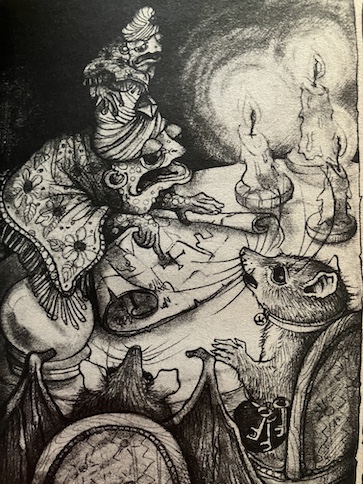
Then, there’s an even more shocking revelation. Nibbins shows him that there are spy hole where Kay can see what’s happening in various rooms in the house, and in the dining room, he witnesses a meeting of witches! Nibbins shows Kay where the witches keep their brooms, and they take a couple of the brooms on a ride to the woods, where Nibbins introduces Kay to a poacher called Bitem. They witness the witches having a bonfire and a magical ritual at Wicked Hill. Nibbins says that he used to be a witches’ cat and helped with rituals like that. Sometimes, he still feels the call of magic.

The leader of the magical group is a wizard called Abner Brown, and they overhear him saying to the witches that they are going to hunt for the Harker Treasure. Abner has learned that the treasure is not actually in the Harker house, but it’s somewhere close by. Abner reveals previously-unknown details of the treasure’s history, including the fact that his own grandfather had once been in possession of it and hid it until someone called Benito Trigger found it. Abner has found evidence that his grandfather tracked down Trigger and confronted him in this very area and that Trigger may have killed him. Abner believes that the treasure is still hidden somewhere near to where his grandfather died. Nibbins leads Kay back to his bedroom through another secret passage before anyone discovers that he is gone.

Kay knows that what he witnessed the night before wasn’t a dream because, in the morning, he sees the remains of the leftover goose that the witches were eating the night before, picked to the bones. The servants think that the cats got at the goose and ate the leftovers, but Kay knows better.

Then, the portrait of Kay’s great-grandfather comes to life, and his great-grandfather invites Kay into the portrait, showing him the house as it was in the past. His great-grandfather denies having stolen the treasure years ago, but he says that it was entrusted to him and that he lost it. He was in Santa Barbara when the territory was breaking away from Spain, and the archbishop gave him the treasure to guard from the revolutionaries. However, his crew did mutiny and turn pirate. The crew took the treasure, and they abandoned Kay’s great-grandfather ashore, far from any European colony. For a time, he says that he was a slave of a tribe of Indians (Native Americans), but he eventually escaped and made it home to England. He heard that his old ship may have sunk, but he doesn’t know for sure. Even he doesn’t know where the treasure is now, thinking that it must have either sunk with the ship or been scattered by the crew. It’s always bothered him that he was unable to fulfill his promise to keep the treasure safe. He wants Kay to learn what happened to the treasure and, if possible, restore it to its rightful owners.

Through Kay’s midnight adventures and the ghosts of the past stirred up by the magic of the witches, Kay begins to learn the full sequence of events that led to the treasure being lost, and eventually, what happened to it. Along the way, Kay also makes the startling discovery that his governess is actually one of the witches!

The book is available to borrow and read for free online through Internet Archive (multiple copies).

My Reaction and Spoilers

There were some parts of the story that I found difficult to follow because the story kind of jumps around, people start talking about things as if we should already know about them, and some things that Kay encounters are not fully explained. Many of them seem like dream sequences or imaginings, except they have lasting consequences. Then, there are times when people go into lengthy explanations that seem to meander, and there are people who go by multiple names. For awhile, Kay almost seems to forget about seeking his great-grandfather’s treasure and starts looking for the treasure of an old highwayman instead, and there is a strange interlude with King Arthur and his knights.

Still, this story is a children’s classic, and it’s almost like a collection of all the features that are found in classic children’s literature: an orphan, talking animals, witches, pirates, ghosts, mermaids, a highwayman, King Arthur and his knights, hidden treasure, etc.

For awhile, I thought that the story might end with the implication that much of it was in Kay’s imagination. Kay is a lonely boy who doesn’t see his guardian very often and lives with a strict governess and no other children for company. I thought maybe he was spinning dreams or imagined stories to explain other events happening around him. I spent part of the story working out how a child might interpret a strict governess who took away his old toys as a witch, and I thought maybe she was in a romantic relationships with Abner Brown, which would be why Kay would see him as a wizard. Then, maybe these young people had parties in the house with their friends after Kay was put to bed, so he imagined that they were having witches’ meetings. They could also be hunting for the legendary treasure, so all the parts related to treasure-hunting could be true. However, the book implies that the magical parts of the story are real. Even the magical things Kay experiences have real world consequences, which help both him and readers to realize that what he has seen has really happened.

I thought that the story became a little more cohesive after Kay makes the discovery that his governess is actually one of the witches. He eventually learns the full truth of what happened to the treasure years ago and meets up with his old toys/guards, who are still alive and have been seeking the treasure the entire time. Kay’s toys/guards bring the treasure from its hiding place to a secret hiding place in Kay’s room and help him to alert the proper authorities and restore the treasure to its rightful owner. Kay’s governess is arrested when she and her friends are caught trespassing in pursuit of the treasure and in possession of smuggled goods. The governess is released when Abner Brown pays the fines for their activities, but she leaves the area instead of returning to Kay. Kay’s home life changes for the better because a friend of his mother comes to live with him and look after him.

The Bell Tolls at Mousehaven Manner

This book is the sequel to Shadow Over Mousehaven Manor.

Since the characters’ adventures in the previous book, Minabell Mouse has come to live with her Aunt Pitty Pat in their ancestral home, Mousehaven Manor. Just as Aunt Pitty Pat and Minabell have finished their spring cleaning, Minabell’s cousin Violet Mae arrives for a visit … apparently a long one, based on the amount of luggage that she brought with her.

Also, the prairie hawk who brought Violet Mae to Mousehaven Manor brings a package for Minabell, although there’s nothing to say who the package is from. Minabell finds the package disturbing and is afraid to open it. Instead, she stashes it in the music room. Still, the package leaves her feeling weak and unwell, as if it were somehow cursed.

That evening, their friend Percy the bat comes to dinner, and they are also joined by a mysterious stranger bat who calls himself Count Von Flittermouse. Count Von Flittermouse is a traveler, but he has no luggage except for a large box, which he declines to bring inside. They invite him to join them for dinner, but he says he’s already eaten, so he will just join them in conversation. Aunt Pitty Pat asks the Count if he’d like to spend the night at Mousehaven Manor, but the Count says that he’s a nocturnal creature, so he’s active at night. He asks for directions to Springfield because he says he wants to camp in the Oak Ridge Cemetery and visit Lincoln’s tomb. After dinner, the Count leaves, and they see he’s carrying a long box on his back. He’d mentioned that he brought his bed with him, so they figure that’s what it is. Percy seems a little uneasy about the Count, and Minabell notices that the Count left some odd kind of dust on the chair where he was sitting.

Minabell is in charge of security at Mousehaven Manor, but that evening, she accidentally leaves the music room window open. At night, Minabell hears someone moving around the manor, but she never sees the mysterious intruder, and in the morning, nothing is missing, so her aunt thinks it might have been her imagination.

Meanwhile, a country singer mouse called the Rhinestone Rodent arrives in town. (A joke on the Rhinestone Cowboy song.) Minabell is shopping when she stops to watch the singer perform. Then, an alarm goes up among the mice in town because Mousehaven Manor is on fire! Minabell rushes home, and Percy rings the bell at Mousehaven Manor to summon help. Others come to form a bucket brigade, and they successfully put the fire out. Aunt Pitty Pat is fine, but it takes them awhile to find Violet Mae. Violet Mae casually strolls downstairs and tells them that she was upstairs, having a nap and missing the whole thing.

Part of the mansion is damaged from the fire, and they have to clean everything up. Violet Mae meets the Rhinestone Rodent and develops a crush on him. While Violet Mae and Aunt Pitty Pat go to see the Rhinestone Rodent perform, Minabell and Percy inspect the site of the fire. They determine that the fire was set deliberately, but it was never intended to burn down the whole mansion. It seems like whoever set the fire was using it to cause a distraction while they did something else, but they’re not sure what.

The mysterious package that Minabell hid in the music room is still there, and Minabell finally opens it in front of Percy. It turns out that it’s from Wendell Weasel, a member of the local law enforcement agency, the Illinois State Ski Patrol. The mysterious package contains an equally mysterious ancient box, and Wendell’s letter explains that this box has been passed down in the Mouse family for generations, always held by the head of the family. Until recently, it was in the possession of Colonel Mouse, who was Violet Mae’s guardian but has recently passed away (something that Violet Mae has completely failed to mention to anyone, which is weird). Wendell says that Violet Mae doesn’t know anything about the box, but Colonel Mouse wanted Minabell to look after both the box and Violet Mae. Wendell says that there is a document in the box itself that will explain the purpose of the box, but each caretaker of the box is bound to use its contents to help others and not just for personal gain. Also, there are evil people who may try to steal the box, so Minabell is going to have to be careful.

In the mysterious antique box, Minabell finds a pile of sand surrounding a bottle holding something intensely cold and an old map written in Spanish. It seems like this is what their mysterious intruder was looking for, but what does it mean, and who wants it?

The book is available to borrow and read for free online through Internet Archive (multiple copies).

This story is more supernatural than the previous book in the series, which was an adventure story. I thought that the villain in the story was pretty obvious, although I did have a couple other suspects in mind for a more devious twist. It turned out to be the obvious choice, though.

Count von Flittermouse is not what he seems, in more ways than once. Percy figures out pretty quickly that the Count is a vampire bat, but what that seems to mean in this version of the animal world is not only different from what vampire bats actually are, but it’s also kind of confusing. I expected that he’d turn out to be like a human vampire, only with a bat as his main form – drinking blood, being immortal, etc. But, that’s not it. Count von Flittermouse is a shapeshifter. He can change into different scary animals, like wolf and spider. That’s his main super power. So, he’s not exactly what I think of as a “vampire”, he’s more like a werewolf, or werebat, or werewolf bat or something. We never see him drink blood or try to drink blood, although there are some bones in his lair that suggest that he might eat other animals. They don’t really go deep into the lore of it or outline the rules for vampire bats in their version of Illinois. You just have to take their word for it that vampire bats are shapeshifters, and that’s it. That’s their thing. Also, their vampire bats aren’t immortal vampires. That’s really the problem that Count von Flittermouse has. He’s actually a very old vampire bat and not likely to live much longer unless he can get his little winged paws on the package that Minabell received.

The bottle in the mysterious package turns out to contain water from the Fountain of Youth. Generations back, one of Minabell’s ancestors accompanied Spanish conquistadors on their search for the Fountain of Youth, and they not only found it but saved some water from it. Count von Flittermouse wants it to restore his youth and make him immortal. It wouldn’t be so bad if he wasn’t also evil and a werewolf bat.

Of course, our heroes are victorious. They find a way to use the special water so that it benefits everyone, except for the evil bat, and everything ends happily. I actually think that this book might make a fun Disney cartoon, something like a more supernatural version of The Great Mouse Detective. Even though I thought that the book’s version of what a vampire bat is and what it does is a little confusing, a movie version could clarify some of the rules regarding what vampire bats are supposed to be and what they do. The lore about human vampires varies depending on the source, although they usually do have the ability to shapeshift into bats, an ability which is kind of pointless if the vampire happens to already be a bat. It’s understandable that the story has to tweak the traditional vampire lore to fit into this animal society. I kind of picture that the vampire bat would only be able to change into things whose blood it sucked earlier, but that’s just my theory; the book doesn’t clarify that point. Still, it’s a fun story, and I think a movie version would also be fun.

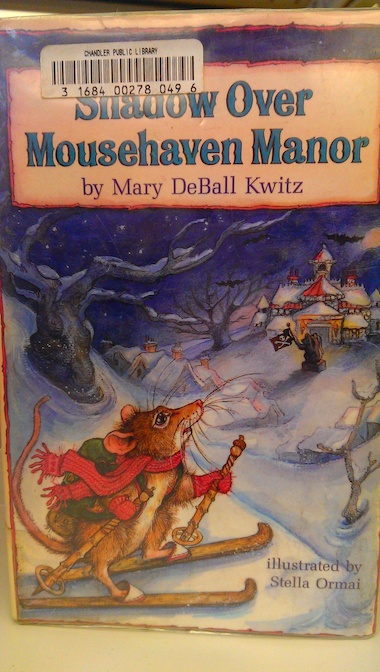
Shadow Over Mousehaven Manor

Shadow Over Mousehaven Manor by Mary DeBall Kwitz, 1989.

Minabell Mouse is happily looking forward to her Aunt Pitty Pat visiting her for Christmas with her new husband, Magnus, but she receives an urgent message from Magnus, saying that her aunt is very ill and may not survive much longer. He urges Minabell to home to her aunt’s home, Mousehaven Manor right away and bring the copy of her aunt’s will that her aunt left with her. With her home suddenly damaged badly by a storm, Minabell does immediately set out for Mousehaven Manor, crossing the Illinois prairie through the tunnel called Rodent Run, which small animals use to travel in safety. Before she leaves home, one of her friends gives her a Christmas present to take with her, something long and thin. It’s awkward to carry, but her friend insists that she take it with her and open it on Christmas. Another friend warns her to beware of the tough Chicago rats who are a gang of criminals who have invaded Chicago’s City Hall.

On the way, Minabell Mouse stops to rest and has a fearful encounter with a group of rats carrying a pirate flag with the name “Prairie Pirates” on it. She witnesses them murder a chicken at a farm, pluck it, and carry it off. It’s horrifying, and Minabell is lucky that the pirates didn’t see her. She is alerted by a stranger who makes her keep quiet.

The stranger introduces himself as Secret Agent Wendell Weasel, a member of the Illinois State Ski Patrol, a form of animal law enforcement. Minabell asks Wendell who those pirates were, but before he answers her questions, he insists that she identify herself and tell him where she’s going and why. Minabell explains to Wendell about her aunt, and he looks at the copy of the will she is carrying, which leaves everything to her, as her aunt’s closest relative.

Wendell urges Minabell to turn around and go home because it’s too dangerous for her to continue her journey. The Prairie Pirates are a band of Chicago rats, and the “Sungam” that they heard the pirates chant is the code name of their leader. Wendell says that he can’t tell her more than that because the information is classified, but he says that if Minabell really thinks about the word “Sungam”, she will see that there is a good reason not to go to her Aunt Pitty Pat and Uncle Magnus. (Hint, hint.) Of course, Minabell doesn’t see what Wendell is talking about at first and continues her journey because she thinks Aunt Pitty Pat needs her. She does, but not in the way Minabell expects.

Minabell does realize the significance of the word “Sungam” when she uses it to frighten off cats who attack her. Puzzling over the word more, Minabell tries writing it out in the snow and sees that it’s “Magnus” spelled backward. Minabell realizes that her aunt has actually married the leader of the Prairie Pirates! The Prairie Pirates have taken over Mousehaven Manor, and her beloved aunt is their prisoner! (Flying their pirate flag over the house isn’t the most subtle way to lure an innocent victim into their new hideout. I don’t think it even counts as a hideout anymore if you have a banner advertising that you’re there. Even if Minabell hadn’t already figured out the code name clue, the flag is a dead giveaway. Just saying.)

There is still time for Minabell to turn back before meeting the pirates, but she can’t leave her aunt in danger and Mousehaven Manor occupied by the enemy. However, she’s going to have to come up with a clever plan, or she’s going to be in danger, too.

I haven’t found a copy of this book online, but there is also a sequel called The Bell Tolls at Mousehaven Manor. There are only two books in the series.

My Reaction and Spoilers

I had to get this book because I vaguely remembered a teacher reading it to my class years ago in elementary school. There was a lot about the book that I forgot over the years. I had completely forgotten that it was actually a Christmas story. My strongest memory of this story was actually a small detail, but one that they repeat during the book. Minabell has a little ritual that she does whenever she needs to remember something, particularly when she needs to remember where she hid something. I had forgotten the rhyme she says, but I remembered her writing what she needs to remember on her forehead with her finger. That struck me as actually a clever trick because writing something, even if you never look at it again, helps things to stay in your memory because you really need to concentrate in order to write, and you can remember the act of writing, which brings back the memory of what you’ve written. When I was a kid, after hearing this story, I used to do that sometimes, write something on my forehead with a finger to help me remember.

Reading the book as an adult, the Sungam/Magnus clue is pretty obvious. The plot also sort of reminds me of The Mysteries of Udolpho, which I read several years ago because I really like Jane Austen’s Northanger Abbey, which references and parodies that book. The connection that book and this one is that part of the long, rambling, episodic plot of The Mysteries of Udolpho involves an aunt who has cluelessly married the leader of a gang of bandits, and the leader of the gang just wants to acquire her money and property. This book is a little different because the mouse aunt has not actually married the rat; he’s just holding her captive so he can take over her house and use it as the base for his gang and claiming that they’re married to justify occupying the manor. Like in The Mysteries of Udolpho, the bandit leader holds the aunt and her niece captive at an isolated manor house, trying to get the aunt to not only sign over all her money and property to him but also her niece’s inheritance. That’s why Magnus told Minabell to bring her copy of her aunt’s will. He needs to change the will so that it leaves Mousehaven Manor to him.

So, strangely, Shadow Over Mousehaven Manor is a little like The Mysteries of Udolpho for children. I actually recommend it more than The Mysteries of Udolpho because The Mysteries of Udolpho is rather long and disjointed. Both books contain some admiration of the beauties of the countryside while the character that travel, but the scenery descriptions are much longer in The Mysteries of Udolpho, and Shadow Over Mousehaven Manor is just more fun to read because it involves talking mice and pirate rats. The mice in this book are also much more sensible than the humans in The Mysteries of Udolpho. The mouse aunt knows darn well what Magnus is, while the human aunt was completely clueless almost up to the point where her husband caused her death. I’ve amused friends sometimes with describing The Mysteries of Udolpho, and I might put my short (short-ish) explanation of the plot (plots) of the book on the Internet sometime just for fun, but I mostly recommend reading that book only if you’ve already read and like Northanger Abbey.

I’m going to include some spoilers for the story because this book isn’t currently available to read online. Minabell has the presence of mind to realize that, before she attempts to enter Mousehaven Manor and save her aunt, she needs to hide the will she is carrying because she can’t let it fall into Magnus’s hands. When she does reach the manor, she is also imprisoned with her aunt in the manor’s dungeon, along with a friend who came to try to help her. (I don’t really know why any mansion in the US, mouse or human, needs a dungeon, but maybe mouse history in the US was more feudal than human society or something. It doesn’t really matter. It’s just a really cool mouse manor house, and it has a dungeon. It also has secret passages.) They get out of the dungeon because the aunt remembers an old song that has a clue to a secret way out of the dungeon, and they find their way to the belfry tower, where they ring the bell to signal for help. There, they meet a family of bats hibernating in the bell tower. The bell wakes them up, and one of them helps them reach their friends. Minabell, her aunt, and their friends battle the pirates and drive the out of Mousehaven Manor. They celebrate with a big New Year’s party, and Minabell decides that she wants to continue living at Mousehaven Manor with her aunt.

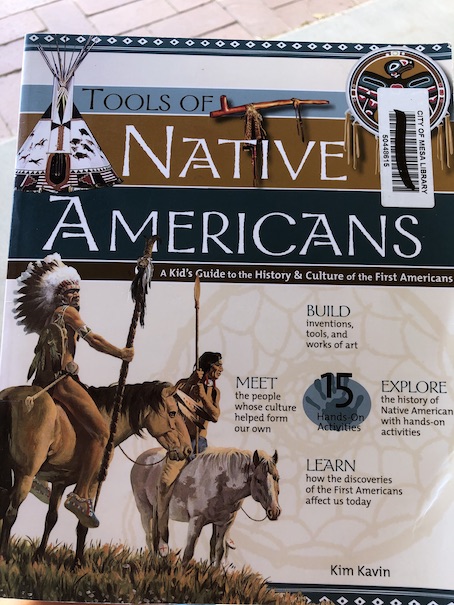
Tools of Native Americans

Tools of Native Americans by Kim Kavin, 2006.

This nonfiction book is part of a series recommended for kids ages 9 to 12. It provides insights into the daily lives of Native Americans of the past by explaining their tools and inventions. I was intrigued by the idea immediately because I love books that give insights into history through the lives of ordinary people.

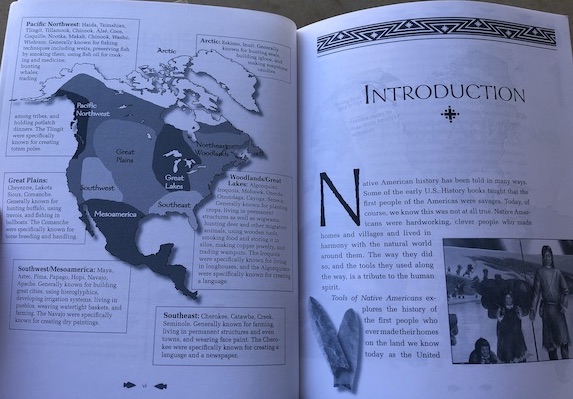
The book is divided into time periods and geographic areas of North America. At the beginning of the book, there is a timeline of important events in the history of North America and Native American culture, beginning c. 20,000 to 8000 BCE, when the ancestors of Native Americans are believed to have migrated to the continent and ending in 2006, the year the book was published. There is also a map showing major geographic regions of North America and the Native American tribes that live there. The chapters of the book are mostly grouped by region, except for the first two, which are about the First Americans and Archaic and Formative Periods.

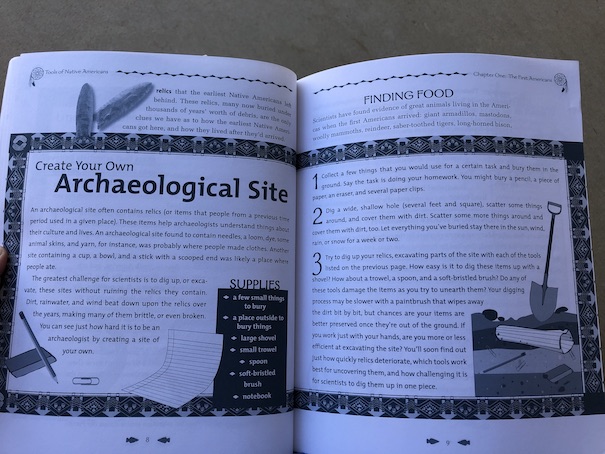
The first chapter, called The First Americans, discusses theories about how the ancestors of Native Americans first arrived on the continent from Asia. The exact circumstances of their arrival are unknown, but there are some possible migration paths that they could have taken. The chapter discusses the Ice Age that existed when this migration took place, how people found food, and Clovis culture, one of the earliest known civilizations in the Americas. One of the activities from this section is about archaeology, which is what we use to learn more about ancient civilizations that did not leave written records, and how to create an archaeological site of your own.

The next chapter is about the Archaic and Formative Periods, which were characterized by climate change as the Ice Age came to an end and many plants and animals that had thrived in the colder climate died off. The changes in the environment cause Native American groups to make changes in their own lifestyles. Rather than relying on herds of large animals for food, they began cultivating crops. They made pottery and developed new cooking techniques. They still hunted, using a device called an atlatl to throw their spears further and with more power. Civilizations like the Maya flourished.

After the second chapter, the other chapters discuss tribes by region:

The Northeast Woodland and Great Lakes Tribes – The Algonquian and Iroquois

This chapter discusses Native American tribes from the East Coast to the Midwest, around the Great Lakes, who primarily lived in woodland areas. The Iroquois and the Algonquian were both collections confederated tribes. There is information about the Algonquian language, which contributed some words to English, including moccasin, succotash, hominy, hickory, and moose. There is also an activity about creating Algonquian style pictographs and petroglyphs.

The Southeast Tribes – The Cherokee, Catawba, Creeks, and Seminoles

The tribes in this chapter lived in and around the Appalachian Mountains. It explains about Sequoyah, who developed a system of writing for the Cherokee language.

The Great Plains Tribes – The Cheyenne, Lakota Sioux, and Comanche

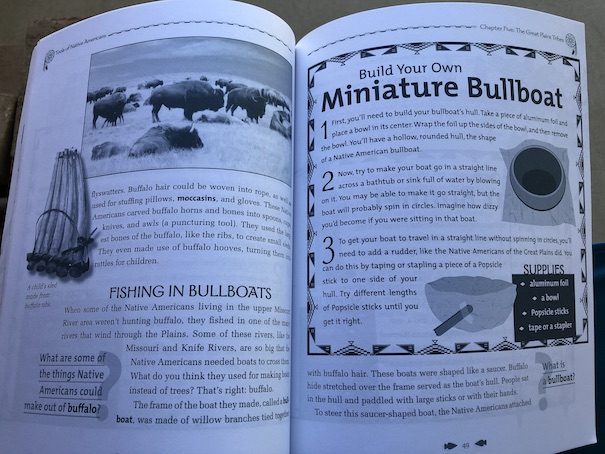
The tribes of the Great Plains were migratory, following herds of buffalo, which were a primary source of food. Because they moved often, everything they owned, from the tepees where they lived to the tools and other objects they used, had to be easily portable. The Comanche were particularly known for being expert horsemen. This chapter also discusses the Lewis and Clark Expedition and Sacagawea, who was part of the Shoshone tribe from the Rocky Mountains. She had been abducted when she was young, and when she joined the Expedition, she was able to guide Lewis and Clark and their men back to the territory she had known when she was a child and to the Pacific Ocean. Activities for this chapter include making a rattle of the kind children used as toys, making a miniature bullboat, and making a war bonnet (using pieces of poster board instead of feathers).

The Southwest and Mesoamerican Tribes – The Hohokam, Mogollon, Anasazi, Maya, Aztec, Hopi, Apache, and Navajo

I know this area because this is where I grew up. Much of it is desert, and the book is correct that there can be sharp differences in temperature between day and night. In modern Southwestern cities, buildings and pavement can hold in heat even at night, but there isn’t much to hold in heat in the open countryside, not even much humidity in the air to hold heat once the sun goes down. There is an abundance of clay in the soil in this region which local tribes used to make pottery and adobe homes.

Among the civilizations discussed in this section are the Hohokam, whose name means “Vanished Ones” (I’ve seen different versions of the translation of that name, but they’re all words to that effect – that they are gone, vanished, disappeared, etc.) because, for unknown reasons, they seem to have suddenly abandoned the area where they had previously lived and farmed for generations. They don’t seem to have died off, at least not all of them. It’s believed that they were the ancestors of the Pima and Tohono O’odham tribes, and the book discusses that a little further on in the chapter. There is a Pima story about a fierce rainstorm and a massive flood that killed many people, but The Hohokam were the ones who built the original irrigation canals for watering their crops. Later, when settlers came from the Eastern United States, they found these abandoned canals, dug them out, and started using them again. The canals are still in use today, and one of the activities in this chapter of the book is about irrigation.

This section of the book also covers the Maya and the Aztecs, who lived in what is now Mexico and Guatemala. There is an activity about creating hieroglyphs, like the kind that the Maya once used.

In the part that describes the Navajo, there are activities for sand painting and Navajo-style jewelry.

The Pacific Northwest Tribes – The Nootkas, Makahs, and Tlingits

Much of this chapter discusses hunting and fishing and the preservation of food. Because food-related work mostly took place during a single season due to the severity of the winters, there were periods of time when the members of the Pacific Northwest Tribes had time for social and artistic pursuits. The book explains the meaning of totem poles, and there is an activity for readers to create their own.

The Arctic Tribes – The Inuit

The lives of the Inuit were shaped by learning to live in a very cold environment. The book explains how they built igloos out of packed snow and ice, but really, igloos were temporary shelters. The houses they lived in long term where made of sod and were partially built underground for insulation. There are activities for building a snow cave called a quinzy (this requires that you live in a place with snow) and for playing a game called Nugluktaq.

The last chapter in the book is called New Immigrants, Manifest Destiny, and the Trail of Tears. It’s about how European settlers arrived in the Americas, the westward expansion of the United States, and the confinement of Native American tribes to reservations.

The book ends with an Appendix with further information about Native American Sites and Museums State by State. There is also a glossary, index, and bibliography.

Indian Sign Language

Indian Sign Language by William Tomkins, 1969.

This is the third book I’ve reviewed on the topic of Indian Sign Language, and the reason why I wanted to include this one is that it was part of the list of recommended reading in one of the others, a book that was written much later. I can see why it was recommended. I found the readability of this book to be lower than the later book, but there is information found in this book that isn’t found in the later book.

The introductory notes at the beginning of the book explain a little about the author’s background. He grew up near the Sioux Indian Reservation in the Dakota Territory during the late 1800s, which was where he was first introduced to this form of sign language. He was not Native American himself, but he was later ceremonially adopted into the Sioux tribe. He became a lecturer about American Indian issues, and he discovered that people were very interested in his sign language demonstrations. He wanted to create this book so there would be a readily-available text explaining how the language works. He credits this form of sign language as being “probably the first American language. It is the first an only American universal language. It may be the first universal language produced by any people.” I’m not completely sure that’s true, but the author does have great respect for the beauty and utility of the sign language and the role that it played in Native American history.

The later book had the vocabulary of the sign language organized by topic, but this book (like an earlier one) had it organized in alphabetical sections, like a dictionary. The hand signs are shown in drawings on one side of the page, with lines and arrows to indicate movement where necessary, and written descriptions of the hand signs on the other.

The range of vocabulary is much more broad in this book than in the newer book, and it includes descriptions of more complex words and concepts that can be conveyed by combining some of the signs for simpler words. For example, the word “generous” can be indicated by making the signs for “heart” and “big”, and there is a list of synonyms for words. The book also demonstrates how to form sentences using the vocabulary words.

There are a couple of sections in the back of this book that provide additional information about other forms of communication, pictographs and smoke signals, which is interesting because the later book that I mentioned also made references to these other forms of communication but didn’t really offer details about how they work. This book is very detailed on the subject of pictographs, showing what different ideographs mean and explaining how to tell entire stories with them. It even explains the correlations between sign language and pictography. The book ends with some historical information about this form of sign language and suggestions for a unit about Indian sign language for a boy scout troop meeting, which include a somewhat cheesy play where the boy scouts pretend to be American Indians and use words like “How” and “paleface” with each other. The book seems very good and thorough on the technical explanations of the language, but I suspect it could be a little better on the subject of cultural representation.

The book is available to borrow and read for free online through Internet Archive (multiple copies).

How Sign Talk in Pictures

How; Sign Talk in Pictures by Iron Eyes Cody, 1952.

I like nonfiction books on esoteric topics! This one has kind of a kitschy feel to it. It’s partly the “How” in the title, like the way Native Americans talk in old movies, but it was written around the time those old black-and-white westerns were made, and this sort of movie theme is actually a major issue with both the book and the author. We found this book as a library discard, and part of the interest for me is that another book by the same author (available through Internet Archive) was used as recommending reading in a later book on the same subject.

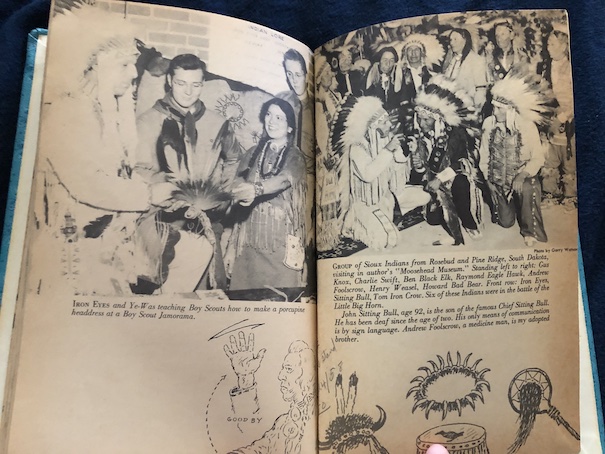
The author and his wife appear frequently in pictures in the book, demonstrating different signals in Indian sign language. Part of the book near the beginning explains about the author’s life, and what it says actually isn’t true, but the real story of the life of “Iron Eyes Cody” is pretty interesting. The main reason for the deception is that Iron Eyes Cody was an actor known for playing Native Americans in films, beginning in the 1920s. To support his film persona, he claimed to be of Native American descent, but the truth is that both of his parents were Italian. His birth name was Espera Oscar de Corti. In the book, he says that he was born on his family’s ranch in Texas, but he was actually born in Louisiana, and his parents owned a grocery store. The family did live in Texas for awhile. After his father died, he and his brothers moved to California to pursue acting careers, changing their last name to Cody. As part of his film persona, he was known to wear his Native American costumes on a daily basis, as if he were living a Native American lifestyle. Many people really believed he was Native American, but this costume quality is part of what gives the book that kitschy vibe. If you think that you’ve never seen or heard of Iron Eyes Cody before, it’s actually very likely that you have because one of his acting roles was that of the “Crying Indian” in the “Keep America Beautiful” anti-pollution PSAs of the 1970s. Yep! He’s that guy, and that’s the man who wrote this book.

So, you can disregard many of the details of Cody’s brief autobiography (there’s a fanciful story there about how he got the name “Iron Eyes”, but Chief Iron Eyes was actually the name of the character he played in the 1948 movie The Paleface with Bob Hope), but what is real is that he was married to an archaeologist of Native American descent, Bertha Parker (referred to as Yeawas in the book and also appearing in pictures to demonstrate the sign language), and they had two adopted children, also of Native American descent (one of which appears in pictures in the book). Outside of his acting work, Cody supported many charitable causes that helped Native Americans and promoted the study of Native American culture. He had a collection of Native American costumes and art that he called the Moosehead Museum, and he offered lessons in Native American arts and crafts, songs and dances, and lore out of his home. (The book doesn’t really offer details about how that worked, but my guess would be that his wife, the archaeologist, provided much of the instruction or at least educated Cody about these subjects before he taught others.) Cody also worked with the Boy Scouts, helping with Scout-O-Ramas and acting as an adviser about Indian (Native American) lore. He also sometimes helped the Girl Scouts. The book is dedicated to “the youth of America, especially the Boy Scouts of America.” If you would like to know a little more about Cody, I recommend this YouTube video and this one.

On the one hand, a person who is deceptive or misleading about their identity and credentials is worrisome and probably rightly considered unreliable. However, as near as I can tell (not being an expert on this topic myself), the information presented here seems reasonably accurate, and I think that’s probably due to research, consulting with experts, and the influence of the author’s wife, who did have credentials as an archaeologist and ethnologist and had connections to other scholars through her museum work. One of the beginning sections of the book is called “A Brief History of Sign Language by Bertha Parker Cody” with an accompanying list of works consulted (texts spanning 1880 to 1926, the 19th century ones apparently written by army officers because their ranks are given, if you’re curious – Bertha’s a woman after my own heart because she also added a note to her citation about a book with a particularly good bibliography section, and I’m a great believer in notes).

So, now that you know who’s talking here, let’s discuss what they have to say about Indian Sign Language, the main topic of this book.

In a foreword to the book, F. W. Hodge, director of the Southwest Museum in Los Angeles, where Bertha Parker used to work, discusses the concept of sign language and non-verbal cues used in communication by people all over the world. People in different countries, speaking different languages, might recognize a nod of the head as meaning “yes” or a finger placed against the lips as a gesture to be quiet, but sign languages convey much more than these simple ideas, allowing people to hold entire conversations. The Indian Sign Language presented in this book was used by many different tribes, ranging from Canada all the way south to Mexico. If members of different tribes encountered each other, they could use this language to communicate, no matter which language they spoke verbally. When people of European descent learned this sign language, they also gained the same ability to communicate with a wide range of Native Americans, without even needing to speak a single word aloud. Hodge said that this was an uncommon skill for people of European descent, although he does mention one of the army officers referenced by Bertha Parker Cody in her essay.
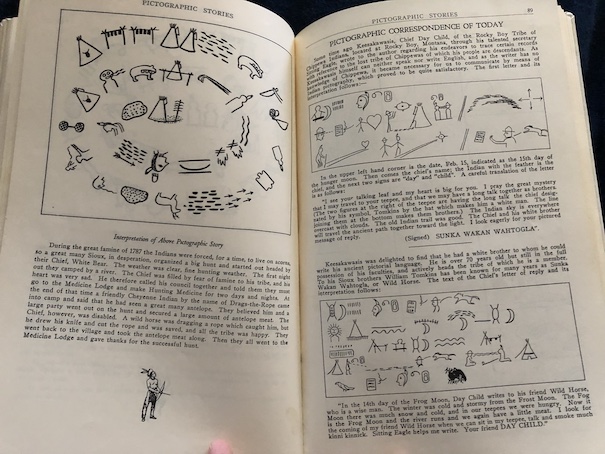
In her essay, Bertha Parker Cody also explains the concept of sign language, referring to it as a kind of “universal language.” She explains how people have used hand signs and gestures to convey ideas and concepts throughout history. She says that the reason why this type of universal language based on gestures was necessary because, in the territory now known as North America, there were once more than 500 different spoken languages among Native Americans. Even groups who were living no more than 10 miles away from each other might be speaking completely different languages, but they would need to be able to interact with each other and communicate. It is unknown exactly who invented this particular system of sign language (although there are some possible theories), but it was particularly developed by the Plains Indians because they were nomadic buffalo hunters, often encountering other tribes as they followed the herds. As an added benefit, because the language is completely silent, hunters could use it without startling their prey, and warriors could use it with each other before a surprise attack on an enemy. Chiefs of tribes would even use sign language to convey important messages because it would guarantee that people would pay attention and focus on the hand signs to interpret what they were saying. She explains that there are signs that the language changed over time and variations existed among different tribes, there was enough commonality that members of different tribes could communicate with each other effectively. She concludes by saying that their hope was that this book would help to keep knowledge of this sign language alive among young people at a time when it was falling out of use and living knowledge.

The actual vocabulary of the sign language is presented in sections organized alphabetically, with drawings and photographs of Cody and his wife performing each of the hand signs.

The book ends with a section about hand signs for numbers and counting and a section presenting examples for forming complete sentences using the hand signs presented in the book.

The final part of the book contains an Acknowledgement from Cody to all of the people who helped with the research and writing of the book, including the photographer and the artist who did the drawn pictures.

My Reaction

I’ve already given some of my thoughts and reactions in the review above, but there is one more thought that I had about this book. I completely understand why this book was library discard. It is an older book, and there are newer ones that cover the same topic as well or better. The author is an actor who is not as culturally relevant as he once was, and although it wasn’t known at the time of his popularity, he was deceptive about his life and past. In some ways, though, reading and researching this book and its background was educational. The education I would say that I got from this book wasn’t just about sign language but also about perceptions vs. reality, the roles people play, the personas created by the movie industry, and also the expectations of the public and the credentials we require or are willing to accept from those with a message to spread.

That last part is the most complicated part, but the resources that I consulted to get the details of Cody’s life pointed out that he did genuinely encourage interest in Native American culture and support causes important to Native Americans, which begs the question of whether he would have been accepted in that role of spreading interest and providing support if it had been known at the time that he was not actually a Native American himself. The truth is that he was something of a fake and a poser. He wasn’t really what he pretended to be, and in a sense, he was acting in a permanent role, even outside movies. He was given roles as a Native American in films because his physical appearance made it credible that he could have been one, and as far as movies are concerned, that’s really all that matters. Average people believed he really was a Native American because he was a good actor and convincing, and they didn’t know enough about real Native Americans to spot the parts about his dress and act that didn’t quite ring true. However, I think that Cody’s interest in Native American culture was genuine, probably the most genuine part of his performance, and he appears to have taken a genuine pride in it. A person lying about their background is deceptive and makes other things that they do suspect, but I’m still left with some questions. If he had been honest about his family’s background, would his interest in Native American culture been accepted or would people have sneered and said that he should have stuck to speaking only about the culture his family came from? Is it possible for someone to adopt a new culture not based on family or upbringing but pure personal interest and choice, and if so, could it ever be as deep or authentic as the culture one is born into and brought up in? Or, will it only ever just be an act or a deception, something that might only fool those who don’t know how to see the reality? What is the difference, or is there one? Could the person doing it even get so deep into the act that they themselves don’t know the difference anymore?