Discover the Night Sky by Chris Madsen and Michele Claiborne, 1989.
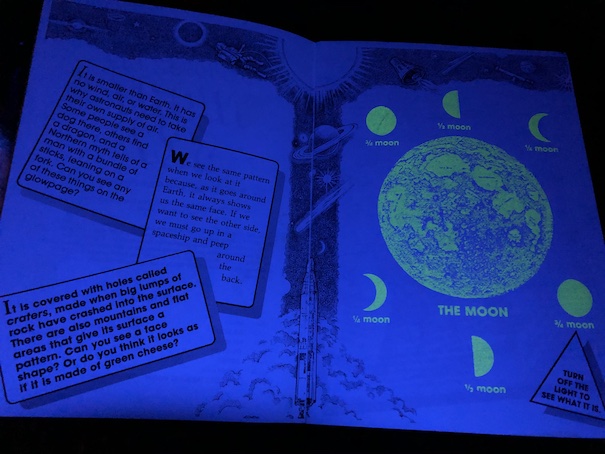
I bought this book at a school book fair when I was a kid, and it was my favorite book about the stars and outer space because it has glow-in-the-dark pictures. As a child, I loved anything that was glow-in-the-dark. Actually, I still do.
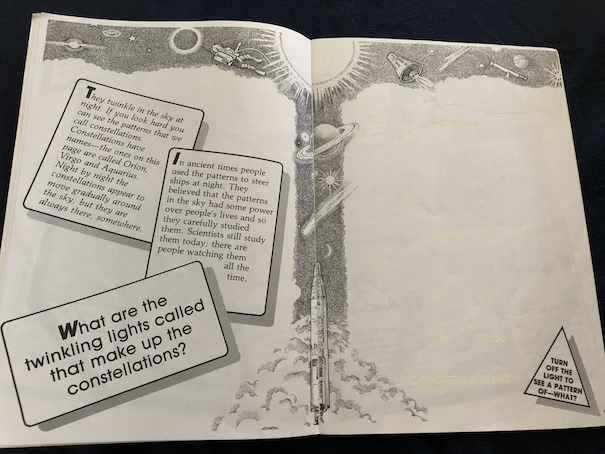
Every page in the book is designed to be interactive. There are pages that talk about different aspects of outer space, but the pages with the glow-in-the-dark pictures want you to guess what’s in the picture based on descriptions of it. Then, you’re supposed to turn off the light and look at the glowing picture to see what it is. You can see the what the glow-in-the-dark picture is without turning off the lights if you tilt the book and look at it at an angle or use a black light (like I did to take the pictures), but it is more fun if you really do look at it while it’s glowing in the dark. (Like other glow-in-the-dark toys, it glows better if the page has been in the light first to charge it.)
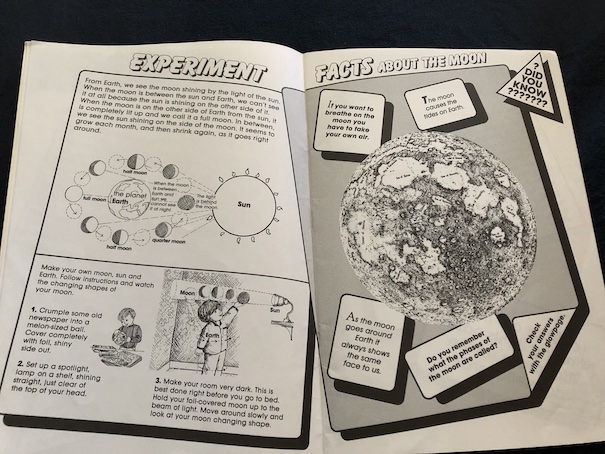
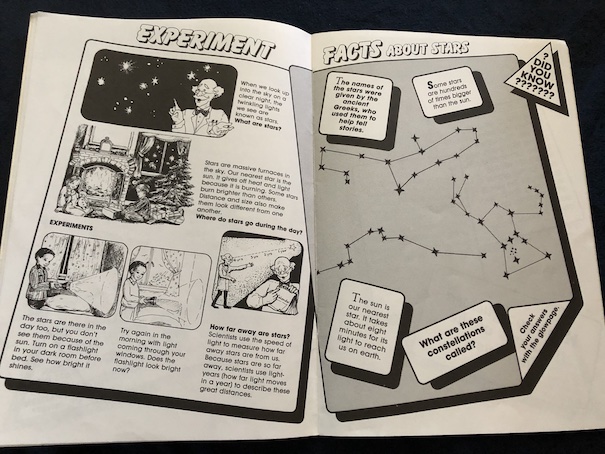
The pages after each glow-in-the-dark page have facts about the object in the glow-in-the-dark picture and an experiment for readers to do. The experiments help demonstrate the nature of the moon, stars, and planets, like what causes the phases of the moon, what causes seasons on Earth, and why you don’t see the stars during the day, even though they’re still there.
The information in the book is still factually correct, although it shows Pluto as being the last planet of the solar system. (Since people still quibble about this, I don’t consider it a big issue.) It isn’t a bad introduction to outer space for young children. The last page in the book is about the Voyager 2 space probe. Its primary mission ended around the time the book was first published, but we have contact with the space probe today (as of early 2021).
The book is available to borrow and read for free online through Internet Archive. The online version of the book doesn’t fully do it justice because you can’t take advantage of the glow-in-the-dark feature, but you can still read the text and see the experiment pages.
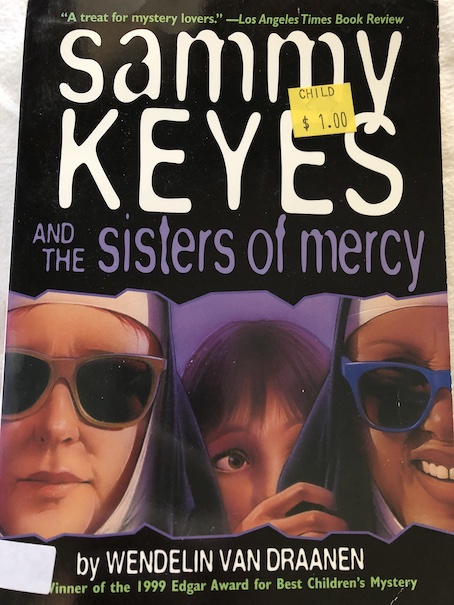
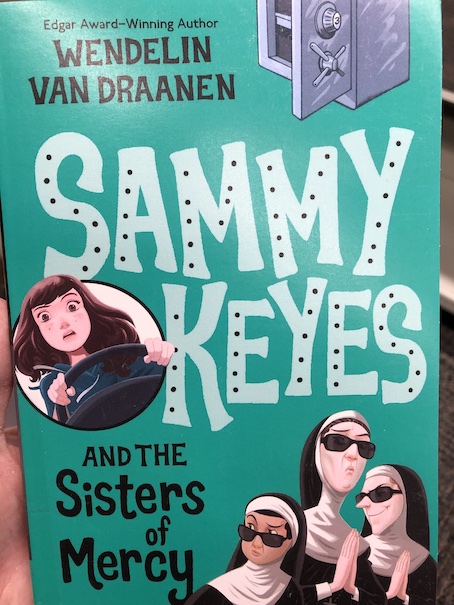
Sammy Keyes and the Sisters of Mercy by Wendelin Van Draanen, 1999.
At the end of the previous book in the series, Sammy was given a punishment from her school for causing a disturbance during an assembly that requires her to complete 20 hours of community service. She’s working off her volunteer hours at St. Mary’s Church under the supervision of Father Mayhew. When Sammy lived with her mother, they weren’t religious, and Sammy hadn’t even been baptized. However, her grandmother is much more religious, and she had Sammy baptized by Father Mayhew soon after Sammy moved in with her. Father Mayhew is kind and understanding with Sammy. There are also some nuns at St. Mary’s from an order called the Sisters of Mercy. They’re helping out in the soup kitchen. When elderly Sister Josephine sees that Sammy is painting a wall in Father Mayhew’s office, she complains that he’s always getting the services that the nuns ask for and never get. They’ve been asking to have the house where they live painted for years, and it still hasn’t happened.
Father Mayhew’s gratitude for Sammy’s help fades when a small ivory cross is stolen from his office, and he thinks that Sammy did it because she was in there. Sammy tells him that she didn’t take it, but he doesn’t believe her and sends her to go work in the soup kitchen for awhile. (He didn’t ask her to turn out her pockets before she left his office. I would have because that would settle the matter right there.) In the soup kitchen, Sammy sees another girl about her age who reminds her somewhat of herself, partly because of the high-top shoes she wear. Sammy wonders who the girl is and why she’s eating at the soup kitchen, but she isn’t able to talk to her there.
Later, Sammy discusses the missing cross with Father Mayhew again. This time, he seems less certain that Sammy took it, and Sammy asks him if it was something valuable that might have been sold for money or if someone who is angry with him could have taken it as revenge. The one person who seems angry with Father Mayhew is Sister Josephine, but he can’t picture her taking the cross. However, there are other people who might have a reason to be angry with Father Mayhew. Brother Phil, who works in the soup kitchen, wants to become a full priest, but Father Mayhew doesn’t think that he’s suited to it.
The thefts also continue. A couple of gold chalices are stolen from the church. The nuns who are part of the Sisters of Mercy turn out to be traveling and staying in a trailer, and they’re only staying at St. Mary’s temporarily to hold a fundraiser. They tell Father Mayhew that someone tried to break into their trailer, but they scared the thief off. One of the nuns ask Father Mayhew to keep an heirloom locket in his safe until she can deliver it to her niece.
Meanwhile, at school, Sammy is playing on one of her school’s two softball teams. Her school nemesis, Heather, plays on the other school team, so their feuding and rivalry has transferred to the school’s sports field.
This book is the first book in the series to bring up the subject of Sammy’s father. Sammy’s grandmother gives her a catcher’s mitt that once belonged to her father. Sammy’s mother was going to throw it out, but her grandmother rescued it from the trash, and it’s the only thing Sammy has that was once her father’s. She sees her love of playing catcher at softball as a connection to the father she’s never known. Sammy has never seen a picture of her father and doesn’t know his name, and her mother has admitted that he has no idea that Sammy exists. She has asked her mother about her father in the past, but her mother refuses to tell her who he is or what happened to him. All she has ever told Sammy is that she was young when they met and her relationship with him was a mistake. Sammy can’t help but feel that her mother things of her existence as a mistake as well, maybe even a bigger one than her relationship with her father. The fact that her mother has essentially abandoned her to pursue her dream of being an actress has left her feeling like her mother never really wanted her. Sammy has to stay with her grandmother, even though it means keeping her living arrangements a secret, because staying with her father isn’t even an option.
The next time that Sammy sees the mysterious girl in high-tops at the soup kitchen, she and her friends follow her to see where she lives. It turns out that she’s homeless and living in a cardboard box. This discovery raises some personal questions and concerns for Sammy. On the one hand, she’s unfortunate because her living situation is precarious and depends on not being caught in her grandmother’s apartment, which is meant only for seniors, but on the other, she does have her grandmother to rely on. This other poor girl doesn’t seem to have anyone. At one point, Sammy asks her grandmother about what would have happened to her if she hadn’t been able to take Sammy when her mother left. It’s an uncomfortable question for both of them because it raises the question of whether Sammy’s mother would have just abandoned her completely if she hadn’t had her mother willing to take her. Sammy’s mother doesn’t seems to care how awkward their living arrangement is because they have to keep Sammy’s presence in the apartment a secret. Without Sammy’s father in the picture, there is no one else but her grandmother to take her. There is also the constant question of what would happen to Sammy and her grandmother if someone manages to prove that Sammy is living with her against the rules. Sammy is better off than the homeless girl, not by much, but still better.
Later in the story, after Sammy’s beloved mitt is stolen, Sammy tells Hudson about everything that’s going on. She’s pretty sure that Heather is the mitt thief because she’s the one person who’s always doing awful things to her. Hudson points out that, in a way, Sammy is fortunate to know who she can trust and who she can’t, and she has one definite enemy. Holly has never really had anybody to trust before, and Father Mayhew has no idea who he can trust or not trust in his church. His thief is obviously one of the people who works with him on daily basis, someone who can come and go while seeming above suspicion, and Father Mayhew is only just beginning to realize that there are people around him he can’t trust as much as he thought.
The book is available to borrow and read for free online through Internet Archive (multiple copies).
My Reaction
For awhile, Sammy suspects that the homeless girl who visits the soup kitchen might be the thief who is stealing things from the church, but she’s not. The girl, whose name is Holly, becomes a regular character in the series. She is a runaway foster child who’s had an even tougher life than Sammy. When she and Sammy talk, she explains how she was abused in previous foster homes, which is why she ran away to live on her own. At one point, she is attacked by a man, and Sammy has to help fight him off. The girls realize that Holly can’t keep camping out on her own, and Sammy helps her find a place to stay with people who turn out to be able to provide a much more stable home for her, which is how she remains a character for the rest of the series. Holly begins attending school with Sammy and her friends, with her new foster family making up a story about how she transferred from New Mexico. Her new home seems to be a kind secretive foster home, not unlike Sammy’s living arrangements. Her new foster family doesn’t seem to try to legalize their custody of Holly (not in this book, anyway), possibly out of fear of her being taken away and put in other abusive or dysfunctional foster homes in the flawed system she came from. There is also a standalone book which focuses specifically on Holly called Runaway, which explains more about her personal history. Some of the things that happened to Holly are an indication that this series isn’t meant for young children. I would say that it’s best for tweens and up, probably about around the middle school level.
One of my favorite characters in this series is Hudson Graham, a retired old man who acts like a grandfather to Sammy. She often goes to see him when she needs help and advice. He is knowledgeable on an eclectic range of topics, and he has a massive private library that can answer most of Sammy’s questions. In this book, Sammy thinks about how, even though she and Hudson have talked about many things together, including his wide-ranging hobbies, she doesn’t really know that much about his past, even what he used to do for a living before he retired. Because he has a collection of foreign language dictionaries and recording devices, Sammy thinks that he might have once worked for the CIA or something. When the people who own the dog grooming business down the street lose the key to their safe because a dog ate it, Sammy asks Hudson what they can go, and he tells her some fascinated facts about safes and how to get into them. The fact that he knows about that suggested to me that he probably worked in law enforcement or security at some point. My thought is that he might have once been a private investigator because they do security work and would have some basic law knowledge and use devices that Hudson has, like recording machines and cameras. My next guess would be that he was a journalist, also because of the recording devices and cameras and because journalists can write on a wide range of topics, giving Hudson his eclectic knowledge and the need for his own private research library. Aspects of Sammy’s life and the lives of people she knows add extra mystery to the story. Hudson’s past isn’t explained in this book in the series, and I’m not sure if it ever is.
Sammy Keyes and the Hotel Thief by Wendelin Van Draanen, 1998.
Samantha “Sammy” Keyes lives with her grandmother in her apartment because her mother (who she calls “Lady Lana”) left her with her grandmother a year before, when she left to pursue an acting career. Much of the time, Sammy doesn’t have much to do at her grandmother’s apartment, so she spends her time watching people and nearby buildings with her binoculars. Technically, Sammy isn’t supposed to be living in her grandmother’s apartment because the apartment building is for seniors only, so they have to keep her presence a secret. Sammy only keeps a few belongings that are easily hidden, and she has to hide in a closet when people they don’t know and trust come to the door. She can’t come and go as often as she wants because her grandmother’s nosy neighbor will notice and report her. One day, while looking at a seedy hotel nearby, she witnesses someone with black gloves stealing money from someone’s purse. As she watches, this man looks directly at her and can tell that she’s watching. Sammy has the strange feeling like she’s seen the man somewhere before, but she can’t think where, and she’s nervous that he saw her, too.
A little later, Sammy’s friend, Marissa, comes to the apartment and asks Sammy to help her find her younger brother, who’s missing. Sammy knows that the best place to look for Marissa’s brother is at the pet store, so the two girls hurry off to find him. On her way back to her grandmother’s apartment, Sammy sees that there are police at the hotel, so the theft has been discovered. There are other kids standing around and watching, so Sammy decides to take a look, too. She sees the police interviewing the woman whose money was stolen. As she listens to them talk and mention looking for fingerprints, she can’t help but comment that there won’t be any fingerprints because the thief wore gloves. When the police and victim all hear her say that, they realize that she’s the only witness to the crime. As they question her, she describes what she saw while giving them as little personal information as possible so her secret of living with her grandmother won’t be exposed. When the police take down her name and address, she gives them her real name but Marissa’s address in a wealthy part of town.
The next day, both Sammy and Marissa have their first day of junior high school. Sammy immediately gets the attention of the school mean girl, Heather Acosta (who becomes her school nemesis for the rest of the series). When Heather jabs Sammy in the butt with a sharp pin, Sammy punches her in the nose. Of course, the vice principal shows all kinds of sympathy to poor Heather and punishes Sammy because he claims that nobody saw Heather jab Sammy in the butt with a pin. He makes her sit alone in a tiny closet that the school calls “the Box” to think about what she’s done. Even when Marissa tells the principal what really happened, supporting what Sammy said, the principal just says that there’s never any excuse for punching anybody and that Sammy is suspended. The vice principal expects Sammy to shake hands with her rotten abuser and make peace when she returns to school. (Ooh, I hate that. I’ve got a rant for later.)
After Sammy’s suspension, she and Marissa walk home together, and Sammy tells Marissa about what she witnessed at the hotel. When the two girls stop at the store, they see the woman whose purse was robbed and learn that she’s an astrologer called Madame Nashira (real name Gina). Surprisingly, she admits that she doesn’t really believe in fortune-telling, but she does it anyway because she needs the money. She likes drawing up astrological birth charts for people, though. There’s an interesting scene in the book where she does one for Sammy and explains how it works. (I’ve never been serious about astrology, and I doubt it even more since I took an astronomy class and my teacher showed us how to use a star globe and used it to explain why people’s birth signs aren’t their real birth signs, but it was still kind of fascinating just to think about. I’ve never actually seen a real birth chart before.)
When Sammy gets back to her grandmother’s apartment, Sammy’s grandmother’s nosy neighbor, Mrs. Graybill, tries to find evidence that Sammy is living there against the rules, or Sammy has to pretend like she’s only visiting and leaves to visit a nearby friend, Hudson Graham, an old man who has a lot of books. The two of them talk about other robberies that have happened in the area recently. When Sammy gets back to the apartment, she finds Mrs. Graybill angrily telling her grandmother that Sammy wrote her a threatening note and slipped it under her door. Of course, Sammy didn’t do any such thing. When Sammy sees that the note says, “If you talk, you’ll be sorry,” she knows that the threat is actually from the thief. The thief knew that someone from the apartment building was watching him, but he accidentally delivered the threat to the wrong apartment. With a threatening thief wanting to keep her quiet, Heather and the school principal wanting her butt to suffer at home, the nosy Mrs. Graybill wanting her sent away from her grandmother’s apartment, and the police wanting Sammy at her friend Marissa’s house, Sammy’s witnessing of the theft threatens to expose her own secrets.
The book is available to borrow and read for free online through Internet Archive (multiple copies).
My Reaction
One of the things that stands out to me is that neither Marissa nor Sammy really live in the best homes. Marissa’s family has a lot more money, and they live in a big house, but her parents are busy business people who spend most of their time working and traveling, often leaving Marissa alone with her younger brother, fending for themselves with Pop Tarts and tv dinners. Marissa feels neglected, and she really is. She also doesn’t have many real friends. A lot of the other kids who play up to her, like Heather, are trying to get her to give them money because they’re aware that her parents give her a lot of spending cash, and Marissa has had trouble saying “no” to them in the past. One of the thing Marissa likes about Sammy is that she’s never asked her for money. Sammy likes Marissa for herself.
Sammy is surprised when she finds out that Marissa actually envies her because her grandmother is always there for her in ways her parents aren’t. Sammy doesn’t feel lucky because, even though her grandmother cares about her, she always lives on the edge, having to pretend like she’s not really living with her grandmother, keeping only a few belongings that are easily hidden, and ducking into a closet to avoid being caught. She can never be completely at home in her grandmother’s apartment because she isn’t supposed to be there at all. Sammy’s mother occasionally calls, but Sammy always feels uncomfortable and neglected by her mother’s abandonment of her, which is why she refers to her as “Lady Lana” instead of as her mother.
I thought at first that Sammy’s housing situation might be solved by the end of the book, but it wasn’t. At the end of the story, she’s still secretly living with her grandmother and lying to the police about being Marissa’s foster sister. However, there are hints in this book about another possible place for Sammy and her grandmother to live in the future, so that situation might change. At no point in the story does anyone mention who Sammy’s father is, where he is, or why he didn’t take Sammy when her mother left. The identity of Sammy’s father is actually an over-arching mystery in this series, something that they discuss later.
As for the book’s introduction of “Rear” Admiral Heather the Butt Poker, the book doesn’t use the phrase “rotten abuser”, but that’s my take on it. Get ready for another one of my anti-bullying rants, or skip the rest of this long paragraph and the next two after that. I always find bullying in books stressful, especially when adults take the side of the young bully. It’s not as bad when a bully is punished or at least called out for their bullying, but when adults refuse to believe the victim, it’s awful. I know from long, bitter experience how the worst, most twisted mean kids provoke fights so their victims end up looking like the bad ones when they finally snap. The abusive kids know that the adults like them and will favor them every time. I’ve seen it happen before, and the fact that situations like this end up in books like this shows that it’s a sadly common experience that many people relate to. The abusers’ behavior never changes because they never experience consequences. The adults delude themselves that the abusers are either “normal” kids or will change (somehow, magically) as they get older and gaslight the victims that the situation is their fault and that it’s possible to be friends with the abuser without the abuser changing their behavior and continuing to act the same mean way they always act. I appreciate that the book shows the unfairness of the situation by adults who just want the situation easily resolved and make the kid they don’t like as well take the brunt of it. I know that Sammy’s use of physical retaliation is what put her in trouble, but honestly, I feel more inclined as an adult to think that sometimes physical force is necessary when dealing with a physical abuser. I’ve never heard of anyone who stopped being physically or emotionally abusive because they were asked politely, and when people in authority refuse to do anything, there sadly isn’t much recourse. Heather should not be touching anyone else’s butt, not with a sharp object, not with her hands, and not with anything else.It’s someone else’s butt.Heather should NOT be touching anyone else’s butt for any reason at all, let alone inflicting pain to someone else’s butt by penetrating it with something sharp. At her age, she should be old enough to understand that sort of thing has connotations other than a kid’s prank, and if she isn’t, someone needs to have a long, serious talk with her to explain why. I know that Heather’s meant to be just a thoughtless mean kid and not molester or something, but she’s still young and someone should put a stop to this before it goes any further. Understanding of these things has to come at some point in a person’s life. If there’s any lesson that’s difficult to carry too far, it’s the concept that no one should mess with someone else’s butt and cause pain. If Heather is allowed to mess with people’s butts in this school, understand that there is absolutely nowhere else in this society where she would be allowed to do that without repercussions. There’s no shame in having some weirdo you don’t even know assault your butt, but there’s a whole world of shame for being that weirdo who can’t leave someone else’s butt alone. Also, Heather jabbed Sammy with something sharp that penetrated her skin. Am I the only adult thinking about tetanus and blood poisoning?
Kids who are bullies in school are more likely to engage in aggressive, anti-social, and criminal behavior in adulthood. Shrugging and saying “Kids will be kids” while doing nothing is one of the worst possible things to do. Bullies don’t magically get better when they hit a certain age. If no one intervenes and teaches them that there are some forms of behavior that are never acceptable and really enforce the rules, they will continue their bullying for the whole rest of their lives, seeing the whole rest of the world as being in the wrong for complaining about their behavior, causing workplace stress, family turmoil, and failed relationships. It’s a serious problem. It’s not harmless. It seems like decades past time for the school vice principal to have this explained to him as well. A school can have all kinds of anti-bullying rules, but if they never enforce them for all parties involved, they’re completely useless because it’s like they don’t even exist at all. Kids are pretty good judges of who’s a pushover and what they can get away with, so anyone who’s worked with them should realize that the only rules that matter are the ones that actually get enforced. Unless the vice principal is one of those grown-up bullies himself who never got a clue and can’t stand to realize the reality about himself, which is always a possibility. I just have no sympathy for that.
I wonder if the vice principal considered how his reaction to what Sammy told him about being jabbed in the butt by a sharp object, actively punishing Sammy for what she said and for her physical retaliation to the violation of her body, might be teaching her some terrible lessons about how to respond to a sexual assault, including the one that people in authority will never believe her and will actively punish her because it’s the easiest thing for them to do and that’s all that matters. That happens quite a lot in real life, as the #MeToo movement has shown. This video, which is rather explicit in its descriptions and not for kids, explains about university officials who act like this vice principal and the harm they do when they let sexual violators go unpunished and even rewarded, while their victims are sent jumping through hoops for justice they never plan to give them because they just want them to shut up, go away, and not make trouble for the bullies they really like. At their core, bullying and sexual violence are both about power and control over other people and using people for the perpetrator’s purpose. It’s not really surprising that there is a connection between the two and that young bullies can turn into perpetrators of sexual violence. I wonder if the vice principal’s response would have been different if it had been a boy who jabbed Sammy’s butt instead of a girl. Actually, I don’t really wonder. I’m sure he would never think of that and would spend a lot more time coming up with reasons why this situation is different is different from any form of sexual assault, so harmless, and how he shouldn’t have to think of it if someone asked him. I liked the part where Sammy offered to show him the mark from the pin if he refused to believe her, an offer the vice principal didn’t accept. I know he’s just taking the easy way out here, punishing the person who didn’t lie and deny throwing a punch and maybe sympathizing with Heather because she got noticeably hurt in a place that isn’t covered by pants and underwear, but as an adult who remembers kids like Heather, I have absolutely no respect for this vice principal for his hard-line punish-the-bullied stance. I don’t feel for Heather at all because she got what she provoked, and there was repeated provocation followed up by a physical attack before Sammy finally broke. Every human on Earth has a breaking point, anyone might snap when pushed too far, and nobody is clever for exploiting someone’s human emotions to the point where they break. Learning that is a valuable life lesson. Of course, I know Heather sticks around as a bully for other books, so she’s not learning a thing.
While Sammy is suspended, Heather and her friend Tenille start a scheme at school to get money from other students by milking their sympathy for her “broken nose” (what they call the “Help Heal Heather Fund”). Of course, her nose isn’t really broken. Sammy realizes it because she’s seen someone with a broken nose before, and the bandaging on Heather’s isn’t right. (The book doesn’t mention it, but people with a broken nose also typically get two black eyes or at least dark, obvious bruises under the eyes from the broken blood vessels. I didn’t know that as a kid, but someone told me about that as an adult, so that’s one of the first things I’d look for.) When Sammy realizes that Heather is faking a broken nose and putting bandages on herself, she figures out how to expose her scheme. She calls the office of the doctor Heather mentioned to someone else, pretending to be Heather, and has the doctor’s office call the vice principal to explain that she doesn’t really need to wear bandages, implying that the vice principal is forcing her to wear them against her will out of an abundance of caution. After the vice principal gets the call from the doctor, who chewed him out for forcing a girl to cover her nose in bandages over just a little nose bleed, he marches into the cafeteria and tells Heather to take her bandages off in front of everyone, exposing her fraud. He tells her that they’re going to have a talk in his office about her lies, and Heather tries to hit Sammy, accidentally hitting the vice principal instead. Heather gets suspended for much longer than Sammy was, and the other students are angry with both her and Tenille for taking their money. The vice principal never apologizes to Sammy for his earlier implication that she was lying and for making her sit in that little closet called “the Box” to think about it, but her reputation is restored at school.
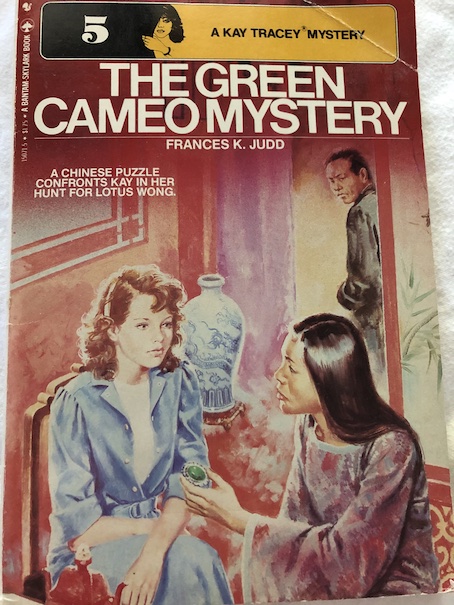
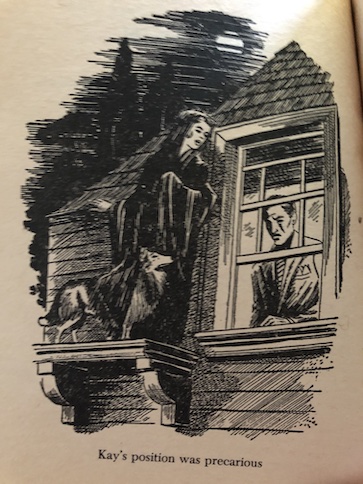
The Green Cameo Mystery by Frances K. Judd, 1952, 1980.
The story begins with Kay’s friends, Betty and Wendy, treating her to lunch, but when the girls try to pay the bill, the cashier says that their money is counterfeit. Betty and Wendy say that their mother gave them the cash, and she got those particular bills on a recent trip to San Francisco. The cashier tells them to contact the Secret Service and report the counterfeit money and tell them where it came from. (This book is old, but the Secret Service still investigates counterfeit money.)
As the girls leave the restaurant, they talk about the errands they want to run this afternoon. There is an auction Kay wants to attend because there’s a beautiful Chinese desk that she wants to get for her cousin, Bill, for his new office. However, she remembers that she needs to drop Bill’s shirt off at a laundry before they go to the auction. The laundry is a cliched Chinese laundry (connections are building in this story), but the man Kay usually sees there is absent today. The woman at the counter, Lily Wong, says that she’s the man’s sister and that her brother is unwell. Kay asks if he’s been to a doctor, and Mrs. Wong fearfully says that she doesn’t think that there’s anything a doctor could do against the green cameo. She explains that her husband got the green cameo in Shanghai, but it’s cursed, and it brings misfortune to her family every three years. While the girls are talking to the woman, she gets a phone call from someone who tells her that her daughter Lotus is now missing, having disappeared from the college she attends. (Yeah, Lotus. I don’t know if that’s a name that Chinese people actually use, but many of the Chinese names in this book struck me as being made up. I could be wrong because I’m not an expert on Chinese names, but they have that look.)
Mrs. Wong tells Kay that she tried to hire a medium named Cara Noma to break the curse of the green cameo, but she hasn’t been able to do it. Right away, Kay is sure that Cara Noma is a fraud. Kay volunteers to help find Lotus. A prime motive for her disappearance is Lotus’s impending arranged marriage to an older but wealthy businessman named Foochow. (I Googled that name, and apparently, it’s a romanized version of a place name, not a last name.) Kay’s first thought is that Lotus may have run away because she decided that she didn’t want to participate in this arranged marriage. Mrs. Wong also tells Kay that Cara Noma claims that her daughter has sold a jewel box with a green lotus cameo on the lid that Mr. Wong gave her as a betrothal gift.
The medium Cara Noma shows up while Kay is discussing the situation with Mrs. Wong and starts into her mystical act about how she’s going to break the curse. Kay impatiently tells her that it’s all nonsense and that she’s just taking poor Mrs. Wong’s money. Even Mrs. Wong agrees because, so far, Cara Noma hasn’t produced any results, and Kay is nice enough to offer to help her for free. Angrily, Cara Noma grabs both Kay and Mrs. Wong and uses some blood from a cut on Mrs. Wong’s finger to draw a red X on Kay’s forehead. She declares that she has transferred the curse of the green cameo to Kay and that Kay will soon see that the curse is real.
Kay still doesn’t think that the curse is real, and she and her friends head over to the auction where she wants to buy that desk for her cousin. Before the auction begins, Kay and her friends are looking over the items for sale when Kay discovers that the desk she wants to buy has a secret compartment in it. On impulse, she puts the envelope holding her money in the secret compartment to try it out. (This is so dumb, Kay. Don’t put all of your money in the secret compartment of a desk you don’t own!) Then, she gets distracted when she spots a jewelry box matching the one described by Mrs. Wong. Then, Kay’s nemesis from school, Chris Eaton, shows up and tells her not to waste her time bidding on the jewelry box because she wants and she has more money than Kay.
It turns out that Kay is unable to buy the desk she wanted to buy because the bidding is much higher than she can afford. Then, a man named Sidney Trexler shows up and protests the auction, saying that the desk belongs to him and he doesn’t want to sell it. It turns out that he’d been storing the desk there, but the desk was being sold because he hadn’t paid his storage fees. Mr. Trexler says that he has the money to pay his fees now and wants the desk back because he’s planning to get married and will need the furniture. The man who was going to buy the desk agrees to cancel his offer to buy so Mr. Trexler can have the desk back. When the jewelry box comes up for sale, both Kay and Chris Eaton are outbid by Mr. Trexler as well. Kay is disappointed because she was hoping to get the jewelry box for Mrs. Wong.
However, the mystery is only just beginning. When Kay gets home, she finds that the envelope she thought held her money isn’t really her envelope. She did remember to retrieve the envelope from the desk before it was sold (for a moment, I was afraid that she would forget), but by mistake, she grabbed a different envelope. Is this the first bad luck of the curse? Kay knows that she has to talk to either the auction house or Mr. Trexler to get her envelope and money back! Then, a taunting comment from Chris Eaton reveals that Mr. Trexler’s fiancee is actually Lotus Wong. Now, Kay really needs to find Mr. Trexler!
The book is available to borrow and read for free online through Internet Archive.
My Reaction and Spoilers
So, right from the beginning of this story we have the mystery of the counterfeit money, the mystery of the cameo curse, the mystery of the fake medium, the mystery of the disappearance of Lotus Wong, and the mystery of Mr. Trexler and his engagement and sudden money. The girls also come to wonder about Mr. Wong. He seems to have much more money than his brother-in-law who operates the laundry, and his wife seems afraid of him. What is Mr. Wong’s business, and why doesn’t he do more for his brother-in-law? Are any or all of these things connected? Actually, yes. At first, I wasn’t sure how they were going to circle back toward the counterfeit money from the beginning of the book, but it turns out that Cara Noma is in on the counterfeiting operation. For a time, it looks like Mr. Wong might be the head of the operation, but it turns out that he’s innocent. I thought that Lotus’s reasons for running away were poorly explained. Part of it is that she doesn’t want to marry Foochow, but there’s also a side plot about Cara Noma using hypnosis to control both Lotus and her mother. I think the implication is that she was doing it to milk Mrs. Wong of money while keeping Lotus hidden from her, but it seemed like an odd complication to me since Cara Noma was also involved in the counterfeiting ring.
I’m not sure that I’d call anything in the book “racist”, although I think there may be justification for saying that parts are “stereotypical” and probably a bit culturally shallow and “tone deaf.” My first impression was that the author and the characters in the story like Chinese culture for being exciting and exotic, but in that way where there’s no real depth to their knowledge it and it comes off as being a bit like caricatures of Chinese people you might see in old movies. I’ve seen some of the old Charlie Chan mystery movies, and the way the characters in the book talked kind of reminded me of them. The Chinese names seem pretty stereotypical and so does the way they speak in broken English. They don’t do the “Engrish” thing where the ‘l’s and ‘r’s are swapped, but the Chinese characters don’t speak proper English, and they throw in phrases and expressions that I think are meant to sound quaintly foreign. At one point, Mrs. Wong says to the girls, “When you see Lotus again, tell my lovely flower not study too hard. Much study make many wrinkles.” I’m not sure whether that was just a joke or if it was supposed to be some kind of pseudo-proverb, like Charlie Chan used to make. On the other hand, some of the speech patterns I thought might be old stereotypical tropes from movies might have more grounding in real life than I’ve credited them for having. Lily Wong also sometimes refers to herself in the third person, “Lily Wong not sure,” instead of “I am not sure.” I’ve met people in real life whose first language was Chinese, and none of them do this. I thought at first that this might be another trope carried over from old movies, but I looked it up, and apparently, actual Chinese speakers can do this sometimes. The technical name for it is illeism. So, while some of the speech patterns seem like old movie tropes, they might not be completely wrong for real life.
One part of the story that bothered me is the Chinese play that Kay’s school decides to perform. Kay and her friends are told that “a delegation of foreign visitors to the United States” (no nationality/nationalities specified at first) would be visiting schools in the area, including the high school that they attend. To entertain their foreign visitors, the school decides that they’re going to put on a short play, and of course, the drama teacher picks one with an “Oriental” theme called “The Pagoda Mystery.” (“Oriental” is the word they use, which is rather vague and considered somewhat outdated now. Some people consider it demeaning because it has old associations with stereotypes that people don’t want to perpetuate. The demeaning part seems to be more in the attitudes associated with its use than in the word itself. It is a technical geographic term that refers to the Eastern Hemisphere, but my thought is that referring to an entire hemisphere is rather vague. I don’t think the book meant it badly, but in modern times, it’s generally considered more polite and a sign of being well-educated to use the most specific word possible when describing geographic regions or groups of people. When people are overly vague, it makes it sound like they don’t know what they’re talking about or what the more specific word is. If this play is specifically about China, they could have just said that.) It’s rather coincidental that they’re doing a mystery play set in China right when Kay is working on a mystery involving people from China, but those types of coincidences happen often in Kay Tracey books. I wasn’t able to find any real information about this play, so I’m pretty sure sure that it was just made up by the author of the book so the school would have just the right kind of coincidental play to perform. Also, of course, Kay gets the lead role in the play when she tries out for it, that of a beautiful Chinese maiden. If there are any Asian students at this school, they aren’t mentioned, so I don’t think there are any. Charlie Chan was also not played by Asian actors, even though other characters in the series were, which is why they bother people now and there haven’t been any new ones made since 1981. The book says, “But because of her recent experiences at the Wong home, Kay spoke her lines with special feeling and proved her familiarity with Chinese customs and people. Therefore, the leading role was given to her.” I’m not convinced that her conversations with Mrs. Wong have really given her deep knowledge of China, but they did have tea together at her house, so maybe there’s an implication that she told her more about Chinese tea customs than the book described or something.
By another coincidence, it turns out that Mrs. Wong was in a production of the same exact play in China when she was young, and she played the part that Kay is going to play, so she coaches Kay in how to play the part. (What stroke of luck! See, Kay isn’t cursed!) Mrs. Wong assures Kay that when her face is made up to look Chinese, no one will know that she isn’t really Chinese because she’s such a good actress. I suppose that people in the 1950s, when this book was originally written, would be a little more accepting of non-Asians wearing makeup to play Asians (called “yellowface“) just because it was done more often back then, and people get comfortable with things they see often. It’s not particularly comfortable for modern people because our society is sufficiently diverse to have actual Asians playing Asian roles without the help of cheesy makeup, so this part of the story is eye-rolling, especially the way everyone fawns over Kay being so authentic-seeming. Also, much of what Mrs. Wong teaches Kay seems to involve making gestures with her hands and fluttering her eyelashes when she speaks, which the drama teacher praises as being very realistically Chinese. It’s hard to know exactly what that means without seeing exactly what Kay’s doing, and the description doesn’t say much. The fluttering eyelashes make me think that she’s acting flirty, but I don’t know if that’s suppose to be part of her role in the play or not because we’re never told the full story. Again, I could be wrong, but it Kay’s apparently authentic performance seems more like something from an old movie than real life.
I think that the drama coach choosing a play from China was meant to be some kind of salute to the foreign visitors (and a coincidence that helps further the plot of Kay’s mystery), but it seems like a kind of tone-deaf choice to me, not thinking about what people really want to see and experience when they visit a foreign country. If I were the person making the decisions, I don’t think that I would be comfortable with showing visiting foreign dignitaries a high school production of a play they would already know from their own youths in their country, entirely acted by people wearing makeup to look like them, probably with varying degrees of success. It just seems awkward and might give the impression that they were being made mocked rather than honored. People travel to see new and different things, not imitations of things they already have back home. That would be like someone from New York City going to New Orleans and spending their entire time there watching productions of Broadway plays instead of touring the French Quarter or the Garden District. If you’re just going to do something you could do back home, what did you even make the trip for? Traveling is about seeing things that make different places unique. So, if I were in charge of the high school play, I think I would have picked something that had nothing to do with China, something new and original that the visitors could describe to people back home as something you could only see if you go to America. It might be an American-written play or maybe something that the students put together themselves to show their individual personalities and interests, a view of the modern American teenager, like a collection of student-written short skits or a talent show. Musical performances would be good because people can still enjoy the sounds of the music even if they don’t know all of the words. It’s pretty likely that this school has a band or orchestra, and there may be some unofficial student bands that could play. Dancing, gymnastics, and juggling acts might be good, too, if there are people who know how to do those, because people understand what they are just by looking at them. They don’t require explanations like humor that involves puns and might go over the heads of people who aren’t completely fluent in a language. I like the idea of the entertainment being a sort of variety show with music and skits because that’s a traditional form of entertainment that was still popular in the 1950s, and it’s a good format when you have a large group of people because there are multiple leading parts and solos in different acts of the show, avoiding some of the inevitable arguments about who gets the best parts. They could even have displays of artwork or science projects from students who aren’t part of the performing entertainment. It would offer variety for the visitors and give everyone a chance to contribute something.
Of course, there’s a subplot to the story about Chris Eaton, Kay’s school nemesis, trying to steal her part in the play. Chris even goes so far as to drug Kay’s food so she’ll miss the performance. First of all, I’d never be as trusting as Kay, and I wouldn’t eat anything that someone who has a history of doing nasty things gave me. If Kay’s so sharp, she should have figured that Chris would do something nasty to her food. Second, drugging somebody isn’t a harmless prank. Chris apparently slipped Kay a strong sleeping pill, and Kay didn’t even finish everything Chris gave her. We don’t know whether Chris might have accidentally overdosed Kay if she’d eaten it all. People can die from drug overdoses. Chris also couldn’t know for sure whether or not Kay might have been taking some other medication at the time that would conflict with what she gave her. People can also die from mixing the wrong medications. For some reason, Kay and her friends don’t tell on Chris, and Chris isn’t punished. I understand that people don’t like to be thought of as tattletales, but I think that there are limits to what people should be willing to put up with, and being drugged should definitely something no one should tolerate. What she did was serious, and I don’t like it that they’re pretending like it isn’t.
Overall, I found myself often thinking of the old Charlie Chan movies while reading this book, comparing what I was reading to what I’ve seen in old movies. There are reasons why the Charlie Chan movies didn’t last, and I think this book is a decent example of some of those reasons. During their heyday, the Charlie Chan books and movies were welcomed as one of the first portrayals of an Asian hero in American culture who was kind, intelligent, and upheld justice. Even though Charlie Chan was a stereotypical character, he was a stereotype of all that was good, which was a welcome break from previous stereotypes of Asians as devious, evil characters, like the fictional villain Fu Manchu. Charlie Chan was one of the first fictional characters to encourage the American public to see Asian people in a friendly light and even as people to be admired. The Charlie Chan series encouraged a positive interest in Chinese people and culture, even though it was also somewhat shallow and stereotypical. As I said, the actors who portrayed Charlie Chan in movies were not Asian themselves. Hollywood back in the day couldn’t bring itself to put an Asian in the leading role. Culturally speaking, it’s probably best to look at that series as a stepping stone to better things. Once people have been introduced to a concept, we expect them to eventually gain more depth and understanding. Charlie Chan helped people to break away from old, toxic ideas and prejudices, but that doesn’t mean that people should stay at that level of cultural understanding and portrayals. People progress. They grow and learn, and so do societies and cultures.
What I’m saying is that nothing in this story related to China or Chinese culture is educational for children. They won’t learn anything from this book, and most of the books that I read as a child specifically included real facts about other countries and culture to be at least factually-correct or semi-educational. This book doesn’t even define the word “pagoda” for anyone who doesn’t already know it. There are no Chinese words in the story, and when Kay and her friends have tea with Mrs. Wong, they don’t say whether there are any special tea customs they observe. What the book tells you about Chinese people is very general – that they have some interesting antique furniture and art objects, they drink tea, they might be superstitious, not all of them speak good English, some are friendly and helpful while others are sinister criminals, and if you want to act like one on stage, hand gestures and fluttering eyes are pretty important (whatever that means). Some of that stuff is true, particularly the parts about tea, the fascinating antiques, and the fact that some can be good and some bad, like human beings in general. But, there’s not much concrete, factual knowledge here, and some parts might give kids the wrong impression. I had the feeling the whole time I was reading it that the person who wrote it was a fan of old movies and didn’t really know much about Chinese culture to tell anybody in a factual, educational way. The old Scooby-Doo cartoons were kind of like this when they talked about other countries and cultures, too, because many of them were written as kind of spoofs on movies that people would have known when they were first made. If you’re into old movies, you can recognize the references, but they weren’t meant to teach anything or include any real information. If you compare the older Scooby-Doo series to the more modern ones, you’ll notice that some of the modern ones make more of an effort to include some real, educational facts. Scooby-Doo isn’t an educational show, but I have noticed a slight shift in how they talk about other countries and cultures. That’s more the standard of children’s literature and entertainment I’m accustomed to – when someone says something about another country or culture, I expect it to be something factual that shows that the author did at least a little basic research and knows something about what they’re talking about. It’s grating to me sometimes that older, vintage children’s series don’t always do this. Some of them even shamelessly make things up about other countries and cultures just because they think it would make the story more exciting, assuming that the kids reading the books won’t notice or care. If this book sparked an interest and encouraged kids to learn more about China or Chinese culture, it’s not too bad, but by itself, it doesn’t demonstrate any helpful level of cultural knowledge and information.
The Mansion of Secrets by Frances K. Judd, 1951, 1980.
Kay’s cousin, Bill, is relieved when he finds a buyer for the old Greeley mansion. The former owner, Manuel Greeley, was an elderly man who passed away without leaving a will. As a lawyer, Bill was put in charge of trying to find the nearest Greeley relative as heir, who turned out to be a distant nephew of Manuel’s. The nephew isn’t interested in keeping the house for himself because he’s an airplane pilot and spends most of his time traveling, so he asked Bill to sell it on his behalf. It’s not a particularly desirable property because it’s a few miles outside of town and rather isolated. There’s also a local rumor that the place is haunted and that there’s a treasure hidden somewhere on the property, earning it the nickname “Mansion of Secrets.” The man who says he wants to buy the mansion, Clarence Cody, is from another state, Wyoming, and he doesn’t care about the isolated nature of the house because he wants to turn the place into a resort and riding school. The mansion would be an idea location because it already has stables and pastures on the property.
Kay is still fascinated by the stories of ghosts and treasure she’s heard about the house and asks Bill if she and some friends could take a look around the place before he completes the sale. She’s always wondered what it was like inside, and she thinks this might be her last chance to find out. Bill decides that the request is harmless enough, lends her the key to the house, and tells Kay that she and her friends can go out to the property and take down the “For Sale” sign for him. He doesn’t expect that Kay and her friends are really going to find any ghosts or treasure.
However, when Kay and her friends go out to the old mansion, they spot a strange woman on the property. This strange woman uses some tools to pry up one of the boards of the stairway and seems to find something hidden under the step, but she becomes frightened and runs away when she realizes that Kay and her friends are there. When the girls try to run after her, she gets away from them.
Then, a man shows up and introduces himself as Peter Greeley, Manuel’s grandnephew. He says that he just came to take some of the pictures from the walls of the house. The girls ask him if the stories about treasure in the house are true, but Peter says he doesn’t think so. He admits that he’s searched the house himself to see if he could find anything, but he never has, so he thinks that it’s just a story.
The girls investigate the steps where the mysterious woman was searching and discover another step with something hidden inside. The papers they find turn out to be blueprints of the house, and there are several spots marked with red ‘X’s and labeled “IMPORTANT.” Two of the ‘X’s represent the step where the woman was searching and the step where the girls found the blueprints, so the girls figure out that the other ‘X’s are also secret hiding places. The girls decide to try checking another one to see what they find, and they discover a hidden panel that holds diamond jewelry! The girls realize that they need to tell Bill and Peter immediately because this treasure and anything else hidden in the house legally belong to Peter, and he should claim it before moving forward with selling the house.
When they show the diamond jewelry to Bill, he takes it to the bank for safe keeping, and he goes out to the house with the girls to check out the other hiding places marked on the blueprints. They split up to search different spots, and Kay’s friends discover some antique Bibles that are valuable collectors’ items. Kay decides to consult the blueprints again, but someone stole them while everyone was looking at the Bible! Realizing that the thief could be hiding somewhere in the house, Bill decides to search, but the thief knocks him down and runs away. They don’t know who it was except that it was a man wearing a mask. Bill decides that the only thing to do is to call Peter Greeley and arrange for someone to guard the house.
They don’t know who either the man or the woman sneaking around the house are, but somehow, both of them seem to know something about what Manuel Greeley was hiding in his house and even where some of it was hidden. With Clarence Cody pressing to finalize the sale of the property, Bill, Kay, and their friends try to find the other stashes of hidden treasures in the house before anyone else can steal them.
The book is available to borrow and read for free online through Internet Archive. That copy is one of the older versions, where Kay’s friend “Wendy” is still called “Wilma”, and her nemesis at school is called “Ethel” instead of “Chris.” Those names changed in later printings of the stories. It also shows the girls with their true hair colors on the cover, something which most other books in the series don’t do. Kay is supposed to have brown hair, Betty is blonde, and Wendy/Wilma has dark hair (I think they usually just say “dark”, implying dark brown or black hair).
My Reaction and Spoilers
Spooky old houses with secret hiding places and hidden rooms are classics in children’s literature, and it’s fun in this book to see them find various kinds of valuable objects hidden in this house by its eccentric former owner. I have to admit that the hidden room of animal trophies was more creepy for me than it was for the characters in the story. I’m an animal lover, and I would not be happy to find myself in a room with deceased animals staring at me reproachfully from the walls. The last thing on my mind at that point would be figuring out how much they were worth. It’s also a bit coincidental that one of Manuel’s “treasures” turns out to be a valuable jar of ambergris, a key ingredient in perfumes, when Kay accidentally broke a jar of the stuff on a class trip to a perfume factory.
Of course, Kay breaking the jar wasn’t actually her fault but that of her school nemesis, who bumped into her on purpose and made her drop it. Kay is one of those characters who seems a little too perfect at everything she does, and even her missteps are often someone else’s fault. I don’t hate Kay, but I have to admit that I’d prefer her being a little more realistic as a human character. Minor klutziness that wasn’t someone else’s fault wouldn’t be a bad characteristic for her to have. There is only one minor flaw that I’ve seen in Kay, which is occasional impatience. Her impatience is only very minor and never enough to seriously interfere with her investigations, but it does appear in this book, toward the end.
Even though they mention rumors of the house being haunted early in the story, there was never a point where the characters really thought that there were ghosts in the house or had to come to the realization that strange things happening were caused by humans instead of ghosts. They knew right from the beginning that there were real humans lurking around the house, looking for hidden treasures. Between the two people initially caught sneaking around the old house, looking for things, the man is more sinister than the woman, and he becomes the repeat visitor. It turns out that the woman used to work for Manuel Greeley and she was searching under one of the steps because Manuel told her to do that if her wages weren’t completely paid by the time he died. When Kay learns the reason why she was searching in the house, her situation is easily resolved.
In many Kay Tracey books, the mystery is less about who the villains are than where they’re hiding and how to catch them. What I mean is that the Kay Tracey mysteries are generally not the kind of mystery book where you have maybe five or six main suspects for committing a crime and the story is about figuring out which of them did it. Instead, the villains and criminals are typically people Kay and her friends have never met or seen before in their lives. In this case, they figure out that they’ve seen the man sneaking around the old mansion before in advertisements because his main career is being a model. It doesn’t take too long to find out his name (at least his professional name) by tracing the advertisements back to an agency, but tracking him down is harder. They eventually catch him when he returns to the mansion but the more mysterious part is how he knew about the mansion’s treasures and the secret hiding places marked on the blueprints. Kay eventually realizes that the man doesn’t have a connection to old Manuel Greeley but to the architect who designed his house. In a rare display of imperfection, Kay almost misses the key clue to the relationship because she gets impatient with the woman who is telling her about the architect and his family.
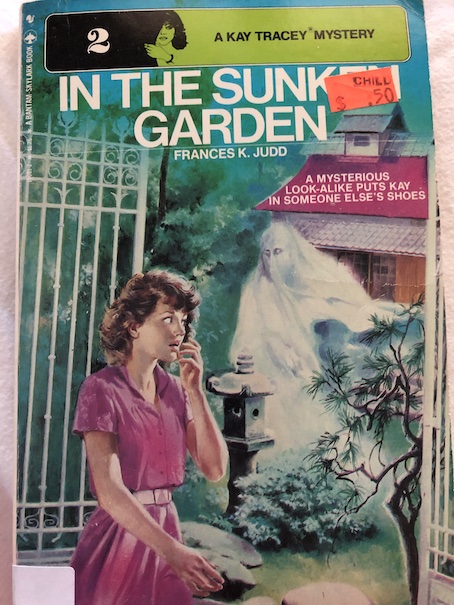
In the Sunken Garden by Frances K. Judd (Stratemeyer Syndicate), 1952 (revised from 1941 edition), 1980.
Kay Tracey discovers that she has a doppelganger when she’s running some errands for her mother and some people in town act like they know her even though she’s never seen them before. As she heads home, a dog even follows her car, as if it thinks that she’s his owner. Kay is bewildered by this, but she decides to take the dog home with her until she can figure out who really owns him.
This is just the beginning of Kay’s entanglement with her mysterious double. Ronald Earle, the boy who likes Kay, gets angry because he thinks that he’s seen her out riding with someone else in his car after turning down a ride with him to attend her mother’s luncheon party. Kay straightens Ronald out only to be confronted with her cousin, Bill, who returns home, very upset because he has heard that Kay was in a car accident and is now in the hospital. Bill is relieved to see Kay perfectly fine at home, but that still doesn’t clear up the question of who this mysterious double is.
According to the hospital, the girl who was in the car accident told them she was Jane Barton, but she checked herself out of the hospital because she only had minor injuries. That isn’t the end of the matter, though. A man named Joe Craken shows up and accuses Kay of wrecking his car in the car accident. He says that the police identified her as the driver of the other car in the accident based on her physical description. With Joe Craken attempting to sue her for damages and the injuries done to a passenger in his car, Kay needs to find her mysterious double!
This mysterious double seems to have some connection to the old Huntley place, a mansion outside of town. The Huntleys were distant relatives of Ronald’s, and Kay learns about the family scandal from someone who used to work for the family. Years ago, Mrs. Huntley’s sister, Trixie Rue, was a dancer with a promising career, but she gave it all up to get married. Unfortunately, the marriage didn’t really work out, and she and her husband fell on hard times. Mrs. Huntley gave her sister some money to help her get by, but apparently, it wasn’t enough because the sister resorted to stealing to help support herself and her baby daughter and ended up having to leave town in disgrace. Does this local scandal have any bearing on the sudden appearance of Kay’s double? One night, while having a look at the old Huntley mansion, Kay sees a ghostly white figure dancing in the garden. Was it her mysterious look-alike or someone else? Before the mystery is over, Kay’s look-alike will need her help as much as Kay needs hers.
The book is available to borrow and read for free online through Internet Archive.
My Reaction
The various parts of this mystery fit together much better than the first Kay Tracey book I read. The first book I read in this series seemed rather awkward, but there is a more cohesive thread in this story. The mysterious double, the Huntley family scandal, and the ghostly dancing figure in the garden all fit together in a way that makes sense. However, there are two sets of villains in this story, and although Kay was not involved in the car accident, it turns out that, rather than her double trying to fob off responsibility on Kay, it’s actually the driver of the other car who was responsible for the accident and had always planned on trying to blame Kay for the accident to extort money from her. It was just his bad luck that he crashed his car into the car Jane was driving instead of Kay’s. This story also has a side plot involving a benefit show that Kay and her friends are putting on with others who are also taking dance lessons, and there’s more rivalry with Chris Eaton, the nasty snob they know from school.
I still find that the Kay Tracey books aren’t particularly good on readability, though. The language is a little old-fashioned, and at times, the plot seems to drag. I think this is one of the better books, plot-wise. The story felt more cohesive than the previous one and mystery stories with mysterious doubles, long-lost relatives, spooky mansions, and inheritance are pretty classic and compelling. However, I did get a little bored while reading it because I just didn’t find the writing style to be very engaging.
The Double Disguise by Frances K. Judd (Stratemeyer Syndicate), 1952 (revised from 1941 edition), 1980.
Kay and her friends, Betty and Wendy, stop to help a woman who was knocked down at the train station. As they help the woman up, a man who claims to be the woman’s son picks up the woman’s suitcase and takes her purse away from Kay. However, the man is not the woman’s son and runs away with her things while Kay and the other girls focus on the woman. The woman, Alice Janey, is very distressed when she finds out that she’s been robbed, and Kay invites her to come stay at her house with her mother and cousin, who is a lawyer, while the police try to find her missing belongings.
The invitation to stay at the Tracey house turns out to be fortuitous because Alice Janey is actually an old friend of Kay’s mother, Kathryn. Kathryn Tracey tells Miss Janey that she’s sure Kay and her friends can help her because they’ve solved mysteries before. (Even though my copy of the book numbers this as the first book in the series, when the series was published for the first time, it was much further along in the series. The order of the books was changed in different reprintings, so the girls have had other adventures before this.) Miss Janey used to live in their town, Brantwood, and she has now returned in order to finish some work that her late father was doing. Her father’s old papers were in the suitcase that was stolen. Miss Janey thinks that the person who stole her suitcase was after those papers.
The next day, Kay takes Miss Janey to the house that she’s purchased on the edge of town, but the house is somewhat lonely and isolated. Miss Janey is a bit nervous about being there alone, so she asks Kay if she’s willing to stay with her until she can get a housekeeper. During the night, Kay wakes up because she hears voices, and she discovers Miss Janey talking to a woman who looks like a witch and seems to be some kind of medium or fortune-teller, telling her where to find her missing suitcase and purse. The next day, Miss Janey claims that she a dream about where to look for the purse and suitcase, not saying anything about the witch woman. Kay knows that Miss Janey is hiding something, but she’s not sure why.
When Miss Janey goes to the empty old house that the witch woman described as the place where she would find her bags, Kay and her friends follow her. The bags are there, but they’re empty. Miss Janey disappears, apparently taken away by a couple of men, and she later turns up at her own house.
As Kay befriends Miss Janey, Miss Janey opens up to her and explains a few things. She admits to Kay that she’s been consulting with the fortune teller, Nanna, for some time. Although Kay is suspicious of Nanna, Miss Janey trusts her. Miss Janey also explains that she used to help her late father in his chemical research and that she now has a laboratory set up in her house. Specifically, she’s trying to finish a formula that her father started working on for a substance that is like glass but which has more uses. She was carrying the formula in her bags when they were stolen, and that’s what the thief must have wanted. This technological development would be very valuable, at least when it’s finished, and the thieves might not have realized that the formula was incomplete.
The situation becomes more complicated when Kay discovers that the men who removed Miss Janey from the old house before are detectives who are investigating her because they suspect her of participating in a fraud that has robbed widows of their money. Kay knows that Miss Janey would never take part in such a thing, but this fraud has a connection to the theft of Miss Janey’s formula.
My Reaction
I found this book rather meandering and disjointed. It started off with a pretty strong premise – a lady has her bags stolen at a train station, and it turns out that she’s carrying an unfinished chemical formula that may be worth a lot of money once it’s finished. The fact that the formula is incomplete adds a complication to the story. Are the people who stole the formula capable of completing it on their own or will they have to trick or force the original owner to finish it for them?
Then, the plot is further complicated by a mysterious fortune teller who turns out to own the house where she told the lady her bags would be found. Is she in the plot to steal the formula? There’s a pretty case for it because it would explain how she seems to know things that she shouldn’t know otherwise, and also it turns out that the thieves have actually been renting her house and using it as a base for their plots without her knowledge, so that plot angle doesn’t really go anywhere in the end.
But, then, the plot is further complicated by a couple of detectives who suspect Miss Janey of being part of a fraud to steal money from widows. A widow’s son is briefly arrested breaking and entering because he entered the mysterious old house for his mother’s money, while various other people have entered and left that same old house with no complaints from anyone. Kay and her friend Ronald see a couple of men at the house who dress as women, and realizing that they must be part of the fraud, try to turn them over to the police only for them to drag Kay with them as a hostage when they go rob a train like bandits from a old western movie, resulting in her being temporarily accused of being their accomplice. Then, a vial marked “POISON” (not any specific poison, mind you, just “POISON” – why a chemist would have something with such a vague label is beyond me) is stolen from Miss Janey’s laboratory and ends up in the hands of the widow’s son. However, they don’t really explain why he had it or what he meant to do with it, he doesn’t use it on anybody, and he tells Kay that the fortune teller make him hand it over to her before Kay even reaches him, so that plot point doesn’t go anywhere, either. All the while, the school mean girl and Kay’s nemesis, Chris Eaton, competes with her to solve the mystery in a vague sort of way and spreads various wild rumors about her at various times that don’t really do anything and also don’t really go anywhere but provide temporary distractions from the plot.
Why would people who steal chemical formulas and have the connections to sell them also perpetrate financial frauds targeting widows and also rob trains? This criminal group is quite diversified. The book also has the criminals speaking a foreign language at times because, with such diversified skills, why wouldn’t they also be from some exotic foreign country? It never even leads anywhere. At first, I thought that they were setting it up for the thieves to also be spies, but that is also never explained and doesn’t go anywhere. The “double disguise” part of the story is that the two thieves are men who also periodically disguise themselves as women, but Kay actually sees them putting on their disguises at one point, so that isn’t a plot twist for very long.
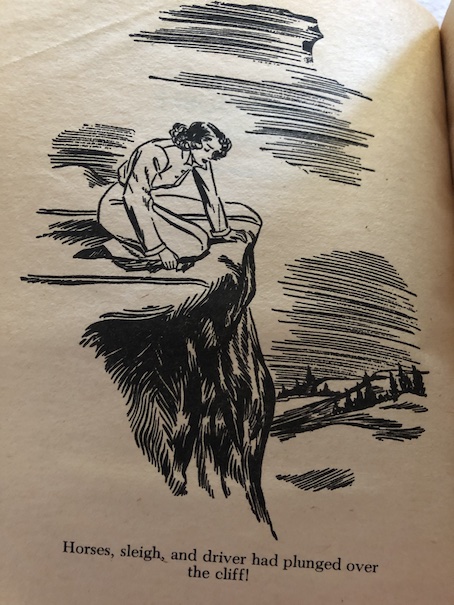
The scene with the sleigh crash happens toward the end of the book, and they get one of the thieves from the wreckage. Kay locates the thieves’ apartment and finds the items they stole there, but she doesn’t get the other thief herself. The other thief gets away from her, and a detective just tells her that they caught him at the hospital, visiting his partner in crime. The end. It ends happily, but it was a confusing ride with a lot of points that didn’t really go anywhere along the way.
It’s summer, and Lucy has been helping Susannah practice for the Black Poetry Recitation contest. She’s not expecting the summer to get any more exciting than that because her father has told her that he can’t afford summer camp for her this year.
One day, Lucy and Susannah go to visit a friend of Susannah’s grandmother, Mrs. Quigley. Mrs. Quigley, often called Quiggy, says that she has a surprise for them. The “surprise” turns out to be that Quiggy has taken in a foster child, a girl named Theresa. Theresa is about the same age as the other girls and will be going to school with them in the sixth grade. Theresa tells the other girls that she likes Quiggy, but she doesn’t like Ruth, Quiggy’s cousin who lives with her. Ruth is a fussy woman who doesn’t like kids much, and Lucy tells Theresa that she’s like that with everyone. The only people Ruth really seems to like are Quiggy and her dog, Pipsqueak.
However, the girls are also shocked when they see that Quiggy’s garage has burned down. Fortunately, the fire didn’t spread to her house, but the garage is destroyed, and it looks like arson. Susannah tries to question Theresa about the fire, but Theresa says that she was asleep until Quiggy smelled smoke and woke her. Lucy thinks that the fire reminds her of when a girl she knew in second grade tried to set fire to a storage shed on the playground. Then, Lucy suddenly realizes why Theresa looks so familiar to her – Theresa was that girl from the second grade. Susannah doesn’t remember Theresa or the shed incident because she was going to a different school then.
Lucy is quick to suspect that Theresa is the one who set the garage on fire because of her firebug past, but Susannah is more doubtful. She wants to learn a little more about Theresa’s past since the second grade, where she’s been living, and whether she’s continued her firebug habit in other places she’s lived.
However, Theresa falls under suspicion again when another fire destroys Quiggy’s back porch, deliberately set by lighting a pile of newspapers on fire. Quiggy and Ruth were out at the time, and Theresa was home, but she says that she went to the park and didn’t know about the fire until she got back. Ruth is quick to accuse Theresa, saying that she knew that she’d be trouble from the beginning.
Mrs. Weinberger, the woman who called the fire department, said that she noticed the smoke right away because she was working in her garden around the time the fire started. When Susannah asks her if she was in the garden the whole time, she says that she did leave for awhile because she got an unexpected delivery of roses from a secret admirer, and the delivery boy even sang “You Are My Sunshine.” It sounds suspicious, like someone who knew Mrs. Weinberger’s normal habits deliberately tried to distract her so she wouldn’t see the arsonist arrive. Mrs. Weinberger describes the delivery boy, saying he looked about 18 years years old, he was blonde, and he had a tattoo on his arm. Also, both his shirt and his bicycle were purple. All she can remember about the name of the florist is “Mongoose”, which is a pretty odd name for a flower shop. The roses make it seem less likely that Theresa would have been the arsonist. Roses would be an expensive gift/distraction for a recently-arrived foster child to send.
When the girls learn from a boy Theresa used to live with in another foster home that she was sent away for trying to set a fire there, it looks bad for her. The girls talk to Theresa and suggest that she needs professional help, but Theresa denies ever setting any fires at all, at least, not on purpose. The fire at her last foster home was just a cooking accident, and Theresa wasn’t sad to leave there because the family wasn’t nice to her. As for the shed in the second grade, Theresa explains that she wasn’t actually trying to light the shed on fire. She was living in a foster home back then, too, and she’d just gotten a bad report card and a letter from her teacher that she was afraid to show to her foster family. She was trying to destroy them, and things just got out of control. Theresa insists that she would never want to do anything to hurt Quiggy or make her mad because she’s been nicer to her than any of her previous foster parents have, and she really wants to stay with her.
Theresa isn’t the only suspect for the arsonist, though. Could Ruth have somehow arranged the fires to get rid of the child because she didn’t want to share a home with her? What about Mr. Reid, the cranky next door neighbor who is annoyed about the sound of kids playing? There’s also Toby, Quiggy’s handsome nephew, who does handyman work for his aunt. He has access, but does he have a motive? What about George Peterson, who wants to buy Quiggy’s house? What about Arthur Featherstone from Theresa’s former foster home? Could he be holding some kind of grudge? It seems like the key to finding the real arsonist is finding the boy who delivered the flowers on the purple bike with the name “Mongoose” printed on it.
The book is available to borrow and read for free online through Internet Archive (multiple copies).
My Reaction
One of my favorite things about this series is that the author does a good job of making a number of people look like equally good suspects. In the beginning, I had multiple theories about who the real arsonist could be, and I honestly wasn’t sure who it was for much of the book. One of my early theories turned out to be correct, but I changed my mind two or three times along the way.
Something else that I’d like to mention is that, at one point, the characters go to the library to do some research, and they use microfiche to read some old newspaper articles. When this book was written, the Internet and the World Wide Web were just starting to evolve into something that the general public could use, but most people didn’t have access yet. Even libraries didn’t have the rows of Internet-capable computers they have now. Some may have been starting to get them by this point, but it was a gradual process, and I don’t think my local library had them until a few years later. In fact, I think this was around the time that my school’s library replaced the old card catalog with the new computer catalog, and it wasn’t an online catalog; it was just a database stored on the computer in the library. Remembering things like this makes me feel old, but I was part of that 1980s/1990s generation of kids (the very oldest of the Millennials) who were first taught to use more manual forms of data storage before being gradually trained in more digital forms as we moved up through the grades in school.
Because, in those days, in the 1980s and into the early 1990s, there was no ability for most public libraries and other institutions to scan documents, like newspapers, and upload them to the Internet for easy sharing, or just write them directly to the Internet in the first place, they would convert printed materials to microfiche, which are essentially smaller film images taken of the documents. In order to read them, you would have to use a microfiche reader, physically load the images you want on sheets of transparent film, and look at a magnified version of them on the screen, scrolling through them until you found the information you were looking for. There was no way to make the process go faster with a keyword search. It was a royal pain. I had to do it a few times for various school reports, and I never thought it was fun. If you look at this video of people demonstrating how to use a microfiche reader, you see how they have to turn the dial to get the image aligned properly so they can read it, and also when they physical move the piece of film in the opposite direction to the way the image scrolls on the screen. I always thought that was annoyingly counter-intuitive. I know why it does that, because it’s about where the viewer is positioned over the image, not where film is moving, but I remember being annoyed with it when I was a kid because I’d move it in the wrong direction and get mixed up. Maybe it’s just how my mind works. When you find the image/page you want on the microfilm, there is a way to print it out on paper. Some libraries still use microfiche (which is why this video exists), and it can be useful for looking at old records, but online archives are starting to replace this method of data storage. When my local library underwent renovations in the early 2000s, they decided to replace their old microfiche area with a new teen center and more computers. I think they sent the microfiche machines and archives to the local university library. I’m not even 40 yet, and I feel old.
Susannah and the Blue House Mystery by Patricia Elmore, 1980.
Susannah Higgins and her friend, Lucy, live in Northern California. Susannah loves mysteries and she’s asked Lucy to be her partner as a detective. Susannah loves mysteries and is always looking for a mystery to solve, but so far, the girls haven’t found anything worth investigating. Susannah finally finds the mystery she’s been looking for when another friend’s grandfather fails to meet her at the bus stop. Shy Juliet Travis, who is largely shy because people at school have made fun of the burn scar on her face, meets her grandfather at the bus stop every day, and then, they walk home together. When he fails to show up one day, Juliet is sure that something is wrong. Susannah and Lucy, finding Juliet upset, try to reassure her, saying it’s probably nothing and that her grandfather probably forgot the time or his clock stopped. They offer to walk Juliet home to see if her grandfather is there.
Juliet and her mother live in a small apartment house next door to the old, once-grand Blue House. Her “grandfather” is the last of the old Withers family. (Juliet and her mother aren’t actually related to Juliet’s “grandfather” at all. He’s just a family friend who likes to treat Juliet and her mother like family because none of them really have any close relatives. Mrs. Travis got divorced when Juliet was a baby, and Juliet hasn’t seen her father since. Mr. Withers’s only relative is a niece named Ivy.) The Withers family was once one of the richest families in the area, but they haven’t been really wealthy for some time. Ivy Withers has some money and is a social climber, but the Blue House mansion where Mr. Withers lives has fallen into severe disrepair. Ivy pays Mrs. Travis to be her uncle’s cleaning woman, and that’s about all of the attention either the house or Mr. Withers receives.
Juliet’s mother, Mrs. Travis, cleans houses and is also an artist. When she first meets Susannah and Lucy, she comments that she’d like to do a sketch of Susannah because her face would be good for an African princess. (Susannah is African American, and this is the first mention of it in the book.) Juliet asks her mother about her grandfather, and her mother says that she thinks he went to see his friend Joe. Juliet feels a little better, thinking that her grandfather just lost track of time with his friend, but by the next morning, Mr. Withers still hasn’t come home. Susannah and Lucy go to visit Juliet again, but she and her mother don’t know much about Mr. Withers’s friend, Joe. They don’t know his full name or where he lives to see if he’s really seen Mr. Withers. Susannah says that they should take another look around the Blue House, even though Mrs. Travis has already looked there.
In the Blue House, they discover that Mr. Withers took his good coat instead of his old one and left his wallet with his identification behind. Mrs. Travis also remembers that he was carrying an umbrella, even though it wasn’t supposed to rain that day. From this information, Susannah deduces that he went to another city, where there was a chance of rain, but it couldn’t have been too far away because he didn’t take luggage or his wallet with him, and he was planning to be back to meet Juliet that afternoon. Also, since Mr. Withers doesn’t have a lot of money, he probably went by bus. After making a call to bus station to check the bus schedule for buses leaving around the time he left, they decide that the most likely place he would have gone was Sacramento. Then, the customer service agent tells them that the bus returning from Sacramento arrived late because an old man had a heart attack. Realizing that the old man could have been Mr. Withers, who couldn’t be identified because he left his wallet at home, they begin phoning hospitals to learn where he could have gone. Sadly, they learn that Mr. Withers was the man who had the heart attack and that he died in the hospital.
That would be the end of the mystery of the disappearing grandfather, but it turns out to be the beginning of a greater mystery. Susannah is disappointed that the mystery seems to be over just when she wanted to investigate some odd points of the situation more deeply. Lucy thinks that sounds heartless to be thinking of Mr. Withers’s disappearance and death as just an exciting adventure like that, but Susannah explains that there are still some aspects of the situation that seem strange. They still don’t know why he went to Sacramento. Apparently, it was something important because he felt the need to dress up in his nicer coat. (It couldn’t be to see a doctor because his Medicare card was one of the cards he left behind in his wallet.) They also don’t know who “Joe” is because this friend didn’t turn up at the funeral. Nobody else seems to know who “Joe” is, either.
Susannah also begins to suspect that Mr. Withers may have made a second will, leaving something to Juliet. Mr. Withers didn’t have much to leave, and it’s publicly known that he promised his house to Ivy because she helped him pay the taxes on it for years. Mr. Withers lost most of his money years ago due to a bad investment, and thieves also stole many of the valuable antiques that he used to own. However, on the morning of the day he died, he told Juliet that he was going to leave her a “treasure.” Juliet says that this “treasure” was supposed to be a book of some kind, and he emphasized to her that she should “see a good man.” What is that supposed to mean, and did Mr. Withers really have a treasure to leave to Juliet? Someone else must think that Mr. Withers had something of value because someone has been sneaking around the Blue House at night.
The book is available to borrow and read for free online through Internet Archive (multiple copies).
My Reaction
I read this book years ago, when I was in elementary school, but for a long time, I’d forgotten the name of it and much of the plot, which made it difficult to find it again. As with so many other things, I found it again by accident while looking for something else on Internet Archive.
The part that stuck with me the most from when I read it as a kid was the scene where Susannah and Lucy meet Juliet’s mother, who is an artist. Mrs. Travis likes to do sketches of people she’s just met so she can use their faces in paintings later. When she first sees Susannah, she takes her by the chin and studies her face. She compliments Susannah’s bone structure and says that her face would be great for an African princess, which is a rather odd thing to do and say to somebody on first acquaintance. I liked the quirkiness of Mrs. Travis, and I kind of wished somebody would tell me that I looked like a princess. (I don’t, and I never really did. I look more like somebody’s teacher or librarian. I’m not either of those, but I just look like somebody who would be.)
The scene with Mrs. Travis is also the first mention in the book that Susannah is black. She is shown as black on the covers of the books in this series, but Mrs. Travis’s description of her as having the look of an “African princess” is the first indication of it in the text. The reason why I like that is that, before we get to that point, Susannah is described by her friend Lucy as an aspiring detective, an “amateur herpetologist” who dreams of buying the snake called Beelzebub in the pet store, and one of the few people who can draw out shy Juliet and get her to talk before we are given any indication of her race or appearance. I like it that readers are drawn into Susannah’s own quirky and distinctive personality before she is described physically, so she isn’t typed by race or appearance.
Further on in the book, Lucy describes more of Susannah’s appearance, saying that she has glasses and wears her hair in two clumps on her neck. They didn’t always get along because they’re in the same academic group at school, and of the two, Susannah is really the better student. She got on Lucy’s nerves by constantly nagging her to do her homework and improve her grades so their group could get the school’s Top Scholar Award. Susannah complained that Lucy actually could do better at school if she just tried and called her a “clown” and a “dumb blonde” (the first indication of what Lucy looks like) for not even trying to do better. Lucy retaliated against this criticism by drawing unflattering cartoons of Susannah. They started to resolve their differences when they got into an argument over something Lucy said to another classmate about Susannah. Lucy said that Susannah “prevaricates”, which means to lie, but what she really meant was “pontificates.” At first, Susannah was mad at Lucy for calling her a liar, then she laughed when she realized that Lucy mixed up words that were vocabulary words for their class, and then, she realized that there was some justification to Lucy’s criticism of her, that she does sometimes act like a know-it-all. Realizing that someone else had a justifiable criticism of her caused Susannah to soften her own criticism of Lucy, and their relationship improved.
I liked the description of how Lucy and Susannah came to be friends, and it also fits in with how the girls become better friends with Juliet. Appearances are important to Juliet because the burn scar on her face has made it difficult for her to make friends with people. They never explain how she got the scar, but she is very self-conscious of it because of the teasing she got about it early in life. She is very shy and has a habit of turning her head to the side as she talks to people because she doesn’t want them to look at the scar. Lucy thinks to herself that the scar isn’t really so bad. As she spends more time with Juliet, she realizes that she hardly notices it anymore, just like most of the time, she hardly notices anymore that Susannah wears glasses. It’s common for people to have various types of imperfections, and Lucy herself has crooked front teeth. The only reason why Juliet’s scar really matters is that it matters to her because it makes her feel bad about herself. What Juliet wants most of all is an operation to remove the scar tissue so the scar will be less noticeable, but her mother can’t afford it. By the end of the book, she can afford the operation, and she goes ahead with it, although part of me wanted to see her rethink it because she sees that she can make friends anyway, whether she has a scar or not.
Deceptive appearances are a large part of the mystery because things in the Blue House, Mr. Withers’s treasure, and even Mr. Withers himself weren’t quite what they seemed to be. Mr. Withers was unfortunate for losing his money and most of the beautiful antiques that he loved, but he didn’t lose everything. Ivy thinks that he was a lonely, bitter hermit who rejected all of his old friends because he was too proud to see them after he lost his money, but Lucy realizes that the truth is that Mr. Withers just made new friends who wouldn’t judge him because he was now poor. Mr. Withers wasn’t lonely, and he was even happy with the new people in his life and the secret he was keeping. Even the mysterious “Joe” and the “good man” were not what everyone assumed they were at first. As I read through the book, I remembered what Mr. Withers’s trick was, but it took me some time be sure of the villain. I thought I knew who it would turn out to be, but the author does a good job of making multiple people look guilty.
One other thing I’d like to add is that apparently none of the children in this book live in a two-parent household. Books featuring children of divorced families were becoming increasingly common in the 1980s and into the following decades, and there are three children in this book who live in single-parent households. Juliet’s mother is divorced. Lucy lives with just her father, and to her horror, she eventually discovers that he’s starting to date the divorced mother of the most annoying boy in her class (who actually proves to be very helpful in their investigation). Susannah also appears to live with her grandparents. This book doesn’t explain why, but she always talks about her grandparents and not her parents.
Somewhere in Africa by Ingrid Mennen and Niki Daly, illustrated by Nicolaas Maritz, 1990.
I didn’t read this book when I was a child, although it’s old enough that I could have, but I was fascinated when I found it in a Little Free Library because this is an American edition of a book that was originally from South Africa. I enjoyed the colorful painted pictures, and I think it’s a good book for explaining to American children what it would be like to be a kid in South Africa. For a child living in a city, life actually wouldn’t be too different from the lives of American children living in cities. Africa isn’t all savannas and animal safaris.
A boy named Ashraf lives in Africa. He doesn’t live in a place with lions, crocodiles, and zebras, though. He lives in a very busy city. Ashraf likes animals, and he reads about them in his favorite library book.
As Ashraf goes to the library, he sees all of the busy traffic of the city and passes by shops with fascinating things in their windows. In the market, there is a fruit seller singing about his products. Other people are selling flowers, and there are street musicians.
When Ashraf gets to the library, he checks out the same book about African animals again.
The book is available to borrow and read for free online through Internet Archive (multiple copies).