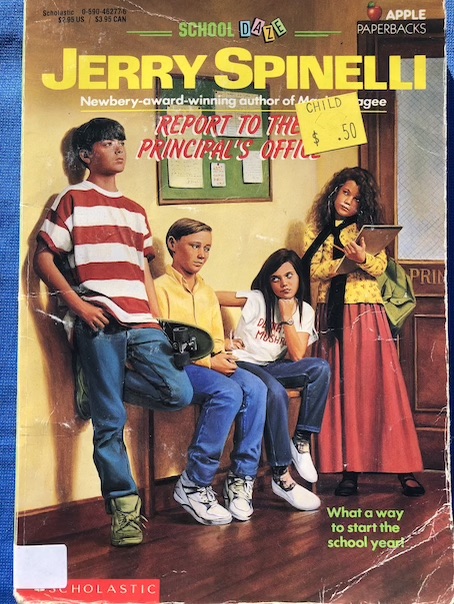
Report to the Principal’s Office

School Daze

This is the first book in a series about a group of unlikely friends in middle school.

The start of the new school year is a disaster for Sunny Wyler. Her best friend, Hillary, lives directly across the street from her house, and they’ve been close for their entire lives, always attending the same school. However, because of the construction of a new middle school in their town and changing school zone lines, which happen to be drawn directly down the middle of their street, Sunny and Hillary will now be sent to different schools for middle school. (During my childhood, parents could sometimes ask for a boundary exception for kids from the local school district so they could attend a different school with their friends, but that doesn’t appear to be an option here.) Hillary tries to be optimistic, pointing out that the new middle school that Sunny will be attending is much nicer than the old middle school that she will have to attend, but Sunny doesn’t care about that. She just wants to go to school with her best friend.

Sunny thinks that she’s come up with a plan to reunite with Hillary. She’s decided to make herself so obnoxious at her new school that they will kick her out, and her parents will have no choice but to send her to Hillary’s school. She’s decided to wear an old t-shirt that says “Death to Mushrooms” every day, never washing it, so she’ll smell bad. She’ll refuse to wash her hair, so it will be dirty and greasy. Above all, she’ll have the worst attitude, never smile, and never talk, never even answering if her teacher asks her questions in class.

Eddie Mott first encounters Sunny Wyler on the bus to school. She sits next to him, and he can tell right away that she has problems and a bad attitude, and that’s the last thing he wants for the beginning of his new school year. Eddie is trying to adopt a more grown-up image in his middle school years, and he desperately wants to fit in with the other kids. He’s trying to wear the right clothes, be friendly with other kids, and above all, avoid problems. None of that has prepared him for Sunny.

There is one person, though, who has done his best to prepare for all the kids who will be coming to the new middle school, the school’s principal, Mr. Brimlow. Over the summer, he studied the details of the incoming students, and he can recognize them on sight as soon as they arrive. When the school bus driver tells him that there’s a kid on the bus who refuses to get off, he recognizes the kid immediately as Eddie. Between dealing with Sunny’s aggressive unfriendliness and being roughed up by older kids on the bus, Eddie can’t bring himself to come to the school. The bus driver, impatient to get to his other job, actually drives off with the principal, Eddie, and Salem, a girl with literary ambitions who wanted to study the situation for story fodder, still on board.

Things are generally going wrong all over Plumstead Middle School as everyone, including the teachers, try to figure out their way around, but Mr. Brimlow is calm and good-natured, and getting back to school with Eddie and Salem after their bus adventure breaks the ice between them. When Mr. Brimlow gets back to his office, he finds Dennis “Pickles” Johnson waiting for him. Dennis, who gained his nickname from the time he decorated his family’s Christmas tree with actual pickles and the incident made the local paper, is an amateur inventor who made his own oversized skateboard that looks like a pickle. The reason why he was sent to the principal’s office is that his skateboard won’t fit in his locker, and he can’t have it in class. When Pickles asks the principal what could happen if he were allowed to ride his skateboard around the school, the principal asks to try the skateboard himself. He’s unable to stop himself and ends up rolling into a nearby classroom and crashing into the geography teacher’s desk, proving to Pickles (and everybody else) what could happen if Pickles is allowed to use his skateboard in the school hallways. Mr. Brimlow forbids Pickles to bring the skateboard to school again but also thanks him for the fun ride and invites him to lunch.

Far from being upset by the strange beginning to the school year, Mr. Brimlow is actually grateful for the eccentric students and their shenanigans because he really likes to get to know his students, and he particularly learns a lot about Eddie, Salem, Pickles, and Sunny on their first day. It hasn’t escaped his notice that Sunny is being purposely sour to other people, and it isn’t really a surprise when one of her teachers sends her to the principal’s office after she deliberately answers all of her math problems wrong, misspells everything in a writing assignment, writes all of her assignments in extra tiny writing to make them difficult to read, and then pretends to flick boogers at Eddie.

When she’s sent to the principal’s office, Sunny thinks that her plan of being obnoxious has already worked and that she’ll soon be sent home or to Hillary’s school, but the principal ends up inviting her to lunch along with Pickles, Eddie, and Salem. The principal actually enjoys the experience, and rather than punishing any of the students for their various shenanigans from the morning, he decides to give each of them special jobs to help them settle into life at their new school. Since Eddie was a flag raiser at his old school, Mr. Brimlow gives him that job at Plumstead Middle School, assigning Pickles to help him. He puts Sunny in charge of taking care of an escaped hamster that the kids found, and noting Salem’s interest in people’s personalities and organizational skills, puts Salem in charge of all of the other students as they are given the collective job of coming up with a mascot for the school.

Through these activities, the four kids become friends with each other and also start to become a real part of their new school. Instead of being kicked out, Sunny is the one who comes up with the winning idea for the school’s new mascot, the Hamsters, becoming attached to the hamster that she has to care for and upset during a time when she thinks that he’s dead. (Fortunately, the hamster is fine in the end.) Eddie thinks of himself as a wimp for being pushed around by the older kids, but Pickles becomes his friend and sticks up for him, and Salem writes a story about him to show him why he’s actually a hero in his own small way.

It’s a good story about a group of unlikely friends with likable, eccentric characters. In the end, the principal’s tactic of helping the students to adjust to middle school by getting them more involved works well, and even Sunny realizes that she can be happy in her new school with her new friends while still being friends with Hillary from across the street.

The book is available to borrow and read for free online through Internet Archive.

Trouble at School

The Berenstain Bears

Trouble at School by Stan and Jan Berenstain, 1986.

“When a problem at school
Is kept secret too long,
It can grow ’til a cub
Thinks that everything’s wrong!”

Brother Bear runs into problems at school after he catches a bad cold. While he’s recovering from his cold, he is allowed to watch tv and read comic books. His teacher sends home a packet of schoolwork for him to do, but he ignores it and forgets about it.

He doesn’t remember the packet of work until he’s better and going back to school. However, he soon becomes preoccupied with the news that Cousin Freddie has taken over his position on the soccer team during his absence.

When his teacher gives a quiz on the new lesson in division, Brother fails it. Brother is supposed to show the quiz to his parents and have them sign it, but his parents become preoccupied with Sister, who is now sick, and Brother doesn’t show them the quiz.

The next day, Brother is so upset about his bad grade and what’s happening on the soccer team that he doesn’t go to school. He makes his quiz into a paper airplane and throws it away.

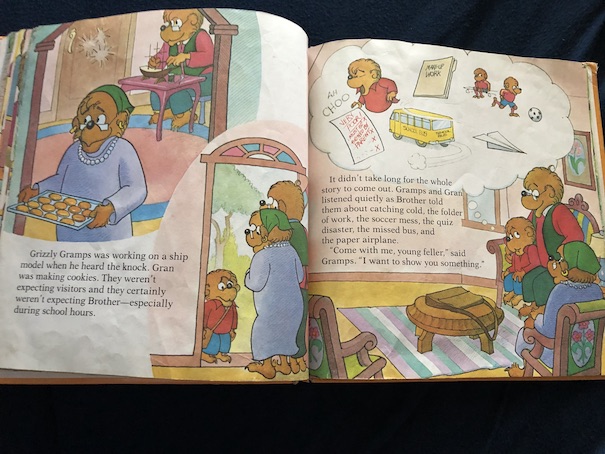
Then, Brother gets the idea of going to see his grandparents for help. He explains the entire situation to them. His grandfather tells him a story that helps put the situation in perspective.

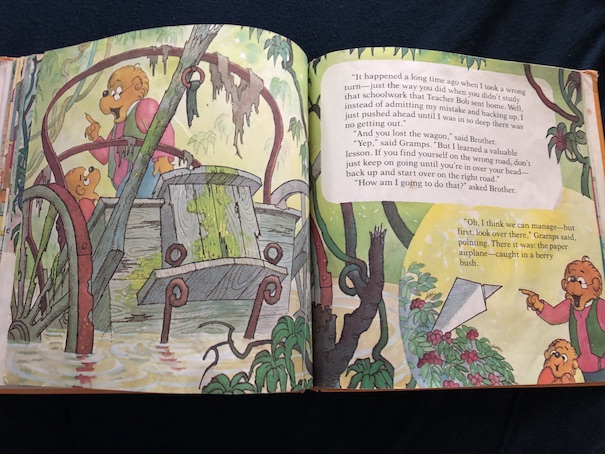
There was a time when Gramps did something wrong, and instead of admitting his mistake, he just kept going and made the problem worse, like Brother did by ignoring his schoolwork and not telling his parents about his problems at school. Gramps says that it’s best to admit when you’ve made a mistake so you can do what you need to do in order to turn the situation around.

They find the quiz that Brother threw away and go home to tell Brother’s parents about his school problems. They’re not happy about the situation, but they tell Brother that “It’s never too late to correct a mistake,” and Gramps proves to Brother that he can do division by having him divide a bag of cookies among the family members.

When Mama takes Brother back to school, he learns that nobody else in class did very well on the quiz, so the teacher is letting them do a retake. Now that Brother realizes what division is really about, he does much better. At the soccer game that afternoon, Brother also gets a chance to retake his old position on the team. If he hadn’t gone to school that day, he would have missed these chances to make things right, but because he did go and took the second chances that he was offered, things were much better by the end of the day.

Adults reading the story will recognize that the reason why Brother’s parents are supposed to sign his failed quiz is because that is how the teacher draws parents’ attention to problem areas that their children have so they can make sure that they can pay extra attention to the child’s homework and help him with his problem areas. It’s not about shaming or punishing the child but getting the child the help he needs to understand the subject. By hiding the bad quiz from his parents, Brother was avoiding the help that his parents were supposed to provide and making the situation worse. Parents can be disappointed when their children bring home bad grades, but this is a situation where parents would rather know than not know if their children are struggling with something because they generally want to help their children when they need it.

The lesson of the story is a good one. Anyone can occasionally make mistakes, have problems, or just plain fail at something, but the people who succeed in the end are the ones who face up to their problems and do what’s necessary to make them right. Some people feel overwhelmed when confronted by problems, but the best thing they can do is admit that there is a problem and that they’re feeling overwhelmed and get help from someone else. Brother could have just told his parents and gotten help with division immediately, as soon as he realized that neglecting his make-up work had left him behind in class. At first, he was too embarrassed and worried to do that, but he did manage to turn things around by talking to his grandfather about his problems and taking the help and advice that he offered. Making mistakes or even failing something doesn’t have to be scary or overwhelming because there are always things you can do to make the situation better and people who are able to help.

The book is available to borrow and read for free online through Internet Archive.

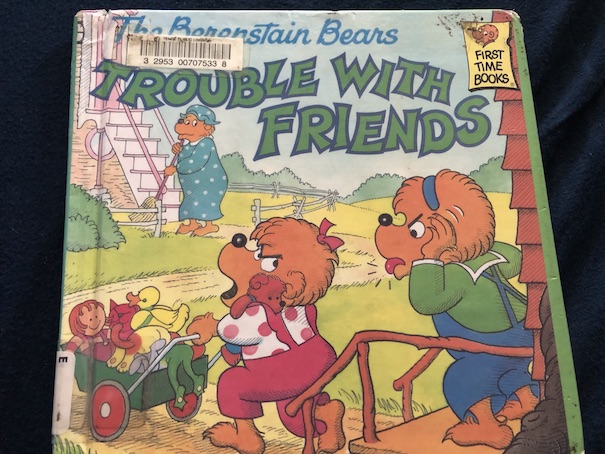
The Berenstain Bears and the Trouble with Friends

The Berenstain Bears

The Berenstain Bears and the Trouble with Friends by Stan and Jan Berenstain, 1986.

“When making friends,
the cub who’s wise
is the cub who learns
to compromise.”

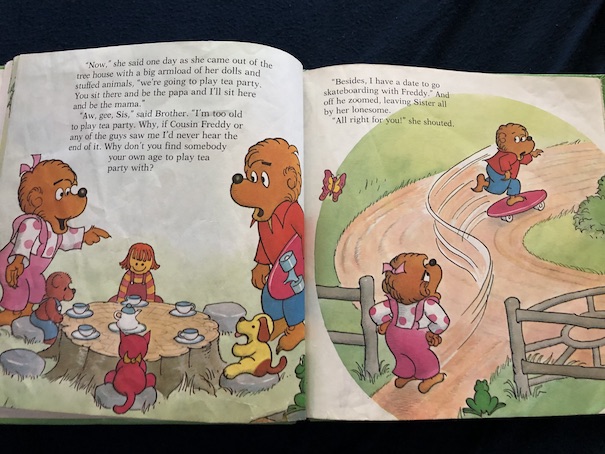
Brother and Sister usually play pretty well together, but Brother is two years older than Sister, and he doesn’t always want to play girls’ games like tea party and house. Brother likes to hang out with Cousin Freddy, but Sister doesn’t have a friend who lives close enough to play with her after school.

Then, one day, a new family moves in down the road, and they have a girl who’s Sister’s age. The new girl’s name is Lizzy, and she likes to do many of the things that Sister likes to do. The girls start playing together right away. Sister thinks that Lizzy is fun, but a little bossy … kind of like Sister herself.

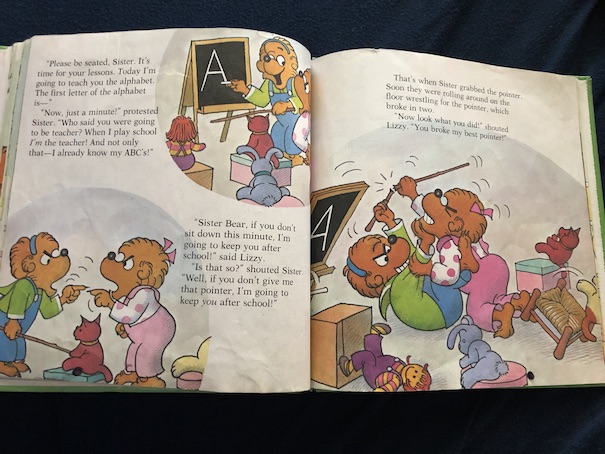
Later, Sister takes some of her stuffed animals to Lizzy’s house so they can play school. However, the girls argue over who is going to play the part of the teacher. Both of them want to play the teacher, and during their argument, they break Lizzy’s pointer stick.

Sister goes home angry, but Mama Bear reminds her of the reasons why she might want to make up with her new friend. Getting along with people can be difficult, but there are many things that are difficult to do alone. Having friends can be a lot of fun, certainly much more fun than sitting home and being lonely. If Sister wants to make up with Lizzy, she needs to accept her for the person she is and recognize that she can be a bit bossy herself sometimes. Both of the cubs need to give a little, let each other have their way sometimes, and care about each other’s feelings.

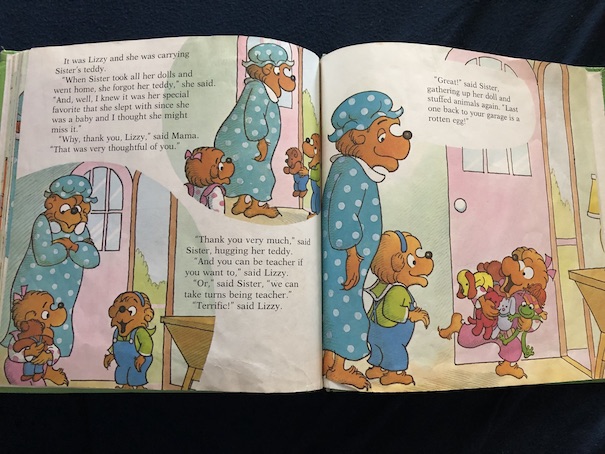
Lizzy drops by to return Sister’s teddy bear, which she left behind. She remembers what Sister told her about her teddy bear and why it’s important to her, showing that she does care about Sister’s feelings. The girls make up and agree to compromise and take turns being the teacher when they play school. Both the girls realize that getting along with friends means considering each other’s feelings and being willing to compromise.

The book is available to borrow and read for free online through Internet Archive (multiple copies).

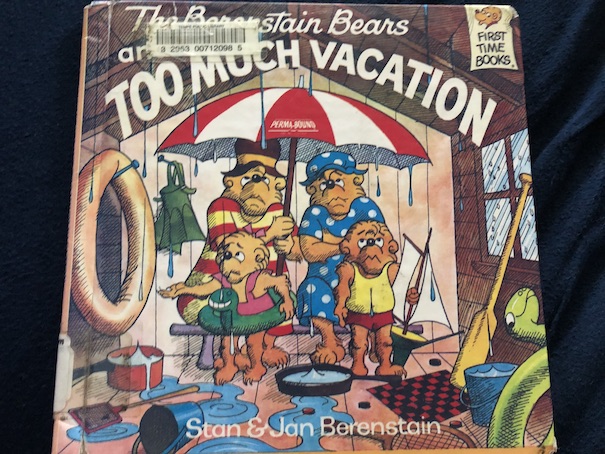
The Berenstain Bears and Too Much Vacation

The Berenstain Bears

The Berenstain Bears and Too Much Vacation by Stan and Jan Berenstain, 1989.

“Can a bear’s vacation
with more rain than sun
end up being
the one that’s most fun?”

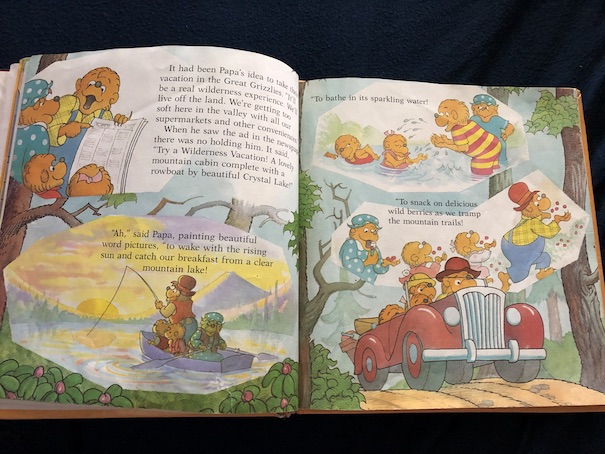
The Bears are looking forward to their family vacation! The vacation was Papa’s idea because he saw an ad in the newspaper for a rental cabin the mountains. Papa likes the idea of a wilderness vacation and living off the land. He describes to his family how much fun it will be to swim and fish in the lake and eat wild berries.

However, when they arrive at the cabin, it soon becomes apparent that their vacation is not going to be as it was advertised. The cabin is run-down and messy. The water from the pump is brownish, and the lake is too.

From the very beginning, nothing on their vacation goes right. Papa’s “wilderness stew,” made from plants that he gathered, is terrible, and the wild berries are sour. Their rowboat sinks, and fishing is a disaster!

When it starts to rain, their cabin leaks, and Papa falls down in the mud. By then, everybody has decided that they’ve had enough and that it’s time to go home.

So, what did they get out of their worst vacation ever? Memories! The experiences were pretty awful, but Mama’s pictures of everything that happened turn out to be hilarious! This is a fun story about how even disappointing situations can have a humorous side.

The book is available to borrow and read for free online through Internet Archive (multiple copies).

Day and Night

Day and Night by Roger Duvoisin, 1960.

Night is an owl who likes to go out hunting for food at night, and Day is a poodle who lives with family called the Pennyfeathers. Because Day is usually only out during the day and sleeps in the family’s house at night, they don’t usually meet. However, by chance, Day rescues Night from a fox.

Night is grateful, and the two of them become friends. However, because they are normally active at very different times, they can’t easily meet to talk to each other.

They sometimes leave each other little treats, like a bone with some meat or something from one of Night’s hunts.

They also begin meeting at the kitchen door at night to talk to each other.

However, Day’s barking and Night’s hooting is too loud, and they start keeping the Pennyfeathers awake at night. At first, they can’t figure out why Day keeps barking every night, but their son, Bobby, sneaks out one night and sees the way Day seems to be talking to the owl.

Bobby correctly realizes that Day and the owl are friends and that they’re just trying to talk to each other. To solve the problem, Bobby builds a dog house for Day so that Day can comfortably sleep outside and talk to his owl friend without disturbing everyone.

Day likes the new dog house, and Night meets him there every night so the two friends can talk whenever they want.

My Reaction

This is a cute picture book that I’ve liked since I was a kid. I like the way that Day and Night talk to each other and some of Day’s misconceptions about what his humans are thinking. When Mr. Pennyfeather yells at them to be quiet, Day tells Night that he thinks Mr. Pennyfeather is barking at the moon.

Some of the pictures are in black-and-white and some are in color. It seems to be common in older picture books to have a mixture of black-and-white and color images. I think it might partly have been done to save money on printing.

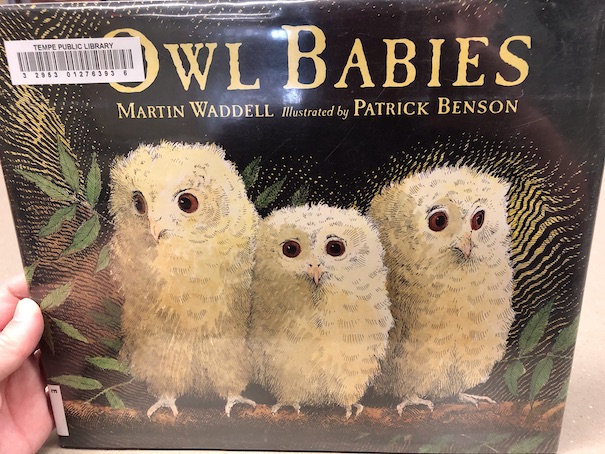
Owl Babies

Owl Babies by Martin Waddell, illustrated by Patrick Benson, 1992.

Sarah, Percy, and Bill are three owl babies who live in a tree with their mother. One night, they wake up and can’t find their mother. They think it over, and they decide that she has probably gone out to get food for them.

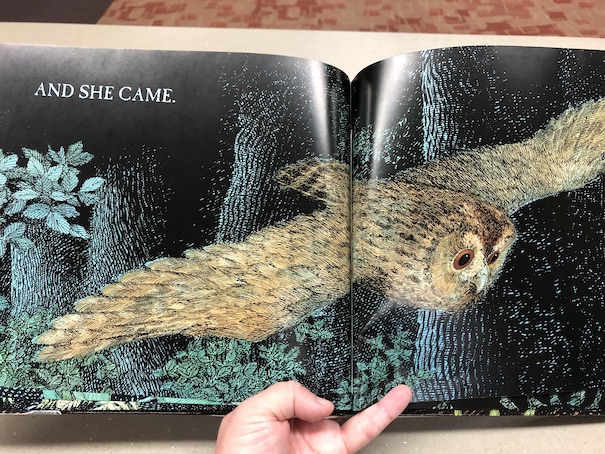
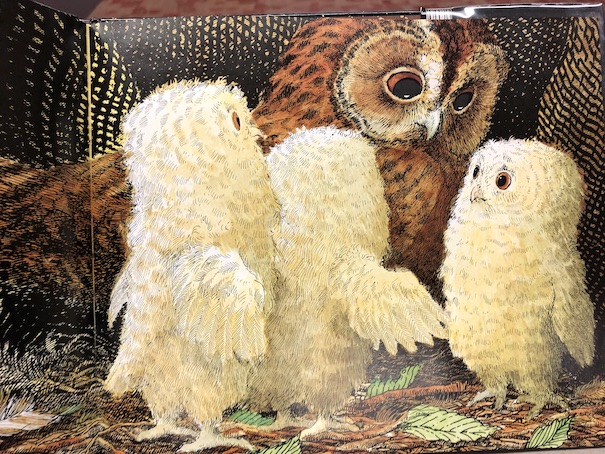
They wait for her and try to be brave, but they get worried that she isn’t coming back. Then, suddenly, their mother does come home!

The little owls are happy to see their mother, and their mother reminds them, “You knew I’d come back.”

It’s common for children to worry when their parents go away without them, wondering if they will ever come back. The story reminds young children that, even when mommy has to go away for a while, she will still come back home.

The book is available to borrow for free online through Internet Archive.

Spot Visits the Hospital

Spot

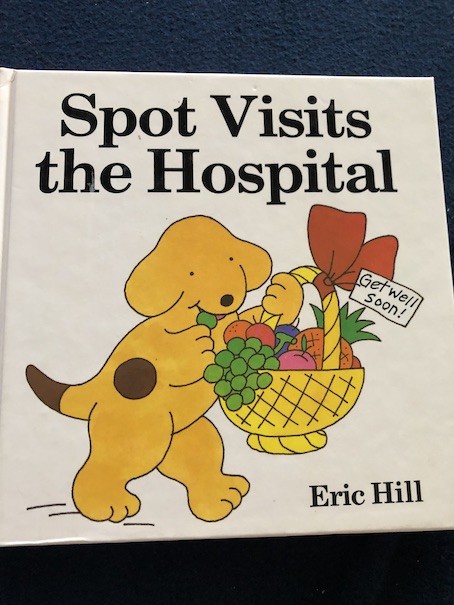
Spot Visits the Hospital by Eric Hill, 1987.

Spot’s friend Steve, who is a monkey, is in the hospital with a broken leg. Spot and some of their other friends decide to go visit him and take some presents to cheer him up.

Steve likes their presents, and Spot and his friends sign Steve’s cast. They play in the hospital’s playroom, where they have toys, games, and books for child patients.

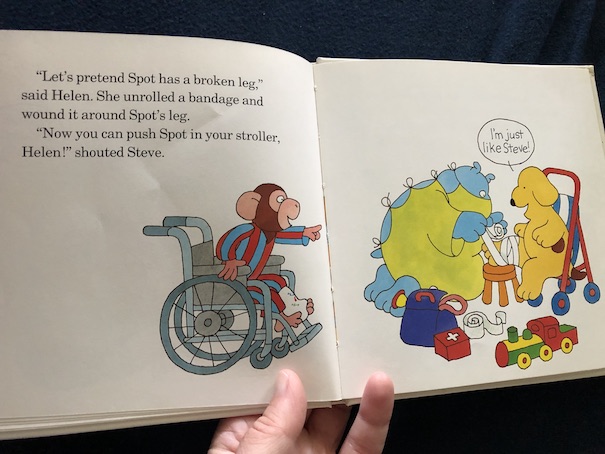
Spot’s friend Helen decide to play doctor, and she puts a bandage on Spot’s leg, as if his leg is broken, like Steve’s. They start pushing Spot around in a stroller, like it’s a wheelchair.

Their friend Tom hides, and they all go looking for him, finding him in an x-ray room. In real life, they would probably get in trouble for goofing off around the x-ray equipment, but in the book, nobody catches them doing it. I think the reason why the book has this episode in it is to have a reason to show readers the x-ray equipment and explain how the doctors used it to examine the break in Steve’s leg.

Spot is fascinated by what he sees in the hospital and tells his mother that he might like to be a doctor someday.

This story could encourage children who find the idea of studying medicine and helping people interesting, but it also makes a visit to the hospital seem less scary for children who may worry about what happens there and what all the big machinery, like the x-ray machines, are for.

The book is available to borrow and read for free online through Internet Archive.

Spot Goes to the Beach

Spot

Spot Goes to the Beach by Eric Hill, 1985.

Spot’s parents take him to the beach to spend the day there. When they get to the beach, Spot wants to get a sailor hat from a stand selling beach equipment, and his father also buys him some beach toys.
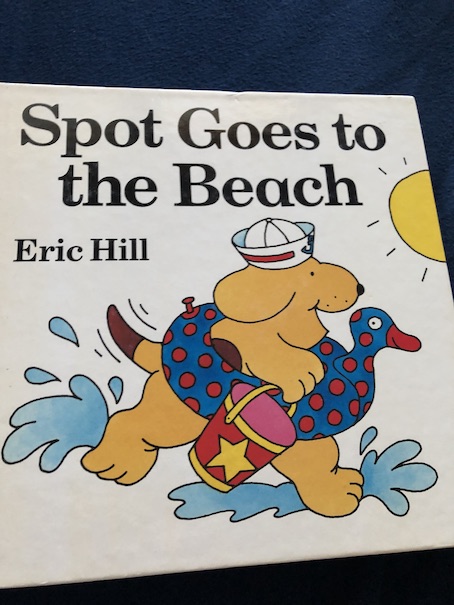
Spot plays with a beach ball, builds sand castles, and buries his father in the sand.

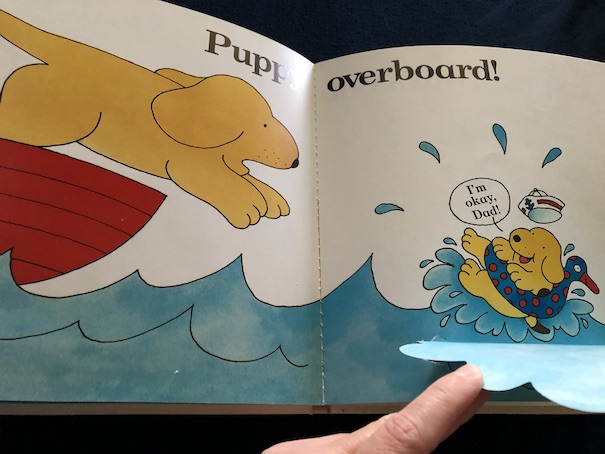
Spot and his father later go fishing, and Spot falls in the water, but Spot is fine because he’s wearing a pool float.

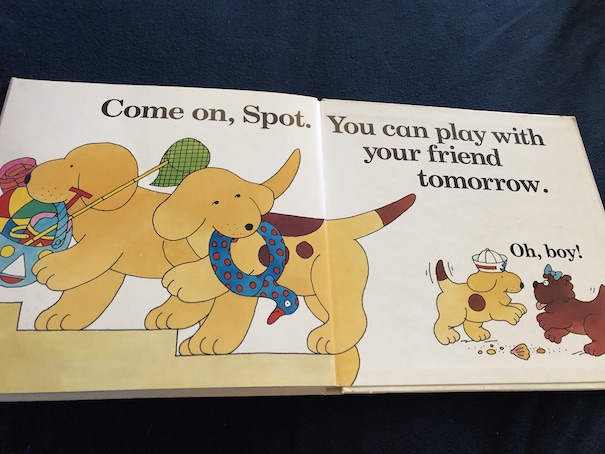
Before they leave the beach, Spot also makes a new friend, another puppy!

This is just a cute book for children about the fun things that they can do at the beach.

Like other Spot books, this book is a lift-the-flap picture book. The British version of the title is Spot Goes on Holiday. It’s available to borrow and read for free online through Internet Archive (multiple copies).

Spot Goes to School

Spot

Spot Goes to School by Eric Hill, 1984.

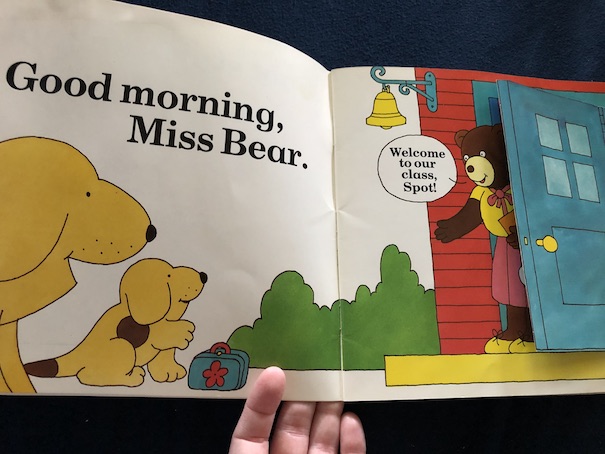
Spot is going to school for the first time. His mother drops him off at the school, where he meets his teacher, Miss Bear.

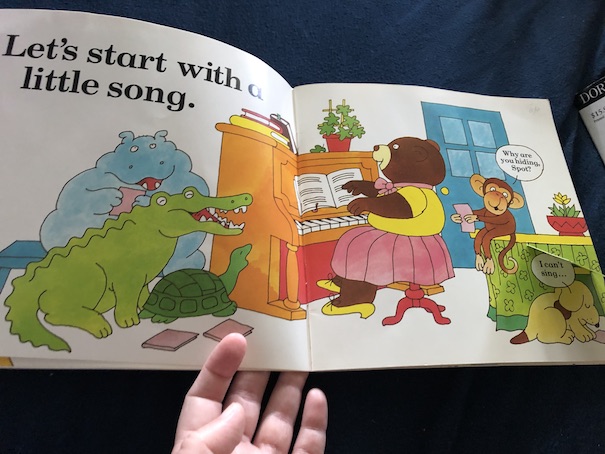
Spot and his animal friends participate in typical kindergarten activities. They sing a song while their teacher plays the piano (although Spot hides because he can’t sing), and they play dress up in the classroom playhouse.

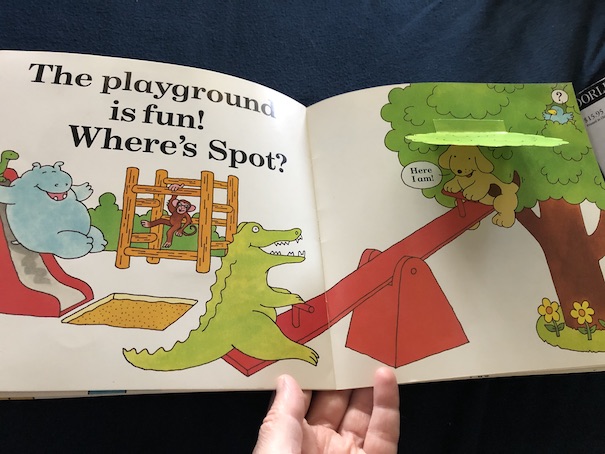
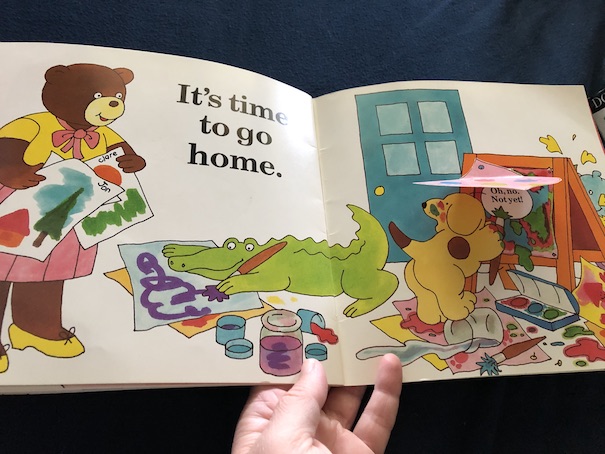
They play on the playground and show what they brought for show-and-tell. Spot roughhouses with a friend during storytime, and he loves painting pictures with his friends. When school is over, Spot doesn’t even want to go home because he’s had so much fun!

Like other Spot books, this is a lift-the-flap book. It is available to borrow and read for free online through Internet Archive (multiple copies), but to be honest, it’s not as much fun to read electronically because you can’t experience the lift-the-flap effect.

Where’s Spot

Spot

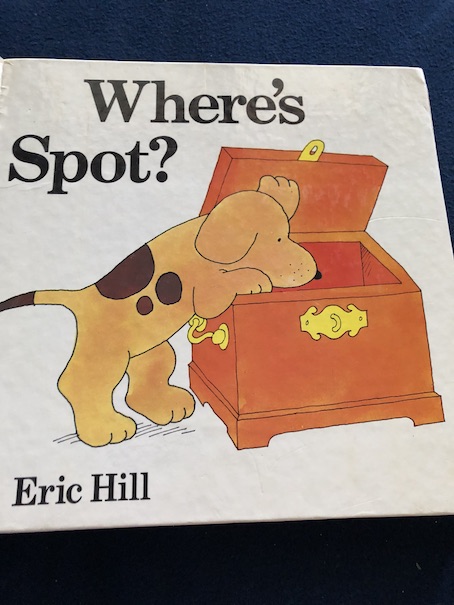
Where’s Spot? by Eric Hill, 1980.

This is the first modern lift-the-flap book for children, inspired by the author’s young son, who was playing with some sheets of papers on which he had drawn some concepts for an advertisement. There was an earlier style of lift-the-flap book from the 18th century, but this first book in the Spot the Dog series led to the popularization of modern lift-the-flap books for children.

Spot’s mother, Sally, notices that her puppy hasn’t eaten his dinner. She doesn’t know where he is, so she goes looking for him.

Sally searches for Spot all around their house, looking behind a door, in a closet, inside a clock and piano, under the stairs, and under the bed. In each place, she finds different animals (no explanation, there are just a lot of animals in this house).

Finally, the turtle hiding under the rug suggests that Sally check the basket, which is where she finally finds Spot.

The story is very simple, and the lift-the-flap concept is what really makes it work. The interactive element is fun, as if the readers are participating in a game of hide-and-seek with the characters. Kids enjoy being surprised by the different kinds of animals hiding all over the house. I loved it when I was a kid!

The book is available to borrow and read for free online through Internet Archive (multiple copies), but to be honest, it’s not really a good book to read online because the lift-the-flap effect doesn’t carry over.