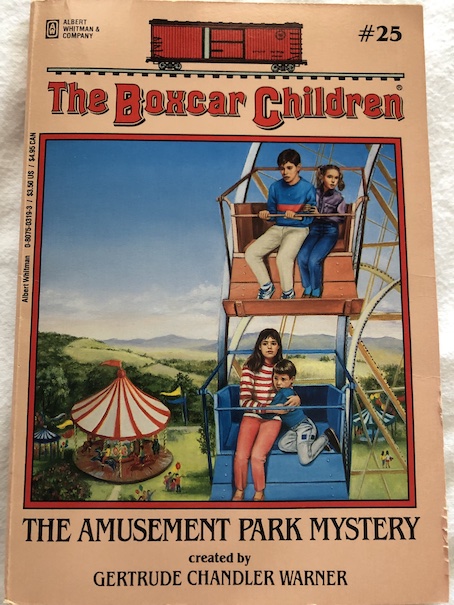
#25 The Amusement Park Mystery by Gertrude Chandler Warner, 1992.
The four Alden children go to visit their cousin Joe and his wife Alice. They work at a museum, but one of the best parts of visiting them is the amusement park nearby. The amusement park has a charming, antique carousel with hand-carved horses. The horses are valuable antiques, and Alice says that they are wonderful examples of Americana (American folk art).
The Aldens, especially Benny, think the carousel is wonderful, but not everyone feels the same away about it. When they talk to the owner of the amusement park, Joshua, they learn that he loves the antique carousel but his daughter, Karen, who works with him, thinks that they should get rid of old rides like that and add newer, more modern ones. What she really wants to do is add a roller coaster to the park, something that would appeal to older kids and adults rather than young children. The Aldens don’t see how she can add a roller coaster because the park isn’t very big, and a roller coaster would take up about half the park. They hear Karen later talking about it again with her boyfriend, who is a golfer. They notice the boyfriend doing some sketches of horses that he doesn’t seem to want to let them see.
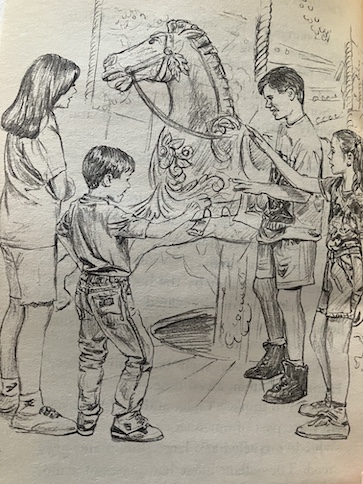
The first time the Aldens ride the carousel, they have a great time, and Benny chooses a dappled gray horse as his favorite. However, when they return to ride the carousel again later, it seems like something is wrong with the horse. It used to bob up and down during the ride, but now, it doesn’t move. When they return again, a couple of days later, the dappled gray horse moves but now has a long scratch on its side that wasn’t there before. The Aldens also begin to notice problems with other horses. Another gray horse has stopped moving, and a chocolate brown one oddly has an unpainted stomach when they were sure it was painted before.
They talk to Joshua about the horses, and he becomes concerned. He has an expert examine them, and the expert assures him that these are the authentic antique horses that were always there, but the Aldens are sure that something suspicious is going on.
If someone has been taking the original horses and substituting fakes, why did the so-called expert say that they were the original horses? Who could be behind it? Is Karen trying to sabotage the carousel to get the roller coaster she wants? Her boyfriend seems to need money, so he could be selling off the horses. What about the cotton candy seller and his disagreeable wife or the man who actually runs the carousel ride?
My Reaction
I thought the book did a good job of providing readers with multiple suspects to consider. We know Karen isn’t fond of the carousel and wants more exciting, modern rides, so she could be selling off antique carousel horses to fund her ideas. Her golfer friend also needs money, and his sketches of horses might be for planning how to create counterfeits of the originals. Then again, the cotton candy seller and his grumpy wife are always around and acting suspiciously, and the man who runs the carousel ride has obvious access to the horses. I like mysteries where there are multiple suspects to consider!
The concept of the antique carousel reminded me of the Nancy Drew computer game The Haunted Carousel, but that computer game was based off of a Nancy Drew book, not this one. It’s interesting to notice some themes that appear in different children’s series. Not every kids’ mystery series features an antique carousel, making it a charming and uncommon theme. However, amusement parks are common themes in children’s books, and a mysterious, antique ride offers that element of both quaint nostalgia and spookiness together.
The Mystery in the Snow by Gertrude Chandler Warner, 1992.
The Alden children are disappointed because there is still no snow this winter, and they’ve really been looking forward to snow. Their grandfather tells them not to worry because, soon, they’ll have all the snow they want. A friend of his, Mr. Mercer, owns a ski lodge and has been urging him to visit and bring his grandchildren. There’s going to be a winter carnival there. The children are eager to go and have fun in the snow!
At the ski lodge, the Alden children meet a boy named Jimmy. Jimmy is a regular visitor to the lodge, but for some reason, he says that his parents never stay. There is also a girl called Freddie, which is short for Fredrica. Her parents aren’t at the hotel, either, because they’re visiting her sister, but she says that they will come later. Freddie could have gone to visit her sister, too, but she didn’t want to miss the fun at the ski lodge. She and Jimmy are both team captains for the winter games, which include skiing, skating, sledding, snow sculpting, and ice carving. Strangely, when the team captains get the box where kids are supposed to submit their names to join the teams, they can’t find the keys. The loss of the keys is worrying because, if they can’t find them, they won’t be able to get into the equipment shop for the equipment they need for the games. They still manage to put together the teams, and the Alden children also join.
Then, Mr. Mercer discovers that all four of the tires on his truck are flat. Grandfather Alden offers to drive him into town to get a pump for the tires and to talk to a locksmith about getting into the equipment shop.
While the adults tend to that, the kids talk about the try-outs for different events. The Aldens are all excited about different events. Violet notices that one girl, Nan, isn’t enthusiastic about the events at all and doesn’t want to try out for anything. Violet asks her why, and Nan says that joining in the games was her parents’ idea, not hers. They say it will be fun, but she never really enjoys herself at these things. She doesn’t think there are any events she can do, and she’d hate to be the one to lose an event for her team. To encourage her and build up her confidence, Violet suggests that they both sign up for the ice carving event, which doesn’t require a try out. Violet says that she doesn’t know how to do ice carving, and Violet says that’s fine because she doesn’t, either. She says that it would just be fun to try it out together. Nan points out that they would be competing against each other because they’re on opposite teams, but Violet says that doesn’t matter because they’re both equals, neither one of them knowing what they’re doing. Nan is cheered by Violet’s friendliness and signs up for ice carving.
Nan isn’t the only unhappy child involved in the games, and the Aldens begin to feel that the focus on competition instead of simply having fun in the snow is partly to blame. A boy named Pete is upset that he didn’t get selected for any of the events he tried out for, and he says he doesn’t want to be the time team’s time keeper, which is the default position. Pete says he no longer wants to be involved in any of it. Freddie is angry because she and Jimmy drew names for their team members at random, and she thinks that Jimmy ended up with most of the really good team members. She wants a way to even things out. When the Aldens ask Jimmy if his parents will come to the awards dinner at the end of the games, he seems upset and doesn’t want to talk about it much. They’re not sure if Jimmy is more upset about his parents not being there than he pretends or if he’s worried about the awards ceremony in general.
It soon becomes apparent that someone is intentionally trying to sabotage the winter games. Someone smashes the snow sculptures that the Aldens made for their team. Then, someone steals a skier’s skis and ruins the ice sculpture made by the other team. The entire skating event has to be postponed when someone ruins the ice.
Who is doing these things and why? It could be someone who’s trying to make their team win the competition, but the sabotage has been aimed at both teams and at the event in general. Is it a kid who is unhappy with the contest or their position on their team? Jimmy seems eager to cancel events every time something goes wrong. Can the Boxcar Children figure out who is responsible?
The book is available to borrow and read for free online through Internet Archive (multiple copies).
My Reaction
There are themes in the story about competition and family. The Aldens aren’t accustomed to thinking competitively about other people because they’re used to doing things with each other cooperatively, as a team. Because they’re accustomed to thinking cooperatively, they are friendly with people on the other teams, like Nan, and they’re more focused on the fun of the events than on winning. That makes them different from some of the other kids, who are concerned about winning, but there are other issues in the book besides competition that matter more.
There are indications in the story that the parents of the children in the competition don’t always want the same things that their children want. Nan, for instance, didn’t even want to join contest, but her parents urged her to do it. Also, some of the children aren’t as good at others at conveying to their parents what they really want. When the most troubled child in the group finally manages to say what they really want, many things get straightened out.
I feel like there are many stories where the conflicts revolve around people who don’t really communicate with each other. In this story, there’s a character who blames others for not understanding how they feel, but even they have to acknowledge that they haven’t actually explained their feelings. They’ve just been expecting everyone else to know what they’ve been feeling. Some honest communication straightens out the problem, and that’s a good life lesson for kids and families.
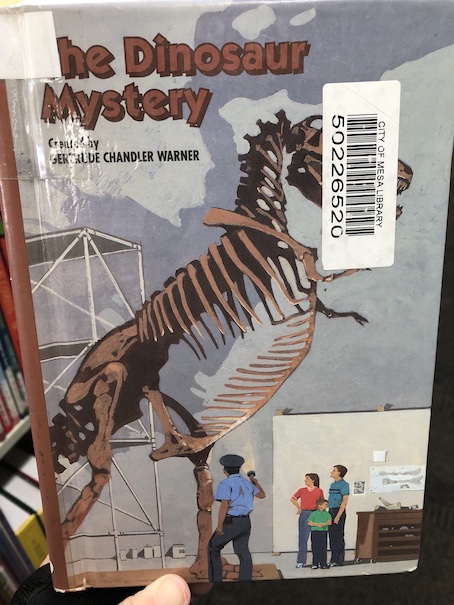
The Dinosaur Mystery by Gertrude Chandler Warner, 1995.
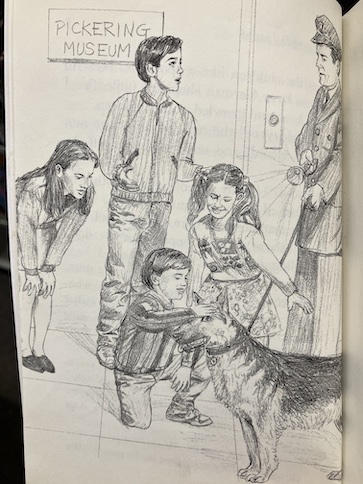
The Alden children and their cousin Soo Lee are visiting the Pickering Natural History Museum to help Mr. and Mrs Diggs, who are on the museum’s board of directors, to set up a new dinosaur exhibit. They will be staying in the Diggs’s apartment, which is connected to the museum by a tunnel. The children love the rooms where they will be staying because they’re decorated with spare exhibits from the museum!
However, very quickly, they notice that strange things are happening at the museum. The alarms seem to go off sometimes for no reason. The night watchman, Pete, is new at the museum and acts oddly. He seems to like having fun with the exhibits more than paying attention to security. On their first night there, Jessie sees a light in the museum windows, in the dinosaur room, where nobody is supposed to be, and she thinks that she sees the shadow of the dinosaur skeleton moving.
The next day, the Aldens meet the other staff at the museum. Dr. Eve Skyler operates the planetarium, and she’s very protective of it. She’s been upset because renovations at the museum have messed up the planetarium. When the Diggs tell her that the Alden children are there to help clean up, Dr. Skyler is dubious and worries that the children will damage the equipment, but the Diggs tell them that the children have worked in museums before.
After the children clear the planetarium and take a lunch break, they catch Dr. Sklyer moving some things that they had thrown out back into the planetarium! When they confront her about what she’s doing, she denies everything, and it ends up taking the children almost twice as long to finish the task. The children don’t know what Dr. Skyler’s problem is and why she would want to sabotage their cleaning of the planetarium when she had badly wanted it cleaned.
When Dr. Titus Pettibone, who is the fossil expert in charge of the dinosaur room, returns from a trip, he discovers that bones are missing from the tyrannosaurus skeleton! Benny and Soo Lee are sure that Dr. Pettibone was the man they saw sneaking around the museum the night before. Dr. Pettibone avoids their questions about sneaking around the museum and is every bit as opposed to the children working on the new dinosaur exhibit as Dr. Skyler is about the children helping to clean the planetarium.
Then, someone removes all the posters that the children put up about the new dinosaur exhibit. Mrs. Diggs knows that someone removed them on purpose because, when she asks people at the places where the children put them up, they say that a woman took them, saying that she wanted them as souvenirs. In spite of that, everyone in town knows about the new exhibit because word about the missing dinosaur bones has spread. Is someone trying to drive people away from the new exhibit, or are things that have been happening part of a publicity stunt? The children known that someone is sneaking around the museum, especially at night, and both Dr. Skyler and Dr. Pettibone seem to have something to hide.
The book is available to borrow and read for free online through Internet Archive.
My Reaction
One of the first things that I noticed about the book is that many of the characters have pun names – Mr. and Mrs. Diggs, who operate the natural history museum; Dr. Sklyer, who is in charge of the planetarium; and Pettibone, who is the fossil expert.
The book does a good job of making everyone look equally guilty. From the beginning, I suspected that was because there are multiple people doing multiple things for different reasons, and it helps to make the mystery more complicated and involved, keeping readers guessing.
This is another instance of the Alden children having the opportunity to do something unusual and build work experience because of their grandfather’s connections. Their grandfather knows Mr. and Mrs. Diggs and arranges for the children to stay with them, and their previous experiences with museums, like in one of the later books, The Mystery of the Mummy’s Curse, were also due to Mr. Alden’s connections. Although the children’s grandfather allows the children to have independent adventures without him, he is usually the one who sets them up in the stories. Most real children never get opportunities like this and may not be allowed to do some of the things the Alden children do because of rules regarding volunteers, especially juvenile volunteers, due to insurance liabilities. I would have loved to work in a museum when I was a kid, but my family never had the connections that the Aldens do.
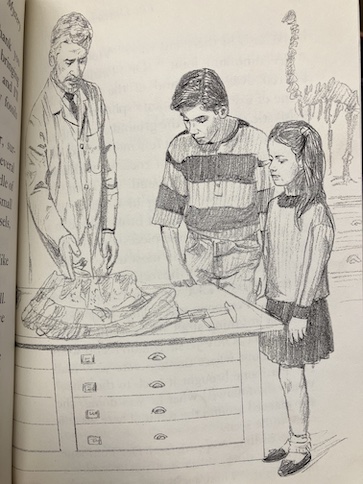
I can understand why children aren’t allowed to do certain jobs. Dr. Pettibone is correct that there are certain tasks that require specialized knowledge and delicacy. After he warms up to the kids more, he begins showing the children some of the details of his work and what his equipment does. He lets Violet do some of the delicate work after he shows her what to do because she does artwork and plays the violin, so she is accustomed to fine, detailed work. In real life, though, I don’t think that a 10-year-old child would be allowed to do this kind of work as quickly or as well as Violet does in the story. The Aldens have to learn to do things quickly in the interest of time in their stories, and they rarely make the kinds of mistakes that beginners do at anything they try.
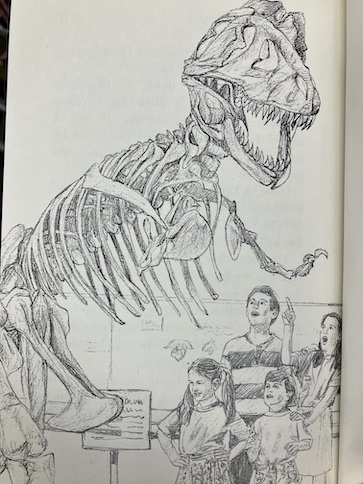
I have done volunteer work in museums as an adult, and one thing that they don’t tell you in this book is that, when you see an assembled dinosaur skeleton in a museum, it’s probably all or partly a plaster model of the bones rather than the real bones. That’s because fossilized bones are no longer actual bone. They are petrified, so they are as heavy as other stones. When you have stones the size of large dinosaur bones, it’s extremely difficult to mount them so that they stand up, like the dinosaur would in real life. Sometimes, plaster models also fill in for bones that are missing from an incomplete skeleton. Complete skeletons are very, very rare. There were only two places where there were real dinosaur bones on exhibit in the last museum where I volunteered. One was a dinosaur thigh bone that visitors were allowed to touch to learn what fossilized bone feels like. The other was a collection of pterosaur wing bones mounted on a wall, where no one could touch them, and it wasn’t a complete wing. Some museums have exhibits marked so you know which bones are models and which are real fossils.
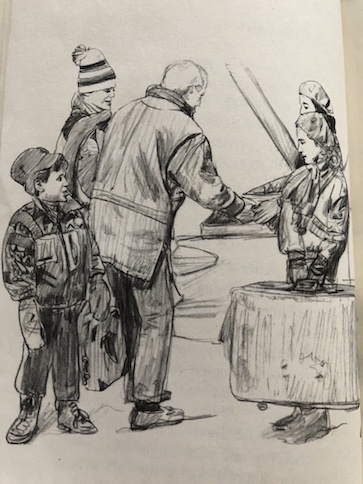
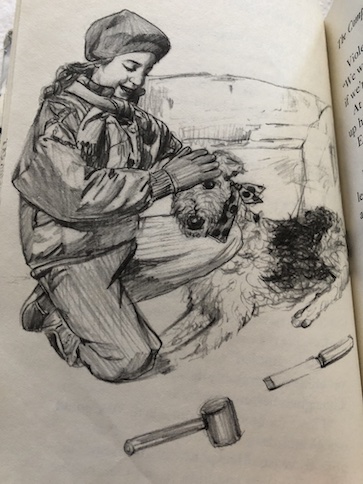
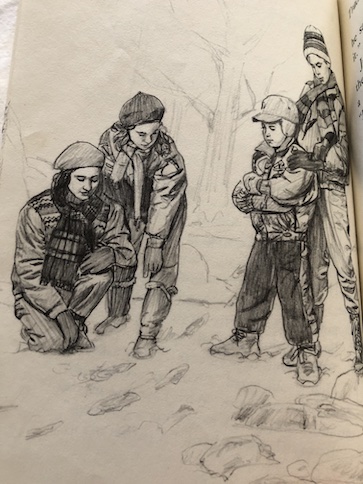
I also liked the art style in this book. Boxcar Children books vary in art style because they were produced over multiple decades, but my favorite illustrations are the ones that look the most realistic. I think realistic illustration styles are best for this book in particular because they show the details of the dinosaur skeleton realistically.
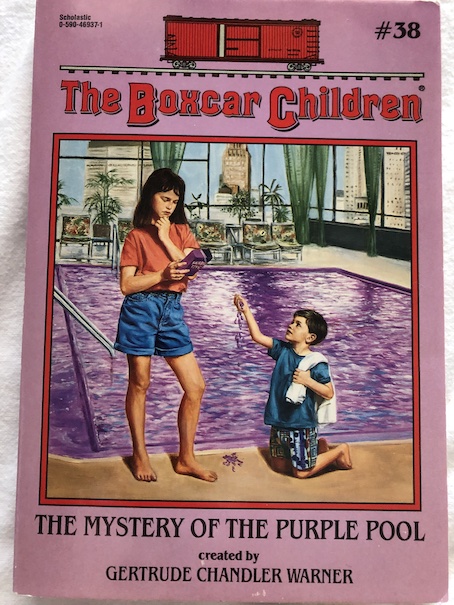
The Mystery of the Purple Pool by Gertrude Chandler Warner, 1994.
The Boxcar Children are all bored, especially Benny. Grandfather Alden tells them that he has to go to New York City on business, and the children can come with him and see the city. That sounds like just the kind of excitement the kids need! Their grandfather calls the hotel where he’ll be staying and reserves a suite of room for all of them. Then, he tells the children to look through some guidebooks for the city and decide what they want to see there. He says that, during the time when he’ll be working, the two oldest children, Henry and Jessie, will be in charge. The children start looking through the guidebooks and talking about things they want to see in New York.
When they arrive at the Plymouth Hotel in New York, the children’s grandfather notices right away that the service isn’t how it usually is at this hotel. For some reason, their reservation was canceled, although they are still able to get rooms. Then, there are no bellhops to be found to carry their bags, and even the hotel management doesn’t know where they are. As they go to their room, they hear another guest complaining that his room wasn’t cleaned, even though the maid said that she’d cleaned it.
All of these things could be mistakes or signs of bad hotel management, but it soon becomes apparent that someone is deliberately trying to sabotage the hotel. When the children try to swim in the hotel pool, they find out that someone dyed the pool purple! Then, someone switches the sugar and salt in the hotel restaurant, ruining everyone’s breakfast. When the kids come back from sight-seeing, they see a crowd of people in the lobby, all complaining about various things missing from their rooms, like pillows and shower curtains. Then, the children get stuck in the hotel elevator when someone turns it off and have to call for help.
The Alden children have another mystery on their hands! Who could be the mysterious saboteur, and what would they want to harm the hotel? There’s a mysterious man who seems to be lurking around when bad things happen. There’s also a maid who is angry about her brother being fired from the hotel. The hotel manager isn’t always on hand to deal with things when they go wrong. There’s also an unfriendly woman who doesn’t like kids (named Karen before that name started to be used as a slang word for a disagreeable, complaining woman) and is always scribbling in her notebook, never letting anybody see what she’s writing. Any of them could be the culprit, or it could be someone they haven’t even thought to suspect.
The book is available to borrow and read for free online through Internet Archive (multiple copies).
My Reaction
I remember reading this book and liking it when I was a kid. One of the hallmarks of The Boxcar Children series is that the children are always allowed their independence in their adventures. Their grandfather lets them explore the city completely on their own, even though the oldest child in the family is only 14 years old. Few people would let their children roam around New York City completely on their own these days, and they didn’t when I was a kid in the 1990s, either. Another guest at the hotel even lets his young son go sight-seeing with the Alden children when they haven’t known each other very long.
The kids have fun exploring the amenities at the hotel, too. The book draws attention to various aspects of staying at hotel, like suites with kitchenettes, hotel restaurants, pools and exercise rooms, and the snacks and toiletries you might find in your hotel room. I thought it was interesting how the book explains how you can call for help in an elevator if it gets stuck. Its a useful thing for kids to know.
One thing that occurred to me when I revisited this story was that it doesn’t mention the World Trade Center. They characters could have visited the original World Trade Center in the story because the book was published 7 years before it was destroyed in the September 11, 2001 terrorist attack, but the World Trade Center was not one of the sights that the children went to see. If it had been, it would have dated the story, but I can’t think of anything the children saw or did in the book that really dates it. The things they mention still exist in New York, and this story could still be set in the early 21st century.
Mystery Behind the Wall by Gertrude Chandler Warner, 1973.
It’s summer vacation, and Benny doesn’t know what to do with himself because his friends have gone away for the summer. Mrs. MacGregor, the housekeeper, suggests that they invite a guest to the house to cure Benny’s loneliness. Her sister in Canada knows a boy who lives on a farm and is often lonely because they live a long way away from other people. The boy, called Rory (short for Roderick), is very lively and full of ideas, and he could use some company as much as Benny does. The kids are all eager to meet Rory and have him visit, so their grandfather calls Rory’s family and arranges for the visit.
The Alden kids are excited about Rory’s visit and start preparing the spare bedroom. They wonder if Rory will like it or not because the room seems old-fashioned and a little sad to them. The walls are covered with a wallpaper with roses, so the kids think that it must have been a girl’s room at one time. They notice an old photograph on the wall of a girl with her parents in front of the house, but the house looked different and smaller when the photograph was taken. There’s also a poster that says “Coolidge for President” in the window, dating the photograph to the 1920s, meaning that the picture is decades old. (The Aldens refer to that as being about 40 years yearly, dating the story to the 1960s.) Mrs. MacGregor puts a bright red bedspread on the bed to brighten the room up a bit, and the Aldens hope that Rory won’t mind that it still seems a bit old-fashioned.
Rory doesn’t mind the room at all. In fact, he is a bright and curious boy, who is interested in everything and notices little details. He notices the photograph in the room when he arrives, and he asks Grandfather Alden about it. Grandfather Alden explains that the people in the photograph are the Shaw family and that they owned the house before he bought it. The girl is named Stephanie, and she was the Shaws’ daughter. The Shaw family sold the house to Grandfather Alden when they moved to France, and Grandfather Alden built an addition onto the house, which is why it looks different now. The children wonder what happened to the Shaw family and to Stephanie, but Grandfather Alden says that he doesn’t know. They never wrote to him after they moved to France.
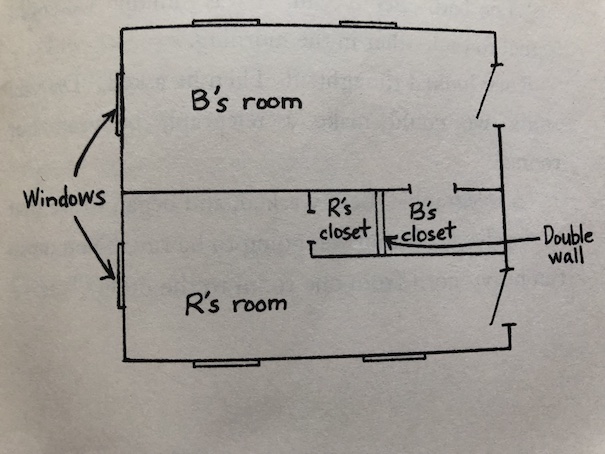
Another thing that Rory notices about the guest room is that it looks like the closet should be bigger than it actually is. Benny has the room next to Rory’s, and he has the idea making a hole in the backs of their closets so they can have a secret communication system between their rooms. Grandfather Alden doesn’t mind the project, so they cut holes in the backs of their closets. That’s when they discover that there is a secret, hidden space between the closets, and there’s something hidden in the space. They pull it out, and it’s a piece of cloth. They wonder what it’s for and why someone would hide it.
Grandfather Alden identifies the cloth as a coin case. He tells the kids a little more about Stephanie Shaw. He knows that Stephanie’s father was a very strict man. Her mother went to France ahead of the rest of the family, and her father was in charge of her in her mother’s absence. He had her tutored at home and didn’t let her play with other children, so she was often lonely. However, he allowed her to indulge in their shared hobby, which was coin collecting. The kids wonder what happened to the coins when Stephanie left for France. There are no coins in the coin case now. Professor Nichols, a coin collector who specialized in rare nickels, also helped Stephanie with her collection. He thought that Stephanie might have left her coin collection behind when she went to France, thinking that she might return one day, but Stephanie never did return. Professor Nichols would have asked Stephanie about it, but he didn’t have their address in France.
When the kids explore the hiding place in the closet further, they find an old notebook that turns out to be Stephanie’s journal from when she was 10 years old. Stephanie explains about her loneliness, and her coin collection. She talks about a puzzle that she created that will fool even her father, but the journal ends, so they don’t know what sort of puzzle Stephanie was talking about.
As the children explore Stephanie’s old room further, they find a clue that shows that Stephanie created a treasure hunt before she left for France, a treasure hunt that nobody has ever solved. The Boxcar Children and their new friend, Rory, begin playing along with Stephanie’s old treasure hunt, hoping that it will eventually lead to her missing coin collection.
The book is available to borrow and read for free online through Internet Archive (multiple copies).
My Reaction
This is one of the early Boxcar Children books, written by the original author. Because the book was written decades ago, a child who was 10 years old in the 1920s would have been about 50 years old at the time the story is set, but the children are sad to learn that Shaw family, including young Stephanie, was killed in a railway accident in Europe, which is why none of them ever returned to solve the treasure hunt and reclaim the coin collection.
The Boxcar Children run into multiple dead-ends in the treasure hunt because things have changed in the decades since Stephanie created her treasure hunt, and clues have been lost. They almost give up, but Benny and Rory realize something that helps them solve the final riddle.
When they finally find the coin collection, they call Professor Nichols to come and look at it, and he tells them about some of the rare coins in the collection, like a 20 cent piece and an Indian head penny. He explains some general principles of coin collecting to the kids, like the fact that the oldest coins aren’t always the most valuable pieces in a collection. There are some very old and even ancient coins that are not quite as rare as some newer coins, and the rarity is what makes them valuable. He helps the children to start their own coin collections. This book could be a fun mystery to help get kids interested in a new hobby!
Bicycle Mystery by Gertrude Chandler Warner, 1970.
Grandfather Alden tells the Boxcar Children that their Aunt Jane has invited them to visit her on her farm. To make the trip more interesting for the adventurous kids, he suggests that they make the journey to Aunt Jane into a cross-country bicycle trip. There are motels along the route where they can stay, or they can came out. They won’t be able to take Watch the dog with them this time because he’s getting too old to follow their bikes that long distance, but the kids like the idea of the cross-country bike trip.
The cross-country trip gives the Alden children the chance to meet new people and have adventures. Along the way, they stop to help Mrs. Randall, a woman who is worried about having to fix dinner suddenly for her husband’s boss while her house is a mess. The Aldens see how upset she is while they’re shopping for food themselves, so they volunteer to help her. The boss’s visit turns out to be a success, and rather than coming to discuss a problem at work, he’s there to tell the Randalls that he’s considering Mr. Randall for a promotion. However, the Alden children have the feeling that there’s something else worrying Mrs. Randall that has to do with her son, Carl, who isn’t there. Every time Carl is mentioned, Mrs. Randall seems worried.
As the children continue on their way, they get caught in a rain storm and take shelter in an abandoned house. There, they find a little gray dog, who seems friendly and well-behaved. The dog is very hungry, and they share their food with him. The dog seems eager to follow them when they leave. They try to tell the dog to go home, thinking that he probably lives somewhere nearby, but he insists on going with them. Benny starts calling the dog Shadow for following them. The Aldens don’t think they can keep Shadow because they don’t think Watch would like them getting another dog, and they’re a little worried that letting him follow them might be taking him further away from wherever he lives, but they don’t know what to do but take care of him until they can figure out where he belongs.
Later, they meet a boy who is minding a roadside vegetable stand who has a broken leg. The boy says that he feels badly because his father can use some help picking vegetables, too, but he can’t do much since he broke his leg. The Boxcar children offer to help, and the boy and his father are surprised that they’re willing to work for free. The kids say that they’re just out for adventure right now, and they don’t mind helping. The father, Mr. Smith, notices the way that Shadow whines constantly, even though he doesn’t seem hurt. They talk about the dog and wonder who the owner is. Mr. Smith thinks that, if someone didn’t want the dog, they probably could have sold him instead of abandoning him. His son, Roy, noticed something odd while he was minding the vegetable stand. A pair of girls commented that it was the same dog that they had seen in a parking lot earlier. Mr. Smith suggests that the kids ask Miss Lucy at the post office if anyone in the area has lost a dog because she knows everyone and everything that’s going on. When they ask Miss Lucy, she says that nobody in the area has lost a dog, and Shadow isn’t at all familiar to her. Shadow seems to be an unusual breed, and Miss Lucy thinks that he looks funny.
As the children travel further, they spot a sign for a dog show. They decide that they should go to the dog show and see if they can meet people who are interested in dogs and might know what kind of dog Shadow is. They meet a man who tells them that the dog is a young show dog, and he offers to buy the dog. When the kids say that they can’t sell Shadow because he doesn’t belong to them, the man and his wife seem suspicious, and the woman takes a picture of them and the dog.
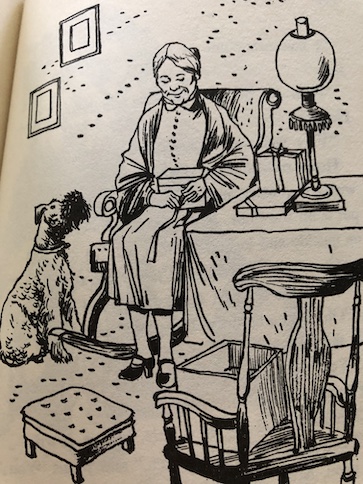
When the kids finally reach Aunt Jane’s farm, Uncle Andy recognizes the dog as a Skye terrier. The kids finally manage to locate the dog’s owner, and it turns out to be a surprise.
The book is available to borrow and read for free online through Internet Archive (multiple copies).
My Reaction
This is one of the early Boxcar Children books, written by the original author. Because of the cross-country trip format, the book is somewhat episodic, with incidents taking place at different places where the children stop on their trip. The story has more elements of adventure than mystery, but the mystery element is there, too.
The Boxcar Children frequently have more independence from adult supervision than most kids have today, which is part of the appeal that the series has for kids. I think that most people who rent motel rooms would be concerned about renting rooms to children by themselves, but it’s important to point out that the word “kids” is relative. In the later books in the series, the kids’ ages are frozen, so the eldest, Henry, never ages past 14 years old. However, in the earlier books, like this one, the kids did age. In this book, Henry is college-aged, so he’s not exactly a kid anymore. The book doesn’t provide an exact age for him, but he’s probably 18 years old or older.
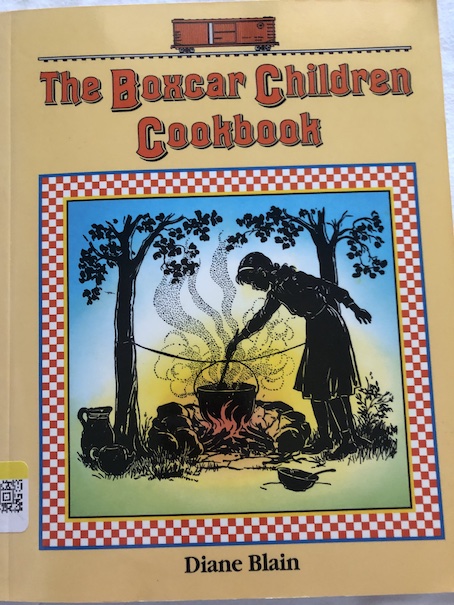
The Boxcar Children Cookbook by Diane Blain, 1991.
This book is a companion to The Boxcar Children series, written years after the original series by a different author. Most of these recipes weren’t included with the original books in the series, but the books often mention food. The children in the stories are often eating foods they like or demonstrating that they can prepare their own food. In particular, the youngest of the children, Benny, likes to eat.
The first part of the book discusses kitchen equipment, measurements, and safety rules. The recipes in the book are organized by types of dishes. There is even a section about cooking over a campfire because the children camp out in multiple books. Each of the recipes explains which story in the series mentioned that type of food. The books that the cookbook references are all part of the original 19 Boxcar Children books written by Gertrude Chandler Warner, not the later ones written by ghost writers under her name.
None of the recipes are very difficult because they’re meant for children, but they’re not overly easy, either.
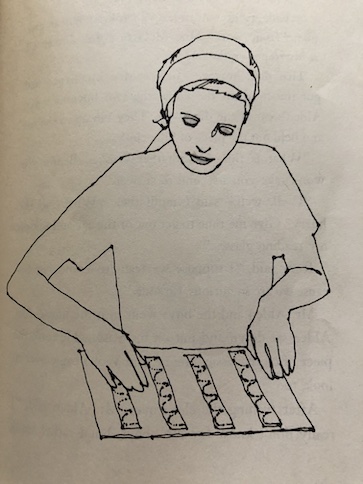
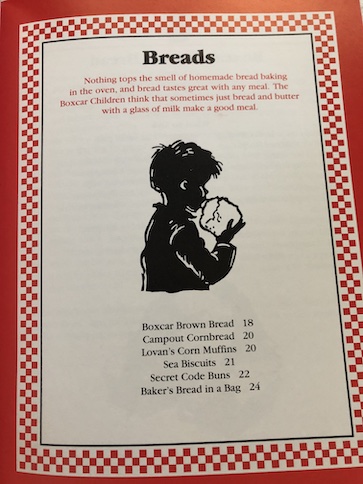
The section about beverages includes recipes for hot chocolate mix, strawberry milkshakes, lemonade, eggnog, and an orange drink. The breads section includes a recipe based on one that appeared in The Snowbound Mystery, which was a secret recipe for buns. However, the recipe in this book includes a shortcut using prepared sweet roll dough from the grocery store.
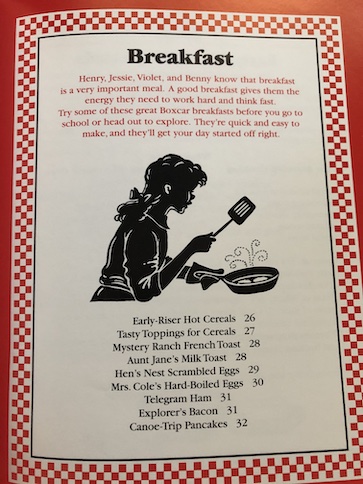
The breakfast section includes recipes for pancakes, French toast, and different types of eggs. I thought it was interesting that the page about hot cereals not only included recipes for oatmeal and cream of wheat, which are common ones but grits, hasty pudding, and cream of rice, which I had never heard of before.
There are sections for sandwiches and main dishes. There is also a section about salads and vegetables for side dishes.
The section about campfire cooking includes instructions for building a campfire and safety rules. There are also grill instructions.
Finally, there are sections for cookies, cakes and desserts. I think the cookbook is a fun way to add activities to accompany the stories. Cooking is a valuable learning experience, and many people like to experience foods similar to the ones that characters in their favorite stories enjoy.
The illustrations in the book are in silhouette form, like the illustrations from the very first Boxcar Children book, but they’re not exactly the same. Some of them have been changed to fit the recipes in the book, with characters holding foods that they weren’t holding in the original illustrations.
The book is available to borrow and read for free online through Internet Archive.
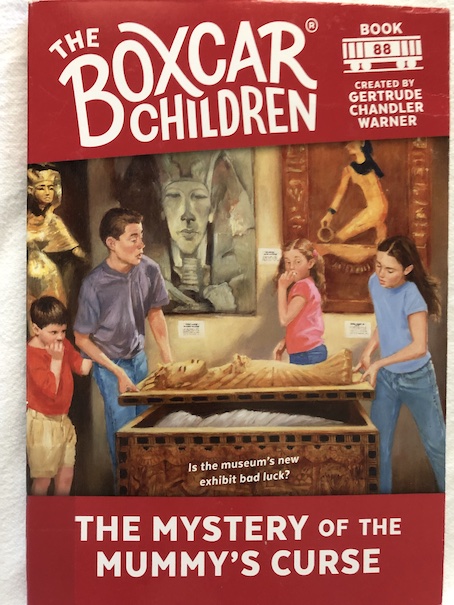
The Mystery of the Mummy’s Curse by Gertrude Chandler Warner, 2002.
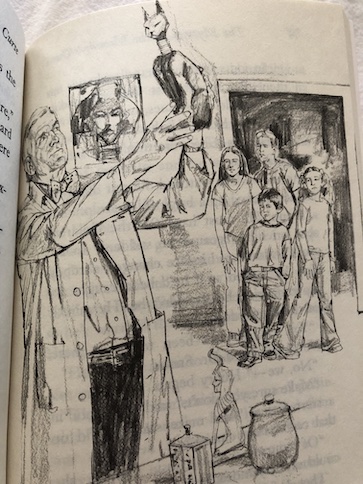
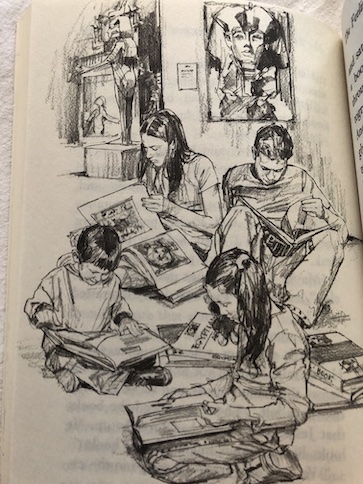
The Alden children are at the museum to get a sneak preview of the new Egyptian exhibit because the man in charge of the exhibit is the son of one of their grandfather’s friends. When he shows them the mummy that will be the centerpiece of the exhibit, one of his assistants accidentally falls off a stepladder and breaks her ankle. The museum personnel joke that it’s the “mummy’s curse,” although they quickly reassure the children that they don’t believe in curses.
With the opening of the exhibit coming soon, there’s a lot of work to do, including cleaning up the exhibit hall where it will be set up. Losing the assistant has left the museum short-handed, so the Aldens volunteer to help with the cleaning and setting up.
However, the children notice other odd things about the exhibit when they’re helping to clean up. They hear strange noises, as if someone were creeping around the off-limits areas where the artifacts are being stored and the exhibit getting set up. Then, some of the artifacts that they noticed when they were first introduced to the exhibit disappear. When they check to see what else is missing, they realize that some of the artifacts they’ve seen aren’t even listed on the official roster. Jessie tries making her own list of artifacts in the exhibit, since the master list isn’t reliable, but someone steals it.
Who is stealing from the Egyptian exhibit?
The book is available to borrow and read for free online through Internet Archive.
My Reaction
I enjoyed the mystery. I was pretty sure that I knew early on who was responsible for the thefts, but mysteries involving museums, mummies, and stolen artifacts are my cup of tea!
I did think, as I was reading this, that few museums would let random kids help set up an exhibit like this, including valuable artifacts, even if most of what they were doing is just cleaning up. In the story, the eldest of the Alden children is 14, and I’ve done enough volunteer work to know that there are age limits and training requirements for certain volunteer tasks. There are really only two reasons why kids like the Aldens would be doing this. One, the requirements of the story: having the kids help set up an exhibit of Egyptian artifacts is exciting, something that plenty of kids would find fascinating, and it allows them to be in the right place to notice the thefts. Two, Grandfather Alden is rich: if the children’s grandfather wasn’t rich and well-connected, the Aldens wouldn’t be doing most of what they do in the stories. The second reason isn’t as charming as the first, and it never occurred to me when I was younger that the Aldens are actually very privileged to be in the position to do the things they do and meet the people they meet, but they are.
I wouldn’t say that the knowledge spoils the story for me, but it did make me stop and think. Sometimes, when adults, especially older adults, look back on books like the Boxcar children series, they talk about how independent the kids in these stories are and how willing to work, but the truth is that, in most of the stories, the kids’ grandfather sets them up with the opportunities for volunteer work or independence that the children have. The kids didn’t get this volunteer position because it’s an extension of special classes any of them are taking in history or archaeology or because they’ve done lower-level volunteer work for the museum before, working their way up, or because they applied for the position. They got it because of someone their grandfather knows. The Alden children are still willing to take advantage of opportunities that come their way and work hard at them and learn whatever they can, but when you think about it, it’s not quite the same as people who have to prove themselves and their merits first just to get the opportunity to do the same thing. So, I enjoy the story for the fun and mystery, but thinking about it now, as an adult who has done volunteer work for museums as well, I’m not quite so impressed with the way other, older adults compare the characters to real kids of non-rich, non-connected parents.
There are still volunteer opportunities for youths who want to get involved in museum work, but most of them require the kids to be older teens. One of the reasons for the age requirements is that there can be liability issues if someone gets hurt on the job, but people who hire volunteers also want to know about the skills the volunteers have, what kind of training they’ve had or need, and how much they can alreay do unsupervised. Rules can vary by location and position, but in the places I’ve been, kids under 14 are usually required to be supervised by an adult, 18 or over. Often, teens who do those sorts of jobs have already proved their skills or worked their way up in some way, applying for volunteer jobs and discussing their skills, taking related classes, being part of museum programs for younger children before, and/or volunteering in tandem with a parent first. The same is true of other places where I’ve volunteered, like animal shelters. So, the kids who seem more independent are that way because the adults in their lives took them through the preparation and training first and helped them connect with people who could take them further. This is a fun mystery story, but just understand that real children often aren’t like kids in mystery adventure books because they are real people in the real world, where circumstances are different from the ones in fiction. Real life has rules and regulations, and not everybody has a rich grandfather or family friends who are willing to treat them as special exceptions to the rules. If you want to see the kids around you get involved in a cause like this and gain some skills, the best way to go about it is to get involved yourself, both with the cause and with the lives of the kids, and give them the training and knowledge they need to go further on their own. Things like this don’t just happen on their own.
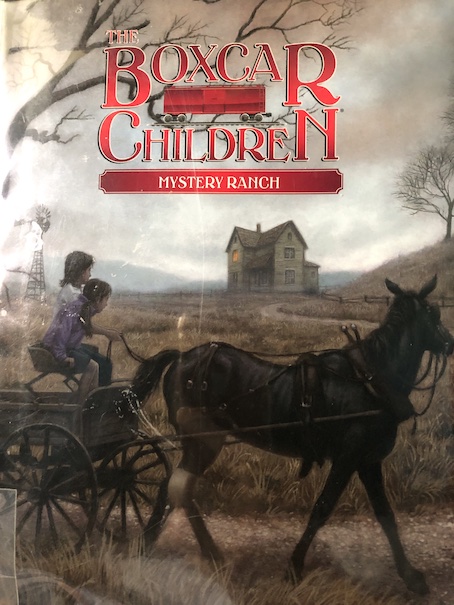
Mystery Ranch by Gertrude Chandler Warner, 1958, 1986.
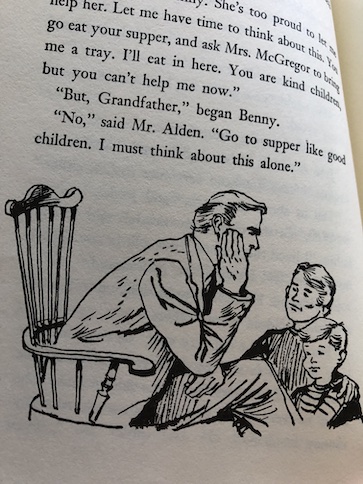
The children can tell that something is wrong when their grandfather, Mr. Alden, comes home and bangs the doors. When they ask their grandfather what’s the matter, he says that he’s worried about his sister, Jane, because he just got a disturbing letter about her. The children have never met their Great-Aunt Jane before, and she lives on a ranch out west. The trouble is that Jane is a difficult person to get along with. She can’t stay at the ranch alone because she’s elderly and needs help, but the person who was helping her before is leaving, and because Jane is such a difficult person, their grandfather doesn’t know where he’s going to find someone else willing to help her. Their grandfather admits that he doesn’t even get along with Jane himself, confessing that he hasn’t been very nice to her, either. (We never find out exactly why the children’s parents originally told them that their grandfather wasn’t a nice man, as established in the first book of the series, but this confession hints that he used to be much harder on his relatives than he is now, perhaps having mellowed a bit with age and experience.)
Their grandfather says that the ranch where Jane lives is the ranch where both of them grew up. When he moved east years ago, Jane wanted to stay on at the ranch. He knows that Jane doesn’t have much money and doesn’t even keep many animals anymore, but because of her sense of pride and their past quarrels, Jane won’t accept any money or help from him. The children wish they could do something to help, and their grandfather says that he has to think things over. They ask who wrote the letter about Jane, and their grandfather says that it was written by the neighbor who has been staying with Jane. She says that she can’t put up with the bad treatment from Jane anymore. The letter further says that Jane wants to see Mr. Alden’s grandchildren. Naturally, the children say that they would like to see Jane themselves and try to help her. However, their grandfather isn’t sure that it’s a good idea because he doesn’t know how Jane would treat the children.
After talking it over some more, they all decide that the two girls, Jessie and Violet, will go to see Aunt Jane without the boys because Jane might find all four children at once to be too overwhelming. Mr. Alden says that if Jane gives them too much trouble, they should go to the neighbors, who are nice and will help them. When the girls get off the train at the town near their aunt’s ranch, they notice that a man gets off at the same time and quickly disappears. They are curious about him and wonder where he went. The townspeople are curious, too, because it’s rare that anybody comes to their little town, let alone a mysterious stranger.
When the girls arrive at the ranch, the neighbor, Maggie, helps them get settled. Aunt Jane refuses to get out of bed, and Maggie says that she hasn’t been eating much and won’t let her eat much, either. The girls ask Maggie what’s wrong with Aunt Jane, and she says Jane feels like she doesn’t have anything to live for, so she’s kind of given up. Jessie and Violet insist that they’re all going to eat, and they fix some food. The girls and Maggie eat first, and then, the girls take Jane some orange juice with a beaten egg. Jane finds it difficult to refuse the girls, so she drinks it. Aunt Jane starts asking the girls questions about their brothers and says that she would like to see them.
Aunt Jane begins eating better because she finds these interactions with her young nieces interesting and because they speak more kindly to her than anybody else has for years, and she enjoys the attention. Maggie stays on at the house and continues to help because the girls have money and buy more and better food. Things seem like they’re getting better at the ranch, but when Maggie and the girls return from buying food in town, Aunt Jane says that three strange men came to the house while they were gone, even entering her bedroom, and they tried to badger her into selling her ranch to them. At first, Maggie doesn’t believe that, but Aunt Jane has the paper the men left to prove it. Of course, Aunt Jane refused to sign anything and told the men to go away, but she seems a little shaken by the experience.
The girls miss their brothers, and Aunt Jane tells them that the boys can come and stay, provided that they’re not like their grandfather. When the boys come, Aunt Jane likes them, too. To the children’s surprise, she tells them that she’s decided to give her ranch to the four of them because she has no children of her own and she would rather they have it than those men who tried to get her to sell. The prospect is thrilling, but when the lawyer comes to arrange everything, they make sure that the arrangement includes providing for Aunt Jane, too.
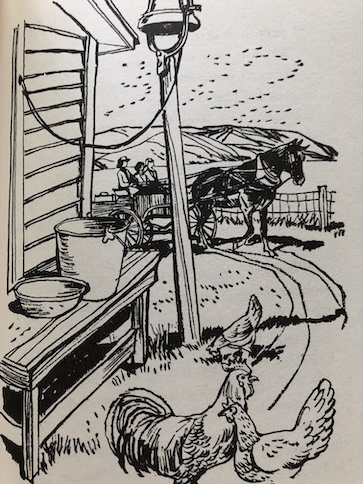
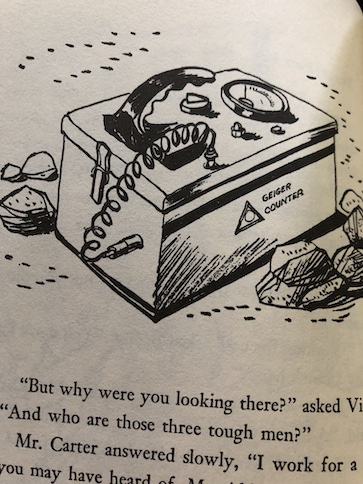
As the children explore their new ranch together, they see that things are as their grandfather described to them. The only animal Aunt Jane currently has is an old, black horse that Benny ironically names Snowball. However, they find an old hut that looks like someone has been living there recently. Who has been secretly camping out on Aunt Jane’s land? Is it the mysterious stranger who got off the train or the three tough guys who tried to get Aunt Jane to sell the ranch to them? Why would anybody even want the ranch anyway? The children find it charming, and while the girls like to imagine how they’d like to fix up the house, they know it isn’t worth much monetarily. There aren’t many animals, and while there’s fool’s gold on the land, there’s no real gold. Is there something else on the ranch that they don’t know about?
The book is available to borrow and read for free online through Internet Archive (multiple copies).
My Reaction and Spoilers
As readers might have guessed, there is a resource on the ranch that the Aldens have overlooked for years, but other people have figured it out. However, more than the mystery, I like this book for the insights into the Alden family’s past. As I said, we never fully find out why Mr. Alden’s son and his wife had a falling out with him years ago and told the children he wasn’t very nice, but his sister’s feelings about him offer some clues to the type of boy and young man Mr. Alden was. Mr. Alden admits that he wasn’t always nice to his sister, and Jane says that he was always “bossy.” I get the feeling that Mr. Alden used to be the kind of man who thought that he knew best about everything and started feeling like he could tell everyone what to do. Perhaps his falling out with his son helped show him that he didn’t really know best about everything, including how to get along with his own family, but admittedly, that’s speculation.
Jane also admits to being difficult to get along with in other ways. Her major problem has been her sense of pride, which is one of the reasons why she never wanted to listen to her brother or go to him for help when she needed it. One of their chief disputes had been about the ranch itself. Years ago, her parents and brother were ready to give up the ranch and move east, but Jane felt more attached to it than the others and insisted on staying there and running it herself. Unfortunately, Jane admits that she didn’t really know how to run the ranch properly. There were points when she could have asked for help, but that would have been admitting to the others that she had been wrong to insist on staying, and she couldn’t bring herself to do that. Things gradually got worse over time because Jane wouldn’t listen to anybody or ask for help, which is how the ranch got into its current state.
The discovery of an important resource on the ranch brings more money to the family, greater security for Jane, and a chance for the brother and sister to make up. Jane invites Mr. Alden to the ranch to celebrate her birthday and to help her and the children arrange things. Mr. Alden is careful to arrange the situation so that the resources can be mined while not disturbing the old ranch house, so his sister can continue to live in the house she always loved so much.
#6 Blue Bay Mystery by Gertrude Chandler Warner, 1961, 1989.
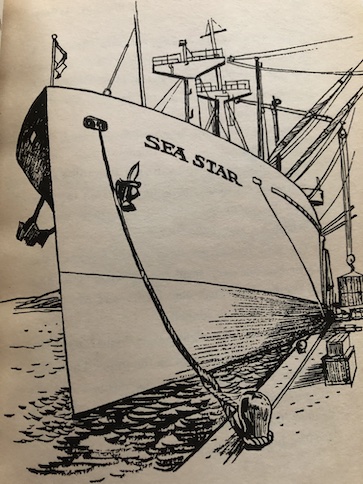
Grandfather Alden has a surprise for his grandchildren. He is arranging a special trip for them as an extension of a business trip of his. A business associate of his, Lars, has a ship going to Tahiti, and he offered to let them come along. However, rather than just having a tour of Tahiti, which would be pretty exciting by itself, Lars is going to take them to camp out on a tropical island. Lars found this island while escaping from a shipwreck himself. No one lives there, but there is plenty of fresh water and edible plants and no dangerous animals. Not every family would like to be on an uninhabited island when they could be in Tahiti, but the kids love camping out and do-it-yourself activities. Grandfather Alden has also invited the children’s friend, Mike Wood (who was introduced in a previous book), to join them. Mike is the same age as Benny.
The trip will take place during the school year, so their grandfather has arranged for the children to bring along some school supplies and lessons to study while they’re on the boat to the island. The lessons help not only to pass the time while they’re traveling but also to enhance it. They have science lessons about marine animals and how parts of the ship, like the radio room, work. Violet tells the others about how she’s been reading about Captain Cook and how he realized that eating certain types of food, like citrus fruit and sauerkraut, helped to prevent scurvy, even though he didn’t realize that the reason is that those foods are rich in vitamin C.
Once they reach the island, their grandfather says that they won’t have time for school lessons because they will have to set up their shelter and learn how to fish and forage for food, although he considers those to be educational lessons as well. They bring some supplies and tools with them so they won’t have to forage for everything, but the kids like assembling their own shelter and improvising things, like they did when they made their own home in a boxcar in the first book. They eat out of shells they find, whittle their own spoons, and use a huge turtle shell they find as a cooking pot.
However, they soon realize that they are not as alone on the island as they thought. Some of their food disappears, and they find some colored stones arranged in patterns. There is a stone with a carved face, sort of like the Easter Island heads, and the turtle shell they find has been carved with a knife. Later, they encounter a myna bird who keeps repeating the phrase, “Hello, Peter!” Someone taught the bird the phrase in English, but who is on the island, and why does this person seem to be hiding from them?
The book is available to borrow and read for free online through Internet Archive (multiple copies).
My Reaction and Spoilers
In the early Boxcar Children books, the children aged as the series progressed. After the death of the original author, when other authors continued the series, the children became frozen in age, but this book is one that was written by the original author. At the beginning of the story, the children’s grandfather mentions that the two oldest children, Henry and Jessie, are in high school, showing that they’ve aged about two or three years from the first book. This remark about the children’s ages only appears once at the beginning of the book, and their increasing ages aren’t really reflected in the story. The lessons the children have on the boat seem to be roughly about the same subjects, although it seems like the children’s lesson books aren’t identical because Violet seems like she’s the only one with the lesson about Captain Cook and scurvy.
This book also varies a little from the other books in the series because the children’s grandfather plays a larger role than usual. One of the hallmarks of the Boxcar Children books is that the children usually do things by themselves, with as little adult help or interference as possible. However, this time, their grandfather is with them on the island, sharing the adventure with them.
As with other vintage children’s mystery series, the early books of this series sometimes lean more toward adventure than mystery. The mystery in this story is pretty light, and the solution is pretty straight-forward. The children eventually find the person who’s camping out on the island with them. The person turns out to be a boy who was also shipwrecked. There was an adult sailor with him before, but the boy, Peter Horn, says that he went swimming one day and never came back, so he’s been alone ever since. The others say that he might have been attacked by a shark but they don’t dwell on it very long, as they do any time someone’s death is mentioned in one of the books in the series, so it doesn’t get too sad. Peter says his parents went overboard while they were escaping the shipwreck, and he doesn’t know whether they’re still alive. Mr. Alden says that he read about some people being rescued from a shipwreck, so it’s possible that they’re still alive. When they return to the mainland, Peter is reunited with this parents for a happy ending.























 Jestress's Forgotten Books and Stories