Alvin’s Secret Code

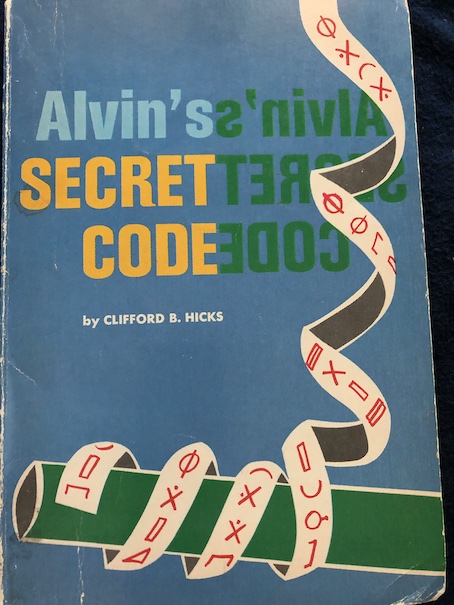
Alvin’s Secret Code by Clifford B. Hicks, 1963.

This book is part of the Alvin Fernald series.

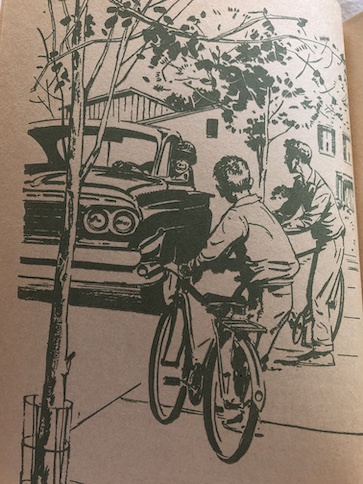
Alvin has been reading a book about spies, and now, he and his best friend, Shoie (a nickname, his real name is Wilfred Shoemaker), are playing at being spies. One day, as the boys are walking home from school, Shoie stops to pick up another bottle top for his collection, and he finds a scrap of paper with a strange message on it. The words in the message don’t make any sense, and it looks like it’s some kind of secret code.

When Alvin gets home, his mother insists that he clean his room before he does anything else. Shoie helps him, and Alvin’s little sister, Daphne, insists that she wants to help, too, because she wants to see what the boys are doing. Daphne is fascinated by the things her older brother does and always wants to be included. When Daphne finds out that they’re being spies and have found a secret message, she also insists that she wants to be a spy and look at the message with them. They let her see the message, but they insist that she can’t be a spy because it’s dangerous and “work for men.” (That attitude comes up in mid-20th century kids’ books, especially ones for boys. I’d just like to point out here that, while dealing with spies would actually be dangerous, too dangerous for a young kid like Daphne, the fact is that both Alvin and Shoie are only twelve years old, so technically, they don’t count as “men”, either.) At first, the kids think maybe the message is meant for a secret Russian spy ring targeting the nearby defense plant. (This book was written during the Cold War, so that would be one of the first possibilities they would consider.)

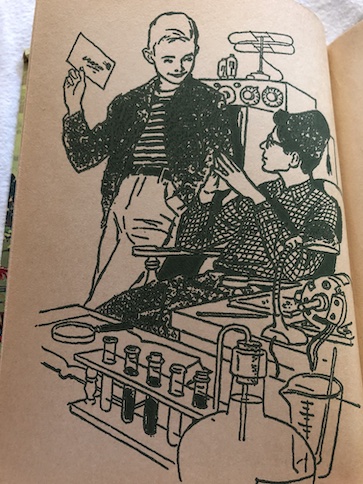
Alvin comes to the conclusion that they need to investigate Mr. Pinkney, a relative newcomer to their town, because they found the message near his house, the message mentions an oak, and there’s one growing nearby. Alvin also thinks that they might need some help to break the code in the message, so he suggests that they visit Mr. Link, a WWII veteran who was also a spy during the war. He’s now an invalid who has a housekeeper who takes care of him, but he could still advise them about what to do with the mysterious message. Although the boys tell her that she can’t be involved with what they’re doing, Daphne still tags along with them when they go to see Mr. Link.

When the kids ask Mr. Link about his time as a secret agent during the war, he calls spying a “dirty, dirty business” but “something that must be done”, saying that he’s glad that it’s all over now. However, he’s perfectly willing to talk about secret codes and ciphers. Mr. Link has even written a couple of books on the subject. This story is a nice introduction to codes and ciphers for kids because it explains some of the terms and how codes and ciphers work. As Mr. Link points out, much of what people think of as secret codes are actually ciphers. The difference is that ciphers are actually secret alphabets that can be used to compose messages. When Mr. Link asks them if they’re trying to compose a cipher themselves, the kids tell him about the secret message and their suspicions that there could be a spy in their town.

Mr. Link doesn’t reject the possibility that there could be a spy in the area, but he tells them that they’re wrong to suspect Mr. Pinkney of being a spy because Mr. Pinkney is a friend of his, and he knows him very well. For a moment, Alvin wonders if they should suspect Mr. Link too, but Mr. Link anticipates the thought and says that he can prove that he’s trustworthy by telling them more about Mr. Pinkney and breaking the code for them. Mr. Link explains that Mr. Pinkney was lonely when he first came to town, and that’s how the two men started playing chess together regularly. Mr. Pinkney owns a factory that makes electronic devices, like transistor radios and intercoms, and one day, he told Mr. Link that he had a problem with his business. He suspected a business spy of trying to intercept his messages to his product distributors in Europe, and he needed a way to make his messages more secure. Naturally, Mr. Link suggested using a code, and he recognizes the coded message the kids found as one that Herman Pinkney sent to his distributors. Mr. Link shows the kids how each word in the strange message stands for another word or concept. Only someone who knew what the code words were supposed to mean would be able to read it.

Alvin is a bit embarrassed about jumping to the wrong conclusion, and Mr. Link says that he’s learned a couple of important lessons from this experience. First, you shouldn’t jump to conclusions about people if you don’t know them very well, and second, people who are full of tricks and deception are easily confused when they encounter straightforward honesty. In other words, while Alvin was spinning imaginative spy tales in his head, he overlooked the possibility that there could be a more innocent explanation. Alvin is still embarrassed, but he takes the lessons to heart, and Mr. Link tells them more about codes, how they have been used in history, and how codes are around them all the time, every day.

I liked Mr. Link’s explanations about how codes aren’t just for spies. He says that codes are used for all kinds of communications where only certain people are meant to read and understand messages. He explains about the product codes on things that the kids buy and wear everyday, showing them how to read the size codes on their shoes. Codes can indicate where and when products were made, and we still use product codes for that purpose in the 21st century. I used to work in a textbook store, and we used the codes on textbooks to tell which edition of a book students needed or whether a student needed just the textbook or if they needed books that came bundled with other, supplemental materials. Mr. Link says that ordinary people can sometimes figure out what product codes mean by studying them and looking for patterns that they recognize, like dates or sizes.

Since this book was written in the 1960s, they don’t talk about computers or the Internet, but that’s a major use of codes in the 21st century, and anybody can study and learn computer coding. Computer programming involves “coding” because, like with the other codes that Mr. Link describes, programming languages are also codes, using certain words and symbols to represent concepts that not everybody needs to read in order to use a computer, but which the computer can interpret so it knows what the programmer and user want it to do. Communications and transactions over the Internet also involve cryptography to protect the users’ information, using algorithms to convert a sender’s plaintext message to ciphertext to conceal its true meaning from any third party who might try to read the message and then back into plaintext so the intended recipient can read it. Codes really are around us all the time, even when we’re not fully aware of them or paying close attention to them.

The kids are fascinated by Mr. Link’s stories about how codes were used in history and the unusual methods people used to send secret messages, like writing them on someone’s head and then letting their hair grow out and cover it. He also shows them scytales, round pieces of wood that can be used for reading secret messages. The message would be written on a long strip in what appears to be jumbled letters. The message only makes sense when the strip is wrapped around the scytale so that the letters will align in the proper order to be read. That’s what’s shown on the cover of this book, although the picture also shows a message written with code symbols.

It’s all fun and games until a woman named Alicia Fenwick shows up in town with a puzzle that puts the kids’ abilities to the test. She comes to see Alvin’s father in his professional capacity with the police, looking for a man named J. A. Smith. Miss Fenwick explains an incident that happened to her family during the Civil War. The Fenwicks used to own a Southern plantation with slaves. (Daphne says that she doesn’t like the part of the story about the slaves, and Miss Fenwick says she doesn’t either although her great-great grandfather was apparently kind to his … which is what they all say, isn’t it? More about that in my reaction section below.) During the Civil War, her great-great grandfather was an old man. All the young men went away to fight in the war, but he stayed at home. When there were rumors of marauding bandits, he got worried that the plantation with would be a prime target for them with all the young men gone. He enlisted the help of a former slave he had freed before but who was still a friend to help him hide the Fenwick family’s valuables. They put everything they could into a chest and buried it. Unfortunately, when the bandits came, they forced the former slave, Adam Moses, to reveal the location of the chest by threatening to kill his young son. After they dug up the chest, they took Mr. Moses prisoner and forced him to help them take the chest with them further north. Eventually, Mr. Moses escaped from the bandits after they tried to kill him, and he wrote a letter to the Fenwicks saying that he was now in Indiana and that the bandits had forced him to help them rebury the chest. He said that he would try to retrieve the chest and return home with it, but sadly, he was later found murdered close to Riverton, the town where the children now live, probably killed by the same bandits who took the chest. However, the leader of the bandits was also killed shortly after that, so they never enjoyed their ill-gotten gains. The treasure chest was never recovered. The story was passed down in the Fenwick family for generations as an unsolved mystery until recently, when Miss Fenwick received a letter from J. A. Smith asking her for any information she might have about about the treasure. She told this person about the letter from Mr. Moses but didn’t hear from him again, so she’s trying to trace J. A. Smith and find out what he knows about the treasure.

Sergeant Fernald, Alvin’s father, says that there are people in town with the last name of Smith but nobody who has the initials “J. A.”. However, the kids say that Miss Fenwick’s story might explain some of the stories told by local kids about an area outside of town called Treasure Bluffs. Rumor has it that there was a treasure buried there years ago, although nobody knows exactly why or where. The kids start to think that the story really points to the location of the Fenwick treasure, but the bluffs cover a lot of territory, and before they can really search for the treasure, they have to find a way to narrow down the search area.

The kids’ new lessons in code-breaking pay off when they spot a man at the local library using the code books that Mr. Link donated. The strange man is trying to break a message that will reveal the secret hiding place of the Fenwick treasure. Can Alvin and his friends figure out who the man is and break the code themselves before he does?

The book ends with a section explaining more about codes and ciphers. One of the codes they explain is the pigpen cipher, which is a popular one for children and appears in other children’s books. This book says that it was used in the Civil War, which is true, but it’s actually older than that.

The book is available to borrow and read for free online through Internet Archive.

My Reaction and Spoilers

There are some elements in this story about boys thinking that they’re more capable than girls, like in the way that Alvin and Shoie talk to Alvin’s little sister, but Alvin also acknowledge, to his irritation, that sometimes Daphne thinks even faster than he does. When Mr. Link is explaining the size codes on the children’s shoes, 8-year-old Daphne actually catches on a little faster than 12-year-old Alvin and comes up with the answer to a problem Mr. Link poses before Alvin’s “Magnificent Brain” does. I liked that touch of imperfection on Alvin’s part and the acknowledgement of Daphne’s abilities, which help thwart any overconfidence or arrogance that Alvin might have about his “Magnificent Brain.”

I appreciated that, although Alvin is clever, he’s not a complete genius, and he is noticeably fallible. He’s not good at everything, like some heroes of children’s books. He is terrible at spelling, and when he tries to write that he’s a cryptographer, he spells it “criptogruffer,” which doesn’t inspire professional confidence. Daphne knows the correct spelling and spells it aloud for him, much to Alvin’s embarrassment and annoyance. Alvin is still pretty clever, and he breaks the final code that reveals the hiding place of the treasure, but it is nice that he’s not unbelievably perfect.

The final code in the book is easy enough that anybody could actually break it with minimal effort. I spotted it pretty quickly because there’s something that I always do with secret messages in books, and it often pays off. (There are one or two things in the Harry Potter books that this works on as well.) I’m not going to spoil it here, although I’ll give you a hint: When I was a kid, I read and liked a book about Leonardo Da Vinci.

I genuinely enjoyed the parts of the story about codes, which run through most of the book. Mr. Link is full of helpful information, and the section at the back of the book with more information about codes is a nice introduction to some basic types of codes. As I said above, I like the practical applications of the lessons, showing kids how they can read parts of product codes, if they understand what to look for. That’s a useful skill, and you can use similar techniques to interpret the expiration dates on food products when they’re only stamped with a code instead of an explicit date.

Like Daphne, I also didn’t like the part of the story about slaves. This book was written during the Civil Rights Movement, which makes its takes on the Civil War, slaves, and race interesting. The author wants to tell a story that bears on the Civil War, so he has to address this is some fashion, and he tries to get pass the uncomfortable issue of families owning slaves as quickly as he can to get to the adventure part of the story.

The Civil War and its associated legends of battles, ghosts, secret passages, hiding places, hidden treasures, and secret messages are staples of American children’s literature. It’s completely understandable because the Civil War was a major event that shaped life and history in the US, it was a traumatic event whose impact is still felt even into the 21st century, and it gave rise to many stories and legends that have further helped shape our culture. The idea of treasures hidden during the war and later forgotten is a popular trope and so are coded messages that point to secrets from the past. I’ve seen these tropes used in other children’s stories, like The Secret of the Strawbridge Place, The House of Dies Drear, and Mystery of the Secret Dolls, and they’re always fun. However, stories with a Civil War backstory can sometimes feel a little uncomfortable because they’re almost impossible to tell without involving slavery in some way because slavery was at the heart of the war.

When Daphne says that she doesn’t like hearing about slavery and owning slaves, they deal with the issue quickly, with Miss Fenwick saying she doesn’t like it, either, and adding that her great-great grandfather was apparently nice about it, and then continuing with the story. As I said above, yeah, right, that’s what they all say. In stories (and sometimes real life), when there are characters whose families owned slaves and plantations, they almost always add the idea that, while slavery was bad and horrible and slaves were mistreated elsewhere, this particular family was special and treated their slaves with kindness, and it was almost like they were one big, happy family. Yeah, right. To be honest, I probably would have accepted that as a kid and let it pass. As an adult, I’m not letting it pass without at least a few pokes in the side as it goes.

The idea of the grateful slave or ex-slave who loves the family he served has been a trope since the anti-Tom literature of the 1850s. I can’t swear that no slave never felt any kind of affection for members of the family that owned them because human nature is varied and unpredictable, surprising relationships can spring up, and if all else fails, Stockholm Syndrome also exists, so I suppose it could happen, but at the same time, I just don’t buy that whole “slavery is bad, but my family is kind, and our slaves loved us” type of narrative. Even if a given slave-owning family was “above average” in treatment of slaves, that doesn’t mean that they were “good” so much as “less bad” among a group of people perpetrating something bad. The “average” in this situation is so bad that there’s quite a lot above that level that still wouldn’t qualify as good, whether the descendants of slave owners believe those old school textbooks promoted by the United Daughters of the Confederacy (some of which were still in use during the Civil Rights Movement – children are shaped by the things they read and the people who gave them those books, and history is not written by the “winners” but by the people who write) or have really thought this through all the way or not. (You don’t have to take my word for it. You can hear about it from people who actually were slaves.) I suppose I can suspend my disbelief about this fictional family for the sake of this kids’ story, which is mostly about secret codes and a treasure hunt and spends little time on racial issues, but I’d just like to point out that I definitely do have a sense of disbelief about this that requires suspension.

Of course, I can see why the author had to include it. In order for us to be invested in the treasure hunt and care about the Fenwick family getting their fortune back, we have to believe that they’re great people, sort of removed or distanced from the responsibility for choosing to own slaves (“in those days, it was accepted throughout the South” is the only explanation we’re given), who were as kind to their slaves as possible, so kind that at least one loved them so much that he gave his life attempting to recover the family fortune, and that they will now use the treasure for some beneficial purpose. (We are told that the family now operates an orphanage, which badly needs money, although we’re also told that one of their former charges has since become a US Senator, so you’d think he could help raise some.) If we didn’t like this family at all, we might see the fortune that came from their plantation as the ill-gotten goods of exploiting someone else’s labor, its loss as poetic justice, and the profit from its recovery as probably something that should either go toward the slaves who did the work on the plantation or maybe some public cause, like a museum or something.

We are told that Adam Moses’s son survived the experience with the bandits, escaped from them when his father was captured, and was adopted by another family, but we are not told anything further about his descendants. While I was reading the book, I halfway wondered if a descendant of the Moses family would surface with some important clue to the situation and get some acknowledgement, but that doesn’t happen. Instead, there’s a person who’s related to one of the bandits, who thinks that he has a right to the treasure because his ancestor stole it from someone else. The characters in the story scoff at that logic, but when I consider the full context of the situation, it makes me think.
Our Man Weston

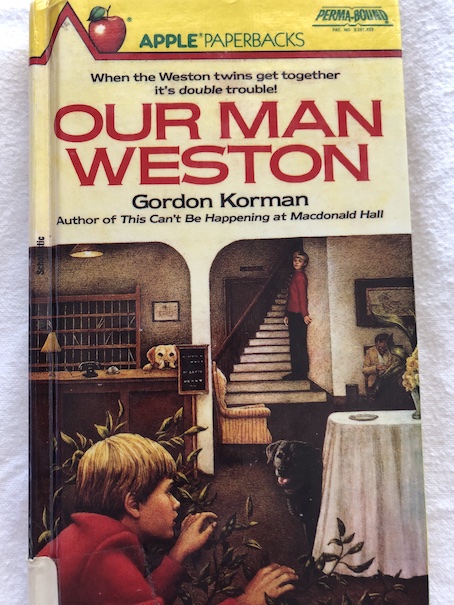
Our Man Weston by Gordon Korman, 1982.

Tom and Sidney Weston, a pair of identical twins, are excited about their first big summer jobs as service boys at a fancy resort hotel. Tom is thinking that the work is going to be easy and that they’ll have plenty of time to have fun, but then, he starts worrying about what kind of fun Sidney is going to try to have. Sidney mentions that they might see some interesting people at the hotel, and Tom remembers that Sidney thinks of himself as a detective and is always on the lookout for spies and criminals. It’s a real problem because Sidney is perpetually wrong in his suspicions about everything and everyone he tries to investigate. He’s gotten into trouble before for making false accusations, and because the two boys look alike, Tom sometimes gets blamed for things that Sidney does. Tom is really looking forward to this summer, and he’s determined that Sidney isn’t going to ruin their summer jobs.

Right from the first, Sidney is in detective mode. As the boys are picking up room service dishes, Sidney tries to study the dishes to make deductions about the people in each room. Tom tries to get Sidney to stop because their manager, Walter Parson, is a serious man with little patience, and he’s already annoyed that he has trouble telling the two boys apart. Sidney is excited when a hotel guest complains that her purse is missing, thinking that he’s found a case to investigate, but while he interviews her for details and pressing for details about a primary suspect, Tom just notices that the lady’s purse is still in her room. It wasn’t stolen, just misplaced. Tom uses this incident to emphasize to Sidney that he needs to give up this detective game because it only causes problems.

However, unbeknownst to the boys, there are real spies at the hotel, and they’re interested in the nearby air base, just like Sidney speculated might happen. The readers learn who the spies are right in the beginning, before the boys even know that there are spies. It’s a little like a Columbo mystery, where the identities of the villains aren’t a secret, and part of the suspense of the story is how the heroes will figure it out and prove it. Even though we know right away who the main villains are, Sidney is clueless.

Sidney continues investigating various guests as though they’re all spies or criminals, although he doesn’t seem at all suspicious of our real villains. He becomes convinced that Lawrence Waghorn is a spy when he’s actually a television writer who’s working on a script for a show about spies. He convinces the guest who temporarily lost her purse, Miss Fuller, that another guest, Mr. Kitzel, is a suspicious character, and she starts following him around and spying on him. In turn, Mr. Kitzel gets the idea that Miss Fuller either has an awkward crush on him or that she’s investigating him because he cheated on his taxes. He’s very nervous because she keeps following him around and tries his best to avoid her. Sidney steals his boss’s dog because he’s under the false impression that the dog is being trained to help the spies carry out their mission, and he seriously wants to inform the Prime Minister of Canada (where they live) and the President of the United States. Tom keeps trying to thwart his brothers’ various schemes and confiscate the spy equipment that he’s hidden around their hotel room. Confusion abounds, although some of its helps to inspire Waghorn, who has been suffering from a case of writer’s block.

Meanwhile, the real spy, Richard Knight (a pseudonym, county of origin unspecified), is trying to get his hands on a new airplane being tested at the nearby air base. He’s brought along a pilot named Bert Cobber. Cobber actually has military training and trained alongside the pilot testing the plane, “Wings” Weinberg. Weinberg has nerves of steel … except about anything related to his cadet days, having been partnered with Cobber, who is a skilled but reckless flier and nearly got him killed on many occasions while flying drunk, forgetting to put sufficient fuel in the plane, and repeatedly crashing. Weinberg hasn’t seen Cobber for years, but he practically has a nervous breakdown every time he relives those memories. A friend of Weinberg’s assures him that, if Cobber is really as reckless as Weinberg remembers, he probably got himself killed long ago, but Weinberg has the uneasy feeling that Cobber is still around somewhere.

Although many characters have the overall situation wrong, I appreciated those moments when some people got certain things exactly right. When Miss Fuller overhears Mr. Parson yet again mistaking Tom for Sidney and also quizzing him about why he’s getting mail from different government agencies, she steps up to tell him to stop his bullying, reminding him that mail is private and that the boy doesn’t owe him any explanation about his personal mail just because he works for him. She also tells him that he’s talking to Tom, not Sidney, and that he’s a fool for getting that wrong.

I also love it that the different government agencies that Sidney has been writing to already know who he is because Sidney has submitted many other inquiries to these various agencies. They’re all familiar with Sidney’s false accusations, and in their response letters to Sidney, they express both amusement for Sidney’s wild escapades and sympathy for whatever poor sap Sidney is suspicious of today. Sidney is never discouraged by their criticism of his wild theories or their requests for him to stop writing. It’s getting to the point where some law enforcement agencies are so fed up with Sidney that they wish they could find something to arrest him for.

Meanwhile, Richard Knight has noticed Sidney’s investigations, although he is unimpressed because he knows that Sidney is way off base. However, he hasn’t fully reckoned with the lengths Sidney is prepared to go to “save the western world”, and Sidney’s schemes interfere with Knight’s in completely unexpected ways.

My Reaction

I remember reading this book when I was in middle school, and I loved it. I remember thinking that it was really funny, although I’d forgotten a lot of the details since then. As an adult, I find Sidney more frustrating than I remember, and I feel sorry for poor, long-suffering Tom. As with the MacDonald Hall books by the same author but with different characters, Sidney’s crazy schemes end up working out for the best, and he ultimately saves the day, even though it’s largely by accident.

There are a couple of changes that I wish I could make to the story. First, I liked it that, while Mr. Kitzel isn’t a spy or a major criminal, he does have one guilty secret: he cheated on his taxes by claiming his dog as a dependent daughter. He becomes convinced that Miss Fuller is onto him for that. However, I’d like to create even more semi-guilty secrets for various guests at the hotel so that Sidney can be almost correct about some things while still missing the most suspicious person of all. As it is, Sidney is seriously way off base because he’s paranoid and delusional, although in a comedic sort of way. I don’t like characters that are intentionally stupid, so I’d like more secrets and petty crimes among the more innocent guests so Sidney can be almost right about them.

I’d also like to see Sidney develop some self-awareness during the course of the story. He is completely oblivious to his own failings and false conclusions and also to the way other people react to him, even when they tell him, in writing, that they don’t want to be bothered with his wild goose chases anymore. That’s part of the comedy of the story, but I find it a bit frustrating. Sidney does almost come to realize how other people look at him when he tries to persuade Miss Fuller that he was wrong about Mr. Kitzel being a spy, but she’s as impervious to correction as he is, so he ends up just letting her continue barking up the wrong tree. I think it would have shown more character development and maybe even have been more funny if Sidney comes to realize how Tom feels, trying to reign him in, if he had to try to control someone even more overly paranoid and determined than he is. The book ends well, but I think it would have been even better if, at the end, Sidney apologizes to Tom for everything he’s put him through, saying that, while everything worked out for the best, he realizes that he’s done a lot of things wrong and that he still has a lot to learn. Then, just when Tom thinks that things are going to calm down, he can see Sidney seriously reading a book about espionage or interrogation techniques and making notes or signing up for a summer correspondence course in criminal investigation, hinting that Sidney’s adventures aren’t over yet and leaving it open about whether he’s going to really learn something practical or just graduate to the next level of crazy.

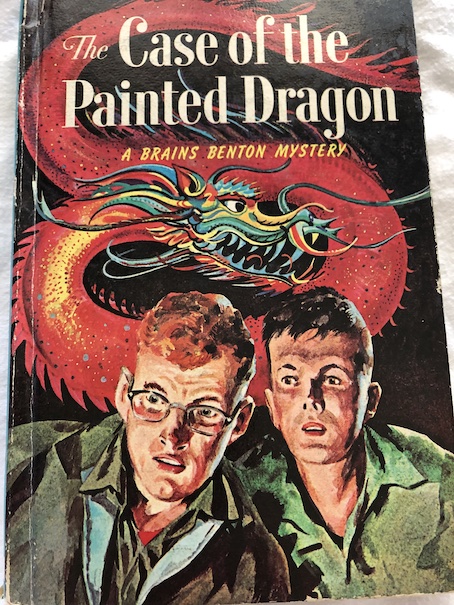
The Case of the Painted Dragon

Brains Benton

The Case of the Painted Dragon by by George Wyatt (Charles Spain Verral), 1961.

Jimmy and Brains are on their way to school when a strange man in a car stops and asks them if they know where he can find a Japanese kid. (He uses the derogatory terms “Jap” and “Nip”, and Brains disapproves. Also, the man is very unspecific about which kid he’s looking for. He offers no names, just that he’s looking for a Japanese boy about their age The town where the boys live is a fairly small college town, so I guess it’s supposed to be reasonable that there would only be one boy matching that description. I grew up in a larger university town, so the idea of there being only one person who could match any description and just expecting random people to know who it is seems really odd to me.) Brains just says that they don’t know anybody with Japanese ancestry, and the man drives away.

After the man leaves, the boy talk about how suspicious he was. They really don’t know who he could be looking for. The last Japanese family to live in their town was the Yamadas, but Mrs. and Mrs. Yamada were killed in a car accident the year before. (It was a point in the book’s favor that Brains doesn’t like derogatory racial terms, but the point is lost quickly when Jimmy is describing Mr. Yamada, who taught art at the boys’ school, and he says that Mr. Yamada “wasn’t one of those ‘inscrutable orientals’ you’re always reading about.” He says that Mr. Yamada was friendly and also coached the school’s swimming team. It’s nice that Jimmy liked Mr. Yamada, but the way he says it sounds a little back-handed. I suppose it’s a sign of the times when this book was written that the author thought it was reasonable for people, even kids, to “always” be reading about “inscrutable orientals”, but on the other hand, I’ve read other books from this time period and earlier that weren’t like that, so I’m inclined to think that it’s not really “always” and everyone.) However, the boys don’t remember the Yamadas having a son their age, so they doubt there’s a connection. They’re concerned because they think that the suspicious stranger might have bad intentions toward the kid he’s looking for.

After the boys get to school, Jimmy sees that stranger driving by the school, and he gets worried. Either the stranger is still looking for the Japanese boy, or he’s looking for Brains and Jimmy. Brains thinks that the best thing to do is try to find the Japanese boy before the man does. However, Brains doesn’t want to tell their principal or teacher about the stranger or the boy. Jimmy worries that maybe the stranger made up the Japanese boy as an excuse to get to him and Brain, and he decides to tell the principal about the stranger in the car, and the principal goes outside and demands that the stranger tell him who he is and what he’s doing, hanging around the school and scaring the students. Unfortunately, he confronts the wrong person in the wrong car, which is an embarrassing situation. (He did the right thing even if he confronted the wrong person. I give him credit for that, but they need to have a reason why the school authorities don’t do anything about the weirdo scouting the students.)

In the boys’ next class, they meet a new student, Mikko, who may be the Japanese boy that the stranger was looking for. The boys make friends with Mikko, inviting him to come to baseball practice with them. They want to warn him about the stranger, but before they talk to him about thr man who seems to be looking for him, they spot the car following them again. Mikko spots the car, too, and the boys ask him if he knows the driver. Mikko says, no, the man is a stranger. Aside from the people at school, the only people Mikko knows in town are Mr. and Mrs. Bevans, the people he’s staying with. Brains makes up a story about why the man might be following them because he doesn’t want to alarm Mikko too much and also because he doesn’t want anybody calling the police until he and Jimmy have had a chance to investigate the situation themselves. (This is a selfish move – Brains just wants a case to investigate, and he doesn’t want to share the case with the proper authorities. But, again, the story needs to provide a reason for Brains and Jimmy to handle the investigation without adult help.)

Jimmy’s mother knows about Mikko’s background and tells him about it when he gets home. It turns out that Mikko is the Yamadas’ son, but until recently, he had been living with relatives in Japan. Mr. Yamada was born in the US, but he worked in Army Intelligence during WWII, which is when he went to Japan and met his wife. Mikko had been born in Japan and was going to school there, but the Yamadas planned to move to the US permanently. Mr. and Mrs. Yamada had come first to get established, but they died in the car accident before they could bring Mikko to join them in the US. However, Mr. Yamada had wanted his son to become an American citizen, like him, and get an American education. The Yamadas had boarded with Mr. and Mrs. Bevans and became friends with them. The Bevanses’ have no children of their own, and they are considering adopting Mikko and giving him the American life that his father wanted him to have.

There is one adult who knows about the mysterious car following Mikko: Yama, an old family servant who accompanied Mikko from Japan to the US to make sure that he gets settled in his new home. Yama is a former sumo wrestler and a formidable man, and when Mikko tells him about the mysterious stranger in the black car, Yama says that he will protect him. However, when the Bevanses’ house is ransacked while the boys are playing baseball and they return and find Yama looking around Mikko’s room, they boys start to suspect that Yama may be involved with the mysterious stranger in some way. At least, he seems to know more than he wants to say about the situation because he refuses to call the police to report the ransacking.

After some further research, Brains and Jimmy learn that the Yamadas’ car accident might not have entirely been an accident, and Brains suspects that everything that has happened may relate somehow to Mr. Yamada’s former work in Army Intelligence.

My Reaction

This is the last book in the Brain Benton series, but it’s also more of a mystery than the previous books. In most of the books, it doesn’t take the boys long to realize who the villains are, and the mystery is more about how they’re going to prove it and stop the bad guys. However, in this book, Brains and Jimmy really do start off completely in the dark. First, they have to learn who the Japanese boy is that the strange man is looking for, and then, they have to learn the history of Mikko and his family. Brains and Jimmy do genuine investigative work, starting with old newspaper stories about the accident that killed Mikko’s parents. Little by little, they begin to reconstruct the past and learn why someone is looking for Mikko and what Mikko has that they want. Even when the boys know who the bad guys are and what they’re after, there is still the puzzle of where Mikko’s father hid it before he died.

I enjoyed the mystery in the book, but I didn’t like some of the ways Jimmy talked about Japanese people. I think it was good that he noted that derogatory terms are inappropriate, and I appreciated that he liked Mikko pretty quickly and pointed out good things about him. Those are good points. It’s just that, sometimes, even when Jimmy speaks favorable about some of the Japanese people in the story, it comes off sounding a little back-handed, like when he says that Mr. Yamada was actually a really nice and friendly guy and not “inscrutable” like characters Jimmy has heard about. I can see that it’s a positive point that someone who has been given a negative impression about certain types of people can consciously notice that the reality is both different and better than what he’s heard before. I think Jimmy is moving in a good direction in his attitudes. It’s just that compliments sound flat when they’re accompanied by a negative or implied negative. It’s like the difference between saying “He’s a really nice guy” vs. “He’s a really nice guy for being the kind of person I’ve always heard was really sinister.” It just adds an uncomfortable twist on the sentiment. I know that the reason Jimmy talks like this is because this book was written during the 1960s, when racial attitudes were changing, and the author probably felt like it was necessary to acknowledge old stereotypes, but I still don’t like it.

The Case of the Roving Rolls

Brains Benton

The Case of the Roving Rolls by George Wyatt (Charles Spain Verral), 1961.

Summer has been dull, with no mysteries to solve. Jimmy doesn’t mind too much because he has other things to do, but his friend and partner in their detective agency, “Brains” Benton, is going a little stir-crazy. When they started their detective agency, they named it the Benton and Carson International Detective Agency, but so far, they’ve only solved local cases. Brains wants to find an international case to solve to justify the name. The opportunity comes when Jimmy gets a letter from his Uncle Ed, who has been living overseas.

Uncle Ed is a pilot who has been living in a fictional Middle-Eastern country called Kassabeba. In his letter, he mentions that something strange has been happening there recently, although he finds it hard to explain exactly what’s been happening. He says that, soon, the answer may be coming to the boys’ town of Crestwood, if it’s not there already. The Emir who ruled the country died under somewhat suspicious circumstances, and his half brother took over from him, but the Emir also had a son who was attending Eton at the time his father died. Apparently, the Emir’s half brother has been doing everything he can to prevent this young prince from coming home to challenge his rule of their country. Uncle Ed and some others who were friendly with the former Emir and like his son, Prince Halam, have been trying to help him, although it’s not going very well. The half brother hasn’t been coronated as the new Emir yet, but the prince’s supporters doubt they can get the prince back home before that happens in another month. Instead, they’ve decided to send the prince to Crestwood College, where Brains’s parents are teachers, seeing it as a quieter, safer place for him to finish his education. The prince’s supporters are hoping that he’ll have another chance at ruling his country when his education is complete. Unfortunately, Uncle Ed has just received word that the half brother has sent a couple of his associates to the US. It’s possible that he’s discovered where the prince is going, and his associates may be heading to Crestwood to harm the prince. Uncle Ed describes these two associates – Jujab, who is short and round with a moon-shaped face, and “the Duke”, who is tall and lanky with a horse face and claims to be British.

The prospect of helping to protect a prince from another country is exciting, and Brains has a thought about the first thing they should do. He says that, if people are coming to Crestwood from another country, probably one of the first things they would do is try to connect with someone else from their own country who is already living in Crestwood because they could use some help and support. Crestwood isn’t a big city, and there is only one other person from Kassabeba already living there, a man named Khouri who works as a cook for a wealthy woman in town. Jimmy is afraid of the cook because he’s a temperamental man, and he had a bad run-in with him at Mrs. Willoughby’s mansion. Jimmy’s been doing a little work there because Mrs. Willoughby hired him to make some shelves for a gardening show, and the cook flew into a rage at him for coming into the kitchen. However, Brains thinks it’s important that they find out if Jujab and the Duke have been to see the cook.

When Jimmy is on his way to the Willoughby estate to meet Brains there after his paper route, he is almost hit by Mrs. Willoughby’s Rolls-Royce … but there’s nobody driving it! Yet, somebody must be controlling it somehow because the car deliberately swerved toward Jimmy and then made a turn in the road. Just after the Rolls-Royce almost hits Jimmy, Mrs. Willoughby’s British butler and chauffeur, Frothingham, comes along on a bicycle, in pursuit of the car. He falls off the bike, and Jimmy helps him. Frothingham explains that he’s got to catch up to the car. He says that it was parked in the Willoughby driveway and that the hand brake was set, and he can’t understand what happened. When Jimmy says that maybe the brake just failed, Frothingham says that he doesn’t think it’s likely because it’s a good quality car and well-maintained. When Brains comes along, Jimmy explains the situation to him, and the two of them follow Frothingham to where he has found the Rolls-Royce parked and apparently undamaged.

Frothingham says that he still can’t imagine who was driving the car and just abandoned it, and Jimmy is still sure that he didn’t see anyone behind the wheel. Brains says that he has an idea about it but that this strange occurrence is a sign that something more serious is about to happen. When Frothingham asks him what he means by that, Brains asks him if he’s seen any unusual strangers around the Willoughby estate recently. Frothingham says that he hasn’t, but Brains is still convinced that the people who are after the prince have been around the Willoughby estate already and that there may be something important hidden in the car.

When the boys later see the Rolls-Royce strike a pedestrian, Frothingham is blamed. The boys are sure that he’s innocent, but they didn’t see who was driving the car, so they can’t swear to it. The boys struggle to clear Frothingham’s name.

My Reaction and Spoilers

I liked this story in the series better than the last one that I read because I felt like there was more intrigue and uncertainty. We do have two specific villains that Brains and Jimmy are looking for from the beginning – the men known as Jujab and the Duke. The characters have descriptions of them, and they know that these men pose a threat to the young prince who will be arriving soon. That means that these people haven’t actually done anything yet, but Brains and Jimmy want to find them before they do.

The incidents with the car are odd and seem like they might be unrelated at first, but they are actually part of the villains’ plot. When Frothingham was first introduced, I was suspicious of him because he seems to be British, but the man known as the Duke is known for posing as a British person. Although the characters in the story seem to have known and liked Frothingham for some time, it occurred to me that he could have been planted in Crestwood for longer than Jimmy’s uncle thought. However, that’s not the case. (Spoiler!) Frothingham is just exactly what he seems to be, an innocent man working for a wealthy local woman. In order for Jujab and the Duke to accomplish their mission, they have to establish some kind of identity for themselves in Crestwood. By making it seem like Frothingham committed a hit-and-run, they get his drivers’ license temporarily revoked so that the man known as the Duke can get hired as a temporary chauffeur for Mrs. Willoughby. Mrs. Willoughby is the one who’s going to meet the young prince when he arrives, so her chauffeur is in a perfect position for some foul play.

The boys have all the information they need to figure this out about halfway through the book, but what makes this book intriguing is that there’s more going on than just the evil half-uncle’s associates trying to get to the prince. When the prince actually arrives, the boys ask him what happens at a coronation ceremony in his country. (This is part of why the prince comes from a fictional country. Not only does the author not have to account for real people and events in a real country, but he can also make up any customs he wants for this country.) The prince describes the ceremony, including a part where the new Emir drinks spring water called the “Water of Life” from a special Golden Vial that has been used for the purpose for generations. The ceremony cannot take place without this Golden Vial, and Brains realizes that, although the prince believes that the vial is back in his home country with his half-uncle, it has actually been transported to the US. It turns out that Mrs. Willoughby’s car was originally owned by the prince’s father and that he left it to her because she was a friend of his and had admired it … and maybe because he hoped that his son would also go to her and retrieve the Golden Vial from the car. The half-uncle’s associates are not just in the US to find the prince but to retrieve this Golden Vial because, without it, the half-uncle cannot be coronated at all.

One other point I thought I would mention is that, when Jimmy first saw the car and didn’t see a driver, I thought that, for some reason, the villains installed a remote control device in the car. This book was written a few years before remote controlled cars were first sold, but with Brains interested in new inventions, it wouldn’t be out of the realm of possibility. However, that’s not the case with this story. The car does have a driver; it’s just that he’s crouched down so he can’t be seen as well. Science and invention enter the story when they realize that they can find the Golden Vial with a Geiger counter because it contains a special stone that contains radioactive material.

The Case of the Counterfeit Coin

Brains Benton

The Case of the Counterfeit Coin by George Wyatt (Charles Spain Verral), 1960.

One Saturday, Jimmy Carson is going around, collecting fees from customers on his paper route, when he decides to stop for a soda. To his surprise, he discovers that one of the coins he has received from a customer turns out to be something very unusual. It appears to be from a foreign country, although Jimmy doesn’t recognize what country it’s from. When someone suggests that it could be a rare and valuable coin, Jimmy decides to call his friend and detective partner Brains Benton and ask him what he thinks about it. However, as Jimmy is talking to Brains at a public pay phone, someone tries to reach into the phone booth to grab the coin! Luckily, Jimmy notices in time and yells, and the person doesn’t succeed in getting the coin. Jimmy isn’t able to see the person’s face, but he gets a good look at their hand, the person’s hand has an odd, blackened thumbnail.

It seems that the coin has greater significance for someone than just an odd foreign coin that they accidentally spent instead of American money. When Brains looks at the coin, he identifies it as an ancient Athenian coin, but he also notices that someone has used modern implements on the coin and a varnish to make it look older than it really is. In other words, the coin might at first look like a collector’s coin, but it’s actually a fake. So, if the coin is fake, where did come from, and who wants it so badly?

The boys start going over Jimmy’s route to try to figure out where the coin came from and if any of Jimmy’s customers have a blackened thumbnail. It turns out that the coin came from Binky Barnes’s house. Binky is about their age, but the boys consider him to be a nuisance because he has a way of exaggerating things and is always telling tall tales. You can’t believe a lot of things that Binky says, but the coin apparently came from Binky’s coin collection. It was a new acquisition, and his mother was the one who accidentally gave it to Jimmy when paying him for their news delivery. That still doesn’t explain who was trying to steal it from Jimmy.

Binky is upset when the boys tell him that his coin is a fake, but they point out that he’s legally entitled to get his money back from the person who sold it to him. Binky says that he bought the coin at an old junk shop owned by a man named Silas Gorme. When the boys go to the shop with Binky, they discover that Silas Gorme is the man with the blackened thumbnail who tried to steal the coin from Jimmy!

Silas Gorme is quick to offer Binky a refund in exchange for getting the coin back, but Brains confronts him about how he tried to steal the coin from Jimmy earlier and demands to know where the coin came from. Gorme finally agrees to take the boys to the coin dealer he purchased the coin from, Jeremy Dexter. Gorme tells Dexter that he wants his money back because the coin is fake, but Dexter denies selling him a fake coin. When Dexter examines the coin, he confirms that it’s fake and that it looks like the coin he sold Gorme, but he insists that the coin he sold was authentic.

During the conversation with Dexter, it is revealed that Gorme sold the coin to Binky for less than he paid when it bought it from Dexter, which looks suspicious. Then, they find the tools used for creating the fake coin in Dexter’s shop, which also looks suspicious. Dexter denies that those tools belong to him, but the situation has now become a police matter. Brains is sure that Gorme planted the tools in Dexter’s shop to frame him, and Jimmy is concerned that Dexter is in trouble because of them. Can the boys figure out what Gorme’s game really is and prove it?

The book is available to borrow and read for free online through Internet Archive.

My Reaction and Spoilers

This story has the trope of a tomboy girl who is mistaken for a boy. Jeremy Dexter has a daughter called Terry. Terry is one of those neutral names that can be nicknames for other, longer names. In this case, Terry is short for Theresa. When the boys first meet her, she’s dressed in clothes that a boy might wear and a baseball cap, and when she gets mad at the boys for getting her father into trouble with the police, she tries to hit Brains and accidentally hits Jimmy. At first, Jimmy is ready to get into a fight with Terry, thinking that Terry is another boy, but Brains stops him and points out that Terry is actually a girl. Traditionally, it isn’t considered acceptable for a boy to hit or get into a fight with a girl, so Jimmy would look bad for hitting Terry back, even though she struck first. The whole situation is something of an old-fashioned trope that’s partly there to show how bright Brains is for noticing something that Jimmy didn’t.

Terry is also a Scrappy-Doo-like character, picking fights to prove she’s tough and charging in when she’s not supposed to, messing things up. Brains and Jimmy find her annoying because of that, and frankly, so did I. A tough and intelligent girl is good and could be a real help to the boys as well as being a client, but Terry’s a thoughtless, put-up-your-dukes kind of character and doesn’t really add anything to the plot besides comic relief. Really, it’s odd for her to be the kind of character who sees fist fighting as her first resort because her father is such a gentle, intellectual type. I just don’t see the point in it.

The mystery itself seems pretty obvious. Considering that only Dexter, the boys, and Gorme are present in Dexter shop when the counterfeiting tools are discovered, it seems pretty obvious who planted them. This is one of those books where there’s less emphasis on whodunit than how they’re going to prove it. I’m not that big on most howdunit style stories, but this one does have a bit of a twist because the boy discover that Gorme is really only the tip of the iceberg. He’s not just an unethical shopkeeper selling one duplicate coin so he can sell his antique coin and have it, too. I turns out that he’s just one member of a larger counterfeiting ring, and the others aren’t happy with him for drawing attention to their activities. Brains and Jimmy infiltrate the gang’s hideout to get the proof that they need to prove what’s really going on to the authorities.

Nate the Great and the Halloween Hunt

NateHalloweenHunt

Nate the Great and the Halloween Hunt by Marjorie Weinman Sharmat, 1989.

Nate the Great gets a Halloween case when Rosamond asks him to help her find one of her cats.  Rosamond and Annie show up at Nate’s house, trick-or-treating.  They’re both dressed as Little Red Riding Hood, and Annie’s dog, Fang, is the wolf/grandmother.

Rosamond has several cats, all named “Hex”: Big Hex, Plain Hex, Super Hex, etc.  But, she’s worried because she can’t find Little Hex.  Every Halloween, her other cats like to go to an old house in the neighborhood that is supposedly haunted in order to help haunt it, but Little Hex is afraid on Halloween and apparently hid somewhere.  Nate thinks that Little Hex will probably come out as soon as Halloween is over, but Rosamond is so worried that he agrees to look for Little Hex anyway.

NateHalloweenHuntTrickOrTreat

Nate interviews kids in the neighborhood to see if they’ve seen Little Hex, but they haven’t.  Then, he and his dog, Sludge, go to the haunted house to look around.  He sees Rosamond’s other cats, but not Little Hex.  There’s a scary moment when he realizes that he’s locked in the house, but Sludge helps him to escape.

Little Hex isn’t as far away or lost as Rosamond thinks, and Nate realizes that both Sludge and Rosamond herself have given him the clues he needs to solve the mystery.  Sludge demonstrates what an animal might do when it’s frightened, and Nate suddenly realizes why Rosamund’s treat basket was so much heavier than Annie’s even though they had been to the same houses.

The book is available to borrow and read for free online through Internet Archive.

Nate the Great and the Phony Clue

NatePhonyClue

Nate the Great and the Phony Clue by Marjorie Weinman Sharmat, 1977.

One day, as Nate is coming back from a run with his dog, Sludge, he finds a torn piece of paper on his doorstep that says “VITA.”

NatePhonyClueJog

Realizing that this odd word is actually part of a longer word in a message, he decides to hunt down the rest of it.

Thinking that perhaps Rosamond’s cats may have found the message and torn it, he goes to Rosamond’s house. When he gets there, he sees that more of the message is up in a tree with Big Hex.

Even when Nate gets that piece, it still doesn’t tell him the full story of the message. It seems that someone is inviting Nate to come to their house at three that afternoon, but without a name or address, how will Nate know where to go?

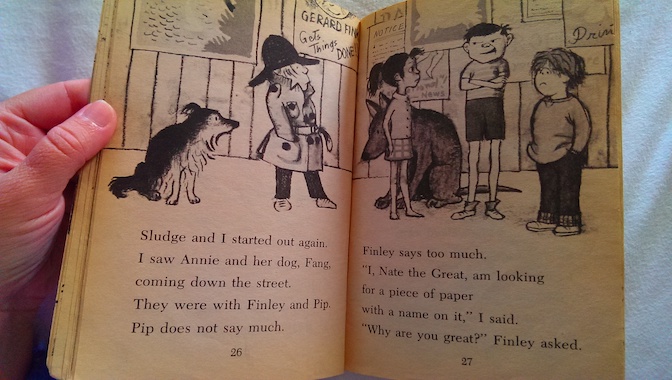
It looks like there’s still one more piece missing from the message, so he begins looking for it. One of the other boys in the neighborhood, Finley, says that he doesn’t think Nate is really as “Great” as he says he is, and he doubts that Nate will find what he’s looking for. When Finley walks away, dropping a piece of paper behind him, Nate thinks that perhaps Finley is giving him a clue.

It turns out that the paper that Finley dropped says “phony clue” on it. However, Finley’s “phony clue” turns out to be the clue that Nate needs to solve the mystery!

NatePhonyClueKids

My Reaction and Spoilers

This test of Nate the Great’s detective skills is actually a test set up by Finley and his friend, Pip, who have a bet about whether or not Nate will put all the pieces together by three o’clock.  I thought that might be the case from the beginning, but I’m not sure whether that’s because the mystery is obvious or if I helf-remembered the solution to the mystery from when I first read the book when I was a kid.

Nate the Great Goes Undercover

NateUndercover

Nate the Great Goes Undercover by Marjorie Weinman Sharmat, 1974.

Nate isn’t too fond of his next-door neighbor, Oliver. He thinks Oliver is a pest. Still, when Oliver tells Nate that someone keeps getting into his garbage cans at night, knocking them over and stealing garbage, Nate is curious.

NateUndercoverOliver

Nate recently found and adopted a dog, which he calls Sludge, and he decides to take Sludge along on the case. After interviewing a couple of girls who live in the neighborhood, Rosamond and Esmeralda, Nate comes to the conclusion that no human would ever visit Oliver’s garbage cans at night. Humans are not interested in stealing someone else’s garbage or in visiting Oliver’s house because Nate is not the only person who thinks that Oliver is a pest.

So what does that leave? Perhaps some kind of animal? But what kind? There is only one way to find out, and it’s not going to be pretty. Nate has to hide out in Oliver’s garbage at night. It’s a dirty job, but, well, you know . . .

My Reaction and Spoilers

NateUndercoverNote

I think a lot of people would see the solution to this puzzle coming. I frequently debate about how many spoilers to include in these reviews/summaries (and frequently give in to the urge to offer them), but I think Sludge’s past as a stray dog and his expressions when Nate keeps feeding him pancakes really say it all.

NateUndercoverGarbageCan

Later editions of the book also have a section of activities in the back. There is information about animals that come out at night and things to do to make baths more interesting and recipes for hamburgers and ice cream (which are among the things that Rosamond says that she would rather eat than garbage).

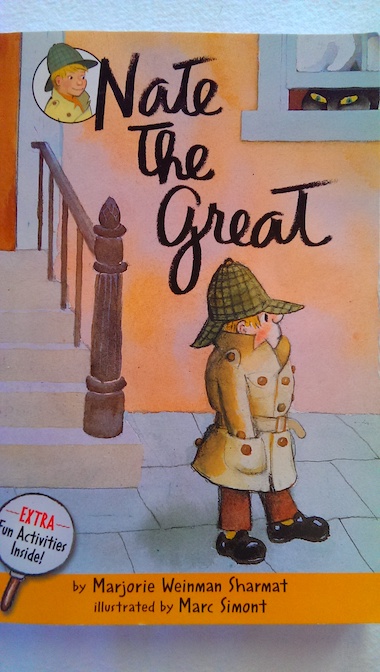
Nate the Great

NateGreat

Nate the Great by Marjorie Weinman Sharmat, 1972.

Nate is eating his favorite breakfast, pancakes, when his friend Annie calls him from her house down the street, asking for his help in finding a lost picture. When Nate arrives at Annie’s house, she says that she painted a picture of her dog, Fang, and then left it on her desk to dry, but it disappeared.

NateGreatBreakfast

After establishing that Annie’s house has no trapdoors or secret passages, Nate declares that this will be a very dull case. But, of course, he investigates anyway.

NateGreatAnnie

Nate searches Annie’s room, and not finding the picture, asks Annie who else knew about it. Annie says that she showed it to Fang, her little brother Harry, and her friend Rosamond.

NateGreatYellow

Determining that Fang didn’t bury the picture of himself and that Rosamond is only interested in cats, that just leaves Harry. But, if Harry took Annie’s picture, why did he take it and what did he do with it?

NateGreatHarry

My Reaction

This is a fun mystery for young children, one of the first mysteries that I read as a kid. The pictures in the book have clues, and it helps if kids know how to combine colors to create new ones (hint).

Later editions of the book also have a section of activities in the back. Most of them have to do with art and color, and there is also a recipe for pancakes.