The Mystery of the Creep-Show Crooks by M. V. Carey, 1985.
The Three Investigators are at the beach when Bob finds a plastic tote bag that appears to belong to a girl. Trying to figure out who the bag belongs to, the boys look through it to see if there’s some kind of identification. They find a teddy bear, a copy of People magazine, a self-help book about achieving success, some makeup, and a pair of earrings, but nothing with the owner’s name on it. When Jupiter takes a closer look at the book, he realizes that it’s a library book from the Fresno Public Library. The boys decide to contact the library, tell them that they found the book, and ask how to contact the person who checked it out. However, this simple attempt to return lost property turns into a much bigger mystery.
The librarian in Fresno gives the boys’ phone number to a frantic woman looking for her missing daughter, Lucille Anderson. Sixteen-year-old Lucille apparently ran away to Hollywood to try being an actress. Her parents are worried, the police haven’t been much help, and the boys’ inquiry about the tote bag and library book is the first lead they’ve had to Lucille’s location. Since the Three Investigators are all about solving mysteries, they immediately decide to search for Lucille themselves.
The self-help book immediately offers a few clues. The premise of the book is that anyone can become successful at whatever they want to achieve by imagining that they’re already successful. This is actually a real theory that I’ve heard of before, after a fashion. In real life, the theory is that you will also adopt the positive habits of the successful person you envision yourself to be, therefore promoting positive change in your life. (“If your habits don’t line up with your dream, then you need to either change your habits or change your dream.”) The self-help book in this story doesn’t seem to go into those details, though. Judging by the pawn tickets that Lucille has used as bookmarks, it’s not going very well for her.
Mr. and Mrs. Anderson come to Jupiter’s uncle’s salvage yard to meet the boys and collect Lucille’s bag. The Andersons bring along pictures of Lucille, and they talk to the local chief of police. There isn’t much the police can do, and runaways of Lucille’s type are unfortunately all too common. However, the police chief vouches for the boys’ reputations as amateur investigators, so the Andersons agree to let the boys try to find Lucille.
The boys’ first move is to check out all of the pawn tickets. They discover that, at each place where Lucille pawned something, she used a different name, the name of an actress who is already famous. Lucille has also been using makeup to change her appearance. The boys spot her at a pizza place, but because of her disguise, she gets away from them before they fully recognize her. They talk to some other people at the pizza place who know her under the name Arianne Ardis. At first, Lucille’s new friends are reluctant to say much about her to strangers, but the boys explain that her parents are frantic and need to know where she is. Lucille’s friends tell them where Lucille has been living.
It turns out that Lucille is being helped by a kind woman named Mrs. Fowler. Mrs. Fowler owns a large house, and she sometimes takes in teenagers like Lucille and gives them a place to stay and some work to do while they’re getting themselves established in life. Mrs. Fowler met Lucille at the hair salon where Lucille works part time. Now, Lucille is doing some house-sitting and helping Mrs. Fowler’s housekeeper while Mrs. Fowler is on a trip to Europe. Lucille says that it gives her some security and time to take acting classes and look for acting work. It’s a pretty cushy position for a teenage runaway. When the boys convince her to call her parents and bring her parents to see her, Lucille is angry and says that she doesn’t want to go back home with them because she is actually getting somewhere with her life and acting career.
Lucille tells them that she’s been offered a leading role in a new horror movie called Dracula, Mon Amour. It’s supposed to be a sequel to the classic Dracula. It sounds cheesy, and her parents are understandably skeptical. Lucille’s father doubts whether this movie offer is legitimate, and he recruits the Three Investigators again to research this film company and the movie producer to find out whether they’re even real filmmakers.
It doesn’t take the boys long to determine that the supposed producer isn’t who he claims to be. He’s assumed someone else’s identity, and when the Three Investigators meet with the real producer, he says that the phony is probably out to take advantage of this girl in some way. He says that there are some real weirdos out there and tells the boys to warn the young actress to back away from this supposed movie offer. However, when they go to tell Lucille what they’ve learned, they discover that she’s missing and may have been kidnapped! Why would phony movie producers kidnap a teenage runaway/wannabe actress? To make matters worse, the Three Investigators start to suspect that this horror movie crew might have something to do with a series of robberies committed around town by people dressed as horror movie creatures.
The book is available to borrow and read for free online through Internet Archive.
My Reaction
For part of the mystery, while the characters are pondering the real identity of the movie producers and Lucille’s whereabouts, I found myself wondering why Lucille left her tote bag of stuff on the beach. I wouldn’t have expected a teenage runaway, who has few personal possessions and probably can’t afford to replace any she loses, to be so careless with her things. At first, I wondered if this was an oversight or plot hole in the story, but it’s not. Lucille’s tote bag and its contents are key to the mystery. They’re the reason why the criminals are interested in Lucille. In a way, this story reminds me of the movie Charade with Cary Grant and Audrey Hepburn. In both stories, there is a bag full of seemingly innocent contents, but someone wants something in the bag very badly. The challenge is to figure out what they want and what its significance is.
There are also a couple of twists about the crimes being committed. The main criminals aren’t doing all of the things everyone suspects them of doing, and there is another criminal involved because there is another crime that isn’t discovered until the end.
The Mystery of the Whispering Mummy by Robert Arthur, 1965.
In the original editions of The Three Investigators, their cases were introduced by Alfred Hitchcock. Later editions of the books in the 1990s were rewritten to remove Alfred Hitchcock, but I’m using the version of this book that includes Alfred Hitchcock’s introduction for my review.
This story begins with two letters address to The Three Investigators. One of them is from an elderly woman in a wealthy area of town, who has heard about how The Three Investigators helped a friend of hers find her lost parrot in the previous book in the series. This lady would like their help to find her missing cat. Bob and Pete thinks that sounds like a simple enough case, but their other letter is from Alfred Hitchcock, so they decide to read that before committing themselves.
Alfred Hitchcock’s letter is incredible! He tells The Three Investigators about an old house that has been turned into a private museum by an archaeology professor. His museum has relics from his archaeological digs in Egypt. Recently, a mummy has arrived at his museum from a museum in Egypt. Professor Yarbrough was the one who originally discovered that particular mummy, but since it arrived at his museum, he has noticed a bizarre phenomenon. The mummy seems to whisper! Professor Yarbrough can’t figure out how the mummy can whisper, but it seems like the mummy is trying to tell him something important. Professor Yarbrough has consulted with a friend, Professor Freeman, who is a language expert, but the mummy only seems to talk when Professor Yarbrough is alone. Knowing how crazy this predicament sounds and what his other colleagues would say if he told them, Professor Yarbrough decides to tell his friend Alfred Hitchcock instead. That is why Alfred Hitchcock decides to tell The Three Investigators and see what they make of it.
Bob and Pete think that the mummy mystery sounds exciting but creepy. Since Jupiter is away on an errand, they decide that they would rather try to find the missing cat first. However, when Jupiter returns, he already knows about their prospective cases, and as predicted, he can’t wait to investigate the mummy. At first, Professor Yarbrough doesn’t have much confidence in the boys because they’re younger than he expected, but Jupiter persuades him to let them try. The professor’s butler, Wilkins, is very nervous and tells the boys that there is a curse on the mummy. Strange things are happening that make Wilkins think that the professor is in danger from the curse. The boys are there when a large statue in the professor’s museum suddenly falls over, almost striking the professor. Wilkins would rather send the mummy back to Egypt, but the professor doesn’t believe in curses. In spite of the talking mummy, the professor is sure that there must be a logical, scientific explanation for everything.
Jupiter also believes in scientific solutions, and his first theory about the whispering is that it’s being transmitted electronically, but they can’t find any electronics on or around the mummy. His next idea is to capture some of the mummy’s speech on a recording, which is successful. Professor Freeman says that the mummy seems to be speaking a form of ancient Arabic.
Then, Wilkins sees someone walking around in a jackal costume. Someone steals the mummy, and strangely, comes back a second time to steal the mummy case. Even the missing cat puts in an appearance.
Who wants the professor to think that the mummy is whispering and believe that it’s cursed? Who wants the mummy case, and why is that case even more important to the thief than the mummy itself?
The book is available to borrow and read for free online through Internet Archive (multiple copies).
My Reaction
From the beginning of the book, I had a couple of theories about who could be responsible for the mummy’s whispering and “curse”, but I was only partially correct. There are different people involved, doing different things and for different reasons. The main villain is one of the people I suspected, but I didn’t know this person’s motive until it became clear that the mummy case is what they really want. The missing cat is part of the mystery, but don’t worry, the cat is fine and being cared for!
This is the novel that the live action Disney film Blackbeard’s Ghost from 1968 was based on. My copy is a later edition designed as a tie-in with the Disney movie, based on the cover, but it contains the text of the original story.
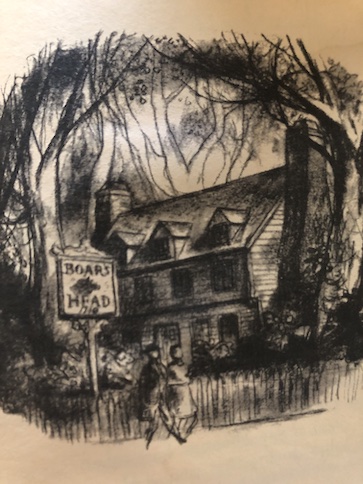
The story begins with a prologue that explains how Blackbeard the pirate evaded execution for piracy by offering to collect tolls from ships on behalf of the colonial governor, Governor Eden, in the town of Godolphin. However, instead of collecting tolls from the ships, he decided to use his position for his own benefit. Knowing that he would eventually need a source of stability on land instead of spending the rest of his life at sea, he looted wood from various ships and used it to build a tavern for himself called the Boar’s Head. He hired a woman rumored to be a witch, Aldetha, to tend the tavern for him. In the end, though, Blackbeard was killed by someone who wanted to collect the bounty on him for piracy. After his death, the poor woman who tended his tavern was burned at the stake for witchcraft.
(Note: The witch burning is historical inaccuracy because no witchcraft executions in North America involved burning, at least not in English-controlled parts of the American colonies. Accused witches in North America were typically hanged. None of this story is meant to be historically accurate, but I always feel compelled to point that out in stories that make that mistake. The town of Godolphin and the Boar’s Head Tavern are fictional. In real life, Blackbeard did receive a pardon from the real Governor Eden in Bath, North Carolina, and he was eventually killed in 1718 in a battle with Lieutenant Robert Maynard and his crew, as he did in this story. However, in the book, the tavern is now owned by a descendant of Maynard’s, and in real life, Maynard didn’t have any children.)
Most of the story takes place in the 20th century, when two 14-year-old boys, J.D. and Hank, talk about how the old Boar’s Head Tavern is about to be torn down because the former owner sold it, and there’s going to be a gas station built on the land instead. They think it’s a shame because they’ve heard ghost stories about the place and think the old tavern is fascinating. The boys go to watch the workmen tearing down the old tavern, but the workmen haven’t made any progress so far. Although they’d love to loot some of the expensive woods from the old tavern, they just can’t seem to dismantle the building. They’ve been able to dismantle some of the newer additions to the building, but somehow, they can’t seem to touch the original structure. The site has been plagued with mysterious accidents. Their equipment fails, heads fall off the ends of their hammers, and workmen keep getting injured in small accidents, not enough to seriously hurt anyone but enough to keep them away from their work for days at a time.
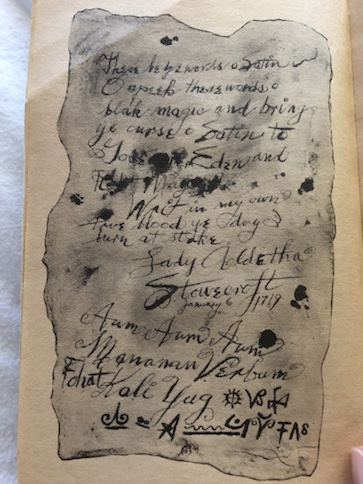
When J.D. and Hank see the workmen leaving the building in frustration soon after arriving, they decide to go inside and look around to satisfy their curiosity and see if there’s anything of value that they can salvage before the tavern is demolished. They don’t find much of value, but they do find their way into Blackbeard’s secret dungeon under the tavern. There, they find a piece of old parchment with a satanic curse written by Aldetha. (So, apparently, people were actually right about her being a witch. Plot twist!) Inspired by this creepy message from the past, the boys realize that they can make money from other kids by capitalizing on the ghost stories about the old tavern and holding seances to contact the spirits. They don’t really believe that seances are real, but they figure that, if they can get enough ghost-story fans to come to their seances, they can make a profit from this enterprise.
Of course, the boys’ seance awakens the ghost of Blackbeard. Blackbeard is invisible to everyone except for the boys, but he’s a solid ghost, who can manipulate physical objects. The boys quickly realize that Blackbeard can be a dangerous ghost, and he’s not at all happy when he finds out that a descendant of the man who killed him wants to have his tavern torn down.
The book is available to borrow and read for free online through Internet Archive. The Disney movie is available to buy or rent through YouTube or Amazon Prime. There is also a sequel to this book called The Secret of Red Skull, which involves spies and is also available online through Internet Archive.
My Reaction and Spoilers
There is some humor in this book because only the boys are able to see and hear Blackbeard, but by the end of the story, adults become aware of Blackbeard’s ghost, too. The boys’ history teacher is helpful in finding a way to appease the ghost by helping him to negotiate to buy back his tavern using his hidden treasure. When it becomes obvious both to Maynard and the company he tried to sell the tavern to that it’s haunted, they’re willing to accept pirate gold in exchange. The company also sees that it can use the building for public relations purposes by sponsoring a pirate museum in the old tavern. It’s good news for the teacher, too, because he gets to be the director of the museum. There, he can show off his collection of pirate memorabilia and indulge his love of pirate history. The tavern continues to be haunted by the ghosts of Blackbeard and his witch friend, leaving the story open for the sequel.
As expected of Disney films, the Disney movie version of the story is quite different from the book. In the movie, the person who can see the ghost is a college track coach who is staying in the old inn, which is still being operated by elderly descendants of Blackbeard’s old crew. There is a track meet in the movie that never appeared in the book, and at the end of the movie, Blackbeard disappears, having been freed from his haunting by performing a good deed.
I prefer the concept of the boys being the ones who accidentally summoned Blackbeard’s ghost, but the boys got on my nerves at first. In the early part of the book, they bickered a lot and didn’t seem to like each other enough to be best friends, although they seemed to be friendlier with each other later, when they were both trying to figure out what to do about Blackbeard. I think the teacher character was my favorite. He takes the matter of the ghost in stride, coming up with a practical solution that helps everyone.
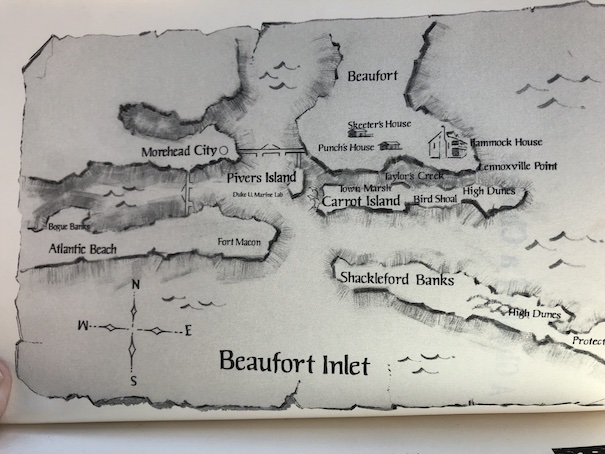
Punch (real name Philip) Wagner and his family are spending the summer by the sea in North Carolina, and his parents have let his friend Tom Ellis come with them. The 12-year-old boys are looking forward to exploring the area by themselves, but Punch’s father has arranged for the son of a friend of his to be their guide. At first, Punch isn’t thrilled about his father arranging for them to be led around by a boy they don’t know. Punch’s father has a very different personality from Punch. His father is a professor, very academic, so Punch doesn’t feel like he can take his father’s word that they’ll get along with this new boy. Punch and Tom particularly wanted their independence and a chance to make some plans of their own.
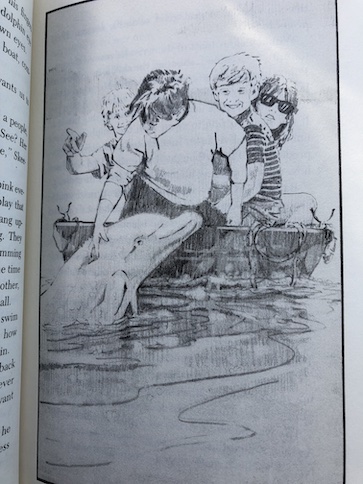
However, Punch is surprised to discover that his father’s old friend is a laid-back, jovial man who calls his father “old crawdad.” His son, Skeeter Grace, is a little younger than Punch and Tom, which makes Punch even less enthusiastic about having him as a guide. Skeeter Grace doesn’t seem to be any more excited about hanging out with Punch and Tom as they are with him, but the adults suggest that Skeeter take the other boys for a boat ride. Punch’s pretty older sister, Lila, says that she’d like to go with them. Punch warms up to Skeeter when he finds out that he participates in dolphin watches run by Duke University because he loves dolphins, although he considers Skeeter a bit of a know-it-all.
When Punch tries to ask Skeeter if he plans to work with the dolphin researchers when he grows up, Skeeter becomes oddly touchy. Punch mentions it to his father, and his father explains that nobody in Skeeter’s family has been to college before. His father is a carpenter, and it isn’t expected that Skeeter will attend college, either. Punch’s father points out that it must be difficult for Skeeter to want something that he doubts he’ll ever be able to get.
Punch is particularly interested in an old house nearby where Blackbeard once lived. He tries to persuade Skeeter to come with him and Tom to check it out, but Skeeter warns them not to go there. For one thing, that house is owned by somebody who wouldn’t like them trespassing, and for another, Skeeter is firmly convinced that the house is haunted by the ghost of Blackbeard. Lila says she doesn’t know why the boys are so interested in Blackbeard because he was a horrible person who killed people and “used women” (no details given, but you get the idea). Punch’s main interest is the stories about Blackbeard’s hidden treasure. He wants to be the one to find it.
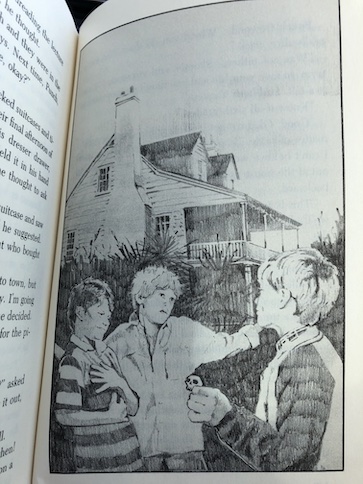
The boys go by Blackbeard’s old house, now called Hammock House, and they’re started by the sound of something hitting the roof and dropping down to the ground. When Punch picks up the small object, he discovers that it’s a small plastic skull with glittering red eyes. It’s startling, but it doesn’t seem likely that a real pirate ghost would toss them a plastic skull. Tom thinks maybe it’s some kind of warning, but Punch thinks that Skeeter probably tossed the little toy skull in the air when they weren’t looking, just to scare them.
Punch eventually persuades Skeeter to help him and Tom search for the treasure by pointing out to him that he would be able to afford college if they found Blackbeard’s treasure. He sees how badly Skeeter wants to go to college when Skeeter jumps on the project, bringing along a metal detector and helping the other boys dig and do research. At first, Punch just thought of the project as a fun summer adventure, but when he realizes what a big difference it would make to Skeeter to really find the treasure, the hunt becomes much more serious. Punch knows that searching for the treasure is a long shot, and it would be disappointing if they never found anything. Since it will be several more years before Skeeter will be old enough for college, they don’t have to succeed this summer, and the boys discuss making it an annual project every summer.
To make the most of this summer, they want to spend some time camping out and searching for treasure. Punch’s mother is reluctant to let the boys do that until Lila says that she’ll go with them. Lila knows that the boys are searching for treasure, and she encourages them to get into the mindset of being pirates as much as possible.
While the boys are using a metal detector, they find an old metal box. The contents don’t look like pirate treasure, but they appear to be someone’s treasure. There’s an old Bible, some jewelry, and a couple of tarnished silver baby spoons. On one hand, the boys are pleased to have found something, but on the other, it’s not as grand as what they had hoped to find. Lila says that the jewelry could be valuable, and the boys think that the local historical society might be interested in the old Bible. Skeeter explains that there used to be an old whaling community in the area they’re searching, but it was often damaged by storms. He says people sometimes buried valuables, knowing that their homes could be damaged or destroyed by storms. He figures that the owner of this particular box could have been killed in one of the storms, which is why he never returned for his box. They find some other boxes that appear to have been lost in a shipwreck, including one with spices and one with bottles of alcohol, but none of them are what they’re really looking for.
More and more, Punch becomes convinced that the only place where they should be looking for Blackbeard’s treasure is around his old house. He finally persuades Tom and Skeeter to come with him and have a look.
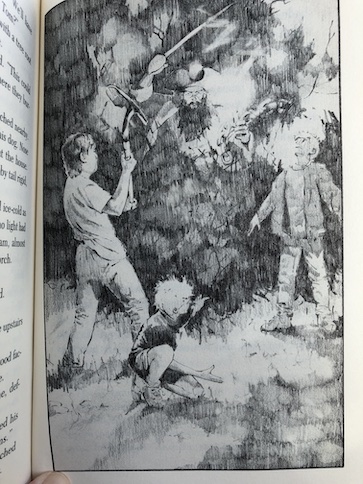
However, the house doesn’t seem as empty as the boys assumed it would be. Punch’s dog seems afraid of the house, and they still don’t know where the little plastic skull came from. Then, the boys hear a frightening scream, like the screams of a girl who was supposedly murdered by Blackbeard years ago. Is the house really haunted?
My Reaction and Spoilers
For most of the book, the boys are doing things like watching the dolphins, camping out, and digging for treasure in various places. The question of whether or not Blackbeard’s old house is haunted is the main mystery of the story, but the story doesn’t really become about that until almost the end of the book. Punch has the little skull to puzzle over before that, but it isn’t until the boys return to Hammock House to look for buried treasure that they become truly concerned with the ghosts that seem to be haunting the place.
There is a logical explanation behind the hauntings, at least some of them, making this the kind of Scooby-Doo Pseudo-Ghost Story that I always liked as a kid. In a way, this story is also a kind of MacGuffin story. It’s not so much what the kids find as the adventures that they have during the search that are important. The boys’ fathers understand because they later confess that they also hunted for Blackbeard’s treasure when they were young. It seems that, even though Punch thinks of his professorial father as being very different from him, when he was young, he was much the same sort of boy that Punch is now. Skeeter’s dreams of studying marine biology also do not depend on finding Blackbeard’s treasure. When his father finds out that’s what Skeeter really wants to do, he’s supportive, and Punch’s father, as a professor, offers some useful advice about scholarships.
There is some alcohol use in the book. There is a part of the story where the boys find a box with old liquor bottles and drink the contents, pretending like they’re pirates drinking rum. The boys get drunk and make themselves sick, and when Lila catches them, she lectures them about how they could have died. My first thought was that only an idiot drinks from random bottles that they just find. Even though they thought they were probably whiskey bottles, “probably” doesn’t seem good enough to just start drinking it. Also, Lila is right that they could have killed themselves from drinking too much. It is possible to die from alcohol poisoning by drinking way too much liquor of any kind all in one sitting, as kids they would be hit much harder than full-sized adults, and not having any prior experience with alcohol, they have no sense of their own limits. I’ve heard of college parties where people have died from alcohol overdose because they were new to drinking, didn’t know when they were going too far, and were in an environment where people were encouraging drinking to excess rather than learning restraint. What I’m saying is that the boys were in real danger because they were too young and inexperienced to understand the danger they were in. Fortunately, the boys learn their lesson without any lasting harm, and making themselves sick means that they’re unlikely to make the same mistake again.
The Secret of Skeleton Island by Robert Arthur, 1966.
In the original editions of The Three Investigators, their cases were introduced by Alfred Hitchcock. Later editions of the books were rewritten to remove Alfred Hitchcock, but I’m using the version of this book that includes Alfred Hitchcock for my review.
At the beginning of the story, Alfred Hitchcock himself brings the boys a new mystery and an acting job. Of the three boys, only Jupiter has done any acting before. However, Alfred Hitchcock knows that Pete’s father is a movie technician and that he’s working on a new suspense film. When Hitchcock speaks to the boys, Pete’s father is helping to restore an old amusement park on an island off the southeast coast of the United States that will be used in the movie. The name of the island is Skeleton Island because it’s shaped like a skull, and other formations around it look like part of a skeleton. It was once a place where pirates hid out. Sometimes, people still find buried bones there, and the island is supposedly haunted. The problem is that someone has been stealing equipment from the movie company and sabotaging their boats. Hitchcock wants the boys to discover who is behind the theft and sabotage. As their cover for the investigation, the boys can take part in a short film being shot at the same location, about a group of boys searching for pirate treasure.
When the boys arrive at Skeleton Island, they hear about the Phantom of the Merry-Go-Round. Supposedly, years before, there was a girl who was riding the merry-go-round at the amusement park when there was a terrible storm. The girl, Sally, refused to get off the merry-go-round with everyone else, and she was killed when the merry-go-round was struck by lightning. Since then, the merry-go-round supposedly runs by itself, and Sally’s ghost rides it. The amusement park has been abandoned for years, but people still report seeing Sally’s ghost and the running merry-go-round.
The man who was supposed to bring the boys to the island, Sam, maroons them in the wrong place at night during a storm. They are rescued by Chris, a young diver who originally came from Greece, who was hoping to get work in the movie industry and is currently looking for treasure because he needs money to help his father. He says that he has sailed the area many times in his boat, and he tells the boys the legend of the pirate who was executed there, Captain One Ear. Nobody was able to find his treasure, and he went to his execution saying that Davy Jones had it. People have believed that the treasure is lost at sea, dumped overboard by Captain One Ear, and occasionally, a gold doubloon washes up on shore on the island, which seems to indicate that’s what happened. (ch 3)
As the boys approach the island with Chris, they see what looks like the lights of the merry-go-round with a pale figure among the horses. It looks like a girl in a white dress, and they hear the music of the merry-go-round. The Three Investigators want to go see the ghost and investigate, but Chris refuses. Instead, he takes the boys to the boarding house in town.
When the boys tell Pete’s father and the other movie people about their night’s adventures, they learn that Sam is known as a local prankster and troublemaker, and he’s been in trouble with the law before. Could he be behind the thefts, sabotage, and apparent hauntings? Some people suspect Chris because he’s a foreigner, local people don’t trust outsiders, and everyone knows that Chris needs money for his father, who has health problems. Maybe he could be stealing from the movie company to get money. On the other hand, the movie people are suspicious of some of the local fishermen. Some of the local people suspect that the movie people are secretly looking for pirate treasure instead of making a movie. Then, the boys learn about a robbery that took place in the area years before and are told that the robbers have recently been released from prison. It seems like there’s no end of suspicious people!
The Three Investigators think that the culprit behind everything is someone who was to drive away the movie company and keep people off the island. Who could that be, and what is there on the island that someone wants to protect?
The book is available to borrow and read for free online through Internet Archive (multiple copies).
My Reaction
I enjoyed this book because of its abundance of suspects! I kept changing my mind about what was really happening and who was behind it. Because there were several mysterious things happening at once – lost pirate treasure, ghost at a haunted amusement park, sabotage of the movie crew, old robbery with the money never found and the robbers recently released from prison, and suspicious locals suffering from a failing local economy – it occurred to me that there might even be multiple plots being staged by multiple people. There is one main scheme, and it is the one that I thought would be most likely, but there’s plenty of adventure and plot twists along the way. In the end, things are wrapped up neatly without any hanging plot threads.
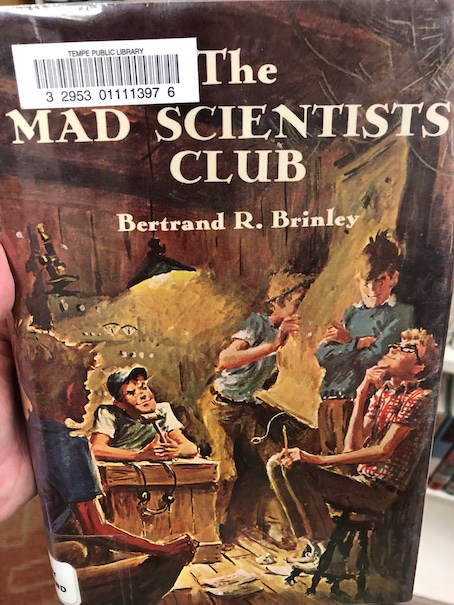
The Mad Scientists Club by Bertrand R. Brinley, 1965, 2001.
TheMad Scientists Club series is about a group of boys who like science and make things in their clubhouse laboratory. Their inventions are often part of pranks that they play on their town, Mammoth Falls, but the boys also use their inventions and skills to help people. People in town are aware that the boys pull pranks and stunts, but they are often unable to prove the boys’ involvement in particular pranks, and the boys typically keep the methods they use secret.
Henry is the idea man of the group, and the club’s rival is a former member named Harmon. Harmon’s cousin is still a member of the Mad Scientists Club, and Harmon likes to spy on them and pump his cousin for information so he can mess up their plans out of spite.
Each chapter in the book is its own short story about the club’s antics. Some of the stories originally appeared in Boys’ Life magazine in the 1960s. The stories are a good fit for Boys’ Life because some of the skills the boys use are skills that are taught in Boy Scouts, like what to do when someone is injured and how to tie different types of knots.
The stories reference scientific and mathematical principles, and the boys are methodical in their approaches to the problems in each story. The technology is old by modern 21st century standards (and so are some cultural references, like McGee’s closet), but the principles are sound. There are no projects for readers to do themselves in the book, but it does occur to me that these types of stories could work well with some included activities or nonfiction accompaniment.
The first story in the book was made into a live action tv movie by Disney, The Strange Monster of Strawberry Cove (1971), but the movie has different characters from the ones in the book. The Disney movie uses the same set of characters they used for their movie version of Secrets of the Pirates’ Inn (based on The Secrets of the Pirate Inn). The plot of The Strange Monster of Strawberry Cove is also very different from the original story because, in the Disney movie, the kids don’t know what the “monster” is at first and need to investigate it, whereas the boys in the Mad Scientist Club know exactly what the monster is in their story because they built it themselves. You can watch the movie online through Internet Archive, but unfortunately, I couldn’t find an online copy of the book.
Stories in the Book:
The Strange Sea Monster of Strawberry Lake
Dinky accidentally starts a town-wide rumor about a sea monster in the lake when he makes up a story about seeing a strange creature in the lake when he needs an excuse for arriving home late. His friends know it’s just a story, but they decide to play along and build a monster of their own out of canvas and chicken wire and scare people as a prank. Even though people in town are scared of the monster, the attention the town receives is so good for local businesses, the boys can’t bring themselves to stop their prank. Instead, they decide to make their monster more elaborate, and things start to get out of hand. How can they end the hoax while saving the town’s image and avoiding punishment?
Night Rescue
An Air Force plane explodes near the town of Mammoth Falls. The pilot escaped from the plane, but he’s now lost in the woods. The local authorities are searching for him, and the boys in the club want to help. The mayor doesn’t want the kids involved, knowing their usual pranks and stunts, but the Air Force colonel is willing to let them help, if they think they can, because he just wants his pilot rescued. The boys use a flare to determine which way the parachuting pilot would have drifted, and then, they calculate about how far he would have drifted to find him.
The Unidentified Flying Man of Mammoth Falls
The boys find an old department store manikin and keep it in their clubhouse until Henry gets the idea for how they can use it in an elaborate prank on the town’s Founder’s Day. They’re going to make the manikin fly!
The Secret of the Old Cannon
The town’s old cannon from the Civil War is a local landmark now. (We don’t know what state Mammoth falls is in, but there are statues of Confederate soldiers next to the cannon.) Years ago, the town filled the barrel with cement, so it can never fire again. Around the time that the cannon was filled in, there was a bank robbery in town, and some of the boys in the Mad Scientists Club think that the money might have been hidden in the cannon before it was filled with cement. The boys try to figure out how they can prove whether or not the money’s in there without removing all of the cement. Someone else also wants to know the answer to that, and the answer may be important to the upcoming race for mayor.
The Great Gas Bag Race
Henry has an idea for a new kind of balloon that he thinks will help the Mad Scientists Club win the balloon race, but the club’s rival, Harmon, is also entering the race.
The Big Egg
The boys are digging for fossils in the local quarry when they find a dinosaur egg! At first, they’re not quite sure what to do with it. They consider selling admission for people to come see it or maybe turning it over to a museum, but Henry announces that he has another idea. Henry wants to bury the egg in the ground and see if it hatches. It seems unlikely, but the other boys agree to try it. Then, when a couple of the boys go to check on the egg, they discover that it’s missing! They bring their friends back to look at it, and suddenly, the egg is there again! What’s going on? Did someone take the egg and then return it? Is this another one of Harmon’s tricks?
The Voice in the Chimney
One day, some of the boys in the club see Harmon throwing stones at an old, abandoned house in town while some girls watch him. Wondering what he’s doing, they get closer and hear him challenging the ghost that supposedly haunts the old house, trying to impress the girls with his bravery. The boys are disgusted because they know Harmon isn’t really that brave, and they hate seeing him show off for the girls. When they hear Harmon brag that he’s going to come back to the house at night, they tell the rest of their club, and the boys decide to put on a haunted house act of their own to scare Harmon. In the process, they also end up scaring the mayor and the chief of police!
Mystery of the Inca Cave by Lilla M. Waltch, 1968.
Thirteen-year-old Richard Granville has been living in Peru for the last two years. His family moved from California to a mining town in the Andes because his father is a manager for a mining company. Richard enjoys living in Peru because he’s developed an interest in archaeology and the history of the Incan civilization. Richard feels like the mountains are a connection to the distant past, and he loves the historical feel of the place. His parents don’t understand how he feels and would rather see him work harder at his schoolwork instead of spending all of his time exploring the mountains. Richard’s father tells him that he won’t become an archaeologist if he doesn’t apply himself to his studies, and his mother worries that something could happen to him in the mountains. They think he should finish school first and then decide if he wants to go into archaeology or not, but Richard’s mind is already made up, and he doesn’t want to waste this golden opportunity to do what he loves most right now. Richard feels hurt that his parents don’t really listen to him, don’t share his interests, and don’t appreciate the finds he’s already made.
Richard loves to explore the area with his friend, Todd Reilly, and see if they can find pieces of Incan relics. They’ve found some interesting bits of pottery and broken tools, but one day, they make a particularly exciting discovery – an ancient stone road mostly covered with grass. Although Richard knows that there are many other remains of Incan roads, this one is particularly tantalizing because it seems more hidden than most. Richard is fascinated with how neatly the stones of the road fit together so precisely without mortar, and he wonders where the road leads.
The boys explore the old road further, but they discover that at least part of the road was buried in a landslide. Todd doubts that they’ll ever be able to find where the road leads, but Richard wants to keep trying. When they return to the spot to try again, Richard spots the remains of an ancient building! Richard is sure that the building was once a chasqui station (also called tambos), which was a place where Incan messengers could stop, rest, and trade off with other messengers, who would continue to carry messages along the route, like the members of the Pony Express used to trade off with each other. Richard knows that stations like that were placed about 2.5 miles apart along roads, so there might be other stations located along this route.
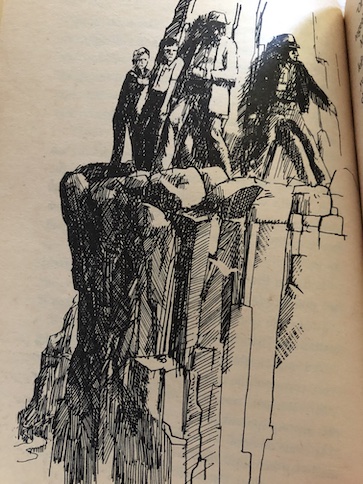
The boys go a little further and find a stairway leading up the side of a cliff to a cave. On the stairs, Richard finds a small doll. The doll is puzzling because Richard isn’t sure if it’s an Incan relic that somehow managed to survive or if it’s a more modern doll made by the South American Indians in the area. He has trouble believing that any more modern person could have been at this spot recently because it’s pretty isolated and rough territory. It looks like other landslides could happen. He can’t tell his parents about his discovery because they probably wouldn’t let him return to the area to explore it further if they knew how dangerous it was, and he can’t bring himself to abandon the most exciting discovery he’s ever made.
On a trip to the marketplace, Richard and Todd spot a mine foreman, Jeb Harbison, yelling at a boy in Quechua. He stops as soon as he sees the other boys watching, and they wonder what that was about. Then, the boys spot a merchant selling dolls that are similar to the one they found at the ruins. They ask the merchant where the dolls came from and who made them, and he gives them the name of the doll maker, a woman named Deza. Todd thinks that the most likely explanation for the doll they found is that some young girl living in the area got a doll from the same doll maker, and she lost it while playing around the cave. However, Richard doesn’t think that’s likely because the cave is such an out-of-the-way place, not somewhere a young child could easily reach alone.
On another visit to the area of their discovery, the boys find a mine shaft that doesn’t belong to the company their fathers work for, even though it’s on land that they know the company owns. There are signs that someone is actively mining there, but who?
The boys also discover that the activity at the cave is connected to the mine when they see some men there, breaking up rocks and stuffing them inside of little dolls, like the one they found earlier. It seems like the miners are smuggling gold or other minerals in the dolls, but when the boys talk to Richard’s dad about what they’ve seen, the situation points to a possibly larger conspiracy.
The book is available to borrow and read for free online through Internet Archive. The book was originally titled Cave of the Incas.
My Reaction
The first thing that I liked about this book was the pieces of information about the ancient Incas. Our knowledge of ancient civilizations has increased since the 1960s, but the information in this book is still good. I liked the book’s descriptions of Inca building techniques, how they used closely-fitted stones instead of mortar, and how their system of messengers was organized. There are also points where the characters notice parallels between the way the ancient Incas lived and the way their descendants live, such as their system of cooperative farming.
However, this story is also about human relationships as well as adventure, mystery, and ancient civilizations. Through most of the book, Richard is troubled about his relationship with his parents, especially his father. His parents are frustrated with him because he is absorbed by his interest in archaeology and exploring the countryside and isn’t applying himself to his schoolwork. At the same time, Richard hates it that his parents don’t understand what interests him and only seem to want him to focus on what they want. They’re having a clash of priorities.
When I was a kid, I hated homework with a vengeance. That might be a surprising revelation about an adult who willingly does what are essentially book reports on a regular basis as a hobby. Reading is fun. Research produces interesting information. I like knowing things and writing to other people about them. Basically, I was always good at the skills necessary for homework, so that wasn’t the problem. The problem is that there were many other things I wanted to do, and homework got in the way. I didn’t always get to read about what I wanted to read about in school because someone else was always choosing the school material for me, and I frequently hated their choices. Even the arts and crafts weren’t always the ones I wanted to learn, and I was usually told what to make instead of getting to make what I wanted. Because I was a good student, I ended up in the honors classes, so I always had more homework to do than everyone else. I was proud that I was a good student, but at the same time, I also hated it because I found it stifling. I’ve always been interested in many different subjects and handicrafts, but all through my childhood, I felt like I could never just take up all the different projects I wanted to do because I had to do my never-ending supply of homework first. Everything I wanted to do always had to wait. Even after I graduated, it was difficult for me to shake off the feeling that I had to wait on things I wanted to do , which was also kind of irritating.
I could sympathize with Richard’s attitude toward his own studies. He knows what he really wants to do, and he finds it infuriating that his parents want him to put it off and finish his homework and his education first. There is something to be said for making the most of finding himself in the very place he wants to be with direct access to what he knows he wants to study seriously. The move to Peru was an enriching experience for Richard that gave him a direction and life ambition, and I think he would regret it forever if he didn’t use this opportunity to explore it as much as possible. At the same time, though, my adult self knows that there is truth to what Richard’s parents say about his explorations in the mountains. The mountains are dangerous, like Richard’s mother says, and even Richard knows it. Also, Richard’s father is correct that if Richard seriously wants to be a professional archaeologist, he’s going to have to finish his education.
Nobody in modern times becomes a serious, professional archaeologist without a college degree, and even archaeologists need to study things beyond their specialist field. Archaeology isn’t just wandering around, digging, and seeing what you find. You have to recognize what you find, study its context, understand its significance, and know how to treat it to preserve it. You can’t study past lives and interpret artifacts without having real life and world knowledge. Archaeology is also where science and history intersect. Archaeologists need to know mathematics, geology, and how humans are affected by climate (which can and does change over time, for various reasons) and access to resources. There are legal and ethical principles to archaeology that Richard will also have to understand. Archaeologists can also benefit from learning drawing and photography to record and interpret finds and perfecting their writing skills to present their findings to the world. Richard has made a good start in his field of interest, but to get serious about it, he will need more education and greater depth and breadth of knowledge.
As annoying and stifling as homework feels, the skills it imparts are necessary for doing many more interesting things. Getting through the studying phase can be a pain, but sometimes, you really have to lay a solid foundation before you can build something solid on it. I still think that my past school assignments could have been more interesting and less stressful if I’d had more flexibility about them and more time for personal projects in between. However, I have realized over the years that, once you’ve really learned something, you will use it, even if you only use it indirectly as part of something else. I don’t regret learning the things I learned because, as hard as it was along the way, I have used things I learned in more interesting ways later in life. I’ve also realized that, if I had spent less time and emotions complaining about how stifling my homework situations were, I also could have used the time I spent lamenting about homework and procrastinating about it to accomplish some of the other things that I complained that I never had enough time to do. Not all of them, but more than I did when I was too busy being upset and resentful about homework. That’s also a lesson that Richard learns in the story.
At one point, Richard talks to Todd about his relationship with his own father, and Todd says that they get along pretty well. Richard realizes that Todd and his father don’t fight over his studies because Todd is an easy-going type who doesn’t mind doing his homework much and takes care of things without making anybody nag him to do it. Todd just accepts that there are some things that just need to be done, so he doesn’t waste time complaining or procrastinating about them. That’s harder for Richard because he feels the strong pull of what he really wants to do.
Todd admits that he and his parents don’t always get along perfectly because he doesn’t always do what he’s supposed to do. There are times when he leaves messes or physically fights with his brother or talks back to his mother, and his parents get angry or irritated about it. When Richard asks Todd what he does in those instances, Todd says that, eventually, after the initial argument, he typically apologizes or cleans up his mess or does whatever he needs to do to fix the situation. Todd’s reasoning is that, while people aren’t perfect and don’t always do what they should, “when you’re wrong, you’re wrong.” He accepts that, sometimes, he screws up and needs to do something to fix it without getting too overwrought about having been in the wrong. He sees it as just a normal part of life. When it happens, he can correct himself and move past it.
In the case of Richard and his father, each of them has to admit to being a little wrong and accept that the other is partly right. Both of them have to do some work to fix their relationship. Richard has to admit to his father that he does need to continue his education and apply himself to getting his work done. In return, his father needs to try harder to understand Richard’s interest in archaeology and allow him some time and opportunities to make the most of his time in Peru, getting the firsthand knowledge and experience he needs for the future he really wants and that won’t come from the standard classes he’s taking.
Through their adventures in the course of the story, Richard and his father come to a better understanding of each other and have an honest conversation about how to manage the conflicts in their relationship. Richard’s father admits that he needs to stop looking at his son as being just a younger version of himself and to see Richard for the independent person he is, with his own interests and goals in life. Meanwhile, Richard connects somewhat to his father’s interests through their investigation of the illegal mining operation he and Todd discovered.
This mystery story is a little unusual for children’s books, where kids often investigate mysteries on their own, having adventures without the adults, because Richard’s father joins the boys in their investigations and he stands up for them and what they’ve discovered when their discovery is challenged. The shared adventure becomes a bonding experience for Richard and his dad. At the end of the story, Richard’s father helps Richard connect with a museum curator, who helps the whole family to see the true value and significance of Richard’s archaeological finds. The curator also emphasizes to Richard that, while he has the potential to excel in his chosen field, he’s going to have to study and move on to higher education to get where he wants to go. Richard agrees, now having a greater understanding of its importance and satisfied that his parents understand the direction he’s chosen for his life.
The story takes place during the 1920s. (It doesn’t actually give a date, but it references the early days of radio and silent movies, which helps place it.) Bruce Crowell meets the new kid in the neighborhood, Bill Slocum, shortly before Halloween. Bruce is afraid of Bill at first because he’s big and has a mean look. Bill does turn out to be a bully, picking on him and shoving him into mud puddles as they walk home from school. Then, one day, Bruce fights back and gives Bill a black eye. Bruce expects that Bill will be mad, but when he points out that Bill didn’t have to shove him into a puddle, Bill says that he guesses that they’re even now, and the two of them end up becoming friends.
Bruce and Bill spend a lot of their time playing outside with other neighborhood kids, and they start making plans for Halloween. During the 1920s, kids mainly celebrated Halloween with pranks. Even though Bill isn’t very good in school, he likes to read nonfiction books, and he starts reading folklore about ghosts. Bruce is more into fiction, and he starts reading books of ghost stories. Bill is really into hard facts and doesn’t believe in ghosts. His reading about ghosts is because he wants to figure out why people would believe in something so silly. He reads about how people have faked ghosts before, and he comments that he wishes that there was a haunted house nearby so he could do some research.
Bruce tells Bill about a house in a richer neighborhood that’s supposedly haunted. Bruce has seen the house before with another boy named Virgil. Virgil’s father says that there was a story about a dead baby being chopped up and buried in the garden of the house or something. Bruce isn’t completely clear about the details, but he says that the house has been boarded up for years because there’s some kind of long-standing dispute about who owns the property. Bill asks Bruce what he saw when he and Virgil went to the house, but Bruce says that they didn’t see much because the house is surrounded by a high wall, and they couldn’t get past the gates. It’s impossible to climb over the wall because there’s broken glass on top that’s cemented in place to stop people from getting in.
When it looks like it’s going to rain on Halloween, Bill suggests that they go check out the haunted house instead of running around the neighborhood, playing pranks. Bruce is reluctant, but Bill talks him into it. They have trouble finding the house at first, and they stop to ask a mailman where it is. The mailman gives them directions, amused that the boys are looking for a scare on Halloween. Bruce doubts that they’ll be able to get near the house because of the wall around it, but Bill discovers that there’s a door in the wall that’s unlocked.
Inside the wall, they find a messy, overgrown garden. The house itself is three stories tall and badly damaged on one side from a fire. In the garden, the boys meet another boy, Jamie Bly, who says that he also snuck onto the property. Jamie has his dog with him, and he says that he’s not scared of the ghosts in the house, daring the other boys to come inside with him.
Inside, the boys have a frightening encounter with the half-blind caretaker of the house, who menaces them with a broken axe handle. The boys run outside again, and Jamie says that the old caretaker wouldn’t really hurt them. Jamie says that he comes there from time to time to spook him because he thinks it’s funny. The caretaker knows it’s him because he calls him by name when he chases him. Jamie says that the caretaker won’t be there much longer, though, because the house is going to be torn down soon, and if the other boys want to see some real ghosts, they should come to his house later that night.
Jamie claims that he lives in a real haunted house. The other boys don’t believe him, and at first, they don’t want to show up to meet Jamie that night because they think he’s really annoying. However, their curiosity gets the better of them, and they decide to show up and see whatever Jamie has to show them. They think at first that they’re just calling Jamie’s bluff and that they’ll prove that he’s a liar, but they’re about to be in for the scariest Halloween they’ve ever had!
When they meet Jamie that night, he leads them through an unfamiliar neighborhood to a house that seems as big as the other old house. It’s difficult for them to see the outside because it’s raining heavily, but the inside is lit with gaslight and oil lamps instead of electricity, something that immediately strikes the boys as odd. They don’t see anyone else at first, and Jamie says that his parents are out for the evening. Bill expects that there are probably servants somewhere in the house because it’s such a big place, and he actually seems to be enjoying himself, looking forward to the challenge of debunking any “ghosts” that Jamie might show them.
The scares start slowly. Something scratches Bill on the cheek before they enter the house. They don’t know what it is, but they assume that it’s some trick that Jamie set up. There’s a creepy maid who doesn’t seem to see them or acknowledge them. Lights go on and off mysteriously. Jamie makes a peanut butter sandwich. (That wouldn’t be scary except that the boys are seriously starting to be creeped out by Jamie, so everything he does is creepy.) Then, Jamie takes them upstairs to see the Red Room.
The Red Room is a bedroom where everything is red. It has a picture of the Slaughter of the Innocents and a tapestry with the same theme outside. It has a red marble fireplace. Even the ceiling of the room is red … and it looks red and sticky. Then, Jamie locks them inside. The room has no windows, and Jamie says that there’s a secret staircase out … if they can find it.
The book is available to borrow and read for free online through Internet Archive (multiple copies).
My Reaction and Spoilers
Getting locked in what looks like a creepy murder room is scary enough, but there are other scares, and the boys do see what looks like real ghosts. After their experience, Bill thinks that he’s reasoned out a good explanation, but there is one more punchline to the story when the boys go back the next day to confront Jamie about all the creepy things that happened.
This is one of those stories where you never get a full explanation. In the end, we still don’t know what the deal was with the theme of the of Slaughter of the Innocents and the dead baby that was once supposedly found on the property. However, when the boys talk to an impartial person at the end, they do learn that the house is the same one that they visited before and that Jamie probably did live there at some point in the past, back when people used gaslights. The Bly family who once owned the house seems to have had a dark and sinister history, and while it’s still possible that there was some kind of trick being played by a person who knows about it, the boys come to believe that they really did have a supernatural experience.
Because of the scary subject matter, I would say that this book would be best for older elementary school children who really like a good scare.
Personally, the parts I liked the best were the references to things that kids don’t often encounter in modern times. I liked how Bruce gives an estimated time period for the story by talking about silent movies that are accompanied by piano playing and how he and Bill learned the term “yellow” for cowardly from western films. When they first meet Jamie and don’t want to tell him their names, they give the retort of “Pudding Tane. Ask me again and I’ll tell you the same.” I’ve seen/heard that retort used in old books (like Ruth Fielding at Lighthouse Point) and tv shows, but it’s one that went out of style before I was a kid myself. I had to get my parents to explain it to me the first time I heard it on a tv show as a kid.
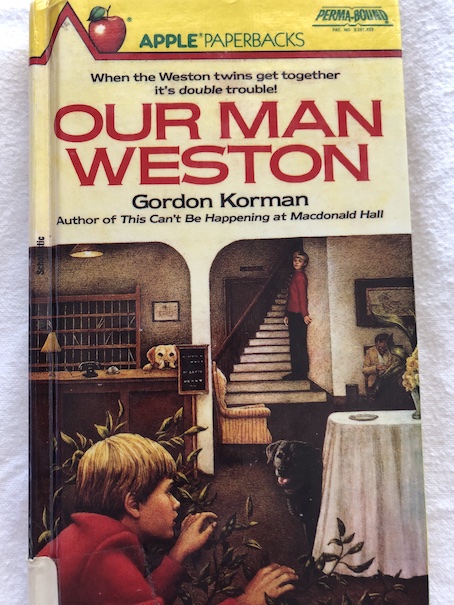
Tom and Sidney Weston, a pair of identical twins, are excited about their first big summer jobs as service boys at a fancy resort hotel. Tom is thinking that the work is going to be easy and that they’ll have plenty of time to have fun, but then, he starts worrying about what kind of fun Sidney is going to try to have. Sidney mentions that they might see some interesting people at the hotel, and Tom remembers that Sidney thinks of himself as a detective and is always on the lookout for spies and criminals. It’s a real problem because Sidney is perpetually wrong in his suspicions about everything and everyone he tries to investigate. He’s gotten into trouble before for making false accusations, and because the two boys look alike, Tom sometimes gets blamed for things that Sidney does. Tom is really looking forward to this summer, and he’s determined that Sidney isn’t going to ruin their summer jobs.
Right from the first, Sidney is in detective mode. As the boys are picking up room service dishes, Sidney tries to study the dishes to make deductions about the people in each room. Tom tries to get Sidney to stop because their manager, Walter Parson, is a serious man with little patience, and he’s already annoyed that he has trouble telling the two boys apart. Sidney is excited when a hotel guest complains that her purse is missing, thinking that he’s found a case to investigate, but while he interviews her for details and pressing for details about a primary suspect, Tom just notices that the lady’s purse is still in her room. It wasn’t stolen, just misplaced. Tom uses this incident to emphasize to Sidney that he needs to give up this detective game because it only causes problems.
However, unbeknownst to the boys, there are real spies at the hotel, and they’re interested in the nearby air base, just like Sidney speculated might happen. The readers learn who the spies are right in the beginning, before the boys even know that there are spies. It’s a little like a Columbo mystery, where the identities of the villains aren’t a secret, and part of the suspense of the story is how the heroes will figure it out and prove it. Even though we know right away who the main villains are, Sidney is clueless.
Sidney continues investigating various guests as though they’re all spies or criminals, although he doesn’t seem at all suspicious of our real villains. He becomes convinced that Lawrence Waghorn is a spy when he’s actually a television writer who’s working on a script for a show about spies. He convinces the guest who temporarily lost her purse, Miss Fuller, that another guest, Mr. Kitzel, is a suspicious character, and she starts following him around and spying on him. In turn, Mr. Kitzel gets the idea that Miss Fuller either has an awkward crush on him or that she’s investigating him because he cheated on his taxes. He’s very nervous because she keeps following him around and tries his best to avoid her. Sidney steals his boss’s dog because he’s under the false impression that the dog is being trained to help the spies carry out their mission, and he seriously wants to inform the Prime Minister of Canada (where they live) and the President of the United States. Tom keeps trying to thwart his brothers’ various schemes and confiscate the spy equipment that he’s hidden around their hotel room. Confusion abounds, although some of its helps to inspire Waghorn, who has been suffering from a case of writer’s block.
Meanwhile, the real spy, Richard Knight (a pseudonym, county of origin unspecified), is trying to get his hands on a new airplane being tested at the nearby air base. He’s brought along a pilot named Bert Cobber. Cobber actually has military training and trained alongside the pilot testing the plane, “Wings” Weinberg. Weinberg has nerves of steel … except about anything related to his cadet days, having been partnered with Cobber, who is a skilled but reckless flier and nearly got him killed on many occasions while flying drunk, forgetting to put sufficient fuel in the plane, and repeatedly crashing. Weinberg hasn’t seen Cobber for years, but he practically has a nervous breakdown every time he relives those memories. A friend of Weinberg’s assures him that, if Cobber is really as reckless as Weinberg remembers, he probably got himself killed long ago, but Weinberg has the uneasy feeling that Cobber is still around somewhere.
Although many characters have the overall situation wrong, I appreciated those moments when some people got certain things exactly right. When Miss Fuller overhears Mr. Parson yet again mistaking Tom for Sidney and also quizzing him about why he’s getting mail from different government agencies, she steps up to tell him to stop his bullying, reminding him that mail is private and that the boy doesn’t owe him any explanation about his personal mail just because he works for him. She also tells him that he’s talking to Tom, not Sidney, and that he’s a fool for getting that wrong.
I also love it that the different government agencies that Sidney has been writing to already know who he is because Sidney has submitted many other inquiries to these various agencies. They’re all familiar with Sidney’s false accusations, and in their response letters to Sidney, they express both amusement for Sidney’s wild escapades and sympathy for whatever poor sap Sidney is suspicious of today. Sidney is never discouraged by their criticism of his wild theories or their requests for him to stop writing. It’s getting to the point where some law enforcement agencies are so fed up with Sidney that they wish they could find something to arrest him for.
Meanwhile, Richard Knight has noticed Sidney’s investigations, although he is unimpressed because he knows that Sidney is way off base. However, he hasn’t fully reckoned with the lengths Sidney is prepared to go to “save the western world”, and Sidney’s schemes interfere with Knight’s in completely unexpected ways.
My Reaction
I remember reading this book when I was in middle school, and I loved it. I remember thinking that it was really funny, although I’d forgotten a lot of the details since then. As an adult, I find Sidney more frustrating than I remember, and I feel sorry for poor, long-suffering Tom. As with the MacDonald Hall books by the same author but with different characters, Sidney’s crazy schemes end up working out for the best, and he ultimately saves the day, even though it’s largely by accident.
There are a couple of changes that I wish I could make to the story. First, I liked it that, while Mr. Kitzel isn’t a spy or a major criminal, he does have one guilty secret: he cheated on his taxes by claiming his dog as a dependent daughter. He becomes convinced that Miss Fuller is onto him for that. However, I’d like to create even more semi-guilty secrets for various guests at the hotel so that Sidney can be almost correct about some things while still missing the most suspicious person of all. As it is, Sidney is seriously way off base because he’s paranoid and delusional, although in a comedic sort of way. I don’t like characters that are intentionally stupid, so I’d like more secrets and petty crimes among the more innocent guests so Sidney can be almost right about them.
I’d also like to see Sidney develop some self-awareness during the course of the story. He is completely oblivious to his own failings and false conclusions and also to the way other people react to him, even when they tell him, in writing, that they don’t want to be bothered with his wild goose chases anymore. That’s part of the comedy of the story, but I find it a bit frustrating. Sidney does almost come to realize how other people look at him when he tries to persuade Miss Fuller that he was wrong about Mr. Kitzel being a spy, but she’s as impervious to correction as he is, so he ends up just letting her continue barking up the wrong tree. I think it would have shown more character development and maybe even have been more funny if Sidney comes to realize how Tom feels, trying to reign him in, if he had to try to control someone even more overly paranoid and determined than he is. The book ends well, but I think it would have been even better if, at the end, Sidney apologizes to Tom for everything he’s put him through, saying that, while everything worked out for the best, he realizes that he’s done a lot of things wrong and that he still has a lot to learn. Then, just when Tom thinks that things are going to calm down, he can see Sidney seriously reading a book about espionage or interrogation techniques and making notes or signing up for a summer correspondence course in criminal investigation, hinting that Sidney’s adventures aren’t over yet and leaving it open about whether he’s going to really learn something practical or just graduate to the next level of crazy.
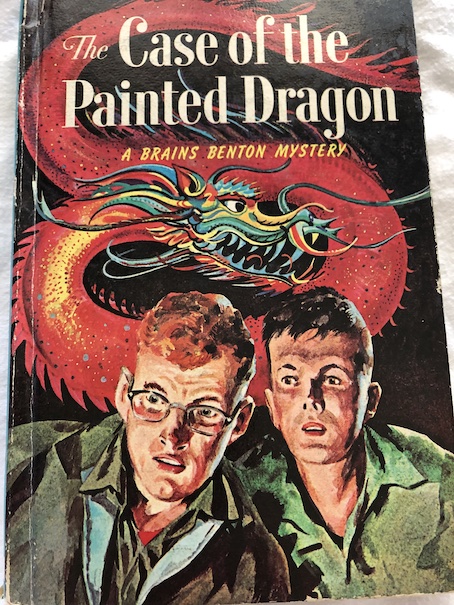
The Case of the Painted Dragon by by George Wyatt (Charles Spain Verral), 1961.
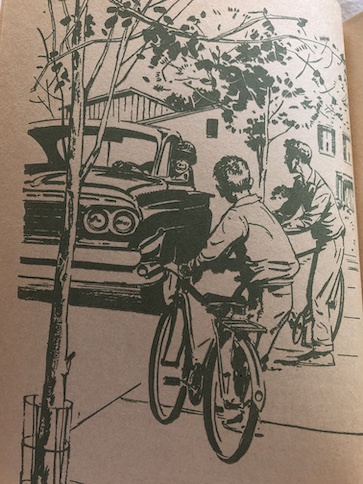
Jimmy and Brains are on their way to school when a strange man in a car stops and asks them if they know where he can find a Japanese kid. (He uses the derogatory terms “Jap” and “Nip”, and Brains disapproves. Also, the man is very unspecific about which kid he’s looking for. He offers no names, just that he’s looking for a Japanese boy about their age The town where the boys live is a fairly small college town, so I guess it’s supposed to be reasonable that there would only be one boy matching that description. I grew up in a larger university town, so the idea of there being only one person who could match any description and just expecting random people to know who it is seems really odd to me.) Brains just says that they don’t know anybody with Japanese ancestry, and the man drives away.
After the man leaves, the boy talk about how suspicious he was. They really don’t know who he could be looking for. The last Japanese family to live in their town was the Yamadas, but Mrs. and Mrs. Yamada were killed in a car accident the year before. (It was a point in the book’s favor that Brains doesn’t like derogatory racial terms, but the point is lost quickly when Jimmy is describing Mr. Yamada, who taught art at the boys’ school, and he says that Mr. Yamada “wasn’t one of those ‘inscrutable orientals’ you’re always reading about.” He says that Mr. Yamada was friendly and also coached the school’s swimming team. It’s nice that Jimmy liked Mr. Yamada, but the way he says it sounds a little back-handed. I suppose it’s a sign of the times when this book was written that the author thought it was reasonable for people, even kids, to “always” be reading about “inscrutable orientals”, but on the other hand, I’ve read other books from this time period and earlier that weren’t like that, so I’m inclined to think that it’s not really “always” and everyone.) However, the boys don’t remember the Yamadas having a son their age, so they doubt there’s a connection. They’re concerned because they think that the suspicious stranger might have bad intentions toward the kid he’s looking for.
After the boys get to school, Jimmy sees that stranger driving by the school, and he gets worried. Either the stranger is still looking for the Japanese boy, or he’s looking for Brains and Jimmy. Brains thinks that the best thing to do is try to find the Japanese boy before the man does. However, Brains doesn’t want to tell their principal or teacher about the stranger or the boy. Jimmy worries that maybe the stranger made up the Japanese boy as an excuse to get to him and Brain, and he decides to tell the principal about the stranger in the car, and the principal goes outside and demands that the stranger tell him who he is and what he’s doing, hanging around the school and scaring the students. Unfortunately, he confronts the wrong person in the wrong car, which is an embarrassing situation. (He did the right thing even if he confronted the wrong person. I give him credit for that, but they need to have a reason why the school authorities don’t do anything about the weirdo scouting the students.)
In the boys’ next class, they meet a new student, Mikko, who may be the Japanese boy that the stranger was looking for. The boys make friends with Mikko, inviting him to come to baseball practice with them. They want to warn him about the stranger, but before they talk to him about thr man who seems to be looking for him, they spot the car following them again. Mikko spots the car, too, and the boys ask him if he knows the driver. Mikko says, no, the man is a stranger. Aside from the people at school, the only people Mikko knows in town are Mr. and Mrs. Bevans, the people he’s staying with. Brains makes up a story about why the man might be following them because he doesn’t want to alarm Mikko too much and also because he doesn’t want anybody calling the police until he and Jimmy have had a chance to investigate the situation themselves. (This is a selfish move – Brains just wants a case to investigate, and he doesn’t want to share the case with the proper authorities. But, again, the story needs to provide a reason for Brains and Jimmy to handle the investigation without adult help.)
Jimmy’s mother knows about Mikko’s background and tells him about it when he gets home. It turns out that Mikko is the Yamadas’ son, but until recently, he had been living with relatives in Japan. Mr. Yamada was born in the US, but he worked in Army Intelligence during WWII, which is when he went to Japan and met his wife. Mikko had been born in Japan and was going to school there, but the Yamadas planned to move to the US permanently. Mr. and Mrs. Yamada had come first to get established, but they died in the car accident before they could bring Mikko to join them in the US. However, Mr. Yamada had wanted his son to become an American citizen, like him, and get an American education. The Yamadas had boarded with Mr. and Mrs. Bevans and became friends with them. The Bevanses’ have no children of their own, and they are considering adopting Mikko and giving him the American life that his father wanted him to have.
There is one adult who knows about the mysterious car following Mikko: Yama, an old family servant who accompanied Mikko from Japan to the US to make sure that he gets settled in his new home. Yama is a former sumo wrestler and a formidable man, and when Mikko tells him about the mysterious stranger in the black car, Yama says that he will protect him. However, when the Bevanses’ house is ransacked while the boys are playing baseball and they return and find Yama looking around Mikko’s room, they boys start to suspect that Yama may be involved with the mysterious stranger in some way. At least, he seems to know more than he wants to say about the situation because he refuses to call the police to report the ransacking.
After some further research, Brains and Jimmy learn that the Yamadas’ car accident might not have entirely been an accident, and Brains suspects that everything that has happened may relate somehow to Mr. Yamada’s former work in Army Intelligence.
My Reaction
This is the last book in the Brain Benton series, but it’s also more of a mystery than the previous books. In most of the books, it doesn’t take the boys long to realize who the villains are, and the mystery is more about how they’re going to prove it and stop the bad guys. However, in this book, Brains and Jimmy really do start off completely in the dark. First, they have to learn who the Japanese boy is that the strange man is looking for, and then, they have to learn the history of Mikko and his family. Brains and Jimmy do genuine investigative work, starting with old newspaper stories about the accident that killed Mikko’s parents. Little by little, they begin to reconstruct the past and learn why someone is looking for Mikko and what Mikko has that they want. Even when the boys know who the bad guys are and what they’re after, there is still the puzzle of where Mikko’s father hid it before he died.
I enjoyed the mystery in the book, but I didn’t like some of the ways Jimmy talked about Japanese people. I think it was good that he noted that derogatory terms are inappropriate, and I appreciated that he liked Mikko pretty quickly and pointed out good things about him. Those are good points. It’s just that, sometimes, even when Jimmy speaks favorable about some of the Japanese people in the story, it comes off sounding a little back-handed, like when he says that Mr. Yamada was actually a really nice and friendly guy and not “inscrutable” like characters Jimmy has heard about. I can see that it’s a positive point that someone who has been given a negative impression about certain types of people can consciously notice that the reality is both different and better than what he’s heard before. I think Jimmy is moving in a good direction in his attitudes. It’s just that compliments sound flat when they’re accompanied by a negative or implied negative. It’s like the difference between saying “He’s a really nice guy” vs. “He’s a really nice guy for being the kind of person I’ve always heard was really sinister.” It just adds an uncomfortable twist on the sentiment. I know that the reason Jimmy talks like this is because this book was written during the 1960s, when racial attitudes were changing, and the author probably felt like it was necessary to acknowledge old stereotypes, but I still don’t like it.












 Jestress's Forgotten Books and Stories