The Dangerous Book for Boys

The Dangerous Book for Boys by Conn Iggulden and Hal Iggulden, 2006, 2007.

This is an activity/hobby book for children, especially for boys, but really, full of activities that girls could enjoy, too. It’s often sold in sets with a companion book, The Daring Book for Girls. These books follow in the tradition of earlier activity/hobby books like The American Boy’s Handy Book and The American Girl’s Handy Book by the Beard siblings. Some of the activities in these modern books are similar to ones included in historical children’s activity/hobby books, but there are some notable differences. Although The Dangerous Book for Boys includes sports and outdoor activities, it has more scientific and academic information than The American Boy’s Handy Book.

The differences between these books show changes that have taken place in society, the activities that adults want to promote for children, and the types of activities that children can actually use in the 125 years between the times when the two books were published. The motives of the authors of these books were similar, all of them wanting to produce the type of activity/hobby book that they would have liked to have when they were young and didn’t have, not because other hobby books didn’t exist exist when they were young but because they were looking for something that they hadn’t found in the hobby books of their youth. In the 1880s, Daniel Beard set out to write a hobby book for American boys because many of the hobby books of his youth were poorly written and/or came from England, using words that were not used in American English or recommendations for London shops where boys could buy equipment, which were of no use to an American boy. His book, The American Boy’s Handy Book, promoted do-it-yourself hobbies, particularly ones related to outdoor activities and suitable for children who lived near woods and lakes or rivers where they could do things like go fishing, sail boats that they made themselves, or build log cabin playhouses. However, 21st century society is much more urban/suburban, and it can be difficult or impossible for modern children to do something the things that Daniel Beard recommended. The Dangerous Book for Boys was written for 21st century children, who might need a bit of nudging to get off their computers and video game systems now and then and maybe a little academic help or something to ignite an interest in history or science, but are no less interested in learning something new and interesting or something fun to do with their friends. One thing that I hope readers come to understand from these books is that the world is full of things to do. There is more to do in life than anyone will have time to do in a single lifetime, and far, far more than can be contained in any one book. The Dangerous Book for Boys (published first in the UK and later in the US) contains things that 19th century Daniel Beard might have found very interesting but didn’t exist during his time, so they never even occurred to him as possibilities, and there are bound to be more things coming in the future that people either haven’t thought of yet or are quietly working on right now, planning the books and activities of the future. There’s always something to do. People just need time to do things and the willingness to get started.

I like to explain the contents of books so that people will know whether they would like to read them in more detail. It’s difficult to describe the contents of The Dangerous Book for Boys succinctly because the contents are extensive and they are not grouped into convenient categories. It’s more like reading a very long magazine with isolated articles, although some of the articles are related to each other. It’s just that related topics are not put next to each other. For example, the information about reading star maps comes much later in the book than the introduction to astronomy, and information about the solar system comes even later, with many other sections in between. There are also some sections of trivia/interesting information, history, or academic topics which were purposely split into different numbered sections and distributed throughout the book, like Questions About the World (explaining natural phenomena like the seasons, the tides, and why the sky is blue), Famous Battles (divided into sections starting with ancient battles and then more modern ones), Extraordinary Stories (about the lives and accomplishments of famous men, including the Wright Brothers and Robert the Bruce), and Understanding Grammar (a more academic section).

Because it would be difficult for me to explain everything in this book without basically copying the entire table of contents, which would take quite a lot of space to do, I’ll just hit some of the highlights by describing them in sections that the book doesn’t have but which explain the types of activities covered in this book. All of the types of activities that I describe below are included in the book, but there is also more in the book than I could take the time and space to describe in detail.

Useful Skills and Knowledge

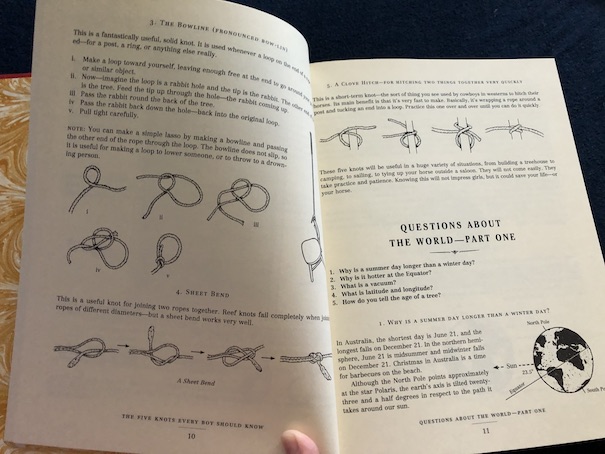
The book has sections explaining how to do first aid, how to tie different types of knots, how to wrap a package with brown paper and string, and how to make cloth fireproof.
I was somewhat amused by the section about how to talk to girls. Most of it is good advice, like maintaining a clean appearance and not being vulgar or overdoing it with jokes. Lesson #1 is “It is important to listen.”, which is always true. The part that I thought was funny was in the introduction: “You may already have noticed that girls are quite different from you. By this, we do not mean the physical differences, more the fact that they remain unimpressed by your mastery of a game involving wizards, or your understanding of Morse Code.” To that, I say, “Are you kidding?!” I used to have Morse Code memorized from playing the Nancy Drew computer games by Her Interactive, and I know from my fascination with activity books like this that the reason why Morse Code looks the way it does is that Morse wisely decided to make the letters of the alphabet used the most often the shortest to form. I used to play World of Warcraft, and I played every one of the available factions, but then I got more interested in physical board games and board game history. My female friends continued much longer, although they ended up switching to Final Fantasy. I’ve played both D&D and Call of Cthulu and liked them both. The more wizards, the better, as far as I’m concerned!

I always think that advice about what girls like often fails to take into account that girls are individuals with different interests and hobbies, no matter what their age. Not all woman like to wear high heels (which are stupid, annoying shoes that are bad for your feet, especially those with the dumb, skinny heels that always make me turn my ankle), and some either never wear makeup or consider it an annoying hassle that they feel obligated to do to because other people expect it. Some girls wear their hair long because they like the feminine look or like to experiment with different types of artistic braids and hairstyles, and some girls chop their hair short because they’d rather just quickly run a comb through it and forget about it. Some women, like me and my friends are geeks, who love books, play video games and role-playing games, know various types of computer programming or maker hobbies, study history, and would gladly do most of the activities in books like this. Some girls are into sports and working out. There are even some girls who are into things like hunting and even taxidermy and wished that they could have joined the Boy Scouts instead of learning to sew and bake cupcakes in Brownies. People in general can have many and varied interests. Even though this book was written for boys of the 21st century, I don’t think that the authors are really in touch with women and girls of the 21st century and understand the range of topics that many of them find interesting. Although, I think that the authors’ attitudes about girls’ interests aren’t just due to them growing up in the 20th century themselves. Guys have often tried to figure out what women like and what women want, and they frequently get it wrong because they approach the question from the wrong angle. Chaucer tackled the problem of what women want way back in the Middle Ages, and he figured it out. What women like most is often what men like most: having things their own way. What that means varies from person to person because of our different interests, but in some form or other, that’s what we all want. So, don’t try to figure out what “girls” like; just ask a particular girl what she likes. Guys don’t need to try to please all the girls in the world at once, just the one they’re with. Most people will tell you who they are and what they’re interested in, given the chance (or maybe a Facebook or Instagram page), and when a boy finds a girl who likes things that he also likes or is willing to do things that he likes to do, he’s found a good one.

Aside from random, useful life skills, there is also academic information in the book that would be useful to school, like standard and metric measurements, the sections about how grammar works, the origins of words, Latin phrases, quotes from Shakespeare, the Ten Commandments, and poems that boys should know and books that boys should read.

Games

I count games differently from sports because sports tend to be outdoor activities and require a certain level of physical skill, and games tend to be more general, require less physical skill, and can be played indoors. This book includes some pen-and-paper games, marbles, chess, role-playing games, poker, and table football.

Sports

The book has the rules for soccer and stickball. It also discusses famous baseball players and rugby.

Outdoor Activities

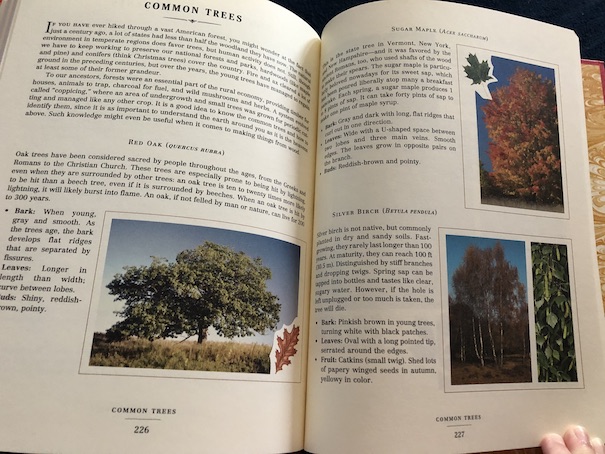
These are activities to do that are related to the outdoors and nature and things to make related that are related to outdoor activities, including fishing, building a treehouse, making a bow and arrow, how to hunt and cook a rabbit, how to tan an animal skin, making a go-cart, and learning various methods of navigation and different types of trees.
Science and Technology

The book describes various topics related to science, like astronomy, insects and spiders, cloud formations, and fossils and dinosaurs. There are also instructions for making projects that would probably make good science fair projects, like a battery, an electromagnet, a periscope, a pinhole projector, and crystals.

History and Geography

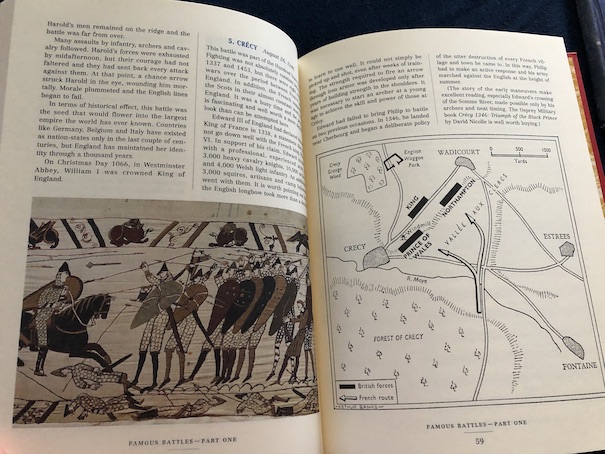
There are sections about US geography (I don’t know if the original UK version had this or if it focused on the geography of the UK), Early American History, the Declaration of Independence, the Golden Age of Piracy, descriptions of the Seven Wonders of the World (both ancient and modern), the sections about Famous Battles from history, and a Brief History of Artillery.
Spies and Secret Codes

There are sections about the codes and ciphers that spies use, the Navajo Code Talkers’ Dictionary from World War II, the US Naval Flag Codes, and how to make secret inks.

Crafts

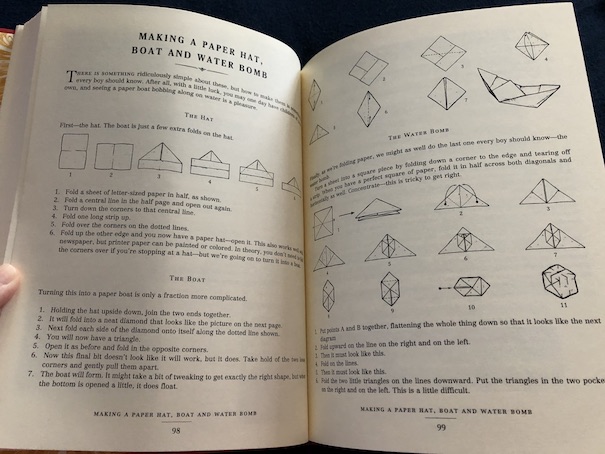
The book explains how to build a workbench, how to grind an italic nib for italic writing, and how to make marbled paper, making paper airplanes and paper hats, boats, and water bombs (these are little origami boxes that you fill with water and splat when you throw them at something – I’ve made them before).
Stunts and Random Skills

These are just random things that are fun to know how to do, like juggling, skipping stones, coin tricks. There is also a section about teaching tricks to dogs.

Dangerous Book for Boys Badges
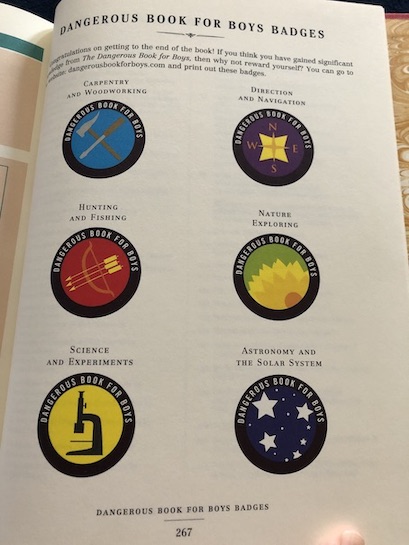
This is the final part of the book. Since many of the activities in the book are the kind done at summer camps or in scout troops, the book overs suggested “badges” you can award yourself and your friends for doing the activities. Even though the activities in the book are not sorted into specific categories, there are six categories of badges offered: Carpentry and Woodworking, Direction and Navigation, Hunting and Fishing, Nature Exploring, Science and Experiments, and Astronomy and the Solar System. The book doesn’t specify what activities you should master to award yourself these badges, leaving that up to the reader. My copy says that if you go to their website, you can print out these badges, but that website no longer exists. I don’t know if later printings say something different.

If you’re looking for something to do with the kids during coronavirus lock-downs and/or over summer vacation, this book has plenty of ideas, and you can even make up your own “badges”, using their ideas, my category suggestions, or anything else you would like to do yourself.

The book is available to borrow and read for free online through Internet Archive. I’ve also learned that the book has inspired a tv series, which is available through Amazon Prime. You can see the trailer on YouTube.

The American Boy’s Handy Book

The American Boy’s Handy Book by Daniel Beard, 1882.

This is a Victorian activity book for boys, focusing particularly on outdoor seasonal activities. It was not the first book of its kind during the Victorian era, but the author explains in the preface that he wanted to create a book of sports, games, and activities that would be better than the ones that he knew from his own youth, with instructions that were well-written, complete, and easy to follow, particularly written for American boys, without some of the foreign phrases found in other books or tips that would be impossible for them to use, like recommendations for shops in London that sell equipment for the various activities and pastimes.

The book is now public domain and available to read for free online through Internet Archive.

Historical Background

Daniel Beard wasn’t just an author who had an interest in providing useful guides to fun activities for American boys; he was also a social reformer who was one of the founding members of the Boy Scouts of America. Before the Boy Scouts of America was founded in 1910, there were other, smaller scouting organizations throughout the United States, and Daniel Beard had founded one of these groups in 1905, which he called the Sons of Daniel Boone. This group later went through a couple of name changes before Beard joined the Boy Scouts of America and merged his group with theirs.

The Beard family in general believed in the benefits of exercise, appreciation of the natural world, and healthy outdoor activities for youth people, both male and female. Daniel’s sisters, Lina and Adelia, would later be founding members of the Camp Fire Girls, the first major scouting organization for girls in America, during the 1910s, a cause which Beard also supported. (Camp Fire Girls was founded before the founding of the Girl Scouts. It had the opportunity to merge with the Girl Scouts at one point but didn’t. Today, it is now a co-ed scouting organization simply called Camp Fire.) A few years after the publication of The American Boy’s Handy Book, Lina and Adelia published their own book of activities specifically for American girls called The American Girl’s Handy Book, which had somewhat of an outdoor focus but not as much as The American Boy’s Handy Book or some of the other books that they would later write. These were not the only books that the Beards published, and they would later go on to write more books about activities and wilderness skills for boys and girls.

Contents of the Book

The activities in this book are organized by season, which makes sense because of the largely outdoor focus of the activities. Within each section, there are more specialized sections, focusing on particular pastimes in each season. The American Girl’s Handy Book follows the same seasonal organization, but The American Boy’s Handy Book doesn’t mention holidays as much as The American Girl’s Handy Book. There is only one holiday section in this entire book, and the holiday is the Fourth of July. Later editions of the book also have some extra notes and projects in the back.

My copy of the book has a foreword written in modern times, part of which notes that some of the activities in the book are not really recommended for modern children because they are not suitable for kids living in urban or suburban environments and because some of them are outright dangerous and involve fire. At least, children should not attempt these activities without close supervision and help. Some 19th century people managed to play with fire and not hurt themselves, partly because more of them lived in the countryside, away from houses that could be set on fire, and like the author of this book, also lived in places in the Midwest and East Coast that see a lot of rain, keeping plants and fields from drying out and becoming more flammable, and could also be near lakes, ponds, and rivers. However, not everyone lives in those types of places these days. (If you want an indication of what could possibly go wrong with trying some of the more flammable activities in the book, consider what’s happened with some of the more flammable or explosive gender reveal parties in modern times. Consider your environment before deciding whether these activities are feasible.) Also, not everyone from the 19th century or 20th century pulled off these activities unscathed, and it’s the ones who did get hurt or caused serious damage that make the concern. The writer of the foreword describes how a 19th century boy lost a leg attempting the fire balloon activity with his friends years before this book was published. (The fire got out of control, and his leg was badly burned when he tried to put the fire out.) That being said, there are many interesting activities in this book that are perfectly harmless and fire-free and that kids from any era can try, even those who don’t live in the countryside.

Spring

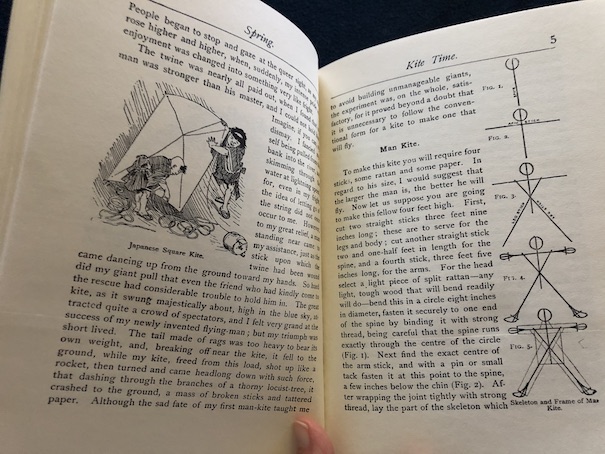
The spring section is mainly about making and flying kites and going fishing. The kites section explains how to make different types of kites in different shapes, like people, frogs, butterflies, fish, turtles, and dragons. One of these designs, called The Moving Star, involves attaching a lit lantern to the tail of a long kite. This kite is meant to be flown at night, so the light will bob in the air. It’s an interesting concept, although the instructions mention that certain types of lanterns are likely to just set fire to the kite. (I think I know how the author knows this.) The book provides instructions for making a custom lantern that will work better. This custom lantern featured a candle that is stuck between nails that are supposed to hold it in place, and it is supposed to be covered with red tissue paper (which is also sure to catch fire if that candle gets loose and falls over while it’s flying around). I’ll admit that the effect is probably neat, if you can pull it off without setting fire to something, but setting something on fire seems to be a likely outcome. This is one of the activities which wouldn’t work well for modern kids, especially if they live in places with highly flammable brush or dead grass and weeds or in the middle of areas with a lot of houses or apartments that would be set on fire if the flying lantern gets out of control (which is, apparently, a distinct possibility). Of course, thanks to modern technology, a battery-operated light could be an option.

There is also a section about war kites, which can be used for kite fighting.

The rest of the spring section is about different methods of fishing, how to make fishing tackle, and how to keep aquariums.

Summer

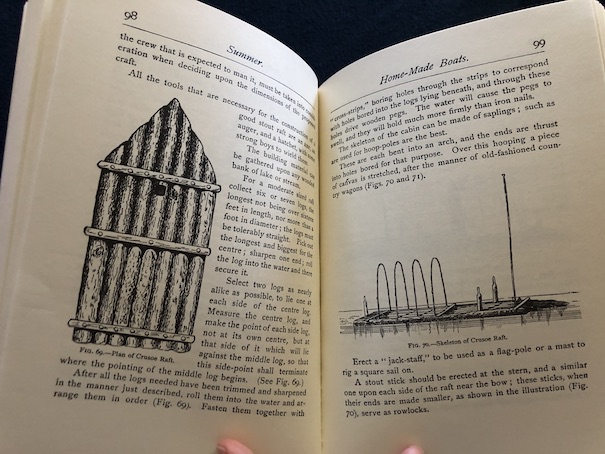
The summer section has more variety, although many of the activities are ones that modern boys can’t do if they live in an urban or suburban environment. There is more information about fishing in this section and how to make and sail different types of boats. I thought that the water telescope, which can be used to look at things under water, was really interesting. The book provides two sets of instructions for making a water telescope, one wooden and one metal.

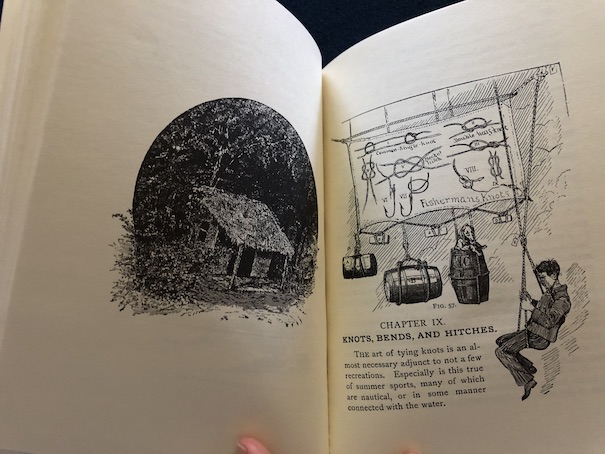
There is also information about different types of knots and how to tie them, blowing soap bubbles with a clay bubble pipe, and how to camp outside without a tent. The section about soap bubbles mentions “an aged negro down in Kentucky” whom the author knew as a child called “Old Uncle Cassius.” Uncle Cassius used to smoke a corn cob pipe, and he liked to amuse the children by blowing soap bubbles. The reason why the author brings up the subject of Uncle Cassius is that he had a particular trick where he would blow smoke-filled bubbles by filling his mouth from smoke from his own pipe before blowing some through the bubble pipe. The term “negro” is a bit archaic now, and I wouldn’t recommend smoking in general, but the author’s memories of Uncle Cassius seem to be fond ones, which is nice. The book doesn’t say whether or not Cassius was a slave, but the author was born in 1850, so my guess is that Cassius was either a slave or had been one earlier in life.

The section about soap bubbles also describes how children can use the gas from the gas lighting in their homes to blow bubbles, another activity that modern children can’t do.

As I mentioned before, fire is important to certain activities in this book. For Fourth of July, there are instructions for making a special kind of balloon that rises with heat produced by fire. They’re sort of like sky lanterns, made of paper. However, instead of having a place to set a small candle, these balloons have a “wick-ball”, which is a ball of rolled-up wick string, the kind used in an oil lamp, which is then soaked with alcohol and set on fire. The author notes that other people who make this type of balloon use small sponges instead, but he doesn’t think they’re as good because they don’t burn long, and as they burn out, the balloon comes back down, near where it started. He prefers to make a wick-ball so that it will continue burning and float out of sight. (I can’t help but notice that the sponge balloons, not burning for long and coming down nearby would also probably be easier to control and monitor for fire risk than the wick-ball balloons, which will float off to God-only-knows-where and get caught on who-knows-what before fully burning out.) The author says that he used to experiment with these as a child and has notes about which shapes are unsafe. Generally, it’s best to make them large and round, without a long neck at the opening. (As I said, the modern foreword in my copy notes that these types of balloons are actually dangerous and that kids have been injured trying to use them. This is why you don’t tend to see this type of activity suggested in modern children’s hobby books. Try it only at your own risk and remember that you’re responsible for any fires you start in the process. If you live in an urban setting or an area with a high risk of wildfires, don’t do it at all.)

There is quite a lot of information about activities involving real birds, like collecting bird nests and raising wild birds. (The modern view is that wild animals should be left wild and not kept as pets.)

There are also instructions for different types of hunting and how to make hunting weapons, including blow guns. In Meet Samantha from the Samantha, An American Girl series, she mentions that she read the instructions for how to make a boomerang in The American Boy’s Handy Book and that she wants to make and sell boomerangs to raise money to buy a new doll until her grandmother talks her out of it because that isn’t a proper activity for young girls. This is the part of the book where the boomerang instructions are, p. 190. Meet Samantha doesn’t say why Samantha was reading The American Boy’s Handy Book instead of The American Girl’s Handy Book in 1904, but that passage is mainly there to show the difference between what were considered acceptable activities for girls vs. acceptable activities for boys.

Autumn

The autumn section is much shorter than the previous two sections. It has information about trapping animals and practicing taxidermy. There is also a section about how to keep and train a pet dog. (Remember, that’s a commitment for life, not just for autumn.)

The part that I liked the best was the section about how to be a “decorative artist.” It teaches boys about photographic paper, how to make shadow pictures, and how to enlarge and reduce images.

Winter

The winter section has both indoor and outdoor activities, and the outdoor activities are designed for places with snow. (The author was born in the Midwest and lived on the East Coast of the United States, so these are the environments he considers for his outdoor activities.) He describes snowball fights, snow forts and houses, snow statuary, different types of sleds and sleighs, snow-shoes, and how to fish in winter.

For the indoor activities, there are instructions for making puppets and a script for a puppet show version of Puss-in-Boots. There are also tips for making costumes for people, so children could perform their own theatricals.

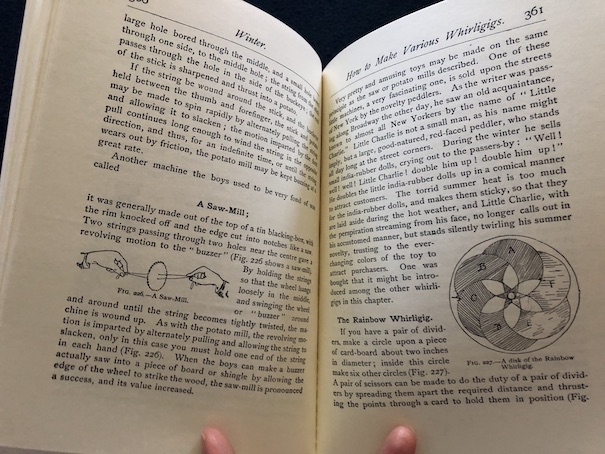
I particularly liked the sections about how to make and use magic lanterns and how to make different types of whirligig toys. The magic lantern was a kind of early slide projector. The whirligigs were homemade toys that would spin.

The Secret of Terror Castle

The Three Investigators

TITerrorCastle#1 The Secret of Terror Castle by Robert Arthur, 1964, 1992.

In the first book in the series, Jupiter, Pete, and Bob form the Three Investigators, an organization dedicated to solving all kinds of mysteries.  It was particularly Jupiter’s idea. They have been friends for a long time, and they used to have a club dedicated to solving puzzles. Now, they’ve decided that they want to solve more complicated problems and mysteries. Jupiter has won the use of a Rolls Royce and chauffeur for a month by entering a contest at an auto rental agency, so he thinks that it would be a good time to get started because they will have transportation to anywhere in the city.

Jupiter also has an idea for their first case, something that will help them get publicity for their new investigative organization. There is a rumor that a director, Reginald Clarke, is looking for a genuine haunted house to be the setting of his next movie. Jupiter manages, through some clever trickery, to get an interview with Reginald Clarke and persuades him to introduce this account of their first case if he and the other investigators can find a genuine haunted house right in town. Clarke takes them up on it, not because he thinks they will succeed, but because he sees it as the only way to get Jupiter to stop doing an unflattering impersonation of him.

Jupiter, however, is confident that they will be successful because he already knows the perfect place to investigate. Terror Castle is a large mansion that was built years ago by an old actor who was in silent films. All of his movies were scary ones, and since his death under mysterious circumstances, no one has succeeded in staying in the castle very long. Strange apparitions have been seen there, and anyone who tries to spend the night there is overcome by inexplicable terror. As far as Jupiter is concerned, all they have to do is prove that the castle is really haunted, and that means that the Three Investigators must visit it themselves.

In the original books, the director that Jupiter tries to find a real haunted location for was Alfred Hitchcock.  Alfred Hitchcock introduced the early books in the series and played minor roles in some of them, and The Three Investigators capitalized on his reputation.  When the series was re-released, however, Alfred Hitchcock was replaced by a fictional director, and his role in later books was taken by a fictional mystery author named Hector Sebastian.  In the re-released version of the first book, Reginald Clarke refers the boys to Hector Sebastian at the end of the story so they can help a friend of his to find his missing parrot, which leads directly into the subject of the next book.

The haunting in this story (as with others in the series) has a reasonable explanation, not a supernatural one.  In fact, one of the things that I always found memorable about this book was the explanation of how the inexplicable feelings of terror people experienced were created using sound waves which could be felt but which were beyond the normal range of human hearing.  I’m not sure whether the book was completely correct about the science behind this technique, but I have heard about sounds being used to create odd or even harmful effects on human beings in real life.  As for the reasons behind the haunting, they concern the original owner of the castle and the life he lived.

This is one of the books in the series which was made into a movie, The Three Investigators and the Secret of Terror Castle, but the movie was very different from the original book.  In the movie, the owner of the castle was an inventor, not an actor.  Part of the plot also concerned Jupiter’s deceased parents and a mystery that they had been investigating.  Jupiter’s parents were not part of the original book at all.  A villain who appears in some of the other books in the series also makes an appearance in the movie, although he had nothing to do with this particular story in the original series.  Overall, I don’t recommend the movie for fans of the original series.  The changes don’t seem to be for the better, and I think people who remember how the original story was and liked it would be disappointed in the movie.

There are multiple copies of this book available to borrow for free online through Internet Archive, both the original version with Alfred Hitchcock and the updated one.

The Whipping Boy

The Whipping Boy by Sid Fleischman, 1986.

Jemmy is an orphan who lives in the royal castle as the prince’s new whipping boy.  Prince Horace, or Prince Brat, as the prince is commonly called, is known for constantly misbehaving, playing mean pranks, and refusing to do his lessons (he tells his tutor that he doesn’t need to learn how to read because he could always get someone else to do his reading for him).  However, in their land, it is illegal for anyone to use any kind of physical force or punishment on a prince.  Instead, the royal family employs a whipping boy to take the prince’s punishments for him.  As you can imagine, seeing someone else whipped in his place does little to correct the prince’s bad behavior.  In fact, the prince usually likes the spectacle of the whipping boy yelling.  He doesn’t like it that, unlike the others, Jemmy never yells when he’s whipped.

Jemmy was recruited for the role of whipping boy off the streets, where he survived by being a mudlark and rat catcher.  There are benefits to living in the palace, even if his purpose in being there is to take the prince’s punishments.  Jemmy gets food to eat and nice clothes to wear and attends the prince’s lessons with him, where he pays attention when the prince does not.  Jemmy actually loves the books and learning he receives.

After about a year, though, the prince suddenly comes to Jemmy in the middle of the night and tells him that he’s running away from home and wants Jemmy to come with him as a manservant.  When Jemmy asks him why he wants to leave, the prince says that he’s bored.  Jemmy wonders why Prince Brat wants him to come along instead of a friend, but then he realizes that, as nasty as he is, Prince Brat doesn’t have any real friends.

When the two of them are outside of the palace, Jemmy is tempted to run off and leave Prince Brat to fend for himself, but before he can make up his mind about it, the two boys are taken prisoner by bandits, Cutwater and Hold-Your-Nose Billy (named for all the garlic he eats).

Prince Horace tries to pull rank on the bandits, telling them who he is and ordering them to go away.  It’s a mistake.  When the bandits see the royal crest on the saddle of the horse that the boys are riding, they decide that they can probably get a good ransom for the prince.  Since neither of the bandits can write, they try to make the prince write his own ransom note, but of course, Prince Brat can’t write because he’s refused to learn. 

Jemmy, seeing an opportunity to turn the situation around, offers to write the note instead.  As Jemmy suspected, when the bandits realize that he can write and Horace can’t, they start assuming that he’s actually the prince and that the two boys have switched places.  After writing the note, Jemmy suggests that they let the “whipping boy” (Horace) take it to the castle, thinking that not only will Horace get safely away but that he’ll be rid of Horace after that.

To Jemmy’s surprise, Prince Horace ruins the whole scheme by refusing to return to the castle.  Jemmy tries to reason with him, but Horace says that he won’t go home until he’s ready.  The boys to manage to slip away on the bandits, and Horace insists on following Jemmy even though Jemmy wants to be rid of him.

Although Jemmy can’t understand why, Horace says that he’s having the time of his life.  For once in his life, he doesn’t have people fussing over him and telling him to keep his clothes clean.  Horace has found palace life stifling and boring, and he feels like his father hardly notices him or cares.  Part of the reason why Horace acts up is to get his father’s attention.  Jemmy is surprised by these insights into the prince’s life and character, and he is also surprised that, when he finally gets the chance to slip away and leave Horace behind, he can’t do it.  He knows that Horace isn’t used to life outside the palace, and Jemmy worries about what might happen to him if he’s left alone, although he tells himself that Horace could always return to the castle.

Before their adventures are over, Horace gets to experience what it’s like to do chores for himself and even to be whipped by the bandits, when they think he’s the whipping boy.  Being whipped himself shows Horace what he has subjected others to on his account.  Jemmy is surprised that Horace bears the punishment without crying or complaining, something which Horace says that he learned from watching Jemmy, who made it a point to take whippings with quiet dignity.  Horace also learns what other people really think of him when a woman at a fair comments on the prince’s disappearance, using the “Prince Brat” nickname and saying that the young prince is a “terror” and bound to be a terrible king when he’s older.  Usually, people are careful about what they say in front of the prince, and Horace is shocked to find out how disliked he is because of his bad behavior.  However, Horace’s new experiences and realizations bring a change in his outlook and personality that make him more sympathetic and likeable.  There is also the realization that what Horace really needs in his life isn’t a whipping boy to take his punishments for him but someone who can be a real, honest friend with him, like Jemmy.

In the end, Jemmy becomes the prince’s companion, not his whipping boy, so that the prince will be less lonely and stop acting out to get attention.  The king promises that Horace can keep Jemmy as his companion and his responsibility as long as Horace himself can behave responsibly and do his lessons as he should.

Although the country and characters in the story are fictional, the practice of keeping a whipping boy so that princes wouldn’t have direct physical punishment was a real practice.  Even today, the term “whipping boy” can stand for a person who takes blame or punishment in the place of someone with higher rank or authority, even when the person of higher rank is the one at fault.  For example, if a business manager or CEO makes a bad decision and orders one of his employees to do something they shouldn’t and the employee gets the blame for it as if what they did was their idea and not the boss’s, that employee can be considered the “whipping boy.” Another example would be if a stepchild in a family was given blame or punishment in place of a biological child because of favoritism on the part of the punishing parent (similar to the crude saying “beaten like a red-headed stepchild“). In fact, depending on the circumstances, a “whipping boy” might not even be a person, but a thing or a concept that is blamed instead of the person or thing that is the true cause of a problem, such as blaming “modern society” or “kids these days” for an individual’s bad habits or behavior, “the government” or “the system” for a business’s bad decisions or policies, or “millenials” for practically everything they’ve been blamed for by older people. It is similar to the concept of the “scapegoat” or “fall guy” but with the connotation that the person who is really at fault, the one who is trying to avoid blame or punishment, succeeds because of higher rank, authority, seniority, or some other form of favoritism among those who will assign blame or punishment.

This book is a Newbery Medal Winner and is available online through Internet Archive (multiple copies).

There is also a movie version of the book, sometimes called Prince Brat and the Whipping Boy.  The movie follows the concept of the original story pretty well, but it elaborates more on Jemmy’s life before he became the whipping boy and on how Horace feels neglected by his father.  In the movie, Jemmy is pressed into service as whipping boy by the king’s soldiers, who don’t bother to find out if he has any other family.  Although Jemmy is an orphan in both the book and movie, in the movie, he also has a younger sister he looks after, and part of what he wants to do when he leaves the palace is to find her.  The boys together learn that the younger sister was arrested for attempting to steal a handkerchief in Jemmy’s absence, and they have to rescue her from prison, a side adventure that didn’t occur in the book.  In the movie, Horace also explains to Jemmy that his mother died in a riding accident when he was young and that his father pays more attention to affairs of state than he does to him.  Horace is shown multiple times trying to get his father’s attention, only to be brushed off because his father is too busy.  In the movie, the king almost declares war on another country, thinking that Horace was kidnapped over a border dispute, something that didn’t happen in the book.  In both the book and the movie, Jemmy’s new friendship with Horace brings about a change in the prince.  At the end of the movie, both Jemmy and his sister are taken in to the palace as companions for Horace. Sometimes you can find this movie or clips of it on YouTube. Although it was originally released on VHS, it is currently available on DVD.

Ira Sleeps Over

IraSleepsOver

Ira Sleeps Over by Bernard Waber, 1972.

Ira, a young boy, is happy when his friend, Reggie, who lives next door, invites him to sleep over at his house. Then, his sister asks him if he’s going to take his teddy bear with him. At first, Ira says no, but his sister points out that he’s never slept without it.

Ira starts to worry about whether he should take the teddy bear with him or not. He worries that Reggie might laugh at him for having a teddy bear. His parents say that he won’t and that Ira should go ahead and take the bear with him. However, his sister says that Reggie probably will laugh.

IraSleepsOverWorry

Ira tries to talk to Reggie and sound him out on the idea of teddy bears to see if Reggie will laugh, but Reggie ignores Ira’s questions. Reggie is excited about all the things that he and Ira can do at the sleepover and eagerly explains his plans. It all sounds like fun, but Ira gets nervous when Reggie mentions ghost stories.

IraSleepsOverReggie

Ira continues to debate about whether or not he should take his bear with him. Before going over to Reggie’s house, he decides to leave his teddy bear at home.

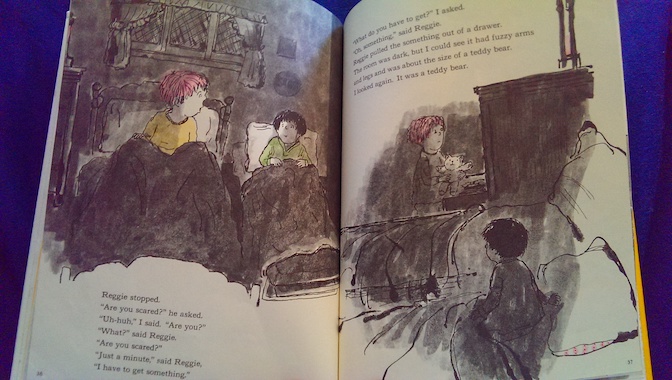
The two boys have a lot of fun playing together at the sleepover. At bedtime, Reggie starts to tell a ghost story, and both of the boys are a little spooked. That’s when Ira discovers that Reggie has a teddy bear of his own.

IraSleepsOverTeddy

The book is currently available online through Internet Archive.

My Reaction

This is a nice story about how the things that we worry other people will find ridiculous or embarrassing are often more common and less embarrassing than we think. At first, Ira worries (because of what his sister said) that Reggie will think that his teddy bear, named Tah Tah, is silly and childish, but after discovering that Reggie has a teddy bear named Foo Foo, Ira realizes that Reggie will understand how he feels about his bear and decides to run home and get it.  Reggie probably dodged Ira’s earlier questions about teddy bears because he was similarly worried about what Ira would think of his bear.  Sometimes, when people really open up to each other and talk honestly about the way they feel, they learn that other people have shared their feelings and experiences more than they might have thought.

The Ship That Never Was

ShipThatNeverWasThe Ship That Never Was by Mickey Spillane, 1982.

Larry Damar and Josh Toomey are sailing in a boat off the coast of Peolle Island in the Caribbean when they rescue an old man from what seems to be a skiff. But, as soon as they get him aboard their own boat, they realize that what they thought was a skiff is actually more of a long boat, and it looks old. Very old.

They take the old man, who is suffering from exhaustion, to their fathers. While the old man rests, they inspect the boat and confirm that it is an antique. Oddly, from the condition of the wood, they believe that it has been resting in water for some years, but not salt water. It’s the kind of longboat that would have been carried aboard larger naval ships from a couple hundred years earlier. The name on the side of the boat, HMS Tiger, is familiar, but they heard that it was lost at sea ages ago. The old man is also carrying what appears to be some very old documents, but they are unable to read them, and when the old man speaks, they’re not quite sure what language he’s speaking.

They send a message to Sir Harry Arnold at the antiquities department of the British Naval Archives about the boat and the old man. When he arrives, he confirms that the longboat came from the HMS Tiger, a three-masted ship built in England in 1791. The Tiger was considered a jinxed ship because of everything that went wrong during its construction and its maiden voyage. Because of that, no one wanted to sail on it again or even work on the ship to dismantle it. So, the builder decided to send the boat on one last voyage by itself. He and his men loaded up the ship with supplies as if it had a crew aboard and then set it adrift, watching it sail off majestically, without a crew. Everyone had assumed that it would have eventually sunk, damaged by the weather, but apparently, it survived for longer than anyone had suspected.

Since no one can understand his language, the old man, who calls himself Vali, draws pictures to explain to them where he came from. Vali indicates which island he came from, and according to his other drawings, he lived there with many other people until many of them were killed in some kind of storm. He also draws a picture of a young girl with a crown on her head. Then, Larry’s dad, Vincent, recognizes the seal on a signet ring that Vali shows them. Vincent has read about the history of the country of Grandau (fictional country), and he recognizes its royal seal.

About 200 years before, Grandau was overrun by a neighboring country. Members of the royal family of Grandau escaped the invasion along with some loyal servants and tried to flee across the Channel to England to seek sanctuary. However, they were only in an old fishing boat, and it was thought that it sunk in a storm before they reached England because such a small craft would be unlikely to have survived. Grandau has not been a happy country since then. Over the years, they have been ruled by a series of dictatorships, and it has been in an almost constant state of unrest.

Now, the presence of the longboat from the HMS Tiger presents a much more intriguing theory of what happened to King Tynere of Grandau and his people. By an unbelievable coincidence (your suspension of disbelief is required for this story), the royal family’s attempted escape to England happened around the same time that the HMS Tiger was sent off alone and fully equipped for its final voyage. It now seems that the desperate people on the fishing boat were saved by encountering this grand, unmanned ship that no one else wanted, that everyone feared was jinxed. Grandau was not a seafaring nation, so the people were probably unable to actually sail the ship, simply letting it drift until they found land. Eventually, they arrived at an island in the Caribbean, and their descendants have been living there ever since in anonymity, until the disaster that prompted Vali to risk venturing out for help.

Unfortunately, their attempts to determine what language Vali was speaking and where he came from have also come to the attention of the wrong people. The government currently in power in Grandau has been working hard to stamp out the history and culture of the country in order to tighten its hold on the people, although their hold has never been more than tenuous, just like all the other dictatorships since Grandau’s royal family fled. Now that word has reached them that members of the royal family that the people of Grandau mourn may actually still be alive, they are determined to eliminate them before they can return to their ancestral home.

The author of this book, Mickey Spillane, is best known for his Mike Hammer series of hard-boiled mysteries for adults, and some of his hard-boiled style shows in this adventure book for children. This book is also part of a short series, although I don’t have the first book, The Day the Sea Rolled Back. In that book, Larry and Josh are helping their fathers hunt for sunken treasure, but their efforts are being sabotaged by a pair of treasure-hunting brothers.

Emil and the Detectives

Emil

Emil and the Detectives by Erich Kastner, translated by May Massee, 1929, 1930.

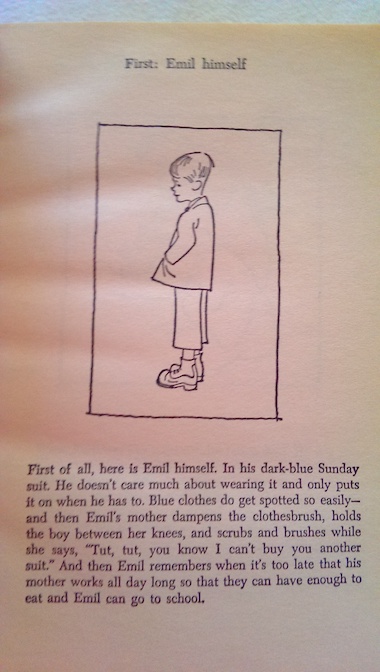
EmilHimselfThis book was originally written in German.  It was written in Germany during the period between the two World Wars.  The date of the story itself is never specified, but it may actually be earlier than when it was written, prior to World War I.  There is a sequel to the book that I haven’t read where Emil’s vacation ends early because he hears that war has broken out, an incident based on the author’s own boyhood experiences at the start of World War I.

The Emil books have an interesting history because of the time period when they were written.  This video explains how the book came to be written, the time period when it was written, and its cultural impact.  By the time the Nazis came to power, Emil and the Detectives had become popular and, as a harmless children’s book, was saved from Nazi book burnings.  The sequel story, Emil and the Three Twins, wasn’t so lucky, which is why it isn’t as well-known as the first Emil book, although it is available today.  The author, Erich Kastner, was known to be a pacifist and opposed to the Nazi government, which was why many of his works were burned during the Nazi regime and publishers were forbidden to publish new books from him.  (This video explains more about the book burnings and Kastner’s burned works.)  Although his political stance interfered with his writing, and he was questioned by the Gestapo several times, he chose to remain in Germany for the duration of the war.  Another of his children’s books, Lisa and Lottie, which was the basis for the Parent Trap movies by Disney, was written after World War II ended.

EmilTrainAt the beginning of this story, it explains that Emil Tischbein’s father died when he was very young and that his mother works hard as a hairdresser to support the two of them. When she can, she saves a little money for Emil’s grandmother as well. When the story begins, Emil is preparing for a train trip to Berlin to visit his relatives. Emil will be traveling by himself and will meet his relatives near the station when he arrives. His mother gives him some money to take to his grandmother and warns him to be careful. Emil pins the money inside his pocket for security.

On the train, Emil talks to the people who share his train compartment. One of them, who calls himself Herr Grundeis, tells him tall tales about what Berlin is like and gives him a piece of chocolate, which is apparently drugged. Emil falls asleep on the train, and when he wakes up, he realizes that he’s been robbed!

EmilGustavDetermined to get the money for his grandmother back, Emil searches for Herr Grundeis and spots him getting off the train. It’s too soon for Emil’s stop, but he follows Grundeis off the train anyway, tracking him to a café.

While Emil is trying to decide how to handle the situation, another boy who carries a horn that he likes to honk, Gustav, spots him watching Grundeis. Gustav asks Emil what he’s doing, and Emil explains the situation. Emil isn’t sure how to get the money back from Grundeis. At first, he’s afraid to tell the police what happened because of a prank he and some friends pulled at home. He worries that perhaps the police have found out about the prank and that they won’t take him seriously. Gustav is sympathetic to Emil and tells him that he can get together some friends to help.

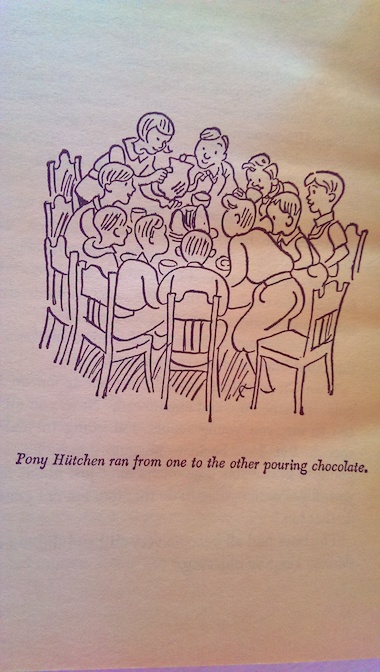
EmilPonyChocolateGustav recruits a bunch of other boys from the neighborhood, and they continue tailing Grundeis through the city to his hotel. The boys call another friend at home, who keeps track of their progress and gives them reports about what others have said.  Emil gets one of the other boys to tell his relatives that he has been delayed on important business, causing his cousin, Pony Hutchen, to come and tell him that everyone is worried and that he’s going to be in big trouble with his relatives if he doesn’t show up soon.  However, they still have the problem of deciding how to confront Grundeis and get him to return the money.  In this case, the detectives don’t need to solve the mystery of who the thief is.  The real problem is how to prove it.

This book is known around the world and has been made into movies several times, including a Disney version in 1964.  The Disney version still takes place in Germany, but for some reason, Emil’s train trip is changed to a bus trip, and the criminal’s plot is much more elaborate.  It’s available on dvd, and you can see the trailer on YouTube.

The book is currently available online through Internet Archive (multiple copies).

My Reaction and Spoilers

Overall, I liked the story, although I found the book difficult to read because the wording sounded strange and awkward in many places.  I think this is probably because of the translation between German and English.  I have the feeling that the translator was trying to be too literal in the translation instead of focusing on translating for meaning and tone.  Unfortunately, I can’t read German, so I can’t say what the original version was like.

EmilReportersThere was a note in the beginning of my copy of the book that says that many of the character names in the book are actually jokes on the part of the author. It’s not as obvious in English because the forms of the names sound reasonable for German names, but anyone who knows German would spot that they aren’t real names. For example, Emil’s last name is Tischbein, which means “table-leg,” and the thief’s alias, Grundeis, means “ground-ice.”
In the end, the boys use their numbers (they have about a hundred child detective recruits by the end of the story) to corner the thief in a bank, and when they confront him in front of the bank personnel, they manage to prove that Emil is the owner of the money using the pin holes in the bills, where Emil had pinned it to his jacket.  The author of the book also appears briefly in the story as a journalist who interviews Emil and his friends for a newspaper story about how they caught the thief. (I think he’s the one standing at the back of the group of reporters in the picture because the man’s hair looks like Kastner’s, combed back.)

Like in another of Kastner’s books, Lisa and Lottie, there is the theme of a child who behaves well because of the family’s poor circumstances.  Emil, like Lottie, is being raised by a single mother who has to work hard to support the two of them. Both Emil and Lottie understand that if they behave badly and get into trouble, it would create more hardships for their mothers.  They basically live hand-to-mouth, and the children understand that their mothers cannot take time away from work to deal with their discipline problems.  Each of them has had to shoulder some of the household burdens from an early age, and it has made them more serious and also a little closer to their mothers than many of the other children from more affluent families. Aside from Emil’s prank at home (which causes him some worry), he is obedient to his mother and also very concerned about her welfare.

A Clue in Code

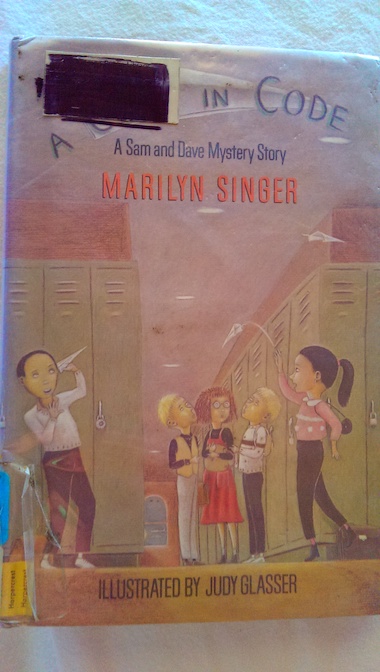
ClueInCodeA Clue in Code by Marilyn Singer, 1985.

This book is part of a series about a pair of twin boys, Sam and Dave Bean, who solve mysteries with their friends.

One day, the boys’ teacher, Ms. Corfein, has one of their classmates, Roger, collect money from the students for a class field trip.  Ms. Corfien tells Roger to put the money in her locker, but later, the money is gone.

Anyone in the class could have taken it.  When Dave went into the classroom to feed the class’s pet gerbil at lunchtime, he saw Willie, the class bully, there as well as his friend Patti, who thought that it was her turn to feed the gerbil.  Of the two, Willie seems like the best suspect for the theft because he’s been in trouble before for stealing, but perhaps there was someone else in the room before any of them arrived.

ClueInCodeSneakingSam and Dave decide to begin their investigation with Willie.  His father is the school’s custodian, and Willie has been using a copy of his father’s key to the school to sneak around after hours.  To the twins’ surprise, when they confront Willie, not only does Willie deny stealing the money, but it turns out that he’s actually been scared and upset himself.  After being caught stealing the last time, his parents have been especially strict with him, sending him to bed early, limiting his time with friends, and not allowing him to watch tv or read comic books.  In fact, his father tried to get rid of his entire collection of comic books by throwing them in the trash, but Willie rescued them and has been hiding them in the school, sneaking away to read them when he can.  However, someone has discovered them and stolen them.  Willie wants his comic books back, but he can’t report them stolen because his father thinks that they’re already gone.  Worse still, his parents will be even harder on him if he ends up taking the blame for stealing the class’s trip money.

ClueInCodeMessageIn spite of Willie’s reputation, which he deserves, Sam and Dave think that he’s telling the truth about the thefts.  Then, they happen to find a strange message that appears to be written in code after some of their classmates were throwing paper airplanes.  With the help of Rita, a friend who is very good with codes, they decode the message and uncover a valuable clue that explains why the comic books were taken and leads them to the thief’s identity.
I was pretty sure, from the very first chapter, who had stolen the money, but I wasn’t completely sure of who had taken the comic books until the end.  At first, I thought perhaps Willie’s father had found his stash and got rid of it again, but that wasn’t the case.  The thief who took the comic books was the same person who took the trip money and for the same reason.  This person’s father has been out of work, and they need the money.  It turns out that Willie has a number of comic books that are now collectors’ items, and someone is willing to pay a lot of money for them.

The Return of the Plant That Ate Dirty Socks

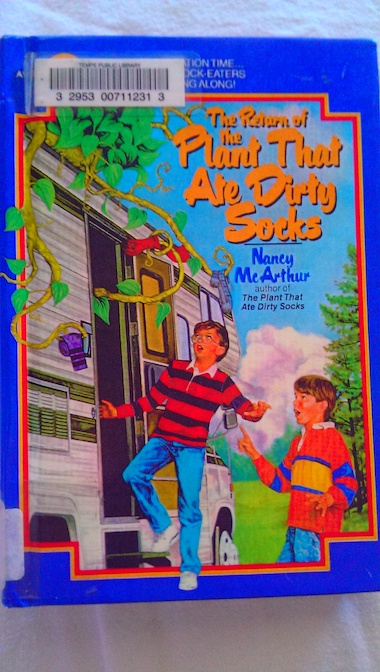
ReturnPlantDirtySocksThe Return of the Plant That Ate Dirty Socks by Nancy McArthur, 1990.

Michael and Norman’s father has finally gotten the chance to take a vacation, but his sons’ weird, sock-eating plants complicate things.  You can board pets or ask someone to come in and feed them, but how can you ask someone to leave out socks for your houseplants?  The boys’ parents still kind of think that the plants are more trouble than they’re worth, but the boys love them like pets and can’t bear to get rid of them.  Instead, they persuade their parents to rent an RV for the family’s vacation.  That way, they can take the plants along.

It seems like a good idea, although before they leave home, the boys notice that the plants are starting to produce seed pods, something that they decide not to tell their parents.  Instead, they simply remove the seed pods from the plants when they find them.  So, the family sets off for Florida and Disney World in their RV with the sock-eating plants sticking out through the sun roof.

At first, it seems like things might be okay on the trip, but one night, when the boys are visiting their grandmother and sleeping in the house instead of the RV, they forget to set out socks for their plants to eat.  When they wake up in the morning, the RV is gone.  The boys worry that the plants somehow got control of the RV and drove it off to find more socks, but it turns out that it was stolen by car thieves.  The police recover the RV but are puzzled when witnesses describe the thieves as abandoning the vehicle, screaming and running away without their shoes on, one of them only wearing one sock.  The family is relieved to get their RV back, not to mention their plants, however their adventures are just beginning.

The family has a good time when they get to Disney World, but the plants start drooping because they feel neglected, all alone in the RV all day.  To get the plants out in the sunshine and supervised more, the boys ask the people at the daycare center at the RV park if they can leave their plants there during the day.  The plants perk up a little more, getting attention from the staff and children, especially when they sing.

But, it turns out that the mother of one of the girls who has seen the plants, Dr. Sparks, is a botanist, and she’s very curious about the origin of these unusual plants.  The boys’ parents think that it might not hurt to get an expert opinion about their strange plants, but the boys worry that if the plants turn out to be very rare, scientists will want to take them away or their parents might decide to sell them.  Their parents still think that the plants are too weird and too troublesome to keep, but Michael and Norman think of them as their friends and pets.  They’ve been trying hard to keep their plants’ sock-eating abilities quiet.  Is it finally time to tell someone?  Can Dr. Sparks be trusted?

They end up asking for Dr. Sparks’ help when Fluffy accidentally eats something he shouldn’t.  Dr. Sparks knows that the plants are unusual, but by the end of the book, she’s still not sure that she believes that they really eat socks.  The boys give her some seeds so that she can experiment without taking their plants, knowing that she’ll eventually discover just how unusual the plants are.  By the end of the book, other people are also growing more plants like Fluffy and Stanley, partly because Michael’s friend Jason stole some of the seeds they were saving and sold them to other kids while Michael and Norman were out of town.  The boys can’t get back the seeds, but they force Jason to at least confess to the other kids that the plants will eventually eat socks.  Jason doesn’t think that they’ll believe him, but the boys know that it’s only right that the buyers be warned because they’ll discover the truth eventually.  Fluffy and Stanley are also starting to acquire the ability to move around on their own.

Giving Thanks

GivingThanks

Giving Thanks by Kate Waters, 2001.

This book describes the feast of 1621 that we think of as “the first Thanksgiving” from the point of view of two boys: Resolved White (a six-year-old English colonist) and Dancing Moccasins (a fourteen-year-old Wampanoag).  The book explains that the reality of this feast is somewhat different from the way many people think of it.  For one thing, the exact date is unknown, and it wasn’t really a single meal but a kind of harvest celebration that took place over several days.  The events of that celebration were re-created using reenactors from the Plimoth Plantation living history museum.

In the beginning of the book, Dancing Moccasins explains that his family has been harvesting their crops and preparing to move to the place where they live in the winter. Wampanoag lived in different places depending on the time of year, moving between them when the seasons changed.  At their winter home, they would continue hunting and fishing, returning to the place where they planted their crops at the end of winter.

GivingThanksBeginning

Similarly, Resolved’s family has finished harvesting their crops and have stored up food for the winter.  Now that most of the hard work is over, they have time to relax and celebrate.  The community is planning a feast.  Resolved and his friend, Bartle, follow some of the men, who are going out hunting and target-shooting.

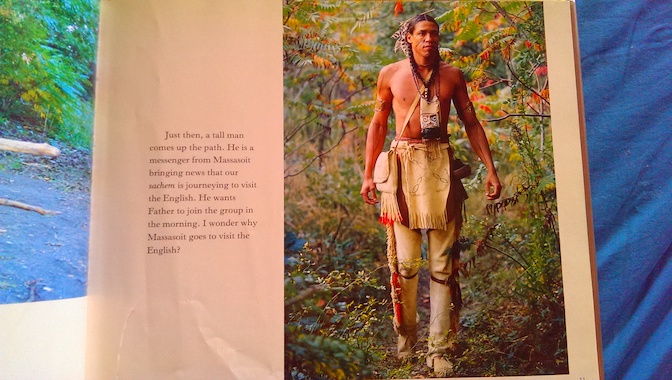
The colonists meet up with some of the Wampanoag, which is how Dancing Moccasins and Resolved first see each other.  Dancing Moccasins returns home and tells his father what he has seen.  Then, a messenger arrives from their chief, Massasoit, saying that he will be visiting the colonists soon, and Dancing Moccasins’s father is invited to come.

GivingThanksMessenger

Just as Dancing Moccasins is wondering about the purpose of this visit, Resolved is wondering the same thing because word has reached the colonists that they will soon be visited by the chief and representatives of the tribe.  (The book explains in the back that the exact reasons for the Wampanoag visit to the colonists are unknown today, only that it happened at the same time that the colonists were planning their harvest feast.) The two boys meet again when Dancing Moccasins accompanies his father on the visit to the colonists’ village.

GivingThanksGovernorDinner

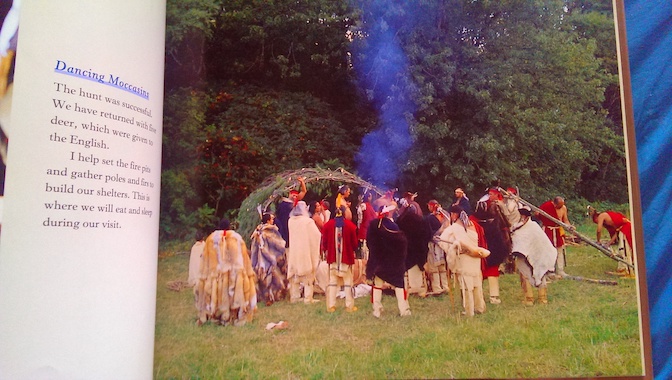
When the Wampanoag arrive at the village, they are treated as honored guests, and some of the Wampanoag go deer-hunting to provide a present for their hosts.  The chief dines with the governor of the colonists.  The Wampanoag build shelters for themselves, where they will stay during their visit.

GivingThanksShelters

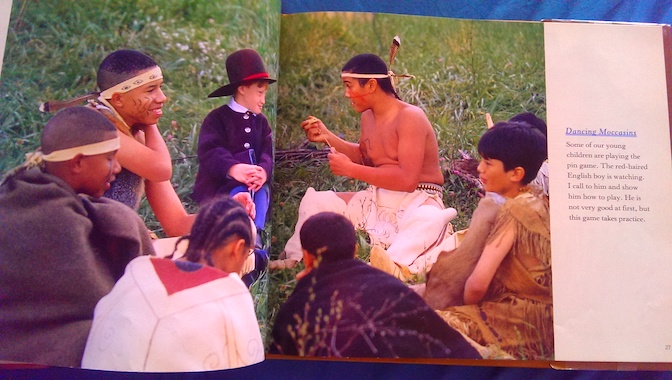
Eventually, Dancing Moccassins invites Resolved to play a game with him and some other Wampanoag boys when he sees him watching them.  Some of the Wampanoag men also join in the games that the English men play, like competing to see who can throw a log the farthest.

GivingThanksGames

At the end of the day, Dancing Moccassins and Resolved each eat with their own families, but there is plenty for everyone.

There is a section in the back with historical information about the harvest feast, traditions about giving thanks among both the colonists and the Wampanoag, and how Thanksgiving eventually became a national holiday in the United States.  There is also information about food and clothing in the time of the story and a recipe for samp (a kind of corn pottage eaten by the Wampanoag and later adopted by the English colonists).  The book also has some information about the Plimoth Plantation living history museum and the reeanctors.  It is part of a series of books by the same author about the lives of children in Colonial America.

The book is available to borrow and read for free online through Internet Archive.