The Twin in the Tavern

TwinTavernThe Twin in the Tavern by Barbara Brooks Wallace, 1993.

Young Taddy has lived with his Aunt and Uncle Buntz in Virginia ever since he can remember. When they die during an epidemic, he is left completely alone and afraid that he will be sent away to a work house. Before his uncle dies, however, he tells Taddy something that gives him even more reason to be afraid. He tells Taddy that nothing is how it seems and that Taddy is not really their nephew. He says that Taddy will only learn the truth when he finds his twin, but he must beware because he is in danger. Unfortunately, he never says where Taddy’s twin is or what kind of danger he is in.

Before Taddy can decide what to do, a couple of thieves, Neezer and Lucky, come to rob the house because they heard that Mr. and Mrs. Buntz were dead. When they discover Taddy in the house, they bring him with them to Alexandria and make him work in their tavern. Taddy is only given scraps to eat and he must sleep under a table in the kitchen with another boy who works for Neezer called Beetle. However, by coincidence, Neezer and Lucky may have brought Taddy to the very place he needs to be to find the answers about his past and his true identity.

Danger seems to lurk around every corner in the city, and Taddy doesn’t know who to trust. Even when Neezer hires him out to work in the home of the wealthy Mrs. Mainyard and her two daughters, sinister characters surround him, from the suspicious Professor Greevy to the stern John Graves, who visits the family.  At one point, Taddy thinks that he’s found his twin, but the boy mysteriously vanishes. Will Taddy find his twin and the secret of his past, or will the danger that his uncle warned him about find him first?

This book was a BOOKLIST Editors Choice Book in 1993 and won the 1994 Edgar Allan Poe Award.  It is available to borrow and read for free online through Internet Archive.

My Reaction

This was one of my favorite mystery stories when I was a kid!  Orphans with mysterious pasts are staples of children’s literature and make for compelling mystery stories, and the addition of a secret twin makes it even better!  Secret twins can be somewhat cliche in stories, but this one is good because there’s an unexpected twist for Taddy that he never considered until the truth is finally revealed.

Many of Barbara Brooks Wallace’s mystery books involve sinister characters with hidden agendas and children who don’t know who to trust because they don’t fully understand the plot they’re caught up in.  This book is like that because Taddy doesn’t know the real source of danger to him.  Like other children in stories of this type, Taddy frequently depends on the help of other children because he doesn’t know which adults to trust.

The story is set at an unspecified time in the past, although it appears to be sometime in the 19th century.
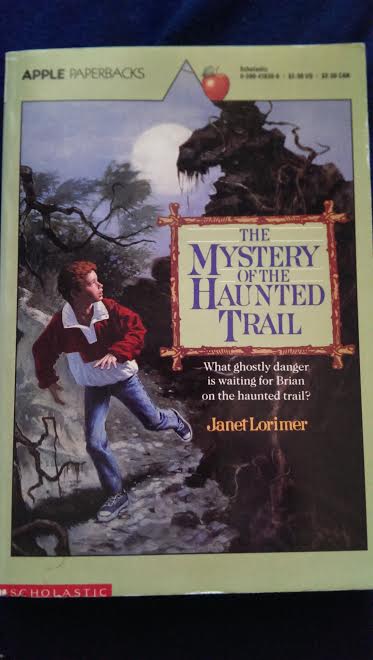
The Mystery of the Haunted Trail

MysteryHauntedTrailThe Mystery of the Haunted Trail by Janet Lorimer, 1989.

Brian Kelly wasn’t too excited at first when his teacher assigned his class to write letters to students at a school in Hawaii.  He doesn’t really like to write, and the whole thing sounded boring, but it turned out to be pretty fun when his new pen pal, Alani, wrote back.  Brian discovered that he and Alani had a lot in common, and he even got to meet Alani when his family came to California on a trip.  Then, best of all, Alani’s family invited Brian to spend part of the summer with them in Hawaii!

Brian loves Hawaii from the moment he arrives.  Alani’s family lives in a rural area near Kalawa.  All of the families in the area raise their own vegetables and keep animals.  They depend on what they earn from selling food although some of them, like Alani’s mother, who is a nurse, have other jobs as well.  Alani’s father, like Alani’s grandfather, is primarily a farmer.  Alani’s grandfather lives with him on land that the family has owned for generations.

Alani and his family enjoy showing Brian around their island and talking about the history of the place.  Brian particularly likes the stories that Alani’s grandfather, who they call Kupuna, tells them, although some of them are frightening.  At the luau that the family and their friends have to welcome Brian to Hawaii, Brian overhears people talking about the Night Marchers.  They say that the Night Marchers have been seen recently and that bad things have been happening in the area, like crops dying and the nearby stream starting to dry up.  Some people seem to think that it’s a sign of bad luck and that maybe they should move away from the area.

According to Kupuna, the Night Marchers are a ghostly parade of the ancestors of the people who have lived there for generations.  Sometimes, it’s just ordinary people and sometimes it’s the souls of warriors.  Sometimes, Hawaiian gods may even walk among them.  But, when they march, any living person must either flee from them or, if that is impossible, they must lie down and hide their eyes.  At the head of the Marchers is a ghostly spearman who will strike down any living person who sees them, unless that person is related to one of the Marchers themselves.  They spare members of their own families.  People who are struck by the spear of the Marchers appear to have died of a heart attack.

The place where the Marchers supposedly walk is an old trail that leads to a sacred place where Alani’s ancestors are buried.  Brian is curious to see the place, but Alani warns him away, saying that they are not allowed to go there because it’s too dangerous.  However, Brian soon sees the Marchers himself one night in Alani’s family’s fields, and the next day, their crops are dead.  When Brian notices strange footprints in the fields as well, he realizes that some living people may be responsible for the awful things that have been happening in the area, but the only way he can prove it would be to explore the haunted trail himself and track the “ghosts” to their lair.

Janet Lorimer’s books are interesting because they are often a combination of mystery and ghost story.  There are logical explanations and living villains who are responsible for the things that are happening to Alani’s family and their neighbors, but there is also a definite supernatural element to the story as well.  Telling you where one ends and the other begins may be saying too much.  It may be more fun to let you find out yourself.

The book is currently available online through Internet Archive.

Mystery of the Roman Ransom

romanransomMystery of the Roman Ransom by Henry Winterfeld, 1971.

This is the sequel to Detectives in Togas, a mystery story about a group of boys in Ancient Rome.  Like the first book, it was originally written in German and translated into English.

On Xantippus’s birthday, his students decide that they want to give him a special present because they think he’s turning 50.  Actually, it turns out that they did their math wrong because Xantippus (whose real name is Xanthos and only known as Xantippus as a nickname among his students) was born in Athens, and the Greeks use a different dating system from the Romans.  His Roman students forgot even after he had explained that in their history lessons, which really annoys him.  He is also really annoyed that the special present they decided to give him was a slave of his very own so that he can concentrate on his studies while the slave does all of his chores.  Xantippus points out that, far from being a present, slaves are actually a burden because there are extra expenses for owning them and it would end up costing him more money than he could afford (much like the “free” cars that Oprah Winfrey gave to some of her audience members), and Xantippus wants no part of it.  He gives the boys the day off from lessons to reward them for being thoughtful (although, not quite thoughtful enough), and tells them to return the slave to the dealer who sold him and get their money back.  But, it turns out that this slave isn’t just any ordinary slave.

romanransompicWhen they return to the slave dealer’s home, he is gone, and the place is boarded up.  An elderly slave who was left behind said that all of the other slaves were sold, and then the dealer simply fled, abandoning him.  He also says that there was someone else who had come to see the dealer, demanding that he hand over the slave called Udo (the one that the boys had already bought).  This man was a former gladiator with only one eye, and he was very angry that Udo was gone.  He swore that he would he would get Udo one way or another, dead or alive.  He threatened the dealer, saying that he would return later and kill the dealer and all of his slaves if Udo was not among them then.  The slave dealer, not knowing the names of the boys who had bought Udo or where he could be found and therefore unable to get Udo back, fled in fear of the former gladiator’s threats.
During this time in Rome’s history, crime rates were high because gangs of ex-gladiators, runaway slaves, and criminals roamed the city, robbing and terrorizing the citizens.  The boys soon learn that the dealer’s fears were well-founded when the ex-gladiator finds them in the marketplace while they are trying to decide what to do with Udo.  He tries to take Udo from them by force, but they fight with him and manage to escape by dumping a pail of honey over his head.

Once the boys are safely away and in their secret hideout with Udo, he reveals his true story to them.  At first, they had believed that Udo was deaf and mute because he acted like he couldn’t speak, but he tells them that he was afraid to do so because he is a hunted man.  He was the slave of a powerful Roman army commander now stationed in Germania.  He was sent to Rome by his master in order to deliver an important letter, but upon learning that he would be killed after handing over this letter, he did not complete his mission.

The meeting was to take place in a cemetery at midnight, and when Udo arrived, he became frightened and hid.  Then, he overheard his contacts, two men who did not seem to even know each other, talking about how he would be eliminated after passing on his message.  Now, these men are looking for him for the message that he did not give to them, and Udo cannot go back to his master because his master would probably kill him for disobeying orders.

Udo discovered that the letter contained instructions for an assassin to murder an important Roman senator, and upon learning that, all of the boys are immediately worried because they are all the sons of senators.  They demand to know which senator will be murdered, but Udo cannot tell them because that information was in the letter, and he lost it after he fled from the cemetery.  He thinks that it’s in a cellar where he hid and spent the rest of the night before he was found by a group of gladiators who sold him as a slave the next day.  Now, he’s not quite sure where that cellar was.  Udo also says that his master will arrive in Rome himself in three days and will probably just pass on the name of the intended target to the assassins then when he learns that Udo didn’t.  With time running out and their fathers’ lives possibly on the line, the boys and Udo struggle to find the letter and stop the assassination plot before it’s too late!

In Ancient Rome, slaves were common among the wealthy, and owners had the power of life and death over them.  They could punish a slave severely for even a small mistake, abandon them if they were sick or elderly, and even sell them to the gladiatoral arenas, where they would have to fight for their lives or die as public entertainment.  To the boys in the story, such things are simply facts of life as they have always known it.  Rome in general was a violent place.

The book is available to borrow and read for free online through Internet Archive.

Detectives in Togas

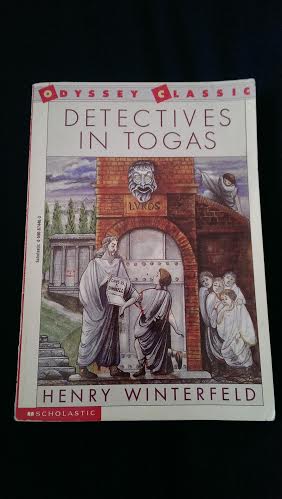
detectivestogasDetectives in Togas by Henry Winterfeld, 1956.

Seven Roman boys, all the sons of wealthy families, attend the school run by the Greek mathematician and scholar, Xanthos. Although the boys are proud of their school, the lessons are sometimes boring, and everyone has given Xanthos the nickname Xantippus, in reference to the wife of Socrates, who was known for her nagging.

During a rather boring lesson on Greek vocabulary, a fight breaks out between two of the students that ends up creating a strange mystery for all of them. Caius was poking Rufus with his stylus, so Rufus wrote “Caius is a dumbbell” on the wax tablet where he was supposed to write his lesson. The boys get into a fight, and when Xantippus breaks it up, he sends Rufus home with the threat that he will expel him from the school.

detectivestogaspicThe next day, when the other boys arrive at school, they discover that their teacher has been attacked and robbed during the night. Worse still, when they go to Rufus’s house to visit him, they learn that someone has written “Caius is a dumbbell” on the side of the Temple of Minerva, which has been dedicated to the emperor. Defacing a temple is a crime, and soon Rufus is arrested and sent to prison (being young and part of an important family does not guarantee him special treatment). Rufus swears that he was not the one who defaced the temple, but who else could have done it?
Rufus disappeared that night, but if he didn’t go to the temple, where was he? Does the vandalism have anything to do with the attack on their teacher?  The key to the mystery seems to be a mysterious soothsayer with ties to some of the highest officials in Rome. Something sinister is happening in Rome, and the boys are the only ones who can discover what it is!

This story was inspired by a piece of graffiti found during excavations of Pompeii in 1936. (This video doesn’t actually show the Caius inscription but similar types of graffiti, including ones done by children. I keep looking for the Caius graffiti, but I can’t find pictures of it. This video of a lecture at the Western Australian Museum about ancient graffiti in Pompeii shows the more graphic adult kind of graffiti with swear words, if you’re interested.) In ancient Pompeii, someone wrote “CAIUS ASINUS EST” on the wall of a temple, which basically means “Cauis is a dumbbell” (or similar type of insult) in Latin.

Although the book was originally from 1956, it was also originally written in German. I have a later reprinting that was translated into English.  The book is available to borrow and read for free online through Internet Archive.  There is a sequel called Mystery of the Roman Ransom.

Valentine Blues

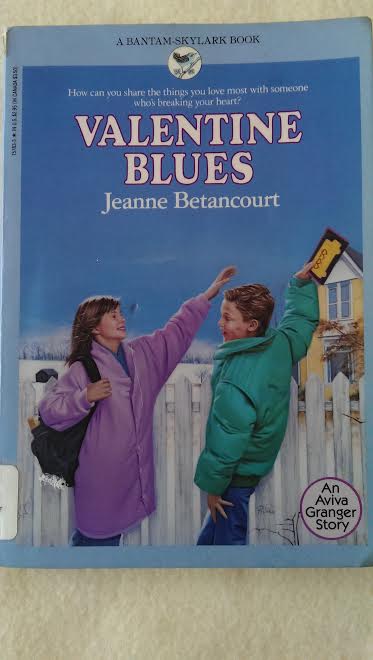
valentinebluesValentine Blues by Jeanne Betancourt, 1990.

This book is part of the Aviva Granger Stories series.  (It’s the only one I have in the series right now.)

In the last book, Aviva’s best friend, Josh, came to live with her, her mother, and her step-father.  Josh was living in an orphanage before that, and since he and Aviva were close, her mother and stepfather thought that it would be natural to invite him to be part of the family.  At the time, Aviva thought that it was a good idea, but being friends with someone doesn’t mean that it will be easy living with them, and Aviva’s family life is already complicated!

Aviva’s parents are divorced, and both her mother and father are already in new relationships.  Her mother has remarried, and Aviva not only has a stepfather but a half-sister (college age) and half-brother (baby) living in the same house.  Aviva’s father has a girlfriend, Miriam, and Aviva doesn’t get along well with her.  Miriam would like it if she and Aviva’s father had a child of their own.

When Josh comes to live with Aviva’s mother and her family, Aviva realizes that sharing a family and house with him makes things even more complicated.  He takes too long in the bathroom and makes her late to school.  He’s one more person for her mother to pay attention to, so Aviva gets less attention.  Even her dog seems to like Josh better now!

Then, shortly after Valentine’s Day, Aviva overhears Josh and his friend Ronnie Cioffi talking about girls and giving them ratings based on their looks.  Out of 10 points, Cioffi rates Aviva as a 2, and Josh agrees.  Josh has a crush on Louise, a girl they know from school, and she has a much better figure.

It isn’t that Aviva is in love with Josh, who she sees more as a friend/brother, but it hurts that he seems to be taking her place in the family and doesn’t even really appreciate her, joining in with his friend in making fun of her body.  With her time divided between two households, two parents who hardly seem to have time for her these days, and Josh moving in and taking over, Aviva worries that maybe she doesn’t really belong anywhere or to anybody.

It takes a night when Aviva sleeps out in the barn without telling anyone where she is to make the people closest to her realize how much she needs them.  A sleepover at Louise’s house (where the girls candidly discuss their own ratings for the boys they know) and Aviva’s anonymous question in sex ed class also help to put the rating system into perspective for all the kids.

The book has some Christian themes because the children go to a Catholic school, although this book mostly focuses on family life and girls’ and boys’ perceptions of each other.  The kids are eighth graders, and there is also some talk about sex ed.

Soup

soupSoup by Robert Newton Peck, 1974.

This is the first book in a series about the author’s childhood best friend.  His friend’s real name was Luther Wesley Vison, but he always hated that name.  Because Luther refused to come home whenever his mother called his name for dinner, his mother took to just yelling, “Soup’s on!” when she wanted him to come home to eat.  After that, everyone else just started calling him “Soup”, which he liked a lot better than “Luther.”

Together, Soup and Robert had a reputation for getting into scrapes in their small town in Vermont.  The book is a series of short stories about the funny things they did as kids, like how they got revenge on the school nurse for asking embarrassing questions, how Soup got punished for breaking a window other than the one he’d actually broken, how Soup talked Rob into rolling down a hill in a barrel, and how Robert’s aunt let him tie her to a tree right before a lightning storm.

souppicSome of the stories are laugh-out-loud funny, and some of them have kind of a moral lesson to them, like the time when Rob realized that he didn’t have the heart to lie to his mother even if it would allow him to escape punishment for talking back to the school nurse, the time when Soup and Rob tried to cheat Mr. Diskin out of some money so they would have enough to go to the movies but ended up feeling guilty, and how the boys made themselves sick by attempting to smoke cornsilk.  Others are just stories of childhood events and friendship, like the story of how Rob and Soup played football and how Soup loaned Rob his new shoes when his were ruined.  Even though Soup often got Rob into trouble, he really was a good friend and went out of his way to make Rob feel better when he needed it the most.
Although it is a short chapter book that is easy to read, a couple of the stories might require some further explanations for young children reading them, like the one where the boys smoke cornsilk using homemade pipes and the one where Soup says that someone told him it was all right to cheat Mr. Diskin because he’s a Jew (a belief that they come to rethink when they feel guilty for cheating someone who was always fair with them and was kind to them even when he discovered the deception).  They deal with older practices and prejudices and can be the start of discussions about the lessons people learn by making mistakes. Other than that, these stories present a fascinating look at what it was like to grow up in the country during the 1920s.

The book is available to borrow and read for free online through Internet Archive.

This Can’t Be Happening At MacDonald Hall

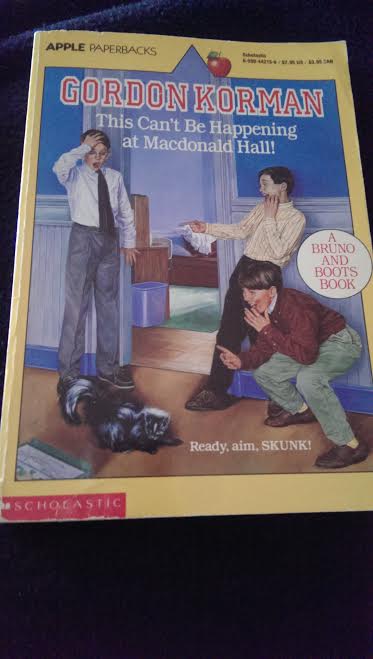
macdonaldhallThis Can’t Be Happening at MacDonald Hall by Gordon Korman, 1978.

Bruno and Melvin (called Boots) have been roommates ever since they began attending boarding school at MacDonald Hall.  The two of them are best friends, and they do everything together.  Quite a lot of what they do involves practical jokes.  But, they’ve really been pushing the limit with their antics, and when they go a little too far during a hockey game, the headmaster gives them the ultimate punishment: they can no longer share a room.  Mr. Sturgeon thinks that they’re a bad influence on each other.  Each of them is assigned to a new roommate, and they won’t even be able to hang out together.

The prospect of losing each other as best friends is too much for Bruno and Boots. Besides, neither of them likes their new roommates.  Boots has to share a room with George, who comes from a wealthy family and is only interested in money.  George is also a germophobe who hates it that Boots sneezes every morning when he wakes up.  Bruno’s new roommate is Elmer, the school’s supreme science nerd.  Elmer isn’t happy about Bruno’s presence, either, because Bruno and his belongings take up valuable space that Elmer requires for his many projects.  Obviously, the situation is completely intolerable for everyone.

Bruno, the idea man of the duo, declares that he will find a way for him and Boots to become roommates again.  They meet secretly at night to discuss their plans.  The boys try every tactic they can think of.  They try making themselves completely obnoxious to their new roommates so that Mr. Sturgeon will have pity on them and give them their old room assignments.  They try framing George and Elmer for some outrageous pranks of their own so Mr. Sturgeon will think that they’re a bad influence on Bruno and Boots.  Bruno and Boots even try (as an extreme measure) behaving themselves!  What will finally work?

This is the first book in the MacDonald Hall Series (or Bruno and Boots) series.  It is currently available online through Internet Archive.

The Mystery Hideout

MysteryHideoutThe Mystery Hideout by Ken Follett, 1976.
The first time Mick Williams meets Randall Izard (called “Izzie”) is when the news dealer Mick works for asks him to train the new boy on his paper route, and Mick learns that Izzie will also be going to his school. Mick doesn’t like Izzie much at first. The new boy speaks with a posh accent and is riding an expensive bike that he says was a present from his father, who makes television ads for a living. Mick doesn’t have a father, and he stole the bike that he rides for his paper route.

Mick guesses that Izzie’s family used to have more money but have fallen on hard times, which is why Izzie needs the paper route.  Mick is worried about his own future.  Someone is building a new hotel on the street where he lives by knocking down the old film studios, and his mother says that they’re going to demolish all the old apartment buildings around it.  That means that they’ll have to find a apartment, which isn’t easy because they don’t have much money, and not everyone wants to rent to a lone woman with a child.

Mick kind of envies the criminal gangs that he reads about in the paper, like the Disguise Gang.  They stage daring raids on banks while wearing clever disguises so that no one knows that they really look like.  They fool everyone and get away with tons of money.  Mick wishes that he was that clever!  If he was, his mother would never have to worry about money again.

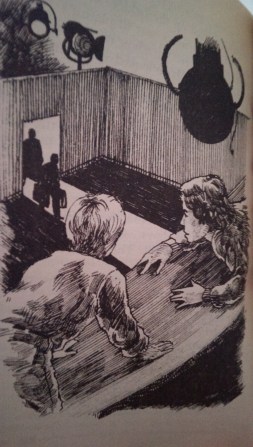
MysteryHideoutPicBut, Izzie turns out to be a good friend for Mick.  They both love to play soccer, and Izzie tells Mick that his father used to work in the old studio buildings that they’re tearing down to build the new hotel. In fact, Izzie even knows a secret way in, so the boys sneak in to explore a little.  They’re goofing off with some of the props when they make the startling discovery that the prop guns are loaded with real bullets! Then, the boys have to make a run for it because there are other people sneaking around the old studios. What is going on there?

This book actually takes place in London. I don’t think they actually say the name of the city in the story, but they do mention the Thames, the money is all in pounds, and there are children playing cricket.  But, it’s the kind of story that could take place anywhere.  Mick and Izzie are realistic characters.  Both of them are worried about their families’ hard times.  Mick in particular wants to be the man of the house and to help his mother in her struggles to provide for them.  His inner debate about which side of the law he should be on is also feels real, and it’s satisfying what he chooses when he realizes what criminals are really like and the danger they pose to people he cares about.