The Story of Ferdinand

The Story of Ferdinand by Munro Leaf, drawings by Robert Lawson, 1936.

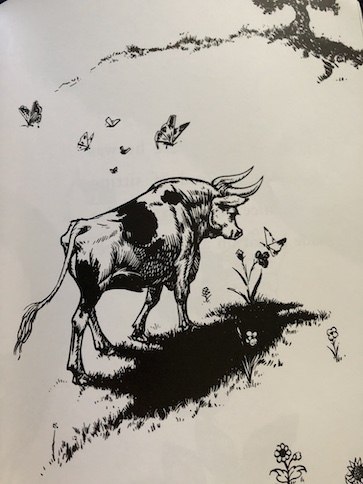
Ferdinand is a young bull living in Spain. He has been different from the other young bulls since he was a little calf. While the other young bulls liked to run around and butt their heads together, Ferdinand preferred to simply enjoy the peaceful countryside and smell the flowers. His mother sometimes worried about him, sitting all by himself under his favorite tree. She was afraid that he would be lonely, but Ferdinand told her that he just liked sitting under the tree and smelling flowers and that he didn’t want to play rough with the other young bulls. As long as Ferdinand was happy, his mother was content to let him do what he wanted to do.

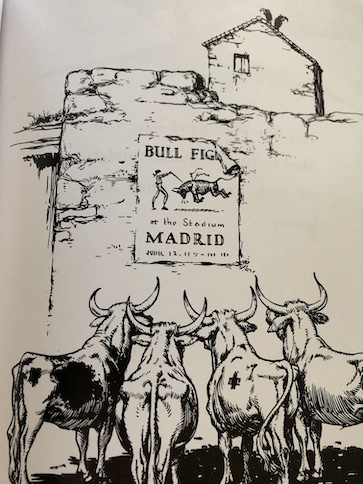
As time went on, Ferdinand and all of the other young bulls grew up big and strong. The young bulls who had always played rough together were fascinated by the bull fights held in Madrid. They thought that it would be exciting to be picked to participate in the fights. But, Ferdinand had no interesting in fighting of any kind. Although he was big and strong, he still preferred to just enjoy his flowers and his favorite tree.

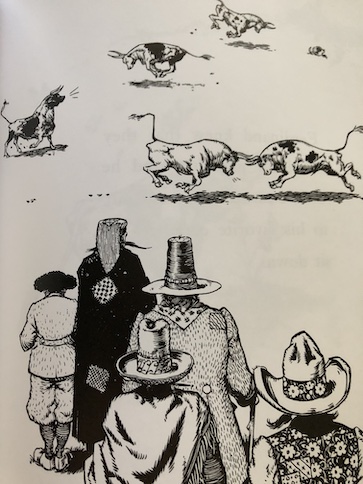
When some men come to the field to pick out bulls for the bull fight, the other bulls try to show off for the men. Ferdinand doesn’t, but by accident, he sits on a bee and is stung. When the men see him jumping around in pain, they assume that he must be the fiercest bull in the field!

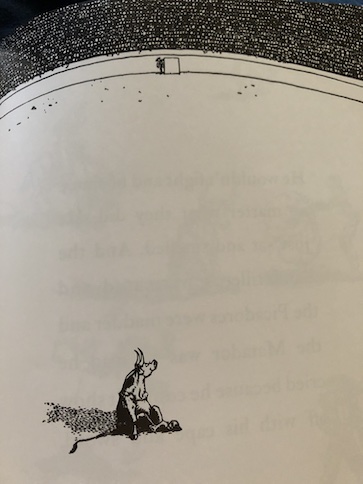
Poor Ferdinand is carted off to Madrid, but no matter what the bull fighters do in the arena, they just can’t get Ferdinand interested in fighting them. There is only one thing that interests Ferdinand, and that’s flowers. When the men put him in the bull fighting arena, he just sits and looks at the pretty flowers that the women in the stands are wearing in their hair, enjoying the smell. They are so disappointed at the lack of fighting that they put Ferdinand back in the cart and put him back in the field … which is exactly where he wants to be.

The book is available to borrow and read for free online through Internet Archive (multiple copies, including some in different languages). It has been reprinted many times. It has not been out of print since its first publication, and it has been made into a movie.

My Reaction and A Little History

I remember that I didn’t care for this book when I first read it years ago. I was really worried for poor Ferdinand when he was picked to join the bullfight. Because the book is for young children, it doesn’t make it fully clear that the bullfight is supposed to end with the death of the bull. The bullfighters all have spears and swords “to stick in the bull”, and the book says it’s to make the bull mad, but adults and older kids realize that they’re really going to hurt and kill the bull during the fight. There are vultures in some of the pictures as a clue that death is a real risk.

Fortunately, nothing bad happens to Ferdinand in the story. Because Ferdinand is a peaceful bull, who has no interest in fighting and only wants to enjoy flowers, he is not exciting enough for the bullfight, so he gets sent home to the field and the peaceful life he loves. The other bulls may not know that their lives could be much shorter because of their willingness to fight.

It’s also interesting to note that this book was written in the 1930s, when the world was headed for World War II. It was also published shortly before the Spanish Civil War. Because of its pacifistic themes, it was banned by both Franco and Hitler. The author, Munro Leaf, said that he didn’t really mean the story to be a serious one, but its themes resonated with even the adults of his time, in different ways, as this article from Sotheby’s notes:

“In 1937 Leaf wrote that he had published a book he “thought was for children… but now I don’t know” and in 1938 The New Yorker wrote “Ferdinand has provoked all sorts of adult after-dinner conversations.””

It wasn’t just Hitler and Franco who were suspicious of the book’s intentions. Some people also suspected it of being “Red Propaganda” or “Fascist Propaganda”, presumably because some people feared the pacifism in the story would encourage people not to fight communists or fascists. Some people also questioned the book’s message on the topic of masculinity. I could see that the story could be regarded as a commentary on men who think they have to tough, macho fighters, like the bulls. Even though Ferdinand might be regarded as a failure as a bull for not engaging in the fighting and rough play of the other bulls and not going through with the bullfight, he lives a happier, more peaceful, and ultimately, longer life because of it. Maybe he’s not a failure after all but just smarter than the average bull. Ferdinand is certainly a non-conformist who finds a way to make it work for him. How any reader might feel about that could depend on what they think conformity means and how they feel about that.

However, the book also received a lot of positive support. There is an anecdote that Gandhi loved it, and President Franklin Roosevelt requested a copy. The Sotheby’s article also recounts a story that I first heard from my children’s literature teacher when I was in college, that 30,000 copies of the book were sent to Germany after World War II as a peace gesture. When my teacher told the story, she explained that few children’s books were published during the war (and if you’ve already read my review of Emil and the Detectives, you already know that even children’s books were not exempt from book burnings if they had anti-war themes), so the distribution of the copies of The Story of Ferdinand were welcome, and the children who received them loved the story.

The Rover Boys at School

The Rover Boys

The Rover Boys at School by Arthur M. Winfield (aka Edward Stratemeyer), 1899.

The three Rover boys, Richard, Thomas, and Samuel (called Dick, Tom, and Sam), live with their aunt and uncle in the country, but they learn that they are going to be sent to boarding school. The boys have been restless on the farm because they used to live in the city.

The boys’ father, Anderson Rover, is a mineral expert and made his fortune in mining. The family had lived in New York, so the boys are accustomed to city life. The boys’ mother died of a fever when they were young. After his wife’s death, the boys’ father traveled restlessly because of his grief, leaving the boys at boarding school in New York. Then, he had the notion to go to Africa and left the boys with their Uncle Randolph. The boys and their uncle haven’t heard from him since, and they worry that something has happened to him.

When the boys first arrived at the farm, they enjoyed the outdoor life of the country, but there isn’t much variety to the activities, and the boys start getting to trouble when they get bored. Their Uncle Randolph spends all of his time in studying scientific farming, and he can’t understand why the boys can’t take an interest in the subject or at least give him some peace and quiet for his work. The boys aren’t too impressed because, so far, their uncle doesn’t seem too successful at it. Richard (Dick) is the oldest of the three boys and is often quiet and studious, so he gets along better with Uncle Randolph than the others. He is 16 at the beginning of the series. Thomas (Tom) is fun-loving, likes to play pranks, and is 15 years old. His pranks are part of the reason why the boys are driving their uncle and aunt and their cook crazy. Samuel (Sam) is 14 years old and athletic.

Uncle Randolph doesn’t know much about kids or young people, so boarding school seems like the ideal solution. The boys’ aunt and uncle think that the boys need some discipline. They do, but the boys are also looking forward to seeing something of the world and having some adventures, so the prospect of going to boarding school sounds exciting to them. They’ve been to boarding school before, but they think it would be exciting to go to a military academy.

Before the boys leave the farm, Dick is attacked by a tramp, who steals his watch and pocketbook (wallet). The boys chase him and get the wallet back, but Tom almost drowns and Sam is almost swept over a waterfall while they try to pursue the tramp, who escapes in a boat with the watch. The boys are sad about the loss of the watch, which belonged to their father.

Tom gets a letter from his friend, Larry Colby, to say that he’s going to be attending the Putnam Hall Military Academy soon, and Larry’s father has recommended the school to the boys’ uncle. Uncle Randolph says that he’s decided to take the suggestion. The boys think it sounds exciting, and they’re glad that they’ll be going to school with someone they know. Uncle Randolph says that the headmaster of the school, Captain Victor Putnam, is a former military man who has a reputation for being kind to his students but strict on discipline, so it sounds like what the boys need.

Later in the story, they explain that Captain Putnam is a graduate of West Point and that he used to serve under Major General Custer, helping to put down Indian uprisings (Native American) until he was injured in a fall from his horse. For this book’s original audience of boys living in the late 19th century, this probably would have sounded exciting and noble, but not to people from the early 21st century. However Captain Putnam would have looked at it, quelling Native American uprisings would be essentially admitting to being part of their oppression because they weren’t uprising for nothing, and that fall from his horse is probably the only reason why he would even still be alive at the time of this story, given what eventually happened to Major General Custer. Because Custer had been a Civil War hero, people were shocked and saddened by his sudden and violent death. As with many people who die young, they romanticized his past and exaggerated his story, turning him into a legend for young people to live up to. Eventually, the romanticism wore off, and the reality stayed (he was the bottom of his class at West Point, not a student parents would really want their kids to emulate, and there were darker sides to his life and personality than most people in the 1800s would have known and which wouldn’t be appropriate talk for children), which is why his modern legacy isn’t as great as people a hundred years or more ago would have thought. Captain Putnam doesn’t look as exciting and heroic as advertised by association, but it’s enough to know that the Rover boys would have thought that it sounded impressive because of what their elders would have told them and so would their earliest readers, for similar reasons.

Before the boys leave for school on the train, Tom plays one last trick on the unpleasant station master by throwing a firecracker into some trash that the station master was burning, setting the mood for the boys’ eventual arrival at school.

After the train ride, the boy have to continue part way by boat. On the boat, they meet three pretty girls (how fortuitous) and a bully who also goes to their new school, Dan Baxter. The bully is harassing the girls by continuing to try to talk to them when they want him to leave them alone. Dan doesn’t say anything shocking to the girls, it’s more that he’s off-putting because he’s rather pushy and full of himself and can’t read a room to see that he’s making the girls uncomfortable because of the way he talks. It’s awkward. The Rover boys step in and try to get Dan to leave the girls alone, making an enemy of Dan. The girls (Dora Stanhope and her two cousins, Grace and Nellie Laning, who belong to prosperous farming families in the area) are grateful for the intervention and think that the Rover boys are better behaved than Dan is. The boys talk to the girls about their new school and learn that they don’t live far from the school, although they don’t mix with the students there much because the students at Putnam Hall don’t leave the campus very often. The boys hope that they’ll have the chance to see the girls again while they’re at Putnam Hall. (You know they will.)

Tom’s Putnam Hall experience starts off with a bang … literally. As the boys arrive at the school, Tom decides to give the other students a “salute” by scaring them with another of his firecrackers. That’s when Tom gets his first taste of military discipline from the Head Assistant Josiah Crabtree, the second in command at the school and the strictest disciplinarian in the place. Most of the school would have given the prank a pass, especially from a new boy, but Josiah Crabtree takes exception to Tom’s attitude and doesn’t accept his excuse that he doesn’t need to answer to Crabtree because he has only just arrived at the school, isn’t an official student yet, and shouldn’t be subject to the school’s rules. (Tom may have thought that military school would be exciting, but it’s pretty clear that he doesn’t have the first clue what military discipline is about.) Crabtree marches Tom off and locks him in the guard room to wait for Captain Putnam to return to the school and administer his discipline. This is actually in Tom’s favor because Captain Putnam understands that his students are still boys, and therefore, he isn’t as strict with them as he would be full adult soldiers.

Josiah Crabtree’s ultra-strictness has caused him to be not well-liked by other students at the school. When he and Tom discuss Tom’s prank while waiting for Captain Putnam, Tom continues to argue the point that he is not yet a student at the school and that Crabtree has no right to lock him up like he has. Tom tells him that he wants to be released to stay at the hotel in town so he can contact his guardian because he may not wish to join this school after all, threatening to tell his uncle of his mistreatment. Crabtree is correct that setting off a fire cracker to scare people isn’t the best way to start off on the right foot with the faculty (I wouldn’t have liked it if someone did it to me, and this is a school where people learn to fire real guns, so you can’t have people who treat firearms and explosives like toys), but Tom’s point that immediate imprisonment before he’s even really joined the school and been notified of the school’s rules is a valid criticism, and he is not so committed to the school at this point that he can’t leave if he wants to. If Tom makes false imprisonment a public issue, it would damage the reputation of the school. That threat is worrying to Crabtree, who knows that he has already rubbed others the wrong way and made a few enemies of his own.

Tom runs away from Crabtree and hides in the forest outside the school. He plans to walk into town, but along the way, he spots a campfire. He listens in on the conversation of the men sitting by the campfire. He discovers that one of them is the tramp who stole their father’s watch before, and he listens to the men discussing some clandestine “mining deal.” When they catch Tom spying on them, Tom confronts the man called Buddy about stealing his father’s watch. Buddy and his friend deny it, and Tom fights with them before running away and getting help at the Laning farm, where he meets Grace and Nellie again and the family gives him a room for the night. When he explains his story to the family, he learns that Josiah Crabtree has been courting Dora Stanhope’s widowed mother because she owns a sizeable farm and has money from her first marriage.

In the morning, Tom returns to the school and makes his case to Captain Putnam, arguing as he did the night before that he had not yet officially joined the school before Josiah Crabtree imprisoned him and confiscated and searched his luggage. Captain Putnam makes it clear to Tom that certain things, like fire crackers, are forbidden at the school, and he will have to accept that if he’s serious about being a student there. Tom asks what the point is of him joining the school if he’s going to have marks against him before he’s even had a chance to properly start, and Captain Putnam says that if Tom still wants to join, he’s willing to let bygones be bygones and let him start school with a clean slate. Captain Putnam sees Tom as intelligent and spirited even though he’s undisciplined, and is willing to give him a chance. Tom accepts and joins the school, although Crabtree is still annoyed at Tom getting away with his prank and running away the previous night. When Tom rejoins his brothers, he tells them about seeing the thief who stole the watch, and they discuss how awful it would be for Dora if the martinet Crabtree became her stepfather.

Because The Rover Boys is an early Stratemeyer Syndicate series, there is more adventure and the general friendships and rivalries of life at a boarding school than there is mystery. The boys and their friends get used to the routines, rules, and drills of military school, getting into fights with the bullies, playing sports, and pulling stunts with their friends. However, there are villains in the story with secrets for the boys to learn. Josiah Crabtree hasn’t been honest with Dora Stanhope’s mother, trying to use pressure to get her to marry him so he can use her money and property for his purposes … including money and property entailed for Dora under her late father’s will. Crabtree claims to have money of his own, bur shows no evidence of it. Although, who has been giving the bully, Dan Baxter, large sums of money and for what purpose? What about the watch thief and his friend? Why do they keep hanging around?

By the end of the book … not too much is resolved, compelling readers to continue on to the next book in the series to find out what happens.

This book and others in the series are now public domain and are easily available online in various formats through Project Gutenberg and Internet Archive (including audiobook).

My Reaction

I never read any of this series of books when I was a kid, but having grown up with other Stratemeyer Syndicate books, like Nancy Drew, Hardy Boys, and the Bobbsey Twins, I was curious about this first series produced by the Syndicate. I picked several of the books to get a feel for the series, and I had several reactions. First, the Rover Boys, like other early Stratemeyer Syndicate series, is almost but not quite a mystery series. It has some elements of suspense, but the little mysteries and secrets of the villains in the story come secondary to physical adventures and the drama of boarding school life for much of the book. In fact, the action kind of breaks for stories about football and baseball games the boys play at school, which don’t really have anything to do with the villains’ plots and are just part of school life. Although, the bully Dan Baxter loses favor with other boys at school when they discover that he actually placed a bet against the school’s own football team before a game, which seems pretty disloyal. I also suspected at first that at least some of the villains’ threads would be connected, but really, they have very little to do with each other, which was disappointing.

Stratemeyer Syndicate books have a pattern of ending chapters on cliffhangers in order to keep kids reading to find out what happens, which begins to show in this book, and often, the mystery/suspense elements in early stories help to set up these cliffhangers while the plot is more about the characters’ lives. Personally, I prefer stories that are more definitely mysteries, where the characters are making active efforts to solve problems and discover the villains’ secrets instead of just randomly stumbling on information. This particular story kind of annoyed me because the entire book ends on a cliffhanger. In fact, the only problem/mystery that gets resolved in the story is that Dick eventually gets his watch back. The other villains are still hanging around. At the end of the book, Crabtree is still hanging around, in spite of multiple interventions, trying to get Dora’ mother to marry him and turn over Dora’s inheritance from her father. The bully, Dan Baxter, left the school, but is apparently hanging around with Crabtree. It also turns out that Baxter’s father is secretly an old enemy of the Rover boys’ father and thinks that Anderson Rover cheated him out a mine years ago and still has the paperwork to prove it, possibly carrying it with him to Africa, for some reason. The Rover boys’ father is also still presumably lost somewhere in Africa, doing who-knows-what there. All of these problems are left hanging, apparently to be resolved in later books with other problems probably being added along the way. The only thing that I felt really certain about at the end of the book is that Dick is probably going to marry Dora in the future because he is already trying to be her protector, and his brothers will probably marry her convenient cousins, Grace and Nellie, in some order.

Second, I was bracing myself throughout the story to watch for its use of racial language. One thing to watch with old Stratemeyer Syndicate books is racist language and attitudes. In the 1950s and 1960s, with the beginning of the Civil Rights Movement, the Syndicate revised and updated its different series. They changed and removed outdated language, including racial terms, and also updated references to culture and technology. The version of this particular book that I used for my review is the old public domain version. I already talked about Captain Putnam’s service with Major General Custer and how people at the time would have felt about that compared to modern people, but there is also a black man called Alexander who works at Putnam Hall. He doesn’t have a very big role in the story, but I wanted to talk about him because of the way the book describes him. The book describes him using the words “colored” and “Negro”, which are outdated now although acceptable for the time period (that’s why they’re part of the names of the National Association for the Advancement of Colored People (NAACP), which was founded in 1909, and the United Negro College Fund, founded in 1944). However, during the Civil Rights Movement, people wanted to distance themselves from terms that were used during periods of high discrimination, so they began shifting to the use of “African American” as the specific term and “black” as the generic. This is the sort of language update that the Stratemeyer Syndicate books received in later reprintings.

Later in the book, one of the boys’ friends jokingly imitates a “Negro minstrel” in an old minstrel show (an entertainment people of this time would have been familiar with which included caricatured characters of black people), saying “That’s the conundrum, Brudder Bones. I’se gib it up, sah!” (“Brudder Bones” was a stock character in one of those shows, although I don’t know much about it because I’ve never seen a real minstrel show. I think there was a similar reference to the name “Bones” as a minstrel show character in the book Cheaper by the Dozen as well.) This is another cultural element that would be removed from later Stratemeyer Syndicate books and that also appeared in other older children’s books that were written prior to the Civil Rights Movement, including at least one of the Little House on the Prairie books. These references get a bad reaction in modern times because this type of caricature is a mean style of humor that probably wouldn’t have lasted very long against anybody who had the authority to complain about it at the height of its popularity. To put it another way, it’s the kind of humor where someone is definitely being laughed “at”, not “with,” and some even included songs with descriptions of horrifically violent things happening to black people masked as comedy. If you’ve never seen this kind of reference to minstrel shows before, you are not missing anything for having grown up without it. There’s nothing inherently funny in the friend’s little joke, and it wouldn’t mean anything to anybody who didn’t know what the reference referred to. It seems to be one of those things that only becomes amusing when someone recognizes the source of the reference, and as I said, I’m not even sure exactly who “Bones” was supposed to be, other than some kind of stock character. I vaguely know what the reference is from, but not enough to connect with it in the way the original audience might have, and anyone younger than I am probably wouldn’t recognize even that much. I don’t want to put undue emphasis on this line in the book because it was only one line, and the Rover boys weren’t really into it either because they were worried about a problem they had at the time that wasn’t really funny, but I thought that I should explain the background of this comment and point it out as another reason why the Stratemeyer Syndicate books needed revising.

When referring to their father, who is still missing in Africa, the boys also worry that maybe he was killed or taken prisoner by “savage” tribes. “Tribes” in many children’s books of this period are described as “savage.” The exact location their father was trying to reach is not specified, just somewhere in Africa where there is a jungle, although a later book in the series has more about it.

Some general old slang in this book really dates it, like the use of the word “fellows” instead of “guys” and the word “peach” for “tattle” or “tell on” someone. Even later Stratemeyer Syndicate series, like the Hardy Boys, use language that would sound dated to modern people, like the word “chums” for “friends.” These old slang terms were also changed and removed from later reprintings.

There were also some features of this story that took me by surprise. Pranks and stunts are regular features of boarding school stories, but I was surprised at some of the roughness of the boys at the school as well as some of the punishments. At one point, the boys realize that Crabtree has pushed Dora’s mother to marry him, and they’re on their way to town to get married immediately. The Rover boys tell their friends and get them to swarm the carriage, pretending that it’s part of a game they’re playing, trying to delay or disrupt their trip to town and their wedding plans. The boys cause an accident with the carriage that causes Mrs. Stanhope to get a broken arm and a cracked rib. They’re lucky nobody broke their neck. It’s a pretty violent way to interfere, even though they’re trying to save Mrs. Stanhope and Dora from Crabtree’s machinations.

One thing I did enjoy was the description of the game of Hare and Hounds (also called Paper Chase) that came right before the carriage scene. I’d never heard of the game before, but apparently, it’s been a popular game in British schools for centuries. Probably, the reason I’ve never seen it played is because the playgrounds and yards of the schools I attended wouldn’t have been large enough to make a really good game. One person plays the role of the “hare” and is given a head start, leaving a trail of bits of paper behind him as he goes. The other players are the “hounds”, and they try to find the hare by following the trail of paper bits, like they were hounds following a scent. The object of the game is for them to catch the hare before he reaches a designated finishing point. At a school where you can see pretty much the entire playground and everyone on it at once, there wouldn’t be any point in following a trail or any real challenge to the game, but it sounds like an interesting game to play if you can find a large enough space for it.

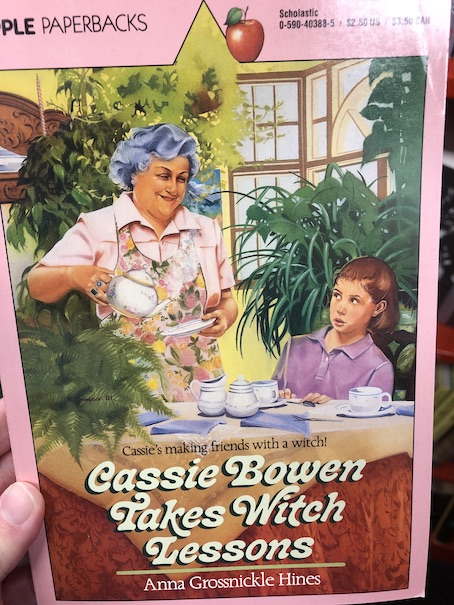
Cassie Bowen Takes Witch Lessons

Cassie Bowen Takes Witch Lessons by Anna Grossnickle Hines, 1985.

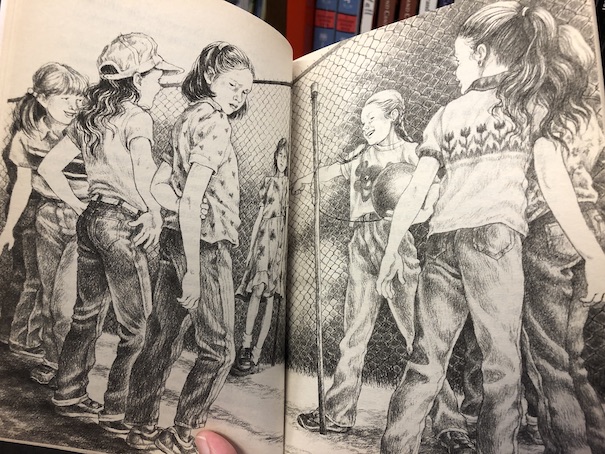
Cassie Bowen and Brenda Bolter have been friends for years, but lately, Brenda has been getting friendlier with Sylvia, another girl in their fourth grade class at school. Sylvia is a mean girl, and the favorite target of her meanness is Agatha Gifford, the new girl at school. Sylvia likes to call her “Saggy Aggy” and “Thrifty Gifford” because Agatha always comes to school wearing dresses that are too loose on her and Sylvia thinks that she probably got them at a thrift store. Most of the girls at school wear brand new jeans, not dresses. Agatha doesn’t bother to fight back when the other girls tease her, and Cassie doesn’t know what to say or do about it, even though the teasing makes her uncomfortable, too.

Even if the other girls are right about Agatha wearing used clothes, Cassie can understand. Cassie wears jeans like most of the other girls, but hers are actually hand-me-downs from an older cousin. (The story of my own youth, too. Thrift stores are the story of my present because I still don’t have much money, and anything I don’t spend on clothes is something I could potentially use to buy books, most of which will also be used because I like older books and because it maximizes my buying power. Life and budgets are about priorities.) Cassie’s mother hasn’t had money to buy new clothes since Cassie’s parents got divorced. The book is vague about what happened in Cassie’s family before the divorce, but Cassie’s father now lives in another state and doesn’t even write or communicate with the family, and he’s certainly not sending money. Cassie’s mother says that he’s got to sort out his life, and Cassie says that her father is kind of a “creep” now, but the book doesn’t go any deeper into it. It’s more important that Cassie’s family is now tight on money, and Cassie has mixed feelings about the divorce. On the one hand, she misses her father and wishes that the divorce had never happened, but on the other, she’s also angry with her father for his part in the divorce and the ways that he changed from the father she knew and loved before. Cassie’s mother says that everyone changes over time, and sometimes, when they change, they grow apart. Cassie will soon come to understand that better through her experiences with Brenda.

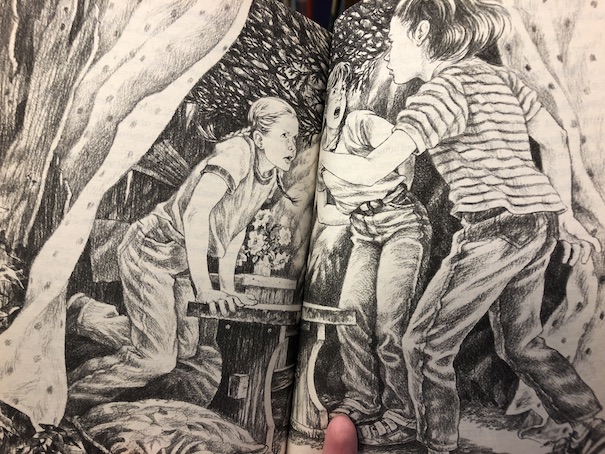
Cassie doesn’t like the ways that Brenda is changing, and she resents Brenda sharing the secret hideout they built with Sylvia without even talking it over with her. One day, when the girls are going to their secret fort, they pass the old house where Agatha lives with her grandmother. There are neighborhood rumors that Mrs. Gifford is actually a witch because her old house looks kind of creepy and she often does odd things, like talking to her plants. As the girls pass her house, they hear her talking to her flowers, and suddenly, Sylvia trips up Brenda so that she goes sprawling into the flower bed. As Mrs. Gifford laments about her flowers, Sylvia dramatically exclaims that they must pick some flowers and actually starts yanking more out of the bed until Mrs. Gifford angrily chases them off with a broom.

Cassie is appalled by the entire incident, although she admits that it was funny, watching Mrs. Gifford chase the other girls. Brenda is fascinated with Sylvia because of the daring way she likes to show off and grab attention, and it inspires her to do the same thing, finding ways to make fun of people or cause trouble. It upsets Cassie, who just wants Brenda to be the same Brenda she’s always known. Brenda also tells Cassie that Sylvia has amazing things in her room, like a collection of glass animal figurines. Sylvia even gives her one to keep. Also, Sylvia’s parents supposedly let her stay up as late as she wants, and she can usually get her way with them just by throwing a tantrum. Brenda thinks that all this is cool, which makes her different from the kids I knew growing up. Most self-respecting fourth graders were beyond tantrums and would have been called babies if they had admitted to having one at that age. Having great clothes and a lot of cool stuff in her room would have gone a long way, though.

When the children’s teacher, Mr. Gardner, assigns the kids partners to work on presenting a story to the rest of the class, Cassie hopes that she and Brenda will be partners so that things can be like they were before. However, Brenda and Sylvia end up being partners, and Cassie is assigned to Agatha. Cassie isn’t enthusiastic about it, and Agatha notices, but Cassie decides that she’s going to be as friendly as she can. She asks Agatha about which story she would like to present to the class because she doesn’t like reading that much, and Agatha says that she knows because she’s noticed that Cassie is better at math. Cassie is surprised that Agatha would know that, considering how new she is, and Agatha says that she envies her because she’s been having trouble with fractions. Agatha says that she really likes the story The Nightingale because it reminds her of a beautiful music box that her grandmother owns, and Cassie is fascinated.

One day, when Cassie’s brother is off playing baseball and Brenda and Sylvia are working on their project together, Cassie passes by Agatha’s house and is invited in. Cassie hesitates at first because the house is creepy, but she has to work on the project with Agatha, so she accepts. Agatha’s grandmother serves the girls rose hip tea and cookies. Cassie thinks that rose hip tea sounds weird at first, but it tastes nice. Mrs. Gifford is an eccentric lady, but rather sweet. She introduces Cassie to Roberto, her favorite plant. Part of the reason why she talks to plants is that she lived alone and was lonely before Agatha came to live with her. She is also a member of the same gardening club that Cassie’s mother belongs to. Cassie uses the cookies at tea to explain fractions to Agatha, and Mrs. Gifford shows Cassie her music box, which is beautiful. The music box is special to Mrs. Gifford because it was the last present her father gave her before his death, when she was about the age of the girls now. Cassie understands the feeling because she prizes the teddy bear that her father gave her before he went away.

The more Cassie learns about the Giffords, the less strange they seem, and she no longer believes that Mrs. Gifford is a witch. Agatha tells Cassie that she lives with her grandmother because her parents were killed in a car accident. The only other family she has is an older sister who is away at college, which is why Agatha can’t live with her. Cassie acknowledges that Agatha’s situation is worse than hers because, even though Cassie misses her father, she’s not an orphan. Agatha also explains that the reason why she wears those dresses to school is that her old school was a private church school, where all the girls were required to wear dresses. When Cassie explains to Agatha’s grandmother that there is no requirement about dresses at their school and that most of the girls wear jeans, Agatha’s grandmother is surprised and says that she didn’t realize, so she buys Agatha some new clothes, taking Cassie with them on their shopping trip.

The new clothes fit Agatha better, and Cassie hopes that they will help her fit in better at school, but Sylvia and Brenda won’t let up on the teasing. In fact, Sylvia seems irritated at Agatha dressing more normally and mocks her, saying, “What’s she trying to do? Act like a normal person?” Cassie tries to tell them that Agatha is normal, but they don’t believe her. Soon after, Brenda asks Cassie if she wants to hang out when she’s on her way to see Agatha again about their project. In an effort to get Brenda to ease up on Agatha, Cassie asks Brenda to come with her so that she can see for herself that Agatha and her grandmother are fine.

The Giffords are nice to Brenda, but during the visit, Mrs. Gifford’s special music box disappears. Agatha says that Brenda stole it, and Cassie gets offended by the accusation, saying that Agatha is making it up and telling her that she doesn’t want to be friends anymore out of loyalty to Brenda. Unfortunately … Agatha was right, and Cassie is shocked when she discovers the truth. Cassie retrieves the music box from Brenda, but with Brenda and Sylvia both angry at her for taking the music box back and Agatha and her grandmother probably mad at her for bringing Brenda to their house in the first place and siding with her over the theft, what is Cassie going to do?

I think the ending of the story is very realistic, although it does leave some things unresolved. Agatha does forgive Cassie for not believing her after Cassie returns the music box. Cassie doesn’t tattle on Brenda and Sylvia because they had accused her of being a tattletale earlier, but she does eventually tell her mother everything that has been happening with Sylvia and Brenda. Her mother reassures Cassie that she did the right thing, even if Brenda didn’t. She says that it sounds like Cassie is angry at Brenda for a lot of things besides this, and Cassie agrees that she doesn’t like it that Brenda is so mean sometimes. Cassie mother says that everyone changes, and sometimes, they change for the better and sometimes for the worse. Cassie doesn’t think she and Brenda will ever be friends again, and her mother says that someday Brenda will also get tired of Sylvia’s meanness, but even if she doesn’t, Cassie will find plenty of other friends. Cassie realizes that she and Agatha really do understand each other, and she’s glad when they make up. At school, Sylvia and Brenda both tease Cassie now, saying that she’s taking witch lessons from the Giffords. It hurts Cassie’s feelings to see her old friend turn against her, but she follows Agatha’s advice and ignores them.

Sylvia and Brenda are never punished for the things they’ve done, which is sadly the case for most of the little bullies I knew as a kid. However, it is nice that Cassie and Agatha realize that they are better friends for each other than either Brenda or Sylvia would have been. I noticed that there is also potential for them to be friends with other people in their class besides Brenda and Sylvia. When Cassie got to school at the end of the book, a girl named Stacy asked her if she wanted to play tether ball, which shows that other girls don’t think badly of her for hanging out with Agatha. I also wished that the book would show more of Pam, who had been Sylvia’s best friend at the beginning of the book before Sylvia and Brenda started hanging out. After being abandoned by Sylvia, perhaps she would also be open to making some new friends. Cassie and Agatha might have other options for making new friends.

There is no magic in the story or witchcraft of any kind. In fact, Brenda and Sylvia probably never really believed that Agatha or her grandmother are actually witches. It’s more that, for reasons of their own, Sylvia and Brenda were looking for someone to pick on, and the “witch” accusations were just their excuse. That’s why they were so irritated when Agatha started dressing like the other girls. If their excuse for bullying Agatha disappeared, they didn’t want to lose their ability to bully her. It was never about making Agatha dress or act like the other girls; it was always about Sylvia and Brenda’s need to have someone to victimize. The truth is that even if the Giffords had seemed less strange in the beginning, Sylvia and Brenda probably would either have picked on them anyway or maybe selected some other victim, perhaps going straight to Cassie as their first choice, because they were looking for a victim and would have found one eventually because that was always their goal.

Angels Don’t Know Karate

The Adventures of the Bailey School Kids

Angels Don't Know Karate Cover

#23 Angels Don’t Know Karate by Debbie Dadey and Marcia Thornton Jones, 1996.

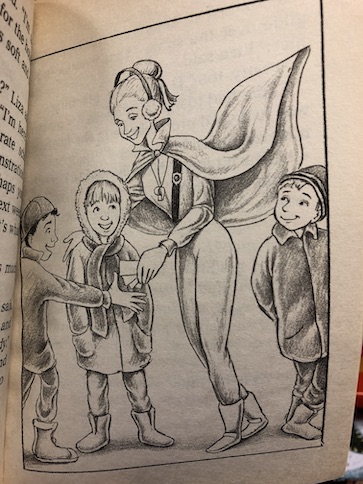
Before Christmas, the kids at Bailey School are making snow angels, and they start talking about whether or not real angels exist. Melody and Liza say that they do and that everyone has a guardian angel. Eddie jokes that the new school crossing guard should have one as she repaints the crosswalk lines in the road. The kids say that she should also be careful not to get paint on the sidewalk in front of Mr. Mason’s house Mr. Mason is the meanest man in the neighborhood.

As the kids stand around talking, Ben, the school bully, hits Eddie in the mouth with a snowball. Eddie wishes that he knew karate so that he could take care of Ben, and Ben tells him that he’s a just a chicken, daring him to climb a tree on the playground. The other kids tell Eddie not to do it because the tree branches are snowy and icy and he’d probably fall, but Eddie feels like he has to do it to prove that he isn’t chicken. (Yeah, kid, the best way to prove you’re not scared of things is to do a stupidly dangerous thing because you don’t mind demonstrating that you’re desperately scared of what someone you don’t even like thinks about you.) Of course, Eddie does fall, but the others have the impression that the tree branches seem to be helping to hand him down to the ground, where the new crossing guard catches him. Melody thinks that, for a moment, it looked like the crossing guard had angel wings, but no one else saw it because they were all looking at Eddie.

The crossing guard says that her name is Angela Michaels and that she has just come to town for the opening of a new karate school. She invites the children to come to a karate demonstration at the mall. Eddie thinks that the karate demonstration would be great, and Howie says that karate isn’t about attacking people so much as protecting. More and more, Melody becomes convinced that Angela’s rescue of Eddie was a miracle, that she’s Eddie’s guardian angel, and that she’s come to Bailey City on a mission.

Angela turns out to be a karate expert, and the kids are impressed. Mr. Mason yells at the kids as they walk by his house on the way home, and they wish that Angela would teach him a lesson. Eddie says that if they want to spy on Angela and find out if she’s a real angel, Mr. Mason’s yard is the best place to do it because it’s near the crosswalk and no one would expect kids to be hiding in his yard. The others say that he’s crazy to want to go in mean Mr. Mason’s yard, but Eddie says that if Angela is a real guardian angel, they should be safe.

Mr. Mason catches the children in his yard, and Angela does intervene when Mr. Mason yells at them. She convinces Mr. Mason to let her make him a cup of Heavenly Tea. Melody decides that Angela’s mission is probably to help Mr. Mason be nicer and make some friends. Melody says that they should help Angela by being friends with Mr. Mason and doing nice things for him. The others think that she’s crazy, but she’s convinced that it’s safe to do nice things for Mr. Mason because Angela will make sure that they’ll be safe and that Mr. Mason won’t get mad.

Mr. Mason yells at the kids when they come to help him, but Melody convinces him to accept the cookies they’ve brought him and let them shovel some snow for him and decorate his yard for Christmas. He doesn’t seem particularly grateful at first, but he does accept their kindness. Then, to the children’s surprise, Mr. Mason becomes their new school crossing guard, replacing Angela. He says that Angela had to leave on some important business and that she convinced him that he would like the job, and he admits that he does like it. Melody remains convinced that Angela was an angel. Eddie says that she never proved it, but she says that some things don’t need proof, just belief.

Eddie never does use karate on Ben, but Angela deals with Ben for him. Angela catches Ben bullying another younger boy and teaches him that strong people are supposed to protect weaker people, not bully them. The children take karate lessons from Angela, and she’s tough. Eddie compares her to a drill sergeant. But, being tough isn’t the same as being mean. Angela is serious when she says that strong people have a duty to protect others, and that’s what she teaches other people to do. She uses her strength and toughness to help people, not hurt them. It’s a good philosophy!

The book is available to borrow for free online through Internet Archive.

Chrysanthemum

Chrysanthemum by Kevin Henkes, 1991.

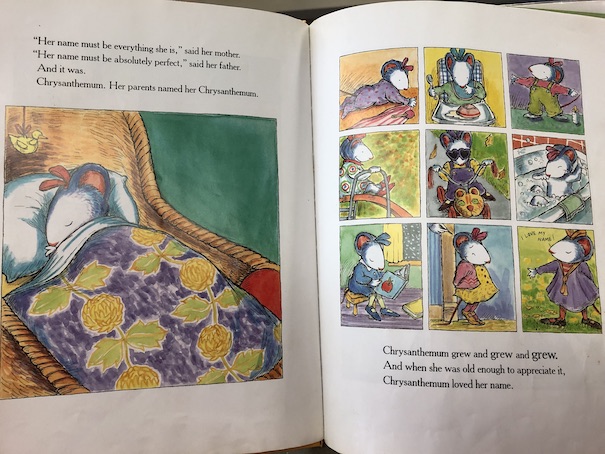
When little Chrysanthemum was born, her parents chose Chrysanthemum as her name because it just seemed perfect, as perfect as their little girl. As Chrysanthemum grew up, she loved her name, and she thought that it was perfect, too.

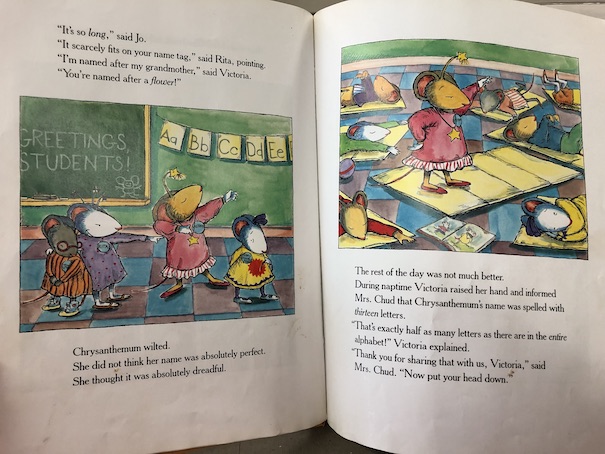
However, when Chrysanthemum starts school, the other kids point out how unusual her name is. Most of them have much shorter names. Chrysanthemum’s name is so long that it doesn’t really fit on her name tag. One girl, Victoria, is particularly mean about Chrysanthemum’s name, making fun of her whenever she can and encouraging other children to make fun of her.

For the first time in her life, Chrysanthemum starts hating her name. She wishes that she had a much shorter name, like Jane. Her parents comfort her and tell her that the other kids are probably just jealous, but their repeated teasing really bothers her.

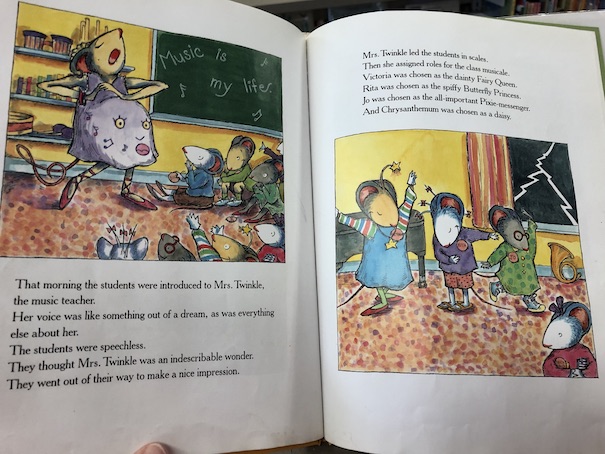
Then, the children have music lessons at school with Mrs. Twinkle. Mrs. Twinkle is a fun teacher, and the kids are excited about her class. She gives the children roles to play in a class musicale, and Chrysanthemum is cast as a daisy. When the other kids laugh about her playing a different type of flower, Mrs. Twinkle asks them what’s so funny.

The other kids explain about Chrysanthemum’s name and that they think it’s funny because it’s so long and weird. That’s when Mrs. Twinkle tells them that her first name is Delphinium – another long, unusual flower name! She says that she really likes the name Chrysanthemum, and since she’s expecting a baby, she might name the baby Chrysanthemum if it turns out to be a girl. Suddenly, the other girls in class envy Chrysanthemum and wish they had flower names, too!

In the short epilogue at the back of the book, the baby does turn out to be a girl, and Mrs. Twinkle names her Chrysanthemum. Chrysanthemum also gets a laugh at Victoria’s expense when the class puts on their musicale, and Victoria completely forgets her lines.

It’s a nice book, and I appreciate some of the messages now even more than when I first read it when I was a kid. Now that I’m an adult, I know that Chrysanthemum’s name isn’t the real reason why Victoria picks on Chrysanthemum. Victoria is mean basically because Victoria is a mean person. Kids who want to bully others make the decision to bully first and then pick something to bully about second. From what I’ve seen, they’re usually out to make fun of someone or make someone mad just to do it, and they don’t really care how or why. Chrysanthemum’s unusual name was just a convenient thing for Victoria to single out and use for her bullying. If she hadn’t had that name, Victoria would have picked on her (or maybe some other, more convenient target) for something else. Maybe it would have been someone’s clothes. Maybe it would have been the way someone walks or the way someone talks or their hair or their eyes or the fact that they have fingernails or breathe air or take up physical space … you get the idea. Victoria is the way she is because that’s what she is and what she wants to be, and she doesn’t see any need to change until the end of the story. (Even then, she may be back to bully again over something different because she hasn’t yet learned not to bully in general, just not over that particular thing.)

My point is that the way Victoria is has nothing to do with Chrysanthemum and her name. I’ve heard parents who are considering names for their children working hard to pick names that can’t be used for teasing, and sometimes, it can help. However, at the same time, bullies are basically going to bully because that’s who they are and what they do, and most importantly, it’s what they want to do. They’ll find something to bully about anyway because they’re always intentionally looking for something to bully about.

For a time, because of Victoria’s meanness and bullying, Chrysanthemum’s enjoyment of her name is ruined. She even feels like Victoria is destroying her sense of identity. At one point, she has a nightmare that she is actually a Chrysanthemum flower and that Victoria plucks her petals, picking at her and picking at her and picking at her until there’s nothing left. That’s the kind of effect that bullies have on people, which is why I have such contempt for them. They ruin things, even really fun and cool things like a colorful name, and make people unhappy just by being the kind of people they are. (If you’ve read my other reviews of books with bullies, you’ve already heard that I have very strong feelings about this subject and absolutely no patience or sympathy for bullies.)

But, fortunately, the book takes a very positive tone and points out that Chrysanthemum’s name is not really ruined by Victoria’s meanness. Chrysanthemum’s music teacher also has a really unusual flower name, and naming her baby Chrysanthemum as well gives Chrysanthemum new status among the kids at school, to the point where some of them, including Victoria, wish that they also had flower names of the kind that might inspire someone to name their baby after them. Mrs. Twinkle is a fun and different kind of teacher, and her fun and different name fits her personality. Although it hasn’t occurred to the other kids yet, the world would be a pretty drab place without colorful and unusual people. The Victorias and Janes of the world may have very proper names and are reassuringly ordinary, but the Delphiniums and Chrysanthemums are the ones who bring color and excitement to life. So, although I wouldn’t deliberately give a child a name that might leave them open to teasing, I don’t see a need to go overboard and reject some of the fun names that are just a bit unusual. Different is good, and it should be appreciated for what it is, not for what a bully may or may not be able to say about it when they’re trying to be mean. (They’ll find something else to bully and complain about two seconds later anyway, so why bother considering them for longer than that?)

The book is currently available online through Internet Archive. It is part of Mouse Books series.

Sixteen and Away from Home

Sixteen and Away from Home by Arleta Richardson, 1985.

The year is 1889. Mabel O’Dell turns 16 years old at the beginning of the book, and her mother gives her a journal as a present. Soon, she and her best friend, Sarah Jane Clark, will be starting the final years of their education at the academy in town. Mabel worries about going to the academy, first whether they’ll pass the entrance exams, and then whether they’ll be homesick because they will have to board in town. Sarah Jane assures her that it will be okay because they’ll be going together, and they’ll probably be too busy at school to think about homesickness much. Mabel’s mother is a little worried about the foolishness that young women can get into when they’re on their own. However, the girls do pass their exams and are admitted to the academy, and their parents agree to let them go.

In town, the girls will be staying with Sarah Jane’s Aunt Rhoda. Aunt Rhoda’s housekeeper, Lettie, seems to resent the girls being there for reasons they don’t understand. When school begins, the girls are shocked to learn that they’ll have to wear bloomers for “physical culture” classes. The teacher gives them a sewing pattern so they can make the uniform themselves. The girls imagine that their parents would be shocked to see them running around without skirts on. Fortunately, Mabel and Sarah Jane will have all the same classes, along with all of the other first year students. They have to take Grammar and Rhetoric, Biology, Latin, History, Calculus, and Physical Culture (physical education or PE).

They also quickly realize that the class troublemaker is going to be Clarice Owens, who unfortunately sits near Mabel because they all sit in alphabetical order by last name. Clarice deliberately picks on Mabel and Sarah Jane for coming from the countryside, calling them “hayseeds.” Mabel is disgusted because she can never think of a good comeback until after Clarice walks away. (Yeah, I’ve been there before.) Sarah Jane thinks she’s jealous of Mabel for being prettier. Mabel doesn’t really believe that, but she appreciates the thought. Molly, one of the other town girls, is friendlier. She says that she knows Clarice has always thought she was better than everyone, but she’s not usually this deliberately mean. Mabel says that maybe it would help if they knew the reason.

Through the rest of the school year, Clarice tries one scheme after another to cause trouble for the girls, especially Mabel. Mabel tries to be as patient as she can with Clarice, trying to let her know that she’d rather be a friend than an enemy, but Clarice gets angry and upset when Mabel tells her that she forgives her for all the awful stuff she does. Mabel thinks that there’s something hurting Clarice and affecting her behavior, although Molly tells her that she shouldn’t waste her sympathy on Clarice because “she gets what she wants.” Molly thinks that they should just be grateful for those times when Clarice isn’t immediately stepping on them to get what she wants because that happens, too.

When Mabel is injured in a sledding accident and has to stay in bed for awhile, she worries about falling behind in her classes. Lettie talks to her and brings into question the reason why she’s so concerned about her standing in class. Is it really because she loves learning, or is it because she’s trying to compete with the other students? Mabel starts to consider how too much competitiveness can spoil a person’s attitude and take the enjoyment out of things. Competition has much to do with Clarice and her attitude.

Things get worse when Clarice’s grandmother becomes ill and her parents arrange for her to stay in the house with Mabel and Sarah Jane while they go to see her grandmother. Clarice is rude to the servants in Aunt Rhoda’s house and sneaks out of the house during the night. Lettie tells the girls that Clarice’s mother was strong-willed as a girl, and she’s given a lot of her attitude to Clarice. There was a boy that Clarice’s mother had always wanted for herself, but he married someone else. Although Clarice’s mother also married and had a child, she never completely got over losing her first choice to someone else. Since the man she originally loved has a son the age of her daughter, Russell Bradley, she might be hoping that Clarice will marry him. Clarice certainly is interested is Russ … who is apparently more interested in Mabel.

Mabel considers that allowing Clarice to be with Russ and not trying to compete with her would help settle things between them, but as Sarah Jane says, Russ’s feelings on the issue matter. To get the most out of her education, Mabel needs to focus on her love of learning instead of comparing herself to her classmates, and to get the most out of their relationships with other people, all of the girls need to focus on caring about other people and their feelings.

The book is part of the Grandma’s Attic series. It is available to borrow and fread for free online through Internet Archive.

My Reaction

The problem with Clarice and her mother and their attitudes and expectations is that they do not take anyone else’s feelings into account other than their own and don’t even inform people of what they really want, yet they expect everyone else to somehow accommodate their wishes and feel toward them exactly how they want them to feel. These are not reasonable expectations at all. For most of the book, Mabel is completely unaware that Clarice’s meanness comes from the fact that she sees her as competition, and even then, it’s not really clear at first what Clarice is trying to compete for. Mabel didn’t ask or agree to be Clarice’s competitor in anything, and she’s not even trying to be. In fact, she’s been trying everything that she can to avoid it. Russ also apparently has no idea what Clarice is really after because he doesn’t have the same feelings about Clarice that she has about him. He’s just trying to live his life and focus on his own feelings and interests, and as far as he’s concerned, Clarice doesn’t really enter into it. Russ has no obligations to Clarice and her mother, and even Mabel doesn’t have the right to tell him how to feel or what to do to get rid of Clarice’s ire.

When Clarice pulls one last trick on Mabel, and she still forgives her, Clarice finally tells her that she gives up because, “You can’t go on disliking someone who refuses to be disliked.” I have to admit that I found the end to be a bit unbelievable. I’ve never encountered anybody who was that much of a pain and who ever let someone else’s kind behavior stand in the way being a pain. The response that I’ve usually seen is that they congratulate themselves on finding someone who’s never going to fight back and use that opportunity to run roughshod over them. They usually blame the kind person for making it easy to take advantage of them. As even the book says, people cannot decide how anyone else should feel or force them to feel anything in particular. It just doesn’t work. Mabel cannot “refuse to be disliked” because what Clarice likes or dislikes is all in her own mind. All that Mabel can decide is how she feels and what she’s going to do about it.

What Mabel really does decide is that, whether she likes or dislikes Clarice, she’s not going to compete with her and try to fight or match her meanness. It isn’t so much a matter of likes and dislikes in the end as Clarice discovering that she’s running a race with no other runners. If there’s no one to race against, there isn’t really a race at all, and no one cares if you walk off with the trophy or not. Maybe there was never even a trophy there to begin with.

If I’ve said it once, I’ve said it a million times, I don’t like bullying or one-upmanship, and I have no interest in sympathizing with anyone who does those things. Part of the trouble I have with overly-competitive personality traits is the same trouble that actors sometimes suffer when they’re out in public: they don’t always know when to stop acting, stop posing, or stop performing. Overly-competitive people don’t know went to stop competing. Where does the one-upmanship end and the human person actually begin? Or is that their personality all by itself? Do they have any interests outside of being competitive, or are they only about competition just for the sake of competition? Do they wan to be good at something for a purpose or because they just love it, like the love of learning, or is everything they do just about trying to look better than someone? I was reading this article recently, about how trying to keep up an image all the time too often leads to a person having no real substance or sense of self.

By herself, Clarice doesn’t present much to connect with or sympathize with. Clarice doesn’t really seem like a real person to me. She’s rather a one-dimensional character. This is a problem with a lot of bullies in children’s books. She apparently has very generic family issues that are supposed to explain her behavior with little insight into how she really feels about anything. At least, that was how she seemed to me. The explanation behind these family issues comes from a youthful romantic trauma of her mother’s, but what does that really mean to Clarice herself? She seems to have some kind of fear of being second-best, possibly because her mother has pushed her in that direction, but again, we return to the question of second-best at what? Is it that she fears being rejected by classmates or potential boyfriends, or does she fear not living up to her mother’s expectations? If her mother is still pining for her first boyfriend, what does that say about her parents’ relationship with each other? Does her mother view her own husband as second-best, the consolation prize in the contest of life, and what does that mean for Clarice’s relationship with her father? What does Clarice really want out of life and what, specifically does she want to be the best at doing? The idea of romance with Russell may be wish-fulfillment for her mother, but what do she and Russell really have in common? What does she have in common with anybody, when we mainly see her in competition with everyone?

I wouldn’t have nearly as much patience with her as Mabel because, when it comes right down to it, I wouldn’t see Clarice’s friendship as a prize worth winning. Mabel went through quite a lot to get through to Clarice, but her efforts only pay off right before the end of the book, so we don’t really see much of what Clarice is like after she says that she’s giving up the competitive mean girl act. Apparently, Mabel will get the benefit of not having to put up with Clarice’s mean tricks from now on, which is something, but if Clarice isn’t being mean and sneaky, what is she? Who is she, really?

In real life, people have hobbies, interests, and life goals, but Clarice doesn’t seem to have much that really interests her. Are Clarice’s goals really hers or her mother’s, as they hint? What does Clarice want, or has she even thought about what she wants? In modern times, a sixteen-year-old still has years of education ahead of her because more people attend college these days, but once Clarice finishes at the academy in town, her education is likely over. She only has a couple of years left to think about a direction for her life before she has to get on and live it as a full adult. Even if her destiny seems to be someone’s wife and mother, connecting with someone emotionally to the point where they would want to be married and sharing a life with her would be difficult for someone who has no real interests to connect to or a sense of how to build a shared life with someone else. For a while, she seemed to do well at memorizing the reading from Alice in Wonderland that she was going to perform with Mabel at the end of the school year, but that was just another part of her tricks so that she could back out at the last minute and let Mabel down. It was all part of an act by itself. Does Clarice really like acting? Does she like books? Does she like anything?

Clarice doesn’t even seem to have any close friends of her own, which is very unlike the real-life bullies I’ve known. Most of them do have friends and hangers-on who enjoy their mean humor (the thing that often binds them together and bolsters their bad behavior) or who put up with it because of some other benefit they get from that friendship, but Clarice doesn’t seem to have anybody and isn’t really offering anything. It just doesn’t seem realistic and makes me feel like Clarice is there mostly to be the cardboard cut-out of a nemesis. That may be why she gives up so easily in the end.

I would have found her change more believable if Russ had straight-up told her that her mean tricks and selfish attitude are the reasons why he doesn’t like her and isn’t interested in her. That would have been motivation for Clarice to change because it would give her both something to lose by not changing (Russ and others getting angry and saying they’ve had enough of her attitude) and something to gain by taking on different habits (like the possibility that Russ might change his mind if she can demonstrate that she can do as many unselfish deeds as Mabel, something that might actually appeal to Clarice’s competitive personality). I would also have found it believable if Clarice changed her mind about Russ because she ultimately realized that Russ is what her mother wants for her, not what she wants for herself, and that there are other possibilities that she likes better. I would also have liked it if Clarice had been planning to back out on the reading of Alice in Wonderland in order to ruin the presentation for Mabel but changed her mind at the last minute because she realized that she loves the story or performing so much that she just can’t bring herself to miss the event, that she has found something that she loves doing more than causing problems for someone else. Reassessing the consequences of behavior or finding different goals are the kinds of self-motivation that provoke real people to change.

On the other hand, maybe the real issue is Clarice has sensed that she’s fighting a losing battle for Russ, and as Sarah Jane noted, you can’t control the way other people feel. If Russ doesn’t love Clarice, he’s just not going to love her. Perhaps she can tell, even when he’s with her, that he’s not thinking of her and just isn’t going to be interested in her the way she is with him. There’s only so much effort that a person can pour into getting someone’s attention before it starts to get really awkward when they don’t get the attention they’re looking for. Even if Russ doesn’t spell it out for her, she can probably tell that she doesn’t want to be with someone who clearly doesn’t want to be with her. Clarice still might not know quite what she really wants yet, but she might have figured out that’s one thing she doesn’t want, to be with someone who doesn’t think of her as his first choice or even much of a choice at all. All along, she’s been trying to compete with someone who doesn’t even want to compete for a prize that doesn’t want to be won by her because he’s already picking another winner. It brings us back to the idea of one person attempting to run a race all alone. It’s not really a race, it’s just one person running down the street, getting sweaty and tired, with no real prize to win, and who is there to care when they start or stop? That might actually be the most believable explanation of them all.

The books in this series have Christian themes, including this one. As the characters discuss the problem of Clarice and other situations, they often turn to the Bible for inspiration, sometimes discussing specific quotes that relate to the concepts they consider, like forgiveness and revenge.

On a fun note, I liked the description of the Halloween party activities. I was born around Halloween, and I often have a Halloween-themed birthday party. I’m sometimes fascinated by the traditions of Halloweens past. In the book, they call it a Halloween party, but the activities are more harvest-themed than spooky. They bob for apples and run races with apples balanced on their heads, and they also play tug-of-war and Skip to My Lou.

The Ravenmaster’s Secret

The Ravenmaster’s Secret by Elvira Woodruff, 2003.

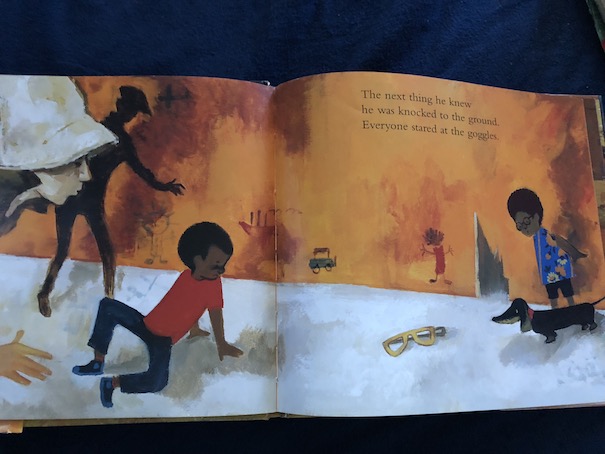
Forrest Harper is the son of the Ravenmaster of the Tower of London in 1735.  The story begins by explaining the tradition of keeping ravens at the Tower of London because of the superstition that the Tower would be conquered by its enemies if the ravens ever abandoned it.  This superstition led to the creation of the job of Ravenmaster, who looks after a flock of ravens that live at the Tower with wings clipped so that they can’t fly away.

Forrest Harper lives at the Tower with his parents and sisters, training to become a Ravenmaster, like his father.  He likes the ravens, and they like him.  He is pretty good at caring for ravens, but there is something that bothers him: he thinks that he isn’t brave enough and that others think that he is a coward, too.  He is smaller than the other boys and is often teased.  He has trouble cutting up the squirrels that the rat catcher’s boy (his only real friend, although his mother doesn’t approve of him) brings to him to feed to the ravens.  Even though it’s necessary, Forrest doesn’t like the sight of blood and feels kind of sorry for the squirrels.  Worse still, when Forrest’s family attends the public hangings (which were treated as a kind of festival day with music and entertainment in Forrest’s time), Forrest is unable to look at the criminals who are being hanged.  The one time he does try it, he throws up, and again, the other boys tease him mercilessly for it.  Forrest’s problem, as readers will see, isn’t so much that he’s a coward as he has more empathy than the other boys, both for animals and people, and that isn’t really as much of a problem as he believes.  His father tells him to ignore the bullies because they are foolish, and their foolishness will show in time.

Forrest sometimes dreams of going out into the wider world, beyond the Tower, where he could do something brave that would impress everyone.  The rat catcher’s boy, whose real name is Ned although most people just call him Rat, also dreams of running away because he is an orphan, treated harshly by his master and always in danger of being turned over to the chimney sweep to be used as a climbing boy.  He doesn’t think that Forrest has a real problem because his life at the Tower is pretty good, living comfortably at the Tower with his parents, whatever the local bullies say.  Still, the two boys often imagine what it would be like to go to sea together and have adventures.  When there is an announcement that a new prisoner will be arriving at the Tower, a Scottish Jacobite rebel, Forrest thinks that helping to guard a dangerous rebel will make the Tower bullies respect him.

To Forrest’s surprise and embarrassment, this rebel actually turns out to be a girl.  She is the daughter of the rebel Owen Stewart, who is being held in a different tower at the Tower of London (the Tower of London is actually a fortress with multiple towers – she is imprisoned in Bloody Tower and her father is in Bell Tower).  She has been charged with treason, along with her father and uncle.  Forrest isn’t happy about being given the task of taking food to a girl prisoner. 

However, Madeline McKay Stewart, the girl prisoner, is pretty tough in her own right.  Although Maddy’s been separated from her father and uncle and all three of them are likely to be executed, she is being pretty brave about it.  She talks to Rat and Forrest.  She is interested in Forrest’s pet raven, Tuck, and tells him about how she used to feed baby owls back home.  She talks about her life and family in Scotland, and Forrest realizes that he’s starting to think of her as a friend instead of an enemy to be guarded.
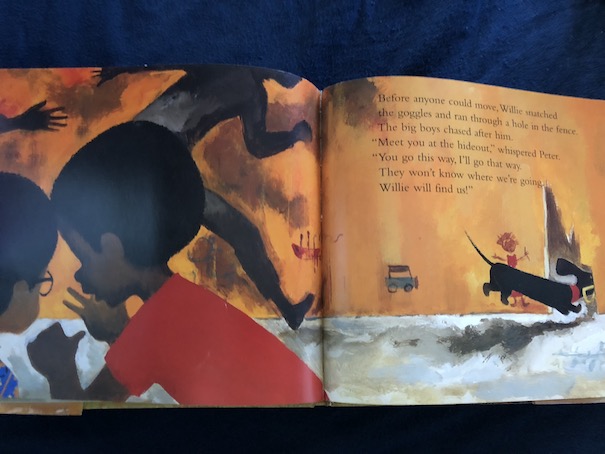
While Forrest is used to hearing English people criticize the Scots for being “savage,” he is astonished and a bit offended when Maddy talks about English people being “evil.”  For the first time, it makes him think of the situation from the other side.  He knows that not all English people are evil and realizes, having seen that Maddy actually has refined manners, that Scottish people aren’t “savage.”  One day, at Maddy’s request, he takes a message to her father in exchange for her ring, which he plans to sell in order to buy Ned back from the chimney sweep after the rat catcher loses his term of indenture to the chimney sweep in a game of cards, sparing him from the horrible life and health problems that the young climbing boys suffer.  Then, Owen Stewart gives Forrest a message to take back to Maddy.  Without really meaning to, Forrest realizes that he has suddenly become a go-between for the rebels and could be considered a conspirator under English law.

As Forrest considers the fate that lies ahead for Maddy and the nature of war between England and the Scottish rebels, it occurs to him that the adults in his life have often done the opposite of the things that they have always taught him were important.  His father always emphasized fairness, yet the war and Maddy’s possible execution are unfair.  Maddy shares Forrest’s feeling that the world might be a better place if people didn’t become adults and abandon their values.

Then, Maddy’s father and uncle are shot while attempting to escape, and Maddy is left completely alone.  Forrest feels badly for Maddy.  Soon after, he is unexpectedly approached by a carpenter who seems to know that he has become friends with Maddy.  The carpenter, who is a stranger to Forrest, tells him that Maddy will soon be executed by beheading but that he has a way to save her life.  Forrest has to decide if he is willing to trust the stranger and save Maddy, knowing that doing so would make him a traitor himself.

One of the parts of this story that interested me was how Forrest noted the hypocrisy in the adults around him as he was trying to decide what he should do.  Qualities that adults often praise and try to instill in their children are often ignored in the way that the adults live and even in how they treat other children, like Ned and Maddy.  Abandoning values, even the ones that they really want their children to have, isn’t something that adults have to do as they grow older, but it is something that some adults do if they think they must in order to live as they want to live or accomplish something that they want to accomplish.  The adults who think that Maddy should be beheaded would probably say that they were doing it for the greater good in promoting their cause against the rebels.  However, treating Ned as a piece of disposable property is something that they mostly do because they can and because they know that there is nothing that Ned can do to stop them.  Ned actually tries to repay his indenture legally with money that Forrest gives him, but although the sweep accepts the money, he refuses to let him go, saying that no one will take Ned’s word over his and that he could always use the money to make sure that Ned is hung as a thief if he tries to make trouble.  It is this type of attitude and situation that make the children realize that they are on their own to solve their problems and that working within the law is not going to be an option for them because the law is not just and it is not on their side.  It’s a frustrating situation, and I often feel frustrated when I encounter this type of thing in books, but fortunately, things do turn out well in the end.

This is one of those coming-of-age stories where a boy must decide what he stands for and where he really belongs.  Through Maddy and the inscription on her ring, which means “Face Your Destiny,” Forrest comes to understand the destiny that is right for him as he helps both Maddy and Ned escape to a better life elsewhere. 

The book also includes some interesting historical information. There’s a map of the Tower of London in the front of the book, and in the back, a short history of the Tower with information about famous prisoners and escapes. There is also a glossary of English and Scottish words that modern children (especially American children) might not know, such as breeches, wench, loch, and tattie-bogle (scarecrow).


The book is currently available online through Internet Archive.  (To borrow a book through Internet Archive, you have to sign up for an account, but it’s free, and then you read the book in your browser window.)

Spoiler: In the last chapter of the book, it explains what happened to the characters after the story ends.  Forrest does become the Ravenmaster after his father, realizing that it is the right kind of life for him and that he no longer desires to have adventures outside the Tower.  He has a wife and daughter, and years later, he receives a message from Ned, who says that he has become a captain in the Royal Navy and that Maddy has gone to live in the colonies with other Stewarts (something that my own Jacobite ancestors did, which is how I got to where I am now).

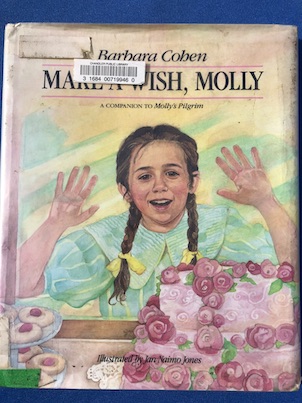
Make a Wish, Molly

Make a Wish, Molly by Barbara Cohen, 1994.

This book is the sequel to Molly’s Pilgrim.

Things have improved for Molly in Winter Hill since she and Emma became friends.  Now, Molly doesn’t feel quite so alone as she once did.  However, Emma is still friends with the nasty Elizabeth (resident mean girl from the first book).  Molly has learned that a major part of Elizabeth’s resentment toward her is that Elizabeth is used to being the teacher’s pet and the center of attention at school.  In both first and second grade, she always seemed to be the favorite student.  Now, in the third grade, Elizabeth thinks that their teacher prefers Molly, and she can’t stand it.  So, she tries to make trouble for Molly whenever she can and make others not like her, too.

Emma tries to ignore Elizabeth’s nastiness and invites both girls to her birthday party.  Molly is excited because she’s never been to a birthday party in America before, and birthdays are celebrated very differently in America from the way they were in Russia.  Emma and Elizabeth (in her condescending way) explain how birthday parties are, that the birthday girl receives presents from her friends and gives them small party favors in return, and that there is cake and ice cream for everyone.  Molly has never had a cake like the ones that the girls look at in the bakery window and is eager to try it.  But, there’s a problem.
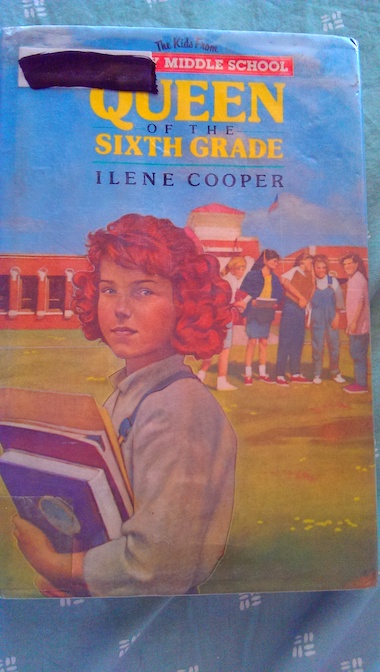
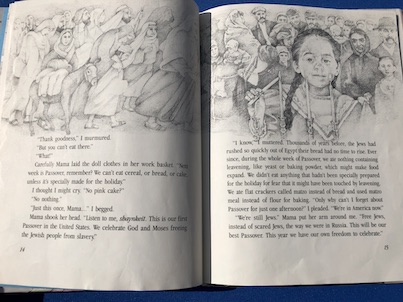
Molly’s mother says that it’s fine for her to go to the party and is willing to make some doll clothes for Emma’s birthday present, but she says that Molly cannot try the cake because the party will take place during Passover, and Jewish families like theirs cannot eat leavened foods during that time. Leavened foods are those that include rising agents, like yeast, baking powder, and baking soda, which includes cakes and breads. For Passover, Molly and her family are limited to things which don’t have these ingredients.

Instead, Molly’s mother packs a snack for Molly to take and eat while the others have the cake.  At first, Molly thinks maybe she could disobey her mother just this once and try the cake anyway without her noticing and without feeling different among the other girls, but when a piece of cake is placed in front of her at the party, she can’t bring herself to eat it.

Of course, Elizabeth takes advantage of Molly’s inability to eat the cake to make her feel bad and look bad in front of the others.  Elizabeth says that Jewish people don’t like to eat in Christian homes.  Molly tries to explain that isn’t the problem and to tell them about Passover, but Elizabeth ignores her explanation and just says that Molly’s reluctance to eat proves that what her mother told her about Jews was true.  (Let me just say that when a kid is as awful as Elizabeth is routinely, I always assume that the parents are exactly the same way.  I decided that Elizabeth’s mother was probably a bully and a snob back in the first book, so hearing that she’s been spewing anti-Semitic comments is no more than what I would have expected.  I view this type of behavior as an off-shoot of a bullying mindset, so I would completely expect that a person who is prone to one type of bullying would also engage in another. The apples never fall far from the tree.)  Molly knows that she can’t make the other kids understand the situation, so she just leaves in embarrassment.

When she gets home, Molly tells her mother about what happened.  Her mother says that everyone is a little different from other people, and there’s no use in pretending that they don’t live different types of lives from some of their neighbors.  However, Molly also has a birthday coming soon, and Molly’s mother thinks that if they invite some of the girls from Emma’s party to their house for a celebration, they will see that Molly’s family isn’t quite as different as they might think.

At first, Molly isn’t sure that it will be such a good idea, but it turns out better than she expects.  Her birthday is full of wonderful surprises.  There’s no cake, but Molly’s mother bakes other wonderful goodies, like rugelach (pastries with apples, raisins, and nuts).  Emma and another girl, Fay, try them and like them, but Elizabeth still refuses.  She also just looks defiant when Molly’s mother proves to her that Jews will wash and reuse plates that Christians have eaten from, not throw them away, like Elizabeth’s mother said before.  Once again, the issue with Elizabeth isn’t how correct or incorrect she (or her mother) was in whatever she said but whether or not she happens to look better than someone else at the current moment.  All Molly’s mother’s demonstration means to her is that she just lost another opportunity to look better than someone, and that annoys her.  But, Molly doesn’t care so much about Elizabeth’s lingering nastiness at that point because she knows that Emma is still her friend and Fay has just become a new friend.

There is also a movie version of this book, although the story was altered slightly so that the girl who insults Molly at the party says that it was her aunt who told her all the bad stuff about Jews, not her mother.  Also, the movie takes place in a time contemporary with when it was made.  The original book takes place in the past, judging by why the reasons why Molly’s family had to leave Russia and the clothes that the girls wear in the pictures.

The Goggles

Goggles

The Goggles by Ezra Jack Keats, 1969.

Peter and his best friend, Archie, live in a big city (probably New York City), and they often play in empty lots between the apartment buildings.  One day, Peter and Archie are playing in a lot filled with old, discarded junk, when Peter finds a special prize: a pair of motorcycle goggles!

GogglesFinding

The boys have fun playing with the goggles, but then they’re spotted by a gang of bigger boys.  The bigger boys try to make Peter give them the goggles, one of them even knocking him to the ground when he attempts to take them.

GogglesBullies

Peter’s dog, Willie, runs off with the goggles, and the boys split up to get away from the bullies, meeting back at their “hideout” in the vacant lot.

GogglesRunning

However, the big boys are still looking for Willie and the goggles.  What can Peter and Archie do to get rid of them?

GogglesTrick

Queen of the Sixth Grade

QueenSixthGradeQueen of the Sixth Grade by Ilene Cooper, 1988.

This is part of The Kids From Kennedy Middle School series.

Robin Miller has been best friends with Veronica for years, although it hasn’t always been the easiest friendship. Veronica can be exciting. She gets lots of interesting ideas and her apparent confidence in herself can be contagious. Unfortunately, she isn’t really a nice person, not even to her closest friends. She likes to call Robin “Curly” because of her hair, which Robin hates, but she tolerates the nickname for Veronica’s sake. The way Veronica teases and bullies other people makes Robin uncomfortable, too, but Robin hesitates to speak up about it both for the sake of maintaining her friendship with Veronica and because she doesn’t want to get on Veronica’s bad side herself. However, now that the girls are in sixth grade, things are about to change.

Veronica has decided to start a kind of club with some of the girls in their class called the Awesome Kennedy Girls (or AKG for short). Of course, Robin is a member. Veronica chooses the other members herself from the girls in the class that she thinks are the coolest, at least by her standards.

Then, Veronica tells Robin that she has a crush on Jonathan Rossi, a cute boy in their class. Robin likes him herself. In fact, she’s had a serious crush on him for some time, although she’s never told Veronica about it. It’s been Robin’s good fortune that she and Jonathan have been assigned to be partners for an oral book report in class. While working on the project together, Robin and Jonathan discover that they have some interests in common and start becoming friends. However, somewhat like the love triangle in Cyrano de Bergerac, Veronica asks Robin to use her influence with Jonathan to tell him that Veronica likes him and wants him to be her date for the Halloween party she’s planning. Because she always does what Veronica wants, Robin does attempt to do so, even though it pains her. But, Jonathan really likes Robin and misunderstands what Robin is saying, agreeing to be Robin’s date for the party. That’s when Robin’s real problems begin.

Veronica is used to getting what she wants and having people do thing her way. Instead of accepting Jonathan’s decision that he likes Robin completely on his own, she decides that Robin has “stolen” Jonathan from her. Immediately, Robin goes from being Veronica’s best friend to her worst enemy. Worse still, Veronica starts spreading terrible rumors about Robin to the other girls in class. Soon, no one in class wants to be friends with Robin, and the other girls in the AKG go out of their way to make life miserable for her with their bullying.

At one point in the story, Robin remembers back to when she and Veronica first became friends in the third grade. Before she met Veronica, she was friends with Gretchen, a fat girl who is now one of Veronica’s favorite people to bully. While Robin is on the outs with Veronica and shunned by most of the rest of the girls in class, she tries to become Gretchen’s friend again out of loneliness, but to her surprise and shame, Gretchen tells her that she is no longer interested in her friendship. Gretchen correctly realizes that Robin is still too much attached to Veronica and the way she does things. There were many times when she could have stood up to Veronica and defended Gretchen, but she chose not to. Gretchen points out to Robin that if Veronica decided that she wanted to be friends with her again, she’d be off like a shot after Veronica, dropping Gretchen and forgetting all about her like she did when they were younger. Robin is ashamed when she realizes that everything Gretchen says is true. In becoming friends with Veronica, Robin lost part of the nice person she used to be. Although she is not as mean as Veronica, Robin isn’t completely nice and, in some ways, has become rather shallow. If getting dumped and bullied by a former best friend hurts, it hurts even more when Robin realizes that she partly deserves it because of the kind of person she’s been and the type friendships she’s chosen.

However, there is hope for Robin in realizing the mistakes she’s made. She comes to admire Gretchen for her ability to put up with the bullying she’s endured and for continuing to stand on her own, not come crawling to the first person who offers her friendship. Gretchen is sometimes lonely and she did once fall for a trick of Veronica’s when she pretended to offer her a place in the AKG, but Gretchen still respects herself, in spite of the bullying she’s endured. In a way, she has better self-esteem than Robin does. Gretchen has her problems, but she doesn’t define herself solely by her relationships with other people, like Robin does at first. When Gretchen can’t find friends who appreciate her, she simply does the best she can without them, pursuing her own interests by herself. In a way, that attitude becomes the solution to Robin’s problems. At her mother’s urging, Robin begins pursing new interests in life.

Robin’s mother correctly points out that Robin needs to develop her own interests for her own sake and to look for friendship beyond her cramped little circle of “cool” kids. There are many other options for good friends around her, but Robin has been stuck in a mindset that hasn’t allowed her to see them. By getting out, finding new interests, and learning to be her own person again after spending the last few years mainly being Veronica’s sidekick/puppet, Robin develops new confidence and new insights on herself and the people around her.

Robin is successful at finding new friends when she takes a drama class. She even connects with another girl from her school who was neither part of the in-crowd nor the bullied ones in her class, Sharon. For a time, Robin still feels badly about what happened to her friendship with Veronica, but the more time they spend apart, the less Robin misses her and the more she begins to see Veronica, her behavior, and the problems in Veronica’s life for what they are. In the process, she begins to recover a bit of her old self, the nicer, freer person she was before she became Veronica’s friend.

When a drama project allows Robin to meet a celebrity, she becomes something of a celebrity in her class. Suddenly, people who had shunned her before are anxious to be her friend again, making Robin feel awkward because she knows their motives are self-serving, not honest or sincere. At the same time, Veronica’s controlling behavior and the one-upmanship she encouraged in her little club backfire on her. The other girls get fed up with her behavior, and Veronica is put in the uncomfortable position of appealing to Robin for help. With her former best friend and tormentor at her mercy, Robin has to decide if she will use the opportunity to take revenge or if she will go forward with her efforts to be a better person and use her new popularity for good instead of evil. There is power in popularity, but there is also power in knowing who you are and what you really stand for.

The book is available to borrow and read for free online through Internet Archive.  I’d also like to give special kudos to this book for mentioning other books that Robin likes, including Where the Wild Things Are, The Wolves of Willoughby Chase, and The Westing Game (the book Robin and Jonathan use for their book report, which they both like).