Isabel’s House of Butterflies

The story begins by explaining that the forests of Michoacan, Mexico are a sanctuary for monarch butterflies, but that sanctuary is in danger because of logging activities. The large-scale industry is a major threat, but sometimes poor people living in the area also chop down trees because they need to sell the wood. The author notes that there have been efforts to preserve these trees, but it’s difficult to enforce laws protecting them, and no one is sure what will happen to the monarch butterflies if the trees disappear.

Isabel is an eight-year-old girl living with her family on a small farm, and the tree outside their house attracts butterflies on their migration route. She calls it, “La casa de las mariposas,” which means “The House of Butterflies.” Her family is poor, but they can’t bring themselves to chop down their special butterfly tree, like other families in the area have done. They love it that the butterflies appear there every autumn, and they think it’s a beautiful miracle to see them return every year. Sometimes, tourists come to the area to see the butterflies, and that brings the family a little extra money.
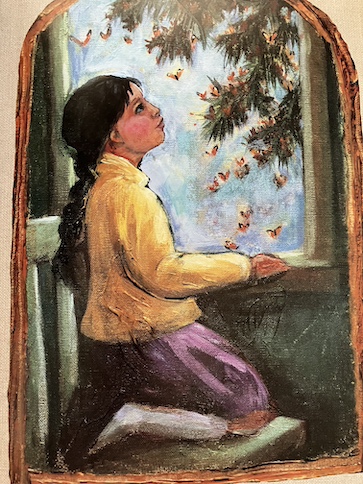
However, one year, there is very little rain, and they have a very bad harvest. The family sells their pigs and continues on as best they can, but their money is running low. They don’t have many resources left for money, and Isabel’s father is reluctantly considering cutting down their butterfly tree. He doesn’t want to do it, but he doesn’t know what else to do.

Isabel is distressed at the loss of the tree and the butterflies, so she suggests another plan to her parents. She often helps her mother to make tortillas, so she tells her mother that maybe they can set up a stand selling tortillas to the tourists who come to see the butterflies. The family decides to give Isabel’s plan a try.

The book is available to borrow and read for free online through Internet Archive.

The story ends on a somewhat hopeful note, but it bothered me a little because it’s not definite that Isabel’s plan is going to work. Isabel is hoping that they’ll be able to make enough money that they won’t need to cut down the tree, but we only see them getting set up, so we don’t know if they’re successful or not. I would have preferred to see them succeeding so we would know that things are going to get better, but the story just ends at that point, and it’s left up to the minds of the readers whether they were successful or not.

I think that hopeful but slightly worrying note at the end of the story is meant to reflect how people trying to preserve natural resources often feel – they have ideas and plans to help preserve natural areas and resources, but nobody knows for sure what will work or how well their plans will work. It’s realistic, if a little bit of a let-down. However, while nothing is guaranteed to be successful and life has its uncertainties, there is hope in the people who are willing to try different approaches to problems rather than simply giving up. The book does speak to the concerns that modern people, even children, have about the environment and the search for systems that work better than the ones that we already have.
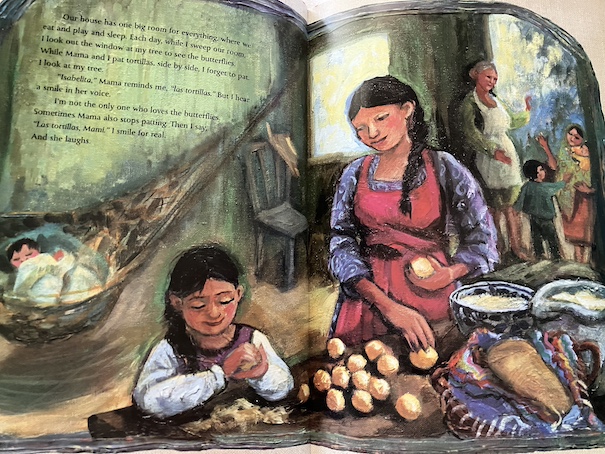
The pictures in this book are soft, colorful, and lovely. Although the family is poor, they appreciate the small pleasures in their lives, like making the tortillas and the yearly appearance of the beautiful butterflies. I did also feel a little sorry for the butterflies the pigs ate, but the story doesn’t dwell on that part too much.

This book was published by Sierra Club Books for Children, and there is a small note with the publishing information about the origins of the Sierra Club, which is dedicated to protecting scenic and ecological resources.

The Very Hungry Caterpillar

A small caterpillar hatches out of an egg and is very hungry. Each day, the caterpillar goes out looking for food, finding different things to eat.

Part of the book is a counting story, as the caterpillar eats different numbers of different types of fruit in different numbers. The format of this part of the book is really interesting because each of those pages isn’t a whole page but sections of pages that are different sizes, showing how the amount that the caterpillar eats increases each day.

Also, there are real holes in the pages to show where the caterpillar ate through different types of food. Kids like books with interesting physical features that encourage them to interact with the book as a toy as well as a story. I think that’s part of what has caused this book to have lasting appeal.

The book does also have a story to it about the growth and development of the caterpillar along with the counting part. At the end of the part that counts the number of pieces of fruit the caterpillar eats, the caterpillar eats a bunch of random junk foods and gives himself a stomachache. Eating a green leaf makes him feel better. By this point, the caterpillar is a fat caterpillar who is no longer hungry. At the end of the book, the caterpillar makes a cocoon and turns into a butterfly.

This is a cute picture book that is fun to show to very young children. The counting element is good both for teaching young children and for the children who have already learned to count because they can predict what the caterpillar is going to do next. The unusual format of those pages with the holes also makes the book distinctive.

On the 50th anniversary of the book in 2019, the BBC produced an article about the book’s history and its appeal to generations of young readers.

The book is available to borrow for free online through Internet Archive.

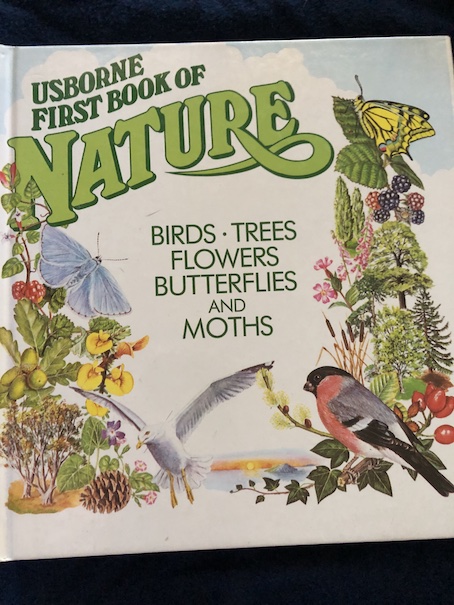
Usborne First Book of Nature

Usborne First Book of Nature designed by David Bennett, 1980.

I remember getting this book as a present from my grandmother as a child because my grandmother was an amateur naturalist. Although it’s a nonfiction book, I’m sentimental about it for that reason.

The book is divided into four sections covering different types of plants and creatures (each of which has its own book in the Usborne collection, but this book is a compilation):

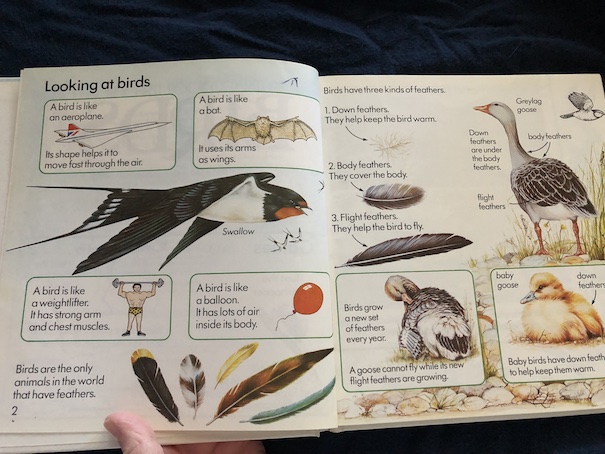
Birds

This chapter explains about the parts of birds, like the different shapes of beaks and feet different birds have, aspects of birds lives and behavior, and how birds fly.

Trees

This chapter explains the parts of trees, like how roots and twigs grow and the differences between different types of leaves, tree flowers, and seeds.

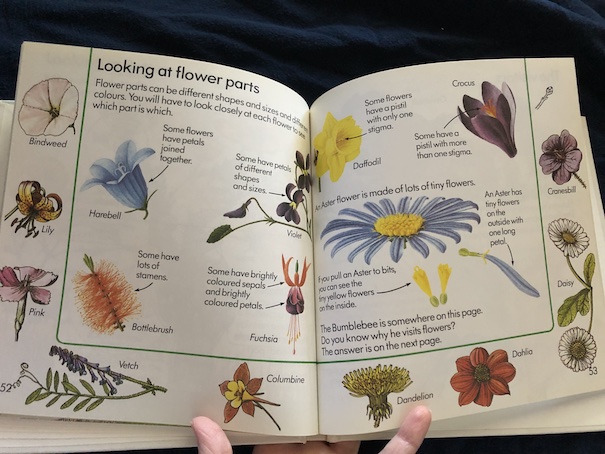
Flowers

This chapter explains the parts of flowers and about pollen and seeds. It also points out the creatures that like to visit flowers, like bees and hummingbirds.

Butterflies and Moths

This chapter explains the similarities and differences between butterflies and moths and what their life cycles are like.

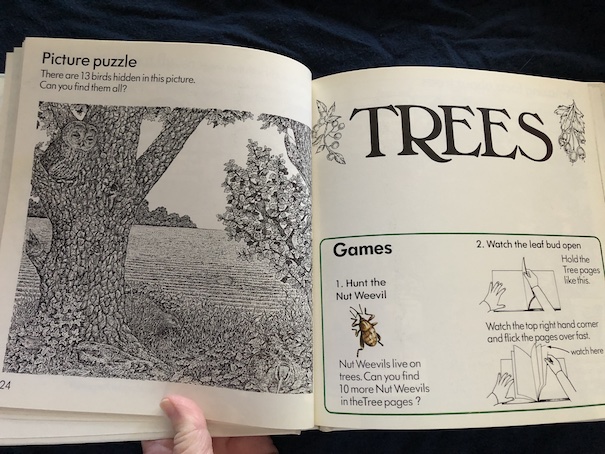
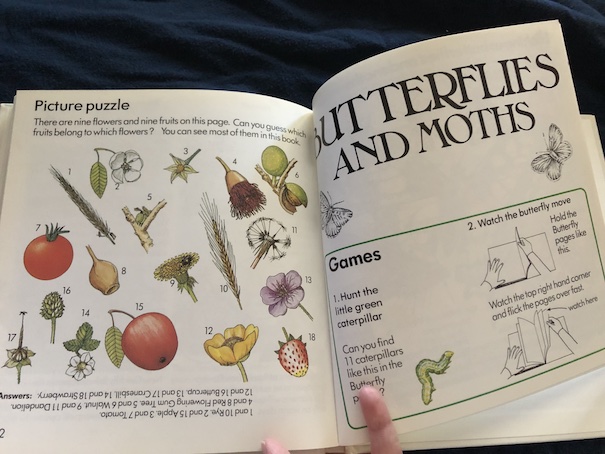
One of the best parts of this book is that it is designed to be interactive as well as informative. Some of the activities are explained at the beginning of each chapter, and there’s a puzzle or game at the end of each chapter. The upper right corners of each chapter have images that are meant to be used as a flip book. In the bird section, readers can quickly flip the pages to watch a bird fly. In the tree section, a leaf bud opens. In the flower section, a flower opens. In the butterfly and moth section, a butterfly opens and closes its wings.

Each chapter also has a game where you hunt for different creatures within the pages of that chapter and see how many you can find, and then, there’s another game or puzzle at the end. At the end of the bird chapter, there’s a picture puzzle where you have to find all the birds hidden in a black-and-white picture. At the end of the tree section, you have to find how many products are made from or come from trees in a busy market scene. At the end of the flower chapter, you have to match up different types of fruits with their flowers. The butterfly and moth section doesn’t have a game at the end.

This book is available to borrow and read for free online through Internet Archive.