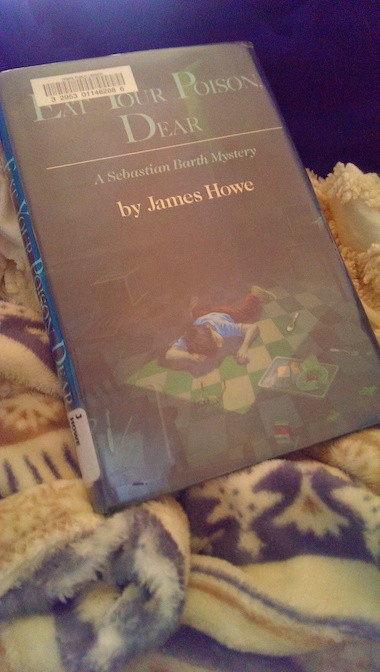
Eat Your Poison, Dear by James Howe, 1986.
Milo Groot is the editor of the school paper at Sebastian Barth’s school. Milo is something of a social outcast at school, but after he gets extremely ill eating in the school cafeteria, Sebastian and his friend David begin to wonder if there’s been some foul play. Although everyone thinks it’s just a bad case of the flu at first, it’s strange how Milo’s symptoms only come up after eating lunch at school.
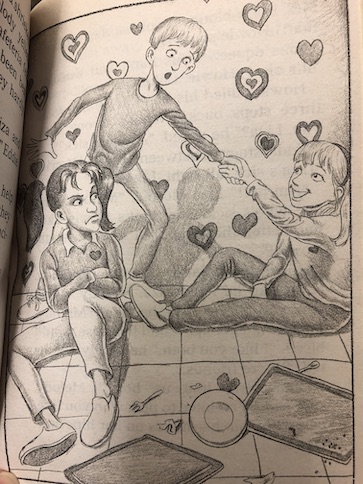
Milo recently wrote an editorial for the school paper, criticizing a group of boys at school who have adopted kind of a “greaser” look, wearing leather jackets, smoking cigarettes, wearing temporary tattoos (so badass), and calling each other by biker-style nicknames. The biker boys, who like to call themselves the Devil Riders (they don’t actually have motorcycles, but they like to stand around and look at pictures of them a lot), have been kind of mean to other kids, even former friends, but the school’s principal says that there’s no school rule against simply wearing leather jackets, so there’s nothing he can do about their biker persona. Milo starts up a petition against them, though, trying to get the principal to crack down on their little group. Could one of them be behind Milo’s poisoning?
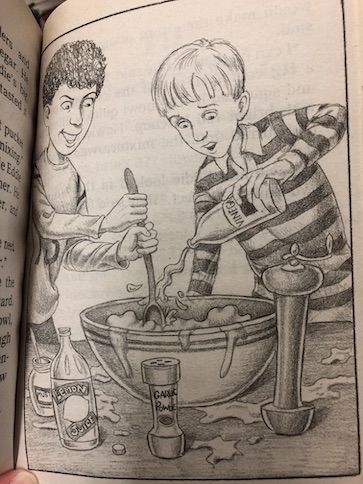
Then, suddenly, two more kids at school get sick in the same way. The school cafeteria has always gotten good health ratings, leading Sebastian to think that whatever is harming people at school must be deliberate. Soon, whatever is harming the students affects a large part of the student body, with seventy-seven students all getting sick on the same day. But, still, who is doing it and what is their motive?
The book is currently available online through Internet Archive.
My Reaction and Spoilers
The story gets somewhat philosophical about the nature of hurt and why people hurt each other. Sebastian asks his friend Corrie’s father, Reverend Wingate, for his opinion about why people hurt others. Sebastian’s grandmother thinks that people hurt others because of some hurt that they have themselves. This is part of the reason why the Devil Riders act the way they do. It is revealed that the leader of the little gang, Harley (not his real name, that’s his “biker” nickname) has a very unhappy home life that he often lies about to others. Acting tough with his friends and pushing other people around is his way of dealing with it. One thing that Reverend Wingate notes is that “There is no way for people to stop hurting one another except to stop.” He relates it to the arms race of the Cold War (contemporary with when the story was written), saying:
“If we justify building up our own arsenals because they have more weapons, then we only heap one folly on top of another. There comes a time when we must say, ‘Enough! I don’t have to have more toys than you. I don’t need the last word. I will turn the other cheek.’”
In other words, some battles aren’t worth fighting because the cost is too high, higher than the gains of victory, and in those cases, it’s better just to move on. In a way, both Sebastian’s grandmother and Reverend Wingate are correct; the villain that they’re looking for is someone who’s been harboring hurt for a long time and hasn’t yet realized the cost of getting revenge.
I found it interesting when Harley (who is not the villain, even though he is the primary suspect for a time) tells Sebastian that a person who is less popular than others is at a disadvantage when they do something wrong. Harley says that his social worker tells him, “. . . everybody makes mistakes. She says, you make a mistake on the blackboard, what do you do? You erase it and try again. I say to her, sometimes somebody writes on the blackboard with a magic marker, just to be mean, and everybody sees it and nobody can erase it away. It’s always there, and always will be the rest of your life.”
Popularity can make other people more willing to forgive a wider range of behavior, however I think that the situation that Harley describes is less a matter of popularity and more of method and intent. When someone does something “just to be mean,” it’s always going to leave a mark, at least emotionally, and “magic marker” isn’t meant to be erased, so it’s a bad choice for someone airing only temporary feelings. If he had chosen chalk, then yeah, whatever mean or rude thing he wrote would have been erased and forgotten, but Harley didn’t do that, and that’s his own fault. If his aim was to hurt people, he can’t legitimately complain that people got hurt because all that happened was that he succeeded in what he deliberately set out to do. He also can’t legitimately complain about lasting consequences when he deliberately chose a lasting form of inflicting that hurt. Some people just have poor priorities and bad strategy, and that’s what gets them into trouble. Harley is still blaming other people for his own bad choices, and he’s going to continue having problems until he realizes that he, and he alone, is the one responsible for the thing he does and only he can change what he decides to do.
That being said, some things that are apparently permanent aren’t really, if you know how to clean up after yourself and have the will to do it. You can even get permanent marker off of a chalkboard, if you have some rubbing alcohol. People have figured out how to do that because there are times when they’ve had the need to do it, and they tried ways to fix the situation until they found what worked. Life is like that. You can gripe about things being wrong and unfixable, or you can try ways of fixing things before you decide that they’re impossible to fix. People also appreciate people who make an effort. Harley needs to learn both how to behave himself in the first place and how to clean up after himself in the second. He could use a practical adult who understands how to fix things, and he needs to develop the mindfulness to keep himself from creating more problems to solve.
Before the story is over, Sebastian himself makes a big mistake, accusing the wrong person because he made a false confession. However, Sebastian is willing to face up to the apologies that he will owe others after he learns the truth, realizing that a false accusation was part of what the real villain was hoping for. Anger is also a kind of poison. Truth can hurt at first, but unlike poison, it can make things better.




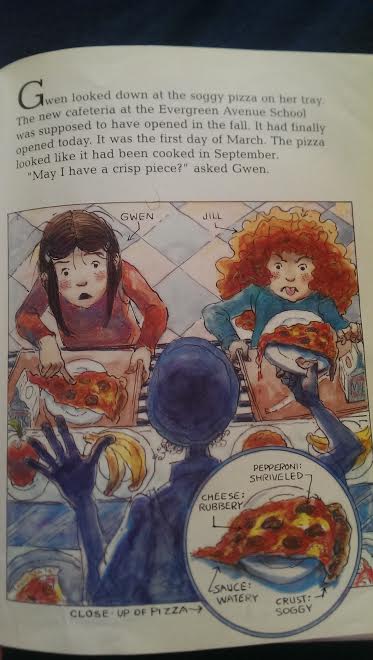 Ms. Lensky, the cafeteria lady at Gwen and Jill’s school, is just plain mean. All of the food that the cafeteria serves is yucky, even though the cafeteria is new. There will be a party to celebrate the opening of the new cafeteria, and even the kids’ parents and the mayor are invited. Gwen and Jill are happy because their class will get to help decorate the cake. However, Ms. Lensky, the M.C.L. (Mean Cafeteria Lady), doesn’t like the girls, and she blames them for a number of accidents that happen in the cafeteria.

 Jestress's Forgotten Books and Stories