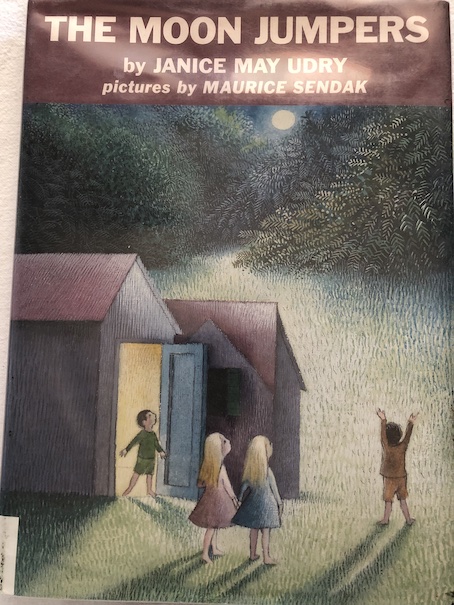
The Moon Jumpers by Janice May Udry, pictures by Maurice Sendak, 1959.
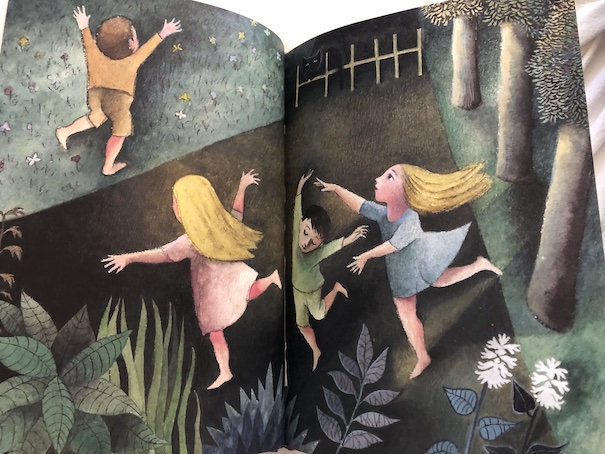
In this pleasant, relaxing children’s picture book, some children enjoy a beautiful summer evening! Some of the pictures are in black-and-white and some are in color, but the best pictures are the full-color, full-page illustrations. The illustrations are by Maurice Sendak, who wrote and illustrated Where the Wild Things Are. The story is told from the point-of-view of the children.
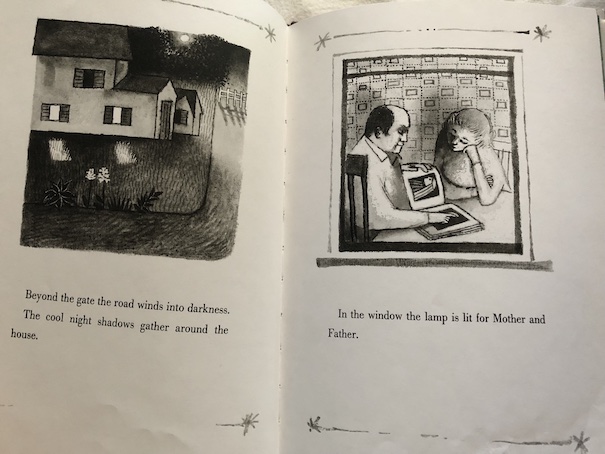
While their parents are in the house, the children go outside to enjoy the relative coolness of the evening. They run barefoot through the grass and play tag.
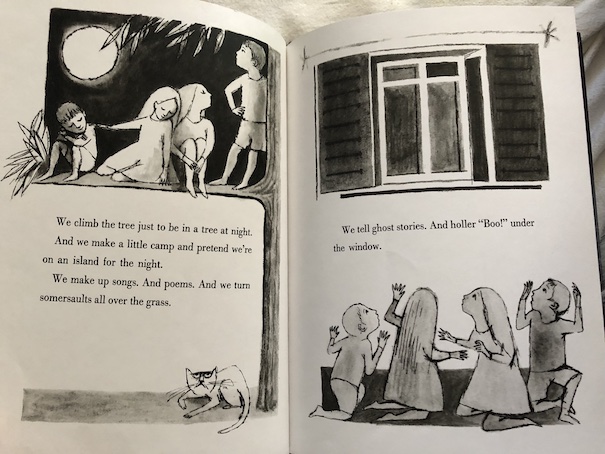
They climb a tree “just to be in a tree at night.” They set up their own camp, make up songs and poems, and tell each other ghost stories.
The moon is rising, and the children jump in the air, trying to touch it, although they know they can’t.
Eventually, their parents call them inside to go to bed. As the children go to bed, they say goodnight to the moon through their bedroom window.
The book is available to borrow and read for free online through Internet Archive (multiple copies). It’s a Caldecott Honor Book!
My Reaction
This is a nice, calm book that would make a good bedtime story on a summer night! It reminds me a little of Goodnight Moon, Time of Wonder, and The White Marble, which are other calm bedtime stories. It isn’t told in rhyme like Goodnight Moon, but it does show the beauties of summer and evenings spent outside, like Time of Wonder and The White Marble.
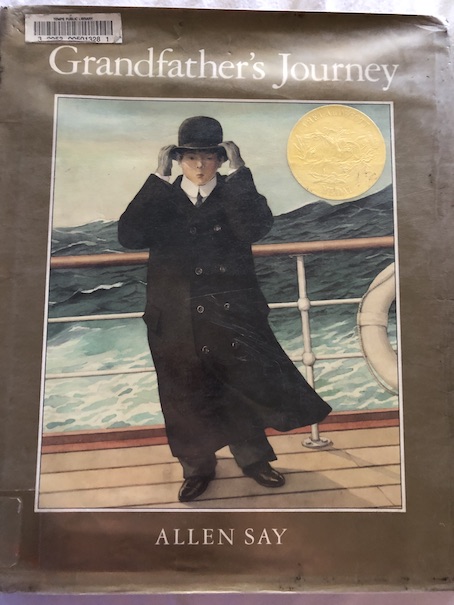
A man describes how his grandfather traveled by ship from his home in Japan to the United States. The time period isn’t specified, but from the context of the story, the grandfather’s original journey would have taken place either at the end of the 19th century or at the beginning of the 20th century.
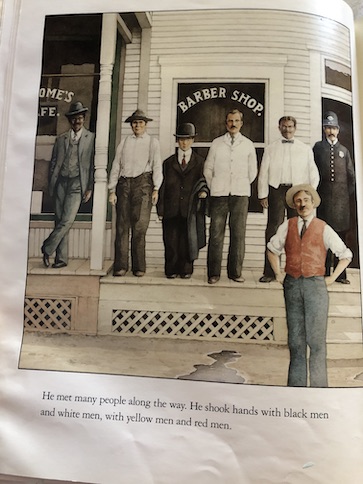
As a young man, the future grandfather travels all over the United States, seeing the sights and meeting all kinds of interesting people. It’s a bit of an adjustment for him, wearing Western style clothing and getting used to life in a new country, but he enjoys the adventure of it. He decides to settle in California, the part of the United States that he likes the best. He briefly returns to Japan to persuade his girlfriend to marry him and return to the United States with him.
The grandfather and his wife have a daughter in the United States, and they enjoy living there, but as the daughter grows older, the grandfather realizes that he misses Japan and wants to return home. He and his wife move back to Japan with their daughter.
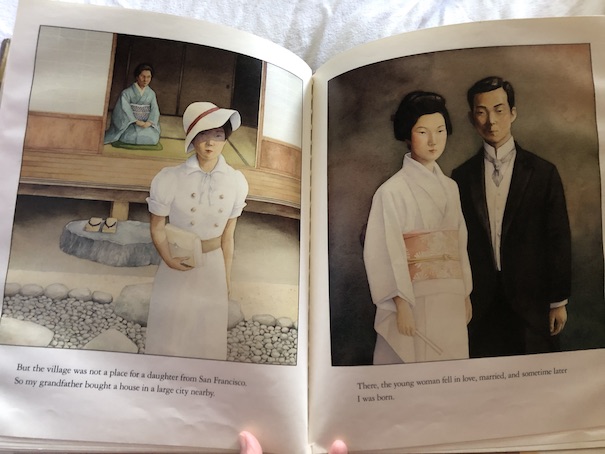
The daughter has to learn to adjust to life in Japan after having lived all of her life so far in America. The family moves to the city because life there is more what their daughter was accustomed to than life in the countryside, where they were originally from.
Later, the daughter grows up, gets married, and has a son, who is the author of the book. The grandson describes being young during World War II and the devastation in Japan during the war. (This is part of what dates the earlier part of the story.)
Toward the end of his life, the grandfather finds himself growing nostalgic about his time as a young man in the United States and wishes that he could return to California one more time. Unfortunately, the grandfather dies before making the trip. Instead, his grandson goes to the United States to see the places that his grandfather told him about.
Like his grandfather, the grandson stays in the United States for a time and has a daughter of his own. He comes to understand how his grandfather felt, missing Japan when he is in the United States and missing the United States when he is in Japan. The world is vast and full of fascinating places to explore, but there is always something to miss and feel nostalgic about, no matter where you are. The grandson continues to travel back and forth between the United States and Japan, enjoying both of them.
The book is a Caldecott Medal winner. It is available to borrow for free online through Internet Archive.
When I Was Young in the Mountains by Cynthia Rylant, illustrated by Diane Goode, 1982.
This nostalgic picture book is based on the author’s experiences living with her grandparents in West Viriginia when she was young. It paints a vivid picture of Appalachian life in the past. The story doesn’t give any particular years to describe when it takes place, but the author apparently lived with her grandparents during the 1960s, although from the pictures, it would be easy to believe that the story takes place in a much earlier time. Partly, the style of the clothes and stoves give that impression, but for me, it was really the cloth cover over the camera that made me think it was during the first half of the 20th century. You can still get these covers, but they’re not as common in modern times.
In the story, the author describes various aspects of Appalachian life, starting each section with “When I was young in the Mountains . . .” She remembers her grandfather coming home after working in a coal mine and how they would all have cornbread, fried okra, and pinto beans for supper.
For fun, the kids would go swimming in the swimming hole. They would also use the swimming hole for baptisms. They would also use the schoolhouse as their church.
She describes the general store where her family would go for groceries and how they would have to heat water on the stove for baths.
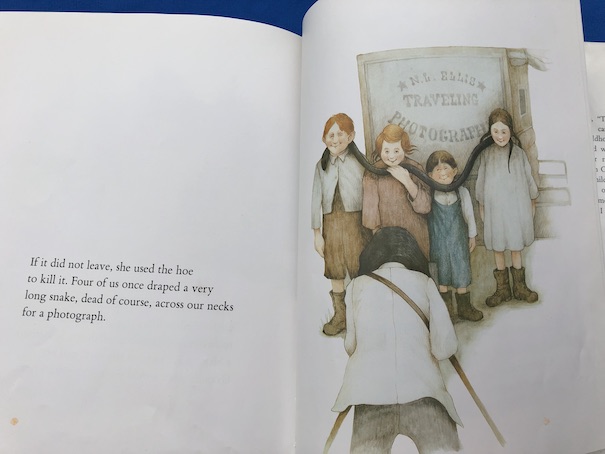
Sometimes, they had to deal with snakes, and once, when their grandmother killed a particularly big one with a hoe, they took a picture of the children with it.
Overall, the story is about enjoying the simple pleasures in life in a place you love, surrounded by people you care about.
This is a Caldecott Honor Book. It is currently available online through Internet Archive. Sometimes, you can also find people reading this book aloud on YouTube. I particularly like this reading because I think the reader has a good accent for reading this story, and she comments on her own experiences growing up in the country.
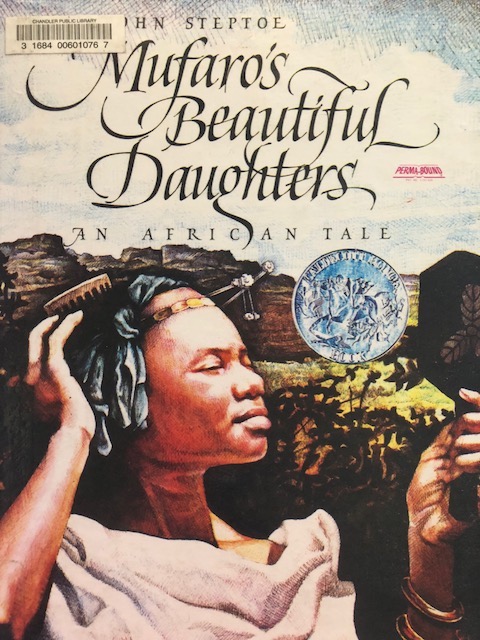
Mufaro’s Beautiful Daughters by John Steptoe, 1987.
This story, based on an African folktale, is somewhat similar to other folktales and fairy tales from other parts of the world such as Cinderella, Mother Holle, and Vasilisa the Beautiful, where a girl with a kind, hard-working nature triumphs over a mean sibling because someone in authority recognizes her good nature and rewards it.
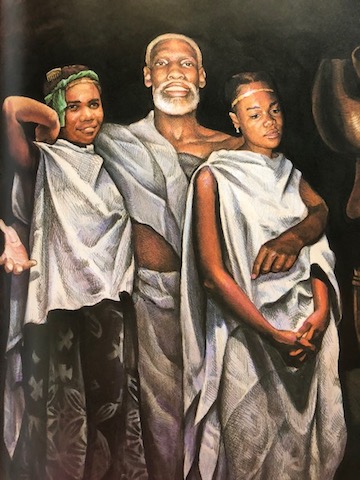
In a small village in Africa, a man named Mufaro has two daughters, Manyara and Nyasha. Both girls are beautiful, strong, and clever, but they have very different natures. Nyasha is kind, gentle, and patient. Manyara is bad-tempered, jealous, and self-centered. She frequently taunts Nyasha about how, one day, she will be the queen and her sister will be her servant. When Nyasha asks her why she is so mean, Manyara says that she hates the way people praise Nyasha for her kindness. She thinks that Nyasha is their father’s favorite child, and she wants to prove that Nyasha’s “silly kindness is only weakness.”
Since there is nothing that Nyasha can do to change her sister’s mind or attitude, she just continues doing her usual chores and being kind to people and animals. In particular, she makes friends with a small garden snake, knowing that his presence in her garden will keep away pests.
Manyara is sneaky and always behaves herself when their father is present, so Mufaro doesn’t know about the troubles between his daughters. When a messenger arrives, saying that the Great King is seeking a wife and that beautiful, worthy girls are summoned to his city so that he can choose from among them, Mufaro is proud and eager to present both of his beautiful daughters. Manyara tries to persuade her father to send only her, but Mufaro is firm that both girls must present themselves for the king’s decision.
Manyara decides that the only way to get the better of her sister is to be the first to arrive and present herself to the king, so she slips out in the middle of the night and begins the journey alone. However, both the journey and the king are not what Manyara thinks they are. Along the way, Manyara encounters various strange characters who ask for help or offer advice, but thinking that a queen doesn’t need to pay attention to others or do anything she doesn’t want to, Manyara ignores them all.
Nyasha, on the other hand, gets ready to leave at the appointed time in the morning. Everyone worries about Manyara but decides that the best thing to do is to follow her to the city, since she seems to have gone on ahead. As Nyasha travels with the rest of their friends and family, she listens to the people Manyara ignored and shows them kindness.
When they finally reach the city, Nyasha encounters a terrified Manyara, who hysterically insists that when she went to meet the king, she found a horrible monster instead. However, like everything else, it’s just another part of the test, and Nyasha is the one who passes because she, like her sister, has actually met the king before, but unlike her sister, she actually paid attention to him.
The pictures in the book are beautiful and colorful. A note in the front of the book says that the buildings in the illustrations were based on an ancient city in Zimbabwe that is now ruins. The note in the book also explains that the names of the characters in the story come from the Shona language. The meanings of the names are clues to the characters’ natures. Manyara means “ashamed”, and Nyasha means “mercy.”
The book is a Caldecott Honor Book. It is currently available online through Internet Archive.
The Desert is Theirs by Byrd Baylor, illustrated by Peter Parnall, 1975.
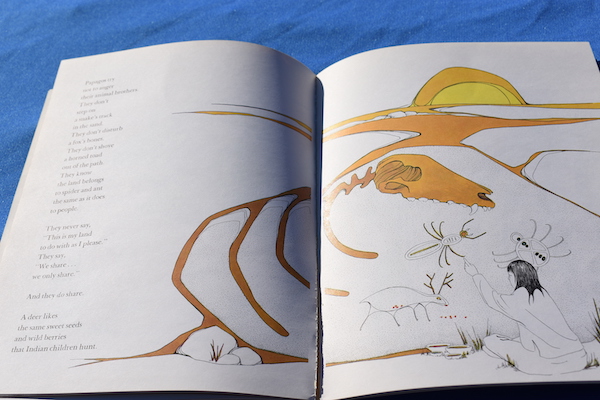
The story in the book is written in a kind of poetical form, describing what life in the desert is like. It talks about the kinds of animals that live in the desert and how the plants sometimes have to go without water for months because it doesn’t rain much.
It also describes the Desert People, the Papago Indians (Tohono O’odham – Which literally translates as “Desert People”). Even though the desert is a harsh environment, the people who have lived there for generations think of it as home and like living there.
The book continues with a Native American creation myth that describes how the Earthmaker made a little plot of dirt and greasewood grew in it – the beginning of the desert. Then, Coyote scattered seeds to grow cactus, and the Spider People sewed the earth and sky together. In the creation story, other animals help to form the desert, which earns the respect of the Papago. The Desert People recognize that they have to share the land with the animals as well as each other.
While
the desert can be harsh, it isn’t barren.
In the desert, there are still plants to eat and use as medicine. People also use grasses for weaving baskets
and the soil itself for building homes.
People
also learn patience in the desert. It can
take a long time for it rain. Plants
sometimes have to wait for years in order to bloom. Animals wait for the coolness of night to
come out. People plant their crops very
carefully. But, even though they often
have to wait, good things are worth waiting for.
I remember
teachers reading this book to us in early elementary school because I grew up
in Arizona. It is a Caldecott Honor
Book.
One Christmas Eve, a young boy is lying awake in bed when he hears strange sounds. When he looks out of his window, he is astonished to see a train outside of his house, where there aren’t any train tracks. He goes outside to investigate, and the train conductor tells him that the train is heading to the North Pole and asks the boy if he wants to come.
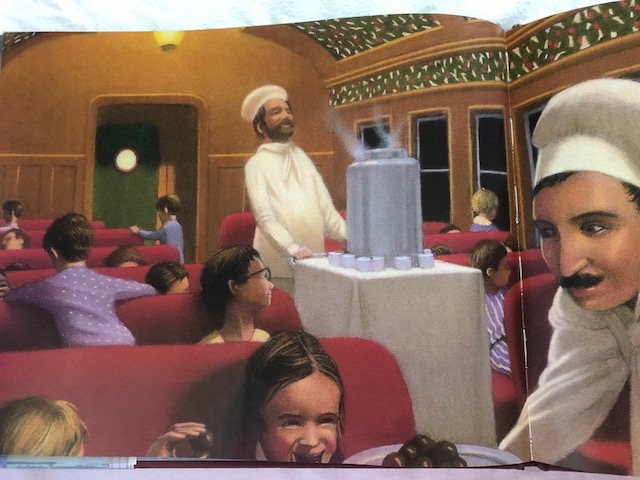
The boy (who is never named) believes in Santa Claus even though some of his friends no longer do, and he gets on board the train. The train is filled with other children, singing Christmas songs, eating candy, and drinking hot cocoa.
After a long trip over mountains and through forests, they arrive at Santa’s city at the North Pole, where they get to take part in a ceremony to give the first gift of Christmas. Out of all the children from the train, the boy who narrates the story is chosen to receive the first gift. He can ask for anything he wants for Christmas, but he asks for a bell from Santa’s sleigh as proof of his adventures and Santa’s existence.
When the children get on the train to go back home, the boy seems to have lost the bell because of a hole in his pocket, and he is sad. However, the bell reappears on Christmas morning as a mysterious extra present under the tree. The boy’s parents can’t hear the bell ring, and they think it’s broken, but the boy and his sister, Sarah, can hear it. The boy says when he and his sister grew up, Sarah eventually reached the point where she could no longer hear the bell, but he still can because only people who believe in Santa can hear the bells on his sleigh.
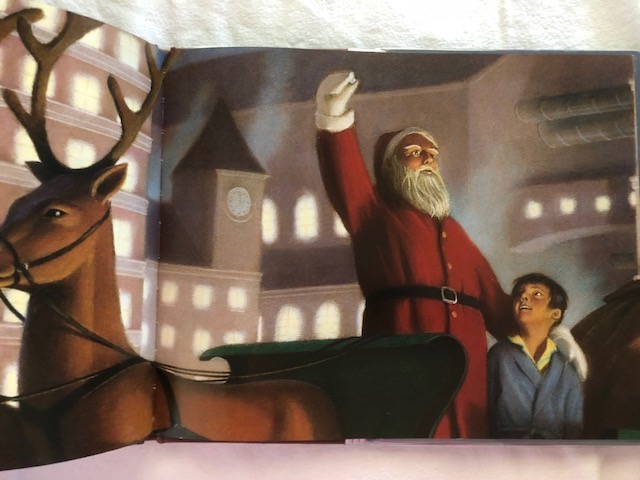
The book is a Caldecott Medal winner, and it has become a Christmas classic! Some places that have trains hold special Polar Express train rides where they decorate the trains with Christmas decorations and try to re-create the ride from the book. There is also a movie version of the book, although the story in the movie includes incidents which weren’t in the book to make the movie longer and more dramatic. The original story was very calm and low-key, although still magical, the kind of thing that you could easily read to a child in bed on Christmas Eve.
Most of what Internet Archive has about The Polar Express is related to the movie, but there is also an audio version of the original book. For the benefit of teachers and homeschooling parents, there is also A Guide for Using The Polar Express in the Classroom on Internet Archive.
Strega Nona is a witch who lives in a small town and uses her magic to help people in various ways, everything from small cures or love potions. However, she runs into problems when she hires Big Anthony to help her around her house. Big Anthony is helpful, but he doesn’t always pay attention or follow orders.
Strega Nona has a magical pot that makes pasta. To get it to make a never-ending pot full of pasta, she recites a certain rhyme. To get it to stop making pasta, she recites a different rhyme and blows three kisses to it.
Big Anthony is forbidden to use the pasta pot himself, but he can’t resist telling people in town about it. At first, no one believes him because it sounds so strange. Everything thinks he’s just making it up. Big Anthony is offended that no one believes him, so one day, while Strega Nona is gone, he sets out to prove to everyone that this magical pot exists.
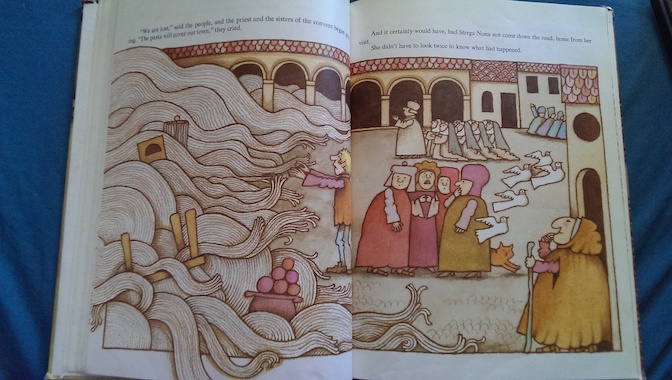
Big Anthony knows the rhyme to get the pot to start making pasta, and he uses it to make pasta for everyone in town so they will know that he was telling the truth. Unfortunately, he doesn’t really know how to get it to stop because he didn’t know that Strega Nona blows kisses to the pot. With the pot now sending a massive river of pasta through the town, what can Big Anthony do?
This is a Caldecott Honor Book. It is currently available online through Internet Archive.












 Jestress's Forgotten Books and Stories