When Clay Sings

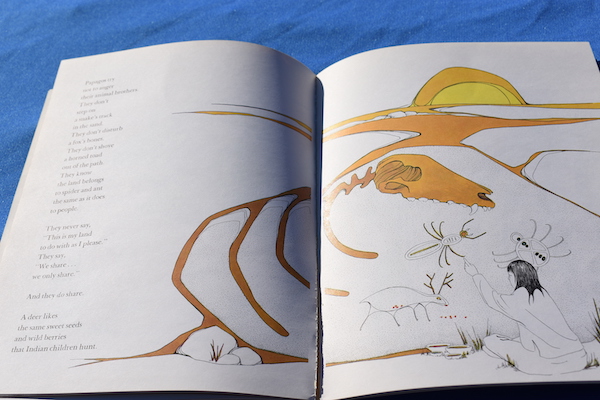
This children’s picture book is a salute to the ancient makers of Native American pottery, dedicated to these makers and the museums that preserve their work. It’s written as free form poetry with images of the American Southwest and designs from Native American pottery.

The story sets the scene on a desert hillside, where pieces of ancient pottery are buried. Sometimes, Indian (Native American) children dig up pieces of old pottery, and their parents remind them to be respectful of what they find because they are pieces of the past and of lives that went before. Sometimes, they’re lucky enough to find pieces that fit together or even a bowl that isn’t broken.

They reflect on the time and skill that went into making the pottery and how strong the pottery would have to be to last well beyond the lives of the people who made it. They think about the people who painted the beautiful designs on the pots and what their lives were like. Could their own children have requested favorite pictures painted on their bowls?

Some designs show animals or bugs or hunters, but others show bizarre creatures that might be monsters or spirits. Others show a medicine man trying to cure a child, ceremonies, dancers in masks and costumes, or the traditional flute player. People can reflect on the lives of those long-ago people and how they compare to the lives of people today.

There is a map in the back of the book which shows the areas of the American Southwest (Arizona, New Mexico, Utah, and Colorado) where the pottery designs the book uses originated from and the tribes that used them.

This is a Caldecott Honor Book. It is available to borrow and read for free online through Internet Archive (multiple copies).
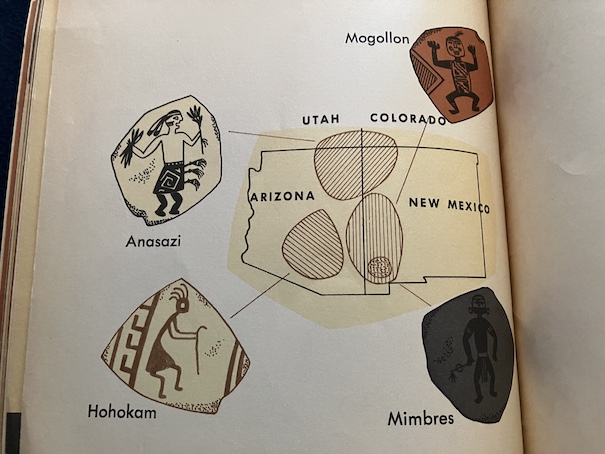
I grew up in Arizona, and I remember our school librarian reading books by Byrd Baylor to us in elementary school during the late 1980s or early 1990s. She wanted to introduce us to this author because she wrote about the area of the United States where we lived. In fact, this book about pottery was fitting because, when they were building our school in the 1970s, they found some ancient pottery. They used to have it on display in the school library. Even to this day, it’s common for people creating buildings in this area to have the site surveyed by archaeologists. Finds are fairly common, and the usual procedure is to thoroughly document everything that gets uncovered before burying it again in the same location and constructing the building over it. One of the reason why they usually rebury finds is that, in this dry, desert climate, putting them back into the ground will actually preserve them very well. It’s possible that later generations will find them again (especially with the location documented) when the building is gone or no longer necessary, but they may have better instruments or techniques for analyzing them.

I’m a little divided on how much I like this book, though. On the one hand, I like books about folklore and traditional crafts, and this book focuses on a geographical area that’s very familiar to me. On the other hand, the free verse poetry that reflects on the feelings of people about the pottery doesn’t appeal to me quite as much as books which show the process of making it, like The Little Indian Pottery Maker. I like to see the process and learn more of the known background legends of some of the designs than just try to imagine what things might have been going through the minds of the designers. Toward the end of the book, they show the legendary humpbacked flute player, but they don’t tell you that this figure is called Kokopelli and that there are legends about him. It’s a nice book, but I just felt like there was potential to include more background information.

This book uses the word “Indian” for “Native American” or “America Indian”, which is common in older children’s books.

Last Stop on Market Street

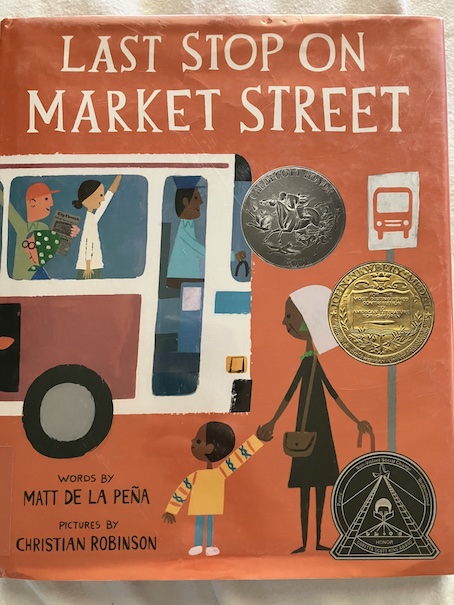
After church, CJ and his grandmother have to wait for the bus while other people just get in their cars and leave. CJ is annoyed because it’s raining. He asks his Nana why they have to wait in the rain and why they don’t have a car. His Nana says that they don’t need a car because they have the bus.

The bus is interesting because many interesting people take the bus. The bus driver does little tricks, like pulling a coin from behind CJ’s ear, and there are interesting passengers, like the lady with a jar of butterflies and a man with a guitar.

While CJ’s friends, whose families have cars, go straight home after church, CJ and his Nana have somewhere else to go. CJ wishes that he could just go home, too, but Nana points out that the boys who just go straight home miss meeting so many interesting people. CJ does enjoy listening to the man with the guitar playing music on the bus.

CJ and his grandmother get off at the last stop on Market Street, which is in a bad neighborhood. CJ comments about how dirty it is, but his grandmother points out that people who surrounded by dirt know how to see what’s beautiful.

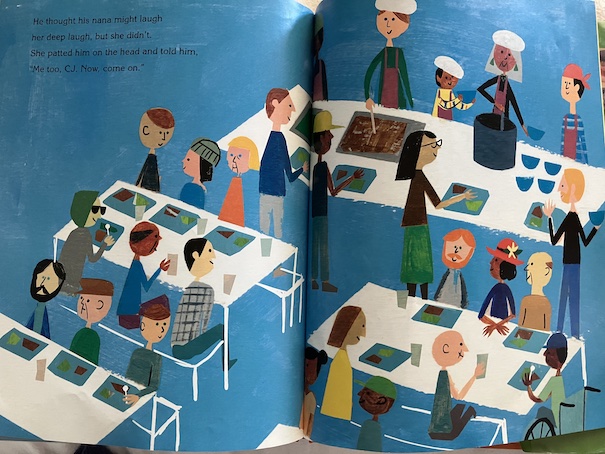
The reason why CJ and his grandmother are here is that they help out at a soup kitchen. CJ recognizes the faces of people he’s seen there before, and he realizes that he’s glad that he came.

This book is the winner of multiple awards. It’s a Newbery Medal winner, a Caldecott Honor book, and a Coretta Scott King Award honor book for its messages about appreciating and helping other people in a diverse community.

This is one of those picture books that I think can speak to adults as well as kids, maybe even more so because adults might understand some of the broader context of the story. CJ and his grandmother probably don’t have as much money as some of CJ’s friends and their families, which is why they don’t have a car. When CJ comments about why do they have to wait for the bus in the rain, his grandmother could have given him a straightforward answer about how they can’t afford a car, but that would have been depressing. Instead, she points out the positives of the bus and the people they meet. All through the book, she points out the positives about situations that both CJ and the readers can see are not entirely positive. It’s noticing these positives that help make the situation better.

CJ and his grandmother don’t have much money themselves, but Nana is teaching CJ how to help other people and build relationships with them. The people they meet are often poor people or people who are unfortunate in some way, but they still enjoy meeting these interesting people with colorful lives. There are times when CJ wishes that he could be somewhere else or doing something else, but yet, he also enjoys parts of where he is and realizes that what he’s doing is better than other things he could be doing. CJ and his grandmother experience the enrichment of life experiences and relationships with other people.

Hershel and the Hanukkah Goblins

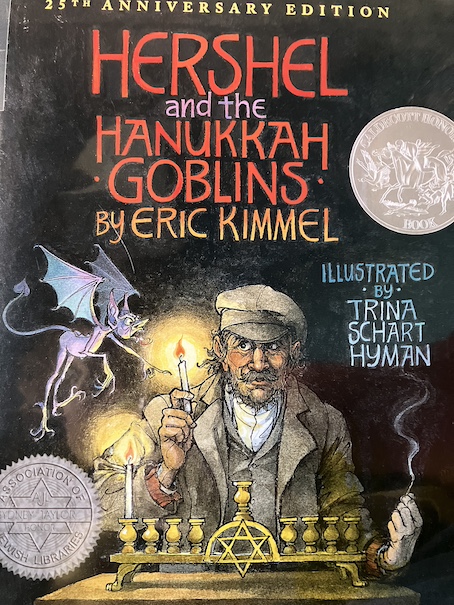
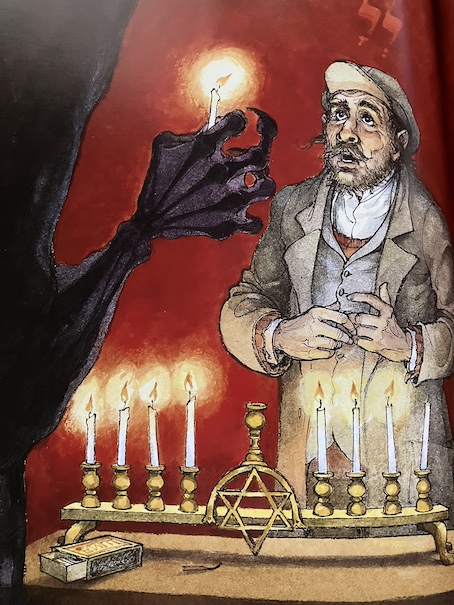
On the first night of Hanukkah, a tired travel, Hershel, trudges through the snow on his way to the next village. There, he hopes to get something to eat and celebrate the holiday with the local villagers. However, when he reaches the village, nobody is celebrating.

When he asks the villagers why they’re not celebrating, they tell him that they can’t because there are goblins haunting the old synagogue on the hill. Every time they try to celebrate Hanukkah, the goblins come after them, blow out the candles on their menorahs, breaks their dreidels, and throw all the potato latkes on the floor.

Hershel decides that he isn’t scared of the goblins, and he’s going to put an end to their mischief. The village rabbi says that the only way to get rid of the goblins is to spend all eight nights of Hanukkah in the synagogue, lighting Hanukkah candles every night. Then, on the final night of Hanukkah, the goblin king must light the candles himself. Although this sounds difficult, Hershel is confident that he can do it. Although the villagers aren’t really expecting Hershel to succeed, they support Hershel in his mission, and they give him some food, a menorah, candles, and matches.

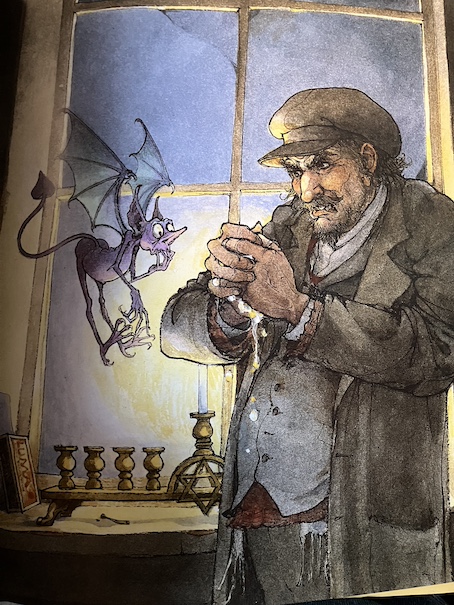
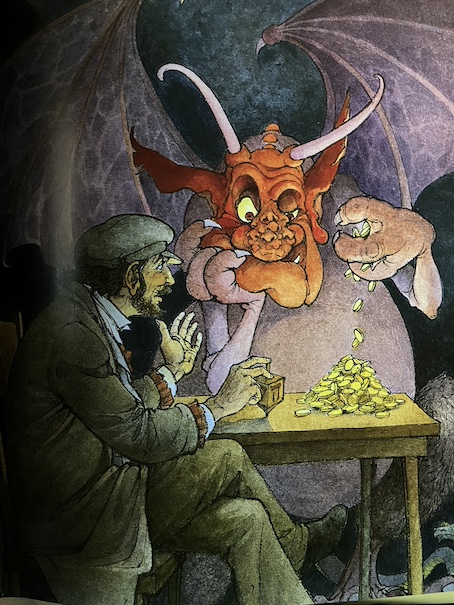
The old synagogue is creepy, and when Hershel lights his first candle, a small goblin appears to ask him what he’s doing. Herself isn’t intimidated by the little goblin, and he tricks the goblin into thinking that he’s strong enough to crush rocks in his hands by squeezing a hard-boiled egg in his hands until it breaks. The little goblins is scared away but warns him that bigger goblins than him will come later. The next night, a bigger goblin comes, but he isn’t very bright and gets his hand stuck in a jar of picks when he tries to take too many. The night after that, tricks the third goblin into playing dreidel with him and giving him all his gold.

It continues like this, night after night, with Hershel tricking the goblins in various ways so that they’ll let him light the candles on his menorah. Finally, Hershel comes face-to-face with the most sinister goblin of all – the king of the goblins. Can Hershel find a way to trick him and get him to light the candles of the menorah himself?

The book is a Caldecott Honor Book and named a Sydney Taylor Honor Book by the Association of Jewish Libraries. It is available to borrow and read for free online through Internet Archive (multiple copies). It was originally published as a short story in Cricket magazine and later as a book, which is why the story has two copyright dates.

I’m not Jewish, and I admit that this isn’t a book I read as a kid, although I do remember that it was one that was often recommended when I was young. As an adult, I decided to try it, since I just never got around to it before. I really do like this story. I enjoyed the folklore elements, and I also appreciated that the main character saves Hanukkah, in much the same way that various characters had to “save” Christmas when I was a kid.

It makes me laugh to think about it now, but Christmas always seemed to be an extremely endangered holiday in Christmas television specials from my childhood. Some evil person or being was always out to destroy Christmas, for various reasons, with varying degrees of logic, and popular television characters always had to “save” it from being destroyed or canceled or whatever. It was fun and entertaining, but when you consider the entire canon of endangered Christmas holiday specials all together, it does seem like there isn’t a single year when Christmas isn’t in danger from somebody or something, making it weirdly routine for Christmas to almost not happen. At some point, I think my brother pointed out that Christmas was always in danger, but it seemed like Hanukkah was relatively safe. (At least, in the land of holiday-themed winter television specials starring well-known cartoon characters.) I figured that Christmas was likely a bigger target for the forces of evil due to its wide mass appeal because there were just more people who celebrated Christmas where I lived than Hanukkah (and also because of the all the related Christmas toy tie-in commercials and advertising sponsors for those shows).

So, I was delighted to see Hanukkah get saved from a band of comically nefarious goblins in this book. The goblin king is a sinister figure in the pictures, but fortunately, he’s not too much brighter than his cohorts. The book has been adapted as a stage play (you can sometimes find clips or trailers from performances on YouTube), and there is also an animated short film of the story. I think it would be fun to see a longer version, though, in video or movie form. The book skims over the details of what Hershel does to trick some of the other goblins after the third one, so there’s room to elaborate and make the story longer. I think I would have been a little scared by the final goblin when I was a little kid, but the goblins not being particularly bright and easy to trick does help remove some of the scare factor.

At first, I though that the story of Hershel might have been a folktale because it reads like one. In the back of the book, the author explains that he wanted to write a story that was somewhat like A Christmas Carol by Charles Dickens but about Hanukkah, and he took his inspiration from the folktale Invanko, the Bear’s Son (also known as Jean de l’Ours or John the Bear), which is includes the hero tricking a goblin, and he added in a Jewish folk hero, Hershel of Ostropol. The resulting story is sort of like a new folktale, remixed from old ones, which is fitting because that’s what happens with folk stories Overall, I thought it was a fun story.

A Chair for My Mother

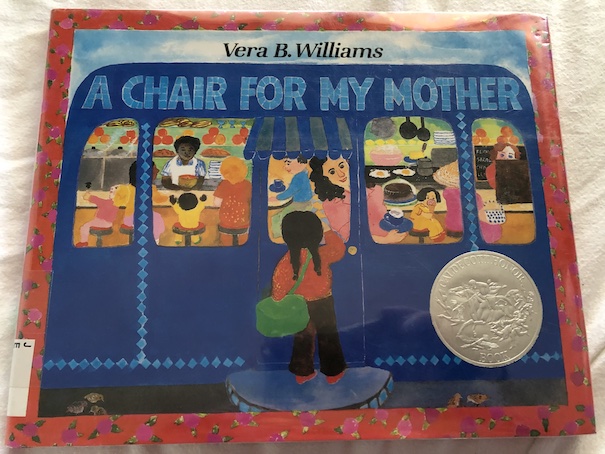
A girl explains how her family is saving up for a new chair after a fire destroyed all the furniture in their old home. The fire happened before the story really begins, but the girl explains how she and her mother returned from a shopping trip and discovered that their home was on fire.

The girl’s grandmother and the family cat escaped from the fire, but everything they had in the house burned.

The girl, her mother, and her grandmother all moved in with the girl’s aunt and uncle until they could move into a new apartment. However, they didn’t have any furniture in the apartment. Their relatives, friends, and neighbors all helped them by giving them food and pieces of furniture they didn’t need anymore.

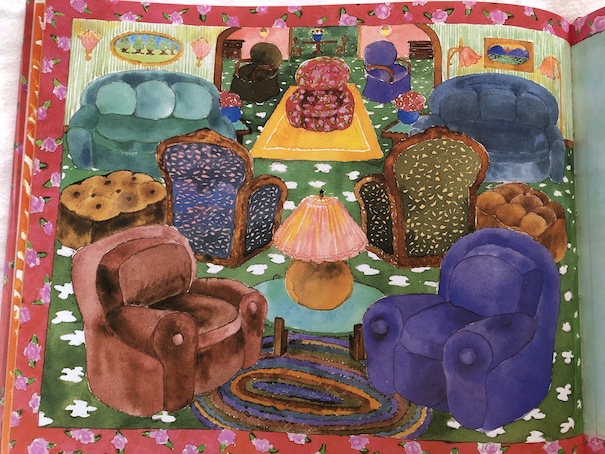
It was a big help, however, a year later, they still don’t have a sofa or comfortable armchairs. The girl’s mother works in a restaurant, and when she comes home, she’s very tired from being on her feet all day. She wishes that they had a comfortable armchair where she could rest after work.

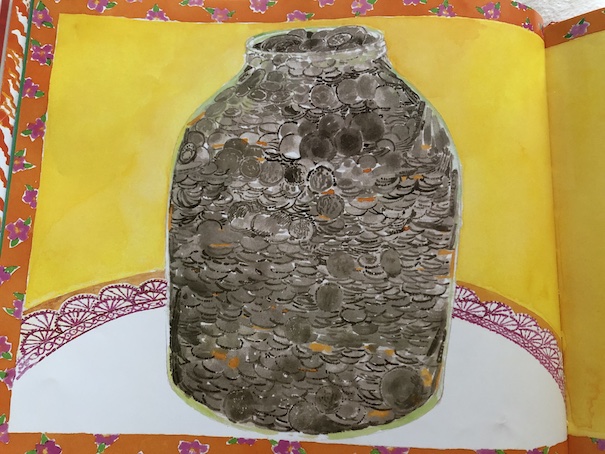
The mother starts saving part of her tips from the restaurant in a coin jar to save up for a new chair. Sometimes, the restaurant owner even pays the girl to do little chores, and she saves part of her money for the chair. Whenever the girl’s grandmother saves money on food she buys, she also puts the savings into the jar. They say that when the jar is full of coins, they will buy the new chair they want.

Eventually, the jar is completely full. They count the coins, roll them in coin wrappers, and take them to the bank to change them for ten-dollar bills. Then, they go shopping for a new chair! There are many chairs to choose from, but they know exactly what kind of chair they want.

The book is a Caldecott Honor Book. It’s available to borrow and read for free online through Internet Archive (multiple copies, including one in Spanish).

I remember this book from Reading Rainbow when I was a kid! The pictures are bright and colorful, and the story offers comfort and hope.

The people in the story have been through a tragedy where they lost almost everything they had, but the book shows how they recover. Although the fire was sad, the story starts after the fire happened, and the girl talks about the help they’ve received and what they’re doing to make their new home more comfortable. They’re over the initial shock of the fire and concentrating on improving their situation from there. This book felt both comforting and very real. I liked how it showed the family recovering from their ordeal through a combination of help from relatives and friends and their own efforts. Other people help them with some basic household items as they move into a new apartment, and they also save up their money for the chair they want to make their new place feel more like home.

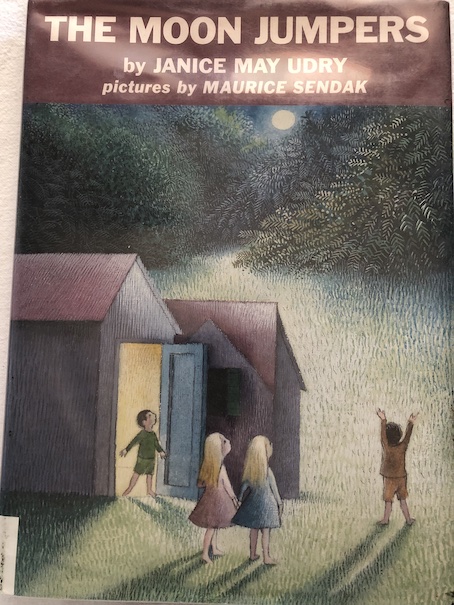
The Moon Jumpers

The Moon Jumpers by Janice May Udry, pictures by Maurice Sendak, 1959.

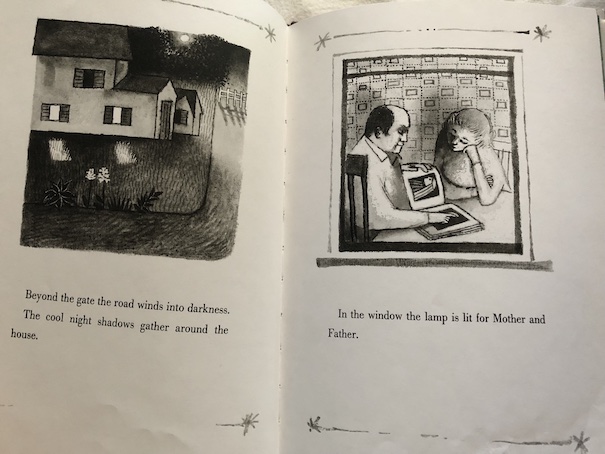
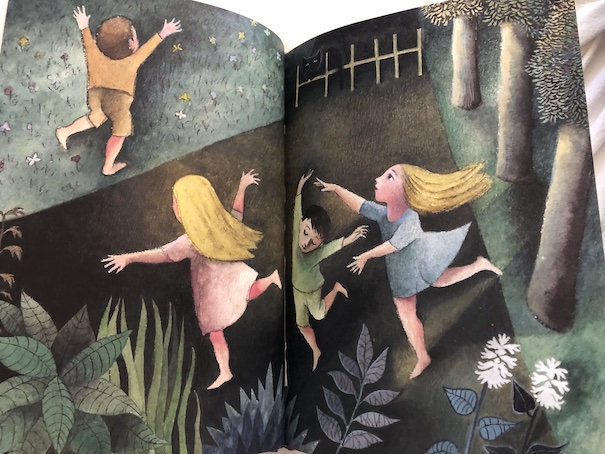
In this pleasant, relaxing children’s picture book, some children enjoy a beautiful summer evening! Some of the pictures are in black-and-white and some are in color, but the best pictures are the full-color, full-page illustrations. The illustrations are by Maurice Sendak, who wrote and illustrated Where the Wild Things Are. The story is told from the point-of-view of the children.

While their parents are in the house, the children go outside to enjoy the relative coolness of the evening. They run barefoot through the grass and play tag.

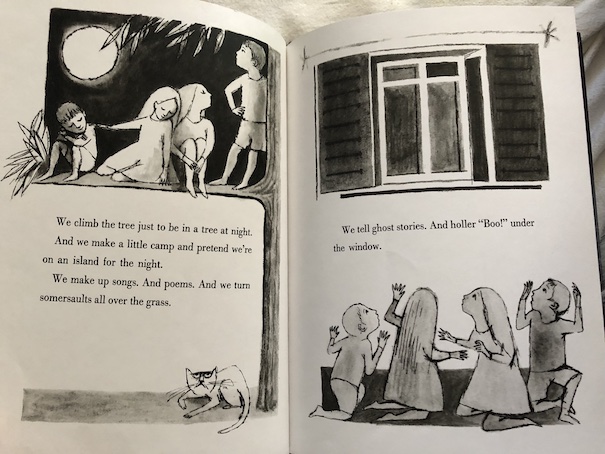
They climb a tree “just to be in a tree at night.” They set up their own camp, make up songs and poems, and tell each other ghost stories.

The moon is rising, and the children jump in the air, trying to touch it, although they know they can’t.

Eventually, their parents call them inside to go to bed. As the children go to bed, they say goodnight to the moon through their bedroom window.

The book is available to borrow and read for free online through Internet Archive (multiple copies). It’s a Caldecott Honor Book!

My Reaction

This is a nice, calm book that would make a good bedtime story on a summer night! It reminds me a little of Goodnight Moon, Time of Wonder, and The White Marble, which are other calm bedtime stories. It isn’t told in rhyme like Goodnight Moon, but it does show the beauties of summer and evenings spent outside, like Time of Wonder and The White Marble.

Ben’s Trumpet

Ben’s Trumpet by Rachel Isadora, 1979.

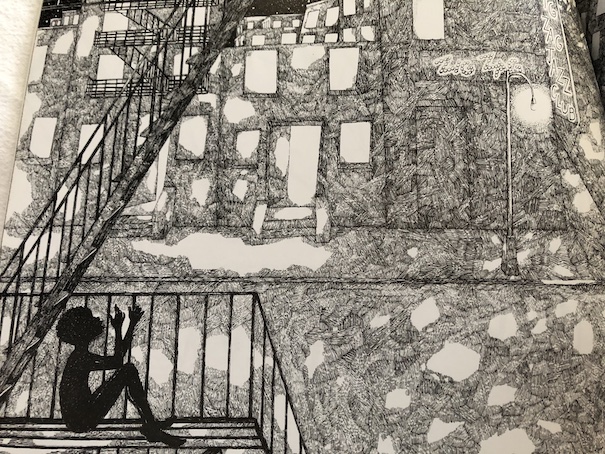
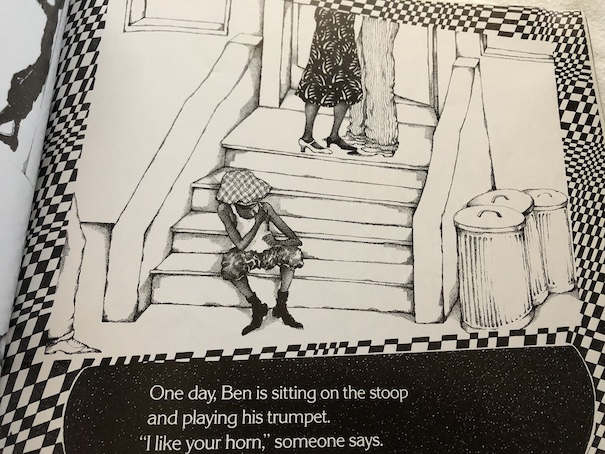
A boy named Ben likes to listen to the music coming from the nearby jazz club at night.

During the day, Ben stops by the club on his way home from school so he can watch the musicians practice.

Ben’s favorite instrument is the trumpet. Ben doesn’t have a trumpet himself, but he imagines that he does and that he can play for his family or play along with the musicians from the club.

Some of the other kids in the neighborhood laugh at Ben for playing an imaginary trumpet, but the trumpeter from the club doesn’t laugh. When he sees Ben playing his imaginary horn, he compliments him.

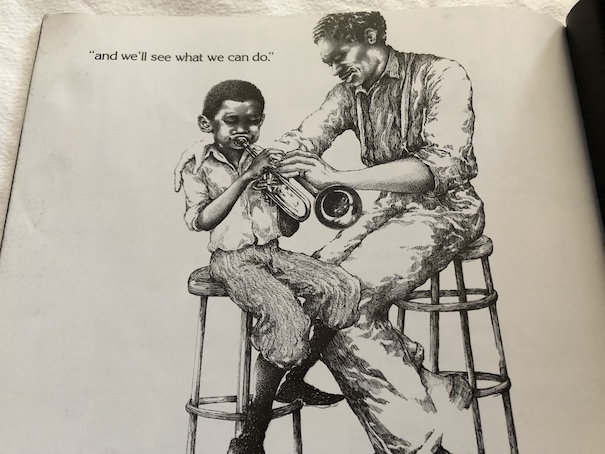
Later, when he sees Ben watching the club, the trumpeter invites Ben inside and lets him try his trumpet for real.

This book is a Caldecott Honor Book. It’s available to borrow and read for free online through Internet Archive (multiple copies).

My Reaction

I thought this was a nice story about an adult who understands a boy’s dream and is willing to take him under his wing. Both Ben and the trumpeter understand the love of music, and the trumpeter sees how badly Ben wants to be a real musician. We don’t know whether Ben eventually becomes a professional musician or not because the story ends with him trying a real trumpet for the first time, but the story implies that the trumpeter may become a mentor to Ben and that this might be the beginning of Ben realizing his dream.

The book doesn’t give a specific date for the story, but the illustrations and use of terms like “the cat’s meow” indicate that it takes place in the 1920s. The illustrations not only give the story its 1920s vibe, but the abstract lines included in the pictures help to convey the sounds of the music and echo the art deco style popular during the 1920s.

There are a couple of things in the pictures that adults should be aware of. There is one picture where Ben’s baby brother is completely naked, for some reason, and there are adults with cigarettes. Other than that, I can’t think of anything else about the book that would be a cause for concern. There is no specific location given for the story, but it takes place in a city, and all of the characters are African American.

Blueberries for Sal

Blueberries for Sal by Robert McCloskey, 1948.

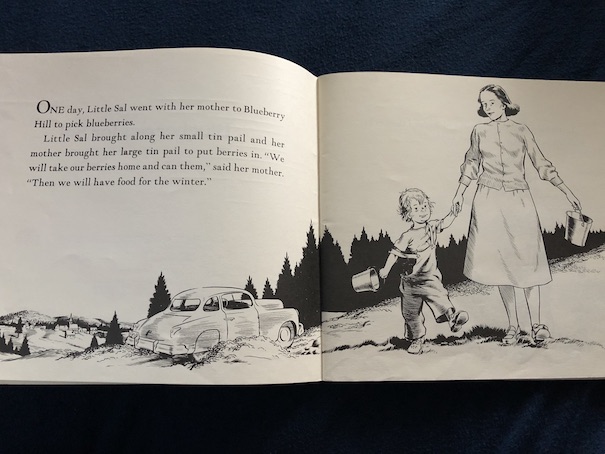
Sal is a little girl whose mother takes her to pick blueberries one day. The mother wants to can the blueberries for winter.

Sal gives in to temptation and eats the blueberries as she picks them.

Meanwhile, a mother bear and her baby come to eat blueberries.

Both Sal and the Little Bear lose sight of their mothers, and when they go looking for them, Sal accidentally finds the mother bear, and the little bear accidentally finds Sal’s mother.

Eventually, the mother bear realizes that Sal is following her when she hears the blueberries plunking into Sal’s pail. Sal’s mother realizes that a small bear is following her when he eats blueberries out of her pail.

Fortunately, nothing bad happens. The mothers just look around for their respective children and figure out where they are by the sounds they make. Then, the mother bear leaves with her baby, and Sal and her mother take their blueberries home.

At first, I was worried about Sal being with the mother bear and how Sal’s mother would react to the mother bear when she saw it, but the two mothers never meet in the story, and the children are fine.

The book is a Caldecott Honor Book. It is available to borrow for free online through Internet Archive (multiple copies).

When I Was Young in the Mountains

When I Was Young in the Mountains by Cynthia Rylant, illustrated by Diane Goode, 1982.

This nostalgic picture book is based on the author’s experiences living with her grandparents in West Viriginia when she was young.  It paints a vivid picture of Appalachian life in the past. The story doesn’t give any particular years to describe when it takes place, but the author apparently lived with her grandparents during the 1960s, although from the pictures, it would be easy to believe that the story takes place in a much earlier time. Partly, the style of the clothes and stoves give that impression, but for me, it was really the cloth cover over the camera that made me think it was during the first half of the 20th century. You can still get these covers, but they’re not as common in modern times.

In the story, the author describes various aspects of Appalachian life, starting each section with “When I was young in the Mountains . . .”  She remembers her grandfather coming home after working in a coal mine and how they would all have cornbread, fried okra, and pinto beans for supper.

For fun, the kids would go swimming in the swimming hole.  They would also use the swimming hole for baptisms. They would also use the schoolhouse as their church.

She describes the general store where her family would go for groceries and how they would have to heat water on the stove for baths.

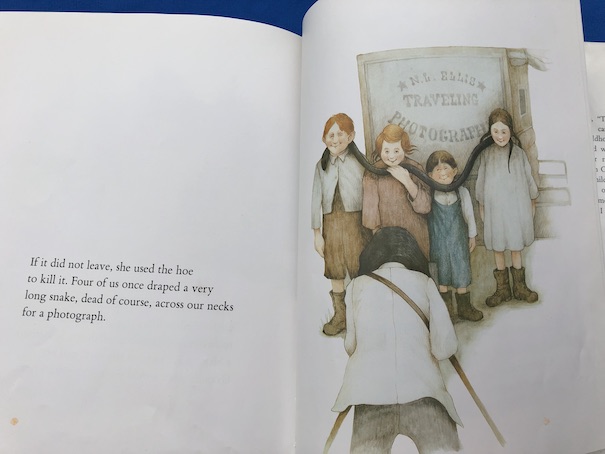
Sometimes, they had to deal with snakes, and once, when their grandmother killed a particularly big one with a hoe, they took a picture of the children with it.

Overall, the story is about enjoying the simple pleasures in life in a place you love, surrounded by people you care about.

This is a Caldecott Honor Book. It is currently available online through Internet Archive. Sometimes, you can also find people reading this book aloud on YouTube. I particularly like this reading because I think the reader has a good accent for reading this story, and she comments on her own experiences growing up in the country.

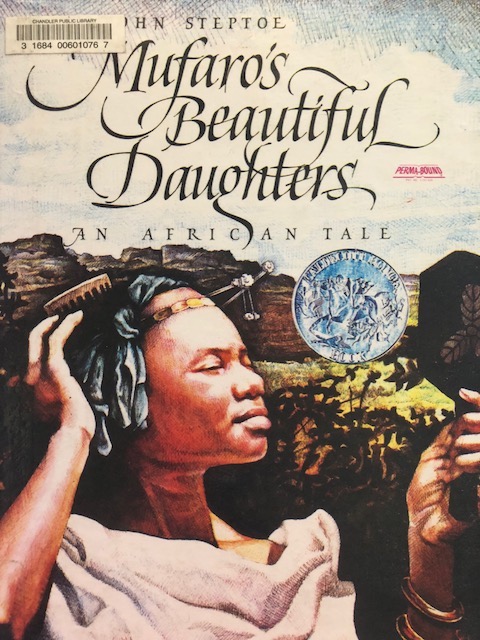
Mufaro’s Beautiful Daughters

Mufaro

Mufaro’s Beautiful Daughters by John Steptoe, 1987.

This story, based on an African folktale, is somewhat similar to other folktales and fairy tales from other parts of the world such as Cinderella, Mother Holle, and Vasilisa the Beautiful, where a girl with a kind, hard-working nature triumphs over a mean sibling because someone in authority recognizes her good nature and rewards it.

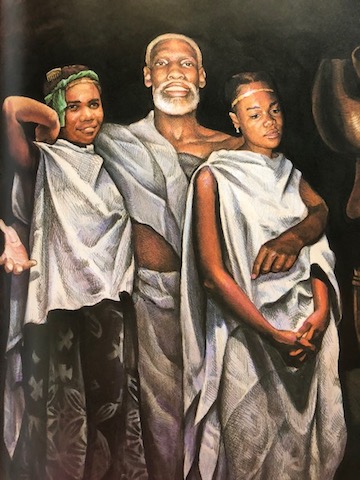
In a small village in Africa, a man named Mufaro has two daughters, Manyara and Nyasha.  Both girls are beautiful, strong, and clever, but they have very different natures.  Nyasha is kind, gentle, and patient.  Manyara is bad-tempered, jealous, and self-centered.  She frequently taunts Nyasha about how, one day, she will be the queen and her sister will be her servant.  When Nyasha asks her why she is so mean, Manyara says that she hates the way people praise Nyasha for her kindness.  She thinks that Nyasha is their father’s favorite child, and she wants to prove that Nyasha’s “silly kindness is only weakness.”

MufaroSisters

Since there is nothing that Nyasha can do to change her sister’s mind or attitude, she just continues doing her usual chores and being kind to people and animals.  In particular, she makes friends with a small garden snake, knowing that his presence in her garden will keep away pests.

Manyara is sneaky and always behaves herself when their father is present, so Mufaro doesn’t know about the troubles between his daughters.  When a messenger arrives, saying that the Great King is seeking a wife and that beautiful, worthy girls are summoned to his city so that he can choose from among them, Mufaro is proud and eager to present both of his beautiful daughters.  Manyara tries to persuade her father to send only her, but Mufaro is firm that both girls must present themselves for the king’s decision.

Manyara decides that the only way to get the better of her sister is to be the first to arrive and present herself to the king, so she slips out in the middle of the night and begins the journey alone.  However, both the journey and the king are not what Manyara thinks they are.  Along the way, Manyara encounters various strange characters who ask for help or offer advice, but thinking that a queen doesn’t need to pay attention to others or do anything she doesn’t want to, Manyara ignores them all.

Nyasha, on the other hand, gets ready to leave at the appointed time in the morning.  Everyone worries about Manyara but decides that the best thing to do is to follow her to the city, since she seems to have gone on ahead.  As Nyasha travels with the rest of their friends and family, she listens to the people Manyara ignored and shows them kindness.

MufaroCity

When they finally reach the city, Nyasha encounters a terrified Manyara, who hysterically insists that when she went to meet the king, she found a horrible monster instead.  However, like everything else, it’s just another part of the test, and Nyasha is the one who passes because she, like her sister, has actually met the king before, but unlike her sister, she actually paid attention to him.

MufaroSnakeKing

The pictures in the book are beautiful and colorful.  A note in the front of the book says that the buildings in the illustrations were based on an ancient city in Zimbabwe that is now ruins.  The note in the book also explains that the names of the characters in the story come from the Shona language.  The meanings of the names are clues to the characters’ natures.  Manyara means “ashamed”, and Nyasha means “mercy.”

The book is a Caldecott Honor Book.  It is currently available online through Internet Archive.

MufaroWedding

The Desert is Theirs

The Desert is Theirs by Byrd Baylor, illustrated by Peter Parnall, 1975.

The story in the book is written in a kind of poetical form, describing what life in the desert is like.  It talks about the kinds of animals that live in the desert and how the plants sometimes have to go without water for months because it doesn’t rain much.

It also describes the Desert People, the Papago Indians (Tohono O’odham – Which literally translates as “Desert People”).  Even though the desert is a harsh environment, the people who have lived there for generations think of it as home and like living there.

The book continues with a Native American creation myth that describes how the Earthmaker made a little plot of dirt and greasewood grew in it – the beginning of the desert.  Then, Coyote scattered seeds to grow cactus, and the Spider People sewed the earth and sky together.  In the creation story, other animals help to form the desert, which earns the respect of the Papago.  The Desert People recognize that they have to share the land with the animals as well as each other.

While the desert can be harsh, it isn’t barren.  In the desert, there are still plants to eat and use as medicine.  People also use grasses for weaving baskets and the soil itself for building homes.

People also learn patience in the desert.  It can take a long time for it rain.  Plants sometimes have to wait for years in order to bloom.  Animals wait for the coolness of night to come out.  People plant their crops very carefully.  But, even though they often have to wait, good things are worth waiting for.

I remember teachers reading this book to us in early elementary school because I grew up in Arizona.  It is a Caldecott Honor Book.