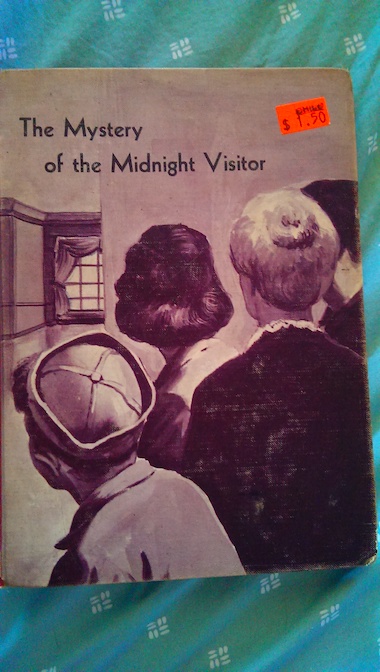
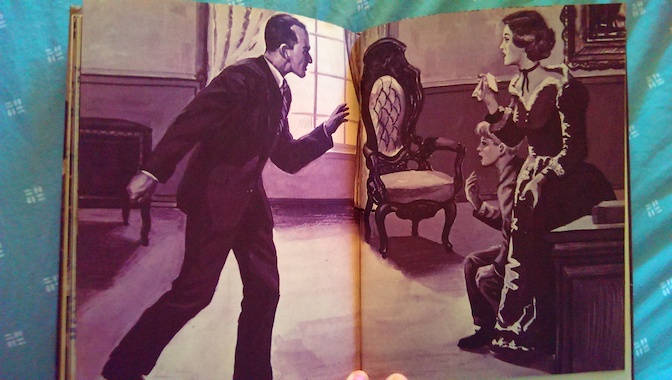
The Mysterious Christmas Shell

Tom and Jennifer are visiting their grandmother and their Aunt Vicky and Aunt Melissa Vining in Monterey for Christmas while their parents are in New York, taking care of Aunt Winny, who is sick. However, the children can tell that something is wrong as soon as they arrive because Mrs. Nipper, their aunts’ housekeeper, seems upset, and the house isn’t decorated for Christmas like it usually is. They have a Christmas tree, but there are no ornaments on it yet, and the Christmas greenery hasn’t been laid out.
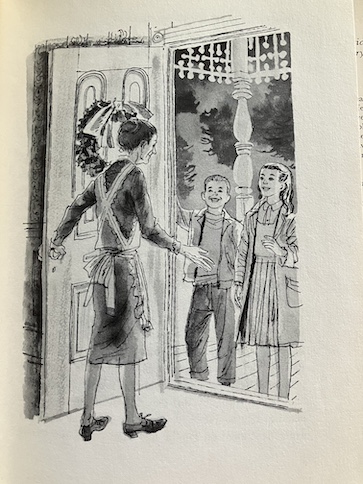
The children hear their aunts talking about a letter that their father (the children’s grandfather) had written before he died. They know that he wrote the letter, but they’re upset because they can’t find it. The aunts explain to the children that they had to sell Sea Meadows, the wooded lands that they own, to a man called Theodore Bidwell. It’s a deep disappointment because Sea Meadows is full of ancient sequoias, and the children always liked to go camping and exploring there. Originally, Mr. Bidwell told them that we was only planning to put a few houses on that land that wouldn’t require removing many of the old trees, but now, they’ve learned that he’s actually planning on creating a large summer resort town. The aunts are upset that Mr. Bidwell lied to them to get them to sell the property, but there wasn’t much they could do anyway because they badly needed money to settle debts they had after their father died. The saddest part is that the family business has improved since they made the sale, and the aunts could now afford to buy back the property, but Mr. Bidwell refuses to sell it back to them.

There is one thing that might change the situation. Before the aunts’ father died, he discussed changing his will. He decided that, rather than leave that land to them as he originally planned, he wanted to leave it to the state of California to be turned into a state park. He thought it was the best way of ensuring that the natural beauty of the land would be preserved, and his daughters approved. The aunts already had the family business, and they didn’t need the land for their own sake. However, for some reason, his lawyer never got the letter their father said he was going send about the change in his will. The aunts are sure that he actually wrote the letter, but they think it got lost or mislaid instead of being mailed. If the aunts can find the letter that their father wrote, it would prove that the land actually belongs to the state of California and that it was never really theirs to sell. They’d have to refund Mr. Bidwell’s money, but they’re prepared to do that. It’s more important to them that the land would be preserved from development. Even local people have been angry with the family for selling the land to Mr. Bidwell because they don’t want the development, either.

When Tom and Jennifer begin helping with the Christmas decorations, and they start reminiscing about the Christmas before, the last Christmas when their grandfather was alive and he wrote his letter about the land, they remember that their cousin Elsa was also visiting. Elsa is about Jennifer’s age, and she and her parents are living in France now, so she doesn’t come to visit very often. The mention of Elsa makes the aunts remember that there was something that their father wanted to tell them about Elsa. He mentioned a funny thing she did, but then, they were interrupted, and he didn’t finish telling them what it was before he died. Everyone starts to wonder if Elsa may have done something with the important letter, but they can’t ask her because they know that she and her parents are visiting friends somewhere in France for Christmas, and they don’t know where or how to get in touch with them. (This is the 1960s, pre-Internet and pre-cell phones, so there are no methods of communication they can use that are independent of also knowing their physical location. They have to either know the address or phone number of where they are staying, and they don’t.)
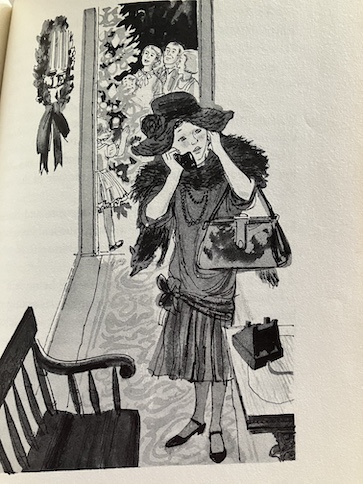
The children’s grandmother recalls that Elsa was still with them even after Tom and Jennifer left with their parents, and they talked about Sea Meadows and showed her the deed to the land. Elsa had been helping to put away Christmas decorations at the time, and while the adults were talking, she suddenly started to cry. She had cut her finger on something, but they were never sure how she did that because none of the decorations were broken. Elsa was also upset because she had done two things earlier in the day that had caused trouble: she’d broken a little figurine and she’d forgotten to tell her grandfather about a phone call from a friend. She seemed worried that she had done yet another thing wrong, but her grandfather told her not to worry because troubles come in threes, and if the cut finger is her third trouble, she has nothing more to worry about. However, their grandmother recalls that Elsa didn’t seem reassured by that. Rather than being the third trouble of last Christmas, Elsa’s cut finger is a clue to a bigger problem that Elsa was afraid to admit, and that’s the clue they need to solve the problems of this Christmas.
The book is available to borrow and read for free online through Internet Archive. There is an earlier book with the same characters, a mystery about a sea monster in the same area of California, called The Terrible Churnadryne, but I haven’t read it and haven’t been able to find a copy.

I read this book years ago, and I remember liking it, but for a long time, I couldn’t remember the details of the story. I only remembered bits and pieces. I didn’t remember that it was a Christmas story, which would have helped. I remembered that a girl did something with an important paper, but until I reread the book, I couldn’t remember why the paper was important. What stayed with me the longest was the solution to the missing letter and the cut on Elsa’s finger. But, because I forgot that this was a Christmas story, I misremembered exactly what Elsa put the letter in.

I also remembered that one of the aunts had a secret hiding place in a cave when she was young, and when they revisit the cave, they find cave drawings done by Native Americans. I also remembered that the cave is dangerous at certain times because the tide comes in. Years ago, Aunt Melissa was almost trapped there because she stayed too long and was caught by the tide. When her father found out, he refused to allow her to go there alone again. Since her mother and sister didn’t like going to the cave at all and she and her sister soon went away to boarding school, she gave up going there entirely for a long time. She was always sad about the loss of her secret hiding place. However, when she returns there as an adult, it contains part of the secret to unraveling what happened to her father’s letter last Christmas.

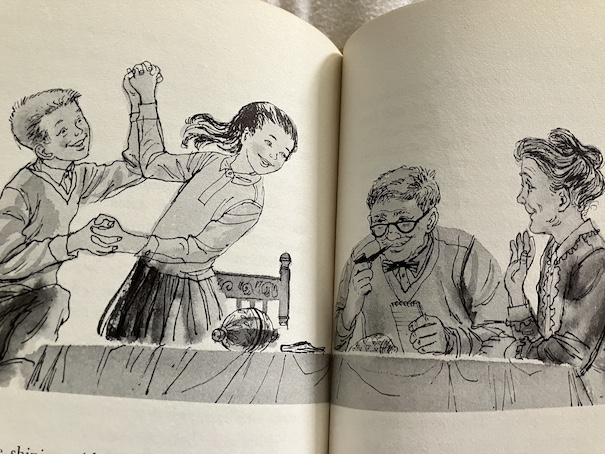
At one point in the story, Jennifer finds a very distinctive seashell with red and green colors. Everyone is amazed because it’s a court cone, not a shell normally found on the shores of California, and it also doesn’t normally appear in those colors. This is the shell that Jennifer calls the Christmas Shell. This shell doesn’t directly contain the solution to the mystery, but its shape and something Jennifer does with the shell awaken some of Aunt Melissa’s memories. I also remembered that Jennifer was the one who figured out what Elsa did after watching her brother fiddling around with a napkin in a napkin ring.

While I was rereading this book, I was happy to see all the bits and pieces of my memories of this book fall into place alongside the clues to the mystery. Stories with secret hiding places are always fun, and this one has two – Aunt Melissa’s old secret hiding place in the cave and the place where the missing letter is hidden.

There is also a reference in this story to the Elsie Dinsmore books, a children’s series from the late 1800s and early 1900s.

Susannah and the Blue House Mystery

Susannah and the Blue House Mystery by Patricia Elmore, 1980.

Susannah Higgins and her friend, Lucy, live in Northern California. Susannah loves mysteries and she’s asked Lucy to be her partner as a detective. Susannah loves mysteries and is always looking for a mystery to solve, but so far, the girls haven’t found anything worth investigating. Susannah finally finds the mystery she’s been looking for when another friend’s grandfather fails to meet her at the bus stop. Shy Juliet Travis, who is largely shy because people at school have made fun of the burn scar on her face, meets her grandfather at the bus stop every day, and then, they walk home together. When he fails to show up one day, Juliet is sure that something is wrong. Susannah and Lucy, finding Juliet upset, try to reassure her, saying it’s probably nothing and that her grandfather probably forgot the time or his clock stopped. They offer to walk Juliet home to see if her grandfather is there.

Juliet and her mother live in a small apartment house next door to the old, once-grand Blue House. Her “grandfather” is the last of the old Withers family. (Juliet and her mother aren’t actually related to Juliet’s “grandfather” at all. He’s just a family friend who likes to treat Juliet and her mother like family because none of them really have any close relatives. Mrs. Travis got divorced when Juliet was a baby, and Juliet hasn’t seen her father since. Mr. Withers’s only relative is a niece named Ivy.) The Withers family was once one of the richest families in the area, but they haven’t been really wealthy for some time. Ivy Withers has some money and is a social climber, but the Blue House mansion where Mr. Withers lives has fallen into severe disrepair. Ivy pays Mrs. Travis to be her uncle’s cleaning woman, and that’s about all of the attention either the house or Mr. Withers receives.

Juliet’s mother, Mrs. Travis, cleans houses and is also an artist. When she first meets Susannah and Lucy, she comments that she’d like to do a sketch of Susannah because her face would be good for an African princess. (Susannah is African American, and this is the first mention of it in the book.) Juliet asks her mother about her grandfather, and her mother says that she thinks he went to see his friend Joe. Juliet feels a little better, thinking that her grandfather just lost track of time with his friend, but by the next morning, Mr. Withers still hasn’t come home. Susannah and Lucy go to visit Juliet again, but she and her mother don’t know much about Mr. Withers’s friend, Joe. They don’t know his full name or where he lives to see if he’s really seen Mr. Withers. Susannah says that they should take another look around the Blue House, even though Mrs. Travis has already looked there.

In the Blue House, they discover that Mr. Withers took his good coat instead of his old one and left his wallet with his identification behind. Mrs. Travis also remembers that he was carrying an umbrella, even though it wasn’t supposed to rain that day. From this information, Susannah deduces that he went to another city, where there was a chance of rain, but it couldn’t have been too far away because he didn’t take luggage or his wallet with him, and he was planning to be back to meet Juliet that afternoon. Also, since Mr. Withers doesn’t have a lot of money, he probably went by bus. After making a call to bus station to check the bus schedule for buses leaving around the time he left, they decide that the most likely place he would have gone was Sacramento. Then, the customer service agent tells them that the bus returning from Sacramento arrived late because an old man had a heart attack. Realizing that the old man could have been Mr. Withers, who couldn’t be identified because he left his wallet at home, they begin phoning hospitals to learn where he could have gone. Sadly, they learn that Mr. Withers was the man who had the heart attack and that he died in the hospital.

That would be the end of the mystery of the disappearing grandfather, but it turns out to be the beginning of a greater mystery. Susannah is disappointed that the mystery seems to be over just when she wanted to investigate some odd points of the situation more deeply. Lucy thinks that sounds heartless to be thinking of Mr. Withers’s disappearance and death as just an exciting adventure like that, but Susannah explains that there are still some aspects of the situation that seem strange. They still don’t know why he went to Sacramento. Apparently, it was something important because he felt the need to dress up in his nicer coat. (It couldn’t be to see a doctor because his Medicare card was one of the cards he left behind in his wallet.) They also don’t know who “Joe” is because this friend didn’t turn up at the funeral. Nobody else seems to know who “Joe” is, either.

Susannah also begins to suspect that Mr. Withers may have made a second will, leaving something to Juliet. Mr. Withers didn’t have much to leave, and it’s publicly known that he promised his house to Ivy because she helped him pay the taxes on it for years. Mr. Withers lost most of his money years ago due to a bad investment, and thieves also stole many of the valuable antiques that he used to own. However, on the morning of the day he died, he told Juliet that he was going to leave her a “treasure.” Juliet says that this “treasure” was supposed to be a book of some kind, and he emphasized to her that she should “see a good man.” What is that supposed to mean, and did Mr. Withers really have a treasure to leave to Juliet? Someone else must think that Mr. Withers had something of value because someone has been sneaking around the Blue House at night.

The book is available to borrow and read for free online through Internet Archive (multiple copies).

My Reaction

I read this book years ago, when I was in elementary school, but for a long time, I’d forgotten the name of it and much of the plot, which made it difficult to find it again. As with so many other things, I found it again by accident while looking for something else on Internet Archive.

The part that stuck with me the most from when I read it as a kid was the scene where Susannah and Lucy meet Juliet’s mother, who is an artist. Mrs. Travis likes to do sketches of people she’s just met so she can use their faces in paintings later. When she first sees Susannah, she takes her by the chin and studies her face. She compliments Susannah’s bone structure and says that her face would be great for an African princess, which is a rather odd thing to do and say to somebody on first acquaintance. I liked the quirkiness of Mrs. Travis, and I kind of wished somebody would tell me that I looked like a princess. (I don’t, and I never really did. I look more like somebody’s teacher or librarian. I’m not either of those, but I just look like somebody who would be.)

The scene with Mrs. Travis is also the first mention in the book that Susannah is black. She is shown as black on the covers of the books in this series, but Mrs. Travis’s description of her as having the look of an “African princess” is the first indication of it in the text. The reason why I like that is that, before we get to that point, Susannah is described by her friend Lucy as an aspiring detective, an “amateur herpetologist” who dreams of buying the snake called Beelzebub in the pet store, and one of the few people who can draw out shy Juliet and get her to talk before we are given any indication of her race or appearance. I like it that readers are drawn into Susannah’s own quirky and distinctive personality before she is described physically, so she isn’t typed by race or appearance.

Further on in the book, Lucy describes more of Susannah’s appearance, saying that she has glasses and wears her hair in two clumps on her neck. They didn’t always get along because they’re in the same academic group at school, and of the two, Susannah is really the better student. She got on Lucy’s nerves by constantly nagging her to do her homework and improve her grades so their group could get the school’s Top Scholar Award. Susannah complained that Lucy actually could do better at school if she just tried and called her a “clown” and a “dumb blonde” (the first indication of what Lucy looks like) for not even trying to do better. Lucy retaliated against this criticism by drawing unflattering cartoons of Susannah. They started to resolve their differences when they got into an argument over something Lucy said to another classmate about Susannah. Lucy said that Susannah “prevaricates”, which means to lie, but what she really meant was “pontificates.” At first, Susannah was mad at Lucy for calling her a liar, then she laughed when she realized that Lucy mixed up words that were vocabulary words for their class, and then, she realized that there was some justification to Lucy’s criticism of her, that she does sometimes act like a know-it-all. Realizing that someone else had a justifiable criticism of her caused Susannah to soften her own criticism of Lucy, and their relationship improved.

I liked the description of how Lucy and Susannah came to be friends, and it also fits in with how the girls become better friends with Juliet. Appearances are important to Juliet because the burn scar on her face has made it difficult for her to make friends with people. They never explain how she got the scar, but she is very self-conscious of it because of the teasing she got about it early in life. She is very shy and has a habit of turning her head to the side as she talks to people because she doesn’t want them to look at the scar. Lucy thinks to herself that the scar isn’t really so bad. As she spends more time with Juliet, she realizes that she hardly notices it anymore, just like most of the time, she hardly notices anymore that Susannah wears glasses. It’s common for people to have various types of imperfections, and Lucy herself has crooked front teeth. The only reason why Juliet’s scar really matters is that it matters to her because it makes her feel bad about herself. What Juliet wants most of all is an operation to remove the scar tissue so the scar will be less noticeable, but her mother can’t afford it. By the end of the book, she can afford the operation, and she goes ahead with it, although part of me wanted to see her rethink it because she sees that she can make friends anyway, whether she has a scar or not.

Deceptive appearances are a large part of the mystery because things in the Blue House, Mr. Withers’s treasure, and even Mr. Withers himself weren’t quite what they seemed to be. Mr. Withers was unfortunate for losing his money and most of the beautiful antiques that he loved, but he didn’t lose everything. Ivy thinks that he was a lonely, bitter hermit who rejected all of his old friends because he was too proud to see them after he lost his money, but Lucy realizes that the truth is that Mr. Withers just made new friends who wouldn’t judge him because he was now poor. Mr. Withers wasn’t lonely, and he was even happy with the new people in his life and the secret he was keeping. Even the mysterious “Joe” and the “good man” were not what everyone assumed they were at first. As I read through the book, I remembered what Mr. Withers’s trick was, but it took me some time be sure of the villain. I thought I knew who it would turn out to be, but the author does a good job of making multiple people look guilty.

One other thing I’d like to add is that apparently none of the children in this book live in a two-parent household. Books featuring children of divorced families were becoming increasingly common in the 1980s and into the following decades, and there are three children in this book who live in single-parent households. Juliet’s mother is divorced. Lucy lives with just her father, and to her horror, she eventually discovers that he’s starting to date the divorced mother of the most annoying boy in her class (who actually proves to be very helpful in their investigation). Susannah also appears to live with her grandparents. This book doesn’t explain why, but she always talks about her grandparents and not her parents.

Linda Craig and the Clue on the Desert Trail

Linda Craig

Linda Craig and the Clue on the Desert Trail by Ann Sheldon, 1962.

Linda and her friend, Kathy, are exploring Olvera Street in Los Angeles before a horse show when Kathy notices a strange man watching them.  While the girls were shopping, Linda bought a small horse statue that reminded her of her own horse.  As the girls finish lunch, Linda notices an odd symbol on the statue that looks like an arrowhead, but before she can study it more, the man grabs the horse and runs off.  Linda tries to chase him down to get the horse back, but the man drops it and breaks it.  Linda picks up the horse’s head and decides to go back to the shop where she bought it to see if she can get another one.

The shop doesn’t have another horse like the one Linda bought.  It was unglazed, and the others are glazed.  Disappointed, Linda goes on to the horse show, where she is taking part, along with her brother Bob and his friend Larry.  At the show, they see the mysterious man again, and he apparently steals the broken head of the horse statue that Linda had kept.  Bob thinks that maybe the man is some kind of smuggler and that there was something hidden in the head that Linda hadn’t noticed.

Linda goes back to the shop to talk to the owner again, and he tells her that the horse was a special order from Mexico for a man named Rico.  Rico said that he was a traveling salesman and that he would collect the horse at the shop, but when he didn’t turn up to get it, the shop owner decided to sell it. Linda asks the shop owner to send her another horse statue like the broken one if one comes into his shop and reports all of this information to the police.  Then, when she returns to the horse show, she finds a threatening message, warning her to “Beware. Stay away from C. Sello.”  The note is signed with the symbol of an arrowhead, similar to the one on the horse statue.  Linda also reports this note to the police, but she can’t resist trying to figure out who C. Sello is and how this person fits into the mystery of the possible smugglers.

Soon after, the shop owner calls Linda to say that another horse statue did come into the shop and that he has sent it to her but now someone has broken into his shop and smashed every horse statue he has. Realizing that what they wanted was not in the shop, the bad guys are soon on Linda’s trail, even kidnapping one of her friends by mistake, thinking that it’s her. They even try to poison Linda’s horse!

At the end of a desert trail, the Mojave Trail, there is a ghost town with sinister characters and old cliff dwellings with Native American petroglyphs that may hold part of the secret to the mystery.

The story contains some anecdotes about California history, which is interesting. I have to admit, though, that I thought that the warning note for Linda was pretty silly. C. Sello turns out to not be a person but a clue about what the smugglers are smuggling, and they didn’t have to tell Linda what it was because she hadn’t heard about it at that point and wouldn’t have any reason to know what they were talking about. If they really wanted to get her to leave them alone, they could have left a more vague warning that didn’t include any clues like “Go home!” or “Go away!”

The Court of the Stone Children

The Court of the Stone Children by Eleanor Cameron, 1973.

Nina and her parents have recently moved to San Francisco from Nevada.  Nina doesn’t like living in the city, but the move was necessary because her father has been ill and in need of a job.  Still, Nina misses her friends, and her parents don’t understand how difficult Nina has found it to make friends in their new home.

One of the most popular girls, Marion Charles, nicknamed Marnychuck, and her friends like to tease Nina at every opportunity. Nina doesn’t think that she even wants to try to be friends with them because hanging out at Marnychuck’s house would mean always having to be on her guard about every little thing she says, knowing that they would twist every innocent comment she makes into some sort of joke so they could laugh at her.  They could never be friends because there would be no way that Nina could ever open up to them about anything.  (Sadly, I know the type all too well.)  For example, one day, while the girls are walking home from school, they start talking about things they want to be when they grow up.  Nina says that she wants to be “something in a museum,” momentarily forgetting the word “curator”, until a boy nearby helpfully supplies the word. Of course, Marnychuck and her friends ignore the helpful word and just laugh about “something in a museum” as they walk away.

However, the boy who was listening turns out to be genuinely curious about why Nina wants to work in a museum, saying that it sounds like an unusual ambition.  Nina tells him that, until she had come to San Francisco, she’d never been in a big museum before, and she describes how the one in the park impressed her.  She used to work in a small one in her home town. The boy understands the way she feels and shares her love of the past.  He tells her about Mam’zelle Henry, a local woman who owns a private museum called the French Museum.

Nina visits the French Museum and loves the rooms with old-fashioned furniture.  They give her a strange feeling of timelessness, and before she knows it, she finds herself in a room with another young girl who says, “I knew you’d come.”  Nina isn’t sure who this mysterious girl is, but she asks her to come back another time.

When Nina returns to the museum the next day to return an umbrella that she borrowed from Mrs. Staynes, the registrar at the museum, she speaks to the girl again in the museum courtyard.  The courtyard is full of stone statues of children, and the girl tells Nina that when she was young, she used to wish that they would come to life.  The girl’s name is Dominique, although she says that people usually call her Domi. The two girls begin talking about their lives, although Domi oddly talks about her past in the present tense. Domi tells Nina about her emotionally-distant grandmother and her loving father, who was imprisoned and shot.  The news of Domi’s father being shot comes as a shock to Nina.  Domi tells Nina that, after her father was (“is”) imprisoned and shot, she had a dream about Nina in which her father said that Nina would help them.  Domi also says that the rooms at the museum are from her home in France, which was taken apart to be “modernized”and some of the pieces were sent to the museum. Nina finds Domi’s story confusing, but Domi says that they will talk more later.

Nina meets up with the boy who introduced her to the museum, whose name is Gil, at the cottage of Auguste, who lives on the museum property.  As she talks with the two of them and Mrs. Staynes, Mrs. Staynes brings up the subject of the ring that Nina saw Domi wearing and which also appears in a painting in the museum.  Earlier, Mrs. Staynes had told Nina that she couldn’t possibly have seen anyone wearing that ring, and Mrs. Staynes now explains that the reason why is that she owns the ring herself.  At first, Nina thinks that she must own a ring which is similar to Domi’s, since the two of them couldn’t have the same ring,but then, it turns out that the cat that Domi said was hers also belongs to Auguste.

The answer, as Nina discovers the next time she meets Dominique, is that Domi is a ghost.  Mrs. Staynes does own Domi’s ring now because Domi died a long time ago. Nina faints when Domi’s hand goes right through hers.  When Nina recovers, Domi is gone, and Mam’zelle Henry gives her a ride home.  The two of them bond as they discuss Nina’s ambition to become a curator.

Mam’zelle lets Nina borrow a journal that she found in the garden that belonged to Odile Chrysostome in 1802.  Odile was one of the names of the stone statues in the courtyard, according to Dominique, and Nina learns that the others are also named after members of the Chrysostome family.  The people at the museum say that they don’t know which of the statues is supposed to have which name, but thanks to Dominique, Nina does.

Gil becomes Nina’s first friend her own age, and he’s been working on a project involving time.  Someday, he wants to write a book about the concept of time. Time is important because Domi needs Nina’s help to resolve problems that occurred in the past.

Domi was young during the time of Napoleon.  Her mother had died in childbirth along with Domi’s younger sibling.  After her mother died, her grandmother moved into the house to oversee things and help care for Domi.  However, Domi’s father had protested some of Napoleon’s policies of conquest, and it led to his downfall.  One day, Domi discovered her father’s valet,Maurice, murdered in her father’s bedroom. She had thought that her father was there the night before, having returned from being away for a time, but he was nowhere to be found.  A short time later, her father was charged with conspiring against Napoleon and executed. Domi knows that her father was innocent of the charges, and she suspects that Maurice was killed because he knew something important, but she needs Nina’s help to find the missing pieces.  Domi knows that Mrs. Staynes is working on a book about her father’s life, and she doesn’t want the false accusations against him to be printed.

This book is available to borrow and read for free online through Internet Archive.

My Reaction and Spoilers

I thought that the book started out a little slowly.  It takes quite a while before Nina discovers that the boy’s name is Gil or learns anything about him, and it’s about halfway through the book before Nina learns that Domi is a ghost, although there are hints before it.  I knew that Domi was from the past, although I thought at first that she might be a time traveler of some kind.  Even after Nina learns that Domi is a ghost, it takes a while before Domi tells Nina her full story and what she really needs her to do.  The first part of the book dragged a little for me, and I was a little confused at first about why Odile’s diary was so important, but it turns out to contain the vital clues that Domi needs.  Domi’s father was with the Chrysostome family at the time that he supposedly murdered his valet and was conspiring against Napoleon. There is a piece of physical evidence that proves it, and finding it convinces Mrs. Staynes to change her book. 

One of Nina’s strengths is her power of imagination, and she helps Mrs. Staynes not only to see the truth about Domi’s father but to see him as a living, breathing person.  Before, Mrs. Staynes’ book was mostly facts with little sense of the feelings of the living people behind it, but Nina’s discoveries and imagination help breathe life into the work.  At the end of the book, the past remains unchanged (Domi’s life and that of her father are what they were before), but having the truth known gives Domi peace. Nina also makes peace with her new life in San Francisco, having discovered new opportunities and friends there as well as a nicer apartment for her family to live in.

The Secret of the Floating Phantom

SecretFloatingPhantom

The Secret of the Floating Phantom by Norma Lehr, 1994.

Kathy Wicklow is going to be staying with her grandmother in Monterey for a while, helping her while she recovers from a twisted knee.  Kathy is disappointed about it because she only just got home from visiting her Aunt Sharon, and she was looking forward to some time at home with her dog, Snuggles.  Snuggles can’t even come with her to her grandmother’s house because of her grandmother’s allergies.

Kathy’s grandmother is a dance instructor, but someone else has to teach her classes until she’s better.  Her friend, Loretta, owns a Spanish restaurant and sometimes visits and brings dinner with her.  (The grandmother describes it as a “Spanish” restaurant, but they serve things like tacos and burritos with salsa, which is what people where I live think of as Mexican food.)  Kathy’s grandmother is sure that Kathy will like Loretta’s granddaughter and grandnephew.  However, she is strangely secretive about what she and Loretta have been doing during her visits, saying that their meetings, which they hold with a mysterious man called Mason, are financial discussions and are “not for children.”

Kathy learns that her grandmother and her friend are really holding séances. Loretta’s husband is dead, and Loretta fears that she might lose her property unless she can produce the original deed to it. She thinks her husband knew where the deed was, and she hopes to contact him so that he can tell her.  When Kathy spies on them during a séance, she sees a mysterious fog that seems to be trying to tell them something. No one else can see it but her. It appears to Kathy several more times, and it seems to be leading her not only toward the deed but toward a lost treasure from the early days of California.

Kathy is suspicious of Mason’s motives and the fact that he doesn’t seem to like her. It turns out that he is not really trying to help Loretta and her family but trying to find a treasure that was hidden by an ancestor of Loretta’s over a hundred years ago. At that time, the area where they now live in California was attacked by pirates. Loretta’s ancestor, Ambrose, was given the task of hiding the treasures from the local mission. He buried them under a tree and marked the tree with a cross. However, during the attack, he was badly injured and blinded. He was unable to find the spot where he buried the treasure himself, and the others who went to find it couldn’t locate the tree.

The fog-like spirit that Kathy sees is Ambrose. Lisa, Loretta’s granddaughter and Kathy’s friend, is spooked by Kathy’s visions, but she helps Kathy to follow the clues that the ghost provides to the treasure. In a hole in the trunk of the tree, Kathy also finds the deed that Loretta has been searching for. Mason tries to take the treasure himself, but he can’t move the heavy bricks on top of it by himself. Mason leaves before anyone can confront him. Digger, Lisa’s cousin, feels especially betrayed because Mason had seemed like such a good friend to him. Kathy notices that Mason seems to share some characteristics with one of the pirates from the attack in Ambrose’s time, which might be a hint that Mason is a descendant of the pirates, but it’s never fully explained.

The book is currently available online through Internet Archive.

The Mystery of the Midnight Visitor

MorganMidnightVisitor

The Mystery of the Midnight Visitor by John and Nancy Rambeau, 1962.

One day, Gabby is going fishing on the beach at Morgan’s Landing. Miss Wellington, a family friend, owns the property along with the old mansion known locally as Morgan Castle. She has given permission to Gabby to fish there, but Gabby is surprised to meet a stranger on the beach as well. This stranger is an old man who says that his name is Admiral Lavendar. When Gabby tells him that he’s on private property, the old man moves on. Then, Gabby spots smoke coming from Morgan Castle!

When Gabby goes to investigate, he finds that someone has shut Miss Wellington in a closet and that there is a fire in the bedroom that had once belonged to Mrs. Morgan, the former lady of the house. He gets Miss Wellington out of the closet, and they call the fire department. The firemen put out the fire and tell Miss Wellington that it was apparently caused by a dropped candle.


Morgan Castle was once owned by the wealthy Morgan family that gave Morgan Bay its name. However, the house has become shabby over the years. Miss Wellington inherited the house after Mrs. Morgan died because there were no other Morgans left. However, she doesn’t actually live in Morgan Castle because she has a house of her own. People have been saying that perhaps the house should be torn down because of its poor condition. Miss Wellington doesn’t have much money and says that she would find it difficult to manage the upkeep of the house.

Gabby and his brother Bill and sister Vinny don’t want to see the old beautiful old mansion destroyed, and there is still the mystery of who dropped the candle and why to consider. A small silver box that Gabby found on the beach turns out to be a jewelry box that once belonged to Mrs. Morgan. Mrs. Morgan wasn’t particularly interested in jewelry, but she did own one particularly fine emerald necklace that was never found after her death. Perhaps the person who dropped the candle was looking for it!

To give Morgan Castle a new purpose and prevent it from being torn down, the kids convince Miss Wellington to let them turn it into a Historical, Boat, and Tennis Club, dedicate to celebrating local history and providing entertainment for local people.

At first, the mysterious Admiral Lavendar looks like a likely suspect for the person sneaking around Morgan Castle, but he turns out to be very helpful to the children and their plans. There is another stranger in town who has the knowledge to seek out Mrs. Morgan’s lost necklace.

MorganMidnightVisitorThief

This book is part of a series that were once used as classroom readers.

The Wizard’s Apprentice

WizardsApprentice

The Wizard’s Apprentice by S.P. Somtow, 1993.

WizardsApprenticePic1Sixteen-year-old Aaron Maguire thinks of himself as a typical teenager, even though his family is far from typical.  His mother is a buyer for a fashion boutique, and his father does special effects for monster movies in Hollywood.  They’re also officially “separated” and preparing for a divorce, even though they’re still living in the same house.  So far, they’ve just kind of divided the house in two in order to have their own space.  Aaron goes back and forth between the two halves of the same house as his parents share him.  It’s a little weird (and, to Aaron, also a little depressing), but there’s weirder to come.

An old man approaches Aaron and tells him that he’s destined to be a wizard and that he will teach Aaron what he needs to know.  At first, Aaron thinks this man is nuts and probably homeless, but what he says is true.  The old man is the wizard Anaxagoras.  Anaxagoras demonstrates to Aaron how the skateboarding maneuver he had just pulled off defies the laws of physics and tells Aaron things about his personal life that no one should know (how angry he is with his parents about their separation and about his crush on Penelope Karpovsky, a girl he knows from biology class).  He also changes the dollar Aaron had offered him into a $100 bill and shows him that they can travel to magical lands and even through time.  Although Aaron still has trouble believing what he sees (his father does special effects for a living, after all), he becomes Anaxagoras’s apprentice.

Partly because Aaron still has doubts and needs something physical to convince him of the wizard’s powers and trustworthiness, Anaxagoras gives him a mirror.  It looks basically like an ordinary pocket mirror with a neon pink frame, but Anaxagoras invites him to ponder it and figure out what it does, telling him that what he does with it is important.

WizardsApprenticePic2However, when Aaron meets the divine Penelope for pizza and she asks to borrow a mirror to check her hair, Aaron lets her borrow Anaxagoras’s mirror.  He instantly regrets it because the mirror suddenly changes in Penelope’s hands.  Now, it has a tortoiseshell frame and is shaped like a heart.  Penelope, who has low self-esteem in spite of her prettiness, is suddenly really happy when she looks in the mirror and refuses to give it back, insisting that she wants to borrow it for a few days.  Because Aaron is in love with Penelope, he finally agrees to let her keep it for awhile.

When Aaron tries to tell Anaxagoras about Penelope borrowing the mirror, he doesn’t seem concerned.  He just hurries Aaron on to his next lesson, which involves a plumbing problem.  Anaxagoras’s lessons are pretty weird, although Aaron finds himself learning that there is more magic in the everyday world than he ever suspected.

Aaron later attempts his own feat of magical plumbing at the studio where his dad is working and encounters a creature of darkness.  The mirror gets out of his hands, and he enchants a car in order to chase it down.  Finally, a dare from some classmates causes him to unleash a dragon on the unsuspecting city, one that only Aaron can understand and defeat, once he realizes the true nature of his magical mirror.

Aaron has a distinctive voice as a California teenager, and his first experiments with magic lead him to some surprising discoveries about himself which help him to understand and reconcile his feelings about his parents’ divorce.

Silver Days

silverdaysSilver Days by Sonia Levitin, 1989.

This is the second book in the Journey to America Saga.

Escaping from World War II Europe was only the first step for the Platt family. Now that they are reunited in the United States, survival is still a struggle. They have very little money, and Lisa’s father struggles to find work and a permanent place for his family to live. Along the way, they encounter people who are prejudiced against them, some because they are Jewish and some because they are German, and are forced to confront certain prejudices that they hadn’t realized that they held as they settle into their new country and learn to live alongside people from different backgrounds who live very different lives.

Lisa describes her family’s day to day struggles and adventures with understanding. In Germany, her father had his own business, selling coats, but he has to struggle to get into the clothing business in America. Her mother, who had once had her own servants in Germany, is forced to take a job as a maid to help make ends meet. Besides the basic problems of learning a new language, dealing with a lack of money, and trying to find work, she also describes the parts of American culture that take her family by surprise. There are religious issues because most of the people around them are Christian, and Lisa’s mother is upset when her youngest daughter, Annie, ends up getting a role in her school’s Easter play. Her mother also isn’t sure what to make of the Japanese family who lives next door when Annie makes friends with their daughter.

Meanwhile, the war that they had feared is becoming a reality. People in the U.S. are starting to support the war effort, collecting materials that the army can use, starting Victory Gardens to help support themselves during food rationing, joining the army, and volunteering as nurses. The Platts also experience survivor’s guilt as they hear reports of friends and family who weren’t lucky enough to escape the Holocaust.

The Platt family is realistic, and they have their arguments as the stresses of all these changes take their toll on them. But, they are a loving family and continue to support each other through everything. The title of the book comes from a song, “Golden Days”, about looking back on happy times. When Lisa’s little sister Annie asks her if these are their “golden days”, Lisa tells her that she doesn’t think so, but she thinks that they might be silver ones, days leading up to happier times ahead.

In some ways, the children of the family have an easier time dealing with all the changes than their parents. In the beginning, they are aware that they don’t quite fit in, although they desperately want to. However, they do manage to make new friends, and Lisa and her older sister, Ruth, even find their first loves. While the world around them is changing, the three sisters also change, growing up, finding new interests, and learning more about themselves and the kind of lives they want to live in their new home.

The book is currently available online through Internet Archive.