Camp Ghost-Away

Pee Wee Scouts

The Pee-Wee Scouts sell powered sugar donuts door-to-door in their neighborhood to raise money for their trip to camp, and there is a special badge for the scout who sells the most. The kids all brag about how much they’re going to sell, each claiming that they can sell the most. Rachel teases Sonny because his over-protective mother will probably go with him while he’s going door-to-door. She calls him a “mama’s boy”, and he calls her “stuck up.” (There is some truth to both of these insults, but they’re still nasty, and no adult comments on it.) Molly and Mary Beth decide to do their selling together because they’re best friends.

In the end, Rachel and Sonny are the biggest sellers, each of them selling more than 100 boxes, in spite of Rachel’s teasing about his mother’s involvement and Rachel’s mother’s objection that donuts aren’t very healthy. However, there are some objections about how fair that is when Rachel and Sonny reveal the secrets of their success. Sonny’s mother sold 80 of his boxes at her workplace, and some kids object that it isn’t fair because Sonny didn’t sell them himself. He gets more teasing about being a “baby” and having his mother do things for him, but Mrs. Peters, the scout leader, says that it’s fair for a mother to sell on their behalf because the most important thing is the money they raise for camp.

Similarly, Rachel explains that her family went to a family wedding, and she sold most of her boxes to her relatives. Her family seems to have money, and her aunt and grandmother each bought 20 boxes. Jealously, Molly says that her relatives will get fat if they eat that many donuts. Rachel says that they won’t because they plan to donate the donuts to hungry people. Again, Mrs. Peters doesn’t say anything about the insults the children trade, just saying that the money they raised is important because they will now be able to afford to go to camp.

The camp is called Camp Hide-Away, and Mrs. Peters gives the children information about the camp and what to pack. They will go to camp next weekend, and Lisa’s mother will come with them on the trip. Rachel brags about how she has two swimsuits to bring, while the other kids only have one each, and she also shows off her new gold bracelet.

When they get to camp and Rachel discovers that they will be sleeping in tents, she isn’t so sure she wants to go camping after all. She doesn’t like bugs, and she worries about bears. The other kids call her “sissy” and “scaredy cat.” Mrs. Peters assures them that it will all be fine, and she has her large dog with them.

That night, they hear a strange sound, which sounds like the moaning of a ghost. The kids debate about whether it’s a ghost or some kind of wild animal. Either prospect is terrifying. When it starts talking, they’re sure it’s a ghost, but Mrs. Peters’s dog saves the day!

I’ve commented before that the kids in this book series do a lot of name-calling. In a way, it’s realistic for young children, but it’s also really annoying. Sonny inevitably gets called “sissy”, “baby”, and/or “mama’s boy” in every book I’ve read. It also bothers me that no adult ever tells the kids not to talk like that. The kids in the story are only six years old, so this kind of name-calling could be considered realistic, but adults telling kids not to talk like that is also realistic. I feel bad for Sonny because he often gets picked on in these books, and I think it’s unfair. Maybe his mother is a little over-protective, compared to the other parents, but at the same time, these kids are only six years old. Things like having a mom who walks to a six-year-old to school and doesn’t want a six-year-old to go door-to-door, selling things to strangers all by himself, are not outrageous. Even Rachel admits that she heard her mother saying that the kids were rather young to be away from home overnight for an entire weekend, and I think that’s true. There is some trouble with homesickness in the story, and I’m not surprised.

Like other books in this series, there are also multiple parts to the story, almost like short stories put together. The first part of this book is about selling the donuts to raise money for camp, and the second part is about their camping trip, although that part also has some smaller episodes. The highlight of the book is the spooky noise that the kids hear at night and think is a ghost. It is pretty quickly revealed that it’s just a couple of the scouts playing a prank on the others. The prank gets foiled by Mrs. Peters’s dog and the pranksters crashing into things because they have sheets over their heads.

There’s also a third part of the story, where Molly has more trouble with camp activities than the other kids. She can’t swim or row as well as they can, and when they look for interesting things, like rocks and wild flowers, on their hike, all she finds is poison ivy. But, she isn’t the only one having problems. Rachel doesn’t like bugs and the camping food, and Sonny gets homesick. Sonny’s mother comes to pick him up because he’s so upset. The other kids tease him again, but the truth is that other kids are also homesick and cry at night. Even Lisa cries, even though her mother is there on the trip. Molly realizes that she is the only one who isn’t homesick. Although she doesn’t get the badges for the standard camp activities, Molly does get one for not being homesick and another for finding Mary Beth’s lost ring. I was surprised that Rachel’s bracelet wasn’t the thing that got lost since she made a big deal of introducing it, but it was Mary Beth’s ring that got lost instead.

Although I often think that the adults don’t explain much to the children in this series, Mrs. Peters does tell the children that homesickness is natural. I think she could have given them a little more advice about it and defended Sonny from the teasing more, though.

Dig for a Treasure

This is the second book in The Invisible Island series. It begins with the arrival of the Lennox family and their two children, Hugh and Barbie. The Lennox family has been staying with various relatives since the father got out of the army, but now, they’ve found a house to rent in the small town of Anchorage, Connecticut. The children are looking forward to having a yard to play in, and the mother wants to have a garden.

Unfortunately, when they arrive they are shocked to see that the house they were going to rent has been destroyed by fire. Their landlord, Mr. Prentice, is also on the scene, and he regretfully tells them that the fire just happened, although they don’t know the cause, and that there are no other houses in the area to rent. At first, they think that they will have to go back to staying with relatives, but Mrs. Lennox says firmly that they won’t. The family has had enough of staying with relatives, and they desperately need a place of their own. It’s summer, so her idea is that they can camp out on the property of the burned house for a few months while they look around for another place to rent. The children are excited about the idea of a camp-out. Mr. Prentice says that he wouldn’t have any problem with the family camping on the land, and he returns their rent deposit to them, saying that they can stay at his house that night and get some camping equipment the next day.

While Hugh and Barbie are exploring the area and looking for their cat, who ran off, they meet the children from the first book in the series. Hugh is about the age of David Guthrie, and Barbie is about the same age as Winkie Guthrie, the youngest of the children who play on the island they call “The Invisible Island.” Since the previous book in the series, they have finished their stone hut, and it has a grass and sod roof and four built-in beds for the four Guthrie children. Mr. Guthrie is an architect, and he helped the children build the house.

Hugh and Barbie admire the hut, and they say that they wish they had a stone house like that because it couldn’t catch fire. They explain to the other children what happened to the house that their family was going to rent, and they ask the children if they would consider renting the stone hut to their family until they can find another place to live. Mr. Lennox isn’t really happy about the idea of camping in tents because he lived out of tents when he was in the army.

At first, the Guthrie children and the Leigh children aren’t sure that they want to rent out their stone hut. They spend a lot of time there, and they’ve been trying to save up money to add improvements. The hut really belongs to the Guthries, who built it, but they want to add an extra room for the Leighs. However, after thinking it over, they realize that they can earn more money as rent from the Lennox family than they can by just doing chores, and while the Lennox family stays in the hut, they can camp out on other parts of their little island, like the woods that they call “Sherwood Forest.”

Since the little hut is just a one-room hut with no bathroom or other amenities, the children aren’t sure at first whether the Lennox adults would want to stay there or not. However, staying in a stone hut does sound better than in a tent, where they would also have no bathroom or amenities. Mr. Lennox is also intrigued by the pond, where he can go fishing. The children and the Lennox family talk things over with Mr. Prentice and the Guthrie children’s parents, and they all agree to renting the stone hut to the Lennox family.

The Lennox family still isn’t sure whether or not they’ll find another house for sale or rent in the area. They want to stay in the area because Mr. Lennox has a job nearby and Mrs. Lennox knows that some of her ancestors used to live in the area, although she doesn’t know much about them. However, Anchorage is a small town, and most of the houses already have people living in them. There is only one empty house in the area, but the owner has always refused to rent it or sell it. Mr. Prentice explains that the owner believes that there is a treasure in the house or nearby, a necklace that once belonged to a queen, and she’s been looking for it for years. Mr. Prentice doesn’t think that there really is a necklace or, if there once was, it’s probably long gone, but the owner insists that it exists and is still there, somewhere.

The children are fascinated, and they ask Mr. Prentice to tell them the story of the queen’s necklace. He says that during the time of Queen Elizabeth (Tudor), the ancestors of the Winthrop family who owned the house did something for Queen Elizabeth that caused her to reward them with a golden necklace that was passed down through the family for generations. When the Winthrops came to the colonies in America around 1650, they brought that necklace with them. However, when they came to this area and settled there, they had problems with the local Indians (Native Americans).

Mr. Prentice says that he can’t blame the American Indians for resenting strangers coming and taking over their lands and hunting grounds or for them trying to stand up for their rights, but the situation escalated with increasing violence. David Guthrie protests that American Indians scalped people and that, if he’d been there at the time, he’d “show them.” Mr. Prentice explains that was exactly the problem – everybody who was there at the time thought he’d “show them”, and that’s why the violence escalated. As for the scalping, Mr. Prentice says that white people committed their share of atrocities, too, and when David is older and learns more about it, he might not feel so proud of his side in this battle. (I thought that was an amazingly honest and self-aware interlude about European colonization and its effects on Native Americans for a book written in the late 1940s, when cowboy and western shows were becoming popular, and American Indians were mainly portrayed as violent enemies to be defeated. I was a little concerned at first when “Indians” entered the story, but I was relieved that the author took this attitude.)

Continuing with the local legend, Mr. Prentice explains that the colonists received warning one day that the local tribe was going to attack. In preparation for the attack, some families hid valuable items that they didn’t want stolen or destroyed in the coming battle. Some people buried valuables, and others hid their valuables in wells or caves. Presumably, the Winthrops hid their necklace, called the Queen’s Chain, during this time, but nobody really knows what happened to it. The colonists fled the area, and the American Indians burned the entire village to the ground. Every man-made structure was destroyed during this attack. Although people later returned to the area and rebuilt the town, it’s unknown what valuables they retrieved or when or if they ever retrieved them from their hiding places. Because all the buildings and some of the trees were burned, many landmarks were destroyed, so some people might not have found their hidden valuables again, even if they managed to return to look for them.

Mr. Prentice is related to the Winthrop family, and so is his cousin, Lizzie, who currently owns the rebuilt house known as the Winthrop house. Lizzie is firmly convinced that the Queen’s Chain is still there, somewhere. She thinks it was never hidden during the attack that destroyed the first house and was passed down through the family but hidden by a later generation, which is why she won’t sell or rent the house. Mr. Prentice, on the other hand, thinks that the necklace is lost forever. He thinks that either the necklace was hidden with other valuables that were never retrieved after the attack or that the family found the necklace and sold it to get money to rebuild the farm that was destroyed. Mrs. Prentice, on the other hand, sides with Lizzie, saying that nobody in the Winthrop family would have sold the necklace because it was part of a family trust.

The children are fascinated by the story, and they immediately begin thinking about searching for the necklace themselves. They talk to Miss Lizzie about the story Mr. Prentice told them and use some of the descriptions that she gives them of the old Winthrop property and the plants that once grew in their herb garden to see if they can pinpoint the exact location of the original house and the hiding place that the Winthrops might have used for their valuables. Even though everything manmade was destroyed in the attack, some plants have a way of coming back, and the remains of the old herb garden might still be there, even almost 300 years later.

The treasure hunt takes on greater importance when the Guthrie children learn that their family might not be able to buy the island from Mr. Prentice. Mr. Prentice is also the Guthrie family’s landlord, and the family has been saving up to buy their house from him. They had also hoped to be able to buy the island where the children have been spending so much time, but Mr. Prentice is reluctant to sell it. Lumber is valuable, and he’s thinking of cutting down the pine trees on the island to sell the wood. The children are horrified at the thought that their beloved “Sherwood Forest” might be cut down! Perhaps, if they can find the missing treasure, they can persuade Mr. Prentice to sell the land to them and Miss Lizzie to rent her house to the Lennox family.

The book is available to borrow and read online through Internet Archive (in audio form!).

There isn’t as much imaginary play as “castaways” in this book as their was in the first book in the series, but the theme still shows up in some ways. The kids still go camping on the island. They use tents when the Lennox family is living in their hut. The children’s search for treasure also offers plenty of outdoor adventure, and I really enjoyed the element of mystery in the story.

The children approach the treasure hunt from the assumption that the necklace is still hidden wherever the Winthrops hid their valuables. They do find that spot and recover some relics of the 17th century, but the necklace is not among them. Readers probably won’t guess exactly where the necklace has really been hidden, but there are a few clues to notice along the way. Mrs. Lennox says at the beginning that her ancestors were from this town, even though she doesn’t know much about them. I had guessed that they might have a connection to the Winthrops, especially when Miss Lizzie explains that the name of the girl who hid the family’s valuables before the attack was Elizabeth, and there are other Elizabeths in the family. Besides Miss Lizzie, Mrs. Lennox is called “Betty” when her husband addresses her by her first name, and Betty is another nickname for Elizabeth. When Barbie recognizes something that Miss Lizzie has as being like something her family owns, Miss Lizzie realizes that the Lennox family is related to her. By comparing what each of them has and what Miss Lizzie knows about their family, they figure out what really happened to the necklace. It not only solves the mystery of the necklace, but once Miss Lizzie realizes that the members of the Lennox family are relatives, she’s happy to have them living in the old Winthrop house.

The problem of what will happen to the children’s island and the trees on it is solved when the children win a bet with Mr. Prentice. In the first book, the children called their island “The Invisible Island” because it isn’t obvious at first that it really is an island, surrounded by water on all sides. So far, the children have kept the knowledge to themselves and their parents. When the children accidentally refer to the island in Mr. Prentice’s presence and realize that Mr. Prentice isn’t aware that it’s really an island, they start to explain. Mr. Prentice can’t believe that there’s actually an island on his land, and he says that he will give up ownership if they can prove that it’s really an island. The children easily demonstrate that it’s truly an island, showing him all of the waterways and bodies of water around it, and Mr. Prentice says that they’ve won. The Guthries end up with control of the island and the trees on it.

The Invisible Island

The four Guthrie children (Dit, Allen, David, and Winkie – short for Winifred) find it difficult to play in their family’s apartment, where they always have to be careful not to disturb the neighbors. One rainy day, while their mother is at a dentist appointment, the children act out a scene from The Swiss Family Robinson, where they’re throwing the animals overboard from the shipwreck to swim to the desert island when they accidentally break part of the floor, which is also the same as breaking part of the ceiling for the neighbors underneath. When they get a knock at their door, shortly after, they figure that the neighbors have come to complain.

However, it turns out that their visitor is the neighbors’ cousin, who is staying with them. The children explain about The Swiss Family Robinson, the shipwreck, and how they were throwing particularly heavy ducks overboard from their wrecked ship. The neighbors’ cousin is a good-natured man who enjoys talking to the children. When the children’s mother comes home, she apologizes for the damage and explains that she and her husband are currently looking for a new house with more room for the children to play, but they haven’t found a place yet. The cousin says that he comes from a smaller town himself, Anchorage, Connecticut, and he might be able to help them find a place to buy there.

The Guthries do rent a house in that town that has some land attached to it, and the children are excited about the move. They want to be able to camp out on their land, like castaways from their favorite book. When they stop in town to buy some supplies before heading to their new house, they are surprised that there don’t seem to be any children around. The shopkeeper explains that there’s a measles epidemic going around town, and most of the children have it right now. He asks the Guthries if their children have had measles before, and their mother says they have … except for the youngest, Winkie. She decides that, for safety’s sake, she should keep the children close to home until the epidemic is over, and the kids should wait to try to make some new friends in town.

The children are hoping to find some new friends, but there’s plenty to do at their new house in the countryside to keep them occupied for a while. On their first day there, they are delighted to find out that there’s a brook and a lake on their property. The children convince their father to come exploring with them, and he has them help him to make a map of the area, knowing that they will want to camp out later. After walking around a piece of land that’s bordered by the lake and the brook, they realize that it’s actually an island because it is bordered on every side by water. The lake is on one side, the brook on another, and there are two more brooks or streams on the other sides that separate it from the land around it and make it into a sort of oblong-shaped island. They call it “The Invisible Island” because it isn’t obvious that it is actually an island until someone walks all the way around it and realizes that it’s actually surrounded by water on all sides. As far as they know, nobody else besides them is even aware that it’s an island.

The children’s mother has some reservations about the children camping out on the island, but the children agree to some safety rules and bringing along some practical camping supplies. They make a raft to carry their supplies across the water to the island. The children begin calling their new house “The Wreck”, imagining that they are rescuing supplies from a shipwreck, like The Swiss Family Robinson. They create a hiding place for their tents, and they find a spring on the island, although their father won’t let them drink from it until he has the water tested to make sure that it’s safe.

The children have enough supplies to camp on the island for a week, and they begin having an idyllic summer, with little adult supervision. They swim and bathe in the lake, using colorful soap on a rope that Winkie found when the family bought supplies at the store in town. They feed the birds, explore, and pick wild strawberries. They get ideas for how castaways are supposed to act from The Swiss Family Robinson and The Mysterious Island.

Their parents do come to visit them and check on them, playing along with the shipwreck theme by calling themselves friendly “savages” when they visit the camp. Their father helps the children to bring stones from a quarry to build a hut. Their mother tells them that she has started to meet the neighbors, and they have some nice children who could make good friends for the Guthries, once they’re out of quarantine from the measles. Both the nice man who helped them find the house to rent and the local doctor have nieces and nephews. The children don’t care that their mother thinks the children are well-mannered. They’re more concerned about whether or not they’ll be adventurous types, who would have fun with them on their special island. They think that they would hate to share their island with “apron-string children” who would be too tied to their parents and home and wouldn’t appreciate the independence and adventure the island allows. The truth is that the children have been enjoying their freedom on the island so much that they’re not sure that they want to give it up yet to make friends with the local children, and in a way, they’re grateful to the quarantine for giving them this time to explore by themselves.

However, there are some strange things that the children have started to notice about the island. One day, Winkie’s soap on a rope disappears and reappears in a different place, strangely looking less used than when they last saw it. The children’s wishes also seem to be granted by a mysterious, unknown person. When they wish aloud for a book about castaways that they haven’t read before and book about birds so they know more about the birds they’ve been seeing, they soon find a wooden box that contains books matching that exact description. When they wish that they had more strawberries, they suddenly find more strawberries in their icebox that they can tell came from a store instead of the wild strawberry patch. Winkie has a bizarre encounter with a “dryad”, and the footprint of a 6-toed giant suddenly appears on the beach. Maybe they’re not as alone on the island as they thought, but who else is there with them?

The book is available to borrow and read for free online through Internet Archive (in audio form!)

Copies of this book are difficult to find now. It’s become a collector’s item, and copies go for hundreds of dollars on Amazon at the time of this writing. It’s a shame because it’s really a charming story, and I think it would really appeal to fans of Cottagecore. If I hadn’t found a copy on Internet Archive, I couldn’t even talk about this book at all.

There were many children’s book series published in the mid-20th century about children having adventures in the countryside and independent of their parents and guardians, like The Boxcar Children series or many of the books by Enid Blyton. Some of these books and series seem a little more realistic than others. Most require the children’s families to be at least middle-class or wealthy to be able to set the children up for their adventures. Some books, particularly the ones by Enid Blyton, feature parents who are preoccupied with their own problems or activities and seem less concerned with the children’s welfare than about getting the kids out of their hair. I thought The Invisible Island had a good balance of independence for the children and adult supervision.

The adults in this book know that the children have been camping before, so they have some basic camping skills, and they come to visit the children about every two days, to see how they’re doing and make sure they aren’t having any problems. The kids pride themselves on their independence (they brag that they’re “not apron-string children”), but at the same time, their parents do regularly check on them and are aware of developments on the island, sometimes more so than the children realize. The children confide to their parents some of the strange things they’ve noticed on the island, but not everything because they’re enjoying their adventure so much that “the castaways” don’t want to be “rescued.” Eventually, readers come to understand that the parents know who’s been hanging around the island and that the children are not in any danger.

Adults will probably realize pretty quickly that some of the neighbor children are also camping out in the area, and that these children are the ones moving things around, giving them things, and staging fantastical stunts, like the appearance of the “dryad” and the giant’s footprint. It’s just that they can’t introduce themselves to the Guthrie children yet because the quarantine is still on, and they have to stay mostly separate. As the quarantine ends, they’re able to let the Guthrie children see them and interact with them more, although the game doesn’t completely end until the official end of the quarantine and the surprise party they hold to celebrate. The book ends with the children and their new friends making plans for more adventures that summer.

One of the great things about this book is that it’s one of those children’s books that reference other children’s books. There are other vintage children’s books like this, where the child characters take their inspiration for their games of imagination from their favorite books. The books are named throughout the story, and presumably, child readers from the time when this book was originally printed, would also know these stories and identify with the children’s pretend play. The main favorite book of the Guthrie children is the classic The Swiss Family Robinson, which inspires them not just to camp out but to turn their camping trip into one big game of imagination in which they’re shipwrecked. Most of the things they do in the story are based around that concept, although some fantasy elements also creep in, like fairies and dryads and granted wishes, because the children also enjoy fantasy books and poems. The new friends they make in the area turn out to enjoy similar stories, so some of the mysterious incidents they stage are also based on those stories, further appealing to the children’s imaginations as well as their sense of adventure.

I wasn’t completely sure if the book that their new friends gave to the Guthrie children was meant to be a real book because there are many books with titles like The Smuggler’s Island, and I had trouble locating a book from before 1948 with that exact title. Since the other books and poems they reference are real, The Smuggler’s Island might be real, too. If anybody knows what it is and who wrote it, please let me know. On the other hand, that book, because the children say they’ve never read it before, might just be invented by the author to represent that general genre of children’s fiction.

Other real books, stories, and poems referenced by this story include The Mysterious Island by Jules Verne (which is a sequel to both his Twenty Thousand Leagues Under the Sea and In Search of the Castaways), The Hunting of the Snark by Lewis Carroll (at one point, David recites the lines from the poem, “His intimate friends called him “Candle-ends”, And his enemies “Toasted-cheese”), and the poem Overheard on a Saltmarsh by Harold Munro (which was the inspiration for the dryad scene because it contains a nymph and a goblin and a necklace of green glass beads).

The concept of a quarantine probably would have made this an excellent story for the coronavirus pandemic, but the setting is idyllic and enchanting for any time. The children are clever in the way they set up their camp, trying to keep it as secret as possible. Their island also includes a spring (which is safe to drink from) and a cave, and they start building a stone hut in this book.

There’s only one thing I can think of to complain about in this book, and that’s the concept of the “savages.” When the parents describe themselves as “savages” when they visit the children, they’re playing on themes from earlier vintage books with islands and shipwrecks. “Natives” and “savages” in those stories can either be helpful or, more commonly, threats to the castaways. I’ve complained about this before in previous book reviews with similar themes because there are stereotypes around these generic “natives” and “savages”, and modern children should be taught not to talk about people in those ways. However, there is no malice behind it in this story. The characters aren’t making fun of anyone or disparaging anybody for being “primitive.” It’s just that they’re playing a game of imagination built on these earlier stories, and they’re using this concept as a plot device to work themselves into the story as something other than visiting parents, preserving both the children’s sense of independence and the imaginary world of the children’s game. Anybody who can understand that should be fine with this book.

My only other complaint is that this book is so rare and so long out of print. I really do think it would appeal to modern audiences, especially fans of cottagecore.

Swallows and Amazons

Roger Walker is staying at a farm near a lake for the summer holidays in 1929 with his mother and siblings. His father is away on a ship, a destroyer, and the family write letters to him. The children are particularly waiting for a reply from their father because they’ve asked him for permission to do something special, and their mother says that they will be allowed to do it if their father agrees. What they want is permission to sail the family’s sailboat, the Swallow, by themselves and to camp out on an island in the middle of the lake. They are all thrilled when their father agrees that they can do it! Roger is especially thrilled because, until their littlest sister, Vicky, was born, he was the baby of the family, and he was often left out of things that the older children were allowed to do.

There are a couple of conditions on the permission for the children to go sailing and camping by themselves. The first is that the two oldest children, John and Susan, are in charge. Roger and their other sister, Titty, will have to follow their orders. Before the children can camp out, their mother also makes them tents to use, shows them how to set up the tents, and takes them on a sailing trip so she can make sure that the children know what they’re doing. The excited children prepare for their sailing and camping expedition, giving themselves sailing roles, working out ship’s articles, and gathering supplies. John will be the captain of their ship, while Susan will be the mate and cook. Roger is a cabin boy, and Titty is an able seaman.

When the children go to the island, they find a nice place to set up their camp and a harbor for their boat. Surprisingly, they also discover signs that someone else has been on the island before them, but they don’t know who that is. They begin to think of the mysterious people who have been there before as “Natives” of the island, and they also start to think of their mother and other adults who help them as “Natives.” Their mother plays along with it, as if she’s part of one of the stories the children have probably been reading. When their mother comes to bring them some supplies, the children also mention seeing a man with a parrot on a house boat. The man helping their mother, Mr. Jackson, says that the man often has his nieces with him, but they don’t seem to be with him this time. The children’s mother tells the children where to go to pick up milk, and she says that she wants the children to talk to her every couple of days so she will know they’re all right and so they can pick up more provisions from her.

The children continue with their camping and fishing, and they continue to notice the man on the houseboat, who they think of as being like a “retired pirate” with his parrot. They also notice that he has a small cannon on his houseboat. One day, the children spot another boat approaching the island, sailed by a pair of girls. The children hide and watch the boat. Then, it sounds like the cannon on the boat goes off, and the “retired pirate” is on the deck, appearing to shake his fist at the girls in the boat. The children from the Swallow think that the man on the houseboat might be firing at the girls! The girls also run a flag with a skull and crossbones on it up their mast. The girls are being pirates! The children try to follow the girls’ boat, the Amazon, to see who the girls are and where the boat docks, but they lose track of the Amazon.

The lady who gives the children their milk talks to them when they come to get their supplies. She tells them not to bother Mr. Turner, the man on the houseboat. The children realize that Mr. Turner thinks of them as a nuisance, although they don’t know why. The crew of the Swallow takes it as the “retired pirate” stirring up the “Natives” against them. Then, someone steals their boat, the Swallow, and the children are set upon by the pirate girls at their camp!

There is a battle at the camp between the Swallows and the Amazons, but one of the Amazons asks for a “parley.” The crew of the Swallow confronts the Amazons about the theft of their boat, and the Amazons confront the Swallows about the campers trespassing on “their” island. The crew of the Amazon says they’ve been coming to this island for years, and they’re the ones who built the little fireplace the Swallows found when they started setting up camp.

During their “parley”, the children sort of continue their imaginary roles as explorers and pirates in their talk, but they also reveal some of their real backgrounds. The two girls from the Amazon explain that Mr. Turner on the houseboat is their Uncle Jim. At least, they say that sometimes he’s their uncle and is nice to them. They’ve been visiting the island for years, and their uncle is the one who gave them their boat. However, this year, their uncle is a hostile “native” and their enemy. The Swallows say that Mr. Turner has apparently been complaining about them to the local adults, “stirring up the natives” against them, so he is their enemy, too. The Amazons, Nancy (real name Ruth) and Peggy (Margaret) Blackett, suggest a truce between the Amazons and the Swallows and an alliance against their shared enemy, the “pirate” Jim Turner, characterized as a Captain Flint type character. If the two crews are allied, it won’t matter who technically “owns” or controls the island because they have a shared mission against their enemies, particularly Uncle Jim, aka “Captain Flint.” The Amazons admit that they really have wanted to be allies all along. The Swallows agree to this plan, and the two crews sign a treaty with each other.

As the two crews celebrate their new alliance, the Amazons explain how their uncle came to be their enemy. Usually, their uncle likes playing with them when they visit during the summer, sailing and exploring with them and teaching them things he knows about sailing. However, this year, he’s writing a book about his travels, and he doesn’t have time for them. He gets upset when they disturb his work, and the girls’ mother has told them to leave him alone when he’s working. The girls feel betrayed that he isn’t paying attention to them and gets annoyed by them. The day when the crew of the Swallow thought the man on the houseboat fired his cannon at them, the girls say that it wasn’t the cannon. They set off a firecracker when Uncle Jim was asleep as a prank, and that’s why he was shaking his fist at them as they fled in their boat.

It sounds like the Blackett girls have been a nuisance to their uncle because they’re hurt that he’s not spending time with them, and they’re trying to get his attention. Still, the Swallows enjoy their new alliance with the Amazons. Each of the crews has some experience sailing, the Amazons having learned what they know from their uncle and the Swallows having been taught by their father. John is impressed by what the Amazons teach them, but there are a few things that they know that the Amazons don’t. The two crews learn from each other, and they begin planning war games with their two ships to practice for a battle with their sworn enemy. In between, they enjoy their camping and exploring activities.

It turns out that Mr. Turner on the houseboat has been blaming the children from the Swallow for his nieces’ pranks with fireworks, which is why he’s been complaining about them to local people. When Mr. Turner leaves a complaining note at the Swallows’ camp, John realizes why he resents them. John knows that he could tell Mr. Turner the truth about who had the fireworks, but he doesn’t want to tattle on the Amazons because of their alliance and because Mr. Turner is angry and offensive and accuses him of being a liar when he insists that he and his siblings didn’t do what he’s accusing them of doing.

The Swallows and the Amazons start a daring war game with each other, a contest for them to try to capture each other’s ship. The winning crew will have their ship declared the flagship of the fleet! The Swallows attempt to capture the Amazon after dark, but their attempt is foiled because the Amazons sneak out of their house and head for the island that night. Titty, left alone on the island to mind their camp, realizes that the Amazons are on the island and decides on a risky plan to take their ship herself!

However, the children aren’t the only marauders abroad that night. When Titty takes the Amazon, she overhears some men in another boat. Some charcoal burners told the children from the Swallow earlier that Mr. Turner should make sure that he locks up his houseboat securely because they’ve heard some talk that someone might try to break in, but they never delivered the message because Mr. Turner accused John and his siblings of setting off the fireworks, and they forgot they were going to tell him what the charcoal burners said. The men that Titty overhears are suspicious, and they seem to be hiding something. After the Swallows win the mock war, the Swallows tell the Amazons what the charcoal burners said, although the Amazons are reluctant to tell their uncle to lock up his boat because they want to stage their own raid on it.

The Walker family will be heading home in only three more days and bad weather may be coming, so the children have to hurry to make the most of their adventures as Swallows and Amazons. Titty tells her siblings about the men who seemed to be hiding something, and she thinks it’s some kind of treasure. Her older siblings think that she probably dreamed about hearing men hiding something because she fell asleep on the Amazon, but Titty persuades Roger to come with her to find the treasure.

The book is available to borrow and read for free online through Internet Archive. This is the first book in a series, and it’s been adapted for film and television multiple times.

The author of the story, Arthur Ransome, named the character of Roger after Roger Altounyan, who he met when the real-life Roger was a child, visiting grandparents in the Lake District of England with his sisters. (Real-life Roger Altounyan later became a doctor and pharmacologist, known for a pioneering treatment for asthma.) The names of the fictional Roger’s siblings are also based on the real-life Roger’s siblings. The name “Titty” is odd, but it’s actually a nickname. The real-life Roger had a sister, Mavis Altounyan, who was called “Titty” as a nickname after a children’s story, Titty Mouse and Tatty Mouse by Joseph Jacobs. The character of Titty is sometimes called “Kitty” in some adaptions of the story.

Although the story explicitly states the year as 1929 when the Swallows and Amazons sign their treaty with each other, most of the book could take place at just about any time during the 20th century and into the 21st century because the children are dedicated to camping and sailing and don’t use any form of technology that would firmly date the book. The book has a timeless quality, and it’s the sort of independent adventure that many children dream of having!

The books in this series have been popular in Britain since they were first published, and they have also inspired other books for children on similar themes, having outdoor adventures with minimal adult help or interference. Enid Blyton wrote several series for children on these themes after Swallows and Amazons was published, such as The Famous Five Series and Enid Blyton’s Adventure Series, and Elinor Lyon started her Ian and Sovra series in the 1950s, explicitly stating that she wanted to write books with similar adventures for children but with child characters who weren’t as competent as the children in Swallows and Amazons. The children in Swallows and Amazons are very knowledgeable about sailing and camping and seem to do almost everything right, and Elinor Lyon thought it would be more realistic if the children in her stories didn’t entirely know what they were doing but somehow managed to muddle their way through anyway. There are also similar books by American authors written after Swallows and Amazons, like The Invisible Island by Dean Marshall.

The children in the story take their inspiration for their imaginary play from books they’ve read, like Robinson Crusoe and Treasure Island. All of the children in the story seem familiar with sea stories and books about exploration and island adventures, and they make references to aspects of them and use those aspects when they’re playing. For example, they refer to adults and anyone who is unfamiliar to them as “Natives” and “savages”, and they call their bottles of ginger beer “grog”, while tea is “hot grog”, lemonade is “Jamaica rum”, toffee candy is “molasses”, and tins of corned beef is “pemmican”, living out their fantasy that they’re sailors exploring unknown territory. Later, they compare Jim Turner, the man on the houseboat, to Captain Flint and call him that for most of the story. Some of the language that the children use, like “natives”, “savages”, and the phrase “Honest Injun” are racially out of date and can have some offensive connotations. The children probably got those phrases from the books they’ve been reading, and they seem to think of them innocently, as part of their imaginary play, living out the stories they’ve read, but modern readers should be aware.

Clifford Takes a Trip

Clifford

Clifford Takes a Trip by Norman Bridwell, 1966.

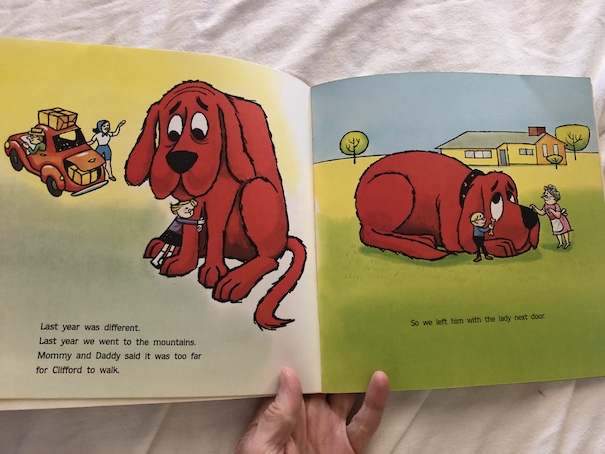
Emily Elizabeth and her parents don’t usually take long trips during the summer because it’s too difficult to bring Clifford along. He’s just too big to go on trains or buses. One summer, Emily Elizabeth’s parents decide to go camping in the mountains. They can’t take Clifford, so they leave him behind with a neighbor.

However, Clifford misses Emily Elizabeth too much, so he decides to go find her! A gigantic red dog can create a lot of chaos on a cross-country trip.

Along the way, he does help a man with a broken-down grocery truck, and the man is grateful enough to feed him.

He also arrives at the family’s campsite just in time to save Emily Elizabeth after she thought it would be fun to play with some baby bears she found.

The family considers that next year, they may find a way to take Clifford with them somewhere else.

The book is available to borrow and read for free online through Internet Archive (multiple copies, including one in Spanish).

My Reaction

Like all Clifford books, the humor is based around Clifford’s enormous size. Even though the family thought that it would be too far for Clifford to walk to come to the mountains with them, he tracks them down there anyway. Then, after he rejoins his family, he sleeps with Emily Elizabeth, his ear propped up to be her tent. The idea they’re considering next for transporting Clifford is a flat-bed truck. I could well imagine my own dog trying to track me down if I went on vacation without her, but fortunately, when your dog is about the same size as Toto in the Wizard of Oz, traveling with a dog isn’t as difficult.

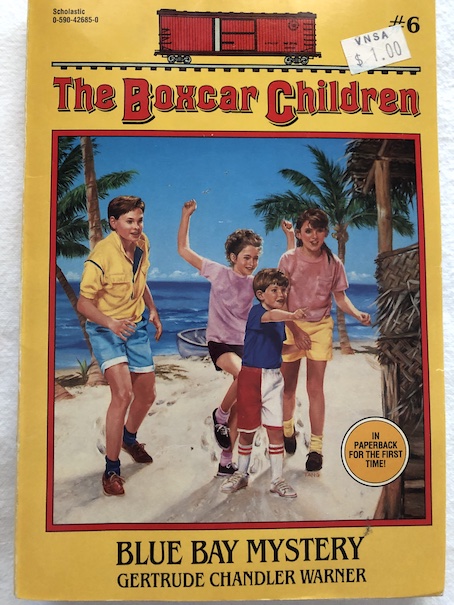
Blue Bay Mystery

The Boxcar Children

#6 Blue Bay Mystery by Gertrude Chandler Warner, 1961, 1989.

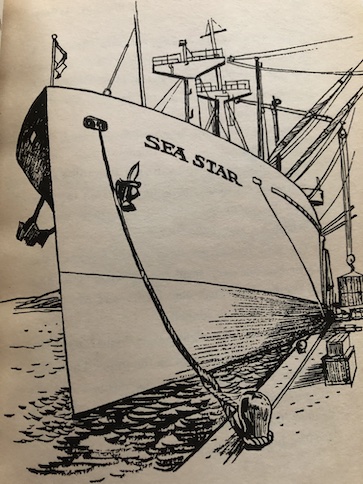
Grandfather Alden has a surprise for his grandchildren. He is arranging a special trip for them as an extension of a business trip of his. A business associate of his, Lars, has a ship going to Tahiti, and he offered to let them come along. However, rather than just having a tour of Tahiti, which would be pretty exciting by itself, Lars is going to take them to camp out on a tropical island. Lars found this island while escaping from a shipwreck himself. No one lives there, but there is plenty of fresh water and edible plants and no dangerous animals. Not every family would like to be on an uninhabited island when they could be in Tahiti, but the kids love camping out and do-it-yourself activities. Grandfather Alden has also invited the children’s friend, Mike Wood (who was introduced in a previous book), to join them. Mike is the same age as Benny.

The trip will take place during the school year, so their grandfather has arranged for the children to bring along some school supplies and lessons to study while they’re on the boat to the island. The lessons help not only to pass the time while they’re traveling but also to enhance it. They have science lessons about marine animals and how parts of the ship, like the radio room, work. Violet tells the others about how she’s been reading about Captain Cook and how he realized that eating certain types of food, like citrus fruit and sauerkraut, helped to prevent scurvy, even though he didn’t realize that the reason is that those foods are rich in vitamin C.

Once they reach the island, their grandfather says that they won’t have time for school lessons because they will have to set up their shelter and learn how to fish and forage for food, although he considers those to be educational lessons as well. They bring some supplies and tools with them so they won’t have to forage for everything, but the kids like assembling their own shelter and improvising things, like they did when they made their own home in a boxcar in the first book. They eat out of shells they find, whittle their own spoons, and use a huge turtle shell they find as a cooking pot.

However, they soon realize that they are not as alone on the island as they thought. Some of their food disappears, and they find some colored stones arranged in patterns. There is a stone with a carved face, sort of like the Easter Island heads, and the turtle shell they find has been carved with a knife. Later, they encounter a myna bird who keeps repeating the phrase, “Hello, Peter!” Someone taught the bird the phrase in English, but who is on the island, and why does this person seem to be hiding from them?

The book is available to borrow and read for free online through Internet Archive (multiple copies).

My Reaction and Spoilers

In the early Boxcar Children books, the children aged as the series progressed. After the death of the original author, when other authors continued the series, the children became frozen in age, but this book is one that was written by the original author. At the beginning of the story, the children’s grandfather mentions that the two oldest children, Henry and Jessie, are in high school, showing that they’ve aged about two or three years from the first book. This remark about the children’s ages only appears once at the beginning of the book, and their increasing ages aren’t really reflected in the story. The lessons the children have on the boat seem to be roughly about the same subjects, although it seems like the children’s lesson books aren’t identical because Violet seems like she’s the only one with the lesson about Captain Cook and scurvy.

This book also varies a little from the other books in the series because the children’s grandfather plays a larger role than usual. One of the hallmarks of the Boxcar Children books is that the children usually do things by themselves, with as little adult help or interference as possible. However, this time, their grandfather is with them on the island, sharing the adventure with them.

As with other vintage children’s mystery series, the early books of this series sometimes lean more toward adventure than mystery. The mystery in this story is pretty light, and the solution is pretty straight-forward. The children eventually find the person who’s camping out on the island with them. The person turns out to be a boy who was also shipwrecked. There was an adult sailor with him before, but the boy, Peter Horn, says that he went swimming one day and never came back, so he’s been alone ever since. The others say that he might have been attacked by a shark but they don’t dwell on it very long, as they do any time someone’s death is mentioned in one of the books in the series, so it doesn’t get too sad. Peter says his parents went overboard while they were escaping the shipwreck, and he doesn’t know whether they’re still alive. Mr. Alden says that he read about some people being rescued from a shipwreck, so it’s possible that they’re still alive. When they return to the mainland, Peter is reunited with this parents for a happy ending.

The House in Hiding

The House in Hiding by Elinor Lyon, 1950.

This is the first book in the Ian and Sovra series, which takes place in Scotland.

Ian and Sovra Kennedy are brother and sister, and they live by the sea in western Scotland. Their father is the doctor in their small town. One day, after Ian and Sovra have been asking their dad to rent a boat for them so they can explore some of the islands just off the coast where they live, their father tells them that he has bought a boat for them. It’s just a small boat for rowing, but it’s theirs, and it gives them the freedom to explore that they want. There is one island in particular that they want to explore, the one they call Castle Island. Its real name is Eilean Glas, which means “Gray Island”, but they like to call it Castle Island because there’s a square-shaped rock in the middle of the island that looks somewhat like a castle. However, their visit to this particular island has to wait for the end of the book because other events intervene to distract them.

When the children come back from trying out their boat for the first time, they hear their parents arguing about how to accommodate some house guests. Their father’s fishing friend wants to come for a visit. He was going to rent rooms in town for himself, his wife, and their daughter, but the innkeeper has had a stroke and can’t handle guests right now. So, Dr. Kennedy has offered to host the family, but the Kennedy house isn’t very big. If the guests use the children’s rooms, Ian and Sovra will have to camp out in the bothy, which is an old hut in back of the house. Ian and Sovra sometimes camp there anyway for fun, but it does get damp when it rains. Mrs. Kennedy doesn’t like the idea of the children sleeping there if the weather gets bad, but the children think that it sounds like fun and tell their mother that they’ll be fine and that they want to do it.

Dr. Kennedy’s friend is named Tom Paget. Dr. Kennedy doesn’t like Mrs. Paget, although it isn’t completely clear why. All he says about her is that she likes to wear a cloak and paint with water colors, which doesn’t sound very objectionable by itself. (I was actually a little irritated at Dr. Kennedy because he makes repeated comments about how much he doesn’t like Mrs. Paget without offering any more information than that. If she’s just a little eccentric in her style of dress and likes art, so what? I found the parts in the book where they get nitpicky and really down on her irritating.) Their daughter Ann is about the same age as Ian, and because Dr. Kennedy hasn’t yet met her, he’s not sure what she’s like until the family arrives, although he makes a point of saying, to his children, directly, that he hopes Ann isn’t like her mother. (Nope, no further information about why, and Dr. Kennedy sounds rather rude.) Dr. Kennedy’s comments about Ann and her mother leave Ian and Sovra feeling unenthusiastic about their guests, so they plan to spend most of their visit staying out of their way and possibly avoiding Ann, too, if she turns out to be like whatever her mother is like. (Way to go, Dr. Kennedy. Let’s start this whole experience off on a bad foot with everyone primed to hate your house guests, shall we?) Ian thinks that their whole camping outside the house experience would be even more fun if they were further from the house, so they won’t have to deal with the guests poking their noses into the bothy to see where they’re staying or worrying about whether Ann will want to join them because that would be bad for vague reasons.

Ian and Sovra start camping out in the bothy before the guests actually arrive to get things in order. However, they accidentally set fire to the bothy during an accident with their camp fire. With the bothy burned, where are Ian and Sovra going to camp out while the guests use their rooms? Their parents won’t let them have a tent because it won’t be dry enough if it rains. Fortunately, an important discovery that Ian and Sovra make turn this misfortune into an adventure.

While their parents worry about finding them another place to stay during their guests’ visit, the kids go exploring further in their boat. Their boat gets caught in a whirlpool and is drawn around the back of a waterfall, where they find a hidden cave. More importantly, someone else discovered this cave a long time ago. There are stone steps carved into the rock and a metal ring set into the wall for tying up boats, showing the children that this is an intentional landing spot. When they go up the stone steps, they discover an old, abandoned cottage hidden in a green hollow. (They call it a shieling.) The old cottage is in remarkably good condition for being abandoned for a long time, and Ian thinks that if they clean it up, it would be the perfect place for the two of them to stay during the guests’ visit. Sovra thinks that their parents aren’t likely to agree because the cottage is too far from their own house and rather isolated, and the landing place behind the waterfall is too dangerous. However, Ian is sure that there’s a better landing place somewhere else, if they approach from another side. Upon further exploration, the kids find a collection of cottages that were once a tiny village, older than the shieling they found and abandoned for a long time. The little abandoned village does have a landing place, and they decide that was probably how the people who once lived in the shieling got to where they built their home. They have to be careful, though, because the area is surrounded by a bog that might contain quicksand, and they’re not sure how to get across or around the bog. In the end, they decide that the waterfall entrance is actually the best way to reach the shieling, and they learn to navigate the currents around the waterfall safely.

The children’s father finally gives them permission to camp out in the old shieling, although their mother still has misgivings because the parents aren’t completely clear on exactly where the children will be camping and haven’t seen it yet themselves. The children describe the shieling to their father and tell him that it’s over near Lochhead, another town nearby. Dr. Kennedy is satisfied from their description that the house will be safe to camp in and says that they can communicate with them daily by sending them a message by the postal van from Lochhead, and if they need anything, the parents will send it to them by the same van the next day. Their mother is still uneasy, but since their father is convinced that it will be fine, she finally agrees to let them go. Ian and Sovra are thrilled at having this secret house all to themselves, but Ian says that they will need to keep it a secret and be careful not to leave signs that they’re there, just in case someone still owns the old house and doesn’t want them there, even if they’re not using the house themselves right now.

The children’s discovery and use the shieling is not only the beginning of this story but also the rest of the series. The children’s secret hiding place not only provides them with a secret place of their own but also leads them to some important discoveries about their own family and other people. This book in particular focuses on the missing chieftain of the Gunn clan, who has been presumed dead, but it takes awhile for that mystery to enter the story.

While Ian and Sovra are enjoying their freedom in their secret house, the Pagets arrive with their daughter, Ann. Mrs. Paget turns out to be a somewhat eccentric woman, sometimes overly enthusiastic about little things, raving about them with some cutesy talk. She often elaborates her daughter’s name from Ann (which is what it really is) to the longer Annabel or Annabella (neither of which is her actual name) and referring to the absent Ian and Sovra as the “dear little children.” (Yeah, it’s kind of an annoying cutesiness, but I still think that Dr. Kennedy shouldn’t have been maligning her before she arrived.) Mrs. Paget isn’t just a hobby painter; she has actual shows of her work and has been successful at selling her paintings. When she arrives, she tells the Kennedys that she wants to find the best places in the area to paint, and she’s particularly interested in things like old castles, old bridges, and waterfalls. (I think you can see where this is going.) The Kennedys mention that there are abandoned villages in the area.

Mrs. Paget thinks that sounds exciting and asks about the history of these villages. The Kennedys say that they don’t know the full story behind them, but Donald, the old man they bought the boat from, might know. They think that the people who used to live there probably moved to the bigger cities to find work or something. (This is something that actually did happen to small villages in Scotland in real life. If you’d like to know more about the circumstances and see pictures, I suggest looking at Hirta Island. Although it looks like a pretty spot, living conditions there were harsh, and after a young woman died there who might have been saved if she had lived near a city with a hospital, the people decided that it was too isolated, and they didn’t have the population levels and support they needed to stay there.)

Poor Ann is bored and disappointed by the absence of Ian and Sovra. (Yeah, thanks again, Dr. Kennedy, for all the negative talk that made them not want to even meet poor Ann and be friends with her. In his first message to the children after the guests arrive, Dr. Kennedy makes fun of Mrs. Paget’s sandals, which he says are “made of pink string” and says he doesn’t know why Mrs. Paget wants them to meet Ann. Oh, I don’t know Dr. Kennedy. Let’s all think hard about this. Could it possibly be because Ann is lonely, there are no other kids in the area, and she could use a friend? Why is Dr. Kennedy so mean and weird about this? He’s an adult, for crying out loud! Ian and Sovra think that it would be “frightfulness” if they have to meet Ann and actually “be nice to” her if she’s like her mother. Keep in mind that they still don’t even know what Mrs. Paget is really like because they haven’t met her, and oh, noes, how awful to be nice to somebody who’s a little strange or eccentric during a temporary visit. What a family!) Ann often finds family holidays boring because she’s an only child. When her mother is busy painting and her father is busy fishing, Ann has very little to do and nobody to talk to. Ian and Sovra know that the Pagets have arrived, but they try to avoid meeting them, both because they think that they won’t like the Pagets, not even Ann, and because they want to keep the house where they’re staying a secret.

The very first time Ian sees Ann, he tries to run away from her and ends up falling and getting hurt. Ann tries to help him, although he resists at first, partly because he is afraid that if his mother finds out that he’s hurt, she’ll put an end to the camping trip. Ian messes up Ann’s name, calling her “Animosity,” and I’m not sure if he did it on purpose or because he actually has a head injury from his fall. (Actually, it was probably on purpose because he does it repeatedly from this point on in the story. No, Ian, “animosity” is what your family cultivates for other people and what I’ve been feeling each time your dad criticizes Mrs. Paget behind her back.) Ann messes up Sovra’s name, asking if Ian is saying “Sofa”, but I cut her more slack because Sovra is a more unusual name, and she’s not doing it deliberately. She’s just asking if she heard that right. Ian does explain that although Sovra mostly spells her name “Sovra” for school, her name is really supposed to be the Gaelic word “Sobhrach”, which means “Primrose.” Same name and pronunciation, but different spelling. Ann likes the name for being unusual. Ann goes to get some water for Ian, and while she’s gone, Sovra finds Ian and helps him into their boat. By the time Ann gets back, they’re gone.

Sovra worries about whether Ian has given away their secret to Ann. Ian says he doesn’t think so, but he has been rambling and not thinking straight since he hit his head, so he can’t be sure. He’s dizzy and disoriented and definitely showing signs of having a concussion. He should be checked out by a doctor, who happens to be his dad in this area. However, Sovra takes Ian back to the shieling. Ann worries about where Ian disappeared to, but she realizes that he couldn’t have gone anywhere by himself in his condition, so someone else must have come and helped him. She doesn’t mention what happened when she returns to where her mother is painting by the abandoned village because she doesn’t know where Ian is and can only assume that someone took him somewhere to get help. Both she and her mother spot smoke rising from the hollow where the shieling is, and Ann wonders if that could be Ian and Sovra’s campsite, although she isn’t sure. When Ian and Sovra get another note from their parents, it says nothing about Ian’s injury, so they realize that Ann didn’t tell the adults about it, and they begin to think more highly of her for keeping their secret. (Yeah, as if that was the smartest or most caring thing she could have done. But, these are kid priorities. You’d think with a father who’s a doctor that they’d know better than to be too cavalier about head injuries, though.)

However, soon, there are other things on the kids’ minds. When Ian went to go see Donald about a bung for their boat, he noticed that Donald has a special two-handled cup called a quaich, and his quaich has a symbol on it that’s the same as a symbol that was carved into the hearth of the shieling. Ian and Sovra wonder if that means that Donald actually owns the shieling. When they ask him about it, he tells them that the symbol is a juniper sprig and it’s the badge of the Gunn clan. Donald questions them about why they want to know, and they carefully say that they’ve seen the symbol carved somewhere else. Donald realizes what they’re talking about, and he tells them that he once helped to build the little house where they’re staying. Years ago, his cousins lived in the little abandoned village, and he found that secret cave behind the waterfall himself when he was young. He’s the one who created the secret landing place and stone steps. The Gunns once owned the village and the land around it, but the head of the family, Colonel Gunn, died without children. Since then, Kindrachill House, the bigger house where Colonel Gunn lived, has been empty. Colonel Gunn did have a nephew named Alastair, but everyone believes that he died somewhere in the Far East. Alastair used to live in the shieling where Ian and Sovra have been staying. Donald gives the kids permission to continue staying there, since it seems that the original owner isn’t coming back. He also tells them that there’s a superstition in the Gunn family that, when Kindrachill House is empty, the heir to the estate will not arrive until someone lights a fire in the hearth. Ian wonders if they really have to light a fire only in the hearth at Kindrachill to make the legend come true or if it would count that they’ve been lighting fires in the hearth at the shieling, where Alastair used to live and where he carved his family’s crest in the hearth. Sovra says that it doesn’t really matter since Alastair’s dead and can’t come back … but is that really true?

When things in the shieling are moved around when Ian and Sovra aren’t there, they assume that Ann has found their hideout. They know that she’s been looking for it. Later, she admits to them that she has been there, having figured out a way to get there that Ian and Sovra don’t even know about, but she didn’t move all of the things that have been moved. Someone else who knows about the shieling has been there. They know it’s not Donald because he has trouble walking and can’t make the trip to the shieling by himself. So, who else could it be?

The book is available to borrow and read for free online through Internet Archive (multiple copies).

My Reaction and Spoilers

The location of the story gives it an almost timeless quality. The children spend much of their time in nature, with few references to modern technology, so the story could take place in many time periods. However, the book is set contemporary to the time when it was written, in the mid-20th century, after WWII. That time period is especially important in the third book in the series. This first book in the series could take place during many possible decades, but the third book can only be set during the 1950s because WWII is important to that story.

There is a slight element of mystery to the story, but the kids aren’t actively trying to solve the mystery element. Mostly, it’s a kind of adventure story with elements of slice-of-life about how these kids spend their summer in an exciting location with a somewhat mysterious history. Little pieces of the situation are gradually revealed to the characters during their adventures. Kids like stories about other kids who have adventures without adult supervision, and parts of the story are about the fun things they do, setting up house in the old cottage and enjoying themselves in and around the secret hideaway.

The Kennedys’ Attitude Problems

I have to say that I didn’t like the attitudes of any of the Kennedys. I actually read the third book before this one, and I liked the characters better in that book. In this book, both the parents and the kids seem to be some kind of snobs. They’re negative and mean about Mrs. Paget and her daughter for little reason. Granted, I don’t like cutesiness much, but Mrs. Paget just seems to be a mildly eccentric artist who dresses a little oddly and acts overly enthusiastic about some things. I didn’t think there was any call for a medical man like Dr. Kennedy, who should be at least somewhat understanding about human nature because of his profession, to be so mean about the way Mrs. Paget dresses or try to discourage his children from being nice to Ann. There’s almost a mean girl exclusiveness quality to the Kennedys’ behavior. Most of the men I know have little knowledge about women’s clothes, but Dr. Kennedy sounds like a middle school mean girl, nitpicking the way the poor woman dresses. He even writes about it in the notes that he sends to his kids during their camping trip. The pink rope sandals bother him so much that he wants to put that in writing to his kids who aren’t even there and who should be polite to this guest when they actually meet. Dude, you live a “simple” life in a cottage near a small town on the coast of Scotland. You’re not exactly in a high society fashion district, and there are few people around to see or care what anybody dresses like. So what if she likes to wear cloaks with sandals? It’s an odd clothing choice because it seems to indicate that she’s dressing for two different types of weather at once, but it’s harmless. Calling the landscape “delicious” and the children “dear little children” (“dear” seems overly generous to me, but Mrs. Paget doesn’t know any better) might seems a little sappy, but again, so what if she’s somewhat sappy and romantic in her speech? Calling her daughter Ann by much longer names which she could have just named her in the beginning, like Annabel or Annabella, is also a little odd, but if Ann doesn’t seem to care, why should anybody else? Families do sometimes have odd nicknames for kids, and it’s not the worst I’ve ever heard. Going from a shorter name to a longer one is the opposite of what most nicknames do, but again, it’s just harmless eccentricity. None of the things Mrs. Paget does seem really that bad. Mrs. Paget doesn’t do anything rude or mean, and she seems like a pretty unobtrusive guest. Mostly, she just wants to find pretty spots where she can sit most of the day and work on her paintings while her husband fishes, so if they don’t like her cute, sappy talk, they don’t have to hear it much. She only seems to return to the Kennedy house to eat and sleep, and that’s literally the least a host can provide a house guest.

The Kennedys are fine in the scenes when they’re just by themselves, but when their guests are around, they’re barely holding back inner meanness and rudeness for the guests that seems completely undeserved. That was a constant source of tension for me while reading the book. When Mrs. Paget is asking about beautiful spots in the area with enthusiasm and interest in their history, Dr. Kennedy is thinking about the best way to answer her questions quickly so he can just talk to her husband (about fishing, I guess), like he just wants her to shut up. The men are going to go off fishing together, during which they’ll have hours to talk about anything they want, and Dr. Kennedy thinks it’s such an imposition to talk to Mrs. Paget for a few minutes when they first arrive about the area where he lives and its history, for which Mrs. Paget has only expressed admiration and interest. Mrs. Kennedy also seems oddly defensive to Mrs. Paget about the “simple” life they lead, which she seems to think is too simple for Mrs. Paget, but Mrs. Paget reassures her that isn’t the case, that she thinks the area is charming and the children’s camping trip sounds like fun. Mrs. Paget seems overly enthusiastic about how great it all is. Whether she’s really that enthusiastic on the inside, I couldn’t say, but at least she speaks positively and makes an effort to show interest. She is definitely interested in the artistic possibilities of the area and sincerely curious about its history. She follows up her curiosity by asking Donald about what he knows, which shows effort.

Meanwhile, the Kennedys are trying to hide their negativity, which seems to spring from ideas they have about Mrs. Paget that aren’t born out in real life. There’s little indication of how the Kennedys got these ideas except their own inner negativity and insecurity. When I was a kid, my mother would tell me to be nice to other people and to make visitors feel welcome, and even if I wasn’t having fun with particular visitors, to remember that their visit was only temporary and make the best of it until it’s over. You can feel any way you want, but you still have to behave yourself. Being nice to a temporary guest is not a terrible imposition, and putting up with a less-than-ideal guest is completely bearable and encourages return hospitality. The Kennedys don’t impart these lessons to their children, and the father seems to particularly discourage this thinking. This is the type of family that breeds little bullies, people who think that generally being nice to people is a terrible burden to endure. It really struck me as pretty rotten for Dr. Kennedy, a grown man in a position of trust and responsibility for the welfare of people in their community, to try to discourage his children from meeting and being nice to Ann, a lonely child who never did anything to Dr. Kennedy and doesn’t deserve this bad treatment from him, smearing her reputation and making it difficult for her to make friends. Why is Dr. Kennedy trying to get his kids to be mean to Ann instead of telling them to be kind to a guest and make friends?

Of course, I really know why the Kennedys have to be this way. It’s a plot device. Their reasons for not liking Ann and her mother don’t have to be fair or make complete sense because it’s the results that matter. It’s all to set up part of the conflict of the story. If Dr. Kennedy was nicer about Mrs. Paget and encouraged his kids to be nice to Ann, they wouldn’t be so worried about having Ann around or joining them on their camping trip. Ian wouldn’t have been so worried about Ann seeing him that he tried to run from her, fell, and got that concussion. If the kids were friendlier with each other, Ann wouldn’t have needed to get a ride from a stranger or might have told them about the man she met who gave her a ride and who turns out to be important. Quite a lot of the problems the kids encounter would have been different or simplified if characters were nice with each other and worked together more. It’s a theme that appears often in literature, and actually, quite a lot in real life, too. It doesn’t make it any less annoying for me.

Character Development

The parts where I thought Ian and Sovra were at their best were when they were completely by themselves. They seem to have a good brother-and-sister relationship and know how to function as a team. Even when one of them messes something up and they criticize each other, they still have each other’s back and work together to clean up their messes. However, I never really got to like Ian and Sovra as people during this book because of their meanness and snobbishness, which is ironic because they later say that they don’t like Ann because she thinks that she’s better than they are. This seems to be a retroactive decision by the author because she doesn’t show that trait right away. It seems to surface later in the story, long after Ian and Sovra have decided that they don’t like Ann and need to avoid her and think it would be frightful to be nice to her.

My favorite characters in the story are thoughtful Ann and kind Alastair. Yes, Alastair does appear in the story. He’s not dead. Ann is the first to meet Alastair on his arrival back in the area, and he helps her when Ian and Sovra have been mean to her, stealing her shoes so she can’t follow them back to their secret house from the beach and leaving her to limp back to the Kennedy house over rocks with a hurt foot. Ann vents to Alastair about her troubles with the Kennedys without knowing who he really is, and he tells her that he’s sorry that she’s having such a bad time and that the Kennedys have been unpleasant to her. Finally, a voice of reason and compassion in the story! Ann doesn’t mention this encounter with Alastair to anybody at first because she doesn’t know who he is, that they all think he’s dead, or that his return has any special meaning.

Little by little, Ian and Sovra do start to feel guilty about the way they’ve treated Ann and start looking at her differently, noticing the things she does well and acknowledging some of the skills and knowledge she has. Eventually, Sovra does apologize to Ann for stealing her shoes. When Ann is seasick the first time they take her out in their boat, she admits that she’s not as used to sailing as they are, which makes her seem less superior than Ian and Sovra thought she was. Ann even apologizes for talking like she knows everything when she doesn’t, but I still thought it was weird because that wasn’t the impression that I was getting from her until after Sovra and Ian started saying that’s what she was doing. The apologies they each give each other and their mutual acknowledgement of each other’s faults and strengths help them come to a better understanding of each other and resolve their conflicts.

Ann also proves to Ian and Sovra that she does know things that even they don’t know about the shieling and the area around it because of the questions her mother asked Donald about the history of the area. Donald told Mrs. Paget that there was once a pathway between the abandoned village and the shieling that was lost years ago, apparently swallowed up by the bog, and nobody knows quite where it is now. However, this summer has been drier than normal in the area, and Ann realizes that the path might have been exposed again by the lower water levels in the bog. She carefully observes the area from a high vantage point when they go hiking in the mountains until she spots where the path goes and marks it on her map. Then, the next time her mother goes to the village to paint, she scouts for the beginning of the path from the ground, finding a series of stepping stones through the bog.

When Ian and Sovra ask her later how she got to the shieling when she didn’t know about the waterfall entrance, she explains to them what she did, and they ask her to show them where the path is. I liked this part because Ian and Sovra were smug earlier about Ann’s map, saying that they didn’t need any local maps like that because everyone knows where everything around here is anyway, and their big source of pride with Ann was that they know more about the area than she does. (They thought that her explanations of what’s on her map when they asked her to show it to them earlier was just her trying to be “superior” to them.) They do know a lot from living there for their whole lives, but the problem is that they count too much on that sometimes and don’t think to ask the questions Ann and her mother do because Ann and her mother are aware of what they don’t know and are actively trying to learn.

I also liked it that when Ian and Sovra finally let Ann join them camping at the shieling, they also let her take over the cooking. Earlier, they took exception to her father saying that she’s an excellent cook because they saw it as bragging and acting superior, but Ann really is good at cooking and likes doing it, and Sovra admits that she isn’t terribly good at it and doesn’t really like it herself. I was relieved when the characters stopped worrying about who was superior to who and who was acting superior when they shouldn’t and just let people do what they’re good at and interested in doing, acknowledging when someone does something well without adding a kind of put-down onto it, like Ian and Sovra did earlier.

Alistair

Getting back to Alastair’s return, he eventually shows up at the shieling and talks to the children, explaining what happened to him. He says that he tried to talk to them before, but they weren’t at the shieling the last time he stopped by. His plane was wrecked in the Pacific (They don’t say that it happened during the war, so it might not have been. I thought they might have been implying that he was a pilot in the war, but that would play with the timing of later books in the series.), as they heard, and he spent some time living with a native group on an island. The natives were friendly enough and helped him, but it took him awhile to learn enough of their language to really communicate with them and figure out how to get to a place where he could arrange passage home. That was when he first learned that he’d been declared dead. Since then, he’s been reestablishing his identity and checking on the estate that he’s inherited. By the time that Alastair finally shows up at the shieling and introduces himself to the children, they’ve heard that Kindrachill House is supposed to be sold to pay the mortgage. When they ask Alastair about it, he confirms that he doesn’t have the money he needs to pay the mortgage. He almost didn’t come back to the area at all because he didn’t think there was anything there for him. However, it turns out that he’s an art lover, and when he went to a showing of Mrs. Paget’s paintings in Glasgow, he saw the painting she did of the old village and how she included the smoke rising from the shieling where Ian and Sovra were staying. That made him want to return to his old cottage and see who was there. So, the legend about a fire in the hearth bringing the Gunn heir home comes true.

There is an argument among the four of them whether Ian and Sovra should get the credit for Alastair’s return because they lit the fire in the hearth at the shieling or whether Mrs. Paget should get the credit because her painting is what drew it to Alastair’s attention, but it’s a good-natured debate. There is still the problem of the mortgage that needs to be paid, but Ian, Sovra, and Alastair find the solution to the problem when they finally go take a look at Castle Island, and Ann rescues them when they accidentally maroon themselves there. Since Ian was the first to spot the solution to their problem, Alastair thanks him by giving him the shieling so he and his sister can use it whenever they want. Alastair is able to save Kindrachill House and takes up his role as chieftain of the Gunn clan, which sets up the other stories that follow in this series.

My Favorite Parts

The best parts of the book for me were its timeless quality and the location. A secret house, forgotten by everyone, accessed by going behind a waterfall and climbing a hidden stone stairway is just the sort of place I would have loved as a kid. Even as an adult, I love the idea of a secret hideaway in a picturesque spot. The location and atmosphere are what I recommend to other readers the most. The imagery of the setting is wonderful, and it’s a great place to escape to mentally, if you can’t get to such a spot physically.

I also like books that bring up interesting facts and bits of folklore for discussion. At one point in the book, Ian explains singing sand to Sovra, which is dry sand that makes a sound when people walk on it under the right conditions. (This YouTube video demonstrates what singing sand can sound like on Prince Edward Island.) A less pleasant but still informative part is when Sovra breaks the necks of the fish they catch to kill them quickly. I’m not sure if I’ve heard of other people doing that when they fish or not. It makes sense when they explain it, but I know very little about fishing. I’ve never lived near bodies of water and haven’t gone fishing, and I get squeamish about things, so I’ve never asked.

On a day of heavy mists, Ian and Sovra are also fascinated with how muffled and mysterious the land looks and talk about how it probably inspired stories they’ve heard about ghosts and “second sight” and doppelgangers (although they say it as “doublegangers”). Ian explains how doppelgangers are like “the wraith of someone who’s still alive, so there are two of them.” This piece of folklore is why we refer to people who bear a strong resemblance to each other without being actual twins as doppelgangers. (Some people also call them “twin strangers.”)
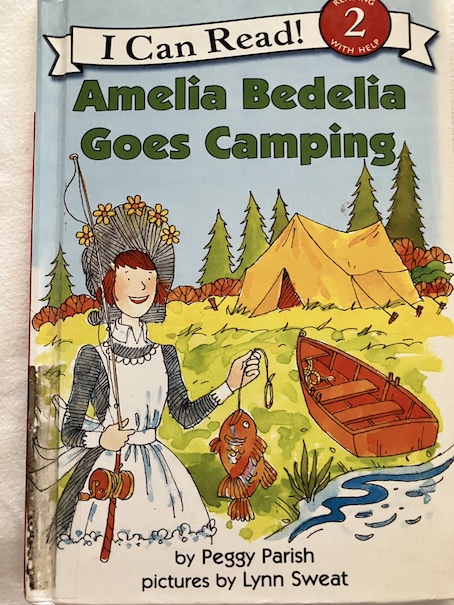
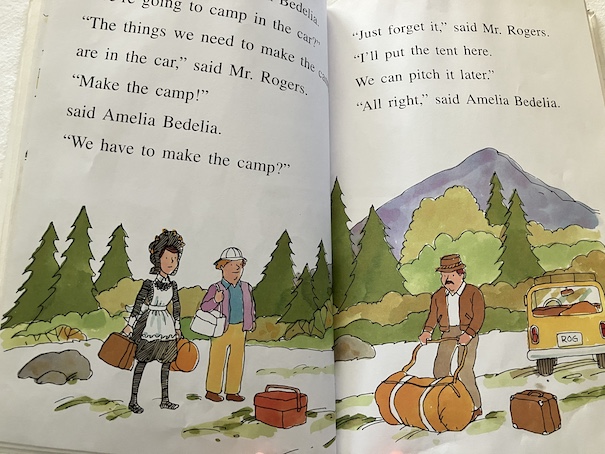
Kate’s Camp-Out

Sleepover Friends

#6 Kate’s Camp-Out by Susan Saunders, 1988.

Kate’s family is spending the weekend at a cabin at Spirit Lake, and Kate is allowed to bring her Sleepover Friends with her.  However, what promised to be a fun and exciting weekend soon comes with complications.  First, Kate discovers that the Norwood family will be in a cabin nearby.  Dr. Norwood is a colleague of her father’s, but his two sons, Sam and Dave, are pests who like to play practical jokes.  When they arrive at the cabin, there is also no electricity (a problem that they fix the next day), and they learn that the reason the lake is called Spirit Lake is because there are some scary stories about the place.  Kate’s father tells the girls a story before bed about an old fur trapper who murdered another fur trapper for his money.  The ghost story is interrupted by Dr. Norwood, who comes over to see if everything is all right because there have been some break-ins in the area recently.

The girls are spooked by the ghost story, but the next day, they also encounter the Norwood boys and realize that they’re every bit as awful as Kate remembers them.  First, Sam and Dave trick a couple of the girls into wading out into a deeper area of the lake so that they’ll fall in and get wet.  Then, when the families meet for a barbecue, the boys give a couple of the girls worms in a bun instead of sausages.

Because of their bad experiences with the boys, the girls are allowed to go back to their cabin while the others finish the barbecue.  While the girls are at the cabin, they accidentally find a secret hiding place in the fireplace with a pouch of old coins inside!  The girls wonder if that could be the stolen money from the ghost story, but Stephanie, who has been reading a book about ghost stories from the area, says that the dates on the old coins are later than the story took place.  According to the book, a ghost child was once seen around their cabin, but the girls can’t figure out why a child would have hidden so much money.

While the girls wait for the adults to return from the barbecue, they fix dinner for themselves and decide to hold a séance to contact the spirits.  They don’t really believe that the séance will work when they try it, but without any tv or radio, they don’t have anything else to do, and they can’t get their minds off the ghost stories. 

To the girls’ surprise, they actually hear strange knocks in reply to the questions that they ask the spirits.  Then, a child’s giggle convinces them that it’s just the Norwood boys, spying on them and trying to scare them again.  It’s the last straw, and the girl plot how to get even with the Norwood boys!

The book is currently available online through Internet Archive.

My Reaction and Spoilers

This is one of those stories that has a somewhat ambiguous ending. When the girls try to catch the Norwood boys playing ghost, they instead discover the identities of the people behind the recent break-ins at the cabins. Later, they learn that Sam and Dave actually have alibis for the time that they heard the ghost noises, leaving them wondering if the knocking and giggling could have actually been a ghost. The girls do manage to play a prank on the boys before the end of the story, but they never learn the story behind the old coins.

I liked the part where they never firmly establish whether or not there was a ghost because it’s fun to leave people wondering. People who like ghost stories can imagine that the girls did hear a ghost, but if you don’t like the scary explanation, you can imagine that there’s another explanation for the noises. However, I found the lack of resolution behind the presence of the coins a little disappointing. The owner of the cabin they were using lets each of the girls keep a single coin as a souvenir (and the coins really are valuable collectors’ items) and gives the others to a local museum. I think I would have liked the story better if the girls found an explanation for the presence of the coins at the museum, so at least part of the story would be resolved.

There are two main theories that I have behind the events in the story. One is that the thieves in the area hid some stolen coins in the cabin for some reason and they were the ones trying to scare the girls during their seance. The other is that the mystery of the coins ties in with the child ghost in some way, hinting at dark unknown deeds from the past. Alas, there is no confirmation about which of these theories, if any, is true.

The Camp-Out Mystery

The Boxcar Children

#27 The Camp-Out Mystery by Gertrude Chandler Warner, 1992.

The Alden family has decided to go on a camping trip to a campground at a state park.  From the moment that they arrive, though, strange things seem to be happening.  When they stop for supplies, a woman Mr. Alden knows, Doris, seems oddly evasive when he tries to ask her about her sister, Hildy, and she makes the odd comment that she hopes nothing will spoil their trip.  As they pull into the state park, they discover that the arrow on the sign pointing to the rangers’ station has been reversed to point the wrong way.  Mr. Alden shrugs the incident off as a prank, but it’s only the beginning of the strange happenings.

The Aldens get to their camp site and notice that the place is a mess.  Either the previous campers were pretty messy, or they left in a hurry.  The Aldens clean up the site and set up their tents.  (The description of how they set up camp is actually somewhat educational because they talk about things to look for when choosing a campsite, how they have to check the ground for rocks and tree roots before setting up their tents and why they should avoid places where it looks like rain water might pool and why it can be dangerous to set up a tent under a tree if there is a lightning storm.)  Later that night, Violet is woken by the sound of music.  At first, she thinks that it must be some nearby campers, but it sounds too loud and too close.  When she and Jessie get up to investigate, the sound stops.

Later, the kids see strange lights in the woods, and things disappear or are moved around at their campsite.  When Mr. Alden realizes that someone has been sneaking into their camp and taking things, he suggests that they might want to leave the park, but the kids say that they’d rather stay because they’re still enjoying themselves.  Then, Mr. Alden injures his ankle when he’s startled by another blast of loud music and part of the path he’s on gives way because the dirt was loosened by rain.  The children are prepared to leave when their grandfather is injured, but to their surprise, Mr. Alden says that he’d rather stay, too.

Who is doing all of these things and why?  Is it the unfriendly Hildy, who lives alone in a cabin and wants everyone to leave her alone?  Or maybe her seemingly-helpful neighbor, Andy, for reasons of his own?  Could Doris be responsible?  What about the Changs, a family camping nearby who seemed disappointed that they didn’t have the campground to themselves?

There are some environmental themes and lessons in the story.  The Aldens frequently pick up litter that other campers and hikers leave behind.  There is also an explanation that the reason why part of the path Mr. Alden was on collapsed due to erosion because there are no trees along that section of path; tree roots help secure the soil so that it doesn’t wash away.  After the mystery is solved, Mr. Alden decides to donate some trees to the park, and the kids talk about adding more trash cans and a recycling center to help solve the litter problem.

The book is available to borrow and read for free online through Internet Archive.

The Yellow House Mystery

The Yellow House Mystery by Gertrude Chandler Warner, 1953, 1981.

This story in the Boxcar Children series picks up the following spring after the previous book.  The children’s cousin, Joe, is arranging for the excavation of the cave where the children found their Native American artifacts.  They’ve decided to use dynamite to blast open the roof of the cave to make excavation easier (I’m not sure if this is really the best way to get at artifacts that were sheltered safely for years in their cacve and were easily being dug up by children in their current situation, but okay), and although he had told the children that they couldn’t be there for the blasting, he’s changed his mind.  He’s even going to let seven-year-old Benny be the one to push down the handle that will set off the blast.  (Because this is one of the early books in the series, the children are aging from the first book in the series – Henry is sixteen years old, Jessie is now fourteen, and Violet is twelve.)

One of the people who will be working on the excavation is Alice, an old school friend of Joe’s.  Everyone can tell that Joe is in love with her, and soon, he proposes to her.  They get married and decide to spend their honeymoon camping out in the barn on the island, just like the children did the previous summer.

However, the children have started to wonder what the story is about the old yellow house on the island.  For some reason, it makes their grandfather sad, and he doesn’t like to talk about it.  Eventually, their grandfather tells them that their housekeeper, Mrs. McGregor, used to live in that house with her husband, Bill.  Bill used to take care of Mr. Alden’s father’s race horses.  He was a nice man, but weak-willed.  His brother, Sam, and his brother’s disreputable friends were often able to persuade Bill to do things that would get him into trouble, and Bill was never able to stand up to them.  One day, he vanished mysteriously from that house, and neither his wife nor the Aldens have any idea what happened to him.  There are only two clues about the reason for Bill’s disappearance.  One is money that Bill was supposed to give to Mr. Alden’s father for the sale of two horses that he managed on his behalf.  Mr. Alden assumes that Bill’s brother did something with the money and that Bill probably left because he was afraid to face Mr. Alden without the it.  Sam died soon after Bill disappeared, so they were unable to ask him about what he knew.  The other odd thing that happened before Bill disappeared was that Mrs. McGregor heard strange sounds in the night.  When she went to investigate, her husband was apparently just reading a newspaper, and he claimed that the noise was nothing unusual.  But, what was Bill really doing?

The kids want to investigate Bill McGregor’s mysterious disappearance, and their grandfather and Joe and Alice enter the house with them to have a look for more clues.  In a hiding place behind one of the fireplace bricks, they find a letter from Sam to Bill about the money from the horse sale.  Sam promised Bill that he would be able to pay him back more than the money he owed and tells Bill to meet him at a house in Maine near Bear Trail.  The kids persuade their grandfather to let them to go Maine with Joe and Alice over the summer to try to find the house on Bear Trail so they can find out what happened to Bill.  The trip will involve camping, hiking, and canoeing, but they’re up to the challenge!

Joe is familiar with Bear Trail because he used to work as a trail guide when he was in his teens.  They are also joined by another trail guide, Mr. Hill, and have adventures that include a storm and a real bear.  However, the real answers to the mystery lie at the Old Village at the end of the trail.

The book is available to borrow and read for free online through Internet Archive. There are multiple copies of the book. In order to check out a book through Internet Archive, you need to sign up for an account. The account is free, and you read the books in your browser.

My Reaction

In a number of ways, this book is more adventure than mystery.  It doesn’t take long for the kids to realize discover Bill McGregor’s new identity.  However, what happened to the money is more of a puzzle.  Even Bill has been unable to find where his brother hid it years ago.  Benny discovers it by accident while watching a toad. 

One thing that had made me uncomfortable was how long Bill had stayed away from his wife.  When the kids confront him about his real identity, it turns out that Sam’s disreputable friends had lied to him, telling him that his wife had died shortly after he disappeared.  He is overjoyed to discover that she is still alive, and she is glad to see him when he finally returns home.