Kiki’s Delivery Service

More Americans would probably recognize the title as the title of a Studio Ghibli animated film for children than as a book title, but the book came before the movie, and it is actually the first in a series, which continues the story about Kiki’s life and adventures, although I don’t think the later books in the series have been translated into English (at least, I haven’t found them in English). The original Japanese version of this book was written in 1985, and I read the English translation from 2003.

Kiki is a young witch, and in keeping with the traditions of young witches, she is expected to leave home at age 13 and live for a year in a city with no other witches.  It will be a test of her developing skills and a coming-of-age experience, helping her to recognize her talents and find her place in the world.

When Kiki sets out for her journey with her cat, Jiji, she doesn’t know exactly where she is going to go or what she will find when she gets there. Some young witches know early on what their talents are and how they plan to support themselves during their year away from home, but Kiki is less sure (like so many of us who “don’t know what we want to be when we grow up”).  The term “witch” just refers to a person’s ability to do magic.  It’s not a job title by itself, and witches are expected to develop a specialization, such as brewing potions or telling the future. Kiki’s mother has tried to teach Kiki her trade, growing herbs and making medicines from them, but Kiki hasn’t had much patience with it.  The only major ability Kiki has is flying, which is something that witches are expected to do anyway.  Still, she has an adventurous spirit and is eager to set out and see what life has to offer.
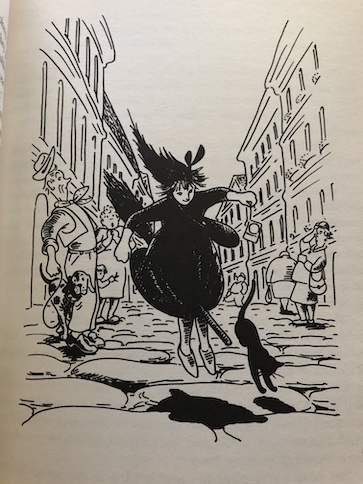
Once Kiki locates a city with no other witches, she has to find a place to stay and a job to earn money. She finds a city by the sea, which seems exciting to her.  As she explores the city, she meets Osono, a woman who owns a bakery with her husband. When she helps deliver a baby’s pacifier to a bakery customer who left it behind, flying to the customer’s house on her on her broom, Osono offers to let her stay in a small apartment attached to the bakery. Kiki feels a little overwhelmed by the big city at first, but she realizes that, in a large city like this, there are probably a lot of people who have small delivery errands that wouldn’t be covered by ordinary parcel delivery services.

Kiki opens a delivery service, delivering small packages and running errands for people around the city.  At first, business is slow, and some people are afraid of her as a witch. During a trip to the beach, a curious boy borrows her broom and breaks it. Kiki is distressed, and the boy apologizes. The boy’s name is Tombo, and he is part of a club of other kids who are interested in flying. He has made a study of flight and had hoped to learn more about how witches fly by trying Kiki’s broom, but Kiki expains that only witches can fly with brooms and that the ability is inherited. Kiki has to make a new broom, and it takes her a while to break it in, but it actually works to her benefit. People who were initially afraid of her for being a witch become less afraid of her and more concerned about her when they see that she is just a young girl, clumsily trying to master a new broom. Kiki gets some additional support and business from people who feel moved to help a struggling young witch. Tombo also makes it up to her and becomes a friend when he helps Kiki to figure out a way to carry a difficult object on her broom.
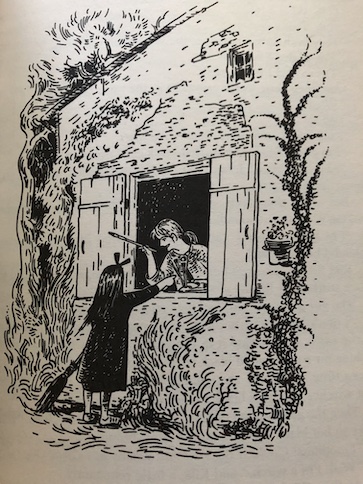
During her very first delivery assignment, Kiki was supposed to carry a toy cat to a boy who was having a birthday, but she accidentally dropped it. When she searched for it, she met a young artist, who was enchanted by Kiki as a young witch and painted a portrait of Kiki with Jiji. When the artist asks Kiki to take the painting to the place where it will be on exhibit, Kiki isn’t sure how to carry it at first. It’s kind of a bulky object to carry on her broom. Remembering that Tombo has made a study of flying, she asks him for help. Tombo ties balloons onto the painting to make it float and tells Kiki that she can now pull the painting along on a leash, as if it were a dog. The idea works, and when people see Kiki pulling a painting of herself along through the sky with balloons tied to it, it acts as advertising, bringing her more business.

Some of Kiki’s new jobs are difficult or awkward, and some customers are more difficult to deal with than others. There are times when Kiki finds herself missing home or trying to remember how her mother did certain things, wishing that she had been better at watching and remembering what her mother did. Still, Kiki learns many new things from her experiences and acquires new skills.

Kiki’s experiences also help her to realize a few things about herself and life in general. Like other girls, Kiki worries about how boys see her. When Tombo makes a comment that he can talk to her when he can’t talk to other girls, Kiki worries that he doesn’t see her as a girl at all. A job delivering a surprise present to a boy from another girl her age helps Kiki to realize that everyone is a little shy and uncertain about romance and even people who act confident feel a little awkward about first relationships.

As her first year away from home comes to an end, Kiki wonders how much she’s really changed over the year. Although she has successfully started a new business and done well living away from her parents, she still experiences a sense of imposter syndrome, where she doesn’t quite feel like she’s really done all of the things she’s done. Her first visit home to her parents reminds her that her new town has really become her new home. She has become a part of the place, and she feels her new business and friends calling her to return.

In 2018, the author, Eiko Kadono, was awarded the Hans Christian Anderson for her contributions to children’s literature.

My Reaction

I think of this story as one of those stories that takes on more meaning the older you get.  Young adults can recognize Kiki’s struggles to make her own way in the world and establish herself in life as ones that we all go through when we start our working lives and gain our first independence.  It can be a scary, uncertain time, when we often wonder if we really know what we’re doing. (Life Spoiler: No, we don’t, but no one else completely does, either, so it’s normal and manageable. Some things just have to be lived to be really understood, and that’s kind of the point of Kiki spending a year on her own, to see something of life and how she can fit into it.) However, it’s also a time of fun and adventure as we try new things, build new confidence, make new friends, and learn new things about ourselves. Like so many of us, Kiki doesn’t always do everything right, but she learns a lot and endears herself to the people of her new town.

The Miyazaki movie captures the feel of the story well, although the plot isn’t completely the same. There are incidents and characters that are different between the book and the movie. Tombo appears in both the book and the movie, but there are other characters who appear in the book who weren’t in the movie. In the book, Kiki makes friends with a girl named Mimi, who is her age, and the two of them discuss crushes on boys and how each of them was a little envious of the other because, while each of them is struggling with their own uncertainties in life, they each thought that the other acted more confident. The movie version developed the character of the young artist more. Kiki also didn’t lose her powers during the book, although that might be a part of one of the other books in the series, since I haven’t had the chance to read the others yet.
Charlie the Tramp

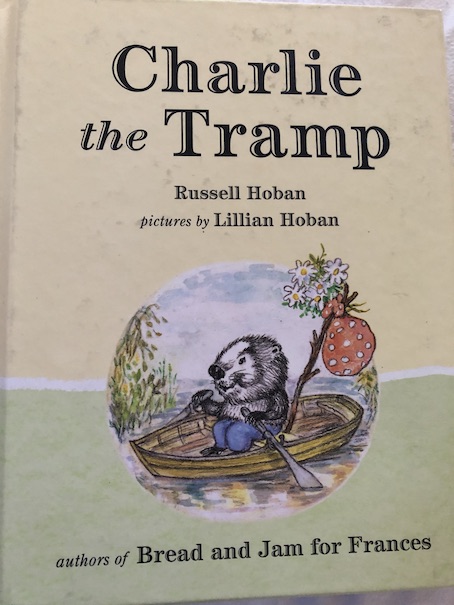
Charlie the Tramp by Russell Hoban, illustrated by Lillian Hoban, 1966.

Disclosure: I am using a newer edition of the book, published by Plough Publishing House.  Plough sent a copy to me for review purposes, but the opinions in the review are my own.

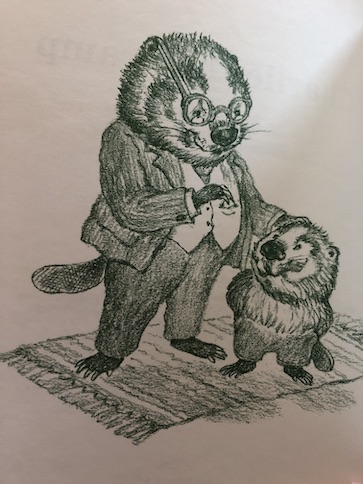
One day, when Charlie Beaver’s grandfather comes to visit, his grandfather asks him what he wants to be when he grows up. The grandfather assumes that he knows the answer to the question because everyone in the family is a beaver, and beavers naturally do beaver work. (Beaver is apparently both species and profession in books where beavers talk and wear clothes.) However, Charlie stuns his family when he declares that he wants to be a tramp.

Few families would be happy to hear a child say that he wants to be a tramp. Charlie’s grandfather says that he’s never heard a child want to be tramp, and his mother says that she doesn’t think he means it. However, Charlie thinks that being a tramp would be good because he wouldn’t have to learn how to chop trees or build dams or other routine jobs. Charlie thinks that tramps have a lot of fun and just work now and then at little jobs when they need something to eat. Charlie thinks that the little jobs would be much more fun than the ones his father really wants him to do. Charlie’s grandfather says that kids these days just don’t want to work hard.

However, Charlie’s parents decide that if he wants to be a tramp, they’ll let him try it out. Charlie makes himself a little bundle with some food, and his parents let him sleep outside, telling him to come back for breakfast. Both the father and grandfather quietly admit that they both wanted to be a tramp when they were his age, so it’s not just kids these days.

Charlie has some fun, roaming the countryside, sleeping under the stars, and enjoying his freedom. In the morning, he comes home and does some chores to earn his breakfast, lunch, and dinner. In between, he goes out to roam the countryside again.

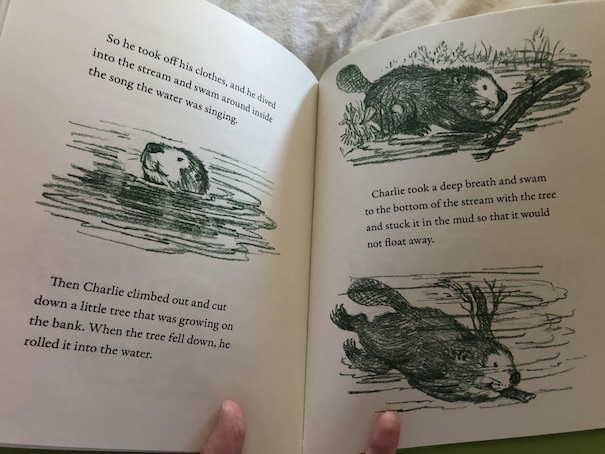
Charlie begins to notice that something keeps waking him up in the night, an odd sound that he can’t identify at first. Eventually, he realizes that it’s the sound of a nearby stream. For some reason, the trickling sound of the stream seems nice but makes him feel restless. It inspires him to swim in the stream and begin building his own dam, working through the night.

When Charlie sleeps through breakfast, his family comes looking for him and admires the good job that Charlie did on his dam and the pond that he has created. When they ask him about why he was making a dam when he was trying to be a tramp, Charlie says that he likes doing both and can do either sometimes. His family is satisfied that Charlie is a good worker, and his grandfather says, “That’s how it is nowadays. You never know when a tramp will turn out to be a beaver.”

It isn’t that Charlie expects to go through life without doing work because he insisted on working to earn his meals even when he was being a tramp. It was more that Charlie wanted the freedom to decide when he wanted to work and what kind of work he was going to do. However, he is a beaver and has a beaver’s instincts. In the end, he sees the appeal of doing a beaver’s work, building dams, enjoying it because he made the dam himself in the way he wanted to make it. I think it shows that when a person has the knowledge and ability to do something and the interest in doing it, they will eventually use their skills, perhaps in surprising ways. I remember reading some advice to writers that said that people write because “they can’t not do it,” and that’s true of many aspirations in life. Sometimes, when people know what they really want to do with their lives, they can’t resist doing it, and sometimes, people realize what their aspirations are when they find something that they can’t resist doing. Charlie is a beaver because it’s a part of who he is, and he can’t not do it. As he grows up, he will continue growing into that role, just as human children eventually grow up to be the people they are going to be.

This book is available to borrow for free online through Internet Archive, but it’s also back in print and available for purchase through Plough. If you borrow the book and like it, consider buying a copy of your own!

Chimney Sweeps

ChimneySweeps

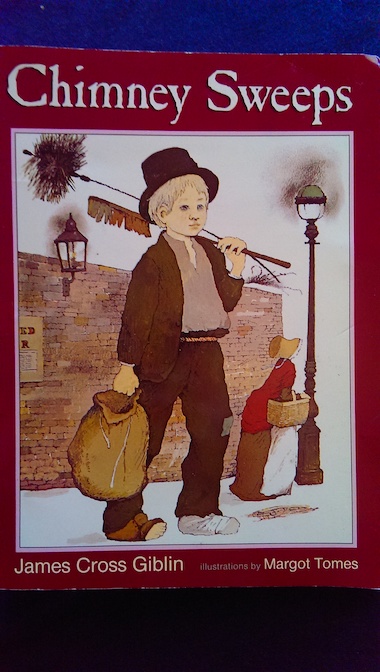
Chimney Sweeps by James Cross Giblin, 1982.

This book explains about the history and traditions of chimney sweeps. I love books that cover odd topics from history like this!

It starts by explaining the origins of chimneys in the Middle Ages. Before they were invented, people would have to have simple holes in the roofs of their houses to let out smoke from heating and cooking fires, or they would have had to rely on windows or doors to perform the function of venting smoke. Chimneys vent smoke more efficiently, but the more they are used, the more soot collects inside them, and they need to be cleaned out from time to time. If they aren’t cleaned, the build-up inside could either block air from getting to the fire in the fireplace, causing the fire to go out sooner, or it could pose a fire risk because the build-up inside the chimney is still flammable. Sometimes, home owners could clean their own chimneys, if they weren’t very tall, but the taller the chimney is, the more professionals are needed to clean it.

ChimneySweepsAdult

Modern chimney cleaners have vacuums that they can use to clean soot out of a chimney, but originally, people were basically relying on brushes. The book explains the evolution of the profession and variations in the profession between England, Germany, and the United States. Germany is significant to the profession because it was one of the first places where chimney sweep became a recognized profession and there were laws even in the 1400s that all chimneys had to be cleaned twice year. (Remember that chimneys that haven’t been cleaned can be a real fire risk, posing a danger not only to you but your neighbors, especially during a time when most buildings are made of wood and other highly flammable materials.) When chimney sweep became a recognized profession during the Middle Ages, members of the profession formed a guild (as was traditional for different professions in general during the Middle Ages) and established rules and standards for the profession. One of the responsibilities of a guild was to decide on the training and qualifications that the profession requires, and in the case of chimney sweeps, the only way to learn was by serving an apprenticeship. The apprentice would live with a master sweep for three years, learning the trade, and at the end of his training, he would have to prove that he could clean a difficult chimney all by himself with thoroughness and reasonable speed.

There are many traditions and superstitions that came to surround the profession of chimney sweep. One of them that you can still sometimes see even in modern times is the image of the chimney sweep in a top hat. The exact reasons for adopting a top hat and tailcoat as part of their uniform are uncertain, but it began back in the 1500s in Europe. The sweeps often got their top hats and tailcoats as secondhand clothing from undertakers (yes, really). Part of the reason for wearing them might have been as an effort to look professional, but the color black was also suitable for a person who was going to end up covered in soot. According to superstition, the top hat would help to protect the chimney sweep from falling when he was on the roof of a house. Chimney sweeps were often thought to be lucky because their jobs were dangerous, yet they survived.

ChimneySweepsChild

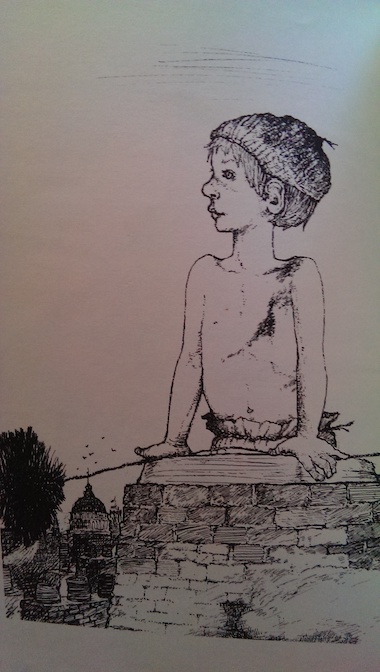
However, chimney sweeps’ lives and work were often hard. In 18th century England, their jobs became more difficult because chimneys were purposely being built in narrow, crooked zigzags. The idea behind the crooked chimneys was that they would keep more heat in, but that made them much harder to clean. Because brushes couldn’t make it around the bends of these chimneys and adults couldn’t get into the narrow flues, sweeps became reliant on young boys to climb up into them and clean them by hand. Although the law required boy apprentices to be no younger than eight years old, many sweeps used boys as young as four or five. Sometimes these boys were official apprentices with the permission of their parents (typically from poor families with many children) or even the sweep’s own children (sometimes, they used their daughters because girls were often smaller than boys). If they couldn’t get children any other way, sometimes sweeps would get children from orphanages or might even resort to kidnapping.  The author of this book includes a short story about what a day in the life of a child chimney sweep was like.

The plight of child chimney sweeps came to light during the early 19th century, when people were starting to become concerned about child labor of all kinds. At first, there was strong opposition to banning child chimney sweeps and using new cleaning devices because the adult chimney sweeps saw it as a threat to their livelihoods and home owners were worried that new methods would be more expensive for them (of the two, I think I’m more offended at the home owners’ attitudes because of the implication that they were more upset about a possible slight increase in expense than the risk to the lives of the children they knowingly endangered).  Many of the child chimney sweeps suffered severe and permanent health problems because they were forced to do this kind of work at an early age, while they were still growing, and because they inhaled and were covered with soot for such long periods.

In the back of the book, there is a poem by William Blake called “The Chimney Sweeper,” which was published in Songs of Innocence in 1789. Knowing the risks to young children, like the little boys in the poem, makes the poem seem pretty disturbing, which may actually be the author’s intention.  Eventually, after long years of struggles in which children were still exploited in chimney sweeping spite of regulations against it, in 1875, Parliament tightened regulations against child labor even further, forcing chimney sweeps to apply for licenses in order to practice their trade, listing each of their apprentices and their ages.

Chimney sweeping in American history was a little different from the way things were done in Europe. The American colonists sometimes tried some strange tactics for cleaning their chimneys. One of the oddest methods was to tie a rope to a goose’s feet and lower it down the chimney. The goose would become frightened and flap its wings, thus knocking the soot loose. When the job was done, the home owner would pull the goose out of the chimney and wash it off. Another tactic was to actually burn the excess soot out of the chimney, although there was a risk of simply setting the house on fire. Later, American cities had official chimney sweeps who were licensed and regulated. On Southern plantations, slaves were used as chimney sweeps, and some of them continued to work as chimney sweeps after they gained their freedom.

Later, when homes began to be heated by other sources than fireplaces, chimney sweeps were in less demand, although there was increased demand in the 1970s, during the energy crisis, because people started using their fireplaces more instead of relying on other heating methods that involved scarce or expensive fuel. Chimney sweeps can also perform other duties beyond simply cleaning chimneys, depending on where they live. For example, in Germany, sweeps perform inspections of factories and homes to make sure that they are using fuels efficiently, looking for sources of needless pollution, which can lead to fines for the owners of the buildings if the problems are not corrected. Some people might also become chimney sweeps as a seasonal part-time job, while they also have another career.

The book is available to borrow and read for free online through Internet Archive.