You Wouldn’t Want to Be a Pirate’s Prisoner

You Wouldn’t Want to Be a Pirate’s Prisoner by John Malam, 2002.

This picture book, which is part of a series, explains what it would have been like to be a pirate’s prisoner in the 18th century.  It sets the stage by casting the reader in the role of a Spanish ship captain in 1716.

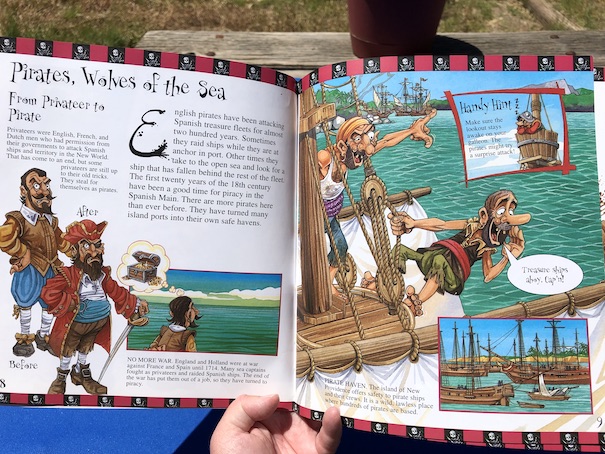
The reason why the reader is cast as a Spanish captain, captured by English pirates, is because England and Holland had been at war with Spain until 1714.  During the war, the government of England (as well as Holland and France) authorized some ship captains to act as privateers, conducting raids on Spanish ships and outposts.  When the war ended and the privateers were dismissed from service, some of them continued to act as independent pirates.
The book explains the geography of the “Spanish Main,” the area between the southern coast of North America and the northern coast of South America – basically, the Caribbean Sea and its islands and the Gulf of Mexico.  Spanish galleons in the 18th century carried gold and treasures from the Americas to Spain as well as timber from the rainforests and goods that were transported to the Americas across the Pacific Ocean, such as spices and silk.  All of these goods made Spanish treasure ships tempting targets for English pirates.
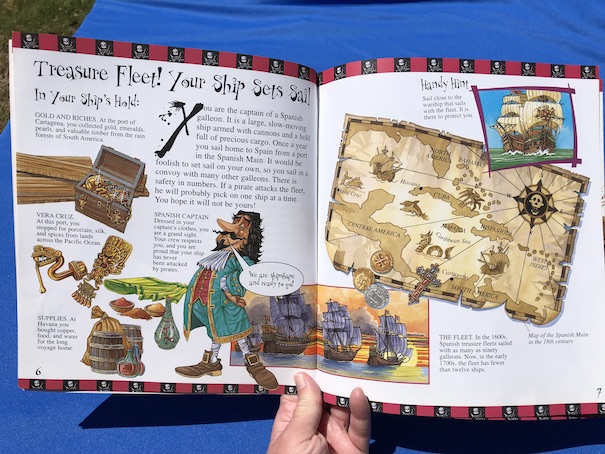
As a Spanish ship’s captain, there were a few precautions that you could take against pirate attack.  One of the most basic was traveling as part of a convoy because pirates would be more likely to attack a lone ship than one that was part of a group.  A fleet of ships would have a warship traveling with them for protection, and the closer your ship sailed to the warship, the less likely a pirate ship would try to separate you from the group and attack.
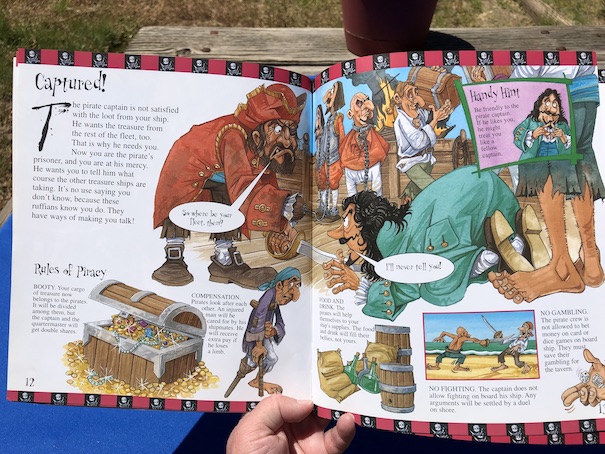
If the worst situation happened and the ship was taken by pirates, a captain could try to dress like other members of the crew to disguise his rank, but that didn’t always work.  The captain of the ship was in danger of being taken captive because he might have information that the pirates would find useful, like the exact route of other ships in a convoy.

The gruesome part of this book (and the source of the title, because this series basically focuses on the gruesome parts of history) is the part where they describe different forms of torture that pirates might use on a ship’s captain to convince him to tell them what they wanted to know.  Besides the direct physical abuse, pirates could also keep a captive in squalid conditions to make him weaker, more vulnerable, and exposed to disease.  In the end, they might simply decide to maroon the captive somewhere, even if they got the information they were after.

However, pirates could also face gruesome fates if they were caught. They could be hung and their bodies displayed publicly, as a warning to others.

The Ship That Never Was

ShipThatNeverWasThe Ship That Never Was by Mickey Spillane, 1982.

Larry Damar and Josh Toomey are sailing in a boat off the coast of Peolle Island in the Caribbean when they rescue an old man from what seems to be a skiff. But, as soon as they get him aboard their own boat, they realize that what they thought was a skiff is actually more of a long boat, and it looks old. Very old.

They take the old man, who is suffering from exhaustion, to their fathers. While the old man rests, they inspect the boat and confirm that it is an antique. Oddly, from the condition of the wood, they believe that it has been resting in water for some years, but not salt water. It’s the kind of longboat that would have been carried aboard larger naval ships from a couple hundred years earlier. The name on the side of the boat, HMS Tiger, is familiar, but they heard that it was lost at sea ages ago. The old man is also carrying what appears to be some very old documents, but they are unable to read them, and when the old man speaks, they’re not quite sure what language he’s speaking.

They send a message to Sir Harry Arnold at the antiquities department of the British Naval Archives about the boat and the old man. When he arrives, he confirms that the longboat came from the HMS Tiger, a three-masted ship built in England in 1791. The Tiger was considered a jinxed ship because of everything that went wrong during its construction and its maiden voyage. Because of that, no one wanted to sail on it again or even work on the ship to dismantle it. So, the builder decided to send the boat on one last voyage by itself. He and his men loaded up the ship with supplies as if it had a crew aboard and then set it adrift, watching it sail off majestically, without a crew. Everyone had assumed that it would have eventually sunk, damaged by the weather, but apparently, it survived for longer than anyone had suspected.

Since no one can understand his language, the old man, who calls himself Vali, draws pictures to explain to them where he came from. Vali indicates which island he came from, and according to his other drawings, he lived there with many other people until many of them were killed in some kind of storm. He also draws a picture of a young girl with a crown on her head. Then, Larry’s dad, Vincent, recognizes the seal on a signet ring that Vali shows them. Vincent has read about the history of the country of Grandau (fictional country), and he recognizes its royal seal.

About 200 years before, Grandau was overrun by a neighboring country. Members of the royal family of Grandau escaped the invasion along with some loyal servants and tried to flee across the Channel to England to seek sanctuary. However, they were only in an old fishing boat, and it was thought that it sunk in a storm before they reached England because such a small craft would be unlikely to have survived. Grandau has not been a happy country since then. Over the years, they have been ruled by a series of dictatorships, and it has been in an almost constant state of unrest.

Now, the presence of the longboat from the HMS Tiger presents a much more intriguing theory of what happened to King Tynere of Grandau and his people. By an unbelievable coincidence (your suspension of disbelief is required for this story), the royal family’s attempted escape to England happened around the same time that the HMS Tiger was sent off alone and fully equipped for its final voyage. It now seems that the desperate people on the fishing boat were saved by encountering this grand, unmanned ship that no one else wanted, that everyone feared was jinxed. Grandau was not a seafaring nation, so the people were probably unable to actually sail the ship, simply letting it drift until they found land. Eventually, they arrived at an island in the Caribbean, and their descendants have been living there ever since in anonymity, until the disaster that prompted Vali to risk venturing out for help.

Unfortunately, their attempts to determine what language Vali was speaking and where he came from have also come to the attention of the wrong people. The government currently in power in Grandau has been working hard to stamp out the history and culture of the country in order to tighten its hold on the people, although their hold has never been more than tenuous, just like all the other dictatorships since Grandau’s royal family fled. Now that word has reached them that members of the royal family that the people of Grandau mourn may actually still be alive, they are determined to eliminate them before they can return to their ancestral home.

The author of this book, Mickey Spillane, is best known for his Mike Hammer series of hard-boiled mysteries for adults, and some of his hard-boiled style shows in this adventure book for children. This book is also part of a short series, although I don’t have the first book, The Day the Sea Rolled Back. In that book, Larry and Josh are helping their fathers hunt for sunken treasure, but their efforts are being sabotaged by a pair of treasure-hunting brothers.