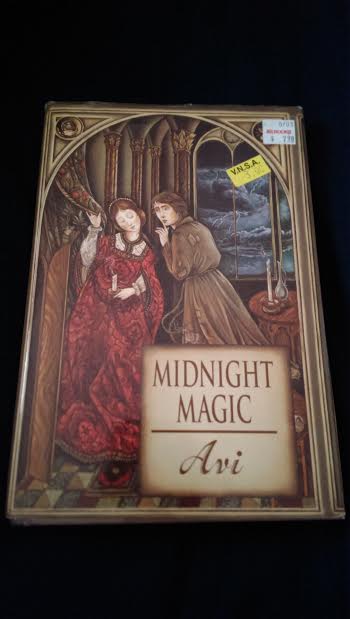
The Castle of Adventure

Enid Blyton’s Adventure Series

The Castle of Adventure by Enid Blyton, 1946.
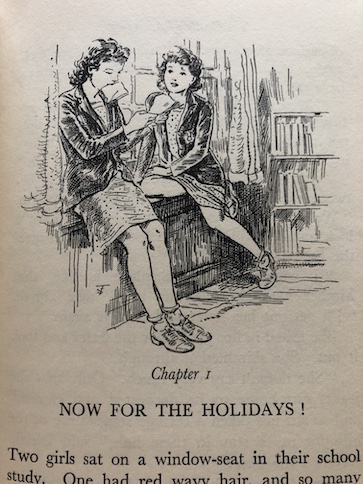
Since the children’s last adventures, Philip and Dinah’s mother has used the children’s reward money to buy a home for them, so the children won’t have to continue staying with their aunt and uncle on school holidays.  They’ve also invited their friends, Jack and Lucy-Ann, to live with them, so they don’t have to return to their uncle’s house.  Now, the girls go to the same boarding school, and the boys go to their boarding school, and they’re all together on holidays.

When the children are out of school for the summer again, they and their mother go to stay in a cottage near an old castle on a hill.  The children are fascinated by the castle, but their mother doesn’t want them going near it because local people tell sinister stories about it.  She doesn’t explain about their stories, but she seems to think that it might be dangerous.  However, she does agree that the children can go have a look at an eagle’s nest near the castle, knowing how Jack feels about birds.  The children realize that they can use that to get a look at the castle anyway.
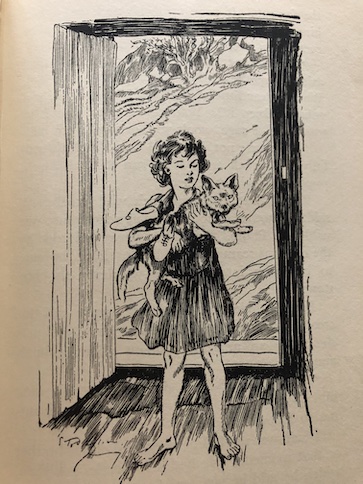
They make friends with a local girl named Tassie.  They call Tassie a “wild girl” because she’s a gypsy, has a pet fox, and runs around in old, dirty clothes and without shoes (she carries shoes with her but doesn’t wear them) and seems uneducated.  She doesn’t seem to know what an eagle is or what a bath is (although the children’s mother insists that she get one).  (No, I don’t believe that she’s ignorant for being a gypsy. I think it’s both a stereotype and a plot device.)  However, Tassie knows the area very well and helps the children find their way around.  Tassie is also afraid of the castle.  When the children ask her what stories people tell about the castle, she says that an evil man used to live there, and people would come to see him and never be seen again.  Still, the children want to explore the castle.
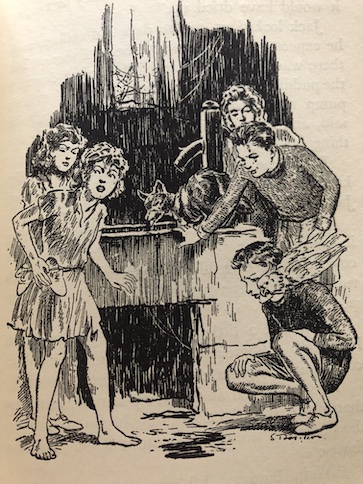
When they explore the castle, they find a water pump with a puddle beneath it, indicating that someone has been there recently to prime and use the pump.  Jack also realizes that the eagles in the next have a young eaglet who looks like it’s about ready to fly.  He persuades the children’s mother to let him build a hide (camouflaged shelter) so he can camp out and watch the birds.

While camping out, he realizes that there’s someone else in the castle besides himself.  At night, he hears someone moving around and using the pump, and he thinks he sees a flashing light, like someone signaling to someone else.  In the morning, he thinks maybe he dreamed it, but Lucy-Ann mentions seeing the flashing light.  Lucy-Ann thought that Jack was signaling to her, but Jack realizes that it was someone else and that he wasn’t dreaming.

Exploring the castle further, he finds a hidden room with old furniture and armor and realizes that someone has been hiding there.  Later, he sees some strange men in the castle and hears them speaking a language that he doesn’t recognize.  Who are they and what are they doing there?  Could they have something to do with the assignment that their friend Bill, an undercover investigator, is doing in a town nearby?

The book is available to borrow and read for free online through Internet Archive (multiple copies). It was also made into a tv movie serial. You can see it on YouTube.

My Reaction

Like other Enid Blyton books, there are racial issues in this book that were changed in reprintings. Enid Blyton books often feature stereotypical gypsies (more politely called Romany or Travelers these days) as characters and plot devices. Tassie is a pleasant and helpful character but still stereotypical.

I like the setting for the story. A supposedly abandoned castle makes an exciting place for our young heroes to explore. Even with the references to spooky stories about the place, the kids never really believe that the castle might be haunted. They very quickly realize that there are living people who have been hanging around the place. The sort of sinister characters using the place as a hideout are the same sort of villain characters as in the first book, which brings the kids’ friend Bill back into the story.

I enjoyed the movie serialization of the book, and I thought that it followed the story of the book well.
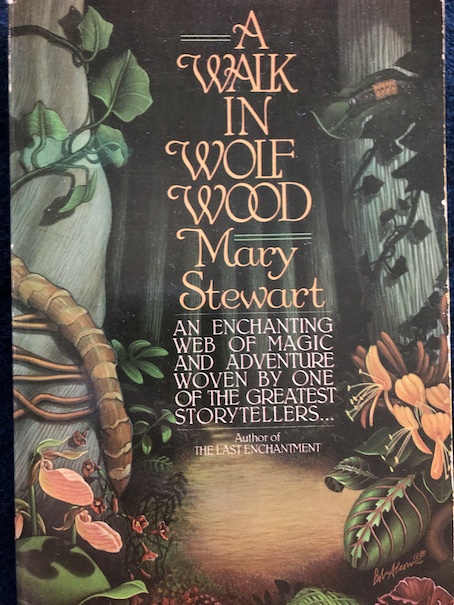
A Walk in Wolf Wood

A Walk in Wolf Wood by Mary Stewart, 1980.

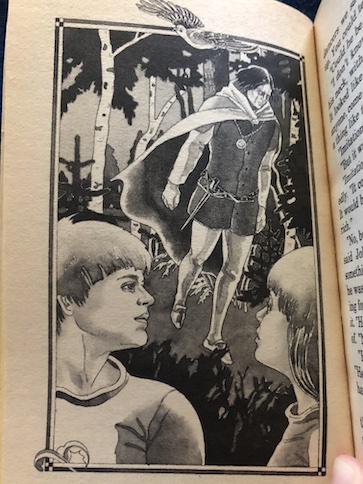
John and Margaret Begbie are traveling with their parents through Germany, and the family stops to have a picnic in the Black Forest. From their picnic spot, they can see the old castle on the hill that they visited earlier that day. The children’s parents doze off after lunch, but the children stay awake and see a strange man. The man walks by their picnic spot wearing an old velvet costume and a dagger in his belt, and the children see that he’s crying. The kids worry about the man because he seems so deeply distressed. They decide to leave a note for their parents and follow the man to be sure that he’s alright.

As they go after the man, they spot what looks like the tracks of a large dog, but the man didn’t have a dog with him. The kids realize that these are actually wolf tracks, and John remembers that their father told them that this area is called Wolfenwald, which means Wolf Wood. Then, they find the man’s gold medallion lying on the ground. Going a little further, they find an old cottage. The cottage looks abandoned, but they decide to explore around it anyway, just in case the man went inside. No one answers their knocks on the door, but they see the man’s clothes on the bed inside the house. They decide to leave the medallion with the man’s clothes and go back to their parents, but they suddenly notice that it has become night, and when they try to leave the cottage, they are confronted by a large wolf!

John frightens the wolf away by flinging the medallion at it. When the wolf is gone, the children decide that they have no choice but to risk going through the woods in the dark to find their parents. However, when they arrive at the picnic spot again, their parents aren’t there. The children find the note they left and a bar of chocolate. They eat the chocolate and lie down to wait for their parents to return for them, but the next thing they know, they are woken by the sound of a horn and the horses of a group of hunters. The hunters are pursuing the wolf. When they wave down one of the horsemen, he offers them a coin to tell him where the wolf is. Margaret points the man in the wrong direction to get the hunters off the trail of the wolf. The children aren’t really sure whether it’s a real wolf or just a dog that resembles one, but Margaret has the sense that the wolf needs their help.

The children also need help. They notice that the horsemen are dressed strangely, like people out of the past, and the coin that the man gave them is stamped with the year 1342 although it looks new. Even more strangely, the children suddenly realize that they understood what the man said even though neither of them can speak German. Is this is a dream, or have they gone back in time?

Not knowing what else to do, they decide to return to the cottage and see if the man who owns the medallion is there and can explain things. The man does have an explanation. He explains that he was the wolf. The man, whose name is Mardian, is a werewolf, and Margaret saved his life when she diverted the hunters. Mardian says that he and his family served the dukes who have ruled this land, and he and the current duke grew up together and were best friends for years. However, after suffering a terrible injury at the hands of an enemy and losing his wife, Duke Otho became a changed man, angry and bitter. In a fit of temper, he even accused Mardian of plotting against him. A real enemy in Otho’s circle, an enchanter called Almeric, used Otho’s suspicions to try to eliminate Mardian. When his plots to kill Mardian failed, Almeric used sorcery to turn him into a werewolf. Now, Alermic has promised a reward to the hunter who kills the wolf, and in the meantime, he has disguised himself as Mardian and taken his place in the duke’s castle. So far, the duke hasn’t even noticed that Mardian has been replaced by an imposter. Mardian believes that Alermic will use his position to kill both the duke and his young son so he can take the dukedom for himself. Can the children help Mardian expose the imposter and break the spell?

The book is available to borrow and read for free online through Internet Archive (multiple copies).

My Reaction

In order to reach the duke and get his help to expose the imposter, the children must disguise themselves as other children from this time period and join in the life of the duke’s castle. Mardian gives them a plausible cover story, in case anyone asks them who they are. They carry off the charade very well, and there are so many people and children in the castle that two more aren’t questioned. John is even mistaken for another boy, called Lionel. John doesn’t know who or where the real Lionel is, although he theorizes that the real Lionel might have died young because many children of this time period did. While real-life castles were full of many different types of people of all ages, I do find it a little difficult to believe that so few people are surprised by children who suddenly appear without any introduction. There does seem to be the implication that people do come and go from this castle, making it difficult to keep track of everyone.

Margaret and John also experience the different expectations people of this time have for girls and boys. John is immediately put to work as a servant, waiting on the noblemen of the duke’s court as a page along with the sons of the nobles. He also has to dodge the rough games that the other boys play that are meant to prepare them for war. On the other hand, Margaret is taken to the nurseries with the other young girls of the castle and lectured about how she should be quiet and modest. The girls are much more closely supervised than the boys, although she finds a way of slipping away from the others to meet with John.

I liked some of the descriptions of the Medieval food in the book. At one point, Margaret thinks she’s eating turkey (a bird native to the Americas and not found in Europe during this time period), but John tells her that it’s actually swan and peacock, birds which were eaten around this time. There are a few instances where alcohol is mentioned because people during this time period drink wine and small beer. The duke also insists that a boy bring him his favorite posset, a drink I discussed in my earlier review of the The Box of Delights.

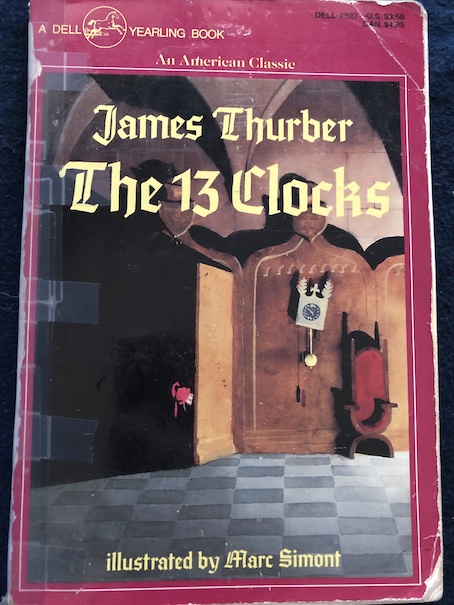
The 13 Clocks

The 13 Clocks by James Thurber, 1950.

An evil Duke lives with his niece, Princess Saralinda, in a castle with 13 clocks that do not work. The Duke is a cold-hearted man, so cold that his hands are always cold, and he has frozen all of the clocks. Time itself seems frozen in the cold castle. The Duke comes to believe that he has actually “murdered” time, that it will never again be “Now” in the castle. The Duke is afraid of “Now.” “Now” has urgency and consequences, and he hopes that by stopping time, he will never have to confront “Now.”

One of the Duke’s fears is of his niece’s suitors. Princess Saralinda is lovely and as warm as the Duke is cold, so the Duke does not want to let her go. He needs her warmth as relief from his own coldness. Every time a potential suitor attempts to call on Princess Saralinda and ask for her hand, the Duke thinks up some impossible task for the suitor to accomplish with a sentence of death for failing to accomplish the impossible so Princess Saralinda will never be married.

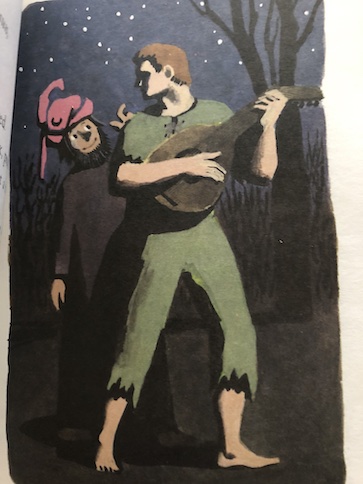
Then, a prince comes to town disguised as a minstrel named Xingu, which is dangerous because using a name that starts with ‘X’ is one of the things that the Duke sometimes kills people for doing. The prince is a youngest son, and as youngest sons often do in fairy tales, he has gone into the world to seek his fortune, adventure, and the lady of his dreams. At the town’s inn, the minstrel prince hears stories about Princess Saralinda, her suitors, and the Duke’s impossible challenges. In spite of the gruesome consequences for failing to complete the impossible tasks, the prince finds himself contemplating how he might be able to gain entrance to the castle and try his hand at defeating the Duke and winning the princess.

The minstrel prince begins making up a joking song about the Duke, and the people in town are nervous because the Duke kills people for any form of impertinence. One of the Duke’s spies, known as Whisper, witnesses the song and runs off to tell the Duke about it. Then, the prince is approached by a strange little man who calls himself the Golux and who offers to help him, although he freely admits that he makes up stories and often forgets what’s made up and what’s real. The prince doubts how helpful he can be, but the Golux suggests a story he can tell the Duke when the Duke considers killing him and feeding him to his geese, that Princess Saralinda can only be married two days after his death. The Duke would do almost anything to prevent Princess Saralinda’s marriage, so he wouldn’t kill him if his death might be the omen that causes her marriage to happen.

Soon, the Duke’s guards come to arrest the minstrel prince and take him to the dungeon. When he is brought before the Duke, the minstrel prince tells him what the Golux told him to say. The Duke isn’t sure whether he’s telling the truth or not, but since he’s not sure if he can kill him outright, he decides to set one of his impossible tasks for the minstrel to complete. The minstrel says that he can’t do an impossible task because he’s not a prince (as far as the Duke knows), but the Duke says that they’ll make him one just so he can do it.

As the guards escort the minstrel prince back to the dungeon, he sees Princess Saralinda, and she wishes him well, which is all that she can say in her uncle’s presence because she’s under a spell. The minstrel prince falls in love with her, and he realizes that his love is returned when she later manages to give him a rose.

In the dungeon, the minstrel prince encounters the Golux again and asks him how he got in and if there’s a way out, but the Golux is evasive, just telling another one of his stories about his mother being a witch and his father a wizard. However, the Golux has a useful suggestion for managing the Duke’s next impossible task: control what the task is through reverse psychology. He doesn’t use those exact words, but he tells the minstrel prince to beg the Duke to set him any task he likes but not to send him out in search of a thousand jewels. The Duke, being evil, will automatically set him the one task he begs not to be given. The minstrel prince says that he still can’t give the Duke a thousand jewels because he doesn’t have any jewels. The Golux points out that he’s no ordinary minstrel. He is actually Prince Zorn of Zorna, and his father will surely supply the jewels he needs. That’s all very well, but the prince isn’t sure if the Duke will give him the time he needs to reach his father and return.

Sure enough, the Duke sets the prince the task of getting a thousand jewels, but the matter is complicated because it turns out that he’s aware of who the prince really is. Knowing that it would take Prince Zorn 99 days to get the required jewels from his father and return, the Duke gives him only 99 hours to do it, and he further requires that all of the 13 clocks in the castle strike five o’clock (they are frozen at 10 minutes before five o’clock) when he returns with the thousand jewels.

The stakes of the task are high for both the Prince and the Duke because, as a guard explains to Prince Zorn, the Todal, which is a kind of blob monster in the service of the devil, waits to gobble up the Duke if the Duke fails to be sufficiently evil. If Prince Zorn passes whatever test the Duke sets for him, rescues the princess, and escapes, the Todal will surely put an end to the Duke.

The book is available to borrow and read for free online through Internet Archive (multiple copies).

My Reaction and Spoilers

This isn’t a princess book for young children because it has some dark content in it. The Duke is cruel to animals and has even killed children. The cruelty and killing isn’t described in detail, but the story is better for older elementary school children or middle school level. I’d say about 9 or 10 years old and older.

Through the course of the story, it’s revealed that Princess Saralinda isn’t actually the Duke’s niece. He later confesses that he actually abducted her from a castle as an infant, and even he isn’t completely sure of her true identity. Even as a child, she had that magical, glowing warmth that the Duke craves. He’s been raising her with the idea of marrying her himself when she’s old enough. He’s been unable to marry her up to this point because her former nurse was a witch and cast a spell that prevents him from marrying her until she’s 21 years old, and that time is approaching soon.

Part of the fun of this book is that it draws on many elements from fairy tales, like the woman who can cry jewels, which somewhat resembles the fairy tale about the kind girl whose words produce jewels and flowers when she speaks. The solutions to many of the problems in the story are also riddles. For example, if nothing makes a person laugh or cry, then literally nothing is what you have to provide. In the case of how to get the clocks moving again, Princess Saralinda has been the key all along. The clocks aren’t dead, merely frozen, and her warmth can get them moving again.

Of course, it all ends happily. Princess Saralinda’s true identity is established by the end of the story, and Prince Zorn is able to marry her. The Duke is thwarted and eaten by the Todal.

The Case of the Dragon in Distress

The Case of the Dragon in Distress by E. W. Hildick, 1991.

The McGurk organization start getting interested in the Middle Ages when they acquire a round table, which reminds them of King Arthur’s Round Table, and they begin studying the Middle Ages in school. Shortly after that, Brains buys a set of walkie-talkies at a fire sale. At first, they don’t work, but Brains tinkers with them until he can get them to send and receive. The strange thing is that they only seem to work well at night.

One night, the organization decides to test them, and somehow, they are transported into the Middle Ages. A strange voice speaks to them through their “little black boxes” and sends them on a quest that takes them to the castle of Princess Melisande the Bad. The castle is supposedly guarded by a dragon, but it is really a couple of servants in a dragon costume. Like many others in the castle, they are prisoners of Princess Melisande, who appears young and sweet, but is actually evil. She uses the dragon story to lure brave men to the castle so that she can imprison them and drink their blood. She has leeches put on them, and then she eats the leeches. That is how she maintains her youth, even though she is ancient. Among her prisoners are the king’s son, Prince Geoffrey, and the young chief of the McGurk clan from Ireland, who may be a distant ancestor of Jack P. McGurk.

When the members of the McGurk Organization arrive at the castle, everyone is amazed by their strange appearance, modern clothes, and the little black boxes that talk. Even Princess Melisande is in awe of them, but the McGurk in her prison is weakening, and she may be planning to replace him with the McGurk from modern times.

The book is currently available online through Internet Archive.

My Reaction and Spoiler:

The two servants who were pretending to be the dragon, Gareth and his sister Gwyneth, are also time travelers, but they are from the 17th century. They were brought to the Middle Ages after drinking a potion that was supposed to cure them of a fever. In their own era, they live close to the castle where they are now imprisoned, and they know that there is a secret passage that leads out of the castle from the dungeon. The kids develop a plan to sneak out of the castle under the dragon costume, but they are caught and thrown in the dungeon. They try the secret passage, not knowing if the path goes all the way through. It does, and they make it to the king’s camp. When they tell the king that Princess Melisande has his son, the king plans to storm the castle and free the prisoners. McGurk says that their mission is accomplished, and the voice from their little black boxes says that it’s time for them to go home. Everyone wakes up in their own beds, as if nothing had happened. They believe that the walkie-talkies are responsible for what happened, but they aren’t quite sure if they actually went back in time or merely dreamed that they did. There is some evidence that they really went back in time, but it isn’t answered definitely.

I liked this book as a kid, although it’s a little bizarre because most of the books in this series are just mysteries involving a group of neighborhood friends that take place contemporary to when the books were written. There is usually nothing magical or supernatural about the books in this series, and it’s kind of a weird departure from the usual format. There is another book after this one that continues their time traveling adventures.

The Enchanted Forest

The Enchanted Forest by La Comtesse de Segur, translated by Beatrice Schenk de Regniers, 1856, 1974.

This is an English translation and retelling of one of La Comtesse’s stories.  I can’t read French, and I’ve never read the original version of the story, but the translator, Beatrice Schenk de Regniers, had a note in the book that she altered the story slightly from its original version.

King Goodheart has a lovely little daughter named Goldenhair, who he loves very much.  Unfortunately, his wife dies, and his people urge him to remarry.  His new wife, Queen Meanette, is as mean as her name sounds, and she does not like Goldenhair at all.  The King, realizing this, does his best to keep her away from his daughter and puts his daughter in the care of some trusted servants. 

Meanette, still jealous of the love and attention the King gives Goldenhair, plots to get rid of her.  One of the princess’s attendants is a boy who takes her out in her little carriage in the garden every day.  The boy is greedy for sweets, and the queen bribes him into tricking the princess into going into the enchanted forest.  People who go into the forest have been known to disappear forever.  When the princess becomes lost in the forest, she is befriended by a cat who takes her to a palace where he lives with a doe.  They are very kind to her, but Goldenhair still longs for a way to return home.

One day, while Goldenhair is living with the cat and the doe in their palace, a parrot comes and claims that he knows a way that the princess can return home.  He insists that she leave the palace, against the doe’s wishes, and pick a single rose that grows in the forest.  What the girl doesn’t know is that the parrot is an evil wizard in disguise.  When the girl picks the rose, the doe’s palace is destroyed, and the evil wizard reveals himself. 

Thinking that she has killed her friends, Goldenhair wanders, lonely and miserable, through the forest.  Then, a large tortoise comes and tells her that her friends are still alive and that she can find out what happened to them if she’s willing to take a long journey on the tortoise’s back without saying a single word the whole time.  Goldenhair does so and arrives at a fine palace where she learns that the doe was really Fairy Kindheart and the cat was really her son, Prince Charming.  They had been turned into animals by the evil wizard, and they had been freed when the princess picked the rose.  However, the princess had then fallen under the spell of the evil wizard, and the other trials were necessary to free her.  Fairy Kindheart takes the princess home to her father, who is overjoyed to see her.  The King marries Fairy Kindheart, and Goldenhair marries Prince Charming, and they all live happily ever after.

The book is currently available online through Internet Archive.

My Reaction and Further Information

The life of La Comtesse de Segur, the original author of this story, is almost like a fairy tale itself. Her first name was Sophie, and she was born in 1799 in Russia.  Her father was a Russian Count, and she grew up with her seven siblings on his vast estate.  However, even though her family was wealthy, her mother believed that children shouldn’t have life easy.  Sophie and her brothers and sisters had to sleep on small, hard beds and were never given much food to eat or any sweets.  When she was 18, Sophie went to live in France, and she married a French Count named Eugene de Segur.  It was not a particularly happy marriage, but she had four daughters and four sons and many grandchildren.  She wrote stories for them and became the most popular children’s writer of her time in France.  She died in 1874, but her stories are still popular with children in France.

I found the story of La Comtess’s life even more interesting than the story in the book, although the story in the book isn’t bad. It seems like a pretty obvious variation on the story of Snow White, but it is a charming story.

Do-It-Yourself Magic

Do-It-Yourself Magic by Ruth Chew, 1987.

Rachel and her younger brother, Scott, stop by the discount store on the way home to admire the model kits.  Most of the model kits are too expensive for them to buy, but one kit has been put on discount, The Build-Anything Kit.  The kids think it’s a good deal because they can use it to build more than one kind of model. 

When they get it home and begin to play with it, they are confused at first.  Scott tries to build a model stock car racer, but all the wheels and other pieces are all different sizes.  Then, Rachel finds a double-headed hammer labeled, “sizer.”  The kids discover that when they hit the model pieces with the hammer, they can make them bigger or smaller.  Besides working on pieces, the sizer can also make people bigger or smaller.  Rachel makes Scott smaller so that he can drive his stock car model around the room.  Then, when he drives outside, she makes both him and the car bigger, so the car is the size of a normal car.  A neighbor spots them in this strange car and calls the police, so the children are forced to shrink the car again quickly. 

When they get home, they discover that they left the door open and that a man is trying to steal their tv set.  Without thinking, Rachel hits him with the sizer and shrinks him.  Now, they have to decide what to do with him before the situation gets worse!

At first, the kids keep the thief in a glass, but then they let him out and allow him to drive around in the stock car model.  While they are trying to decide what to do with him, they take a look in the model box again and notice some pieces that weren’t there before.  They look and feel like stone blocks, so they begin building a castle with them.  To their surprise, the man they shrunk runs into the castle.  They are worried about him, so they hit the castle with the sizer to make it bigger.  Suddenly, the castle is as large as life, and they go inside to discover that they are back in medieval times. What will happen to the thief in the past, and will the kids get back home?

The book is currently available online through Internet Archive.

The Rescuers

The Rescuers by Margery Sharp, 1959.

This is the first book of The Rescuers Series.  Disney made a movie called The Rescuers based on this series, but the movie was very different from the book.  The movie involved a pair of mice who were members of a mouse version of the United Nations called The Rescue Aid Society who rescued a young orphan girl who was kidnapped for the purpose of recovering a treasure from a dangerous cave.  In the book, the prisoner the mice rescued was a poet who was being held captive in a castle.

The beginning of the first book of the series explains the purpose of the Prisoners’ Aid Society, an organization of mice that helps human prisoners:

“Everyone knows that the mice are the prisoners’ friends – sharing his dry bread crumbs even when they are not hungry, allowing themselves to be taught all manner of foolish tricks, such as no self-respecting mouse would otherwise contemplate, in order to cheer his lonely hours; what is less well known is how splendidly they are organized. Not a prison in any land but has its own national branch of a wonderful, world-wide system.”

However, the mice are daunted by their latest concern, a prisoner who is being held captive in the Black Castle, a Norwegian poet.  The Black Castle is a harsh prison, and because of the jailer’s cat, mice usually cannot reach the prisoners there.  However, the current chairwoman of the society believes that it may be possible to rescue one of the prisoners there.  She thinks that Miss Bianca is just the mouse for the job because she is the pet of an ambassador’s son and will soon be traveling to Norway with her owner.  The chairwoman sends Bernard, a pantry mouse, to Miss Bianca to recruit her for the mission.

Miss Bianca is frightened when Bernard explains the mission to her and faints.  However, it turns out that Miss Bianca is a poet, and so is the man who is being held prisoner.  Bernard uses her sympathy for a fellow poet and some flattery to inspire her to agree to help.

When Miss Bianca reaches Norway, she recruits some help from the mice in the cellar of the embassy.  In particular, a sailor mouse called Nils accompanies her to where the other mice from the Society are meeting.  There, Bernard joins them for the journey to the Black Castle.

When they reach the castle, Miss Bianca, Bernard, and Nils take up residence in an empty mouse hold in the head jailer’s quarters.  (There is a horrifying description of how the head jailer apparently pinned live butterflies to his walls to die. Ew!)  The jailer does have a horrible cat named Mamelouk, who is as cruel as his master.  At first, Miss Bianca isn’t afraid of the cat, having known a nice cat who didn’t eat mice when she was young.  After talking to Mamelouk and interacting with him, she comes to recognize his cruelty and real intentions toward her.  However, Mamelouk is an important source of information.  It is from Mamelouk that they learn that the jailers will be having a New Year’s Eve party soon and that many of them are likely to be lax in their duties.  This will be the best time for them to try to rescue the poet!

The mice do successfully rescue the poet, and Miss Bianca returns to her boy, who has been missing her. However, this is just the first of her adventures in this series!

Overall, I prefer the first Disney Rescuers movie to the book because the prison/castle seemed pretty dark for a children’s book, and I think the idea of rescuing a child is also more appropriate for a children’s book.

The book is currently available online through Internet Archive.

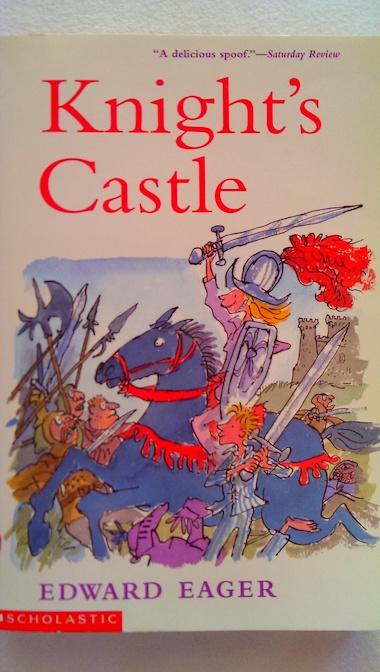
Knight’s Castle

Knight's Castle

Knight’s Castle by Edward Eager, 1956.

Roger and Ann are the children of Martha from the previous two books in the series. Like their mother’s family when they were growing up, they live in Toledo, Ohio. Their Aunt Katharine (one of Martha’s older sisters) used to live close to them in the Midwest but now lives in Baltimore, Maryland. Roger and Ann don’t particularly get along with Aunt Katharine’s children, Eliza and Jack, because Eliza is bossy and Jack is only interested in photography. However, the four children end up spending the summer together when Roger and Ann’s father needs to have an operation at a hospital in Baltimore.

Like their mother and her siblings when they were young, Roger and Ann also like fantasy stories, which their father likes to read to them. Roger starts to believe in real magic when it seems like one of his toy soldiers comes to life at night. Roger collects toy soldiers, and he has over 200 of them, but this one is special because his father says that its been handed down in their family for generations. Roger calls it the Old One. It’s rather worn, so it isn’t obvious at first, but the Old One is actually a knight. Worried about his father’s illness, Roger takes the Old One to bed with him (which he thinks is more manly than taking a teddy bear to bed), and then feels it wriggling in his hand.

Knight's Castle Roger

Realizing that the Old One is magic and is coming to life when he holds him, Roger asks him if it’s part of his magic to grant wishes. If it is, then he wishes for his father to get well, and if possible, for him and his sister to have an adventure in Baltimore over the summer. The Old One doesn’t answer him immediately, but over time, he makes it clear to Roger that wishes have to be earned, and that will be the source of his summer adventure.

When the children arrive in Baltimore to stay with wealthy Aunt Katharine while their father is in the hospital, Aunt Katharine gives them presents. Ann gets a new dollhouse, and there is a toy castle for Roger. Since Aunt Katharine has also just taken all the children to the movies to see Ivanhoe, all of them become immediately interested in playing with the castle.

That night, Roger has a strange dream that he finds himself within the story of Ivanhoe, which is being acted out in his toy castle. The Old One is there as well, although he is mainly watching the action as Roger begins to take part in the story. When Roger comes face-to-face with the villain, he accidentally lets Ivanhoe’s plans slip to him. Things are looking pretty bleak when Roger suddenly realizes that the castle is still a toy and everyone around him is just a lead soldier. This revelation ends the magical adventure and brings him back to reality. However, Roger is disappointed that he ended the adventure so early when perhaps he could have done something really heroic.

Seeing the toy soldiers scattered around instead of poised for the battle they were planning the night before, Eliza and Ann think that Roger was just playing with the castle without them, but he explains to them what happened. The girls were just reading The Magic City by E. Nesbit, and they start building their own “magic city” out of random things from around the house, surrounding the toy castle. Roger is upset about the city because he says that it doesn’t fit in with the Ivanhoe story, and he’s sure that it will ruin everything, maybe from preventing the magic from working again at all. The Old One tells Roger that magic works by threes, so the next opportunity for magic will be in three days.

Knight's Castle Magic City

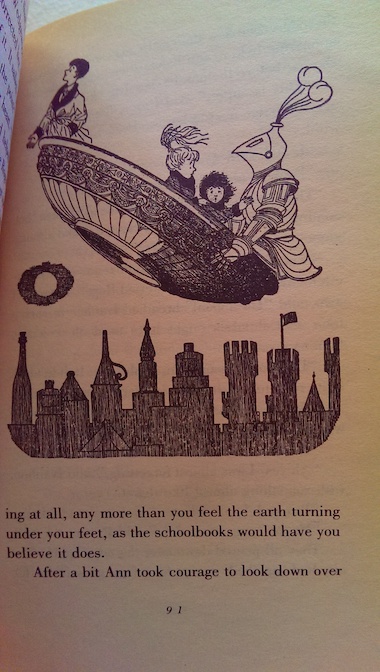
As it turns out, the city does end up becoming part of the story when the magic brings it all to life on the third night. Roger, Ann, and Eliza find themselves in the middle of the city, surrounded by knights attempting to drive modern cars. Ivanhoe has become a fan of science fiction books, via the public library in the city that the girls built. Although Ivanhoe has turned into something of a geek, the children persuade him to come on a mission to rescue the captive Rebecca, and they end up traveling in a flying saucer (made from a real saucer) to the Dolorous Tower, where the adventure ends as soon as Eliza remembers that the villain threatening them is still just a lead soldier.

Knight's Castle Flying Saucer

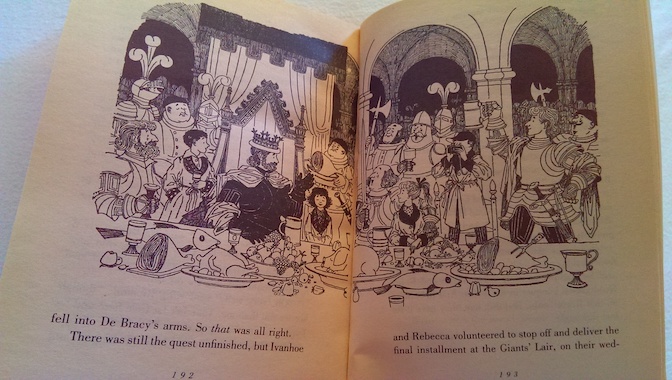
It was an even weirder adventure than Roger’s first one, but by now, the children are starting to understand the rules that go along with the magic. Jack, who says he doesn’t really believe in magic, accompanies the other children on the next adventure, as they try to prove to him that it’s real. They end up having to rescue some of the others from the “giant’s lair”, which turns out to be Ann’s new dollhouse. The dolls are angry that Ann has been neglecting them, only paying attention to the dollhouse when she and Eliza needed to borrow things for their magic city. They manage to escape again by remembering that the dolls are just dolls.

However, Roger is still worried about their father, who is about to undergo his operation. The Old One had told him that wishes needed to be earned, and he doesn’t think that they’ve managed to accomplish much in their adventures. Roger thinks that they need to do something really heroic so that his wish for his father to get better will come true. The Old One gives Roger a rhyme, hinting at what the children need to do on their next adventure, but Roger doesn’t understand what it means, and he doesn’t know if he can figure it out in time.

Actually, it is Ann who eventually realizes what the rhyme means and provides Roger with the “wisdom” that he needs to earn his wish. All throughout the story, Roger was criticizing his little sister for things she did wrong, saying that she was too little and only a girl. Because Roger thinks of her as being just his little sister, he overlooks what she has to contribute to the adventure. Roger’s acquired wisdom is to value the contributions of others and not underestimate their ability to contribute. Ann, being young and shy, frequently doubts herself, but she also learns confidence when she realizes that she has the answer to the riddle. Jack and Eliza learn lessons as well. Doubting Jack learns to believe in magic, and Eliza learns that she can’t always be the boss, that sometimes it is better to let someone else take the lead when they’re the right person for the job. (Although, she does say at the end of story, “If that wouldn’t be just like that magic’s impudence! Trying to teach me moral lessons!”)

Like other books in this series, there are a lot of references to popular pieces of children’s literature and jokes about things that happen in children’s stories.

The book is currently available online through Internet Archive.

Knight's Castle Feast

Meg Mackintosh and The Mystery at the Medieval Castle

Meg Mackintosh Mysteries

MMCastle

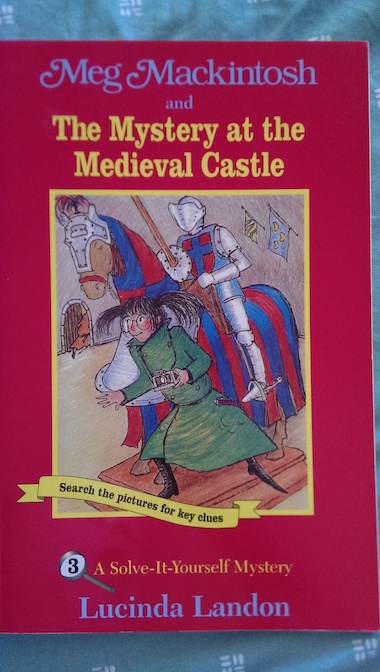
Meg Mackintosh and The Mystery at the Medieval Castle by Lucinda Landon, 1989.

Meg is visiting Dundare Castle with her teacher and some other students.  Dundare Castle is a special museum where people can learn about life in Medieval times, although it used to be a private home.  The owner’s family came from Scotland, and they built their home to look like their ancestors’ castle there.  Eleanor, the owner, now calls herself the Duchess of Dundare, and with her staff, dresses up to recreate the lives of people from the 1300s.

MMCastleTour

One of the Duchess’s prized possessions is a silver chalice studded with jewels that has been in her family for generations.  She keeps it on display in the castle’s “abbey,” guarded by the actor playing the part of a knight, Knight Henry.  But, when Meg and her classmates get to the abbey, the chalice is gone, and Knight Henry is lying on the floor, unconscious!

MMCastleTheft

Not long before they found Knight Henry, the kids had seen a robed figure run across the courtyard.  Monk William falls under suspicion, although the Duchess doesn’t really believe that he is guilty because he’s been with her family for a long time.  There are other possible suspects, and Meg believes that both the thief and the chalice are still in the castle.

The book is currently available online through Internet Archive.

MMCastleSearch

My Reaction

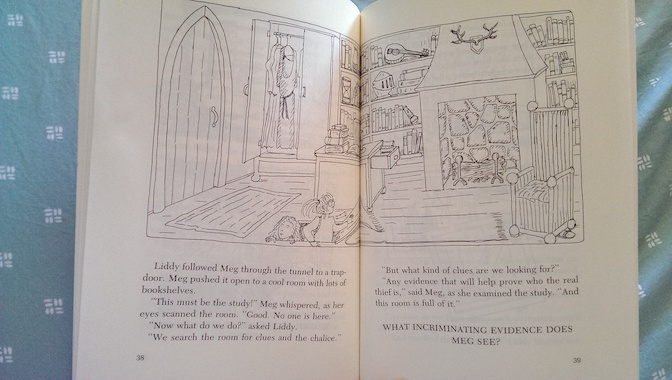
I love this series because the books are interactive, giving readers the opportunity to figure out the clues and solve the mystery along with Meg. As Meg interviews the other actors in the castle and explores every room, readers are invited to study the pictures and consider the evidence to see if they can solve the mystery before Meg can.  At various points in the story, there are questions for the reader to consider, giving them the chance to pause and see if they’ve noticed what Meg has seen. I recommend that adults who are introducing children to the mystery genre read a couple of these stories along with them and discuss the clues as they go, helping children to learn how to notice details, solve puzzles, and think critically. It’s a good learning opportunity as well as a fun mystery!

Midnight Magic

midnightmagicMidnight Magic by Avi, 1999.

The story takes place in Italy, toward the end of the Middle Ages.  Mangus, a formerly wealthy scholar and philosopher, is living under house arrest because the king believes that he has practiced black magic. Mangus was merely performing magic tricks to earn extra money, and in fact, does not believe in real magic.  However, the king is very superstitious and easily influenced by his scheming advisor, Count Scarazoni, who needed a scapegoat to distract everyone from his schemes.  Unfortunately, many people in the kingdom of Pergamontio believe that Mangus is a real magician with frightful powers.  Even Fabrizio, an orphan who is Mangus’s only remaining servant, believes that magic really exists.

When a messenger arrives, summoning Mangus to the castle to see the king, they are afraid that the king has reconsidered his decision to spare Mangus’s life. However, it turns out that the king is in need of Mangus’s help. He believes that his young daughter, Princess Teresina, is being tormented by a ghost, and he wants Mangus to use his magic to get rid of it.

Mangus again protests that he does not do real magic, but both the king and Count Scarazoni promise dire consequences if he fails to help them deal with the problem.  Mangus isn’t sure why Count Scarazoni has asked for his help because he knows that the count doesn’t really believe in magic, except perhaps as a way of appeasing the king.  The king promises that if Mangus can free the princess from the influence of the ghost, he will not only end Mangus’s house arrest but reward him with a generous pension.  Mangus has little choice but to agree to do his best, and the promise of the pension for his master convinces Fabrizio to do everything he can to make sure that Mangus succeeds, not only to save his master’s life but to restore his family’s fortunes.

But, what is the secret of the ghost?  Fabrizio believes in ghosts, even though Mangus doesn’t.  Princess Teresina insists that the ghost is real, appealing directly to Fabrizio to convince Mangus that it is. Adding to the mystery is the disappearance of the princess’s brother, Prince Lorenzo, and the murder of the princess’s tutor. Danger lurks in the castle, and conspiracies are around every corner. Could the troubled spirit really belong to the murdered prince?

The book is available to borrow and read for free online through Internet Archive.

My Reaction

I love historical books and spooky mysteries, and this is both! The Italian kingdom where the story takes place is fictional, but it takes its inspiration from real kingdoms of the later Middle Ages and early Renaissance, with Machiavellian intrigue, power struggles, and arranged marriages, even for children, that could influence the balance of power and successions. (There is talk of a potential arranged marriage in the story, but no child marriages actually take place.  If a child is old enough for ghost stories and murder mysteries and isn’t too frightened by them, there is really nothing more concerning than that to prevent them from reading this book.)

Princess Teresina is one of the most intriguing characters in the book.  Although young, she isn’t a shrinking violet or anyone’s fool, and she’s definitely not a tea party and ball gown kind of princess.  Like real life Medieval princesses, she is the product of a family who came to power by the sword and maintains it by the iron fist in the velvet glove and some clever political maneuvering, although some members of the family are more clever about it than others.  Princess Teresina well knows the family she was born into and what’s expected of her as royalty, and she knows to be careful about who she trusts and what the consequences of trusting the wrong people can be.  Although apparently terrified by the ghost, the princess has a kind of toughness and shrewd determination to do what she thinks is necessary.  She seems to be smarter and knows more than most people give her credit, and Fabrizio often wonders just how much she really knows.

One of the best things about the story is that, as soon as you think you know what’s going on, you learn that there is more to the story. There are conspiracies within conspiracies!

Hint: If you like pseudo-ghost stories, spooky stories of the Scooby-Doo variety, where there are logical explanations for the supernatural phenomena … you won’t be disappointed.