Castles by Stephanie Turnbull, illustrated by Colin King, 2003.
This nonfiction picture book for kids is part of the Usborne Beginners series, originally published in Britain. There are other books about castles, knights, and life in the Middle Ages from Usborne, but this book in particular, like others in its series, is a simplified version meant for beginning readers. The book is recommended for ages 4 and up.
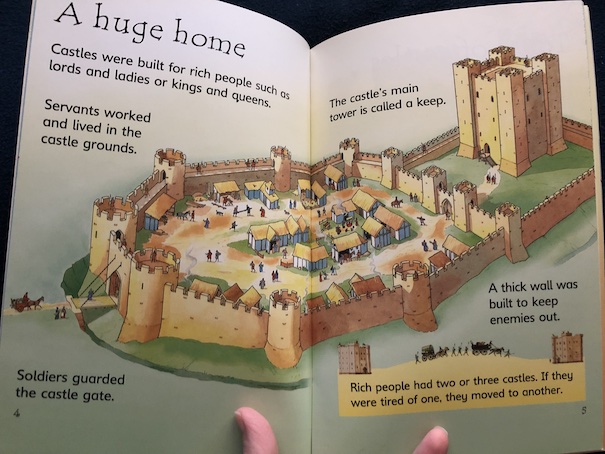
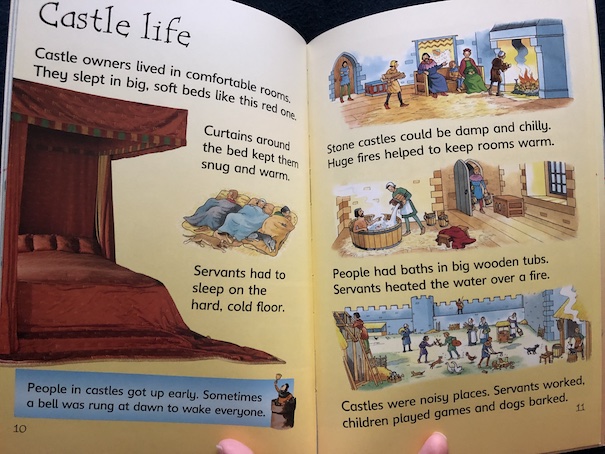
The book explains different types of castles and the parts of a castle. It also offers details about daily life for people who lived in castles, including hunting, food and feasts, and things they would do for fun.
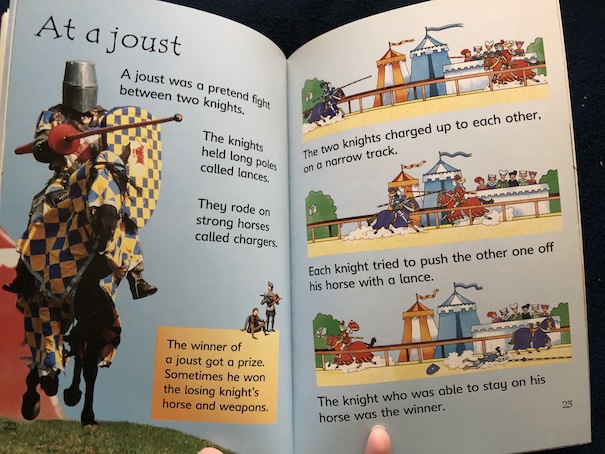
There are also pages about knights, the armor they wore, jousts, and attacking and defending a castle.
The book ends by explaining why castles from the Middle Ages are in ruins today.
In the back of the book, there is a glossary of terms and a link to the Usborne site’s page of quicklinks, which still works and has links to child-friendly informational sites on various topics, organized first by topic and then by related book. Both the book and the website offer Internet safety tips for kids and parents.
The book is available to borrow and read for free online through Internet Archive (multiple copies).
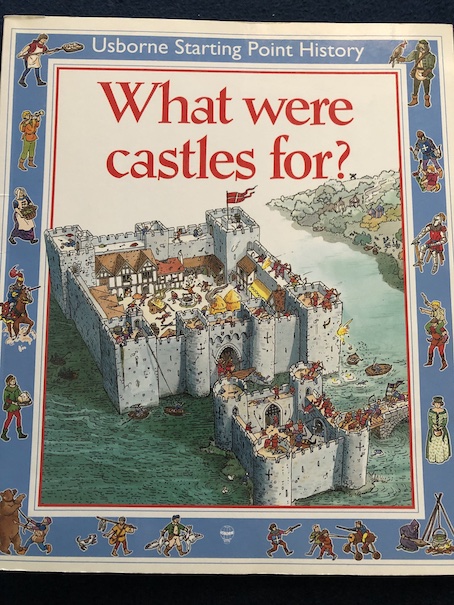
What Were Castles For? by Phil Roxbee Cox, illustrated by Sue Stitt and Annabel Spenceley, 1994.
This nonfiction picture book for kids is part of the Usborne Starting Point History series, originally published in Britain.
I love books about daily life in the past, and this book explains the lives of people who lived in castles during the Middle Ages by answering questions about what castles were for and what people in castles did. Each page of the book is organized around sections answering specific questions.
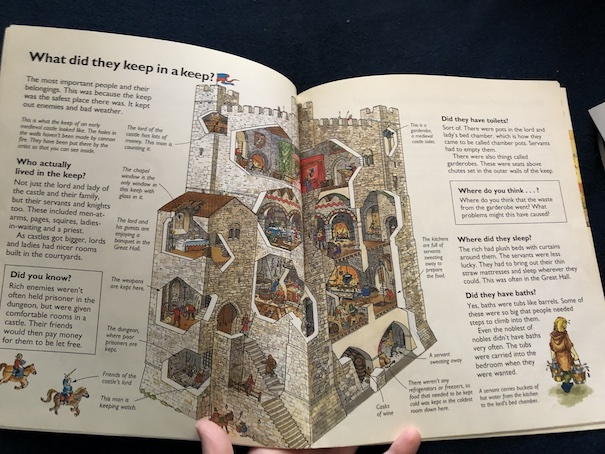
First, the book describes the basic purpose of castles and different types of castles that have existed and how they were built. The, it shows different parts of a castle and what people did in different parts. One of my favorite parts is where they show what is in a castle’s keep, which is where the lord of the castle and his family lived. The book uses cutaway pictures to show what is inside buildings, and the detailed pictures show the different activities of the people.
Among the activities of the nobles who lived in castles, the book explains how they would hunt and hold feasts and jousts.
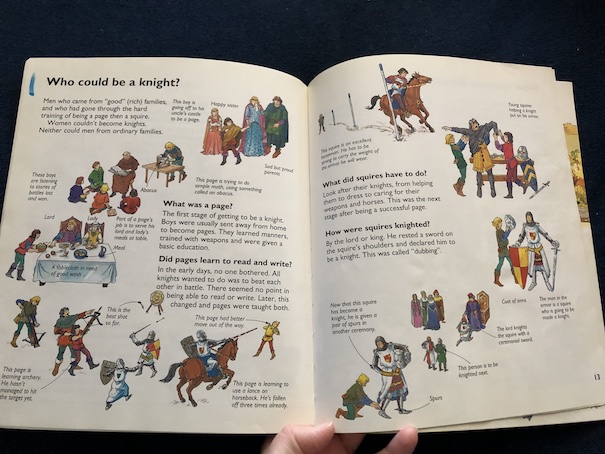
Knights and warfare were central to the purpose of a castle, which was to provide a defensible fortress for the noble families who lived in them and their supporters. The book explains how boys from noble families were raised and educated to be knights. There are also pages showing weapons and the siege of a castle.
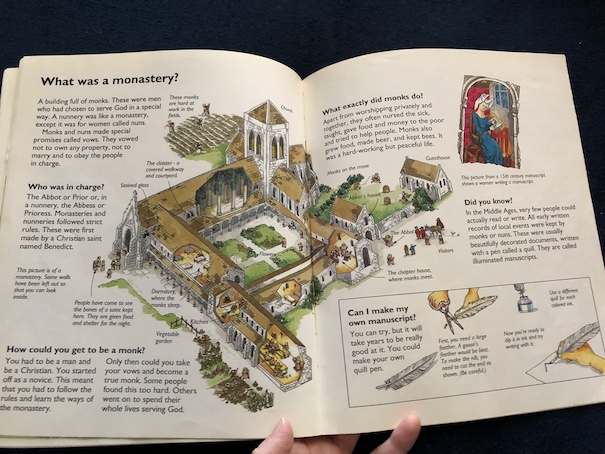
One of the things I liked about this book is that, while it is mainly about castles and the people who lived in them, it also shows how people lived outside of castles in small villages, towns, and monasteries. While castles are iconic of the Middle Ages, seeing how people lived in these other places gives a more expanded view of life in Medieval times.
The pictures really make the book! Every picture from the cutaway castle views to the scenes of villages and towns or jousts and hunts, show many people and small details. There are little descriptions labeling the people and details, most giving extra historical information, but some just for fun so readers can notice humorous details, like the monk being chased by bees at the monastery, the chicken escaping along the castle wall, the sister who is happy that her brother is going off to learn to be a knight, and the page who is learning archery but hasn’t made the target yet (his last failed shot falls short of the target, but it’s labeled as the best he’s done so far).
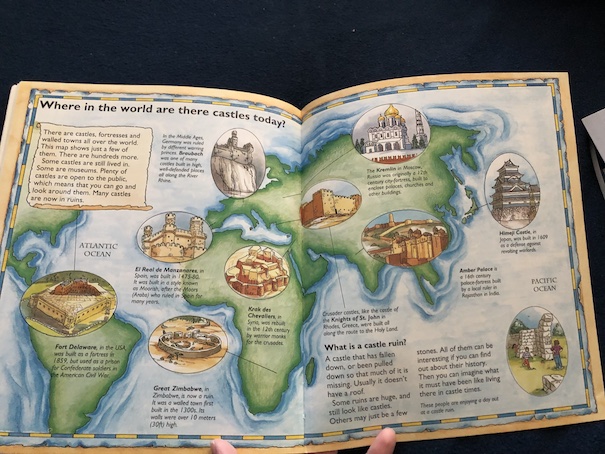
In the back of the book, there is a section with the legend of Richard the Lionheart and his minstrel and a map marked with famous castles around the world.
The book is available to borrow and read for free online through Internet Archive (multiple copies, including one in French).
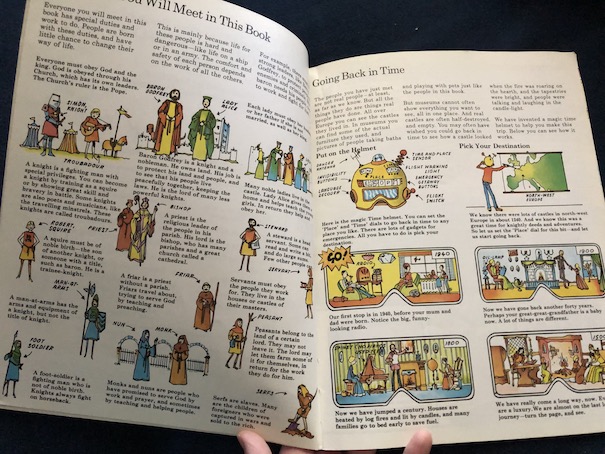
The Usborne Time Traveller Book of Knights and Castles by Judy Hindley, illustrated by Toni Goffe, 1976, 1993.
This nonfiction picture book for kids is part of the Usborne Time Traveller Books series, originally published in Britain.
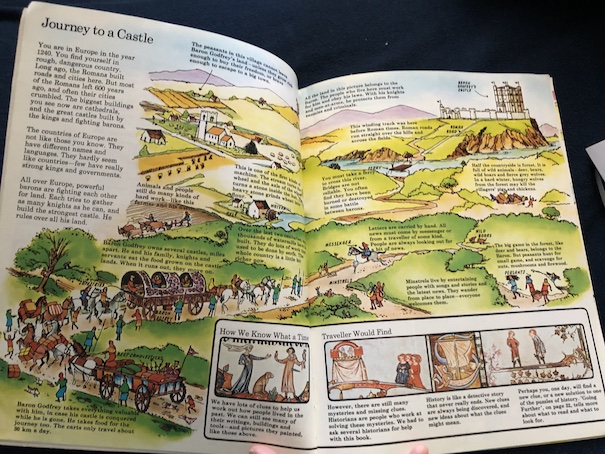
The contents are framed as a time back in time to the Middle Ages, specifically 1240 AD, to see how people would have lived in Medieval times and what castles were like when people actually lived in them. Readers follow a specific set of Medieval characters as they go about their lives.
Our trip back in time begins with a road journey to a castle. Readers see how people in the Middle Ages traveled. The journey page also explains how the Romans built the roads Medieval people used centuries earlier, which is a good historical segue because the period that we call the “Middle Ages” begins with the fall of the Roman Empire and the withdrawal of Roman forces from the furthest parts of its empire. On some pages of the book, there are extra panels at the bottom of the page with additional information, and the first set explains how we know what people would find if they were able to travel back in time to the Middle Ages, explaining how historians have gleaned information from Medieval writings and pictures and from studying physical objects, like buildings and tools.
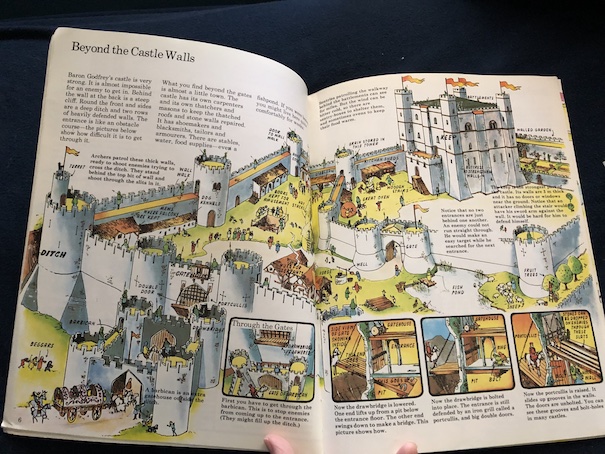
When readers arrive at the castle, the book explains different parts of the castle and how they were used for defense.
I particular like the cutaway pictures of the interior of the keep because I enjoy the details of people’s living quarters and daily life in the past. There is a page that shows the morning routine of the castle and how people would get dressed for the day. There are also pages about hunts, feasts, a visit to a building site, and a trip to town.
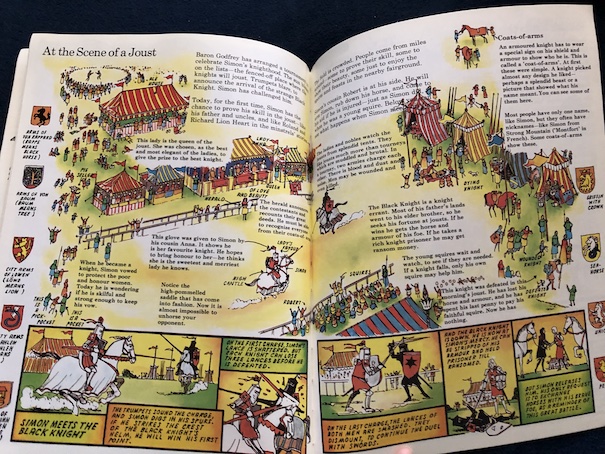
There are a couple pages about knights and how a boy would train to be a knight. There are also pages about jousts, the Crusades, and attacking and defending a castle.
The pictures are cartoon-like, but they are busy and full of details for readers to study, accompanied by notes that offer more information and historical background.
At the end of the book, there is a map showing locations of famous European castles.
The book is available to borrow and read for free online through Internet Archive (multiple copies).
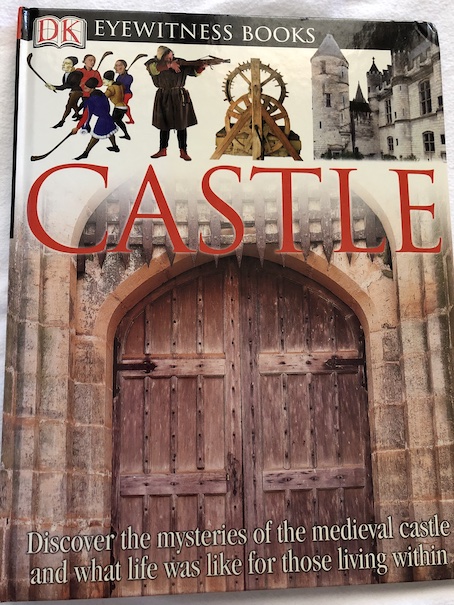
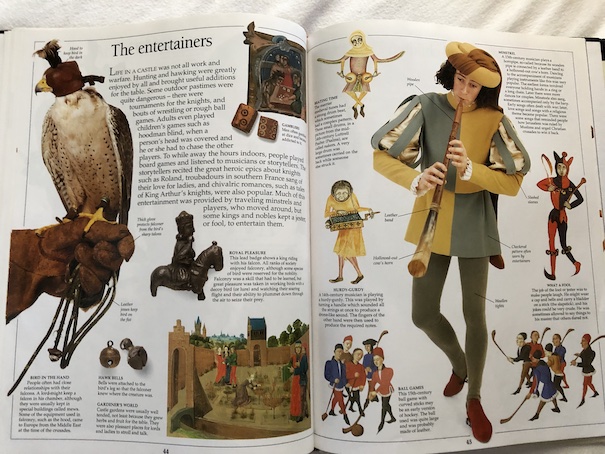
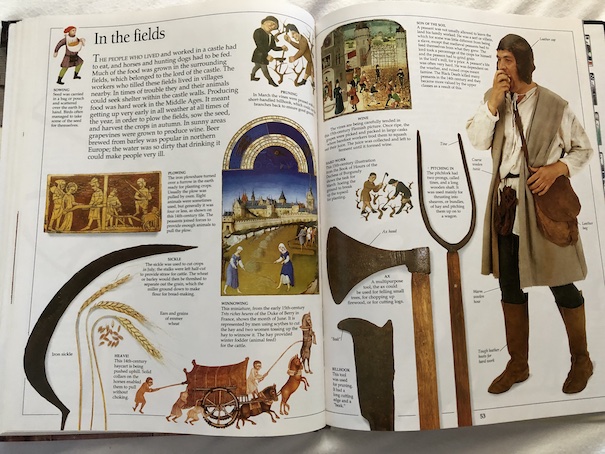
Castle by Christopher Gravett, photographed by Geoff Dann, 1994, 2004.
Eyewitness books are always great for the photographs that they use to illustrate the concepts in the book!
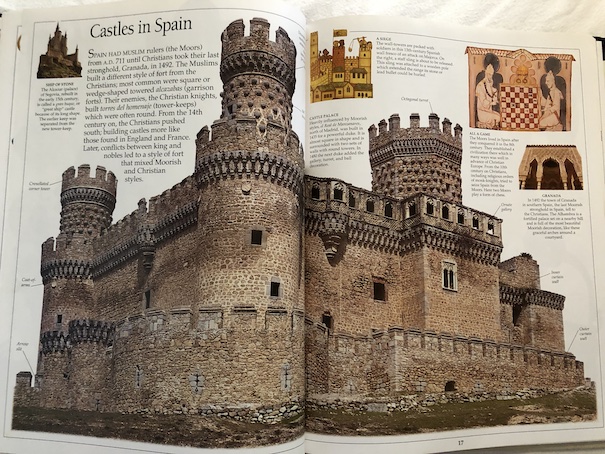
This book is all about Medieval castles. It starts by explaining the evolution of castle-building from early wooden motte-and-bailey castles to the great stone castles that we often think of as being the classic Medieval castle. However, stone castles could come in different shapes and styles, depending on where they were located.
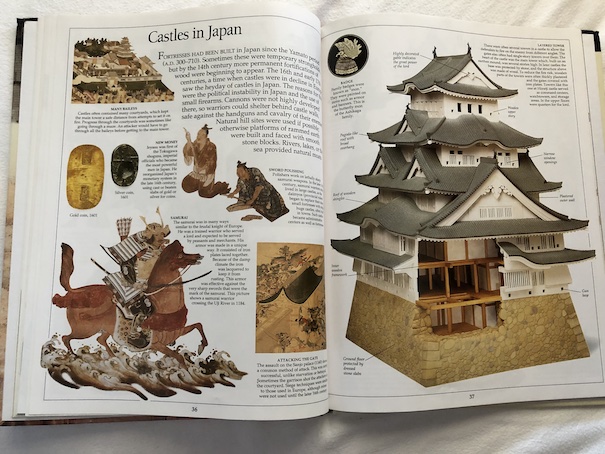
The book shows examples of castles in different countries. Most of the focus of the book is on castles in European countries, including Spain, Germany, and France. However, the book also includes information about castles in Japan.
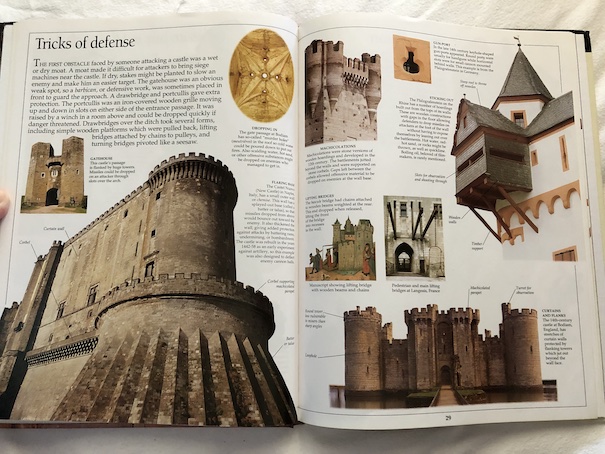
Castles were built for defense, and the book explains the types of defenses that castles would have, such as gatehouses, murder holes, lifting bridges, battlements with corbels and machicolations, and loopholes. It also explains what a siege was like, what types of weapons would have been used, and what knights and soldiers were like.
The parts of the book that I liked best were the parts that described the rooms in a castle and the daily lives of the people in a castle. Among the rooms in a castles were the great hall, kitchen, and chapel. I like how they show the objects that would be found in different rooms and how they would be used.
The book explains the lives of the lord of the castle and women and children who lived there. There is information about the types of foods they would eat in a Medieval castle and the types of games and entertainment they would have enjoyed.
There is also information about other workers in and around the castle, including the castle builders and people who tended the castle’s animals and worked in the agricultural fields around the castle, producing food and textiles for the population.
There are sections in the back of the book with additional facts and information about castles and the people who lived in them and a glossary.
The book is available to borrow and read for free online through Internet Archive (multiple copies).
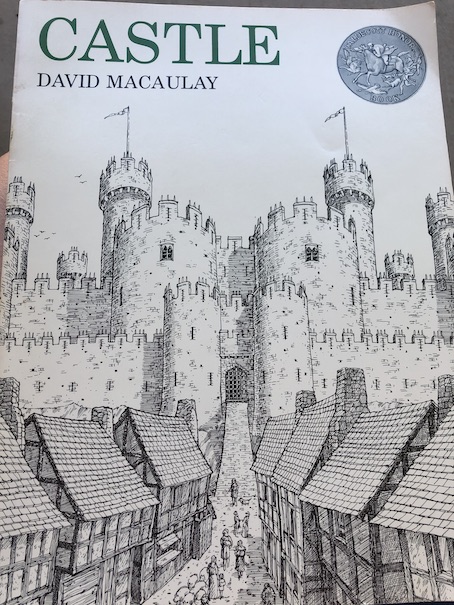
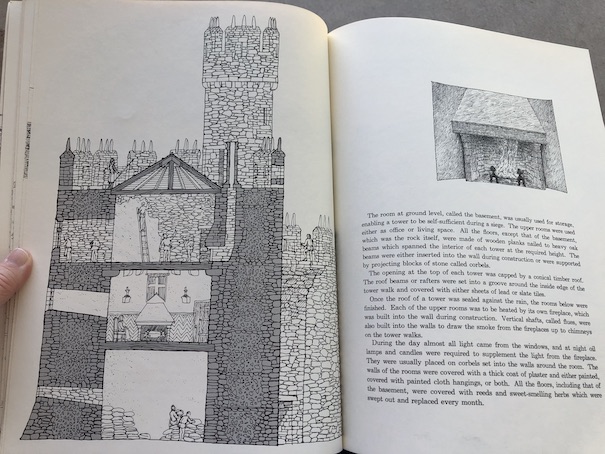
Castle is one of David Macaulay’s books about historical architecture, and like his earlier book, Cathedral, it has detailed and realistic drawings to explain each step in the building process.
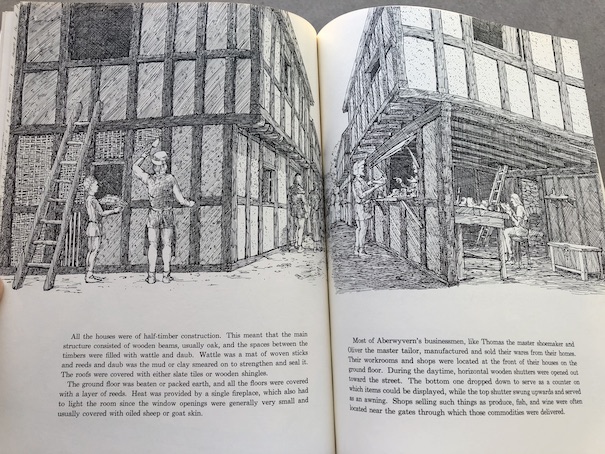
The castle in the story is fictional, but it’s based on real castles built by English lords during the conquest of Wales, circa 1277 to 1305. The process for constructing the castle and the military strategy behind it are historically accurate. The English, under King Edward I, used a strategy of establishing permanent towns and castles in Wales to dominate the Welsh. The construction of these castles and their accompanying towns took years, but it was part of a long-term political and military strategy that actually aimed at avoiding direct armed conflict. The purpose of the castles and towns was not only to support the occupying English forces and settlers, but also to provide economic centers that the Welsh would also find beneficial. The idea was that the Welsh, while initially opposed to the interlopers, would eventually come to rely on the presence of the new towns for business and trade and not want to force the newcomers out. This strategy is in keeping with the nature of castles themselves because they are defensive structures, designed for holding off attackers in order to maintain territorial control, shielding the people within the castle so they cannot be forced out. The fictional castle in the story is built with a fictional town called Aberwyvern and belongs to a fictional nobleman, Lord Kevin.
The beginning of the book explains the military strategy of Edward I and how he appointed noblemen to build castles in Wales. When choosing the site for a castle, they would take into account the natural landscape and its defensive capabilities. For example, Lord Kevin’s castle will be built on a high outcrop on the edge of a river. The high ground and the surrounding water will make the castle harder to attack.
The book shows a plan of the castle that will be built and explains the different craftsmen who will be working on the construction, along with the tools they will use. The book then describes the various stages of construction, beginning with the preparation of the site and the digging of a moat that will separate the section of rocky outcropping where the castle will be built from the land around it, where the town will be located. The moat is important because it provides an extra defensive feature.
My favorite parts explain the living quarters of the castle. People think that castles must have been uncomfortable with bare stone walls, but actually, the walls are only bare in ruined castles that were exposed to the elements over time. When a castle was inhabited, the walls were covered with plaster. The plaster would be painted and/or hung with tapestries for decoration. Reeds and nice-smelling plants would cover the floors as a kind of carpeting, and the plants would be swept out and replaced regularly.
The castle and town take years to finish, and the pictures show how they look at each stage of construction, both in aerial view and up close.
Toward the end of the book, King Edward visits the castle and warns Lord Kevin that there have been some Welsh uprisings. Lord Kevin and his people make sure that they have enough food and supplies to last through a siege, and the following year, the castle’s defenses are put to the test when they do have to withstand a siege.
Eventually, the Welsh attackers are forced to retreat when they are unable to take the castle and they receive word that more English forces are coming.
Over time, the community includes people of Welsh and English descent, living side-by-side, and the town extends beyond the original town walls. The town walls are no longer necessary for defense. By that point, the castle itself is mostly neglected, and people sometimes scavenge stones from it for other buildings.
This book is a Caldecott Honor Book. It is available to borrow and read for free online through Internet Archive (multiple copies). There is also an animated film version of this story, which is available online through Internet Archive.

















 Jestress's Forgotten Books and Stories