Kiki’s Delivery Service

More Americans would probably recognize the title as the title of a Studio Ghibli animated film for children than as a book title, but the book came before the movie, and it is actually the first in a series, which continues the story about Kiki’s life and adventures, although I don’t think the later books in the series have been translated into English (at least, I haven’t found them in English). The original Japanese version of this book was written in 1985, and I read the English translation from 2003.

Kiki is a young witch, and in keeping with the traditions of young witches, she is expected to leave home at age 13 and live for a year in a city with no other witches.  It will be a test of her developing skills and a coming-of-age experience, helping her to recognize her talents and find her place in the world.

When Kiki sets out for her journey with her cat, Jiji, she doesn’t know exactly where she is going to go or what she will find when she gets there. Some young witches know early on what their talents are and how they plan to support themselves during their year away from home, but Kiki is less sure (like so many of us who “don’t know what we want to be when we grow up”).  The term “witch” just refers to a person’s ability to do magic.  It’s not a job title by itself, and witches are expected to develop a specialization, such as brewing potions or telling the future. Kiki’s mother has tried to teach Kiki her trade, growing herbs and making medicines from them, but Kiki hasn’t had much patience with it.  The only major ability Kiki has is flying, which is something that witches are expected to do anyway.  Still, she has an adventurous spirit and is eager to set out and see what life has to offer.
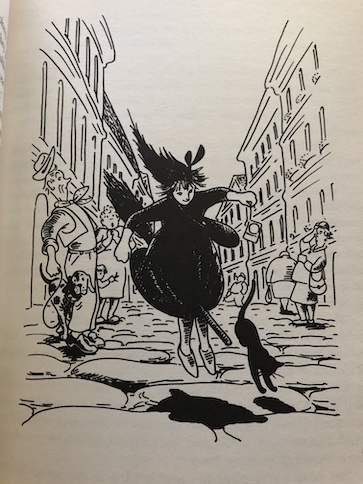
Once Kiki locates a city with no other witches, she has to find a place to stay and a job to earn money. She finds a city by the sea, which seems exciting to her.  As she explores the city, she meets Osono, a woman who owns a bakery with her husband. When she helps deliver a baby’s pacifier to a bakery customer who left it behind, flying to the customer’s house on her on her broom, Osono offers to let her stay in a small apartment attached to the bakery. Kiki feels a little overwhelmed by the big city at first, but she realizes that, in a large city like this, there are probably a lot of people who have small delivery errands that wouldn’t be covered by ordinary parcel delivery services.

Kiki opens a delivery service, delivering small packages and running errands for people around the city.  At first, business is slow, and some people are afraid of her as a witch. During a trip to the beach, a curious boy borrows her broom and breaks it. Kiki is distressed, and the boy apologizes. The boy’s name is Tombo, and he is part of a club of other kids who are interested in flying. He has made a study of flight and had hoped to learn more about how witches fly by trying Kiki’s broom, but Kiki expains that only witches can fly with brooms and that the ability is inherited. Kiki has to make a new broom, and it takes her a while to break it in, but it actually works to her benefit. People who were initially afraid of her for being a witch become less afraid of her and more concerned about her when they see that she is just a young girl, clumsily trying to master a new broom. Kiki gets some additional support and business from people who feel moved to help a struggling young witch. Tombo also makes it up to her and becomes a friend when he helps Kiki to figure out a way to carry a difficult object on her broom.
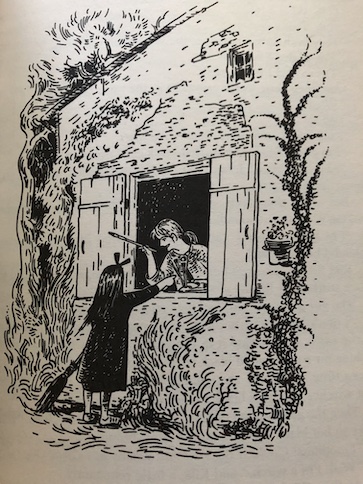
During her very first delivery assignment, Kiki was supposed to carry a toy cat to a boy who was having a birthday, but she accidentally dropped it. When she searched for it, she met a young artist, who was enchanted by Kiki as a young witch and painted a portrait of Kiki with Jiji. When the artist asks Kiki to take the painting to the place where it will be on exhibit, Kiki isn’t sure how to carry it at first. It’s kind of a bulky object to carry on her broom. Remembering that Tombo has made a study of flying, she asks him for help. Tombo ties balloons onto the painting to make it float and tells Kiki that she can now pull the painting along on a leash, as if it were a dog. The idea works, and when people see Kiki pulling a painting of herself along through the sky with balloons tied to it, it acts as advertising, bringing her more business.

Some of Kiki’s new jobs are difficult or awkward, and some customers are more difficult to deal with than others. There are times when Kiki finds herself missing home or trying to remember how her mother did certain things, wishing that she had been better at watching and remembering what her mother did. Still, Kiki learns many new things from her experiences and acquires new skills.

Kiki’s experiences also help her to realize a few things about herself and life in general. Like other girls, Kiki worries about how boys see her. When Tombo makes a comment that he can talk to her when he can’t talk to other girls, Kiki worries that he doesn’t see her as a girl at all. A job delivering a surprise present to a boy from another girl her age helps Kiki to realize that everyone is a little shy and uncertain about romance and even people who act confident feel a little awkward about first relationships.

As her first year away from home comes to an end, Kiki wonders how much she’s really changed over the year. Although she has successfully started a new business and done well living away from her parents, she still experiences a sense of imposter syndrome, where she doesn’t quite feel like she’s really done all of the things she’s done. Her first visit home to her parents reminds her that her new town has really become her new home. She has become a part of the place, and she feels her new business and friends calling her to return.

In 2018, the author, Eiko Kadono, was awarded the Hans Christian Anderson for her contributions to children’s literature.

My Reaction

I think of this story as one of those stories that takes on more meaning the older you get.  Young adults can recognize Kiki’s struggles to make her own way in the world and establish herself in life as ones that we all go through when we start our working lives and gain our first independence.  It can be a scary, uncertain time, when we often wonder if we really know what we’re doing. (Life Spoiler: No, we don’t, but no one else completely does, either, so it’s normal and manageable. Some things just have to be lived to be really understood, and that’s kind of the point of Kiki spending a year on her own, to see something of life and how she can fit into it.) However, it’s also a time of fun and adventure as we try new things, build new confidence, make new friends, and learn new things about ourselves. Like so many of us, Kiki doesn’t always do everything right, but she learns a lot and endears herself to the people of her new town.

The Miyazaki movie captures the feel of the story well, although the plot isn’t completely the same. There are incidents and characters that are different between the book and the movie. Tombo appears in both the book and the movie, but there are other characters who appear in the book who weren’t in the movie. In the book, Kiki makes friends with a girl named Mimi, who is her age, and the two of them discuss crushes on boys and how each of them was a little envious of the other because, while each of them is struggling with their own uncertainties in life, they each thought that the other acted more confident. The movie version developed the character of the young artist more. Kiki also didn’t lose her powers during the book, although that might be a part of one of the other books in the series, since I haven’t had the chance to read the others yet.

The Mystery of the Disappearing Cat

Five Find-Outers

The Mystery of the Disappearing Cat by Enid Blyton, 1944, 1966.

Bets is happy that her brother, Pip, is coming home from boarding school, and he’s bringing his friends to visit. Now that the children are reunited, Bets and the others hope that they will find another mystery to solve! The others ask Bets if anything interesting has happened since they were home last, and she says not very much, although someone has moved into the empty house next door. The new neighbor is Lady Candling, who keeps Siamese cats.

The boy who helps the gardener, Luke, is nice and allows the children to visit and see the cats. Lady Candling says that the Siamese cats are valuable prize-winning cats. She keeps them in a large cage most of the time for safety, but Miss Harmer, the housekeeper, takes one out to show the children. Unfortunately, one boy, Fatty, owns a Scottie dog named Buster, and Buster comes into the garden looking for him. Buster frightens the cat and chases her! The cat claws Buster after he chases her into the bushes, and they manage to get Buster under control, but they have trouble finding the cat. Miss Harmer is upset that her cat is lost, and Bets goes to search for the cat.

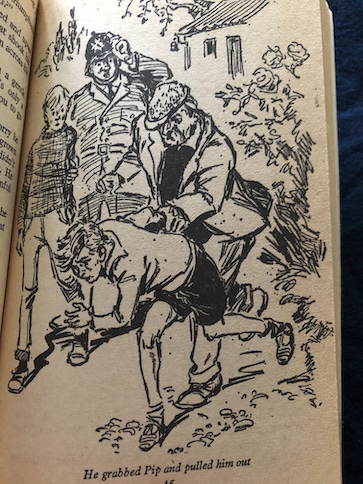
While Bets is looking for the cat, the gardener, Mr. Tupping comes to find out what the fuss is about. Mr. Tupping is a violent and short-tempered man. (They also emphasize that he has a hooked nose, which I think is probably a stereotype. Enid Blyton’s books often contain derogatory racial stereotypes, although later printings have been revised to remove them.) Mr. Tupping hates children and animals, and he grabs Buster and locks him up, threatening to beat him later. The children try to help Buster, but he chases them out of the garden. Bets is left behind, but she locates the missing cat, and Luke helps to free Buster and get Bets out of the garden without Mr. Tupping seeing her. However, Mr. Tupping threatens Luke with dire consequences if he ever lets the children into the garden again.

This is just the beginning of their troubles with Mr. Tupping. When Mr. Tupping finds out that Bets has visited Luke again, he storms into Bets’s own little garden, rips her strawberry plants out of the ground, burns them, and yells at her. Bets is afraid to report him to the adults because she’s afraid that Luke will get in more trouble with Mr. Tupping. Luke is a poor orphan who lives with his stepfather, and he desperately needs the job, which is the only reason why he continues to work with the nasty Mr. Tupping. Mr. Tupping is also friends with the local policeman, and the children know that the local policeman resents them for solving a mystery before he did, so they’re sure that he will side with Mr. Tupping, no matter what they say about him.

Then, Lady Candling’s prize cat, Dark Queen, disappears, and Luke is blamed for stealing her! The children are sure that Luke is being framed for the cat-napping, but the evidence is against him. Pip and Bets’s own mother saw the cat in its cage when she went to tea with Lady Candling, and Luke was working in a garden bed nearby. Even Luke says that no one else went near the cage between then and the time when the cat disappeared. When a wooden whistle Luke made is found in the cats’ cage, the children are sure that it was planted to frame Luke, but how can they prove it? Then, the cat reappears, and later disappears again! What is going on?

The book is available to borrow and read for free online through Internet Archive (multiple copies).

My Reaction and Spoilers

I found this story frustrating because all of the adults in the story are so oblivious to Mr. Tupping’s violence and aggression. He is actively abusive to the children and animals, but nobody seems to notice or even inquire about signs of trouble. Bets’s mother never seems to notice that all of her daughter’s strawberry plants have suddenly disappeared from her garden and never asks her daughter what happened. Mr. Tupping is able to just march onto the family’s property and abuse an 8-year-old girl with complete impunity, and her mother never notices a thing. (Of course, if I were the girl in question, I would have done what I used to do when I was picked on as a kid – take a deep breath, throw back my head, and scream continuously until help arrives. I figured out at a young age that if you scream from your diaphragm, you can get extra volume and keep the scream going for longer without straining your throat, and it’s difficult for the adults to ignore. You can’t scream like that at every inconvenience or people will start to ignore it, but it’s definitely an attention-getter if you use it when it really counts! Just let Mr. Tupping explain his presence and actions when the adults come to find out why their daughter is screaming like she’s being murdered!)

Mr. Tupping is a very obvious villain. He’s also the first person on the scene each time the cat disappears, the one who strategically assigns Luke to work near the cats’ cages just before the prize cat disappears each time, and the keeper of the key to the cats’ cages when Miss Harmer is away, which she is each time the prize cat disappears. Yet, even though he has means (the key), motive (he hates the kids and animals and wants to get rid of Luke), and opportunity (always the first person in the cats’ cages whenever the cat disappears and the one person who controls where Luke is working), all of the adults immediately look at Luke as the thief, never even questioning Mr. Tupping. An adult would be more likely than a kid to know where to sell a prize-winning cat (heck, as a an adult, I wouldn’t even know where to deal in black market animals), but nope, all of the adults first think a kid did it, like kids have those kinds of criminal connections to the prize cat black market. It drove me completely crazy!
It’s worse because Mr. Tupping is friends with the local policeman and gets favoritism because of it. When the kids consult their friend who is a police inspector, he finds out that Mr. Tupping has a police record for being involved in a dog-napping case (surprise, surprise), which establishes his criminal history and connections to people who deal in stolen animals. I was disgusted that the local policeman never looked into his background himself, but I felt a little better when the inspector reprimands him for making friends with a criminal and overlooking evidence that implicated him and trying to prevent the children from bringing evidence and concerns to light. The local policeman is embarrassed, but at that point, I felt like he deserved to be.

The villain was obvious, but what saved this mystery was that he actually used a clever trick to confuse the time when he actually took the cat. I knew from the beginning who the cat thief was, so the real mystery for me was how he got the cat out of its cage without people seeing him. It turns out that Mr. Tupping takes the cat earlier in the day than everyone thought the cat was stolen. The Siamese cats look very much alike, but the one that was stolen had a marking that was different from the others. With a bit of paint, Mr. Tupping makes a different cat look like the missing one for most of the afternoon, quickly using a bit of turpentine to remove the paint at a strategic moment to make it seem like the cat disappeared at a time when Luke was near the cats’ cages.

Patty Paints a Picture

Patty Paints a Picture by Laura Bannon, 1946.

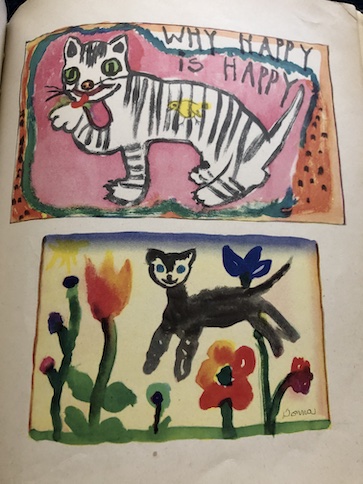
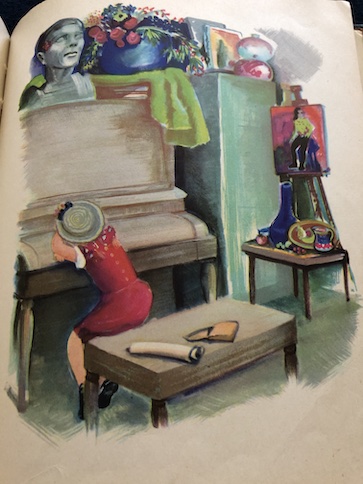
Patty wants to paint a picture of her kitten, Happy, to hang in her room. However, she has trouble creating a painting that truly satisfies her. Her first attempt doesn’t really look like her kitten. Patty is taking an art class at a local museum, and her mother suggests that she take her picture of Happy to her teacher and ask her how to make it better. Through Patty’s efforts to paint a realistic picture of her kitten, she comes to learn more about art.

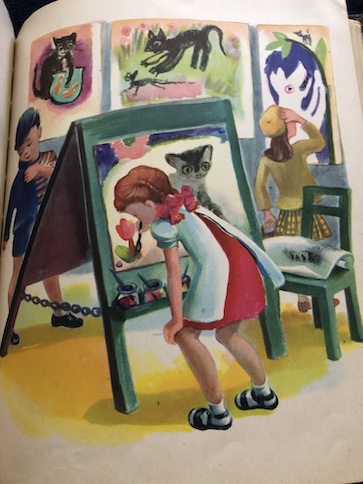
Patty’s teacher suggests that Patty actually bring her kitten to class so that everyone can observe and paint him. When Patty takes her kitten to her art class, the whole class looks at Happy, pointing out parts of the the cat, like his whiskers and his little padded feet with retractable claws. Every part of Happy, including the shape of his eyes and his powerful back legs that are good for jumping, is suited to making him a good hunter because cats often hunt for their food. Studying the form of the cat helps the children understand how to draw him.

The fun part of the book is when Patty studies all of the different ways her friends in class draw the kitten, seeing how everyone looks at the kitten differently and uses different art styles, some drawn better than others because all the artists are children. The children’s pictures in the book look like pictures that would be painted by real children.

The children in the art class paint the cat in different ways and different imagined settings, indoors and outdoors, depending on their interests and how they see the cat and his personality. The boy who drew Happy in a cartoon style, with a bird in his stomach and a caption, wants to be a cartoonist, which is why his style was a good choice for his painting. Patty, on the other hand, wants her painting to be realistic for the way she sees her kitten.

The book explains how Patty learns new art techniques to make her painting look more realistic. She studies the lines that people use in their paintings and compares them to her cat, seeing that curved lines for the cat’s body make him look more realistic. Patty’s teacher points out that one of the mistakes that she’s made in her first efforts is giving Happy a body more the size of an adult cat than a kitten. A kitten’s body looks smaller when compared to the size of the head. To make her picture more realistic, Patty has to learn to draw her kitten’s body parts and features in the right proportions. Patty also notices that the edges of another girl’s cat painting look fuzzy because she’s painting in watercolor and the edges of her painting are wet and running. Patty likes the fuzziness of that painting, so she decides to use that technique on purpose to make more realistic, fuzzy fur. Her teacher shows her how to use that technique with more control by putting a wet blotter under her paper. I like how the book describes Patty’s observations of both her kitten and other people’s pictures and how she uses them to improve her own painting.

At one point in the story, Happy disappears from the art class, and Patty is afraid that she’s lost her kitten forever. Fortunately, she finds Happy hiding in the art room, taking a nap, and he is fine.

In the end, Patty produces a painting that satisfies her because it really looks like her kitten, the way she sees him.

This is one of those vintage children’s books that I would like to see in print again! It’s a nice story, and I really liked the way the book examines the different ways that people look at art and the styles they use. There’s no wrong way to paint something, but the book explains how learning different techniques can help artists to express themselves and their vision the way they want. Patty knows when she’s doing well at her painting when the picture she paints looks more like the vision she has of her kitten.

You can read this book online in your browser through the HathiTrust Digital Library.

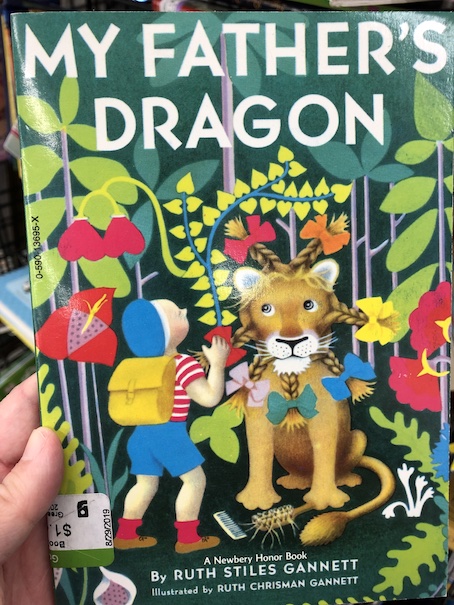
My Father’s Dragon

My Father’s Dragon by Ruth Stiles Gannett, illustrated by Ruth Chrisman Gannett, 1948.

This is a fantasy book where the author tells a story about her father’s adventures rescuing a dragon when he was a boy.

It all starts when the boy, Elmer Elevator, brings home an alley cat that he found. However, his mother doesn’t like the cat and doesn’t want Elmer to keep her. When he tries to feed the cat secretly, she throws the cat out and punishes Elmer. The boy and the cat take a walk in the park together, and the boy confides his wish to learn how to fly airplanes when he grows up. The cat says that he doesn’t have to wait until he grows up to learn how to fly.

The cat explains that she has traveled a great deal, and not too long ago, she visited the Wild Island, which is inhabited by wild animals. The island is divided in half by a river inhabited by crocodiles. Normally, the animals have to take the long way to get around the river to avoid being eaten by the crocodiles, but a few months before the cat visited the island, a baby dragon fell of his cloud and landed next to the river with an injured wing. The other animals on the island captured the poor baby dragon, and when his wing healed well enough for him to fly, they started forcing him to carry passengers and cargo over the river. They work the poor baby dragon too hard and mistreat him. The cat made friends with the little dragon and wanted to help him but didn’t know how because she couldn’t untie the rope that holds the dragon prisoner. The cat suggests to Elmer that the dragon would probably be happy to give him a ride if he helps to free him, and Elmer decides to do just that. Besides, he’s angry with his mother for mistreating the cat and doesn’t mind leaving home for awhile.

The cat decides that she’s too old to travel, so she stays behind, but she helps Elmer to prepare for the trip. Elmer stows away on a ship to the nearby Island of Tangerina and gets to the Wild Island by climbing over the rocks between them. When he reaches the Wild Island, he decides to look for and follow the river, but he has to be careful of the animals on the island.

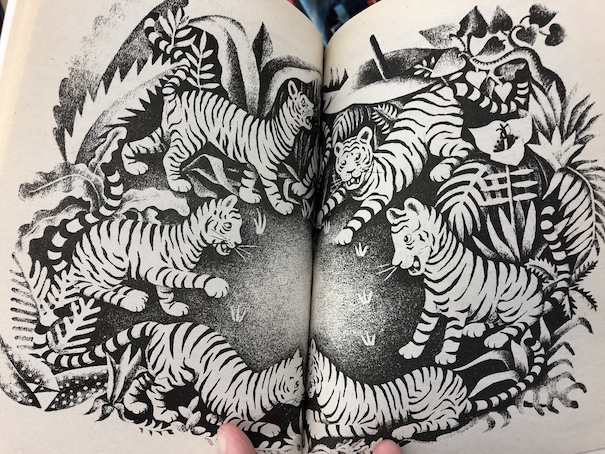
Elmer is found by some tigers who say that they’re hungry and curious to know what little boys taste like. However, remembering some of the cat’s advice, he offers the tigers some chewing gum because (apparently) tigers love it. He also tells them that it’s special chewing gum that will change colors when they chew it, and then, they’ll be able to plant it in the ground to grow more chewing gum. The tigers fall for it and forget about Elmer, who sneaks away.

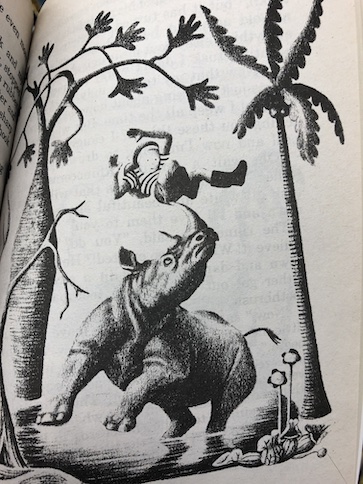
Elmer also has a dangerous encounter with a rhinoceros after he drinks from his “weeping pool.” The rhino wants to toss Elmer into his pool to drown him, but Elmer asks him what he has to weep about. The rhino says that he’s upset that his tusk is no longer as white and pretty as it used to be, and Elmer gives the rhino his toothbrush and toothpaste. The rhino lets Elmer go and begins using the toothbrush to clean his tusk, but by now, the boars have realized that there is someone on the island who doesn’t belong.

Elmer continues onward, helping a lion with a messy mane and a gorilla with fleas and befriending the crocodiles by offering them all lollipops, until he finally finds the dragon and rescues him. They fly away from the island together, but it’s not the end of their adventures.

There’s a reason why the author and illustrator’s names are very similar but not identical. If you read their short biographies, they explain that the illustrator was the stepmother of the author.

This book is a Newbery Honor Book, and it’s also the first in a trilogy about Elmer and the dragon and their adventures together. It’s available to borrow and read for free online through Internet Archive (multiple copies).

Peter and the Wolf

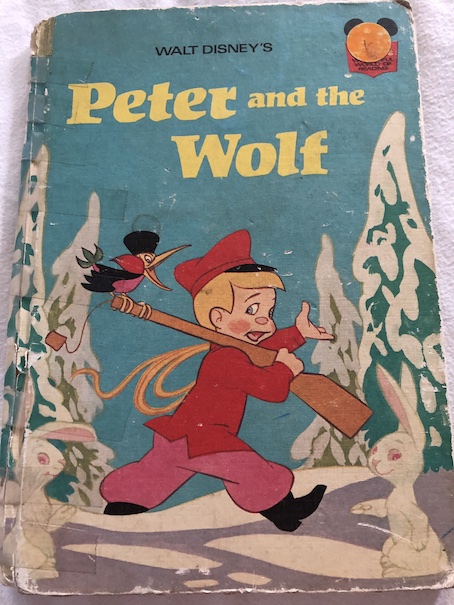
Peter and the Wolf by Walt Disney Productions, 1974.

This is the picture book version of Disney’s cartoon from 1946 based on Peter and the Wolf, which was originally a musical symphony for children, written by Sergei Prokofiev in 1936 for the Central Children’s Theatre in Moscow.

Young Peter lives with his grandfather near a forest in Russia. Peter’s grandfather warns him to stay away from the forest because there are hungry wolves there, but Peter thinks that he can catch a wolf himself. One day, while his grandfather is asleep, Peter sneaks out of the house to go catch a wolf.

Along the way, Peter’s friend, Sasha the bird, also warns him that there really are dangerous wolves in the woods and that he can’t hope to catch one with his toy gun. Peter insists that he’s going to try anyway, and Sasha says he’ll go along and help.

As they venture further, they are also joined by Sonia the duck. Ivan the cat tries to eat Sasha, but Peter makes him let Sasha go. Then, suddenly, a wolf appears!

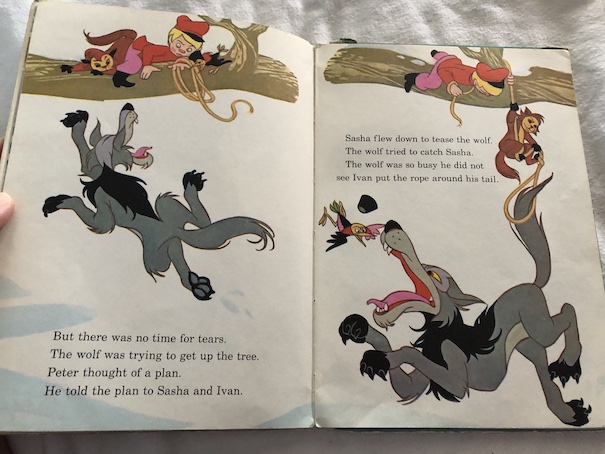
The wolf chases Sonia, and at first, the others think he actually caught and ate her. They manage to catch the wolf by the tail. Sasha attracts some help from some passing hunters.

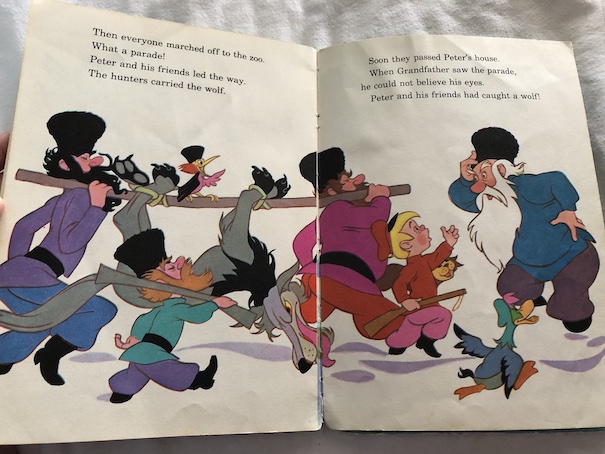
At first, the hunters want to shoot the wolf, but Peter asks them to take the wolf to the zoo instead, realizing that the wolf was just hungry. It tuns out that Sonia is safe after all, and they all take the wolf to show Peter’s grandfather.

The book is available to borrow and read for free online through Internet Archive (multiple copies).

The Cat Next Door

Magic Charm Books

The Cat Next Door by Elizabeth Koda-Callan, 1993.

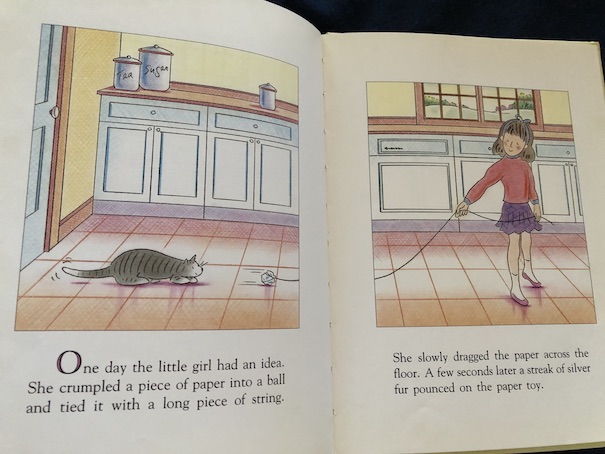
A little girl (unnamed, like the other girls in this series) really wants a kitten of her own. However, the girl’s mother won’t give her a kitten because she doesn’t think that the girl is responsible enough to care for one. In the past, the girl has had a hamster and a gerbil, and she left most of the animals’ care to her mother.

Soon, the girl gets a chance to prove that she can be more responsible. The woman next door is going away for a week, and she needs someone to look after her cat, Clover. The girl says that she would like to take care of Clover. Besides playing with Clover, the girl would have to feed her, change her water, and clean her litter box, but the girl says that she is willing to do it.

The girl loves Clover, but Clover is very shy around her at first. It takes time and patience for the girl to make friends with her and to take care of her. Once the cat gets used to the girl, the two of them have fun together.

When the neighbor returns from her trip, she is pleased that the girl took good care of her cat and gives her a silver cat charm as a memento. The girl misses Clover, now that she no longer needs to take care of her and still wishes for a cat of her own. Her wish is fulfilled when Clover has kittens, and the neighbor gives one to the girl.

All of the books in this series originally came with charms like the ones described in the stories. This book originally included a little silver cat charm for the reader to wear. The hole in the cover of the book was where the charm was displayed when the book was new. The books in the series often focus on the unnamed main character (who could represent any girl reading this story – the books were aimed at young girls) developing new self confidence, and the charms were meant to be either a sign of their new self confidence or inspiration for developing it. In this case, the charm is a reminder of the girl’s experience with the neighbor’s cat, which taught her what she needed to know to take care of a pet of her own.

The book is available to borrow for free online through Internet Archive.

The Enchanted Forest

The Enchanted Forest by La Comtesse de Segur, translated by Beatrice Schenk de Regniers, 1856, 1974.

This is an English translation and retelling of one of La Comtesse’s stories.  I can’t read French, and I’ve never read the original version of the story, but the translator, Beatrice Schenk de Regniers, had a note in the book that she altered the story slightly from its original version.

King Goodheart has a lovely little daughter named Goldenhair, who he loves very much.  Unfortunately, his wife dies, and his people urge him to remarry.  His new wife, Queen Meanette, is as mean as her name sounds, and she does not like Goldenhair at all.  The King, realizing this, does his best to keep her away from his daughter and puts his daughter in the care of some trusted servants. 

Meanette, still jealous of the love and attention the King gives Goldenhair, plots to get rid of her.  One of the princess’s attendants is a boy who takes her out in her little carriage in the garden every day.  The boy is greedy for sweets, and the queen bribes him into tricking the princess into going into the enchanted forest.  People who go into the forest have been known to disappear forever.  When the princess becomes lost in the forest, she is befriended by a cat who takes her to a palace where he lives with a doe.  They are very kind to her, but Goldenhair still longs for a way to return home.

One day, while Goldenhair is living with the cat and the doe in their palace, a parrot comes and claims that he knows a way that the princess can return home.  He insists that she leave the palace, against the doe’s wishes, and pick a single rose that grows in the forest.  What the girl doesn’t know is that the parrot is an evil wizard in disguise.  When the girl picks the rose, the doe’s palace is destroyed, and the evil wizard reveals himself. 

Thinking that she has killed her friends, Goldenhair wanders, lonely and miserable, through the forest.  Then, a large tortoise comes and tells her that her friends are still alive and that she can find out what happened to them if she’s willing to take a long journey on the tortoise’s back without saying a single word the whole time.  Goldenhair does so and arrives at a fine palace where she learns that the doe was really Fairy Kindheart and the cat was really her son, Prince Charming.  They had been turned into animals by the evil wizard, and they had been freed when the princess picked the rose.  However, the princess had then fallen under the spell of the evil wizard, and the other trials were necessary to free her.  Fairy Kindheart takes the princess home to her father, who is overjoyed to see her.  The King marries Fairy Kindheart, and Goldenhair marries Prince Charming, and they all live happily ever after.

The book is currently available online through Internet Archive.

My Reaction and Further Information

The life of La Comtesse de Segur, the original author of this story, is almost like a fairy tale itself. Her first name was Sophie, and she was born in 1799 in Russia.  Her father was a Russian Count, and she grew up with her seven siblings on his vast estate.  However, even though her family was wealthy, her mother believed that children shouldn’t have life easy.  Sophie and her brothers and sisters had to sleep on small, hard beds and were never given much food to eat or any sweets.  When she was 18, Sophie went to live in France, and she married a French Count named Eugene de Segur.  It was not a particularly happy marriage, but she had four daughters and four sons and many grandchildren.  She wrote stories for them and became the most popular children’s writer of her time in France.  She died in 1874, but her stories are still popular with children in France.

I found the story of La Comtess’s life even more interesting than the story in the book, although the story in the book isn’t bad. It seems like a pretty obvious variation on the story of Snow White, but it is a charming story.

Cam Jansen and the Mystery of the UFO

CJUFO

Cam Jansen and the Mystery of the UFO by David A. Adler, 1980.

Cam Jansen‘s friend, Eric, wants to enter a photography contest.  All of the pictures for the contest must be taken in black-and-white, have to be “of local interest”, and must be completely natural, not posed.  As Cam and Eric look for things to photograph, Cam spots a kitten trapped in a tree.  Eric takes a picture of her rescuing the kitten.

Then, they see a bunch of people standing around, pointing at some strange, multi-colored lights in the sky.  A local newscaster even shows up to cover the mysterious lights and talk about UFOs.

Cam and Eric decide to investigate the area where it look like the UFOs landed.  When they get there, they spot some strange creatures with silvery skin and pointed heads!  However, it soon becomes obvious that these “aliens” aren’t what they appear to be.  They speak English, are called “Cindy” and “Steven”, and are actually covered in aluminum foil.  But, why are they playing alien, and what are the UFOs really about?

Cam decides to keep the cat that she rescued and names her Neptune.  When the true purpose behind the aliens’ hoax is revealed, Neptune helps to foil their plans.


Nate the Great and the Halloween Hunt

NateHalloweenHunt

Nate the Great and the Halloween Hunt by Marjorie Weinman Sharmat, 1989.

Nate the Great gets a Halloween case when Rosamond asks him to help her find one of her cats.  Rosamond and Annie show up at Nate’s house, trick-or-treating.  They’re both dressed as Little Red Riding Hood, and Annie’s dog, Fang, is the wolf/grandmother.

Rosamond has several cats, all named “Hex”: Big Hex, Plain Hex, Super Hex, etc.  But, she’s worried because she can’t find Little Hex.  Every Halloween, her other cats like to go to an old house in the neighborhood that is supposedly haunted in order to help haunt it, but Little Hex is afraid on Halloween and apparently hid somewhere.  Nate thinks that Little Hex will probably come out as soon as Halloween is over, but Rosamond is so worried that he agrees to look for Little Hex anyway.

NateHalloweenHuntTrickOrTreat

Nate interviews kids in the neighborhood to see if they’ve seen Little Hex, but they haven’t.  Then, he and his dog, Sludge, go to the haunted house to look around.  He sees Rosamond’s other cats, but not Little Hex.  There’s a scary moment when he realizes that he’s locked in the house, but Sludge helps him to escape.

Little Hex isn’t as far away or lost as Rosamond thinks, and Nate realizes that both Sludge and Rosamond herself have given him the clues he needs to solve the mystery.  Sludge demonstrates what an animal might do when it’s frightened, and Nate suddenly realizes why Rosamund’s treat basket was so much heavier than Annie’s even though they had been to the same houses.

The book is available to borrow and read for free online through Internet Archive.

The Case of the Muttering Mummy

MutteringMummy

The Case of the Muttering Mummy by E.W. Hildick, 1986.

Joey Rockaway needs to buy a special present for his mother’s birthday. Having broken his mother’s china cat ornament recently, he has decided that he will buy one of the replicas of a golden cat statue from Egypt at the Egyptian exhibit at the local museum. The other members of the McGurk Organization come to the museum with him, and McGurk uses this as an opportunity to give them a kind of memory test about objects in the exhibit.

Actually, everything in the exhibit is a replica, not just the items sold in the museum gift shop. Justin Matravers, a wealthy man who has recently died, collected Egyptian artifacts, but part of his will specified that the collection should never be put on public display. However, his widow, who wanted to show off the collection, had replicas made of everything in the collection so that she could have those put on display.

MutteringMummyCase

McGurk sneers about how everything in the exhibit is fake, although he is actually surprisingly superstitious. The museum always did have a real mummy case on display. They always said that the mummy case was empty, but some of the more superstitious kids, like McGurk, believe that there is a mummy inside the case and that there is a curse on it. McGurk has nicknamed the mummy Melvin. The other kids aren’t afraid of Melvin or Egyptian curses, and while they are looking around the Egyptian exhibit, Mari plays a joke by using her ventriloquist skills to make the mummy case “talk.” This trick sets off a bizarre mystery for the McGurk Organization.

A scholar and author, Harrison Keech, is sketching the replicas at the exhibit and witnesses Mari’s trick and Joey picking out the replica cat for his mother. After he asks Joey if he can take a look at the cat, Keech suddenly becomes very upset, saying that the cat statue is cursed! He says that Mari’s joke has angered the spirit of the mummy and awakened the spirit of Bastet. The mummy was a follower of Bastet, the Egyptian cat goddess, and it will now be drawn to the statue if they remove it from the museum. Mari tells Joey that she can tell from Keech’s voice that he’s making up the whole story and that he shouldn’t let that stop him from buying the cat.

MutteringMummyNight

However, strange things start happening after Joey buys the cat. It seems like someone is following him home, a dark, shadowy figure. Joey thinks it might even be the mummy, come back to life! The others are skeptical, and McGurk arranges a kind of test where Joey brings the statue with him to a meeting of the organization. Sure enough, a strange figure lurks outside their meeting, and they hear strange whispers in a foreign language!

The spookiness doesn’t last for long. It turns out that Mari, as well as being a ventriloquist, has some skill with different languages and recognizes what the “mummy” says as being Greek, not Egyptian, and the phrases as being typical things that someone might say in a restaurant. When the kids find a scrap of bandage outside, they are quick to notice that it’s a modern, elasticized bandage, like the kind you can get at any pharmacy.

So, the question becomes who is playing at being a mummy and why? Is it Keech, wanting to make the kids think that the mummy story he told them is real, and if so, what would he have to gain from it? The only other two people who know about the story are Joanne, who works at the museum, and Donny, her fiancé, who is jealous of the attention she’s been paying to Keech when he comes to the exhibit.

MutteringMummyLies

I have some complaints about this book that hadn’t occurred to me when I read it as a kid. At one point, Donny, who is described as being a social worker, comes to visit the kids because he wants to hire the organization to check up on Keech and his relationship with Joanne. Donny is very jealous, and when he explains how Joanne seems to be falling for all of Keech’s crazy mummy stories, he suddenly turns to Wanda and Mari and says, “You women, you’ll believe anything when a smarmy two-bit jackass like that starts shooting his mouth off!” That’s just really inappropriate for an adult to say to kids, and the whole situation is weird on several levels. First of all, Donny is an adult, and if he’s having issues with his love life, especially with the woman he thinks he wants to spend the rest of his life with, the last thing he should do is hire kids (even really smart ones) to handle the issues for him. Second, Wanda and Mari are young girls, not “women,” and what little girls believe is no business of Donny’s. Trying to imply that Wanda and Mari might someday fall for a “jackass” is not only insulting but implies that Donny is thinking about Wanda and Mari in terms that no grown man should be thinking about girls their ages. I find it disturbing that Donny is apparently a social worker, a person in a position of trust who is supposed to help people in difficult situations to manage their lives, and he’s acting like this. Also, toward the end of the book when the bad guy (I won’t say who it is here, although I thought that the answer was pretty obvious even early in the story) is making his escape, he shoves Joanne aside and calls her a “slut.” That’s pretty strong language for a kid’s book of this level. None of this occurred to me when I was a kid, so maybe other kids reading this wouldn’t notice, but I thought that I’d mention it because these things bother me now.

At one point, Brains gives a demonstration of using water displacement to determine the volume of irregularly-shaped objects, explaining how Archimedes discovered the principal (although I’m not sure that Archimedes’ Principal was quite as he explains it), as the kids investigate what makes Joey’s cat statue so special. You might be able to guess what it is. It seemed pretty obvious to me. The one thing that seemed the most puzzling was how it was done. Mari also offers an interesting explanation of the different kinds of lies that people tell and their motives for doing so.

The book is currently available online through Internet Archive.