The Mysterious Christmas Shell

Tom and Jennifer are visiting their grandmother and their Aunt Vicky and Aunt Melissa Vining in Monterey for Christmas while their parents are in New York, taking care of Aunt Winny, who is sick. However, the children can tell that something is wrong as soon as they arrive because Mrs. Nipper, their aunts’ housekeeper, seems upset, and the house isn’t decorated for Christmas like it usually is. They have a Christmas tree, but there are no ornaments on it yet, and the Christmas greenery hasn’t been laid out.
The children hear their aunts talking about a letter that their father (the children’s grandfather) had written before he died. They know that he wrote the letter, but they’re upset because they can’t find it. The aunts explain to the children that they had to sell Sea Meadows, the wooded lands that they own, to a man called Theodore Bidwell. It’s a deep disappointment because Sea Meadows is full of ancient sequoias, and the children always liked to go camping and exploring there. Originally, Mr. Bidwell told them that we was only planning to put a few houses on that land that wouldn’t require removing many of the old trees, but now, they’ve learned that he’s actually planning on creating a large summer resort town. The aunts are upset that Mr. Bidwell lied to them to get them to sell the property, but there wasn’t much they could do anyway because they badly needed money to settle debts they had after their father died. The saddest part is that the family business has improved since they made the sale, and the aunts could now afford to buy back the property, but Mr. Bidwell refuses to sell it back to them.

There is one thing that might change the situation. Before the aunts’ father died, he discussed changing his will. He decided that, rather than leave that land to them as he originally planned, he wanted to leave it to the state of California to be turned into a state park. He thought it was the best way of ensuring that the natural beauty of the land would be preserved, and his daughters approved. The aunts already had the family business, and they didn’t need the land for their own sake. However, for some reason, his lawyer never got the letter their father said he was going send about the change in his will. The aunts are sure that he actually wrote the letter, but they think it got lost or mislaid instead of being mailed. If the aunts can find the letter that their father wrote, it would prove that the land actually belongs to the state of California and that it was never really theirs to sell. They’d have to refund Mr. Bidwell’s money, but they’re prepared to do that. It’s more important to them that the land would be preserved from development. Even local people have been angry with the family for selling the land to Mr. Bidwell because they don’t want the development, either.

When Tom and Jennifer begin helping with the Christmas decorations, and they start reminiscing about the Christmas before, the last Christmas when their grandfather was alive and he wrote his letter about the land, they remember that their cousin Elsa was also visiting. Elsa is about Jennifer’s age, and she and her parents are living in France now, so she doesn’t come to visit very often. The mention of Elsa makes the aunts remember that there was something that their father wanted to tell them about Elsa. He mentioned a funny thing she did, but then, they were interrupted, and he didn’t finish telling them what it was before he died. Everyone starts to wonder if Elsa may have done something with the important letter, but they can’t ask her because they know that she and her parents are visiting friends somewhere in France for Christmas, and they don’t know where or how to get in touch with them. (This is the 1960s, pre-Internet and pre-cell phones, so there are no methods of communication they can use that are independent of also knowing their physical location. They have to either know the address or phone number of where they are staying, and they don’t.)
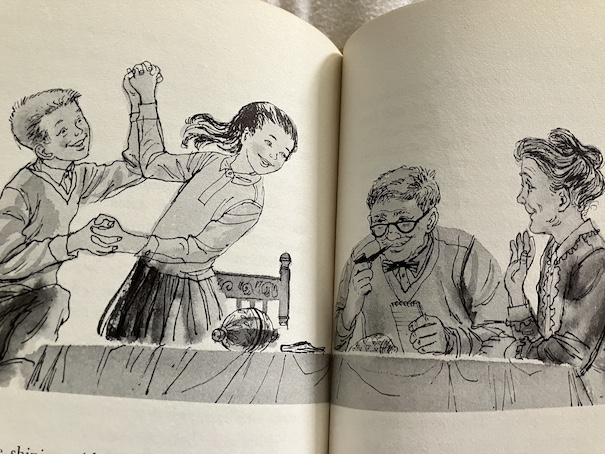
The children’s grandmother recalls that Elsa was still with them even after Tom and Jennifer left with their parents, and they talked about Sea Meadows and showed her the deed to the land. Elsa had been helping to put away Christmas decorations at the time, and while the adults were talking, she suddenly started to cry. She had cut her finger on something, but they were never sure how she did that because none of the decorations were broken. Elsa was also upset because she had done two things earlier in the day that had caused trouble: she’d broken a little figurine and she’d forgotten to tell her grandfather about a phone call from a friend. She seemed worried that she had done yet another thing wrong, but her grandfather told her not to worry because troubles come in threes, and if the cut finger is her third trouble, she has nothing more to worry about. However, their grandmother recalls that Elsa didn’t seem reassured by that. Rather than being the third trouble of last Christmas, Elsa’s cut finger is a clue to a bigger problem that Elsa was afraid to admit, and that’s the clue they need to solve the problems of this Christmas.
The book is available to borrow and read for free online through Internet Archive. There is an earlier book with the same characters, a mystery about a sea monster in the same area of California, called The Terrible Churnadryne, but I haven’t read it and haven’t been able to find a copy.

I read this book years ago, and I remember liking it, but for a long time, I couldn’t remember the details of the story. I only remembered bits and pieces. I didn’t remember that it was a Christmas story, which would have helped. I remembered that a girl did something with an important paper, but until I reread the book, I couldn’t remember why the paper was important. What stayed with me the longest was the solution to the missing letter and the cut on Elsa’s finger. But, because I forgot that this was a Christmas story, I misremembered exactly what Elsa put the letter in.

I also remembered that one of the aunts had a secret hiding place in a cave when she was young, and when they revisit the cave, they find cave drawings done by Native Americans. I also remembered that the cave is dangerous at certain times because the tide comes in. Years ago, Aunt Melissa was almost trapped there because she stayed too long and was caught by the tide. When her father found out, he refused to allow her to go there alone again. Since her mother and sister didn’t like going to the cave at all and she and her sister soon went away to boarding school, she gave up going there entirely for a long time. She was always sad about the loss of her secret hiding place. However, when she returns there as an adult, it contains part of the secret to unraveling what happened to her father’s letter last Christmas.

At one point in the story, Jennifer finds a very distinctive seashell with red and green colors. Everyone is amazed because it’s a court cone, not a shell normally found on the shores of California, and it also doesn’t normally appear in those colors. This is the shell that Jennifer calls the Christmas Shell. This shell doesn’t directly contain the solution to the mystery, but its shape and something Jennifer does with the shell awaken some of Aunt Melissa’s memories. I also remembered that Jennifer was the one who figured out what Elsa did after watching her brother fiddling around with a napkin in a napkin ring.

While I was rereading this book, I was happy to see all the bits and pieces of my memories of this book fall into place alongside the clues to the mystery. Stories with secret hiding places are always fun, and this one has two – Aunt Melissa’s old secret hiding place in the cave and the place where the missing letter is hidden.

There is also a reference in this story to the Elsie Dinsmore books, a children’s series from the late 1800s and early 1900s.
The Bone Keeper

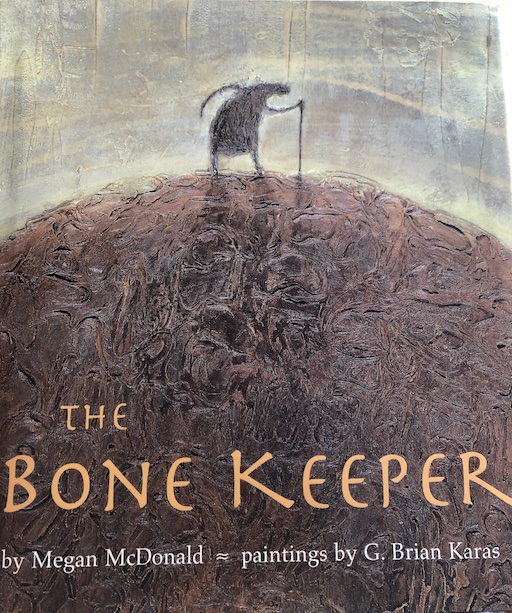
The Bone Keeper by Megan McDonald, paintings by G. Brian Karas, 1999.

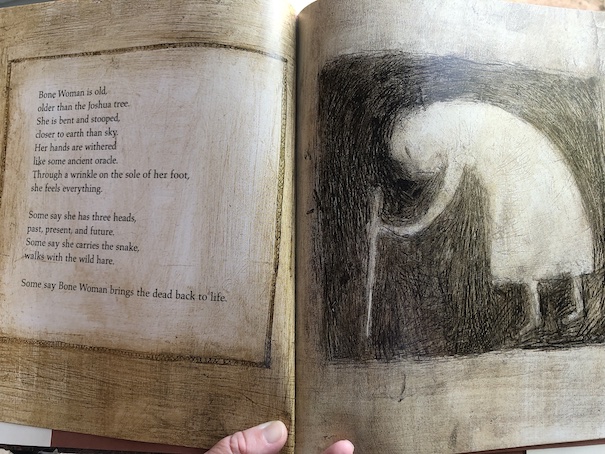
The story in this picture book is written as an unrhymed poem and illustrated with paintings that resemble paintings on a cave wall.

Bone Woman is a strange old woman. She is ancient, legendary, may have powers to bring back the dead, and lives in a cave full of bones.

She spends her time searching for bones in the desert sand. She collects the bones, studies them, and arranges them to form complete skeletons.

When she manages to complete a skeleton, she performs a ritual to bring the creature back to life!

The book is available to borrow and read for free online through Internet Archive.

My Reaction

This is one of those picture books that I think would actually be appreciated more by adults than by children. The poetry and art style seem more sophisticated than the styles that children seem to prefer. Most of the pictures are not very colorful, using a lot of grays and browns and black, although the art style is unusual and fascinating, looking like paintings and drawings scratched into rock.

I think kids could understand the action of the story – a strange old woman who lives in a cave collects bones, assembles them into skeletons, and can use them to bring animals back to life. It’s a strange story, partly because there is no explanation about why she is doing this.

One of my regrets about this book is that it doesn’t explain the background of this story. I had expected that there would be a section at the back of the book that would explain more, but there isn’t. From the context – the pictures, the style of the story, the names that the woman is called, and the fact that the artist thanked the Phoenix Public Library and the Heard Museum (both places that are familiar to me) in the dedication – adults can figure out that this is a story from folklore, but it’s not immediately clear what kind of folklore. Anyone who doesn’t already know the story might be confused. I didn’t know this story when I read the book, so I had to look it up.

The story of the Bone Woman has been told and referenced in other books. The story of La Huesera (the Bone Woman) is a Mexican folktale. Sometimes, it’s also called La Loba (the Wolf Woman) because that is the animal that she particularly wants to resurrect. The Bone Woman is a “wild woman” or a “crone” who uses a kind of natural magic to bring life to lifelessness and restoring what was lost.

Mystery in the Old Cave

Mystery in the Old Cave cover

Mystery in the Old Cave by Helen Fuller Orton, 1950.

Mystery in the Old Cave nut gathering

Andy and Joan Draper are excited about spending the fall and winter in the country. Usually, they live in an apartment in New York City and only go to their family’s vacation home in Vermont during the summer. However, this year, some friends of their father will be moving to New York, and they’ll need a place to stay because they are having trouble finding an apartment of their own. The children’s father has decided to rent their apartment to his friends while his family stays in Vermont. That means that the children will have to go to school in Vermont, but the children like the idea because they will be able to do things that they normally can’t do when the seasons change, like gathering nuts. When the first frosts come, the hickory nuts on the trees fall to the ground, making it easy to collect them.

After Andy and Joan collect nuts for the first time, they decide to store them in the old sugarhouse on the property. Normally, the family doesn’t use the sugarhouse for anything, but it used to be used during the times when their vacation house was a working farm and people tapped the maple trees for their sap to make maple syrup. They would process the sap in the sugarhouse. Sometimes, farm hands also used to sleep there during the harvest.

Soon, the children begin to suspect that there’s a stranger hanging around the property. Their dog, Ponto, barks at someone the children don’t see and comes running back to them, acting like someone kicked him. Later, a strange man approaches them and asks them if they know anything about a cave in the area. Andy and Joan don’t know anything about a cave. The man tells them that it’s supposed to be near the old sugarhouse, but if the children haven’t seen it, it might have caved in or something. He seems very secretive and doesn’t want the children to tell anyone that he’s been asking questions, and the children wonder if he could be the one who kicked their dog earlier. Later, someone (perhaps this strange man) steals many of the nuts that the children gathered and even some cookies. The children change their minds about storing things in the sugarhouse and decide to keep their gathered nuts in an unused room in the main house. The only clue to the identity of who’s been sneaking around is a red pencil that the person dropped.

Mystery in the Old Cave store

The children make friends with a boy named Phil who lives nearby. Phil is an orphan who lives with his Cousin John (who he sometimes calls Uncle John because he is so much older), a mean and stingy old man who doesn’t treat him very well and makes him work hard around the house instead of going to play after school with the other kids. He doesn’t even replace Phil’s clothes when they get old and torn. Phil gets a job at the local store to earn some money for a new sweater, but Cousin John even confiscates Phil’s earnings.

Mr. Lane, who owns the local store, is nice, and he tells Andy and Phil about how maple syrup and maple sugar are made, something that everyone in town used to participate in so that it was like a community party. The boys think it sounds like a lot of fun, and while they are talking about the old sugarhouse, Mr. Lane mentions that, once, some thieves joined in when they were making making syrup. Nobody knew they were thieves at first; they were just a couple of strangers who came along with everyone else and started helping out. Later, there were some robberies in the area, and the thieves were found hiding in a cave near the sugarhouse. Mr. Lane says that he and his friends used to play in that cave when they were young, and Andy and Phil decide that they want to find it.

Mystery in the Old Cave bones

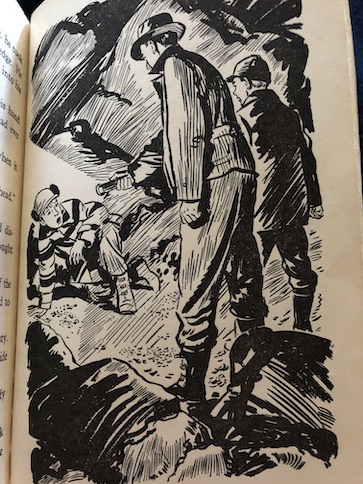
The boys take some tools with them while they’re looking for the cave, in case the entrance has been covered over, which turns out to be the case. Once they dig through the entrance, the rest of the cave appears intact. They find some old bones inside that probably belonged to a bear. They can’t look around much more because the cave is too dark, so they decide that they’ll return later with some lanterns. Mr. Lane tells the boys that there still might be stolen loot around because they never did find everything that the thieves took, including a pearl necklace that belonged to Andy’s grandmother, who was living there back then. Could these things be what the mysterious stranger is looking for?

Mystery in the Old Cave stove in store

During the course of the book, Mr. Lane begins to notice that Phil’s cousin isn’t giving him enough food. Cousin John denies Phil food when he refuses to turn over the extra money that he’s been earning to him. Mr. Lane gives Phil food from the store to eat. While Phil is at the store, he overhears the stranger, who calls himself Joe Williams, talking to Mr. Lane. Joe Williams admits that he’s looking for treasure in the area. Mr. Lane says that he doesn’t have high hopes that Joe Williams will find anything around the cave because the whole area was searched thoroughly years ago.

Phil tells Mr. Lane that he can’t stand living with his cousin anymore and wants to run away. Mr. Lane tries to persuade him not to go, saying that he can deal with Phil’s cousin, but Phil has had enough and worries that his cousin will make life hard for anyone who tries to help him. When Phil hides out in the old sugarhouse, he meets up with Joe Williams, who explains to him more about how he knows about the treasure that may be hidden in or around the cave. He’s about ready to give up the search, but Phil finds something that everyone else has overlooked.

In the end, Andy and Joan’s parents decide to take Phil in. Phil’s cousin agrees to sign over custody to the Drapers, provided that he gets to keep the money from Phil’s job that he took and the money that Phil’s mother left for Phil’s upkeep. I’m pretty sure that’s illegal and that the courts and social workers would have something to say about that if this story happened in real life in the 21st century, but in the story, Mr. Draper accepts the deal and basically uses the money that was meant for Phil to pay off his cousin to surrender custody of the boy. The story ends at Thanksgiving, with Phil sitting down to Thanksgiving dinner with his new family, who will really love him and treat him much better than his cousin did.

Mystery in the Old Cave hiding

This is one of those older mystery stories that’s really more adventure than mystery. There’s really only one suspect for the odd person sneaking around, and his reasons for sneaking around turn out to be exactly what he said they were. There is no other hidden purpose or secret past behind that man other than what he said, and in the end, he just kind of leaves the story. The kids don’t have many clues to the location of the stolen items, and in the end, Phil finds them more by accident than anything else.

Sometimes, when I’m unsatisfied by the ending of a story, I like to make up an alternate one of my own. If I were writing this, I’d have had Phil’s nasty cousin be involved in the robbery and the hunt for the hidden loot. For example, maybe he was actually one of the original thieves and had a falling out with his partners, and he’s secretly searching for the rest of the loot they hid for years. Maybe he’s had to redouble his efforts recently because they’re getting out of prison soon, and he wants to get to the hidden loot before they do. Cousin John is money-hungry enough that it could be plausible, and that would allow the story to end with him being sent to prison, which seems fitting.

This isn’t important to the story at all, but I just wanted to say that the copy I have of this book is damaged in a very odd way. On some of the beginning pages, someone has cut out a few of the words, ransom-note style. I don’t know why that happened. There aren’t enough missing for a real ransom note, and some of the cut-out words are still stuck in the pages, but since this is a mystery book, I kind of like the image of someone using it to write some kind of mysterious secret message.

I haven’t been able to find an online copy of this book yet, but Internet Archive has others by the same author.

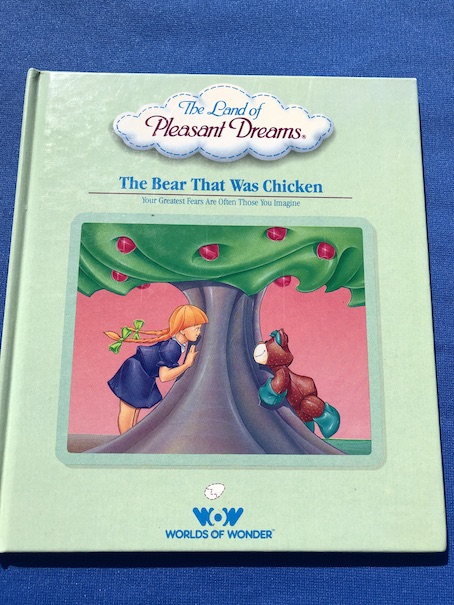
The Bear That Was Chicken

The Land of Pleasant Dreams

The Bear That Was Chicken by Ane Weber, Ron Krueger, Tony Salerno, 1986.

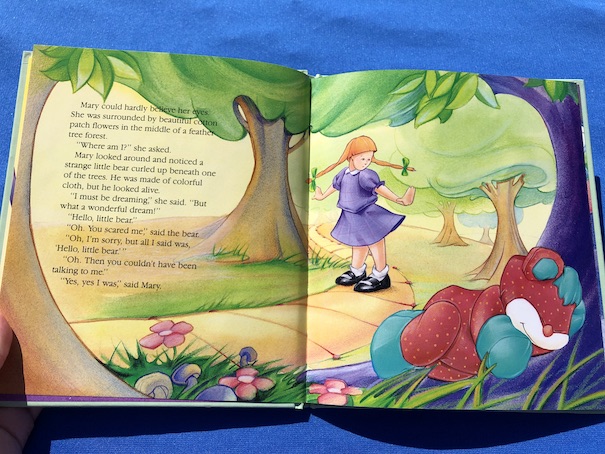
In her dream, Mary meets Threads the Bear.  When she meets him, he’s trying to sleep under a tree.  He’s sad and tells Mary that he thinks he’s a chicken and that all of his friends say so.  (It’s not a nice thing for friends to say, and I wish the story had said so.  There’s a song about it on the tape that accompanies the book with the words given in the book, but it bothers me because calling people “chicken” is something that I associate with people who are trying to goad people into doing things that they really shouldn’t do. I don’t think that it’s good to teach children to react to being called “chicken” or any other insulting names.)

Mary thinks that Threads’ imagination is getting the better of him and that’s why he’s so afraid of so many things.  However, Threads tells Mary something that isn’t imaginary: there are some strange eggs in his cave that appeared there suddenly and mysteriously.  That’s why he’s sleeping in the forest, because he doesn’t know where the eggs came from or what they are.  Mary bravely offers to go with him to have a look at the eggs.

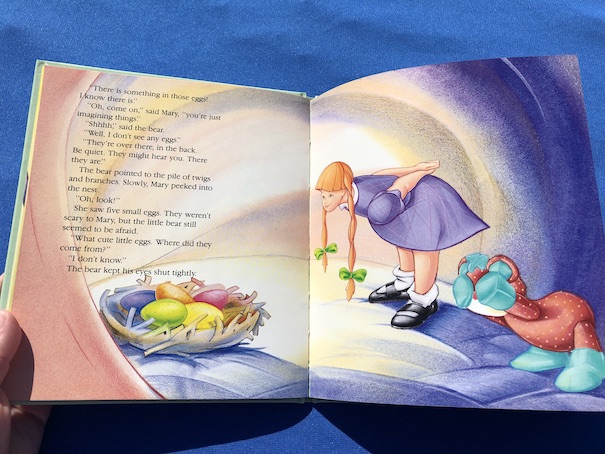
When they go to look at the eggs, Mary thinks that they look pretty harmless.  They’re kind of cute and colored like Easter eggs.  Threads is still worried about them and what they might hatch into.  Mary says again that Threads is imagining the worst and volunteers to sit with Threads while he takes his nap and keep an eye on the eggs to see what happens.

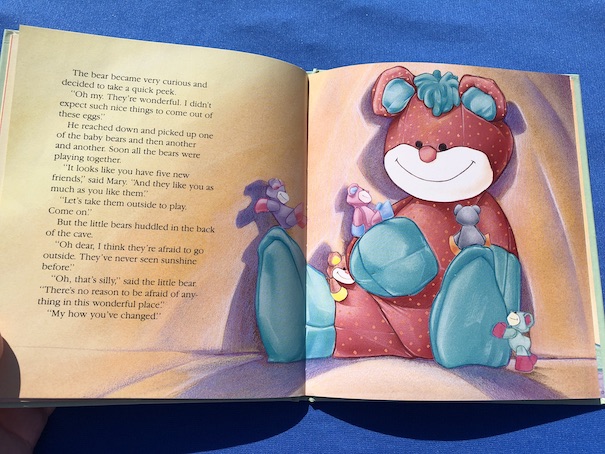
The eggs do hatch, and it turns out that they contain tiny teddy bears, very much like Threads.  When Threads sees the little bears, he loves them and thinks that they’re adorable.  The little bears seem worried when Threads wants to take them outside to play, but Threads encourages them, telling them that there’s nothing to be afraid of.

Moral: Your Greatest Fears Are Often Those You Imagine.

The main message of the story is that it’s better to face your fears than imagine the worst. However, I found some of this story a little confusing as a kid, and some of the implications are a little alarming when you begin to analyze it.  Where did those little bear eggs come from?  Did Threads lay them himself in his sleep? Are those little bears his children?  Did Threads lay eggs because he was a “chicken”?  But, Threads is a boy bear!  Then again, this is supposed to be a dream, so I guess it doesn’t really have to make sense.

I still don’t like that the story uses “chicken” as an insult and in a way that implies that people who are called “chicken” should try to prove that they’re not. This just seems like a recipe for disaster, encouraging children to accept dares.

The book is available to borrow and read for free online through Internet Archive. This book is currently available online through Internet Archive. It was made into an episode for the tv show version of this series with puppets.

The Secret of the Strawbridge Place

SecretStrawbridgePlace

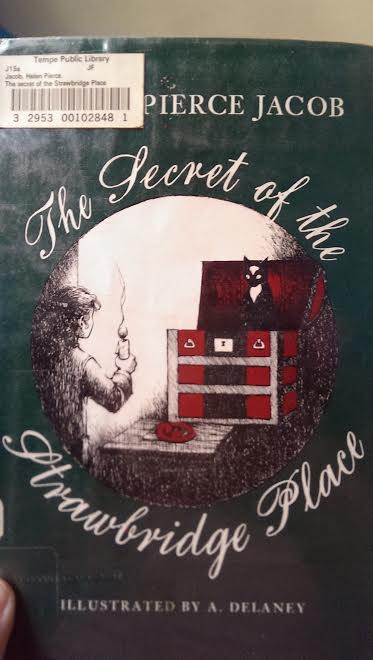
SecretStrawbridgePlacePic1The Secret of the Strawbridge Place by Helen Pierce Jacob, 1976.
This story takes place in Ashtabula, Ohio during the Great Depression. Kate is frightened of the hobos who pass through town looking for work, but at the beginning of summer, her brother Josh dares her to come with him to spy on the hobo camp. The two of them witness a fight between three hobos, and in their haste to get away, Kate falls and breaks her arm. At first, she is sure that her summer is ruined, but when she considers the place where she fell, she realizes that she has stumbled on an important clue to a secret surrounding the old house where they live.

Locals say that during the Civil War, the Strawbridge family, who lived in the house before Kate’s family, were part of the Underground Railroad, hiding runaway slaves. However, no one has ever been able to find the place where the slaves were hidden. When Kate fell, she discovered the opening to a cave near the river that she never knew was there before.

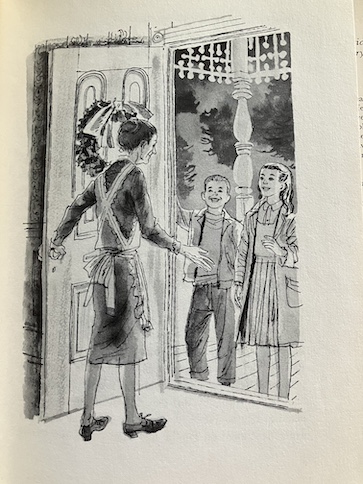
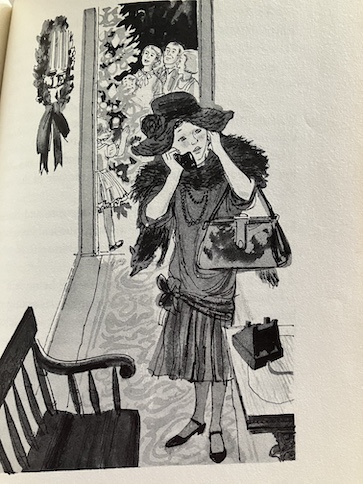
SecretStrawbridgePlacePic2Oscar, a boy visiting his grandfather nearby, becomes Kate’s friend. Since he was also injured in one of Josh’s escapades (having broken his leg when the kids were fooling around in the haymow), she invites him to join her in the search for the secret. They form a partnership called Cripples Incorporated and have fun inventing code words and writing secret messages about what they’ve discovered. Pursuing the secret comes with some risks, and before Kate can discover the whole truth about Strawbridge Place, she has a serious brush with danger.

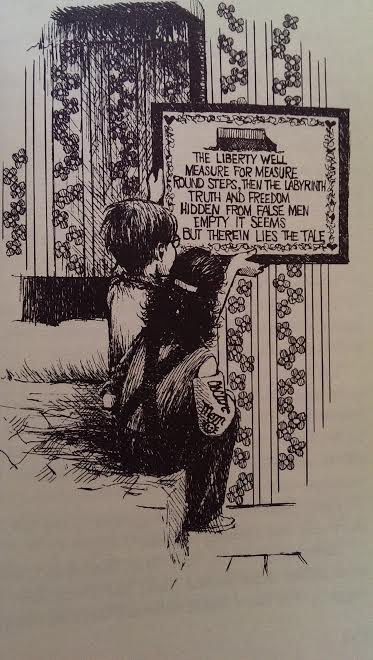
It’s an interesting mystery that invites readers to try to figure out the clues along with Kate and Oscar as they ponder the sampler with the strange motto left behind by the Strawbridge twins. Oscar also introduces Kate to Sherlock Holmes stories, one of which provides her with the inspiration to solve the mystery. Kate also develops better feelings for the hobos, who, like the runaway slaves, turn out to be mostly ordinary people just looking for a better life.

The book is available to borrow and read for free online through Internet Archive.  There is also a prequel book that focuses on the original adventures of the Strawbridge family when the house was operating as a stop on the Underground Railroad called The Diary of the Strawbridge Place.

Mandie and the Cherokee Legend

MandieCherokeeLegend#2 Mandie and the Cherokee Legend by Lois Gladys Leppard, 1983.

Mandie is going to visit her Cherokee relatives with her mother and Uncle John. Mandie is eager to meet her relatives, and she hopes that they all like her. The Cherokees all knew her father well, and most of them are eager to meet her. All except for her cousin, Tsa’ni, that is.

Tsa’ni knows the stories of how white men have oppressed the Cherokees and forced them to move off of their land years ago, and he resents all white people because of it. The others tell him that he is wrong to hate all white people because of what some of them did in the past and that Mandie and her Uncle John are good people. However, Tsa’ni doesn’t listen to them, and he plays a mean trick on Mandie, Joe, and Uncle Ned’s granddaughter, Sallie. He offers to show them a cave, but then he abandons them inside.

The three kids have to find their own way out, but they discover a fortune in gold nuggets in the process. First, the children have to make it back to Uncle Ned’s house after a frightening night in the woods. Mandie, Joe, and Sallie accidentally stumble onto a still (machinery for making alcohol) that belongs to a white couple while they are wandering around in the woods after leaving the cave. The couple are worried that they will tell people about their illegal still, so they hold the kids prisoner.

Although the kids manage to escape, they must return to the cave to find the treasure again (while dodging Tsa’ni’s tricks to foil their efforts) and keep it safe (from the still operators and anyone else who might want to steal it) until they can decide what to do with it. As far as Uncle Ned and the other Cherokees are concerned, gold is bad luck because it was the discovery of gold which forced the Cherokees out of their old homeland. However, the origin of this gold may help to change their minds.

This book is one of the Mandie Books.  It is currently available online through Internet Archive.

Twenty and Ten

TwentyTenTwenty and Ten by Claire Bishop, 1952.

The story takes place in occupied France during World War II.  Children were often sent to the countryside to escape the violence of war, and a group of twenty children, both boys and girls, are staying at a small school taught by a nun, Sister Gabriel.  Most of them are about eleven years old, although four-year-old Louis is allowed stay at the school with his older sister, Denise.

Janet, another student at the school, tells how a strange man comes to the school and begs them to help him hide ten Jewish orphans from the Nazis.  Sharing their school with these newcomers means that they will have to share their already meager rations with them and to keep their presence at the school absolutely secret.  In spite of the danger and difficulty, everyone at the school agrees to help.  They think of it as being like when Mary and Joseph had to take baby Jesus to Egypt to hide him from King Herod, a story they had recently acted out in play form.

TwentyTenPic1The two groups of children soon make friends, and one of the Jewish children, Arthur, shares something special with his new friend, Henry: a small piece of chocolate.  With the rationing, none of them have seen chocolate in a long time.  Henry decides to share a little with Janet because he likes her, and they decide to hide the rest and save it for later.  When Denise spies them with the chocolate and wants to have a little herself, she steals the piece of chocolate from where Henry has hidden it. The others chase after her to get the chocolate back, and they end up accidentally discovering a cave that none of them knew was there.

This becomes a vital discovery when the children spot a pair of Nazis heading toward their school.  Sister Gabriel is away, so the children have to take care of the situation themselves.  Quickly, Arthur leads the other Jewish children to the cave, where they can hide.  The other children remain at the school and try to keep the Nazis from learning anything.  They try not to even talk to the Nazis when they start asking questions.  But, how long can they keep it up?  Something has obviously happened to Sister Gabriel, and the Jewish children can’t hide in the cave forever.

There is a movie version of this book called Miracle at Moreaux.  The movie differs significantly from the book.  In the book, the children at the school are all welcoming to the Jewish children, but in the movie, some of the children at the school are afraid of the Jewish children (there are only three of them in the movie), one of them in particular hating Jewish people because she believes anti-Semitic stories she’s heard.  Also, instead of the cave that appears in the book, the movie uses a Christmas pageant as the device for confusing the Nazis and allowing the Jewish children to escape to Spain (instead of staying at the school until the end of the war, as they did in the book).

This book is available online through Internet Archive.