The Prince and the Golden Ax

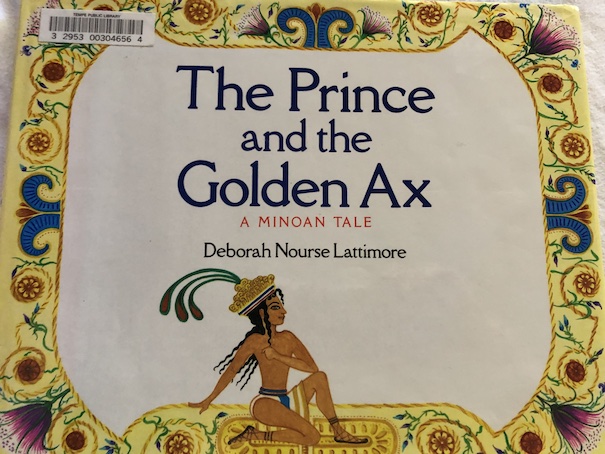
The Prince and the Golden Ax by Deborah Nourse Lattimore, 1988.

This story is based around the ancient Minoan civilization and the destruction of the island of Thera. Thera was a real place, and it was actually destroyed, but the story itself is fiction, based upon the pieces of information that the Minoans left behind about their culture.
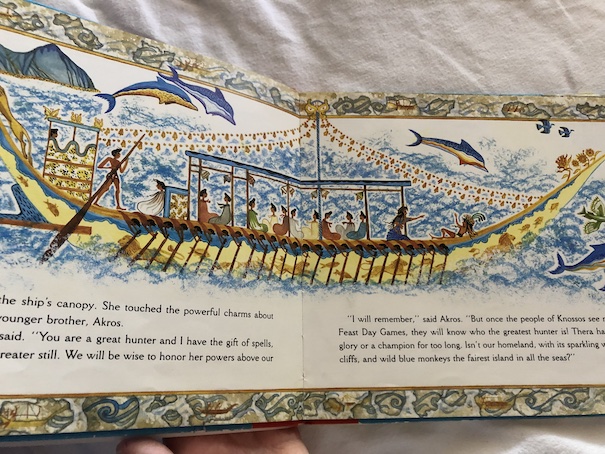
When the story begins, the city of Knossos on Crete is the home of the Goddess Diktynna. Princess Illyra and her brother, Akros, are on their way to Crete from Thera with their fleet of ships. Akros is eager to show off his skills at the games on this feast day, although Illyra cautions him to not show off too much and to remember to honor the goddess.

When they arrive at Crete, they are shown the goddess’s shrine with her statue holding the golden ax that is the source of her power. Akros is impressed by the golden ax and begins to think that if he had the ax, he could use it to bring glory to Thera. At the feast games, Akros shows off his ability to wrestle a bull. Full of pride for himself, he declares that he’s even better than the goddess because he did it without a golden ax. The goddess is angered by his comments and causes an earthquake.
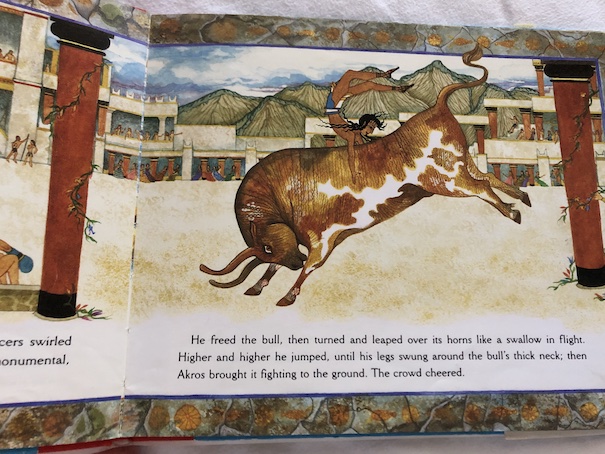
The priestess says that Akros has challenged the goddess, and in order to make amends, Akros must find the golden-scaled fish of the Eastern Isle and obtain a bronze ax. If he fails to complete this task, the goddess’s golden ax will destroy Thera. Akros has no choice but to accept the challenge.

Illyria has the ability to use magic, and she helps her brother to complete the task successfully, but Akros can’t resist bragging about how easy it all was, angering the goddess again. This boast earns him a more difficult task, to capture a griffin and earn a silver ax.
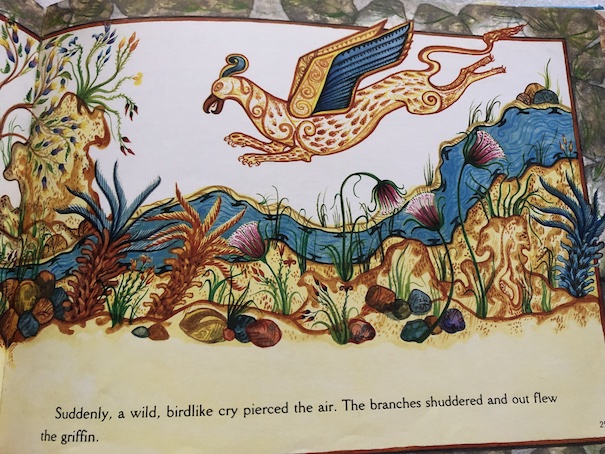
Once again, Illyria helps Akros to succeed in his task, but when he is presented with the silver ax, Akros insists that it’s not good enough for him and that he wants the golden ax. The priestess says that only a godlike hunter can have that ax, and if he tries to get it, his homeland will be destroyed. Still, Akros insists that he can prove that he’s good enough by catching a creature that no one, man or god, has ever caught before.

What Akros has in mind is catching the blue monkeys on the island of Thera. This time, Illyria refuses to help him because the blue monkeys are sacred. At first, Akros thinks that he’s managed to capture the blue monkeys without her help, but they have abilities that he never expected. As promised, when Akros fails to accomplish his boast, the island of Thera is destroyed, and Illyria and Akros only narrowly escape.

The book ends with the discovery of the remains of the palace of Knossos centuries later, when the image of the goddess and a small ax are discovered.

My Reaction

I knew at the beginning of the story that there couldn’t be a happy ending because I already knew what happened to the real island of Thera, now called Santorini. The island was largely destroyed by a volcanic eruption during the Minoan period, a cataclysm that may have sparked the legend of the sunken island of Atlantis. However, this story does not mention Atlantis, instead using the statue of a goddess found in the remains of the palace of Knossos as inspiration. In spite of the ending, I wouldn’t call this a sad story. The book doesn’t dwell on the aftermath of the destruction of Thera, and we don’t actually see much of the civilization of Thera, so there isn’t much for us to miss when it’s destroyed. The colorful pictures throughout the book are beautiful and actually feel rather cheery.

A Fence Too High

The Land of Pleasant Dreams

A Fence Too High by Jeanine Bartelt, Jeff Parker, and Tony Salerno, 1986.

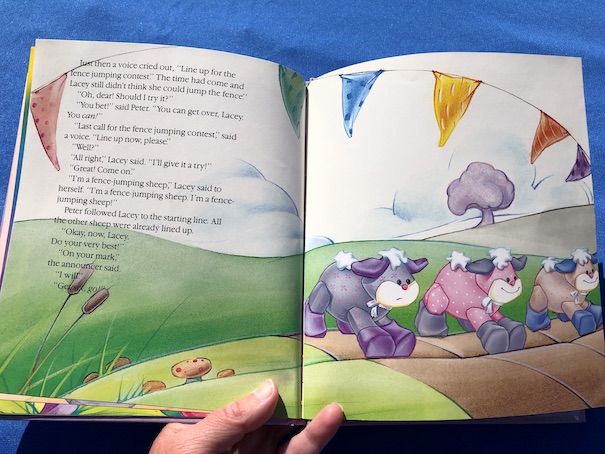
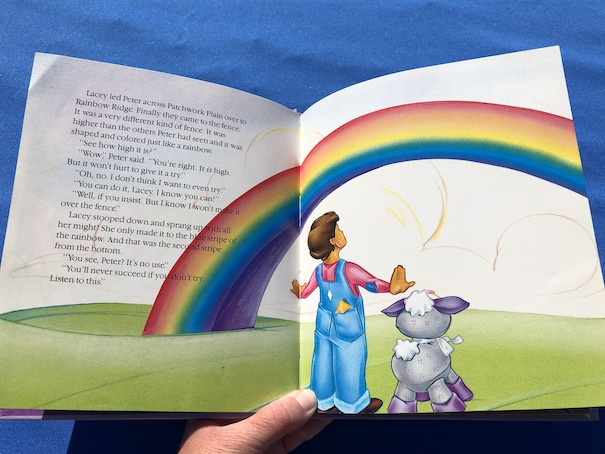
Peter falls asleep while counting sheet jumping over the fence and meets Lacey the Lamb in his dream. Lacey the Lamb is sad and worried because, even though she’s growing up to be a fence-jumping sheep, there is one fence that she just can’t get over. Peter offers to take a look at the fence with her and see if he can help. When he does, it turns out to be a giant rainbow.

It’s important that Lacey make it over this fence because she is taking part in a fence-jumping contest in less than an hour. Lacey doesn’t think that she can learn to jump this fence in so little time. However, Peter encourages Lacey to try again.

After a few more tries in which she hits the blue stripe on the rainbow and then the yellow stripe and then the orange stripe, Lacey is ready to give up. She thinks that it’s hopeless. Peter points out that it isn’t hopeless because each time that Lacey has tried, she has improved, gradually hitting higher and higher marks on the rainbow. He doesn’t think that Lacey should give up so easily.

Even though she’s still feeling very unsure of herself, she decides to participate in the contest. This time, Lacey does make it over the fence, and she feels much better about herself because of her success. She thanks Peter for giving her the encouragement to try one more time.

Moral: If At First You Don’t Succeed, Try, Try Again.

It’s a nice story about the importance of making an effort, trying again, and not giving up just because there are obstacles and challenges. Life has many challenges, and just because something is difficult doesn’t mean that it’s impossible or not worth doing. People don’t need to be perfect; it’s enough to be willing to improve.

This book was made into an episode for the tv show version of the series with puppets.

The Mysterious Queen of Magic

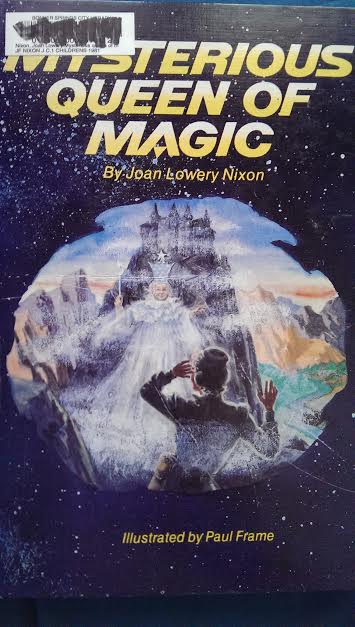
KleepQueenMagicThe Mysterious Queen of Magic by Joan Lowery Nixon, 1981.

This is part of the Kleep: Space Detective series.

Kleep and Till meet a strange young man who is looking for Kleep’s grandfather, Arko.  The young man, Mikkel, tells them a wild story, that an evil wizard is after him.  He is controlling Mikkel’s people on the planet Durth, putting them under a spell and forcing them to become his slaves. Mikkel believes that Arko may have the key to getting rid of him because an old wise man told him to ask Arko how to find Queen Stellara.  Queen Stellara was a legendary queen who could do magic, and Arko has some old write-rolls, scrolls of the kind people used to use before people began using computers alone for learning, that talk about her and her kingdom.  However, Arko doesn’t believe in wizards or magic spells or anything of the kind.

Kleep remembers Arko telling her the old stories from the write-rolls when she was little, and unlike her grandfather, she believes that wizards and magic may be real and wants to try to help Mikkel.  When Arko says that he doesn’t believe in magic and can’t help Mikkel, Kleep and her friend Till decide to use the scrolls to try to help Mikkel find Queen Stellara.  Taking Kleep’s robot, Zibbit, with them, they journey to the planet Loctar, where Queen Stellara was supposed to live.

Although this series is mostly sci-fi with a bit of mystery thrown in, this book is more fantasy.  When Kleep and her friends arrive on the planet Loctar, they discover that they must face a series of challenges to reach the legendary queen’s palace, like heros in a fairy tale.  Magic is real, and they must prove themselves worthy in order to meet the queen and ask her for the solution to the problem of the evil wizard.  But, their ordeal doesn’t quite end there because, while Queen Stellara provides them with the means to fight the wizard, they must face him themselves!

A little corny, but fun, although it’s not my favorite book in the series.  The others were more sci-fi, and this is more fantasy.  Also, for a “detective” series, there isn’t much mystery, more adventure.  It sort of reminds me of the original Star Trek episode Catspaw, except that the magical beings in this one are apparently really magical and not just aliens.  Like the other books in this series, I like the pictures, too.

KleepQueenMagicPic3