
The Westing Game by Ellen Raskin, 1978.
It all starts when a mysterious person invites six sets of people to live in the new apartment building, Sunset Towers. Sunset Towers is a luxury apartment building, but the rent for these individuals and families is surprisingly affordable. That is because these people are special, and the owner of these apartments is preparing for a very special game. Although there doesn’t seem to be anything to tie these people together at first, they do share a special connection that isn’t immediately obvious, a connection to the wealthy but mysterious Samuel Westing.
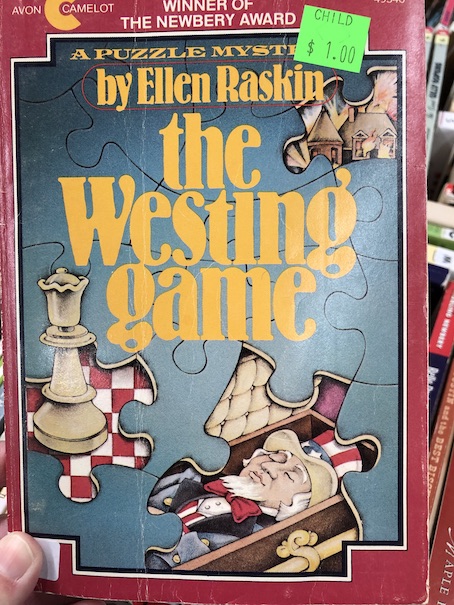
Among the new tenants of Sunset Towers is young Turtle Wexler. Although she is often in the shadow of her overly-shy but pretty older sister, Angela, she has ambitions of her own in life. While her mother dreams of making it in high society, Turtle (whose real name is also something of a mystery to the other tenants for most of the book) wants to become a successful businesswoman when she grows up, and one of the things she wants most is a subscription to the Wall Street Journal. To raise the money she needs, Turtle accepts a bet to sneak into the supposedly empty Westing House on Halloween night, earning $2 for every minute she spends there. There are stories that the place is haunted and that Mr. Westing’s body lies rotting on an oriental rug there, but Turtle doesn’t believe them. As it turns out, she’s right. Instead, she finds Mr. Westing dead in bed.
To everyone’s surprise, the tenants of Sunset Towers are all named in the will, but not in an ordinary way. In order to determine who the final heir will be, they must all play The Westing Game. The heirs are divided up into teams of two and given $10,000 and a set of clues. They must use these to give an answer at the end. But, what kind of an answer? Mr. Westing’s will implies that he was murdered, but is that really true? Could his murderer even be among the heirs/game players?
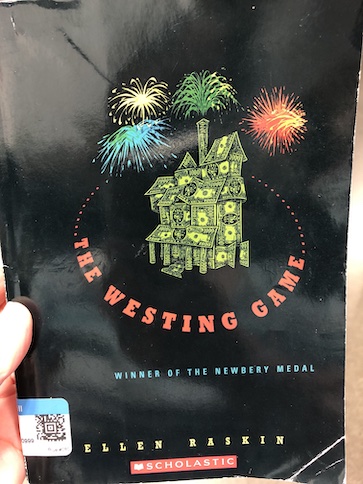
As the book continues, readers learn more about each of the contestants. Each of them has their own personalities, ambitions, and problems. For example, Angela Wexler is about to be married but seems less than enthusiastic about the wedding. Cristos Theodorakis suffers from a strange malady that keeps him confined to a wheelchair. Sydelle Pulaski was actually invited to join the tenants by mistake, but it might be the best mistake of her life. Mr. Hoo is worried about his restaurant, and Madame Hoo dreams of returning to China.
The competition is fierce in the Westing Game. Players are suspicious of other players cheating. Things around the apartments start disappearing, and some mysterious person has even started planting explosives in unlikely places! Whether the thefts and explosions have anything to do with the contest itself is for the reader to discover, but there is an answer to the Westing Game, and only one of the contestants will discover it.
The book is a Newbery Award winner. There is a movie version of the book called Get a Clue! (1997), although it doesn’t follow the book completely. There are multiple copies of the book currently available online through Internet Archive.
My Reaction
One of the great things about the Westing Game is how the seemingly mismatched pairs of contestants actually complement each other, giving people new perspectives on their lives and the answers to problems that some of them have been struggling with. Lonely Flora Baumbach, grieving for her deceased daughter, is paired with young Turtle, who finds in her a more motherly person than her own mother, someone who values her for her intelligence and her unique skills in a way that no one else does. Mrs. Baumbach enjoys having someone to care for again, and Turtle blossoms under her care and attention. Mr. Hoo, meanwhile, finds some unexpected support for his business from Mrs. Wexler, who develops broader interests in life than her previous social ambitions and an unexpected flair for business and marketing. Judge Ford, who was educated by Mr. Westing and always worried about how to repay the debt, finally finds a way to repay his kindness, a way that Mr. Westing would have approved. Bertha Crow, an unhappy woman who turned to religion to atone for past sins, finds new happiness with someone who understands and accepts her past and is willing to help her continue her good works. Even Angela, who seems to have everything a young girl would want (good looks and a kind fiance with a promising future in medicine), figures out what she really wants in life and finds the courage to stand up for it.
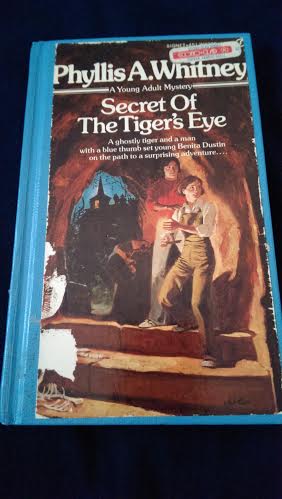 Secret of the Tiger’s Eye by Phyllis A. Whitney, 1961.
 Jestress's Forgotten Books and Stories