The Twin Connection
Dangerous Play by Adam Mills, 1989.
Thirteen-year-old twins Ryan and Chris Taylor are visiting Kansas State University during homecoming week because their parents used to attend the university, and the boys are looking forward to getting their first look at life on a college campus. They’re also looking forward to the big football game. At least, Chris is looking forward to the game. Ryan isn’t as athletic and doesn’t see the appeal of sports as much as Chris does. Ryan is more studious. However, both of the boys are hoping to meet Trent Dasher, the star quarterback on the Kansas State football team. Chris wants to ask him for sports advice, and Ryan is hoping to get some pictures of him for their school’s newspaper. Meanwhile, their parents are looking forward to reliving their college years. They met in college, and they spent their honeymoon at the same hotel where they are now staying with the boys.
The twins go in search of Trent Dasher. They contacted him before arriving, so he should be expecting them, but they discover that he is missing. When they go to his dorm room, his roommate doesn’t know where he is. Then, the boys overhear a conversation between Coach Butler and Dean Murray in the athletic offices, in which the coach says that Trent has been behaving oddly recently, and now, he can’t find him. The twins ask Trent’s roommate, Danny, for more information about Trent and if he knows anything about where he might be. Danny says that he and Trent don’t really confide in each other. Even though they’re sharing a dorm room, they’re both pretty busy with their own activities. Danny has noticed that Trent has been unusually nervous recently and that he’s missed some classes, which is out of character for him. Danny suggests that they look for Trent at the Wildcats’ Lair, a snack bar in the University Union where Trent likes to hang out.
Before they leave Trent’s dorm room, the boys sneak a look at Trent’s belongings, and they learn a few things about him. Trent has a girlfriend named Jeannie who lives in their town and has written letters to him. He’s also in danger of failing his chemistry class if he doesn’t get some extra help, and if he fails chemistry, he could lose his scholarship. The boys figured that his problems with his classwork and the threat of losing his scholarship are probably what was worrying him so much.
When the boys go to check out the Wildcats’ Lair, they meet a girl who says that she’s Trent’s girlfriend. Unfortunately, she isn’t Jeannie. When the boys address her as Jeannie, assuming that she’s the one who wrote the letters, she says that’s not her and gets angry. The twins are embarrassing, thinking that they might have just accidentally created a new problem for Trent by complicating his love life.
The boys finally locate Trent talking to a tutor called Wilson about getting help to pass his chemistry exam. It seems like the mystery of the missing athlete is over, but then, Wilson tells Trent that the way he “helps” students is by selling them the test answers. Trent gets angry and refuses to cheat. The boys try approaching Trent, but he doesn’t want to talk to them because he has too much on his mind.
The twins are a little offended at being brushed off by Trent since he knew they were coming and had agreed to meet them, but they can also see that Trent is in trouble and could use some help. They decide to go after him, and they hear him talking to someone on the phone about a special “deal.” Since they just heard him turn down an opportunity to cheat by purchasing test answers, what kind of “deal” is he looking into to solve his problems?
The boys follow Trent and see him meeting with Coach Hatfield from Flint Hills University, Kansas State’s rival. It seems that Coach Hatfield has made Trent an offer to come play for their team, or at least, that’s how Trent interpreted his offer. With his scholarship to Kansas State in danger, Trent is considering the possibility of switching schools. However, it turns out that Coach Hatfield wants something very different. He wants to bribe Trent to throw the upcoming homecoming game and make sure his team loses! He says that he’ll make sure that Trent has enough money for his tuition if he does. Trent is appalled and refuses.
The twins continue to follow Trent as he goes to talk to his girlfriend, Cindi, who is the girl they met earlier. She asks him about Jeannie, but Jeannie is just a high school girl from his home town who has an unrequited crush on him. He’s really serious about Cindi. Trent tells Cindi everything about the troubles he’s been having and the unethical offers he’s had. She asks him why he hasn’t gotten help from the legitimate tutors or from his professor, but he says that the chemistry tutor quit and hasn’t been replaced yet and that his professor seems to have a prejudice against athletes. Trent is thinking that maybe he should just quit college and get a construction job so that he and Cindi can get married, but Cindi doesn’t think that’s a good idea.
Even if Cindi can help Trent find a solution to his problems in chemistry, Trent’s football problems are just beginning. He turned down Coach Hatfield’s proposition, but the Flint Hills football team isn’t going to take no for an answer. They’re prepared to use violence to make sure that the upcoming football game goes their way. Chris and Ryan witness some of them kidnapping Trent! They’ve got to get help and prove that Trent is in trouble to save him!
The book is available to borrow and read for free online through Internet Archive.
My Reaction
There wasn’t really much mystery to the story, which was a disappointment to me. The boys figure out where Trent is and directly witness his kidnapping, so there’s nothing really for them to figure out. It’s more about how they manage to rescue him. It’s more of an adventure story than a mystery. Part of the premise of this series is also that the twins have a kind of psychic connection and can sense each other’s thoughts, but that didn’t really enter into this particular story. The resolution of the situation didn’t depend on them having this ability, and for most of the story, the twins just talk to each other openly about everything without a need to communicate anything silently.
Things turn out okay in the end because Trent is able to make it to the football game and help his team win. The book doesn’t mention any of them going to the police about the coach and football team participating in an actual kidnapping, which made me feel a little weird. It’s great that the boys were able to rescue Trent and that he was able to win the football game honestly. Trent never compromises his values, in spite of the pressure he’s experiencing from all sides, and in the end, there’s an honest solution to his problems with his grades, but still, kidnapping is a serious crime, and I thought that there should have been serious consequences to go with it.
As for Trent’s troubles with chemistry, it turns out that his chemistry professor is actually an old friend of the boys’ parents, and he isn’t really against athletes. The only reason why he hasn’t noticed Trent failing and helped him to get the extra tutoring he needs is that, at a large university, classes are made up of hundreds of students, and professors rely on graduate assistants to help manage the grading. The professor doesn’t know that much about how individual students are doing. They mainly help when students approach them for help, which Trent hasn’t done. When the twins explains Trent’s problems to the professor, the professor talks to Trent, telling him that he should have come to him earlier and that he will help him improve his grades, not because he’s a star athlete but because he’s a student in need of help to complete his degree.
Although I wasn’t thrilled by the mystery itself because it wasn’t much of a mystery, there are some interesting points in this story about both prejudices people have about athletes and the system of success/failure at universities. First, the prejudice part is an obvious one. Many people assume that people are either smart and good at studying or that they’re not smart and that’s why they’re mainly good at sports – like life’s options are brain vs. brawn, with no in-between. The twins themselves represent this notion because Ryan is the studious one and Chris is the athletic one. This seems to be how other people think of them and how they think of themselves.
Ryan in particular has this view. He’s good in school subjects, better than his brother, but not that good at sports and has no interest in sports. Chris is offended that his brother seems to think that his athletic prowess also makes him the dumber twin and that Ryan is often telling him that he needs to read more and study more or he’s not going to make it in college. Chris argues with Ryan and tells him that just because he’s into sports and not as good at studying as Ryan is doesn’t mean that he can’t manage. Ryan is correct that a student athlete can’t just be all about sports and neglect his school work, as Trent’s situation indicates, but he does underrate the athletes’ abilities to manage and think their way through problems. The boys also have some prejudices against girls, with Ryan particularly thinking of cheerleaders as being brainless, but Cindi, who is also a college cheerleader, comes through for them and helps to rescue her boyfriend. I didn’t like the way the boys talked about girls in the story, but Cindi’s role helps to highlight that theme of underestimating people and their abilities.
Success and failure are major themes in the story. Trent is a successful athlete, and generally, a pretty good student, apparently. However, the failure of one single class could endanger his scholarship and end his entire university career. As the chemistry professor points out later, it’s not just a matter of Trent losing his scholarship because of failing that class; this is a class that is required to complete his degree. We don’t actually know what Trent’s major is, but he apparently needs to understand at least some chemistry for it. Failure of this particular class is just not an option. A student whose scholarship was assured or who had other resources for paying for their education could simply retake a failed class and try to pass the next time, but there’s pressure for Trent because he really relies on his scholarship. Without it, there won’t be a next time for him. What the story points out is that it’s not just Trent’s failure but also the system’s failure. Professors with hundreds of students, and also the pressure of having to do their own researching, writing, and publishing on the side, just can’t keep up with every individual student and give them all the support they need. They rely on graduate assistants and tutors to fill in the gaps and provide that support. Trent falls through the cracks because the chemistry tutor left and hasn’t been replaced yet, and he was reluctant to talk to his professor about it. His lesson is one about how the university system functions and his need to go to his professor about his problems to get the help he needs.
It turns out that Trent isn’t the only one whose future hangs by a thread because of one possible failure. The reason why Coach Hatfield and his players are so desperate to win this upcoming football game is that Coach Hatfield will be fired if they don’t. The Flint Hills football players are desperate to save their coach. They see it as loyalty and as avoiding having to get a new coach that they won’t like as well, but that doesn’t justify engaging in a serious crime to accomplish their goals. In real life, they would be endangering their own futures by pulling this kidnapping stunt. The fact that the coach is willing to go along with such a thing may be a sign of why his career has reached this desperate point in the first place. It might not be just that he’s been unable to deliver the football victories that his university wants but that he also engages in reckless, irresponsible, and unethical behavior. At the very least, we know that he is likely to lose his job because his team lost the football game, but I still think that there are serious legal consequences for his actions.
 Cranberry Autumn by Wende and Harry Devlin, 1993.
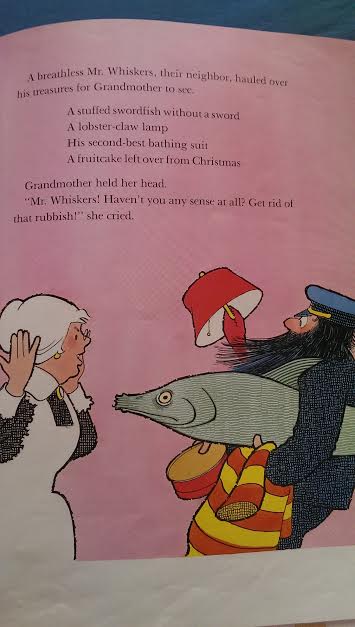 School is about to start, and Maggie and her grandmother realize that they’re short of money. Maggie needs new school clothes, and her grandmother needs a new coat. They know that some of their neighbors could also use some more money, so Grandmother suggests that they hold a sale. Some of them have some antiques and other interesting old items that they could sell.

 #3 The Candy Corn Contest by Patricia Reilly Giff, 1984.
 While Richard is worrying over his mistake, he’s also worrying about the sleep-over party his parents are letting him have over the Thanksgiving break. At first, he was looking forward to it, but some of the other boys in class can’t come and some of those who said they could are concerned because Matthew is coming. Matthew and Richard are friends, and people in class generally like Matthew, but everyone knows that Matthew still wets the bed. Some of the other boys are worried that they’ll have to sleep next to Matthew at the sleep-over. As much as Richard likes Matthew, it feels like his problem is going to ruin the party, and when Matthew is nice to him, it only makes Richard feel worse.
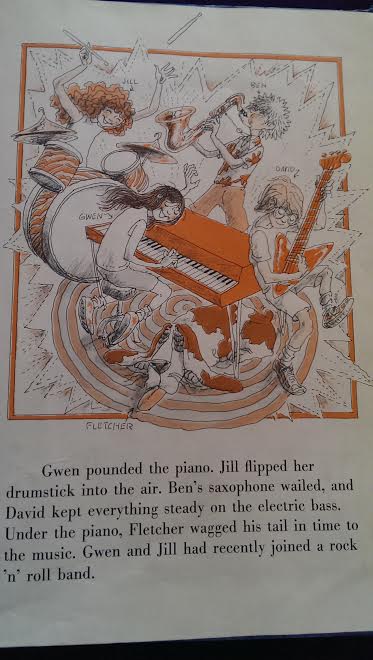 Gwen and Jill join a couple of other friends in forming a rock band. They want to enter a rock contest run by a local tv station. In order to enter, they have to have an original rock song, so they write one about Jill’s dog, Fletcher. They discover that Fletcher loves pizza so much that he gives a spectacular howl when they offer him some. They make Fletcher and his wonderful howl part of their act.
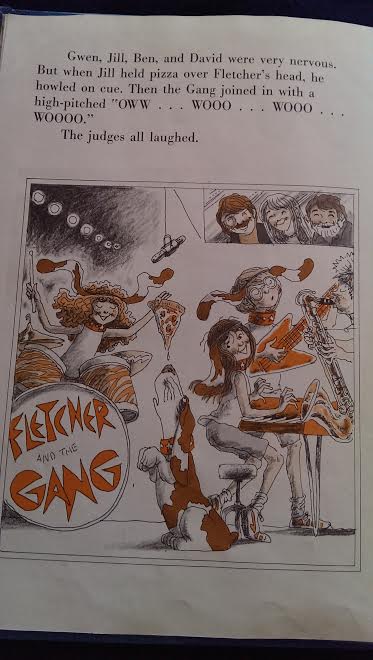 Fletcher is all right, but now, he suddenly hates pizza! It seems that Fletcher’s abductor fed him nothing but pizza until he started to hate it. Did someone do that on purpose to ruin their act for the contest? How would this person have even known about their act? Also, what can they do about the contest now that Fletcher is more likely to run from the sight of pizza than howl for it?
 Triple Trouble in Hollywood by Michael J. Pellowski, 1989.
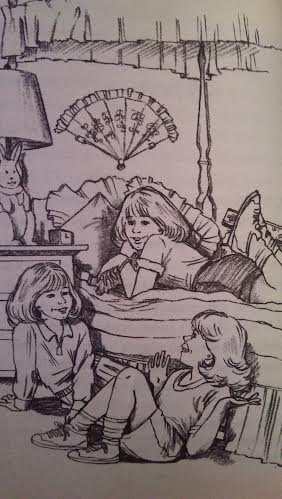 Sandi doesn’t want to do it because it would be dishonest, but Randi and Mandy talk her into it. It’s partly to help Mandy, partly to get back at Tara for her rotten attitude, and partly for the chance to meet the heartthrob Judd Morrison who will also be in the commercial. Of course, as is always the case when the girls switch places, nothing goes as planned. But, to the girls’ surprise, their younger brother Teddy helps to make things better in the end.
 Jestress's Forgotten Books and Stories